Crops ›› 2026, Vol. 42 ›› Issue (1): 257-265.doi: 10.16035/j.issn.1001-7283.2026.01.032

Previous Articles     Next Articles

Effects of Winter Sowing Date on Agronomic Traits and Yield of Quinoa in Northwestern Yunnan, China

Yang Wengao(), Yuan Wenjue, Li Zhaoguang, He Guiqing, He Qiongji, Wang Rui, Li Yan, Ye Lei, Hou Zhijiang()   

  1. Institute of Alpine Economic Plants, Yunnan Academy of Agricultural Sciences, Lijiang 674100, Yunnan, China
  • Received:2024-10-28 Revised:2024-12-09 Online:2026-02-15 Published:2026-02-10

Abstract:

This study used 17 selected quinoa lines as experimental materials and established three sowing dates: November 10, 2022 (T1), December 15, 2022 (T2), and January 5, 2023 (T3), to analyze the effects of sowing date on quinoa agronomic traits and yield. The results showed that delaying the sowing date shortened the average growth period from 191.7 d (T1) to 148.1 d (T3), a reduction of 44.0 d for late sowing compared to early sowing. Under T3 treatment, quinoa exhibited the highest average plant height but the lowest 1000-grain weight. Under T2 treatment, the average stem diameter, number of effective branches, and yield per plant were all the highest. Under T1 treatment, the average main panicle length was the shortest. Correlation analysis showed that the yield per plant had a highly significantly positive correlation with stem diameter, number of effective branches, and 1000-grain weight. Two-way ANOVA showed that plant height, main panicle length, 1000-grain weight, and growth period were most strongly affected by sowing date. In contrast, number of effective branches and yield per plant were only significantly affected by the line and the interaction between line and sowing date. In conclusion, the most suitable winter sowing date for quinoa in the low-heat valley area of the Jinsha River in northwest Yunnan is mid-December (T2). Under this sowing date, lines Q201909, Q201807, and Q201913 exhibited the best comprehensive performance in agronomic traits and yield, making them suitable for winter cultivation in the low-heat valley areas of Yunnan and similar climatic regions.

Key words: Quinoa, Winter sowing, Yunnan, Agronomic traits, Yield

Table 1

Information of quinoa lines tested"

序号Code 品系Line 籽粒颜色Grain color 茎秆颜色Stem color 穗部颜色Panicle color 其他性状Other characteristics
1 Q1 白色 绿色 绿色 -
2 Q2 白色 绿色 绿色 主穗集中呈球状
3 Q4 红色 红色 红色 -
4 Q5 红色 浅红色 浅红色 -
5 Q6 红色 绿色 红色 -
6 Q7 黑色 绿色 红色 -
7 Q8 黑色 绿色 红色 穗型呈棒状
8 Q9 黑色 绿色 绿色 分枝较多
9 Q201802 白色 绿色 绿色 -
10 Q201807 红色 红色 红色 -
11 Q201808 红色 红色 红色 叶片红色
12 Q201833 白色 浅红色 绿色 穗型蓬松
13 Q201843 红色 浅红色 红色 穗型呈梭状
14 Q201904 红色 浅红色 红色 主穗较紧凑
15 Q201909 白色 浅红色 绿色 分枝较多
16 Q201913 白色 绿色 绿色 抗病
17 Q202020 黑色 浅红色 红色 -

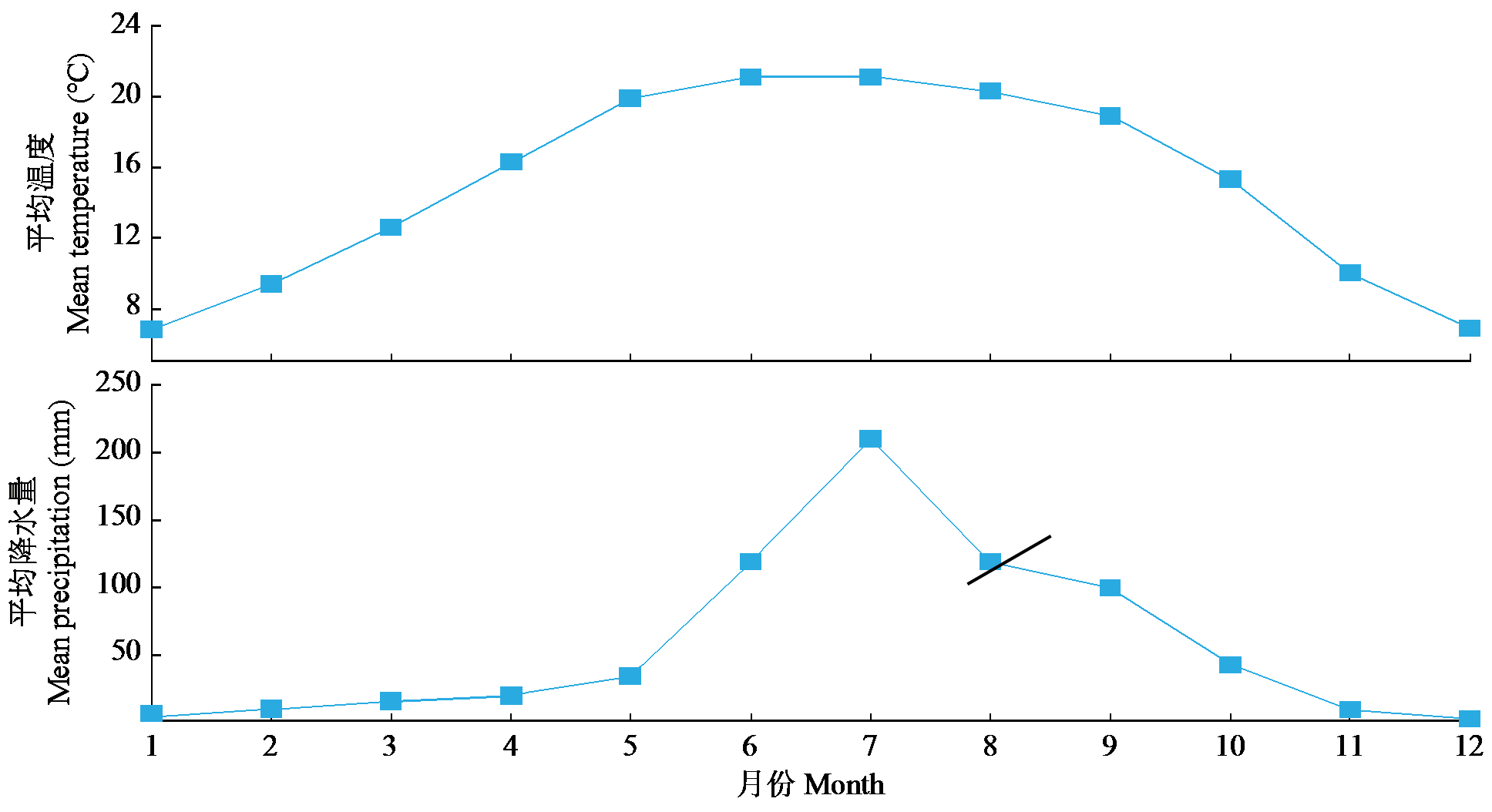
Fig.1

Average temperature and precipitation in the test site"

Table 2

Agronomic traits of quinoa lines at different sowing dates"

处理
Treatment
品系
Line
株高
Plant height (cm)
茎粗
Stem diameter (mm)
主穗长
Main panicle length (cm)
有效分枝数
Number of effective branches
T1 Q1 71.80±6.46b 11.35±0.80b 24.80±3.56c 7.20±1.48b
Q2 68.00±13.23b 12.41±2.02b 18.00±8.18a 8.20±3.03b
Q4 91.40±5.98b 10.94±1.27b 26.00±2.74b 7.80±1.30b
Q5 96.80±7.36b 15.14±1.42a 20.40±2.07b 10.60±1.67a
Q6 85.60±14.59b 11.87±1.34ab 18.20±2.86b 9.40±2.07a
Q7 69.00±12.94c 12.53±1.70b 20.80±3.35b 11.80±2.59a
Q8 89.80±16.72b 12.58±1.51b 22.20±3.96b 20.60±6.43a
Q9 103.40±8.68b 14.37±1.62b 31.60±4.39a 12.40±2.88ab
Q201802 73.20±6.02b 13.50±0.68a 27.60±5.68a 11.60±1.82a
Q201807 87.80±2.86c 10.24±0.98c 19.60±2.97b 6.80±0.84b
Q201808 92.20±9.39c 10.07±1.25b 20.40±2.88b 7.80±3.11a
Q201833 87.00±11.92c 11.92±1.34b 26.20±3.11b 9.00±2.35b
Q201843 78.60±7.70c 11.17±0.86c 21.40±3.91b 8.40±1.95c
Q201904 71.00±5.83c 10.40±1.94b 16.00±2.74b 10.20±1.48b
Q201909 81.80±8.93c 10.25±1.08c 15.40±4.34b 7.40±1.82b
Q201913 89.60±8.79c 12.61±1.32b 27.00±4.58a 13.00±4.30a
Q202020 124.20±19.32b 12.00±1.94b 30.20±5.81a 8.60±3.36a
T2 Q1 171.00±13.91a 15.34±2.56a 45.40±8.62a 10.40±2.41a
Q2 106.80±8.52a 15.12±1.74a 18.60±3.58a 13.00±3.08a
Q4 132.00±6.12a 12.15±1.56ab 19.80±3.70c 10.40±2.30a
Q5 121.00±18.45a 12.09±1.46b 20.60±4.51b 6.80±2.28b
Q6 116.60±5.55a 10.88±0.65b 17.00±3.54b 11.80±1.92a
Q7 141.60±10.92b 14.92±1.13a 31.20±3.49a 13.20±3.19a
Q8 133.80±13.55a 15.40±1.67a 31.80±5.45a 14.60±2.07b
Q9 142.20±13.99a 17.12±1.06a 31.20±4.15a 15.20±3.27a
Q201802 146.60±10.29a 13.67±3.30a 29.40±3.05a 14.40±4.72a
Q201807 136.60±15.88b 16.60±2.14a 25.80±4.55a 15.00±2.74a
Q201808 129.60±16.01b 13.54±2.42a 24.80±3.35a 9.20±4.97a
Q201833 106.40±13.99b 12.41±1.66b 23.80±1.92b 10.80±1.64b
Q201843 139.60±5.41b 16.15±1.38a 22.00±2.24b 14.80±1.30a
Q201904 114.80±7.98b 14.98±1.38a 24.20±3.49a 13.40±3.21a
Q201909 130.60±11.55b 17.14±1.59a 23.00±4.85a 16.60±7.09a
Q201913 134.00±14.54b 18.07±4.94a 29.60±4.04a 14.00±3.54a
Q202020 146.20±13.76a 13.21±1.25ab 22.40±2.41b 10.80±2.78a
T3 Q1 176.40±3.85a 13.59±0.92ab 32.40±1.52b 7.40±2.07b
Q2 111.80±11.54a 12.02±0.70b 17.00±6.25a 6.80±1.92b
Q4 136.80±5.89a 13.50±1.10a 32.20±3.19a 9.60±1.52ab
Q5 134.80±12.27a 15.02±1.03a 27.20±3.27a 7.80±2.17ab
Q6 128.60±15.57a 12.47±1.15a 25.60±2.97a 9.60±1.82a
Q7 158.40±12.18a 14.44±1.12a 32.60±6.03a 12.00±2.74a
Q8 141.60±10.11a 13.17±0.92b 25.80±3.70ab 8.40±0.89c
Q9 153.60±7.44a 11.99±1.03c 29.80±2.28a 9.80±0.84b
Q201802 150.40±11.35a 12.29±1.77a 30.20±2.17a 10.20±3.27a
Q201807 159.00±5.96a 12.37±0.96b 21.20±3.27ab 8.80±1.30b
Q201808 151.80±16.41a 14.48±1.30a 20.60±2.88b 10.40±2.30a
Q201833 173.00±2.65a 15.93±1.50a 33.40±5.64a 14.60±2.07a
Q201843 167.60±6.03a 13.33±0.70b 39.40±4.88a 11.80±2.39b
Q201904 154.20±5.45a 15.34±2.27a 22.80±2.78a 13.20±1.30a
Q201909 160.00±9.41a 13.52±1.15b 28.00±1.87a 13.00±2.92ab
Q201913 159.20±14.79a 16.98±0.98a 24.80±4.87a 13.80±1.64a
Q202020 147.40±13.32a 14.76±0.89a 26.80±4.32ab 10.40±1.14a

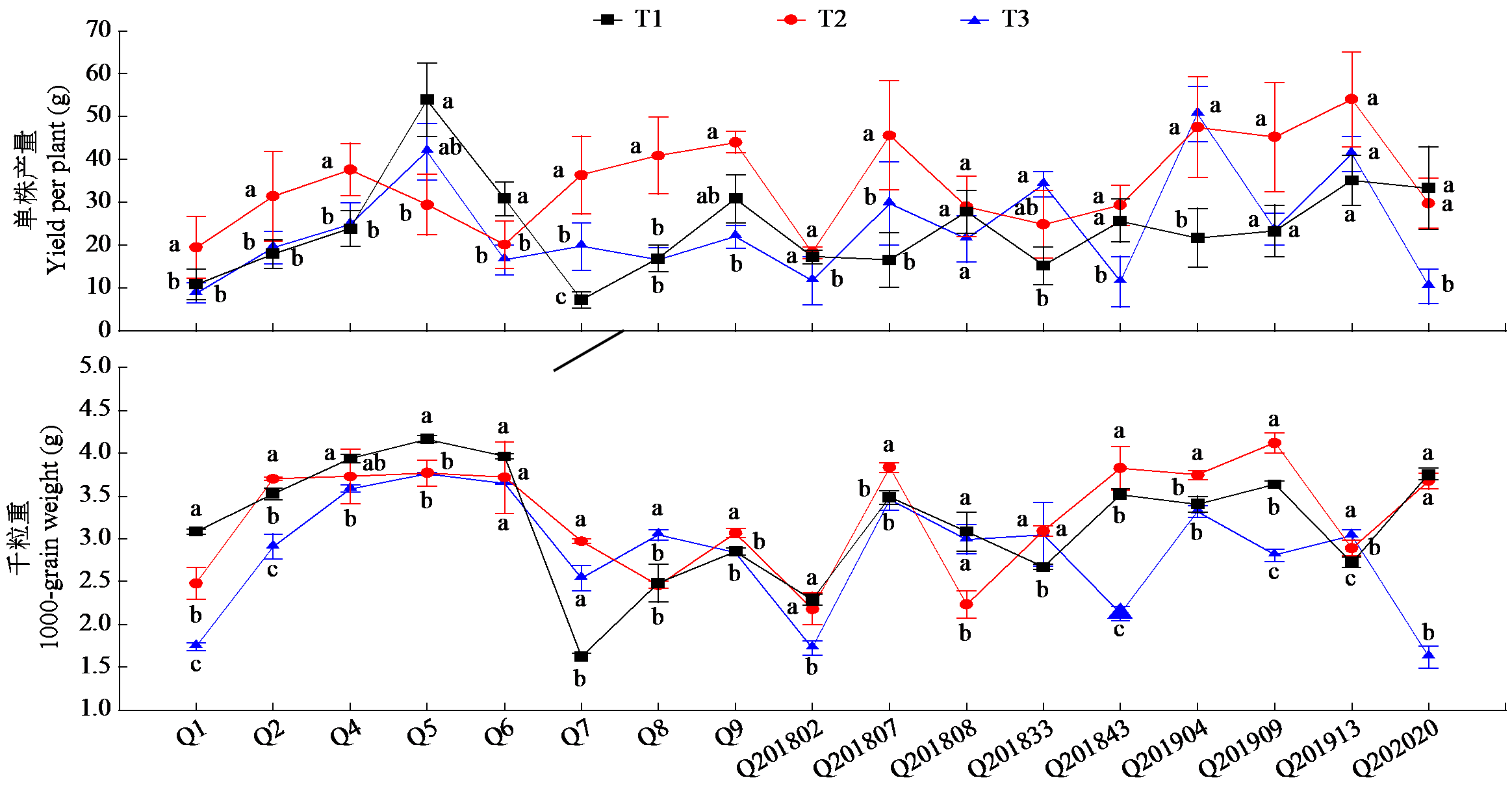
Fig.2

Yield per plant and 1000-grain weight of quinoa line at different sowing dates Different lowercase letters indicate significant differences (P < 0.05)."

Table 3

Statistical analysis of traits of quinoa lines at different sowing dates"

处理
Treatment
性状
Trait
平均值
Mean
标准差
SD
最大值
Max.
最小值
Min.
极差
Range
变异系数
CV (%)
偏度
Skewness
峰度
Kurtosis
T1 株高 85.95 16.91 158.00 50.00 108.00 19.68 0.96 2.78
茎粗 11.96 1.90 17.31 7.54 9.77 15.89 0.33 -0.20
主穗长 22.69 6.04 40.00 11.00 29.00 26.61 0.36 0.11
有效分枝数 10.05 4.12 30.00 3.00 27.00 40.98 1.98 6.58
单株产量 24.02 14.74 94.03 5.15 88.88 61.39 2.24 7.33
千粒重 3.18 0.67 4.20 1.56 2.64 20.93 -0.62 -0.22
生育期 191.65 3.31 196.00 189.00 7.00 1.73 0.52 -1.69
T2 株高 132.32 19.30 195.00 89.00 106.00 14.59 0.33 0.43
茎粗 14.64 2.77 23.29 9.84 13.45 18.90 0.57 0.67
主穗长 25.92 7.64 54.00 12.00 42.00 29.46 1.33 3.01
有效分枝数 12.61 3.94 29.00 4.00 25.00 31.27 0.77 2.80
单株产量 34.30 16.15 93.85 8.18 85.67 47.07 1.37 2.53
千粒重 3.26 0.64 4.30 2.00 2.30 19.50 -0.41 -1.11
生育期 169.35 4.25 178.00 165.00 13.00 2.51 0.60 -0.42
T3 株高 150.86 18.57 182.00 102.00 80.00 12.31 -0.59 -0.01
茎粗 13.84 1.79 18.02 10.46 7.56 12.90 0.33 -0.54
主穗长 27.64 6.47 45.00 10.00 35.00 23.40 0.10 0.56
有效分枝数 10.45 2.89 17.00 5.00 12.00 27.69 0.26 -0.36
单株产量 23.79 14.13 77.01 3.46 73.55 59.38 1.22 1.60
千粒重 2.83 0.68 3.78 0.86 2.92 23.99 -0.68 -0.30
生育期 148.06 2.55 158.00 147.00 11.00 1.72 3.59 11.76

Table 4

Membership function values and comprehensive evaluation of different traits of quinoa lines at different sowing dates"

处理
Treatment
品系
Line
株高
Plant
height
茎粗
Stem
diameter
主穗长
Main panicle
length
有效分枝数
Number of
effective branches
单株产量
Yield per
plant
千粒重
1000-grain
weight
平均值
Mean
排序
Order
T1 Q1 0.068 0.252 0.580 0.029 0.076 0.575 0.263 13
Q2 0.000 0.462 0.160 0.101 0.228 0.748 0.283 12
Q4 0.416 0.172 0.654 0.072 0.355 0.909 0.430 6
Q5 0.512 1.000 0.309 0.275 1.000 1.000 0.683 1
Q6 0.313 0.355 0.173 0.188 0.505 0.921 0.409 7
Q7 0.018 0.485 0.333 0.362 0.000 0.000 0.200 17
Q8 0.388 0.495 0.420 1.000 0.206 0.339 0.474 5
Q9 0.630 0.848 1.000 0.406 0.504 0.484 0.645 2
Q201802 0.093 0.677 0.753 0.348 0.214 0.264 0.391 8
Q201807 0.352 0.034 0.259 0.000 0.199 0.732 0.263 14
Q201808 0.431 0.000 0.309 0.072 0.439 0.575 0.304 11
Q201833 0.338 0.365 0.667 0.159 0.171 0.413 0.352 9
Q201843 0.189 0.217 0.370 0.116 0.395 0.744 0.338 10
Q201904 0.053 0.065 0.037 0.246 0.310 0.701 0.235 16
Q201909 0.246 0.036 0.000 0.043 0.343 0.791 0.243 15
Q201913 0.384 0.501 0.716 0.449 0.596 0.433 0.513 4
Q202020 1.000 0.381 0.914 0.130 0.558 0.839 0.637 3
T2 Q1 1.000 0.621 1.000 0.367 0.036 0.155 0.530 7
Q2 0.006 0.590 0.056 0.633 0.368 0.785 0.407 11
Q4 0.396 0.177 0.099 0.367 0.542 0.800 0.397 12
Q5 0.226 0.169 0.127 0.000 0.314 0.822 0.276 14
Q6 0.158 0.000 0.000 0.510 0.053 0.794 0.253 16
Q7 0.545 0.561 0.500 0.653 0.507 0.409 0.529 8
Q8 0.424 0.629 0.521 0.796 0.633 0.143 0.524 9
Q9 0.554 0.867 0.500 0.857 0.718 0.459 0.659 4
Q201802 0.622 0.388 0.437 0.776 0.000 0.001 0.371 13
Q201807 0.467 0.796 0.310 0.837 0.764 0.855 0.672 2
Q201808 0.359 0.369 0.275 0.245 0.301 0.027 0.263 15
Q201833 0.000 0.213 0.239 0.408 0.184 0.469 0.252 17
Q201843 0.514 0.733 0.176 0.816 0.311 0.850 0.567 5
Q201904 0.130 0.571 0.254 0.673 0.817 0.808 0.542 6
Q201909 0.375 0.870 0.211 1.000 0.755 1.002 0.702 1
Q201913 0.427 1.000 0.444 0.735 1.000 0.368 0.662 3
Q202020 0.616 0.324 0.190 0.408 0.321 0.773 0.439 10
T3 Q1 1.000 0.322 0.688 0.077 0.000 0.056 0.357 14
Q2 0.000 0.007 0.000 0.000 0.255 0.602 0.144 17
Q4 0.387 0.303 0.679 0.359 0.382 0.917 0.505 8
Q5 0.356 0.606 0.455 0.128 0.787 1.000 0.556 4
Q6 0.260 0.097 0.384 0.359 0.186 0.947 0.372 12
Q7 0.721 0.490 0.696 0.667 0.262 0.429 0.544 5
Q8 0.461 0.236 0.393 0.205 0.186 0.664 0.357 13
Q9 0.647 0.000 0.571 0.385 0.316 0.567 0.414 11
Q201802 0.598 0.061 0.589 0.436 0.071 0.049 0.300 16
Q201807 0.731 0.076 0.188 0.256 0.499 0.855 0.434 10
Q201808 0.619 0.500 0.161 0.462 0.304 0.641 0.448 9
Q201833 0.947 0.790 0.732 1.000 0.607 0.667 0.791 1
Q201843 0.864 0.268 1.000 0.641 0.063 0.237 0.512 7
Q201904 0.656 0.671 0.259 0.821 1.000 0.793 0.700 3
Q201909 0.746 0.306 0.491 0.795 0.355 0.554 0.541 6
Q201913 0.734 1.000 0.348 0.897 0.775 0.662 0.736 2
Q202020 0.551 0.555 0.438 0.462 0.038 0.000 0.340 15

Table 5

Correlation analysis between agronomic traits and yield indexes of quinoa"

性状
Trait
株高
Plant
height
茎粗
Stem
diameter
主穗长
Main panicle
length
有效分枝数
Number of
effective branches
单株产量
Yield per
plant
千粒重
1000-grain
weight
茎粗Stem diameter 0.490**
主穗长Main panicle length 0.545** 0.350**
有效分枝数Number of effective branches 0.229** 0.512** 0.243**
单株产量Yield per plant 0.108 0.395** 0.022 0.279**
千粒重1000-grain weight -0.211** -0.030 -0.383** -0.079 0.405**
生育期Growth period -0.769** -0.306** -0.213** -0.054 -0.044 0.096

Table 6

Analysis on variation sources of agronomic traits and yield indexes of quinoa"

因素Factor 项目Item df F P
品系Line 株高 16 4.93 <0.001
茎粗 16 2.36 0.003
主穗长 16 3.92 <0.001
有效分枝数 16 5.01 <0.001
单株产量 16 2.28 0.004
千粒重 16 21.36 <0.001
生育期 16 23.09 <0.001
播期Sowing date 株高 1 818.86 <0.001
茎粗 1 32.57 <0.001
主穗长 1 39.34 <0.001
有效分枝数 1 0.66 0.418
单株产量 1 0.01 0.912
千粒重 1 53.91 <0.001
生育期 1 32 201.74 <0.001
播期与品系交互作用
Interaction between
sowing date and line
株高 16 5.79 <0.001
茎粗 16 2.39 0.003
主穗长 16 3.23 <0.001
有效分枝数 16 4.03 <0.001
单株产量 16 2.48 0.002
千粒重 16 14.98 <0.001
生育期 16 12.84 <0.001
[1] Vega-Gálvez A, Miranda M, Vergara J, et al. Nutrition facts and functional potential of quinoa (Chenopodium quinoa Willd.), an ancient Andean grain: a review. Journal of the Science of Food and Agriculture, 2010, 90(15):2541-2547.
doi: 10.1002/jsfa.4158 pmid: 20814881
[2] Gómez C A M, Iafelice G, Lavini A, et al. Phenolic compounds and saponins in quinoa samples (Chenopodium quinoa Willd.) grown under different saline and nonsaline irrigation regimens. Journal of Agricultural and Food Chemistry, 2012, 60(18):4620-4627.
doi: 10.1021/jf3002125 pmid: 22512450
[3] 任永峰. 内蒙古阴山北麓藜麦生长发育、水肥利用和产量形成特性研究. 北京: 中国农业大学, 2018.
[4] Pathan S, Siddiqui R A. Nutritional composition and bioactive components in quinoa (Chenopodium quinoa Willd.) greens: a review. Nutrients, 2022, 14(3):558.
doi: 10.3390/nu14030558
[5] 魏玉明, 杨发荣, 刘文瑜, 等. 藜麦不同生育期营养物质积累与分配规律. 草业科学, 2018, 35(7):1720-1727.
[6] Sadaqat S S, Shi L X, Li Z J, et al. Yield, agronomic and forage quality traits of different quinoa (Chenopodium quinoa Willd.) genotypes in Northeast China. Agronomy, 2020, 10(12):1908.
doi: 10.3390/agronomy10121908
[7] 贡布扎西, 旺姆, 张崇玺, 等. 南美藜在西藏的生物学特性研究. 西北农业学报, 1994, 3(4):81-86.
[8] 石振兴, 杨修仕, 么杨, 等. 60份国内外藜麦材料子粒的品质性状分析. 植物遗传资源学报, 2017, 18(1):88-93.
doi: 10.13430/j.cnki.jpgr.2017.01.011
[9] 杨发荣, 黄杰, 魏玉明, 等. 藜麦生物学特性及应用. 草业科学, 2017, 34(3):607-613.
[10] Tan M, Temel S. Performance of some quinoa (Chenopodium quinoa Willd.) genotypes grown in different climate conditions. Turkish Journal of Field Crops, 2018, 23(2):180-186.
[11] 徐天才, 和桂青, 李兆光, 等. 不同海拔藜麦的营养成分差异性研究. 中国农学通报, 2017, 33(17):129-133.
doi: 10.11924/j.issn.1000-6850.casb16100121
[12] Jacobsen S E. The worldwide potential for quinoa (Chenopodium quinoa Willd.). Food Reviews International, 2003, 19(1/2):167-177.
doi: 10.1081/FRI-120018883
[13] 杨招娣, 郭凤根, 王仕玉, 等. 植物生长抑制剂对藜麦农艺性状和穗发芽抗性的影响. 中国农业科技导报, 2024, 26(5):44-51.
[14] 魏志敏, 李顺国, 和剑涵, 等. 藜麦规模化发展现状及建议. 世界热带农业信息, 2021(2):56-57.
[15] 贡布扎西, 旺姆, 张崇玺, 等. 南美藜在西藏的生物学特性表现. 西南农业学报, 1994, 7(3):54-62.
[16] 王倩朝, 张慧, 刘永江, 等. 播期对藜麦主要农艺及品质性状的影响. 云南农业大学学报(自然科学), 2020, 35(5):737-742.
[17] 张新民, 吾其木·吐孙, 麦麦提江·居麦. 藜麦高产栽培技术. 农村科技, 2020(2):13-14.
[18] 黄杰, 李敏权, 潘发明, 等. 不同播期对藜麦农艺性状及品质的影响. 灌溉排水学报, 2015, 34(增1):259-261.
[19] 任永峰, 梅丽, 杨亚东, 等. 播期对藜麦农艺性状及产量的影响. 中国生态农业学报, 2018, 26(5):643-656.
[20] 陈奕浪, 范道付, 吴应齐, 等. 播期对藜麦农艺性状及产量的影响. 浙江农业科学, 2021, 62(8):1492-1496.
doi: 10.16178/j.issn.0528-9017.20210809
[21] 刘俊娜, 孔治有, 张平, 等. 不同播期藜麦主要营养及抗氧化成分分析. 江苏农业学报, 2020, 36(5):1082-1087.
[22] 张晓玲, 袁加红, 何丽, 等. 云南省高海拔低温干旱山区藜麦种植技术探讨. 安徽农业科学, 2018, 46(30):45-46,50.
[23] 刘正杰, 李玉平, 张盟, 等. 云南省藜麦引进栽培及产业发展现状研究. 现代农业科技, 2021(10):4-9.
[24] 郑晓明, 杨庆文. 中国农业生物多样性保护进展概述. 生物多样性, 2021, 29(2):167-176.
[25] 翟西均.藜麦品种区域试验记载项目与标准. 中国种业, 2016(5):25-26.
[26] 王艳青, 卢文洁, 李春花, 等. 10个藜麦新品系主要农艺性状分析与综合评价. 南方农业学报, 2019, 50(3):540-545.
[27] 张永泽, 王瑞刚, 王艺媚, 等. 播期和施氮量对中籼杂交稻群体质量、产量及氮素吸收利用的影响. 河南农业科学, 2024, 53(4):37-46.
[28] 阿图尔·博汗格瓦, 希尔皮·斯利瓦斯塔瓦. 藜麦生产与应用. 北京: 科学出版社, 2014.
[29] 任贵兴, 杨修仕, 么杨. 中国藜麦产业现状. 作物杂志, 2015(5):1-5.
[30] 李兆光, 杨文高, 和桂青, 等. 滇西北藜麦氮磷钾生态化学计量特征的物候期动态. 植物生态学报, 2023, 47(5):724-732.
doi: 10.17521/cjpe.2021.0226
[31] 张燕红, 郭占斌, 刘瑞香. 50份藜麦种质资源农艺性状的综合分析与评价. 中国农业科技导报, 2024, 26(6):45-54.
[32] 刘敏国, 王士嘉, 陆姣云, 等. 河西走廊藜麦C、N、P生态化学计量学特征对物候期的响应. 干旱区研究, 2018, 35(1):192-198.
doi: 10.13866/j.azr.2018.01.24
[33] 梅丽, 郭自军, 王立臣, 等. 15份藜麦资源在北京地区的生态适应性评价. 中国农业大学学报, 2019, 24(9):27-36.
[34] 王艳青, 李春花, 卢文洁, 等. 135份国外藜麦种质主要农艺性状的遗传多样性分析. 植物遗传资源学报, 2018, 19(5):887-894.
doi: 10.13430/j.cnki.jpgr.20180209001
[35] 常丽, 周昕, 汪贵斌. 温度和干旱胁迫对银杏叶代谢物含量的影响. 林业科技开发, 2013, 27(6):52-55.
[1] Zhou Wenli, Hao Miaoyi, Zhang Renhe. Effects of Nitrogen Fertilizer on Maize Root Growth and Nitrogen Metabolism under High-Density Planting [J]. Crops, 2026, 42(1): 125-132.
[2] Ma Xiaoming, Qi Xiangkun, Tan Xue, Shi Mengyu, Wang Yufeng, Fu Jian, Yang Kejun. Effects of No-tillage with Straw Mulching on Soil Aggregate Stability and Maize Yield in Semi-Arid Region [J]. Crops, 2026, 42(1): 152-159.
[3] Xie Fuxin, Jiang Xiaolin, Li Chenghuan, Zhang Wenjing, Wang Feixue, Hu Weili, Mei Hongxian, He Geming, Liu Yan. Effects of Harvesting Period on Main Economic Yield Traits and Comprehensive Benefit Analysis of Sesame Leaf Vegetable [J]. Crops, 2026, 42(1): 160-166.
[4] Zhu Lingyu, Yang Qiaohui, Liu Yixun, Yuan Jian, Wang Minghua, Xiang Dabing, Zou Liang, Wang Junzhen, Fan Yu. Photosynthetic Characteristics and Agronomic Traits of Wild and Cultivated Oats during Filling Process [J]. Crops, 2026, 42(1): 167-174.
[5] Gao Yanmei, Feng Pengrui, Chen Weiwei, Zhang Meng, Zhang Yongqing. Physiological Response of Quinoa Seedlings with Drought Resistance to Drought Stress [J]. Crops, 2026, 42(1): 182-188.
[6] Shi Nuo, Zhu Hongqiang, Yang Mengxuan, Zhou Yanbin, Dai Huijuan, Lü Penghui, Liu Bo, Wang Shengfeng, Mu Wenpo, Du Yu. Effects of Different Microbial Fertilizers on Growth, Yield and Quality of Flue-Cured Tobacco [J]. Crops, 2026, 42(1): 189-196.
[7] Zhang Le, Han Yunfei, Du Erxiao, Li Baocheng, San Xintong, Liu Xinyu, Wang Yanli, Zhao Peiyi, Ren Yongfeng. Effects of Organic Fertilization Measures on Photosynthetic Characteristics, Nutrient Content and Yield of Potato [J]. Crops, 2026, 42(1): 197-207.
[8] Xu Hao, Wei Quanquan, Tan Hongwei, Gou Jiulan, Ran Xuesong, Zhang Meng, Song Nanling, Liu Lingling, Gu Xiaofeng, Lü Xibin. Effect of Organic-Inorganic Compound Fertilizer from Distillerʼs Grains on Yield, Quality, Nutrient Uptake and Utilization of Sorghum [J]. Crops, 2026, 42(1): 208-216.
[9] Ye Xiaojuan, Liu Qiang. Simulation of Spring Wheat Yield Response to Precipitation, Nitrogen Application, and Straw Mulching under Different Precipitation Year Types [J]. Crops, 2026, 42(1): 217-224.
[10] Sang Ruijuan, Dong Chunyang, Zhang Hongmei, He Yun, Sun Hao, Liu Boshuai, Zhu Xiaoyan, Ma Sen, Li Defeng. Effects of Mowing at Different Growth Stages on Forage Yield, Quality and Silage Fermentation Quality of Triticale in Northern Henan Province [J]. Crops, 2026, 42(1): 225-230.
[11] Tang Cuifeng, A Xinxiang, Dong Chao, Zhang Feifei, Yang Yayun, Yang Hongmei, Dai Luyuan, Su Zhenxi. Analysis of Genetic Diversity by SSR Markers and Correlation of Main Agronomic Traits of Rice Germplasm Resources in Border Areas of Yunnan [J]. Crops, 2026, 42(1): 33-46.
[12] Liu Xiaohan, Tang Yujie, Liu Xinyu, Qiao Zhengyan, Shi Guishan, Yu Miao, Li Yang, Wang Nai, Qi Hongying, Chen Bingru. Analysis of Combining Ability and Heterosis of Main Traits in Core Parents of Sorghum for Spring-Sown Early-Maturing Regions [J]. Crops, 2026, 42(1): 47-53.
[13] Li Wenjun, Guo Yanping, Yang Shenghua, Shao Yang. Analysis of Genetic Diversity of Main Agronomic Traits of 513 Faba Bean Germplasm Resources [J]. Crops, 2026, 42(1): 85-93.
[14] Yu Huaxian, An Rudong, Tao Lianan, Lang Rongbin, Bian Xin, Zhang Yu, Liu Xinlong, Liu Jiayong, Zhao Liping, Liu Hongbo, Zhang Gemin, Zhang Baoqing. Comprehensive Evaluation of Reciprocal Cross Hybrids between 57NG208 and Nanjian Chewing Cane Based on Agronomic Traits [J]. Crops, 2026, 42(1): 94-103.
[15] Zhang Yemeng, Lu Kexin, Mao Wenyu, Zhang Xiaoyan, Li Wenjing, Yang Xiu. Identification and Expression Analysis of LEA Gene Family in Chenopodium quinoa Willd. under Salt Stress [J]. Crops, 2025, 41(6): 100-111.
Viewed
Full text


Abstract

Cited

  Shared   
  Discussed   
No Suggested Reading articles found!