Crops ›› 2025, Vol. 41 ›› Issue (5): 35-41.doi: 10.16035/j.issn.1001-7283.2025.05.005

Previous Articles     Next Articles

Analysis of Salt Tolerance in 50 Peanut Varieties (Lines) at Seedling Stage

Wang Liang1(), Wang Rui1, Zhu Jincheng1, Sang Yuwei2, Shi Biao1, Guo Jiashuai3, Jiao Huimin2, He Zongling2, Shui Yong2   

  1. 1 Biotechnology Research Institute, Xinjiang Academy of Agricultural and Reclamation Science, Shihezi 832000, Xinjiang, China
    2 Agricultural Science Research Institute of the First Division of Xinjiang Production and Construction Corps, Alar 843300, Xinjiang, China
    3 College of Agriculture, Tarim University, Alar 843300, Xinjiang, China
  • Received:2024-09-08 Revised:2025-03-04 Online:2025-10-15 Published:2025-10-21

Abstract:

To investigate the salt-tolerance differences during the seedling stage of 50 introduced peanut varieties (lines) and screen for varieties (lines) with better salt tolerance, an experiment was conducted using 0.5% NaCl solution and ddH2O (control). The study measured germination rate, germination potential, main root length, seedling height, shoot fresh mass, shoot dry mass, root fresh mass, and root dry mass. The relative salt-tolerance coefficient and a comprehensive D-value (subordinate function analysis) were calculated. The results confirmed that salt stress inhibited the growth of peanut seedlings. Based on the D-values, the 50 varieties (lines) were categorized into five clusters: highly salt tolerant, salt tolerant, moderately salt tolerant, salt sensitive, and highly salt sensitive. The test materials included one highly salt-tolerant germplasm, eight salt- tolerant germplasms, 13 moderately salt-tolerant germplasms, 24 salt-sensitive germplasms, and four highly salt- sensitive germplasms. The dry matter accumulation at seedling stage was identified as a key indicator for evaluating salt tolerance of peanut varieties. Nine peanut germplasms such as ?Puhua 9805-2?, ?Huaxiaobao 25?, ?Huayu 50?, and ?Yuanza 9847?, were identified as highly salt-tolerant germplasms. These findings provide a valuable reference for breeding salt-tolerant peanut varieties (lines) in Xinjiang.

Key words: Peanut, Seedling stage, Salt tolerance, Comprehensive evaluation

Table 1

Test material name"

编号
Number
品种(系)
Variety (line)
编号
Number
品种(系)
Variety (line)
NY1 sh NY26 濮花0409-2
NY2 鲁花18号 NY27 濮花0409-4
NY3 花育19号 NY28 濮花0224-1N
NY4 冀花9号 NY29 濮花23号
NY5 冀花10号 NY30 濮花28号
NY6 冀花5号 NY31 花育40号
NY7 徐花13号 NY32 花育41号
NY8 徐花9号 NY33 11测L16
NY9 花育25号 NY34 11测L19
NY10 花育28号 NY35 11测L36
NY11 花育22号 NY36 11测L39
NY12 花育62号 NY37 豫花9719
NY13 C10 NY38 花育9301
NY14 10A1 NY39 花小宝23
NY15 山花7号 NY40 花育50号
NY16 山花8号 NY41 花小宝25
NY17 山花9号 NY42 花育33号
NY18 山花11号 NY43 花育44号
NY19 山花13号 NY44 花育57号
NY20 山花15号 NY45 花小宝12
NY21 山花17号 NY46 青花09-6
NY22 农大818 NY47 青花6号
NY23 丰花5号 NY48 花小宝16
NY24 冀花4号 NY49 远杂9847
NY25 濮花9805-2 NY50 花小宝19

Table 2

Analysis of salt-tolerance coefficients of different peanut varieties (lines) during seedling stage"

性状
Trait
相对耐盐系数平均值
Average of relative salt-tolerance coefficient
最小值
Min.
最大值
Max.
标准差
SD
变异系数
CV (%)
偏度
Skewness
峰度
Kurtosis
相对发芽势RGP 0.67 0.13 1.41 0.32 48.00 0.02 -0.56
相对发芽率RGR 0.96 0.67 1.14 0.08 8.00 -1.50 4.01
相对苗高RSH 0.58 0.37 1.02 0.15 25.00 1.36 1.73
相对主根长RMRL 0.80 0.45 1.04 0.14 17.00 -0.50 -0.10
相对地上部鲜重RSFM 0.61 0.31 0.97 0.18 29.00 0.41 -0.71
相对根鲜重RRFM 0.74 0.30 1.08 0.19 25.00 -0.58 -0.06
相对地上部干重RSDM 0.68 0.29 1.01 0.16 23.00 -0.26 -0.51
相对根干重RRDM 0.78 0.31 1.18 0.16 20.00 -0.01 0.93

Table 3

Relative trait extraction factor eigenvalues, contribution rates, and loading matrices"

指标
Index
主成分Principal component
1 2 3 4
相对发芽势RGP -0.37 0.51 0.55 -0.13
相对发芽率RGR -0.41 0.47 0.54 -0.11
相对苗高RSH 0.64 0.37 0.09 0.49
相对主根长RMRL -0.35 -0.30 0.37 0.66
相对地上部鲜重RSFM 0.82 0.29 0.14 0.21
相对根鲜重RRFM -0.43 0.53 -0.44 0.42
相对地上部干重RSDM 0.59 0.50 0.02 -0.29
相对根干重RRDM -0.39 0.65 -0.43 0.00
特征值Eigenvalue 2.19 1.76 1.11 1.01
贡献率Contribution rate (%) 27.36 22.05 13.85 12.61
累计贡献率
Cumulative contribution rate (%)
27.36
49.41
63.26
75.87

Table 4

Correlation analysis of salt-tolerance in seedling of different peanut varieties (lines)"

性状
Trait
相对
发芽势
RGP
相对
发芽率
RGR
相对
苗高
RSH
相对
主根长
RMRL
相对地上
部鲜重
RSFM
相对
根鲜重
RRFM
相对地上
部干重
RSDM
相对
根干重
RRDM
耐盐性
综合评价值
D-value
相对发芽势RGP 1.00
相对发芽率RGR 0.40** 1.00
相对苗高RSH 0.01 0.07 1.00
相对主根长RMRL 0.25 0.13 0.16 1.00
相对地上部鲜重RSFM 0.22 0.19 0.56** 0.17 1.00
相对根鲜重RRFM 0.01 0.02 0.13 0.03 0.54** 1.00
相对地上部干重RSDM 0.03 0.11 0.38** 0.04 0.79** 0.37** 1.00
相对根干重RRDM 0.16 0.06 0.00 0.05 0.43** 0.69** 0.47** 1.00
耐盐性综合评价值D-value 0.30* 0.17 0.57** 0.22 0.71** 0.63** 0.71** 0.67** 1.00

Table 5

The relative salt-tolerance coefficient membership function value, D-value, and ranking of different peanut varieties (lines)"

品种编号
Variety
number
相对
发芽势
RGP
相对
发芽率
RGR
相对
苗高
RSH
相对
主根长
RMRL
相对地
上部鲜重
RSFM
相对
根鲜重
RRFM
相对地上
部干重
RFDM
相对
根干重
RRDM
耐盐性
综合评价值
D-value
排名
Ranking
NY1 0.71 0.84 1.02 0.77 0.73 0.80 0.81 0.55 0.62 7
NY2 0.69 0.87 0.41 0.90 0.96 0.50 0.69 0.69 0.49 22
NY3 0.91 1.00 0.44 0.83 0.39 0.86 0.51 0.86 0.43 37
NY4 1.06 0.96 0.44 0.85 0.31 0.92 0.42 0.80 0.42 39
NY5 0.76 1.00 0.53 0.95 0.43 1.00 0.58 0.98 0.52 16
NY6 0.78 1.00 0.60 0.86 0.58 0.75 0.63 0.72 0.50 20
NY7 0.49 0.98 0.63 1.03 0.49 0.82 0.52 0.67 0.46 28
NY8 1.41 0.99 0.50 0.95 0.42 0.85 0.49 0.85 0.53 14
NY9 0.99 1.00 0.54 0.77 0.42 0.89 0.56 0.93 0.49 21
NY10 1.04 0.98 0.61 0.70 0.56 0.62 0.62 0.60 0.46 30
NY11 0.78 0.86 0.52 0.77 0.41 0.30 0.53 0.70 0.31 47
NY12 0.90 0.98 0.48 0.93 0.37 0.41 0.50 0.96 0.40 42
NY13 1.04 0.99 0.57 0.85 0.80 0.79 0.85 0.72 0.61 9
NY14 0.71 1.03 0.56 0.99 0.81 0.63 1.01 0.90 0.62 5
NY15 0.61 0.99 0.47 0.97 0.36 0.96 0.47 0.83 0.43 38
NY16 0.25 0.88 0.51 0.48 0.55 0.30 0.68 0.69 0.25 50
NY17 0.36 0.92 0.53 0.73 0.50 0.90 0.58 0.68 0.38 45
NY18 0.70 0.99 0.57 0.83 0.49 0.81 0.75 0.68 0.48 24
NY19 0.15 0.98 0.49 0.73 0.41 0.66 0.53 0.59 0.28 49
NY20 0.14 0.97 0.44 0.98 0.34 0.75 0.44 0.60 0.29 48
NY21 0.33 0.99 0.49 0.77 0.52 0.99 0.77 0.94 0.46 32
NY22 0.19 1.00 0.81 0.91 0.97 0.90 0.57 0.87 0.62 8
NY23 0.21 0.98 0.55 0.86 0.64 0.79 0.88 0.68 0.46 29
NY24 0.14 0.95 0.65 0.92 0.72 0.46 0.75 0.31 0.40 41
NY25 1.21 0.97 0.98 0.91 0.84 0.84 0.81 0.69 0.76 1
NY26 0.92 1.01 0.37 0.70 0.53 0.47 0.82 0.64 0.39 44
NY27 0.89 1.06 0.57 0.92 0.84 0.38 0.49 0.61 0.50 19
NY28 1.04 1.04 0.56 0.69 0.88 0.48 0.92 0.59 0.56 10
NY29 0.82 1.14 0.66 0.78 0.67 0.87 0.80 0.99 0.62 6
NY30 0.56 0.95 0.44 0.75 0.53 0.85 0.69 0.77 0.42 40
NY31 0.15 0.67 0.56 0.91 0.67 0.69 0.81 0.63 0.40 43
NY32 0.35 0.92 0.65 0.58 0.73 0.79 0.79 0.85 0.48 25
NY33 0.53 0.78 0.59 0.86 0.67 0.63 0.58 0.79 0.44 35
NY34 0.79 0.92 0.41 0.80 0.55 0.87 0.75 1.18 0.50 18
NY35 0.38 0.87 0.45 0.87 0.49 0.81 0.48 0.80 0.36 46
NY36 0.13 0.74 0.76 0.82 0.96 0.67 0.72 0.84 0.52 15
NY37 0.89 0.98 0.57 0.61 0.56 0.73 0.76 0.70 0.47 27
NY38 0.84 0.97 0.55 0.71 0.49 0.80 0.71 0.74 0.46 31
NY39 0.59 0.93 0.67 0.72 0.67 0.51 0.78 0.79 0.48 23
NY40 1.29 1.00 0.62 1.04 0.56 1.01 0.73 0.99 0.68 3
NY41 0.88 0.97 0.93 0.63 0.92 0.75 0.84 0.82 0.68 2
NY42 0.61 0.90 0.54 0.67 0.61 0.70 0.89 0.87 0.47 26
NY43 0.87 0.97 0.50 0.45 0.67 1.08 0.94 1.05 0.56 11
NY44 0.83 1.00 0.44 0.95 0.41 0.75 0.62 0.79 0.44 34
NY45 0.48 0.96 0.51 0.80 0.54 0.68 0.77 0.82 0.43 36
NY46 0.78 1.00 0.59 0.61 0.55 1.05 0.70 1.08 0.54 13
NY47 0.47 0.97 0.67 0.74 0.65 0.92 0.29 0.76 0.45 33
NY48 0.46 1.00 0.59 0.91 0.70 0.65 0.82 0.74 0.51 17
NY49 0.71 0.97 0.88 0.71 0.75 0.67 0.85 0.98 0.63 4
NY50 0.43 0.97 0.82 0.57 0.88 0.75 0.71 0.75 0.55 12

Table 6

Salt-tolerance evaluation based on D-values"

类群
Cluster
D值范围
Range of
D-value
苗期相对耐盐性
Seedling relative
salt-tolerance
材料数量
Quantity of
materials
0.76 高度耐盐型 1
0.61~0.68 耐盐型 8
0.49~0.56 中等耐盐型 13
0.36~0.48 敏感型 24
0.25~0.31 高度敏感型 4

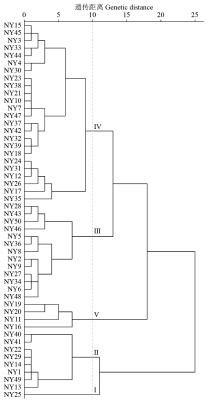
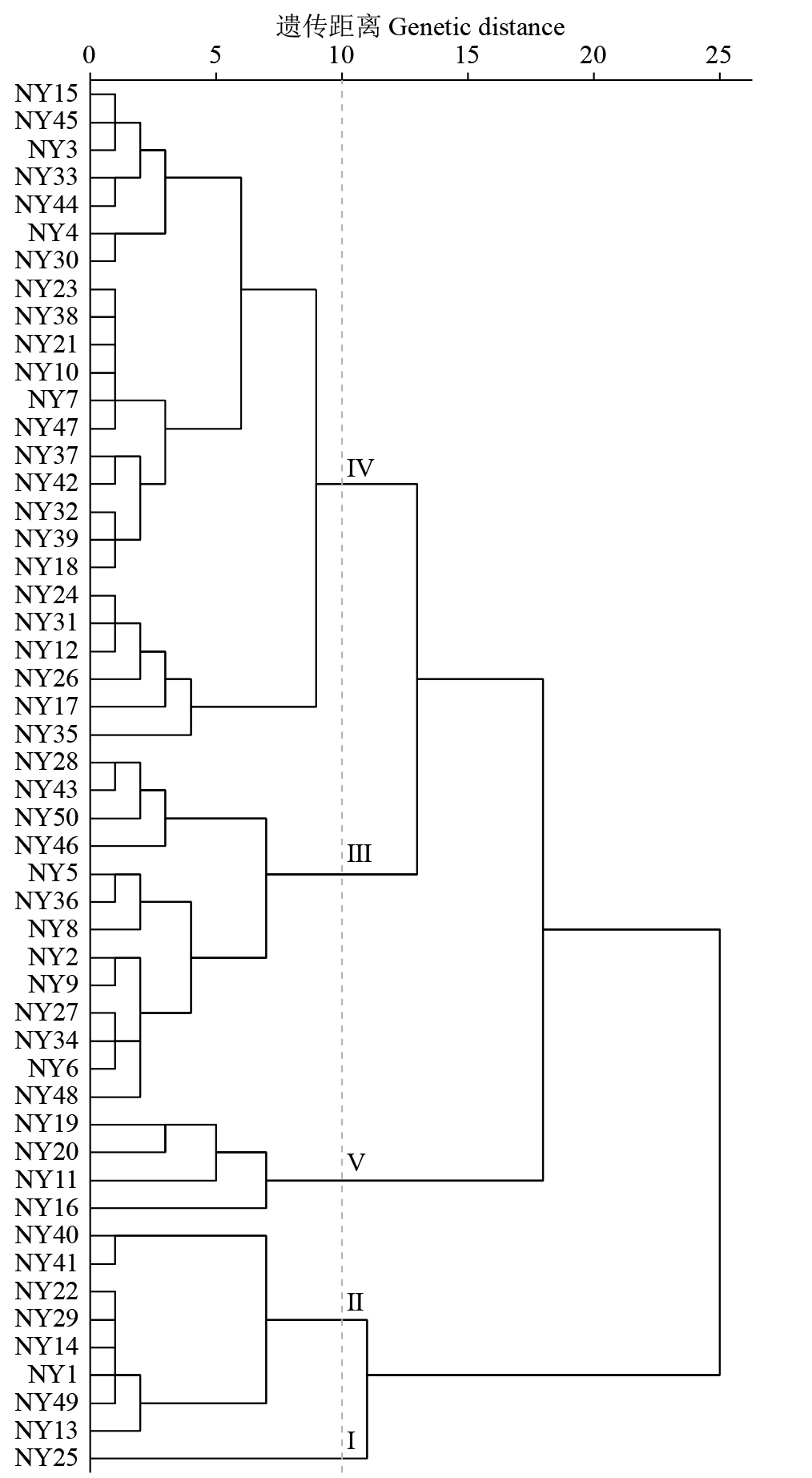
Fig.1

Cluster analysis of D-values for different varieties (lines)"

[1] Wu H H. Plant salt tolerance and Na+ sensing and transport. The Crop Journal, 2018, 6(3):215-255.
[2] Sun H, Meng M H, Yan Z H, et al. Genome-wide association mapping of stress-tolerance traits in cotton. The Crop Journal, 2019, 7(1):77-88.
[3] 董积忠, 尹传华, 王海孝, 等. 两种盐生植物生物移盐能力及土壤改良效果比较. 新疆农业科学, 2014, 51(1):124-128.
[4] 孙东雷, 卞能飞, 陈志德, 等. 花生萌发期耐盐性综合评价及耐盐种质筛选. 植物遗传资源学报, 2017, 18(6):1079-1087.
doi: 10.13430/j.cnki.jpgr.2017.06.010
[5] 马晓蕾, 胡朋举, 郭颂, 等. 花生耐盐碱品种的筛选及评价. 华北农学报, 2023, 38(增1):145-153.
[6] 徐婷, 柳延涛, 王海江, 等. 盐碱胁迫对花生种子发芽特性影响及盐害综合鉴定评价. 中国油料作物学报, 2022, 44(5):1037-1047.
doi: 10.19802/j.issn.1007-9084.2021245
[7] 吴兰荣, 陈静, 许婷婷, 等. 花生全生育期耐盐鉴定研究. 花生学报, 2005, 34(1):20-24.
[8] 刘永惠, 沈一, 陈志德, 等. 不同花生品种(系)萌发期耐盐性的鉴定与评价. 中国油料作物学报, 2012, 34(2):168-173,180.
[9] 沈一, 刘永惠, 陈志德, 等. 花生幼苗期耐盐品种的筛选与评价. 花生学报, 2012, 41(1):10-15.
[10] 郭峰, 万书波, 李新国, 等. NaCl胁迫对花生种子萌发的影响. 干旱地区农业研究, 2010, 28(3):177-181.
[11] 慈敦伟, 丁红, 张智猛, 等. 花生耐盐性评价方法的比较与应用. 花生学报, 2013, 42(2):28-35.
[12] 吕宁, 石磊, 戴昱余, 等. 新疆盐碱地治理利用研究回顾与启示. 灌溉排水学报, 2024, 43(12):1-10.
[13] 王新富, 王彦君, 周晓芳, 等. 新疆盐碱地区土壤变化情况及固碳潜力分析. 中国煤炭地质, 2024, 36(5):50-55.
[14] 李瀚, 杨吉顺, 张冠初, 等. 花生品种萌发期耐盐性比较鉴定. 花生学报, 2015, 44(4):48-52,57.
[15] Katerji N, Hoorn J W, Hamdy A, et al. Salt tolerance classification of crops according to soil salinity and to water stress day index. Agricultural Water Management, 2000, 43(1):99-109.
[16] 董志刚, 程智慧. 番茄品种资源芽苗期和幼苗期的耐盐性及耐盐指标评价. 生态学报, 2009, 29(3):1348-1355.
[17] 侯林琳, 张佳蕾, 郭峰, 等. 盐胁迫下外源Ca2+对花生植株性状的影响. 山东农业科学, 2015, 47(10):25-28.
[18] 徐晨, 凌风楼, 徐克章, 等. 盐胁迫对不同水稻品种光合特性和生理生化特性的影响. 中国水稻科学, 2013, 27(3):280-286.
[19] 陈杨, 吕玉英, 杨会, 等. 水培法鉴定花生苗期耐盐性研究. 山东农业科学, 2019, 51(9):125-131.
[20] Flowers T J. Improving crop salt tolerance. Journal of Experimental Botany, 2004, 55(396):307-319.
doi: 10.1093/jxb/erh003 pmid: 14718494
[21] 谢承陶. 盐渍土改良原理与作物抗性. 北京: 中国农业科技出版社,1993.
[22] 朱世杨, 张小玲, 罗天宽, 等. 花椰菜种质资源萌发期耐盐性综合评价. 核农学报, 2012, 26(2):380-390.
[23] 王兴州, 时晓磊, 张恒, 等. 引进春小麦品种萌发期耐盐性鉴定及评价. 新疆农业科学, 2023, 60(6):1353-1362.
doi: 10.6048/j.issn.1001-4330.2023.06.007
[24] 杨圆圆. 花生种质苗期耐盐性鉴定评价. 泰安:山东农业大学, 2017.
[1] Jin Lulu, Xu Min, Wang Zisheng, Wu Xiaodong. Comparative Study on Canopy Temperature, Light and Water Characteristics and Dry Matter Production Characteristics of Organs under Cotton/Peanut Intercropping [J]. Crops, 2025, 41(5): 177-183.
[2] Wang Shengtai, Zhao Baoxie, Du Shikun, Li Yuyang, Yu Hualin, Li Rongxin. Identification of Salt Tolerance and Variety Screening of Flax in Moderately Saline-Alkali Soil [J]. Crops, 2025, 41(4): 111-117.
[3] Yin Junhua, Deng Li, Guo Minjie, Miao Jianli, Hu Junping, Li Shaowei, Ren Li. Comprehensive Evaluation of Small-Seeded Peanut Varieties Based on BLUP Values and GGE Biplot [J]. Crops, 2025, 41(4): 118-125.
[4] Lü Rongzhen, Maihemuti∙Rouzi , Zhang Yong, Maihemuti∙Remutula , Yaermaimaiti∙Alimu , Zhang Jiancheng, Yu Tianyi. Effects of Exogenous Hormones and Inhibitors on Hormone Content, Growth and Development of Peanut in Acidified Soil [J]. Crops, 2025, 41(3): 218-224.
[5] Zhang Zhengjie, Yang Guohua, Guo Ruihong, Cheng Kaihua, Mi Xingwang, Liu Fei. Comprehensive Evaluation of Regional Trials for the Spring Maize in Northwest China Based on DTOPSIS Method and Membership Function Method [J]. Crops, 2025, 41(3): 78-84.
[6] Zhao Fuyang, Ma Bo, Hu Jifang, Tan Kefei, Liu Chuanzeng, Yan Feng, Dong Yang, Hou Xiaomin, Li Qingquan, Han Yehui. Evaluation of Photoperiod Sensitivity of Japonica Rice in Cold Regions under Different Photoperiod Conditions [J]. Crops, 2025, 41(2): 135-140.
[7] Lu Jing, Yu Bo, Jiang Mi, Peng Lianxin, Ren Yuanhang, Wu Qi. Assessment of Genetic Diversity in 58 Germplasm Resources of Highland Barley [J]. Crops, 2025, 41(2): 20-28.
[8] Shi Huiying, Fan Baojie, Liu Changyou, Wang Yan, Wang Shen, Zhang Zhixiao, Su Qiuzhu, Tian Jing. Identification and Evaluation of Salt Tolerance of Mung Bean Germplasm Resources during Germination [J]. Crops, 2025, 41(1): 66-75.
[9] Zhang Ying, Wang Haiyang, Jiang Lin, Guo Xueqing, Zhong Xiaoli, Zhang Xing, Lu Minjiao, Ji Xiaoming, Yang Xiaopeng, Wu Shusong. Comprehensive Evaluation and Spatial Distribution of Soil Fertility Suitability in Changting Tobacco-Growing Area [J]. Crops, 2024, 40(6): 171-178.
[10] Yu Mu, Yang Haitang, Hu Yanling, Liu Ruanzhi, Shi Yanzhao, Li Pan, Han Yanhong, Zhu Zhenzhen, Li Shizhong, Guo Zhenchao. Genotype-by-Environment Interaction and Stability of Yield Components in Peanut [J]. Crops, 2024, 40(6): 55-60.
[11] Li Yawei, Zhang Lei, Liu Tianpeng, He Jihong, Dong Kongjun, Ren Ruiyu, Yang Tianyu. Analysis and Evaluation of Agronomic and Economic Characteristics of Foxtail Millet in Northwest Ecological Region [J]. Crops, 2024, 40(5): 48-53.
[12] Ma Yanhua, Sun Dequan, Li Suiyan, Lin Hong, Pan Liyan, Li Donglin, Fan Jinsheng, Wu Jianzhong, Yang Guowei. Comprehensive Evaluation of Main Agronomic Traits and Screening of Excellent Germplasms of Maize Landraces in Heilongjiang Province [J]. Crops, 2024, 40(4): 103-112.
[13] Yuan Di, Zhi Hui, Wang Haigang, Zhang Hui, Yao Qi, Liang Hongkai, Wang Junjie, Chen Ling, Diao Xianmin, Jia Guanqing. Genetic Diversity Analysis and Comprehensive Evaluation of Registered Varieties of Foxtail Millet in China [J]. Crops, 2024, 40(4): 14-23.
[14] Li Shiqing, Zhang Peng, Gong Dan, Wang Suhua, Zhang Yaowen, Wang Lixia. Salt Tolerance Evaluation of New Mung Bean Varieties at Germination Stage [J]. Crops, 2024, 40(4): 188-193.
[15] Li Qingchao, Zhang Dengfeng, Li Chunhui, Yang Shan, Liu Jianxin, Wu Xun. Genetic Diversity Analysis and Comprehensive Evaluation of Maize Landraces in Southwest China [J]. Crops, 2024, 40(4): 24-32.
Viewed
Full text


Abstract

Cited

  Shared   
  Discussed   
No Suggested Reading articles found!