



玉米作为主要粮食作物之一,含有对人体有益的核黄素、多种微量元素和维生素A(VA)等化学物质[1]。目前,自然界中已有750余种类胡萝卜素被研究[2]。近年来,在玉米VA源物质类胡萝卜素的合成分子机制方面的研究取得了重要进展,鉴定了一些与类胡萝卜素合成的关键QTL位点。开展了lcyE、crtRB、PSY1和crtRB3等类胡萝卜素合成关键基因的多态性对玉米籽粒中类胡萝卜素含量的影响,开发了功能位点的分子标记,为实施利用分子标记加快高VA品种的选育提供了重要的方法[3]。对玉米籽粒中类胡萝卜素研究鉴定出叶黄素、玉米黄质、β-隐黄质和β-胡萝卜素4种主要的类胡萝卜素[4-5]。类胡萝卜素最主要的分离方法有高效液相色谱法[6⇓-8]、超高效液相色谱法[9]、分光光度法[10]、超临界流体色谱法[11]、拉曼光谱法[12]和液相色谱―串联质谱法[13]等。类胡萝卜素是一种对身体有益的健康天然食用色素,以黄色、橙色或红色表现出来,不仅具有为食品添色的功效,还含有较高的保健价值[14]。因其具有抗氧化和抗衰老等特点,被视为一类抗氧化剂。类胡萝卜素含有对人体有益的叶黄素、玉米黄质、β-隐黄质、α-胡萝卜素和β-胡萝卜素等[15-16],其中叶黄素和玉米黄质对缓解癌症和降低心血管疾病等方面具有较好的效果[17]。类胡萝卜素对人体健康有十分重要的作用,可在食品和医药等行业大规模应用[18-19]。
陈洁琼等[20]对5种鲜食甜、糯玉米籽粒中类胡萝卜素含量进行分析,发现不同种类玉米籽粒中的类胡萝卜素含量差别较大,甜玉米籽粒(39.68mg/kg)比糯玉米(2.10~3.69mg/kg)高出十几倍。章园等[21]对黄玉米不同时期籽粒类胡萝卜素含量进行分析,发现玉米黄质、叶黄素和β-隐黄质含量水平随着籽粒成熟度的提高总体呈上升态势,β-胡萝卜素含量无明显变化。严华等[22]使用高效液相色谱分析法对沙棘中4种类胡萝卜素进行检测,发现不同品种沙棘中类胡萝卜素含量具有较大差异。郭艳等[23]采用液相色谱法对甘蓝不同颜色花的类胡萝卜素含量进行检测,发现玉米黄质、β-胡萝卜素和叶黄素等是导致花瓣颜色变化的主要原因。
本试验用高效液相色谱技术测定不同籽粒颜色玉米自交系叶黄素、玉米黄质、β-隐黄质和β-胡萝卜素4种类胡萝卜素含量,探究玉米籽粒中类胡萝卜素含量与籽粒颜色间的关系,为优质玉米品种培育提供技术支持。
1 材料与方法
1.1 试验材料
表1 60份供试材料
Table 1
| 编号 Number | 材料名称 Material name | 编号 Number | 材料名称 Material name | 编号 Number | 材料名称 Material name | 编号 Number | 材料名称 Material name | 编号 Number | 材料名称 Material name |
|---|---|---|---|---|---|---|---|---|---|
| C1 | CAU404 | C13 | CAU204 | C25 | CAU532 | C37 | IL18 | C49 | CAU206 |
| C2 | CAU322 | C14 | CAU366 | C26 | B73 | C38 | CAU319 | C50 | CAU393 |
| C3 | CAU440 | C15 | CAU55 | C27 | CAU489 | C39 | CAU75 | C51 | CAU149 |
| C4 | IL23 | C16 | CAU281 | C28 | CAU482 | C40 | CAU146 | C52 | CAU129 |
| C5 | CAU252 | C17 | CAU219 | C29 | IL5 | C41 | CAU164 | C53 | CAU479 |
| C6 | CAU268 | C18 | CAU140 | C30 | CAU167 | C42 | CAU274 | C54 | CAU261 |
| C7 | IL52 | C19 | CAU597 | C31 | CAU208 | C43 | CAU269 | C55 | IL51 |
| C8 | CAU501 | C20 | CAU338 | C32 | CAU14 | C44 | CAU565 | C56 | IL27 |
| C9 | CAU263 | C21 | CAU513 | C33 | CAU342 | C45 | IL86 | C57 | IL65 |
| C10 | CAU159 | C22 | CAU640 | C34 | CAU93 | C46 | CAU502 | C58 | CAU18 |
| C11 | CAU297 | C23 | CAU525 | C35 | CAU365 | C47 | CAU539 | C59 | CAU160 |
| C12 | CAU144 | C24 | CAU504 | C36 | CAU416 | C48 | CAU154 | C60 | CAU225 |
1.2 仪器与设备
仪器为高效液相色谱仪、6530 Q-TOF精确质量级四极杆―飞行时间质谱仪(atmosphericpressure chemical ionization,APCI)、精宏水浴锅、真空离心浓缩仪Eppendorf concentrator 5301和扫描仪(Imagescanner Ⅲ)。试验用的叶黄素、玉米黄质、β-胡萝卜素和β-隐黄质的标准品来自美国Sigma公司。甲基叔丁基醚(methyl tert-butyl ether,MTBE)和甲醇均为色谱级,环己烷、乙醇、无水硫酸钠和氢氧化钾等均为分析纯。
1.3 测定项目及方法
1.3.1 玉米籽粒颜色鉴定
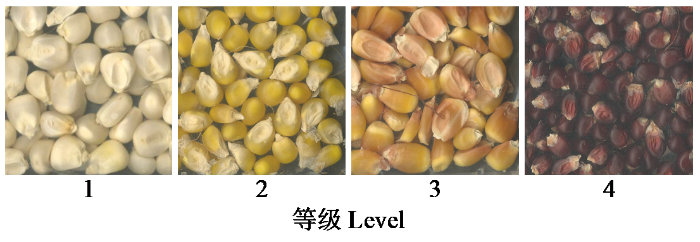
每个自交系挑选外观一致的种子约30粒,使用EPSON EU-88扫描设备和EPSON Scan软件进行图像数据采集,获得初始图片进行提取和计算,得到60份材料籽粒颜色的R(红色)、G(绿色)、B(蓝色)和Gray(灰度)值数据。并将60份玉米自交系籽粒色泽分为4个等级(图1),等级1为白色,等级2为黄色,等级3为橙黄色,等级4为紫黑色,以此为籽粒颜色的视觉分级表型数据。
图1
1.3.2 玉米中类胡萝卜素的提取
成熟的玉米籽粒经磨样机粉碎研磨后,称量3.0g置于50.0mL离心管中,加入乙醇30mL(含0.1% BHT),密封摇匀,85℃水浴加热孵育20min,加入80% KOH 0.6mL溶液,水浴60min进行皂化后冰水冷却,将皂化溶剂放入分液漏斗中,加入环己烷30.0mL和去离子水15.0mL振荡摇匀,重复2次。加入无水硫酸钠5.0g过滤,收集分液漏斗中上层溶液,减压浓缩至干燥,用乙腈―甲醇(75:25,V/V)溶液溶解,将溶液过0.22μL有机系滤膜后进行高效液相色谱(high performance liquid chromatography,HPLC)测定,整个前处理过程注意避光[25]。
1.3.3 高效液相色谱分析
色谱柱:YMC carotenoid(250×4.6mm,5μm)色谱柱;柱温:30℃;检测器波长为325和450nm;流动相:A为甲醇-MTBE-水(81:15:4,V/V),B为甲醇-MTBE-水(6:90:4,V/V),进样20μL;线性梯度洗脱,流速为1mL/min。洗脱程序:0~12.5min(100% B),12.5~25min(0%B)。DAD检测器测定波长为450nm。
1.3.4 类胡萝卜素组分定性定量分析
对于有标样的部分加以比较,利用保留时间的统一性加以测定,并利用外标定量法建立回归方程,对玉米类胡萝卜素各组分含量作出量化分析(表2)。
表2 混合标准液浓度
Table 2
| 标准样品 Standard sample | 水平1 Level 1 | 水平2 Level 2 | 水平3 Level 3 | 水平4 Level 4 | 水平5 Level 5 | 水平6 Level 6 |
|---|---|---|---|---|---|---|
| 叶黄素Lutein | 200.00 | 100.00 | 50.00 | 25.00 | 12.50 | 6.25 |
| 玉米黄质Zeaxanthin | 200.00 | 50.00 | 12.50 | 3.13 | 0.78 | 0.20 |
| β-隐黄质 β-cryptoxanthin | 100.00 | 20.00 | 4.00 | 0.80 | 0.16 | 0.03 |
| β-胡萝卜素 β-carotene | 72.50 | 36.25 | 18.13 | 9.06 | 4.53 | 2.27 |
1.4 数据处理
利用SPSS 19.0软件进行单因素方差分析及组间差异的Duncan’s多重比较,采用SPSS分析变量间的Pearson相关系数进行相关性分析,用GraphPad Prism 5作图。
2 结果与分析
2.1 玉米类胡萝卜素含量统计的回归方程
采用外标定量法进行试样中各组分峰的定量。配制标准溶液样品,按上述色谱要求计算标准试样的相对峰面积,由相对峰面积―进样量关系,按线性回归方式得出其中4种主要类胡萝卜素线性回归方程、相关系数值与线性范围,结果见表3。试样中各组分的含量使用的标准曲线数据,3次重复,取平均值。
表3 4种类胡萝卜素的线性范围及相关系数
Table 3
| 标准样品Standard sample | 线性范围Linear range (mg/kg) | 线性方程Linear equation | 相关系数Correlation coefficent (r2) |
|---|---|---|---|
| 叶黄素Lutein | 6.0~200 | Y1=0.015X1 | 0.9905 |
| 玉米黄质Zeaxanthin | 0.0~200 | Y2=0.3023X2+0.1171 | 0.9958 |
| β-隐黄质 β-cryptoxanthin | 0.0~100 | Y3=0.1119X3-0.1048 | 0.9976 |
| β-胡萝卜素 β-carotene | 2.0~75 | Y4=0.0023X4+0.0022 | 0.9988 |
Y1、Y2、Y3和Y4分别为叶黄素、玉米黄质、β-隐黄质和β-胡萝卜素的峰面积,X1、X2、X3和X4分别为其对应的进样量(ng)
Y1, Y2, Y3 and Y4 are the peak areas of lutein, zeaxanthin, β-cryptoxanthin and β-carotene, the peak areas of X1, X2, X3 and X4 are their corresponding injection volumes (ng), respectively
2.2 不同自交系中类胡萝卜素含量分布
60份玉米自交系籽粒类胡萝卜素检测(表4)表明,玉米籽粒中含有丰富的类胡萝卜素,且变化范围在1.49~119.31mg/kg。其中,总类胡萝卜素含量占比最低的是自交系C1,仅有1.49mg/kg,最高的自交系为C47,可达119.31mg/kg,最高与最低含量之间相差近80倍。60份玉米自交系叶黄素平均含量为56.32mg/kg,其中C27含量最高,达99.98mg/kg,C1含量最低,为0.56mg/kg;玉米黄质平均含量为0.85mg/kg,其中C35含量最高,达2.91mg/kg,C14含量最低,为0.02mg/kg;β-隐黄质平均含量为1.31mg/kg,其中C27含量最高,达2.20mg/kg,C1含量最低,为0.94mg/kg;β-胡萝卜素平均含量为5.75mg/kg,其中C52号含量最高,达26.61mg/kg,C19含量最低,为0.61mg/kg。
表4 玉米自交系的类胡萝卜素含量统计分析
Table 4
| 标准样品 Standard sample | 最大值 Maximum | 最小值 Minimum | 平均值 Average | 方差 Variance |
|---|---|---|---|---|
| 叶黄素Lutein | 99.98 | 0.56 | 56.32 | 776.29 |
| 玉米黄质Zeaxanthin | 2.91 | 0.02 | 0.85 | 0.54 |
| β-隐黄质 β-cryptoxanthin | 2.20 | 0.94 | 1.31 | 0.11 |
| β-胡萝卜素 β-carotene | 26.61 | 0.61 | 5.75 | 35.57 |
2.3 不同颜色等级籽粒中类胡萝卜素的含量
图2
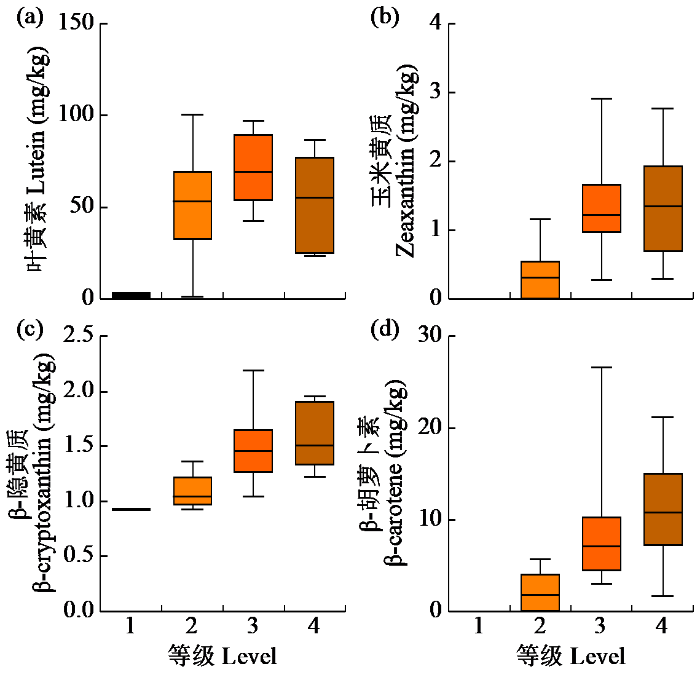
图2
不同籽粒颜色等级中4种类胡萝卜素含量
Fig.2
Carotenoid content of four groups in different seed color grades
表5 不同颜色等级中叶黄素、玉米黄质、β-隐黄质和β-胡萝卜素的含量分析
Table 5
| 等级Level | 叶黄素Lutein | 玉米黄质Zeaxanthin | β-隐黄质β-cryptoxanthin | β-胡萝卜素β-carotene |
|---|---|---|---|---|
| 1 | 1.69±0.76a | nd | 0.94±0.00a | nd |
| 2 | 50.53±5.44b | 0.37±0.08a | 1.10±0.03a | 2.12±0.40a |
| 3 | 71.05±3.62b | 1.31±0.12b | 1.51±0.06b | 8.71±1.24b |
| 4 | 54.76±9.02b | 1.35±0.32b | 1.56±0.11b | 10.89±0.77b |
| 平均值Average | 56.32 | 0.85 | 1.31 | 5.75 |
| 变异系数Coefficient of variation (%) | 49.46 | 87.06 | 25.19 | 103.65 |
| F值F-value | 12.291 | 17.662 | 17.238 | 12.767 |
| 标准差Standard deviation | 27.86 | 0.74 | 0.33 | 5.96 |
nd表示未检出。玉米自交系不同等级类胡萝卜素成分含量间标有不同小写字母表示差异显著(P < 0.05),下同
nd means not detected. Different levels of carotenoid content in maize inbred lines with different lowercase letters indicate significant differences (P < 0.05), the same below
玉米自交系中的叶黄素平均含量远大于玉米黄质、β-隐黄质和β-胡萝卜素的平均含量,其在等级3的含量最高,为71.05mg/kg,依次是等级4和等级2,分别为54.76和50.53mg/kg,含量最低的是等级1,为1.69mg/kg。玉米黄质中等级4的含量最高,为1.35 mg/kg,其次为等级3(1.31mg/kg)和等级2(0.37mg/kg),等级1未检出。β-隐黄质中等级1、等级2与等级3、等级4间有显著差异(表5),等级4和等级3中β-隐黄质含量较高,等级1和等级2含量较低,等级4(1.56mg/kg)中β-隐黄质含量大约是等级1(0.94mg/kg)的1.7倍。另外玉米籽粒中β-胡萝卜素含量较高的是等级4(10.89mg/kg),而在等级1中没有检测到β-胡萝卜素(表4)。
2.4 R、G、B和Gray值与类胡萝卜素含量的相关性分析
对60份玉米自交系中R、G、B、Gray值与类胡萝卜素含量进行相关性分析,如表6所示,R、G、B、Gray值间和类胡萝卜素之间均具有极显著正相关性;R、G、B、Gray值与叶黄素、玉米黄素、β-隐黄质、β-胡萝卜素间具有极显著负相关性,即类胡萝卜素含量越高,红度、绿度、蓝度和灰度值越低。总体而言,R、G、B和Gray值之间,G与Gray值的正相关性最高,达0.992,其次是R值与Gray和G值,正相关性分别达到0.939和0.912,R与B值正相关性较低,为0.408;类胡萝卜素含量之间,β-隐黄质和β-胡萝卜素相关性较高,达0.830,其次是玉米黄质和β-隐黄质,达0.815,而叶黄素与β-胡萝卜素关联性较低,为0.343;叶黄素与B值负相关性较高,达-0.619,而叶黄素与R值负相关性则较低,为-0.593。
表6 R、G、B和Gray值与类胡萝卜素含量间的相关性分析
Table 6
| 项目 Item | R | G | B | Gray | 叶黄素 Lutein | 玉米黄质 Zeaxanthin | β-隐黄质 β-cryptoxanthin | β-胡萝卜素 β-carotene |
|---|---|---|---|---|---|---|---|---|
| R | 1.000 | |||||||
| G | 0.912** | 1.000 | ||||||
| B | 0.408** | 0.596** | 1.000 | |||||
| Gray | 0.939** | 0.992** | 0.632** | 1.000 | ||||
| 叶黄素Lutein | -0.256** | -0.385** | -0.619** | -0.402** | 1.000 | |||
| 玉米黄质Zeaxanthin | -0.370** | -0.520** | -0.416** | -0.498** | 0.505** | 1.000 | ||
| β-隐黄质 β-cryptoxanthin | -0.506** | -0.598** | -0.421** | -0.589** | 0.452** | 0.815** | 1.000 | |
| β-胡萝卜素 β-carotene | -0.455** | -0.532** | -0.331** | -0.520** | 0.343** | 0.582** | 0.830** | 1.000 |
“**”表示极显著相关(P < 0.01)
“**”indicates extremely significant correlation (P < 0.01)
2.5 玉米自交系类胡萝卜素含量的聚类分析
根据类胡萝卜素含量,采用系统聚类法,用欧式距离可变类平均法对60个品种进行聚类分析,60份玉米自交系按籽粒中类胡萝卜素含量差异可分为5大类,其中编号C1~C8聚为一类;C9~C34、C36~C46、C48、C49、C52~54、C56、C58和C60聚为一类;C59单独聚为一类;C50、C51和C57聚为一类;C35、C55和C47聚为一类。
在5个类群中,第5类的叶黄素、玉米黄质和β-隐黄质含量都是最高的,属于高VA的自交系,第1类叶黄素、玉米黄质、β-隐黄质和β-胡萝卜素的含量都最低,β-隐黄质和玉米黄质含量在5个类群中的平均值较低。第2类包含了多个自交系,属于中富含类胡萝卜素的自交系(表7)。
表7 不同类群间类胡萝卜素含量的分析
Table 7
| 类群Group | 叶黄素Lutein | 玉米黄质Zeaxanthin | β-隐黄质 β-cryptoxanthin | β-胡萝卜素 β-carotene |
|---|---|---|---|---|
| 1 | 3.94±1.30 | nd | 0.94±0.00 | nd |
| 2 | 63.68±2.94 | 0.83±0.08 | 1.28±0.03 | 4.76±0.46 |
| 3 | 24.50±0.00 | 0.68±0.00 | 1.32±0.00 | 15.04±0.00 |
| 4 | 75.44±6.06 | 1.62±0.22 | 1.76±0.16 | 12.41±5.30 |
| 5 | 85.93±4.76 | 2.82±0.04 | 2.02±0.06 | 14.96±3.22 |
| 平均值Average | 56.76 | 0.86 | 1.30 | 5.19 |
| 变异系数Coefficient of variation (%) | 49.52 | 86.05 | 23.08 | 94.03 |
| F值F-value | 22.87 | 19.28 | 20.05 | 16.29 |
| 标准差Standard deviation | 28.11 | 0.74 | 0.30 | 4.88 |
3 讨论
筛选高含量类胡萝卜素玉米是十分关键的,但这需要一种快速、准确、操作简便的分析测定方法。与其他检测方法相比,高效液相色谱法具有高效性、精确性和显著性等优势,已成为化学分析中主要分离方法[26]。本试验采用高效液相色谱法测定玉米类胡萝卜素中的叶黄素、玉米黄质、β-隐黄质和β-胡萝卜素的浓度,结果发现玉米籽粒中类胡萝卜素各组分间含量差异显著,与Baseggio等[27]和周毅等[28]研究结果一致。Hwang等[29]采用紫外分光光度计法检测白色和橙色玉米类胡萝卜素含量,结果表明类胡萝卜素的组成及其浓度是影响籽粒色泽的主要原因。Hu等[30]通过高效液相色谱法测定不同玉米籽粒颜色,结果表明,黄色、橙黄色和黑色玉米中有相对高含量的类胡萝卜素,而白色玉米最低。类胡萝卜素组成成分分析表明,叶黄素被确定是玉米中主要的类胡萝卜素,并且紫黑色玉米类胡萝卜素含量总体最高,这与Hu等[31]和OʼHare等[32]的研究结果类似。本试验以60份玉米自交系为材料,运用高效液相色谱技术对各种玉米自交系的类胡萝卜素组成成分进行分析测定,探究玉米籽粒颜色与类胡萝卜素含量的关系,结果显示,类胡萝卜素含量占比最高的是叶黄素、β-胡萝卜素和玉米黄质,其次是β-隐黄质。同时发现类胡萝卜素各组分间含量差异影响籽粒颜色。
4 结论
采用高效液相色谱检测法,对60份玉米自交系籽粒中类胡萝卜素含量进行测定,结果显示各自交系中叶黄素含量最高,是类胡萝卜素的主要成分,其次是β-胡萝卜素、玉米黄质和β-隐黄质。其中,4种类胡萝卜素含量间均有显著性差异,玉米黄质、β-隐黄质和β-胡萝卜素含量随着籽粒颜色等级的增加而增加,叶黄素含量呈先增加后降低的变化趋势。籽粒中类胡萝卜素含量与籽粒颜色相关指标相关性分析显示,4种主要类胡萝卜素含量与R、G、B、Gray值均呈极显著负相关,而4种主要类胡萝卜素组分间呈极显著正相关,R、G、B和Gray值间也呈极显著正相关。本研究结果表明,随着颜色等级的增长,类胡萝卜素含量也随之增长,且在等级3时达最高,其次是等级4,因此籽粒颜色可用作判断总类胡萝卜素含量的依据,可为培育高富集营养玉米品种提供直观有效的方法。
参考文献
Maize:a paramount staple crop in the context of global nutrition
DOI:10.1111/j.1541-4337.2010.00117.x URL [本文引用: 1]
Carotenoids in algae:distributions,biosyntheses and functions
DOI:10.3390/md9061101 URL [本文引用: 1]
Location and variety but not phosphate starter fertilization influence the profiles of fatty acids,carotenoids,and tocochromanols in kernels of modern corn (Zea mays L.) hybrids cultivated in Germany
DOI:10.1021/acs.jafc.0c07571 URL [本文引用: 1]
Determination of carotenoids in yellow maize,the effects of saponification and food preparations
DOI:10.1024/0300-9831.78.3.112
PMID:19003733
[本文引用: 1]

Maize is an important staple food consumed by millions of people in many countries. Yellow maize naturally contains carotenoids which not only provide provitamin A carotenoids but also xanthophylls, which are known to be important for eye health. This study was aimed at 1) evaluating the effect of saponification during extraction of yellow maize carotenoids, 2) determining the major carotenoids in 36 genotypes of yellow maize by high-performance liquid chromatography with a C30 column, and 3) determining the effect of cooking on the carotenoid content of yellow maize. The major carotenoids in yellow maize were identified as all-trans lutein, cis-isomers of lutein, all-trans zeaxanthin, alpha- and beta-cryptoxanthin, all-trans beta-carotene, 9-cis beta-carotene, and 13-cis beta-carotene. Our results indicated that carotenoid extraction without saponification showed a significantly higher yield than that obtained using saponification. Results of the current study indicate that yellow maize is a good source of provitamin A carotenoids and xanthophylls. Cooking by boiling yellow maize at 100 degrees C for 30 minutes increased the carotenoid concentration, while baking at 450 degrees F for 25 minutes decreased the carotenoid concentrations by almost 70% as compared to the uncooked yellow maize flour.
Reversed-phase high-performance liquid chromatography for the quantification and optimization for extracting 10 kinds of carotenoids in pepper (Capsicum annuum L.) leaves
DOI:10.1021/acs.jafc.7b02440 URL [本文引用: 1]
Analyzing carotenoids of snow algae by raman microspectroscopy and high-performance liquid chromatography
DOI:10.1016/j.saa.2019.01.013 URL [本文引用: 1]
Ultra high performance liquid chromatography versus high performance liquid chromatography:stationary phase selectivity for generic carotenoid screening
DOI:10.1016/j.chroma.2014.01.042 URL [本文引用: 1]
Carotenoid quantification of Cucurbita spp. by spectrophotometry,high-performance liquid chromatography and photoacoustics
Supercritical fluid chromatography for lipid analysis in foodstuffs
DOI:10.1002/jssc.201600936
PMID:27696781
[本文引用: 1]
The task of lipid analysis has always challenged separation scientists, and new techniques in chromatography were often developed for the separation of lipids; however, no single technique or methodology is yet capable of affording a comprehensive screening of all lipid species and classes. This review acquaints the role of supercritical fluid chromatography within the field of lipid analysis, from the early developed capillary separations based on pure CO, to the most recent techniques employing packed columns under subcritical conditions, including the niche multidimensional techniques using supercritical fluids in at least one of the separation dimensions. A short history of supercritical fluid chromatography will be introduced first, from its early popularity in the late 1980s, to the sudden fall and oblivion until the last decade, experiencing a regain of interest within the chromatographic community. Afterwards, the subject of lipid nomenclature and classification will be briefly dealt with, before discussing the main applications of supercritical fluid chromatography for food analysis, according to the specific class of lipids.© 2016 WILEY-VCH Verlag GmbH & Co. KGaA, Weinheim.
Temperature dependence of resonance Raman spectra of carotenoids
DOI:10.1016/j.saa.2010.12.071 URL [本文引用: 1]
Bioanalytical method development and validation study of neuroprotective extract of kashmiri saffron using ultra-fast liquid chromatography-tandem mass spectrometry (UFLC-MS/MS):in vivo pharmacokinetics of apocarotenoids and carotenoids
DOI:10.3390/molecules26061815 URL [本文引用: 1]
Comparison of carotenoid content in fresh,frozen and cannedcorn
DOI:10.1016/j.jfca.2004.04.001 URL [本文引用: 1]
Lutein and zeaxanthin concentrations in rod outer segment membranes from perifoveal and peripheral human retina
In addition to acting as an optical filter, macular (carotenoid) pigment has been hypothesized to function as an antioxidant in the human retina by inhibiting the peroxidation of long-chain polyunsaturated fatty acids. However, at its location of highest density in the inner (prereceptoral) layers of the foveal retina, a specific requirement for antioxidant protection would not be predicted. The purpose of this study was to determine whether lutein and zeaxanthin, the major carotenoids comprising the macular pigment, are present in rod outer segment (ROS) membranes where the concentration of long-chain polyunsaturated fatty acids, and susceptibility to oxidation, is highest.Retinas from human donor eyes were dissected to obtain two regions: an annular ring of 1.5- to 4-mm eccentricity representing the area centralis excluding the fovea (perifoveal retina) and the remaining retina outside this region (peripheral retina). ROS and residual (ROS-depleted) retinal membranes were isolated from these regions by differential centrifugation and their purity checked by polyacrylamide gel electrophoresis and fatty acid analysis. Lutein and zeaxanthin were analyzed by high-performance liquid chromatography and their concentrations expressed relative to membrane protein. Preparation of membranes and analysis of carotenoids were performed in parallel on bovine retinas for comparison to a nonprimate species. Carotenoid concentrations were also determined for retinal pigment epithelium harvested from human eyes.ROS membranes prepared from perifoveal and peripheral regions of human retina were found to be of high purity as indicated by the presence of a dense opsin band on protein gels. Fatty acid analysis of human ROS membranes showed a characteristic enrichment of docosahexaenoic acid relative to residual membranes. Membranes prepared from bovine retinas had protein profiles and fatty acid composition similar to those from human retinas. Carotenoid analysis showed that lutein and zeaxanthin were present in ROS and residual human retinal membranes. The combined concentration of lutein plus zeaxanthin was 70% higher in human ROS than in residual membranes. Lutein plus zeaxanthin in human ROS membranes was 2.7 times more concentrated in the perifoveal than the peripheral retinal region. Lutein and zeaxanthin were consistently detected in human retinal pigment epithelium at relatively low concentrations.The presence of lutein and zeaxanthin in human ROS membranes raises the possibility that they function as antioxidants in this cell compartment. The finding of a higher concentration of these carotenoids in ROS of the perifoveal retina lends support to their proposed protective role in age-related macular degeneration.
甘蓝黄花和白花在着色过程中类胡萝卜素代谢分析
Juvik Simultaneous quantification of carotenoids and tocopherols in corn kernel extracts by HPLC
DOI:10.1081/JLC-100102068 URL [本文引用: 1]
Natural variation for carotenoids in fresh kernels is controlled by uncommon variants in sweet corn
Provitamin A potential of landrace orange maize variety (Zea mays L.) grown in different geographical locations of central Malawi
DOI:10.1016/j.foodchem.2015.10.067 URL [本文引用: 1]
Profiles of carotenoids,anthocyanins,phenolics,and antioxidant activity of selected color waxy corn grains during maturation
DOI:10.1021/jf104149q URL [本文引用: 1]
Biosynthesis and accumulation of multi-vitamins in black sweet corn (Zea mays L.) during kernel development
DOI:10.1002/jsfa.10573 URL [本文引用: 1]
Zeaxanthin biofortification of sweet-corn and factors affecting zeaxanthin accumulation and colour change
DOI:S0003-9861(15)00040-5
PMID:25637659
[本文引用: 1]
Zeaxanthin, along with its isomer lutein, are the major carotenoids contributing to the characteristic colour of yellow sweet-corn. From a human health perspective, these two carotenoids are also specifically accumulated in the human macula, and are thought to protect the photoreceptor cells of the eye from blue light oxidative damage and to improve visual acuity. As humans cannot synthesise these compounds, they must be accumulated from dietary components containing zeaxanthin and lutein. In comparison to most dietary sources, yellow sweet-corn (Zea mays var. rugosa) is a particularly good source of zeaxanthin, although the concentration of zeaxanthin is still fairly low in comparison to what is considered a supplementary dose to improve macular pigment concentration (2mg/person/day). In our present project, we have increased zeaxanthin concentration in sweet-corn kernels from 0.2 to 0.3mg/100g FW to greater than 2.0mg/100g FW at sweet-corn eating-stage, substantially reducing the amount of corn required to provide the same dosage of zeaxanthin. This was achieved by altering the carotenoid synthesis pathway to more than double total carotenoid synthesis and to redirect carotenoid synthesis towards the β-arm of the pathway where zeaxanthin is synthesised. This resulted in a proportional increase of zeaxanthin from 22% to 70% of the total carotenoid present. As kernels increase in physiological maturity, carotenoid concentration also significantly increases, mainly due to increased synthesis but also due to a decline in moisture content of the kernels. When fully mature, dried kernels can reach zeaxanthin and β-carotene concentrations of 8.7 mg/100g and 2.6 mg/100g, respectively. Although kernels continue to increase in zeaxanthin when harvested past their normal harvest maturity stage, the texture of these 'over-mature' kernels is tough, making them less appealing for fresh consumption. Increase in zeaxanthin concentration and other orange carotenoids such as β-carotene also results in a decline in kernel hue angle of fresh sweet-corn from approximately 90° (yellow) to as low as 75° (orange-yellow). This enables high-zeaxanthin sweet-corn to be visually-distinguishable from standard yellow sweet-corn, which is predominantly pigmented by lutein.Copyright © 2015 Elsevier Inc. All rights reserved.


