



植物生长调节剂是人工合成的具有植物激素活性的化合物,其在适宜浓度下能有效改善作物抗逆性、提升品质和增加产量[5
目前,关于叶面喷施丙酰芸苔素内酯(propionyl brassinolide,PBR)改善夏大豆株型和提高产量的研究较少,且其喷施的最适浓度尚未明确。因此,本研究选择4个夏大豆品种,设置5个PBR浓度,在大豆营养生长阶段的3叶期(V3期)、生殖生长阶段的盛花期(R2期)和鼓粒期(R5期)喷施,探究其对叶绿素相对含量、光合速率、主要农艺性状和产量的影响,明确PBR的最佳喷施浓度,为PBR在夏大豆生产中的推广应用提供理论依据。
1 材料与方法
1.1 试验材料
供试材料为贡夏15(GX15)、贡夏7103(GX7103)、南夏豆38(NXD38)和南夏豆40(NXD40),其中GX15和GX7103来源于自贡市农业科学研究院,NXD38和NXD40来源于南充市农业科学院。供试药剂为有效含量0.003%的PBR水剂,购于江苏龙灯化学有限公司。
1.2 试验设计
大豆分别于2022和2023年6月播种,播种地点为达州市农业科学研究院北斗村试验基地。按照供试药剂说明书中作物推荐稀释倍数2000~5000倍,设置5个PBR浓度,分别为清水(CK)和供试药剂稀释6000(C1)、4000(C2)、3000(C3)、2000(C4),在大豆营养生长阶段V3期、生殖生长阶段R2期和R5期喷施,对照喷施等体积清水;以喷施至完全将叶片表面润湿,但不明显掉到土壤为标准。小区面积为6 m2(2 m×3 m),行距0.50 m,间距0.13 m,播种密度为16.05万株/hm2。随机区组排列,每个处理设置3个重复,共60个试验小区,小区外围设置1 m宽的保护行。
1.3 测定项目与方法
分别在大豆V3、R2和R5期喷施PBR次日,选择长势均匀一致的5株大豆,使用叶绿素测定仪(SD-1CK,北京时代创客有限公司)测定夏大豆倒二功能叶中间叶片的叶绿素相对含量(SPAD值),结果取平均值。在R5期喷施PBR次日,选择长势均匀一致的5株大豆,于当日8:00-12:00使用植物光合作用测定仪(3051D,浙江托普云农科技股份有限公司)测定夏大豆倒二功能叶中间叶片的净光合速率(Pn)、蒸腾速率(Tr)、气孔导度(Gs)和胞间CO2浓度(Ci),结果取平均值,SPAD值和光合参数仅在2023年进行了测定。在大豆生殖生长阶段的完熟期(R8期)选择长势均匀一致的5株大豆,测量株高、主茎节数、底荚高度、单株有效分枝数、单株有效荚数和单株粒数等农艺性状,结果取平均值。大豆收获后,分别测定各小区产量,并使用考种系统(TPKZ-2,浙江托普云农科技股份有限公司)测定百粒重、粒长和粒宽,每个小区重复3次,结果取平均值。
1.4 数据处理
采用Excel 2016计算各农艺性状的平均值和标准差;使用SPSS Statistics 25进行相关性分析和显著性分析;使用SPSSUA在线工具进行互作效应分析。
2 结果与分析
2.1 叶面喷施PBR对夏大豆叶片光合作用的影响
由图1可知,在大豆V3、R2和R5期喷施PBR后,4个夏大豆叶片SPAD值较CK处理明显增加,且部分处理间存在显著性差异,GX15、GX7103、NXD38和NXD40叶片的SPAD值较CK分别增加了0.37%~6.33%、1.11%~7.69%、0.71%~ 5.19%和1.43%~4.85%。在大豆V3、R2和R5期,随着PBR浓度的增加,叶片的SPAD值逐渐增加,均在R5期达到最大值,GX15、GX7103、NXD38和NXD40分别为39.52、39.31、39.36和39.92。
图1
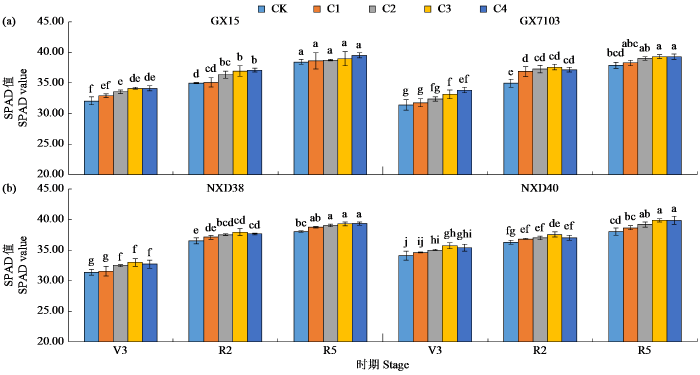
图1
叶面喷施PBR对SPAD值的影响
不同小写字母表示在P < 0.05水平上差异显著,下同。
Fig.1
Effect of foliar propionyl brassinolide application on SPAD value in leaves
The different lowercase letters indicate significant difference at P < 0.05 level, the same below.
由图2可知,相比CK,叶面喷施PBR提高了夏大豆叶片的Pn、Gs和Ci,对Tr无影响。随着PBR浓度的增加,Pn呈先增加后减小趋势,在C3浓度达到最大值,GX15、GX7103、NXD38和NXD40的Pn分别为16.42、16.30、16.56和16.21 μmol/(m2∙s);Gs呈逐渐增加趋势,NXD38不同处理间Gs无显著增加;Ci也呈增加趋势,部分处理间存在显著性差异;Tr在部分处理间呈显著性差异,但总体无明显变化。综上所述,叶面喷施PBR会影响夏大豆叶片的SPAD值、Pn、Gs和Ci,进而影响叶片光合作用。
图2

图2
叶面喷施PBR对叶片光合参数的影响
Fig.2
Effect of foliar propionyl brassinolide application on photosynthetic parameters in leaves
2.2 叶面喷施PBR对大豆主要农艺性状的影响
由表1可知,叶面喷施PBR后,2022年4个大豆品种的株高在70.00~88.53 cm,明显高于2023年的株高(55.33~75.93 cm);各处理间株高无显著性差异(2022年NXD38除外)。2022年和2023年的主茎节数分别在16.27~19.93和13.87~18.47 cm,两者间差异较小;各处理的主茎节数也无显著性差异。2022年的底荚高度在15.20~ 35.00 cm,而2023年在14.60~24.07 cm;同一年份大部分处理的底荚高度无显著性差异。2022年和2023年的有效分枝数分别在3.53~5.67和1.40~3.87 cm,两者之间存在一定差异;同一年份大部分处理的有效分枝数无显著性差异(2022年GX7103和2023年NXD40除外)。综上所述,叶面喷施PBR对大豆的株高、主茎节数、底荚高度和有效分枝数影响极小,品种因素影响次之,环境因素影响最大。另外,不同品种和PBR浓度对株高、主茎节数、底荚高度和有效分枝数等性状没有极显著的互作效应。
表1 叶面喷施PBR对大豆农艺性状的影响
Table 1
| 年份 Year | 品种 Variety | 处理 Treatment | 株高 Plant height (cm) | 主茎节数 Number of main stem nodes | 底荚高度 Bottom pod height (cm) | 有效分枝数 Effective branch number |
|---|---|---|---|---|---|---|
| 2022 | GX15 | CK | 83.73±6.17abcd | 17.33±0.82cde | 18.47±1.76cde | 4.07±0.25cde |
| C1 | 81.93±1.79abcd | 18.13±0.96abcdef | 19.73±3.49bcde | 3.93±0.41de | ||
| C2 | 81.60±5.41abcd | 18.60±0.16abcde | 15.20±2.61e | 4.73±0.38abcde | ||
| C3 | 79.00±5.24bcde | 17.27±1.20cdef | 16.20±2.51de | 3.93±0.41de | ||
| C4 | 80.10±1.10abcde | 17.87±0.09bcdef | 22.00±4.53bcde | 4.20±1.23bcde | ||
| GX7103 | CK | 72.40±1.57ef | 16.33±1.00f | 18.47±2.85cde | 3.53±0.50e | |
| C1 | 71.27±4.03ef | 18.40±0.98abcde | 16.73±2.00cde | 5.67±0.38a | ||
| C2 | 70.00±4.71f | 17.47±0.68cdef | 15.47±1.41de | 5.60±1.13a | ||
| C3 | 77.60±5.62cdef | 17.24±1.87cdef | 19.04±2.73cde | 4.27±1.04bcde | ||
| C4 | 72.80±3.10ef | 17.47±0.82cdef | 16.07±3.61de | 5.27±0.19abc | ||
| NXD38 | CK | 87.07±0.66ab | 19.67±1.48ab | 19.00±1.84cde | 3.93±1.00de | |
| C1 | 77.27±5.72def | 19.00±1.13abc | 19.80±0.91bcde | 4.67±0.62abcde | ||
| C2 | 82.33±5.14abcd | 19.93±1.09a | 21.47±0.93bcde | 4.87±0.41abcd | ||
| C3 | 88.53±4.17a | 19.67±0.57ab | 20.07±1.48bcde | 4.47±0.41abcde | ||
| C4 | 79.07±5.70bcde | 18.73±0.77abcd | 35.00±2.79a | 4.67±0.68abcde | ||
| NXD40 | CK | 86.40±3.18ab | 16.33±1.32f | 24.27±3.95bcde | 4.67±0.66abcde | |
| C1 | 86.00±2.44abc | 16.80±0.28ef | 27.00±1.42abc | 5.00±0.43abcd | ||
| C2 | 86.93±2.71ab | 17.47±0.52cdef | 30.00±2.36ab | 4.73±0.19abcde | ||
| C3 | 83.70±3.50abcd | 16.27±0.41f | 23.27±0.82bcde | 4.80±0.28abcd | ||
| C4 | 87.27±2.74ab | 17.00±0.33def | 25.87±1.39abcd | 5.40±0.16ab | ||
| 品种 | 17.92** | 14.31** | 6.31** | 3.09* | ||
| 浓度 | 0.96 | 1.30 | 1.23 | 3.23* | ||
| 品种×浓度 | 1.06 | 0.59 | 1.10 | 0.97 | ||
| 2023 | GX15 | CK | 66.00±4.63abcde | 17.07±1.61abcde | 20.27±1.67abc | 3.13±1.36abcd |
| C1 | 65.07±2.23bcdef | 16.93±0.66abcde | 18.20±2.47abc | 3.00±0.75abcd | ||
| C2 | 64.47±5.60bcdef | 17.13±1.54abcde | 14.60±1.47c | 3.87±0.57a | ||
| C3 | 67.80±0.98abcde | 17.47±0.62abcd | 17.87±0.66abc | 3.47±0.41abc | ||
| C4 | 72.47±5.14ab | 17.73±0.09abc | 20.27±4.10abc | 2.47±0.34bcdef | ||
| GX7103 | CK | 55.33±7.95f | 14.27±0.75gh | 18.20±1.88abc | 1.40±0.59f | |
| C1 | 57.67±2.97ef | 13.87±0.38h | 21.93±6.41ab | 2.07±1.05def | ||
| C2 | 62.07±9.11cdef | 15.33±1.57efgh | 19.73±2.64abc | 2.67±0.25bcde | ||
| C3 | 61.53±1.25def | 15.67±0.41defgh | 16.20±1.63bc | 2.00±0.65def | ||
| C4 | 60.73±1.95def | 14.73±0.34fgh | 20.73±4.59abc | 1.60±0.49ef | ||
| NXD38 | CK | 68.33±3.49abcd | 17.80±0.28abc | 18.73±0.77abc | 2.40±0.43cdef | |
| C1 | 75.80±3.02a | 18.20±1.73ab | 24.07±1.25a | 2.33±0.25cdef | ||
| C2 | 71.73±5.33abc | 18.47±0.34a | 22.60±5.10ab | 2.33±0.47cdef | ||
| C3 | 72.13±4.10abc | 18.73±0.41a | 21.60±4.85abc | 1.67±0.52ef | ||
| C4 | 75.27±2.54a | 18.47±1.33a | 20.67±1.51abc | 2.20±0.43def | ||
| NXD40 | CK | 71.87±3.80abc | 15.93±0.25cdefg | 15.53±4.97bc | 3.07±0.41abcd | |
| C1 | 75.93±4.25a | 17.00±0.75abcde | 20.00±4.25abc | 3.60±0.16ab | ||
| C2 | 68.80±7.78abcd | 15.27±0.34efgh | 17.47±6.42abc | 2.27±0.19def | ||
| C3 | 71.93±9.39abc | 16.53±1.48bcdef | 18.67±4.22abc | 3.47±0.50abc | ||
| C4 | 70.80±2.83abcd | 15.33±0.19efgh | 21.00±1.14abc | 2.60±0.65bcde | ||
| 品种 | 14.44** | 27.39** | 1.70 | 10.42** | ||
| 浓度 | 0.94 | 0.86 | 1.09 | 1.21 | ||
| 品种×浓度 | 0.59 | 0.75 | 0.61 | 1.34 | ||
不同小写字母表示在P < 0.05水平上差异显著;“*”和“**”分别表示在P < 0.05和P < 0.01水平差异显著和极显著,下同。
The different lowercase letters indicate significant difference at P < 0.05 level;“*”and“**”indicate significant and extremely significant difference at the P < 0.05 and P < 0.01 levels, respectively, the same below.
2.3 叶面喷施PBR对大豆粒长和粒宽的影响
叶面喷施PBR后(图3),2022和2023年的大豆粒长分别在8.18~9.43 mm和8.22~11.71 mm,而大豆粒宽分别在6.49~7.21 mm和6.55~8.82 mm,表明2023年部分处理的大豆籽粒大于2022年。另外,2022年各处理的籽粒长宽无显著性差异(极少部分处理除外),而2023年各处理的籽粒长宽均存在明显的差异(虽无显著性,但数据波动较大),表明大豆籽粒长宽不受PBR和品种影响,但易受环境因素影响。
图3
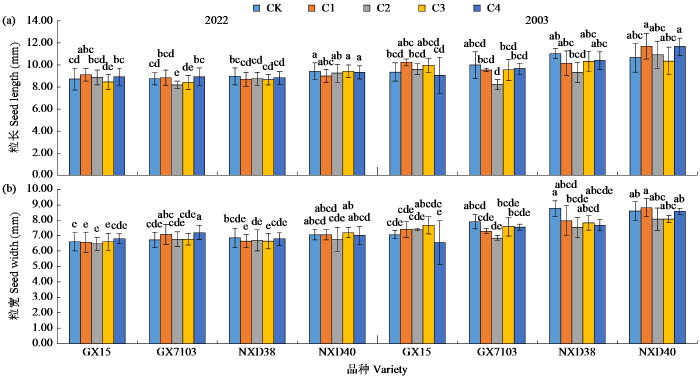
图3
叶面喷施PBR对粒长和粒宽的影响
Fig.3
Effect of foliar propionyl brassinolide application on seed length and seed width
2.4 叶面喷施PBR对产量性状及产量的影响
由表2可知,叶面喷施PBR后,4个大豆品种的单株有效荚数、单株粒数和百粒重较CK均有所增加,且部分呈显著性差异。4个大豆品种的单株有效荚数均随PBR浓度增加而增加,GX15和GX7103在C2浓度时达最大值,而NXD38和NXD40在C3浓度时达最大值。单株粒数随PBR浓度增加而增加,且均在浓度C2时达最大值(2023年GX15和NXD40除外,其在C3浓度时达最大值)。百粒重也随PBR浓度增加而增加,且均在浓度C3时达最大值。2022年4个品种的产量均随PBR浓度增加而增加,且均在浓度C3达最大值,GX15、GX7103、NXD38和NXD40分别为2694.44、2383.33、2600.00、和2558.48 kg/hm2;2023年的小区产量均随PBR浓度增加而增加,且均在浓度C3达最大值,GX15、GX7103、NXD38和NXD40分别为2992.46、2264.10、2735.04和2497.28 kg/hm2。另外,品种和PBR浓度对2022年的单株有效荚数和百粒重有显著的互作效应,表明大豆单株有效荚数和百粒重由这2种因素共同控制。
表2 叶面喷施PBR对大豆产量性状及产量的影响
Table 2
| 年份 Year | 品种 Variety | 处理 Treatment | 单株有效荚数 Number of effective pods per plant | 单株粒数 Seed number per plant | 百粒重 100-seed weight (g) | 小区产量 Yield per plot (kg/m2) | 产量 Yield (kg/hm2) |
|---|---|---|---|---|---|---|---|
| 2022 | GX15 | CK | 34.60±6.53ghi | 54.40±10.25e | 14.86±0.18j | 1.24±0.05ghi | 2072.22±88.54ghi |
| C1 | 42.00±9.05efghi | 65.07±12.71de | 15.90±0.45ghi | 1.26±0.07fghi | 2094.44±115.74fghi | ||
| C2 | 62.13±5.19bc | 97.60±7.80ab | 16.43±0.25fg | 1.44±0.14bcde | 2405.56±239.73bcde | ||
| C3 | 40.47±1.18efghi | 54.60±6.79e | 16.60±0.59fg | 1.62±0.09a | 2694.44±152.95a | ||
| C4 | 36.60±11.02fghi | 48.00±7.93e | 14.93±0.66ij | 1.51±0.06abcd | 2511.11±103.04abcd | ||
| GX7103 | CK | 31.07±10.07i | 48.07±15.65e | 15.39±0.33hij | 1.14±0.04hi | 1900.67±61.97hi | |
| C1 | 64.53±3.90ab | 98.73±4.47ab | 16.64±0.20fg | 1.25±0.07fghi | 2088.89±109.99fghi | ||
| C2 | 78.07±5.98a | 111.87±11.56a | 16.94±0.12f | 1.34±0.08efg | 2238.89±136.31efg | ||
| C3 | 52.73±2.95bcde | 60.16±5.91e | 17.05±0.07f | 1.43±0.06bcde | 2383.33±102.74bcde | ||
| C4 | 48.80±6.23cdefg | 72.20±4.53cde | 16.20±0.33fgh | 1.33±0.06efg | 2211.11±95.58efg | ||
| NXD38 | CK | 42.27±15.94efghi | 69.33±27.55cde | 21.44±0.71e | 1.22±0.14ghi | 2033.33±232.54ghi | |
| C1 | 50.73±9.08bcdef | 86.13±14.23bcd | 22.68±0.75d | 1.27±0.03fgh | 2122.22±56.66fgh | ||
| C2 | 58.53±5.88bcd | 91.27±6.15abc | 25.99±0.62a | 1.36±0.06defg | 2272.22±92.63defg | ||
| C3 | 60.60±4.61bcd | 71.27±16.08cde | 26.51±0.65a | 1.56±0.06ab | 2600.00±98.13ab | ||
| C4 | 46.60±13.01defgh | 67.53±5.69cde | 23.06±0.59cd | 1.27±0.08fgh | 2111.11±136.99fgh | ||
| NXD40 | CK | 29.40±3.49i | 44.87±6.41e | 21.40±0.34e | 1.11±0.06i | 1857.78±106.33i | |
| C1 | 33.00±6.72hi | 51.67±13.52e | 23.26±0.51cd | 1.24±0.04ghi | 2061.11±67.13ghi | ||
| C2 | 33.40±4.67ghi | 63.45±5.17de | 23.92±0.14bc | 1.35±0.06efg | 2250.00±108.01efg | ||
| C3 | 38.87±3.03efghi | 62.27±5.25de | 26.15±0.65a | 1.54±0.07abc | 2558.48±121.84abc | ||
| C4 | 35.53±7.31fghi | 58.67±13.84e | 24.57±0.81b | 1.40±0.04cdef | 2327.78±64.31cdef | ||
| 品种 | 15.05** | 7.76** | 807.07** | 4.34** | 4.34** | ||
| 浓度 | 10.36** | 10.43** | 50.57** | 26.53** | 26.53** | ||
| 品种×浓度 | 2.25* | 1.85 | 6.96** | 0.98 | 0.98 | ||
| 2023 | GX15 | CK | 43.73±6.49efgh | 95.80±9.53abcde | 14.09±0.50e | 1.65±0.06abcd | 2750.19±93.14abcd |
| C1 | 54.27±8.21abcdefg | 106.13±16.17ab | 16.70±2.74d | 1.72±0.05abc | 2863.54±83.81abc | ||
| C2 | 69.53±16.43a | 108.20±6.98ab | 17.02±0.24d | 1.74±0.13ab | 2907.41±214.25ab | ||
| C3 | 62.13±4.65ab | 111.80±10.59a | 17.67±0.49d | 1.80±0.09a | 2992.46±148.63a | ||
| C4 | 59.93±7.74abcd | 103.27±6.66abc | 16.54±1.10d | 1.78±0.03a | 2970.71±47.81a | ||
| GX7103 | CK | 38.07±3.29h | 76.27±3.70fgh | 15.62±0.67de | 1.25±0.15g | 2087.81±243.25g | |
| C1 | 39.73±6.78gh | 78.33±14.11efgh | 16.68±0.18d | 1.27±0.02g | 2108.78±40.51g | ||
| C2 | 52.47±7.29bcdefgh | 111.07±4.99a | 16.86±0.34d | 1.31±0.01efg | 2187.13±22.58efg | ||
| C3 | 41.33±9.00fgh | 90.87±5.43bcdef | 17.15±0.57d | 1.36±0.11defg | 2264.10±189.44defg | ||
| C4 | 37.53±9.29h | 77.00±14.99efgh | 16.34±0.69de | 1.31±0.08fg | 2181.74±126.00fg | ||
| NXD38 | CK | 45.47±9.13cdefgh | 68.73±5.89gh | 21.33±0.63c | 1.45±0.20bcdefg | 2422.96±334.83bcdefg | |
| C1 | 55.60±5.31abcdefg | 83.67±13.96defg | 23.88±1.43ab | 1.58±0.21abcdef | 2628.16±354.99abcdef | ||
| C2 | 61.27±5.88abc | 98.53±4.89abcd | 24.41±0.45a | 1.62±0.09abcde | 2696.66±152.03abcde | ||
| C3 | 64.07±4.20ab | 86.53±13.67cdefg | 24.77±0.64a | 1.64±0.17abcd | 2735.04±284.28abcd | ||
| C4 | 57.07±6.93abcdef | 76.67±3.56fgh | 21.69±0.42bc | 1.62±0.08abcde | 2693.61±129.64abcde | ||
| NXD40 | CK | 43.20±5.11efgh | 62.60±9.48h | 23.54±0.38abc | 1.37±0.03defg | 2291.28±48.53defg | |
| C1 | 44.67±9.24defgh | 68.27±5.72gh | 24.12±1.30a | 1.43±0.40cdefg | 2381.98±673.33cdefg | ||
| C2 | 50.00±3.37bcdefgh | 74.73±7.88fgh | 24.65±2.75a | 1.47±0.09bcdefg | 2447.80±155.01bcdefg | ||
| C3 | 58.27±12.60abcde | 89.87±5.81bcdef | 25.73±1.64a | 1.50±0.05abcdefg | 2497.28±91.58abcdefg | ||
| C4 | 40.80±3.37gh | 60.40±5.25h | 24.87±1.13a | 1.42±0.29cdefg | 2363.59±477.16cdefg | ||
| 品种 | 9.52** | 22.58** | 137.49** | 15.49** | 15.49** | ||
| 浓度 | 5.28** | 8.56** | 6.04** | 0.97 | 0.97 | ||
| 品种×浓度 | 0.70 | 1.13 | 0.64 | 0.05 | 0.05 | ||
2.5 大豆主要农艺性状间的相关性分析
由表3可知,产量与单株有效荚数和单株粒数呈极显著正相关,表明较高的单株有效荚数和单株粒数是产量增加的重要因素;而产量与其他农艺性状无显著相关性。主茎节数与单株有效荚数呈极显著正相关,表明主茎节数更多的大豆品种产量可能更高。株高与单株粒数呈极显著负相关,表明大豆株高越低,产量可能越高。底荚高度与单株有效荚数和单株粒数均呈显著负相关,表明具有较低底荚高度的品种可能具有更好的产量潜力。另外,有效分枝数、百粒重、粒长、粒宽等其他性状间也存在一些显著的相关性。例如,粒宽与株高、主茎节数和有效分枝数呈显著负相关,与百粒重和粒长呈显著正相关。
表3 大豆主要农艺性状的相关性分析
Table 3
| 性状 Trait | 株高 Plant height | 主茎节数 Number of main stem nodes | 底荚高度 Bottom pod height | 有效分枝数 Effective branch number | 单株有效荚数 Number of effective pods per plant | 单株粒数 Seed number per plant | 百粒重 100-seed weight | 粒长 Seed length | 粒宽 Seed width |
|---|---|---|---|---|---|---|---|---|---|
| 主茎节数Number of main stem nodes | 0.61** | ||||||||
| 底荚高度Bottom pod height | 0.41** | 0.12 | |||||||
| 有效分枝数Effective branch number | 0.67** | 0.45** | 0.14 | ||||||
| 单株有效荚数Number of effective pods per plant | -0.21 | 0.43** | -0.37* | 0.04 | |||||
| 单株粒数Seed number per plant | -0.53** | 0.11 | -0.36* | -0.18 | 0.80** | ||||
| 百粒重100-seed weight | 0.43** | 0.25 | 0.44** | 0.07 | 0.05 | -0.18 | |||
| 粒长Seed length | -0.30 | -0.31* | -0.05 | -0.55** | -0.07 | -0.05 | 0.39* | ||
| 粒宽Seed width | -0.43** | -0.37* | -0.14 | -0.55** | 0.01 | 0.01 | 0.36* | 0.93** | |
| 产量Yield | -0.17 | 0.20 | -0.18 | -0.28 | 0.53** | 0.48** | 0.06 | 0.27 | 0.19 |
“*”和“**”分别表示在P < 0.05和P < 0.01水平显著和极显著相关。
“*”and“**”indicate significant or extremely significant correlation at the P < 0.05 and P < 0.01 levels, respectively.
3 讨论
叶面喷施PBR后,夏大豆产量仅与单株有效荚数和单株粒数呈极显著正相关,而主茎节数与单株有效荚数呈极显著正相关,株高与单株粒数呈极显著负相关,底荚高度与单株有效荚数和单株粒数均呈显著负相关。综上所述,具有更高产量潜力的大豆品种可能具有更多的单株有效荚数、单株粒数、主茎节数以及更矮的株高和底荚高度。然而,大豆株高与产量的关系,国内外学者研究结果各有不同。大多数研究[27-
叶绿素是光合作用的物质基础,能直接反映作物光合作用的能力,其在光合作用中起着吸能和转能的重要作用[31]。本研究中,随着喷施PBR浓度逐渐增加和生育时期的变化,4个夏大豆品种叶片SPAD值逐渐增加,相比CK,夏大豆叶片SPAD值均有不同程度的提高(图1)。另外,随着喷施PBR浓度的增加,4个夏大豆品种叶片的Gs和Ci随之增加;但光合作用呈先增加后减小的趋势,且在C3浓度时达最大值。喷施PBR后,光合作用没有随着SPAD值增加而持续增加,而是在达到一定值后趋于稳定。前人研究[32]结果表明,SPAD值常作为叶绿体发育和光合能力的指标,与光合速率呈正相关,本研究结果与其基本一致。因此,在使用叶面肥提升夏大豆光合作用时,不能只考虑叶绿素等内在因素,也需关注品种、栽培密度以及光照等外在因素,才能达到最佳增产效果。
4 结论
叶面喷施PBR会显著影响夏大豆叶片的光合作用。SPAD值、Pn、Gs和Ci相较于CK更高,而Tr则保持不变;SPAD值、Pn、Gs和Ci会随PBR浓度增加而升高。叶面喷施PBR显著影响大豆部分农艺性状和产量。相比于CK,大豆的单株有效荚数、单株粒数、百粒重和产量随PBR浓度增加呈先增加后减小的趋势(部分处理显著增加),且在C2或C3浓度时达最大值,而株高、主茎节数、底荚高度、有效分枝数和籽粒长宽则不受影响。在大豆生产中,叶面喷施3000倍PBR稀释液可提升夏大豆产量。
参考文献
基于783份大豆种质资源的叶柄夹角全基因组关联分析
DOI:10.3724/SP.J.1006.2022.14102
[本文引用: 1]

叶柄夹角是影响植株高效受光态势的重要因素, 通过调节叶柄夹角实现大豆株型改良, 对大豆产量提高非常重要。大豆叶柄夹角为数量性状, 目前大多数研究处于QTL定位阶段, 已报道的控制叶柄夹角GmILPA1基因也是从突变体中克隆得到, 因此亟须发掘更多调控基因及优异等位变异, 以促进大豆叶柄夹角调控机制的解析及育种利用。本研究于2019年和2020年分别在海南、北京种植783份和690份大豆种质资源并调查叶柄夹角表型, 通过分布于大豆全基因组的单核苷酸多态性(SNP)标记对叶柄夹角进行关联分析。结果表明, 不同节位叶柄夹角呈现正态分布, 属于典型的数量遗传特征。全基因组关联分析共统计到325个与叶柄夹角显著相关的SNP位点, 在顶部节位关联到51个SNP位点, 中部节位关联到230个SNP位点, 底部节位关联到10个SNPs位点, 3个节位的平均值关联到34个SNP位点。显著位点LD block进一步分析得到3个候选基因, 第1个是生长素类调节蛋白相关的基因Glyma.05G059700, 在茎尖分生组织中特异性表达, 第2个是生长素反应因子(AFR)类蛋白相关基因Glyma.06G076900, 在叶片和茎尖分生组织中高表达; 第3个是COP9信号体复合物相关的基因Glyma.06G076000, 在叶片、茎尖分生组织以及茎中均高表达。
外源喷施植物生长调节剂对套作大豆碳氮代谢和花荚脱落的影响
DOI:10.3724/SP.J.1006.2021.04129
玉米-大豆带状套作模式下, 玉米荫蔽会抑制大豆苗期生长、减少花荚数、降低产量, 探究外源植物生长调节剂对大豆开花结荚和产量的调控效应对套作大豆生产具有重要意义。采用单因素随机区组设计研究套作大豆初花期叶面喷施6-苄基腺嘌呤(6-Benzylaminopurine, 6-BA)、2-N,N-二乙氨基乙基己酸酯(diethyl aminoethyl hexanoate, DTA-6)、烯效唑(S3307)对花荚脱落、叶片碳氮代谢及产量形成的影响。结果表明, 外源调节剂会增强盛荚期和鼓粒期叶片蔗糖合成酶(sucrose synthetase, SS)、蔗糖磷酸合成酶(sucrose phosphate synthase, SPS)及转化酶(invertase, Inv)的酶活性; 提高始粒期茎、叶、荚果的可溶性糖含量, 促进后期茎、叶中可溶性糖向荚果的转移。外源调节剂会增加始荚期叶片碳、氮含量, 降低叶片C/N比值; 增加始粒期叶片碳含量, 减少氮含量, 提高叶片C/N比值。外源调节剂会增加大豆开花结荚数, 降低落荚数、落荚率及花荚脱落率, 以DTA-6效果较好, 其处理下2年大豆单株有效荚数和产量显著高于CK, 较CK分别增加25.4%、41.3%和32.9%、37.6%。套作大豆初花期叶面喷施6-BA、DTA-6、S3307提高叶片SPS、SS和Inv酶活性, 协调大豆各器官碳氮代谢动态平衡, 促进大豆开花结荚、减少大豆落荚, 显著提高大豆的单株有效荚数与产量, 其中DTA-6的增产效果最好。
不同生长调节剂叶面喷施对套作大豆形态及产量的影响
Impacts of plant growth promoters and plant growth regulators on rainfed agriculture
DOI:10.1371/journal.pone.0231426 URL [本文引用: 1]
叶面喷施芸苔素内酯481对水稻植株性状和产量的影响
叶面喷施芸苔素内酯对紫花苜蓿生长发育和种子产量的影响
DOI:10.11733/j.issn.1007-0435.2016.04.025
在紫花苜蓿(Medicago sativa)花期叶面喷施浓度为0.25‰,0.50‰,0.67‰和1.00‰的芸苔素内酯溶液,研究其对苜蓿生长发育、种子产量和质量的影响效果,旨为苜蓿种子生产提供科学依据。结果表明:适宜浓度芸苔素内酯溶液处理显著提高了生长阶段的叶片相对叶绿素含量、单株花序数量、生殖分配、收获期株高、主茎基部直径、单株荚果重以及种子产量和发芽势。其中浓度0.67‰处理,单株花序数最高,种子产量高达251.82 kg·hm<sup>-2</sup>,较对照增产78.27%。综合考虑,以浓度0.67‰处理效果最佳,对促进苜蓿的生长发育,提高种子产量和质量效果最好,0.50‰浓度效果次之。
Salinity effects on morpho- physiological and yield traits of soybean (Glycine max L.) as mediated by foliar spray with brassinolide
DOI:10.3390/plants10030541
URL
[本文引用: 1]
Salinity episodes that are common in arid regions, characterized by dryland, are adversely affecting crop production worldwide. This study evaluated the effectiveness of brassinolide (BL) in ameliorating salinity stress imposed on soybean at four levels (control (1.10), 32.40, 60.60 and 86.30 mM/L NaCl) in factorial combination with six BL application frequency (control (BL0), application at seedling (BL1), flowering (BL2), podding (BL3), seedling + flowering (BL4) and seedling + flowering + podding (BL5)) stages. Plant growth attributes, seed yield, and N, P, K, Ca and Mg partitioning to leaves, stems and roots, as well as protein and seed-N concentrations, were significantly (p ≤ 0.05) reduced by salinity stress. These trends were ascribed to considerable impairments in the photosynthetic pigments, photosynthetically active radiation, leaf stomatal conductance and relative water content in the leaves of seedlings under stress. The activity of peroxidase and superoxidase significantly (p ≤ 0.05) increased with salinity. Foliar spray with BL significantly (p ≤ 0.05) improved the photosynthetic attributes, as well as nutrient partitioning, under stress, and alleviated ion toxicity by maintaining a favourable K+/Na+ ratio and decreasing oxidative damage. Foliar spray with brassinolide could sustain soybean growth and seed yield at salt concentrations up to 60.60 mM/L NaCl.
Soybean yield formation: what controls it and how it can be improved
Estimating factor contributions to soybean yield from farm field data
DOI:10.2134/agronj2012.0018n
URL
[本文引用: 1]
Illinois ranks second in soybean [Glycine max (L.) Merr.] production in the United States with an annual crop value of some $4 billion. To discover what management practices, soil parameters, and environmental conditions enable higher soybean yields, the Illinois Soybean Association (ISA) started in 2010 a state‐wide “Yield Challenge” (YC) program. Enrolled producers established a “challenge” plot and adjoining “standard” practices plot, and agreed to share crop management information, soil samples, and yield data. Our work describes data analyses and findings using data generated under this program. Yields differed between standard and challenge plots across the state, with foliar applications of fungicide and or insecticide resulting in significant yield increases. Using principal component analyses and multiple regression tools, we were able to explain about 54% of the variation in soybean yield for the state in 2010. Within the available data range, delays in planting date and increased row spacing both reduced soybean yields, and tilled fields yielded more than no– tilled soybean fields. We uncovered a negative trend between soybean yield and PC1, formed by soil cation exchange capacity (CEC), dominant cations, and soil organic matter (SOM), likely due to the drainage characteristics of the plots. Yields were also decreased with increasing values of PC3, a variable that includes soil pH, Mn levels, and soybean cyst nematode (SCN) egg count. On the other hand, higher soil test values of P, Zn, Fe, and K, included in PC2, were related to higher soybean yields. We see this as a promising start to identifying management factors that may be addressed as we continue the search for higher soybean yields.
天然植物生长调节剂芸苔素的生物活性及应用浅析
DOI:10.11924/j.issn.1000-6850.casb2020-0619
[本文引用: 1]
天然芸苔素属于甾体类植物内源生物活性物质,其骨架为甾醇,其中芸苔素内酯生物活性最强,被称为第六类植物激素,是高效、广谱、无毒的植物生长调节剂(PGR)。为更好地将芸苔素推广应用于农业生产,本文概括了芸苔素内酯的生物活性及在粮食、果蔬等作物上的应用。探讨了芸苔素内酯在提高种子活力,促进作物生长,大幅度促进产量提升以及品质改善,提升作物抗逆性,缓解农药对作物影响的研究概况及取得的进展,指出了芸苔素内酯的应用是作物增产增收的关键途径,同时,能够减少化肥、农药的施用量,减少作物种植成本与减轻环境污染,将带来显著的经济效益。
Interrelationships among height, lodging and yield in determinate and indeterminate soybeans
Heritability and correlations among traits in four-way soybean crosses
DOI:10.1023/B:EUPH.0000019523.09542.8c [本文引用: 1]
Leaf senescence and nitrogen remobilization efficiency in oilseed rape (Brassica napus L.)
DOI:10.1093/jxb/eru177 URL [本文引用: 1]
Use of a SPAD-502 meter to measure leaf chlorophyll concentration in Arabidopsis thaliana
DOI:10.1007/s11120-010-9606-0 URL [本文引用: 1]


