



杂交水稻通过利用水稻杂种优势提升产量,是保障世界粮食安全的重要举措[1]。光温敏不育系(photo-thermo-sensitive genic male sterile line,P/TGMS)具有独特的育性转换特性,在杂交水稻育种中应用价值显著[2]。其育性受环境温度及光周期调控,在典型情况下,植株于高温(或长日)条件下表现为雄性不育,低温(或短日)条件下则可育,这一特性使杂交制种更为便捷。近年来,分子生物学技术发展迅速,众多水稻P/TGMS基因被成功克隆且功能得到验证,为P/TGMS系的创制与利用提供了坚实的理论基础[3-4]。基因芯片技术作为高通量基因分型技术,可同步检测水稻基因组中成千上万个遗传标记,为快速鉴定水稻品种、分析基因型及挖掘关键基因提供了有效工具[5]。
本研究运用基因芯片技术对19XS及其杂交后代开展基因型分析,通过单核苷酸多态性(SNP)标记分析,直接检测了与光温敏不育特性相关的功能基因。此方法有助于明确其遗传背景,验证不育性与特定基因位点的关联性,为深入探究19XS光温敏不育的遗传机制提供了重要依据。19XS源自籼粳亚种间杂种优势利用的杂交水稻系统工程研究,其具备稳定的光温敏不育特性,经多代种植观察与遗传分析证实,19XS的不育性不受遗传背景影响,属于一种新的隐性不育系。
1 材料与方法
1.1 试验材料
以新选育的水稻光温敏不育系19XS及其与香78S(X78S)的杂交组合为供试材料,19XS是从籼粳杂交稻甬优6078的后代中发现的一株自然突变体,香78S是一个广泛使用的光温敏不育系。
1.2 试验方法
于湖北省武汉市和海南省陵水县进行田间试验。两地试验田均为典型稻作土壤,武汉市试验地耕层pH约6.4、有机质约25.0 g/kg;陵水县pH约6.8、有机质约18.0 g/kg,速效磷和速效钾为当地常见水平。于5月10日在武汉播种,6月初插秧;于11月下旬在陵水播种,次年3月初抽穗。每个试验地点设置4个重复,每小区面积16 m2(4 m×4 m),行距22.5 cm,株距16.5 cm,每穴插1苗,田间管理同常规大田管理措施。
1.3 测定指标与方法
1.3.1 农艺性状
考察全生育期、株高、穗长、每穗粒数和结实率等主要农艺性状。
1.3.2 育性鉴定
于抽穗期,每天观察19XS的花药颜色和花粉活力,取新鲜花药,用1%碘―碘化钾(I2-KI)溶液染色后在显微镜下观察花粉粒形态和染色情况,计算可育花粉百分比。同时进行自交结实率测定,对19XS与香78S的杂交F1至F6代进行连续种植观察,考察其表型性状和育性表现。
以培矮64S为对照(CK)。
1.3.3 基因芯片分析
1.4 数据处理
采用Excel 2019软件对表型数据进行统计分析。使用R 4.3.3软件对基因芯片数据进行可视化分析,并绘制基因组组成图谱。
2 结果与分析
2.1 选育过程
于2006年,利用籼粳亚种间杂种优势进行杂交水稻系统工程研究。从湖北省武汉市亘谷源基地选择6个甬优6078系列组合的F1种子,种植于海南省陵水县华中师范大学南繁基地,获得6个F2群体,每个群体500株。于2017年4月,从每个F2群体中选择10个生长旺盛、结实好、后期转色好且米质优良的单株,共计60个F2单株,种植后形成60个F3株系。将F3株系种植于湖北省荆州市,每个株系种植200株。9月收获时,从每个F3株系中选择2个表现最优的单株,形成120个F4单株,并于海南省陵水县加代种植。于2017年冬季,在华中师范大学南繁基地种植120个F4单株,获得120个F5株系。2018年3月开始,选用表现优良的F5株系作父本进行测交,4月收获种子,形成120个F6株系。于2018年夏季,将F6株系种植于湖北省荆州市。于2019年3月,在35个测交组合中,以1240株系(某个F6株系的后代)作父本的杂交F1代表现突出,农艺性状优良,结实率高,后期转色好。于2019年完成1240株系的收获和小面积制种,在种植过程中发现6株表现较好且农艺性状优良的单株,移栽另地种植。收获后,其中1株表现完全雄性不育,且开花习性好,柱头外露率高,命名为19XS(图1)。具体选育过程见表1。
图1

表1 水稻光温敏不育系19XS选育流程
Table 1
| 世代 Generation | 选育操作 Breeding operation |
|---|---|
| F1 | 于2016年9月,选取甬优6078系列F1种子,在海南省种植 |
| F2 | 于2016年冬季至2017年春季,获得6个F2群体,每群体500株 |
| F3 | 于2017年4月,选择60个F2优良单株,种植形成F3株系 |
| F4 | 于2017年9月,从F3株系中选择120个优良单株形成F4 |
| F5 | 于2017年冬季,将F4种植于海南省,并收获F5种子 |
| F6 | 于2018年春季,种植F5并用于测交,形成120个F6株系;于同年夏季,将F6株系种植于湖北省 |
| F7 | 于2019年3月,发现优良株系1240;同年种植1240株系F7代,发现并命名雄性不育株19XS |
2.2 19XS的特性
2.2.1 生育特性
19XS是一个新选育的水稻不育系,具有优良的农艺性状。其株高适中,在75 cm左右,穗长约25.6 cm,全株叶片数13.5,叶片细长挺直,叶色深绿,株型紧凑。在武汉地区于5月10日播种,6月5日插秧,8月8日前后抽穗,播种至抽穗历期约90 d。
19XS的茎秆粗壮,抗倒伏能力强,抽穗整齐顺畅。穗型较大,每穗平均总粒数可达210,着粒密度合理。19XS的稻谷为长粒型,长宽比2.7:1,成熟时谷粒饱满,米色黄亮,无腹白及垩白。米质优良,千粒重在28~30 g。
2.2.2 育性表现
经光温敏不育水稻人工光温育性鉴定,在武汉地区5月10日播种的条件下,于7月22日至8月15日期间,19XS在不同光照时长(12.5 h、14.5 h和自然光照)及温度条件(23.0 ℃、24.0 ℃和自然温度)下均表现出极高的花粉败育度(99.56%~100.00%)和极低的自交结实率(0.00%),呈稳定的雄性不育性(表2)。
表2 2022年光温敏不育水稻人工光温育性鉴定
Table 2
| 材料 Material | 鉴定条件(光长-温度) Identification condition (Photoperiod-temperature) | 花粉观察日期 Pollen observation date | 花粉败育度 Pollen sterility (%) | 自交结实率 Self-pollination seed set rate (%) |
|---|---|---|---|---|
| 19XS | 14.5 h-23.0 °C | 07/27-08/10 | 99.56 | 0.00 |
| 14.5 h-24.0 ℃ | 07/25-08/10 | 99.62 | 0.00 | |
| 12.5 h-24.0 ℃ | 07/22-08/06 | 99.58 | 0.00 | |
| 14.5 h-自然温度 | 07/25-08/15 | 100.00 | 0.00 | |
| CK | 14.5 h-23.0 °C | 08/12-08/20 | 99.39 | 0.57 |
| 14.5 h-24.0 ℃ | 08/10-08/20 | 99.51 | 0.00 | |
| 12.5 h-24.0 ℃ | 08/09-08/18 | 97.25 | 1.08 | |
| 14.5 h-自然温度 | 08/10-08/25 | 99.88 | 0.00 |
2.2.3 测配能力
在杂交测配中,19XS展现出良好的杂种优势和配合力。作为籼粳交不育系,19XS与不同父本杂交后的F1代表现突出(表3),其全生育期适中(119~127 d),株高适应性强(70~ 145 cm),穗长在28~35 cm;结实率大多超过85%,最高达96.63%(19XS/鄂丰丝苗);千粒重表现良好,在20.0~32.0 g;单穗粒重范围为6.5~15.2 g,总粒数最高达695(19XS/7041),展现出较大的库容量和产量潜力。这些数据凸显了19XS在水稻育种中的重要价值,为培育高产优质杂交水稻品种提供了优良种质资源。
表3 19XS测交F1代主要农艺性状表现
Table 3
| 编号 Code | 组合 Combination | 全生育期 Total growth (d) | 株高 Plant height (cm) | 穗长 Panicle length (cm) | 总粒数 Total grains | 实粒数 Filled grains | 结实率 Seed setting rate (%) | 千粒重 1000-grain weight (g) | 单穗粒重 Grain weight per panicle (g) |
|---|---|---|---|---|---|---|---|---|---|
| 1 | 19XS/香98S | 119 | 92~122 | 30.0 | 346 | 284 | 82.08 | 23.0 | 6.5 |
| 2 | 19XS/香86S | 121 | 70~98 | 28.0 | 403 | 370 | 91.81 | 20.0 | 7.4 |
| 3 | 19XS/鄂丰丝苗 | 120 | 86~118 | 29.5 | 357 | 345 | 96.63 | 23.0 | 7.9 |
| 4 | 19XS/7041 | 122 | 102~145 | 35.0 | 695 | 611 | 87.91 | 25.0 | 15.2 |
| 5 | 19XS/1180 | 127 | 110~145 | 35.0 | 554 | 468 | 84.47 | 32.0 | 14.9 |
| 6 | 19XS/1050 | 123 | 82~120 | 30.0 | 442 | 397 | 89.81 | 24.0 | 9.5 |
| 7 | 19XS/1055 | 124 | 103~132 | 30.0 | 459 | 425 | 92.59 | 24.0 | 10.2 |
| 8 | 19XS/1061 | 124 | 89~120 | 32.0 | 558 | 478 | 85.66 | 22.0 | 10.5 |
2.3 19XS/香78S杂交稻组合的选育及特性分析
2.3.1 19XS和香78S的基因组分析
GSR 40K芯片的分析结果(图2)显示,19XS和香78S的纯合度分别为93.00%和99.83%,表明其基因型稳定。籼粳特性分析表明,19XS和香78S均为偏籼类型,但19XS的粳稻成分比例更高,达23.53%,这种籼粳成分的差异可能会影响其农艺性状和稻米品质,具体影响需要进一步研究。
图2
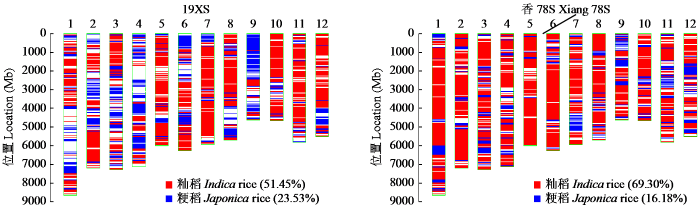
2.3.2 19XS/香78S的遗传稳定性
为评估19XS/香78S的遗传稳定性,对其F1~F6代进行连续种植观察和基因型分析。结果显示,19XS/香78S的F1代结实正常,F2代群体表现整齐一致,未出现分离,表明其具有良好的遗传稳定性。对19XS/香78S的F2代进行高密度基因芯片检测,结果表明其基因组中同时包含了母本19XS和父本香78S的遗传成分,进一步证实了其高度的遗传稳定性。
2.3.3 19XS/香78S的农艺性状
对19XS/香78S的F1~F6代农艺性状进行调查分析,结果如表4所示。19XS/香78S表现出优良的农艺性状,具体表现为株型紧凑,叶片深色,叶形狭长而窄细,整体挺直;分蘖力中强,成穗率较高,有效穗较多,穗大;结实率高,在80%以上,后期转色较好;米质优良。然而,19XS/香78S的耐高温能力较差,需要进一步改良。
表4 19XS/香78S的F1~F6代主要农艺性状比较
Table 4
| 世代 Generation | 株高 Plant height (cm) | 穗长 Panicle length (cm) | 结实率 Seed setting rate (%) | 千粒重 1000-grain weight (g) | 每穗总粒数 Grains per panicle |
|---|---|---|---|---|---|
| F1 | 110.3 | 30.0 | 82.08 | 23.0 | 346 |
| F2 | 110.5 | 30.2 | 82.15 | 23.2 | 347 |
| F3 | 110.3 | 29.8 | 82.10 | 22.9 | 345 |
| F4 | 110.4 | 30.4 | 82.05 | 23.4 | 346 |
| F5 | 110.4 | 30.5 | 82.19 | 23.1 | 348 |
| F6 | 110.7 | 30.1 | 82.13 | 23.3 | 344 |
2.3.4 育性基因分析
育性基因分析(表5)表明,19XS和香78S在关键育性基因的组成上存在明显差异。19XS含有温敏雄性不育基因TMS5和籼粳亲和基因S5,而香78S除了携带TMS5和S5基因外,还携带光敏育性恢复基因Rf2。上述3个基因均通过SNP探针检测到。
表5 19XS和香78S及其杂交后代的基因特征
Table 5
| 基因 Gene | 表型 Phenotype | 材料 Material |
|---|---|---|
| TMS5 | 高温条件下雄性不育,低温条件下可育 | 19XS,香78S,F1 |
| Rf2 | 光敏育性恢复,长日照条件下恢复雄性育性 | 香78S |
| S5 | 籼粳亲和,影响籼粳杂交后代育性 | 19XS,香78S,F1 |
在杂交组合中,19XS/香78S的F1代继承了双亲的TMS5和S5基因,这意味着F1代保留了温敏不育特性和籼粳亲和性。然而,Rf2基因并未在F1代中检测到,表明光敏育性恢复特性在此次杂交中没有传递给后代。
3 讨论
本研究报道了水稻光温敏不育系19XS及其与香78S杂交组合的选育流程与特性分析。经多年选育和观察,发现19XS及其杂交后代具备独特且有价值的特征,这些特征不仅对水稻育种具有重要意义,还为探索水稻遗传学机制开辟了新的研究方向。
19XS/香78S杂交组合表现出高度遗传稳定性,与传统杂交水稻F2代广泛分离的情况不同,该组合自F2代起,便呈现出高度的表型一致性与基因型稳定性,这或许源于19XS特殊的基因组构成。19XS作为籼粳交材料,其基因组融合了籼稻与粳稻的遗传成分,这种独特的基因组构成可能引发某些基因间的特殊互作,进而维持了杂合状态的稳定,这与一些籼粳交杂种的优势固定现象存在一定相似性[10]。籼粳交杂种优势固定现象指在杂交过程中,部分杂种后代历经多代繁殖后仍能保持优势性状,不出现显著性状分离。不过,19XS/香78S组合的稳定性更强,持续世代更久,这可能是由于材料间遗传相似性高且基因组较为接近所致。
基因芯片分析表明,19XS/香78S组合中存在多个与育性相关的关键基因,如TMS5、Rf2和S5,这些基因的存在及其相互作用可能是该组合呈现独特育性特征的分子基础。值得关注的是,19XS/香78S的F1代虽继承了父本香78S的Rf2基因[11],却仍保持温敏不育性,暗示在该组合中TMS5基因可能发挥主导作用,或者存在某种未知的基因互作机制抑制了Rf2基因的功能。这与Peng等[12]在TMS5基因功能研究中发现TMS5基因编码的RNase ZS1在调控水稻育性方面起关键作用的结果一致。此外,S5基因的存在可能提升了19XS/香78S组合的籼粳亲和性,这一特性不仅有助于提高杂交效率,还可能是该组合具备优良米质的原因之一。研究[13]表明,S5基因是调控籼粳杂交亲和性的关键基因,其功能型等位基因能够显著提高籼粳杂交的结实率。
基于本研究结果,未来研究方向可包括以下方面:其一,深入探究19XS/香78S组合的遗传稳定性机制,借助全基因组测序和表观遗传学分析等技术手段,揭示其背后可能存在的新型遗传学原理;其二,充分利用19XS的特性,开展更为广泛的杂交组合测试,筛选出更多具有类似遗传稳定性的组合;其三,鉴于19XS耐高温能力欠佳,可考虑引入耐高温基因,如OsHTAS或OsHSP101[14],以增强其在极端高温条件下的耐热性。此外,建议根据光周期调控关键基因的不同等位型,对不同生态区和播期条件下的抽穗期进行优化,以此提高制种效率,并确保目标性状能够稳定表达[15]。同时,鉴于播期对花后干物质和氮素的积累以及向穗部转运具有正向促进作用,在制定制种繁育计划时,应优先选择适宜的播期,从而协同提高结实率和最终产量[16]。综上,19XS及其与香78S的杂交组合不仅为水稻育种提供了新的优良材料,也为探索水稻遗传学与育种学的前沿问题提供了材料支撑。未来研究不仅要着眼于其直接的育种应用,更要深入探索其背后的生物学机制,这有望推动水稻遗传育种领域取得新突破。未来可进一步探索19XS光温敏不育性的分子调控网络,开发与其育性相关的分子标记以提高育种效率。
4 结论
经多年选育和系统评估,成功创制了水稻光温敏不育系19XS。本研究揭示了19XS的育性转换特性、农艺性状和遗传背景,为其在杂交水稻育种中的应用奠定基础。19XS具有独特的籼粳杂合基因组构成,使其在与不同类型亲本杂交时表现出良好的配合力,19XS可为优质杂交稻新品种选育提供材料基础。
参考文献
A high-density SNP genotyping array for rice biology and molecular breeding
DOI:10.1093/mp/sst135
PMID:24121292
[本文引用: 1]

A high-density single nucleotide polymorphism (SNP) array is critically important for geneticists and molecular breeders. With the accumulation of huge amounts of genomic re-sequencing data and available technologies for accurate SNP detection, it is possible to design high-density and high-quality rice SNP arrays. Here we report the development of a high-density rice SNP array and its utility. SNP probes were designed by screening more than 10 000 000 SNP loci extracted from the re-sequencing data of 801 rice varieties and an array named RiceSNP50 was produced on the Illumina Infinium platform. The array contained 51 478 evenly distributed markers, 68% of which were within genic regions. Several hundred rice plants with parent/F1 relationships were used to generate a high-quality cluster file for accurate SNP calling. Application tests showed that this array had high genotyping accuracy, and could be used for different objectives. For example, a core collection of elite rice varieties was clustered with fine resolution. Genome-wide association studies (GWAS) analysis correctly identified a characterized QTL. Further, this array was successfully used for variety verification and trait introgression. As an accurate high-throughput genotyping tool, RiceSNP50 will play an important role in both functional genomics studies and molecular breeding.
Genetic characterization and fine mapping of a novel thermo-sensitive genic male-sterile gene tms6 in rice (Oryza sativa L.)
DOI:10.1007/s00122-005-0044-x URL [本文引用: 1]
Mapping of tms8 gene for temperature-sensitive genic male sterility (TGMS) in rice (Oryza sativa L.)
DOI:10.1111/pbr.2011.131.issue-1 URL [本文引用: 1]
Development of a genetic marker linked to a new thermo-sensitive male sterile gene in rice (Oryza sativa L.)
DOI:10.1007/s10681-004-3360-3 URL [本文引用: 1]
Single-copy gene based 50 K SNP chip for genetic studies and molecular breeding in rice
转基因稻米DNA提取方法的比较研究
DOI:10.7506/spkx1002-6630-201022100
[本文引用: 1]
目的:建立一种以水稻种子为原料,简便、快速、有效的基因组DNA 提取方法,作为转基因稻米的PCR 检测基础。方法:选择传统的CTAB 法、改良的碱处理法、高温水煮法,以转基因糙米、非转基因糙米、转基因精米为材料提取DNA,并对提取物进行检测。结果:改良的碱处理法提取的DNA 模板的完整性、纯度和PCR 反应方面与传统CTAB 法相近,且比CTAB 法的产率高、耗时短、成本低。结论:改良的碱处理法可以代替传统的CTAB 法用于转基因稻米检测中DNA 模板的制备。
High-throughput single nucleotide polymorphism genotyping for breeding applications in rice using the BeadXpress platform
DOI:10.1007/s11032-011-9663-x URL [本文引用: 1]
DNA methylation changes in photoperiod-thermo-sensitive male sterile rice PA64S under two different conditions
DOI:10.1016/j.gene.2013.12.015
PMID:24365594
[本文引用: 1]
Epigenetic modification can occur at a high frequency in crop plants and might generate phenotypic variation without changes in DNA sequences. DNA methylation is an important epigenetic modification that may contribute to environmentally-induced phenotypic variations by regulating gene expression. Rice Photoperiod-Thermo-Sensitive Genic Male Sterile (PTGMS) lines can transform from sterility to fertility under lower temperatures and short-day (SD) conditions during anther development. So far, little is known about the DNA methylation variation of PTGMS throughout the genome in rice. In this study, we investigated DNA cytosine methylation alterations in the young panicles of PTGMS line PA64S under two different conditions using methylation sensitive amplified polymorphism (MSAP) method. Compared with the DNA methylation level of PA64S under lower temperatures and SD conditions (fertility), higher methylation was observed in PA64S (sterility). The sequences of 25 differentially amplified fragments were successfully obtained and annotated. Three methylated fragments, which are homologous to D2, NAD7 and psaA, were confirmed by bisulfite sequencing and their expression levels were also evaluated by qPCR. Real time quantitative PCR analysis revealed that five of the six selected methylated genes were downregulated in PA64S (sterility). These results suggested that DNA methylation may be involved in the sterility-fertility transition of PA64S under two different environmental conditions. Copyright © 2014 Elsevier B.V. All rights reserved.
Improvement of rice blast and brown planthopper resistance of PTGMS line C815S in two-line hybrid rice through marker-assisted selection
DOI:10.1007/s11032-020-1098-9 [本文引用: 1]
Review and prospect on utilization of heterosis between indica-japonica rice subspecies
The structural characteristics and the substrate recognition properties of RNase ZS1
An effective strategy for fertility improvement of indica-japonica hybrid rice by pyramiding S5-n, f5-n, and pf12-j
DOI:10.1007/s11032-019-1044-x [本文引用: 1]
Heat-tolerant basmati rice engineered by over-expression of hsp101
DOI:10.1023/a:1022561926676
PMID:12678556
[本文引用: 1]
Rice is sensitive to high-temperature stress at almost all the stages of its growth and development. Considering the crucial role of heat shock protein 101 (Hsp 101) in imparting thermotolerance to cells, we introduced Arabidopsis thaliana hsp101 (Athsp101) cDNA into the Pusa basmati 1 cultivar of rice (Oryza sativa L.) by Agrobacterium-mediated transformation. Stable integration and expression of the transgene into the rice genome was demonstrated by Southern, northern and western blot analyses. There appeared no adverse effect of over-expression of the transgene on overall growth and development of transformants. The genetic analysis of tested T1 lines showed that the transgene segregated in a Mendelian fashion. We compared the survival of T2 transgenic lines after exposure to different levels of high-temperature stress with the untransformed control plants. The transgenic rice lines showed significantly better growth performance in the recovery phase following the stress. This thermotolerance advantage appeared to be solely due to over-expression of Hsp101 as neither the expression of low-molecular-weight heat shock proteins (HSPs) nor of other members of Clp family proteins was altered in the transgenic rice. The production of high temperature tolerant transgenic rice cultivars would provide a stability advantage under supra-optimal temperature regime thereby improving its overall performance.


