



玉米是我国重要的粮食作物,东北地区作为我国主要玉米产区,在保障粮食安全方面具有举足轻重的地位,提高该产区玉米产量对保障我国粮食安全意义重大。当前,提高玉米产量主要有2种途径,一是提升种植密度,二是增加单株玉米粒重。在合理范围内提高种植密度,能够有效促进产量增长。然而,一旦密度超过适宜范围,负面效应便会接踵而至。随着种植密度不断增高致使玉米株高徒长,茎秆却变得细弱,这大大增加了倒伏的风险[1]。此外,高密度种植致使田间植株间距过小,水汽流通严重受阻,为病虫害的滋生与传播创造了温床[2],最终导致产量降低[3]。茎秆是水分、矿质养分和光合产物的运输通道,较粗的茎秆通常含有更多的维管束,能够增加籽粒灌浆效率并提高产量[4]。机械强度高的茎秆可降低倒伏风险[5-
植物生长调节剂是一种人工合成的物质,不仅可以提高作物产量[13]、改善品质[14],也能增强作物抗逆性[15]等。文廷刚等[16]研究表明,乙烯利(ETH)复配处理显著提高小麦籽粒灌浆速率和缩短灌浆期,还可通过影响碳氮代谢和激素平衡优化灌浆过程,并可缩短茎秆节间长度,增加茎秆纤维素和木质素含量,从而提高抗折力[17]。Xu等[18]研究发现,喷施ETH与矮壮素合剂还可改善高密种植条件下的冠层光分布,提高花粉密度,从而提高产量。在高密度条件下,胺鲜酯(DA-6)可增加叶面积进而促进光合作用、提高保护酶活性,降低丙二醛(MDA)含量并提高产量,缓解胁迫对玉米幼苗造成的不利影响[19-20],DA-6与ETH复配使用可通过缩短节间长度、增加茎节粗度及机械强度,提高抗倒伏能力,通过增加行粒数和穗粒重促进产量的提升[21-22]。芸苔素内酯(BR)可以通过调节基因的表达调节叶角的大小进而影响光能利用,也是影响玉米产量的重要因素[23],并且可通过增加库容量与源的供应能力促进产量的提升[24]。苏超宇[25]研究表明ETH与BR复配较单独使用更有利于抗倒伏能力及产量的提升。
腐植酸(HA)是腐植质中的一种,广泛分布于土壤和煤炭当中,HA主要由含-OH基团的可溶部分以及由脂肪链和芳香环组成的不可溶部分构成[26-27]。HA可通过增强根系吸收能力提高叶片叶绿素含量、加快灌浆期干物质积累,通过诱导抗氧化酶活性减少逆境胁迫对茎秆的损伤,同时促进木质素沉积、提升机械强度[28]并促进作物生长,使作物根系生物量增加,提高养分吸收效率[29],提高叶绿素含量、促进碳同化,缓解氧化胁迫,提高非生物胁迫的耐受性[30]。前人研究多集中于单独喷施生长调节剂或HA,但生长调节剂复配HA的研究则鲜有报道。本试验将植物生长调节剂与不同浓度HA混合后叶面喷施,通过研究其对茎秆强度、籽粒灌浆过程以及产量等因素的影响,为实现玉米高产密植抗倒伏提供理论依据。
1 材料与方法
1.1 试验地概况
试验于2024年在黑龙江省安达市黑龙江八一农垦大学安达试验基地(46°24′ N,125°20′ E)进行。该地区属中纬度寒温带大陆性季风气候,年均降水量450~550 mm,无霜期130~140 d。供试土壤为石灰性灰钙土,0~20 cm耕层土壤理化性质为有机质18.77 g/kg、碱解氮92.18 mg/kg、有效磷17.73 mg/kg和速效钾177.05 mg/kg。
1.2 试验设计
于2024年5月1日播种,供试玉米品种为先玉335,种植密度82 500株/hm2,行距65 cm,株距19 cm,采用随机区组设计,每小区长11.00 m,宽5.85 m。采用人工背负式喷雾器于玉米拔节期(V7)叶面喷施ETH(500 mg/L)+DA-6(25 mg/L)或BR(10 mg/L)(调节剂喷施浓度经预试验筛选得出),与腐植酸(HA,0、200、400、600和800 mg/L)复配,对照(CK)为商用调节剂玉黄金(主要成分为27% ETH与3% DA-6混合水剂,四川国光农化股份有限公司),共11个处理(表1),喷液量450 L/hm2,喷头距冠层50 cm。分别于吐丝期(R1)、乳熟期(R3)和完熟期(R6)进行植株取样,于R1期7 d后进行果穗取样,每隔7 d取样1次,直至玉米成熟。
表1 不同处理的调节剂复配HA浓度
Table 1
| 处理 Treatment | 调节剂 Regulator | HA浓度 HA concentration (mg/L) |
|---|---|---|
| CK | 玉黄金 | 0 |
| ED1 | ETH+DA-6 | 0 |
| ED2 | ETH+DA-6 | 200 |
| ED3 | ETH+DA-6 | 400 |
| ED4 | ETH+DA-6 | 600 |
| ED5 | ETH+DA-6 | 800 |
| EB1 | ETH+BR | 0 |
| EB2 | ETH+BR | 200 |
| EB3 | ETH+BR | 400 |
| EB4 | ETH+BR | 600 |
| EB5 | ETH+BR | 800 |
1.3 测定项目与方法
1.3.1 茎粗、压折强度及穿刺强度
分别于R1、R3和R6期选择长势均匀一致的植株,采用游标卡尺测量茎粗,采用YYD-1型茎秆强度测定仪(浙江托普云农科技股份有限公司)分别测定第3节穿刺强度及第5节压折强度,每个处理6次重复。
1.3.2 籽粒干重及灌浆参数
选取长势一致的玉米果穗6穗,取上、中和下部籽粒共100粒,80 ℃烘干至恒重,参照朱庆森等[31]的方法,采用Richards方程模拟籽粒灌浆过程:W=A/(1+Be-Kt)(1/D),式中,A为终极生长量,B为初始生长量参数,K为生长速率参数,D为形状参数,t为吐丝后天数(吐丝当天为0),Wmax为灌浆速率最大时的生长量,W2为快增期生长量,W3为缓增期生长量,对方程进行一阶、二阶求导可确定灌浆速率最大时的日期(Tmax)、平均灌浆速率(Va)、最大灌浆速率(Vmax)、快增期灌浆速率(V2)、缓增期灌浆速率(V3)、活跃生长期(D0)、渐增期持续时间(t1)、快增期持续时间(t2)、缓增期持续时间(t3)和起始生长势(R0)。
1.3.3 产量及其构成因素
于R6期连续选取30穗玉米进行考种,同时测定穗粒数、籽粒重和含水率等指标,每个处理3次重复。
1.4 数据处理
采用Microsoft Excel 2021进行数据整理,采用Origin 2021绘图,利用SPSS 21.0软件进行统计分析与差异显著性分析。
2 结果与分析
2.1 植物生长调节剂复配HA对玉米茎秆强度的影响
2.1.1 对茎粗的影响
如图1所示,在R1期,ED3与ED5处理的玉米茎粗较CK处理分别显著提高3.84%和3.82%,二者间无显著差异,而ED组合其他处理与CK处理均无显著差异;EB2和EB3处理的茎粗较CK处理分别显著降低3.15%和3.34%,EB1和EB5处理的茎粗较CK处理分别降低1.43%和2.82%,EB4处理较CK处理提高2.11%,但是三者与CK间均无显著差异。在R3期,ED1与ED4处理的茎粗较CK处理分别显著降低3.24%和5.03%,ED3较CK处理提高2.43%,但二者间无显著差异,ED5处理的茎粗较CK处理显著提高了3.16%;EB2、EB3和EB5处理的茎粗较CK处理显著降低4.60%~5.11%,EB4较CK处理提高了0.89%,但二者间无显著差异。在R6期,ED1和ED4处理的茎粗较CK处理显著降低3.31%~ 3.79%,而ED5较CK处理显著提高4.25%,其他ED处理与CK间无显著差异;EB3和EB5处理的茎粗较CK处理显著降低2.84%~3.78%,而其他EB处理与CK间无显著差异。
图1
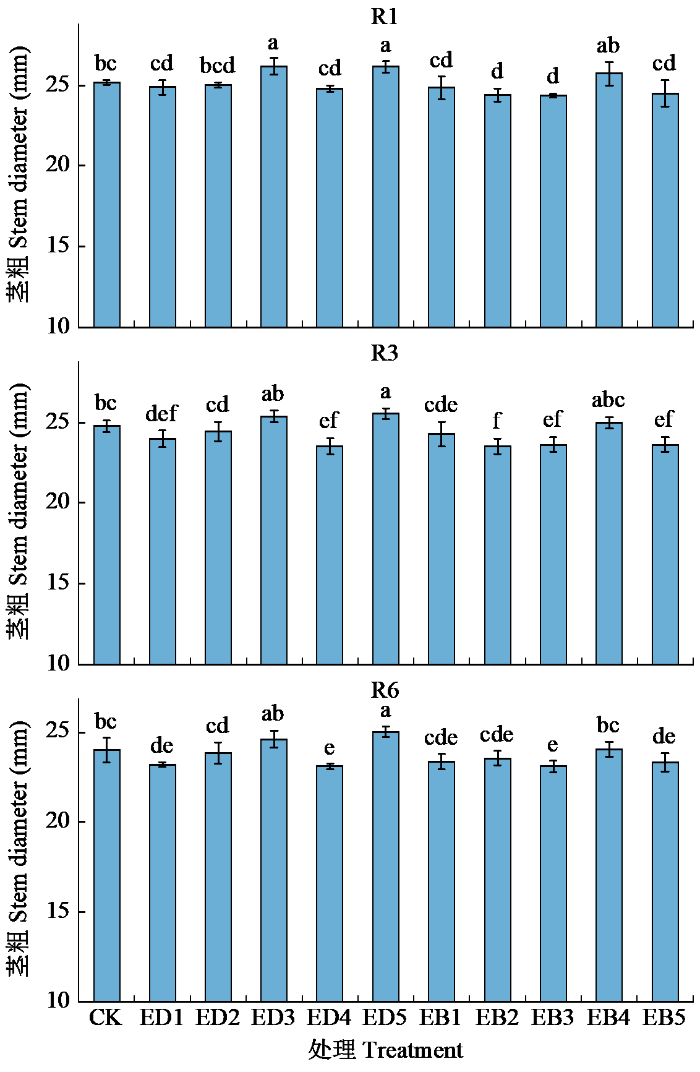
图1
植物生长调节剂复配HA对玉米茎粗的影响
不同小写字母表示在P < 0.05水平差异显著。下同。
Fig.1
Effects of plant growth regulators combined with HA on the stem diameter of maize
Different lowercase letters indicate significant differences at the P < 0.05 level. The same below.
由表2可知,HAC、PGR及HAC×PGR对茎粗均有极显著影响,同时通过偏η2(反应自变量对因变量的影响强度,一般>15%为强效应)可知,对茎粗影响最强的变量为HAC×PGR,其次为PGR,影响最小的为HAC。
表2 植物生长调节剂复配HA对玉米茎粗影响的主体效应检验
Table 2
| 自变量 Independent variable | 因变量 Dependent variable | 平方和 SS | 自由度 df | 均方 MS | F | P | 偏η2 ηp2 (%) |
|---|---|---|---|---|---|---|---|
| HAC | 茎粗Stem diameter | 6.546 | 4.000 | 1.637 | 7.521 | 0.001 | 25.1 |
| PGR | 9.565 | 1.000 | 9.565 | 43.957 | 0.001 | 32.8 | |
| HAC×PGR | 36.179 | 4.000 | 9.045 | 41.564 | 0.001 | 64.9 | |
| 误差Error | 19.585 | 90.000 | 0.218 | ||||
| 总计Total | 71 323.379 | 120.000 |
HAC、PGR、HAC×PGR分别代表HA浓度、植物生长调节剂、HA浓度与植物生长调节剂互作。下同。
HAC, PGR, and HAC×PGR represent HA concentration, plant growth regulator, and the interaction between HA concentration and plant growth regulator, respectively. The same below.
2.1.2 对穿刺强度及压折强度的影响
由图2可知,在R1期,ED2、ED3和ED5处理的穿刺强度较CK处理显著提高5.08%~16.17%,而其他ED组合处理的穿刺强度与CK处理无显著差异,EB3和EB4处理的穿刺强度较CK分别显著提高8.97%和8.08%,而其他EB组合处理与CK间无显著差异;ED3、ED5和EB3处理的压折强度较CK处理分别显著提高了11.95%、9.89%和9.20%,ED1和EB1处理较CK处理分别显著降低4.75%和5.24%。而其余处理与CK处理无显著差异。在R3期,ED2~ED5处理的穿刺强度较CK处理显著提高7.25%~17.01%,EB3和EB4处理的穿刺强度较CK处理显著提高9.16%和10.42%,其他处理的穿刺强度与CK处理均无显著差异;ED3和ED5处理的压折强度较CK处理分别提高17.30%和11.09%,EB2~EB5处理的压折强度较CK处理显著提高4.02%~10.84%,其他处理与CK无显著差异。在R6期,ED3和ED5处理的穿刺强度较CK处理分别提高10.20%和9.12%,EB3和EB4处理的穿刺强度较CK处理分别显著提高6.63%和10.03%,其他处理与CK处理间无显著差异;ED3、ED5和EB3处理的压折强度较CK处理分别显著提高13.01%、11.12%和7.92%,EB1处理的压折强度较CK处理显著降低5.76%,而其他处理与CK间均无显著差异。
图2
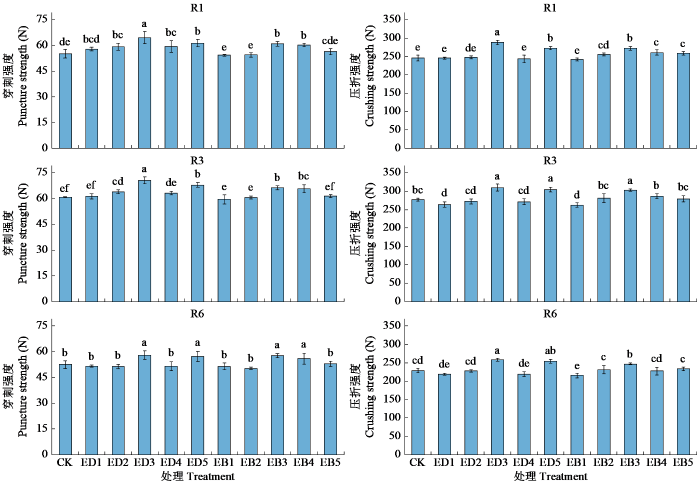
图2
植物生长调节剂复配HA对玉米茎秆强度的影响
Fig.2
Effects of plant growth regulators combined with HA on stalk strength of maize
通过表3可知,HAC、PGR、HAC×PGR对压折强度均有极显著影响,PGR对穿刺强度有显著影响,HAC和HAC×PGR的影响为极显著,此时通过观察偏η2可知HAC对于压折强度及穿刺强度影响最大,其次为HAC×PGR,影响最小的为PGR。
表3 植物生长调节剂复配HA对玉米茎秆强度影响的主体效应检验
Table 3
| 自变量 Independent variable | 因变量 Dependent variable | 平方和 SS | 自由度 df | 均方 MS | F | P | 偏η2 ηp2 (%) |
|---|---|---|---|---|---|---|---|
| HAC | 压折强度 | 744.916 | 4 | 186.229 | 50.943 | 0.001 | 69.4 |
| PGR | 125.495 | 1 | 125.495 | 34.329 | 0.001 | 27.6 | |
| HAC×PGR | 196.968 | 4 | 49.242 | 13.470 | 0.001 | 37.4 | |
| HAC | 穿刺强度 | 21 682.123 | 4 | 5420.531 | 119.971 | 0.001 | 84.2 |
| PGR | 241.117 | 1 | 241.117 | 5.337 | 0.023 | 5.6 | |
| HAC×PGR | 4340.569 | 4 | 1085.142 | 24.017 | 0.001 | 51.6 | |
| 误差Error | 压折强度 | 329.007 | 90 | 3.656 | |||
| 穿刺强度 | 4066.398 | 90 | 45.182 | ||||
| 总计Total | 压折强度 | 420 660.845 | 120 | ||||
| 穿刺强度 | 8 101 603.990 | 120 |
2.2 植物生长调节剂复配HA对玉米籽粒灌浆及产量的影响
2.2.1 对百粒重的影响
如图3所示,随着HA配施浓度的增加,ED和EB处理组合中均表现出两端浓度抑制效应。ED组中ED1较CK处理显著下降3.08%,ED2和ED4处理的百粒重较CK处理分别下降1.52%和1.46%;同处理组中ED3表现最优,百粒重较CK处理显著提高3.95%。EB组中的EB3处理的抑制效应较为显著,其百粒重低于同处理组的EB1及对照组的CK处理,且EB3较CK处理显著降低3.34%,EB4处理表现较佳,较CK处理百粒重提升2.33%。
图3
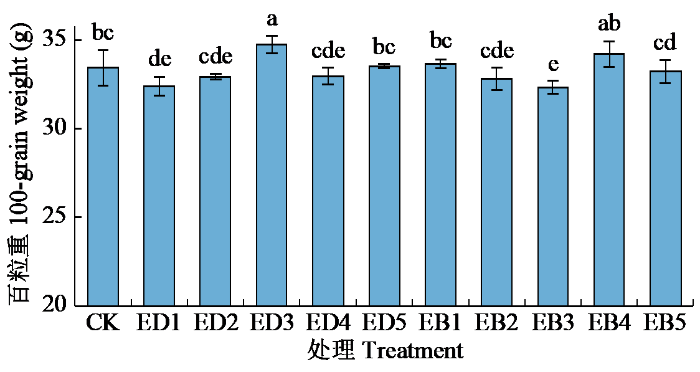
图3
植物生长调节剂复配HA对玉米百粒重的影响
Fig.3
Effects of plant growth regulators combined with HA on 100-grain weight of maize
2.2.2 对籽粒灌浆的影响
如表4模型拟合结果显示,所有处理组的决定系数(R2)均高于0.9(范围0.986~0.997),且相关性分析表明A与百粒重的相关性达极显著(r=0.820,P<0.01),该参数可作为粒重形成的预测指标,证实Richards方程能够精准表征玉米籽粒灌浆动态。
表4 Richards方程及玉米籽粒灌浆参数
Table 4
| 处理 Treatment | Richards方程 Richards equation | 灌浆参数Grain filling parameter | 决定系数 R2 | |||
|---|---|---|---|---|---|---|
| A | B | K | D | |||
| CK | y=34.908/(1+44.694e-0.096t)1/0.639 | 34.908bcd | 44.694 | 0.096 | 0.639 | 0.997 |
| ED1 | y=34.496/(1+1.562e-0.078t)1/0.206 | 34.496cd | 1.562 | 0.078 | 0.206 | 0.992 |
| ED2 | y=34.06/(1+7.554e-0.091t)1/0.547 | 34.060cd | 7.554 | 0.091 | 0.547 | 0.996 |
| ED3 | y=36.473/(1+13.665e-0.099t)1/0.663 | 36.473ab | 13.665 | 0.099 | 0.663 | 0.986 |
| ED4 | y=34.199/(1+3.445e-0.085t)1/0.353 | 34.199cd | 4.753 | 0.903 | 0.401 | 0.993 |
| ED5 | y=35.763/(1+3.168e-0.083t)1/0.339 | 35.763abc | 3.168 | 0.083 | 0.339 | 0.992 |
| EB1 | y=35.247/(1+3.132e-0.082t)1/0.322 | 35.247abcd | 3.132 | 0.082 | 0.322 | 0.994 |
| EB2 | y=33.841/(1+20.511e-0.105t)1/0.771 | 33.841d | 20.511 | 0.105 | 0.771 | 0.994 |
| EB3 | y=34.133/(1+11.597e-0.089t)1/0.672 | 34.133cd | 11.597 | 0.089 | 0.672 | 0.993 |
| EB4 | y=36.889/(1+1.808e-0.075t)1/0.246 | 36.889a | 1.808 | 0.075 | 0.246 | 0.988 |
| EB5 | y=34.582/(1+21.987e-0.098t)1/0.596 | 34.582cd | 21.987 | 0.098 | 0.596 | 0.996 |
不同小写字母表示在P < 0.05水平差异显著。下同。
Different lowercase letters indicate significant differences at the P < 0.05 level. The same below.
如图4所示,ED组与CK处理相比,较低及较高的HA浓度处理均提升了灌浆前中期的灌浆速率,表明在ED组中,HA浓度对灌浆速率具有明显影响,低浓度与高浓度的HA均能在一定程度上促进灌浆前中期的干物质积累。在EB组处理中灌浆速率的峰值并未随着HA浓度的增加有较大的变化,这说明在EB处理中,植物生长调节剂对灌浆速率峰值的调控效应强度要强于HA浓度变化对灌浆速率峰值的影响。综上,ED处理中HA浓度是影响灌浆速率的关键因素,而EB处理中调节剂则为主要影响因素,HA浓度对灌浆速率峰值的影响相对较弱。
图4
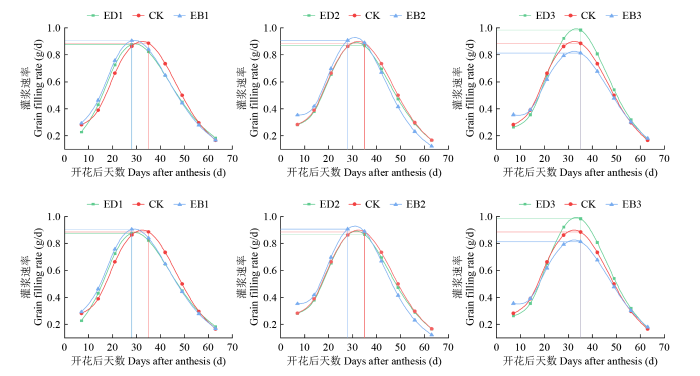
图4
玉米籽粒灌浆拟合方程及灌浆速率曲线
Fig.4
Fitting equations and filling rate curves of maize grain filling
2.2.3 百粒重与灌浆参数相关性
如表5所示,Vmax、Wmax和Va与百粒重呈极显著正相关,W2、V2与百粒重呈显著正相关,W3为影响百粒重的显著负相关参数,相较于灌浆参数W2和V2,提高Vmax、Wmax、Va及降低W3更有利于百粒重的增加。
表5 玉米百粒重与籽粒灌浆参数相关性分析
Table 5
| 指标Index | Vmax | Wmax | Va | W2 | W3 | V2 |
|---|---|---|---|---|---|---|
| 百粒重100-grain weight | 0.486** | 0.397** | 0.390** | 0.321* | -0.320* | 0.371* |
“*”和“**”分别表示在P < 0.05和P < 0.01水平显著相关。
“*”and“**”indicate significant correlation at P < 0.05 and P < 0.01 levels, respectively.
由表6可知,对于灌浆参数Vmax,ED3较CK处理显著提高了7.24%,ED1和ED2分别较CK处理显著降低了4.69%和3.62%,EB1、EB3和EB4分别较CK处理显著降低了4.26%、10.76%和3.94%,其余处理与CK间无显著性差异;对于灌浆参数Wmax,ED3较CK处理显著提高了6.94%,ED1较CK处理显著降低了12.02%,其余处理与CK无显著性差异;对于灌浆参数Va,ED3较CK处理显著提高了7.29%,EB3较CK处理显著降低了10.78%,而其余处理与CK无显著性差异。
表6 植物生长调节剂复配HA对玉米灌浆参数的影响
Table 6
| 处理 Treatment | Tmax (d) | Vmax (g/d) | Wmax (g) | Va (g/d) | D0 (d) | R0 |
|---|---|---|---|---|---|---|
| CK | 28.302ab | 0.939bc | 15.794ab | 0.631ab | 55.651bc | 0.221c |
| ED1 | 25.814e | 0.895d | 13.895c | 0.606bc | 56.971b | 0.411a |
| ED2 | 28.106b | 0.905d | 15.320b | 0.61bc | 55.871b | 0.173de |
| ED3 | 29.531a | 1.007a | 16.890a | 0.677a | 53.852cd | 0.155e |
| ED4 | 26.012de | 0.947bc | 14.711bc | 0.640ab | 53.474d | 0.250c |
| ED5 | 26.677cde | 0.933c | 15.112bc | 0.632ab | 56.979b | 0.250c |
| EB1 | 26.579cde | 0.899d | 15.572b | 0.608bc | 62.261a | 0.380a |
| EB2 | 27.302bcd | 0.948bc | 16.004ab | 0.636ab | 53.404d | 0.149e |
| EB3 | 28.570ab | 0.838e | 15.771ab | 0.563c | 60.784a | 0.141e |
| EB4 | 26.157cde | 0.902d | 15.078bc | 0.612bc | 60.338a | 0.330b |
| EB5 | 27.458bc | 0.961b | 15.558b | 0.647ab | 53.703cd | 0.209cd |
如表7所示,对于灌浆参数W2,EB1、EB3和EB4分别较CK处理显著提高13.27%、5.75%和6.24%,其余处理与CK无显著性差异;对于灌浆参数V2,ED3和EB5分别较CK处理显著提高11.13%和7.16%,而其余处理与CK无显著性差异;对于灌浆参数W3,ED2、EB1和EB3较CK处理分别显著降低8.44%、19.06%和16.89%,其余处理与CK无显著性差异。
表7 植物生长调节剂复配HA对玉米灌浆阶段的影响
Table 7
| 处理 Treatment | 渐增期Gradual increase period | 快增期Rapid increase period | 缓增期Slow increase period | ||||||||
|---|---|---|---|---|---|---|---|---|---|---|---|
| t1 (d) | W1 (g) | V1 (g/d) | t2 (d) | W2 (g) | V2 (g/d) | t3 (d) | W3 (g) | V3 (g/d) | |||
| CK | 15.399b | 4.453bcd | 0.2889b | 26.305de | 20.573cd | 0.782cd | 42.226c | 8.842abc | 0.209bc | ||
| ED1 | 12.268cd | 3.888cd | 0.316b | 27.094cd | 20.982bc | 0.774d | 45.864b | 9.284ab | 0.202bcd | ||
| ED2 | 14.970b | 5.608a | 0.375a | 25.770e | 20.240cd | 0.786cd | 37.661de | 8.096de | 0.215b | ||
| ED3 | 17.259a | 4.997ab | 0.2889b | 24.543ef | 21.321bc | 0.869a | 34.408f | 7.513cd | 0.219b | ||
| ED4 | 13.500c | 4.580bc | 0.338ab | 25.022ef | 19.773d | 0.791cd | 38.997d | 9.511a | 0.247a | ||
| ED5 | 13.272cd | 4.432bcd | 0.336ab | 26.811cd | 20.862bc | 0.779d | 42.881c | 8.766bc | 0.205bcd | ||
| EB1 | 11.898d | 3.964cd | 0.336ab | 29.612a | 23.304a | 0.787cd | 47.663a | 7.157e | 0.150e | ||
| EB2 | 15.257b | 5.220ab | 0.341ab | 24.089f | 19.644d | 0.816bc | 33.023f | 8.656bc | 0.262a | ||
| EB3 | 14.973b | 4.890ab | 0.327ab | 27.695bc | 21.755b | 0.786cd | 39.324d | 7.349e | 0.187cd | ||
| EB4 | 11.854d | 3.689d | 0.315b | 28.605ab | 21.856b | 0.764d | 47.558ab | 8.669bc | 0.183d | ||
| EB5 | 15.126b | 4.923ab | 0.326ab | 24.665ef | 20.671cd | 0.838ab | 36.591e | 8.112cd | 0.222b | ||
2.2.4 对产量及其构成因素的影响
由表8可知,ED3处理的百粒重较CK处理显著提高了3.95%,ED1和EB3处理分别较CK显著降低3.08%和3.34%,其余处理与CK无显著性差异;穗行数各处理与CK均无显著性差异;ED3和EB4的行粒数分别较CK处理显著性提高9.18%和8.26%,其余处理与CK无显著性差异;ED3产量最高,较CK处理显著提高5.40%,其次为EB4,较CK处理显著提高4.69%,ED4和ED5分别较CK处理显著提高1.70%和4.10%,EB1和EB5分别较CK处理显著提高了1.18%和2.19%,ED1和ED2分别较CK处理显著降低2.24%和3.24%,EB2和EB3处理产量虽有降低,但与CK处理间无显著性差异。
表8 植物生长调节剂复配HA对玉米产量及其构成因素的影响
Table 8
| 处理 Treatment | 百粒重 100-grain weight (g) | 穗行数 Kernel rows per ear | 行粒数 Kernels per row | 产量 Yield (kg/hm2) |
|---|---|---|---|---|
| CK | 33.44bc | 16.67a | 36.33bc | 14 581.44d |
| ED1 | 32.41de | 16.00a | 35.33c | 14 082.40f |
| ED2 | 32.93cde | 16.00a | 35.67bc | 14 255.38e |
| ED3 | 34.76a | 16.67a | 39.67a | 15 368.21a |
| ED4 | 32.95cde | 16.67a | 38.33bc | 14 829.57c |
| ED5 | 33.53bc | 16.67a | 37.00b | 15 179.93b |
| EB1 | 33.66bc | 16.67a | 36.33bc | 14 900.96c |
| EB2 | 32.81cde | 16.00a | 35.67bc | 14 453.32d |
| EB3 | 32.32e | 16.67a | 36.00bc | 14 470.56d |
| EB4 | 34.21ab | 16.67a | 39.33a | 15 265.47ab |
| EB5 | 33.23cd | 16.67a | 36.33bc | 14 753.51c |
| HAC | * | ns | ** | ** |
| PGR | ns | ns | * | ** |
| HAC×PGR | ** | ns | * | ** |
“ns”表示无显著差异。
“ns”indicates no significant difference.
3 讨论
本研究表明喷施植物生长调节剂复配HA可以提高玉米茎粗、穿刺强度以及压折强度,并促进籽粒灌浆进程,进而提高产量。HA和植物生长调节剂均可促进作物生长[32-33],提高抗性以促进产量[34]及品质[35]的提升,Khodadadi等[36]发现喷施300 mg/L HA和100 mg/L水杨酸可显著提高甜菜在干旱胁迫下的抗氧化能力,促进糖分积累。李跃伟等[37]研究表明ETH处理能显著增加茎秆粗度,使玉米产量提高15.31%,吴小丹等[38]分别用HA、微生物菌肥和HA+微生物菌肥处理百合,混合处理组的茎粗是对照组的1.57倍,现蕾率是对照组的2.57倍,效果优于单施处理;ETH与DA-6复配通过增加木质素和叶绿素含量提高苯丙氨酸解氨酶和过氧化氢酶活性,降低过氧化物酶活性[39],ETH与BR复配通过增强木质素和纤维素等合成酶的活性及含量缩短节间长度,增加茎粗,显著增强密植玉米茎折强度且提升抗倒伏能力[25]。进一步证实了两者协同对于茎粗及茎秆机械强度的提升作用,本试验结果与上述研究一致,且一定浓度范围内的HA可进一步提高玉米的抗倒伏能力。
喷施植物生长调节剂能减少倒伏风险,同时缩短节间长度以改善光合产物分配,提高籽粒灌浆效率,从而促进产量的提升[40]。李英浩等[41]研究指出,HA可通过提高燕麦叶绿素含量、气孔导度和光合速率提升籽粒灌浆效率、缓解干旱胁迫,协同水分条件促进干物质积累以及增加千粒重来提升产量。赵海燕等[42]对小麦的研究也证实,HA喷施可增加可溶性糖和蛋白质含量、延缓叶片衰老,促进光合产物积累与运输,从而提升籽粒灌浆效率和千粒重,实现高产。Bhuvaneswari等[43]研究发现,HA通过改善土壤环境促进养分吸收及叶绿素合成,微量元素参与光合作用和酶系统激活,植物生长调节剂促进细胞伸长、缩短开花时间并增强光合产物向籽粒的运输,这些因素共同提升干物质生产以影响产量及籽粒灌浆。同时,相关研究[44]表明土壤施用HA结合叶面喷施生长调节剂可显著提高半干旱沙质土壤中小麦的产量,且中等浓度HA配施效果更优,与本试验中不同处理对百粒重及产量的影响趋势一致,且相较于单独使用植物生长调节剂或HA,两者复配使用效果更好,说明植物生长调节剂与HA复配使用存在相互促进的协同作用。值得注意的是,EB处理组中较低HA浓度的处理导致百粒重以及产量方面较同处理EB1有所降低,但随着HA浓度的增加这一现象又得到缓解,导致EB处理产生此种变化的原因可能是HA与BR或ETH两者之一或3种物质混合之后产生拮抗作用,而ED处理组并未表现出此现象。Cacco等[45]提出腐植质中可能含有具有拮抗激素活性的有毒物质,试验中出现此现象的原因是否与之有关需要进一步研究。
刘艳丽等[46]的研究也指出同类处理对不同作物效应存在差异,不同玉米品种对喷施处理的响应是否一致尚需验证。本研究试验数据为1年大田数据,后续研究可通过增加玉米品种和设置种植密度梯度,进一步明确植物生长调节剂与HA复配喷施在高密度种植条件下的应用效果,为玉米高产栽培提供更全面的理论依据。
4 结论
不同植物生长调节剂复配HA喷施玉米可以增加茎粗、茎秆强度及压折强度,提升玉米抗倒伏能力,促进籽粒灌浆阶段的干物质积累,并提高产量。本试验中ETH与DA-6复配400 mg/L HA(ED3)或ETH与BR复配600 mg/L HA(EB4)效果较好,可为高密度种植条件下的玉米种植提供理论依据。
参考文献
Combating dual challenges in maize under high planting density: stem lodging and kernel abortion
DOI:10.3389/fpls.2021.699085
URL
[本文引用: 1]

High plant density is considered a proficient approach to increase maize production in countries with limited agricultural land; however, this creates a high risk of stem lodging and kernel abortion by reducing the ratio of biomass to the development of the stem and ear. Stem lodging and kernel abortion are major constraints in maize yield production for high plant density cropping; therefore, it is very important to overcome stem lodging and kernel abortion in maize. In this review, we discuss various morphophysiological and genetic characteristics of maize that may reduce the risk of stem lodging and kernel abortion, with a focus on carbohydrate metabolism and partitioning in maize. These characteristics illustrate a strong relationship between stem lodging resistance and kernel abortion. Previous studies have focused on targeting lignin and cellulose accumulation to improve lodging resistance. Nonetheless, a critical analysis of the literature showed that considering sugar metabolism and examining its effects on lodging resistance and kernel abortion in maize may provide considerable results to improve maize productivity. A constructive summary of management approaches that could be used to efficiently control the effects of stem lodging and kernel abortion is also included. The preferred management choice is based on the genotype of maize; nevertheless, various genetic and physiological approaches can control stem lodging and kernel abortion. However, plant growth regulators and nutrient application can also help reduce the risk for stem lodging and kernel abortion in maize.
Nitrogen supply regulates vascular bundle structure and matter transport characteristics of spring maize under high plant density
DOI:10.3389/fpls.2020.602739
URL
[本文引用: 1]
Nitrogen (N) fertilizer application greatly enhances grain yield by improving dry matter accumulation and grain filling in spring maize. However, how N application rates regulate the vascular bundle structure, matter transport and grain filling of spring maize under a high planting density has been poorly understood thus far. In this study, we analyzed the relationship between grain filling, vascular bundle structure and matter transport efficiency (MTE) of spring maize in the field. Zhongdan909 (ZD909) was used as the experimental material in a 2-year field experiment from 2015 to 2016, and it was grown under different N levels (0, 150, and 300 kg N ha–1) applied to the grain-filling stage of plots with planting densities of 67,500 plants ha–1 (ND) and 90,000 plants ha–1 (HD). Nitrogen application significantly optimized the structure of the big and small vascular bundles. In particular, there was an increase in the total number of small vascular bundles in the peduncle and cob of the ear system, i.e., increases of 51.8% and 25.7%, respectively, and the proportions of small vascular bundles to the total number of vascular bundles in the peduncle and cob were significantly increased. The root bleeding sap and MTE of maize were significantly increased by N application under both ND and HD, as indicated by the significant increase in the rate of 13C-photosynthate allocation to grain and amount of postsilking dry matter at maturity. Moreover, N application greatly improved the mean grain-filling rate (Gmean) under ND and HD by 30.0% and 36.1%, respectively, and the grain-filling rate increased, leading to a distinct improvement in the grain sink at the grain-filling stage. We concluded that nitrogen application significantly optimized the vascular bundle structure of the ear system, increased the MTE and improved photosynthate distribution to the grain, ultimately enhancing the filling rate and grain yield.
Shading contributes to the reduction of stem mechanical strength by decreasing cell wall synthesis in japonica rice (Oryza sativa L.)
DOI:10.3389/fpls.2017.00881 URL [本文引用: 1]
Manipulation of lignin metabolism by plant densities and its relationship with lodging resistance in wheat
DOI:10.1038/srep41805
PMID:28150816
Increasing plant density is one of the most efficient ways of increasing wheat (Triticum aestivum L.) grain production. However, overly dense plant populations have an increased risk of lodging. We examined lignin deposition during wheat stem development and the regulatory effects of plant density using the wheat cultivars shannong23 and weimai8. Plants were cultivated at densities of 75, 225 and 375 plants per m during two growing seasons. Our results showed that decreasing plant density enhanced culm quality, as revealed by increased culm diameter, wall thickness and dry weight per unit length, and improved the structure of sclerenchyma and vascular bundles by increasing lignification. In addition, more lignins were deposited in the secondary cell walls, resulting in strong lodging resistance. The guaiacyl unit was the major component of lignin and there was a higher content of the syringyl unit than that of the hydroxybenzyl unit. Furthermore, we hypothesised that the syringyl unit may correlate with stem stiffness. We describe here, to the best of our knowledge, the systematic study of the mechanism involved in the regulation of stem breaking strength by plant density, particularly the effect of plant density on lignin biosynthesis and its relationship with lodging resistance in wheat.
Effects of lignin, cellulose, hemicellulose, sucrose and monosaccharide carbohydrates on soybean physical stem strength and yield in intercropping
Relationship between maize stem structural characteristics and resistance to pink stem borer (Lepidoptera: Noctuidae) attack
The pink stem borer, Sesamia nonagrioides (Lefebvre), is one of the most important insect pests of maize (Zea mays L.) in northwestern Spain. The objectives of this work were to evaluate, at different times during the growth of maize, structural traits related to the entry point and tissues on which larvae feed and to determine the relationship between these structural traits and the stem borer resistance. Six inbred lines with different levels of stem resistance to S. nonagrioides were evaluated in several trials. Potential structural resistance factors included rind and pith puncture resistance (RPR and PPR), rind thickness, length of the meristematic area (LMA), and pith parenchyma interlumen thickness (PPIT). Surprisingly, the inbred lines that showed the strongest stalks, EP42 and EP47, were not stem resistant to pink stem borer attack, while the stem resistant inbreds A509, CM151, and PB130 were among the least resistant to rind puncture. There were no significant differences among resistant and susceptible inbreds for the rind thickness. However, the susceptible inbred EP42 had the softest internode pith, and the resistant inbred PB130 showed the hardest, as was expected. Susceptible inbred lines in general showed higher values for the LMA, while the PPIT was important for individual inbreds. The results suggest that the usefulness of these characters as estimators of pink stem borer resistance is limited to some genotypes. Besides, even among those genotypes, other mechanisms of resistance that do not involve stalk strength could be present. Among the traits considered, the LMA was the most promising as an indicator of resistance to pink stem borer, although further experimentation is necessary.
Distributions for European corn borer (Lepidoptera: Pyralidae) resistance ratings of S1 lines from ‘BS9’ corn
DOI:10.1093/jee/79.4.1076 URL [本文引用: 1]
高温胁迫对水稻籽粒灌浆与稻米品质影响及其机理研究进展
DOI:10.3969/j.issn.1006-8082.2024.03.002
[本文引用: 1]
高温胁迫是影响水稻产量和品质形成的主要环境因素之一。本文概述了高温胁迫对水稻籽粒灌浆和稻米品质形成的影响,并从同化物的积累与转运、碳氮代谢关键酶活性、内源激素以及分子机理等方面综述了其生物学机制;讨论了减轻水稻高温危害的关键技术措施和水稻响应高温胁迫机制的重点研究方向,为水稻抗高温育种和栽培提供一定的理论依据。
乙矮合剂对不同施氮量夏玉米根系形态构建和产量的影响
DOI:10.3864/j.issn.0578-1752.2022.24.003
[本文引用: 1]
【目的】根系是玉米获取水分和养分的重要器官,塑造合理的根系结构是发挥玉米高产潜力的关键,也是目前玉米栽培研究中亟待解决的重要科学问题。乙矮合剂和施氮均会影响玉米根系发育,明确乙矮合剂对不同施氮量夏玉米根系形态构建和产量的影响,可为玉米高产高效栽培管理和合理施肥提供理论和技术依据。【方法】2019年和2020年分别在廊坊市燕郊镇大柳店村和北京市顺义区中国农业科学院顺义试验基地开展田间试验,以玉米单交种豫单9953为试验材料,采用裂区试验设计,设置乙矮合剂处理(ECK)和清水对照(CK)为主区;6个施氮水平0(N0)、96(N96)、132(N132)、168(N168)、204(N204)和240 kg·hm<sup>-2</sup>(N240)为副区,研究乙矮合剂对不同施氮量夏玉米根系形态构建和产量的影响。【结果】施氮显著增加了根干重、气生根条数、根长、根表面积和根体积,相比不施氮处理,各施氮量下夏玉米根干重、气生根条数,根长、根表面积和根体积分别平均增加15.0%—25.2%、31.7%—71.7%、15.5%—30.8%、19.0%—40.9%和28.8%—54.0%。ECK处理下夏玉米根干重、根层数、1—2层根和气生根条数相比CK分别增加10.4%—17.0%、5.8%—12.6%、10.8%—3.9%和12.5%—79.6%;在根系形态构建上,相比CK,ECK处理下夏玉米根长、根表面积和根体积分别增加7.5%—21.0%、8.4%—29.3%和14.3%—38.8%,并且在中高氮水平(≥N204)根系直径在1.0 mm以上的根长增幅最大。ECK处理对2019和2020年N0—N168夏玉米单产无显著影响,显著提高了N204和N240夏玉米单产,与CK相比,在N204平均增加6.3%,在N240平均增加3.2%。相关性分析结果表明,夏玉米产量与粒数、千粒重、根长、根表面积和根体积呈极显著正相关,其中产量与根长相关系数最高。【结论】乙矮合剂和施氮协同促进了夏玉米根系发育,并提高了中高氮条件下夏玉米单产,在本试验条件下,6展叶期喷施乙矮合剂配施240 kg·hm<sup>-2</sup>氮肥是适用于环京津地区的夏玉米高产高效栽培技术与氮肥管理方案。
Comparative study on the effects of various plant growth regulators on growth, quality and physiology of Capsicum annuum L.
Exogenously applied plant growth regulators affect heat-stressed rice pollens
DOI:10.1111/jac.2016.202.issue-2 URL [本文引用: 1]
Plant growth regulators enhance maize (Zea mays L.) yield under high density by optimizing canopy structure and delaying leaf senescence
DOI:10.3390/agronomy14061262
URL
[本文引用: 1]
Shaping the canopy architecture and delaying leaf senescence in maize are pivotal strategies for extending the crop’s photosynthetic period and improving yield. The application of plant growth regulators (PGRs) is a critical cultivation measure, with the timing of application being of paramount importance. To explore the effects of PGR application time on maize canopy structure, leaf senescence characteristics and yield, a comparative two-year field study was undertaken during the 2019–2020 growing seasons at the Gongzhuling Experimental Station of the Jilin Academy of Agricultural Sciences, utilizing a PGR containing ethephon as the active ingredient. The experiment was structured with two plant densities of 60,000 and 90,000 plants ha−1, and three distinct PGR application protocols: T10 (application of PGR at the 10th leaf stage), T15 (application at the 15th leaf stage), and CK (control group sprayed with water). The result indicated that the yield increased by 5.62% following T15 treatment compared to the CK under high density (90,000 plants ha−1). Furthermore, the kernel per ear and the 1000-kernel weight increased by 3.93% and 5.62% respectively, while the abortion rate decreased. Correlation analysis showed that yield and yield components were correlated with plant morphology, physiology, and aging characteristics under 90,000 plants ha−1. Pollen density was also positively correlated with the top leaf area and the top leaf angle (p < 0.01). Furthermore, relative green leaf area at maturity (RGLAM) showed positive correlations with chlorophyll b, superoxide dismutase activity (SOD), peroxidase activity (POD), catalase activity (CAT), and soluble protein content (p < 0.01), while displaying a negative correlation with malondialdehyde content (MDA) (p < 0.01). Spraying plant growth regulators at the 15-leaf stage under high density can effectively enhance the top canopy structure of the maize and reduce the upper leaf area and angle, increase pollen density, and boost the number of grains. Furthermore, it delayed the senescence of leaves, prolonged the functional period of the leaves, increased kernel weight, optimized light resource utilization, and ultimately enhanced the maize yield.
Exogenous diethyl aminoethyl hexanoate ameliorates low temperature stress by improving nitrogen metabolism in maize seedlings
DOI:10.1371/journal.pone.0232294 URL [本文引用: 1]
Maize yield and quality in response to plant density and application of a novel plant growth regulator
DOI:10.1016/j.fcr.2014.06.006 URL [本文引用: 1]
WGCNA analysis of the effect of exogenous BR on leaf angle of maize mutant lpa1
DOI:10.1038/s41598-024-55835-7
[本文引用: 1]
Leaf angle, as one of the important agronomic traits of maize, can directly affect the planting density of maize, thereby affecting its yield. Here we used the ZmLPA1 gene mutant lpa1 to study maize leaf angle and found that the lpa1 leaf angle changed significantly under exogenous brassinosteroid (BR) treatment compared with WT (inbred line B73). Transcriptome sequencing of WT and lpa1 treated with different concentrations of exogenous BR showed that the differentially expressed genes were upregulated with auxin, cytokinin and brassinosteroid; Genes associated with abscisic acid are down-regulated. The differentially expressed genes in WT and lpa1 by weighted gene co-expression network analysis (WGCNA) yielded two gene modules associated with maize leaf angle change under exogenous BR treatment. The results provide a new theory for the regulation of maize leaf angle by lpa1 and exogenous BR.
Spraying exogenous 6- benzyladenine and brassinolide at tasseling increases maize yield by enhancing source and sink capacity
DOI:10.1016/j.fcr.2017.05.027 URL [本文引用: 1]
Humic acids: structural properties and multiple functionalities for novel technological developments
Solubility and dissociation of lignitic humic acids in water suspension
DOI:10.1016/j.colsurfa.2004.10.019 URL [本文引用: 1]
Agricultural uses of plant biostimulants
DOI:10.1007/s11104-014-2131-8 URL [本文引用: 1]
Humic and fulvic acids as biostimulants in horticulture
腐植酸对滴灌棉田土壤养分和棉花产量及品质的影响
DOI:10.6048/j.issn.1001-4330.2024.09.005
[本文引用: 1]
【目的】研究滴灌条件下不同用量腐植酸对新疆棉田土壤养分及棉花生长发育的影响,为新疆棉花生产中腐植酸的应用提供理论依据。【方法】采用田间小区试验,设置CK(0 L/hm<sup>2</sup>,不施腐植酸),T<sub>1</sub>(腐植酸225 L/hm<sup>2</sup>),T<sub>2</sub>(腐植酸450 L/hm<sup>2</sup>),T<sub>3</sub>(腐植酸675 L/hm<sup>2</sup>)4个处理,分析其对棉田土壤养分、棉花生长发育、产量与品质的影响。【结果】腐植酸显著增加了土壤养分有效性,施用量675 L/hm<sup>2</sup>时土壤碱解氮含量增加了16.36%~25.66%,有效磷含量增加了23.85%~32.22%,速效钾含量增加了20.15%~29.95%,提高了棉花的光合特性,同一生育期棉花干重和单株叶面积随着腐植酸用量的增加而逐渐增加,在施用量为450 L/hm<sup>2</sup>时对提升棉花株高和茎粗的效果最佳。棉花产量分别增加了18.60%、27.44%、10.61%。提高了棉花品质,施用量450 L/hm<sup>2</sup>提高了棉花马克隆值等级。【结论】施用腐植酸提高了土壤养分有效性,增加了土壤速效养分含量,提高了棉花产量和品质,以施用量为450 L/hm<sup>2</sup>效果最佳。
植物生长调节剂对优质粳稻产量、品质与光合特性的影响
DOI:10.3969/j.issn.1004-1524.20230798
[本文引用: 1]
为探究植物生长调节剂对优质粳稻光合特性、产量与品质的影响,以绥粳18、垦稻12和三江6为试验材料,研究剑叶展开期喷施脱落酸(ABA)、6-苄氨基腺嘌呤(6-BA)、己酸二乙氨基乙醇酯(DA-6)、亚精胺(Spd)、3-吲哚丁酸(IBA)、3,5-二硝基水杨酸(SA)、油菜素内酯(BL)、玉米素(ZT)、三十烷醇(TRIA)、茉莉酸甲酯(MeJA)和N6-呋喃甲基腺嘌呤(KT)对水稻产量、品质和光合特性的影响。结果表明:与对照(CK)相比,喷施BL提高了抽穗后水稻干物质积累和茎鞘物质转运能力,增加了每穗粒重、千粒重、结实率和粒叶比,两年平均增产7.61%;喷施6-BA有利于延长抽穗期至蜡熟期绿叶面积持续期,改善抽穗后光合特性,增加每穗粒数、每穗粒重、千粒重和粒叶比,两年平均增产6.40%;而喷施DA-6、ZT、ABA、Spd、IBA、SA和KT的增产效果存在品种和年份间稳定性差异。在品质上,喷施DA-6和ZT提高了精米率和整精米率,改善了稻米外观品质。综上,剑叶展开期喷施BL和6-BA有利于供试品种增产,而喷施DA-6和ZT则更有利于稳产或增产前提下提质。
Influence of foliar-applied humic acid and some key growth regulators on sugar beet (Beta vulgaris L.) under drought stress: antioxidant defense system, photosynthetic characteristics and sugar yield
种植密度和植物生长调节剂对玉米茎秆性状的影响及调控
DOI:10.3864/j.issn.0578-1752.2019.04.005
[本文引用: 1]
【目的】研究并明确种植密度和植物生长调节剂对玉米茎秆性状的影响,可为合理密植、构建适宜群体结构、实现玉米高产抗逆栽培提供理论依据和技术支撑。【方法】以JK968为试验材料,设置6.0×10 <sup>4</sup>株/hm <sup>2</sup>(D1)、7.5×10 <sup>4</sup>株/hm <sup>2</sup>(D2)和9.0×10 <sup>4</sup>株/hm <sup>2</sup>(D3)3个密度水平,以及乙烯利矮壮素复配剂(EC)和喷施清水为对照(CK)2个处理,研究种植密度对玉米茎秆性状的影响以及茎秆性状对化学调控的响应。 【结果】(1)倒伏率随种植密度增加呈升高趋势,其中在D1密度条件下,JK968的倒伏率分别比D2和D3低69.1%和83.4%;EC处理可显著降低倒伏率,在D1、D2和D3密度条件下分别比对照降低了5.0%、19.8%和41.0%。(2)株高、穗位高、穗位系数和重心高度在不同种植密度和化控处理间均存在极显著差异,具体表现为随种植密度增加呈升高趋势;EC处理后显著降低了地上部第6节以下的节间长度,增加了地上部第7节以上的节间长度,株高和穗位系数略降低,而穗位高和重心高度显著降低。(3)茎秆抗折力和茎秆外皮穿刺强度在不同处理间均存在极显著差异。大喇叭口期至成熟期呈先升高后降低趋势,在乳熟期达最大值。随种植密度增加,地上部第3、4和5节茎秆抗折力和茎秆外皮穿刺强度呈降低趋势;不同节间茎秆抗折力和茎秆外皮穿刺强度表现为地上部第3节>第4节>第5节;EC处理后显著增加了地上部第3、4和5节茎秆抗折力和茎秆外皮穿刺强度。(4)穗粒数和百粒重随种植密度增加呈降低趋势;EC处理后,穗粒数、百粒重和产量均较对照增加。在D1、D2和D3密度条件下,EC处理后产量分别较对照高438.8 kg·hm <sup>-2</sup>、1041.3 kg·hm <sup>-2</sup>和3376.5 kg·hm <sup>-2</sup>,增幅分别为3.6%、8.2%和27.8%。 【结论】随种植密度增加,玉米株高增加、重心高度上移、基部节间伸长、基部节间充实度和抗折力下降。EC处理显著降低了地上部第6节以下的节间长度,显著增加了地上部第7节以上的节间长度,株高略降低,重心高度和穗位高显著降低,基部节间长度缩短、基部节间充实度提高,从而提高了茎秆的抗倒伏能力。由此可见,在风灾倒伏频发地区以及种植密度过大等倒伏风险较大条件下,喷施植物生长调节剂可显著增加玉米茎秆的抗折力和茎秆外皮穿刺强度,显著降低穗位高、重心高度和倒伏率,有利于玉米高产稳产。
水分和腐植酸对燕麦籽粒产量和β-葡聚糖含量的协同提升效应
DOI:10.3724/SP.J.1006.2022.11084
[本文引用: 1]
为明确水分和腐植酸协同作用对燕麦的增产提质效应, 本试验以蒙农大燕1号和内燕5号燕麦品种为研究对象, 分别设置旱作和有限灌溉2个水分处理, 分析喷施腐植酸对燕麦叶片光合特性、籽粒产量和β-葡聚糖含量的影响。结果表明: 孕穗和开花期喷施腐植酸后可以显著提高燕麦叶片的光合特性, 与灌水条件下相比, 蒙农大燕1号叶片的光合速率在旱作条件下的提高幅度更大, 提高了31.78%~123.72%, 而内燕5号在旱作和灌水条件下增幅基本一致; 在旱作条件下喷施腐植酸后两品种籽粒产量和β-葡聚糖含量均显著提高, 尤其以内燕5号的提高幅度更大, 分别提高了5.60%~74.68%和11.24%~19.56%; 与旱作处理相比, 在灌水条件下喷施HA, 两品种籽粒β-葡聚糖含量提高幅度更大, 分别提高了11.30%~33.29%和7.76%~43.81%。通过各指标之间的相关性分析, 蒙农大燕1号品种叶片的光合速率与籽粒β-葡聚糖含量、穗长、单穗小穗数、单穗粒重、千粒重及籽粒产量呈显著正相关关系, 籽粒产量与穗长、单穗小穗数、单穗粒重、千粒重呈显著正相关关系, 籽粒β-葡聚糖与单穗小穗数、千粒重和籽粒产量呈显著正相关关系(P<0.05), 而内燕5号品种籽粒β-葡聚糖含量与各产量构成因子正相关, 但未达到显著水平。综上说明, 水分和腐植酸协同作用可有效改善燕麦叶片的光合性能, 并且协同提高籽粒产量和β-葡聚糖含量。
Evaluation of humic acid, micronutrients mixture and plant growth regulators on growth and quality of bhendi
Integrative soil application of humic acid and foliar plant growth stimulants improves soil properties and wheat yield and quality in nutrient-poor sandy soil of a semiarid region
Plant growth regulator activity of soluble humic complex


