



本研究运用CRISPR/Cas9技术构建了ZmDGK1玉米突变体材料,并对其进行低温胁迫处理。通过测定幼苗存活率、植株形态以及抗性生理生化指标,综合分析其耐低温特性,从功能缺失角度进一步验证了ZmDGK1的功能,明确了ZmDGK1基因在植物低温胁迫反应中的作用机制。
1 材料与方法
1.1 试验材料
以玉米自交系B104为对照材料,以通过CRISPR/Cas9技术敲除ZmDGK1基因的玉米株系(遗传转化受体为B104)为研究对象,开展相关试验。
1.2 试验方法
1.2.1 玉米zmdgk1CR突变体株系的创制
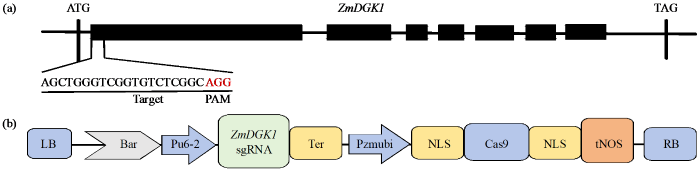
在ZmDGK1基因的编码序列(CDS)第1个外显子中选定靶点。使用targetDesign网站(
图1
1.2.2 zmdgk1CR突变体的基因型鉴定与筛选
取幼苗新鲜叶片,采用CTAB法[15]提取基因组DNA。在ZmDGK1基因编辑靶点上下游约200 bp处设计特异性引物(ZmDGK1靶点F/R),以提取的基因组DNA为模板进行PCR扩增,将PCR产物送至北京华大基因科技有限公司测序,将测序所得峰图上传至DSDecode网站进行解析,旨在分析ZmDGK1靶点的编辑情况和突变类型,从而筛选ZmDGK1纯合突变体。
图2
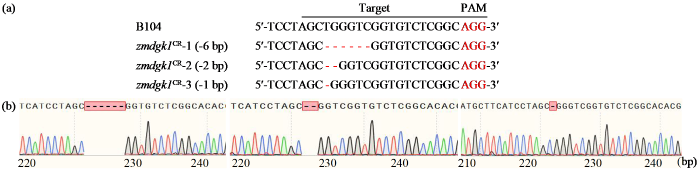
图2
玉米zmdgk1CR株系的基因型鉴定与筛选
Fig.2
Genotype identification and screening of maize zmdgk1CR lines
1.2.3 低温胁迫处理
选取外观一致的玉米种子,置于10% NaClO溶液中消毒30 min,用ddH₂O洗涤5~10次,在蒸馏水中浸泡8 h。将蒸馏水浸湿的纱布铺于催芽盒内,把浸泡好的种子均匀摆放在纱布上,用湿润的纱布覆盖,后用保鲜膜密封盒口,放入人工气候箱(28 ℃)。2 d后挑选芽长一致的种子,使其芽朝上、根朝下,移植到土壤中,培养至植株3叶1心。将在土壤中(25 ℃)生长至2周的玉米幼苗置于4 ℃下进行低温胁迫处理(ST),室温25 ℃处理为对照(CK)。处理4 d时,测定表型和根系指标,并于玉米苗期叶片取样,用液氮快速冷冻后保存于-80 ℃冰箱,用于后续生理指标的测定。之后常温恢复2 d,观察并拍照记录植株生长状况。
1.3 测定指标与方法
1.3.1 表型指标
于处理4 d时,使用直尺测量玉米幼苗的株高和根系总长;剪取地上部和地下部,用滤纸吸干样品表面水分,在分析天平上称量鲜重;将地上部和地下部样品分别置于烘箱中,105 ℃杀青20 min,80 ℃烘干至恒重,再次称量干重。
1.3.2 根系指标
剪取处理4 d后的玉米植株根系,使用WinRHIZO根系扫描仪扫描根系,并分析根系相关指标[16]。
1.3.3 ROS积累水平
使用氮蓝四唑(NBT)和3,3'-二氨基联苯胺(DAB)染液对叶片进行原位浸染,检测ROS积累水平。采用比色法测定超氧阴离子(O2-. )和过氧化氢(H2O2)的含量。使用DGK ELISA试剂盒(MM-6329302,江苏酶免实业有限公司,中国)测定DGK活性。使用NADPH ELISA试剂盒(MM-063102,江苏酶免实业有限公司,中国)测定烟酰胺腺嘌呤二核苷酸磷酸氧化酶(NADPH)活性。
1.3.4 根尖ROS分布
取长约1 cm的根尖样品浸染于10 μmol/L 2′,7′-二氯荧光素二乙酸酯(H2DCF- DA)染色液中,黑暗条件下室温染色10~15 min,染色结束后,用磷酸盐缓冲盐溶液(PBS)和蒸馏水洗涤去除多余染液,滤纸吸干后,使用荧光光谱检测(激发波长/发射波长=504/529 nm),观察根尖ROS(H2DCF-DA)分布并拍照。
1.3.5 抗氧化酶活性
采用紫外分光光度法[17]测定超氧化物歧化酶(SOD)、过氧化物酶(POD)、过氧化氢酶(CAT)和抗坏血酸过氧化物酶(APX)活性。
1.3.6 膜损伤指标
将叶片剪成条状,测定并计算相对电导率[16]。采用比色法测定丙二醛(MDA)含量。将长约1 cm的根尖样品浸染于25 µg/mL碘化丙啶(PI)染色液中染色30 min,用PBS缓冲液洗涤去除多余染液后,置于荧光显微镜下观察根尖细胞膜损伤情况并拍照,激发波长为535 nm,发射波长为615 nm。
1.3.7 渗透调节物质
取0.5 g叶片样品,采用紫外分光光度法测定其脯氨酸(Pro)和可溶性蛋白(SP)含量[18]。
1.3.8 光合色素含量
采用95%乙醇浸染提取法测定玉米幼苗在吸光度(OD)为470、649和665 nm下的数据,代入相应公式计算出叶绿素a、叶绿素b、总叶绿素和类胡萝卜素含量[17]。
2 结果与分析
2.1 低温对玉米zmdgk1CR株系表型及生长指标的影响
图3
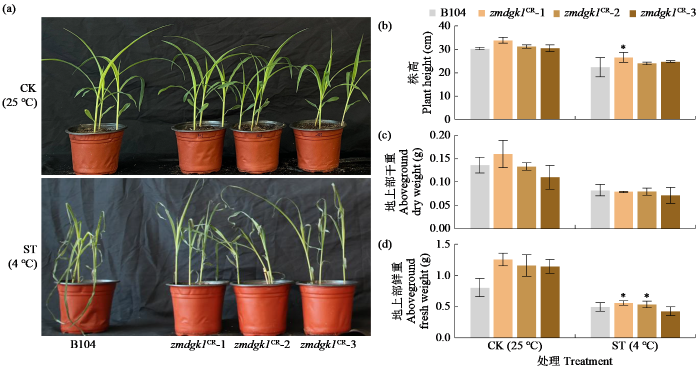
图3
玉米zmdgk1CR株系的耐低温表型及生长指标分析
“*”表示与同处理组中的自交系B104产生显著差异(P < 0.05)。下同。
Fig.3
Analysis of cold-tolerance phenotype and growth indexes of maize zmdgk1CR lines
“*”indicates significant difference from inbred line B104 in the same treatment group (P < 0.05). The same below.
2.2 低温对玉米zmdgk1CR株系根系生长发育的影响
图4
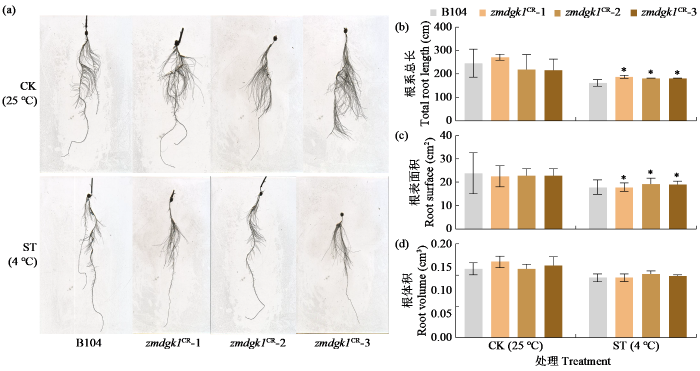
图4
玉米zmdgk1CR株系的根系形态指标分析
Fig.4
Analysis of morphological indexes of the root system of maize zmdgk1CR lines
2.3 低温下ZmDGK1基因缺失对玉米株系ROS积累的影响
低温胁迫下,ROS过度积累会导致植物细胞间的氧化还原状态失衡,进而降低植物的耐低温能力。在CK处理下,各株系叶片经DAB(图5a)和NBT(图5b)浸染后,颜色无明显差异;在ST处理下,相较于B104,3个zmdgk1CR株系叶片的NBT和DAB染色均较浅。进一步测定了玉米各株系中H2O2(图5c)和O2-. (图5d)的含量,结果与染色情况一致。ST处理下,与B104相比,zmdgk1CR-1、zmdgk1CR-2和zmdgk1CR-3中O2-. 含量分别降低了30.71%、24.61%和27.84%,H2O2含量分别降低了0.70%、12.92%和19.32%。DGK活性测定结果如图5e所示,ST处理下zmdgk1CR-1、zmdgk1CR-2和zmdgk1CR-3较B104分别减少了9.97%、10.88%和4.64%。NADPH介导ROS组分H2O2和O2-. 等的产生,ST处理下zmdgk1CR-1、zmdgk1CR-2和zmdgk1CR-3与B104相比分别减少了13.18%、15.92%和23.44%(图5f),表明低温胁迫下NADPH活性的降低可能与DGK活性降低有关。综上,低温胁迫下ZmDGK1基因的缺失可减少ROS的积累。
图5
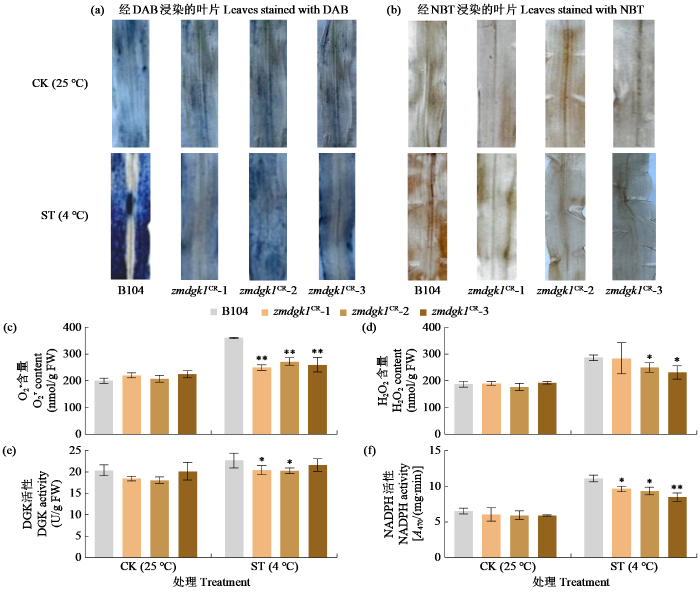
图5
ZmDGK1基因缺失对玉米株系ROS积累及相关指标的影响
“**”表示与同处理组中的自交系B104产生极显著差异(P < 0.01)。下同。
Fig.5
Effects of ZmDGK1 gene deletion on ROS accumulation and related indexes in maize lines
“**”indicates extremely significant difference from inbred line B104 in the same treatment group (P < 0.01). The same below.
2.4 低温对玉米zmdgk1CR株系胚根ROS分布的影响
为进一步证实低温胁迫下ZmDGK1基因缺失会减少ROS积累,将玉米自交系B104和zmdgk1CR株系的胚根进行H2DCF-DA染色,在荧光显微镜下观察各株系根尖的荧光强度。结果(图6)显示,CK处理下各株系玉米胚根的荧光强度均较弱,ST处理下zmdgk1CR各株系的荧光强度较B104更弱,表明低温条件下玉米zmdgk1CR各株系胚根中的ROS积累较少。
图6
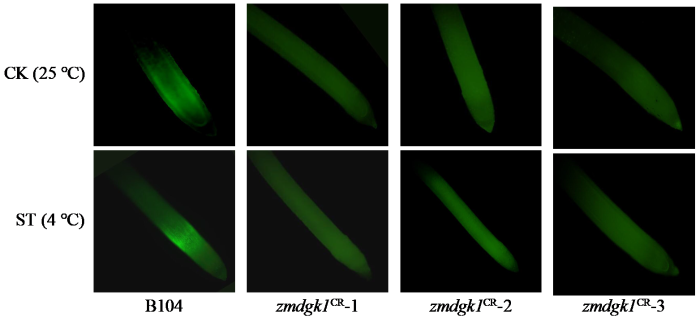
图6
玉米B104和zmdgk1CR株系的ROS分布
Fig.6
ROS distribution of maize B104 and zmdgk1CR lines
2.5 低温对玉米zmdgk1CR株系抗氧化能力的影响
为探究低温条件下ZmDGK1基因缺失导致ROS积累减少是否与植株抗氧化能力有关,对玉米B104和zmdgk1CR株系的SOD、POD、CAT及APX活性进行测定。结果(图7)显示,CK处理下玉米各株系的抗氧化酶活性无显著差异,在ST处理下,zmdgk1CR-1、zmdgk1CR-2和zmdgk1CR-3均较B104有不同程度的升高,其中SOD活性分别提高了19.88%、10.37%和3.31%,POD活性分别提高了1.12%、31.44%和19.81%,CAT活性分别提高了10.25%、25.17%和4.53%,zmdgk1CR-1和zmdgk1CR-3的APX活性分别提高了11.26%和14.18%。综上,低温胁迫下ZmDGK1基因的缺失提高了玉米的抗氧化能力。
图7
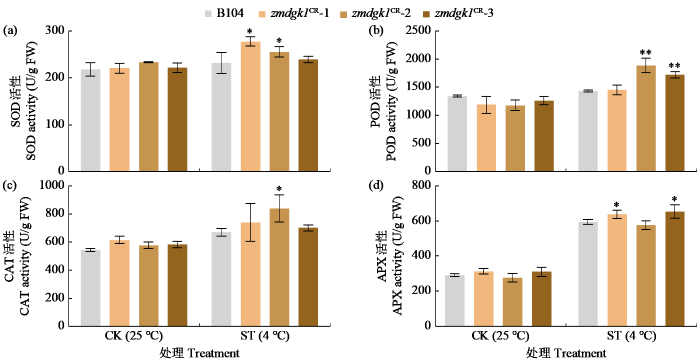
图7
玉米zmdgk1CR株系的抗氧化酶活性分析
Fig.7
Analysis of antioxidant enzyme activities of maize zmdgk1CR lines
2.6 低温对玉米zmdgk1CR株系的细胞膜损伤
相对电导率水平与MDA含量是衡量细胞膜氧化损伤的重要指标。玉米各株系的MDA含量(图8a)和相对电导率(图8b)在CK处理下均处于较低水平,表明细胞膜未受损伤;反之,ST处理下2个指标均出现不同程度的升高,但zmdgk1CR-1、zmdgk1CR-2和zmdgk1CR-3的MDA含量分别较B104低6.49%、18.18%和5.19%,相对电导率分别低26.14%、8.64%和23.11%。各株系的根尖PI染色情况如图8c所示,ST处理下各株系根尖颜色均加深,但zmdgk1CR各株系根尖着色较B104更浅,染色部位更少。综上,ZmDGK1基因的缺失可以降低玉米细胞死亡的发生程度以及细胞膜的损伤程度。
图8
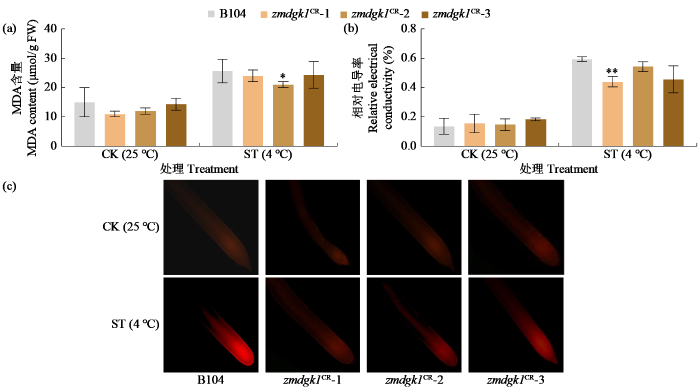
图8
低温对玉米zmdgk1CR株系细胞膜损伤的分析
Fig.8
Analysis of cell membrane damage of maize zmdgk1CR lines under low temperature
2.7 低温对玉米zmdgk1CR株系渗透调节物质含量的影响
如图9所示,ST处理下,zmdgk1CR-1、zmdgk1CR-2和zmdgk1CR-3的SP含量与B104相比分别显著增加24.99%、36.28%和37.12%,Pro含量分别显著增加61.30%、70.98%和64.04%。结果表明低温胁迫下ZmDGK1基因的缺失可增强玉米体内渗透调节作用,提升植物细胞对低温的抗逆能力。
图9
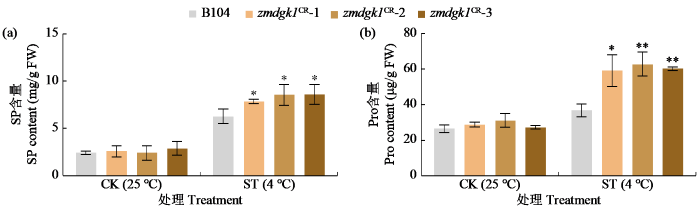
图9
玉米zmdgk1CR株系的渗透调节物质含量
Fig.9
Osmoregulatory substance content of maize zmdgk1CR lines
2.8 低温对玉米zmdgk1CR株系光合指标的影响
如图10所示,ST处理下zmdgk1CR-1和zmdgk1CR-3与B104相比,叶绿素a含量分别增加了17.68%和24.69%,类胡萝卜素含量分别增加了30.14%和27.50%;ST处理下zmdgk1CR-1、zmdgk1CR-2和zmdgk1CR-3与B104相比,叶绿素b含量分别增加了60.07%、55.45%和18.48%,总叶绿素含量分别增加了27.23%、8.78%和23.29%。综上所述,ZmDGK1基因的缺失对玉米植株在低温环境下的光合色素积累具有显著影响。
图10
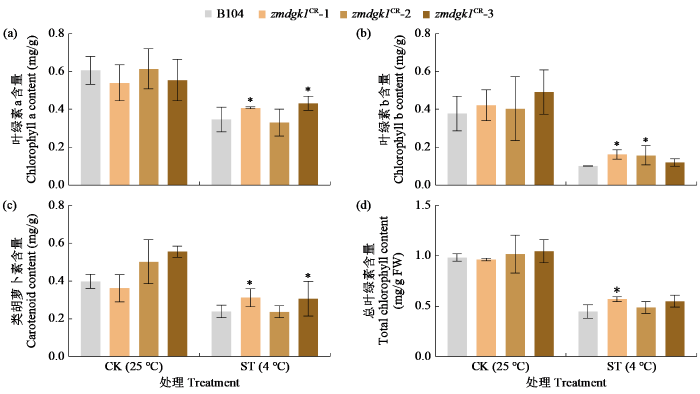
图10
玉米zmdgk1CR株系的光合指标分析
Fig.10
Analysis of photosynthetic indicators of maize zmdgk1CR lines
3 讨论
CRISPR/Cas基因编辑技术能够实现特定基因的敲除、插入与替换,从而精准高效地编辑基因组,该技术已在农作物改良领域得到广泛应用[19]。在实际应用中,利用CRISPR/Cas对特定靶基因进行突变,可影响植物对非生物胁迫的抗性。例如,在拟南芥中,利用CRISPR/Cas9敲除AtWRKY3及其同源基因AtWRKY4后,突变体对ROS的清除能力下降,对茉莉酸甲酯(MeJA)的敏感性增加,耐盐性降低[20];敲除ARF4转录因子则提高了番茄的水分利用效率,敲除株系对盐和渗透胁迫的耐受性增强[21]。本研究采用CRISPR/Cas9技术敲除玉米的ZmDGK1基因,证实ZmDGK1缺失可增强玉米的耐低温性,即ZmDGK1基因对玉米耐低温性起负向调控作用。
低温胁迫会致使植物体内ROS过度累积。在正常温度条件下,植物细胞内的自由基产生与清除处于相对平衡状态。此外,一定水平的ROS对细胞生长、增殖和分化不可或缺,同时其也是植物细胞信号转导过程中的关键信号分子。然而,ROS过度积累会对植物造成不可逆的氧化损伤,严重时甚至引发细胞死亡[22]。本研究发现,ZmDGK1基因缺失可减少玉米幼苗在低温下的ROS积累,增强抗氧化酶活性,这可能是zmdgk1CR突变体呈现耐低温表型的原因。ROS爆发会引发植物膜脂过氧化,造成细胞膜损伤,导致MDA含量升高。本研究通过检测自交系B104和zmdgk1CR株系的MDA含量和相对电导率,并进行PI染色,评估低温对不同玉米株系细胞膜的损伤程度。结果显示,zmdgk1CR各株系的MDA含量和相对电导率均低于B104,表明ZmDGK1基因缺失能够降低玉米细胞死亡及细胞膜损伤程度。
早期针对拟南芥DGK响应非生物胁迫的研究[23]表明,AtDGK2受低温胁迫诱导,参与拟南芥的冷信号转导过程,拟南芥的dgk2、dgk3和dgk5敲除突变体表现出对低温耐受性的提升,同时PA产生量减少,ROS生成降低,进一步增强了其对低温胁迫的耐受能力。另有研究[24]发现,甘油二酯激酶5(DGK5)和PA能与黄质醛脱氢酶(ABA2)相互作用,抑制其酶活性,从而抑制非生物胁迫下拟南芥中脱落酸(ABA)的生成。此外,AtDGK1和AtDGK2在拟南芥的根和叶中显著表达,并在低温胁迫响应中发挥重要作用[14]。DGK基因响应植物耐低温性的机制,维持TAG、DAG和PA的稳态[25]。因此,本研究在明确ZmDGK1响应低温胁迫功能的基础上,为阐释DGK及其产物PA在低温条件下的作用机制提供理论依据,对提高玉米的低温耐受性具有重要意义。
4 结论
采用CRISPR/Cas9技术敲除玉米ZmDGK1基因,获得了zmdgk1CR T3代纯合突变株系。通过对比自交系B104与zmdgk1CR突变株系在低温胁迫下的表型特征,发现低温处理后3个zmdgk1CR株系的玉米幼苗叶片失绿、黄化及萎蔫程度轻于自交系B104,根系生长受抑制程度同样较低。生理指标测定结果显示,ZmDGK1基因缺失可降低玉米幼苗在低温下的ROS积累及细胞膜损伤,同时提高抗氧化酶活性、渗透调节能力及光合作用效率,增强玉米对低温胁迫的耐受性。
参考文献
Maize domestication and gene interaction
DOI:10.1111/nph.2018.220.issue-2 URL [本文引用: 1]
Linking phosphorus availability with photo-oxidative stress in plants
DOI:10.1093/jxb/erv056
PMID:25740928
[本文引用: 1]

Plants have evolved a plethora of mechanisms to circumvent the potential damaging effects of living under low phosphorus availability in the soil. These mechanisms include different levels of organization, from root-shoot signalling at the whole-plant level to specific biochemical responses at the subcellular level, such as reductions in photosynthesis and the consequent activation of photo- and antioxidant mechanisms in chloroplasts. Some recent studies clearly indicate that severe phosphorus deficiency can lead to alterations in the photosynthetic apparatus, including reductions in CO2 assimilation rates, a down-regulation of photosynthesis-related genes and photoinhibition at the photosystem II level, thus causing potential photo-oxidative stress. Photo-oxidative stress is characterized by an increased production of reactive oxygen species in chloroplasts, which at low concentrations can serve a signalling, protective role, but when present at high concentrations can cause damage to lipids, proteins and nucleic acids, thus leading to irreversible injuries. We discuss here the mechanisms that phosphate-starved plants have evolved to withstand photo-oxidative stress, including changes at the subcellular level (e.g. activation of photo- and antioxidant protection mechanisms in chloroplasts), cellular and tissular levels (e.g. activation of photorespiration and anthocyanin accumulation) and whole-plant level (alterations in source-sink relationships modulated by hormones). Of particular importance is the current evidence demonstrating that phosphate-starved plants activate simultaneous responses at multiple levels, from transcriptional changes to root-shoot signalling, to prevent oxidative damage. In this review, we summarize current knowledge about the occurrence of photo-oxidative stress in phosphate-starved plants and highlight the mechanisms these plants have evolved to prevent oxidative damage under phosphorus limitation at the subcellular, cellular and whole-plant levels. © The Author 2015. Published by Oxford University Press on behalf of the Society for Experimental Biology. All rights reserved. For permissions, please email: journals.permissions@oup.com.
施磷水平对不同基因型玉米生理特性及膜保护酶的比较研究
Cold stress regulation of gene expression in plants
DOI:10.1016/j.tplants.2007.07.002
PMID:17855156
[本文引用: 1]
Cold stress adversely affects plant growth and development. Most temperate plants acquire freezing tolerance by a process called cold acclimation. Here, we focus on recent progress in transcriptional, post-transcriptional and post-translational regulation of gene expression that is critical for cold acclimation. Transcriptional regulation is mediated by the inducer of C-repeat binding factor (CBF) expression 1 (ICE1), the CBF transcriptional cascade and CBF-independent regulons during cold acclimation. ICE1 is negatively regulated by ubiquitination-mediated proteolysis and positively regulated by SUMO (small ubiquitin-related modifier) E3 ligase-catalyzed sumoylation. Post-transcriptional regulatory mechanisms, such as pre-mRNA splicing, mRNA export and small RNA-directed mRNA degradation, also play important roles in cold stress responses.
ROS in biotic interactions
DOI:10.1111/ppl.2010.138.issue-4 URL [本文引用: 1]
A gene encoding a phosphatidylinositol-specific phospholipase C is induced by dehydration and salt stress in Arabidopsis thaliana
The plasma membrane-bound phospholipase Dδ enhances freezing tolerance in Arabidopsis thaliana
The Arabidopsis cold- responsive transcriptome and its regulation by ICE1
DOI:10.1105/tpc.105.035568
URL
[本文引用: 1]
To understand the gene network controlling tolerance to cold stress, we performed an Arabidopsis thaliana genome transcript expression profile using Affymetrix GeneChips that contain ∼24,000 genes. We statistically determined 939 cold-regulated genes with 655 upregulated and 284 downregulated. A large number of early cold-responsive genes encode transcription factors that likely control late-responsive genes, suggesting a multitude of transcriptional cascades. In addition, many genes involved in chromatin level and posttranscriptional regulation were also cold regulated, suggesting their involvement in cold-responsive gene regulation. A number of genes important for the biosynthesis or signaling of plant hormones, such as abscisic acid, gibberellic acid, and auxin, are regulated by cold stress, which is of potential importance in coordinating cold tolerance with growth and development. We compared the cold-responsive transcriptomes of the wild type and inducer of CBF expression 1 (ice1), a mutant defective in an upstream transcription factor required for chilling and freezing tolerance. The transcript levels of many cold-responsive genes were altered in the ice1 mutant not only during cold stress but also before cold treatments. Our study provides a global picture of the Arabidopsis cold-responsive transcriptome and its control by ICE1 and will be valuable for understanding gene regulation under cold stress and the molecular mechanisms of cold tolerance.
Rapid phosphatidic acid accumulation in response to low temperature stress in Arabidopsis is generated through diacylglycerol kinase
Activation of phospholipases C and D is an early response to a cold exposure in Arabidopsis suspension cells
The signaling events generated by a cold exposure are poorly known in plants. We were interested in checking the possible activation of enzymes of the phosphoinositide signaling pathway in response to a temperature drop. In Arabidopsis suspension cells labeled with (33)PO(4)(3-), a cold treatment induces a rapid increase of phosphatidic acid (PtdOH) content. This production was due to the simultaneous activation of phospholipase C (through diacylglycerol kinase activity) and phospholipase D, as monitored by the production of inositol triphosphate and of transphosphatidylation product, respectively. Moreover, inhibitors of the phosphoinositide pathway and of diacylglycerol kinase reduced PtdOH production. Enzyme activation occurred immediately after cells were transferred to low temperature. The respective contribution of both kind of phospholipases in cold-induced production of PtdOH could be estimated. We created conditions where phospholipids were labeled with (33)PO(4)(3-), but with ATP being nonradioactive. In such conditions, the apparition of radioactive PtdOH reflected PLD activity. Thus, we demonstrated that during a cold stress, phospholipase D activity accounted for 20% of PtdOH production. The analysis of composition in fatty acids of cold-produced PtdOH compared with that of different phospholipids confirmed that cold-induced PtdOH more likely derived mainly from phosphoinositides. The addition of chemical reagents modifying calcium availability inhibited the formation of PtdOH, showing that the cold-induced activation of phospholipase pathways is dependent on a calcium entry.
Transcriptional regulatory network of plant cold-stress responses
DOI:10.1016/j.tplants.2022.01.008 URL [本文引用: 1]
Disruption of the Arabidopsis defense regulator genes SAG101, EDS1, and PAD4 confers enhanced freezing tolerance
DOI:10.1016/j.molp.2015.06.009 URL [本文引用: 1]
Diacylglycerol acyltransferase and diacylglycerol kinase modulate triacylglycerol and phosphatidic acid production in the plant response to freezing stress
DOI:10.1104/pp.18.00402 URL [本文引用: 2]
Extraction of DNA from milligram amounts of fresh, herbarium and mummified plant tissues
DOI:10.1007/BF00020088
PMID:24306565
[本文引用: 1]
We have developed a DNA extraction procedure for milligram amounts of plant tissue. Yields ranged from 0.3-200 nanograms of DNA per milligram of tissue. The factors affecting yield are discussed. Fresh tissue, as well as herbarium specimens (22-118 years old) and mummified seeds and embryos (500 to greater than 44 600 years old) were used. All tissues attempted (57 types from 29 species) yielded measurable amounts of DNA. In no case tested was inhibition observed for restriction enzymes BamHI or EcoRI.
NADPH oxidase activity in pollen tubes is affected by calcium ions, signaling phospholipids and Rac/Rop GTPases
DOI:10.1016/j.jplph.2012.05.014
PMID:22762791
[本文引用: 1]
Reactive oxygen species (ROS) generated by NADPH oxidase (NOX) are crucial for tip growth of pollen tubes. However, the regulation of NOX activity in pollen tubes remains unknown. Using purified plasma membrane fractions from tobacco and olive pollen and tobacco BY-2 cells, we demonstrate that pollen NOX is activated by calcium ions and low abundant signaling phospholipids, such as phosphatidic acid and phosphatidylinositol 4,5-bisphosphate in vitro and in vivo. Our data also suggest possible synergism between Ca(2+) and phospholipid-mediated NOX activation in pollen. Rac/Rop small GTPases are also necessary for normal pollen tube growth and have been proposed to regulate ROS production in root hairs. We show here elevated ROS formation in pollen tubes overexpressing wild-type NtRac5 and constitutively active NtRac5, while overexpression of dominant-negative NtRac5 led to a decrease of ROS in pollen tubes. We also show that PA formed by distinct phospholipases D (PLD) is involved in pathways both upstream and downstream of NOX-mediated ROS generation and identify NtPLDδ as a PLD isoform acting in the ROS response pathway.Copyright © 2012 Elsevier GmbH. All rights reserved.
Tomato SlMAPK3 modulates cold resistance by regulating the synthesis of raffinose and the expression of SlWRKY46
DOI:10.1021/acs.jafc.3c09066 URL [本文引用: 1]
Genome editing to integrate seed size and abiotic stress tolerance traits in Arabidopsis reveals a role for DPA4 and SOD7 in the regulation of inflorescence architecture
DOI:10.3390/ijms20112695
URL
[本文引用: 1]
Both seed size and abiotic stress tolerance are important agronomic traits in crops. In Arabidopsis, two closely related transcription repressors DPA4 (Development-Related PcG Target in the APEX4)/NGAL3 and SOD7 (Suppressor of da1-1)/NGAL2 (NGATHA-like protein) function redundantly to regulate seed size, which was increased in the dpa4 sod7 double mutants. Whereas ABA-induced transcription repressors (AITRs) are involved in the regulation of ABA signaling and abiotic stress tolerance, Arabidopsis aitr2 aitr5 aitr6 (aitr256) triple mutant showed enhanced tolerance to drought and salt. Here we performed CRISPR/Cas9 genome editing to disrupt DPA4 and SOD7 in aitr256 mutant, trying to integrate seed size and abiotic stress tolerance traits in Arabidopsis, and also to examine whether DPA4 and SOD7 may regulate other aspects of plant growth and development. Indeed, seed size was increased in the dpa4 sod7 aitr256 quintuple mutants, and enhanced tolerance to drought was observed in the mutants. In addition, we found that shoot branching was affected in the dpa4 sod7 aitr256 mutants. The mutant plants failed to produce secondary branches, and flowers/siliques were distributed irregularly on the main stems of the plants. Floral organ number and fertility were also affected in the dpa4 sod7 aitr256 mutant plants. To examine if these phenotypes were dependent on loss-of-function of AITRs, dpa4 sod7 double mutants were generated in Col wild type background, and we found that the dpa4 sod7 mutant plants showed a phenotype similar to the dpa4 sod7 aitr256 quintuple mutants. Taken together, our results indicate that the integration of seed size and abiotic stress tolerance traits by CRISPR/Cas9 editing was successful, and our results also revealed a role of DPA4 and SOD7 in the regulation of inflorescence architecture in Arabidopsis.
Down regulation and loss of Auxin Response Factor 4 function using CRISPR/Cas 9 alters plant growth, stomatal function and improves tomato tolerance to salinity and osmotic stress
DOI:10.3390/genes11030272 URL [本文引用: 1]
AtDGK2, a novel diacylglycerol kinase from Arabidopsis thaliana, phosphorylates 1-stearoyl-2-arachidonoyl-sn-glycerol and 1,2-dioleoyl-sn-glycerol and exhibits cold-inducible gene expression
DOI:10.1074/jbc.M312187200 URL [本文引用: 1]
Triacylglycerol synthesis by PDAT1 in the absence of DGAT1 activity is dependent on re-acylation of LPC by LPCAT2
DOI:10.1186/1471-2229-12-4
[本文引用: 1]
The Arabidopsis thaliana dgat1 mutant, AS11, has an oil content which is decreased by 30%, and a strongly increased ratio of 18:3/20:1, compared to wild type. Despite lacking a functional DGAT1, AS11 still manages to make 70% of WT seed oil levels. Recently, it was demonstrated that in the absence of DGAT1, PDAT1 was essential for normal seed development, and is a dominant determinant in Arabidopsis TAG biosynthesis.
Lipid phosphorylation by a diacylglycerol kinase suppresses ABA biosynthesis to regulate plant stress responses
DOI:10.1016/j.molp.2024.01.003
PMID:38243594
[本文引用: 1]
Lipid phosphorylation by diacylglycerol kinase (DGK) that produces phosphatidic acid (PA) plays important roles in various biological processes, including stress responses, but the underlying mechanisms remain elusive. Here, we show that DGK5 and its lipid product PA suppress ABA biosynthesis by interacting with ABA-DEFICIENT 2 (ABA2), a key ABA biosynthesis enzyme, to negatively modulate plant response to abiotic stress tested in Arabidopsis thaliana. Loss of DGK5 function rendered plants less damaged, whereas overexpression (OE) of DGK5 enhanced plant damage to water and salt stress. The dgk5 mutant plants exhibited decreased total cellular and nuclear levels of PA with increased levels of diacylglycerol, whereas DGK5-OE plants displayed the opposite effect. Interestingly, we found that both DGK5 and PA bind to the ABA-synthesizing enzyme ABA2 and suppress its enzymatic activity. Consistently, the dgk5 mutant plants exhibited increased levels of ABA, while DGK5-OE plants showed reduced ABA levels. In addition, we showed that both DGK5 and ABA2 are detected in and outside the nuclei, and loss of DGK5 function decreased the nuclear association of ABA2. We found that both DGK5 activity and PA promote nuclear association of ABA2. Taken together, these results indicate that both DGK5 and PA interact with ABA2 to inhibit its enzymatic activity and promote its nuclear sequestration, thereby suppressing ABA production in response to abiotic stress. Our study reveals a sophisticated mechanism by which DGK5 and PA regulate plant stress responses.Copyright © 2024 The Author. Published by Elsevier Inc. All rights reserved.
Carbon dioxide treatment modulates phosphatidic acid signaling and stress response to improve chilling tolerance and postharvest quality in paprika


