



种子休眠形成于胚胎发育的成熟阶段,是指完整有活力的种子成熟后即使处于适宜的环境条件下,仍在一段时间内无法萌发的现象[10]。在农业生产中,休眠强的种子可能导致发芽延迟或出苗不整齐,而低休眠的种子在高温、高湿环境下容易发生收获前发芽,即穗发芽(pre-harvest sprouting,PHS)[11]。种子休眠是植物适应环境变化的重要生理机制,其精确调控对农业生产具有重要意义。DOG1基因是在拟南芥中发现的首个控制休眠的数量性状位点,在诱导种子休眠过程中起重要作用。随着种子成熟度的增加,DOG1蛋白水平与拟南芥种子休眠深度呈正相关[12]。DOG1属于一个小基因家族,普遍存在于双子叶和单子叶植物中,在拟南芥中包括5个成员(AtDOG1,AtDOG1L1-4)[12],其中只有AtDOG1参与种子的休眠。而谷物中的DOG1L1-4在拟南芥中异位表达时,能诱导种子休眠,表现出一定的功能保守性[13]。在水稻中存在多个DOG1的同源基因(OsDOG1L1-5)[13],其中OsDOG1L-1位于1号染色体上,由2个外显子构成,OsDOG1L-2位于5号染色体上,不具有内含子。二者与调控种子休眠与萌发的拟南芥AtDOG1基因和小麦TaDOG1L4基因之间存在3个相同的保守域,但这4个基因的同源性较低[14]。
为了探索水稻OsDOG1-like的功能,Wang等[15]通过在非休眠品种南粳35中用玉米泛素启动子过表达强休眠品种N22的OsDOG1L-1、OsDOG1L-2和OsDOG1L-3等位基因,相对于对照,过表达OsDOG1L-3的转基因植株种子的休眠性得到了大大提高;而OsDOG1L-1和OsDOG1L-2的过表达OE植株的萌发势差异不大。其研究结果表明OsDOG1L-3可通过增强ABA合成酶的转录水平以提高种子中ABA含量,且能增加OsABI3、OsABI5等ABA信号转导成员的转录水平,导致ABA敏感性提高。
张洋洋[14]通过比较弱休眠品种9311和强休眠品种东乡野生稻胚中OsDOG1L-1和OsDOG1L-2的表达量变化,发现OsDOG1L-2的表达量在2个品种的胚中具有显著差异。在胚胎发育阶段,东乡野生稻OsDOG1L-2的转录表达远高于9311。在东乡野生稻的胚中,随发育成熟OsDOG1L-2表达量逐渐增加(花后30 d是15 d的4倍),在胚乳中不具有这种趋势,这与种子休眠的建立是同步的。在萌发阶段,强休眠的东乡野生稻胚中OsDOG1L-2的表达量明显高于9311,表明OsDOG1L-2的表达与强休眠呈正相关。OsDOG1L-1表达规律则与OsDOG1L-2相反,它在胚胎发育后期呈降低趋势,在萌发阶段弱休眠品种9311中反而有显著的高表达。
OsDOG1L-2表达的时空特异性及OsDOG1L-3强启动子驱动过表达能增强转基因植株的种子休眠均显示,它们与水稻种子休眠正相关[15]。而OsDOG1L-1可能与种子休眠特性无明显的关联。为了克服基因家族间潜在的功能冗余,本研究构建了osdog1l-2/3双突变体,并在此基础上敲除OsDOG1L-1基因,创制了osdog1l-1/2/3三突变体。与日本晴WT浸种第10天的萌发率(72.92%)相比,osdog1l-2/3和osdog1l-1/2/3的萌发率分别降至16.67%和8.33%。这些被认为与休眠呈正相关的基因突变体反而出现了萌发势的下降。因此,我们对突变体胚胎做了TTC染色活力检测,并使用GA3和GA4+7处理,观察其萌发势变化,发现osdog1l-2/3双突变体萌发率有明显的增加,而osdog1l-1/2/3的萌发率几乎不受影响。本试验发现,OsDOG1-like1对水稻种子萌发在响应GA信号时至关重要,甚至影响水稻种子的正常萌发。这对认识水稻OsDOG1- like基因家族成员调控种子休眠和萌发具有较大的推动意义。
1 材料与方法
1.1 试验材料
以新鲜收获、储藏5周的日本晴背景(Nipponbare,Nip)WT、osdog1l-2单突变体(YN-49,YN-56)水稻种子,以及储藏6个月的WT、osdog1l-2/3双突变体(ZKY-75)和osdog1l- 1/2/3三重突变体(ZKY-74)水稻种子为材料。水稻材料种植于海南陵水的中国科学院南繁基地和四川轻化工大学酿酒专用水稻实验室。用于萌发试验的水稻种子均为同一时间同一生长条件下收获。
1.2 试验方法
1.2.1 osdog1-like突变体的构建与鉴定
通过NCBI查询获得OsDOG1L-1(LOC_Os01g06560)、OsDOG1L-2(LOC_Os05g48650)和OsDOG1L-3(LOC_Os01g20030)的CDS,CRISPR/Cas9基因编辑的靶点分别设计在OsDOG1L-1的第1个外显子和OsDOG1L-3的第2个外显子,序列如表1。
表1 水稻OsDOG1-like家族基因编辑的靶点序列
Table 1
| 靶点名称Target name | 序列(5′-3′)Sequence (5′-3′) |
|---|---|
| OsDOG1L-1 target 1 | TTGGCGAACGACTCGCCGGAGGG |
| OsDOG1L-2 target 1 | CCTCTGGCTCCGCGGGCTGCGGG |
| OsDOG1L-3 target 1 | GACGAACGGGCGGCGTATTATGG |
通过CRISPR/Cas9基因编辑技术创制osdog1l-2和osdog1l-3单突变体,通过水稻杂交技术创制osdog1l-2/3双突变体F1代,并在F2中测序鉴定2个位点的纯合子。以单株DNA为模板进行PCR扩增,对PCR扩增产物进行琼脂糖凝胶电泳。将扩增成功的PCR产物送至生工生物工程(上海)股份有限公司,使用其上游引物进行测序。其检测引物如表2所示。使用DNAS-TAR Lasergene的Seq Man软件分析测序结果。在双突变体材料(筛选到纯合子名称为osdog5-4和osdog8-1)基础上,挑选不含Cas9插入的单株。使用胚胎组织形成的愈伤作为受体,进行遗传转化,敲除OsDOG1L-1基因,创制osdog1l-1/2/3三重突变体。
表2 OsDOG1-like基因家族成员鉴定所用引物及序列
Table 2
| 基因名称 Gene name | 引物名称 Primer name | 引物序列(5'-3') Primer sequence (5'-3') |
|---|---|---|
| OsDOG1L-1 | DOG1L1-F1 | GGCCACCAGTATTTTCTCTGC |
| DOG1L1-R1 | CGCACCAGAGGTAGAGGTTCT | |
| OsDOG1L-2 | Sg7047-F1 | CACCTATCGCCTCCTCAT |
| Sg7047-R1 | GCCGACAGCGTCCACACC | |
| OsDOG1L-3 | GP7029-5796-F | CTCGCCTCGTCTCTTCCTTC |
| GP7029-5796-R | CACGCCCAGAGGAAGGTG |
1.2.2 突变体种子的萌发率
选取新鲜收获和储藏5周后的WT和osdog1l-2单突变体(YN-49、YN-56)水稻种子、新鲜收获的WT和osdog1l-3单突变体(A9-83)种子。用1% NaClO溶液消毒15 min,无菌水清洗4~5次,将种子放置于铺有滤纸的培养皿内(每皿30颗),加入5 mL无菌水。每2 d更换一次无菌水,每组设置3个生物学重复,于25 ℃恒温培养箱内,12 h光照/12 h黑暗循环培养。每隔24 h定时记录萌发数,以胚根突破种皮长度≥2 mm计作萌发,萌发率(%)=正常萌发的种子数/供试种子总数×100。选取储藏6个月后的WT、ZKY-75和ZKY-74水稻种子,种子消毒方法同前。将种子置于6孔板内(每孔16颗),加入2 mL无菌水,每组设置3个生物学重复。温度、光照条件和记录方法同上。
1.2.3 浸种后GA3和GA4+7处理的方法
选取储藏6个月后的ZKY-75和ZKY-74种子,种子消毒方法同上。将种子置于6孔板内(每孔16颗),分别加入2 mL 0.1、1.0、10.0 μmol/L的GA3和GA4+7溶液进行处理,每组设置3个生物学重复。温度、光照条件和记录方法同上。
1.2.4 突变体种子的活力
选取储藏6个月后的WT、ZKY-75和ZKY-74种子各20粒。30 ℃温水浸泡2~6 h,使种子吸胀。吸胀种子去壳,纵切,于TTC染色液中35 ℃恒温处理2~3 h,光学显微镜下拍照记录。当整个种子胚胎染成红色时判定为种子活力强,淡红色为活力弱,无色(或发白)判定为无活力。将对照组于105 ℃烘干2 h,进行种子灭活,随后采用同样的方法进行TTC染色检测。
2 结果与分析
2.1 OsDOG1-like家族成员基因型鉴定
对OsDOG1-like基因家族基因编辑苗的T2代植株进行鉴定,如图1所示。单突变体YN-49和YN-56的OsDOG1L-2基因分别缺失CGCGGGC(-7 bp)和缺失GCTCCGCGGGCTG(-13 bp)纯合,鉴定为osdog1l-2单突变的纯合子;A9-83在OsDOG1L-3位点缺失CGTA(-4 bp)纯合,鉴定为osdog1l-3单突变的纯合子;ZKY-75在OsDOG1L-2和OsDOG1L-3位点分别缺失CGCGGGC(-7 bp)和CGTA(-4 bp),且已经纯合,鉴定为osdog1l-2/3的双突纯合子;ZKY-74除在OsDOG1L-2和OsDOG1L-3位点发生相同的变异,在OsDOG1L-1位点插入G(+1 bp)且纯合,为osdog1l-1/2/3的三突纯合子。
图1
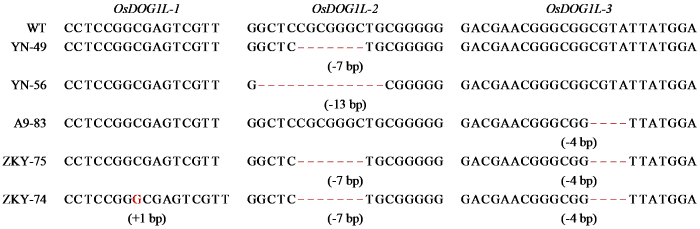
图1
OsDOG1-like基因家族成员突变类型的鉴定
OsDOG1L-1基因ID为LOC_Os01g06560、OsDOG1L-2基因ID为LOC_Os05g48650、OsDOG1L-3基因ID为LOC_Os01g20030。
Fig.1
Identification of mutation types of OsDOG1-like gene family members
The gene ID of OsDOG1L-1 is LOC_Os01g06560, the gene ID of OsDOG1L-2 is LOC_Os05g48650, the gene ID of OsDOG1L-3 is LOC_Os01g20030.
2.2 osdog1l-2单突纯合子种子萌发率的变化
图2
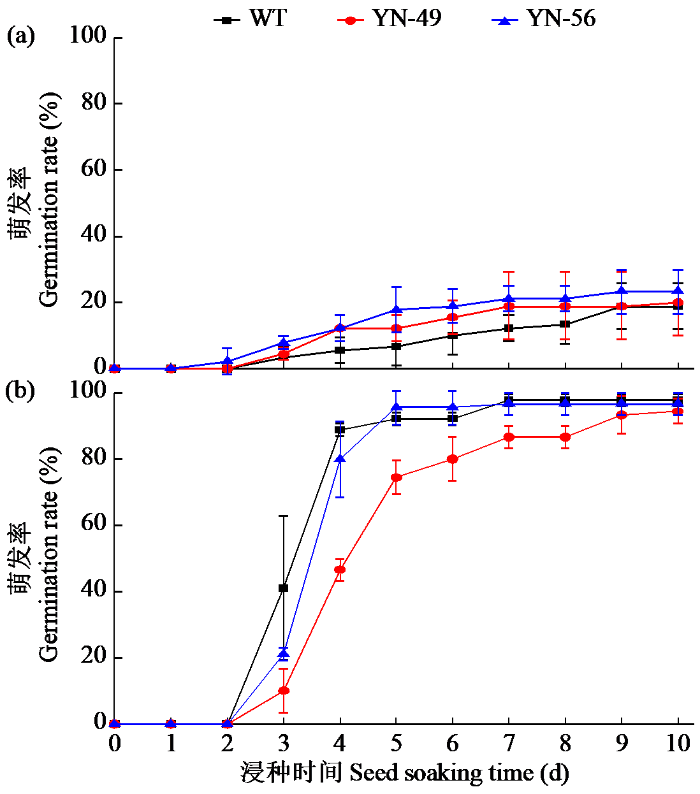
图2
osdog1l-2单突变体种子萌发势的比较
Fig.2
Comparison of seed germination potential of osdog1l-2 single mutant
2.3 osdog1l-3单突纯合子种子萌发率的变化
图3
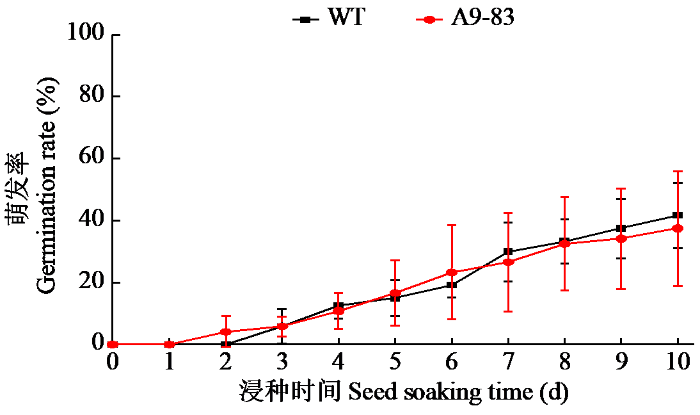
图3
osdog1l-3单突变体种子萌发势的比较
Fig.3
Comparison of seed germination potential of osdog1l-3 single mutant
2.4 osdog1l-2/3和osdog1l-1/2/3纯合子种子萌发率的变化
对杂交后代进行单株叶片的DNA提取,测序鉴定,发现如图1所示ZKY-75为osdog1l-2/3的双突纯合子,而ZKY-74为osdog1l-1/2/3的三突纯合子。由图4可知,种子被收获并储藏6个月左右,在浸种第10天(day after imbibition-10,以下简称DAI-10),WT的萌发率最高(72.92%),ZKY-75的萌发率较低(16.67%),ZKY-74的萌发率更低(8.33%)。说明随着OsDOG1-like家族更多成员的移码突变,其种子的活力逐步降低,更加不耐受储藏。这与拟南芥dog1-1种子寿命缩短的表型有一定相似性[13],暗示了水稻osdog1-like突变体种子在成熟发育方面也有一定的缺陷。结合osdog1l-2和osdog1l-3单突变体种子的萌发率与WT接近,而osdog1l-2/3(ZKY-75)萌发率明显不同于WT,这反映了OsDOG1-L2与OsDOG1-L3基因突变具有一定的加性效应。如果能将OsDOG1-L2或OsDOG1-L3的互补表达载体转入osdog1l-2/3,均能恢复萌发率低的表型,则可揭示二者存在功能上的冗余。
图4
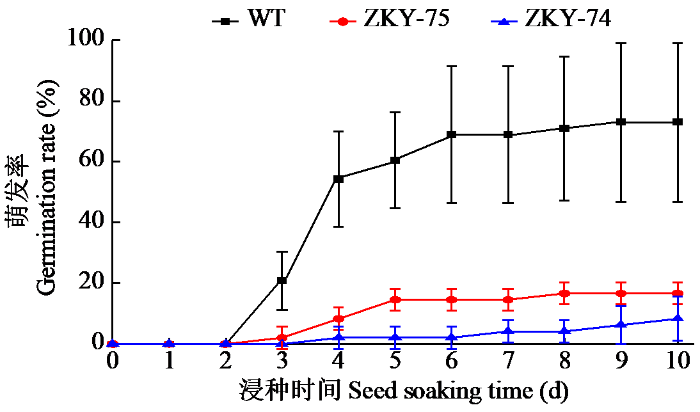
图4
osdog1l-2/3双突变体与osdog1l-1/2/3三重突变体种子萌发势的比较
Fig.4
Comparison of seed germination potential between osdog1l-2/3 double mutant and osdog1l-1/2/3 triple mutant
2.5 osdog1l-2/3双突变体种子萌发率对GA信号处理的响应情况
图5
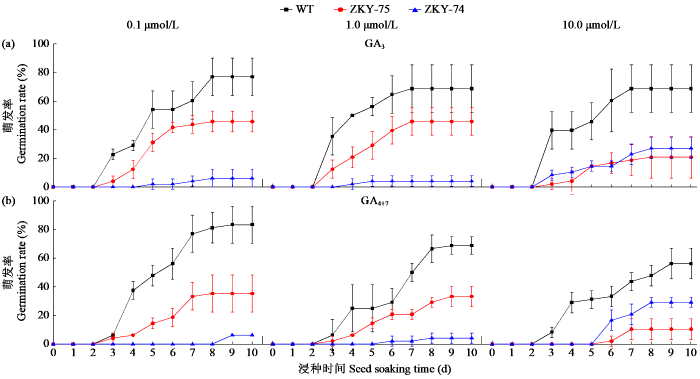
图5
GA处理下osdog1l-2/3双突变体与osdog1l-1/2/3三重突变体种子萌发率的比较
Fig.5
Comparison of seed germination rate of osdog1l-2/3 double mutants and osdog1l-1/2/3 triple mutants under GA treatment
2.6 osdog1l-1/2/3三重突变体种子萌发率对GA信号处理的响应情况
图6
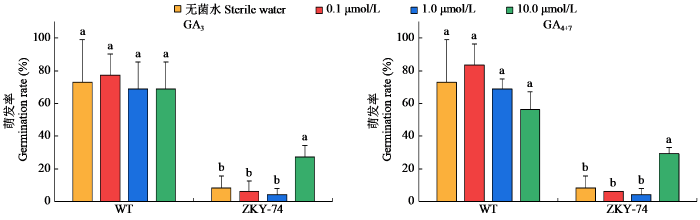
图6
不同GA浸泡处理下osdog1l-1/2/3三突变体萌发率在浸种第10天的变化
不同小写字母表示差异显著(P < 0.05)。
Fig.6
Germination rate changes of osdog1l-1/2/3 triple mutant under different GA soaking treatments on 10th day after imbibition
Different lowercase letters indicate significant differences (P < 0.05).
2.7 水稻osdog1-like突变体幼苗生长情况的变化
由图7可知,在无菌水DAI-10处理下,WT萌发生长情况最好,ZKY-75的幼苗生长受阻,ZKY-74的幼苗生长受阻更加严重,即使萌发的种子在幼苗期也生长迟缓。ZKY-74经10.0 μmol/L GA3处理,其萌发率幼苗生长水平有一定程度的恢复。GA4+7处理也有类似的作用。osdog1-like突变体种子萌发的异常、幼苗的生长异常与GA处理后的变化,三者具有一定的相关性,即双突变体的表型变异大于单突变体,三重突变体的异常程度又大于双突变体。
图7
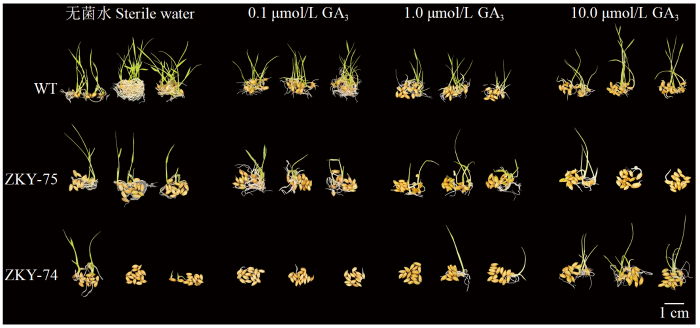
图7
osdog1-like突变体种子萌发后第10天的幼苗生长情况
Fig.7
Seedling growth status of osdog1-like mutants seeds on the 10th day after germination
2.8 水稻osdog1-like突变体胚胎活力的检测
为了检测ZKY-74严重不萌发、幼苗生长迟缓等表型是否与种子活力有关,相同条件下进行了TTC活力检测。由图8可知,经过高温灭活的WT(-)种子胚胎未染上色,即种子无活力,表明本试验的操作方法可行。WT、ZKY-75和ZKY-74的种子胚胎着色程度比较一致,均具有较好的种子活力,这表明ZKY-75和ZKY-74的种子萌发率较低并非是胚胎活力丧失,而是由于种子萌发启动或穿刺破壳阶段的不正常所导致的。
图8
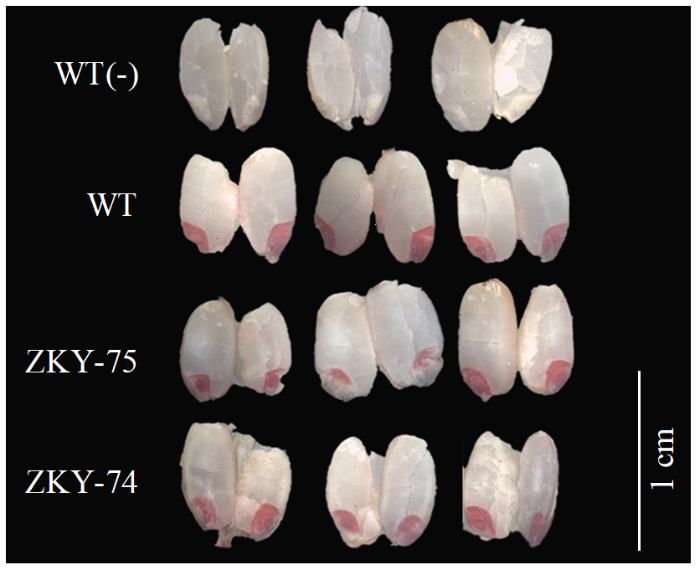
图8
osdog1-like突变体的胚胎TTC染色结果
Fig.8
Embryo TTC staining results of osdog1-like mutants
2.9 水稻OsDOG1-like基因家族互作蛋白及基因功能预测
利用String在线分析软件(
图9
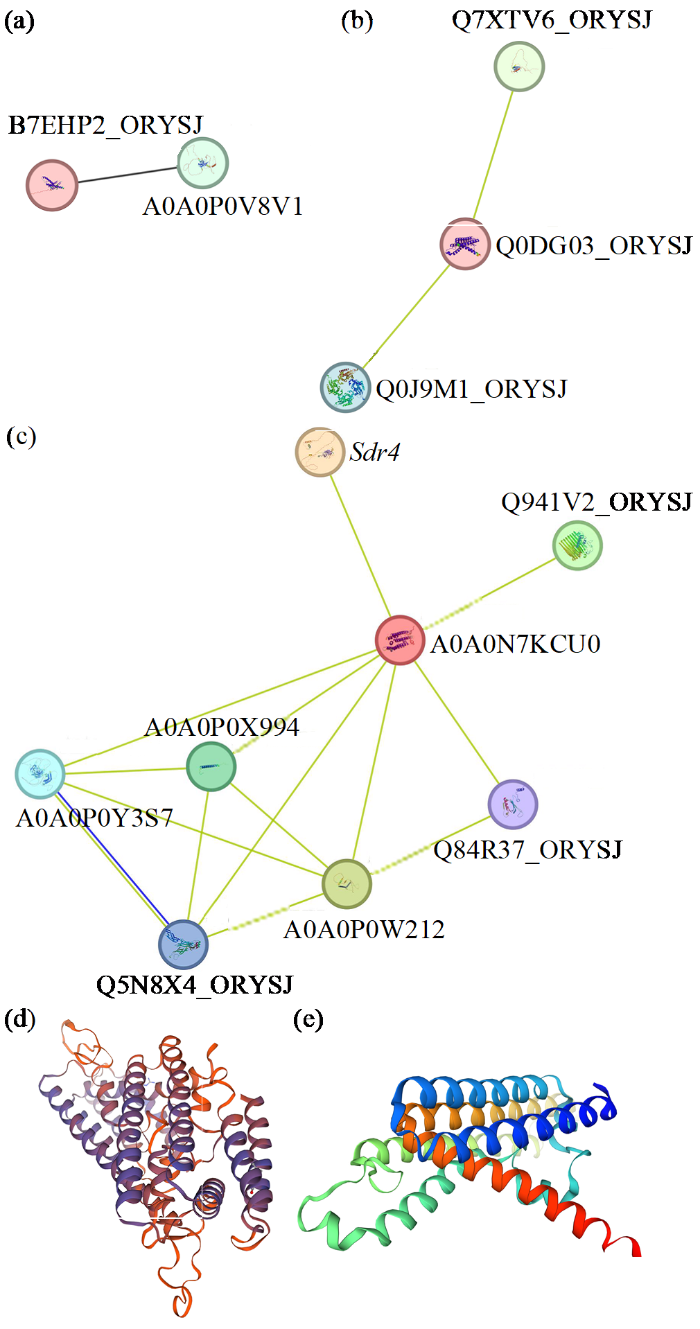
图9
OsDOG1-like基因家族成员互作蛋白预测
(a)、(b)、(c)分别为OsDOG1L-1、OsDOG1L-2、OsDOG1L-3基因互作蛋白预测。(d)和(e)为预测的OsDOG1L-2基因编码蛋白的三维结构。
Fig.9
Prediction of interaction proteins among members of the OsDOG1-like gene family
(a), (b), and (c) represent the predictions of the interaction proteins of the OsDOG1L-1, OsDOG1L-2, and OsDOG1L-3 genes, respectively. (d) and (e) are structures of OsDOG1L-2 protein by SWISS-MODEL.
基于Plant-mPLoc的数据,OsDOG1L-1、OsDOG1L-2和OsDOG1L-3基因编码的蛋白质定位于细胞核,其很可能具有转录因子的功能。基于SWISS-MODEL,仅得到了OsDOG1L-2蛋白的三维结构(
3 讨论
植物种子休眠和萌发受ABA与GA信号通路的协同调控。研究[12]发现,拟南芥种子休眠调控关键基因DOG1突变后仍具有一定ABA敏感性,而渗入强休眠等位基因Cvi的近等基因系NIL- DOG17-1表现出较高的ABA敏感性,以此增强种子休眠。拟南芥新鲜种子中DOG1蛋白水平与休眠程度正相关,尽管拟南芥dog1突变体种子中ABA含量降低,GA含量升高,但研究显示它不依赖于ABA途径等激素途径来调控休眠[16]。以拟南芥dog1-2单突变体为对照,dog1-2/cyp707a2-1双突变体即使内源ABA激素水平很高,也不能进入休眠[16],因此DOG1对于拟南芥种子休眠仍是必需的。DOG1蛋白可与ABA信号转导中PP2C家族AHG1和AHG3形成复合体。dog1突变体种子不具有休眠性,但dog1/ahg1/ahg3休眠性大大增加,不仅如此,ahg1/ahg3双突变体还对dog1突变具有上位效应。AHG1和AHG3处于DOG1的下游来完成对种子休眠的调控[17]。DOG1在介导周期性的低温启动萌发方面也发挥了重要作用[18-
DOG1在种子成熟期和种子传播后土壤内的休眠解除阶段的功能是不同的。在过表达拟南芥DOG1-Cvi的独行菜(Lepidium sativum)转基因种子中,低温18 ℃条件下的GA代谢高于24 ℃,特别是对于GA20ox的转录水平的上调,进而弱化种皮的机械强度,促进胚乳破裂(endosperm rupture,ER)[19]。这种DOG1过表达后能促进萌发的现象,仅在低温时才能表现出来,在拟南芥和独行菜中均得到了验证。在24 ℃条件下,相对WT的对应基因的转录水平持续上升,过表达拟南芥DOG1的强休眠种子中细胞壁松弛相关因子的EXPA2、EXPA9、EXLA1和XTH19呈下降趋势[19],进而阻碍了坚硬组织的弱化(胚芽鞘的穿破)。最新研究[22]表明,GA通过DELLA-MBW-TTG2信号级联模块调控拟南芥果胶的生物合成,并在维持细胞黏附和促进幼苗生长方面具有重要作用。推测这与本文中osdog1-like突变体的胚胎有活力但无法突破颖壳和种皮现象有一定的关联。
Li等[23]发现拟南芥dog1-2突变体的种子完全丧失休眠,比较WT和dog1-2突变体种子的转录组差异,发现无论是干种子还是吸胀6 h的种子,其GA合成代谢相关的DEGs(GA20ox1、GA20ox2、GA20ox3和GA3ox1、GA3ox2、GA3ox4)在dog1-2突变体种子中上调,而GA分解代谢相关的DEGs(GA2ox3、GA2ox6和ELA2)下调。水稻中内源生物活性物质GA的含量和种子萌发率与这些酶(GA20ox、GA3ox和GA2ox)的编码基因的表达水平有关[24]。dog1-2突变体种子的ABA和生长素(IAA)的内源信号强度显著降低,GA、油菜素甾醇(BR)和细胞分裂素的内源信号强度显著增加[23]。由此看来,GA信号在DOG1在调控种子萌发时扮演了重要的角色。
同一基因家族成员之间通常具有相似或相同的功能,当其中一个基因失活时,部分基因家族成员部分或完全替代彼此功能维持表型稳定性,实现功能冗余[25]。但在复杂的调控通路中,部分基因家族成员之间可能相互拮抗。例如,属于同一磷脂酰乙醇胺结合蛋白(PEBP)家族的OsMFT1和OsMFT2在调控水稻种子穗发芽时的作用相反[26-27]。然而,同一基因家族部分成员可能具有不同的功能。拟南芥dog1突变体表现出种子休眠丧失,但dog1l-1、dog1l-2和dog1l-3的单突变体未观察到明显表型,仅dog1l-4突变体的种子表现出休眠适度增强[12],与dog1突变体表型相反。DOG1L-4的序列与DOG1的相似性很低,只有23.4%[12],其缺少一个bZIP结构域,与DOG1不同的是,DOG1L-4由ABA诱导,在介导种子积累贮藏蛋白(SSP)时发挥主要作用[28]。过表达DOG1L-3导致种子萌发时ABA超敏,而过表达DOG1L-5则不会引发该效应[29],表明拟南芥DOG1和DOG1- like在种子休眠调控时具有各自独立的不同功能。
DOG1蛋白是一种诱导休眠必需的蛋白[30],DOG1的发现和功能探索对研究种子休眠与萌发具有重要意义[31]。DOG1除参与调控种子休眠外,也参与种子成熟、种子寿命和萌发调控[12,32-33]。目前,有关DOG1的研究进展主要是基于拟南芥突变体的种子,在水稻中,仅OsDOG1L-3已被明确报道通过增强ABA通路促进种子休眠。虽然DOG1的功能在禾谷类植物中表现出一些功能保守性,但在参与水稻种子休眠与萌发中的作用并不清楚。胚胎成熟发育期间,水稻dog1突变体中是否缺少一些胚胎晚期发育储藏物(如LEA蛋白)的合成仍需进一步的研究。Carrillo-Barral等[30]提出,AtDOG1及其同源基因是控制种子休眠的候选基因。将小麦TaDOG1L4和大麦HvDOG1L2置于35S强启动子下转入拟南芥,其转基因后代的休眠性高于WT[13]。然而,OsDOG1-like基因家族成员的功能及其与GA信号途径的关系尚不清楚。
Huo等[34]研究发现,DOG1可以通过影响microRNAs(miRNAs)miR156和miR172的水平来调节莴苣(Lactuca sativa)和拟南芥的种子休眠和开花时间。在莴苣中,抑制LsDOG1表达使种子能够在高温下发芽,并促进早期开花,这与miR156水平降低和miR172水平升高有关。在拟南芥中,miR156基因过表达增强了种子休眠和延迟开花。OsDOG1-like基因的突变是否影响了水稻开花时间,进而影响结实率,需要更进一步的观察。
GA既能促进细胞伸长和茎秆发育,又能调节花药发育。Dong等[35]利用CRISP/Cas9技术研究了bZIP转录因子家族的OsbZIP01,相比于WT,osbzip01突变体在抽穗期的株高更高,种子萌发也更快;OE-bZip01则株高更低,萌发速率更慢。外源施用GA3能够恢复OE-OsbZIP01半矮化表型。这表明OsbZIP01可能通过调节水稻GA平衡而影响株高和萌发。一方面,OsbZIP01作为转录抑制子负调控了“绿色革命”基因SD1的表达,使得GA生物合成减少。另一方面,GA生物合成基因OsCPS1及信号转导基因GID1和GID2的功能缺失突变会诱导绒毡层程序性细胞死亡(PCD)缺陷,最终导致雄性不育[36]。Jin等[37]发现,GA激素信号被整合到花药遗传程序中,并通过GA-DELLA- OsMS188模块调控水稻花药发育。鉴于上述报道,发现OsDOG1-like基因的优异等位基因或者与其互作的优异等位,培育出株高降低、抗倒伏,且休眠性增强、抗穗发芽的优良品系,将是未来一项有实际价值的工作。本文为研究OsDOG1L-1、OsDOG1L-2和OsDOG1L-3基因调控水稻种子的萌发提供了重要线索,对水稻种子萌发的激素调控机制研究具有一定的理论意义。
对于种子休眠深度的差异,下一步使用新鲜收获的种子同时进行种子萌发、胚胎内源GA含量的测定,将有助于从激素水平上揭示OsDOG1-like调控种子休眠与萌发的生理机制。提高osdog1l-1/2/3种子萌发率的人为技术手段,同样有待后续进一步的摸索。
4 结论
本研究表明,osdog1l-2/3双突变体对低浓度GA3(0.1和1.0 μmol/L)表现非常敏感,而osdog1l- 1/2/3三重突变体的种子对0.1和1.0 μmol/L GA3表现不敏感,这可能是与osdog1l-2/3双突变体种子相比,增加了OsDOG1L-1的敲除导致GA信号转导的缺陷被加重。GA4+7处理所得出的规律性变化与GA3相似度极高。osdog1l-2/3和osdog1l-1/2/3突变体胚胎均有活力,且已萌发的种子能生成结构正常的幼苗,暗示本文OsDOG1-like基因并不影响胚胎活力,而在种子休眠和萌发过程中起作用。
参考文献
Advances in cereal science: implications to food processing and health promotion
Early seedling vigour, an imperative trait for direct-seeded rice: an overview on physio- morphological parameters and molecular markers
DOI:10.1007/s00425-015-2273-9
PMID:25805338
[本文引用: 1]

Rapid uniform germination and accumulation of biomass during initial phase of seedling establishment is an essential phenotypic trait considered as early seedling vigour for direct seeded situation in rice irrespective of environment. Enhanced role of carbohydrate, amylase, growth hormones, antioxidant enzymes and ascorbic acid brings changes in vigour and phenotype of seedling. Early establishment and demanding life form dominate the surroundings. Crop plant that has better growth overdrives the weed plant and suppresses its growth. Seedling early vigour is the characteristic of seed quality and describes the rapid, uniform germination and the establishment of strong seedlings in any environmental condition. The phenotype of modern rice varieties has been changed into adaptable for transplanted rice with thirst toward water and selection pressure for semi-dwarf architecture resulting in reduced early vigour. Decreasing freshwater availability and rising labour cost drives the search for a suitable alternative management system to enhance grain yield productivity for the burgeoning world population. In view of these issues, much attention has been focused on dry direct-seeded rice, because it demands low input. A rice cultivar with a strong seedling vigour trait is desirable in case of direct seeding. However, seedling vigour has not been selected in crop improvement programmes in conventional breeding due to its complex nature and quantitative inheritance. Molecular markers have been proven effective in increasing selection efficiency, particularly for quantitative traits that are simply inherited. Marker-assisted selection approach has facilitated efficient and precise transfer of genes/QTL(s) into many crop species and suggests a speedy and efficient technique over conventional breeding and selection methods. In this review, we present the findings and investigations in the field of seedling vigour in rice that includes the nature of inheritance of physio-morphological and biochemical traits and QTLs to assist plant breeders who work for direct-seeded rice.
Genetical studies on germination of seed and seedling establishment for breeding of improved rice varieties suitable for direct seeding culture
Seeds: physiology of development, germination and dormancy
1-Molecular mechanisms of seed germination
//Feng H, Nemzer B, DeVries J W.
Two Faces of One Seed: hormonal regulation of dormancy and germination
DOI:S1674-2052(15)00356-1
PMID:26343970
[本文引用: 1]
Seed plants have evolved to maintain the dormancy of freshly matured seeds until the appropriate time for germination. Seed dormancy and germination are distinct physiological processes, and the transition from dormancy to germination is not only a critical developmental step in the life cycle of plants but is also important for agricultural production. These processes are precisely regulated by diverse endogenous hormones and environmental cues. Although ABA (abscisic acid) and GAs (gibberellins) are known to be the primary phytohormones that antagonistically regulate seed dormancy, recent findings demonstrate that another phytohormone, auxin, is also critical for inducing and maintaining seed dormancy, and therefore might act as a key protector of seed dormancy. In this review, we summarize our current understanding of the sophisticated molecular networks involving the critical roles of phytohormones in regulating seed dormancy and germination, in which AP2-domain-containing transcription factors play key roles. We also discuss the interactions (crosstalk) of diverse hormonal signals in seed dormancy and germination, focusing on the ABA/GA balance that constitutes the central node. Copyright © 2016 The Author. Published by Elsevier Inc. All rights reserved.
Abscisic acid: emergence of a core signaling network
Gibberellin metabolism and its regulation
Seed dormancy and germination-emerging mechanisms and new hypotheses
Seed dormancy and germination
DOI:S0960-9822(17)30616-4
PMID:28898656
[本文引用: 1]
Reproduction is a critical time in plant life history. Therefore, genes affecting seed dormancy and germination are among those under strongest selection in natural plant populations. Germination terminates seed dispersal and thus influences the location and timing of plant growth. After seed shedding, germination can be prevented by a property known as seed dormancy. In practise, seeds are rarely either dormant or non-dormant, but seeds whose dormancy-inducing pathways are activated to higher levels will germinate in an ever-narrower range of environments. Thus, measurements of dormancy must always be accompanied by analysis of environmental contexts in which phenotypes or behaviours are described. At its simplest, dormancy can be imposed by the formation of a simple physical barrier around the seed through which gas exchange and the passage of water are prevented. Seeds featuring this so-called 'physical dormancy' often require either scarification or passage through an animal gut (replete with its associated digestive enzymes) to disrupt the barrier and permit germination. In other types of seeds with 'morphological dormancy' the embryo remains under-developed at maturity and a dormant phase exists as the embryo continues its growth post-shedding, eventually breaking through the surrounding tissues. By far, the majority of seeds exhibit 'physiological dormancy' - a quiescence program initiated by either the embryo or the surrounding endosperm tissues. Physiological dormancy uses germination-inhibiting hormones to prevent germination in the absence of the specific environmental triggers that promote germination. During and after germination, early seedling growth is supported by catabolism of stored reserves of protein, oil or starch accumulated during seed maturation. These reserves support cell expansion, chloroplast development and root growth until photoauxotrophic growth can be resumed.Crown Copyright © 2017. Published by Elsevier Ltd. All rights reserved.
Occurrence of rice preharvest sprouting varies greatly depending on past weather conditions during grain filling
Cloning of DOG1, a quantitative trait locus controlling seed dormancy in Arabidopsis
DOG1-like genes in cereals: investigation of their function by means of ectopic expression in Arabidopsis
OsDOG1L-3 regulates seed dormancy through the abscisic acid pathway in rice
The time required for dormancy release in Arabidopsis is determined by DELAY OF GERMINATION 1 protein levels in freshly harvested seeds
DOI:10.1105/tpc.112.100214 URL [本文引用: 2]
DELAY OF GERMINATION 1 requires PP2C phosphatases of the ABA signalling pathway to control seed dormancy
DOI:10.1038/s41467-017-00113-6 [本文引用: 1]
Induction of dormancy in Arabidopsis summer annuals requires parallel regulation of DOG1 and hormone metabolism by low temperature and CBF transcription factors
DOI:10.1105/tpc.111.087643
PMID:21803937
[本文引用: 1]
Summer annuals overwinter as seeds in the soil seed bank. This is facilitated by a cold-induced increase in dormancy during seed maturation followed by a switch to a state during seed imbibition in which cold instead promotes germination. Here, we show that the seed maturation transcriptome in Arabidopsis thaliana is highly temperature sensitive and reveal that low temperature during seed maturation induces several genes associated with dormancy, including DELAY OF GERMINATION1 (DOG1), and influences gibberellin and abscisic acid levels in mature seeds. Mutants lacking DOG1, or with altered gibberellin or abscisic acid synthesis or signaling, in turn show reduced ability to enter the deeply dormant states in response to low seed maturation temperatures. In addition, we find that DOG1 promotes gibberellin catabolism during maturation. We show that C-REPEAT BINDING FACTORS (CBFs) are necessary for regulation of dormancy and of GA2OX6 and DOG1 expression caused by low temperatures. However, the temperature sensitivity of CBF transcription is markedly reduced in seeds and is absent in imbibed seeds. Our data demonstrate that inhibition of CBF expression is likely a critical feature allowing cold to promote rather than inhibit germination and support a model in which CBFs act in parallel to a low-temperature signaling pathway in the regulation of dormancy.
DELAY OF GERMINATION 1mediates a conserved coat-dormancy mechanism for the temperature and gibberellin-dependent control of seed germination
Seed dormancy cycling in Arabidopsis: chromatin remodelling and regulation of DOG 1 in response to seasonal environmental signals
DOI:10.1111/tpj.2015.81.issue-3 URL [本文引用: 1]
Dormancy cycling in Arabidopsis seeds is controlled by seasonally distinct hormone- signaling pathways
Gibberellin signaling regulates pectin biosynthesis in Arabidopsis
DOI:10.1038/s41467-025-59268-2 [本文引用: 1]
DELAY OF GERMINATION 1, the master regulator of seed dormancy, integrates the regulatory network of phytohormones at the transcriptional level to control seed dormancy
Brassinosteroid and gibberellin coordinate rice seed germination and embryo growth by regulating glutelin mobilization
DOI:10.1016/j.cj.2020.11.006 URL [本文引用: 1]
Evolution of genetic redundancy
DOI:10.1038/40618 URL [本文引用: 1]
The fourth exon confers antagonistic activity of OsMFT1 and OsMFT2 in rice pre-harvest sprouting
DOI:10.1016/j.cj.2024.12.008 URL [本文引用: 1]
The phosphatidylethanolamine- binding proteins OsMFT1 and OsMFT 2 regulate seed dormancy in rice
DOI:10.1093/plcell/koae211
PMID:39041489
[本文引用: 1]
Seed dormancy is crucial for optimal plant life-cycle timing. However, domestication has largely diminished seed dormancy in modern cereal cultivars, leading to challenges such as pre-harvest sprouting (PHS) and subsequent declines in yield and quality. Therefore, it is imperative to unravel the molecular mechanisms governing seed dormancy for the development of PHS-resistant varieties. In this study, we screened a mutant of BASIC HELIX-LOOP-HELIX TRANSCRIPTION FACTOR4 (OsbHLH004) with decreased seed dormancy and revealed that OsbHLH004 directly regulates the expression of 9-CIS-EPOXYCAROTENOID DIOXYGENASE3 (OsNCED3) and GIBBERELLIN 2-OXIDASE6 (OsGA2ox6) in rice (Oryza sativa). Additionally, we determined that two phosphatidylethanolamine-binding proteins, MOTHER OF FT AND TFL1 and 2 (OsMFT1 and OsMFT2; hereafter OsMFT1/2) interact with OsbHLH004 and Ideal Plant Architecture 1 (IPA1) to regulate their binding capacities on OsNCED3 and OsGA2ox6, thereby promoting seed dormancy. Intriguingly, FT-INTERACTING PROTEIN1 (OsFTIP1) interacts with OsMFT1/2 and affects their nucleocytoplasmic translocation into the nucleus, where OsMFT1/2-OsbHLH004 and OsMFT1/2-IPA1 antagonistically modulate the expression of OsNCED3 and OsGA2ox6. Our findings reveal that OsFTIP1-mediated inhibition of nuclear translocation of OsMFT1/2 and the dynamic transcriptional modulation of OsNCED3 and OsGA2ox6 by OsMFT1/2-OsbHLH004 and OsMFT1/2-IPA1 complexes in seed dormancy in rice.© The Author(s) 2024. Published by Oxford University Press on behalf of American Society of Plant Biologists. All rights reserved. For commercial re-use, please contact reprints@oup.com for reprints and translation rights for reprints. All other permissions can be obtained through our RightsLink service via the Permissions link on the article page on our site—for further information please contact journals.permissions@oup.com.
DELAY OF GERMINATION 1-LIKE 4 acts as an inducer of seed reserve accumulation
DOI:10.1111/tpj.v100.1 URL [本文引用: 1]
Control of seed dormancy and germination by DOG1-AHG 1 PP2C phosphatase complex via binding to heme
DOI:10.1038/s41467-018-04437-9
PMID:29875377
[本文引用: 1]
Abscisic acid (ABA) regulates abiotic stress and developmental responses including regulation of seed dormancy to prevent seeds from germinating under unfavorable environmental conditions. ABA HYPERSENSITIVE GERMINATION1 (AHG1) encoding a type 2C protein phosphatase (PP2C) is a central negative regulator of ABA response in germination; however, the molecular function and regulation of AHG1 remain elusive. Here we report that AHG1 interacts with DELAY OF GERMINATION1 (DOG1), which is a pivotal positive regulator in seed dormancy. DOG1 acts upstream of AHG1 and impairs the PP2C activity of AHG1 in vitro. Furthermore, DOG1 has the ability to bind heme. Binding of DOG1 to AHG1 and heme are independent processes, but both are essential for DOG1 function in vivo. Our study demonstrates that AHG1 and DOG1 constitute an important regulatory system for seed dormancy and germination by integrating multiple environmental signals, in parallel with the PYL/RCAR ABA receptor-mediated regulatory system.
Delay of Germination-1 (DOG1): a key to understanding seed dormancy
DOI:10.3390/plants9040480
URL
[本文引用: 2]
DELAY OF GERMINATION-1 (DOG1), is a master regulator of primary dormancy (PD) that acts in concert with ABA to delay germination. The ABA and DOG1 signaling pathways converge since DOG1 requires protein phosphatase 2C (PP2C) to control PD. DOG1 enhances ABA signaling through its binding to PP2C ABA HYPERSENSITIVE GERMINATION (AHG1/AHG3). DOG1 suppresses the AHG1 action to enhance ABA sensitivity and impose PD. To carry out this suppression, the formation of DOG1-heme complex is essential. The binding of DOG1-AHG1 to DOG1-Heme is an independent processes but essential for DOG1 function. The quantity of active DOG1 in mature and viable seeds is correlated with the extent of PD. Thus, dog1 mutant seeds, which have scarce endogenous ABA and high gibberellin (GAs) content, exhibit a non-dormancy phenotype. Despite being studied extensively in recent years, little is known about the molecular mechanism underlying the transcriptional regulation of DOG1. However, it is well-known that the physiological function of DOG1 is tightly regulated by a complex array of transformations that include alternative splicing, alternative polyadenylation, histone modifications, and a cis-acting antisense non-coding transcript (asDOG1). The DOG1 becomes modified (i.e., inactivated) during seed after-ripening (AR), and its levels in viable seeds do not correlate with germination potential. Interestingly, it was recently found that the transcription factor (TF) bZIP67 binds to the DOG1 promoter. This is required to activate DOG1 expression leading to enhanced seed dormancy. On the other hand, seed development under low-temperature conditions triggers DOG1 expression by increasing the expression and abundance of bZIP67. Together, current data indicate that DOG1 function is not strictly limited to PD process, but that it is also required for other facets of seed maturation, in part by also interfering with the ethylene signaling components. Otherwise, since DOG1 also affects other processes such us flowering and drought tolerance, the approaches to understanding its mechanism of action and control are, at this time, still inconclusive.
Seed germination and dormancy: the classic story, new puzzles, and evolution
DOI:10.1111/jipb.12762
[本文引用: 1]
This review highlights recent progresses in seed germination and dormancy research. Research on the weakening of the endosperm during germination, which is almost a classic theme in seed biology, was resumed by α-xylosidase studies. Strong genetic evidence was presented to suggest that the quality control of xyloglucan biosynthesis in the endosperm (and the embryo) plays a critical role in germination. Further analyses on the endosperm and the adjacent layers have suggested that the cutin coat in the endosperm-testa interphase negatively affects germination while the endosperm-embryo interphase produces a sheath that facilitates germination. These progresses significantly advanced our understanding of seed germination mechanisms. A breakthrough in dormancy research, on the other hand, revealed the unique abscisic acid signaling pathway that is regulated by DELAY OF GERMINATION1 (DOG1). The detailed analysis of <em>DOG1</em> expression uncovered the intriguing story of reciprocal regulation of the sense-antisense pair, which generated new questions. Recent studies also suggested that the DOG1 function is not limited to dormancy but extended through general seed maturation, which provokes questions about the evolution of DOG1 family proteins. Seed biology is becoming more exciting with the classic stories being revitalized and new puzzles emerging from the frontier.
Teaching an Old Dog a New Trick: multifaceted strategies to control primary seed germination by DELAY OF GERMINATION 1 (DOG1)
The Arabidopsis 1 gene affects 5 (5) expression and genetically interacts with 3 during Arabidopsis seed development
DOI:10.1111/tpj.13118
PMID:26729600
[本文引用: 1]
The seed expressed gene DELAY OF GERMINATION (DOG) 1 is absolutely required for the induction of dormancy. Next to a non-dormant phenotype, the dog1-1 mutant is also characterized by a reduced seed longevity suggesting that DOG1 may affect additional seed processes as well. This aspect however, has been hardly studied and is poorly understood. To uncover additional roles of DOG1 in seeds we performed a detailed analysis of the dog1 mutant using both transcriptomics and metabolomics to investigate the molecular consequences of a dysfunctional DOG1 gene. Further, we used a genetic approach taking advantage of the weak aba insensitive (abi) 3-1 allele as a sensitized genetic background in a cross with dog1-1. DOG1 affects the expression of hundreds of genes including LATE EMBRYOGENESIS ABUNDANT and HEAT SHOCK PROTEIN genes which are affected by DOG1 partly via control of ABI5 expression. Furthermore, the content of a subset of primary metabolites, which normally accumulate during seed maturation, was found to be affected in the dog1-1 mutant. Surprisingly, the abi3-1 dog1-1 double mutant produced green seeds which are highly ABA insensitive, phenocopying severe abi3 mutants, indicating that dog1-1 acts as an enhancer of the weak abi3-1 allele and thus revealing a genetic interaction between both genes. Analysis of the dog1 and dog1 abi3 mutants revealed additional seed phenotypes and therefore we hypothesize that DOG1 function is not limited to dormancy but that it is required for multiple aspects of seed maturation, in part by interfering with ABA signalling components. © 2016 The Authors The Plant Journal © 2016 John Wiley & Sons Ltd.
DOG1) regulates both seed dormancy and flowering time through microRNA pathways
OsbZIP 01 Affects plant growth and development by regulating OsSD1 in rice
DOI:10.1016/j.rsci.2023.11.007 URL [本文引用: 1]
Gibberellin Modulates Anther Development in Rice via the Transcriptional Regulation of GAMYB
DOI:10.1105/tpc.108.062935 URL [本文引用: 1]
The GA-DELLA-OsMS 188 module controls male reproductive development in rice
DOI:10.1111/nph.v233.6 URL [本文引用: 1]


