



玉米是我国第一大粮食作物,作为保障国家粮食安全的主力作物,其产量约占全国粮食总产量的40%[1]。良种涵盖优良品种和优质种子,两者缺一不可[2],是实现玉米高产的重要基础。随着密植高产技术的推广和单粒播种技术的广泛应用,玉米种子质量对于实现一播全苗、齐苗,进而形成高产群体、提升单产至关重要。因此,加强种子质量检测对于降低玉米种植风险、选育优良品种以及提升种业核心竞争力具有重要意义。2021年国家农作物种子质量标准[3]修订后,新增加的单粒播种质量要求发芽率指标≥93.0%,纯度指标≥97.0%,水分指标全国统一为13.0%,净度指标为99.0%。玉米种子在生产加工过程中,可能由于冷害或热害等原因造成种子成熟度不足、生命力下降,或者由于机械损伤、品种混杂、感染病害或霉变等原因,导致播种质量受到影响。因此,播种前对玉米种子进行质量鉴定、筛选和分级是保障玉米高产的重要技术环节。
种子质量检测的指标通常包括纯度、净度、发芽率、含水量和种子活力等。玉米种子质量检测的常规方法主要有人工感官鉴定法、形态鉴定法、理化分析法和分子生物学方法等[4]。然而,形态鉴定法和人工感官鉴定法工作量大、操作周期长且易受个人经验影响,导致检测效率不高,难以保证检测结果的准确性;虽然理化分析法对玉米种子的检测精度和特异性较高,但其检测周期长,可重复性差且易对种子造成损害[5]。此外,理化分析法和分子生物学方法虽然准确度较高,但对操作人员的专业技能要求较高,鉴定时间较长,且相关检测设备的造价较高[6]。因此,开发一种快速、高效、稳定、无损且准确度高的玉米种子质量检测方法具有重要的现实意义和迫切性[7]。随着机器视觉技术和光谱技术的不断进步,它们在玉米种子质量检测领域的研究和应用逐渐受到广泛关注[8-9]。本文综述了机器视觉光谱成像技术的原理、在玉米种子质量检测中的应用现状、存在的问题以及发展前景,旨在推动该技术在玉米种子质量检测中更广泛的应用,进一步保障玉米种子产业的安全生产。
1 机器视觉光谱成像技术及其发展
传统机器视觉技术主要依赖于RGB图像或灰度图像,通过目标物体的形状、颜色或纹理信息进行检测、识别和分类。受限于技术原理,传统机器视觉无法揭示目标物体的物质成分特性,也无法对化学、生物性质进行定性或定量分析。随着技术的发展,高光谱成像技术(hyperspectral imaging)作为一种新兴的视觉感知技术,逐渐受到人们的普遍关注。其基本原理是利用分光元件(如光栅或棱镜)将射入的光线分解成不同波长的光谱成分,再通过图像感知系统,如多光谱相机、高光谱相机或激光雷达等,获取记录不同波长下物体反射或辐射信息的图像,形成“三维数据立方体”(空间维度x、y和光谱维度λ)。光谱分辨率在可见范围(400~760 nm)至近红外光谱范围(760~2560 nm)内达到纳米级,高光谱成像通过捕捉和分析数百条连续的窄带光谱信息,揭示物质的深层物理和化学特性,从而使探测精度和检测效率明显提高[12-13]。高光谱成像技术的引入,为机器视觉领域带来了革命性的变革。这项技术不仅打破了传统机器视觉中仅依赖RGB三通道的限制,其包含的图像信息从外观上反映被测样本形态学特征,其光谱信息从内部反映被测样本物理结构和化学成分,进而实现对被测物内外部的综合评价[14]。
近年来,深度学习和人工智能技术的引入带来了新的发展机会。随着机器学习算法的发展,大幅提高了机器视觉系统的精确度和效率,特别是卷积神经网络模型(CNN)的应用大幅促进了机器视觉技术的发展[11],为光谱成像实现感算一体化提供了新的思路,加速了该技术在各个领域的应用。随着技术的成熟,机器视觉光谱成像技术在工业、生物医学、食品检测和农业等多个领域的应用不断拓展与深化。
20世纪70年代以来,机器视觉技术开始在农业领域应用,早期主要用于农产品的品质检测与分级等[15-16]。随着计算机技术、光谱技术以及图像采集处理技术的迅速发展,机器视觉光谱成像技术在农业的应用领域不断扩展,成为种子质量检测领域的主导新技术。20世纪70年代,机器视觉技术开始用于种子形状等表型参数的测定;20世纪80年代后,开始用于品种鉴定和种子质量分级[17]。目前,在玉米种子质量检测方面,机器视觉光谱成像技术已得到更广泛的研究和应用,包括玉米品种分类、种子纯度、种子活力、霉粒和不完善粒检测等方面[18],在玉米种子质量检测方面已有多项成果。种子质量检测系统及机器视觉光谱成像技术流程见图1。
图1
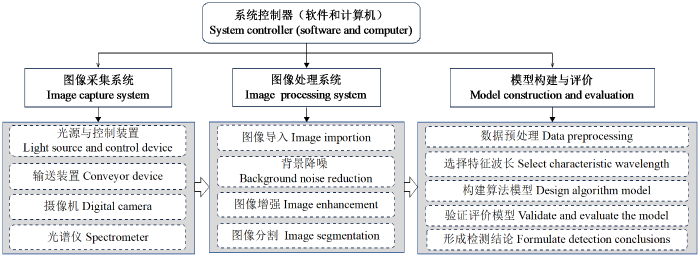
图1
机器视觉光谱成像种子质量检测系统组成及一般流程
Fig.1
System components and general process of machine vision-based spectral imaging technology for seed quality detection
2 机器视觉光谱成像技术在玉米种子质量检测中的应用
2.1 玉米种子不完善粒检测
在玉米种子的收获、干燥、运输、加工和贮藏过程中,种子可能因机械损伤和虫蛀等出现裂纹或破损,从而容易引起发热和霉菌侵袭,导致发芽缓慢甚至无法发芽。因此,在播种前剔除破损种子是种子质量检测的关键环节。依赖人工进行识别剔除,不仅耗时耗力,而且对于发生内部裂纹的种子难以快速鉴定。这促使机器视觉技术自20世纪90年代开始用于玉米种粒裂纹和破损等缺陷的识别[19-
早期研究多采用传统图像处理方法进行特征提取与分类,Valiente-González等[22]将机器视觉技术与主成分分析(PCA)算法相结合,用于分选破损玉米粒,通过构建RGB颜色空间的主成分特征向量,在实验室静态环境下实现92%的检测率,但该方法对光照条件敏感(需控制在500±50 lx),且仅适用于单粒静态检测场景。崔欣等[23]提出的支持向量机(SVM识别模型)在特征提取方面取得重要突破,该研究采用中值滤波处理机械振动引起的椒盐噪声,通过Otsu算法动态确定灰度阈值(误差<0.5%),最终提取出16维形态特征(含面积离散度和周长曲率等创新指标),该模型在实验室条件下可达到95%精度,但其特征提取耗时达120 ms/粒,难以满足产线实时需求。21世纪以来,国内外更加注重机器视觉光谱成像技术进行批量在线检测及田间实时动态检测的研究[24]。王侨等[25]设计了一种基于机器视觉的玉米种粒实时精选装置,采用3个阶段处理流程:(1)高速摄像系统捕捉运动种粒;(2)基于变换的粘连分割算法(分割精度98.7%);(3)多特征融合分类器,可完成尖端变黑、小型粒、虫蚀破损和霉变等非健康种粒的判断,不合格种粒有效吹除率为98%。该装置达到96%的检测准确率,但其基于传统算法的模型泛化能力有限,当破损类型超出训练集范围时,准确率下降至23%。Wang等[26]集成了深度学习和滑动窗口技术,建立了用于评估玉米粒破损率的定量模型,实现了动态实时检测,该研究采用BCK- YOLOv7模型和滑动窗口技术识别目标区域内的整粒和破碎粒,将识别结果输入定量模型进行籽粒破损率的实时检测,同时引入滑动窗口技术来合并相邻帧的识别结果,从而解决了玉米粒流动引起的运动模糊问题。该技术的检测效率达到22帧/s(FPS),可满足玉米籽粒破损率实时检测的要求,但模型参数量达36.7 M,需配置专用GPU(如NVIDIA Jetson AGX Xavier)才能实现22 FPS的实时处理。
上述研究表明,利用机器视觉光谱成像技术,在裂纹、破损和虫蛀等不完整种子的无损、快速及高效识别方面取得了较多进展。但在动态检测稳定性与多尺度特征提取的准确性方面仍需突破。由于输送带振动(振幅>0.50 mm时)导致种子图像模糊,现有去模糊算法(如Wiener滤波)使处理延时增加40%。此外,虫蛀缺陷(最小直径<0.20 mm)与机械裂纹(平均宽度0.05 mm)的跨尺度特征难以兼容提取,在感知系统与成像技术方面还需优化与创新。目前国内外主要集中在特征参数的静态检测与算法研究上,如何实现玉米种粒批量动态在线检测及其商业化应用将是今后玉米不完善粒检测与剔除的重点。
2.2 玉米种子霉变粒检测
21世纪以来,基于机器视觉的光谱检测技术在玉米种子霉变粒检测及毒素含量测定方面逐渐得到应用[29-
Wang等[29]通过高光谱成像技术结合PCA和逐步判别分析(FDA)建立了预测模型,能够检测低至10 μg/kg的黄曲霉素(AFB1),其预测集精度超过88.0%,但模型对样本含水量敏感。da Conceição等[33]利用近红外高光谱图像(HSI-NIR)结合模式识别分析和PLS-DA模型,在特定温湿度条件(25 ℃,相对湿度65%)下对镰刀菌实现100%识别,但该模型在温度超过30 ℃时特异性下降至82.0%,表明环境稳定性有待提升。康孝存等[34]创新性地引入麻雀搜索算法(SSA)优化BP神经网络,通过设定种群规模50、发现者比例20%及预警阈值0.6等参数,将伏马菌检测精度提升至95.56%,但网络结构对硬件计算能力有更高的要求。
上述研究表明,光谱检测技术结合不同的分析模型,模型识别精度多数超过90%,能够高效、准确地检测玉米种子在储藏过程中的霉变情况。但由于种子在霉变过程中受到环境温度和样品形态的影响,容易发生变化,这可能导致研究中毒素浓度与实际浓度之间存在差异,从而使所建立的定量模型产生误差,不具备普适性。此外,种子受侵染的霉菌种类较多,不同霉菌产生的光谱信息存在差异,因此未来应加大不同霉菌对玉米种子光谱成像特征影响的研究力度,开发基于迁移学习的跨场景适应算法,并通过多中心研究完善不同霉菌的特征光谱数据库。
2.3 玉米品种鉴定与纯度检测
在种子的收获、干燥和运输过程中,异品种或劣质品种的混杂,不仅导致单产降低,危害粮食安全,还会给农户造成经济损失[35]。因此,种子品种鉴别与纯度检测是玉米种子质量控制的重要任务之一。近年来,随着杂交技术的广泛应用,作物品种的数量持续增长,不同品种之间的相似性愈加明显,导致区分难度不断增加,同时,品种间的混杂现象也日益严重[36]。种子形态鉴定法是一种常用的种子品种检测手段,主要依赖人工测量与检验员的经验判断,因而错误率高且检测时间长[37-38]。目前高效液相色谱法、电泳法和基因检测法等是精确的品种检测方法,但需要专用仪器设备和专业技术人员操作,其检测过程复杂、周期较长且会对样品造成破坏,通常仅适用于实验室环境[39]。因此,实现品种快速、无损鉴别与纯度检测对于种子的规范选用和市场规范监管具有重要意义[40]。
不断发展的机器视觉光谱成像技术有效突破了传统检测手段的局限,提供了无损、高效且低成本的种子品种自动快速识别解决方案[41]。其近年来取得了3个方面的关键技术突破。
一是种子特征工程优化,筛选稳定且高效的特征。郝建平等[42]基于图像分析技术,从142项初始特征中筛选出27项稳定性指标,涵盖尺寸、几何构型、表面纹理及色泽四大形态特征类别,采用方差分析与随机森林算法,成功构建了一个玉米种子多维度形态数据库,可实现91.2%的品种判别准确率,但该方法对表面纹理复杂的甜玉米品种适用性较差(准确率下降至79.5%)。Feng等[43]利用近红外高光谱成像和多元数据分析对转基因玉米籽粒进行鉴别,采用竞争自适应重加权采样(CARS)从全波段中筛选出54个特征波长(主要集中在980~1100 nm淀粉特征吸收区),使SVM模型复杂度降低62.0%的同时保持99.0%以上的准确率,但波长的选择对种子含水率敏感(>15%时特征漂移率达8.7%)。
二是多源数据融合,提高分类的准确率。Wang等[44]创新性地将光谱吸收峰(550 nm处吸光度差异达0.32)与灰度共生矩阵纹理特征(对比度、相关性和能量)进行特征级融合,通过网格搜索优化最小二乘支持向量机(LS-SVM)的正则化参数(C=2.8,γ=0.03),使分类准确率提升至88.89%,但模型对样本平衡性敏感(少数类召回率仅为73.4%)。
三是深度学习模型架构创新,提高准确分类效率。Zhang等[45]基于高光谱成像技术设计的深度卷积网络采用残差连接结构(ResNet-34改进型),在450~979 nm波段范围内通过3×3卷积核提取胚乳光谱特征,配合Dropout(0.5)和L2正则化(λ=0.001)有效抑制过拟合,使验证集准确率达93.3%,但模型参数量达2.7 M,难以部署至移动终端。Yang等[46]结合近红外光谱处理技术和深度学习模型,提出了一种基于卷积神经网络(LeNet-5)的玉米品种识别模型,在LeNet-5架构中引入批量归一化层,将学习率设置为0.001(Adam优化器),配合早停法(耐心值设为10)有效提升模型收敛速度,在6个品种的450组数据上实现99.2%的识别准确率,平均时间为0.35 s,但模型对成像角度变化鲁棒性不足(偏转30°时准确率下降21.0%)。
以上研究表明,基于机器视觉光谱成像技术的玉米品种鉴别实现了95%以上的准确率,检测效率不断提高。在种子特征提取方面,从早期的种子外部形态特征与颜色的提取发展到当前种子内部成分特征光谱信息的提取,实现了种子内外特征的综合判断,使种子鉴别更加系统化。近年来,算法与判别模型构建不断发展,尤其是当前卷积神经网络与机器深度学习的应用,提高了品种鉴别与纯度检测的准确性。但目前仍存在图像信息利用率不足、模型可移植性不强和大规模样本检测准确率不高等问题。未来品种标准光谱图像数据库的构建、产业的规模化、快速高效检测装备的研发以及精准算法模型的构建等将是突破重点。
2.4 玉米种子含水率检测
随着高光谱成像技术的发展,该方法在玉米种子含水量检测中日益受到重视,被认为是实现实时大批量种子水分检测的重要手段。高光谱成像技术通过光谱特征解耦实现含水率无损检测,当前取得了3个层面的关键技术突破。一是敏感波段筛选机制。Tian等[50]采用连续投影算法(SPA)从1000~2500 nm长波近红外光谱中锁定3个特征波段(1450、1930和2100 nm),分别对应O-H键伸缩振动与淀粉结晶水吸收峰,构建的PLS模型在8%~22%含水率范围内预测误差(RMSEP=1.15%)显著优于全波段模型(RMSEP=1.82%),但该模型对超低含水率(<6%)检测失效(误差增至3.4%)。二是区域特征提取策略。Zhang等[51]通过对比胚乳质心区与边缘区光谱稳定性(质心区信噪比提升23 dB),确定近红外914~1661 nm为最优检测区间,采用无信息变量消除(UVE)算法筛选出21个关键波长(主要集中在970和1450 nm水分子特征吸收带),结合PLSR模型时发现潜变量数(LV=7)对模型性能影响显著(LV<5时R2下降0.17),但该模型对种子表面凹陷区域敏感(凹陷深度>0.2 mm时预测偏差达1.8%)。三是建模算法创新。李江波等[52]在神经网络模型中引入贝叶斯正则化算法(λ= 0.004),将隐含层节点数设置为8(通过k-fold交叉验证确定),基于491和870 nm双波段组合建立的模型R2达0.98,但模型训练耗时长达47 min/千样本,且输入维度超过6时出现过拟合问题。Wang等[53]在LS-SVM模型中采用RBF核函数(σ=0.85)并运用粒子群算法优化正则化参数(C=2.3),使模型在12%~18%含水率区间的预测集相关系数(Rp)提升至0.9325,但核函数的选择存在显著局限性——多项式核函数(d= 3)在高含水率(>20%)场景下表现更优(Rp差异达0.15)。
这些研究表明,光谱成像技术结合先进的建模方法,能够高效且准确地检测种子含水率,为种子质量控制提供了新的技术手段。但光谱稳定性问题和模型泛化缺陷等问题尚待解决;玉米种子含水量的实时动态检测技术及智能化检测系统还待研发与优化,其实时场景应用还有待加强。
2.5 玉米种子活力检测
近年来,机器视觉与光谱技术的融合为种子活力无损检测提供了新范式。其核心创新在于通过光谱特征解析种子内部生化组分的空间分布,结合图像纹理特征表征种皮完整性,进而构建多维活力评估模型[56],使其在玉米种子活力检测中的应用潜力备受关注。例如,Ambrose等[57]采用400~2500 nm高光谱成像捕获老化种子的脂质氧化特征,通过PLS-DA算法实现95.6%的分类精度。Feng等[58]使用近红外高光谱成像技术实现了对不同老化程度种子的鉴别。Cui等[59]利用高光谱(400~1000 nm)成像结合发芽试验鉴定甜玉米种子的活力并预测发芽性能。近年来,在种子活力高光谱检测数据处理算法与模型构建方面取得了较大进展。早期的特征驱动模型(如SVM和RF)依赖人工特征提取,如Wakholi等[60]选用SVM时,需通过递归特征消除(RFE)筛选与种子电解质渗透率相关的532和680 nm特征波段,虽获得85.0%以上的准确率,但特征工程耗时且易丢失高阶交互信息。随着卷积神经网络(CNN)的发展,通过端到端学习自动提取特征,构建了数据驱动模型。Zhao等[61]采用一维(1DCNN)处理光谱序列时,设置卷积核尺寸为7以捕获局部光谱波动的模式,配合线性整流(rectified linear unit,ReLU)激活函数增强非线性表达能力。而Ma等[62]设计二维(2DCNN)时,将光谱―空间信息重构为伪彩色图像,采用3×3卷积核提取局部纹理特征,此架构对样本量需求较1DCNN增加30%以上,对不同活力的玉米种子进行分类,准确率达90%。当前通过三维卷积同步提取空间―光谱特征构建三维(3DCNN)模型可能为玉米种子活力评估提供一个快速、非破坏性的实用解决方案。Wongchaisuwat等[63]基于获取的高光谱成像数据,比较了不同CNN模型,包括1DCNN、2DCNN和3DCNN对种子活力的鉴别效果,发现利用全光谱数据集的3DCNN模型效果最好,该方法采用渐进式学习率(初始0.001,每10轮次下降50%)缓解梯度爆炸,并设置批量归一化层减少内部协变量偏移,最终实现99.89%的特异性。此外,模型性能高度依赖数据预处理策略。Xu等[55]对比SG-2和SNV等预处理方法时发现,去趋势(DE)处理能有效消除种子表面曲率引起的光散射干扰,配合UVE算法剔除冗余波段后,ANN模型的隐含层节点数从128优化至64,既维持了95.24%的准确率又降低了37.00%的计算成本。近年来,Mask R-CNN(基于区域的卷积神经网络)模型的机器视觉技术在玉米种子发芽率监测中得到了应用。该技术通过采集玉米种子发芽过程中的图像,使用标注工具对种子位置进行标注,训练种子定位模型以自动识别种子的发芽状态。通过骨架提取和深度搜索算法,该技术能够自动统计发芽率、发芽势、芽长和根长等指标,为种子发芽试验的自动化管理提供了技术参考[64]。
上述研究表明,机器视觉光谱成像技术用于玉米种子活力与发芽能力检测具有可行性。但当前技术仍存在以下局限性需要突破:(1)模型泛化能力受限于老化样本制备方法。人工加速老化通过高温高湿加速脂质过氧化,虽可快速获取活力梯度样本,但与自然老化种子在细胞膜透性和线粒体功能衰退路径上存在差异,导致模型田间验证精度普遍下降8%~12%。(2)高维数据处理与实时检测的矛盾。3DCNN虽精度优异,但单样本推理耗时可达320 ms,难以满足生产线的实时分选需求。近期研究[61]尝试通过通道剪枝(如NS算法)压缩模型规模,但准确率损失阈值需控制在3%以内。(3)多品种适应性不足。现有模型多在单一杂交种上验证,而不同品种粒形和胚部结构的差异会导致光谱反射峰偏移,需建立品种特异性波长筛选机制。未来不同研究机构之间需加强合作,协同构建不同自然老化样品的数据库,提高玉米种子活力分类精度,加快该技术的实际应用。
3 问题与展望
通过以上分析可以看出,机器视觉光谱成像技术在获取种子形态特征和内部成分光谱特征等方面具有较强的技术优势,在玉米品种鉴定、纯度分析、种子活力检测及种子健康辨识等方面的研究取得了重要进展,目前已有多项技术成功应用。但仍存在一些问题与挑战,未来需在多技术集成与多模态数据融合技术、标准数据库构建、新算法模型以及智能化在线检测系统等方面加强研发与应用。
3.1 加强多模态数据融合技术,构建算法优化体系
针对数据计算能力与算法效率无法适应大批量种子质量检测的问题,应加强多模态数据融合技术并构建算法优化体系。机器视觉光谱成像技术的巨大应用潜力在于批量种子的检测,可以大幅提高采样与检测效率。随着取样效率的提高以及大量光谱信息和图像信息的产生,随之而来的冗余数据会加重数据处理的负担,传统算法难以实现实时处理,进而影响检测效率和检测的准确性。现有数据处理流程存在特征提取维度单一和并行计算架构适配性差等缺陷,导致检测效率与准确性呈负相关关系,制约了大田场景下的在线检测应用。因此,更精准高效的数据获取与算法处理仍是需要解决的问题。未来通过整合图像、光谱和传感器等多种数据,克服了单一模态数据的局限性,显著提高了种子质量检测的准确性和全面性,实现种子外部特征与内部成分的同步检测。同时,开发面向高维数据的轻量化网络架构,采用注意力机制强化关键特征提取,通过迁移学习降低模型训练成本;设计异构高效计算平台,利用流水线并行技术提升数据处理速度,满足每分钟百粒种子的实时检测需求。
3.2 加强科研单位与企业之间的沟通与合作,建立动态演进的标准化数据库
针对通用的标准数据库缺乏、模型泛化能力不足制约产业化应用的问题,应加强科研单位与企业之间的沟通与合作,建立动态演进的标准化数据库。通用和有代表性的校准模型是机器视觉高光谱成像技术现实应用的基础。但品种遗传多样性、种植环境异质性及年度气候波动等因素导致光谱特征表达离散化,影响构建模型的稳定性和准确性,导致现有模型在实际场景中的应用性不强。现有模型在跨品种和跨产区迁移时准确率下降,缺乏涵盖多生态区、多生育期及多基因型种子的标准化数据库,致使模型开发维护成本高昂,商业化应用存在明显技术壁垒。未来应加强科研单位与企业之间的沟通与合作,共同推动数据的收集、整理和共享,构建玉米种子标准化光谱信息数据库,提高数据的利用效率,为检测系统的完善和优化提供重要的参考依据。重视建立动态演进的标准化数据库,开发具有在线学习能力的长期记忆网络(LSTM- Transformer)混合模型,通过增量更新机制使模型跨年度准确率波动控制在±5%以内,建立符合ISO 24333标准[65]的中国玉米种子光谱特征库。同时,注重与国际种子质量检测标准数据库的对接,提高我国种子质量检测的国际化水平。
3.3 加强自动化与智能化检测设备系统研发,研制模块化智能检测系统
针对多模态感知与系统集成技术存在断点、技术系统集成难度大以及一体化多功能检测系统尚显缺乏等问题,应加强自动化与智能化检测设备系统研发,研制模块化智能检测系统。种子质量检测需要对多个指标进行评估,包括纯度、净度、活力、霉变以及不完整粒等。然而,目前的研究和应用主要集中于单一指标或少数几个指标的检测技术,仅从不同角度验证了机器视觉光谱技术在该领域应用的可行性。现有检测设备多采用分体式架构,光谱采集、图像处理和智能决策等模块间存在数据孤岛。硬件层面尚未解决多波段光源同步控制和高速运动导致的成像模糊等工程问题,软件层面缺乏统一的数据融合框架,导致多指标协同检测效率不足。未来应设计多源感知一体化探头,加强光谱技术、图像处理技术、智能算法模型决策、可视化和自动控制等技术的系统集成,开发用于玉米种子表型获取的高光谱成像在线检测系统,通过建立多传感器时空配准模型,实现纯度、活力和不完善粒等多项核心指标的同步检测,提高系统集成度与检测效率,满足种子加工线在线分选的要求,推动实验室技术向实际应用场景的转化及商业化应用。
参考文献
种植密度和植物生长调节剂对玉米茎秆性状的影响及调控
DOI:10.3864/j.issn.0578-1752.2019.04.005
[本文引用: 1]

【目的】研究并明确种植密度和植物生长调节剂对玉米茎秆性状的影响,可为合理密植、构建适宜群体结构、实现玉米高产抗逆栽培提供理论依据和技术支撑。【方法】以JK968为试验材料,设置6.0×10 <sup>4</sup>株/hm <sup>2</sup>(D1)、7.5×10 <sup>4</sup>株/hm <sup>2</sup>(D2)和9.0×10 <sup>4</sup>株/hm <sup>2</sup>(D3)3个密度水平,以及乙烯利矮壮素复配剂(EC)和喷施清水为对照(CK)2个处理,研究种植密度对玉米茎秆性状的影响以及茎秆性状对化学调控的响应。 【结果】(1)倒伏率随种植密度增加呈升高趋势,其中在D1密度条件下,JK968的倒伏率分别比D2和D3低69.1%和83.4%;EC处理可显著降低倒伏率,在D1、D2和D3密度条件下分别比对照降低了5.0%、19.8%和41.0%。(2)株高、穗位高、穗位系数和重心高度在不同种植密度和化控处理间均存在极显著差异,具体表现为随种植密度增加呈升高趋势;EC处理后显著降低了地上部第6节以下的节间长度,增加了地上部第7节以上的节间长度,株高和穗位系数略降低,而穗位高和重心高度显著降低。(3)茎秆抗折力和茎秆外皮穿刺强度在不同处理间均存在极显著差异。大喇叭口期至成熟期呈先升高后降低趋势,在乳熟期达最大值。随种植密度增加,地上部第3、4和5节茎秆抗折力和茎秆外皮穿刺强度呈降低趋势;不同节间茎秆抗折力和茎秆外皮穿刺强度表现为地上部第3节>第4节>第5节;EC处理后显著增加了地上部第3、4和5节茎秆抗折力和茎秆外皮穿刺强度。(4)穗粒数和百粒重随种植密度增加呈降低趋势;EC处理后,穗粒数、百粒重和产量均较对照增加。在D1、D2和D3密度条件下,EC处理后产量分别较对照高438.8 kg·hm <sup>-2</sup>、1041.3 kg·hm <sup>-2</sup>和3376.5 kg·hm <sup>-2</sup>,增幅分别为3.6%、8.2%和27.8%。 【结论】随种植密度增加,玉米株高增加、重心高度上移、基部节间伸长、基部节间充实度和抗折力下降。EC处理显著降低了地上部第6节以下的节间长度,显著增加了地上部第7节以上的节间长度,株高略降低,重心高度和穗位高显著降低,基部节间长度缩短、基部节间充实度提高,从而提高了茎秆的抗倒伏能力。由此可见,在风灾倒伏频发地区以及种植密度过大等倒伏风险较大条件下,喷施植物生长调节剂可显著增加玉米茎秆的抗折力和茎秆外皮穿刺强度,显著降低穗位高、重心高度和倒伏率,有利于玉米高产稳产。
光谱成像技术在玉米种子质量检测方面的研究进展
DOI:10.12190/j.issn.2096-1197.2023.05.10
[本文引用: 1]
应用传统检测技术检测种子质量难以满足快速、无损、高效的要求。随着科技的进步,通过光谱成像技术结合化学计量学方法获取被测物的光谱信息和图像信息,具有快速、无损害、高效率等优点,目前该方法应用到种子质量检测技术的各个方面。文章介绍了光谱成像技术原理,归纳了光谱成像技术检测流程中的玉米种子状态、光谱数据预处理方法、光谱数据特征波长提取方法、建模分析方法和模型评价指标,并总结了光谱成像技术在玉米种子活力、水分、病害、品质与产地等方面检测的研究进展,最后结合光谱成像技术在玉米种子质量检测中存在的数据处理效率低、模型准确率低等问题,从研究系统化、融合新算法等方面展望了光谱成像技术的发展趋势,以期为玉米种子无损检测提供参考。
Review of seed quality and safety tests using optical sensing technologies
DOI:10.15258/sst URL [本文引用: 1]
Identification of citrus disease using color texture features and discriminant analysis
DOI:10.1016/j.compag.2006.01.004 URL [本文引用: 1]
机器视觉技术的农业应用研究进展
DOI:10.3981/j.issn.1000-7857.2018.11.006
[本文引用: 2]
机器视觉技术已广泛应用到农业生产的诸多领域。综合国内外优秀研究成果,阐述了现阶段机器视觉在农业方面应用的主要形式,介绍了机器视觉在农作物精选与质量检测、植物生长信息监测、农田视觉导航等应用方向的研究成果,通过分析其创新性的图像处理算法、机器视觉系统的组成,提出了当前机器视觉农业应用仍存在可靠性差、成本高、智能化水平不高等问题。结合当前机器视觉在各种领域的研究和应用情况,对未来机器视觉在农业应用的发展方向进行展望,认为基于嵌入式处理模块和多技术融合的机器视觉系统将成为未来主要发展趋势,以卷积神经网络为代表的深度学习模型也将成为未来图像识别的核心技术,并将极大改善目前机器视觉在农业应用存在的诸多问题。
Detection of oil chestnuts infected by blue mold using near-infrared hyperspectral imaging combined with artificial neural networks
DOI:10.3390/s18061944
URL
[本文引用: 1]
Mildew damage is a major reason for chestnut poor quality and yield loss. In this study, a near-infrared hyperspectral imaging system in the 874–1734 nm spectral range was applied to detect the mildew damage to chestnuts caused by blue mold. Principal component analysis (PCA) scored images were firstly employed to qualitatively and intuitively distinguish moldy chestnuts from healthy chestnuts. Spectral data were extracted from the hyperspectral images. A successive projections algorithm (SPA) was used to select 12 optimal wavelengths. Artificial neural networks, including back propagation neural network (BPNN), evolutionary neural network (ENN), extreme learning machine (ELM), general regression neural network (GRNN) and radial basis neural network (RBNN) were used to build models using the full spectra and optimal wavelengths to distinguish moldy chestnuts. BPNN and ENN models using full spectra and optimal wavelengths obtained satisfactory performances, with classification accuracies all surpassing 99%. The results indicate the potential for the rapid and non-destructive detection of moldy chestnuts by hyperspectral imaging, which would help to develop online detection system for healthy and blue mold infected chestnuts.
Transferring results from NIR-hyperspectral to NIR-multispectral imaging systems: a filter-based simulation applied to the classification of Arabica and Robusta green coffee
光谱检测技术在种子质量检测中的应用
DOI:10.13733/j.jcam.issn.2095-5553.2021.02.016
[本文引用: 1]
种子质量是影响作物产量关键因素之一,而传统种子质量检测方法难以满足其快速检测的要求,采用光谱检测技术可有效降低种子检验成本、提高检验效率。以玉米种子为研究对象,基于玉米种子光谱检测流程,阐述光谱检测技术在玉米种子活力、含水率与病害、品种与产地等方面的研究现状及现存问题。光谱检测技术已应用于玉米种子质量检测,预测模型的准确率90%左右,但存在着系统性不够,应用局限性、数据处理效率低等问题,从研究系统化、增强实用性、融合新算法等方面分析光谱检测技术在玉米种子质量检测中的发展趋势。光谱检测技术应用于种子质量检验具有重要的理论和实际意义。
Computer vision technology for food quality assurance
Computer vision system for on-line sorting of pot plants based on learning techniques
Discrimination between Arthur and Arkan wheats by image analysis
Corn kernel breakage classification by machine vision using a neural network classifier
DOI:10.13031/2013.28547 URL [本文引用: 1]
Probabilistic neural networks for segmentation of features in corn kernel images
Automatic corn (Zea mays) kernel inspection system using novelty detection based on principal component analysis
Dynamic real-time detection for corn kernel breakage rate based on deep learning and sliding window technology
Early determination of mildew status in storage maize kernels using hyperspectral imaging combined with the stacked sparse autoencoder algorithm
Identification of aflatoxin B1 on maize kernel surfaces using hyperspectral imaging
Shortwave infrared (SWIR) hyperspectral imaging technique for examination of aflatoxin B1 (AFB1) on corn kernels
Application of joint skewness algorithm to select optimal wavelengths of hyperspectral image for maize seed classification
As an effective method for the nondestructive measurement of agricultural products quality, hyperspectral imaging technology has been widely studied in the field of seed classification and identification. Feature extraction and optimal wavelength selection are the two critical issues affecting the application of hyperspectral image in the field of seed identification. This study aimed to select optimal wavelengths from hyperspectral image data using joint skewness algorithm, so that they can be deployed in multispectral imaging-based inspection system for the automatic classification of maize seed. The hyperspectral images covering the wavelength range of 438~1 000 nm were acquired for 960 maize seeds including 10 varieties. After extracting the mean spectrum and entropy from the hyperspectral images, the joint skewness algorithm was used to select optimal wavelengths, and the classification models based on support vector machine were developed using the mean spectrum, entropy, and their combination, respectively. The experimental results indicated that the classification accuracy of the models developed by combination of the mean spectrum and entropy were higher than that of the mean spectrum or entropy for either full wavelengths or optimal wavelengths. The classification model for the combination of the mean spectrum and entropy based on the 10 optimal wavelengths selected by the joint skewness algorithm obtained 96.28% accuracy for test samples, with improvements of 4.30% and 20.38% over that of the mean spectrum and entropy, respectively, which was higher than the classification accuracy of the model that developed in the full wavelength (i.e., 93.47%). Meanwhile, the classification model based on joint skewness algorithm yielded the better classification accuracy than that of uninformative viable elimination algorithm, successive projections algorithm, and competitive adaptive reweighed sampling algorithm. This study made the online application of the hyperspectral image technology available for seed identification.
Detecting maize inoculated with toxigenic and atoxigenic fungal strains with fluorescence hyperspectral imagery
DOI:10.1016/j.biosystemseng.2013.03.006 URL [本文引用: 1]
Application of near-infrared hyperspectral (NIR) images combined with multivariate image analysis in the differentiation of two mycotoxicogenic Fusarium species associated with maize
Spectral and image integrated analysis of hyperspectral data for waxy corn seed variety classification
DOI:10.3390/s150715578
PMID:26140347
[本文引用: 1]
The purity of waxy corn seed is a very important index of seed quality. A novel procedure for the classification of corn seed varieties was developed based on the combined spectral, morphological, and texture features extracted from visible and near-infrared (VIS/NIR) hyperspectral images. For the purpose of exploration and comparison, images of both sides of corn kernels (150 kernels of each variety) were captured and analyzed. The raw spectra were preprocessed with Savitzky-Golay (SG) smoothing and derivation. To reduce the dimension of spectral data, the spectral feature vectors were constructed using the successive projections algorithm (SPA). Five morphological features (area, circularity, aspect ratio, roundness, and solidity) and eight texture features (energy, contrast, correlation, entropy, and their standard deviations) were extracted as appearance character from every corn kernel. Support vector machines (SVM) and a partial least squares-discriminant analysis (PLS-DA) model were employed to build the classification models for seed varieties classification based on different groups of features. The results demonstrate that combining spectral and appearance characteristic could obtain better classification results. The recognition accuracy achieved in the SVM model (98.2% and 96.3% for germ side and endosperm side, respectively) was more satisfactory than in the PLS-DA model. This procedure has the potential for use as a new method for seed purity testing.
Application of hyperspectral imaging and chemometrics for variety classification of maize seeds
DOI:10.1039/C7RA05954J URL [本文引用: 1]
Machine vision system for food grain quality evaluation: a review
Classification of varieties of grain species by artificial neural networks
DOI:10.3390/agronomy8070123
URL
[本文引用: 1]
In this study, an Artificial Neural Network (ANN) model was developed in order to classify varieties belonging to grain species. Varieties of bread wheat, durum wheat, barley, oat and triticale were utilized. 11 physical properties of grains were determined for these varieties as follows: thousand kernel weight, geometric mean diameter, sphericity, kernel volume, surface area, bulk density, true density, porosity and colour parameters. It was found that these properties had been statistically significant for the varieties. An Artificial Neural Network was developed for classifying varieties. The structure of the ANN model developed was designed to have 11 inputs, 2 hidden and 2 output layers. Thousand kernel weight, geometric mean diameter, sphericity, kernel volume, surface area, bulk density, true density, porosity and colour were used as input parameters; and species and varieties as output parameters. While classifying the varieties by the ANN model developed, R2, RMSE and mean error were found to be 0.99, 0.000624 and 0.009%, respectively. In classifying the species, these values were found to be 0.99, 0.000184 and 0.001%, respectively. It has shown that all the results obtained from the ANN model had been in accordance with the real data.
Evaluation of data mining strategies for classification of black tea based on image-based features
DOI:10.1007/s12161-017-1075-z URL [本文引用: 1]
Computer vision and artificial intelligence in precision agriculture for grain crops: a systematic review
Discrimination of transgenic maize kernel using NIR hyperspectral imaging and multivariate data analysis
DOI:10.3390/s17081894
URL
[本文引用: 1]
There are possible environmental risks related to gene flow from genetically engineered organisms. It is important to find accurate, fast, and inexpensive methods to detect and monitor the presence of genetically modified (GM) organisms in crops and derived crop products. In the present study, GM maize kernels containing both cry1Ab/cry2Aj-G10evo proteins and their non-GM parents were examined by using hyperspectral imaging in the near-infrared (NIR) range (874.41–1733.91 nm) combined with chemometric data analysis. The hypercubes data were analyzed by applying principal component analysis (PCA) for exploratory purposes, and support vector machine (SVM) and partial least squares discriminant analysis (PLS–DA) to build the discriminant models to class the GM maize kernels from their contrast. The results indicate that clear differences between GM and non-GM maize kernels can be easily visualized with a nondestructive determination method developed in this study, and excellent classification could be achieved, with calculation and prediction accuracy of almost 100%. This study also demonstrates that SVM and PLS–DA models can obtain good performance with 54 wavelengths, selected by the competitive adaptive reweighted sampling method (CARS), making the classification processing for online application more rapid. Finally, GM maize kernels were visually identified on the prediction maps by predicting the features of each pixel on individual hyperspectral images. It was concluded that hyperspectral imaging together with chemometric data analysis is a promising technique to identify GM maize kernels, since it overcomes some disadvantages of the traditional analytical methods, such as complex and monotonous sampling.
Application of hyperspectral imaging to discriminate the variety of maize seeds
DOI:10.1007/s12161-015-0160-4 URL [本文引用: 1]
Corn seed variety classification based on hyperspectral reflectance imaging and deep convolutional neural network
A recognition method of corn varieties based on spectral technology and deep learning model
Effect of storage materials and environments on drying and germination quality of maize (Zea mays L.) seed
Genome-wide association study of kernel moisture content at harvest stage in maize
DOI:10.1270/jsbbs.18102
PMID:30697124
[本文引用: 1]
Kernel moisture content at harvest stage (KMC) is an important factor affecting maize production, especially for mechanical harvesting. We investigated the genetic basis of KMC using an association panel comprising of 144 maize inbred lines that were phenotypically evaluated at two field trial locations. Significant positive or negative correlations were identified between KMC and a series of other agronomic traits, indicating that KMC is associated with other such traits. Combining phenotypic values and the Maize SNP3K Beadchip to perform a genome-wide association study revealed eight single nucleotide polymorphisms (SNPs) associated with KMC at ≤ 0.001 using a mixed linear model (PCA+K). These significant SNPs could be converted into five quantitative trait loci (QTLs) distributed on chromosomes 1, 5, 8, and 9. Of these QTLs, three were colocalized with genomic regions previously reported. Based on the phenotypic values of the alleles corresponding to significant SNPs, the favorable alleles were mined. Eight maize inbred lines with low KMC and harboring favorable alleles were identified. These QTLs and elite maize inbred lines with low KMC will be useful in maize breeding.
Measuring the moisture content in maize kernel based on hyperspctral image of embryo region
Moisture content detection of maize seed based on visible/near-infrared and near-infrared hyperspectral imaging technology
Determination of moisture content of single maize seed by using long-wave near-infrared hyperspectral imaging (LWNIR) coupled with UVE-SPA combination variable selection method
Seed vigour and crop establishment:extending performance beyond adaptation
DOI:10.1093/jxb/erv490
PMID:26585226
[本文引用: 1]
Seeds are central to crop production, human nutrition, and food security. A key component of the performance of crop seeds is the complex trait of seed vigour. Crop yield and resource use efficiency depend on successful plant establishment in the field, and it is the vigour of seeds that defines their ability to germinate and establish seedlings rapidly, uniformly, and robustly across diverse environmental conditions. Improving vigour to enhance the critical and yield-defining stage of crop establishment remains a primary objective of the agricultural industry and the seed/breeding companies that support it. Our knowledge of the regulation of seed germination has developed greatly in recent times, yet understanding of the basis of variation in vigour and therefore seed performance during the establishment of crops remains limited. Here we consider seed vigour at an ecophysiological, molecular, and biomechanical level. We discuss how some seed characteristics that serve as adaptive responses to the natural environment are not suitable for agriculture. Past domestication has provided incremental improvements, but further actively directed change is required to produce seeds with the characteristics required both now and in the future. We discuss ways in which basic plant science could be applied to enhance seed performance in crop production. © The Author 2015. Published by Oxford University Press on behalf of the Society for Experimental Biology. All rights reserved. For permissions, please email: journals.permissions@oup.com.
Vigor identification of maize seeds by using hyperspectral imaging combined with multivariate data analysis
Recent advances in emerging techniques for non-destructive detection of seed viability: a review
High-speed measurement of corn seed viability using hyperspectral imaging
Identification of maize kernel vigor under different accelerated aging times using hyperspectral imaging
DOI:10.3390/molecules23123078
URL
[本文引用: 1]
Seed aging during storage is irreversible, and a rapid, accurate detection method for seed vigor detection during seed aging is of great importance for seed companies and farmers. In this study, an artificial accelerated aging treatment was used to simulate the maize kernel aging process, and hyperspectral imaging at the spectral range of 874–1734 nm was applied as a rapid and accurate technique to identify seed vigor under different accelerated aging time regimes. Hyperspectral images of two varieties of maize processed with eight different aging duration times (0, 12, 24, 36, 48, 72, 96 and 120 h) were acquired. Principal component analysis (PCA) was used to conduct a qualitative analysis on maize kernels under different accelerated aging time conditions. Second-order derivatization was applied to select characteristic wavelengths. Classification models (support vector machine−SVM) based on full spectra and optimal wavelengths were built. The results showed that misclassification in unprocessed maize kernels was rare, while some misclassification occurred in maize kernels after the short aging times of 12 and 24 h. On the whole, classification accuracies of maize kernels after relatively short aging times (0, 12 and 24 h) were higher, ranging from 61% to 100%. Maize kernels with longer aging time (36, 48, 72, 96, 120 h) had lower classification accuracies. According to the results of confusion matrixes of SVM models, the eight categories of each maize variety could be divided into three groups: Group 1 (0 h), Group 2 (12 and 24 h) and Group 3 (36, 48, 72, 96, 120 h). Maize kernels from different categories within one group were more likely to be misclassified with each other, and maize kernels within different groups had fewer misclassified samples. Germination test was conducted to verify the classification models, the results showed that the significant differences of maize kernel vigor revealed by standard germination tests generally matched with the classification accuracies of the SVM models. Hyperspectral imaging analysis for two varieties of maize kernels showed similar results, indicating the possibility of using hyperspectral imaging technique combined with chemometric methods to evaluate seed vigor and seed aging degree.
Prediction of sweet corn seed germination based on hyperspectral image technology and multivariate data regression
DOI:10.3390/s20174744
URL
[本文引用: 1]
Vigor identification in sweet corn seeds is important for seed germination, crop yield, and quality. In this study, hyperspectral image (HSI) technology integrated with germination tests was applied for feature association analysis and germination performance prediction of sweet corn seeds. In this study, 89 sweet corn seeds (73 for training and the other 16 for testing) were studied and hyperspectral imaging at the spectral range of 400–1000 nm was applied as a nondestructive and accurate technique to identify seed vigor. The root length and seedling length which represent the seed vigor were measured, and principal component regression (PCR), partial least squares (PLS), and kernel principal component regression (KPCR) were used to establish the regression relationship between the hyperspectral feature of seeds and the germination results. Specifically, the relevant characteristic band associated with seed vigor based on the highest correlation coefficient (HCC) was constructed for optimal wavelength selection. The hyperspectral data features were selected by genetic algorithm (GA), successive projections algorithm (SPA), and HCC. The results indicated that the hyperspectral data features obtained based on the HCC method have better prediction results on the seedling length and root length than SPA and GA. By comparing the regression results of KPCR, PCR, and PLS, it can be concluded that the hyperspectral method can predict the root length with a correlation coefficient of 0.7805. The prediction results of different feature selection and regression algorithms for the seedling length were up to 0.6074. The results indicated that, based on hyperspectral technology, the prediction of seedling root length was better than that of seed length.
Rapid assessment of corn seed viability using short wave infrared line-scan hyperspectral imaging and chemometrics
Deep convolutional neural network for detection and prediction of waxy corn seed viability using hyperspectral reflectance imaging
Rapid and non-destructive seed viability prediction using near-infrared hyperspectral imaging coupled with a deep learning approach
Rapid maize seed vigor classification using deep learning and hyperspectral imaging techniques
基于Mask RCNN和视觉技术的玉米种子发芽自动检测方法
DOI:10.3969/j.issn.1004-1524.20221222
[本文引用: 1]
种子标准发芽试验中,为获取种子发芽和生长情况,需借助人工定时对种子的发芽率、发芽势、芽长和根长等相关指标进行统计和测量,该测定过程费时费力,且易对发芽的幼苗造成损伤。针对这些问题,该研究基于Mask RCNN(基于区域的卷积神经网络)模型和机器视觉技术设计了一种玉米种子发芽自动检测方法。首先,在玉米种子发芽试验的7 d内,每天采集模型训练和测试所需的图像,并用Labelme工具对种子位置进行标注,再利用标注图像训练种子定位模型;其次,根据模型定位出的玉米种子掩膜区域,设定一个监测种子发芽的椭圆区域,自动识别种子发芽状态;最后,利用骨架提取和深度搜索算法实现发芽种子幼苗主骨架线的提取,通过计算种子掩膜的质心坐标位置,实现芽和根长度的分别统计。结果表明,该方法能够有效识别发芽种子,实现发芽试验中玉米种子的发芽率、发芽势、芽长、根长等指标的自动统计,可为种子发芽试验的自动化管理提供技术参考。


