



基因编辑技术不同于转基因技术,该技术可实现基因的定向编辑和改造,即对特定的DNA片段进行删除或添加,对特定的碱基进行删除或替换等,从而达到对目的基因以及产物的编辑,改变目标基因或调控元件的结构、序列和功能。该技术的特点是操作简单、通用性强,近年来,利用该技术的相关研究增长迅速,出现许多种技术方法,如锌指核酸酶(zinc finger nucleases,ZFNs)、转录激活因子样效应物核酸酶(transcription activator-like eff- ector nucleases,TALENs)、常间回文重复序列丛集/常间回文重复序列丛集关联蛋白(clustered regularly interspaced short palin-dromic repeats/ CRISPR-associated protein,CRISPR/Cas)[8-
到目前为止,各国对基因组编辑植物的监管还没有明确的规定。日本的政府专家组决定不对某些类型的基因编辑进行监管;美国农业部曾发表声明,只要它们不是植物害虫,或是利用植物害虫开发的,便不会对利用基因组编辑技术改造过的植物进行监管;哥伦比亚、加拿大、阿根廷、巴西、以色列、智利、澳大利亚等国家的监管政策与美国相同;英国最高法院裁定,基因编辑植物应与转基因生物同等受到严格监管,只要不是通过交配或自然重组而发生的,导致生物体的遗传物质发生了改变,就应定义为转基因生物;尼日利亚、挪威、巴拉圭、肯尼亚、乌拉圭等国与英国相同;我国对于未引入外源基因的基因编辑植物,可以根据要求完成试验并提供相关的安全数据资料,可申请生产应用的安全证书[15]。
尽管各国的监管政策存在差异,但随着商业化进程和全球贸易的发展,转基因检测方法已不适用于基因编辑检测,开发基因编辑植物的特异性检测方法是必然的[15]。Zhang等[18]利用PCR及微滴数字PCR方法对基因编辑的水稻进行检测,并对基因编辑成分进行了定量分析,结果发现相对标准偏差(RSD)<25%,偏差在±17%范围内,说明该方法符合检测方法的要求,并为基因编辑植物提供了一种可靠的定性和定量检测方法。Chhalliyil等[16]开发了首个商业化基因组编辑作物油菜的定量PCR检测方法,该方法灵敏度高、特异性强,定量限达到0.05%。本文针对CRISPR/Cas9基因编辑的高GABA番茄建立了荧光PCR和数字PCR检测方法,该方法可以从野生型番茄和基因编辑番茄中识别出CRISPR/Cas9基因编辑的高GABA番茄,具有很高的灵敏性和特异性,满足检测要求,为基因编辑植物的检测提供了理论依据,为制定相关检测标准打下基础,并为生物安全监管提供参考。
1 材料与方法
1.1 试验材料
CRISPR/Cas9基因编辑的高GABA番茄由中国农业大学提供,GABA含量比野生型高19倍。13个不同野生型番茄品种样品由国家植物种质资源库提供,来源于中国、日本、德国、荷兰、俄罗斯、韩国、美国和法国。
1.2 试验方法
试验于2024年在黑龙江哈尔滨海关技术中心齐齐哈尔综合实验室转基因室进行。
1.2.1 DNA提取
使用TaKaRa MiniBEST Universal Genomic DNA Extraction Kit Ver.5.0提取试剂盒(TAKALA公司)从番茄植物组织中提取DNA。利用核酸蛋白测定仪测定DNA的浓度和A260/A280、A260/A230,以评估提取DNA的质量和杂质情况。调整DNA的浓度至300 ng/µL,并储存在-20 ℃备用。
1.2.2 荧光定量PCR
使用荧光定量PCR系统(耶拿,qTOWER2.2,德国)进行实时定量PCR检测。实时荧光PCR的扩增程序为:95 ℃预变性10 s,95 ℃变性15 s、60 ℃退火及延伸1 min,共40个循环,在60 ℃下采集荧光信号[19]。反应体系包括:实时荧光PCR反应混合液12.5 μL、上游引物GABA-F 1.0 μL、下游引物GABA-R 1.0 μL、探针GABA-P 0.5 μL、样品DNA 2.0 μL、补超纯水至25.0 μL。
1.2.3 数字PCR
使用微滴式数字PCR仪进行数字PCR检测。数字PCR的扩增程序为:热启动95 ℃预变性5 min,热循环扩增94 ℃变性30 s、60 ℃退火60 s,共49个循环,扩增结束后进行98 ℃ 10 min的热失活。数字PCR每20 μL扩增的反应体系包含:样品DNA 20~30 ng、上游引物GABA-F及下游引物GABA-R各8~15 nmol、探针GABA-P 2~10 nmol、数字PCR扩增酶Mix预混液10~15 μL、余量为水。
1.2.4 扩增体系检测限试验
以CRISPR/Cas9编辑的高GABA番茄DNA为模板进行梯度稀释,稀释后的基因编辑植物的相对含量分别为5.0%、1.0%、0.5%、0.1%、0.05%、0.01%和0.005%,每个梯度稀释液进行3次重复扩增反应。通过1.2.2的荧光定量PCR检测方法验证扩增体系灵敏度。根据检测结果分别计算DNA拷贝数浓度3个平行之间的RSD值,当RSD<25%时为扩增体系检测限[20]。
1.2.5 引物探针稳定性验证试验
在反应体系中加入13个不同野生型的番茄和CRISPR/Cas9编辑的高GABA番茄,通过1.2.2的实时荧光PCR检测方法对不同模板的筛选元件进行扩增,验证引物探针稳定性。
2 结果与分析
2.1 引物探针的特异性
图1
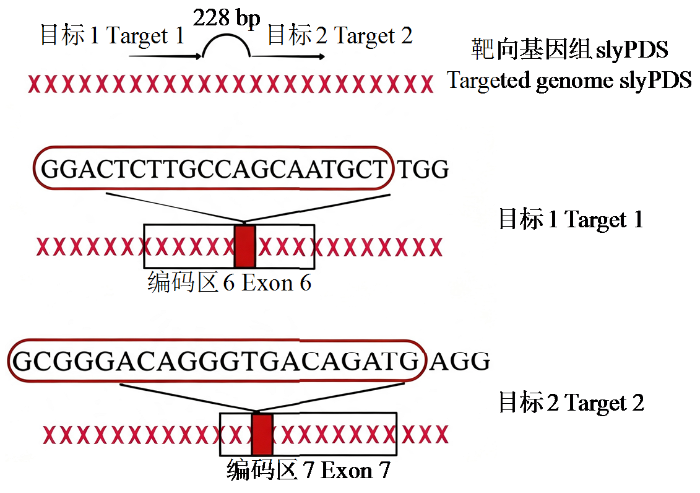
图1
pYLCRISPR/Cas9系统介导的番茄基因组编辑情况
Fig.1
Gene editing in tomato via the pYLCRISPR/Cas9 system
表1 高GABA番茄引物和探针信息
Table 1
| 名称 Name | 序列 Sequence (5′→3′) | 扩增大小 Amplification size (bp) | |
|---|---|---|---|
| G1 | G1-F | GGAGCACATGTACAATGCTTTACC | 99 |
| G1-R | CGGCAATGTGTTTAATTGCTTAG | ||
| G1-P | GAAACAACCCGCCTGGTTGAT | ||
| G2 | G2-F | GCACATGTACAATGCTTTACC | 98 |
| G2-R | GTGTTTAATTGCTTAGTGGCAGC | ||
| G2-P | GAACGAGACTGCCTGGTTGATGC | ||
| G3 | G3-F | GCACATGTACAATGCTTTACCAAC | 99 |
| G3-R | GCAATGTGTTTAATTGCTTAGTGGC | ||
| G3-P | GGAAACAACCCGCCTGGTT | ||
| G4 | G4-F | GCACATGTACAATGCTTTACC | 97 |
| G4-R | GTGTTTAATTGCTTAGTGGCAGC | ||
| G4-P | GAACGAGACTGCCTGGTTGATGC | ||
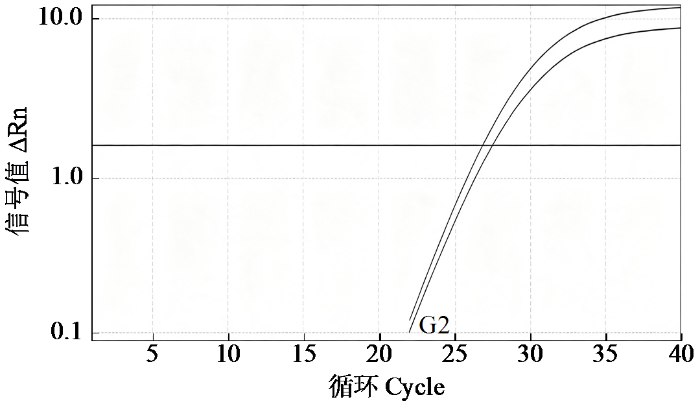
图2
2.2 扩增体系的检测限
由表2可知,≥0.01% DNA浓度的RSD均<25%,但DNA浓度为0.005%时,RSD为ND,即没有扩增到,所以可以得出结论,扩增体系的检测限是0.01%。
表2 DNA梯度浓度检测结果的统计分析
Table 2
| 浓度 Concentration (%) | Ct | 平均Ct Average Ct | 相对标准偏差 RSD (%) | ||
|---|---|---|---|---|---|
| 1 | 2 | 3 | |||
| 5.00 | 30.89 | 32.12 | 31.13 | 31.38 | 2.08 |
| 1.00 | 31.96 | 32.78 | 31.86 | 32.20 | 1.57 |
| 0.50 | 32.86 | 33.68 | 32.82 | 33.12 | 1.46 |
| 0.10 | 34.12 | 35.08 | 35.44 | 34.88 | 1.97 |
| 0.05 | 35.90 | 36.76 | 36.27 | 36.31 | 1.19 |
| 0.01 | 38.11 | 38.88 | 38.60 | 38.53 | 1.01 |
| 0.005 | ND | 39.62 | ND | ND | ND |
ND表示没有检测到扩增。
ND indicates that no amplification was detected.
2.3 引物探针稳定性
表3 野生型番茄品种列表
Table 3
| 序号Number | 国家Country | 品种名称Variety name |
|---|---|---|
| 1 | 中国 | 诺盾314 |
| 2 | 中国 | 荷兰德奥特302 |
| 3 | 中国 | 德澳特7845 |
| 4 | 日本 | 心形番茄 |
| 5 | 日本 | 阳光大道 |
| 6 | 德国 | 鲁比阿姨的德国绿番茄 |
| 7 | 德国 | 巴斯夫蜜思提拉小番茄 |
| 8 | 荷兰 | 德奥特302 |
| 9 | 俄罗斯 | 黑柿子番茄 |
| 10 | 韩国 | 釜山金粉 |
| 11 | 法国 | 樱桃番茄 |
| 12 | 美国 | 传统牛排番茄 |
| 13 | 美国 | 紫色番茄 |
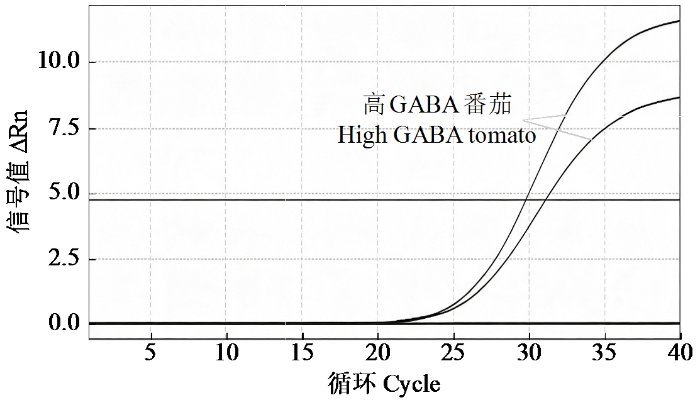
图3
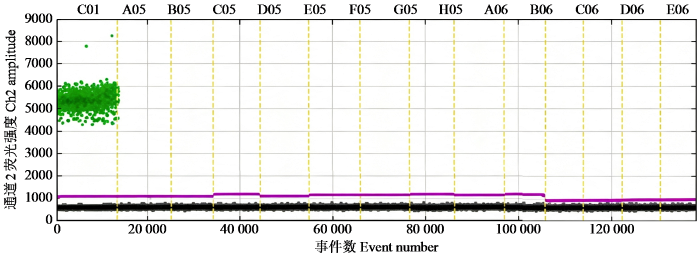
2.4 通过数字PCR进行检测分析
图4
3 讨论
基因编辑技术自从问世以来发展迅速,新方法、新技术、新成果不断涌出。未来,该技术将得到进一步开发并应用于多个领域,有望成为植物改造的重要工具,推动更多基因编辑植物商业化[7]。基因编辑技术改造的是植物本身的基因,没有引入外来基因,这与转基因方法截然不同,因此,应当加快推进基因编辑植物检测方法及检测标准的研究与制定,建立一套灵敏、精准、完善、高通量的基因编辑植物的检测方法体系[7],这有利于生物安全监管、环境监测和品种溯源。Li等[21]采用CRISPR/Cas9方法,针对番茄slyPDS基因组进行靶向编辑,得到高GABA番茄品种。在此,本试验以CRISPR/Cas9基因编辑的高GABA番茄为材料,提出并验证了一种针对编辑位点特异性的荧光PCR和数字PCR检测方法,此方法可用于检测基因编辑的植物。本试验中,设计的引物探针序列中包含了变化的碱基,设计了4组特异性引物探针,利用荧光PCR方法验证引物探针对CRISPR/Cas9基因编辑的高GABA番茄的特异性,从结果中得到1组扩增效果明显的引物探针序列,通过梯度稀释法检测得到验证,扩增体系的检测限是0.01%。引物探针的稳定性尤为关键,为此,选择了来自中国、日本、德国、荷兰、俄罗斯、韩国、美国和法国的13个不同野生型番茄,进一步测试引物探针的稳定性,结果显示该组引物探针序列只对CRISPR/Cas9基因编辑的高GABA番茄有特异性,稳定性良好。最后试验验证该组引物探针序列同样适用于数字PCR检测体系。本文建立的方案为基因编辑植物的检测提供了方法依据,为生物安全监管、环境监测和品种溯源提供技术支撑,并为制订相关检测标准打下基础。
参考文献
A programmable dual-RNA-guided DNA endonuclease in adaptive bacterial immunity
DOI:10.1126/science.1225829
PMID:22745249
[本文引用: 1]

Clustered regularly interspaced short palindromic repeats (CRISPR)/CRISPR-associated (Cas) systems provide bacteria and archaea with adaptive immunity against viruses and plasmids by using CRISPR RNAs (crRNAs) to guide the silencing of invading nucleic acids. We show here that in a subset of these systems, the mature crRNA that is base-paired to trans-activating crRNA (tracrRNA) forms a two-RNA structure that directs the CRISPR-associated protein Cas9 to introduce double-stranded (ds) breaks in target DNA. At sites complementary to the crRNA-guide sequence, the Cas9 HNH nuclease domain cleaves the complementary strand, whereas the Cas9 RuvC-like domain cleaves the noncomplementary strand. The dual-tracrRNA:crRNA, when engineered as a single RNA chimera, also directs sequence-specific Cas9 dsDNA cleavage. Our study reveals a family of endonucleases that use dual-RNAs for site-specific DNA cleavage and highlights the potential to exploit the system for RNA-programmable genome editing.
Multiplex genome engineering using CRISPR/Cas systems
DOI:10.1126/science.1231143
PMID:23287718
[本文引用: 1]
Functional elucidation of causal genetic variants and elements requires precise genome editing technologies. The type II prokaryotic CRISPR (clustered regularly interspaced short palindromic repeats)/Cas adaptive immune system has been shown to facilitate RNA-guided site-specific DNA cleavage. We engineered two different type II CRISPR/Cas systems and demonstrate that Cas9 nucleases can be directed by short RNAs to induce precise cleavage at endogenous genomic loci in human and mouse cells. Cas9 can also be converted into a nicking enzyme to facilitate homology-directed repair with minimal mutagenic activity. Lastly, multiple guide sequences can be encoded into a single CRISPR array to enable simultaneous editing of several sites within the mammalian genome, demonstrating easy programmability and wide applicability of the RNA-guided nuclease technology.
CRISPR-Cas9 system: a new-fangled dawn in gene editing
DOI:10.1016/j.lfs.2019.116636 URL [本文引用: 1]
A glance at genome editing with CRISPR-Cas9 technology
DOI:10.1007/s00294-019-01040-3
PMID:31691023
In recent years, CRISPR-Cas9 technology is widely acknowledged for having major applications in the field of biotechnology for editing genome of any organism to treat a variety of complex diseases and for other purposes. The acronym 'CRISPR-Cas' stands for clustered regularly interspaced short palindromic repeats-CRISPR-associated genes. This genetic organization exists in prokaryotic organisms and aids in the development of adaptive immunity since a protein called Cas9 nuclease cleaves specific target nucleic acid sequences from foreign invaders and destroys them. This mode of action has gained interest of the researchers to understand the insights of CRISPR-Cas9 technology. Here, we review that CRISPR-Cas organization is restricted to two classes and possesses different protein effectors. We also review the architecture of CRISPR loci, mechanism involved in genome editing by CRISPR-Cas9 technology and pathways of repairing double-strand breaks (DSBs) generated during the process of genome editing. This review also presents the strategies to increase the Cas9 specificity and reduce off-target activity to achieve accurate genome editing. Further, this review provides information on CRISPR tools used for genome editing, databases that are required for storing data on loci, strategies for delivering CRISPR-Cas9 to cells under study and applications of CRISPR-Cas9 to various fields. Safety measures are implemented on this technology to avoid misuse or ethical issues. We also discuss about the future aspects and potential applications of CRISPR-Cas9 technology required mainly for the treatment of dreadful diseases, crop improvement as well as genetic improvement in human.
Cas 9 versus Cas12a/Cpf1: Structure- function comparisons and implications for genome editing
DOI:10.1002/wrna.2018.9.issue-5 URL
CRISPR-Cas system for biomedical diagnostic platforms
DOI:10.1002/viw2.v1.3 URL [本文引用: 1]
Improving the efficiency of CRISPR-Cas12a-based genome editing with site-specific covalent Cas12a-crRNA conjugates
DOI:10.1016/j.molcel.2021.09.021
PMID:34648747
The CRISPR-Cas12a system shows unique features compared with widely used Cas9, making it an attractive and potentially more precise alternative. However, the adoption of this system has been hindered by its relatively low editing efficiency. Guided by physical chemical principles, we covalently conjugated 5' terminal modified CRISPR RNA (crRNA) to a site-specifically modified Cas12a through biorthogonal chemical reaction. The genome editing efficiency of the resulting conjugated Cas12a complex (cCas12a) was substantially higher than that of the wild-type complex. We also demonstrated that cCas12a could be used for precise gene knockin and multiplex gene editing in a chimeric antigen receptor T cell preparation with efficiency much higher than that of the wild-type system. Overall, our findings indicate that covalently linking Cas nuclease and crRNA is an effective approach to improve the Cas12a-based genome editing system and could potentially provide an insight into engineering other Cas family members with low efficiency as well.Copyright © 2021 Elsevier Inc. All rights reserved.
基因编辑技术在作物育种中的应用与展望
DOI:10.13560/j.cnki.biotech.bull.1985.2020-0328
[本文引用: 1]
基因编辑技术是指对目标基因进行“编辑”,实现对特定基因片段的删除、插入和替换的一项技术。如今该技术已经被广泛应用于细菌、真菌、动物和植物等领域,其中成簇的规律间隔的短回文重复序列及其相关系统(Clustered Regularly Interspaced Short Palindromic Repeats/CRISPR-associated proteins,CRISPR/Cas system)作为第三代编辑技术,其效用远超于前两代并因此在近年来迅猛发展。简要介绍了锌指核酸酶(Zinc-finger nucleases,ZFNs)、转录激活子样效应因子核酸酶(Transcription activator-like effectors nucleases,TALEN)和CRISPR/Cas共3种基因组编辑技术的作用机理,并总结CRISPR/Cas系统的功能、局限性以及其在作物育种上的应用,最后对基因编辑作物的未来进行展望。
Genome editing: past, present, and future
Near-infrared upconversion- activated CRISPR-Cas9 system: a remote-controlled gene editing platform
DOI:10.1126/sciadv.aav7199
URL
Remote-controlled manipulation of gene editing was achieved in vivo.
Photoswitchable gRNAs for spatiotemporally controlled CRISPR- Cas-based genomic regulation
DOI:10.1021/acscentsci.9b01093
PMID:32490186
The recently discovered CRISPR-Cas gene editing system and its derivatives have found numerous applications in fundamental biology research and pharmaceutical sciences. The need for precise external control over the gene editing and regulatory events has driven the development of inducible CRISPR-Cas systems. While most of the light-controllable CRISPR-Cas systems are based on protein engineering, we developed an alternative synthetic approach based on modification of crRNA/tracrRNA duplex (guide RNA or gRNA) with photocaging groups, preventing the gRNA from recognizing its genome target sequence until its deprotection is induced within seconds of illumination. This approach relies on a straightforward solid-phase synthesis of the photocaged gRNAs, with simpler purification and characterization processes in comparison to engineering a light-responsive protein. We have demonstrated the feasibility of photocaging of gRNAs and light-mediated DNA cleavage upon brief exposure to light. We have achieved light-mediated spatiotemporally resolved gene editing as well as gene activation in cells, whereas photocaged gRNAs showed virtually no detectable gene editing or activation in the absence of light irradiation. Finally, we have applied this system to spatiotemporally control gene editing in zebrafish embryos, enabling the use of this strategy for developmental biology and tissue engineering applications.Copyright © 2020 American Chemical Society.
A DNA origami nanorobot for targeted CRISPR-Cas 9 delivery
Spatial and temporal control of CRISPR-Cas9-mediated gene editing delivered via a light-triggered liposome system
Real-time quantitative PCR method specific for detection and quantification of the first commercialized genome-edited plant
DOI:10.3390/foods9091245
URL
[本文引用: 2]
Discussion regarding the regulatory status of genome-edited crops has focused on precision of editing and on doubts regarding the feasibility of analytical monitoring compliant with existing GMO regulations. Effective detection methods are important, both for regulatory enforcement and traceability in case of biosafety, environmental or socio-economic impacts. Here, we approach the analysis question for the first time in the laboratory and report the successful development of a quantitative PCR detection method for the first commercialized genome-edited crop, a canola with a single base pair edit conferring herbicide tolerance. The method is highly sensitive and specific (quantification limit, 0.05%), compatible with the standards of practice, equipment and expertise typical in GMO laboratories, and readily integrable into their analytical workflows, including use of the matrix approach. The method, validated by an independent laboratory, meets all legal requirements for GMO analytical methods in jurisdictions such as the EU, is consistent with ISO17025 accreditation standards and has been placed in the public domain. Having developed a qPCR method for the most challenging class of genome edits, single-nucleotide variants, this research suggests that qPCR-based method development may be applicable to virtually any genome-edited organism. This advance resolves doubts regarding the feasibility of extending the regulatory approach currently employed for recombinant DNA-based GMOs to genome-edited organisms.
An Editing-site-specific PCR method for detection and quantification of CAO1-edited rice
DOI:10.3390/foods10061209 URL [本文引用: 2]
Definition of minimum performance requirements for analyticalmethods of gmo testing
Multiplexed CRISPR/Cas9-mediated metabolic engineering of γ-aminobutyric acid levels in Solanum lycopersicum
DOI:10.1111/pbi.2018.16.issue-2 URL [本文引用: 1]


