



籽粒灌浆是水稻产量形成的关键过程。在此过程中,叶片既可作为光合器官合成碳水化合物,又是氮素等营养物质的主要“储存库”和“功能载体”,为水稻灌浆提供物质基础[4]。灌浆期叶片碳氮代谢的协调程度是决定水稻产量形成的关键[5]。碳氮代谢是水稻体内最基本的代谢途径,其相关酶活性与代谢产物之间既相互协调,又相互制约[6]。这种动态平衡关系的变化,直接影响碳、氮化合物在水稻体内的合成、转运与分配,最终决定水稻的产量与品质[7]。在水稻生产中,通过施用氮肥来调控植株体内的碳氮代谢过程,是改善水稻产量与品质的有效手段,且效果十分显著[8-9]。选用氮高效品种并配合氮肥后移,可以在花后促进氮素积累,提高碳氮代谢关键酶活性,促进营养器官中光合同化物的积累及转运[10]。有学者[11]发现,在灌浆过程中氮对叶片中的氮代谢产物氨基酸的积累有显著的正向影响。施氮量过高或者氮肥后移有利于植株氮吸收,消耗水稻植株碳水化合物,为蛋白质合成提供碳源[12];反之,减少氮肥施用有利于提高水稻叶片蔗糖合成酶活性和基因表达,促进植株碳同化物的合成与积累[13]。然而,与传统速效氮肥的多次施用或氮肥后移相比,缓控释肥能否在简化栽培管理的同时,维持灌浆期叶片较高的碳氮代谢活性以提高产量,有待进一步研究。
目前,关于缓控释肥在水稻生产上减少施氮量、减少施肥次数、降低氮肥损失量、提高氮肥利用率、提高水稻产量以及环保等方面的研究较多[14-15],也有研究[16]报道在缓控释肥处理下,土壤中的氮素有效性显著提高,叶片中的氮代谢酶活性提高,水稻的生长条件得到改善,进而提高产量。叶片作为水稻植株最重要的源端营养器官,其在灌浆期的碳氮代谢生理过程中尤为重要。因此,本研究以控氮控肥能力强、氮素利用效率高的宁粳8号为试验材料,选用氮素释放特性差异显著的缓控释肥,系统比较不同类型缓控释肥对水稻灌浆期叶片碳氮代谢过程中代谢产物、酶活性及基因表达量的影响,旨在筛选出能够保障水稻高产且省工节本、增产高效的缓控释肥种类,为水稻绿色高效生产提供理论依据。
1 材料与方法
1.1 试验地概况与试验材料
试验于2020-2021年在江苏省镇江市丹阳市延陵镇宝林村南京农业大学丹阳试验站(31°56′39′′ N,118°59′13′′ E,海拔80 m)进行。试验地位于长江三角洲水稻主产区和高产区,属于湿润的亚热带气候,是长江流域典型气候之一。土壤为黄粘土,水稻田0~20 cm耕层土壤的基本理化性质为pH 6.4、全氮1.3 g/kg、速效氮7.9 mg/kg、速效磷16.9 mg/kg、速效钾139.6 mg/kg、有机质18.3 g/kg。
供试品种为当地高产品种宁粳8号。
1.2 试验设计
试验采用随机区组设计。以传统分次施肥(CK)为对照,分4次施用尿素氮肥,基肥、分蘖肥、促花肥和保花肥的比例为3:2:3:2。试验设置4个缓控释肥施肥处理(图1),分别为硫包膜型缓释肥(SCU)、树脂包膜型缓控释肥(PCU)、脲甲醛(UF)和缓释复混肥(BBF),每个处理3次重复。各缓控释肥均由汉枫农业科技(泰州)有限公司(中国江苏)提供。其中UF和SCU属于速效缓释型肥,呈现出爆发性释放模式,在水稻生育前期释放较快,中、后期释放有限。PCU和BBF则属于控释型肥料。其中,PCU作为SCU的升级产品,具有在水稻生育前期少量释放,后期持续快速释放的特征。BBF是由多种缓释肥和控释肥混合而成的水稻专用缓混肥,由南京农业大学水稻栽培课题组研发,适用于水稻机插。BBF的养分释放特征居于SCU和PCU之间,表现为双峰释放模式,即生育前期释放量较大,后期释放量较小,确保养分供应与水稻生长需求协调匹配[17]。
图1
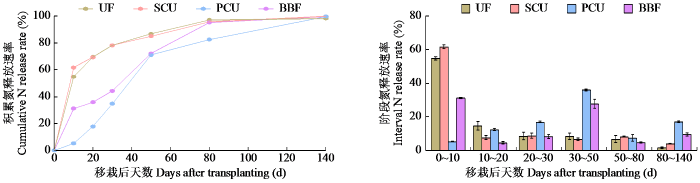
图1
不同类型缓控释肥的积累氮及阶段氮释放速率
Fig.1
Cumulative N and interval N release rate of slow-controlled release fertilizer
试验施氮量均为210 kg N/hm2,缓控释肥及磷钾肥均为一次性基施,其中P2O5 73.5 kg/hm2、K2O 81.9 kg/hm2,其余栽培管理措施按当地高产要求进行。各小区均于每年5月中下旬播种,6月中下旬机械移栽,机插密度为30.0 cm×12.1 cm,11月上旬收获测产。
1.3 测定项目与方法
1.3.1 产量及其构成因素
于水稻成熟期,每小区普查60穴水稻的有效穗数,并计算平均值,按平均有效穗数取代表穴10穴考种,测定穗粒数、结实率和粒重,并计算产量。各小区水稻全部收获并晒干后测定产量。
1.3.2 叶色及光合参数
于水稻花后7、21和35 d用叶绿素仪SPAD-502(Minolta,日本)测定挂牌标记剑叶的相对叶绿素含量(SPAD值)。同时,于晴朗上午9:00-11:00,利用LI-6400便携式光合作用测定仪(Li-COR,美国)测定各小区长势一致剑叶的净光合速率(Pn)、气孔导度(Gs)和蒸腾速率(Tr)。各小区测定10片叶片,3次重复。
1.3.3 碳氮代谢产物
于水稻花后0、7、14、21、28、35和42 d,在每个施肥处理下,分别从3个重复小区中各取30片剑叶,经105 ℃杀青、80 ℃烘干后,粉碎过100目筛,用于测定碳氮代谢产物。参考Hendrix[18]的方法并加以修改测定蔗糖含量。采用蒽酮比色法[19]测定叶片中的淀粉含量。用NCH分析仪(Sumika Chemical Analysis Service,Tokyo,日本)的Dumas燃烧法[20]测定氮含量。采用考马斯亮蓝法[21]测定可溶性蛋白含量。用磺基水杨酸提取,上清液用0.22 mm过滤头过滤,采用日立L-8900氨基酸自动分析仪(Hitachi Corp,日本)测定游离氨基酸含量。
1.3.4 碳氮代谢关键酶活性
1.3.5 基因表达
于水稻花后7、21和35 d,在每个施肥处理下,分别从3个重复小区中各取30片新鲜剑叶,进行蔗糖转运蛋白和碳氮同化关键基因表达的测定。叶片中的总RNA由RNeasy Plant Mini Kit(QIAGEN公司,中国)提取纯化,根据试剂盒方法合成cDNA第1链,稀释后用于荧光定量PCR,其中PCR引物由北京擎科生物科技股份有限公司合成,引物信息详见表1。
表1 基因引物信息
Table 1
| 基因Gene | 正向引物Forward primer (5’-3’) | 反向引物Reverse primer (3’-5’) |
|---|---|---|
| OsActin | CAATCGTGAGAAGATGACCC | GTCCATCAGGAAGCTCGTAGC |
| OsSUT2 | TCTTTTATCGGTGGGCTGGT | TTGCAAAGAATGGCCGACAA |
| OsSUT4 | CTCGTGCCCTTTTAGCTGAC | AACGTTTCCAACAGCCATCC |
| OsGS2 | TGGGTTGGAGGAACTGGAATT | ACGTTTGTTAGTAGGGATGGG |
| OsDOF11 | CAATGCCCATCATGCCAGCA | GCTCTGCAGCCTTGGACTAT |
1.4 数据处理
采用Microsoft Excel 2016计算试验数据平均值和标准误差,采用Graphpad prism 7软件作图,采用SPSS 25.0统计软件对数据进行单因素方差分析(ANOVA)和Duncan法多重比较。
2 结果与分析
2.1 缓控释肥对水稻产量及其构成因素的影响
相较于传统分次施肥(CK),不同种类缓控释肥(UF、SCU、PCU和BBF)对水稻产量的影响存在明显差异(表2)。在2020与2021年的水稻生长季,UF和SCU处理的水稻产量显著低于CK处理,其中UF处理产量分别减少17.65%和13.40%,SCU处理产量分别降低5.88%和23.21%;而PCU和BBF处理的产量与CK处理差异不显著。这主要归因于UF和SCU处理的每穗粒数及总颖花量显著低于CK处理,而PCU和BBF处理与CK处理无明显差异。此外,所有缓控释肥处理均能使结实率维持在与CK相当的水平,同时显著提高水稻粒重。年份与处理互作分析结果显示,不同缓控释肥处理在产量、总颖花量和粒重方面均存在显著差异,表明PCU和BBF处理主要通过提升总颖花量和粒重,进而实现与CK相当的产量水平。
表2 2020-2021年不同类型缓控释肥对水稻产量及其构成因素的影响
Table 2
| 年份 Year | 肥料类型 Fertilizer type | 产量 Yield (t/hm2) | 有效穗数 Effective panicle number (/m2) | 每穗粒数 Grain number per panicle | 总颖花量 Total number of spikelets (/hm2) | 结实率 Seed-setting rate (%) | 粒重 Grain weight (mg) |
|---|---|---|---|---|---|---|---|
| 2020 | CK | 10.2ab | 314.4ab | 129.0a | 4.1a | 93.9a | 26.9c |
| UF | 8.4c | 286.2c | 112.3b | 3.2c | 94.9a | 27.6ab | |
| SCU | 9.6b | 305.5abc | 117.5b | 3.6bc | 95.4a | 28.0a | |
| PCU | 10.2ab | 293.3bc | 131.8a | 3.9ab | 94.9a | 27.8a | |
| BBF | 10.8a | 325.3a | 131.2a | 4.3a | 93.6a | 27.2bc | |
| 2021 | CK | 11.2a | 323.0a | 137.9a | 4.4a | 96.8a | 26.1c |
| UF | 9.7b | 335.7a | 110.5c | 3.7b | 93.6a | 28.3a | |
| SCU | 8.6b | 343.3a | 94.2c | 3.2c | 94.9a | 28.1ab | |
| PCU | 11.1a | 368.3a | 116.0abc | 4.3a | 96.3a | 27.2b | |
| BBF | 11.0a | 355.7a | 117.3ab | 4.2a | 95.6a | 27.5ab | |
| F-value | 处理(T) | ** | ns | ** | ** | ns | ** |
| 年份(Y) | ** | ** | * | * | ns | ns | |
| T×Y | ** | ns | ns | ** | ns | * |
不同小写字母表示各处理间差异显著(P < 0.05);“**”和“*”分别表示在P < 0.01和P < 0.05水平上差异显著,ns表示无显著差异。
Different lowercase letters indicate significant differences among different treatments (P < 0.05);“**”and“*”indicate significant differences at
P < 0.01 and P < 0.05 levels, respectively, ns means no significant difference.
2.2 缓控释肥对水稻灌浆期剑叶光合作用的影响
随着灌浆进程的推进(花后0~42 d),剑叶的SPAD值、Pn、Gs及Tr均呈逐渐下降趋势(图2)。在SPAD值方面,PCU和BBF处理在整个灌浆期表现良好,其SPAD值与CK处理无显著差异;而UF和SCU处理的SPAD值在灌浆中、后期显著低于CK处理,叶色褪绿较快。同时,PCU和BBF处理的光合能力整体优于UF和SCU处理。值得注意的是,在2021年,PCU和BBF处理的Pn在灌浆期可达到与CK处理相当的水平。相比之下,UF和SCU处理的Pn在2年中均明显低于CK处理,尤其在灌浆后期下降更为显著。此外,各施肥处理Gs的变化趋势与Pn基本一致,PCU和BBF处理的Gs整体高于UF和SCU处理,但均低于CK处理。因此,PCU和BBF处理在维持灌浆期剑叶光合功能方面表现优于UF和SCU处理,可达到或接近CK处理的水平。
图2
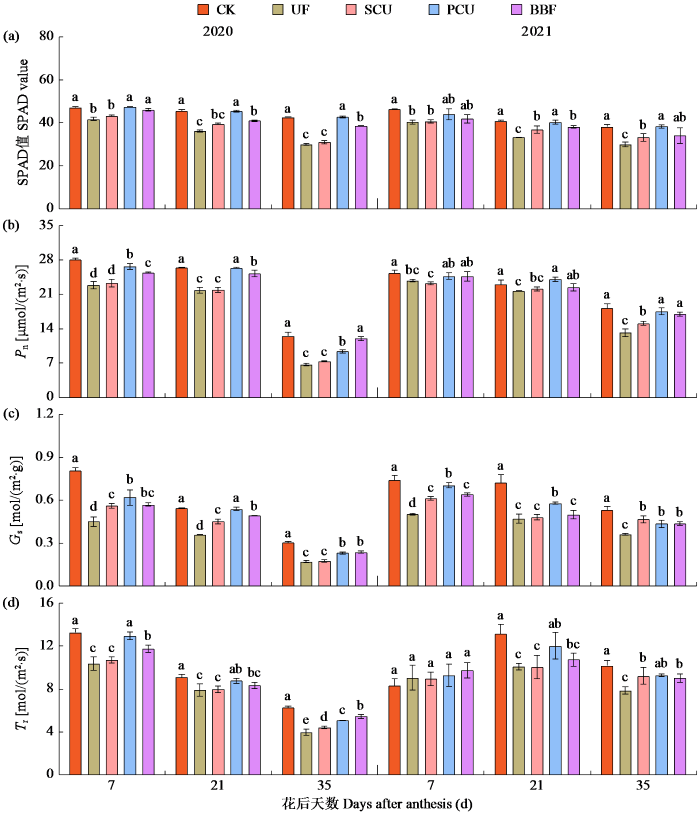
图2
2020-2021年不同类型缓控释肥对水稻灌浆期剑叶SPAD值及光合参数的影响
不同小写字母表示各处理间差异显著(P < 0.05),下同。
Fig.2
Effects of different types of slow-controlled release fertilizer on SPAD value and photosynthetic parameters of flag leaves during grain-filling stage of rice in 2020 and 2021
Different lowercase letters indicate significant differences among different treatments (P < 0.05), the same below.
2.3 缓控释肥对水稻灌浆期叶片中碳代谢物含量及其关键酶活性的影响
灌浆期剑叶中蔗糖含量呈先降低后升高的趋势(图3)。与CK处理相比,BBF处理的剑叶蔗糖含量在整个灌浆期均显著升高,而SCU和PCU处理大多未表现出显著差异。此外,UF处理剑叶蔗糖含量仅在花后0、35和42 d显著高于CK处理。就淀粉含量而言,各处理间差异显著。值得注意的是,PCU处理剑叶淀粉含量在整个灌浆期间大多显著低于CK处理,或与CK处理无显著差异;而UF与SCU处理在花后28~42 d均显著高于CK处理;BBF处理则处于各处理组的中等水平。剑叶中碳代谢关键酶SPS和AGP的活性随灌浆进程呈逐渐下降趋势。与CK相比,UF和SCU处理的碳代谢酶活性多显著降低,而PCU和BBF处理则维持在接近CK的水平。然而,PCU处理的剑叶淀粉含量显著低于CK,表明其叶片光合固定的碳并未滞留积累于叶片,而是被高效转运至籽粒用于灌浆。相比之下,BBF处理酶活性稳定,淀粉含量中等,呈现相对平衡的碳分配。
图3
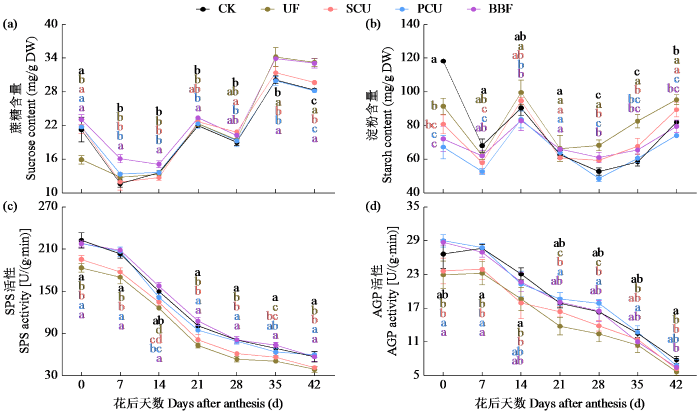
图3
不同类型缓控释肥对水稻灌浆期剑叶中碳代谢物含量及其关键酶活性的影响
Fig.3
Effects of different types of slow-controlled release fertilizer on the change of carbon metabolite contents and key enzyme activities in flag leaves of rice
2.4 缓控释肥对水稻灌浆期叶片氮代谢物含量及其关键酶活性的影响
灌浆期,剑叶中氮代谢物含量及其关键酶活性多呈逐渐下降的趋势(图4)。就氮代谢物而言,PCU处理下剑叶氮含量、总游离氨基酸含量及可溶性蛋白含量均维持在接近CK处理的水平;而UF和SCU处理下,这些氮代谢物含量多显著低于CK处理。氮代谢关键酶(NR、GS和GOGAT)活性的变化趋势与氮代谢物含量基本一致。其中,BBF处理下剑叶氮代谢物含量及关键酶活性均处于各处理组中的适中水平,表明其对氮代谢的调控作用较为平衡。
图4
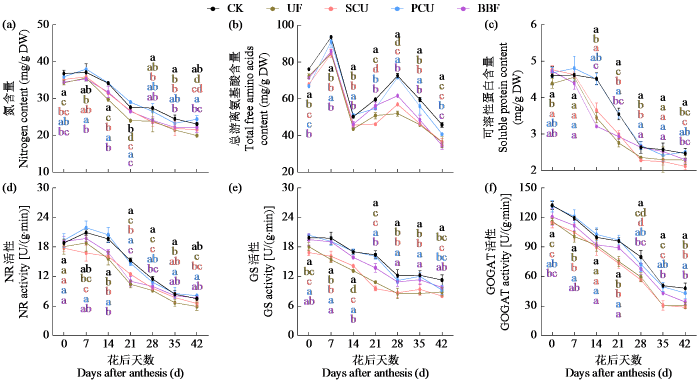
图4
不同类型缓控释肥对水稻灌浆期剑叶中氮代谢物含量及其关键酶活性的影响
Fig.4
Effects of different types of slow-controlled release fertilizer on the change of nitrogen metabolite contents and key enzyme activities in flag leaves of rice
2.5 水稻产量构成因素与剑叶碳氮代谢关键酶活性的相关性
进一步分析产量构成因素与灌浆期剑叶碳氮代谢关键酶活性的相关性分析(图5)可知,不同缓控释肥处理下,水稻产量及总颖花数多与灌浆期剑叶碳氮代谢关键酶活性呈显著正相关,其中与SPS、GS和GOGAT的活性关系最为密切。值得注意的是,灌浆期各处理下粒重与上述剑叶酶活性多呈负相关。这可能是由于灌浆期叶片逐渐衰老导致碳氮代谢酶活性下降,而此时籽粒灌浆仍在进行,并且粒重的最终积累多依赖于灌浆前期叶片光合产物的储备与转运效率。其中,AGP主要在灌浆前期和中期与产量构成参数呈显著正相关,表明其在灌浆前期和中期淀粉转化过程中发挥关键作用;NR在灌浆前期和后期与产量呈显著正相关,在灌浆前期和中期与总颖花数和粒重存在相关性,反映出氮同化过程在水稻奠定颖花数和维持叶片功能、促进氮素再转运的双重贡献。
图5
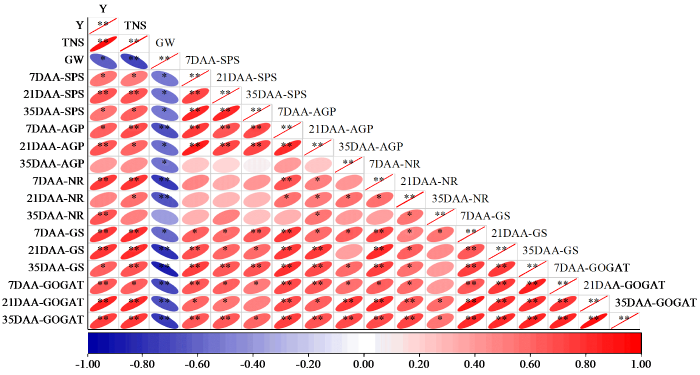
图5
缓控释肥处理下水稻产量构成因素与剑叶碳氮代谢关键酶活的相关性分析
Y:产量,TNS:总颖花量,GW:粒重。7DAA、21DAA、35DAA分别表示花后7 d(灌浆前期)、21 d(灌浆中期)和35 d(灌浆后期)。
Fig.5
Correlation analysis between yield components and key enzyme activities of carbon and nitrogen metabolism in flag leaves of rice
Y; yield, TNS: total number of spikelets, GW: grain weight. 7DAA, 21DAA, and 35DAA represent 7 (early grain filling), 21 (mid-grain filling), and 35 (late grain filling) days after anthesis, respectively. *: P < 0.05, **: P < 0.01.
2.6 缓控释肥对水稻灌浆期叶片碳氮同化关键基因表达的影响
不同类型缓控释肥处理对叶片碳氮同化关键基因的表达具有差异化调控作用(图6)。其中,蔗糖装载关键基因(OsSUT2,OsSUT4)、氮同化关键基因(OsGS2)以及协同调控碳氮同化的关键转录因子(OsDOF11)在不同处理下的表达水平存在明显差异。在灌浆期,PCU处理下这些基因的表达量均显著上调,尤其在灌浆前期和中期最为明显。相比之下,UF和SCU处理下各基因的表达水平多与CK无显著差异,部分基因表达量甚至低于CK处理水平。BBF处理对剑叶碳氮同化关键基因表达的调控作用较为适中,多数基因呈显著上调或维持在与CK相当的水平,但整体上调幅度未超过PCU处理。因此,PCU处理可增强灌浆前、中期碳氮协同代谢关键基因的表达,而BBF处理则表现出较为适中的调控模式。
图6
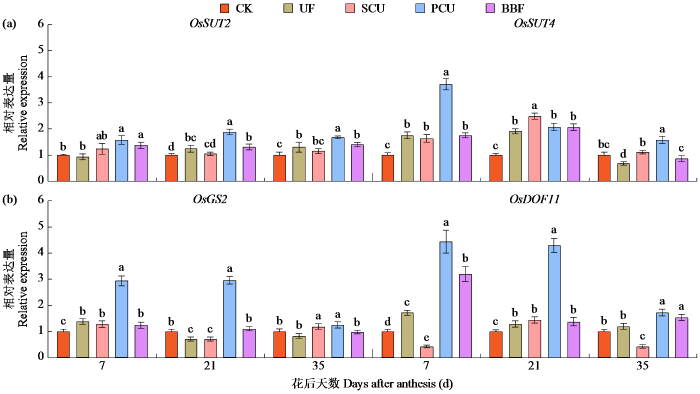
图6
不同类型缓控释肥对水稻灌浆期剑叶中碳氮同化关键基因表达的影响
Fig.6
Effects of different types of slow-controlled release fertilizer on the key genes expression of carbon and nitrogen assimilate in flag leaves of rice
3 讨论
缓控释肥是一种利用效率高、省时省工的新型肥料,可满足作物养分的供需平衡[26]。其中,速效缓释型肥料UF和SCU在水稻生育前期氮素释放较快,生育中、后期释放有限;而控释型肥料PCU和BBF可在全生育期释放氮素,并且BBF肥料呈现双峰释放模式。本研究中,UF和SCU处理的水稻产量明显低于CK处理,而PCU和BBF处理使产量维持在与CK相当的水平。缓控释肥的多级释放机制可满足作物全生育期的生长需求,对水稻产量和品质具有一定的提升作用[27]。这说明,在水稻生长阶段持续提高营养物质的PCU和BBF肥料可充分提供水稻生长发育所需养分,在保证产量的基础上实现省工省力。其中,PCU和BBF处理的总颖花量和粒重显著高于其他缓控释肥处理,并且与CK处理无明显差异,这可归因于PCU和BBF在孕穗期及灌浆期均可持续性释放,为水稻的孕穗和灌浆过程充分提供养分。
水稻籽粒灌浆期间,叶片提供了所需碳同化物的60%~80%,其中剑叶扮演着至关重要的角色[28]。本研究发现,PCU和BBF处理下剑叶的SPAD值及光合参数均可达到CK的水平,而UF和SCU处理则明显低于CK。已有研究[29]表明,氮肥后移对禾本科作物剑叶的光合能力具有显著的促进作用。这说明在灌浆期能够持续释放养分的PCU和BBF肥料,可使水稻的光合能力维持在与CK处理相当的水平。灌浆期,水稻叶片在光照期间通过光合作用合成蔗糖,既可通过碳代谢关键酶SPS和AGP等将蔗糖转化成淀粉临时储存在叶片中,也可通过叶片蔗糖装载的模式立即转运至籽粒[30]。本研究中,UF和BBF处理下蔗糖含量略高于CK处理,其余处理与CK无差异。同时,UF和SCU处理灌浆中、后期淀粉含量显著高于CK,PCU处理则在整个灌浆期显著低于CK,呈低淀粉滞留特征。从碳代谢关键酶活性来看,UF和SCU处理的SPS和AGP活性多显著低于CK处理,而PCU和BBF处理的酶活性则接近CK处理。在碳代谢物转运关键基因表达方面,蔗糖转运子OsSUT2和OsSUT4可以以质外体方式,将叶片中的蔗糖装载入筛管伴胞细胞并运输至未成熟的籽粒中,供其生长发育[31]。PCU处理下剑叶OsSUT2和OsSUT4的表达量均明显高于CK处理,表明PCU肥料可显著增强叶片的碳同化物转运能力。相比之下,BBF处理下剑叶碳代谢物含量及碳同化关键基因表达水平均处于各缓控释肥处理的适中水平。因此,PCU和BBF均可通过促进叶片碳同化物积累和转运能力以改善水稻籽粒灌浆。其中,PCU表现为高效转运和低淀粉滞留的特征,而双峰释放模式的BBF则在碳分配与积累之间表现出更好的平衡性。
氮素营养对叶片中的游离氨基酸和蛋白质有正向影响[9]。可溶性蛋白作为植物体中最活跃的蛋白质之一,参与植物生理代谢中多种酶类的调节[32]。在缓控释肥施用下,PCU处理在灌浆期剑叶中的氮含量、游离氨基酸及可溶性蛋白含量均可达到CK的水平,而UF和SCU处理则显著低于CK,BBF处理居中。随着施氮量的提高,氮代谢酶活性增强,可促进氨基酸的合成与积累。叶片中NR、GS、GOGAT是3种最主要的氮代谢酶[33]。本研究中,各缓控释肥处理下这些酶活性的变化趋势与氮代谢物含量基本一致:UF和SCU处理较低,PCU和CK处理较高,BBF处理居中。已有研究[34]表明,氮肥后移或增加施氮量,可提高氮素营养,进而提高叶片中的可溶性蛋白含量,延缓叶片衰老。因此,全生育期持续释放养分的PCU和BBF肥料,在灌浆期仍能释放氮素,通过提高氮代谢关键酶(NR、GS、GOGAT)活性促进叶片中氮代谢物的合成与积累;而生育前期爆发性释放的UF和SCU肥料,因灌浆期供氮不足,导致氮代谢酶活性下降、氮代谢物含量降低,无法维持叶片正常的氮素营养水平。
不同缓控释肥处理下碳氮代谢关键酶活性与水稻的总颖花数、粒重和产量显著相关。生育后期大量释放营养的PCU肥料明显可加强叶片中的碳转运能力和氮代谢能力,使得叶片中淀粉积累较少,且氮代谢物含量较高。碳氮同化关键基因OsGS2与OsDOF11均为调控水稻产量形成与籽粒灌浆过程的重要转录因子。其中,OsGS2是氮同化过程中GS/GOGAT循环的关键调控基因,核心功能在于调控籽粒大小与产量[35];OsDOF11属于DOF转录因子家族,主要通过调控糖分运输,并间接影响氮素吸收与同化能力,从而维持水稻的碳氮平衡[36]。生育期双峰释放模式的BBF肥料在灌浆期适量释放营养,导致叶片中碳氮代谢关键酶活及OsSUT2/4、OsGS2和OsDOF11的表达模式趋于适中,使得叶片具有较好的碳氮代谢平衡能力。因此,全生育期持续释放养分的缓控释肥(如PCU和BBF肥料),有助于维持叶片的碳氮代谢能力,从而提高水稻产量。然而,在灌浆期适量释放养分的BBF肥料,则更有利于维持叶片的碳氮代谢平衡。
4 结论
不同类型缓控释肥对水稻灌浆期剑叶光合特性、碳氮代谢及产量具有显著的差异化调控作用。其中,生育后期快速释放型肥料(PCU)处理下,剑叶碳氮代谢物含量、关键酶活性(SPS、AGP、NR、GS和GOGAT)及相关基因表达水平均可达到甚至超过CK水平,同时剑叶SPAD值、Pn和Gs维持在较高水平,为籽粒灌浆提供了充足的光合同化物,进而提升了总颖花量和粒重。生育期双峰释放型肥料(BBF)则表现出适中的碳氮代谢调控模式,有利于维持碳氮平衡,同样实现了与CK相当的产量。相比之下,生育期速效释放型肥料(UF、SCU)处理下,多数碳氮代谢指标及光合性能均低于CK。因此,合理选择以BBF为代表的缓控释肥,可在简化施肥方式的同时维持水稻叶片碳氮代谢平衡,实现与CK处理相当的产量水平。
参考文献
Technical efficiency of chemical fertilizer use and its influencing factors in China’s rice production
DOI:10.3390/su13031155 URL [本文引用: 1]
Current status and challenges of rice production in China
DOI:10.1626/pps.12.3 URL [本文引用: 1]
Global trends and current advances in slow/controlled-release fertilizers: a bibliometric analysis from 1990 to 2023
DOI:10.3390/agriculture14091502 URL [本文引用: 1]
Photosynthetic contribution of the ear to grain filling in wheat: a comparison of different methodologies for evaluation
DOI:10.1093/jxb/erw116
PMID:27012283
[本文引用: 1]

The culm (particularly the flag leaf) and the ear are believed to play a major role in providing assimilates for grain filling in wheat. However, the results obtained in the past varied depending on the methodology applied. Three different methodologies were compared that aimed to assess the relative contribution of the culm (photosynthetic organs below the ear) and the ear to grain filling. The first two consisted of applications of photosynthesis inhibition treatments, including the use of the herbicide DCMU and organ shading. The third was a non-intrusive method that compared the carbon isotope composition (δ(13)C) of mature kernels with the δ(13)C of the water-soluble fraction of the peduncle, awns and glumes. Several advanced CIMMYT lines were tested under good agronomic conditions. The δ(13)C approach assigned a higher photosynthetic contribution to the ear than to the culm. However, some methodological considerations should be taken into account when applying the δ(13)C approach, particularly the sampling method used, in order to prevent post-harvest respiration. The shading approach assigned a similar contribution to the ear as to the culm. The DCMU approach assigned a greater role to the culm but herbicide application to the culm affected the ear, thus biasing the final grain weight. Moreover DCMU and shading approaches may cause compensatory effects which overestimated the contribution of unaffected organs. This study may help to develop precise phenotyping tools to identify physiological traits such as ear photosynthesis that could contribute towards increasing grain yield.© The Author 2016. Published by Oxford University Press on behalf of the Society for Experimental Biology.
Nitrogen use efficiency in selected rice (Oryza sativa L.) genotypes under different water regimes and nitrogen levels
DOI:10.1016/j.fcr.2008.01.007 URL [本文引用: 1]
Optimizing agronomy improves super hybrid rice yield and nitrogen use efficiency through enhanced post-heading carbon and nitrogen metabolism
Metabolomic approaches toward understanding nitrogen metabolism in plants
DOI:10.1093/jxb/erq417
PMID:21220784
[本文引用: 1]
Plants can assimilate inorganic nitrogen (N) sources to organic N such as amino acids. N is the most important of the mineral nutrients required by plants and its metabolism is tightly coordinated with carbon (C) metabolism in the fundamental processes that permit plant growth. Increased understanding of N regulation may provide important insights for plant growth and improvement of quality of crops and vegetables because N as well as C metabolism are fundamental components of plant life. Metabolomics is a global biochemical approach useful to study N metabolism because metabolites not only reflect the ultimate phenotypes (traits), but can mediate transcript levels as well as protein levels directly and/or indirectly under different N conditions. This review outlines analytical and bioinformatic techniques particularly used to perform metabolomics for studying N metabolism in higher plants. Examples are used to illustrate the application of metabolomic techniques to the model plants Arabidopsis and rice, as well as other crops and vegetables.
An integrated analysis of the rice transcriptome and metabolome reveals differential regulation of carbon and nitrogen metabolism in response to nitrogen availability
DOI:10.3390/ijms20010001 URL [本文引用: 2]
Nitrogen effect on amino acid composition in leaf and grain of japonica rice during grain filling stage
DOI:10.1016/j.jcs.2015.03.011 URL [本文引用: 1]
Differences in amylose content, amylographic characteristics and storage proteins of grains on primary and secondary rachis branches in rice
DOI:10.1626/jcs.64.601 URL [本文引用: 1]
Combined controlled-released nitrogen fertilizers and deep placement effects of N leaching, rice yield and N recovery in machine-transplanted rice
DOI:10.1016/j.agee.2018.06.023 URL [本文引用: 1]
Optimizing nitrogen release patterns for direct-seeded rice: a life cycle assessment
Controlled release urea improved nitrogen use efficiency, activities of leaf enzymes, and rice yield
DOI:10.2136/sssaj2012.0173
URL
[本文引用: 1]
The effects of a controlled release urea (CRU) on concentration of N in root zones, activities of N metabolism enzymes in leaves, and N use efficiency of rice ( Oryza sativa L.) grown on a silt loam soil in lysimeters were investigated. The entire amount (100–300 kg N ha −1 ) of the CRU was incorporated into a plug for growing the rice seedlings while the regular urea was split into three applications (the standard practice). Results indicated that the N release of CRU closely matched the N requirements of the rice, and the commingling of the CRU with the rice seeds increased N concentration within the root zone and enhanced the activities of glutamine synthetase (GS), glutamine 2‐oxoglutarate amidotransferase (GOGAT) and nitrate reductase (NR) in leaves. At the same N rate, the apparent N use efficiency of the CRU applied at 300 kg N ha −1 was 27.6 and 22.9% higher than that of conventional urea treatment in 2007 and 2008, respectively. Although the CRU at 200 kg N ha −1 supplied one‐third less N than the urea at 300 kg N ha −1, the CRU produced 3 to 5.9% more grain than the urea. Placing the CRU with rice seeds without additional fertilizer application during the entire growing season significantly increased N availability in soils and improved rice growth and led to use of less N fertilizers for greater rice grain yield.\n
Effects of different types of slow- and controlled-release fertilizers on rice yield
DOI:10.1016/S2095-3119(20)63406-2
[本文引用: 1]
<div style="line-height: 150%">This experiment explored the effects of single application of seven types of slow- and controlled-release fertilizers on rice yield and various population characteristics. Based on a study of the nitrogen (N) release characteristics of these fertilizers, pot experiments were conducted in 2018 and 2019 with split fertilization (CK, urea applied split equally at basal and panicle initiation stages, respectively) as control, which assessed the effects on SPAD value, yield and yield components, dynamic changes of rice tillers and dry matter accumulation. The results showed that the N release characteristics of different types of slow- and controlled-release fertilizers were significantly different. Polymer-coated urea (PCU) showed a controlled-release mode and provided sustained release throughout the whole growth stages. Sulfur-coated urea (SCU) exhibited a slow-release mode, providing insufficient release at the middle and late stages. Urease inhibitor urea (AHA) and urea-formaldehyde (UF) yielded a rapid-release mode, with an explosive N release at the early stage and no release at the middle and late stages. These results showed that PCU delayed the peak seedling stage. Compared with CK, dry matter accumulation and SPAD showed no significant differences, and due to the continuous release of N throughout the growth stages, rice yield, spikelets per panicle, seed setting rate, and 1 000-grain weight were all increased. Owing to the lack of N supply at the late stage and the low number of spikelets, SCU led to a reduction of rice yield, which is nevertheless not statistically significant. AHA and UF were susceptible to environmental factors and had varying effects on rice yield. The results of this experiment indicated that given a fixed amount of N applied in a pot, the stronger the N supply capacity and the longer the effective duration time of the fertilizer, the higher the dry matter accumulation at the late growth stage, and the higher the rice yield.</div>
Rapid extraction and analysis of nonstructural carbohydrates in plant-tissues
DOI:10.2135/cropsci1993.0011183X003300060037x
URL
[本文引用: 1]
Considerable time is necessary to determine the nonstructural carbohydrates (i.e., glucose, fructose, sucrose, starch) in plant tissues and some methods used for this purpose lack specificity. Two steps in such assays typically occupy much of the assay time: sample drying and homogenization/centrifugation. A laboratory method was therefore developed to carry out such assays without either of these steps. The new method involved separation of the ethanol‐soluble carbohydrates from disks or slices of plant tissue with hot aqueous ethanol and the in situ conversion of starch to glucose by enzymes. The amount of ethanol‐soluble sugars and the glucose released from the tissue during the starch digestion were then determined in a microplate assay using an enzyme‐coupled colorimetric reaction which was highly specific for glucose. The two starch‐degrading enzymes (α‐amylase and amyloglucosidase) and short digestion times (1.5 h) utilized in this method were selected to quantitatively release glucose from the starch in these samples without digesting significant amounts of β‐glucans. Results obtained with this technique were found to compare favorably with those obtained by homogenization of cotton (Gossypium hirsutum L.) leaf tissue. Besides cotton, this method has been successfully used to analyze soluble carbohydrates from a variety of other plant species. By this method it is possible to analyze plant samples two to five times faster than methods which employ sample drying and homogenization.
The effects of nitrogen uptake before and after heading on grain protein content and the occurrence of basal- and back-white grains in rice (Oryza sativa L.)
DOI:10.1080/1343943X.2016.1223527 URL [本文引用: 1]
Tissue specificity and diurnal change in gene expression of the sucrose phosphate synthase gene family in rice
DOI:10.1016/j.plantsci.2011.04.019
PMID:21683881
[本文引用: 1]
The rice genome contains 5 isogenes for sucrose phosphate synthase (SPS), the key enzyme in sucrose synthesis; however, little is known about their transcriptional regulation. In order to determine the expression patterns of the SPS gene family in rice plants, we conducted an expression analysis in various tissues and developmental stages by real-time quantitative RT-PCR. At the transcript level, the rice SPS genes, particularly SPS1, were preferentially expressed in source tissues, whereas SPS2, SPS6, and SPS8 were expressed equally in source and sink tissues. We also investigated diurnal changes in SPS gene expression, SPS activity, and soluble sugar content in leaf blades. Interestingly, the expression of all the SPS genes, particularly that of SPS1 and SPS11, tended to be higher at night when the activation state of the SPS proteins was low, and the mRNA levels of SPS1 and SPS6 were negatively correlated with sucrose content. Furthermore, the temporal patterns of SPS gene expression and sugar content under continuous light conditions suggested the involvement of endogenous rhythm and/or sucrose sensing in the transcriptional regulation of SPS genes. Our data revealed differential expression patterns in the rice SPS gene family and part of the complex mechanisms of their transcriptional control.Copyright © 2011 Elsevier Ireland Ltd. All rights reserved.
Carbohydrate-metabolism in the developing endosperm of rice grains
DOI:10.1093/oxfordjournals.pcp.a077813 URL [本文引用: 1]
Effect of grain location on the panicle on activities involved in starch synthesis in rice endosperm
DOI:10.1016/S0031-9422(00)90448-5 URL [本文引用: 1]
Controlled- release fertiliser: recent developments and perspectives
DOI:10.1016/j.indcrop.2024.119160 URL [本文引用: 1]
Amendment with controlled release urea increases leaf morpho-physiological traits, grain yield and NUE in a double-cropping rice system in southern China
DOI:10.1002/jsfa.v103.4 URL [本文引用: 1]
Fertilizer management using plant growth-promoting rhizobacteria in rice fields
N-fertilizer postponing application improves dry matter translocation and increases system productivity of wheat/maize intercropping
DOI:10.1038/s41598-021-02345-5
PMID:34819592
[本文引用: 1]
Intercropping increases the grain yield to feed the ever-growing population in the world by cultivating two crop species on the same area of land. It has been proven that N-fertilizer postponed topdressing can boost the productivity of cereal/legume intercropping. However, whether the application of this technology to cereal/cereal intercropping can still increase grain yield is unclear. A field experiment was conducted from 2018 to 2020 in the arid region of northwestern China to investigate the accumulation and distribution of dry matter and yield performance of wheat/maize intercropping in response to N-fertilizer postponed topdressing application. There were three N application treatments (referred as N, N, N) for maize and the total amount were all 360 kg N ha. N fertilizer were applied at four time, i.e. prior to sowing, at jointing stage, at pre-tasseling stage, and at 15 days post-silking stage, respectively. The N treatment was traditionally used for maize production and allocations subjected to these four stages were 2:3:4:1. The N and N were postponed topdressing treatments which allocations were 2:1:4:3 and 2:2:4:2, respectively. The results showed that the postponed topdressing N fertilizer treatments boosted the maximum average crop growth rate (CGR) of wheat/maize intercropping. The N and N treatments increased the average maximum CGR by 32.9% and 16.4% during the co-growth period, respectively, and the second average maximum CGR was increased by 29.8% and 12.6% during the maize recovery growth stage, respectively, compared with the N treatment. The N treatment was superior to other treatments, since it increased the CGR of intercropped wheat by 44.7% during the co-growth period and accelerated the CGR of intercropped maize by 29.8% after the wheat had been harvested. This treatment also increased the biomass and grain yield of intercropping by 8.6% and 33.7%, respectively, compared with the current N management practice. This yield gain was primarily attributable to the higher total translocation of dry matter. The N treatment increased the transfer amount of intercropped wheat by 28.4% from leaf and by 51.6% from stem, as well as increased the intercropped maize by 49.0% of leaf, 36.6% of stem, and 103.6% of husk, compared to N treatment, respectively. Integrated the N fertilizer postponed topdressing to the wheat/maize intercropping system have a promotion effect on increasing the translocation of dry matter to grain in vegetative organs. Therefore, the harvest index of intercropped wheat and maize with N was 5.9% and 5.3% greater than that of N, respectively. This demonstrated that optimizing the management of N fertilizer can increase the grain yield from wheat/maize intercropping via the promotion of accumulation and translocation of dry matter.© 2021. The Author(s).
The inferior grain filling initiation promotes the source strength of rice leaves
DOI:10.1186/s12284-023-00656-x [本文引用: 1]
Low nitrogen enhances apoplastic phloem loading and improves the translocation of photoassimilates in rice leaves and stems
DOI:10.1093/pcp/pcac066
PMID:35579477
[本文引用: 1]
The grain filling of rice depends on photoassimilates from leaves and stems. Phloem loading is the first crucial step for the transportation of sucrose to grains. However, phloem loading mechanisms in rice leaves and stems and their response to nitrogen (N) remain unclear. Here, using a combination of electron microscopy, transportation of a phloem tracer and 13C labeling, phloem loading was studied in rice leaves and stems. The results showed that the sieve element-companion cell complex lacked a symplastic connection with surrounding parenchyma cells in leaves and stems. The genes expression and protein levels of sucrose transporter (SUTs) and sugars will eventually be exported transporters (SWEETs) were detected in the vascular bundle of leaves and stems. A decrease in the 13C isotope remobilization from leaves to stems and panicles following treatment with p-chloromercuribenzenesulfonic acid indicated that rice leaves and stems actively transport sucrose into the phloem. Under low-N (LN) treatment, the activities of α-amylase, β-amylase and sucrose phosphate synthase (SPS) in stems and activity of SPS in leaves increased; genes expression and protein levels of SUTs and SWEETs in leaves and stems increased; the 13C isotope reallocation in panicles increased. These indicated that LN enhanced apoplastic phloem loading in stems and leaves. This improved the translocation of photoassimilates and consequently increased grain filling percentage, grain weight and harvest index. This study provides evidence that rice leaves and stems utilize an apoplastic loading strategy and respond to N stimuli by regulating the genes expression and protein levels of SUTs and SWEETs.© The Author(s) 2022. Published by Oxford University Press on behalf of Japanese Society of Plant Physiologists. All rights reserved. For permissions, please e-mail: journals.permissions@oup.com.
Effects of nitrogen fertilization on nitrogen metabolism and grain protein in premium-tasty japonica rice
DOI:10.1007/s42976-023-00480-5 [本文引用: 1]
Nitrogen modulates grain yield,nitrogen metabolism, and antioxidant response in different rice genotypes
DOI:10.1007/s00344-022-10684-4 [本文引用: 1]
Comparative transcriptome analysis reveals major genes, transcription factors and biosynthetic pathways associated with leaf senescence in rice under different nitrogen application
DOI:10.1186/s12870-024-05129-x
PMID:38760728
[本文引用: 1]
Rice (Oryza sativa L.) is one of the most important food crops in the world and the application of nitrogen fertilizer is an effective means of ensuring stable and high rice yields. However, excessive application of nitrogen fertilizer not only causes a decline in the quality of rice, but also leads to a series of environmental costs. Nitrogen reutilization is closely related to leaf senescence, and nitrogen deficiency will lead to early functional leaf senescence, whereas moderate nitrogen application will help to delay leaf senescence and promote the production of photosynthetic assimilation products in leaves to achieve yield increase. Therefore, it is important to explore the mechanism by which nitrogen affects rice senescence, to search for genes that are tolerant to low nitrogen, and to delay the premature senescence of rice functional leaves.The present study was investigated the transcriptional changes in flag leaves between full heading and mature grain stages of rice (O. sativa) sp. japonica 'NanGeng 5718' under varying nitrogen (N) application: 0 kg/ha (no nitrogen; 0N), 240 kg/ha (moderate nitrogen; MN), and 300 kg/ha (high nitrogen; HN). Compared to MN condition, a total of 10427 and 8177 differentially expressed genes (DEGs) were detected in 0N and HN, respectively. We selected DEGs with opposite expression trends under 0N and HN conditions for GO and KEGG analyses to reveal the molecular mechanisms of nitrogen response involving DEGs. We confirmed that different N applications caused reprogramming of plant hormone signal transduction, glycolysis/gluconeogenesis, ascorbate and aldarate metabolism and photosynthesis pathways in regulating leaf senescence. Most DEGs of the jasmonic acid, ethylene, abscisic acid and salicylic acid metabolic pathways were up-regulated under 0N condition, whereas DEGs related to cytokinin and ascorbate metabolic pathways were induced in HN. Major transcription factors include ERF, WRKY, NAC and bZIP TF families have similar expression patterns which were induced under N starvation condition.Our results revealed that different nitrogen levels regulate rice leaf senescence mainly by affecting hormone levels and ascorbic acid biosynthesis. Jasmonic acid, ethylene, abscisic acid and salicylic acid promote early leaf senescence under low nitrogen condition, ethylene and ascorbate delay senescence under high nitrogen condition. In addition, ERF, WRKY, NAC and bZIP TF families promote early leaf senescence. The relevant genes can be used as candidate genes for the regulation of senescence. The results will provide gene reference for further genomic studies and new insights into the gene functions, pathways and transcription factors of N level regulates leaf senescence in rice, thereby improving NUE and reducing the adverse effects of over-application of N.© 2024. The Author(s).
A new gain-of-function OsGS2/GRF4 allele generated by CRISPR/Cas 9 genome editing increases rice grain size and yield
DOI:10.1016/j.cj.2022.01.004 URL [本文引用: 1]
OsDOF11 affects nitrogen metabolism by sucrose transport signaling in rice (Oryza sativa L.)
DOI:10.3389/fpls.2021.703034
URL
[本文引用: 1]
Carbon and nitrogen antagonistically regulate multiple developmental processes. However, the molecular mechanism affecting nitrogen metabolism by sucrose transport remains poorly defined. Previously, we noted that Oryza sativa DNA BINDING WITH ONE FINGER 11 (OsDOF11) mediated sucrose transport by binding to the promoter regions of Sucrose Transporter 1 (SUT1), Oryza sativa Sugars Will Eventually be Exported Transporters 11 (OsSWEET11), and OsSWEET14. Here, we note that OsDOF11 promotes nitrogen uptake and then maintains the ratio of fresh weight to dry weight in seedling plants and the effective leaf blade at flowering stages. Mutants of the sucrose transporter gene OsSWEET14 displayed a phenotype similar to that of OsDOF11. By microarray analysis and qRT-PCR in OsDOF11 mutant plants, OsDOF11 affected the transcription level of amino acid metabolism-related genes. We further found that mainly amino acid contents were reduced in flag leaves but increased in seeds. Both sugar and organic nitrogen changes caused the ratio of fresh weight to dry weight to decrease in OsDOF11 mutant seedling plants and mature leaves, which might result in vigorous reduced metabolic activity and become less susceptible to stress. These results demonstrated that OsDOF11 affected nitrogen metabolism by sugar distribution in rice, which provided new insight that OsDOF11 coordinated with C and N balance to maintain plant growth activity.


