



苦荞(Fagopyrum tataricum)为一年生蓼科荞麦属植物,其籽粒富含多酚类化合物等活性成分,营养价值高;作为典型的磷依赖性作物,其具有极强的环境适应性,耐寒、耐旱且耐贫瘠,可在多种复杂生境中生长,是一种集营养、药用及生态价值于一体的环境友好型杂粮作物,极具推广意义。磷是植物生长发育不可或缺的营养元素,参与能量代谢、核酸合成及细胞信号传导等关键生理过程[1-2]。然而,全球农业生产中磷肥的当季利用率普遍不足25%,过量施用磷肥不仅造成资源浪费,还加剧了土壤板结和水体富营养化等环境问题[3-
本课题组前期分离筛选出1株解磷功能菌Bacillus vallismortis gz4-1,具有高效降解有机磷的能力,其分泌的柠檬酸和草酸等有机酸可降低根际pH,促进难溶性磷的释放[17-18]。前期研究多聚焦于解磷菌与秸秆的单一配施效应,而对生物有机肥制备工艺及其与梯度减磷配施生物有机肥的系统研究仍显不足。基于此,本研究通过盆栽试验系统探究磷肥减量配施生物有机肥对苦荞生长发育、生理特性及产量品质的影响,重点分析不同生育期根系形态、抗氧化酶活性及磷素分配模式的动态变化,揭示解磷菌生物有机肥的缓释效应与苦荞磷素需求规律的匹配机制。研究结果将为苦荞绿色高效施肥技术的开发提供理论支撑,同时为其他磷依赖性作物的养分管理提供参考。
1 材料与方法
1.1 试验材料
供试菌株Bacillus vallismortis gz4-1和苦荞品种“晋荞6号”均由山西农业大学提供;小麦秸秆由江苏苏锐秸秆加工厂提供;菜籽饼由四川碾山榨油坊提供;麦麸由江苏徐州华升面粉厂提供;发酵羊粪肥由沈阳贝农生物科技有限公司提供;尿素由天津众联化学试剂有限公司提供;过磷酸钙由云南祥丰实业集团有限公司提供;氯化钾由山东省寿光市鼎昊经贸有限公司提供。
1.2 试验方法
1.2.1 解磷菌gz4-1生物有机肥的制备
挑取1环采用-80 ℃甘油法保存的Bacillus vallismortis gz4-1菌株,于新鲜的Nutrient Agar(NA)平板上进行划线操作,置于28 ℃恒温环境中培养48 h,随后在NA液体培养基中28 ℃恒温环境中进行扩繁,至菌体浓度达到1.0×10⁶ CFU/mL时作为发酵菌剂。将制备好的液体发酵剂按1%(v/w)的接种量,接入发酵基质中,基质配比为小麦秸秆:菜籽饼:发酵羊粪肥:麦麸=37:6:10:5(w/w),基质含水量60%,发酵温度为30 ℃,发酵时间11 d,制成解磷菌gz4-1生物有机肥。
1.2.2 盆栽试验
试验于2023年4-7月在山西省太原市山西师范大学防雨棚内进行,采用30 cm× 25 cm×30 cm(内径×底径×高度)的聚乙烯营养钵进行栽培试验。栽培基质各理化指标为全氮34.12 mg/kg、速效磷13.91 mg/kg、速效钾96.92 mg/kg,每盆装填基质质量为10 kg。供试化肥包括尿素(N 46%)、过磷酸钙(P2O5 15%)及氯化钾(K2O 52%),生物有机肥为自主研发的解磷菌gz4-1生物有机肥。选取籽粒饱满度一致、形态均匀且无病理特征的晋荞6号苦荞种子,经30 s H2O2表面灭菌后,采用蒸馏水冲洗3次,室温浸种24 h促进胚萌发后实施单粒精量播种,于4月3日每盆等距播种15粒。播种后实施常规水分管理,首片真叶完全展开后实施间苗,定植密度为每盆6株。
表1 不同处理的肥料添加量
Table 1
| 处理 Treatment | 尿素 Urea | 过磷酸钙 Calcium superphosphate | 氯化钾 Potassium chloride | 生物有机肥 Bio-organic fertilizer |
|---|---|---|---|---|
| CK | 4.30 | 9.50 | 3.50 | 0.00 |
| P0 | 0.00 | 0.00 | 0.00 | 150.00 |
| P1 | 4.30 | 4.75 | 3.50 | 150.00 |
| P2 | 4.30 | 6.34 | 3.50 | 150.00 |
| P3 | 4.30 | 7.13 | 3.50 | 150.00 |
| P4 | 4.30 | 7.60 | 3.50 | 150.00 |
1.3 测定项目与方法
不同生育期每个处理随机选取3株苦荞植株,取样前用蒸馏水浸润盆土,而后慢慢分离出带土苦荞根系,取出整株苦荞并用蒸馏水冲洗干净,迅速带回实验室用于测定相关指标。采用直尺测量株高和主根长;采用游标卡尺测量茎粗;采用LI-3000C便携式叶面仪测定叶面积[20];采用Delta-T SCAN根系分析系统(英国)测定根表面积和根体积[21];在105 ℃条件下杀青30 min,而后75 ℃条件下烘干至恒重,采用电子天平称量测定根干重和茎叶干重;采用科学计数法记录花序数;采用核黄素法[22-23]测定根系超氧化物歧化酶(SOD)活性;采用愈创木酚比色法测定过氧化物酶(POD)活性[24-25];采用氯化三苯基四氮唑(TTC)法[26]测定根系活力;采用丙酮浸提法[27-28]测定叶绿素含量;采用流动注射分析系统测定植株磷含量[29];采用称重法测定单株粒重和千粒重;采用考马斯亮蓝法[30-31]测定蛋白质含量;采用AlCl3分光光度法[32]测定黄酮含量。
2 结果与分析
2.1 磷肥减量配施gz4-1生物有机肥对苦荞不同时期生长的影响
2.1.1 对苦荞地上部生长的影响
与CK处理相比,磷肥减量配施gz4-1生物有机肥对苦荞幼苗期地上部生长指标具有调控效应(表2)。P1处理相比其他处理幼苗地上部促生效果最为显著,其株高(22.50 cm)、茎粗(2.40 mm)、叶面积(8.22 cm2)和茎叶干重(0.69 g)较CK处理均有显著提升。然而,P0处理虽在株高(21.09 cm)、茎粗(2.24 mm)、叶面积(7.45 cm2)和茎叶干重(0.61 g)方面较CK处理有显著提高,但整体表现不如P1处理。P3处理的株高(20.03 cm)和茎粗(1.98 mm)与CK处理仍维持显著差异,但叶面积和茎叶干重与CK无显著差异。P2和P4处理各生长参数与CK相比均未呈现显著差异。
表2 磷肥减量配施gz4-1生物有机肥对苗期苦荞地上部生长指标的影响
Table 2
| 处理 Treatment | 株高 Plant height (cm) | 茎粗 Stem diameter (mm) | 叶面积 Leaf area (cm2) | 茎叶干重 Stem-leaf dry weight (g) |
|---|---|---|---|---|
| CK | 17.86±0.08c | 1.34±0.09e | 6.04±0.08d | 0.51±0.08c |
| P0 | 21.09±0.02b | 2.24±0.09b | 7.45±0.10b | 0.61±0.02b |
| P1 | 22.50±0.02a | 2.40±0.02a | 8.22±0.09a | 0.69±0.05a |
| P2 | 16.80±0.03d | 1.27±0.06e | 5.96±0.15e | 0.48±0.04c |
| P3 | 20.03±0.05b | 1.98±0.04c | 6.39±0.42c | 0.55±0.05c |
| P4 | 18.43±0.11c | 1.63±0.08d | 6.17±0.06d | 0.52±0.04c |
同列不同小写字母表示处理间差异显著(P < 0.05)。下同。
Different lowercase letters in the same column indicate significant differences among treatments (P < 0.05). The same below.
与CK处理相比,磷肥减量配施gz4-1生物有机肥对苦荞花期地上部生长指标具有调控效应(表3)。P3处理的幼苗地上部促生效果最为显著,其株高(60.08 cm)、茎粗(5.01 mm)和茎叶干重(4.25 g)均为最高值。P1处理的苦荞植株只有叶面积(14.00 cm2)为所有处理中的最大值,整体表现不如P3处理。
表3 磷肥减量配施gz4-1生物有机肥对花期苦荞地上部生长指标的影响
Table 3
| 处理 Treatment | 株高 Plant height (cm) | 茎粗 Stem diameter (mm) | 叶面积 Leaf area (cm2) | 茎叶干重 Stem-leaf dry weight (g) |
|---|---|---|---|---|
| CK | 52.73±0.08d | 4.18±0.03d | 12.23±0.19d | 3.34±0.07d |
| P0 | 50.78±0.05e | 4.06±0.03e | 12.06±0.62e | 3.13±0.07e |
| P1 | 56.84±0.06b | 4.59±0.03b | 14.00±0.92a | 3.91±0.03b |
| P2 | 54.78±0.04c | 4.37±0.04c | 13.16±1.27c | 3.62±0.11c |
| P3 | 60.08±0.09a | 5.01±0.09a | 13.55±0.51b | 4.25±0.09a |
| P4 | 49.22±0.06f | 3.85±0.07f | 11.89±0.74e | 2.94±0.04f |
2.1.2 对苦荞根系生长的影响
与CK处理相比,磷肥减量配施gz4-1生物有机肥对苦荞幼苗期根系生长指标同样具有调控效应(表4)。P1处理的幼苗根系促生效果最为显著,其主根长(16.33 cm)、根表面积(0.324 m2)、根体积(3.56 cm3)和根干重(0.24 g)较CK处理均有显著提升。P0和P3处理的主根长(14.94、13.06 cm)、根表面积(0.309、0.275 m2)、根体积(3.24、3.22 cm3)和根干重(0.20、0.17 g)较CK有显著提高,但整体表现低于P1处理。
表4 磷肥减量配施gz4-1生物有机肥对苗期苦荞根系生长指标的影响
Table 4
| 处理 Treatment | 主根长 Main root length (cm) | 根表面积 Root surface area (m2) | 根体积 Root volume (cm3) | 根干重 Root dry weight (g) |
|---|---|---|---|---|
| CK | 11.68±0.02d | 0.254±0.004c | 2.86±0.11c | 0.13±0.01d |
| P0 | 14.94±0.01b | 0.309±0.004a | 3.24±0.14b | 0.20±0.01b |
| P1 | 16.33±0.05a | 0.324±0.013a | 3.56±0.08a | 0.24±0.01a |
| P2 | 11.06±0.02d | 0.207±0.007e | 2.46±0.08d | 0.08±0.01e |
| P3 | 13.06±0.05c | 0.275±0.012b | 3.22±0.11b | 0.17±0.01c |
| P4 | 11.41±0.01d | 0.229±0.012d | 2.68±0.03c | 0.10±0.01e |
与CK处理相比,磷肥减量配施gz4-1生物有机肥对苦荞花期根系生长指标同样具有调控效应(表5)。P3处理相较于其他处理对苦荞花期根系的促生效果最优,其主根长(21.66 cm)、根表面积(0.785 m2)、根体积(6.97 cm3)和根干重(0.77 g)均达到峰值。P1处理在主根长(19.63 cm)、根表面积(0.756 m2)、根体积(6.56 cm3)和根干重(0.71 g)方面较CK有显著提高,但整体表现低于P3处理。
表5 磷肥减量配施gz4-1生物有机肥对花期苦荞根系生长指标的影响
Table 5
| 处理 Treatment | 主根长 Main root length (cm) | 根表面积 Root surface area (m2) | 根体积 Root volume (cm3) | 根干重 Root dry weight (g) |
|---|---|---|---|---|
| CK | 18.12±0.04c | 0.733±0.003c | 6.34±0.06d | 0.64±0.02c |
| P0 | 17.25±0.04c | 0.704±0.011d | 6.21±0.04e | 0.58±0.01e |
| P1 | 19.63±0.03b | 0.756±0.006b | 6.56±0.07c | 0.71±0.03b |
| P2 | 20.18±0.02b | 0.754±0.004b | 6.76±0.04b | 0.61±0.01d |
| P3 | 21.66±0.09a | 0.785±0.007a | 6.97±0.08a | 0.77±0.01a |
| P4 | 16.36±0.02d | 0.672±0.004e | 6.01±0.03f | 0.55±0.02e |
2.2 磷肥减量配施gz4-1生物有机肥对不同时期苦荞生理生化指标的影响
2.2.1 对苦荞根系SOD和POD活性的影响
由表6可知,SOD活性在苗期各处理的排序为P1>P0>P4>P3>CK>P2,P1处理最高,比CK高出56.55%,P2处理最低,比CK降低8.16%;花期SOD活性各处理的排序为P3>P2>P1>CK>P0>P4,P3处理最高,比CK高出26.67%,P4处理最低,比CK降低12.38%。POD活性在苗期各处理的排序为P0>P1>P3>CK>P4>P2,P0处理最高,比CK高出27.88%;花期POD活性各处理的排序为P3>P2>P1>CK>P0>P4,P3处理最高,比CK高出27.04%,P4处理最低,比CK降低18.28%。
表6 磷肥减量配施gz4-1生物有机肥对不同时期苦荞根系SOD、POD活性的影响
Table 6
| 处理 Treatment | SOD活性SOD activity (U/g) | POD活性POD activity [U/(g·min)] | |||
|---|---|---|---|---|---|
| 苗期Seedling stage | 花期Flowering stage | 苗期Seedling stage | 花期Flowering stage | ||
| CK | 233.81±5.78c | 393.86±6.19c | 25.82±0.50bc | 53.06±1.44c | |
| P0 | 305.37±7.94b | 377.24±5.90cd | 33.02±1.37a | 48.57±0.81cd | |
| P1 | 366.05±7.29a | 424.93±6.54bc | 30.01±1.38ab | 59.81±0.73b | |
| P2 | 214.72±6.45cd | 455.56±4.56b | 20.81±0.68c | 63.58±0.76ab | |
| P3 | 245.04±6.57c | 498.91±9.03a | 27.19±0.53b | 67.41±0.87a | |
| P4 | 274.57±7.61bc | 345.09±6.91d | 22.47±0.43bc | 43.36±0.50d | |
2.2.2 对苦荞根系活力、叶绿素含量的影响
由表7可知,苦荞根系活力在苗期各处理的排序为P1>P0>P3>CK>P2>P4,P1处理最高,比CK高出22.22%,P4处理最低,比CK降低19.50%;花期根系活力各处理的排序为P2>P3>P1>P0>CK>P4,P2处理最高,比CK高出47.59%,P4处理最低,比CK降低27.03%。苦荞叶绿素含量在苗期各处理的排序为P1>P0>P3>CK>P2>P4,P1处理最高,比CK高出20.87%,P4处理最低,比CK降低13.59%;花期叶绿素含量各处理的排序为P3>P2>P1>P0>CK>P4,P3处理最高,比CK高出10.49%,P4处理最低,比CK降低7.96%。
表7 磷肥减量配施gz4-1生物有机肥对不同时期苦荞根系活力、叶绿素含量的影响
Table 7
| 处理 Treatment | 根系活力Root vigor [μg/(g·h)] | 叶绿素含量Chlorophyll content (mg/g) | |||
|---|---|---|---|---|---|
| 苗期Seedling stage | 花期Flowering stage | 苗期Seedling stage | 花期Flowering stage | ||
| CK | 0.2733±0.0047b | 0.5666±0.0075d | 6.18±0.07c | 10.29±0.42ab | |
| P0 | 0.3166±0.0045ab | 0.6366±0.0033c | 7.21±0.06ab | 10.35±0.37ab | |
| P1 | 0.3333±0.0050a | 0.7835±0.0041b | 7.47±0.07a | 10.67±0.17ab | |
| P2 | 0.2466±0.0047c | 0.8363±0.0020a | 5.93±0.10cd | 11.12±0.16a | |
| P3 | 0.2866±0.0043b | 0.8288±0.0026a | 6.93±0.07b | 11.37±0.29a | |
| P4 | 0.2200±0.0081c | 0.4134±0.0041e | 5.34±0.09d | 9.47±0.16b | |
2.3 磷肥减量配施gz4-1生物有机肥对苦荞产量构成因素和品质的影响
2.3.1 对苦荞产量构成因素的影响
如图1所示,苦荞单株粒重各处理的排序为P3>P2>P1>CK>P0>P4,其中P3处理最高(3.06 g),比CK高出27.50%;P4处理最低(1.95 g),比CK降低18.75%。苦荞千粒重各处理的排序为P3>P1>P2>CK>P0>P4,P3处理最高(15.83 g),比CK高出10.54%;P4处理最低(8.84 g),比CK降低38.26%。
图1
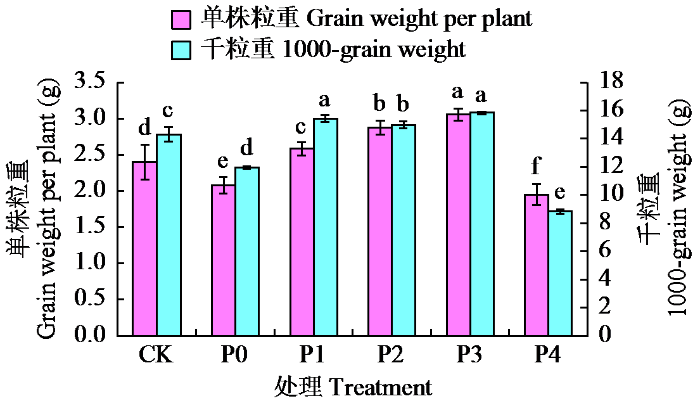
图1
磷肥减量配施gz4-1生物有机肥对苦荞产量构成因素的影响
不同小写字母表示处理间差异显著(P < 0.05)。下同。
Fig.1
Effects of reduced phosphate fertilizer combined with gz4-1 bio-organic fertilizer on yield components of F. tataricum
Different lowercase letters indicate significant differences among treatments (P < 0.05). The same below.
2.3.2 对苦荞品质的影响
如图2所示,磷肥减量配施gz4-1生物有机肥对苦荞籽粒可溶性蛋白和黄酮含量影响的变化趋势大体一致,各处理含量排序均为P3>P2>P1>CK>P4>P0。具体表现为P3、P2和P1处理的可溶性蛋白和黄酮含量高于CK,其中P3处理最高,分别为15.10 mg/g和2.19%;P4和P0处理的可溶性蛋白和黄酮含量低于CK,其中P0处理最低,分别为10.76 mg/g和1.13%。整体而言,P3处理对苦荞籽粒中的可溶性蛋白与黄酮含量提升作用最为显著。
图2
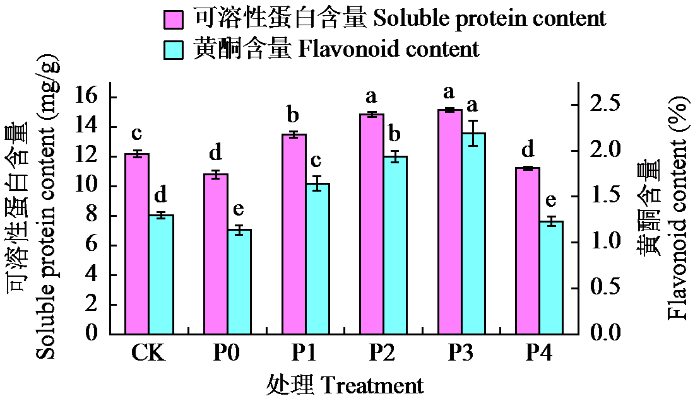
图2
磷肥减量配施gz4-1生物有机肥对苦荞品质的影响
Fig.2
Effects of reduced phosphate fertilizer combined with gz4-1 bio-organic fertilizer on quality of F. tataricum
如表8所示,各处理对根系磷含量的影响表现为苗期<花期<收获期。具体而言,苗期P1处理下苦荞根系磷含量最高,比CK高44.24%,而P2处理下苦荞根系磷含量最低,比CK低13.27%;花期P1和P3处理下苦荞根系磷含量高于CK,分别为1.81和1.90 mg/g,P4处理最低(1.41 mg/g);收获期P1、P2和P3处理下苦荞根系磷含量高于CK,其中P3处理最高(2.35 mg/g),而P4处理最低(1.56 mg/g)。总体来看,P1和P3处理下苦荞各生长周期根系磷含量均显著高于CK。
表8 磷肥减量配施gz4-1生物有机肥对苦荞不同生长时期根系磷含量的影响
Table 8
| 处理 Treatment | 苗期 Seedling stage | 花期 Flowering stage | 收获期 Harvest stage |
|---|---|---|---|
| CK | 1.13±0.08cd | 1.64±0.04c | 1.90±0.03b |
| P0 | 1.33±0.06b | 1.50±0.02d | 1.74±0.08bc |
| P1 | 1.63±0.04a | 1.81±0.04b | 2.27±0.04a |
| P2 | 0.98±0.12d | 1.61±0.02c | 2.16±0.13a |
| P3 | 1.28±0.06b | 1.90±0.02a | 2.35±0.12a |
| P4 | 1.21±0.02bc | 1.41±0.02e | 1.56±0.06c |
由表9可以看出,所有处理下苦荞茎部磷含量随生长时期的增长而提高。苗期P1处理下苦荞茎部磷含量最高,比CK高39.21%,而P2处理下苦荞茎部磷含量最低,比CK低8.82%;花期P1和P3处理下苦荞茎部磷含量显著高于CK,分别为2.32和2.61 mg/g,P4处理最低(1.55 mg/g);收获期P1、P2和P3处理下苦荞茎部磷含量高于CK,其中P3处理最高(2.66 mg/g),P4处理最低(1.84 mg/g)。总体来看,P1和P3处理下苦荞各生长周期茎部磷含量均显著高于CK。
表9 磷肥减量配施gz4-1生物有机肥对苦荞不同生长时期茎部磷含量的影响
Table 9
| 处理 Treatment | 苗期 Seedling stage | 花期 Flowering stage | 收获期 Harvest stage |
|---|---|---|---|
| CK | 1.02±0.10cd | 2.03±0.09c | 2.33±0.16c |
| P0 | 1.11±0.07bc | 1.79±0.04d | 2.04±0.08d |
| P1 | 1.42±0.03a | 2.32±0.12b | 2.53±0.06ab |
| P2 | 0.93±0.02d | 2.07±0.03c | 2.41±0.06bc |
| P3 | 1.20±0.06b | 2.61±0.08a | 2.66±0.03a |
| P4 | 1.14±0.06bc | 1.55±0.08e | 1.84±0.11e |
如表10所示,各处理苦荞叶片磷含量与生长时期呈正相关。苗期P1处理下苦荞叶片磷含量最高,比CK高41.34%,而P2处理下苦荞叶片磷含量最低,比CK低18.99%;花期P1和P3处理下苦荞叶片磷含量显著高于CK,分别为2.83和3.06 mg/g,P4处理最低(2.25 mg/g);收获期P1、P2和P3处理下苦荞叶片磷含量高于CK,其中P3处理最高(3.74 mg/g),而P4处理最低(3.12 mg/g)。总体来看,P1和P3处理下苦荞各生长周期叶片磷含量均显著高于CK。
表10 磷肥减量配施gz4-1生物有机肥对苦荞不同生长时期叶片磷含量的影响
Table 10
| 处理 Treatment | 苗期 Seedling stage | 花期 Flowering stage | 收获期 Harvest stage |
|---|---|---|---|
| CK | 1.79±0.23b | 2.64±0.11c | 3.43±0.07cd |
| P0 | 1.92±0.02b | 2.47±0.04d | 3.33±0.05d |
| P1 | 2.53±0.21a | 2.83±0.08b | 3.62±0.04ab |
| P2 | 1.45±0.04c | 2.57±0.03cd | 3.50±0.03bc |
| P3 | 1.96±0.03b | 3.06±0.10a | 3.74±0.12a |
| P4 | 1.88±0.06b | 2.25±0.05e | 3.12±0.11e |
3 讨论
生理层面,P3处理显著提升了苦荞的SOD(498.91 U/g)和POD[67.41 U/(g·min)]活性,是解磷菌调控植物抗氧化系统以缓解磷胁迫的重要标志。这表明gz4-1生物有机肥可通过增强抗氧化酶活性来缓解减施磷肥引发的活性氧(ROS)积累,进而维持细胞膜稳定性与代谢功能。这一机制与水稻中的研究[36]结果相吻合,即解磷菌通过调控抗氧化途径间接促进磷吸收。同时,P3处理下苦荞根系活力[0.8288 μg/(g·h)]与叶绿素含量(11.37 mg/g)的提升,揭示了“磷素活化―生理功能强化”的联动机制:解磷菌活化的磷素优先满足根系呼吸与叶片光合作用的需求,形成根系吸收能力增强―光合产物积累增加―磷素吸收进一步促进的良性循环,进一步验证了其通过改善根系生理功能与光合同化能力实现磷素高效利用的作用路径。这与在花椰菜[37]中发现的解磷菌通过改善生理代谢间接提升磷利用效率的机制高度一致。
产量与品质方面,P3处理较CK在单株粒重和千粒重分别提升27.50%和10.54%,与郝亚妮等[38]报道的秸秆配施解磷菌具有增产效应(23.3%)的结论一致。籽粒可溶性蛋白(15.10 mg/g)和黄酮含量(2.19%)的显著提升,表明该施肥模式可同步改善苦荞营养与功能品质。全量生物有机肥处理(P0)产量与品质均低于CK,这表明单纯依赖生物有机肥难以满足苦荞生殖生长期的高强度磷需求,而P4处理的产量低于P0,这可能归因于过量施肥产生的高磷环境抑制了解磷菌gz4-1的活性、产生了磷素拮抗与离子失衡以及引起了根系发育受损等因素,印证了化学磷肥适度减量与生物有机肥增效需协同进行的必要性,为平衡减肥与增效的矛盾提供了理论依据[39-40]。
磷素动态分布研究表明,各处理苦荞不同组织磷含量均随生育期推进而递增,收获期达最大值。P1处理在苗期表现出显著的磷吸收优势,而P3处理在花期和收获期的磷素积累更为突出,印证了生物有机肥在生育后期的持续供磷优势。磷素分配模式呈现叶>茎>根的特征,与郝亚妮[17]在低磷胁迫下的研究结果一致,表明苦荞通过优先向光合器官分配磷素以维持代谢活性。本研究为苦荞绿色高效施肥技术体系的构建提供了理论依据。
4 结论
明确了磷肥减量1/4配施gz4-1生物有机肥是协调苦荞产量、品质与磷素利用效率的最优方案,其内在机制体现为解磷菌gz4-1的即时活化效应与生物有机肥的缓释特性协同匹配苦荞不同生育期的磷需求;通过增强抗氧化系统与生理功能,提升磷素吸收与转化效率;优化磷素在各器官的分配模式,提升籽粒产量与品质。
参考文献
Placing cropping systems under suboptimal phosphorus conditions promotes plant nutrient acquisition and microbial carbon supply without compromising biomass
DOI:10.1016/j.soilbio.2025.109753 URL [本文引用: 1]
The effect of a combination of N, P, K and biochar-silica fertilizers on CEC, C-organic, N, P, K content of plant and yield of rice on Inceptisols Jatinangor, Indonesia
DOI:10.9734/ajsspn/2025/v11i1485
URL
[本文引用: 1]

Inceptisols have enormous potential for cultivating lowland rice because of their wide distribution in Indonesia, but low fertility is one of the problems with Inceptisols. The experiment aims to determine the effect of a combination of N, P, K, and biochar-silica fertilizers on CEC, C-organic, N, P, K content of plant, and rice yields and to obtain a treatment combination that gives the best lowland rice yields on Inceptisols. The experiment was carried out from August to November 2024 using experimental plots as experimental units and arranged in a Randomized Completely Block Design (RCBD) consisting of 10 treatments and three replications, namely 3 treatments with a combination dose of 0% N, P, K and biochar-silica, 3 treatment with a dose of 50% N, P, K and biochar-silica, 3 treatments with a dose of 100% N, P, K and biochar-silica, and 1 control treatment. The experimental results showed that the combination of N, P, K, and biochar-silica fertilizers could influence CEC, organic C, P, K element content in plants, and rice yield, but did not have a significant effect on plant N content. Treatment N, P, K (175 kg ha-1 Urea, 25 kg ha-1 SP-36, and 25 kg ha-1 KCl) and dose of biochar (2.5 ton ha-1) + silica 320 kg ha-1 is the treatment with the best dose in increasing the yield of harvested dry grain (GKP) for lowland rice, namely 3.37 kg plot-1.
Chlamydomonas acidophila for phosphorus recovery from municipal wastewater treatment plants: effect of light intensity, temperature, different wastewaters and long-term semi-continuous feeding
DOI:10.1016/j.algal.2025.103941 URL [本文引用: 1]
过量施磷下青稞生长发育和磷素利用的变化
Studies on the phosphorus- solubilizing ability of Isaria cateinannulata and its influence on the growth of Fagopyrum tataricum plants
DOI:10.3390/plants13121694 URL
Compensation mechanisms for early maturity and high yield in tartary buckwheat (Fagopyrum tataricum): a study on ‘source-sink’ relationship and phosphorus utilization
DOI:10.3390/agronomy15010173
URL
[本文引用: 1]
The regulatory mechanisms underlying the ‘source–sink’ relationship in Tartary buckwheat remain largely unexplored. This study selected an early-maturing, high-yield variety, ‘Zhukuzao1’ (ZKZ1), to delve into the ‘source–sink’ relationship and the regulatory mechanisms of phosphorus utilization. Compared with Jinqiao2 (JQ2), ZKZ1 matured approximately 10 days earlier, with significantly reduced chlorophyll content, net photosynthetic rate, and down-regulated PSI-III and GBSSI, indicating a reduced ‘source’. However, ZKZ1 maintained soluble sugar levels in upper leaves and increased sugar transport to seeds, promoting plant growth and yield formation. Under varying phosphorus conditions, ZKZ1 exhibited significantly higher total phosphorus content in lower (3.9~4.5-fold) and upper (1.4~1.6-fold) leaves of seedlings, along with increased phosphorus transport to upper leaves and seeds, and up-regulated PHO1 (2.4~3.0-fold), SPX3 (1.8~2.8-fold), PAP2 (2.8~7.7-fold), and 5PTase2 (1.4~3.5-fold) in leaves, indicating improved phosphorus absorption, transport, and remobilization. At maturity, ZKZ1 achieved yields comparable to JQ2, with superior quality traits, including significantly increased contents of protein (glutenin, prolamin, and globulin) and flavonoids under normal phosphorus conditions. Notably, the efficient phosphorus-regulated sugar metabolism in ZKZ1 maintains yield via enhanced ‘flow’ despite photosynthesis decrease. This study highlights the potential of optimizing the ‘source–sink’ relationship and phosphorus utilization in early-maturing, high-yield Tartary buckwheat breeding.
Volcanic deposits thickness and distance from Mt Semeru crater strongly affected phosphate solubilizing bacteria population and soil organic carbon
Isolation and characterization of phosphate-solubilizing bacteria from rhizosphere of poplar on road verge and their antagonistic potential against various phytopathogens
DOI:10.1186/s12866-023-02953-3
PMID:37580699
Phosphate-solubilizing bacteria (PSB) can solubilize insoluble phosphate compounds and improve phosphate availability in soil. Road verges are important in urban landscaping, but the population structure of PSB and their ecological functions in the road verge soil is still unclear.Twenty-one mineral PSB strains and 14 organic PSB strains were isolated from the rhizosphere of poplar on urban road verge. All the mineral PSB strains showed better solubilization to Ca(PO) than FePO or AlPO. Among them, 7 strains showed high phosphate-solubilizing (PS) activities to Ca(PO) (150-453 mg/L). All the organic PSB strains displayed weak solubilization to lecithin. 16S rRNA gene-based phylogenetic analysis showed good species diversity of the PSB strains, which belongs to 12 genera: Bacillus, Cedecea, Cellulosimicrobium, Delftia, Ensifer, Paenibacillus, Pantoea, Phyllobacterium, Pseudomonas, Rhizobium, Sinorhizobium and Staphylococcus. Moreover, 8 PSB strains showed various degrees of growth inhibition against 4 plant pathogenic fungi, Fusarium oxysporum S1, F. oxysporum S2, Pythium deliense Meurs Z4, Phomopsis sp. AC1 and a plant pathogenic bacterium, Pectobacterium carotovorum TP1.The results indicated that these PSB strains could perform multiple ecological functions on road verge. The development and application of bio-agents based on the strains would provide a new strategy for maintaining and improving the ecosystem stability of road verges.© 2023. BioMed Central Ltd., part of Springer Nature.
生物有机肥对土壤质量及蔬菜产量的影响
DOI:10.16258/j.cnki.1674-5906.2022.03.008
[本文引用: 1]
为了探讨生物有机肥对菜地土壤质量及蔬菜产量的影响,采用田间小区试验,以华南地区代表性瓜类蔬菜白瓜(Cucurbita pepo L.)为试验作物,配施生物有机肥研究了白瓜不同生育期土壤肥力、酶活性、微生物生物量及产量。结果表明,(1)施用生物有机肥能够提高土壤的pH值、碱解氮、速效钾和有效磷的含量。在白瓜清藤期,配施生物有机肥的土壤其pH值、碱解氮、速效钾和有效磷的含量均比农户习惯施肥和无机肥处理均增加10%以上。(2)施用生物有机肥对土壤的酶活性和微生物生物量的含量影响不同。在白瓜苗期,生物有机肥可提高土壤微生物生物量碳含量,与农户习惯施肥和无机肥处理相比分别增加了67.0%和91.8%;在白瓜伸蔓期,生物有机肥可提高微生物量碳含量、蔗糖酶和酸性磷酸酶活性,与农户习惯施肥和无机肥处理相比分别增加了11.8%—33.2%和13.1%—37.4%;在白瓜盛瓜期,生物有机肥可提高微生物生物量碳含量、过氧化氢酶和酸性磷酸酶活性,与农户习惯施肥和无机肥处理相比,分别增加了12.1%—22.7%和19.3%—28.4%;在白瓜清藤期,生物有机肥可增强过氧化氢酶和酸性磷酸酶活性,与农户习惯施肥和无机肥处理相比,分别增加了8.02%—33.5%和20.1%—27.7%。因此,配施生物有机肥对白瓜不同生育期的微生物活性影响不同。(3)生物有机肥对白瓜的增产作用发生在盛瓜期前期,对盛瓜期后期影响很小。综上所述,生物有机肥可提高土壤肥力,增强微生物生物量和酶活性,改良土壤环境,提高白瓜产量。
The effects of bio-fertilizer by arbuscular mycorrhizal fungi and phosphate solubilizing bacteria on the growth and productivity of barley under deficit of water irrigation conditions
DOI:10.3390/agronomy14091973
URL
Bio-fertilizers are the most important and effective method used to reduce the quantities of chemical fertilizers consumed and reduce dependence on them in agricultural production to avoid their harmful effects on the environment and public health as well as reduce the cost of agricultural production in light of increasing pollution and under adverse conditions for production and climate change. A bio-fertilizer depends primarily on the use of beneficial microorganisms such as arbuscular mycorrhizal fungi (AMF) to improve the uptake of nutrients, improve plant growth, productivity, and grain yield. Crop production faces many challenges, and drought is one of the majority of the significant factors limiting crop production worldwide, especially in semi-arid regions. The objective of this study was to evaluate the effects of AMF and phosphate solubilizing bacteria (PSB), plus three rates of the recommended dose of phosphorus (RDP) fertilizer on yield, yield components, and nutrients uptake, in addition to evaluating the beneficial effects of these combinations to develop Phosphorus (P) management under three levels of irrigation water, i.e., three irrigations (normal or well-watered), two irrigations (moderate drought), and one irrigation (severe drought) on barley (Hordeum vulgare L.). The results showed that the treatment with AMF bio-fertilizer yielded the highest values of plant height, spike length, spike weight, number of grains/spike, 1000-grain weight, grain yield, straw yield, biological yield, and harvest index. Moreover, the grain and straw uptake of nitrogen (N), P, and potassium (K) (kg ha−1) in the two seasons under the three levels of irrigation, respectively, were superior followed by the inoculation by PSB. While the treatment without bio-fertilizer yielded the lowest values of these traits of barley, the treatment with bio-fertilizer yielded the increased percentage of the grain yield by 17.27%, 17.33% with applying AMF, and 10.31%, 10.40% with treatment by PSB. Treatment with AMF or PSB (Phosphorien), plus rates of phosphorus fertilizer under conditions of irrigation water shortage, whether irrigation was performed once or twice, led to an increase in grain yield and other characteristics compared to the same fertilization rates without inoculation. The results of this study showed that the use of bio-fertilizers led to an increase in plant tolerance to drought stress, and this was demonstrated by an increase in various traits with the use of treatments that include bio-fertilizers. Therefore, it is suggested to inoculate the seeds with AMF or PSB plus adding phosphate fertilizers at the recommended dose under drought conditions.
Growth and yield of sweet corn (Zea mays var. rugosa) in response to bio-fertilizer application
DOI:10.9734/ajahr/2025/v12i1358
URL
[本文引用: 1]
Bio-N® fertilizer is a substance which contains living microorganisms which, when applied to seed, plant surfaces, or soil, colonizes the rhizosphere or the interior of the plant and promotes growth by increasing the supply or availability of primary nutrients to the host plant. This study was conducted to determine the effects of Bio-N® and different levels of inorganic fertilizers on the growth, yield and postharvest quality of sweet corn (Zea mays var. rugosa). The experiment was conducted using a 5m x 4m plot size and arranged as a 2x3 factorial experiment within a Randomized Complete Block Design. Bio-N application (with and without) was designated as Factor A, while the varying levels of inorganic NPK fertilizer (100%, 75%, 50%) were assigned as Factor B. This resulted in six treatment combinations, with each plot containing 108 sweetcorn plants, replicated three times.\r\nSweetcorn plants applied with Bio-N® fertilizer gave a significant growth and yield compared to those plants without fertilizer (Bio-N®) applied. The highest net income and return of investment were obtained from plants applied with Bio-N® with 100% RR of inorganic fertilizer at 284,866.00 and 316.05% respectively.
Characterization of cosmetic cream with Mesembryanthemum crystallinum plant extract: influence of formulation composition on physical stability and anti-oxidant activity
DOI:10.1111/j.1468-2494.2008.00469.x
PMID:19099545
[本文引用: 1]
Cosmetic or pharmaceutical composition containing superoxide dismutase (SOD) was usually used in topical administration, particularly, in fighting against skin ageing and in the protection of the skin against radiation exposure. Mesembryanthemum crystallinum is a halophyte plant widely used in the traditional medicine, characterized by the presence of anti-oxidants enzymes in responses to abiotic stresses. In the present study, we prepared a formulation with M. crystallinum extract characterized by naturally occurring SOD and catalase in association with other anti-oxidants molecules. The SOD activity was measured by 3-(4,5-dimethyldiazol-2-yl)-2,5-diphenyl-tetrazolium bromide/riboflavin method, catalase by colorimetric method and the total anti-radical activity was measured by 1,1-diphenyl-2-picrylhydrazyl radical (DPPH) method. Formulations contain a significant SOD activity (8.33 U mg(-1)), a catalase activity (0.5 x 10(7) UC) and an anti-radical activity (30% of DPPH inhibition). The formulation storage (15 days at 4 degrees C) showed a marked loss of total anti-oxidant capacity. The addition of the M. crystallinum extract induced also a reduction in formulation viscosity and pH.
Study on dormancy mechanism and breaking dormancy method of Viburnum sargentii seeds
DOI:10.4236/ajps.2019.101007 URL [本文引用: 1]
Study on destroying enzyme in chestnuts (Castanea mollissima Blume) by microwave heating
DOI:10.4028/www.scientific.net/AMR.852 URL [本文引用: 1]
Root K affinity drivers and photosynthetic characteristics in response to low potassium stress in K high-efficiency vegetable soybean
DOI:10.3389/fpls.2021.732164 URL [本文引用: 1]
Assessing different irrigation regimes regarding chlorophyll content of the sweet bell pepper
Isolation, identification of Chlorella pyrenoides from aquaculture wastewater and its purification of wastewater
Phosphorus and sulfur metabonomic profiling of tissue and plasma obtained from tumour-bearing mice using ultra-performance liquid chromatography/inductively coupled plasma mass spectrometry
DOI:10.1002/rcm.6722
PMID:24123642
[本文引用: 1]
Metabonomic studies use complex biological samples (blood plasma/serum, tissues, etc.) that when analysed with high-performance liquid chromatography/mass spectrometry (HPLC/MS) or nuclear magnetic resonance (NMR) generate profiles that may contain many thousands of features. These profiles can be difficult to interpret with the majority of the features contributing little to the study. As such there is an argument for the development of techniques that can simplify the problem by targeting particular classes of compounds.In this study ultra-performance liquid chromatography/inductively coupled plasma mass spectrometry (UPLC/ICP-MS) was used to profile tumour tissue and plasma samples for phosphorus- and sulfur-containing metabolites. These samples were xenograft tumours (derived from breast, lung and colon cell lines) and plasma obtained from nude mice. Plasma was also obtained from non-tumour-bearing mice as a control. Due to isobaric interferences this method took advantage of the dynamic reaction cell within the ICP-MS system to react the phosphorus and sulfur ions with oxygen. The PO and SO ions were then monitored free of interferences. The total phosphorus and sulfur within each sample was also recorded using flow injection ICP-MS. A robust quality control system based on pooled sample replicate analysis was used throughout the study.Determination of the total phosphorus and sulfur content of each sample was sufficient in itself for statistical differentiation between the majority of the cell lines analysed. Subsequent reversed-phase chromatographic profiling of the organic tumour and plasma extracts revealed the presence of a number of well-retained phosphorus-containing compounds that showed tumour-specific profiles. Reversed-phase profiling was not suitable for the sulfur-containing compounds which eluted with the solvent front.This study has shown the potential use of UPLC/ICP-MS to differentiate between tumour cell lines, using both plasma and tumour tissue samples, based solely on metabolites that contain phosphorus or sulfur. Whilst further work is required to identify these compounds this methodology shows the ability of the described methods to provide targets for future biomarker discovery studies. Copyright © 2013 John Wiley & Sons, Ltd.Copyright © 2013 John Wiley & Sons, Ltd.
Influence of different hydrogel levels and irrigation scheduling on leaf protein content of chickpea (Cicer arietinum L.)
Determination of cyclic adenosine phosphate and protein content in dormant chlamydospore and nondormant chlamydospore of Arthrobotrys flagrans
Spectrophotometric quantification of total phenol, flavonoid and alkaloid content and in-vitro investigation of antioxidant and cytotoxic potential of Hippeastrum equestre bulbs
DOI:10.1007/s11094-022-02784-y [本文引用: 1]
Effects of phosphate fertiliser on the physicochemical properties of tartary buckwheat (Fagopyrum tataricum (L.) Gaertn.) starch
DOI:10.1016/j.foodchem.2019.125543 URL [本文引用: 1]
Differential stimulation of phosphorus-mobilizing bacteria by common bean genotypes in Amazonian dark earth and agricultural soils with varying fertility levels
DOI:10.1016/j.rhisph.2025.101026 URL [本文引用: 1]
Effect of different fertilization on soil fertility, biological activity, and maize yield in the albic soil area of China
DOI:10.3390/plants14050810 URL [本文引用: 1]
Replacing traditional nursery soil with spent mushroom substrate improves rice seedling quality and soil substrate properties
DOI:10.1007/s11356-024-33723-x
PMID:38824472
[本文引用: 1]
Currently, large quantities of spent mushroom substrate (SMS) are produced annually. Because SMS has high water retention and nutrients, it has great potential to replace traditional topsoil for raising seedlings in agricultural production. However, few studies have examined the effects of substituting SMS for paddy soil on rice seedling growth and soil nutrients. SMS was mixed with rice soil in different proportions (20%, 50%, and 80%), and chemical fertilizer, organic fertilizer, and peat substrate were added in addition to equivalent nitrogen as a traditional seedling nursery method for comparison. Compared to traditional paddy soil (CK), the seedling qualities of the three SMS ratio treatments were all higher. Adding SMS at different ratios promoted rice seedling root growth, elevated the soluble protein concentration, and amplified the superoxide dismutase (SOD) enzymatic action in rice seedlings. Total porosity and aeration porosity of the soil increased by 17.40% and 32.90%, respectively. Soil organic carbon (SOC), total nitrogen (TN), and total phosphorus (TP) increased by 21.26-118.48%, 50.44-71.68%, and 23.08-80.17%, respectively. Besides, the relative abundance of Bacillus, Bacteroidetes, and other bacteria as well as the abundance of Ascomycota were all significantly increased. Adding 50% SMS increased the abundance of Pseudomonas by 8.42 times. The seedling quality of the 50% SMS treatment was even higher than chemical fertilizer and organic fertilizer treatments, only second to the peat substrate treatment. In summary, partial substitution of paddy soil with SMS can ameliorate substrate properties, improve seedling quality, and increase microbial diversity, indicating the suitability of SMS as a replacement for rice soil in seedling substrates. The 50% SMS ratio is the best. This study provides a basis for SMS to replace traditional rice soil in seedling cultivation.© 2024. The Author(s), under exclusive licence to Springer-Verlag GmbH Germany, part of Springer Nature.
Using Bacillus megaterium as a bio-fertilizer alleviates salt stress, improves phosphorus nutrition, and increases cauliflower yield
DOI:10.1080/01904167.2023.2291022 URL [本文引用: 1]


