



在玉米基因组中,共鉴定出78个NPF、7个硝酸盐转运蛋白2(NRT2)和2个硝酸盐转运蛋白3(NRT3),已对上述蛋白表达模式及功能进行了初步分析[21]。玉米中的氮素利用关键基因ZmNRT1.1B(ZmNPF6.6)可以正调控硝酸盐的吸收并增加玉米产量,具有重要的应用价值[22]。另一主粮作物小麦基因组中的NPF家族也已被鉴定,近年研究[23-24]表明其家族成员多达412个,且含有根、茎叶、籽粒和穗各种组织特异表达的基因,暗示硝酸盐信号对小麦生长发育的全面影响以及硝酸盐调控在小麦中的复杂性。研究[25]发现TaNPF6.2可以促进硝酸盐吸收,超表达该基因可增加小麦根长、分蘖、株高和穗长,而其基因编辑株系则表现为分蘖减少和穗长变短。虽然小麦NPF蛋白家族的成员数量众多,但有关小麦NPF蛋白作用机制的研究却相对较少。
1 材料与方法
1.1 小麦培养与样品采集
试验于2024-2025年在中国农业科学院作物科学研究所进行。以小麦品种KN199(WT)为背景的TaNPF6.2基因编辑T3代株系(KOTaNPF6.2)为试验材料。前期研究[25]显示,田间正常氮及低氮不同区域不同施肥处理下,KOTaNPF6.2转基因植株的株高、分蘖数、穗长及穗粒数等农艺性状均低于亲本KN199。将T3代稳定敲除株系KOTaNPF6.2及KN199在人工气候室内培养,培养条件为16 h/8 h(光/暗)、20 ℃、湿度55%。于3到4叶期分别取1片叶片液氮速冻后于-80 ℃保存,用于DNA提取及基因型鉴定。3叶期取分蘖节,设3个生物学重复,每个重复取5~8个分蘖节,液氮速冻后用于转录组测序。同期取分蘖芽液氮速冻后于-80 ℃保存,用于基因表达量检测。3叶1心期取分蘖节和1~2 cm的茎于液氮速冻,用于内源激素含量检测。
1.2 TaNPF6.2敲除材料的基因型鉴定
表1 TaNPF6.2基因特异性扩增引物
Table 1
| 项目 Item | 正向特异性扩增引物 Forward specific amplification primer (5′-3′) | 反向特异性扩增引物 Reverse specific amplification primer (5′-3′) |
|---|---|---|
| A基因组A subgenome | GGCGCGCTTGAAAATTCTCT | CTGCTCGGTTTCCCTCCTTT |
| B基因组B subgenome | TTCTCCTTTGCTTCCTCGGC | CCAAGACTCCTGACTCGCTC |
| D基因组D subgenome | CCCCCATCTCAGCTACCAAC | CATGCCGATGATGGACAGGA |
1.3 转录组测序与分析
将KN199及KOTaNPF6.2的6个小麦分蘖节组织送至北京诺禾致源科技股份有限公司提取RNA,使用Agilent 2100 bioanalyzer方法质控,文库构建后,Qubit定量并稀释,Agilent检测合格后用qRT-PCR定量(>1.5 nmol),确保质量。测序碱基正确识别率(Q30)为99.90%,样本测序数据过滤情况中高质量有效测序数据(82036334,96.90%)、含N碱基(228,0.00%)、低质量序列(90,0.00%)、包含接头的序列(2623160,3.10%)。检查质控后的高质量有效测序数据用HISAT2软件比对Fielder参考基因组,获取定位信息。
利用StringTie进行新转录本组装,并对其进行Pfam、GO和KEGG等数据库注释。利用DESeq2软件,采用DESeq标准方法,以log2FC≥1、Padj≤0.05为差异基因筛选标准。使用clusterProfiler软件进行差异基因集的GO功能和KEGG通路富集分析。利用诺禾云平台(
1.4 植物内源激素含量
将3叶1心期的KN199及KOTaNPF6.2分蘖节及茎秆样本送至江苏三黍生物科技有限公司,采用超高效液相色谱―串联高分辨Orbitrap质谱联用仪(UHPLC-QE,Thermo,美国),负模式下检测标准品基本信息,测定二氢茉莉酸、吲哚乙酸、ABA、赤霉素、茉莉酸(JA)、水杨酸(SA)、顺(+)-12-氧代―植物二烯酸和反式肉桂酸等29种激素类物质的含量。
1.5 实时荧光定量PCR检测
利用TRIzol试剂提取RNA,通过all in-one 5x RT Master Mix反转录试剂盒(北京艾可莘生物科技有限公司)反转录为cDNA,内参为小麦TaGAPDH,检测引物见表2,所用的荧光定量混液为2×Fast qPCR Master Mixture(DN2058,北京迪宁生物科技有限公司)。使用BIO-RAD荧光定量检测仪(美国)进行qRT-PCR,设置3个生物学重复,3个技术重复,结果采用2-ΔΔCt方法进行计算。
表2 qRT-PCR引物序列
Table 2
| 基因ID Gene ID | 基因名称Gene name | 正向引物Forward primer (5′-3′) | 反向引物Reverse primer (5′-3′) |
|---|---|---|---|
| TraesCS5B02G029300 | NCED3 | TCCGCGCAGCCCCTGGCCT | ACACGTAGGCCGGCGTGCGT |
| TraesCS5B02G075800 | SnRK2 | ATTCGAAGTCATCGGTTCTTCACT | CAACATCACGTAAAGGGTTACCC |
| TraesFLD5B01G508800 | PAL | GCCGAGGCCATTGATATAC | ATCTGCATACGCGAACAC |
| TraesFLD7B01G073800 | PR-10 | CTGTTGAGGGAGAAGGCGG | CGATGAGGGTCGATTTGCAC |
| TraesCS6D02G196300 | TaGAPDH | CGATTCAGAGCAGCGTATTGTTG | AGTTGGTCGGGTCTCTTCTAAATG |
2 结果与分析
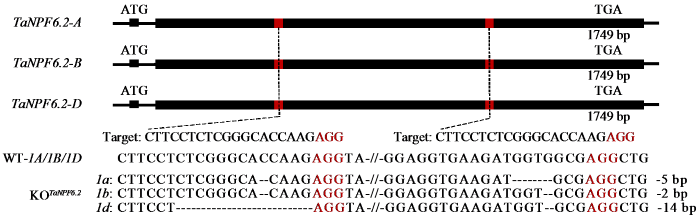
2.1 TaNPF6.2基因敲除材料的筛选及基因型鉴定
图1
2.2 野生型及敲除材料转录组测序质量
为探究TaNPF6.2基因调控小麦发育中的分子机制,对WT和KOTaNPF6.2(KO)分蘖节样品进行转录组测序,获得6个cDNA文库。原始数据过滤后reads数在78440374~84659812,碱基数在11.77~12.69 Gb,测序错误率0.01%,Q20>99.11%,Q30>96.19%(表3)。样本间相关性分析显示生物学重复样品间R2>0.92,符合Encode计划R2>0.92的标准,样本质量合格。
表3 测序数据质量统计
Table 3
| 样本 Sample | 文库 Library | 原始读数 Raw reads | 原始碱基数 Raw bases (Gb) | 有效读数 Clean reads | 有效碱基数 Clean bases (Gb) | 错误率 Error rate (%) | Q20值 Q20 value (%) | Q30值 Q30 value (%) | GC含量 GC content (%) |
|---|---|---|---|---|---|---|---|---|---|
| WT-1 | FRAS250185109-1r | 84631508 | 12.69 | 82192894 | 12.33 | 0.01 | 99.18 | 96.35 | 53.48 |
| WT-2 | FRAS250185110-1r | 84659812 | 12.70 | 82036334 | 12.31 | 0.01 | 99.13 | 96.28 | 53.49 |
| WT-3 | FRAS250185111-1r | 84415958 | 12.66 | 81516152 | 12.23 | 0.01 | 99.17 | 96.46 | 53.31 |
| KO-1 | FRAS250185112-1r | 81627914 | 12.24 | 79531446 | 11.93 | 0.01 | 99.12 | 96.24 | 52.95 |
| KO-2 | FRAS250185113-1r | 78440374 | 11.77 | 75364236 | 11.3 | 0.01 | 99.11 | 96.27 | 53.29 |
| KO-3 | FRAS250185114-1r | 82075428 | 12.31 | 78843794 | 11.83 | 0.01 | 99.11 | 96.19 | 53.29 |
2.3 转录组差异表达基因(DEGs)分析
2.3.1 DEGs提取及聚类
图2
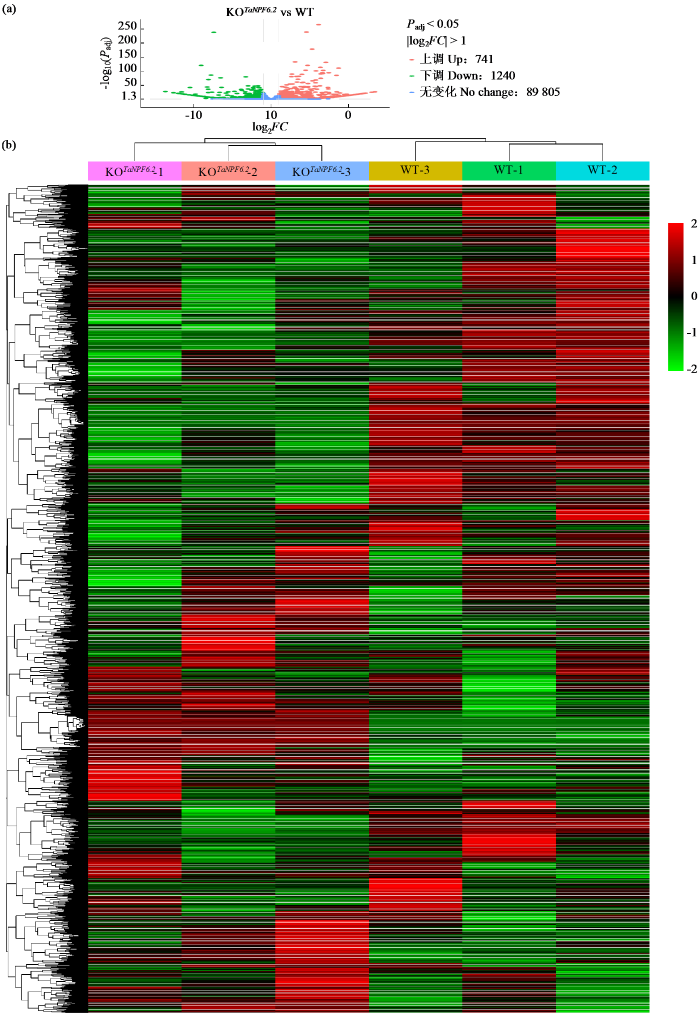
图2
差异表达分析和DEGs聚类分析
Fig.2
Differential expression analysis and cluster analysis of DEGs
2.3.2 DEGs的GO富集分析
对WT与KOTaNPF6.2的1981个DEGs进行GO富集分析,共富集到184个GO功能类别(图3),分别为87个生物过程(BP)、23个细胞组成(CC)和74个分子功能(MF),占比分别为47.3%、12.5%和40.2%。BP、CC和MF分别富集到34、12和57个基因。其中,GO富集在细胞组成的功能类别占比最少,富集在BP和MF的GO功能类别基因较多,且下调基因占比较多。BP下调基因355个,上调基因110个;MF的下调基因170个,上调基因35个,占比分别为76.3%和82.9%。经统计DEGs主要富集在MF的转移酶活性(转移酰基)(GO:0016746、GO:0016747)、肽酶抑制剂活性(GO:0004867、GO:0004866)、肽酶调节因子活性(GO:0061134、GO:0061135),以及BP中的脂肪酸生物合成(GO:0006633)过程(表4)。结合MF层面的转移酶活性富集情况,酰基转移相关的代谢调控可能是DEGs发挥作用的主要功能。
图3
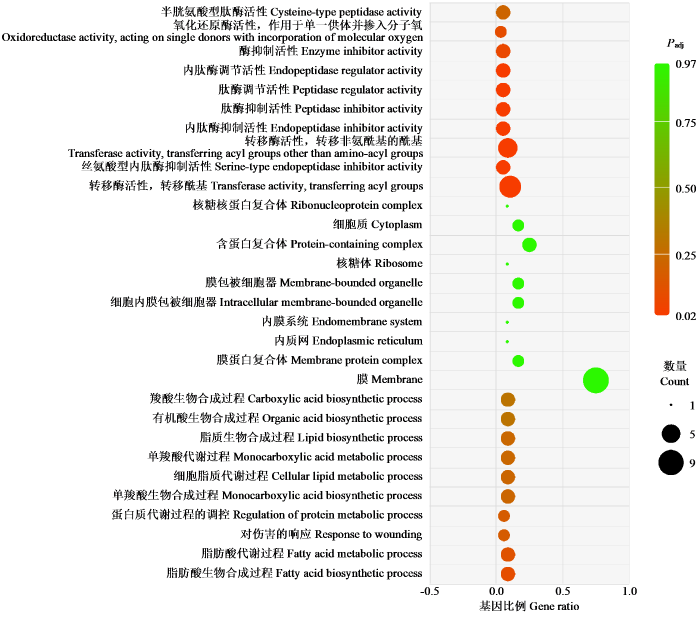
表4 差异基因GO富集分析
Table 4
| 类别Category | GO编号GO code | 描述Description | Padj | 数量Number |
|---|---|---|---|---|
| MF | 0016746 | 转移酶活性(转移酰基) | 0.0204451782464127 | 6 |
| MF | 0004867 | 丝氨酸型内肽酶抑制剂活性 | 0.0204451782464127 | 3 |
| MF | 0016747 | 转移酶活性(转移非氨酰基的酰基) | 0.0204451782464127 | 5 |
| BP | 0006633 | 脂肪酸生物合成过程 | 0.1037956007872910 | 3 |
| MF | 0004866 | 内肽酶抑制剂活性 | 0.0226228547401966 | 3 |
| MF | 0030414 | 肽酶抑制剂活性 | 0.0226228547401966 | 3 |
| MF | 0061134 | 肽酶调节因子活性 | 0.0226228547401966 | 3 |
| MF | 0061135 | 内肽酶调节因子活性 | 0.0226228547401966 | 3 |
2.3.3 DEGs的KEGG富集分析
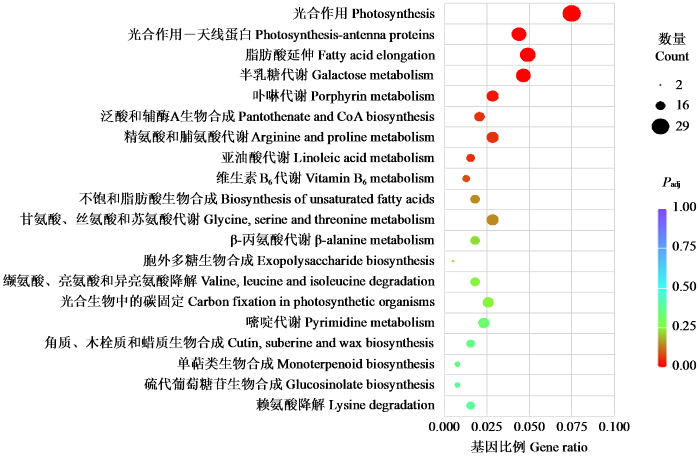
利用DEGs进行KEGG富集分析(图4),共富集到100个通路512个基因,前20个显著通路(Padj<0.05)中DEGs富集最多的为光合作用及代谢生物通路,富集到29个基因且均为下调基因,其次为脂肪酸延伸、半乳糖代谢和卟啉代谢通路。生物合成方面,显著富集的通路为不饱和脂肪酸生物合成、角质、木栓质和蜡质生物合成及单萜类生物合成通路等。
图4
2.4 WT和KOTaNPF6.2的内源激素含量
由于某些NPF家族成员具有转运ABA及IAA的功能,可调控植物逆境激素响应。因此选取WT和KOTaNPF6.2苗期分蘖节与茎,对其内源激素含量进行测定,结果(表5)显示,在KOTaNPF6.2敲除植株中,SA及其衍生物SA-2-O-β-G含量显著升高,为野生型的2.2~3.5倍。ABA的含量在分蘖节及茎中均有所升高。IAA衍生物IAA-Glc,在分蘖节中含量降低、在茎中含量有所升高,IAA-Asp也在KO植株中明显积累。JA在KOTaNPF6.2分蘖节中含量降低,而在茎中升高,JA合成前体顺(+)-12-氧代-植物二烯酸含量升高。反式肉桂酸在2个组织的激素含量均有所降低,激素测定结果表明,SA变化最为明显,表明TaNPF6.2可能通过调控NPF介导的激素运输与代谢,影响SA和JA等逆境响应相关激素的积累与信号通路。
表5 苗期内源激素含量测定
Table 5
| 化合物 Compound | 分蘖节Crown node | 茎Culm | |||
|---|---|---|---|---|---|
| WT | KOTaNPF6.2 | WT | KOTaNPF6.2 | ||
| SA | 122.98±4.27 | 332.79±4.27 | 98.90±3.62 | 276.30±4.53 | |
| SA-2-O-β-葡萄糖苷SA-2-O-β-Glucoside | 374.09±13.32 | 823.27±24.43 | 234.79±9.69 | 831.44±29.14 | |
| ABA | 41.25±0.87 | 44.72±1.19 | 27.91±1.00 | 31.36±1.58 | |
| 反式肉桂酸Trans-cinnamic acid | 23.50±0.44 | 22.21±0.55 | 24.73±0.55 | 20.90±0.09 | |
| IAA-葡萄糖酯IAA-Glc | 580.29±13.45 | 379.92±5.76 | 1138.49±28.71 | 1249.10±16.68 | |
| IAA-天冬氨酸IAA-Asp | 1366.40±40.37 | 1534.95±34.73 | 785.02±22.54 | 1009.47±27.95 | |
| JA | 1.31±0.03 | 1.08±0.03 | 5.82±0.34 | 7.45±0.22 | |
| 顺(+)-12-氧代-植物二烯酸2-oxo-phytodienoic acid | 69.38±3.51 | 86.77±2.37 | 304.57±2.35 | 355.81±10.36 | |
2.5 TaNPF6.2敲除材料DEGs的定量分析
基于以上结果,进行相关基因的qRT-PCR分析,结合转录组DEGs进一步检测验证TaNPF6.2调控的下游基因(图5)。由于前期观察到小麦分蘖以及穗长的变化,因此取小麦的穗和3叶期的分蘖芽,定量分析关键基因的表达。与ABA合成相关的9-顺式环氧类胡萝卜素双加氧酶3(NCED3)基因以及ABA信号转导核心激酶蔗糖非发酵相关蛋白激酶2(SnRK2),在KOTaNPF6.2中表达量显著增高。其中,NCED3基因在敲除材料抽穗期穗的表达量为WT的6.2倍,在分蘖芽中为WT的2.3倍;SnRK2基因在敲除材料抽穗期穗的表达量为WT的1.6倍,在分蘖芽中为WT的1.5倍。与SA生物合成相关的苯丙氨酸解氨酶(PAL)基因以及与SA响应的病程相关基因病程相关蛋白10(PR10),在KOTaNPF6.2中均呈明显上调表达。PAL基因在敲除材料抽穗期穗和分蘖芽中的表达量分别为WT的1.8和3.8倍;PR10基因在敲除材料抽穗期穗和分蘖芽中的表达量分别约为WT的1.5和2.3倍。由于TB1基因可以显著影响小麦分蘖及花序发育,因此对小麦分蘖关键基因TB1的表达量进行检测,发现其在KOTaNPF6.2材料穗中的表达量显著升高,在孕穗期为WT的3.6倍,抽穗期的表达量为WT的3.5~5.3倍,分蘖芽的表达量为WT的2.0倍。TaNPF6.2可能通过调控逆境响应基因或重要转录因子感知并传递硝酸盐信号,影响小麦的发育。
图5
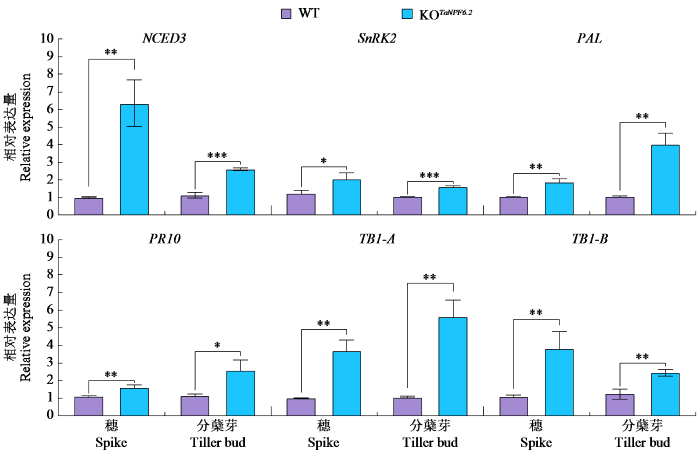
图5
激素相关基因的qRT-PCR分析
“*”、“**”和“***”分别表示在P < 0.05、P < 0.01和P < 0.001水平差异显著。
Fig.5
qRT-PCR analysis of hormone-related genes
“*”,“**”, and“***”indicate significant difference at P < 0.05, P < 0.01 and P < 0.001 levels, respectively.
3 讨论
TaNPF6.2基因编辑材料在株高、分蘖数、穗长和千粒重等关键农艺性状上均低于WT,但其在氮素信号转导方面的作用,以及和其他NPF是否具有同样的功能等问题仍然未知。本研究确定了TaNPF6.2敲除材料的基因型,得到了纯合的蛋白不完整的稳定敲除材料。基因编辑株系中TaNPF6.2蛋白的6个功能结构域缺失导致其功能异常。
由于NPF家族成员数量庞大,因此成员之间的功能可能有重叠,且具有复杂的调控机制,虽然TaNPF6.2蛋白的缺失没有对植株形态造成大幅改变,但其下游调控的基因可能对植物发育有重要影响。转录组数据中KOTaNPF6.2与WT间的1981个显著DEGs可能是其下游调控通路的关键节点,可以揭示敲除植株表型变化的分子基础。GO功能富集分析为理解这些DEGs的功能提供了方向。在分子功能层面,显著富集于转移酶活性(尤其是酰基转移相关)、肽酶抑制剂活性及肽酶调节因子活性,酰基转移酶参与脂质代谢中多种生物分子的修饰与合成[29],近年来,研究[30]表明拟南芥和水稻中组蛋白乙酰转移酶可以介导组蛋白乙酰化,调控株高及分枝,可用于作物改良。而蛋白酶抑制与调节系统则广泛参与发育信号转导。在生物过程中,脂肪酸生物合成过程的富集,与MF同样指向脂质代谢相关途径,脂质不仅是细胞膜的主要成分和能量储存形式,同时脂类代谢也与氮饥饿密切相关[31-32]。因此,TaNPF6.2可能通过富集的脂类代谢基因,影响硝酸盐信号响应。
KEGG分析发现光合作用通路显著富集,已知植物的碳氮代谢及平衡对其生长发育至关重要,且部分NPF具有光响应的活性,TaNPF6.2可能通过直接或间接调控光信号通路影响氮吸收同化[33-
上述转录组结果源于人工可控环境下的分析。该环境避免了自然条件下温度、光照、水分及土壤氮素时空异质性等复杂因素的干扰,有助于解析TaNPF6.2基因本身的功能及其核心调控网络。TaNPF6.2介导的硝酸盐信号与激素通路的交叉对话,在复杂田间条件下可能呈现出更为动态的调控模式。本研究中观察到的生长抑制表型,在遭遇多种胁迫叠加的田间环境中,其程度可能被放大或表现出不同特点。下一步深入研究需将相关遗传材料置于不同氮水平、不同生态区的田间环境中进行多年多点的表型鉴定及基因表达验证,从而为培育广适性氮高效小麦品种提供可靠的理论依据。
此外,内源激素测定与基因表达分析表明,TaNPF6.2敲除显著影响多种激素的代谢与信号转导。分蘖节和茎中SA及其衍生物SA-2-O-β-G的积累,伴随PAL和PR10基因的上调,表明SA信号通路在硝酸盐信号响应中被激活[36-37]。SA作为重要的防御激素,其积累可能与植株增强抗病性或胁迫耐受性相关,但也可能抑制生长。同时,ABA含量升高及NCED3和SnRK2基因的表达上调[38-
4 结论
TaNPF6.2作为硝酸盐信号响应的正向调控因子,其功能缺失会通过激活SA和ABA等逆境激素信号通路,并上调分蘖抑制因子TB1的表达,最终对小麦的分蘖和穗部发育产生抑制作用。通过分子水平的检测揭示其整合氮转运、脂类代谢及激素信号通路共同调控小麦生长发育的机制,为系统解析小麦氮素响应机制提供了理论依据。
参考文献
Nitrate signaling and the control of Arabidopsis growth and development
DOI:10.1016/j.pbi.2018.10.004 URL [本文引用: 1]
高蛋白和低蛋白小麦品种的氮素吸收和运转分配差异的研究
小麦幼苗叶片中硝酸盐转运蛋白NRT1和NRT2家族基因对氮饥饿响应的表达分析
根际微生态环境中氮源转化及循环研究进展
DOI:10.11924/j.issn.1000-6850.casb2023-0716

氮是植物生长所需的三大主要营养元素之一,而硝态氮和铵态氮是植物吸收的2种主要氮素形态。硝态氮与铵态氮在植物生长过程中发挥着不同的作用。植物主要通过根系吸收硝态氮来满足生长过程中氮的需求,并转化为氨基酸、蛋白质等生物活性物质的合成原料,同时硝态氮参与叶绿素的合成,促进光合作用的进行;铵态氮也可被植物根系吸收,并用于植物体内蛋白质和氨基酸的合成,而且铵态氮的吸收速度较快,能够满足植物对氮素的迅速需求。由于植物生长特性不同,植物对硝态氮和铵态氮的利用效率有所差异。植物的基因型和环境因素都会影响其对不同氮素形态的利用能力,形成一些植物对硝态氮偏爱,而另一些植物则对铵态氮更为偏爱。本文从土壤氮素形态与转化影响因子、植物对氮素吸收机制以及高效氮素循环转化展望3个层面综述相关的研究进展,为作物生产中氮肥调控、土壤生态修复等科学研究提供技术理论参考依据。
氮素在植物中的利用综述
氮磷钾肥施用量及施用时期对马铃薯干物质积累与分配的影响
Nitrogen use efficiency in crops: Lessons from Arabidopsis and rice
DOI:10.1093/jxb/erx101 URL [本文引用: 1]
污泥生物有机肥对大豆产量和氮磷吸收的影响
Molecular mechanisms underlying nitrate responses in plants
氮高效玉米新品种中农99的选育
Using membrane transporters to improve crops for sustainable food production
DOI:10.1038/nature11909 [本文引用: 1]
Rice nitrate transporter OsNPF2.4 functions in low-affinity acquisition and long-distance transport
DOI:10.1093/jxb/eru425
PMID:25332358
[本文引用: 1]
Plant proteins belonging to the NPF (formerly NRT1/PTR) family are well represented in every genome and function in transporting a wide variety of substrates. In this study, we showed that rice OsNPF2.4 is located in the plasma membrane and is expressed mainly in the epidermis, xylem parenchyma, and phloem companion cells. Functional analysis in oocytes showed that OsNPF2.4 is a pH-dependent, low-affinity NO₃⁻ transporter. Short-term (¹⁵NO₃⁻) influx rate, long-term NO₃⁻ acquisition by root, and upward transfer from root to shoot were decreased by disruption of OsNPF2.4 and increased by OsNPF2.4 overexpression under high NO₃⁻ supply. Moreover, the redistribution of NO₃⁻ in the mutants in comparison with the wild type from the oldest leaf to other organs, particularly to N-starved roots, was dramatically changed. Knockout of OsNPF2.4 decreased rice growth and potassium (K) concentration in xylem sap, root, culm, and sheath, but increased the shoot:root ratio of tissue K under higher NO₃⁻. We conclude that OsNPF2.4 functions in acquisition and long-distance transport of NO₃⁻, and that altering its expression has an indirect effect on K recycling between the root and shoot.© The Author 2014. Published by Oxford University Press on behalf of the Society for Experimental Biology. All rights reserved. For permissions, please email: journals.permissions@oup.com.
Disruption of the rice nitrate transporter OsNPF2.2 hinders root-to-shoot nitrate transport and vascular development
DOI:10.1038/srep09635
PMID:25923512
Plants have evolved to express some members of the nitrate transporter 1/peptide transporter family (NPF) to uptake and transport nitrate. However, little is known of the physiological and functional roles of this family in rice (Oryza sativa L.). Here, we characterized the vascular specific transporter OsNPF2.2. Functional analysis using cDNA-injected Xenopus laevis oocytes revealed that OsNPF2.2 is a low-affinity, pH-dependent nitrate transporter. Use of a green fluorescent protein tagged OsNPF2.2 showed that the transporter is located in the plasma membrane in the rice protoplast. Expression analysis showed that OsNPF2.2 is nitrate inducible and is mainly expressed in parenchyma cells around the xylem. Disruption of OsNPF2.2 increased nitrate concentration in the shoot xylem exudate when nitrate was supplied after a deprivation period; this result suggests that OsNPF2.2 may participate in unloading nitrate from the xylem. Under steady-state nitrate supply, the osnpf2.2 mutants maintained high levels of nitrate in the roots and low shoot:root nitrate ratios; this observation suggests that OsNPF2.2 is involved in root-to-shoot nitrate transport. Mutation of OsNPF2.2 also caused abnormal vasculature and retarded plant growth and development. Our findings demonstrate that OsNPF2.2 can unload nitrate from the xylem to affect the root-to-shoot nitrate transport and plant development.
OsNRT2.4 encodes a dual- affinity nitrate transporter and functions in nitrate-regulated root growth and nitrate distribution in rice
DOI:10.1093/jxb/erx486 URL [本文引用: 1]
The nitrate transporter OsNPF7.9 mediates nitrate allocation and the divergent nitrate use efficiency between indica and japonica rice
DOI:10.1093/plphys/kiac044
URL
[本文引用: 1]
Nitrate allocation in Arabidopsis (Arabidopsis thaliana) represents an important mechanism for mediating plant environmental adaptation. However, whether this mechanism occurs or has any physiological/agronomic importance in the ammoniphilic plant rice (Oriza sativa L.) remains unknown. Here, we address this question through functional characterization of the Nitrate transporter 1/Peptide transporter Family (NPF) transporter gene OsNPF7.9. Ectopic expression of OsNPF7.9 in Xenopus oocytes revealed that the gene encodes a low-affinity nitrate transporter. Histochemical and in-situ hybridization assays showed that OsNPF7.9 expresses preferentially in xylem parenchyma cells of vasculature tissues. Transient expression assays indicated that OsNPF7.9 localizes to the plasma membrane. Nitrate allocation from roots to shoots was essentially decreased in osnpf7.9 mutants. Biomass, grain yield, and nitrogen use efficiency (NUE) decreased in the mutant dependent on nitrate availability. Further analysis demonstrated that nitrate allocation mediated by OsNPF7.9 is essential for balancing rice growth and stress tolerance. Moreover, our research identified an indica–japonica divergent single-nucleotide polymorphism occurring in the coding region of OsNPF7.9, which correlates with enhanced nitrate allocation to shoots of indica rice, revealing that divergent nitrate allocation might represent an important component contributing to the divergent NUE between indica and japonica subspecies and was likely selected as a favorable trait during rice breeding.
Variation in NRT1.1B contributes to nitrate-use divergence between rice subspecies
DOI:10.1038/ng.3337
PMID:26053497
[本文引用: 1]
Asian cultivated rice (Oryza sativa L.) consists of two main subspecies, indica and japonica. Indica has higher nitrate-absorption activity than japonica, but the molecular mechanisms underlying that activity remain elusive. Here we show that variation in a nitrate-transporter gene, NRT1.1B (OsNPF6.5), may contribute to this divergence in nitrate use. Phylogenetic analysis revealed that NRT1.1B diverges between indica and japonica. NRT1.1B-indica variation was associated with enhanced nitrate uptake and root-to-shoot transport and upregulated expression of nitrate-responsive genes. The selection signature of NRT1.1B-indica suggests that nitrate-use divergence occurred during rice domestication. Notably, field tests with near-isogenic and transgenic lines confirmed that the japonica variety carrying the NRT1.1B-indica allele had significantly improved grain yield and nitrogen-use efficiency (NUE) compared to the variety without that allele. Our results show that variation in NRT1.1B largely explains nitrate-use divergence between indica and japonica and that NRT1.1B-indica can potentially improve the NUE of japonica.
NRT1.1B acts as an abscisic acid receptor in integrating compound environmental cues for plants
DOI:10.1016/j.cell.2025.07.027
PMID:40795855
[本文引用: 2]
Abscisic acid (ABA) is the most crucial phytohormone for plants in adapting to environmental conditions. While the ABA signaling network in plants has been extensively explored, our understanding of the diverse ABA sensing systems remains limited. Here, we found that the transcriptional response to ABA is suppressed under high-nitrate conditions but substantially increases under low-nitrate conditions, suggesting a tight integration of ABA signaling with nutrient conditions. Interestingly, NRT1.1B, traditionally recognized as a nitrate transporter and receptor, exhibits a markedly higher affinity for ABA, leading to the formation of an ABA-facilitated NRT1.1B-SPX4 complex. This complex triggers the release of SPX4-sequestered transcription factor NLP4, thereby initiating the transcriptional response to ABA. These findings establish that NRT1.1B functions as an ABA receptor. Notably, the competitive binding of nitrate and ABA to NRT1.1B unveils a mechanism that enables a flexible ABA response to fluctuating nutrient conditions, illustrating a sophisticated strategy for integrating compound environmental cues.Copyright © 2025 Elsevier Inc. All rights reserved.
Genome-wide identification and functional analysis of nitrate transporter genes (NPF, NRT2 and NRT3) in maize
DOI:10.3390/ijms241612941
URL
[本文引用: 1]
Nitrate is the primary form of nitrogen uptake in plants, mainly transported by nitrate transporters (NRTs), including NPF (NITRATE TRANSPORTER 1/PEPTIDE TRANSPORTER FAMILY), NRT2 and NRT3. In this study, we identified a total of 78 NPF, seven NRT2, and two NRT3 genes in maize. Phylogenetic analysis divided the NPF family into eight subgroups (NPF1-NPF8), consistent with the results in Arabidopsis thaliana and rice. The NRT2 family appears to have evolved more conservatively than the NPF family, as NRT2 genes contain fewer introns. The promoters of all NRTs are rich in cis-acting elements responding to biotic and abiotic stresses. The expression of NRTs varies in different tissues and developmental stages, with some NRTs only expressed in specific tissues or developmental stages. RNA-seq analysis using Xu178 revealed differential expression of NRTs in response to nitrogen starvation and nitrate resupply. Moreover, the expression patterns of six key NRTs genes (NPF6.6, NPF6.8, NRT2.1, NRT2.5 and NRT3.1A/B) varied in response to alterations in nitrogen levels across distinct maize inbred lines with different nitrogen uptake rates. This work enhances our understanding of the structure and expression of NRTs genes, and their roles in nitrate response, paving the way for improving maize nitrogen efficiency through molecular breeding.
ZmNRT1.1B (ZmNPF6.6) determines nitrogen use efficiency via regulation of nitrate transport and signalling in maize
DOI:10.1111/pbi.v22.2 URL [本文引用: 1]
Complex phylogeny and gene expression patterns of members of the NITRATE TRANSPORTER 1/PEPTIDE TRANSPORTER family (NPF) in wheat
DOI:10.1093/jxb/eru231
PMID:24913625
[本文引用: 1]
NPF (formerly referred to as low-affinity NRT1) and 'high-affinity' NRT2 nitrate transporter genes are involved in nitrate uptake by the root, and transport and distribution of nitrate within the plant. The NPF gene family consists of 53 members in Arabidopsis thaliana, however only 11 of these have been functionally characterized. Although homologous genes have been identified in genomes of different plant species including some cereals, there is little information available for wheat (Triticum aestivum). Sixteen genes were identified in wheat homologous to characterized Arabidopsis low-affinity nitrate transporter NPF genes, suggesting a complex wheat NPF gene family. The regulation of wheat NFP genes by plant N-status indicated involvement of these transporters in substrate transport in relation to N-metabolism. The complex expression pattern in relation to tissue specificity, nitrate availability and senescence may be associated with the complex growth patterns of wheat depending on sink/source demands, as well as remobilization during grain filling. © The Author 2014. Published by Oxford University Press on behalf of the Society for Experimental Biology.
Genome-wide identification and in silico analysis of NPF, NRT2, CLC and SLAC1/SLAH nitrate transporters in hexaploid wheat (Triticum aestivum)
DOI:10.1038/s41598-022-15202-w
PMID:35781289
[本文引用: 1]
Nitrogen transport is one of the most important processes in plants mediated by specialized transmembrane proteins. Plants have two main systems for nitrogen uptake from soil and its transport within the system-a low-affinity transport system and a high-affinity transport system. Nitrate transporters are of special interest in cereal crops because large amount of money is spent on N fertilizers every year to enhance the crop productivity. Till date four gene families of nitrate transporter proteins; NPF (nitrate transporter 1/peptide transporter family), NRT2 (nitrate transporter 2 family), the CLC (chloride channel family), and the SLAC/SLAH (slow anion channel-associated homologues) have been reported in plants. In our study, in silico mining of nitrate transporter genes along with their detailed structure, phylogenetic and expression analysis was carried out. A total of 412 nitrate transporter genes were identified in hexaploid wheat genome using HMMER based homology searches in IWGSC Refseq v2.0. Out of those twenty genes were root specific, 11 leaf/shoot specific and 17 genes were grain/spike specific. The identification of nitrate transporter genes in the close proximity to the previously identified 67 marker-traits associations associated with the nitrogen use efficiency related traits in nested synthetic hexaploid wheat introgression library indicated the robustness of the reported transporter genes. The detailed crosstalk between the genome and proteome and the validation of identified putative candidate genes through expression and gene editing studies may lay down the foundation to improve nitrogen use efficiency of cereal crops.© 2022. The Author(s).
TaNPF6.2 improves agronomic traits via enhancing nitrogen uptake efficiency in wheat
DOI:10.1016/j.jgg.2024.11.004 URL [本文引用: 5]
Nitrate-regulated auxin transport by NRT1.1 defines a mechanism for nutrient sensing in plants
DOI:10.1016/j.devcel.2010.05.008
PMID:20627075
[本文引用: 1]
Nitrate is both a nitrogen source for higher plants and a signal molecule regulating their development. In Arabidopsis, the NRT1.1 nitrate transporter is crucial for nitrate signaling governing root growth, and has been proposed to act as a nitrate sensor. However, the sensing mechanism is unknown. Herein we show that NRT1.1 not only transports nitrate but also facilitates uptake of the phytohormone auxin. Moreover, nitrate inhibits NRT1.1-dependent auxin uptake, suggesting that transduction of nitrate signal by NRT1.1 is associated with a modification of auxin transport. Among other effects, auxin stimulates lateral root development. Mutation of NRT1.1 enhances both auxin accumulation in lateral roots and growth of these roots at low, but not high, nitrate concentration. Thus, we propose that NRT1.1 represses lateral root growth at low nitrate availability by promoting basipetal auxin transport out of these roots. This defines a mechanism connecting nutrient and hormone signaling during organ development.Copyright 2010 Elsevier Inc. All rights reserved.
Nitrate does not compete with abscisic acid as a substrate of AtNPF4.6/NRT1.2/AIT1 in Arabidopsis
Multiple mechanisms of nitrate sensing by Arabidopsis nitrate transceptor NRT1.1
DOI:10.1038/nplants.2015.15
PMID:27246882
[本文引用: 1]
In Arabidopsis the plasma membrane nitrate transceptor (transporter/receptor) NRT1.1 governs many physiological and developmental responses to nitrate. Alongside facilitating nitrate uptake, NRT1.1 regulates the expression levels of many nitrate assimilation pathway genes, modulates root system architecture, relieves seed dormancy and protects plants from ammonium toxicity. Here, we assess the functional and phenotypic consequences of point mutations in two key residues of NRT1.1 (P492 and T101). We show that the point mutations differentially affect several of the NRT1.1-dependent responses to nitrate, namely the repression of lateral root development at low nitrate concentrations, and the short-term upregulation of the nitrate-uptake gene NRT2.1, and its longer-term downregulation, at high nitrate concentrations. We also show that these mutations have differential effects on genome-wide gene expression. Our findings indicate that NRT1.1 activates four separate signalling mechanisms, which have independent structural bases in the protein. In particular, we present evidence to suggest that the phosphorylated and non-phosphorylated forms of NRT1.1 at T101 have distinct signalling functions, and that the nitrate-dependent regulation of root development depends on the phosphorylated form. Our findings add to the evidence that NRT1.1 is able to trigger independent signalling pathways in Arabidopsis in response to different environmental conditions.
Plant sn-glycerol-3-phosphate acyltransferases: biocatalysts involved in the biosynthesis of intracellular and extracellular lipids
DOI:10.1002/lipd.12049
PMID:29989678
[本文引用: 1]
Acyl-lipids such as intracellular phospholipids, galactolipids, sphingolipids, and surface lipids play a crucial role in plant cells by serving as major components of cellular membranes, seed storage oils, and extracellular lipids such as cutin and suberin. Plant lipids are also widely used to make food, renewable biomaterials, and fuels. As such, enormous efforts have been made to uncover the specific roles of different genes and enzymes involved in lipid biosynthetic pathways over the last few decades. sn-Glycerol-3-phosphate acyltransferases (GPAT) are a group of important enzymes catalyzing the acylation of sn-glycerol-3-phosphate at the sn-1 or sn-2 position to produce lysophosphatidic acids. This reaction constitutes the first step of storage-lipid assembly and is also important in polar- and extracellular-lipid biosynthesis. Ten GPAT have been identified in Arabidopsis, and many homologs have also been reported in other plant species. These enzymes differentially localize to plastids, mitochondria, and the endoplasmic reticulum, where they have different biological functions, resulting in distinct metabolic fate(s) for lysophosphatidic acid. Although studies in recent years have led to new discoveries about plant GPAT, many gaps still exist in our understanding of this group of enzymes. In this article, we highlight current biochemical and molecular knowledge regarding plant GPAT, and also discuss deficiencies in our understanding of their functions in the context of plant acyl-lipid biosynthesis.© 2018 AOCS.
Conserved and plant-specific histone acetyltransferase complexes cooperate to regulate gene transcription and plant development
DOI:10.1038/s41477-023-01359-3 [本文引用: 1]
Complex changes in membrane lipids associated with the modification of autophagy in Arabidopsis
DOI:10.3390/metabo12020190
URL
[本文引用: 1]
Autophagy is a conserved mechanism among eukaryotes that degrades and recycles cytoplasmic components. Autophagy is known to influence the plant metabolome, including lipid content; however, its impact on the plant lipidome is not fully understood, and most studies have analyzed a single or few mutants defective in autophagy. To gain more insight into the effect of autophagy on lipid concentrations and composition, we quantitatively profiled glycerolipids from multiple Arabidopsis thaliana mutants altered in autophagy and compared them with wild-type seedlings under nitrogen replete (+N; normal growth) and nitrogen starvation (−N; autophagy inducing) conditions. Mutants include those in genes of the core autophagy pathway, together with other genes that have been reported to affect autophagy. Using Matrix-Assisted Laser Desorption/Ionization—Mass Spectrometry (MALDI-MS), we imaged the cellular distribution of specific lipids in situ and demonstrated that autophagy and nitrogen treatment did not affect their spatial distribution within Arabidopsis seedling leaves. We observed changes, both increases and decreases, in the relative amounts of different lipid species in the mutants compared to WT both in +N and −N conditions, although more changes were seen in −N conditions. The relative amounts of polyunsaturated and very long chain lipids were significantly reduced in autophagy-disrupted mutants compared to WT plants. Collectively, our results provide additional evidence that autophagy affects plant lipid content and that autophagy likely affects lipid properties such as chain length and unsaturation.
Nitrogen deficiency in Arabidopsis affects galactolipid composition and gene expression and results in accumulation of fatty acid phytyl esters
DOI:10.1111/tpj.2007.49.issue-4 URL [本文引用: 1]
Nitrogen at the crossroads of light: integration of light signalling and plant nitrogen metabolism
DOI:10.1093/jxb/erae437
PMID:39540633
[本文引用: 1]
Plants have developed complex mechanisms to perceive, transduce, and respond to environmental signals, such as light, which are essential for acquiring and allocating resources, including nitrogen (N). This review delves into the complex interaction between light signals and N metabolism, emphasizing light-mediated regulation of N uptake and assimilation. Firstly, we examine the details of light-mediated regulation of N uptake and assimilation, focusing on the light-responsive activity of nitrate reductase (NR) and nitrate transporters. Secondly, we discuss the influence of light on N-dependent developmental plasticity, elucidating how N availability regulates crucial developmental transitions such as flowering time, shoot branching, and root growth, as well as how light modulates these processes. Additionally, we consider the molecular interaction between light and N signalling, focusing on photoreceptors and transcription factors such as HY5, which are necessary for N uptake and assimilation under varying light conditions. A recent understanding of the nitrate signalling and perception of low N is also highlighted. The in silico transcriptome analysis suggests a reprogramming of N signalling genes by shade, and identifies NLP7, bZIP1, CPK30, CBL1, LBD37, LBD38, and HRS1 as crucial molecular regulators integrating light-regulated N metabolism.© The Author(s) 2024. Published by Oxford University Press on behalf of the Society for Experimental Biology. All rights reserved. For commercial re-use, please contact reprints@oup.com for reprints and translation rights for reprints. All other permissions can be obtained through our RightsLink service via the Permissions link on the article page on our site—for further information please contact journals.permissions@oup.com.
Optimizing carbon and nitrogen metabolism in plants: from fundamental principles to practical applications
Carbon (C) and nitrogen (N) are fundamental elements essential for plant growth and development, serving as the structural and functional backbone of organic compounds and driving essential biological processes such as photosynthesis, carbohydrate metabolism, and N assimilation. The metabolism and transport of C involve the movement of sugars between shoots and roots through xylem and phloem transport systems, regulated by a sugar-signaling hub. Nitrogen uptake, transport, and metabolism are equally critical, with plants assimilating nitrate and ammonium through specialized transporters and enzymes in response to varying N levels to optimize growth and development. The coordination of C and N metabolism is key to plant productivity and the maintaining of agroecosystem stability. However, inefficient utilization of N fertilizers results in substantial environmental and economic challenges, emphasizing the urgent need to improve N use efficiency (NUE) in crops. Integrating efficient photosynthesis with N uptake offers opportunities for sustainable agricultural practices. This review discusses recent advances in understanding C and N transport, metabolism, and signaling in plants, with a particular emphasis on NUE-related genes in rice, and explores breeding strategies to enhance crop efficiency and agricultural sustainability.
A nitrogen-specific interactome analysis sheds light on the role of the SnRK1 and TOR kinases in plant nitrogen signaling
DOI:10.1016/j.mcpro.2024.100842 URL [本文引用: 1]
Complete biosynthesis of salicylic acid from phenylalanine in plants
DOI:10.1038/s41586-025-09175-9
[本文引用: 1]
Salicylic acid (SA) is a pivotal phytohormone for plant responses to biotic and abiotic stresses. Plants have evolved two pathways to produce SA: the isochorismate synthase and phenylalanine ammonia lyase (PAL) pathways 1. Whereas the isochorismate synthase pathway has been fully identified 2–4, the PAL pathway remains incomplete. Here we report the full characterization of the PAL pathway for SA biosynthesis via functional analysis of rice ( Oryza sativa ) SA-DEFICIENT GENE 1 ( OSD1 ) to OSD4. The cinnamoyl-coenzyme A (CoA) ligase OSD1 catalyses the conversion of trans -cinnamic acid to cinnamoyl-CoA, which is subsequently transformed to benzoyl-CoA via the β-oxidative pathway in peroxisomes. The resulting benzoyl-CoA is further converted to benzyl benzoate by the peroxisomal benzoyltransferase OSD2. Benzyl benzoate is subsequently hydroxylated to benzyl salicylate by the endoplasmic reticulum membrane-resident cytochrome P450 OSD3, which is ultimately hydrolysed to salicylic acid by the cytoplasmic carboxylesterase OSD4. Evolutionary analyses reveal that the PAL pathway was first assembled before the divergence of gymnosperms and has been conserved in most seed plants. Activation of the PAL pathway in rice significantly enhances salicylic acid levels and plant immunity. Completion of the PAL pathway provides critical insights into the primary salicylic acid biosynthetic pathway across plant species and offers a precise target for modulating crop immunity.\n
Identification of an OsPR10a promoter region responsive to salicylic acid
DOI:10.1007/s00425-007-0687-8
URL
[本文引用: 1]
Orysa sativa pathogenesis-related protein 10a (OsPR10a) was induced by pathogens, salicylic acid (SA), jasmonic acid (JA), ethephon, abscisic acid (ABA), and NaCl. We tried to analyze the OsPR10a promoter to investigate the transcriptional regulation of OsPR10a by SA. We demonstrated the inducibility of OsPR10a promoter by SA using transgenic Arabidopsis carrying OsPR10a:GFP as well as by transient expression assays in rice. To further identify the promoter region responsible for its induction by SA, four different deletions of the OsPR10a promoter were made, and their activities were measured by transient assays. The construct containing 687-bp OsPR10a promoter from its start codon exhibited a six-fold increase of induction compared to the control in response to SA. Mutation in the W-box like element 1 (WLE 1) between 687 and 637-bp from TGACA to TGAAA completely abolished induction of the OsPR10a promoter by SA, indicating that the WLE 1 between −687 and −637 of OsPR10a promoter is important in SA-mediated OsPR10a expression. We show for the first time that the W-box like element plays a role in SA mediated PR gene expression.
Physiological and transcriptional memory in guard cells during repetitive dehydration stress
DOI:10.1111/nph.13080
PMID:25345749
[本文引用: 1]
Arabidopsis plants subjected to a daily dehydration stress and watered recovery cycle display physiological and transcriptional stress memory. Previously stressed plants have stomatal apertures that remain partially closed during a watered recovery period, facilitating reduced transpiration during a subsequent dehydration stress. Guard cells (GCs) display transcriptional memory that is similar to that in leaf tissues for some genes, but display GC-specific transcriptional memory for other genes. The rate-limiting abscisic acid (ABA) biosynthetic genes NINE-CIS-EPOXYCAROTENOID DIOXYGENASE 3 (NCED3) and ALDEHYDE OXIDASE 3 (AAO3) are expressed at much higher levels in GCs, particularly during the watered recovery interval, relative to their low levels in leaves. A genetic analysis using mutants in the ABA signaling pathway indicated that GC stomatal memory is ABA-dependent, and that ABA-dependent SNF1-RELATED PROTEIN KINASE 2.2 (SnRK2.2), SnRK2.3 and SnRK2.6 have distinguishable roles in the process. SnRK2.6 is more important for overall stomatal control, while SnRK2.2 and SnRK2.3 are more important for implementing GC stress memory in the subsequent dehydration response. Collectively, our results support a model of altered ABA production in GCs that maintains a partially closed stomatal aperture during an overnight watered recovery period. © 2014 The Authors. New Phytologist © 2014 New Phytologist Trust.
Transcription factor HAT1 is a substrate of SnRK2.3 kinase and negatively regulates ABA synthesis and signaling in Arabidopsis responding to drought
DOI:10.1371/journal.pgen.1007336 URL
Abscisic acid-independent stomatal CO2 signal transduction pathway and convergence of CO2 and ABA signaling downstream of OST1 kinase
TEOSINTE BRANCHED1 regulates inflorescence architecture and development in bread wheat (Triticum aestivum)
DOI:10.1105/tpc.17.00961 URL [本文引用: 1]
TEOSINTE BRANCHED1 regulates height and stem internode length in bread wheat
Regulation of plant height and stem elongation has contributed significantly to improvement of cereal productivity by reducing lodging and improving distribution of assimilates to the inflorescence and grain. In wheat, genetic control of height has been largely contributed by the Reduced height-1 alleles that confer gibberellin insensitivity; the beneficial effects of these alleles are associated with less favourable effects involving seedling emergence, grain quality, and inflorescence architecture that have driven new research investigating genetic variation of stem growth. Here, we show that TEOSINTE BRANCHED1 (TB1) regulates height of wheat, with TB1 being expressed at low levels in nodes of the main culm prior to elongation, and increased dosage of TB1 restricting elongation of stem internodes. The effect of TB1 on stem growth is not accompanied by poor seedling emergence, as transgenic lines with increased activity of TB1 form longer coleoptiles than null transgenic controls. Analysis of height in a multiparent mapping population also showed that allelic variation for TB1 on the B genome influences height, with plants containing the variant TB-B1b allele being taller than those with the wild-type TB-B1a allele. Our results show that TB1 restricts height and stem elongation in wheat, suggesting that variant alleles that alter the expression or function of TB1 could be used as a new source of genetic diversity for optimizing architecture of wheat in breeding programmes.
Overexpression of the maize Teosinte Branched1 gene in wheat suppresses tiller development
DOI:10.1007/s00299-008-0543-8 URL [本文引用: 1]


