Crops ›› 2026, Vol. 42 ›› Issue (1): 72-84.doi: 10.16035/j.issn.1001-7283.2026.01.010

Previous Articles     Next Articles

Comprehensive Evaluation of Growth, Development, and Selenium Response Characteristics in Different Tartary Buckwheat Germplasm Resources

Yu Qiuzhu1,2(), Qiu Junhua2, Du Hanmei1, Wang Anhu1()   

  1. 1Panxi Featured Crops Research and Utilization Key Laboratory of Sichuan Province, Xichang 615000, Sichuan, China
    2College of Agricultural Sciences, Xichang University, Xichang 615000, Sichuan, China
  • Received:2024-09-09 Revised:2024-11-06 Online:2026-02-15 Published:2026-02-10

Abstract:

The absorption of selenium by tartary buckwheat to form selenium-enriched characteristics is of great significance for promoting the high-quality development of the tartary buckwheat industry. In this study, 30 representative tartary buckwheat germplasm resources were selected to measure their agronomic traits, dry matter accumulation and translocation characteristics, as well as yield and grain trait indicators. Foliar application of selenium fertilizer was set as a treatment. Principal component analysis (PCA), cluster analysis, and GGE biplot analysis were comprehensively utilized to conduct a thorough evaluation of the growth, development, and selenium response characteristics of different tartary buckwheat germplasms. The results showed that significant variations existed among different tartary buckwheat germplasm resources in terms of agronomic traits, dry matter accumulation and translocation characteristics, yield and its components, and selenium accumulation, distribution, and enrichment traits. Furthermore, foliar selenium application exhibited a promoting effect on all measured growth and development indicators of the germplasm resources. Through cluster analysis, ten selenium-sensitive, 12 selenium-intermediate, and eight selenium-insensitive germplasm resources were screened. GGE biplot analysis identified YYMY002 as a germplasm with high yield, high selenium enrichment, and relative comprehensive superior traits.

Key words: Tartary buckwheat, Germplasm resources, Growth and development, Selenium response, Comprehensive evaluation

Table 1

Information of tested tartary buckwheat germplasms"

种质编号
Germplasm
code
种质
Germplasm
来源
Origin
1 川荞1号 四川昭觉农业科学研究所
2
川荞2号
四川西昌农业科学研究所高山作物研究站
3
川荞3号
四川西昌农业科学研究所高山作物研究站
4 西荞1号 西昌学院
5 西荞2号 西昌学院
6 西荞4号 西昌学院
7 西荞6号 西昌学院
8 西荞7号 西昌学院
9 西荞8号 西昌学院
10 西荞9号 西昌学院
11 迪苦1号 迪庆藏族自治州农业科学研究院
12 迪苦2号 迪庆藏族自治州农业科学研究院
13 云荞2号 云南省农业科学院
14 云荞3号 云南省农业科学院
15 黔苦2号 威宁自治县山地特色农业科学研究所
16 黔苦5号 威宁自治县山地特色农业科学研究所
17 六苦2号 六盘水职业技术学院
18 六苦4号 六盘水职业技术学院
19 赤苦2号 赤峰市农牧科学院
20 贵米苦 贵州师范大学
21
凤苦2号
湖南省经济作物发展中心,湖南省农业农村厅
22 定苦荞1号 定西市农业科学研究院
23 蒙苦12 内蒙古农牧业科学院
24 凉6A 四川凉山彝族自治州农家留种
25 昭苦2号 昭通市农业科学院
26 晋苦12号 山西省农业科学院小杂粮研究中心
27
YYBM001
四川省凉山彝族自治州盐源县白马乡农家留种
28
YYMY002
四川省凉山彝族自治州盐源县棉桠乡农家留种
29
DCAN003
四川省凉山彝族自治州德昌县安宁乡农家留种
30 九江苦荞 吉安市农业科学研究所

Table 2

Analysis of agronomic traits and selenium response of different tartary buckwheat germplasms"

指标
Index
处理
Treatment
最小值
Min.
最大值
Max.
平均值
Mean
标准差
SD
变异系数
CV (%)
P
株高Plant height (cm) C 38.90 100.60 66.04 16.10 24.38 0.048*
P 45.94 102.66 74.67 16.08 21.53
茎粗Stem diameter (mm) C 1.64 4.40 2.75 0.65 23.71 0.060
P 1.87 4.88 3.10 0.73 23.56
主茎节数Number of main stem nodes C 10.50 21.60 15.02 3.14 21.24 0.673
P 10.60 22.00 15.35 3.41 22.61
主茎叶数Number of main stem leaves C 4.70 16.80 10.27 3.47 34.40 0.712
P 5.20 17.60 10.60 3.60 34.62
一级分枝数Number of primary branches C 1.60 6.10 4.53 1.19 26.61 0.764
P 1.00 6.60 4.63 1.32 28.83
二级分枝数Number of secondary branches C 1.60 6.50 4.48 1.12 25.48 0.324
P 2.20 6.90 4.75 1.13 24.24

Table 3

Analysis of yield, grain traits and selenium response of different tartary buckwheat germplasms"

种质编号
Germplasm code
处理
Treatment
产量
Yield (kg/hm2)
千粒重
1000-grain weight (g)
株粒重
Grain weight per plant (g)
株粒数
Number of grains per plant
1 C1|P1 406.95|431.20 8.43|8.55 0.45|0.49 54.70|59.10
2 C2|P2 740.15|795.90 9.00|9.05 0.74|0.81 93.00|97.20
3 C3|P3 1252.30|1535.30 8.54|9.39 0.64|0.57 65.00|72.70
4 C4|P4 699.90|738.60 6.70|7.54 0.72|0.65 62.90|83.20
5 C5|P5 1273.25|1473.85 7.66|8.12 0.47|0.39 45.80|53.50
6 C6|P6 826.40|881.50 6.94|6.64 0.87|0.95 76.80|76.80
7 C7|P7 878.50|1038.40 6.29|7.31 0.81|0.97 104.80|98.80
8 C8|P8 691.05|725.15 7.57|7.40 0.61|0.69 59.70|59.60
9 C9|P9 503.55|530.80 8.86|9.61 0.34|0.39 34.10|33.90
10 C10|P10 512.05|638.15 7.25|7.21 0.69|0.68 76.30|80.50
11 C11|P11 670.75|864.45 7.70|8.66 0.65|0.65 77.80|79.40
12 C12|P12 701.60|1131.75 7.98|8.76* 0.67|0.67 73.60|73.60
13 C13|P13 972.55|996.95 8.36|9.89* 1.31|1.27 125.50|122.60
14 C14|P14 890.05|813.95 8.70|8.58 1.48|1.48 123.90|126.80
15 C15|P15 853.60|959.75 8.58|9.17 1.70|1.90 147.10|158.60
16 C16|P16 1674.10|1759.20 9.07|10.33* 0.65|0.66 72.60|79.90
17 C17|P17 829.30|757.75 7.43|8.17 0.64|0.68 68.70|73.20
18 C18|P18 1349.85|1597.10 7.84|8.47 0.73|0.74 77.20|82.60
19 C19|P19 1466.60|1585.80 8.53|8.49 0.78|0.82 83.20|83.70
20 C20|P20 369.10|374.25 6.82|5.11* 0.22|0.25 45.50|49.10
21 C21|P21 894.50|1093.05 8.04|9.97 0.39|0.48 52.50|40.40
22 C22|P22 452.15|451.45 8.48|8.44 0.16|0.23 26.00|19.20
23 C23|P23 1020.40|968.50 8.93|9.24 0.63|0.68 49.90|59.90
24 C24|P24 1167.80|1218.05 8.74|9.24 0.87|0.95 96.10|97.30
25 C25|P25 322.85|341.55 7.56|8.15 0.21|0.25 23.90|26.70
26 C26|P26 530.65|569.20 8.10|8.05 0.62|0.77 79.40|87.40
27 C27|P27 851.05|895.80 7.55|8.15 0.69|0.66 48.90|51.80
28 C28|P28 870.30|910.30 7.56|7.17 0.82|0.94 119.70|121.50
29 C29|P29 1011.75|1087.30 8.08|8.07 0.73|0.92 96.90|107.90
30 C30|P30 1032.20|1182.00 9.01|9.02 1.19|1.22 131.10|144.50
平均值Mean 857.18|944.90 8.01|8.40 0.72|0.76 76.42|80.05
P 0.342 0.113 0.666 0.692

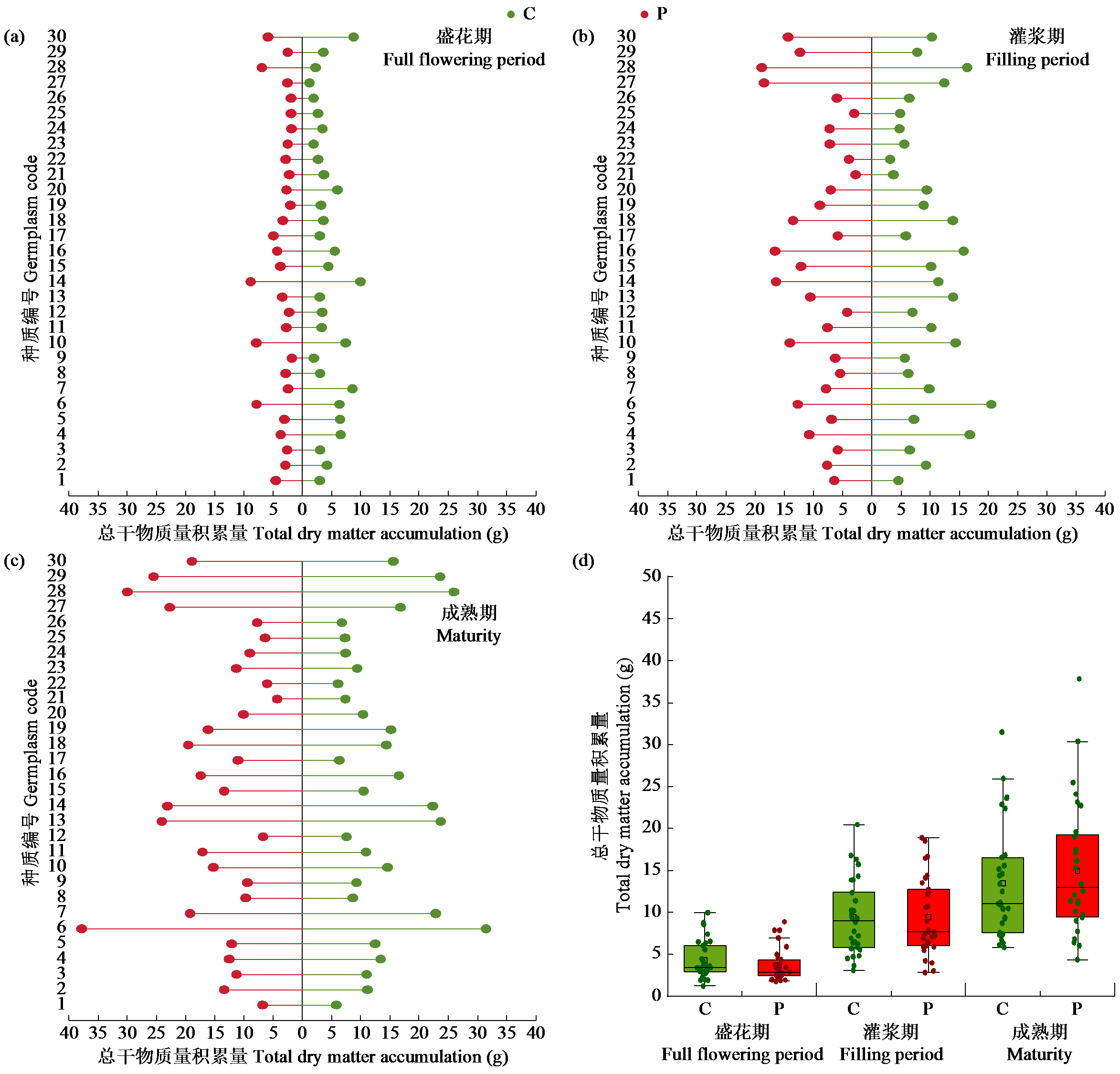
Fig.1

Analysis of total dry matter accumulation and selenium response of different tartary buckwheat germplasms"

Table 4

Analysis of biomass, dry matter transport and selenium response in different tartary buckwheat germplasms"

种质编号
Germplasm
code
处理
Treatment
营养体最大生物量(g/株)
Maximum vegetative
biomass (g/plant)
收获期营养体生物量(g/株)
Vegetative biomass at
harvest (g/plant)
总干物质转运量(g/株)
Total dry matter
translocation (g/plant)
总转运效率
Total translocation
efficiency (%)
1 C1|P1 4.12|4.63 2.46|2.69 1.66|1.94 40.29|41.90
2 C2|P2 8.57|8.87 5.57|5.68 3.00|3.19 35.01|35.96
3 C3|P3 7.88|8.63 4.72|4.64 3.16|3.99 40.10|46.23*
4 C4|P4 12.49|12.49 7.59|7.33 4.90|5.16 39.23|41.31
5 C5|P5 8.86|9.03 6.86|6.79 2.00|2.24 22.57|24.81
6 C6|P6 19.63|19.12* 17.67|16.9* 1.96|2.22 9.98|11.61
7 C7|P7 9.21|9.35 6.39|6.23 2.82|3.12 30.62|33.37
8 C8|P8 6.64|6.35* 4.47|4.31 2.17|2.04* 32.68|32.13*
9 C9|P9 6.62|7.22 4.90|5.59 1.72|1.63* 25.98|22.58
10 C10|P10 10.78|10.31* 8.38|8.02* 2.40|2.29* 22.26|22.21
11 C11|P11 9.13|9.12* 6.71|6.30* 2.42|2.82 26.51|30.92*
12 C12|P12 5.58|6.10 3.82|4.21 1.76|1.89 31.54|30.98*
13 C13|P13 16.63|17.02* 11.07|11.13 5.56|5.89 33.43|34.61
14 C14|P14 10.78|13.27 8.45|9.83* 2.33|3.44* 21.61|25.92
15 C15|P15 7.45|8.87* 5.63|6.73* 1.82|2.14 24.43|24.13
16 C16|P16 6.81|11.34 5.54|9.33 1.27|2.01 18.65|17.72*
17 C17|P17 6.59|6.80 4.10|3.76* 2.49|3.04 37.78|44.71*
18 C18|P18 10.44|10.46 8.69|8.38 1.75|2.08 16.76|19.89
19 C19|P19 10.79|10.28* 7.42|6.86* 3.37|3.42 31.23|33.27
20 C20|P20 9.59|10.46 7.27|8.01 2.32|2.45 24.19|23.42*
21 C21|P21 4.65|5.23 2.78|2.81 1.87|2.42 40.22|46.27*
22 C22|P22 4.52|4.32 3.15|2.90* 1.37|1.42 30.31|32.87
23 C23|P23 5.80|7.33 3.86|4.98 1.94|2.35 33.45|32.06*
24 C24|P24 4.08|5.97 3.17|4.59 0.91|1.38 22.30|23.12
25 C25|P25 4.83|4.36* 2.89|2.23* 1.94|2.13 40.17|48.85*
26 C26|P26 4.57|6.04 2.82|3.46 1.75|2.58 38.29|42.72
27 C27|P27 14.09|18.31* 11.98|15.45* 2.11|2.86 14.98|15.62
28 C28|P28 20.33|24.78* 15.09|17.84* 5.24|6.94* 25.77|28.01
29 C29|P29 18.50|20.62* 10.74|11.08 7.76|9.54* 41.95|46.27*
30 C30|P30 11.39|13.15 8.45|9.35 2.94|3.80 25.81|28.90
平均值Mean 9.34|10.31 6.75|7.25 2.59|3.07 29.29|31.28
P 0.454 0.625 0.009** 0.377

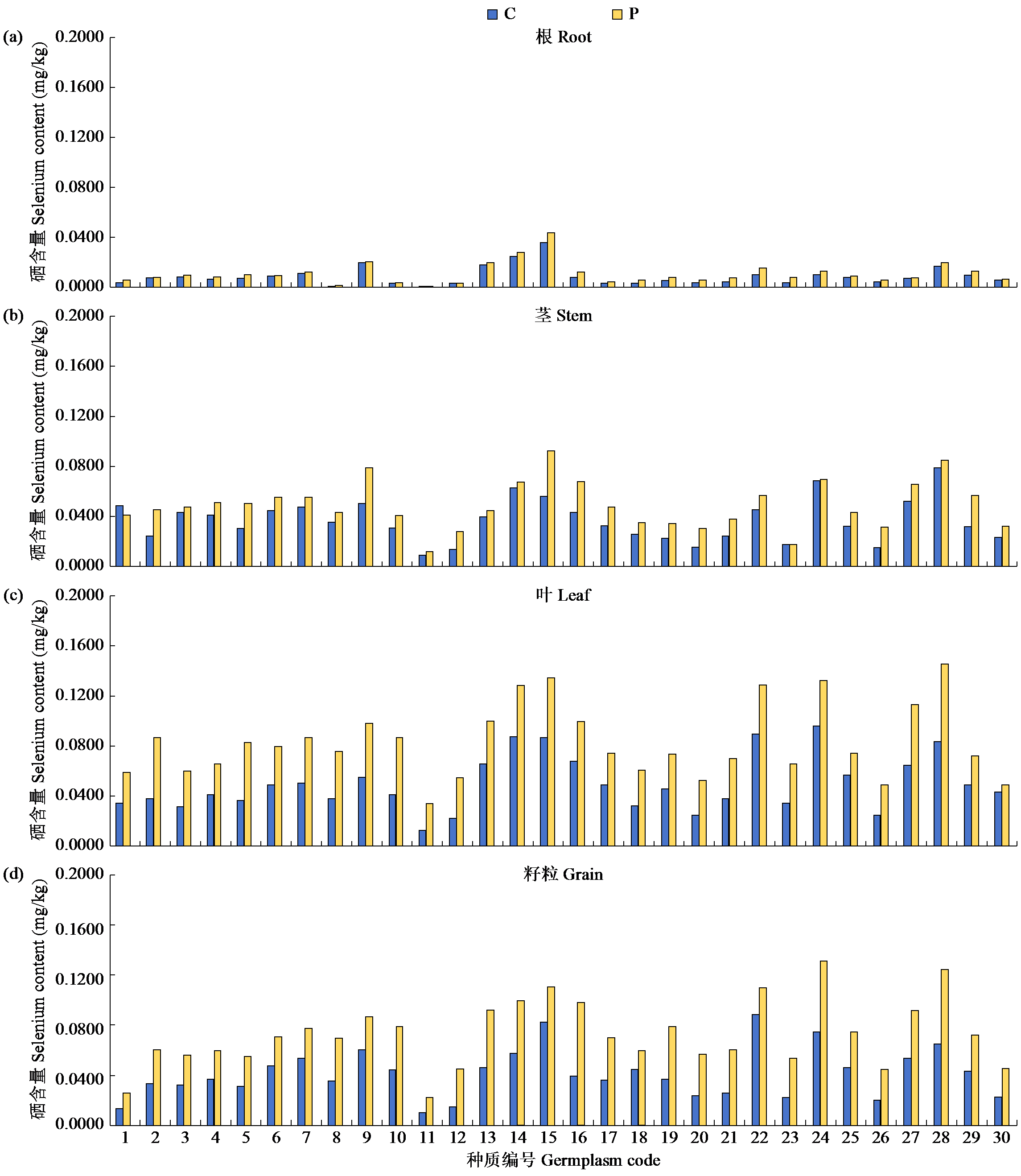
Fig.2

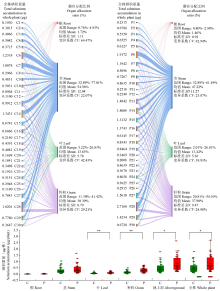
Analysis of selenium content and response differences in different organs of different tartary buckwheat germplasms"

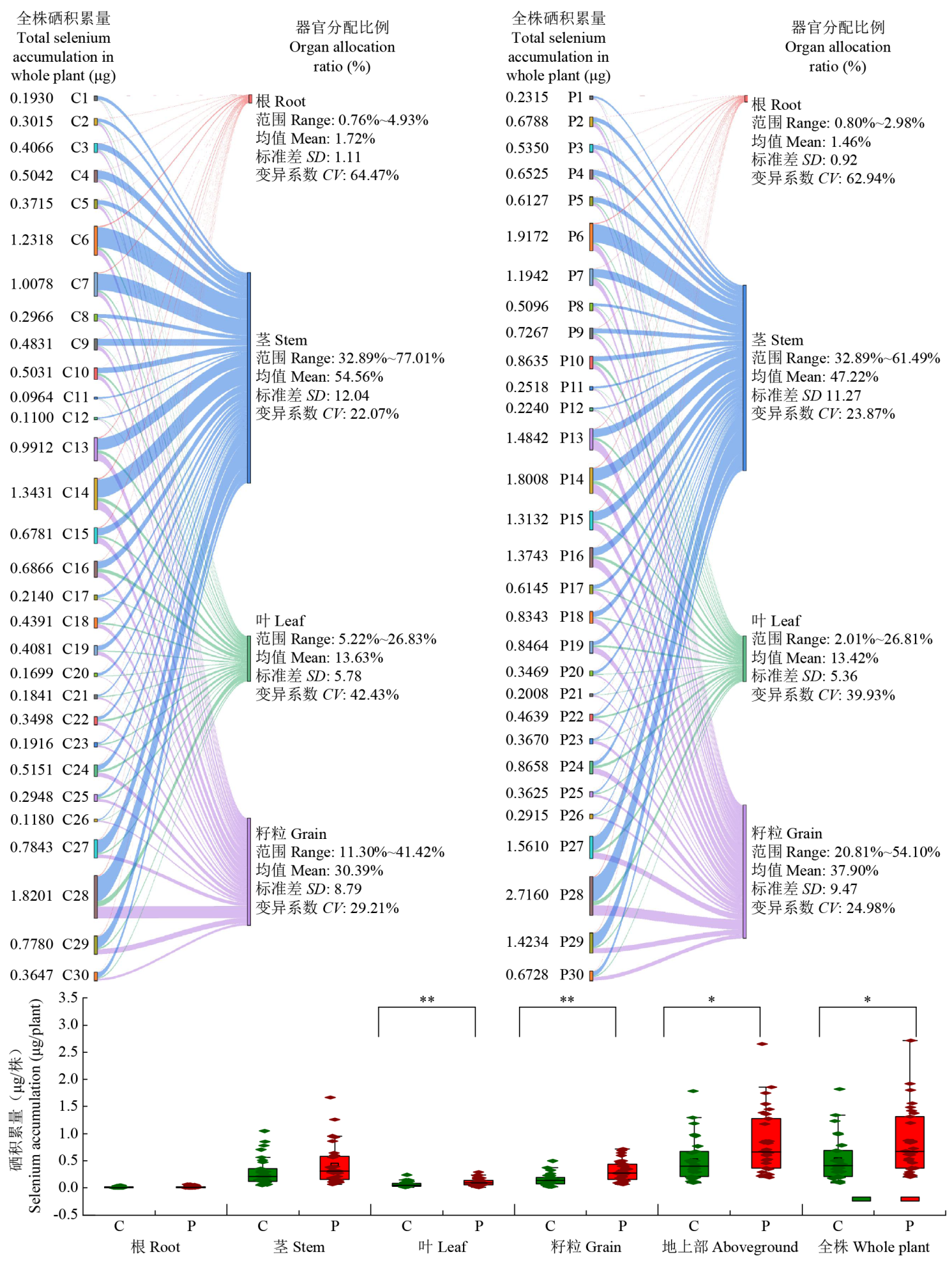
Fig.3

Analysis of selenium accumulation and distribution in different organs of different tartary buckwheat germplasms “*”and“**”indicate significant (P < 0.05) and extremely significant (P < 0.01) differences, respectively. The same below."

Table 5

Analysis of selenium utilization, transportation, absorption and enrichment in different tartary buckwheat germplasms"

种质编号
Germplasm
code
处理
Treatment
硒利用系数
Selenium utilization
coefficient
硒分配系数
Selenium partition
coefficient
硒吸收系数
Selenium absorption
coefficient
硒富集系数
Selenium enrichment
coefficient
1 C1|P1 12.22|30.64 13.92|44.18 2.88 3.54
2 C2|P2 37.12|40.19 59.02|67.21 28.21 12.03
3 C3|P3 24.94|38.24 33.23|61.92 9.60 7.71
4 C4|P4 20.38|24.66 25.60|32.73 11.08 4.35
5 C5|P5 38.34|27.34 62.18|34.53 18.02 1.87
6 C6|P6 18.86|25.52 23.24|34.26 51.23 19.20
7 C7|P7 19.31|38.41 23.93|62.35 13.93 19.73
8 C8|P8 34.97|54.11 53.77|117.88 15.92 12.85
9 C9|P9 34.58|41.81 52.85|71.83 18.21 10.22
10 C10|P10 33.62|35.82 50.65|55.81 26.93 10.47
11 C11|P11 17.97|35.76 21.91|55.66 11.62 5.44
12 C12|P12 26.32|30.41 35.72|43.69 8.51 2.93
13 C13|P13 32.69|47.99 48.57|92.26 36.85 29.01
14 C14|P14 27.53|36.03 37.98|56.32 34.21 20.86
15 C15|P15 38.59|37.81 62.85|60.77 47.46 17.54
16 C16|P16 32.96|43.33 49.17|76.46 51.40 27.59
17 C17|P17 32.32|40.61 47.75|68.38 29.93 13.48
18 C18|P18 38.16|42.86 61.71|75.02 29.54 14.20
19 C19|P19 39.31|51.76 64.73|107.31 32.76 20.76
20 C20|P20 11.32|27.01 12.74|37.01 13.23 5.57
21 C21|P21 41.16|45.88 69.97|84.76 1.25 1.22
22 C22|P22 36.44|39.83 57.32|66.11 8.53 4.27
23 C23|P23 38.88|58.20 63.60|139.23 13.11 10.40
24 C24|P24 35.67|45.76 55.46|84.38 26.21 15.88
25 C25|P25 37.61|43.31 60.26|76.40 5.06 3.45
26 C26|P26 41.42|45.34 70.72|82.95 12.97 6.22
27 C27|P27 18.49|25.88 22.68|34.91 58.05 19.36
28 C28|P28 27.31|25.51 37.58|34.25 66.96 14.63
29 C29|P29 28.64|24.62 40.14|32.66 47.49 9.32
30 C30|P30 25.57|39.01 34.35|63.95 23.02 12.64
平均值Mean 30.09|38.13 45.12|65.17 25.14 11.89
P 0.001** 0.002** - -

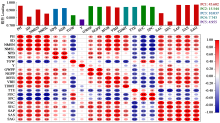
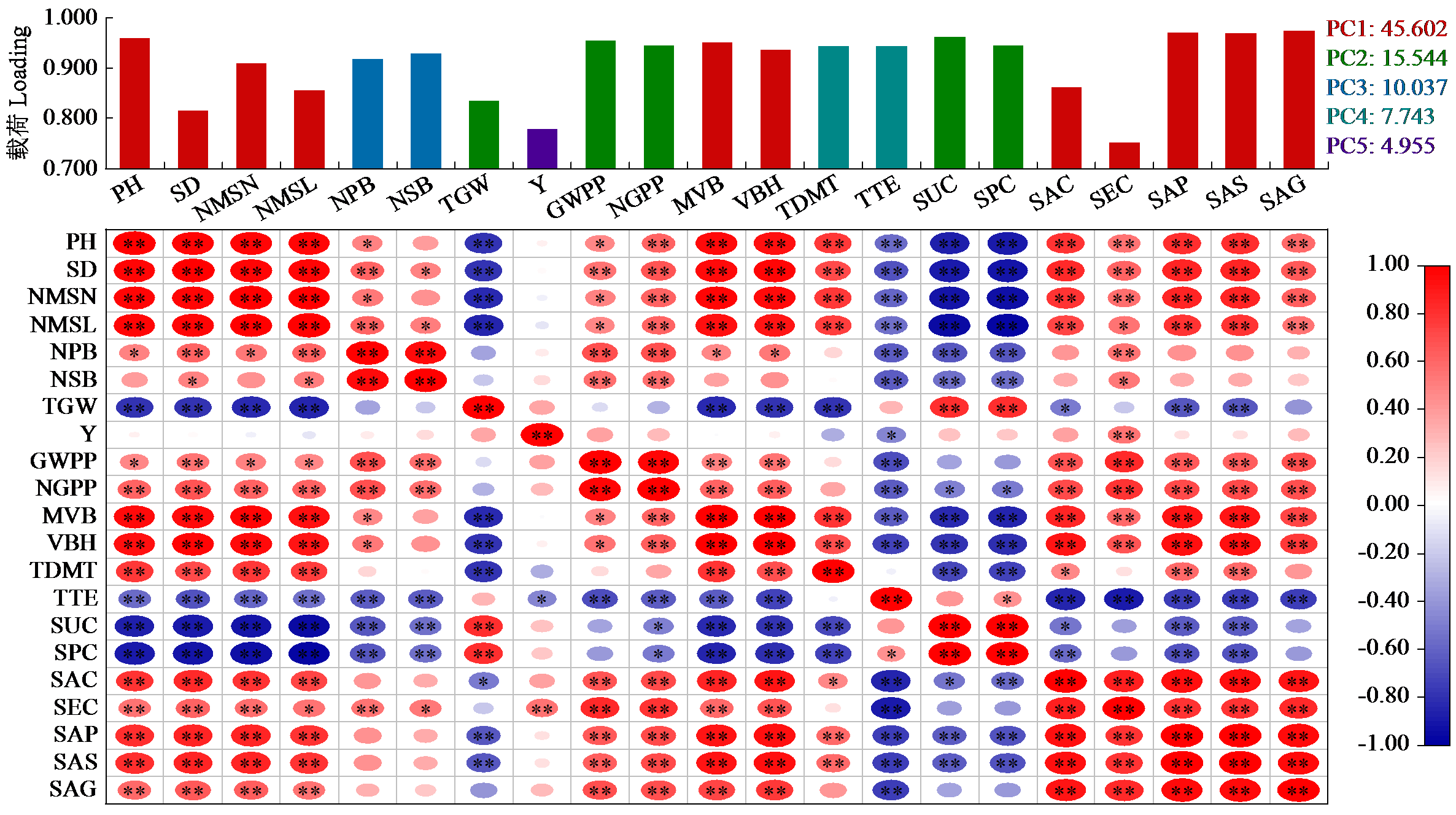
Fig.4

Principal component analysis and correlation analysis of different traits of tartary buckwheat germplasm PH: plant height; SD: stem diameter; NMSN: number of main stem nodes; NMSL: number of main stem leaves; NPB: number of primary branches; NSB: number of secondary branches; TGW: 1000-grain weight; Y: yield; GWPP: grain weight per plant; NGPP: number of grains per plant; MVB: maximum vegetative biomass; VBH: vegetative biomass at harvest; TDMT: total dry matter translocation; TTE: total translocation efficiency; SUC: selenium utilization coefficient; SPC: selenium partition coefficient; SAC: selenium absorption coefficient; SEC: selenium enrichment coefficient; SAP: selenium accumulation in plants; SAS: selenium accumulation in shoots; SAG: selenium accumulation in grains."

Fig.5

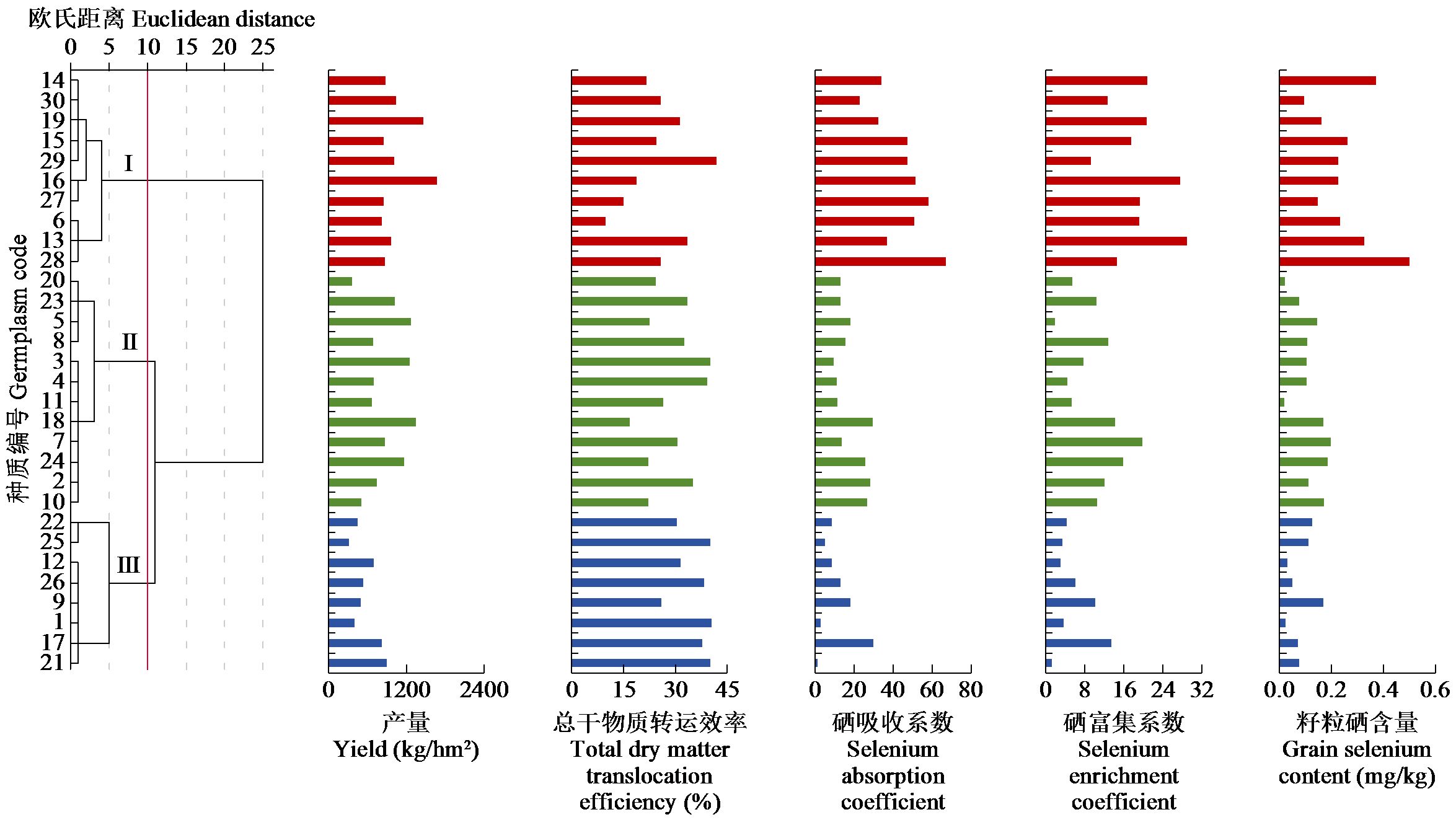
Cluster analysis and group verification of different tartary buckwheat germplasms"

Fig.6

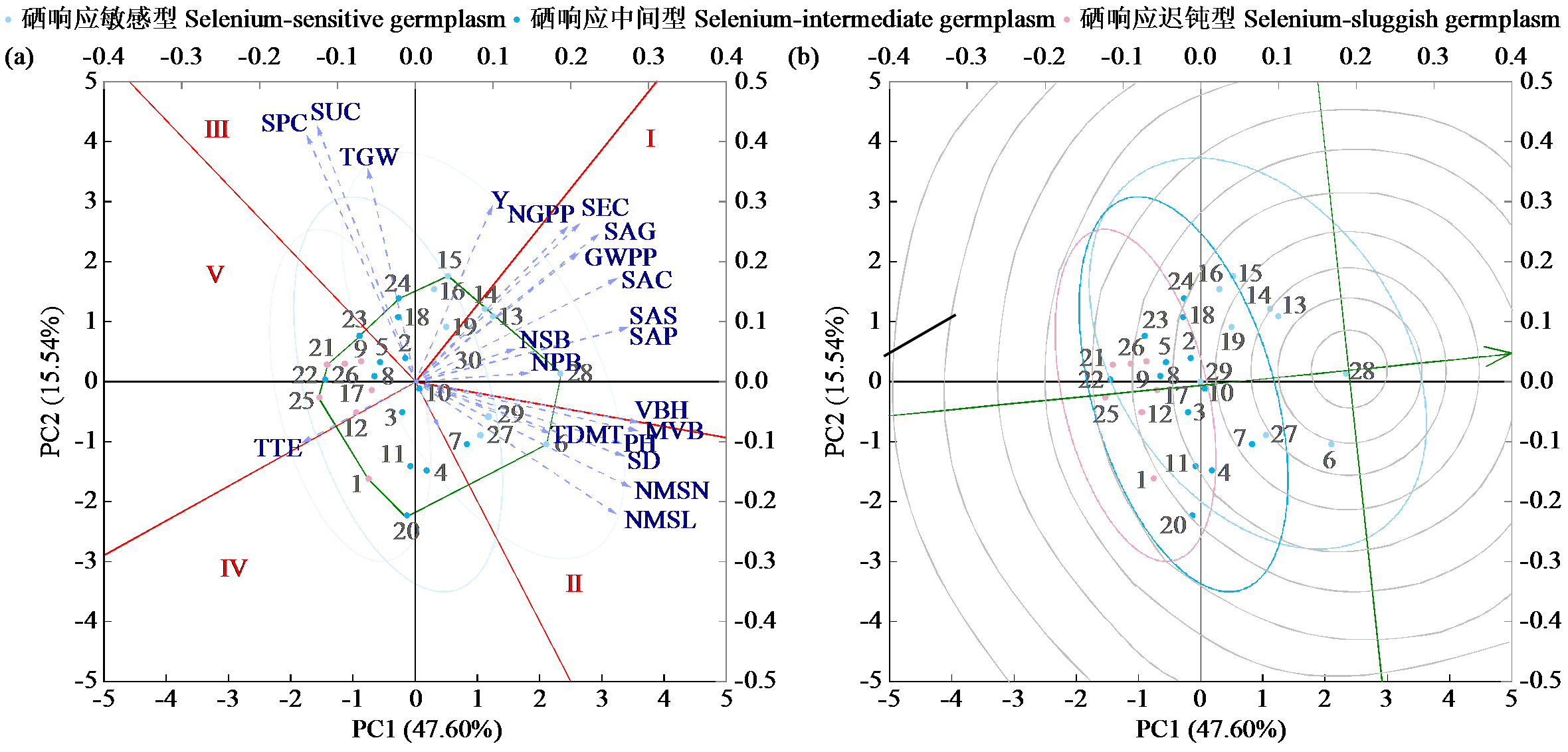
Analysis of selenium response (a) and ideal germplasm (b) of different tartary buckwheat germplasms by GGE biplot"

[1] 杨善岩, 李海龙, 狄志鸿. 硒元素生理功能及微生物富硒发酵研究现状. 食品工业, 2013, 34(6):167-170.
[2] 高向, 章琴, 谢雅情. 关于硒蛋白与人体疾病关系的研究发展. 健康必读, 2017(32):102.
[3] Rayman M P. The importance of selenium to human health. The Lancet, 2000, 356(9225):233-241.
doi: 10.1016/S0140-6736(00)02490-9
[4] 黄冰霞, 支添添, 赵志刚, 等. 硒元素与人类健康. 宜春学院学报, 2019, 41(9):95-101.
[5] 杨光圻, 周瑞华, 荫士安, 等. 我国人民硒需要量的研究五、硒生理需要量的再研究和有关硒需要量问题的讨论. 卫生研究, 1989, 18(2):27-30,55.
[6] Boldrin P F, Faquin V, Clemente A D C S, et al. Genotypic variation and biofortification with selenium in Brazilian wheat cultivars. Journal of Environmental Quality, 2018, 47(6):1371-1379.
doi: 10.2134/jeq2018.01.0045 pmid: 30512055
[7] 刘铖. 苦荞种质资源富硒能力评价. 晋中:山西农业大学, 2022.
[8] 王安虎, 夏明忠, 蔡光泽, 等. 栽培苦荞麦的起源及其近缘种亲缘分析. 西南农业学报, 2008, 21(2):282-285.
[9] 王红育, 李颖. 荞麦的研究现状及应用前景. 食品科学, 2004, 25(10):388-391.
[10] 瓦西一布, 张红彬, 龙慧蕊, 等. 大凉山深处的“天然植物黄金”探访中国重要农业文化遗产四川美姑苦荞栽培系统. 中国民族, 2024(3):84-89.
[11] 彭晓琴, 徐一, 万勇, 等. 凉山州苦荞种植业发展现状及建议. 现代农业科技, 2022(20):184-187.
[12] 薛贤滨, 贾琼, 陈峥峰, 等. 基于主成分分析的苦荞麦重组自交系农艺性状综合评价. 浙江农业学报, 2024, 36(4):748-759.
doi: 10.3969/j.issn.1004-1524.20230489
[13] 陈玥聪. 叶面喷施硒肥对作物养分积累及品质的影响. 哈尔滨:东北农业大学, 2023.
[14] 王艺霖, 李彦青, 黄咏梅, 等. 微量元素硒在薯类作物中的研究进展. 分子植物育种. (2023-07-11)[2024-09-09].https://link.cnki.net/urlid/46.1068.s.20230707.0848.002.
[15] 刘攀锋. 硒硫配施对苦荞生长发育及硒含量的影响. 晋中:山西农业大学, 2022.
[16] 吴正奇, 刘建林. 我国富硒食品的研究进展. 中国食物与营养, 2005(6):15-17.
[17] 张宗文, 林汝法. 荞麦种质资源描述规范和数据标准. 北京: 中国农业出版社, 2007.
[18] 宋晓, 关涵文, 徐新朋, 等. 不同氮效率小麦成熟期茎叶干物质积累量与氮素利用率的关系. 植物营养与肥料学报, 2025, 31(10):1915-1931.
[19] 中华人民共和国卫生部. 食品安全国家标准食品中硒的测定:GB 5009.93-2017. 北京:中国标准出版社,2017.
[20] 侯非凡, 张笑文, 王嘉琦, 等. 硒肥土施位置对小麦生理特性及硒积累的影响. 中国农业科技导报, 2023, 25(7):144-152.
[21] 陈锦平, 潘丽萍, 邢颖, 等. 外源茉莉酸对小白菜耐硒性及硒积累的作用研究. 作物杂志, 2023(6):160-166.
[22] 刘丽, 柴敏, 韩伟, 等. 99份苦荞主要农艺性状评价与筛选. 农学学报, 2023, 13(7):25-31.
[23] 吕丹, 黎瑞源, 郑冉, 等. 213份苦荞种质资源主要农艺性状分析及高产种质筛选. 南方农业学报, 2020, 51(10):2429-2439.
[24] 杨媛, 王慧, 石金波, 等. 晋北地区苦荞种质资源的评价与筛选. 北方农业学报, 2019, 47(4):1-7.
doi: 10.3969/j.issn.2096-1197.2019.04.01
[25] 汪灿, 胡丹, 杨浩, 等. 苦荞主要农艺性状与产量关系的多重分析. 作物杂志, 2013(6):18-22.
[26] 韩芳, 韩向东, 苏乐平, 等. 叶面喷施纳米硒对不同基因型谷子农艺性状、硒含量及产量和品质的影响. 江苏农业科学, 2024, 52(12):89-95.
[27] 赵丹, 李海燕, 吴晓东, 等. 叶面喷施富硒有机肥对棉花农艺性状、产量及籽粒硒含量的影响. 园艺与种苗, 2022, 42(12):68-70.
[28] 王澜, 夏海勇, 孔玮琳, 等. 土壤和叶面施锌对小麦农艺性状、籽粒产量和对锌、铁及硒微量元素浓度的影响. 农学学报, 2021, 11(7):23-27.
doi: 10.11923/j.issn.2095-4050.casb2020-0206
[29] 赵双玲, 银永安, 黄东, 等. 富硒肥对膜下滴灌水稻农艺性状、产量及品质的影响. 中国稻米, 2021, 27(2):93-94,97.
doi: 10.3969/j.issn.1006-8082.2021.02.020
[30] 赵立松. 不同价态硒及硒硫互作对小麦农艺性状及生理指标的影响. 晋中:山西农业大学, 2020.
[31] 刘婷, 候运和, 郑甲成. 外源硒对碎米荠农艺性状及硒含量的影响. 湖北民族学院学报, 2018, 36(4):365-369.
[32] 陈火云, 王加冕, 汪欢, 等. 硒叶面肥对油菜农艺性状、产量和籽粒硒含量影响的初步研究. 长江大学学报, 2018, 15(2):5-8,4.
[33] 秦杰. 外源硒对不同生态区苦荞产量和品质的影响. 晋中:山西农业大学, 2022.
[34] 甘圳. 外施硒对苦荞生长发育、产量品质及转录调控表达的影响分析. 成都:成都大学, 2024.
[35] 王子轩, 宋晓彦, 史晓倩. 探析施硒对苦荞品质和硒含量的影响. 山西农经, 2018(18):66-67.
[36] 黄小燕, 陈庆富, 田娟, 等. 苦荞种子中硒元素含量变异. 安徽农业科学, 2010, 38(10):5021-5024,5027.
[37] 王永勤, 曹家树, 李建华, 等. 施硒对大蒜产量和含硒量的影响. 园艺学报, 2001, 28(5):425-429.
[38] 黄思思, 查升, 余侃, 等. 生物有机硒对马铃薯产量及硒含量的影响. 湖北农业科学, 2021, 60(23):71-74.
[39] 朱智慧. 施硒对苦荞抗衰老生理和硒含量的影响. 晋中:山西农业大学, 2015.
[40] 刘睿. 硒对苦荞营养效应的研究. 重庆:西南大学, 2007.
[41] 董石峰, 孙敏, 赵剑敏, 等. 花期喷施亚硒酸钠对小麦生长特性及硒积累的影响. 山西农业大学学报, 2019, 39(6):13-18.
[42] 李春花, 吴晗, 加央多拉, 等. 苦荞杂交后代主要农艺性状的主成分与聚类分析. 江苏农业科学, 2023, 51(22):94-100.
[43] Zhao J D, Li X L, Shi X H, et al. Principal component analysis and cluster analysis of Fagopyrum tataricum varieties (lines). Agricultural Basic Science and Technology, 2016, 17(12):2707-2712.
[44] 李春花, 卢文洁, 王艳青, 等. 云南苦荞资源农艺性状的主成分和聚类分析. 江西农业大学学报, 2015, 37(4):612-617,724.
[1] Shi Nuo, Zhu Hongqiang, Yang Mengxuan, Zhou Yanbin, Dai Huijuan, Lü Penghui, Liu Bo, Wang Shengfeng, Mu Wenpo, Du Yu. Effects of Different Microbial Fertilizers on Growth, Yield and Quality of Flue-Cured Tobacco [J]. Crops, 2026, 42(1): 189-196.
[2] Wu Yening, Hu Haochi, Wang Chunyong, Xie Rui, Zhang Yonghu, Wen Rui, Jin Xiaolei. Genetic Diversity and Population Structure Analysis of 104 Tartary Buckwheat Germplasm Resources Based on SSR Markers [J]. Crops, 2026, 42(1): 26-32.
[3] Tang Cuifeng, A Xinxiang, Dong Chao, Zhang Feifei, Yang Yayun, Yang Hongmei, Dai Luyuan, Su Zhenxi. Analysis of Genetic Diversity by SSR Markers and Correlation of Main Agronomic Traits of Rice Germplasm Resources in Border Areas of Yunnan [J]. Crops, 2026, 42(1): 33-46.
[4] Jiang Kunwei, Sun Guocai, Wang Jian, Wang Guiyan, Cui Yuefeng. Identification, Evaluation and Screening of Cold Tolerance in Japonica Rice at Germination Stage in Northern China [J]. Crops, 2026, 42(1): 54-59.
[5] Li Wenjun, Guo Yanping, Yang Shenghua, Shao Yang. Analysis of Genetic Diversity of Main Agronomic Traits of 513 Faba Bean Germplasm Resources [J]. Crops, 2026, 42(1): 85-93.
[6] Yu Huaxian, An Rudong, Tao Lianan, Lang Rongbin, Bian Xin, Zhang Yu, Liu Xinlong, Liu Jiayong, Zhao Liping, Liu Hongbo, Zhang Gemin, Zhang Baoqing. Comprehensive Evaluation of Reciprocal Cross Hybrids between 57NG208 and Nanjian Chewing Cane Based on Agronomic Traits [J]. Crops, 2026, 42(1): 94-103.
[7] Chen Lei, Tang Maoyan, Zhang Zhanying, Zhong Xiaoyuan, Gao Guoqing, Zhang Xiaoli, Liang Tianfeng, Pan Yinghua. Analysis and Evaluation of Grain Appearance Quality Traits in Rice Germplasm Resources under Heat Stress during Flowering Stage [J]. Crops, 2025, 41(6): 132-139.
[8] Guo Longyu, Gao Xinmei, Fu Ying, Zhang Mingwei, Wang Ying, Li Wurijimusi, Wurilige , Wang Yingjie, Wang Jingyu, Yang Fengting, Gu Yanru, Quan Yu. Effect of Immune Inducer ZNC on Seedling Growth and Physiological Response of Oat under Saline-Alkali Stress [J]. Crops, 2025, 41(6): 203-209.
[9] Dong Xiaohui, Jing Yuliang, Liu Lichao, Wang Cuiling, Zhang Liguo, Sun Luhong. Effects of Different Phosphorus Supply Levels and Varieties on Morphological and Physiological Characteristics in Industrial Hemp [J]. Crops, 2025, 41(6): 216-224.
[10] Sun Qiang, Ruan Xinsen, Zhou Zhihao, Sun Huijuan, Xu Ran, Ling Dong, Zhao Cuirong. Analysis of Genetic Diversity of Phenotypic Traits in Different Rice Varieties [J]. Crops, 2025, 41(6): 28-36.
[11] Chen Yi, Chen Xiao, Zhang Maoxing, Li Jing, Chang Jingjing, Li Jiawei, Lin Haiqing, Chen Xingping, Deng Xiaoliang, Xie Dasen, Guo Shaolong, Shen Zhongdeng, Zhang Baige. Response of Different Wax Gourd Varieties to Low-Salt Stress and Comprehensive Evaluation of Their Salt Tolerance [J]. Crops, 2025, 41(6): 58-66.
[12] Zhao Caixia, Baima Yangzhen, Yang Guanghuan, Tang Lin. Identification and Cluster Analysis of Agronomic Traits in Different Types of Rapeseed Resources [J]. Crops, 2025, 41(5): 120-127.
[13] Du Hanmei, Tan Lu, Li Shengchun, Wang Qinghai, Xu Zhou, Wu Dandan, Wang Anhu. Cadmium Tolerance of Tartary Buckwheat during Germination Stage and Its Effects on Physiological Characteristics of Seedlings [J]. Crops, 2025, 41(5): 209-220.
[14] Wang Liang, Wang Rui, Zhu Jincheng, Sang Yuwei, Shi Biao, Guo Jiashuai, Jiao Huimin, He Zongling, Shui Yong. Analysis of Salt Tolerance in 50 Peanut Varieties (Lines) at Seedling Stage [J]. Crops, 2025, 41(5): 35-41.
[15] Yin Junhua, Deng Li, Guo Minjie, Miao Jianli, Hu Junping, Li Shaowei, Ren Li. Comprehensive Evaluation of Small-Seeded Peanut Varieties Based on BLUP Values and GGE Biplot [J]. Crops, 2025, 41(4): 118-125.
Viewed
Full text


Abstract

Cited

  Shared   
  Discussed   
No Suggested Reading articles found!