



大量研究表明,硒在一定浓度范围内能促进植物的生长发育,提高产量及品质[5],提升植物的耐逆性[6
1 材料与方法
1.1 试验材料
供试樱桃番茄品种“金陵红玉”和“金陵秀玉”均为江苏省农业科学院蔬菜研究所选育的高品质樱桃番茄品种。供试有机硒肥为扬州大学与四川硒莱坞科技有限公司合作开发的硒代葡萄糖,硒含量3%,用清水稀释至所需浓度。
1.2 试验设计
试验于2020年春季在江苏省农业科学院六合基地塑料钢架单体大棚内进行。樱桃番茄种子在28 ℃恒温箱中催芽,待种子露白后,将种子用镊子播种于72孔穴盘中,育苗基质为泥炭:蛭石= 2:1,于四叶一心时将幼苗定植于大棚内,番茄株行距均为40 cm。塑料大棚长70.0 m、宽8.0 m,翻整地时均匀施入有机肥12 000 kg/hm2和复合肥600 kg/hm2,棚内分为4畦,每畦宽1.5 m,高20 cm。
试验以清水处理作为对照(CK),设5个外源有机硒浓度处理,分别为6、12、18、24和30 mg/L,每株喷施30 mL,每个品种每个小区面积5m2(20株),采用随机区组试验设计,3次重复。第1次喷施时间为番茄第1穗果坐果期,随后每隔14 d喷施1次,连喷4次。番茄果实采样时间距喷施外源硒肥溶液间隔7 d。生产期间按常规管理。
1.3 测定项目与方法
采用植物多酚叶绿素测量仪(Dualex Scientific+,法国FORCE-A公司)于第3次外源喷施有机硒后7 d测定番茄叶片的氮平衡指数(NBI),叶绿素(Chl)、黄酮醇(Flav)和花青素(Anth)含量等生理特性指标,每个处理随机选择5株对中上部功能叶片进行测定,每张叶片选取10个分布均匀的点进行测定并取平均值,3次重复。
1.4 数据处理
利用Excel 2021软件进行分析和作图,利用DPS 7.05软件对数据进行方差分析,用LSD法进行差异显著性分析(P<0.05)。
2 结果与分析
2.1 不同浓度硒肥对番茄植株生理特性的影响
2.1.1 对番茄叶片NBI的影响
经外源有机硒处理后,盛果期番茄叶片的NBI受外源硒浓度影响较大,由图1可知,2个番茄品种的NBI随着外源硒浓度的增加,均呈现先增加后降低的趋势。金陵红玉外源硒浓度6和12 mg/L处理的叶片NBI与CK相比无显著差异;外源硒浓度18 mg/L处理的叶片NBI显著高于CK;外源硒浓度24和30 mg/L处理的叶片NBI含量呈降低趋势,但与CK无显著差异。金陵秀玉外源硒浓度12 mg/L处理的叶片NBI显著高于CK,其余处理的叶片NBI与CK差异均不显著。
图1
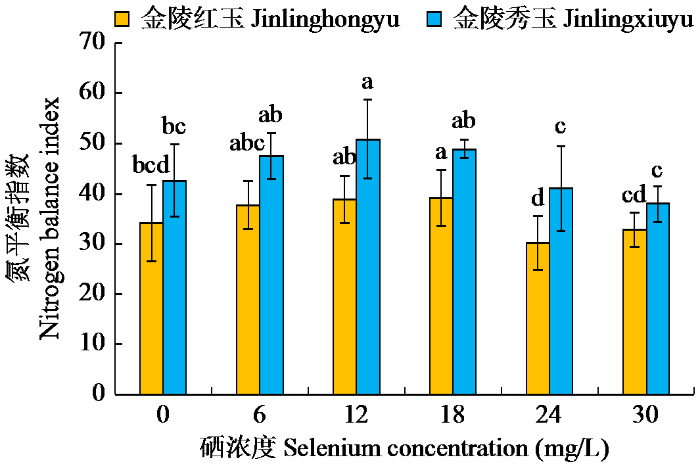
图1
不同浓度硒肥对设施番茄叶片NBI的影响
不同小写字母表示差异达到显著水平(P < 0. 05),下同。
Fig.1
Effects of different concentrations of selenium fertilizer on NBI of facility tomato leaves
Different lowercase letters indicate significant difference (P < 0.05), the same below.
2.1.2 对番茄叶片Chl含量的影响
经外源有机硒处理后,适宜浓度的外源硒可有效提高盛果期植株叶片的Chl指数,由图2可知,2个番茄品种植株叶片的Chl含量随着外源硒浓度的增加也呈现先增加后降低的趋势。金陵红玉外源硒6和18 mg/L处理的Chl含量最高,且显著高于CK;其次为外源硒12、24和30 mg/L处理,但均与CK差异不显著。金陵秀玉外源硒12和18 mg/L处理的Chl含量最高,且显著高于CK;其次为外源硒6、24和30 mg/L处理,但均与CK差异不显著。
图2
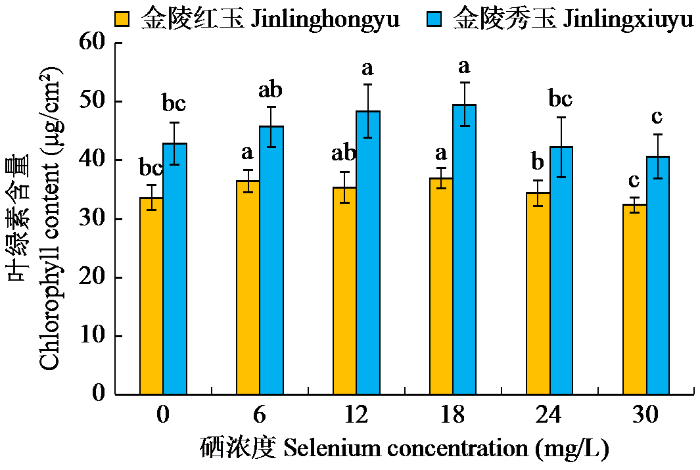
图2
不同浓度硒肥对设施番茄叶片Chl的影响
Fig.2
Effects of different concentrations of selenium fertilizer on Chl content in facility tomato leaves
2.1.3 对番茄叶片Flav含量的影响
2个番茄品种盛果期植株Flav含量随着外源有机硒浓度的增加呈现先降低后升高的趋势(图3)。金陵红玉所有处理的Flav含量与CK差异均不显著,外源硒浓度24 mg/L处理的Flav含量最高,外源硒浓度12 mg/L处理的番茄叶片Flav含量最低。金陵秀玉所有处理的Flav含量与CK差异也均不显著,外源硒浓度6和12 mg/L处理的叶片Flav含量较低,浓度30 mg/L处理下含量最高。
图3
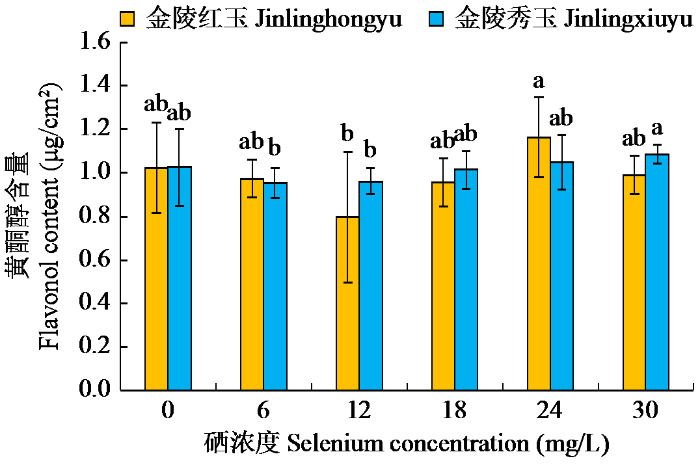
图3
不同浓度硒肥对设施番茄叶片Flav含量的影响
Fig.3
Effects of different concentrations of selenium fertilizer on the Flav content of facility tomato leaves
2.1.4 对番茄叶片Anth含量的影响
2个番茄品种盛果期植株叶片Anth含量随着外源硒浓度的增加呈现抛物线变化趋势,且金陵红玉的叶片Anth含量普遍高于金陵秀玉(图4)。金陵红玉外源硒浓度6和12 mg/L处理的番茄植株叶片Anth含量最低,且与CK差异不显著;外源硒浓度18 mg/L处理的Anth含量最高,并显著高于CK和其他处理;外源硒浓度24和30 mg/L处理的叶片Anth含量显著高于CK,且这2个处理间差异不显著。金陵秀玉外源硒浓度6 mg/L处理的番茄叶片Anth含量在所有处理中最低,且与CK差异不显著;外源硒浓度高于12 mg/L时,所有处理的番茄叶片Anth含量均显著高于CK;当硒浓度24 mg/L时,叶片Anth含量最高。
图4
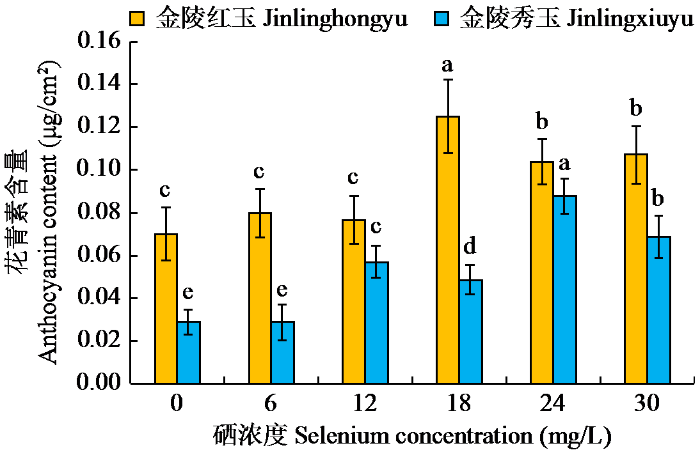
图4
不同浓度硒肥对设施番茄叶片Anth含量的影响
Fig.4
Effects of different concentrations of selenium fertilizer on Anth content in facility tomato leaves
2.2 不同浓度硒肥对番茄单株产量的影响
收获后,对2个番茄品种的分批产量进行统计分析,结果(图5)表明,2个番茄品种的单株产量变化趋势相似,均随着喷施浓度的增加呈现先增加后降低的趋势,但出现峰值的外源硒浓度不同。在金陵红玉品种中,外源硒浓度为12和18 mg/L处理的单株产量最高,且显著高于CK及其他处理;外源硒肥浓度为6 mg/L处理的单株产量显著高于CK及外源硒24、30 mg/L处理;外源硒浓度30 mg/L处理的单株产量最低,与CK无显著差异,但显著低于24 mg/L处理。在金陵秀玉品种中,外源硒浓度为6和12 mg/L处理的单株产量最高,且显著高于CK及其他处理;其次为外源硒肥18 mg/L的处理,且其单株产量与CK差异不显著;外源硒浓度24和30 mg/L处理间的单株产量差异不显著,且显著低于CK。
图5
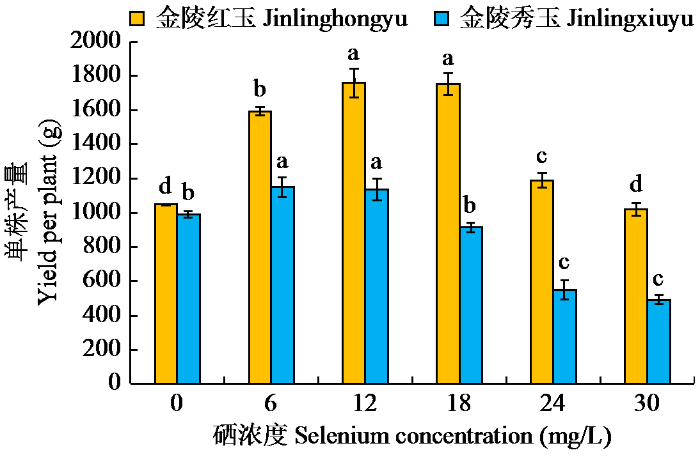
图5
不同浓度硒肥对设施番茄单株产量的影响
Fig.5
Effects of different concentrations of selenium fertilizer on the yield per plant of facility tomato
2.3 不同浓度硒肥对番茄果实品质的影响
2.3.1 对可溶性固形物含量的影响
2个番茄品种第2、3穗成熟果实的可溶性固形物含量变化趋势不同(图6)。金陵红玉可溶性固形物含量随着外源硒浓度的增加呈现逐渐增加的趋势,而金陵秀玉可溶性固形物含量随着外源硒浓度的增加呈现波动的趋势。金陵红玉外源硒6和12 mg/L处理的果实可溶性固形物含量较低,其次为18和24 mg/L的处理,且这4个处理的可溶性固形物含量与CK差异均不显著;外源硒浓度为30 mg/L处理的可溶性固形物含量最高,且显著高于CK及其余所有处理。金陵秀玉外源硒浓度12 mg/L处理的果实可溶性固形物含量最低,且显著低于CK及其他处理;外源硒浓度30 mg/L处理的果实可溶性固形物含量最高,且显著高于CK;外源硒浓度6、18和24 mg/L处理的番茄果实可溶性固形物含量均与CK无显著差异。
图6

图6
不同浓度硒肥对设施番茄可溶性固形物含量的影响
Fig.6
Effects of different concentrations of selenium fertilizer on the soluble solids content of facility tomato
2.3.2 对抗坏血酸(AsA)含量的影响
2个番茄品种第2、3穗成熟果实的AsA含量随着外源硒浓度的增加均呈现抛物线的变化趋势(图7)。金陵红玉所有硒肥处理的番茄果实AsA含量均显著高于CK;外源硒浓度18和24 mg/L处理的番茄果实AsA含量显著高于其他处理,两者间无显著差异;外源硒浓度为30 mg/L时,AsA含量急剧下降,并显著低于其他硒肥处理。金陵秀玉外源硒浓度24和30 mg/L处理果实AsA含量最低,且与CK差异不显著;外源硒浓度6 mg/L处理果实的AsA含量最高,且显著高于其他处理;外源硒浓度12和18 mg/L处理间果实的AsA含量差异不显著,且显著高于除6 mg/L外的其他处理。
图7
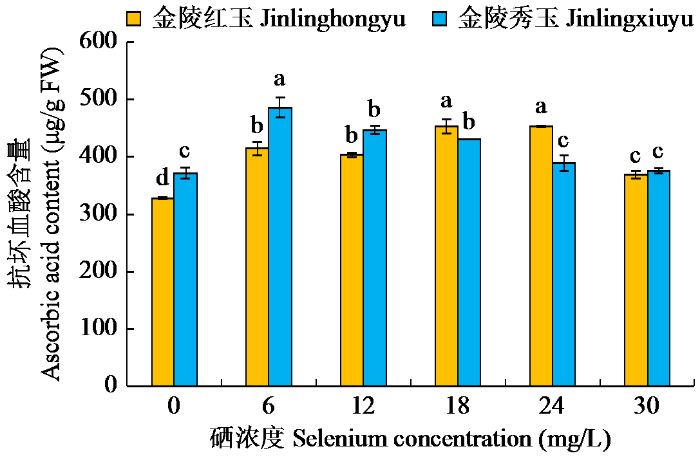
图7
不同浓度硒肥对设施番茄果实AsA含量的影响
Fig.7
Effects of different concentrations of selenium fertilizer on the AsA content in facility tomato fruits
2.3.3 对可溶性糖含量的影响
2个番茄品种的第2、3穗番茄成熟果实的可溶性糖含量在喷施外源有机硒后的变化趋势不同,金陵红玉果实可溶性糖含量随着外源硒浓度增加呈现不断增加的趋势,而金陵秀玉果实可溶性糖含量随着外源硒浓度增加呈现先增加后降低的趋势(图8)。金陵红玉外源硒浓度6 mg/L处理果实的可溶性糖含量最低,且与CK差异不显著;当外源硒浓度为12~30 mg/L时,可溶性糖含量均显著高于对照;硒浓度30 mg/L处理的果实可溶性糖含量最高,且显著高于其他硒肥处理,其次为硒浓度24 mg/L处理。金陵秀玉外源硒浓度为6~18 mg/L时,果实中可溶性糖含量较高,显著高于其他处理;外源硒浓度为24 mg/L时,可溶性糖含量显著下降,且显著低于其他处理;外源硒浓度30 mg/L处理的果实可溶性糖含量显著高于CK及24 mg/L处理。
图8
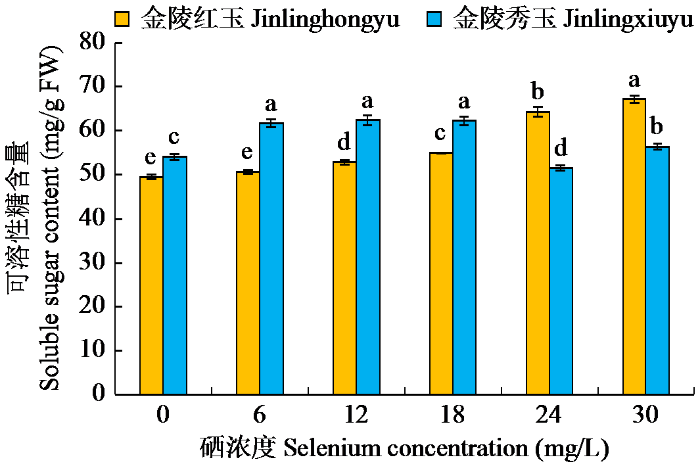
图8
不同浓度硒肥对设施番茄果实可溶性糖含量的影响
Fig.8
Effects of different concentrations of selenium fertilizer on the soluble sugar content of facility tomato fruits
2.3.4 对有机酸含量的影响
2个番茄品种的第2、3穗番茄成熟果实的有机酸含量在喷施外源有机硒后的变化趋势相同,均随着外源硒浓度的增加呈现先增加后降低的趋势(图9)。金陵红玉外源硒浓度6 mg/L处理番茄果实中有机酸含量最高,且显著高于对照及其他处理;外源硒浓度12、18和30 mg/L处理的果实有机酸含量与CK差异均不显著;外源硒浓度24 mg/L处理果实有机酸含量最低,且显著低于其他处理。金陵秀玉外源硒浓度6 mg/L处理番茄果实有机酸含量最高,其次为12 mg/L处理,且2个处理的有机酸含量均显著高于其他处理;外源硒浓度18和30 mg/L处理间果实中有机酸的含量差异不显著,且与CK差异不显著;当硒肥中硒含量为24 mg/L时,果实中有机酸的含量最低,显著低于其他硒肥处理。
图9
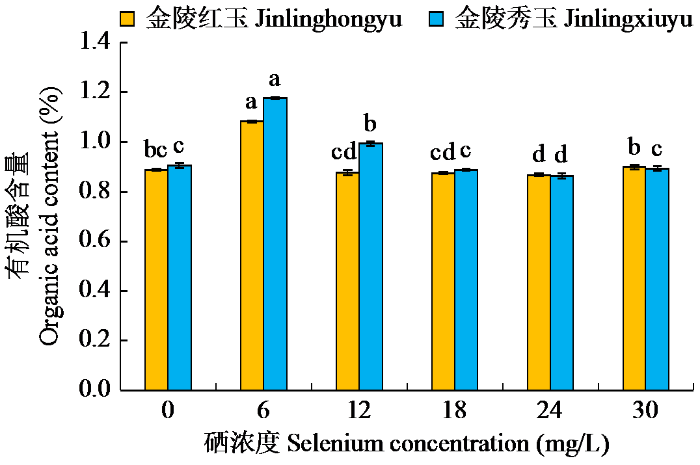
图9
不同浓度硒肥对设施番茄果实有机酸含量的影响
Fig.9
Effects of different concentrations of selenium fertilizer on the organic acid content of facility tomato fruits
2.3.5 对可溶性蛋白含量的影响
由图10可知,2个番茄品种第2、3穗番茄成熟果实的可溶性蛋白含量变化趋势有所差别。金陵红玉外源硒浓度6、12和18 mg/L处理的果实的可溶性蛋白显著低于其他硒肥处理,且均与CK差异不显著;外源硒浓度24、30 mg/L时,果实中的可溶性蛋白含量显著增加,其中外源硒浓度24 mg/L的可溶性蛋白含量最高,显著高于CK及30 mg/L处理。金陵秀玉果实可溶性蛋白含量随着硒肥中硒含量的增加呈现波动的趋势,施硒处理下,浓度12 mg/L处理最高,但与CK差异不显著;其次为外源硒浓度30 mg/L处理,显著低于CK,但显著高于6、18和24mg/L处理;外源硒浓度6 mg/L处理的果实中可溶性蛋白含量最低,显著低于其他处理。
图10
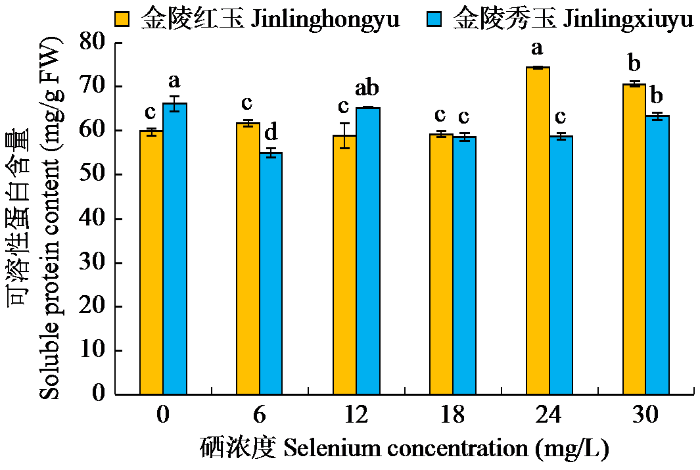
图10
不同浓度硒肥对设施番茄果实可溶性蛋白含量的影响
Fig.10
Effects of different concentrations of selenium fertilizer on the soluble protein content of facility tomato fruits
2.3.6 对硒含量的影响
金陵红玉和金陵秀玉第2、3穗成熟果实硒含量随着外源硒浓度的增加呈现不断增加的趋势(图11)。金陵红玉外源硒浓度6 mg/L处理的果实硒含量显著低于其他处理,且与CK差异不显著;当外源硒浓度为12~30 mg/L时,所有处理的果实硒含量均显著高于CK;外源硒浓度30 mg/L处理的果实硒含量最高,且显著高于其他处理,其次为24、18和12 mg/L处理。金陵秀玉所有外源喷施硒肥处理的果实硒含量均显著高于CK;外源硒浓度6 mg/L处理的果实中硒含量最低,且显著低于其他所有硒肥处理;当浓度为24和30 mg/L时,果实中硒含量最高,且2个处理间差异不显著。
图11
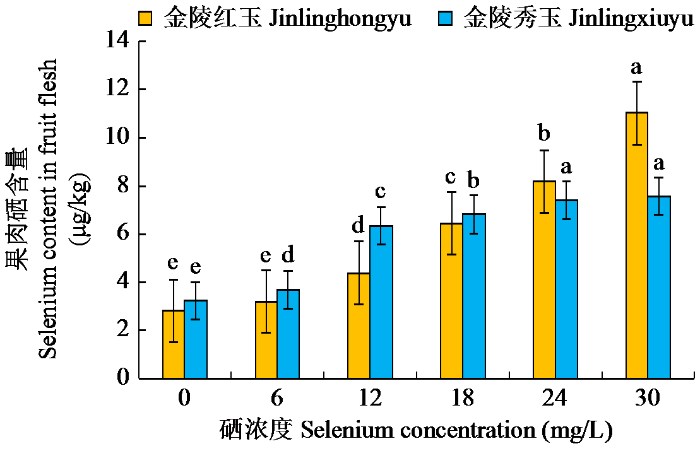
图11
不同浓度硒肥对设施番茄果肉硒含量的影响
Fig.11
Effects of different concentrations of selenium fertilizer on the selenium content of facility tomato fruits
3 讨论
3.1 外源硒对番茄植株生理特性的影响
NBI是指叶绿素和类黄酮的比值,能较好地反映作物受胁迫情况与长势[23]。研究表明,与单纯使用叶绿素指标比较,NBI能更精确、更灵敏地反映小麦[24]和甜瓜[25]等作物的氮素营养状况。本研究表明,与对照相比,金陵红玉和金陵秀玉分别喷施18和12 mg/L的外源有机硒肥时,能显著提升叶片NBI指标,而其他处理均与对照差异不显著;且2个品种的NBI随着硒肥浓度的增加均呈现抛物线变化;说明适宜浓度的外源有机硒能提升樱桃番茄叶片氮肥水平,且不同番茄品种叶片氮肥水平对外源硒肥的响应有所差异。付冬冬等[26]对外源硒对小白菜生长及养分吸收的研究表明,低浓度外源硒促进小白菜叶片对氮的吸收,高浓度外源硒则抑制小白菜对氮的吸收,本研究结果与此类似。
类黄酮是植物次级代谢中一个很大的家族,其中Flav是无色的次级代谢产物,在植物体内不仅可调控植物花色形成,保护植物抵御紫外损伤,还可作为信号分子响应营养胁迫,调控植物生长激素运输等作用[30]。本研究中,2个樱桃番茄品种的Flav含量随着外源硒浓度的增加均呈现先降低后增加的趋势,所有硒肥处理与对照的差异均不显著。杨晓飞等[31]研究表明,白菜芽苗菜中类黄酮含量随亚硒酸钠浓度上升呈逐渐下降的趋势,高浓度的亚硒酸钠抑制类黄酮的积累,并对白菜芽苗菜造成药物胁迫,产生毒害作用;孟祥龙等[32]研究表明,17.30~ 69.19 mg/L外源硒肥处理均可提升蒲公英总黄酮含量,本研究结果与其不同,这可能与试验条件和试验作物等有关。
3.2 外源硒对番茄单株产量的影响
3.3 外源硒对番茄植株品质的影响
可溶性固形物含量是评价番茄品质的重要指标,包含所有溶解于水的化合物。本研究结果表明,喷施30 mg/L外源硒肥能显著增加番茄果实可溶性固形物含量,除了金陵秀玉品种在硒浓度为12 mg/L的处理中可溶性固形物含量显著小于对照之外,2个番茄品种其余处理的可溶性固形物含量均与对照差异不显著。张一雯等[38]研究表明,喷施较低浓度的无机硒可以有效提高番茄果实的可溶性固形物含量;喷施生物硒能有效提高西瓜果实的可溶性固形物含量。本研究结果与其相似,通过适宜浓度的外源硒喷施能显著提高番茄果实可溶性固形物含量。
AsA是一种重要的抗氧化剂,本研究中随着外源硒浓度的增加,2个品种的AsA含量均表现为先增加后降低,且不同品种AsA含量的高峰值存在差异,原因可能是硒增强了番茄对硒的吸收,使得硒更易合成谷胱甘肽,而谷胱甘肽又能参与AsA的循环,从而增加了番茄果实中的AsA含量的积累[39],同时不同品种对外源硒的响应度不同,因此AsA含量的高峰值存在差异。
可溶性糖和有机酸含量是反映番茄果实风味品质的重要指标,影响着番茄果实的口感[15]。本研究中随着外源硒浓度的增加,2个番茄品种可溶性糖含量变化趋势不同,金陵红玉的可溶性糖含量持续增加,而金陵秀玉呈现先增加后降低的趋势;2个番茄品种的有机酸含量均随着外源硒浓度的增加呈现先增加后降低的趋势。与上述研究结果相似,樊尧等[39]研究表明,施用0.5~2 mg/kg外源硒肥显著增加了番茄果实中可溶性糖和有机酸含量。原因可能是施用适量的外源硒肥促进了番茄植株光合作用,提高了蔗糖、葡萄糖和果糖含量,使得可溶性糖含量增加,可溶性糖又通过糖酵解途径合成苹果酸和柠檬酸,促进了果实中的有机酸含量积累[40];而硒肥用量不适宜时,植株光合作用产物积累受到抑制,使得可溶性糖含量下降,同时导致有机酸代谢紊乱,抑制了有机酸的合成[41]。此外本研究中不同品种可溶性糖含量变化趋势不同,可能是不同品种对于外源硒肥的敏感度不同。
本研究中,2个番茄品种随着外源硒浓度的增加,可溶性蛋白变化趋势不同,金陵红玉在喷施中高浓度的硒肥后能显著促进可溶性蛋白含量的积累,但金陵秀玉中仅喷施12 mg/L外源硒处理的可溶性蛋白含量与对照无显著差异,其余处理均显著小于对照。肖真真等[36]对甜瓜施用外源硒肥的研究结果表明,3个甜瓜品种中仅有1个品种在适宜浓度硒肥处理下能显著提升甜瓜果实的可溶性蛋白含量,说明不同品种番茄的可溶性蛋白含量变化对硒肥的敏感度差异较大。
随着外源硒浓度的增加,本研究中的2个樱桃番茄品种果实硒含量均呈现不断上升的趋势,这与张一雯等[38]在番茄和西瓜研究结果类似。本研究中仅金陵红玉樱桃番茄在外源硒浓度30 mg/L时,番茄果实中的硒含量达11.01 μg/kg,超过了10 μg/kg,其余所有硒肥处理均未达到标准;金陵秀玉品种中外源硒浓度30 mg/L处理的番茄果实硒含量仅7.56 μg/kg,这可能与试验品种、硒肥种类及试验条件等有关。
4 结论
外源喷施12~18 mg/L的适宜有机硒肥可以有效提高番茄植株叶片的NBI,Chl、Flav和Anth含量,单株果实产量及AsA、可溶性糖、有机酸及硒含量等品质指标,其中12 mg/L外源硒能显著提高2个樱桃番茄品种单株产量及果实AsA、可溶性固形物和番茄果实硒含量。不同品种对外源硒肥的响应有所差异,喷施18 mg/L的外源有机硒肥仅能提高金陵红玉品种的单株果实产量,喷施12 mg/L的外源有机硒肥只能提高金陵秀玉品种的NBI指数。进行高产优质的番茄品种生产时建议喷施12 mg/L外源有机硒4次,而生产富硒番茄则建议喷施30 mg/L以上的外源有机硒,或者喷施12 mg/L外源有机硒,并增加喷施次数。
参考文献
滴灌条件下不同价态外源硒对水稻硒吸收及转运的影响
DOI:10.16819/j.1001-7216.2017.6069
[本文引用: 1]

目的 通过田间小区试验,研究外源硒酸盐及亚硒酸盐施入滴灌稻田中对土壤中不同价态硒含量及其生物有效性的影响,旨在为滴灌条件下富硒水稻的开发提供理论依据。方法 以水稻品种T-43为材料,硒肥为亚硒酸盐与硒酸盐,施硒量为0.3、0.6、1.2 kg/hm<sup>2</sup>。结果 研究结果表明,施肥后1 d硒酸盐1.2 kg/hm<sup>2</sup>处理土壤中可溶态硒含量最高,比对照高了340%;可交换态硒、铁氧化物态硒及有机态硒含量在施肥后4 d亚硒酸盐1.2 kg/hm<sup>2</sup>处理最高,较对照分别提高了380%、56%、59%,硒酸盐处理铁氧化物态硒及有机态硒含量增加不显著,说明硒酸盐主要以可溶态硒存在,而亚硒酸盐主要以可交换态硒存在,并且由可溶态转化为其他形态,因此降低了其有效性。对水稻的根、茎、叶及籽粒硒含量分析后发现,亚硒酸盐处理的籽粒和叶中的硒含量显著低于硒酸盐处理,而其根部硒含量显著大于硒酸盐处理,茎部硒含量无显著差异,且亚硒酸盐处理的根部硒累积量均大于硒酸盐处理。结论 说明施用亚硒酸盐大部分积累在水稻根部,硒酸盐处理的地上部硒累积量大于亚硒酸盐处理,同时,硒酸盐处理的根系吸收系数、初级转运系数、次级转运系数均大于亚硒酸盐处理,说明亚硒酸盐大部分积累在水稻根部且向地上部转运较难,硒酸盐随水滴施的生物有效性高于亚硒酸盐。
Effect of selenium on alleviating oxidative stress caused by a water deficit in cucumber roots
Effects of selenium on enzymatic changes and productivity of garlic under salinity stress
DOI:10.1016/j.sajb.2018.10.037 URL
Effect of exogenous selenium supply on photosynthesis, Na+ accumulation and antioxidative capacity of maize (Zea mays L.) under salinity stress
The mechanism of selenium-mediated salt tolerance has not been fully clarified. This study investigated the possible role of selenium (Se) in regulating maize salt tolerance. A pot experiment was conducted to investigate the role of Se (0, 1, 5 and 25 μM Na2SeO3) in photosynthesis, antioxidative capacity and ion homeostasis in maize under salinity. The results showed that Se (1 μM) relieved the salt-induced inhibitory effects on the plant growth and development of 15-day-old maize plants. Se application (1 μM) also increased the net photosynthetic rate and alleviated the damage to chloroplast ultrastructure induced by NaCl. The superoxide dismutase (SOD) and ascorbate peroxidase (APX) activities were increased, and ZmMPK5, ZmMPK7 and ZmCPK11 were markedly up-regulated in the roots of Se-treated plants, likely contributing to the improvement of antioxidant defence systems under salinity. Moreover, 1 μM Se increased K+ in the shoots while decreasing Na+ in the roots, indicating that Se up-regulates ZmNHX1 in the roots, which may be involved in Na+ compartmentalisation under salinity. The findings from this single experiment require repetition together with measurement of reactive oxygen species (ROS), but nevertheless suggest that exogenous Se alleviates salt stress in maize via the improvement of photosynthetic capacity, the activities of antioxidant enzymes and the regulation of Na+ homeostasis.
Selenium ameliorates salinity stress in Petroselinum crispum by modulation of photosynthesis and by reducing shoot Na accumulation
DOI:10.1134/S1021443717030086 URL [本文引用: 1]
Selenium mitigates cadmium-induced oxidative stress in tomato (Solanum lycopersicum L.) plants by modulating chlorophyll fluorescence, osmolyte accumulation, and antioxidant system
DOI:10.1007/s00709-017-1162-4 URL [本文引用: 1]
外源硒对叶用莴苣营养品质和风味物质种类及含量的影响
DOI:10.11924/j.issn.1000-6850.casb18050018
[本文引用: 1]
采用盆栽试验研究了叶面喷硒(0、0.1、0.2、0.4和0.8 mg.L<sub>-1</sub>)对叶用莴苣营养品质和风味品质的影响。结果显示,叶面施硒增加了叶用莴苣甜味氨基酸、鲜味氨基酸和苦味氨基酸含量,当浓度为0.2 mg.L<sub>-1</sub>时达到峰值。叶面喷施硒不同程度提高了有机酸总量及柠檬酸含量、苹果酸含量和酒石酸含量,当硒浓度为0.2 mg.L<sub>-1</sub>时,总酸含量、柠檬酸含量、苹果酸含量和酒石酸含量达到最大值。喷施0.8 mg.L<sub>-1</sub>外源硒使得叶用莴苣风味物质总量增加了44.15%,其中2-辛醇、4-羟基-4-甲基环己酮、7-十七烷酮、乙酸己酯分别较对照增加了32.31%、28.87%、33.46%和80.52%。叶面喷硒可以提高叶用莴苣的营养品质、增加风味物质含量,以硒浓度为0.2 mg.L<sub>-1</sub>时品质最佳。
Inhibition of mycotoxin deoxynivalenol generation by using selenized glucose
DOI:10.1016/j.cclet.2020.06.033
[本文引用: 1]
Selenized glucose can be easily prepared <i>via</i> the selenization reaction of glucose using <i>in situ</i> generated NaHSe as the selenization reagent. The technique has been industrialized to produce the chemical in kilogram scale, making it an easily available material in laboratory presently. The selenized glucose may be widely used as the starting material for the preparation of selenium-containing catalysts, as the organoselenium additive for feeds, and as the efficient selenium-enriched foliar fertilizers. In this work, we found that treating <i>Fusarium graminearum</i>, a fungal pathogen inciting wheat scab disease, with selenium glucose could significantly inhibit the generation of the deoxynivalenol (DON) toxin, which might be a breakthrough for reducing the detriment of the wheat scab disease.
Methylselenized glucose:improvement of the stability of glucose-supported selenium via the end-capping strategy
DOI:10.1021/acs.iecr.1c01437 URL [本文引用: 1]
A rapid and sensitive method for the determination of ascorbic-acid using 4,7-DIPHENYL-1,10-PHENANTHROLINE
Performance of dualex in spring wheat for crop nitrogen status assessment, yield prediction and estimation of soil nitrate content
DOI:10.1080/01904160903391081 URL [本文引用: 1]
Evaluation of optical sensor measurements of canopy reflectance and of leaf flavonols and chlorophyll contents to assess crop nitrogen status of muskmelon
DOI:10.1016/j.eja.2014.04.006 URL [本文引用: 1]
玉米叶绿素含量的全基因组关联分析及候选基因挖掘
外源硒对谷子生理特性、硒含量及其产量和品质的影响
DOI:10.3864/j.issn.0578-1752.2017.01.005
[本文引用: 1]
【目的】探索不同生育期喷施不同浓度硒对谷子产量、品质、保护酶活性及籽粒硒含量的变化规律,明确谷子外源硒的最佳施用量和最佳施用期,为富硒谷子的生产管理提供科学依据。【方法】以春谷长农35、夏谷冀谷20、抗除草剂杂交谷晋谷50为试验材料,采用田间试验,设置6个供硒水平(清水对照(T0)、16.96 g·hm<sup>-2 </sup>Na<sub>2</sub>SeO<sub>3</sub>(T1)、33.92 g·hm<sup>-2</sup> Na<sub>2</sub>SeO<sub>3</sub>(T2)、67.84 g·hm<sup>-2</sup> Na<sub>2</sub>SeO<sub>3</sub>(T3)、135.68 g·hm<sup>-2</sup> Na<sub>2</sub>SeO<sub>3</sub>(T4)、271.36 g·hm<sup>-2</sup> Na<sub>2</sub>SeO<sub>3</sub>(T5)),在苗期、抽穗期、灌浆期叶面喷施,研究不同生育期不同供硒水平对不同品种谷子生理生化指标、产量、品质及硒含量的影响。【结果】不同浓度外源硒叶面处理谷子,不同生育期SPAD、POD、SOD、MDA、GSH和GSH-Px等6个生理生化指标,品种间达极显著差异水平(P<0.01),并且除MDA外,其他均主要表现为随着硒浓度的增加呈现先升高后降低的趋势,T3处理达到最大,抽穗期SOD、POD、GSH-Px的活性、GSH含量和SPAD分别比对照增加18%、44%、94%、97.4%和9%。外源硒能够显著提高谷子籽粒硒含量,并且不同喷施时期、不同品种均随着喷施硒浓度的增加而增加,喷施时间对籽粒硒含量的影响为灌浆期>抽穗期>苗期,不同品种同一时期表现为晋谷50 >长农35>冀谷20。在摄入硒的安全范围内,灌浆期T3处理,晋谷50籽粒硒含量达到0.297 mg·kg<sup>-1</sup>,比对照增加8.6倍。叶面喷施硒可以提高谷子粗蛋白、脂肪、赖氨酸和叶酸等营养品质的含量,不同喷施时期不同品种谷子粗蛋白、赖氨酸和叶酸含量与对照相比,均表现为T3处理增加最多,最高增加了13.9%、17.9%和7.5%。与对照相比,不同浓度硒可以提高谷子产量,具体表现为随着硒浓度的增加先增加后减小,以T3处理达到最大,之后为减小趋势。抽穗期T3处理晋谷50、冀谷20、长农35产量与对照相比分别增加4.9%、4.7%和1.2%。【结论】适量的外源硒对谷子生理特性提升、营养品质改善和产量提高具有促进作用,也有利于富硒功能食品谷子的生产。综合分析,抽穗期喷施亚硒酸钠67.84 g·hm<sup>-2</sup>为谷子叶面喷施硒的最佳施用期和最佳施用量。
What controls fleshy fruit acidity? a review of malate and citrate accumulation in fruit cells
DOI:10.1093/jxb/ert035
PMID:23408829
[本文引用: 1]
Fleshy fruit acidity is an important component of fruit organoleptic quality and is mainly due to the presence of malic and citric acids, the main organic acids found in most ripe fruits. The accumulation of these two acids in fruit cells is the result of several interlinked processes that take place in different compartments of the cell and appear to be under the control of many factors. This review combines analyses of transcriptomic, metabolomic, and proteomic data, and fruit process-based simulation models of the accumulation of citric and malic acids, to further our understanding of the physiological mechanisms likely to control the accumulation of these two acids during fruit development. The effects of agro-environmental factors, such as the source:sink ratio, water supply, mineral nutrition, and temperature, on citric and malic acid accumulation in fruit cells have been reported in several agronomic studies. This review sheds light on the interactions between these factors and the metabolism and storage of organic acids in the cell.
Comparative efficacy of bio-selenium nanoparticles and sodium selenite on morpho-physiochemical attributes under normal and salt stress conditions, besides selenium detoxification pathways in Brassica napus L
DOI:10.1186/s12951-022-01370-4
PMID:35351148
[本文引用: 1]
Selenium nanoparticles (SeNPs) have attracted considerable attention globally due to their significant potential for alleviating abiotic stresses in plants. Accordingly, further research has been conducted to develop nanoparticles using chemical ways. However, our knowledge about the potential benefit or phytotoxicity of bioSeNPs in rapeseed is still unclear. Herein, we investigated the effect of bioSeNPs on growth and physiochemical attributes, and selenium detoxification pathways compared to sodium selenite (Se (IV)) during the early seedling stage under normal and salt stress conditions. Our findings showed that the range between optimal and toxic levels of bioSeNPs was wider than Se (IV), which increased the plant's ability to reduce salinity-induced oxidative stress. BioSeNPs improved the phenotypic characteristics of rapeseed seedlings without the sign of toxicity, markedly elevated germination, growth, photosynthetic efficiency and osmolyte accumulation versus Se (IV) under normal and salt stress conditions. In addition to modulation of Na and K uptake, bioSeNPs minimized the ROS level and MDA content by activating the antioxidant enzymes engaged in ROS detoxification by regulating these enzyme-related genes expression patterns. Importantly, the main effect of bioSeNPs and Se (IV) on plant growth appeared to be correlated with the change in the expression levels of Se-related genes. Our qRT-PCR results revealed that the genes involved in Se detoxification in root tissue were upregulated upon Se (IV) treated seedlings compared to NPs, indicating that bioSeNPs have a slightly toxic effect under higher concentrations. Furthermore, bioSeNPs might improve lateral root production by increasing the expression level of LBD16. Taken together, transamination and selenation were more functional methods of Se detoxification and proposed different degradation pathways that synthesized malformed or deformed selenoproteins, which provided essential mechanisms to increase Se tolerance at higher concentrations in rapeseed seedlings. Current findings could add more knowledge regarding the mechanisms underlying bioSeNPs induced plant growth.© 2022. The Author(s).


