



在传统认知中,水稻根系作为植物体与土壤环境的重要连接枢纽,主要负责固定植株以及吸收水分和养分[4]。但在此过程中,水稻根系会向周围土壤释放多种化学物质,产生根际效应,进而调控植株的生长与发育。植物根系在生命活动中释放到外界的各类化合物被称为根系分泌物[5]。Rovira[6]对根土界面根系分泌物开展了系统研究,为后续相关研究奠定了坚实基础。研究[7]表明,根系分泌物可通过酸化、螯合及还原等作用提升根际土壤养分的有效性,促进土壤养分的吸收与溶解;其组成变化能够调控根际微生物群落,从而增强植物的资源竞争力。特别是在干旱胁迫下,根系分泌物的含量和分泌速率上升,使得水分利用效率提高[8]。然而,现有研究仍存在一些不足之处,随着水资源短缺问题加剧,水稻生产面临严峻挑战。目前,关于水稻在不同水分条件下根系分泌物的分子调控机制尚不明确,且不同水稻品种间的差异性及其对根际微生物群落的调控作用也缺乏系统性研究,尤其是在干旱胁迫下,不同水稻品种的适应性差异亟待深入探究。本研究旨在系统探究水稻根系分泌物对干旱胁迫的响应机制,以期为节水灌溉提供理论依据,并为未来水稻育种提供新的思路。
1 水稻根系分泌物
1.1 水稻根系分泌物的种类、组成与产生途径
植物根系分泌物是通过根系释放至根际的多种化合物,其种类与组成受植物种类、生长阶段、矿质营养及根际环境等因素影响[9]。水稻根系分泌物的种类、产生途径及其生物学功能如图1所示。依据化学性质和生物功能的不同,根系分泌物可分为初级代谢产物和次级代谢产物[10]。初级代谢产物包括碳水化合物、有机酸和氨基酸等,其中有机酸种类丰富,如乙酸、苹果酸和柠檬酸等[11],这些低分子量化合物含羧基,可参与能量生成、维持细胞内电荷平衡和渗透势,还能缓解重金属毒害、促进根际微生物活性并活化土壤养分[12-13]。氨基酸和多肽结构与功能各异却又相互关联。目前已发现20多种氨基酸,它们在植物的抗逆性和养分吸收中发挥重要作用,并且不同植物和生育期的氨基酸种类及数量差异显著[14]。多肽类结构更为复杂,可作为信号分子、酶或激素调节植物体的生理生化过程。此外,根系分泌物中的酶类,如蛋白酶和淀粉酶等,能促进微生物与土壤互作,增加土壤养分有效性,参与土壤有机物分解,降解有机污染物[15]。植物激素如生长素(IAA)、赤霉素(GA)和乙烯(ET)等,虽种类相对较少,但对植物的生长发育、抗病性及环境适应性影响显著。次级代谢产物主要包括酚类、萜类和含氮化合物[16]。不同水稻品种根系分泌物的种类和数量差异显著。研究[17]表明,干旱胁迫下,粳稻品种会分泌更多有机酸、氨基酸和糖类以增强渗透调节和抗氧化能力,从而应对胁迫;而籼稻酚类化合物分泌显著增加,有助于抗菌和优化根际微生物群落结构。这些化合物对水稻自身或外界环境具有特定生物活性,在水稻的防御机制、生长发育以及与环境的相互作用中发挥作用。
图1
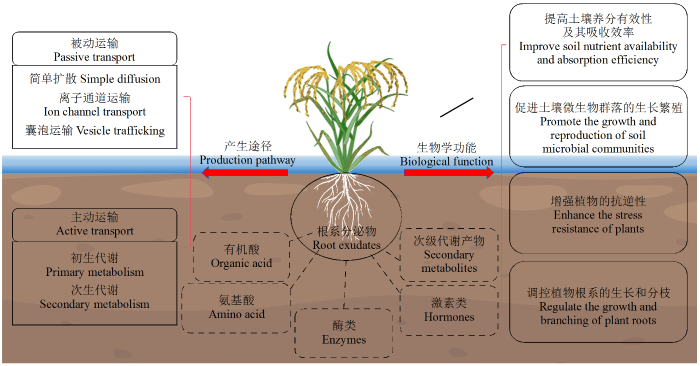
图1
水稻根系分泌物的种类、产生途径及其生物学功能
Fig.1
Types, production pathways and biological functions of rice root exudates
根系分泌物的产生途径可分为代谢途径与非代谢途径[18],代谢途径进一步细分为初生代谢和次生代谢,前者为植物提供必需的物质、能量与信息,后者不直接参与植物生长发育,而是帮助植物应对环境胁迫;非代谢途径则主要来源于植物根系残体或脱落物,这些分解产物会作为根系分泌物进入土壤,影响土壤环境和微生物群落[19]。水稻根系分泌物的释放方式主要分为主动运输和被动运输2类。主动运输假说认为,分泌物的释放是借助膜蛋白逆电化学梯度选择性释放的耗能过程;被动运输假说则认为,分泌物的释放是沿电化学梯度进行的扩散过程,包括简单扩散、离子通道运输和囊泡运输等[20]。其中,离子通道分为慢阴离子通道和快阴离子通道,前者激活需几秒,后者仅需几毫秒。此外,随着水稻根际微生物活性增强、数量增多,其代谢分泌的产物能有效分解土壤有机物,提高土壤有效性,促进水稻生长发育,进而反过来刺激根系分泌物的产生[21]。
1.2 水稻根系分泌物的生物学功能
根系分泌物在土壤微生物群落构建、植物生长以及生态系统功能维持中发挥重要作用[22]。其一,提升土壤养分有效性及吸收效率。根际土壤中存在大量需转化为植物可吸收利用的难溶性养分,即潜在有效养分。水稻根系分泌的有机酸类物质能有效活化土壤矿质养分,促进养分的吸收和转化。同时,水稻根系分泌的氨基酸和蛋白质等化合物为土壤微生物提供必需的营养和能量,进一步增强了养分的矿化与转化效率[23]。其二,促进土壤微生物群落生长繁殖。根系分泌物中的可溶性有机物为土壤微生物提供了充足的能量和营养,为其生长与繁殖创造了有利条件。研究[24]表明,微生物种群的生物产量与根系分泌物的分布总体呈正相关关系。其三,增强水稻抗逆性。水稻根系释放的代谢产物,可直接或间接调控根际环境的生物与非生物组分,在水稻应对逆境胁迫时发挥重要作用。其中一些具有生物活性的化合物,能够直接防御病原菌和食草动物等生物胁迫因子,参与植物的生长和发育[25]。其四,调控水稻根系生长与分枝。水稻根系分泌的多种激素类物质,如IAA和GA等,对水稻根系的生长发育具有促进作用[26]。
1.3 水稻根系分泌物的分子调控
在干旱胁迫下,水稻根系分泌物的组成和分泌强度会发生显著变化,这一过程不是简单的被动响应,而是植物在分子水平上精细调控的结果。转录因子是植物体内一类特殊的蛋白因子,往往作为信号转导和基因调控网络的节点,在植物适应非生物胁迫方面发挥重要作用。水稻在响应干旱胁迫时,涉及许多转录因子家族,如MYB、WRKY和NAC等,它们能够调控下游众多基因的表达,从而影响植物对逆境的响应和适应能力[27-28]。脱落酸(ABA)是一种广泛存在于植物中的激素,在调节植物对干旱胁迫的响应中发挥着核心作用。干旱使植物体内ABA含量上升,通过与体内ABA受体蛋白结合,抑制负调控因子蛋白磷酸酶的活性,从而激活SnRK2s的激酶活性,SnRK2s能够磷酸化下游多种靶蛋白,包括开启ABA信号相关基因表达的转录因子,进而启动ABA信号相关基因的表达,促进根系分泌物的产生[29]。不仅如此,IAA、ET和茉莉酸(JA)在植物适应干旱胁迫中也起着关键作用。干旱胁迫下水稻根系中碳代谢和有机酸代谢等也发生显著变化,通过这种代谢途径重构可以使部分代谢中间产物和最终产物在根际环境中的释放比例发生变化,进而调控根系分泌物的合成与积累[30]。同时,活性氧(ROS)、钙离子(Ca2+)以及其他信号分子在水稻根系分泌物调控过程中参与信号传递与放大,形成多层级协同调控网络,使水稻能够对干旱胁迫做出快速而精准的响应[31]。这些机制的深入研究将为水稻抗旱栽培管理和节水灌溉技术提供理论依据。
2 土壤水分对水稻根系分泌物的影响
2.1 不同土壤水分条件下的水稻根系分泌物差异
水分是影响水稻根系分泌的关键因素,不同水分条件下,植物根系分泌物在种类、数量以及对植物生长发育和土壤环境的影响等方面均差异显著。在水分充足时,水稻根系分泌物种类丰富多样,涵盖低分子量有机化合物(如氨基酸和有机酸类)、高分子量黏胶物质以及根细胞脱落物、降解产物、挥发性气体、质子和多种矿质营养离子等。其中,有机酸和酶类可促进土壤养分的释放与转化,为植物提供更多可利用养分[32]。同时,充足的水分保障了水稻根系新陈代谢正常进行,使其分泌出更多有利于根系生长和养分吸收的物质。而水分严重亏缺时,水稻根系分泌物的种类和数量均显著减少。干旱胁迫会减缓植物的新陈代谢活动,致使土壤结构恶化,有机质含量降低,土壤肥力和保水能力下降等,进而影响根系分泌物的合成与释放。为应对水分亏缺,植物会增加特定保护性化合物的分泌,如黏性物质、脂类化合物、多糖类物质以及参与渗透调节的有机溶质、抗氧化物和植物内源激素等,以维持根部水分平衡,减少蒸发损耗。徐国伟等[33]对干旱胁迫下水稻抽穗期的根系分泌物进行研究,结果表明不同强度干旱胁迫会显著影响根系分泌有机酸的种类和组成,轻度干旱胁迫会增加根系分泌物中苹果酸、柠檬酸、酒石酸、琥珀酸和草酸的含量;而重度干旱胁迫下,这些有机酸含量则减少;且无论干旱胁迫程度如何,均不利于乙酸在根系分泌物中的积累。因此,水分充足与否是调控水稻根系分泌物组成的关键环境因子,其影响程度受干旱胁迫强度、植物生长阶段、种属特性以及根系对干旱胁迫的响应机制等多重因素综合作用。了解这些差异有助于深入理解水稻在不同水分条件下的生长机制,为农业生产中的水分管理提供科学依据。
2.2 水稻根系分泌物与水分吸收的关系
一方面,水稻根系分泌物能改善土壤物理性状,如增加土壤孔隙度和改善土壤结构性,使土壤更好地保持和释放水分,进而提高水稻根系对水分的吸收效率,有效调节植物体内水分平衡。某些有机酸类根系分泌物可通过酸化土壤改变土壤pH,从而提升土壤水分有效性,使植物更易吸收土壤水分;还有一些渗透调节类物质参与植物体内的水分平衡调节,帮助植物在干旱或淹水等逆境中维持正常的生理活动[36]。例如,氨基酸类物质在根系中积累,有助于缓解细胞脱水,并增强植物的抗旱能力。另一方面,水稻根系分泌的有机物质为土壤微生物群落提供充足的营养物质和能量,促进其繁殖与代谢。这些微生物在有机物分解和养分转化等过程中改善了土壤结构,增强了土壤水分保持和释放的能力,从而间接提升了水稻的水分吸收能力。此外,水稻根系分泌物中的生物活性物质,如抗生素和抗氧化剂等,也能增强水稻的抗逆性,使水稻在干旱等不利条件下能够提高对水分缺乏的适应性,减少蒸腾作用并保持水分平衡。水稻根系分泌物中的一些物质如生长激素等还可促进根系生长发育,提高水稻对水分的吸收效率。综上,水稻根系分泌物在水分吸收调控中发挥着多重作用,其通过改善土壤结构、提高水分有效性、调节微生物活动和渗透调节,直接影响水稻的水分吸收效率。尤其是在干旱胁迫下,水稻根系分泌物通过一系列精细调控机制帮助水稻维持水分平衡,提高水分利用效率,为水稻的生长发育提供保障。
2.3 干旱胁迫下水稻根系的生理响应
干旱胁迫是水稻生长过程中常见的逆境因素之一,可引发一系列复杂的生理生化反应,致使植物细胞膜受损,光合与代谢等生理功能受到抑制,最终导致水稻减产[37]。当土壤环境逐渐干旱时,为应对这一胁迫,根系感知并将土壤水分亏缺信号传递给植物的地上部分,同时启动多种生理与分子响应机制,通过调整自身状态或改变外部环境来缓解危害。其中,调整根系分泌物的组成与含量、营造有利于自身的根际微环境可以维持水分吸收和植物生长,是植物增强抗旱能力和适应干旱环境的关键策略之一[38]。随着干旱胁迫的加剧,根系中ROS积累,促使细胞脂质过氧化,产生丙二醛(MDA)等物质,导致细胞损伤甚至死亡[39]。为应对氧化压力,根系会激活抗氧化防御系统,提高超氧化物歧化酶(SOD)、过氧化氢酶(CAT)和过氧化物酶(POD)等抗氧化酶活性以及非酶促抗氧化剂水平来协同清除ROS[40]。干旱胁迫时,水稻根系的呼吸作用可能会发生变化,短期干旱条件下其呼吸作用可能增强,以提供能量支持渗透调节和抗氧化防御等生理过程;长期干旱时,其呼吸作用可能受到抑制,以减少能量消耗,维持基本代谢。植物在面对干旱胁迫时,还会通过积累脯氨酸和可溶性糖等渗透保护剂来提升细胞液的浓度,从而降低其渗透势,以维持细胞对水分的吸收能力并适应干旱[41]。同时,根系中水通道蛋白(AQP)的表达和活性也会发生变化。干旱胁迫下水稻植株中部分AQP的表达量可能上调,以增强水分运输能力,确保水分从根系向地上部高效运输。水稻根系分泌物中的植物激素(如ABA和JA)在这一过程中也起到关键作用,ABA可通过根―冠信号传递,调控气孔关闭、渗透调节能力和抗氧化防御系统等生理过程,从而减少水分散失,帮助根系适应水分短缺环境;JA可缓解干旱引起的生长抑制[42]。这些生理响应通过多途径协同作用,帮助水稻在干旱胁迫下维持正常生长发育。
3 水稻根系分泌物在干旱胁迫中的作用机制
3.1 水稻根系构型
水稻根系是植株与复杂土壤环境交互的关键枢纽,其构型融合了感知功能与空间分布特征,直观呈现了根系的结构形态。水稻主要依靠根系吸收水分和养分,其根系发育状况直接反映了作物的吸水及抗逆能力。优良的根系构型不仅是植物高效利用水分的基础,还对根系分泌物的释放及其位置产生直接影响。水稻根系构型受多种因素调控,涵盖遗传特性、土壤环境、栽培密度、间作体系、农艺措施以及气候条件等[43]。水稻生长发育依赖由种子根和不定根构成的须根系[44],这些根系均具备发达的侧根系统。同时,水稻根尖成熟区形成的根毛在扩大根系表面积、吸收土壤孔隙中的水分和养分方面发挥着重要作用。在干旱胁迫条件下,水稻根系黏液释放量增加,于根表面形成根鞘,可减少水分流失并增强养分吸收[45]。此外,根毛的密度和长度也会增大,进一步扩大水分和养分吸收的表面积[46]。水稻根系分泌物中的部分成分,如有机酸和酚类物质等,能够改变pH和氧化还原电位等根际土壤的理化性质,进而影响根系的生长与分布,提升根系对水分的吸收能力。其中,有机酸还可螯合土壤中的金属离子,降低其毒性,改变水稻根系构型以促进其生长。
3.2 水稻植物激素
植物激素作为植物体内产生的有机化合物,对调控自身生理机能具有关键作用,其不仅是植物与土壤环境相互作用的媒介,还充当了植物内外信号传递的重要角色。当水稻遭遇干旱胁迫时,会刺激激素分泌并改变其水平,进而调控根系分泌物的合成与释放,提升水分吸收效率,调节生长发育进程。ABA作为植物胁迫响应激素,在干旱胁迫下浓度显著升高,抑制植物生长、诱导气孔关闭并减少水分蒸腾;而在水分充足时,则促进气孔开放,提高光合作用效率[47]。同时,ABA还能促进渗透物(如氨基酸、保护蛋白和脯氨酸)的生物合成[48],调控水稻根系分泌物的产生,维持细胞膨胀,减少细胞水分流失,助力水稻适应干旱环境。其他植物激素如JA和ET,在干旱胁迫下也发挥重要作用。JA在调节根系分泌物的过程中充当信号分子,与水稻根系分泌的渗透调节物质相互作用,形成复杂的信号传递网络,以调节水稻的水分吸收和耐旱能力。JA还可与ABA协同增强植物抗氧化防御能力,提升抗氧化酶活性并促进类胡萝卜素、维生素C和维生素E等抗氧化物质合成,同时通过根系分泌以保护根部组织免受干旱引发的氧化损伤,维持其生理代谢正常运转[49]。ET则能促进根系伸长,增强根系对水分的探索能力[50];但在干旱胁迫下,ET能够调节植物体内的激素水平和代谢活动,抑制主根生长,促进不定根发育及叶片衰老,以适应水分短缺环境[51]。综上所述,植物激素通过调节水稻根系分泌物的合成与释放,不仅直接影响水稻根系生长与水分吸收,还通过根系分泌物作为信号分子或介导因子,与水稻的激素网络共同作用,帮助水稻在干旱胁迫下保持水分平衡并增强抗旱能力。
3.3 土壤肥力和碳循环
在干旱胁迫条件下,土壤水分含量降低致使土壤养分的有效性与可利用性均下降,限制了植物对根际营养物质的吸收,进而影响根系分泌物的组成和含量[52]。面对干旱环境,根系可通过多种适应性策略促进自身生长发育并调节土壤养分循环,如合成并释放多种化合物、加速细根周转以及与菌根共生[53]。根系分泌物种类丰富,其化学组分因植物种类和环境因素的不同而差异显著。研究[54]显示,根系分泌物可能包含超200种不同的有机化合物。这些代谢产物为土壤微生物群落提供了重要的碳源与能量,显著影响微生物的生物量积累和生理活性,进而作用于土壤养分的代谢与土壤肥力。例如,干旱胁迫下植物会降低土壤磷(P)的流动性,增加根系分泌的有机酸、磷酸酶或螯合物质。这些分泌物在根际积累,可溶解土壤中的P和钾(K)等无机矿质及难溶性养分,动员难利用的P,提高不同含K矿物的K释放量,增强土壤养分释放潜力[55]。某些特定根系分泌物作为生物硝化抑制剂,能抑制硝化细菌活性,减缓铵态氮转化,提高水稻氮肥利用率[56]。多糖和黏液等物质可促进土壤颗粒结合,形成稳定团聚体,改善土壤孔隙度和透水性,提升土壤保水性与透气性,进而提高养分有效性,缓解干旱胁迫下植物对养分的迫切需求。
此外,在全球气候变化日益加剧的背景下,干旱胁迫对水稻根系分泌物的组成与分泌模式产生了显著影响,并通过直接或间接途径作用于地下生态过程,最终改变了土壤碳库动态及其循环进程。水稻根系分泌物能够积极响应干旱胁迫,通过动态调整自身的数量与组成,影响土壤有机质分解和养分代谢等过程,在一定程度上决定根际微生态系统的碳动态平衡、能量流动以及土壤碳循环,其在水分调控中的作用机制如图2所示。微生物在分解过程中会释放二氧化碳等温室气体,进而影响土壤碳排放。同时,部分微生物残体能促进土壤有机质的形成,保护土壤碳使其免遭进一步降解,增强其长期储存能力。不同根系分泌物组分对土壤碳循环的影响差异显著。例如,草酸通过促进微生物及其胞外酶活性,加速土壤有机质矿化过程;甘氨酸则通过抑制微生物与胞外酶活性,诱导负的土壤碳激发效应。因此,探究根系分泌物对干旱胁迫的响应特征及其调控机制,是预测全球变化情景下陆地生态系统地下碳分配模式的关键科学依据。
图2
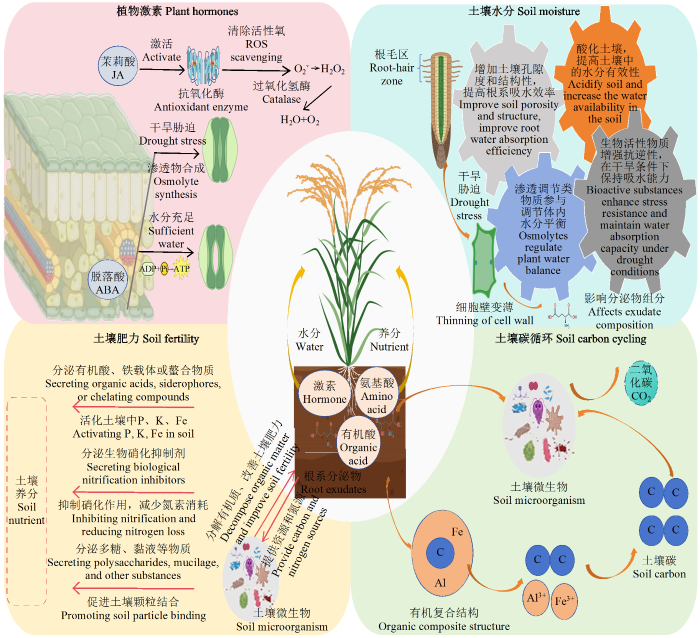
图2
水稻根系分泌物在水分调控中的作用机制
Fig.2
Mechanism of rice root exudates in water regulation
3.4 土壤微生物
根系分泌物作为植物与土壤环境之间的沟通媒介,对土壤微生物群落的组成和功能具有重要影响。在干旱胁迫下,水稻根系通过调节分泌物的组成,为其提供了重要的碳源和氮源,促进土壤微生物的繁殖与代谢活动。同时根际微生物的代谢物质可以反过来影响植物根系信号的产生,进而影响根分泌物的种类和数量,促进水稻根系富集更多的促生菌[57]。这些微生物不仅在有机物分解过程中释放养分,还促进了土壤矿质养分的转化。此外,水稻根系分泌物对微生物群落的影响不仅限于提供养分,还可以通过调节微生物的生理活性,改变微生物群落的结构。干旱胁迫下,植物根系会增加有机酸和黄酮类化合物等分泌物的释放,促进固氮菌和分解菌等有益微生物的生长,同时抑制病原微生物的繁殖,从而改善土壤生态环境,增强植物的抗病能力[58]。有机酸还能调节土壤pH,增加土壤酸性,有利于某些微生物的生长。水稻根系分泌物形成的黏液层或生物膜还能减少根际水分的蒸发,提高土壤保水能力,为微生物的生存提供相对湿润的条件。同时,在干旱胁迫下,一些微生物通过根系分泌物与植物形成了共生关系,它们通过产生植物激素、调节植物水分代谢和养分吸收等方式,帮助土壤微生物维持其代谢活性,从而在一定程度上缓解干旱对植物的影响,提升植物的水分吸收和抗逆能力[59]。水稻根系分泌物中的某些物质如磷酸酶和螯合物质等,能够促进P和K等难溶性养分的溶解和释放,提高土壤中营养物质的有效性。
4 问题与展望
当前,水稻根系分泌物研究仍面临诸多挑战。其一,根系分泌物成分复杂,包含多种有机与无机化合物,且其种类和比例受多种因素制约,精确测定与功能解析难度较大。为此,需研发更精准的分析技术与方法,以实现对这些分泌物的识别与量化。其二,对分子机制的理解尚不深入。目前,对于根系分泌物如何影响植物在干旱胁迫下生理及分子响应的认识尚不全面,需进一步研究阐明分泌物与植物响应机制间的相互作用。此外,跨学科研究的整合也至关重要。根系分泌物研究涉及多学科领域,加强跨学科合作、整合不同领域的知识与技术,有助于全面理解根系分泌物的综合效应。
未来研究应聚焦于以下关键领域:一是水稻根系分泌物与干旱胁迫响应机制。需深入探究水稻根系分泌物在干旱胁迫下如何调控植物的水分吸收、抗氧化系统以及渗透调节机制,提升水稻的水分利用效率和抗旱能力。二是根系分泌物对土壤微生物群落的作用。研究水稻根系分泌物在干旱条件下如何调控土壤微生物群落的生物量积累与代谢活性,并深入分析这些变化对土壤养分代谢及肥力的调节作用,进而为提高水稻产量和品质提供理论依据。三是根系分泌物在土壤碳循环中的功能。研究根系分泌物对土壤有机质分解和碳排放的影响,尤其是在干旱胁迫下,根系分泌物如何通过调节微生物活性影响土壤碳稳定与固定能力,这不仅有助于理解土壤碳库的动态变化,还能为应对全球气候变化提供新的农业管理策略。
参考文献
Analysis of crop water requirements and irrigation demands for rice: implications for increasing effective rainfall
Regulation and function of root exudates
DOI:10.1111/pce.2009.32.issue-6 URL [本文引用: 1]
The role of root exudates in rhizosphere interactions with plants and other organisms
DOI:10.1146/arplant.2006.57.issue-1 URL [本文引用: 1]
Changes in crested wheatgrass root exudation caused by flood, drought, and nutrient stress
DOI:10.2134/jeq2006.0425sc
PMID:17485723
[本文引用: 1]

Root exudates can chelate inorganic soil contaminants, change rhizosphere pH, and may increase degradation of organic contaminants by microbial cometabolism. Root-zone stress may increase exudation and enhance phytoremediation. We studied the effects of low K+, high NH4+/NO3- ratio, drought, and flooding on the quantity and composition of exudates. Crested wheatgrass (Agropyron cristatum) was grown in Ottawa sand in sealed, flow-through glass columns under axenic conditions for 70 d. Root exudates were collected and analyzed for total organic carbon (TOC) and organic acid content to compare treatment effects. Plants in the low K+ treatment exuded 60% more TOC per plant per day (p = 0.01) than the unstressed control. Drought stress increased cumulative TOC exuded per gram dry plant by 71% (p = 0.05). The flooded treatment increased TOC exuded per gram dry plant by 45%, although this was not statistically significant based on the two replicate plants in this treatment. Exudation from the high NH4+/NO3- ratio treatment was 10% less than the control. Exudation rates in this study ranged from 8 to 50% of rates in four other published studies. Gas chromatography-mass spectrometry (GC-MS) analysis indicated that malic acid was the predominant organic acid exuded. Fumaric, malonic, succinic, and oxalic acids were also detected in the exudates of all treatments. These results demonstrate that nutrient and water stress have significant effects on the quantity and composition of root exudates. Cultural manipulations to induce stress may change the quantity of root exudates and thus increase the effectiveness of phytoremediation.
Root-driven microbiome memory enhances plant disease resistance
Chemical structure predicts the effect of plant‐derived low‐molecular weight compounds on soil microbiome structure and pathogen suppression
DOI:10.1111/fec.v34.10 URL [本文引用: 1]
Organic acids in the rhizosphere-a critical review
DOI:10.1023/A:1004356007312 [本文引用: 1]
Organic acid behavior in soils-misconceptions and knowledge gaps
DOI:10.1023/A:1022304332313 [本文引用: 1]
Plant secondary metabolites as defenses, regulators, and primary metabolites: the blurred functional trichotomy
DOI:10.1104/pp.20.00433
PMID:32636341
[本文引用: 1]
The plant kingdom produces hundreds of thousands of low molecular weight organic compounds. Based on the assumed functions of these compounds, the research community has classified them into three overarching groups: primary metabolites, which are directly required for plant growth; secondary (or specialized) metabolites, which mediate plant-environment interactions; and hormones, which regulate organismal processes and metabolism. For decades, this functional trichotomy of plant metabolism has shaped theory and experimentation in plant biology. However, exact biochemical boundaries between these different metabolite classes were never fully established. A new wave of genetic and chemical studies now further blurs these boundaries by demonstrating that secondary metabolites are multifunctional; they can function as potent regulators of plant growth and defense as well as primary metabolites sensu lato. Several adaptive scenarios may have favored this functional diversity for secondary metabolites, including signaling robustness and cost-effective storage and recycling. Secondary metabolite multifunctionality can provide new explanations for ontogenetic patterns of defense production and can refine our understanding of plant-herbivore interactions, in particular by accounting for the discovery that adapted herbivores misuse plant secondary metabolites for multiple purposes, some of which mirror their functions in plants. In conclusion, recent work unveils the limits of our current functional classification system for plant metabolites. Viewing secondary metabolites as integrated components of metabolic networks that are dynamically shaped by environmental selection pressures and transcend multiple trophic levels can improve our understanding of plant metabolism and plant-environment interactions.© 2020 American Society of Plant Biologists. All Rights Reserved.
Rice root architectural plasticity traits and genetic regions for adaptability to variable cultivation and stress conditions
DOI:10.1104/pp.16.00705
PMID:27342311
[本文引用: 1]
Future rice (Oryza sativa) crops will likely experience a range of growth conditions, and root architectural plasticity will be an important characteristic to confer adaptability across variable environments. In this study, the relationship between root architectural plasticity and adaptability (i.e. yield stability) was evaluated in two traditional × improved rice populations (Aus 276 × MTU1010 and Kali Aus × MTU1010). Forty contrasting genotypes were grown in direct-seeded upland and transplanted lowland conditions with drought and drought + rewatered stress treatments in lysimeter and field studies and a low-phosphorus stress treatment in a Rhizoscope study. Relationships among root architectural plasticity for root dry weight, root length density, and percentage lateral roots with yield stability were identified. Selected genotypes that showed high yield stability also showed a high degree of root plasticity in response to both drought and low phosphorus. The two populations varied in the soil depth effect on root architectural plasticity traits, none of which resulted in reduced grain yield. Root architectural plasticity traits were related to 13 (Aus 276 population) and 21 (Kali Aus population) genetic loci, which were contributed by both the traditional donor parents and MTU1010. Three genomic loci were identified as hot spots with multiple root architectural plasticity traits in both populations, and one locus for both root architectural plasticity and grain yield was detected. These results suggest an important role of root architectural plasticity across future rice crop conditions and provide a starting point for marker-assisted selection for plasticity.© 2016 American Society of Plant Biologists. All Rights Reserved.
Root exudates contribute to belowground ecosystem hotspots: a review
Microbial products trigger amino acid exudation from plant roots
DOI:10.1104/pp.104.044222
PMID:15347793
[本文引用: 1]
Plants naturally cycle amino acids across root cell plasma membranes, and any net efflux is termed exudation. The dominant ecological view is that microorganisms and roots passively compete for amino acids in the soil solution, yet the innate capacity of roots to recover amino acids present in ecologically relevant concentrations is unknown. We find that, in the absence of culturable microorganisms, the influx rates of 16 amino acids (each supplied at 2.5 microm) exceed efflux rates by 5% to 545% in roots of alfalfa (Medicago sativa), Medicago truncatula, maize (Zea mays), and wheat (Triticum aestivum). Several microbial products, which are produced by common soil microorganisms such as Pseudomonas bacteria and Fusarium fungi, significantly enhanced the net efflux (i.e. exudation) of amino acids from roots of these four plant species. In alfalfa, treating roots with 200 microm phenazine, 2,4-diacetylphloroglucinol, or zearalenone increased total net efflux of 16 amino acids 200% to 2,600% in 3 h. Data from (15)N tests suggest that 2,4-diacetylphloroglucinol blocks amino acid uptake, whereas zearalenone enhances efflux. Thus, amino acid exudation under normal conditions is a phenomenon that probably reflects both active manipulation and passive uptake by microorganisms, as well as diffusion and adsorption to soil, all of which help overcome the innate capacity of plant roots to reabsorb amino acids. The importance of identifying potential enhancers of root exudation lies in understanding that such compounds may represent regulatory linkages between the larger soil food web and the internal carbon metabolism of the plant.
Studies on the photosynthesis of rice plants: XIII. On the interrelationships between photosynthetic activity of the leaf and physiological activity of the root
DOI:10.1626/jcs.34.148 URL [本文引用: 1]
Root exudates increase N availability by stimulating microbial turnover of fast-cycling N pools
Root exudates of mycorrhizal tomato plants exhibit a different effect on microconidia germination of Fusarium oxysporum f. sp. lycopersici than root exudates from non-mycorrhizal tomato plants
DOI:10.1007/s00572-006-0048-7
PMID:16528569
[本文引用: 1]
The effect of root exudates from mycorrhizal and non-mycorrhizal tomato plants on microconidia germination of the tomato pathogen Fusarium oxysporum f. sp. lycopersici was tested. Microconidia germination was enhanced in the presence of root exudates from mycorrhizal tomato plants. The more tomato plants were colonized by the arbuscular mycorrhizal fungus Glomus mosseae, the more microconidia germination was increased, indicating that alterations of the exudation pattern depended on the degree of root AM colonization. Moreover, alterations of the exudation pattern of mycorrhizal plants are not only local, but also systemic. Testing the exudates from plants with a high and a low P level revealed that the alterations of the root exudates from mycorrhizal plants, resulting in a changed effect on microconidia germination, are not due to an improved P status of mycorrhizal plants.
WRKY transcription factors: key regulators in plant drought tolerance
NAC transcription factors as biological macromolecules responded to abiotic stress: a comprehensive review
The role of PYL genes as core components of abscisic acid signaling in plant abiotic stress response
A multi-omics meta-analysis of rhizosphere microbiome reveals growth-promoting marker bacteria at different stages of legume development
Meta-analysis of drought-tolerant genotypes in Oryza sativa: a network-based approach
DOI:10.1371/journal.pone.0216068 URL [本文引用: 1]
Understanding plant responses to drought-from genes to the whole plant
DOI:10.1071/FP02076
URL
[本文引用: 1]
In the last decade, our understanding of the processes underlying plant response to drought, at the molecular and whole-plant levels, has rapidly progressed. Here, we review that progress. We draw attention to the perception and signalling processes (chemical and hydraulic) of water deficits. Knowledge of these processes is essential for a holistic understanding of plant resistance to stress, which is needed to improve crop management and breeding techniques. Hundreds of genes that are induced under drought have been identified. A range of tools, from gene expression patterns to the use of transgenic plants, is being used to study the specific function of these genes and their role in plant acclimation or adaptation to water deficit. However, because plant responses to stress are complex, the functions of many of the genes are still unknown. Many of the traits that explain plant adaptation to drought — such as phenology, root size and depth, hydraulic conductivity and the storage of reserves — are those associated with plant development and structure, and are constitutive rather than stress induced. But a large part of plant resistance to drought is the ability to get rid of excess radiation, a concomitant stress under natural conditions. The nature of the mechanisms responsible for leaf photoprotection, especially those related to thermal dissipation, and oxidative stress are being actively researched. The new tools that operate at molecular, plant and ecosystem levels are revolutionising our understanding of plant response to drought, and our ability to monitor it. Techniques such as genome-wide tools, proteomics, stable isotopes and thermal or fluorescence imaging may allow the genotype–phenotype gap to be bridged, which is essential for faster progress in stress biology research.
Root architecture and plant productivity
DOI:10.1104/pp.109.1.7 PMID:12228579 [本文引用: 1]
Root exudates as mediators of mineral acquisition in low-nutrient environments
Transcriptional regulatory networks in cellular responses and tolerance to dehydration and cold stresses
DOI:10.1146/arplant.2006.57.issue-1 URL [本文引用: 1]
Response mechanisms of woody plants to high-temperature stress
DOI:10.3390/plants12203643
URL
[本文引用: 1]
High-temperature stress is the main environmental stress that restricts the growth and development of woody plants, and the growth and development of woody plants are affected by high-temperature stress. The influence of high temperature on woody plants varies with the degree and duration of the high temperature and the species of woody plants. Woody plants have the mechanism of adapting to high temperature, and the mechanism for activating tolerance in woody plants mainly counteracts the biochemical and physiological changes induced by stress by regulating osmotic adjustment substances, antioxidant enzyme activities and transcription control factors. Under high-temperature stress, woody plants ability to perceive high-temperature stimuli and initiate the appropriate physiological, biochemical and genomic changes is the key to determining the survival of woody plants. The gene expression induced by high-temperature stress also greatly improves tolerance. Changes in the morphological structure, physiology, biochemistry and genomics of woody plants are usually used as indicators of high-temperature tolerance. In this paper, the effects of high-temperature stress on seed germination, plant morphology and anatomical structure characteristics, physiological and biochemical indicators, genomics and other aspects of woody plants are reviewed, which provides a reference for the study of the heat-tolerance mechanism of woody plants.
Salt and drought stress signal transduction in plants
DOI:10.1146/arplant.2002.53.issue-1 URL [本文引用: 1]
Genome-wide association study for traits related to plant and grain morphology, and root architecture in temperate rice accessions
DOI:10.1371/journal.pone.0155425 URL [本文引用: 1]
Adventitious root formation in rice requires OsGNOM1 and is mediated by the OsPINs family
DOI:10.1038/cr.2009.70 [本文引用: 1]
The rhizosheath: a potential root trait helping plants to tolerate drought stress
DOI:10.1007/s11104-019-04334-0 [本文引用: 1]
Effect of halotolerant rhizobacteria isolated from halophytes on the growth of sugar beet (Beta vulgaris L.) under salt stress
Drought priming improves tolerance of Alhagi sparsifolia to subsequent drought: a coordinated interplay of phytohormones, osmolytes, and antioxidant potential
Effects of elevated CO2, warming and drought episodes on plant carbon uptake in a temperate heath ecosystem are controlled by soil water status
The pivotal role of ethylene in plant growth
DOI:S1360-1385(18)30015-3
PMID:29428350
[本文引用: 1]
Being continuously exposed to variable environmental conditions, plants produce phytohormones to react quickly and specifically to these changes. The phytohormone ethylene is produced in response to multiple stresses. While the role of ethylene in defense responses to pathogens is widely recognized, recent studies in arabidopsis and crop species highlight an emerging key role for ethylene in the regulation of organ growth and yield under abiotic stress. Molecular connections between ethylene and growth-regulatory pathways have been uncovered, and altering the expression of ethylene response factors (ERFs) provides a new strategy for targeted ethylene-response engineering. Crops with optimized ethylene responses show improved growth in the field, opening new windows for future crop improvement. This review focuses on how ethylene regulates shoot growth, with an emphasis on leaves.Copyright © 2018 The Author(s). Published by Elsevier Ltd.. All rights reserved.
Ethylene and plant responses to stress
DOI:10.1111/ppl.1997.100.issue-3 URL [本文引用: 1]
Carbon flow in the rhizosphere: carbon trading at the soil-root interface
Interactions among roots, mycorrhizas and free-living microbial communities differentially impact soil carbon processes
DOI:10.1111/jec.2015.103.issue-6 URL [本文引用: 1]
Interspecific plant interaction via root exudates structures the disease suppressiveness of rhizosphere microbiomes
DOI:10.1016/j.molp.2023.03.009 URL [本文引用: 1]
Root phosphatase activity aligns with the collaboration gradient of the root economics space
DOI:10.1111/nph.v234.3 URL [本文引用: 1]
How plant root exudates shape the nitrogen cycle
DOI:S1360-1385(17)30093-6
PMID:28601419
[本文引用: 1]
Although the global nitrogen (N) cycle is largely driven by soil microbes, plant root exudates can profoundly modify soil microbial communities and influence their N transformations. A detailed understanding is now beginning to emerge regarding the control that root exudates exert over two major soil N processes - nitrification and N fixation. We discuss recent breakthroughs in this area, including the identification of root exudates as nitrification inhibitors and as signaling compounds facilitating N-acquisition symbioses. We indicate gaps in current knowledge, including questions of how root exudates affect newly discovered microbial players and N-cycle components. A better understanding of these processes is urgent given the widespread inefficiencies in agricultural N use and their links to N pollution and climate change.Copyright © 2017 Elsevier Ltd. All rights reserved.
Rhizosphere microbiome mediates systemic root metabolite exudation by root-to-root signaling
Recent advancements in multifaceted roles of flavonoids in plant-rhizomicrobiome interactions
Drought stress triggers shifts in the root microbial community and alters functional categories in the microbial gene pool


