



甘薯(Ipomoea batatas L.)是典型的块根作物和重要的粮食作物,更是优良的新垦地先锋作物和坡地覆盖作物。甘薯的产量主要取决于单株结薯数和单个薯块重,与根系的生长发育和块根分化建成也是紧密联系的[1]。王翠娟[2]发现甘薯块根分化建成不同阶段与薯苗栽后天数存在对应关系:栽后7 d内为发根期;栽后8~14 d为块根分化建成前期;栽后15~21 d为块根分化建成中期;栽后22~28 d为块根分化建成后期,决定幼根的膨大;单株有效薯块数在栽后35 d基本稳定。目前,生产中甘薯经常在发根分枝结薯期遭遇干旱胁迫[3],导致单株薯块数显著降低,块根产量降幅达30%~60%[4]。因此,干旱影响甘薯块根分化建成的研究早已成为甘薯研究领域的一大重要热点。
利用根系结构培育对胁迫环境具有耐受性的根和块根作物已成为近年来的研究热点之一。目前,甘薯、马铃薯和木薯等薯类作物的根系结构对土壤水分的响应可以用来提高其在干旱胁迫环境下的产量稳定性[5]。研究[6]发现,土壤相对含水量低于50%就会抑制甘薯不定根的形成、生长和分化,同时侧根的形成也会受阻,最终造成单株薯块数和鲜薯产量显著减少,这一发现在本实验室也得到了验证[4]。前人[7
干旱胁迫下,活性氧(ROS)水平升高会诱导甘薯叶片启动抗氧化酶防御系统,从而降低氧化胁迫的不利影响[13]。而Kim等[14]认为胁迫下根系抗坏血酸(AsA)系统对ROS的清除作用更为重要,二氧化硅胁迫下甘薯植株抗坏血酸过氧化物酶(APX)活性增加了5倍,远大于超氧化物歧化酶(SOD)活性增加幅度;盐旱胁迫下,胞质中过表达AtDHAR1的转基因马铃薯植株AsA含量显著提高,使其比野生型植株表现出更大的芽生长[15]。在甘薯其他器官中,SOD、过氧化氢酶(CAT)、过氧化物酶(POD)和APX活性及相应基因表达对干旱胁迫的响应情况并不一致[13,16],在受旱块根分化建成中的变化情况及其与ROS的关系有待探索。
甘薯块根分化建成过程中耐旱性的形成可能受自身遗传性状和环境因素制约,是一个涉及众多代谢与调控途径的复杂过程,这是迄今国内外对甘薯耐旱性在生理与分子机制上研究进展缓慢的主要原因,而且对于改良甘薯耐旱性的途径也缺乏认知。本研究以济薯26为试验材料,在块根分化建成不同时期开展干旱试验,分析甘薯块根产量、ROS代谢相关指标和内源激素含量的变化,阐明不同块根分化建成时期干旱胁迫后的甘薯根系差异及其与块根产量形成的关系,为生产上适时、合理采取抗旱栽培调控措施提供理论依据。
1 材料与方法
1.1 试验设计
试验于2020年在江苏师范大学甘薯生物学实验基地的防雨棚(34°15′ N,117°11′ E)进行,采用盆栽方式进行不同块根分化建成时期的土壤干旱试验。供试材料为济薯26(山东省农业科学院作物研究所提供)。盆栽试验所用桶(内径33 cm,高21 cm)大小一致。供试土壤为沙壤土,装桶前土壤自然风干后过筛去杂,每桶约10 kg。挑选长势一致的甘薯幼苗(茎长25 cm左右,保留3片叶)扦插至桶中,保持在土壤统一深度,每桶种植1株甘薯。薯苗扦插时统一定量浇水,分别于扦插后8、15、22和29 d,即甘薯的块根分化建成前期、中期、后期和块根膨大前期进行为期7 d的干旱处理,盆钵底部均设有排水孔。分别设置正常灌水对照(CK,土壤相对含水量为75%±5%)和干旱(D8-14、D15-21、D22-28和D29-35,土壤相对含水量维持在45%±5%)2个水分水平(图1)。采用TDR仪间隔2 d重复监测0~20 cm土层土壤水分状况,并将水分补充至各处理上限。每个处理8个重复。在干旱处理结束当天,对扦插14、21、28、35和42 d甘薯根系进行取样,鲜样洗净后置于-80 ℃保存,用于酶活性和内源激素含量测定。
图1
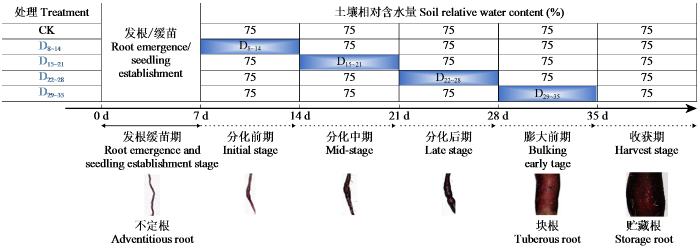
图1
干旱处理标记
 此阶段进行干旱处理7 d。
Fig.1
Drought treatment marker
 This phase is treated with drought for seven days.
1.2 测定方法
1.2.1 单株鲜薯重
在甘薯收获期每个处理各取4株进行单株鲜薯重统计。
1.2.2 ROS代谢
取根系鲜样0.1 g,液氮速冻后用球磨仪研磨成粉末状,加入1.8 mL含聚乙烯吡咯烷酮的50 mmol/L pH 7.0的PBS缓冲液进行提取。随后4 ℃ 12 000 g离心20 min,取上清液4 ℃保存备用。采用紫外分光光度计测定CAT活性;采用氮蓝四唑(NBT)光化还原法测定SOD活性;采用愈木酚法测定POD活性;采用抗坏血酸―过氧化氢法测定APX活性;采用硫代巴比妥酸法测定MDA含量[21];采用羟胺氧化法测定O2-. 含量;采用碘化钾法测定H2O2含量;采用酸性茚三酮比色法测定脯氨酸含量。
1.2.3 内源激素含量
用酶联免疫吸附法测定内源激素IAA、GA、JA和ABA含量。取0.4 g新鲜甘薯根系样品,用80%甲醇溶液(含一定浓度的二叔丁基对甲苯酚)匀浆,4 ℃提取8 h,4000转/min离心15 min,将沉淀用80%甲醇重复提取3次,合并上清液,用氮吹仪吹干,加1 mL样品稀释液溶解后参照试剂盒说明书进行测定(试剂盒购自中国农业大学)。
1.3 数据分析
采用Excel 2019进行数据处理,用最小显著性差异法LSD法比较平均数间的差异显著性。采用GraphPad Prism 9.0进行柱状图绘制。
2 结果与分析
2.1 块根分化建成不同时期干旱对甘薯单株鲜薯重的影响
如图2所示,块根分化建成前期干旱(D8-14)和块根分化建成中期干旱(D15-21)2个处理组的甘薯块根单株鲜薯重最低,显著低于块根分化建成后期干旱(D22-28)以及块根膨大前期干旱(D29-35)处理组的块根单株鲜薯重。块根分化建成前期和中期干旱对甘薯根系单株鲜薯重的影响较大。
图2
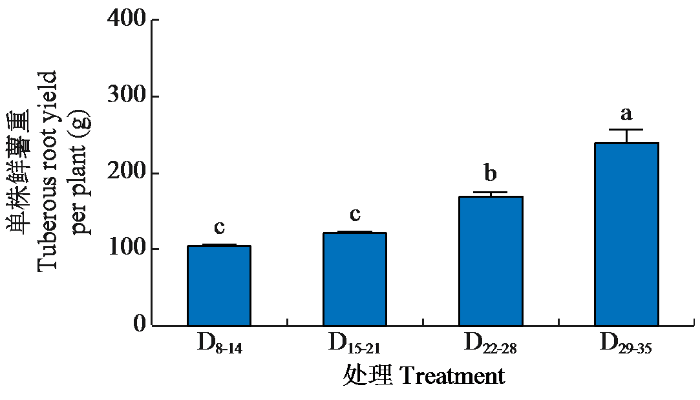
图2
不同时期干旱对甘薯块根单株鲜薯重的影响
不同的小写字母表示在P < 0.05水平上差异显著。
Fig.2
Effects of drought stress at different stages on fresh tuber weight per plant of storage roots in sweetpotato
Different lowercase letters indicate significant differences at the P < 0.05 level.
2.2 块根分化建成不同时期干旱―复水对甘薯根系H2O2、O2-. 、MDA和脯氨酸含量的影响
由图3可知,与正常灌水处理(CK)相比,干旱胁迫导致甘薯根系O2-. 含量显著或极显著降低,且随干旱处理时间推迟,影响程度变低;D8-14、D15-21和D22-28处理均会导致甘薯根系H2O2、MDA和脯氨酸含量显著或极显著升高,其中3个处理的H2O2含量分别升高8.8%、8.1%和7.9%,MDA含量分别升高110.0%、48.6%和43.7%,脯氨酸含量分别显著升高450.0%、84.0%和38.0%。复水8~14 d后4个干旱处理的甘薯根系MDA含量和脯氨酸含量均有不同程度的降低。
图3
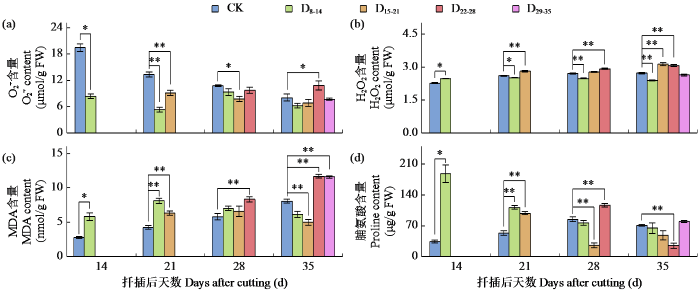
图3
不同时期干旱―复水对甘薯根系O2-. 、H2O2、MDA和脯氨酸含量的影响
“*”和“**”分别表示在P < 0.05和P < 0.01水平上差异显著或极显著,下同。
Fig.3
Effects of drought stress and re-watering at different stages on O2-. , H2O2, MDA and proline contents in sweetpotato roots
“*”and“**”indicate significant or extremely significant differences at the P < 0.05 and P < 0.01 levels, respectively, the same below.
2.3 块根分化建成不同时期干旱―复水对甘薯根系ROS代谢酶活性的影响
与CK处理相比,D8-14和D15-21处理下甘薯根系SOD活性无显著降低,复水8~14 d后其活性有极显著增加,甚至高于CK处理;D22-28和D29-35处理使甘薯根系SOD活性极显著下降(图4a)。
图4
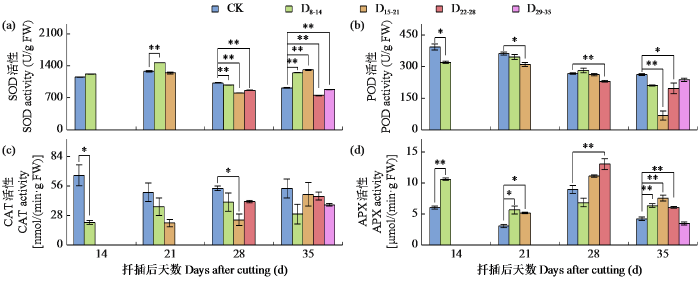
图4
不同时期干旱―复水对甘薯根系SOD、POD、CAT和APX活性的影响
Fig.4
Effects of drought stress and re-watering at different stages on SOD, POD, CAT and APX activities in sweetpotato roots
与CK处理相比,D8-14、D15-21和D22-28处理使甘薯根系APX活性显著或极显著增加了75.8%、68.9%和45.2%,而D29-35处理下甘薯根系APX活性变化不显著。复水后4个时期干旱处理下甘薯根系APX活性均有不同程度降低,但仍然高于CK处理(图4d)。
2.4 块根分化建成不同时期干旱―复水对甘薯根系中内源激素含量的影响
由图5可知,与CK相比,D8-14和D15-21处理的甘薯根系ABA和JA含量显著或极显著增加,其中ABA和JA增加幅度均在40%以上;而IAA含量显著降低,且降低幅度均小于ABA和JA的增加幅度。在块根分化建成后期进行干旱处理(D22-28)时,甘薯根系的这4种内源激素含量变化均未达到显著水平。说明甘薯在块根分化建成前期和中期受到干旱胁迫时,通过升高根系JA和ABA的含量来应对胁迫,且响应比较强烈,但在块根膨大期遭遇干旱胁迫时,仅JA能够产生强烈的响应,有显著的增加。
图5
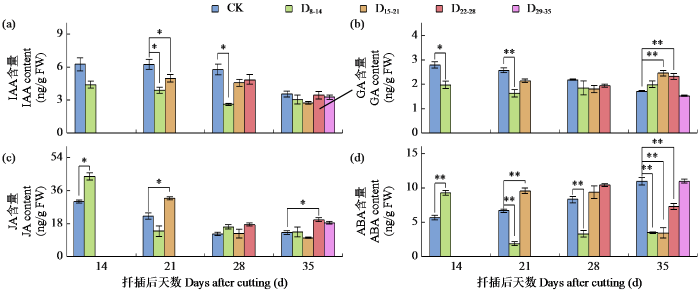
图5
不同时期干旱―复水对甘薯根系IAA、GA、JA和ABA含量的影响
Fig.5
Effects of drought stress and re-watering at different stages on the contents of IAA, GA, JA and ABA in sweetpotato roots
3 讨论
植物在逆境胁迫下均会产生大量的ROS,进一步引起细胞膜脂过氧化使MDA含量增加。SOD作为植物体内清除自由基的首要物质,能把O2-. 转化为H2O2。H2O2在降解酶的作用下,被降解为O2和H2O[22]。植物在干旱胁迫下可以启动复杂的抗氧化保护系统来清除过量的ROS,依靠非酶类系统来阻止水分流失[23]。酶类抗氧化剂主要包括SOD、CAT、POD和APX等;非酶类系统有脯氨酸等渗透调节物质,并参与复水后的生理修复[24]。大部分供试品种SOD活性表现为先轻微上升后剧烈下降或直接下降,严重胁迫的SOD活性明显高于轻度胁迫的[25]。本试验条件下,与CK相比,甘薯块根分化前、中期干旱处理下甘薯根系SOD活性无显著降低,而在甘薯块根分化建成后期干旱处理时SOD活性显著降低。表明甘薯根系在干旱胁迫下可通过增强SOD活性提高抗氧化能力,从而减轻干旱胁迫所带来的伤害。前人研究[12]发现,干旱处理10 d会导致甘薯根系H2O2和MDA含量显著增加,POD能够协同SOD和CAT共同清除植物体内多余的H2O2[26]。在本试验条件下,与CK相比,不同时期的干旱胁迫均会导致POD和CAT活性显著或极显著下降,APX活性在甘薯块根分化建成的前、中、后期遭遇干旱胁迫时显著提升(图4),表明甘薯根系遇到干旱胁迫时主要依靠APX清除ROS,前、中期干旱时SOD对ROS清除也做出较大贡献,与前人研究[27]发现耐旱型甘薯品种根系SOD活性要高于干旱敏感型甘薯品种的结果一致。复水后,甘薯根系APX活性降低,而POD活性相对增加,这说明复水后甘薯根系通过增强POD活性提高抗氧化能力来恢复干旱胁迫所带来的伤害。此外,干旱胁迫下甘薯根系游离脯氨酸含量增加(图3),作为渗透调节物质抵御干旱胁迫,复水后根系脯氨酸含量降低。研究[10]发现,干旱胁迫下抗旱品种济薯21和不抗旱品种济紫薯1号块根中脯氨酸等渗透调节物质显著上升,紫甘薯、近缘野生种Ipomoea trifida(Kunth)G. Don等甘薯材料叶片中也累积了大量的脯氨酸[28-29]。因此,脯氨酸可作为检测植物抗旱性的重要指标。
作物贮藏器官的形成是多种内源激素协同作用的结果,生长素IAA和GA均有增加库器官活性、促进诱导同化物向之运输和累积的作用[7]。也有学者[30]认为,GA含量的减少是马铃薯结薯的重要条件。此外,在块根分化建成期干旱胁迫导致济薯21、济紫薯1号、济薯26和广薯87等多个甘薯品种的根系内源激素含量发生变化,其中GA和IAA含量下降,且内源激素水平变化无法在复水后得到有效修复[7,12]。本试验条件下,干旱胁迫D8-14和D15-21处理使甘薯根系IAA和GA含量均有所下降,且复水后也未得到有效恢复,而D15-21和D22-28处理的甘薯根系GA含量在复水后显著增加(图5),表明甘薯在块根分化前、中期遭遇干旱胁迫时,GA含量下降抑制了块根形成,复水后这2个处理的根系GA含量也未得到有效修复,进而使D8-14和D15-21处理的单株鲜薯重受影响最大(图1),而D15-21和D22-28处理的甘薯根系GA含量在复水后显著增加,使单株鲜薯重受影响较小。
JA是一种公认的新型植物生长调节剂,可调控植物在干旱胁迫下快速启动抗氧化系统以及酶保护系统,清除因干旱胁迫而堆积的ROS,使氧化胁迫带来的伤害降低[31]。ABA是一种典型的胁迫激素,在受到非生物胁迫时,ABA大量合成,可诱导植物体内与抗逆性有关的基因表达,产生大量相关的酶,使植物抵抗恶劣环境[32]。前人研究发现,济薯26属于中等抗旱品种,遭遇干旱胁迫时济薯21[7]、济紫薯1号[33]、济薯26[12]和广薯87[34]等多个甘薯品种根系内源ABA含量显著增加,且移栽前期干旱胁迫下变化幅度最大,但关于内源JA的变化并未见报道。本试验条件下,与CK相比,D8-14和D15-21处理的甘薯根系ABA和JA含量增幅在40%以上(P<0.05),而在块根分化建成后期进行干旱处理(D22-28)时,甘薯根系这2种内源激素含量变化均未达到显著水平(图5),说明甘薯在块根分化建成前期和中期受到干旱胁迫时,通过升高根系JA和ABA的含量来应对干旱胁迫,且响应比较强烈,但在块根膨大期遭遇干旱胁迫时,仅JA能够产生强烈的响应,有显著的增加。有学者[27]发现耐旱型甘薯郑红23号和干旱敏感型甘薯济农432在经历3周土壤干旱后,叶片内源JA含量显著下降。He等[35]发现,干旱胁迫下耐旱型甘薯烟薯25叶片含有相对高含量的内源JA,干旱敏感型甘薯徐薯32则含有相对高含量的ABA。这说明甘薯叶片和根系响应干旱的机制不同。因此,推测干旱胁迫下JA有可能对甘薯块根分化建成的调控和抗旱诱导过程发挥重要作用,且与ABA存在协作调控,需要进一步系统研究。
4 结论
干旱时间越早对甘薯产量影响越大。甘薯块根分化建成的前、中、后期遭遇干旱胁迫时,甘薯根系SOD和APX活性显著增加,脯氨酸含量也显著增加;复水后,甘薯根系POD活性增加,以恢复干旱胁迫所带来的伤害。与对照相比,D8-14和D15-21处理的甘薯根系ABA和JA含量显著增加,而GA和IAA含量显著降低,且降低幅度均小于ABA和JA的增加幅度。综上,甘薯在块根分化建成前期和中期受到干旱胁迫时,主要通过升高根系SOD和APX活性、脯氨酸含量、内源JA和ABA的含量来应对胁迫。
参考文献
Variation in virus symptom development and root architecture attributes at the onset of storage root initiation in ‘beauregard’ sweetpotato plants grown with or without nitrogen
DOI:10.1371/journal.pone.0107384 URL [本文引用: 2]
Root architecture and root and tuber crop productivity
DOI:10.1016/j.tplants.2014.02.002
PMID:24630073
[本文引用: 1]

It is becoming increasingly evident that optimization of root architecture for resource capture is vital for enabling the next green revolution. Although cereals provide half of the calories consumed by humans, root and tuber crops are the second major source of carbohydrates globally. Yet, knowledge of root architecture in root and tuber species is limited. In this opinion article, we highlight what is known about the root system in root and tuber crops, and mark new research directions towards a better understanding of the relation between root architecture and yield. We believe that unraveling the role of root architecture in root and tuber crop productivity will improve global food security, especially in regions with marginal soil fertility and low-input agricultural systems. Copyright © 2014 Elsevier Ltd. All rights reserved.
Measuring variation in potato roots in both field and glasshouse: the search for useful yield predictors and a simple screen for root traits
DOI:10.1007/s11104-012-1483-1 URL [本文引用: 1]
Water use efficiency and yield of sweetpotato as affected by nitrogen and potassium application
不同生长时期干旱胁迫甘薯根系生长及荧光生理的特性比较
不同时期干旱胁迫对甘薯光合效率和耗水特性的影响
DOI:10.13287/j.1001-9332.201806.024
[本文引用: 1]
在2014—2015年遮雨棚下种植甘薯品种‘济薯21’,以全生育期正常灌水(WW)为对照,研究了全生育期(DS)、发根分枝期(DS<sub>1</sub>)、蔓薯并长期(DS<sub>2</sub>)和快速膨大期(DS<sub>3</sub>)干旱胁迫对甘薯光合作用、产量和耗水特性的影响.结果表明: DS、DS<sub>1</sub>、DS<sub>2</sub>和DS<sub>3</sub>的生物产量分别比WW降低31.3%、21.2%、19.6%和7.7%,收获指数分别降低19.9%、14.5%、14.1%和6.5%,薯干产量分别降低45.3%、33.1%、31.3%和14.2%.栽后100 d,DS、DS<sub>1</sub>、DS<sub>2</sub>和DS<sub>3</sub>的叶面积系数分别比WW减少77.1%、60.1%、39.2%和17.1%;栽后90 d,叶片光合速率分别比WW降低56.7%、26.6%、18.7%和9.5%.干旱胁迫降低了甘薯垄间的日蒸发量、蒸腾速率、耗水量和日耗水量,降低了土壤水利用效率而提高了灌溉水利用效率.干旱胁迫通过降低叶面积系数和光合速率,减少了生物产量及其向块根的分配,进而导致薯干产量显著降低.干旱胁迫时间越早、持续时间越长,对叶面积系数和光合速率,以及生物产量和收获指数的不利影响越大、导致减产幅度越大,水分利用效率越低.在有限的灌水条件下,甘薯生产中应尽可能减少前期干旱.
不同时期干旱胁迫对甘薯生长和渗透调节能力的影响
DOI:10.3724/SP.J.1006.2020.04079
[本文引用: 3]
在人工控水条件下, 以抗旱品种济薯21和不抗旱品种济紫薯1号为试验材料,每个品种设全生育期正常灌水(WW, 对照)、发根分枝期干旱胁迫(DS1)、蔓薯并长期干旱胁迫(DS2)、快速膨大期干旱胁迫(DS3) 4个水分处理,研究不同时期干旱胁迫对甘薯生长和渗透调节能力的影响。结果表明,干旱胁迫导致甘薯鲜薯产量显著下降,不同时期干旱胁迫比较,以发根分枝期干旱胁迫(DS1)下降幅度最大,品种间比较,以不抗旱品种下降幅度最大。从3年平均数据来看, DS1处理, 济薯21和济紫薯1号的鲜薯产量分别比对照降低28.59%和38.77%; DS2处理分别比对照降低25.20%和33.50%; DS3处理分别比对照降低14.55%和19.56%。干旱胁迫导致甘薯生物量显著下降,栽后100d,DS1、DS2、DS3的地上部生物量与对照相比,济薯21分别降低32.68%、20.79%、11.72%,济紫薯1号分别降低46.45%、31.89%、18.43%;地下部生物量与对照相比,济薯21分别降低37.69%、25.86%、10.67%,济紫薯1号分别降低54.34%、33.48%、14.20%。干旱胁迫条件下,甘薯功能叶相对含水量下降,功能叶、纤维根和块根中的可溶性糖、可溶性蛋白、游离氨基酸总量和脯氨酸等渗透调节物质含量均上升, 干旱胁迫时间越早,下降或升高的幅度越大。前期干旱胁迫对渗透调节能力的影响无法在复水后得到有效恢复,而后期干旱胁迫对渗透调节能力的影响可在复水后恢复到对照水平。
Characterization of lateral root development at the onset of storage root initiation in ‘beauregard’ sweetpotato adventitious roots
A vacuolar Na+/H+ antiporter gene, IbNHX2, enhances salt and drought tolerance in transgenic sweetpotato
Expression of both CuZnSOD and APX in chloroplasts enhances tolerance to sulfur dioxide in transgenic sweet potato plants
DOI:10.1016/j.crvi.2015.03.012 URL [本文引用: 1]
Transgenic potato overexpressing Arabidopsis cytosolic AtDHAR1 showed higher tolerance to herbicide, drought and salt stresses
DOI:10.1270/jsbbs.61.3 URL [本文引用: 1]
Comparative study on carbon- nitrogen metabolism and endogenous hormone contents in normal and overgrown sweetpotato
Root system architecture and abiotic stress tolerance: current knowledge in root and tuber crops
Recent advances in utilizing transcription factors to improve plant abiotic stress tolerance by transgenic technology
New mechanistic links between sugar and hormone signalling networks
Exogenous melatonin confers enhanced salinity tolerance in rice by blocking the ROS burst and improving Na+/K+ homeostasis
ROS are good
DOI:S1360-1385(16)30112-1
PMID:27666517
[本文引用: 1]
Reactive oxygen species (ROS) are thought to play a dual role in plant biology. They are required for many important signaling reactions, but are also toxic byproducts of aerobic metabolism. Recent studies revealed that ROS are necessary for the progression of several basic biological processes including cellular proliferation and differentiation. Moreover, cell death-that was previously thought to be the outcome of ROS directly killing cells by oxidation, in other words via oxidative stress-is now considered to be the result of ROS triggering a physiological or programmed pathway for cell death. This Opinion focuses on the possibility that ROS are beneficial to plants, supporting cellular proliferation, physiological function, and viability, and that maintaining a basal level of ROS in cells is essential for life.Copyright © 2016 The Author. Published by Elsevier Ltd.. All rights reserved.
干旱胁迫对云南陆稻幼苗生理特性的影响
DOI:10.11924/j.issn.1000-6850.2014-1198
[本文引用: 1]
为揭示干旱胁迫对陆稻幼苗生理生化特性的影响,此研究以‘白花山’、‘旱谷’和‘小红米’3 个具有不同抗旱能力的陆稻品种为试验材料,采用PEG模拟水分胁迫法,对其5 个理化指标在水分胁迫下的变化规律进行研究。结果表明,SOD、POD与CAT等保护酶在轻度的PEG渗透胁迫下,3 个供试陆稻品种的抗氧化酶活性均表现为先升高后下降的趋势;而在严重胁迫下,大部分品种表现为先少量上升后剧烈下降或直接下降的趋势,严重胁迫T3、中度胁迫T2、轻度胁迫T1 对保护酶活力的影响表现为T3>T1>T2,且在各浓度的PEG模拟干旱胁迫下其保护酶的活性均表现为高抗品种‘白花山’>中抗品种‘旱谷’>低抗品种‘小红米’。MDA含量随着胁迫程度的加深以及胁迫时间延长不断上升的趋势,且上升的速度表现为低抗品种‘小红米’>中抗品种‘旱谷’>高抗品种‘白花山’。可溶性糖的总体趋势表现为高抗品种‘白花山’>中抗品种‘旱谷’>低抗品种‘小红米’、T3>T2>T1>T0(CK)。由此可以看出,陆稻在干旱胁迫下通过增加渗透调解物质含量,降低水势来提高其抗旱能力;并通过增强抗氧化酶活性,提高抗氧化能力,来减轻干旱胁迫所带来的伤害。
Transcriptome and metabolome analyses reflect the molecular mechanism of drought tolerance in sweet potato
DOI:10.3390/plants13030351
URL
[本文引用: 2]
Sweet potato (Ipomoea batatas (L.) Lam.) is one of the most widely cultivated crops in the world, with outstanding stress tolerance, but drought stress can lead to a significant decrease in its yield. To reveal the response mechanism of sweet potato to drought stress, an integrated physiological, transcriptome and metabolome investigations were conducted in the leaves of two sweet potato varieties, drought-tolerant zhenghong23 (Z23) and a more sensitive variety, jinong432 (J432). The results for the physiological indexes of drought showed that the peroxidase (POD) and superoxide dismutase (SOD) activities of Z23 were 3.68 and 1.21 times higher than those of J432 under severe drought, while Z23 had a higher antioxidant capacity. Transcriptome and metabolome analysis showed the importance of the amino acid metabolism, respiratory metabolism, and antioxidant systems in drought tolerance. In Z23, amino acids such as asparagine participated in energy production during drought by providing substrates for the citrate cycle (TCA cycle) and glycolysis (EMP). A stronger respiratory metabolism ability could better maintain the energy supply level under drought stress. Drought stress also activated the expression of the genes encoding to antioxidant enzymes and the biosynthesis of flavonoids such as rutin, resulting in improved tolerance to drought. This study provides new insights into the molecular mechanisms of drought tolerance in sweet potato.
PEG-6000模拟干旱胁迫对甘薯近缘野生种Ipomoea trifida (Kunth) G. Don幼苗生理生化指标的影响
The role of gibberellin, abscisic acid, and sucrose in the regulation of potato tuber formation in vitro
DOI:10.1104/pp.117.2.575
PMID:9625710
[本文引用: 1]
The effects of plant hormones and sucrose (Suc) on potato (Solanum tuberosum L.) tuberization were studied using in vitro cultured single-node cuttings. Tuber-inducing (high Suc) and -noninducing (low Suc or high Suc plus gibberellin [GA]) media were tested. Tuberization frequencies, tuber widths, and stolon lengths were measured during successive stages of development. Endogenous GAs and abscisic acid (ABA) were identified and quantified by high-performance liquid chromatography and gas chromatography-mass spectrometry. Exogenous GA4/7 promoted stolon elongation and inhibited tuber formation, whereas exogenous ABA stimulated tuberization and reduced stolon length. Indoleacetic acid-containing media severely inhibited elongation of stolons and smaller sessile tubers were formed. Exogenous cytokinins did not affect stolon elongation and tuber formation. Endogenous GA1 level was high during stolon elongation and decreased when stolon tips started to swell under inducing conditions, whereas it remained high under noninducing conditions. GA1 levels were negatively correlated with Suc concentration in the medium. We conclude that GA1 is likely to be the active GA during tuber formation. Endogenous ABA levels decreased during stolon and tuber development, and ABA levels were similar under inducing and noninducing conditions. Our results indicate that GA is a dominant regulator in tuber formation: ABA stimulates tuberization by counteracting GA, and Suc regulates tuber formation by influencing GA levels.
Jasmonates in plants under abiotic stresses: crosstalk with other phytohormones matters
Abscisic acid in plants under abiotic stress: crosstalk with major phytohormones
DOI:10.1007/s00299-023-03013-w [本文引用: 1]
Antioxidant capacity and root K+ retention: regulation mechanisms of drought tolerance in sweetpotato
不同抗旱性甘薯品种叶片生理性状差异及抗旱指标筛选
DOI:10.3724/SP.J.1006.2022.14031
[本文引用: 1]
在人工控水条件下, 以15个甘薯品种为试验材料, 设置正常灌水和干旱胁迫2个土壤水分处理, 研究了干旱胁迫条件下不同甘薯品种叶片生理特性的差异。结果表明, 干旱胁迫条件下, 叶面积系数均不同程度下降, 反映了品种抗旱性的差异。通过抗旱系数聚类分析, 将15个甘薯品种分为3个抗旱类型, 抗旱品种: 济薯21、济薯25、济徐23、济薯15、烟薯25; 中等抗旱品种: 徐薯18、济薯26、北京553、济紫薯2号、济薯18; 不抗旱品种: 郑薯20、济紫薯3号、济薯22、济紫薯1号、凌紫。叶面积系数与抗旱系数的相关性分析表明, 干旱胁迫条件下抗旱性强的甘薯品种可维持较高的叶面积系数; 而正常灌水条件下的叶面积系数不能反映甘薯品种抗旱性。干旱胁迫导致功能叶叶绿素含量和相对含水量下降, 叶片相对电导率升高。干旱胁迫条件下, 功能叶叶绿素含量和相对含水量与甘薯品种的抗旱性呈显著正相关关系, 而功能叶相对电导率则与甘薯品种抗旱性呈显著的负相关关系。因此, 叶面积系数以及功能叶叶绿素含量、相对含水量和相对电导率等指标可作为甘薯品种抗旱性鉴定的评价指标。
Coordinated regulation between jasmonic acid and abscisic acid mediates drought tolerance in sweetpotato


