



燕麦(Avena sativa L.)是营养与保健谷物,其籽粒富含蛋白质、维生素及β-葡聚糖等成分,可粮饲兼用[1]。近年来,我国燕麦种植面积约70万hm2,产量约85万t,位居世界第8位[2]。燕麦多生长于高寒、贫瘠和干旱等恶劣环境,具有抗旱、耐瘠薄和适应性强等特性,是我国北方及西北干旱冷凉等生态脆弱区的主要优势特色作物[3]。燕麦秆锈病是典型的真菌病害,在我国燕麦主产区周期性发生,大幅度降低了籽粒产量与品质,严重制约燕麦产业可持续发展。近年来,随着燕麦市场需求增长,种植面积持续扩大,新品种不断涌现,其主产区秆锈病流行态势愈发严峻,内蒙古、吉林和河北等地尤为突出[4]。目前,燕麦秆锈病抗性研究尚属空白,因此,提升燕麦的秆锈病抗性已成为我国燕麦生产中亟待解决的关键问题,对推动燕麦产业高质量发展具有重要意义。
植物活性氧(ROS)作为细胞新陈代谢的产物,主要包含超氧阴离子、过氧化氢(H2O2)和羟自由基等。在植物与病原菌的互作过程中,ROS的产生是植物抗病最早期的反应之一[26]。多数植物体内存在与抗病性相关的抗氧化酶类,如超氧化物歧化酶(SOD)和过氧化氢酶(CAT)等,这些酶既能抑制ROS形成,又能清除已生成的ROS,进而延缓植物衰老,是缓解细胞ROS损伤的主要酶类。研究[27-28]表明,在植物-病原菌互作过程中,硅可通过参与相关生理生化反应来提高感病植物体内抗氧化酶活性,从而增强植物抗病性。然而,目前硅增强植物抗病性的作用机理尚不完全明确,且硅在感染秆锈病的燕麦体内诱导抗病的机制尚未见报道。鉴于此,本研究以易感秆锈病的燕麦品种“坝莜1号”为材料,探究施硅对秆锈病菌侵染后燕麦叶片ROS含量和抗氧化酶活性的影响,以及其与燕麦秆锈病抗性诱导的关系,旨在从抗氧化特性角度揭示硅提高燕麦秆锈病抗性的生理机制,为研发新型燕麦秆锈病绿色防控措施提供理论依据。
1 材料与方法
1.1 供试材料
选用易感秆锈病燕麦品种“坝莜1号”[29]为试验材料。试验所用秆锈病菌(Puccinia graminis f. sp. avenae,以下简称Pga)(小种TKR)由沈阳农业大学病理学实验室提供。试验所用硅酸盐(K2SiO3)及其他化学试剂均为分析纯。
1.2 试验设计
采用盆栽试验方法,供试土壤为蛭石与泥炭土按质量比1:1的比例混合而成。泥炭土中N+P+K含量>10 g/kg,有机质含量>50 g/kg,pH 7.0~8.5。塑料盆高12 cm,直径15 cm,每盆装混合土1 kg,种子经NaClO消毒后播种于花盆中,每盆15粒。燕麦出苗后将花盆置于温室中进行培养,每隔3 d浇灌1次Hoagland营养液,每盆200 mL。每天光照时间13 h,用冷光源的白色荧光灯进行补光,光照时维持室温27 ℃,夜晚维持室温23 ℃。
设置4个处理,分别为CK(不施硅,不接种秆锈菌)、+Si-P(施硅,不接种秆锈菌)、-Si+P(不施硅,接种秆锈菌)和+Si+P(施硅,接种秆锈菌),每个处理重复3次。从燕麦出苗开始每隔3 d使用含1.5 mmol/L K2SiO3的Hoagland营养液(前期研究[30]结果已证明该浓度抗病效果最佳)进行浇灌,不施硅处理加入含3.0 mmol/L KCl的营养液,以补充由于施硅量不同带来的钾含量差异,每盆浇灌200 mL。
图1
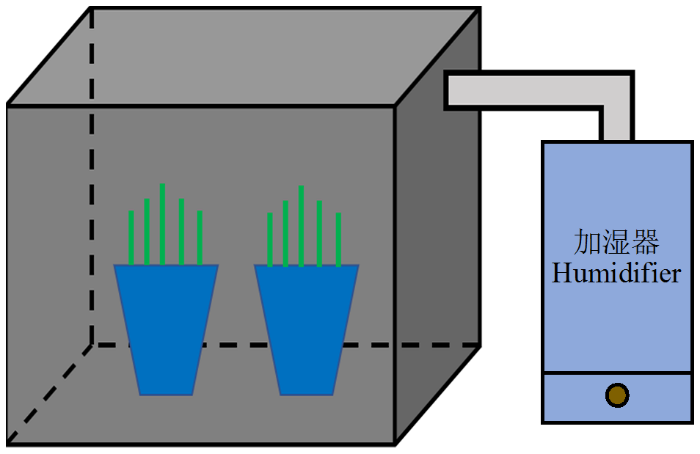
分别于接种后1、3、7和11 d进行拍照,对比观察植株的抗病效应,并且分别在0 d(接种前)和接种后1、3、5、7、9和11 d采集各个处理下的燕麦叶片样品,用液氮冷冻,在-80 ℃下保存,用于生理指标的测定。
1.3 测定指标与方法
1.4 数据处理
采用Excel 2016软件进行数据处理和作图,利用SPSS 22.0软件进行方差分析,运用新复极差法对显著性差异进行多重比较。
2 结果与分析
2.1 施硅对燕麦秆锈病抗性的影响
在接种秆锈病菌的条件下,对施硅与不施硅处理的燕麦植株症状进行观察(图2)。接种后3 d,不施硅处理的燕麦叶片出现细小斑点,而施硅处理叶片未见症状;接种后7 d,施硅处理叶片开始出现斑点;接种后11 d,施硅处理叶片的秆锈病症状较不施硅处理明显减轻,与不施硅处理相比,施硅处理下秆锈病严重度降低35.61%,差异达显著水平(P<0.05)。
图2
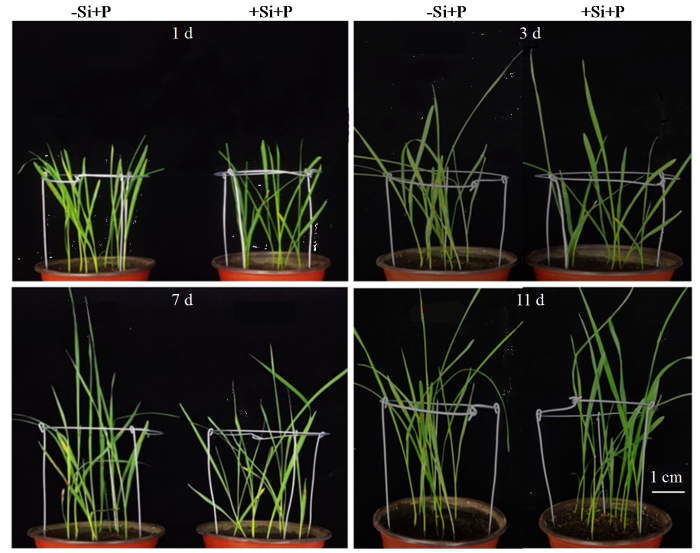
图2
施硅对燕麦秆锈病抗性的影响
Fig.2
Effect of silicon application on the resistance to stem rust in oats
2.2 施硅对感病燕麦叶片ROS代谢的影响
O2-. 和H2O2可通过启动膜脂过氧化或膜脂脱酯作用对植物造成损伤。如图3所示,在不接种秆锈病菌的条件下,无论是否施硅,燕麦叶片的O2-. 和H2O2含量均无明显变化,且施硅与不施硅处理间的差异不明显。接种秆锈病菌后,叶片O2-. 含量在侵染初期迅速上升,于接种后5 d达峰值后随即下降(图3a);施硅处理下,叶片O2-. 含量于接种后3 d达峰值,且在接种后1~7 d内较不施硅处理降低19.45%~35.66%。接种秆锈病菌后,不施硅和施硅处理下燕麦叶片H2O2含量均在侵染初期迅速升高,分别于接种后3 d和11 d达峰值(图3b);在接种后1~7 d内,与不施硅处理相比,施硅处理下H2O2含量降低了20.41%~28.49%。综上,施硅可有效降低秆锈病菌侵染下燕麦叶片的ROS含量,进而提高其抗病性。
图3
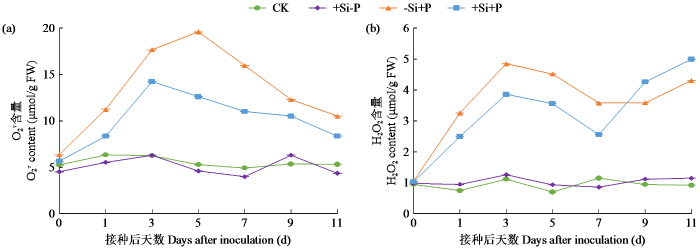
图3
接种秆锈菌与施硅处理对燕麦叶片O2-. 和H2O2含量的影响
Fig.3
Effects of inoculation with Pga and silicon application on the contents of O2-. and H2O2 in oat leaves
2.3 施硅对感病燕麦叶片保护酶系统的影响
不同处理下燕麦叶片保护酶系统的变化情况如图4所示。在不接种秆锈病菌时,无论是否施硅,燕麦叶片保护酶系统的各组分含量基本保持稳定,且施硅与不施硅处理间差异不明显。
图4
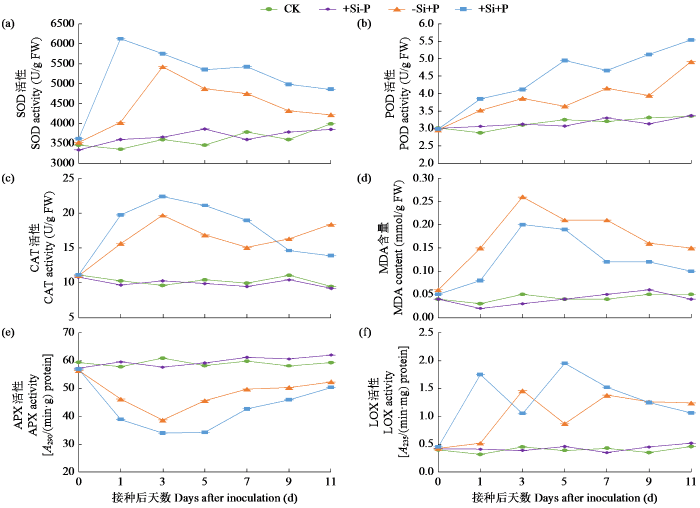
图4
接种秆锈菌与施硅处理对燕麦叶片保护酶系统的影响
Fig.4
Effects of inoculation with Pga and silicon application on protective enzyme system of oat leaves
SOD是植物识别病原物时产生初始抗性信息的关键酶,可催化O2-. 发生歧化反应生成O2和H2O2。接种秆锈病菌后,燕麦叶片SOD活性随接种时间的延长呈先升高后降低的趋势,于接种后3 d达峰值;施硅处理下,SOD活性在短时间内迅速上升,于接种后1 d即达峰值,随后迅速下降;与不施硅处理相比,施硅处理下的SOD活性在接种后1~11 d内提高5.98%~52.14%。POD可清除氧代谢过程中产生的H2O2。接种秆锈病菌后,无论是否施硅,POD活性均随接种时间的延长逐渐升高;与不施硅处理相比,施硅处理下的POD活性在接种后1~11 d内提高6.74%~35.99%。CAT在植物ROS代谢中可将H2O2分解为H2O。在接种秆锈病菌的条件下,无论是否施硅,CAT活性在接种后3~7 d均呈先升后降的变化趋势;在接种后1~7 d内,施硅处理下的CAT活性较不施硅处理提高13.59%~26.18%;但施硅处理下的CAT活性自接种后7 d开始持续下降,至接种后9 d时低于不施硅处理。MDA是膜脂过氧化的主要产物,其含量可反映膜脂过氧化程度。接种秆锈病菌后,MDA含量均迅速升高,于接种后3 d达峰值后逐渐下降;在接种后1~11 d内,施硅处理下的MDA含量较不施硅处理降低9.52%~42.86%。APX是植物ROS代谢中的重要抗氧化酶之一,尤其是叶绿体中清除H2O2的关键酶。接种秆锈病菌后,施硅与不施硅处理下叶片APX活性均随接种时间延长呈先升后降的趋势;在接种后1~9 d内,与不施硅处理相比,施硅处理下的APX活性降低8.78%~24.94%。LOX在植物体内可作为抗菌性物质,参与植物衰老过程及抗病性过敏坏死反应,其代谢会产生ROS和氧自由基,导致细胞膜受损。接种秆锈病菌后,无论是否施硅,LOX活性均出现2个峰值;不施硅处理下,峰值分别出现在接种后3 d和7 d;施硅处理下,峰值均提前2 d,即出现在接种后1 d和5 d,且在大部分时间内,施硅处理下的LOX活性较不施硅处理提高。综上,施硅可有效提高秆锈病菌侵染下燕麦叶片的抗氧化酶活性,进而增强其抗病性。
2.4 施硅对感病燕麦叶片质膜透性的影响
不同处理对燕麦叶片质膜透性的影响如图5所示,在不接种秆锈病菌的情况下,施硅与不施硅处理的叶片EC均无明显变化。接种秆锈病菌后,施硅与不施硅处理的EC变化规律基本一致,侵染初期,叶片EC逐渐上升,接种后3~7 d进入平稳阶段,随后再次持续升高。在接种后1~11 d内,施硅处理下的EC较不施硅处理降低3.27~7.38个百分点。
图5
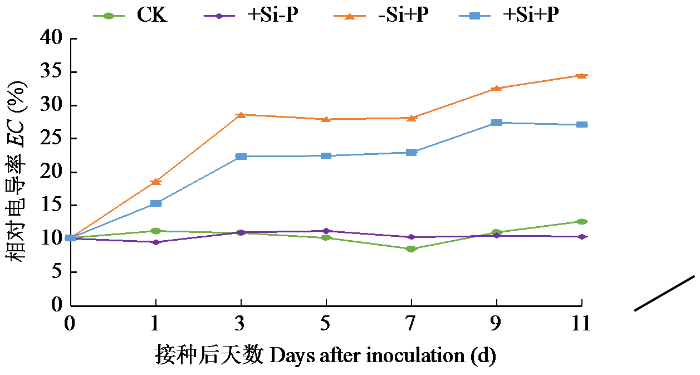
图5
接种秆锈菌与施硅处理对燕麦叶片质膜透性的影响
Fig.5
Effects of inoculation with Pga and silicon application on plasma membrane permeability of oat leaves
3 讨论
鉴于ROS的高度反应特性,SOD、POD和CAT共同构成植物体内有效的ROS清除系统,可有效清除植物体内的自由基和过氧化物[42],这解释了燕麦接种秆锈病菌后,叶片SOD、POD和CAT活性迅速升高的现象。本研究结果显示,接种秆锈病菌后,燕麦叶片LOX活性明显升高,增强了膜脂过氧化,引发过敏反应,提高了燕麦对秆锈病的抗性。秆锈病发病后期,由于病原菌持续攻击,叶片细胞毒性增强,膜脂过氧化严重,导致叶片保护酶系统代谢紊乱,各抗氧化酶变化规律不一致。本研究中,秆锈病菌侵染初期,施硅处理提高了叶片SOD、POD和CAT活性,有助于叶片更快清除ROS和过氧化物,缓解膜脂氧化损伤,抑制电解质大量外渗,降低EC,从而提高燕麦对秆锈病的抗性。侵染后期,尽管ROS过量积累,抗氧化酶系统代谢紊乱,但施硅处理仍提高了SOD和POD活性,且发病后期施硅处理的CAT活性低于不施硅处理,这促进了H2O2的适量积累。H2O2具有直接抗菌作用,还可作为信号分子诱导其他防卫基因表达[43],而SOD、POD和CAT相互配合,有效帮助燕麦抵抗秆锈病菌。接种秆锈病菌后3 d,SOD活性开始降低,而施硅处理使叶片POD活性持续上升,表明硅维持了SOD和POD之间的协调性。张国良等[27]发现水稻感染纹枯病菌后,施硅处理的MDA含量总体低于不施硅处理,而SOD活性始终高于不施硅处理;感病后第4天,施硅处理下SOD活性较低、POD活性较高,而不施硅处理的POD活性较低,说明感染纹枯病后,硅能够维持水稻叶片SOD和POD之间的协调性,这与本研究结果相似。
4 结论
秆锈病菌侵染引发燕麦叶片膜脂过氧化,损害细胞膜,进而导致过敏性反应的发生。外源硅可增强燕麦对秆锈病的抗性,施硅能够帮助燕麦清除体内的活性氧,减轻细胞膜的氧化损伤。
参考文献
Haplotype-based genotyping-by-sequencing in oat genome research
DOI:10.1111/pbi.12888
PMID:29345800
[本文引用: 1]

In a de novo genotyping-by-sequencing (GBS) analysis of short, 64-base tag-level haplotypes in 4657 accessions of cultivated oat, we discovered 164741 tag-level (TL) genetic variants containing 241224 SNPs. From this, the marker density of an oat consensus map was increased by the addition of more than 70000 loci. The mapped TL genotypes of a 635-line diversity panel were used to infer chromosome-level (CL) haplotype maps. These maps revealed differences in the number and size of haplotype blocks, as well as differences in haplotype diversity between chromosomes and subsets of the diversity panel. We then explored potential benefits of SNP vs. TL vs. CL GBS variants for mapping, high-resolution genome analysis and genomic selection in oats. A combined genome-wide association study (GWAS) of heading date from multiple locations using both TL haplotypes and individual SNP markers identified 184 significant associations. A comparative GWAS using TL haplotypes, CL haplotype blocks and their combinations demonstrated the superiority of using TL haplotype markers. Using a principal component-based genome-wide scan, genomic regions containing signatures of selection were identified. These regions may contain genes that are responsible for the local adaptation of oats to Northern American conditions. Genomic selection for heading date using TL haplotypes or SNP markers gave comparable and promising prediction accuracies of up to r = 0.74. Genomic selection carried out in an independent calibration and test population for heading date gave promising prediction accuracies that ranged between r = 0.42 and 0.67. In conclusion, TL haplotype GBS-derived markers facilitate genome analysis and genomic selection in oat.© 2018 The Authors. Plant Biotechnology Journal published by Society for Experimental Biology and The Association of Applied Biologists and John Wiley & Sons Ltd.
Physiological and TMT-based proteomic analysis of oat early seedlings in response to alkali stress
硅介导稻瘟病抗性的生理机理
DOI:10.3864/j.issn.0578-1752.2014.02.004
【目的】稻瘟病是水稻生产主要的病害之一,每年造成严重的产量损失。研究表明,施用硅肥作为一种环境友好型病害防治措施,在增强植物抗病性中起重要作用,但其作用机理还不完全清楚。本文旨在探讨硅处理对水稻稻瘟病的抗性效应及生理作用机理,为稻瘟病的有效防治提供理论依据和实践指导。【方法】选用稻瘟病广谱感病品系CO39(不含已知抗稻瘟病基因)及其近等基因系C101LAC(Pi-1)(抗病品系)为试验材料,设置(1)不加硅不接种(Si-M-)、(2)加硅不接种(Si+M-)、(3)不加硅接种(Si-M+)和(4)加硅接种(Si+M+)等4个处理,通过光照培养箱控制生长条件,用Hoagland营养液进行水培试验,研究施硅对稻瘟病的控制效果,以及对水稻根系和叶片中硅、酚类物质、水杨酸、乙烯及H2O2含量的影响。【结果】施硅显著降低两个水稻品系的稻瘟病的发病率和病情指数。抗病品系C101LAC(Pi-1)的稻瘟病的发病率和病情指数明显低于感病品系CO39。施硅后,两个水稻品系的根、茎、叶中的硅含量都显著增加,地上部的硅含量明显高于根部。稻瘟病菌侵染条件下,加硅显著降低两个材料叶片中的总酚含量,对根系中的总酚含量没有显著影响。不接种稻瘟病菌情况下,加硅对第3天叶片中总酚含量没有显著影响,而显著降低了第7天叶片中的总酚含量,两个水稻品系表现一致。对两个品系水稻品种来说,根系中的总酚含量明显低于叶片中的总酚含量。稻瘟病菌侵染条件下,加硅显著降低两个材料叶片中的木质素含量,对根系中的木质素含量没有显著影响。不接种稻瘟病菌情况下,加硅显著增高了CO39叶片中的水杨酸含量,而对于C101LAC(Pi-1),加硅只在第3天显著增高了叶片中的水杨酸含量。接种稻瘟病菌后,施硅使CO39在第3天叶片中的水杨酸含量显著增高,而对C101LAC(Pi-1)没有显著影响。在两个品系的根系中都没有检测到水杨酸。接种稻瘟病菌后,施硅显著降低了两个水稻材料叶片和根系中的乙烯含量。不接种稻瘟病菌情况下,叶片中乙烯含量极低,加硅显著降低了CO39第3天根系中乙烯含量,而对于C101LAC(Pi-1),加硅后,第3天和第7天根系中乙烯含量都显著降低。加硅显著降低两个材料叶片中H2O2的含量,而显著增加了根系中H2O2含量。对两个品系水稻品种来说,根系中的H2O2含量明显低于叶片中的。【结论】施硅能显著增加水稻对稻瘟病的抗性,改变植株体内的生理代谢状况,调节植物体内酚类物质的含量,并通过诱导信号物质如水杨酸、乙烯、H2O2等的变化来提高水稻植株对稻瘟病的抗性。
A case for silicon fertilization to improve crop yields in tropical soils
Ultrastructural and cytochemical aspects of silicon-mediated rice blast resistance
DOI:10.1094/PHYTO.2003.93.5.535
PMID:18942975
[本文引用: 1]
Although exogenous application of silicon (Si) confers efficient control of rice blast, the probable hypothesis underlying this phenomenon has been confined to that of a mechanical barrier resulting from Si polymerization in planta. However, in this study, we provide the first cytological evidence that Si-mediated resistance to Magnaporthe grisea in rice correlates with specific leaf cell reaction that interfered with the development of the fungus. Accumulation of an amorphous material that stained densely with toluidine blue and reacted positively to osmium tetroxide was a typical feature of cell reaction to infection by M. grisea in samples from Si+ plants. As a result, the extent of fungal colonization was markedly reduced in samples from Si+ plants. In samples from Si- plants, M. grisea grew actively and colonized all leaf tissues. Cytochemi-cal labeling of chitin revealed no difference in the pattern of chitin localization over fungal cell walls of either Si+ or Si- plants at 96 h after inoculation, indicating limited production of chitinases by the rice plant as a mechanism of defense response. On the other hand, the occurrence of empty fungal hyphae, surrounded or trapped in amorphous material, in samples from Si+ plants suggests that phenolic-like compounds or phytoalexins played a primary role in rice defense response against infection by M. grisea. This finding brings new insights into the complex role played by Si in the nature of rice blast resistance.
Silicon induces antifungal compounds in powdery mildew-infected wheat
DOI:10.1016/j.pmpp.2005.05.006 URL
Silicon-induced changes in antifungal phenolic acids, flavonoids, and key phenylpropanoid pathway genes during the interaction between miniature roses and the biotrophic pathogen Podosphaera pannosa
DOI:10.1104/pp.111.185215
URL
[本文引用: 1]
Application of 3.6 mm silicon (Si+) to the rose (Rosa hybrida) cultivar Smart increased the concentration of antimicrobial phenolic acids and flavonoids in response to infection by rose powdery mildew (Podosphaera pannosa). Simultaneously, the expression of genes coding for key enzymes in the phenylpropanoid pathway (phenylalanine ammonia lyase, cinnamyl alcohol dehydrogenase, and chalcone synthase) was up-regulated. The increase in phenolic compounds correlated with a 46% reduction in disease severity compared with inoculated leaves without Si application (Si−). Furthermore, Si application without pathogen inoculation induced gene expression and primed the accumulation of several phenolics compared with the uninoculated Si− control. Chlorogenic acid was the phenolic acid detected in the highest concentration, with an increase of more than 80% in Si+ inoculated compared with Si− uninoculated plants. Among the quantified flavonoids, rutin and quercitrin were detected in the highest concentrations, and the rutin concentration increased more than 20-fold in Si+ inoculated compared with Si− uninoculated plants. Both rutin and chlorogenic acid had antimicrobial effects on P. pannosa, evidenced by reduced conidial germination and appressorium formation of the pathogen, both after spray application and infiltration into leaves. The application of rutin and chlorogenic acid reduced powdery mildew severity by 40% to 50%, and observation of an effect after leaf infiltration indicated that these two phenolics can be transported to the epidermal surface. In conclusion, we provide evidence that Si plays an active role in disease reduction in rose by inducing the production of antifungal phenolic metabolites as a response to powdery mildew infection.
Application of silicon enhanced drought tolerance in Sorghum bicolor
DOI:10.1111/ppl.2005.123.issue-4 URL [本文引用: 1]
Silicon alleviates drought stress of rice plants by improving plant water status, photosynthesis and mineral nutrient absorption
DOI:10.1007/s12011-010-8742-x
PMID:20532668
[本文引用: 1]
Drought is a major constraint for rice production in the rainfed lowlands in China. Silicon (Si) has been verified to play an important role in enhancing plant resistance to environmental stress. Two near-isogenic lines of rice (Oryza sativa L.), w-14 (drought susceptible) and w-20 (drought resistant), were selected to study the effects of exogenous Si application on the physiological traits and nutritional status of rice under drought stress. In wet conditions, Si supply had no effects on growth and physiological parameters of rice plants. Drought stress was found to reduce dry weight, root traits, water potential, photosynthetic parameters, basal quantum yield (F(v)/F(0)), and maximum quantum efficiency of PSII photochemistry (F(v)/F(m)) in rice plants, while Si application significantly increased photosynthetic rate (Pr), transpiration rate (Tr), F(v)/F(0), and F(v)/F(m) of rice plants under drought stress. In addition, water stress increased K, Na, Ca, Mg, Fe content of rice plants, but Si treatment significantly reduced these nutrient level. These results suggested that silicon application was useful to increase drought resistance of rice through the enhancement of photochemical efficiency and adjustment of the mineral nutrient absorption in rice plants.
Role of silicon in enhancing resistance to freezing stress in two contrasting winter wheat cultivars
DOI:10.1016/j.envexpbot.2008.06.005 URL [本文引用: 1]
Silicon and heavy metal tolerance of higher plants
DOI:10.1016/s0031-9422(00)00472-6
PMID:11314953
[本文引用: 1]
The heavy metal tolerant Cardaminopsis halleri, grown on Zn and Cu polluted soil, showed electron dense metal containing precipitates (Zn, Cu, Sn, Fe, Al) on the leaf surface, in the intercellular spaces (Zn, Cu, Sn), the cell walls and the cell wall thickenings of the xylem vessels (Zn, traces of Cu and Fe). Large amounts of Zn were measured in the vacuoles, the main storage compartment for this metal in Cardarminopsis. The cytoplasm and nuclei contained small precipitates, including mainly Zn and Si. As shown by ESI Zn was co-localized with Si in these structures. The EEL-spectra of the cytoplasmic precipitates corresponded with the spectra of Zn-silicate. Besides Zn-silicate, electron translucent structures in the cytoplasm were identified as SiO2 by their EEL spectra. It was concluded that in the cytoplasm of Cardaminopsis Zn is transiently accumulated as silicate, being slowly degraded to SiO2. Zn is translocated into the vacuole and accumulated in an unknown form. A second Si and Zn-uptake mechanism was found, excluding a membrane and cytoplasm passage. Pinocytotic vesicles, formed by the plasmamembrane and the tonoplast, enable a direct translocation of Si and Zn from extracellular compartments into the vacuole. The formation of Zn-silicate is part of the heavy metal tolerance mechanism and may be responsible for the amelioration of the Zn toxicity in Cardaminopsis.
Protective effect of silicon on phenolic biosynthesis and ultraviolet spectral stress in rice crop
DOI:10.1016/S0168-9452(02)00419-3 URL [本文引用: 1]
Silicon-enhanced resistance to rice blast is attributed to silicon-mediated defense resistance and its role as physical barrier
DOI:10.1007/s10658-010-9625-x URL [本文引用: 1]
Silicon suppresses fusarium crown and root rot of tomato
DOI:10.1111/jph.2011.159.issue-7-8 URL [本文引用: 1]
The effect of silicon on the infection by and spread of Pythium aphanidermatum in single roots of tomato and bitter gourd
DOI:10.1093/jxb/erl232 URL [本文引用: 1]
Molecular marker dissection of stem rust resistance in Nebraska bread wheat germplasm
DOI:10.1038/s41598-019-47986-9
PMID:31406132
[本文引用: 1]
Stem rust (caused by Puccinia graminis f. sp. tritici) is a major disease of wheat. To understand the genetic basis of stem rust resistance in Nebraska winter wheat, a set of 330 genotypes representing two nurseries (DUP2015 and TRP2015) were evaluated for resistance to a Nebraska stem rust race (QFCSC) in two replications. The TRP2015 nursery was also evaluated for its resistance to an additional 13 stem rust races. The analysis of variance revealed significant variation among genotypes in both populations for stem rust resistance. Nine stem rust genes, Sr6, Sr31, Sr1RS, Sr24, Sr36, SrTmp, Sr7b, Sr9b, and Sr38, were expected and genotyped using gene-specific markers. The results of genetic analysis confirmed the presence of seven stem rust resistance genes. One genotype (NE15680) contained target alleles for five stem rust resistance genes and had a high level of stem rust resistance against different races. Single marker analysis indicated that Sr24 and Sr38 were highly significantly associated with stem rust resistance in the DUP2015 and TRP2015 nurseries, respectively. Linkage disequilibrium analysis identified the presence of 17 SNPs in high linkage with the Sr38-specific marker. These SNPs potentially tagging the Sr38 gene could be used in marker-assisted selection after validating them in additional genetic backgrounds.
Cyclopentenone isoprostanes induced by reactive oxygen species trigger defense gene activation and phytoalexin accumulation in plants
DOI:10.1046/j.1365-313x.2003.01730.x
PMID:12713542
[本文引用: 1]
Lipid peroxidation may be initiated either by lipoxygenases or by reactive oxygen species (ROS). Enzymatic oxidation of alpha-linolenate can result in the biosynthesis of cyclic oxylipins of the jasmonate type while free-radical-catalyzed oxidation of alpha-linolenate may yield several classes of cyclic oxylipins termed phytoprostanes in vivo. Previously, we have shown that one of these classes, the E1-phytoprostanes (PPE1), occurs ubiquitously in plants. In this work, it is shown that PPE1 are converted to novel cyclopentenone A1- and B1-phytoprostanes (PPA1 and PPB1) in planta. Enhanced formation of PPE1, PPA1, and PPB1 is observed after peroxide stress in tobacco cell cultures as well as after infection of tomato plants with a necrotrophic fungus, Botrytis cinerea. PPA1 and PPB1 display powerful biologic activities including activation of mitogen-activated protein kinase (MAPK) and induction of glutathione-S-transferase (GST), defense genes, and phytoalexins. Data collected so far infer that enhanced phytoprostane formation is a general consequence of oxidative stress in plants. We propose that phytoprostanes are components of an oxidant-injury-sensing, archaic signaling system that serves to induce several plant defense mechanisms.
Calcium chloride effects on salinity-induced oxidative stress, proline metabolism and indole alkaloid accumulation in Catharanthus roseus
DOI:10.1016/j.crvi.2007.07.002
URL
[本文引用: 1]
\n Catharanthus roseus\n (L.) G. Don. plants were grown with NaCl and CaCl\n 2\n in order to study the effect of CaCl\n 2\n on NaCl-induced oxidative stress in terms of lipid peroxidation (TBARS content), H\n 2\n O\n 2\n content, osmolyte concentration, proline (PRO)-metabolizing enzymes, antioxidant enzyme activities, and indole alkaloid accumulation. The plants were treated with solutions of 80 mM NaCl, 80 mM NaCl with 5 mM CaCl\n 2\n and 5 mM CaCl\n 2\n alone. Groundwater was used for irrigation of control plants. Plants were uprooted randomly on 90 days after sowing (DAS). NaCl-stressed plants showed increased TBARS, H\n 2\n O\n 2\n, glycine betaine (GB) and PRO contents, decreased proline oxidase (PROX) activity, and increased γ-glutamyl kinase (γ-GK) activity when compared to control. Addition of CaCl\n 2\n to NaCl-stressed plants lowered the PRO concentration by increasing the level of PROX and decreasing the γ-GK activities. Calcium ions increased the GB contents. CaCl\n 2\n appears to confer greater osmoprotection by the additive role with NaCl in GB accumulation. The antioxidant enzymes superoxide dismutase (SOD), peroxidase (POX) and catalase (CAT) were increased under salinity and further enhanced due to CaCl\n 2\n treatment. The NaCl-with-CaCl\n 2\n -treated\n C. roseus\n plants showed an increase in total indole alkaloid content in shoots and roots when compared to NaCl-treated and untreated plants.\n
黄瓜脂氧合酶基因CsLOX2的克隆及表达分析
DOI:10.3864/j.issn.0578-1752.2013.11.013
[本文引用: 1]
【目的】以华北型黄瓜种质26号为材料克隆黄瓜脂氧合酶基因CsLOX2的cDNA全长并分析其序列特征,在此基础上研究该基因在果实发育进程中的表达模式、酶活性变化及相应的C6醛类物质含量,为研究脂氧合酶基因在黄瓜果实醛类香气物质形成中的作用机制奠定基础。【方法】以华北型黄瓜种质26号为材料,通过RT-PCR和RACE技术克隆黄瓜的脂氧合酶基因CsLOX2的cDNA全长并分析其生物信息学特征,对CsLOX2在果实发育进程中的表达模式进行Real-time PCR检测,通过气质联用(GC-MS)技术测定相应的C6醛类香气物质的含量并利用分光光度法测定LOX酶活性。【结果】华北型黄瓜种质26号的CsLOX2基因cDNA全长2 878 bp,ORF区为2 640 bp,编码879个氨基酸,推导的蛋白质分子量为99.39 kD,等电点为6.28。通过氨基酸序列比对发现,该基因编码的氨基酸序列具有脂氧合酶家族的3个重要特征区域及植物LOX中皆具有的6个高度保守的组氨酸,该序列与其它物种的脂氧合酶氨基酸序列具有较高的同源性。根据其N端序列特征推测CsLOX2属于I类LOX,具有13-LOX活性。Real time-PCR分析结果表明,该基因在花后3 d表达量最高,此后下降,至花后15 d最低;脂氧合酶的活性自开花当天逐渐上升,至花后12 d达到最高,此后下降;C6醛类香气含量在果实发育始期较高,随果实发育进程逐渐下降,至花后12 d最低。【结论】利用RACE技术克隆了华北型黄瓜种质26号脂氧合酶基因CsLOX2的cDNA全长,序列分析表明该基因具有植物LOXs的特征结构域。CsLOX2基因表达高峰先于脂氧合酶活性高峰的出现,C6醛类香气含量在果实发育始期较高,随果实发育进程逐渐下降。该研究结果将为进一步探讨脂氧合酶基因在黄瓜果实醛类香气物质形成中的作用机制奠定基础。
Alterations in photosynthesis and antioxidant enzyme activity in winter wheat subjected to post- anthesis water-logging
DOI:10.1007/s11099-008-0005-0 URL [本文引用: 1]
Plant responses to abiotic stresses: heavy metal-induced oxidative stress and protection by mycorrhization
The aim of this review is to assess the mode of action and role of antioxidants as protection from heavy metal stress in roots, mycorrhizal fungi and mycorrhizae. Based on their chemical and physical properties three different molecular mechanisms of heavy metal toxicity can be distinguished: (a) production of reactive oxygen species by autoxidation and Fenton reaction; this reaction is typical for transition metals such as iron or copper, (b) blocking of essential functional groups in biomolecules, this reaction has mainly been reported for non-redox-reactive heavy metals such as cadmium and mercury, (c) displacement of essential metal ions from biomolecules; the latter reaction occurs with different kinds of heavy metals. Transition metals cause oxidative injury in plant tissue, but a literature survey did not provide evidence that this stress could be alleviated by increased levels of antioxidative systems. The reason may be that transition metals initiate hydroxyl radical production, which can not be controlled by antioxidants. Exposure of plants to non-redox reactive metals also resulted in oxidative stress as indicated by lipid peroxidation, H(2)O(2) accumulation, and an oxidative burst. Cadmium and some other metals caused a transient depletion of GSH and an inhibition of antioxidative enzymes, especially of glutathione reductase. Assessment of antioxidative capacities by metabolic modelling suggested that the reported diminution of antioxidants was sufficient to cause H(2)O(2) accumulation. The depletion of GSH is apparently a critical step in cadmium sensitivity since plants with improved capacities for GSH synthesis displayed higher Cd tolerance. Available data suggest that cadmium, when not detoxified rapidly enough, may trigger, via the disturbance of the redox control of the cell, a sequence of reactions leading to growth inhibition, stimulation of secondary metabolism, lignification, and finally cell death. This view is in contrast to the idea that cadmium results in unspecific necrosis. Plants in certain mycorrhizal associations are less sensitive to cadmium stress than non-mycorrhizal plants. Data about antioxidative systems in mycorrhizal fungi in pure culture and in symbiosis are scarce. The present results indicate that mycorrhization stimulated the phenolic defence system in the Paxillus-Pinus mycorrhizal symbiosis. Cadmium-induced changes in mycorrhizal roots were absent or smaller than those in non-mycorrhizal roots. These observations suggest that although changes in rhizospheric conditions were perceived by the root part of the symbiosis, the typical Cd-induced stress responses of phenolics were buffered. It is not known whether mycorrhization protected roots from Cd-induced injury by preventing access of cadmium to sensitive extra- or intracellular sites, or by excreted or intrinsic metal-chelators, or by other defence systems. It is possible that mycorrhizal fungi provide protection via GSH since higher concentrations of this thiol were found in pure cultures of the fungi than in bare roots. The development of stress-tolerant plant-mycorrhizal associations may be a promising new strategy for phytoremediation and soil amelioration measures.
Phenotypic, physiological, and molecular evaluation of rice chilling stress response at the vegetative stage
稻曲病菌侵染对水稻小穗发育的影响及H2O2的变化趋势
DOI:10.13926/j.cnki.apps.000209
[本文引用: 1]
稻曲病是由稻绿核菌(Ustilaginoidea virens)侵染引起的水稻穗部病害,在全世界不同稻作区均有发生,并在近年呈加重趋势。本研究通过水稻穗期接种后的显微观察及H<sub>2</sub>O<sub>2</sub>检测,分析了稻曲病菌侵染引起的小穗结构变化及侵染过程中H<sub>2</sub>O<sub>2</sub>变化趋势。结果表明,稻曲病菌侵染会导致水稻花粉粒畸形、雌蕊发育受抑制、小穗无法正常扬花授粉,抑制谷粒的正常形成,造成稻曲球及白色秕粒的产生。受侵染小穗的H<sub>2</sub>O<sub>2</sub>含量显著高于对照,其中处于突破颖壳期的受侵染小穗H<sub>2</sub>O<sub>2</sub>含量是对照的7倍;形成白色秕粒的小穗H<sub>2</sub>O<sub>2</sub>含量是对照的11倍;二氨基联苯胺染色结果显示,形成稻曲球的小穗中,在受侵染小穗的花药基部、花药顶端、浆片等部位颜色变深,形成H<sub>2</sub>O<sub>2</sub>富集区;形成白色秕粒的小穗中,H<sub>2</sub>O<sub>2</sub>富集的特征更为明显,富集区域与病菌在小穗内的侵染途径密切相关。


