

作物杂志,2026, 第1期: 118–124 doi: 10.16035/j.issn.1001-7283.2026.01.015
硅对燕麦抗秆锈病及抗氧化特性的影响
李英浩1,2( ), 杨澳1(), 刘景辉1(), 田露2, 米俊珍1
- 1内蒙古农业大学农学院/内蒙古高校燕麦工程研究中心/燕麦内蒙古自治区工程实验室/内蒙古农业大学杂粮产业协同创新中心,010019,内蒙古呼和浩特
2内蒙古自治区农牧业科学院,010031,内蒙古呼和浩特
Effects of Silicon on Stem Rust Resistance and Antioxidant Properties in Oats
Li Yinghao1,2(), Yang Ao1(), Liu Jinghui1(), Tian Lu2, Mi Junzhen1
- 1College of Agriculture, Inner Mongolia Agricultural University / Oat Engineering Research Center of Inner Mongolia Universities / Oat Engineering Laboratory of Inner Mongolia Autonomous Region / Collaborative Innovation Center of Grain Industry of Inner Mongolia Agricultural University, Hohhot 010019, Inner Mongolia, China
2Inner Mongolia Academy of Agricultural & Animal Husbandry Sciences, Hohhot 010031, Inner Mongolia, China
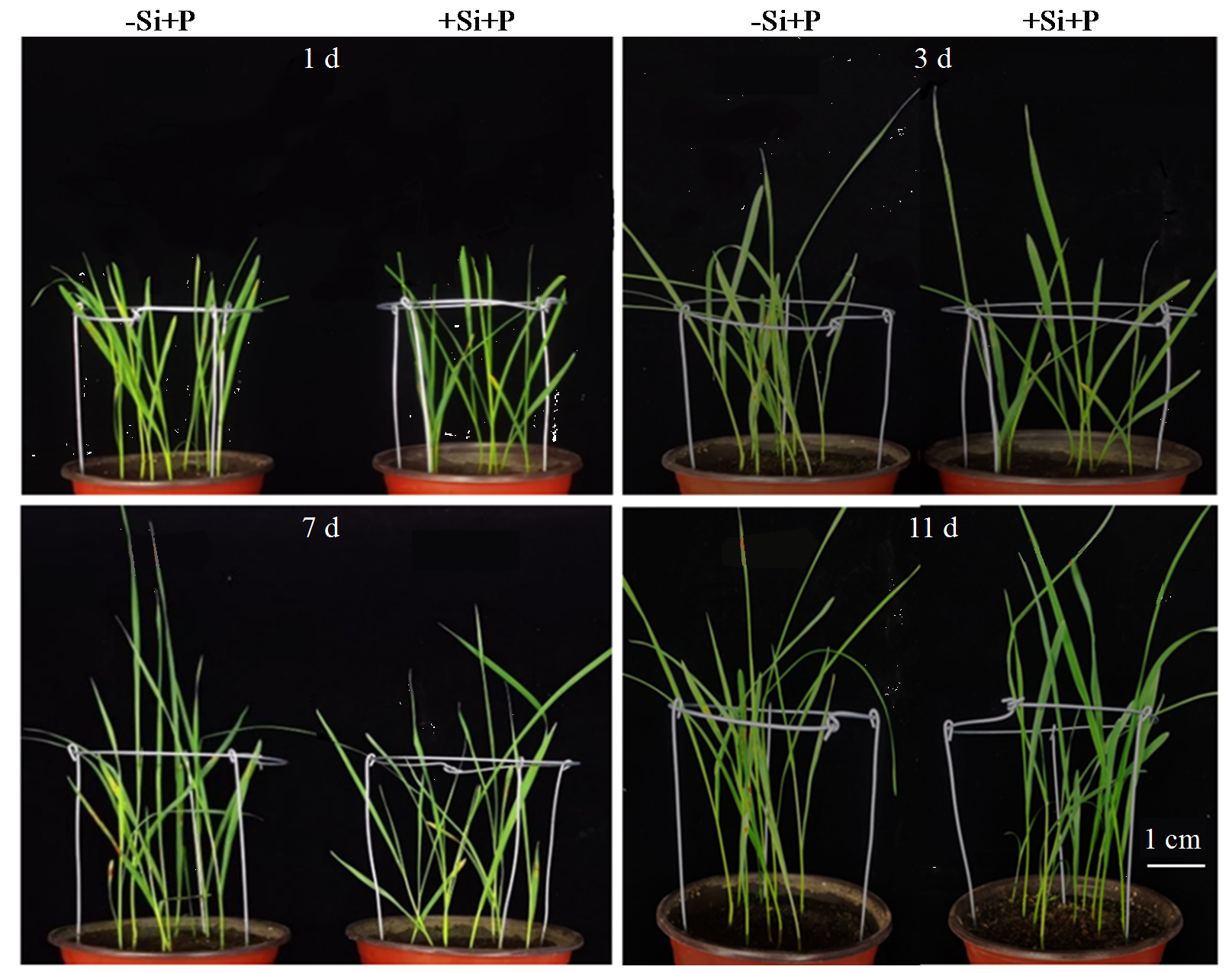
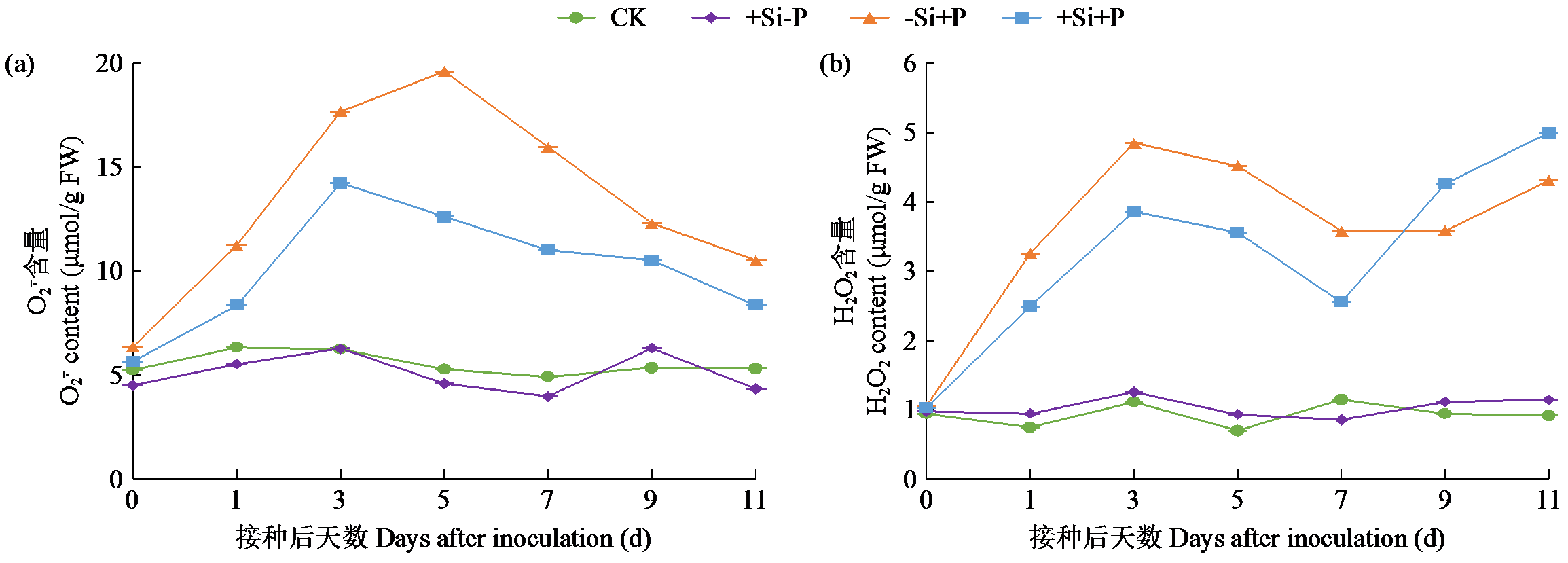
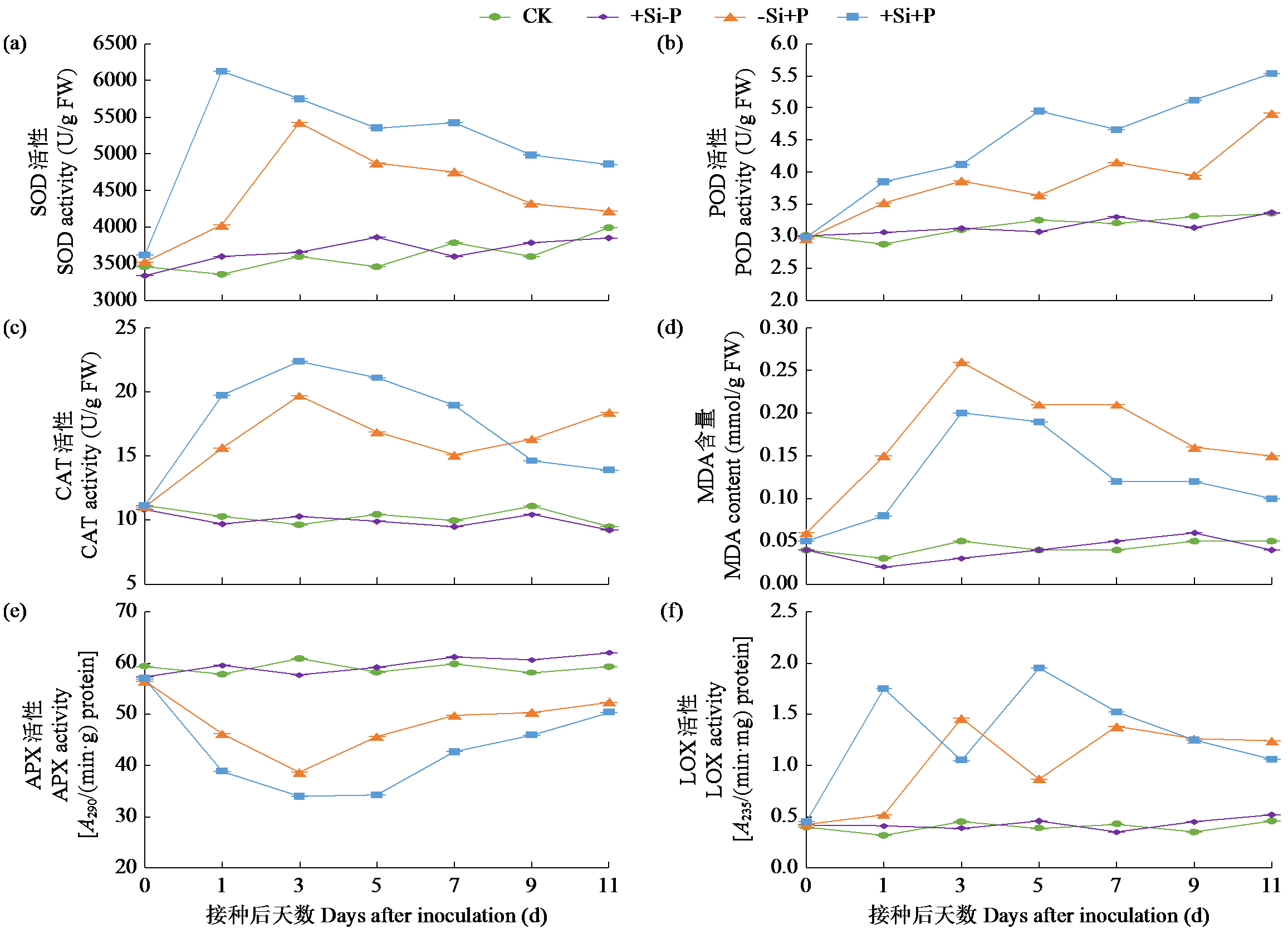
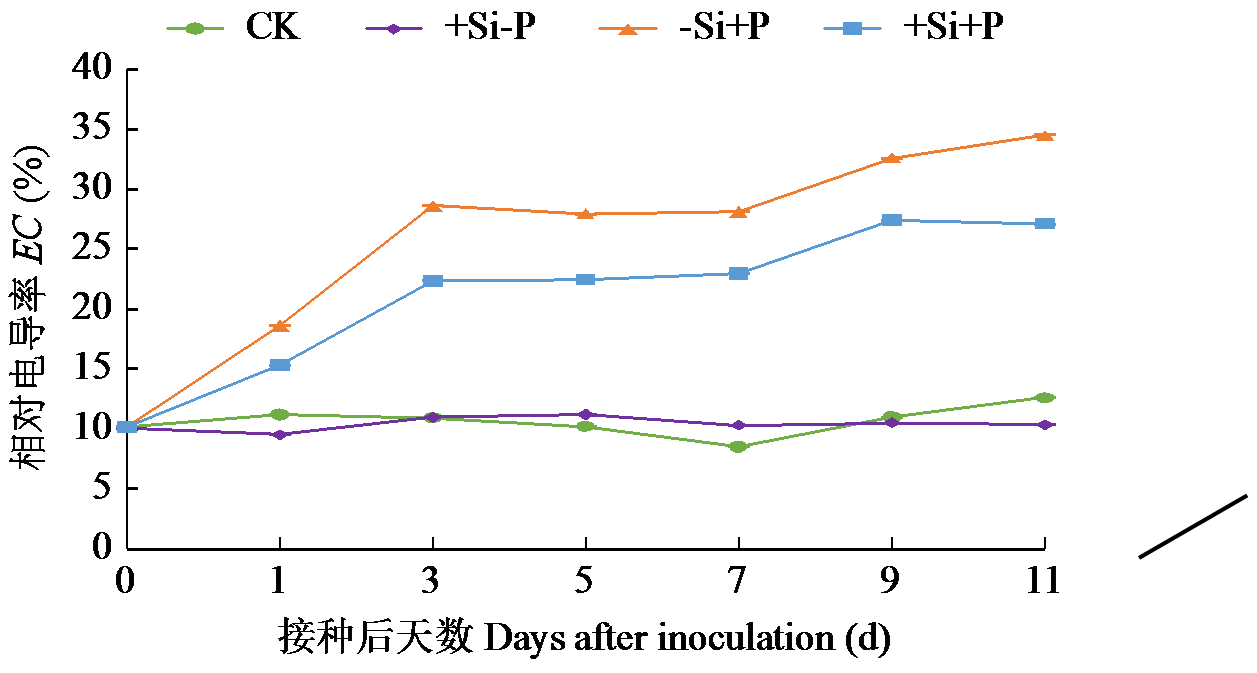
摘要: 为探究硅对秆锈病菌侵染下燕麦叶片生理特性的影响,明确其提升燕麦秆锈病抗性的生理机制,以易感秆锈病的燕麦品种“坝莜1号”为试验材料开展盆栽试验,分别设置CK(不施硅,不接种秆锈菌)、+Si-P(施硅,不接种秆锈菌)、-Si+P(不施硅,接种秆锈菌)和+Si+P(施硅,接种秆锈菌)4个处理,研究施用1.5 mmol/L硅对秆锈病菌侵染后燕麦叶片发病进程、活性氧含量和抗氧化酶活性等的影响。结果表明,施硅处理有效延缓了燕麦秆锈病的发病进程,且发病症状明显减轻;秆锈病菌侵染导致叶片O2-. 和过氧化氢含量迅速升高,同时叶片超氧化物歧化酶(SOD)、过氧化物酶(POD)和过氧化氢酶(CAT)等活性、丙二醛(MDA)含量及相对电导率迅速提升,抗坏血酸过氧化物酶(APX)活性则迅速降低;在接种秆锈病菌后7 d内,施硅处理降低了叶片活性氧含量,同时提升了SOD、POD及CAT活性,降低了APX活性和MDA含量;在接种后11 d内,降低了叶片相对电导率。施硅增强了燕麦叶片的抗氧化防御能力,降低了膜脂过氧化程度,提高了燕麦对秆锈病的抗性。

| [1] |
Bekele W A, Wight C P, Chao S, et al. Haplotype-based genotyping-by-sequencing in oat genome research. Plant Biotechnology Journal, 2018, 16(8):1452-1463.
doi: 10.1111/pbi.12888 pmid: 29345800 |
| [2] | 任长忠, 崔林, 何峰, 等. 我国燕麦荞麦产业技术体系建设与发展. 吉林农业大学学报, 2018, 40(4):524-532. |
| [3] | Zhao Z, Liu J H, Jia R Z, et al. Physiological and TMT-based proteomic analysis of oat early seedlings in response to alkali stress. Journal of Proteomics, 2019,193:10-26. |
| [4] | 李天亚, 吴限鑫, 王浩, 等. 我国燕麦秆锈菌生理小种与毒力分析. 麦类作物学报, 2014, 34(4):552-556. |
| [5] | 薛高峰, 张贵龙, 孙焱鑫, 等. 喷施不同形态硅对温室番茄生长发育及品质的影响. 中国农学通报, 2012, 28(16):272-276. |
| [6] |
葛少彬, 刘敏, 蔡昆争, 等. 硅介导稻瘟病抗性的生理机理. 中国农业科学, 2014, 47(2):240-251.
doi: 10.3864/j.issn.0578-1752.2014.02.004 |
| [7] | Meena V D, Dotaniya M L, Coumar V, et al. A case for silicon fertilization to improve crop yields in tropical soils. Proceedings of the National Academy of Sciences,India, 2014, 84(3):505-518. |
| [8] | 韩永强, 刘川, 侯茂林. 硅介导的水稻对二化螟幼虫钻蛀行为的影响. 生态学报, 2010, 30(21):5967-5974. |
| [9] |
Rodrigues F A, Benhamou N, Datnoff L E, et al. Ultrastructural and cytochemical aspects of silicon-mediated rice blast resistance. Phytopathology, 2003, 93(5):535-546.
doi: 10.1094/PHYTO.2003.93.5.535 pmid: 18942975 |
| [10] |
Rémus-Borel W, Menzies J G, Bélanger R R. Silicon induces antifungal compounds in powdery mildew-infected wheat. Physiological and Molecular Plant Pathology, 2005, 66(3):108-115.
doi: 10.1016/j.pmpp.2005.05.006 |
| [11] |
Shetty R, Fretté X, Jensen B, et al. Silicon-induced changes in antifungal phenolic acids, flavonoids, and key phenylpropanoid pathway genes during the interaction between miniature roses and the biotrophic pathogen Podosphaera pannosa. Plant Physiology, 2011, 157(4):2194-2205.
doi: 10.1104/pp.111.185215 |
| [12] |
Hattori T, Inanaga S, Araki H, et al. Application of silicon enhanced drought tolerance in Sorghum bicolor. Physiologia Plantarum, 2005, 123(4):459-466.
doi: 10.1111/ppl.2005.123.issue-4 |
| [13] |
Chen W, Yao X Q, Cai K Z, et al. Silicon alleviates drought stress of rice plants by improving plant water status, photosynthesis and mineral nutrient absorption. Biological Trace Element Research, 2011, 142(1):67-76.
doi: 10.1007/s12011-010-8742-x pmid: 20532668 |
| [14] |
Liang Y C, Zhu J, Li Z J, et al. Role of silicon in enhancing resistance to freezing stress in two contrasting winter wheat cultivars. Environmental and Experimental Botany, 2008, 64(3):286-294.
doi: 10.1016/j.envexpbot.2008.06.005 |
| [15] | 郑世英, 郑芳, 徐建, 等. 外源硅对NaCl胁迫下小麦幼苗生长及光合特性的影响. 麦类作物学报, 2015, 35(1):111-115. |
| [16] | 郑煜基, 陈能场, 张雪霞, 等. 硅肥施用对重金属污染土壤甘蔗镉吸收的影响研究初探. 生态环境学报, 2014, 23(12):2010-2012. |
| [17] |
Neumann D, Zur N U. Silicon and heavy metal tolerance of higher plants. Phytochemistry, 2001, 56(7):685-692.
doi: 10.1016/s0031-9422(00)00472-6 pmid: 11314953 |
| [18] | 方长旬, 王清水, 余彦, 等. 硅及其吸收基因Lsi1调节水稻耐UV-B辐射的作用. 作物学报, 2011, 37(6):1005-1011. |
| [19] |
Goto M, Ehara H, Karita S, et al. Protective effect of silicon on phenolic biosynthesis and ultraviolet spectral stress in rice crop. Plant Science, 2003, 164(3):349-356.
doi: 10.1016/S0168-9452(02)00419-3 |
| [20] |
Sun W C, Zhang J, Fan Q H, et al. Silicon-enhanced resistance to rice blast is attributed to silicon-mediated defense resistance and its role as physical barrier. European Journal of Plant Pathology, 2010, 128(1):39-49.
doi: 10.1007/s10658-010-9625-x |
| [21] | 薛高峰, 孙万春, 宋阿琳, 等. 硅对水稻生长、白叶枯病抗性及病程相关蛋白活性的影响. 中国农业科学, 2010, 43(4):690-697. |
| [22] |
Huang C H, Roberts P D, Datnoff L E. Silicon suppresses fusarium crown and root rot of tomato. Journal of Phytopathology, 2011, 159(7/8):546-554.
doi: 10.1111/jph.2011.159.issue-7-8 |
| [23] | 梁永超, 孙万春. 硅和诱导接种对黄瓜炭疽病的抗性研究. 中国农业科学, 2002, 35(3):267-271. |
| [24] |
Heine G, Tikum G, Horst W J. The effect of silicon on the infection by and spread of Pythium aphanidermatum in single roots of tomato and bitter gourd. Journal of Experimental Botany, 2007, 58(3):569-577.
doi: 10.1093/jxb/erl232 |
| [25] |
Mourad A M I, Sallam A, Belamkar V, et al. Molecular marker dissection of stem rust resistance in Nebraska bread wheat germplasm. Scientific Reports, 2019, 9(1):11694.
doi: 10.1038/s41598-019-47986-9 pmid: 31406132 |
| [26] |
Thoma I, Loeffler C, Sinha A K, et al. Cyclopentenone isoprostanes induced by reactive oxygen species trigger defense gene activation and phytoalexin accumulation in plants. Plant Journal, 2003, 34(3):363-375.
doi: 10.1046/j.1365-313x.2003.01730.x pmid: 12713542 |
| [27] | 张国良, 戴其根, 张洪程. 施硅增强水稻对纹枯病的抗性. 植物生理与分子生物学学报, 2006, 32(5):600-606. |
| [28] | 孙万春, 薛高峰, 张杰, 等. 硅对水稻防御性关键酶活性的影响及其与抗稻瘟病的关系. 植物营养与肥料学报, 2009, 15 (5):1023-1028. |
| [29] | 袁军海, 曹丽霞, 张立军, 等. 冀西北地区燕麦主栽品种(系)抗秆锈病鉴定. 植物保护, 2014, 40(1):165-168. |
| [30] | 李英浩, 吕品, 米俊珍, 等. 硅对燕麦幼苗秆锈病抗病能力的作用. 中国农业大学学报, 2022, 27(8):68-75. |
| [31] | Stewart D M, Roberts B J.Identifying races of Puccinia Graminis f. sp. avenae: a modified international system. (1970-09-01) [2024-09-19]. https://ageconsearch.umn.edu/record/171842. |
| [32] | 张国良, 陈文军, 仇利民, 等. 不同基因型水稻苗期对1,2,4-三氯苯胁迫的生理响应. 作物学报, 2009, 35(4):733-740. |
| [33] |
Jaleel C A, Manivannan P, Sankar B, et al. Calcium chloride effects on salinity-induced oxidative stress, proline metabolism and indole alkaloid accumulation in Catharanthus roseus. Comptes Rendus Biologies, 2007, 330(9):674-683.
doi: 10.1016/j.crvi.2007.07.002 |
| [34] | 张志良, 瞿伟菁. 植物生理学实验指导. 3版. 北京: 高等教育出版社, 2003. |
| [35] | 萧浪涛, 王三根. 植物生理学实验技术. 北京: 中国农业出版社, 2005. |
| [36] |
陈巧, 陈书霞, 王聪颖, 等. 黄瓜脂氧合酶基因CsLOX2的克隆及表达分析. 中国农业科学, 2013, 46(11):2285-2297.
doi: 10.3864/j.issn.0578-1752.2013.11.013 |
| [37] |
Tan W, Liu J, Dai T, et al. Alterations in photosynthesis and antioxidant enzyme activity in winter wheat subjected to post- anthesis water-logging. Photosynthetica, 2008, 46(1):21-27.
doi: 10.1007/s11099-008-0005-0 |
| [38] | 李合生. 植物生理生化实验原理和技术. 北京: 高等教育出版社, 2000. |
| [39] | 徐松华. 逆境条件下植物体内活性氧代谢研究进展. 安徽农学通报, 2021, 27(21):29-32. |
| [40] |
Schützendubel A, Polle A. Plant responses to abiotic stresses: heavy metal-induced oxidative stress and protection by mycorrhization. Journal of Experimental Botany, 2002, 53(372):1351-1365.
pmid: 11997381 |
| [41] | 计红芳, 张令文, 宋瑞清. 绒白乳菇发酵液提取物对杨树叶枯病菌几种重要酶活性的影响. 北京林业大学学报, 2009, 31 (4):51-54. |
| [42] | Reyes B G D L, Yun S J, Herath V, et al. Phenotypic, physiological, and molecular evaluation of rice chilling stress response at the vegetative stage. Methods in Molecular Biology, 2013,956:227-241. |
| [43] |
胡茂林, 罗来鑫, 李健强. 稻曲病菌侵染对水稻小穗发育的影响及H2O2的变化趋势. 植物病理学报, 2018, 48(2):169-175.
doi: 10.13926/j.cnki.apps.000209 |
| [1] | 吴昊, 贺金萍, 廖朝霞, 薛承康, 吴瑶瑶, 李宗芸, 刘敬然. 块根分化建成期干旱―复水对甘薯根系活性氧代谢与内源激素的影响[J]. 作物杂志, 2026, (1): 111–117 |
| [2] | 朱柃羽, 杨乔惠, 刘亦迅, 袁健, 王名花, 向达兵, 邹亮, 王俊珍, 范昱. 野生和栽培燕麦灌浆过程的光合特性与农艺性状研究[J]. 作物杂志, 2026, (1): 167–174 |
| [3] | 王舒琦, 李建波, 刘志萍, 马宇, 渠佳慧, 巴图, 徐寿军. 不同栽培模式下大麦产量与蛋白质形成的生理机制研究[J]. 作物杂志, 2025, (6): 172–180 |
| [4] | 郭龙玉, 高欣梅, 福英, 张明伟, 王莹, 李乌日吉木斯, 乌日力格, 王英杰, 王靖宇, 杨凤婷, 谷艳茹, 全宇. 免疫诱抗剂ZNC对盐碱胁迫下燕麦幼苗生长发育及生理适应性的影响[J]. 作物杂志, 2025, (6): 203–209 |
| [5] | 武慧娟, 耿小丽, 李德明, 周栋昌, 付萍, 刘乾, 杜笑村. 叶面喷施不同铁肥对燕麦种子产量及其构成因素的影响[J]. 作物杂志, 2025, (5): 233–238 |
| [6] | 徐明丽, 吴柏辰, 刘畅, 高鑫涵, 殷佳琪, 何雪, 刘莹, 尹泽群, 苗兴芬. 褪黑素浸种对盐碱胁迫下谷子萌发的影响[J]. 作物杂志, 2025, (5): 42–46 |
| [7] | 闫晶蓉, 庞春花, 张永清, 毋悦悦, 侯钰晨, 王嘉祺, 乔曼. 脱硫石膏与腐植酸配施对盐碱地土壤及藜麦生长的影响[J]. 作物杂志, 2025, (5): 47–53 |
| [8] | 张金东, 王成, 卢环, 曾玲玲, 张巩亮, 孙浩月, 刘悦, 杨贺麟, 侯晓敏. 盐碱胁迫下不同基因型绿豆对外源BR的响应[J]. 作物杂志, 2025, (5): 54–60 |
| [9] | 陈萍, 罗园园, 王娟, 孙权, 马玲芳, 马文礼, 谢静波. 燕麦萌发期对混合盐碱胁迫的响应及耐受性评价[J]. 作物杂志, 2025, (5): 61–66 |
| [10] | 赵洲, 张丽, 高新磊, 邱鸿雨. 复合盐碱胁迫对燕麦生长及代谢的影响[J]. 作物杂志, 2025, (5): 74–85 |
| [11] | 刘宣宣, 郭瑞士, 董蒙蒙, 朱柯颖, 朱晓品, 王丽, 王宁. 两个棉花品种幼苗涝渍及恢复期耐涝机理初探[J]. 作物杂志, 2025, (4): 126–134 |
| [12] | 周琦, 张靖, 王振龙, 施志国, 邓超超, 常浩, 柳洋, 周彦芳. 绿肥还田和减量施氮对甘肃河西灌区土壤质量及燕麦产量和品质的影响[J]. 作物杂志, 2025, (4): 188–196 |
| [13] | 侯晓敏, 申惠波, 董守坤, 闫锋, 董扬, 赵富阳, 李清泉, 左月桃. 甲哌鎓缓解大豆幼苗叶片干旱胁迫的生理效应[J]. 作物杂志, 2025, (3): 133–140 |
| [14] | 付国庆, 纪军建, 霍阿红, 陈令玮, 王瑶, 左振兴, 葛军勇, 寇淑君. 基于DUS测试性状对我国选育裸燕麦的分析[J]. 作物杂志, 2025, (3): 45–51 |
| [15] | 邸娜, 郑喜清, 王靖, 韩海军, 李娜. 向日葵应对列当寄生的生理响应差异性研究[J]. 作物杂志, 2025, (2): 123–127 |
|
||