



间套作种植已被证明可以养活更多的人并有利于生态系统的可持续性[4]。内蒙古杭锦后旗立足于得天独厚的农业生产条件,是我国著名的商品粮生产基地,主要种植作物为小麦、玉米和向日葵,占总播种面积的90%以上[5]。多样化种植在当地具有悠久的历史和广泛实践,近年来,随着市场需求的变化和农业结构调整的推进,辣椒和西瓜等经济作物,青贮玉米和苜蓿等饲草作物种植面积逐渐增加,种植结构由单一化走向多元化。在精耕细作的优良传统及较高土壤肥力的基础上,农民为了提高单位土地面积的经济效益及充分利用当季的光热资源,开展了多样化种植的尝试。当地农民在长期生产实践中摸索出了各种间套作模式,如粮粮套种、粮油套种、粮经套种和粮草套种等,如今间套作种植已是当地农业发展的一大亮点。但该区域的间套作模式及分布、产量表现、田间管理措施尚不明晰,需要挖掘出高效的间套作模式。此外,间套作作为一种历史悠久的种植模式[6],当前其应用规模仍存在较大的局限性,相较于传统单作而言,这可能与间套作种植在田间管理上较为困难,或与农户接受程度和缺乏技术指导有关,深入了解农户对间套作种植的认知和种植意愿,探索间套作种植经验,直面农户需求,有利于间套作种植模式更好地推广和应用。此外,农民种植收入的提高往往发生在多样化种植发展迅速的时期,同时可达到生态效益的目标[7]。因此,本研究通过农户调研,系统分析杭锦后旗间套作种植的生产现状及限制因素,有助于该区域未来的种植结构调整,并为当地间套作种植技术创新及农业生产优化提供理论基础。
1 材料与方法
1.1 调研区域概况
杭锦后旗地处内蒙古西部河套平原(40°26′~41°13′ N,106°24′~107°34′ E),北靠阴山,南临黄河,地势平坦。全旗地域辽阔,行政村分布范围大,共辖9个乡镇1个农场。总面积1790 km2,作物播种面积925.3 km2。该地区属于典型的温带大陆性季风气候:全年无霜期135 d左右,海拔为1032~ 1050 m,年均日照3200 h以上,是全国光能资源最丰富的地区之一,年均降水量为139 mm,境内有黄河流经,处于黄河自流灌区,年引黄水量可达10亿m3。全旗土壤肥沃,有机质13.0~19.2 g/kg,全氮0.80~1.07 g/kg,有效磷11.0~26.0 mg/kg,速效钾170.1~208.1 mg/kg,pH 8.39~8.93。
1.2 调查方法
在2022年对全旗进行了间套作生产现状及相应作物单作种植现状调研,调研区域根据前期预调研以及当地农技政府部门推荐来确定,以确保样本的代表性。采取实地入户面对面访谈的形式开展调研,调研问卷内容包括农户基本信息、生产资料、田间管理措施和农户认知,并结合杭锦后旗绿色生产调研收集杭锦后旗主要作物单作的基础种植信息。间套作调研样本涵盖8个乡镇,24个行政村,每个村随机选择15~25位村民作为调查对象,共收集有效样本503份,其中间套作样本200份,单作样本共303份,包括小麦42份、玉米148份和向日葵113份。间套作调研样本的农户基本特征如表1所示。其中男性占84%,女性占16%;年龄主要分布在50~60岁,占56%,其次为60岁以上,占32%;受教育水平主要为初中,占59.2%,其次为小学,占28.4%;农户类型主要为小农户种植,占92%,合作社经营及订单生产户仅占8%。
表1 调研样本农户特征
Table 1
| 指标Index | 分布Distribution | 占比Proportion (%) |
|---|---|---|
| 人口Population | 男 | 84 |
| 女 | 16 | |
| 年龄Age | < 40 | 2 |
| 40~50 | 10 | |
| 50~60 | 56 | |
| > 60 | 32 | |
| 受教育水平 Educational level | 小学 | 28.4 |
| 初中 | 59.2 | |
| 高中 | 11.4 | |
| 高中以上 | 1.0 | |
| 经营类型Operation type | 小农户 | 92 |
| 合作社 | 5 | |
| 订单生产户 | 3 |
1.3 数据处理
调研前对农户进行代码编码,调研后将纸质版调研问卷录入成电子版,采用Excel对数据进行初步处理,对每份问卷的前后逻辑进行检查,对于调研时录入有误或与实际情况差异较大的数据再次通过电话回访,确保调研数据的真实可靠性。主要针对杭锦后旗间套作生产的现状进行描述性的统计分析。部分指标计算如下:
根据作物播种和收获日期计算间套作时间生态位分离(TND):TND=1-Poverlap/Psystem[8],式中,Poverlap代表间套作2个作物共生期的时长,Psystem代表间套作中从第一种作物开始播种到最后一种作物收获的全部生长时间。TND=0表示2种作物同种同收,TND=1表示2种作物复种。
间套作作物产量为单位土地面积上收获的某一作物的产量,水分条件为当地农户可出售时作物水分含量(14%)。
调研获得的施肥量按各肥料商品标识的N-P2O5-K2O含量和肥料施用量进行计算。
2 结果与分析
2.1 杭锦后旗间套作模式及分布
2.1.1 杭锦后旗间套作分布
杭锦后旗主要分布有4种间套作体系,分别是小麦/向日葵套作、小麦/玉米套作、西瓜/向日葵套作和玉米||大豆间作(表2)。其中小麦/向日葵套作分布最多,占42.5%,主要分布在头道桥镇,二道桥镇、蛮会镇、蒙海镇和双庙镇也有少量分布;小麦/玉米套作占23.5%,除陕坝镇和沙海镇外,其他几个镇均有分布;玉米||大豆间作占19.5%,每个镇均有分布;西瓜/向日葵套作种植最少,仅占14.5%,分布于蒙海镇和三道桥镇。
表2 杭锦后旗间套作体系的样本分布
Table 2
| 编号 Number | 地区 Area | 小麦/ 向日葵 Wheat/ Sunflower | 小麦/ 玉米 Wheat/ Maize | 西瓜/ 向日葵 Watermelon/ Sunflower | 玉米||大豆 Maize|| Soybean | 总计 Total |
|---|---|---|---|---|---|---|
| 1 | 头道桥镇 | 62 | 21 | 0 | 5 | 88 |
| 2 | 二道桥镇 | 5 | 10 | 0 | 4 | 19 |
| 3 | 蛮会镇 | 6 | 10 | 0 | 4 | 20 |
| 4 | 陕坝镇 | 0 | 0 | 0 | 9 | 9 |
| 5 | 蒙海镇 | 2 | 3 | 14 | 1 | 20 |
| 6 | 三道桥镇 | 0 | 1 | 15 | 0 | 16 |
| 7 | 沙海镇 | 0 | 0 | 0 | 10 | 10 |
| 8 | 双庙镇 | 10 | 2 | 0 | 6 | 18 |
| 总计Total | 85 | 47 | 29 | 39 | 200 | |
2.1.2 间套作条带布置及作物品种
不同间套作体系下种植模式非常多样化,就条带设置而言,小麦/向日葵套作有16种,其中分布最多的为22行小麦和3行向日葵套作,占27.1%;小麦/玉米套作有10种,其中分布最多的为22行小麦和4行玉米套作,占57.5%,这2个体系总体可以分为宽条带套作和窄条带套作,其中又以宽条带套作居多。玉米||大豆间作有7种条带设置,主要分为当地农技推广部门推荐种植的4:4带状间作和农户自发探索的条带设计。西瓜/向日葵套作主要有2种条带设置,分别是1膜种植2行向日葵1行西瓜和1膜种植3行向日葵2行西瓜。
在间套作作物品种选择上,除了小麦之外,其他作物品种选择较为多样化。当地小麦品种均为永良4号,抗倒伏,适应性和稳产性强。向日葵品种主要以SH361和JK601为主,分别占50.0%和39.5%,均为适宜当地生产的品种,在小麦/向日葵套作体系中,农户选择JK601品种较多,因为JK601品种的株高较SH361品种偏低,不易倒伏,便于小麦收获时期的机械化操作。农户选择种植的玉米品种最多样,主要种植品种有西蒙6号、西蒙1573、博金100和科禾699等,其中使用最多的品种为西蒙6号。大豆品种主要选择中吉602和吉育321等,均为早熟、耐阴耐密的品种。
2.2 杭锦后旗间套作产量与田间管理
2.2.1 间套作产量分析
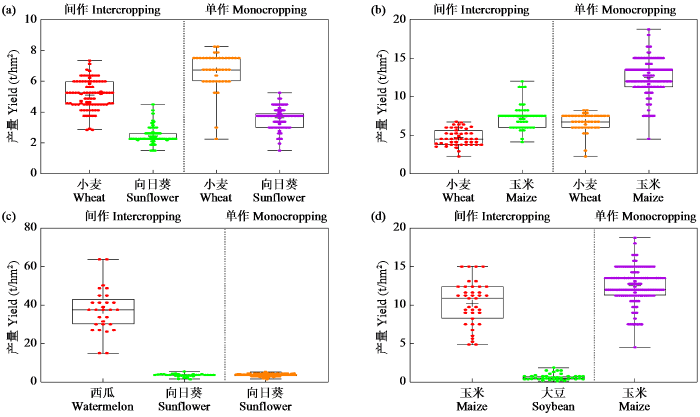
不同种植体系下各作物产量表现如图1所示。单作小麦、玉米和向日葵的平均产量分别为6.71、13.50和3.62 t/hm2。小麦/向日葵套作中小麦和向日葵间作产量平均分别为5.11和2.44 t/hm2,均低于相应作物的单作产量,主要是由于套作中作物占地面积减少。小麦/玉米套作中小麦和玉米产量平均分别为4.69和7.40 t/hm2,同样均低于相应作物的单作产量。根据作物平均产量计算平均土地当量比(LER),小麦/向日葵套作和小麦/玉米套作的LER分别为1.48和1.29,即2种套作体系均能够提高土地利用效率,且小麦/向日葵套作的优势高于小麦/玉米套作,小麦/向日葵套作中的小麦产量高于小麦/玉米套作中的小麦产量。西瓜/向日葵套作中,西瓜由于品种差异导致不同农户间产量差异较大,最高产量可达63.75 t/hm2,最低仅为15.00 t/hm2,套作向日葵平均产量为3.62 t/hm2,和单作产量差异并不明显。玉米||大豆间作中玉米和大豆间作产量分别为10.25和0.67 t/hm2,间作玉米产量略低于单作玉米产量。
图1
2.2.2 间套作施肥量分析
不同种植体系下各作物的N-P2O5-K2O施肥用量如图2所示。单作小麦、玉米和向日葵的N平均施用量分别为317.3、478.1和260.5 kg/hm2,P2O5平均施用量分别为232.4、295.0和184.7 kg/hm2,K2O平均施用量分别为21.6、51.9和50.2 kg/hm2,玉米N施用量和P2O5施用量均大于小麦,向日葵N施用量和P2O5施用量最低,小麦K2O施用量最低,玉米和向日葵K2O施用量差距不大。小麦/向日葵、小麦/玉米、西瓜/向日葵和玉米||大豆4个间套作体系的平均N施用量分别为532.7、888.9、487.5和495.2 kg/hm2,P2O5平均施用量分别为392.2、637.4、380.3和326.6 kg/hm2,K2O平均施用量分别为80.8、97.5、143.5和36.4 kg/hm2,4种间套作体系的施肥量均明显高于相应单作的施肥量,小麦/玉米套作的N施用量远高于其他间套作体系,其次是小麦/向日葵套作,西瓜/向日葵套作的N施用量最低,玉米||大豆间作中大豆作为豆科作物不需要过多氮肥投入,因此该体系的N施用量和单作玉米的N施用量较为接近。各种植体系的P2O5施用量表现出和N施用量一样的趋势。西瓜对钾肥需求量较高,因此西瓜/向日葵套作中K2O施用量高于其他种植体系。
图2
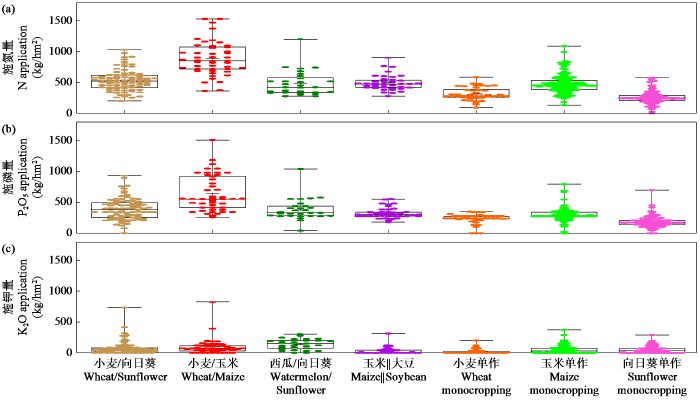
图2
不同种植体系的施肥量
Fig.2
Fertilizer application amount in different cropping systems
2.2.3 间套作田间管理
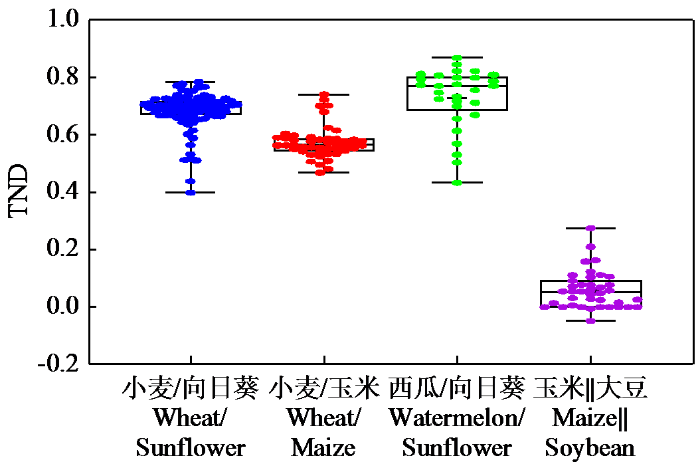
通过调研明确了杭锦后旗各作物的播种和收获时间及共生期的长短。间套作体系中,小麦主要在3月中下旬播种,7月中旬收获;玉米在4月下旬至5月初播种、9月下旬收获;向日葵在5月下旬播种,9月下旬至10月初收获;西瓜在4月中旬播种,7月中旬开始收获;大豆在5月上旬播种,9月下旬收获。小麦/向日葵套作TND平均为0.68、小麦/玉米套作TND平均为0.57、西瓜/向日葵套作TND平均为0.73,这3个体系的套作作物共生期较短。玉米||大豆间作TND平均为0.06,玉米||大豆间作作物共生期最长,2种作物一般为同期播种同期收获(图3)。
图3
作物灌溉次数与生育期有关,按照当地供水规律和农民习惯,作物生育期越长灌溉次数越多,灌溉次数玉米>小麦>向日葵。与相应单作相比,间套作体系灌溉次数有所增加,主要因为在间套作体系下作物灌溉要考虑2种作物,除去共生期外,在各作物单独生育期内也需要根据作物需求进行灌溉(图4)。以单个农户为例,在小麦/向日葵套作中共灌溉5次,其中在向日葵播种前小麦的单独生育期需要灌溉1次,向日葵和小麦共生期需共同灌溉3次,小麦收获后在向日葵单独生育期还需灌溉1次。在小麦/向日葵、小麦/玉米、西瓜/向日葵和玉米||大豆4种间套作体系下除草次数均明显多于小麦、向日葵和玉米单作(图4),单作中除草次数平均为1.28次,而在间套作中除草次数平均为2.18次,并且在间套作中人工除草的频次增加。
图4
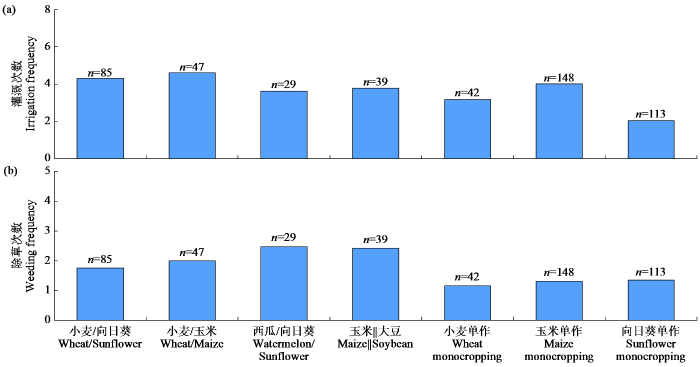
图4
不同种植体系的灌溉次数和除草次数
“n”代表调研样本数。
Fig.4
Irrigation frequency and weeding frequency of different cropping systems
“n”represents the number of survey samples.
小麦/向日葵、小麦/玉米、西瓜/向日葵和玉米||大豆4种间套作体系涉及施基肥、覆膜、播种、追肥和收获5个农事操作过程(图5)。施基肥过程中90%以上实现机械化;覆膜全部为机械化操作;播种和收获的机械化程度主要根据作物不同而有所差异,其中小麦和玉米2种作物机械化程度最高,大豆、向日葵和西瓜机械化程度较低;追肥基本依靠人工追肥。整体来看小麦/玉米套作体系机械化程度最高,仅追肥过程使用人工,其余农事操作均为机械化,且调研发现大部分机器为多功能一体机,例如小麦施基肥和播种可以采用一种机器同时完成,玉米施基肥、覆膜和播种可使用同一机器同时完成。西瓜/向日葵套作体系的机械化程度最低,即粮食作物间套作机械化程度高于经济作物间套作。
图5
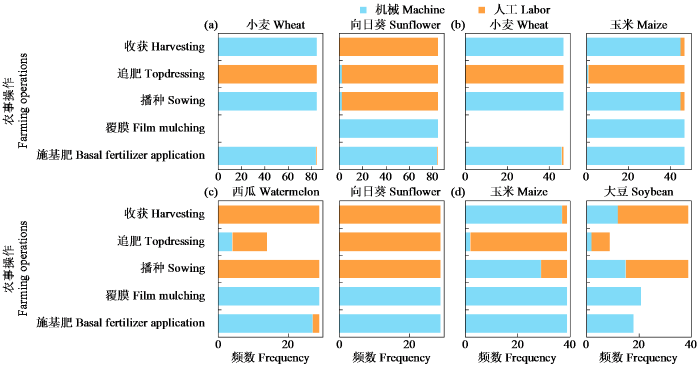
图5
不同间套作种植体系农事操作的机械化情况
(a)、(b)、(c)、(d) 分别代表小麦/向日葵、小麦/玉米、西瓜/向日葵、玉米||大豆间套作的机械化情况。
Fig.5
Mechanization status of farming managements in different intercropping systems
(a), (b), (c), and (d) represent mechanization of wheat/sunflower, wheat/maize, watermelon/sunflower, and maize||soybean intercropping, respectively.
2.3 农户对间套作种植的认知
2.3.1 农户选择间套作的原因及田间管理技术信息来源
在农户对间套作认知的调研中(图6),有50%左右的农户认为,“土壤肥力条件好、为了高收益愿意付出劳动、间套作能够增产增收、间套作是传统种植习惯”等是他们采取间套作种植的原因(图6)。也有部分农户认为,选择间套作是为了地块换茬,换茬主要有2个目的:有22.0%的农户认为换茬可以提升土壤肥力,34.5%的农户认为通过换茬可以减少作物病虫菌害,例如在当地连续种植向日葵的地块,经常出现“烂头”的症状,这是一种真菌性病害引起的,而隔年通过间套作种植换茬可以减少这种病害的发生。调研发现“节水节肥”不是农户选择间套作的原因,而大量研究报道间套作能够实现“减水节肥”,但在农户实际应用间套作生产中,其灌水量和施肥量均高于相应单作。
图6
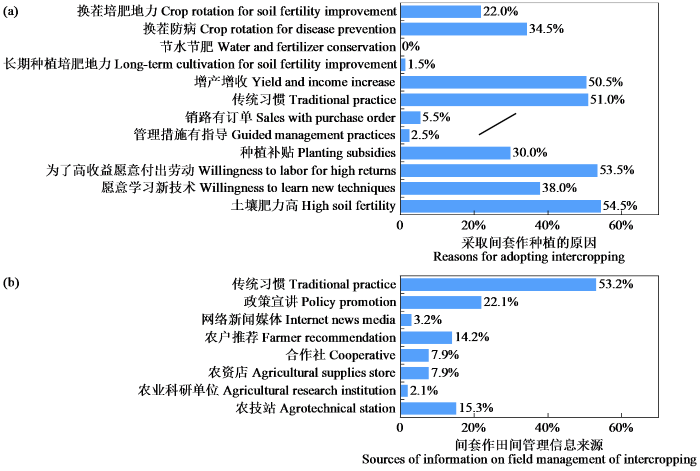
图6
采取间套作种植的原因及田间管理信息来源
Fig.6
Reasons for adopting intercropping and sources of information on field management of intercropping
有30%以上的农户选择间套作种植的原因为“有种植补贴”和“愿意学习新技术”,这部分农户基本都为玉米||大豆间作种植户,这可能与国家政策对玉米大豆带状复合种植技术的大面积推广和技术培训有关。仅有小部分农户选择间套作种植的原因为“销路有订单(5.5%)、长期种植培肥地力(1.5%)以及管理措施有指导(2.5%)”,可见农户对间套作长期种植能够提升土壤肥力的优势认知仍然不足,同时缺少作物销路订单,以及在生产管理上缺乏技术指导。因此,可以看到在农户进行间套作田间管理的信息来源(图6)中,有53.2%的农户依靠自身经验和传统习惯进行间套作种植的田间管理,有22.1%的农户通过政策宣讲来获取间套作种植田间管理信息,这部分农户大多为玉米||大豆种植户。另外“农户推荐(14.2%)、合作社(7.9%)、农资店(7.9%)、农技站(15.3%)”也是农户获取间套作种植田间管理技术的信息来源,但很少有农户通过网络新闻媒体和农业科研单位获取相关信息。
2.3.2 间套作种植需求及种植意愿
本研究进一步了解了农户对间套作种植技术的指导需求和未来是否继续采取间套作的意愿(图7)。前文调研结果表明,间套作种植中作物品种选择上较为杂乱,相应地,在间套作种植技术指导需求中认为作物品种的选择上需要指导的农户也最多,占33.5%。也有农户认为(28.4%)施肥时间及肥料选择上需要指导。此外,农户对间套作中病虫草害相关的技术指导有着较多需求,包括病虫草害发生的原因及其如何防治(26.5%)和主要病虫害症状识别(31.0%)的技术需求,也有小部分农户认为“土壤改良问题(3.2%)、作物播期选择(7.7%)和收获日期选择(3.2%)”需要指导,以上技术指导需求也是限制杭锦后旗间套作种植生产力的重要因素,同时相关技术指导的缺乏增加了种植成本进而影响了农户的间套作种植意愿。在未来是否愿意继续间套作的调研中发现,67.3%的农户表示仍然愿意继续进行间套作种植,有26.4%的农户表示是否进行间套作种植要根据政府相关政策决定,比如是否有种植补贴等,而有6.3%的农户表示未来不愿意再进行间套作种植。
图7
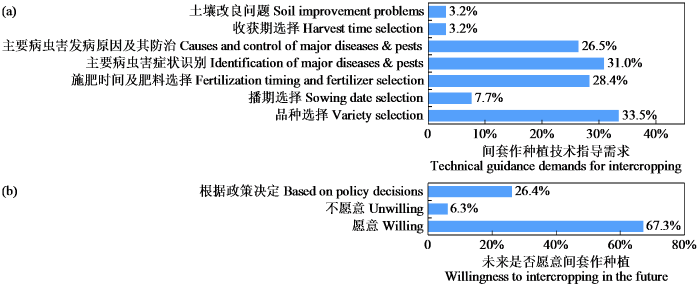
图7
间套作种植技术指导需求及种植意愿
Fig.7
Demands for technical guidance and willingness of intercropping
3 讨论
3.1 杭锦后旗间套作生产现状解析
杭锦后旗间套作体系总体可分为粮食作物间套作(小麦/玉米、玉米||大豆)、粮食作物和经济作物间套作(小麦/向日葵)、经济作物间套作(西瓜/向日葵)。但当地的间套作种植体系远不止这4种,2021年开展预调研时发现还有玉米/西瓜、玉米/甜瓜、向日葵/甜瓜、番茄/向日葵、青椒/向日葵和青椒/西瓜等,因为样本量非常少,统计不具有代表性,因此并未纳入本次调研范围。从种植体系上来看,尽管杭锦后旗间套作体系较为多样,但作为畜牧大旗,并未发现当地存在有关优质饲草生产的间套作体系,仅有个别大型合作社对玉米―大豆带状复合种植作为青贮饲用进行尝试,新型间作技术首先被大农场采用[9],调研秸秆去向时发现小麦、玉米和向日葵等作物秸秆以及西瓜瓜秧都被用作饲喂牲畜,可见当地农户对于饲草料有很大需求,但农作物秸秆的蛋白质含量普遍较低,远低于饲喂的蛋白标准[10],因此,需要探索适宜河套灌区的饲草间套作种植技术,以缓解当地草畜供需矛盾。在地域分布上,从调研结果和实地访谈来看,在头道桥镇间套作种植面积较广,种植规模较大,其他乡镇间套作种植仅为零星分布。各乡镇间套作体系的分布也与其区域特点和主导产业有关,根据杭锦后旗各镇不同地力等级的面积统计数据,三道桥镇一级耕地面积占比最大,西甜瓜、番茄等经济作物是三道桥镇的主导产业,因此,西瓜/向日葵套作主要分布在三道桥镇和邻近的蒙海镇。
3.2 杭锦后旗间套作体系评价及存在问题
根据调研结果和对农户的深入访谈,对各间套作体系的系统评价如下。4种间套作体系中小麦/向日葵套作、小麦/玉米套作和西瓜/向日葵套作均为当地已种植多年的较为成熟的套作体系,是当地传统的种植方式。小麦/向日葵和小麦/玉米套作均为条带式套作,生产中方便机械化操作,套作条带中向日葵和玉米多为覆膜种植,从间套作生产力上来看,换算成当量产量,相比单作分别可增产48%、29%,这也是2种套作体系在当地分布较多的原因。西瓜/向日葵套作体系在当地备受青睐,大部分种植西瓜的农户都会选择这种种植方式,因为西瓜在当地一年一熟有余,而两熟不足,西瓜/向日葵套作可以利用2种作物不同的生长季节,实现一年两收,西瓜/向日葵套作体系为添加式设计,套作西瓜的种植密度和占地面积与单作完全保持一致,在保证西瓜产量的同时还能多收一茬向日葵,并且向日葵在套作下没有减产,充分利用了土地资源[11],相比其他间套作体系而言,该体系的经济效益最高。在全国玉米大豆带状复合种植技术推广的大背景下[12],玉米||大豆间作在当地近两年才开始种植,主要来源于农技推广部门的政策宣传和技术指导,该体系中玉米减产较少,有部分农户甚至能获得和单作玉米产量相当的间作玉米产量,同时还增加了大豆收成,还有相应的种植补贴,可作为助力当地增产增收的间套作生产体系。
本研究4种间套作体系均表现出相应的生产优势,但在生产过程中也存在一系列问题,限制了当地间套作种植的发展。一方面表现为间套作的田间管理较为复杂[13],如灌水次数和除草次数明显增加,尤其在调研中发现间套作体系的病虫草害防治是一大难点。以玉米||大豆间作为例,由于间作中存在禾本科和豆科2类作物,除草剂的使用会有所冲突,大部分农户只能选择人工除草,在玉米||大豆间作地块中普遍可以看到杂草频生,这也是间作中大豆产量偏低的原因[14],尽管有相关种植技术指导,但由于生产成本和农户认知等原因导致当前技术到位率仍偏低[15],相比其他3种套作体系而言,该体系在当地还不够成熟。另一方面,由于农户对间套作的认知有限和传统种植习惯,导致间套作体系中灌水和施肥过量[16],主要是由于作物管理频次的增加,其中,灌水频次增加导致灌水量上升,同样,由于施肥频次增加导致施肥过量,间套作的施肥频次和农户在单作中的施肥习惯有关,据前人[17]调研:杭锦后旗56.0%农户的玉米施氮量集中在300~450 kg/hm2,农户习惯施肥量普遍过高。而本研究调研发现,在间套作中各作物的施肥频次和单作一致,同时还保持了和单作每次基本同样的施肥量,以致于施肥量成倍的增加,以施氮量最高的小麦/玉米套作体系为例,农户施肥次数最多可达5次:其中小麦和玉米播种时各套作条带分别施基肥,共生期间内在各作物需肥时期(小麦追肥:5月中旬;玉米追肥:6月中旬)各自条带分别追肥1次,在小麦收获后,玉米单独生育期内还进行1次追肥,每次施肥时,假设套作中小麦种植面积占比为40%,但仍然保持了小麦单作100%的施肥量,也有部分农户在单作施肥量的基础上适当减少,这与河北省曲周县农户的间作施肥习惯类似[18],可能与农户害怕减产的普遍心理有关,同时也说明农户对间套作种植的科学认知不足。此外,复杂的田间管理随之带来的是生产成本的增加和严重的资源浪费,例如除草增加了人工成本,作物收获时机械成本增加;灌水量过多导致水资源浪费以及土壤盐渍化加重[19];施肥量过多导致养分盈余,也增加了土壤和环境恶化的风险[2],以上因素均制约着杭锦后旗间套作种植的可持续性。
3.3 杭锦后旗间套作种植发展的综合讨论
农户选择间套作种植的主要目的是为了增产增收,获得更高的经济效益,与此同时要注重间套作种植系统的可持续发展[20]。对于杭锦后旗间套作种植的发展,根据调研结果提出以下几点建议和展望:
首先,优化杭锦后旗的间套作种植体系,加强对间套作优良品种的筛选;探索适合间套作的田间管理措施,如仅在作物共生期内灌水是否也能满足各作物的水分需求;减少间套作体系施肥量,如在作物共生期内是否可以同时追肥,进而减少施肥次数,可根据养分盈余确定追肥频次和用量,简化农事操作,降低生产成本[21]。
最后,杭锦后旗作为畜牧大旗,对优质饲草有着极大的需求,而当前存在的间套作模式均应用于粮食作物和经济作物生产,故在继续加强当地已有间套作种植技术应用和推广的基础上,需因地制宜探索更加高产高效的间套作生产体系,以满足当地的种植业和养殖业的生产需求,如禾/豆饲草间套作体系[23]。为推进当地种养循环,可结合养殖端粪污资源化利用实现有机肥还田,采用有机肥替代的方式优化施肥。
4 结论
杭锦后旗种植较为广泛的间套作体系分别有小麦/玉米、小麦/向日葵、西瓜/向日葵和玉米||大豆间套作体系,其中小麦/向日葵、小麦/玉米套作种植分布最多,分别占42.5%和23.5%,均能显著提高土地利用效率,LER分别为1.48和1.29。不同间套作体系下种植模式非常多样化,作物品种选择较多,仅玉米多达21个品种。小麦/玉米、小麦/向日葵和西瓜/向日葵为套作模式,共生期较短,玉米||大豆间作的共生期最长,同期播种同期收获。在机械化程度方面,小麦/玉米套作体系机械化程度最高,西瓜/向日葵套作机械化程度最低,粮食作物机械化程度高于经济作物。
当地间套作种植主要存在两方面限制因素,一方面,间套作种植中田间管理措施更为复杂,其中灌溉次数和除草次数均高于相应的单作,缺乏相应的技术指导,增加了生产成本;另一方面,由于农户对间套作种植的科学认知有限,传统的施肥习惯导致当地间套作种植存在施肥过量的问题,间套作体系的施氮量比单作平均高70.7%。因此,建议在当地进一步探索适合间套作的田间管理措施和施肥策略,以减少水肥投入;同时加强间套作配套机械和除草剂等相关生产资料的研发,并开展技术培训;加强对间套作种植的田间指导以提高农户认知;此外,基于当地生产结构,亟需调整种植结构,因地制宜开发新体系,探索高产优质的间套作模式。
参考文献
Spatiotemporal mismatch of global grain production and farmland and its influencing factors
Fungal endophyte promotes plant growth and disease resistance of Arachis hypogaea L.by reshaping the core root microbiome under monocropping conditions
Agricultural input shocks affect crop yields more in the high-yielding areas of the world
DOI:10.1038/s43016-023-00873-z
PMID:37945784
[本文引用: 1]

The industrialization of agriculture has led to an increasing dependence on non-locally sourced agricultural inputs. Hence, shocks in the availability of agricultural inputs can be devastating to food crop production. There is also a pressure to decrease the use of synthetic fertilizers and pesticides in many areas. However, the combined impact of the agricultural input shocks on crop yields has not yet been systematically assessed globally. Here we modelled the effects of agricultural input shocks using a random forest machine learning algorithm. We show that shocks in fertilizers cause the most drastic yield losses. Under the scenario of 50% shock in all studied agricultural inputs, global maize production could decrease up to 26%, and global wheat production up to 21%, impacting particularly the high-yielding 'breadbasket' areas of the world. Our study provides insights into global food system resilience and can be useful for preparing for potential future shocks or agricultural input availability decreases at local and global scales.© 2023. The Author(s).
Intercropping: feed more people and build more sustainable agroecosystems
Farm size and smallholders’ use of intercropping in Northwest China
Optimized sowing date enhances crop resilience towards size-asymmetric competition and reduces the yield difference between intercropped and sole maize
Yield performance response to field configuration of maize and soybean intercropping in China: a meta-analysis
Relay cropping for sustainable intensification of agriculture across temperate regions: crop management challenges and future research priorities
Weed-induced crop yield loss: a new paradigm and new challenges
DOI:10.1016/j.tplants.2022.12.014
PMID:36610818
[本文引用: 1]
Direct competition for resources is generally considered the primary mechanism for weed-induced yield loss. A re-evaluation of physiological evidence suggests weeds initially impact crop growth and development through resource-independent interference. We suggest weed perception by crops induce a shift in crop development, before resources become limited, which ultimately reduce crop yield, even if weeds are subsequently removed. We present the mechanisms by which crops perceive and respond to weeds and discuss the technologies used to identify these mechanisms. These data lead to a fundamental paradigm shift in our understanding of how weeds reduce crop yield and suggest new research directions and opportunities to manipulate or engineer crops and cropping systems to reduce weed-induced yield losses.Published by Elsevier Ltd.
Intercropping contributes to a higher technical efficiency in smallholder farming: evidence from a case study in Gaotai county,China
Economic performance and sustainability of a novel intercropping system on the North China Plain
DOI:10.1371/journal.pone.0135518 URL [本文引用: 1]
Interspecific competition and productivity in a dryland silage maize/alfalfa intercropping system
DOI:10.1002/fes3.474
URL
[本文引用: 1]
Cereal–legume intercropping has the potential to reduce the use of nitrogen (N) fertilizer and increase forage yield and quality, however, how to optimize system design to fully realize interspecific complementary and enhance crop production in an annual and perennial crops intercropping was not well understood. This study was conducted to evaluate the interspecific interaction and yield performance of silage maize (Zea mays L.) and alfalfa (Medicago sativa L.) intercropping in response to N management and row arrangement under the rain‐fed conditions on the Chinese Loess Plateau. Five planting arrangements, namely, sole maize, sole alfalfa, and maize and alfalfa intercropping in rows of 1:2 (I12), 2:2 (I22), and 2:4 (I24), were compared over a period of 4 years (2018–2021). Two N‐levels (150 and 90 kg N ha−1) were applied to maize in each planting arrangement. Our results show that maize was the dominant species in 2018. In the next 3 years (2019–2021), maize was outcompeted by alfalfa during the first and second cuts of alfalfa, and complete recovery growth of maize was recorded at the third cut. The interspecific competition of I24 was less severe, resulting in a higher yield than I12 and I22. Although the reduction of N application reduced the biomass and crude protein (CP) yield, it weakened the interspecific competition and substantially increased the land equivalent ratio (LER). I24 under low N yielded more than sole cropping, with the LER based on biomass and CP yield of 1.01–1.12 and 1.08–1.18, respectively. In addition, I24 had the highest net revenue of 24,251 ¥ ha−1 on average. Therefore, maize/alfalfa intercrop with a higher alfalfa proportion and a wide strip arrangement (I24) in combination with low N application could alleviate interspecific competition and improve forage production, which is suggested for our study region and similar dryland farming areas worldwide. Maize/alfalfa intercropping provides a basis for grain and livestock mixed farming and helps to improve food supply and resilience of the farming system.
Temperature-mediated developmental delay may limit yield of cotton in relay intercrops with wheat
DOI:10.1016/j.fcr.2007.12.010 URL [本文引用: 1]
Early competition shapes maize whole-plant development in mixed stands
DOI:10.1093/jxb/ert408
PMID:24307719
[本文引用: 1]
Mixed cropping is practised widely in developing countries and is gaining increasing interest for sustainable agriculture in developed countries. Plants in intercrops grow differently from plants in single crops, due to interspecific plant interactions, but adaptive plant morphological responses to competition in mixed stands have not been studied in detail. Here the maize (Zea mays) response to mixed cultivation with wheat (Triticum aestivum) is described. Evidence is provided that early responses of maize to the modified light environment in mixed stands propagate throughout maize development, resulting in different phenotypes compared with pure stands. Photosynthetically active radiation (PAR), red:far-red ratio (R:FR), leaf development, and final organ sizes of maize grown in three cultivation systems were compared: pure maize, an intercrop with a small distance (25cm) between maize and wheat plants, and an intercop with a large distance (44cm) between the maize and the wheat. Compared with maize in pure stands, maize in the mixed stands had lower leaf and collar appearance rates, increased blade and sheath lengths at low ranks and smaller sizes at high ranks, increased blade elongation duration, and decreased R:FR and PAR at the plant base during early development. Effects were strongest in the treatment with a short distance between wheat and maize strips. The data suggest a feedback between leaf initiation and leaf emergence at the plant level and coordination between blade and sheath growth at the phytomer level. A conceptual model, based on coordination rules, is proposed to explain the development of the maize plant in pure and mixed stands.
Enhancing nitrogen use efficiency in crop plants
Nitrogen in agriculture: balancing the cost of an essential resource
DOI:10.1146/energy.2009.34.issue-1 URL [本文引用: 1]
Intercropping of grain legumes and cereals improves the use of soil N resources and reduces the requirement for synthetic fertilizer N: a global- scale analysis
DOI:10.1007/s13593-020-0607-x
[本文引用: 1]
Planetary boundaries for terrestrial inputs of reactive nitrogen (Nr) are transgressed and reducing the input of new Nr and its environmental impacts are major global challenges. Grain legumes fix dinitrogen (N2) in symbiosis with soil bacteria and use soil N sources, but often less efficient than cereals. Intercropping grain legumes with cereals may be a means of increasing use efficiency of soil N. Here, we estimate the global sole cropped grain legume acquisition of N from soil to approximately 14.2 Tg N year−1, which corresponds to one-third of the global synthetic fertilizer N use (109 Tg N year−1) for all crops, assuming that grain legumes recover on average 40% of the fertilizer N. Published data from grain legume-cereal intercrop experiments, employing stable 15N isotope methods, have shown that due to competitive interactions and complementary N acquisition in intercrops, the cereals recover a more than proportional share of the soil N sources. As a consequence, the intercropped legume derives more of its N from the atmosphere, compared with when it is grown as legume sole crop. We estimated that the increased N use efficiency in intercropping can reduce the requirements for fossil-based fertilizer N by about 26% on a global scale. In addition, our estimates indicate that if all current grain legume sole crops would instead be intercropped with cereals, a potential net land saving would be achieved, when also replacing part of the current cereal sole crop area with intercropping. Intercropping has additional potential advantages such as increased yield stability and yield per unit area, reduced pest problems and reduced requirements for agrochemicals, while stimulating biodiversity. It is concluded that crop diversification by intercropping has the potential to reduce global requirements for synthetic fertilizer N and consequently support the development of more sustainable cropping systems.


