玉―豆和麦―豆轮作对大豆田杂草发生规律的影响
王宇 , 1 , 2 , 王金生 1 , 3 , 王晓曦 1 , 2 , 马力 1 , 3 , 王克勤 1 , 2 , 王春 1 , 2 , 刘兴龙 , 1 , 2 , 吴俊江 , 1 , 3 , 李沐恺 4
1 黑龙江省农业科学院,150086,黑龙江哈尔滨
2 农业农村部哈尔滨作物有害生物科学观测实验站,150086,黑龙江哈尔滨
3 农业农村部大豆栽培重点实验室/黑龙江省大豆栽培重点实验室,150086,黑龙江哈尔滨
4 黑龙江八一农垦大学农学院,163319,黑龙江大庆
Effects of Maize-Soybean and Wheat-Soybean Rotation Modes on Weed Occurrence Regularity in Soybean Field
Wang Yu , 1 , 2 , Wang Jinsheng 1 , 3 , Wang Xiaoxi 1 , 2 , Ma Li 1 , 3 , Wang Keqin 1 , 2 , Wang Chun 1 , 2 , Liu Xinglong , 1 , 2 , Wu Junjiang , 1 , 3 , Li Mukai 4
1 Heilongjiang Academy of Agricultural Sciences, Harbin 150086, Heilongjiang, China
2 Scientific Observing and Experimental Station of Crop Pests in Harbin, Ministry of Agriculture and Rural Affairs, Harbin 150086, Heilongjiang, China
3 Key Laboratory of Soybean Cultivation, Ministry of Agriculture and Rural Affairs /Heilongjiang Provincial Key Laboratory of Soybean Cultivation, Harbin 150086, Heilongjiang, China
4 College of Agriculture, Heilongjiang Bayi Agricultural University, Daqing 163319, Heilongjiang, China
通讯作者: 刘兴龙,主要从事害虫生物防治与综合治理研究,E-mail:13244664780@163.com ; 吴俊江为共同通信作者,主要从事大豆耕作与栽培技术研究,E-mail:nkywujj@126.com
收稿日期: 2024-08-28
修回日期: 2024-09-9
网络出版日期: 2025-03-28
基金资助:
黑龙江省农业科技创新跨越工程农业特色产业科技创新支撑项目 (CX23TS26 )黑龙江省“揭榜挂帅”科技攻关项目“第四积温区秸秆还田大豆保护性耕作高产增效关键技术研究” (2021ZXJ05B02-02 )
Received: 2024-08-28
Revised: 2024-09-9
Online: 2025-03-28
作者简介 About authors
王宇,主要从事有害生物防治与综合治理研究,E-mail:wangyuryan@163.com
摘要
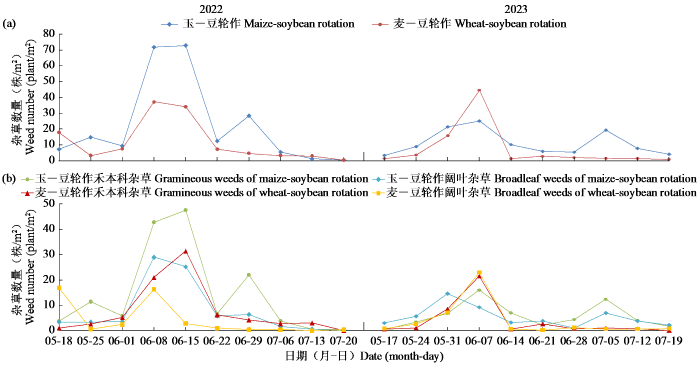
为精准制定玉米―大豆(玉―豆)和小麦―大豆(麦―豆)轮作种植模式下大豆田杂草的防控措施,调查了2种轮作模式下大豆田杂草发生种类和数量。结果表明,在2年试验中,玉―豆轮作模式下的杂草发生量分别是麦―豆轮作模式的1.89倍和1.49倍。玉―豆轮作模式下共11种杂草在2年均有发生,包括2种禾本科杂草和9种阔叶杂草,优势种杂草为禾本科杂草稗草和阔叶杂草藜、苘麻,亚优势种杂草为禾本科杂草野黍和阔叶杂草反枝苋、龙葵。麦―豆轮作模式下2年有8种杂草共同发生,包括禾本科杂草2种和阔叶杂草6种,优势种杂草为禾本科杂草稗草和阔叶杂草藜、苘麻,亚优势种杂草为阔叶杂草龙葵。玉―豆轮作模式下杂草发生量有2个高峰期,分别是在5月末到6月中旬和6月末到7月上旬,第1个高峰期的发生量大于第2个高峰期;而麦―豆轮作模式下则只有1个杂草发生高峰期,主要集中在6月上中旬。
关键词:
大豆田 轮作 杂草种类 优势种杂草 杂草发生规律
Abstract
In order to precisely formulate weed control strategies for soybean field under maize-soybean and wheat-soybean rotation modes, the species and quantities of weeds were investigated in these two rotation modes. The results showed that during the two-year experiment, the weed occurrence in the maize-soybean rotation mode was 1.89 and 1.49 times higher than that in the wheat-soybean rotation mode, respectively. In the maize-soybean rotation mode, a total of 11 weed species were consistently observed over the two years, including two gramineous weeds and nine broadleaf weeds. The dominant weed species were the gramineous Echinochloa crusgalli and the broadleaf Chenopodium album and Abutilon theophrasti . The subdominant species were the gramineous Eriochloa villosa and the broadleaf Amaranthus retroflexus and Solanum nigrum . For the wheat-soybean rotation mode, eight weed species were commonly observed over the two years, including two gramineous weeds and six broadleaf weeds. The dominant species included the gramineous E.crusgalli and the broadleaf C.album and A.theophrasti , while the subdominant species was the broadleaf Solanum nigrum . The maize-soybean rotation mode exhibited two weed occurrence peaks: one from late May to mid-June, and another from late June to early July, with the weed occurrence during the first peak period being greater than that during the second. Conversely, the wheat-soybean rotation mode showed only one weed occurrence peak, primarily concentrated in early to mid-June.
Keywords:
Soybean field Rotation Weed species Dominant weed species Weed occurrence regularity
本文引用格式
王宇, 王金生, 王晓曦, 马力, 王克勤, 王春, 刘兴龙, 吴俊江, 李沐恺. 玉―豆和麦―豆轮作对大豆田杂草发生规律的影响 . 作物杂志 , 2026, 42(1): 175-181 doi:10.16035/j.issn.1001-7283.2026.01.022
Wang Yu, Wang Jinsheng, Wang Xiaoxi, Ma Li, Wang Keqin, Wang Chun, Liu Xinglong, Wu Junjiang, Li Mukai. Effects of Maize-Soybean and Wheat-Soybean Rotation Modes on Weed Occurrence Regularity in Soybean Field . Crops
大豆作为我国主要的粮油兼用型农作物,是优质植物蛋白、油脂及多种功能性医疗保健品的重要来源[1 -2 ] ,也是关系国计民生的重要基础性和战略性物资[3 ] 。黑龙江省是我国最大的大豆产区[2 ,4 ] ,国家统计局[5 ] 公布2022年黑龙江省的大豆播种面积约为4.93×10⁶ hm2 (7397.5万亩),总产量约9.54×10⁹ kg(190.7亿斤),占全国的48.1%。耕作模式是影响作物产量的重要因素之一,长期连作会导致大豆产量降低、品质变差、生长发育受阻,且病虫害加剧[6 8] 。为提高大豆产量与品质,黑龙江省在耕地轮作试点技术路径中推广“一主多辅”种植模式,即以玉米与大豆轮作为主,小麦、杂粮、薯类及经济作物与大豆轮作为辅。自2019年起,黑龙江省推进秸秆综合利用,突出“一主两辅”,即以还田为主,燃料化和饲料化为辅,切实促进全省秸秆综合利用,确保综合利用率达到80%以上,其中还田利用率达到55%以上。然而,大量的秸秆还田可能改变田间病虫草害的发生程度及规律[9 ] 。玉―豆轮作和麦―豆轮作模式下,玉米和小麦秸秆还田对大豆田杂草发生和群落变化规律的影响尚不清楚。因此,本研究连续2年系统研究了2种轮作模式下的杂草种类与数量、群落组成、发生规律及演替变化,旨在明确轮作模式下大豆田杂草的发生与种群演替规律,为不同轮作制度下大豆田杂草的高效防控提供理论依据和技术支持。
1 材料与方法
1.1 试验地概况
试验于黑龙江省哈尔滨市道外区民主乡黑龙江省农业科学院国家现代农业示范区试验地(45°49′ N,126°48′ E)进行。前茬作物分别为玉米和小麦,均为秸秆还田处理,秸秆粉碎后,采用液压双向翻转犁将其翻埋至30 cm土层。作物生长期间未使用任何除草剂。
1.2 试验设计
设玉―豆和麦―豆轮作2种秸秆还田种植模式。于各轮作模式的试验区内分别随机选择5个调查点,每点为1.0 m×1.0 m样方,定点调查。试验田分别于2022年5月11日和2023年5月10日播种大豆。试验区内不施用任何除草剂,进行正常农事操作。播种7 d后开始定点调查,直至2种轮作模式均不再有杂草出现。2年试验中,2种轮作模式的试验区在同一地区的不同试验田。
1.3 测定项目与方法
从大豆播种开始,每7 d在固定的调查点调查1次,直至无新的杂草出现为止。每次调查记录杂草种类及发生数量,调查后拔除样方内所有杂草。完成全部调查后分别统计2种轮作模式的杂草发生种类和发生数量,计算杂草密度、相对密度、频度、相对频度和优势度,明确优势杂草种类和发生规律。相关分析指标及计算方法:
(1) $相对密度(%)=某种杂草密度/所有杂草的密度之和 \times 100 $
(2) $相对频度(%)=某种杂草的频度/所有杂草的频度之和 \times 100$
频度:某种杂草出现的样方数占所有调查样方数的百分数;
(3) $\text { 相对优势度 }=\text { 相对密度 }+ \text { 相对频度 }$
1.4 数据处理
采用WPS软件对原始数据进行统计分析,并制作优势种杂草发生动态图。
2 结果与分析
2.1 2种轮作模式对大豆田杂草多样性的影响
如表1 所示,玉―豆轮作模式下大豆田2022年发生的杂草共13种,隶属于11科12属,2023年共13种杂草发生,隶属于10科13属。2年调查结果存在11种相同种类的杂草,其中禾本科有2种,分别为稗草和野黍;阔叶杂草有9种,分别为藜、苘麻、本氏蓼、水棘针、龙葵、铁苋菜、马齿苋、反枝苋和狼耙草。2年调查结果均在阔叶杂草中存在差异,2022年单独发生萝藦和萹蓄,2023年单独发生野西瓜苗和刺儿菜。麦―豆轮作模式下大豆田2022年发生杂草共10种,隶属于8科10属,2023年共9种杂草发生,隶属于8科9属。其中有8种共同发生的杂草,禾本科杂草2种,分别为稗草和野黍;阔叶杂草6种,分别为藜、苘麻、本氏蓼、水棘针、龙葵和铁苋菜。2022年单独有萝藦和苍耳2种阔叶杂草发生,2023年则单独有1种阔叶杂草马齿苋发生。
玉―豆轮作模式下大豆田发生杂草的种类与数量均多于麦―豆轮作模式。2022年和2023年玉―豆轮作模式下大豆田杂草发生量分别为223.8和111.8株/m2 ,分别是麦―豆轮作模式的1.89倍和1.49倍。2022年杂草发生量大于2023年,2022年玉―豆轮作和麦―豆轮作模式下杂草数量分别为223.8和118.4株/m2 ,分别是2023年的2.00倍和1.57倍。综上所述,不同轮作模式和年份对大豆田杂草多样性有一定的影响,杂草的发生种类和杂草数量有所不同。杂草累计发生量有所差异,麦―豆轮作模式下杂草发生种类和数量小于玉―豆轮作。
2.2 2种轮作模式下大豆田杂草发生规律
玉―豆轮作模式下,2022年和2023年大豆田杂草总发生量分别为223.8株/m2 和111.8株/m2 ,其中禾本科杂草发生量占比分别为64.5%和52.2%,阔叶杂草发生量占比分别为35.5%和47.8%。2年杂草发生的动态分析表明,玉―豆轮作模式下大豆田杂草发生均有2个高峰,第1个高峰期在5月末到6月中旬,第2个高峰期为6月末到7月上旬,第1个高峰期发生量大于第2个高峰期(图1a ),其中第1个高峰期中阔叶杂草发生高峰期较禾本科提前1周(图1b )。麦―豆轮作模式下,2022年和2023年大豆田杂草发生量分别为118.4株/m2 和75.2株/m2 ,其中禾本科杂草发生量占比分别为65.4%和50.0%,阔叶杂草发生量占比分别为34.6%和50.0%。2年杂草发生的动态分析表明,麦―豆轮作模式下大豆田杂草主要集中在前期发生,只有1个发生高峰在6月上中旬(图1a ),其中阔叶杂草在禾本科杂草发生高峰期之前或同时达到高峰(图1b )。
图1
图1
2种轮作模式下大豆田杂草发生动态
Fig.1
Weed occurrence dynamics of two rotation modes in soybean field
2.3 2种轮作模式下大豆田优势杂草
将2年试验相对优势度≥15的杂草归为优势种杂草,仅其中1年相对优势度≥15的杂草归为亚优势种杂草,其余杂草则归为次要杂草。结果(表2 )显示,玉―豆轮作模式下大豆田优势种杂草为禾本科杂草稗草和阔叶杂草藜、苘麻,亚优势种杂草为禾本科杂草野黍和阔叶杂草反枝苋、龙葵。2022年和2023年优势种和亚优势种杂草分别占杂草总发生量的95.9%和91.4%。麦―豆轮作模式下大豆田优势种杂草为禾本科杂草稗草和阔叶杂草藜、苘麻,亚优势种杂草为阔叶杂草龙葵。2022年和2023年优势种和亚优势种杂草分别占杂草总发生量的97.8%和92.6%。
2.4 2种轮作模式下大豆田优势种杂草发生规律
2.4.1 玉―豆轮作模式下大豆田优势种杂草发生规律
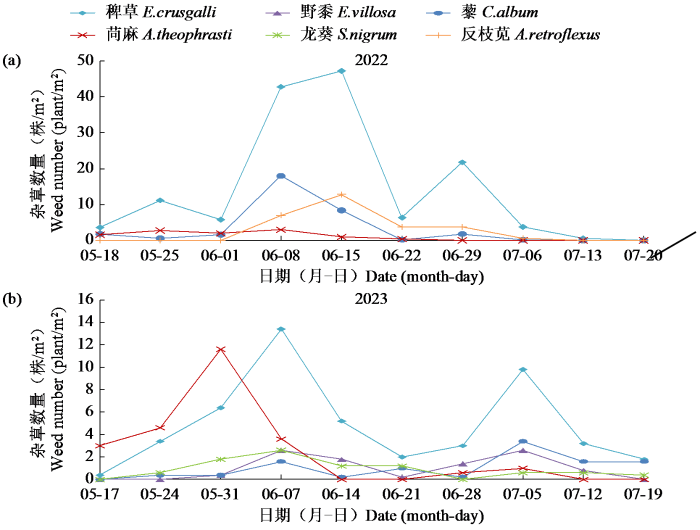
由图2 可知,玉―豆轮作模式下大豆田优势种杂草为稗草、藜和苘麻。稗草在整个调查期均有发生,有2个发生高峰期,在6月7日到6月15日和6月29日到7月5日,第1个高峰期发生量明显大于第2个高峰期。阔叶杂草藜在整个调查期均有发生,主要集中于6月7日到6月15日和6月29日到7月5日;苘麻在6月28日前均有发生,主要集中于5月24日到6月8日,其他时间少量发生;亚优势种禾本科杂草野黍在7月12日前均有发生;亚优势种阔叶杂草反枝苋只在6月8日到7月5日发生;龙葵在5月24日到7月19日均有发生。
图2
图2
玉―豆轮作模式下大豆田优势种杂草发生动态
Fig.2
Dominant weeds occurrence dynamics of maize-soybean rotation mode in soybean field
2.4.2 麦―豆轮作模式下大豆田优势种杂草发生规律
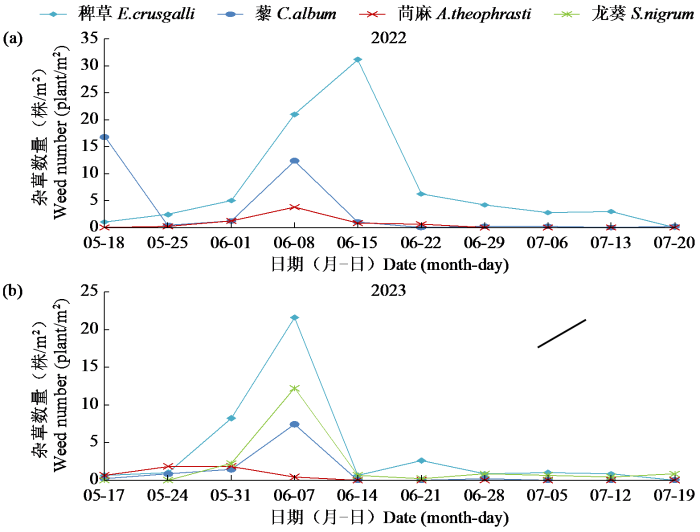
由图3 可知,麦―豆轮作模式下大豆田优势种杂草为稗草、藜和苘麻。禾本科杂草稗草在7月13日前均有发生,只有1个高峰期在6月7日到6月15日;阔叶杂草藜在种群基数大的情况下,大豆播种后就会集中发生,并在6月7日、8日再次集中发生;苘麻主要集中在6月22日前发生。亚优势种杂草龙葵在5月31日开始发生,集中发生在6月7日。
图3
图3
麦―豆轮作模式下大豆田优势种杂草发生动态
Fig.3
Dominant weeds occurrence dynamics of wheat-soybean rotation mode in soybean field
3 讨论
农田杂草是农业生态系统的重要组成部分,其与作物竞争光照和土壤养分等资源,导致作物减产,还会引发收获方面的问题,甚至可能成为作物病害的中间寄主,同时存在构建杂草种子库的风险等[10 ] 。轮作是一项重要的农艺措施,对农田杂草种群多样性和大小均有显著影响。本研究中,2年试验均显示玉―豆轮作模式下大豆田杂草的多样性和数量大于麦―豆轮作模式,说明玉―豆轮作模式下大豆田的种子多样性和数量均大于麦―豆轮作模式,其原因可能是黑龙江地区玉米和小麦的播种日期、行距差异以及小麦的化感作用。玉米在4月末至5月初进行垄播,行距较大;小麦在3月末进行条播,行距较小。这导致在玉米轮作模式下,5月以后萌发的杂草种群数量多于小麦轮作模式,使其大量结实并补充种子进入土壤种子库。此外,小麦能够分泌异羟肟酸、酚酸和短链脂肪酸类物质,对周围靶标产生不同的化感效应[11 ] 。研究[12 ] 证实,小麦水浸提液对节节麦、马唐、稗草和反枝苋的萌发和生长均有显著影响,对裂叶牵牛、小绒毛草、决明和日本稗等杂草种子也会产生一定的抑制作用。
本研究中,2种轮作模式下共有16种杂草,隶属于11科15属。其中,禾本科杂草2种,优势种杂草为稗草,野黍时有发生;阔叶杂草14种,优势种群为藜和苘麻,亚优势种群为野黍、反枝苋和龙葵,其他种类阔叶杂草少量发生。这与王洪武[13 ] 研究禾本科杂草稗草是三江平原玉米―大豆轮作的优势杂草种群的结论一致。本研究的2年试验中,同一种轮作模式均在同一地区的不同试验地块进行,结果发现不同年份的杂草种类有所不同,且同一种杂草在不同模式里的发生数量无明显规律。研究[13 ] 发现在三江平原玉米―大豆轮作模式下,同一村落不同地块间杂草种类不同,本研究结论与其相似。
轮作作物在形态特征和生长特点上的差异,会导致农田覆盖状况、地面光辐射强度和温度等因素发生变化,进而对杂草种子萌发、植株定植和生长产生明显影响[14 ] 。研究[10 ] 表明,选择不同的作物进行轮作,对田间杂草群落的影响存在巨大差异。本研究的2种轮作模式并未改变大豆田杂草的发生时间,但对杂草种群的动态变化产生了较大影响。在2年试验中,玉―豆轮作模式下大豆田杂草的总数量、禾本科优势种稗草以及阔叶杂草藜均出现了2个发生高峰期。这与黄春艳等[15 ] 对黑龙江哈尔滨地区旋耕处理下玉米田杂草发生规律的研究,以及殷红等[16 ] 对辽宁省春玉米田杂草发生规律的研究中观察到的明显双峰特点一致。相比之下,麦―豆轮作模式下杂草仅有1个发生高峰期,主要集中在6月上中旬,这与王宇等[17 ] 在2018年和2019年针对3种秸秆还田方式下玉米田杂草发生规律的研究结果相同。此外,优势种杂草苘麻在玉―豆轮作模式下的发生期长于麦―豆轮作模式。这2种秸秆还田模式下杂草发生量和发生周期的差异,主要原因可能在于小麦与玉米的收获时间不同。春小麦于7月末收获,此时一些晚出苗的早春杂草和晚春杂草无法完成其生活史。因此,麦―豆轮作模式下地下杂草的种子库基数和多样性均小于9月末到10月初收获的玉―豆轮作模式。
气候变化以及耕作栽培制度的改变,会对田间杂草的种类组成和群落结构产生重要影响[18 ] 。不同种类的秸秆还田后,会显著改变土壤的物理性质(如土壤深度和团粒大小)以及土壤结构,进而影响土壤中的水分和温度状况,最终导致土壤种子库中杂草的发生时间和出苗整齐度出现差异[19 22] 。
本研究发现,在2年试验中2种轮作模式下大豆田杂草的出苗时间并无差异,调查的第1周已有稗草、藜和苘麻等早春杂草出现。春季的气候条件,尤其是5月中下旬的降水量,对杂草的发生数量和发生高峰期有着显著影响[17 ] 。通过对播种日至5月31日的降水量进行统计,2022年和2023年的降水量分别为7.2和22.5 mm。因此,2022年杂草的发生高峰期集中在6月8日至15日之间,2023年则主要集中在5月31日至6月7日之间,降水量较大的2023年,其杂草发生高峰期比2022年提前了约1周。本研究中杂草发生量调查是在拔除已出苗杂草的前提下,每7 d新出现杂草的总数,并非自然生长状态下的杂草发生量。在自然生长条件下,杂草的发生量还会受到空间限制以及种内、种间竞争等多种因素的影响。研究结果不仅为大田苗后茎叶处理时选择适宜的除草剂、实施有效的化学防除提供了科学依据,还发现除了可将大豆叶龄和杂草叶龄作为确定大豆田茎叶处理施药时期的参考外,大豆田杂草种群动态也可作为施药时期的考量因素。这为更精准地防控大豆田杂草提供参考,进一步完善了轮作制度下大豆田杂草的防控技术体系。
4 结论
本研究明确了2种轮作模式下大豆田优势杂草的种类和发生规律。在玉―豆轮作模式下,优势种杂草为禾本科的稗草和阔叶杂草藜、苘麻,亚优势种杂草为禾本科的野黍和阔叶杂草反枝苋、龙葵;杂草发生量有2个高峰期,分别为5月末到6月中旬和6月末到7月上旬。在麦―豆轮作模式下,优势种杂草同样为禾本科的稗草和阔叶杂草藜、苘麻,亚优势种杂草为阔叶杂草龙葵;杂草发生高峰期主要集中于6月上中旬。
参考文献
View Option
[1]
王金生 , 闫晓艳 , 吴俊江 , 等 . 大豆营养高效利用型品种筛选
大豆科学 , 2020 , 39 (5 ):696 -702 .
[本文引用: 1]
[2]
王婉 , 刘鑫磊 , 孙君明 , 等 . 大豆新品种黑农84品质性状的环境稳定性分析
大豆科学 , 2024 , 43 (1 ):1 -12 .
[本文引用: 2]
[3]
刘忠堂 . 再谈我国大豆发展问题
大豆科技 , 2012 (6 ):4 -6 .
[本文引用: 1]
[4]
Zhang W W Feng Z Z Wang X K et al. Quantification of ozone exposure- and stomatal uptake-yield response relationships for soybean in Northeast China
Science of the Total Environment , 2017 (599/600 ):710 -720 .
[本文引用: 1]
[5]
国家统计局 . 中国统计年鉴2022 . 北京 : 中国统计出版社 , 2022 .
[本文引用: 1]
[6]
She S Y Niu J J Zhang C et al. Significant relationship between soil bacterial community structure and incidence of bacterial wilt disease under continuous cropping system
Archives of Microbiology , 2017 , 199 (2 ):267 -275 .
DOI:10.1007/s00203-016-1301-x
PMID:27699437
[本文引用: 1]
Soil bacteria are very important in biogeochemical cycles and play significant role in soil-borne disease suppression. Although continuous cropping is responsible for soil-borne disease enrichment, its effect on tobacco plant health and how soil bacterial communities change are yet to be elucidated. In this study, soil bacterial communities across tobacco continuous cropping time-series fields were investigated through high-throughput sequencing of 16S ribosomal RNA genes. The results showed that long-term continuous cropping could significantly alter soil microbial communities. Bacterial diversity indices and evenness indices decreased over the monoculture span and obvious variations for community structures across the three time-scale tobacco fields were detected. Compared with the first year, the abundances of Arthrobacter and Lysobacter showed a significant decrease. Besides, the abundance of the pathogen Ralstonia spp. accumulated over the monoculture span and was significantly correlated with tobacco bacterial wilt disease rate. Moreover, Pearson's correlation demonstrated that the abundance of Arthrobacter and Lysobacter, which are considered to be beneficial bacteria had significant negative correlation with tobacco bacterial wilt disease. Therefore, after long-term continuous cropping, tobacco bacterial wilt disease could be ascribed to the alteration of the composition as well as the structure of the soil microbial community.
[7]
陈雪丽 , 王玉峰 , 李伟群 , 等 . 黑土区连作大豆根际微生物群落结构的动态变化
大豆科学 , 2018 , 37 (5 ):748 -755 .
[8]
Wang Y Z Xu X M Liu T M et al. Analysis of bacterial and fungal communities in continuous-cropping ramie (Boehmeria nivea L. Gaud) fields in different areas in China
Scientific Reports , 2020 , 10 (1 ):3264 .
DOI:10.1038/s41598-020-58608-0
[本文引用: 1]
Ramie (Boehmeria nivea L. Gaud) suffers from long-term continuous cropping. Here, using Illumina high-throughput sequencing technology, we aimed to identify bacteria and fungi associated with continuous cropping in ramie fields in Yuanjiang, Xianning, Sichuan, and Jiangxi. The rarefaction results showed that Jiangxi had significantly lower bacterial α-diversity than that of the other areas. Firmicutes, Proteobacteria, and Acidobacteria were the dominant bacterial phyla, and Ascomycota, Basidiomycota, and Zygomycota were the dominant fungal phyla. In Jiangxi, Firmicutes accounted for 79.03% of all valid reads, which could have significant decreased microbial diversity and negative effects of continuous ramie cropping. We used traditional methods to examine soil nutrients. Sichuan had a relatively high pH and available P and K, but low total N; opposite findings were recorded in Jiangxi. The redundancy analysis revealed that the urease activity, PH, available K, and total N significantly correlated with bacterial community abundance, whereas only total N significantly correlated with fungal community abundance (P < 0.01). Overall, the effect of soil environmental factors on the bacterial diversity of continuous ramie cropping was greater than that on fungal diversity. In the future, we will focus on the effect of rhizosphere bacteria to solve the obstacle in continuous ramie cropping.
[9]
刘兴龙 , 王克勤 , 王晓曦 , 等 . 不同秸秆还田模式对亚洲玉米螟发生及玉米产量的影响
黑龙江农业科学 , 2023 (4 ):31 -35 .
[本文引用: 1]
[10]
程传鹏 , 潘俊峰 , 万开元 , 等 . 轮作对农田杂草的影响研究进展
中国农学通报 , 2013 , 29 (30 ):1 -9 .
[本文引用: 2]
[11]
王康君 , 陈凤 , 樊继伟 , 等 . 小麦化感作用的研究进展与展望
农业科技通讯 , 2018 (2 ):7 -11 .
[本文引用: 1]
[12]
邢海峰 , 高翠萍 , 王雪寅 , 等 . 三周龄小麦地上部浸提液对农田杂草的化感作用研究
沈阳农业大学学报 , 2022 , 53 (3 ):294 -301 .
[本文引用: 1]
[13]
王洪武 . 黑龙江省三江平原玉米-大豆轮作模式下田间杂草分布与防除
园艺与种苗 , 2023 , 43 (7 ):88 -90 .
[本文引用: 2]
[14]
魏守辉 , 强胜 , 马波 , 等 . 不同作物轮作制度对土壤杂草种子库特征的影响
生态学杂志 , 2005 (4 ):385 -389 .
[本文引用: 1]
[15]
黄春艳 , 王宇 , 黄元炬 , 等 . 不同耕作模式对玉米田杂草发生规律的影响
玉米科学 , 2010 , 18 (4 ):103 -107 ,111.
[本文引用: 1]
[16]
殷红 , 刘芳 , 李建东 , 等 . 不同种植方式春玉米田杂草的生态经济阈值研究
作物杂志 , 2009 (6 ):49 -52 .
[本文引用: 1]
[17]
王宇 , 郭玉莲 , 罗婵 , 等 . 不同秸秆还田模式对玉米田杂草发生规律的影响
黑龙江农业科学 , 2022 (3 ):38 -42 .
[本文引用: 2]
[18]
于乐 , 李林 , 黄红娟 , 等 . 湖北省玉米田杂草种类组成及群落特征
作物杂志 , 2023 (5 ):272 -279 .
[本文引用: 1]
[19]
于博 , 王钰艳 , 任琴 , 等 . 秸秆还田对土壤结构和春玉米生长的影响
浙江农业学报 , 2023 , 35 (10 ):2446 -2455 .
DOI:10.3969/j.issn.1004-1524.20221624
[本文引用: 1]
为探讨秸秆还田对旱地土壤结构和春玉米生长的影响,设置连续4 a的秸秆还田定位试验,测定土壤物理性质、结构、春玉米根系指标和产量的变化。结果显示,秸秆还田4 a后,≥0.25 mm团聚体的质量占比、团聚体平均质量直径、团聚体几何平均直径分别显著(P<0.05)增大了8.81%、12.61%、20.35%,团聚体稳定指数、团聚体不稳定系数分别显著增大了38.09%和6.85百分点,团聚体破坏率显著减小了8.49%,土壤容重显著降低了0.2 g·cm<sup>-3</sup>,总孔隙度、质量含水量和田间持水量分别显著增加了7.53、9.92、13.05百分点,耕层(0~20 cm)春玉米根干重、根表面积和根体积显著增加,产量显著提高24.58%。结果表明,长期秸秆还田改变了春玉米旱地的土壤结构状况,提高了土壤的保水性、通透性、团聚体的稳定性,改善了春玉米根系的生长环境,增产效果明显。
[20]
李瑞平 , 罗洋 , 郑洪兵 , 等 . 吉林省中部玉米秸秆还田方式对出苗及苗期生长发育的影响
农业与技术 , 2020 , 40 (18 ):6 -8 .
[21]
高盼 , 刘玉涛 , 徐莹莹 , 等 . 秸秆覆盖与翻埋两种还田模式对农田土壤物理性质及玉米产量的影响
黑龙江农业科学 , 2021 (11 ):13 -17 .
[22]
丁奠元 , 冯浩 , 赵英 , 等 . 氨化秸秆还田对土壤孔隙结构的影响
植物营养与肥料学报 , 2016 , 22 (3 ):650 -658 .
[本文引用: 1]
大豆营养高效利用型品种筛选
1
2020
... 大豆作为我国主要的粮油兼用型农作物,是优质植物蛋白、油脂及多种功能性医疗保健品的重要来源[1 -2 ] ,也是关系国计民生的重要基础性和战略性物资[3 ] .黑龙江省是我国最大的大豆产区[2 ,4 ] ,国家统计局[5 ] 公布2022年黑龙江省的大豆播种面积约为4.93×10⁶ hm2 (7397.5万亩),总产量约9.54×10⁹ kg(190.7亿斤),占全国的48.1%.耕作模式是影响作物产量的重要因素之一,长期连作会导致大豆产量降低、品质变差、生长发育受阻,且病虫害加剧[6 8 ] .为提高大豆产量与品质,黑龙江省在耕地轮作试点技术路径中推广“一主多辅”种植模式,即以玉米与大豆轮作为主,小麦、杂粮、薯类及经济作物与大豆轮作为辅.自2019年起,黑龙江省推进秸秆综合利用,突出“一主两辅”,即以还田为主,燃料化和饲料化为辅,切实促进全省秸秆综合利用,确保综合利用率达到80%以上,其中还田利用率达到55%以上.然而,大量的秸秆还田可能改变田间病虫草害的发生程度及规律[9 ] .玉―豆轮作和麦―豆轮作模式下,玉米和小麦秸秆还田对大豆田杂草发生和群落变化规律的影响尚不清楚.因此,本研究连续2年系统研究了2种轮作模式下的杂草种类与数量、群落组成、发生规律及演替变化,旨在明确轮作模式下大豆田杂草的发生与种群演替规律,为不同轮作制度下大豆田杂草的高效防控提供理论依据和技术支持. ...
大豆新品种黑农84品质性状的环境稳定性分析
2
2024
... 大豆作为我国主要的粮油兼用型农作物,是优质植物蛋白、油脂及多种功能性医疗保健品的重要来源[1 -2 ] ,也是关系国计民生的重要基础性和战略性物资[3 ] .黑龙江省是我国最大的大豆产区[2 ,4 ] ,国家统计局[5 ] 公布2022年黑龙江省的大豆播种面积约为4.93×10⁶ hm2 (7397.5万亩),总产量约9.54×10⁹ kg(190.7亿斤),占全国的48.1%.耕作模式是影响作物产量的重要因素之一,长期连作会导致大豆产量降低、品质变差、生长发育受阻,且病虫害加剧[6 8 ] .为提高大豆产量与品质,黑龙江省在耕地轮作试点技术路径中推广“一主多辅”种植模式,即以玉米与大豆轮作为主,小麦、杂粮、薯类及经济作物与大豆轮作为辅.自2019年起,黑龙江省推进秸秆综合利用,突出“一主两辅”,即以还田为主,燃料化和饲料化为辅,切实促进全省秸秆综合利用,确保综合利用率达到80%以上,其中还田利用率达到55%以上.然而,大量的秸秆还田可能改变田间病虫草害的发生程度及规律[9 ] .玉―豆轮作和麦―豆轮作模式下,玉米和小麦秸秆还田对大豆田杂草发生和群落变化规律的影响尚不清楚.因此,本研究连续2年系统研究了2种轮作模式下的杂草种类与数量、群落组成、发生规律及演替变化,旨在明确轮作模式下大豆田杂草的发生与种群演替规律,为不同轮作制度下大豆田杂草的高效防控提供理论依据和技术支持. ...
... [2 ,4 ],国家统计局[5 ] 公布2022年黑龙江省的大豆播种面积约为4.93×10⁶ hm2 (7397.5万亩),总产量约9.54×10⁹ kg(190.7亿斤),占全国的48.1%.耕作模式是影响作物产量的重要因素之一,长期连作会导致大豆产量降低、品质变差、生长发育受阻,且病虫害加剧[6 8 ] .为提高大豆产量与品质,黑龙江省在耕地轮作试点技术路径中推广“一主多辅”种植模式,即以玉米与大豆轮作为主,小麦、杂粮、薯类及经济作物与大豆轮作为辅.自2019年起,黑龙江省推进秸秆综合利用,突出“一主两辅”,即以还田为主,燃料化和饲料化为辅,切实促进全省秸秆综合利用,确保综合利用率达到80%以上,其中还田利用率达到55%以上.然而,大量的秸秆还田可能改变田间病虫草害的发生程度及规律[9 ] .玉―豆轮作和麦―豆轮作模式下,玉米和小麦秸秆还田对大豆田杂草发生和群落变化规律的影响尚不清楚.因此,本研究连续2年系统研究了2种轮作模式下的杂草种类与数量、群落组成、发生规律及演替变化,旨在明确轮作模式下大豆田杂草的发生与种群演替规律,为不同轮作制度下大豆田杂草的高效防控提供理论依据和技术支持. ...
再谈我国大豆发展问题
1
2012
... 大豆作为我国主要的粮油兼用型农作物,是优质植物蛋白、油脂及多种功能性医疗保健品的重要来源[1 -2 ] ,也是关系国计民生的重要基础性和战略性物资[3 ] .黑龙江省是我国最大的大豆产区[2 ,4 ] ,国家统计局[5 ] 公布2022年黑龙江省的大豆播种面积约为4.93×10⁶ hm2 (7397.5万亩),总产量约9.54×10⁹ kg(190.7亿斤),占全国的48.1%.耕作模式是影响作物产量的重要因素之一,长期连作会导致大豆产量降低、品质变差、生长发育受阻,且病虫害加剧[6 8 ] .为提高大豆产量与品质,黑龙江省在耕地轮作试点技术路径中推广“一主多辅”种植模式,即以玉米与大豆轮作为主,小麦、杂粮、薯类及经济作物与大豆轮作为辅.自2019年起,黑龙江省推进秸秆综合利用,突出“一主两辅”,即以还田为主,燃料化和饲料化为辅,切实促进全省秸秆综合利用,确保综合利用率达到80%以上,其中还田利用率达到55%以上.然而,大量的秸秆还田可能改变田间病虫草害的发生程度及规律[9 ] .玉―豆轮作和麦―豆轮作模式下,玉米和小麦秸秆还田对大豆田杂草发生和群落变化规律的影响尚不清楚.因此,本研究连续2年系统研究了2种轮作模式下的杂草种类与数量、群落组成、发生规律及演替变化,旨在明确轮作模式下大豆田杂草的发生与种群演替规律,为不同轮作制度下大豆田杂草的高效防控提供理论依据和技术支持. ...
Quantification of ozone exposure- and stomatal uptake-yield response relationships for soybean in Northeast China
1
2017
... 大豆作为我国主要的粮油兼用型农作物,是优质植物蛋白、油脂及多种功能性医疗保健品的重要来源[1 -2 ] ,也是关系国计民生的重要基础性和战略性物资[3 ] .黑龙江省是我国最大的大豆产区[2 ,4 ] ,国家统计局[5 ] 公布2022年黑龙江省的大豆播种面积约为4.93×10⁶ hm2 (7397.5万亩),总产量约9.54×10⁹ kg(190.7亿斤),占全国的48.1%.耕作模式是影响作物产量的重要因素之一,长期连作会导致大豆产量降低、品质变差、生长发育受阻,且病虫害加剧[6 8 ] .为提高大豆产量与品质,黑龙江省在耕地轮作试点技术路径中推广“一主多辅”种植模式,即以玉米与大豆轮作为主,小麦、杂粮、薯类及经济作物与大豆轮作为辅.自2019年起,黑龙江省推进秸秆综合利用,突出“一主两辅”,即以还田为主,燃料化和饲料化为辅,切实促进全省秸秆综合利用,确保综合利用率达到80%以上,其中还田利用率达到55%以上.然而,大量的秸秆还田可能改变田间病虫草害的发生程度及规律[9 ] .玉―豆轮作和麦―豆轮作模式下,玉米和小麦秸秆还田对大豆田杂草发生和群落变化规律的影响尚不清楚.因此,本研究连续2年系统研究了2种轮作模式下的杂草种类与数量、群落组成、发生规律及演替变化,旨在明确轮作模式下大豆田杂草的发生与种群演替规律,为不同轮作制度下大豆田杂草的高效防控提供理论依据和技术支持. ...
1
2022
... 大豆作为我国主要的粮油兼用型农作物,是优质植物蛋白、油脂及多种功能性医疗保健品的重要来源[1 -2 ] ,也是关系国计民生的重要基础性和战略性物资[3 ] .黑龙江省是我国最大的大豆产区[2 ,4 ] ,国家统计局[5 ] 公布2022年黑龙江省的大豆播种面积约为4.93×10⁶ hm2 (7397.5万亩),总产量约9.54×10⁹ kg(190.7亿斤),占全国的48.1%.耕作模式是影响作物产量的重要因素之一,长期连作会导致大豆产量降低、品质变差、生长发育受阻,且病虫害加剧[6 8 ] .为提高大豆产量与品质,黑龙江省在耕地轮作试点技术路径中推广“一主多辅”种植模式,即以玉米与大豆轮作为主,小麦、杂粮、薯类及经济作物与大豆轮作为辅.自2019年起,黑龙江省推进秸秆综合利用,突出“一主两辅”,即以还田为主,燃料化和饲料化为辅,切实促进全省秸秆综合利用,确保综合利用率达到80%以上,其中还田利用率达到55%以上.然而,大量的秸秆还田可能改变田间病虫草害的发生程度及规律[9 ] .玉―豆轮作和麦―豆轮作模式下,玉米和小麦秸秆还田对大豆田杂草发生和群落变化规律的影响尚不清楚.因此,本研究连续2年系统研究了2种轮作模式下的杂草种类与数量、群落组成、发生规律及演替变化,旨在明确轮作模式下大豆田杂草的发生与种群演替规律,为不同轮作制度下大豆田杂草的高效防控提供理论依据和技术支持. ...
Significant relationship between soil bacterial community structure and incidence of bacterial wilt disease under continuous cropping system
1
2017
... 大豆作为我国主要的粮油兼用型农作物,是优质植物蛋白、油脂及多种功能性医疗保健品的重要来源[1 -2 ] ,也是关系国计民生的重要基础性和战略性物资[3 ] .黑龙江省是我国最大的大豆产区[2 ,4 ] ,国家统计局[5 ] 公布2022年黑龙江省的大豆播种面积约为4.93×10⁶ hm2 (7397.5万亩),总产量约9.54×10⁹ kg(190.7亿斤),占全国的48.1%.耕作模式是影响作物产量的重要因素之一,长期连作会导致大豆产量降低、品质变差、生长发育受阻,且病虫害加剧[6 8 ] .为提高大豆产量与品质,黑龙江省在耕地轮作试点技术路径中推广“一主多辅”种植模式,即以玉米与大豆轮作为主,小麦、杂粮、薯类及经济作物与大豆轮作为辅.自2019年起,黑龙江省推进秸秆综合利用,突出“一主两辅”,即以还田为主,燃料化和饲料化为辅,切实促进全省秸秆综合利用,确保综合利用率达到80%以上,其中还田利用率达到55%以上.然而,大量的秸秆还田可能改变田间病虫草害的发生程度及规律[9 ] .玉―豆轮作和麦―豆轮作模式下,玉米和小麦秸秆还田对大豆田杂草发生和群落变化规律的影响尚不清楚.因此,本研究连续2年系统研究了2种轮作模式下的杂草种类与数量、群落组成、发生规律及演替变化,旨在明确轮作模式下大豆田杂草的发生与种群演替规律,为不同轮作制度下大豆田杂草的高效防控提供理论依据和技术支持. ...
黑土区连作大豆根际微生物群落结构的动态变化
0
2018
Analysis of bacterial and fungal communities in continuous-cropping ramie (Boehmeria nivea L. Gaud) fields in different areas in China
1
2020
... 大豆作为我国主要的粮油兼用型农作物,是优质植物蛋白、油脂及多种功能性医疗保健品的重要来源[1 -2 ] ,也是关系国计民生的重要基础性和战略性物资[3 ] .黑龙江省是我国最大的大豆产区[2 ,4 ] ,国家统计局[5 ] 公布2022年黑龙江省的大豆播种面积约为4.93×10⁶ hm2 (7397.5万亩),总产量约9.54×10⁹ kg(190.7亿斤),占全国的48.1%.耕作模式是影响作物产量的重要因素之一,长期连作会导致大豆产量降低、品质变差、生长发育受阻,且病虫害加剧[6 8 ] .为提高大豆产量与品质,黑龙江省在耕地轮作试点技术路径中推广“一主多辅”种植模式,即以玉米与大豆轮作为主,小麦、杂粮、薯类及经济作物与大豆轮作为辅.自2019年起,黑龙江省推进秸秆综合利用,突出“一主两辅”,即以还田为主,燃料化和饲料化为辅,切实促进全省秸秆综合利用,确保综合利用率达到80%以上,其中还田利用率达到55%以上.然而,大量的秸秆还田可能改变田间病虫草害的发生程度及规律[9 ] .玉―豆轮作和麦―豆轮作模式下,玉米和小麦秸秆还田对大豆田杂草发生和群落变化规律的影响尚不清楚.因此,本研究连续2年系统研究了2种轮作模式下的杂草种类与数量、群落组成、发生规律及演替变化,旨在明确轮作模式下大豆田杂草的发生与种群演替规律,为不同轮作制度下大豆田杂草的高效防控提供理论依据和技术支持. ...
不同秸秆还田模式对亚洲玉米螟发生及玉米产量的影响
1
2023
... 大豆作为我国主要的粮油兼用型农作物,是优质植物蛋白、油脂及多种功能性医疗保健品的重要来源[1 -2 ] ,也是关系国计民生的重要基础性和战略性物资[3 ] .黑龙江省是我国最大的大豆产区[2 ,4 ] ,国家统计局[5 ] 公布2022年黑龙江省的大豆播种面积约为4.93×10⁶ hm2 (7397.5万亩),总产量约9.54×10⁹ kg(190.7亿斤),占全国的48.1%.耕作模式是影响作物产量的重要因素之一,长期连作会导致大豆产量降低、品质变差、生长发育受阻,且病虫害加剧[6 8 ] .为提高大豆产量与品质,黑龙江省在耕地轮作试点技术路径中推广“一主多辅”种植模式,即以玉米与大豆轮作为主,小麦、杂粮、薯类及经济作物与大豆轮作为辅.自2019年起,黑龙江省推进秸秆综合利用,突出“一主两辅”,即以还田为主,燃料化和饲料化为辅,切实促进全省秸秆综合利用,确保综合利用率达到80%以上,其中还田利用率达到55%以上.然而,大量的秸秆还田可能改变田间病虫草害的发生程度及规律[9 ] .玉―豆轮作和麦―豆轮作模式下,玉米和小麦秸秆还田对大豆田杂草发生和群落变化规律的影响尚不清楚.因此,本研究连续2年系统研究了2种轮作模式下的杂草种类与数量、群落组成、发生规律及演替变化,旨在明确轮作模式下大豆田杂草的发生与种群演替规律,为不同轮作制度下大豆田杂草的高效防控提供理论依据和技术支持. ...
轮作对农田杂草的影响研究进展
2
2013
... 农田杂草是农业生态系统的重要组成部分,其与作物竞争光照和土壤养分等资源,导致作物减产,还会引发收获方面的问题,甚至可能成为作物病害的中间寄主,同时存在构建杂草种子库的风险等[10 ] .轮作是一项重要的农艺措施,对农田杂草种群多样性和大小均有显著影响.本研究中,2年试验均显示玉―豆轮作模式下大豆田杂草的多样性和数量大于麦―豆轮作模式,说明玉―豆轮作模式下大豆田的种子多样性和数量均大于麦―豆轮作模式,其原因可能是黑龙江地区玉米和小麦的播种日期、行距差异以及小麦的化感作用.玉米在4月末至5月初进行垄播,行距较大;小麦在3月末进行条播,行距较小.这导致在玉米轮作模式下,5月以后萌发的杂草种群数量多于小麦轮作模式,使其大量结实并补充种子进入土壤种子库.此外,小麦能够分泌异羟肟酸、酚酸和短链脂肪酸类物质,对周围靶标产生不同的化感效应[11 ] .研究[12 ] 证实,小麦水浸提液对节节麦、马唐、稗草和反枝苋的萌发和生长均有显著影响,对裂叶牵牛、小绒毛草、决明和日本稗等杂草种子也会产生一定的抑制作用. ...
... 轮作作物在形态特征和生长特点上的差异,会导致农田覆盖状况、地面光辐射强度和温度等因素发生变化,进而对杂草种子萌发、植株定植和生长产生明显影响[14 ] .研究[10 ] 表明,选择不同的作物进行轮作,对田间杂草群落的影响存在巨大差异.本研究的2种轮作模式并未改变大豆田杂草的发生时间,但对杂草种群的动态变化产生了较大影响.在2年试验中,玉―豆轮作模式下大豆田杂草的总数量、禾本科优势种稗草以及阔叶杂草藜均出现了2个发生高峰期.这与黄春艳等[15 ] 对黑龙江哈尔滨地区旋耕处理下玉米田杂草发生规律的研究,以及殷红等[16 ] 对辽宁省春玉米田杂草发生规律的研究中观察到的明显双峰特点一致.相比之下,麦―豆轮作模式下杂草仅有1个发生高峰期,主要集中在6月上中旬,这与王宇等[17 ] 在2018年和2019年针对3种秸秆还田方式下玉米田杂草发生规律的研究结果相同.此外,优势种杂草苘麻在玉―豆轮作模式下的发生期长于麦―豆轮作模式.这2种秸秆还田模式下杂草发生量和发生周期的差异,主要原因可能在于小麦与玉米的收获时间不同.春小麦于7月末收获,此时一些晚出苗的早春杂草和晚春杂草无法完成其生活史.因此,麦―豆轮作模式下地下杂草的种子库基数和多样性均小于9月末到10月初收获的玉―豆轮作模式. ...
小麦化感作用的研究进展与展望
1
2018
... 农田杂草是农业生态系统的重要组成部分,其与作物竞争光照和土壤养分等资源,导致作物减产,还会引发收获方面的问题,甚至可能成为作物病害的中间寄主,同时存在构建杂草种子库的风险等[10 ] .轮作是一项重要的农艺措施,对农田杂草种群多样性和大小均有显著影响.本研究中,2年试验均显示玉―豆轮作模式下大豆田杂草的多样性和数量大于麦―豆轮作模式,说明玉―豆轮作模式下大豆田的种子多样性和数量均大于麦―豆轮作模式,其原因可能是黑龙江地区玉米和小麦的播种日期、行距差异以及小麦的化感作用.玉米在4月末至5月初进行垄播,行距较大;小麦在3月末进行条播,行距较小.这导致在玉米轮作模式下,5月以后萌发的杂草种群数量多于小麦轮作模式,使其大量结实并补充种子进入土壤种子库.此外,小麦能够分泌异羟肟酸、酚酸和短链脂肪酸类物质,对周围靶标产生不同的化感效应[11 ] .研究[12 ] 证实,小麦水浸提液对节节麦、马唐、稗草和反枝苋的萌发和生长均有显著影响,对裂叶牵牛、小绒毛草、决明和日本稗等杂草种子也会产生一定的抑制作用. ...
三周龄小麦地上部浸提液对农田杂草的化感作用研究
1
2022
... 农田杂草是农业生态系统的重要组成部分,其与作物竞争光照和土壤养分等资源,导致作物减产,还会引发收获方面的问题,甚至可能成为作物病害的中间寄主,同时存在构建杂草种子库的风险等[10 ] .轮作是一项重要的农艺措施,对农田杂草种群多样性和大小均有显著影响.本研究中,2年试验均显示玉―豆轮作模式下大豆田杂草的多样性和数量大于麦―豆轮作模式,说明玉―豆轮作模式下大豆田的种子多样性和数量均大于麦―豆轮作模式,其原因可能是黑龙江地区玉米和小麦的播种日期、行距差异以及小麦的化感作用.玉米在4月末至5月初进行垄播,行距较大;小麦在3月末进行条播,行距较小.这导致在玉米轮作模式下,5月以后萌发的杂草种群数量多于小麦轮作模式,使其大量结实并补充种子进入土壤种子库.此外,小麦能够分泌异羟肟酸、酚酸和短链脂肪酸类物质,对周围靶标产生不同的化感效应[11 ] .研究[12 ] 证实,小麦水浸提液对节节麦、马唐、稗草和反枝苋的萌发和生长均有显著影响,对裂叶牵牛、小绒毛草、决明和日本稗等杂草种子也会产生一定的抑制作用. ...
黑龙江省三江平原玉米-大豆轮作模式下田间杂草分布与防除
2
2023
... 本研究中,2种轮作模式下共有16种杂草,隶属于11科15属.其中,禾本科杂草2种,优势种杂草为稗草,野黍时有发生;阔叶杂草14种,优势种群为藜和苘麻,亚优势种群为野黍、反枝苋和龙葵,其他种类阔叶杂草少量发生.这与王洪武[13 ] 研究禾本科杂草稗草是三江平原玉米―大豆轮作的优势杂草种群的结论一致.本研究的2年试验中,同一种轮作模式均在同一地区的不同试验地块进行,结果发现不同年份的杂草种类有所不同,且同一种杂草在不同模式里的发生数量无明显规律.研究[13 ] 发现在三江平原玉米―大豆轮作模式下,同一村落不同地块间杂草种类不同,本研究结论与其相似. ...
... [13 ]发现在三江平原玉米―大豆轮作模式下,同一村落不同地块间杂草种类不同,本研究结论与其相似. ...
不同作物轮作制度对土壤杂草种子库特征的影响
1
2005
... 轮作作物在形态特征和生长特点上的差异,会导致农田覆盖状况、地面光辐射强度和温度等因素发生变化,进而对杂草种子萌发、植株定植和生长产生明显影响[14 ] .研究[10 ] 表明,选择不同的作物进行轮作,对田间杂草群落的影响存在巨大差异.本研究的2种轮作模式并未改变大豆田杂草的发生时间,但对杂草种群的动态变化产生了较大影响.在2年试验中,玉―豆轮作模式下大豆田杂草的总数量、禾本科优势种稗草以及阔叶杂草藜均出现了2个发生高峰期.这与黄春艳等[15 ] 对黑龙江哈尔滨地区旋耕处理下玉米田杂草发生规律的研究,以及殷红等[16 ] 对辽宁省春玉米田杂草发生规律的研究中观察到的明显双峰特点一致.相比之下,麦―豆轮作模式下杂草仅有1个发生高峰期,主要集中在6月上中旬,这与王宇等[17 ] 在2018年和2019年针对3种秸秆还田方式下玉米田杂草发生规律的研究结果相同.此外,优势种杂草苘麻在玉―豆轮作模式下的发生期长于麦―豆轮作模式.这2种秸秆还田模式下杂草发生量和发生周期的差异,主要原因可能在于小麦与玉米的收获时间不同.春小麦于7月末收获,此时一些晚出苗的早春杂草和晚春杂草无法完成其生活史.因此,麦―豆轮作模式下地下杂草的种子库基数和多样性均小于9月末到10月初收获的玉―豆轮作模式. ...
不同耕作模式对玉米田杂草发生规律的影响
1
2010
... 轮作作物在形态特征和生长特点上的差异,会导致农田覆盖状况、地面光辐射强度和温度等因素发生变化,进而对杂草种子萌发、植株定植和生长产生明显影响[14 ] .研究[10 ] 表明,选择不同的作物进行轮作,对田间杂草群落的影响存在巨大差异.本研究的2种轮作模式并未改变大豆田杂草的发生时间,但对杂草种群的动态变化产生了较大影响.在2年试验中,玉―豆轮作模式下大豆田杂草的总数量、禾本科优势种稗草以及阔叶杂草藜均出现了2个发生高峰期.这与黄春艳等[15 ] 对黑龙江哈尔滨地区旋耕处理下玉米田杂草发生规律的研究,以及殷红等[16 ] 对辽宁省春玉米田杂草发生规律的研究中观察到的明显双峰特点一致.相比之下,麦―豆轮作模式下杂草仅有1个发生高峰期,主要集中在6月上中旬,这与王宇等[17 ] 在2018年和2019年针对3种秸秆还田方式下玉米田杂草发生规律的研究结果相同.此外,优势种杂草苘麻在玉―豆轮作模式下的发生期长于麦―豆轮作模式.这2种秸秆还田模式下杂草发生量和发生周期的差异,主要原因可能在于小麦与玉米的收获时间不同.春小麦于7月末收获,此时一些晚出苗的早春杂草和晚春杂草无法完成其生活史.因此,麦―豆轮作模式下地下杂草的种子库基数和多样性均小于9月末到10月初收获的玉―豆轮作模式. ...
不同种植方式春玉米田杂草的生态经济阈值研究
1
2009
... 轮作作物在形态特征和生长特点上的差异,会导致农田覆盖状况、地面光辐射强度和温度等因素发生变化,进而对杂草种子萌发、植株定植和生长产生明显影响[14 ] .研究[10 ] 表明,选择不同的作物进行轮作,对田间杂草群落的影响存在巨大差异.本研究的2种轮作模式并未改变大豆田杂草的发生时间,但对杂草种群的动态变化产生了较大影响.在2年试验中,玉―豆轮作模式下大豆田杂草的总数量、禾本科优势种稗草以及阔叶杂草藜均出现了2个发生高峰期.这与黄春艳等[15 ] 对黑龙江哈尔滨地区旋耕处理下玉米田杂草发生规律的研究,以及殷红等[16 ] 对辽宁省春玉米田杂草发生规律的研究中观察到的明显双峰特点一致.相比之下,麦―豆轮作模式下杂草仅有1个发生高峰期,主要集中在6月上中旬,这与王宇等[17 ] 在2018年和2019年针对3种秸秆还田方式下玉米田杂草发生规律的研究结果相同.此外,优势种杂草苘麻在玉―豆轮作模式下的发生期长于麦―豆轮作模式.这2种秸秆还田模式下杂草发生量和发生周期的差异,主要原因可能在于小麦与玉米的收获时间不同.春小麦于7月末收获,此时一些晚出苗的早春杂草和晚春杂草无法完成其生活史.因此,麦―豆轮作模式下地下杂草的种子库基数和多样性均小于9月末到10月初收获的玉―豆轮作模式. ...
不同秸秆还田模式对玉米田杂草发生规律的影响
2
2022
... 轮作作物在形态特征和生长特点上的差异,会导致农田覆盖状况、地面光辐射强度和温度等因素发生变化,进而对杂草种子萌发、植株定植和生长产生明显影响[14 ] .研究[10 ] 表明,选择不同的作物进行轮作,对田间杂草群落的影响存在巨大差异.本研究的2种轮作模式并未改变大豆田杂草的发生时间,但对杂草种群的动态变化产生了较大影响.在2年试验中,玉―豆轮作模式下大豆田杂草的总数量、禾本科优势种稗草以及阔叶杂草藜均出现了2个发生高峰期.这与黄春艳等[15 ] 对黑龙江哈尔滨地区旋耕处理下玉米田杂草发生规律的研究,以及殷红等[16 ] 对辽宁省春玉米田杂草发生规律的研究中观察到的明显双峰特点一致.相比之下,麦―豆轮作模式下杂草仅有1个发生高峰期,主要集中在6月上中旬,这与王宇等[17 ] 在2018年和2019年针对3种秸秆还田方式下玉米田杂草发生规律的研究结果相同.此外,优势种杂草苘麻在玉―豆轮作模式下的发生期长于麦―豆轮作模式.这2种秸秆还田模式下杂草发生量和发生周期的差异,主要原因可能在于小麦与玉米的收获时间不同.春小麦于7月末收获,此时一些晚出苗的早春杂草和晚春杂草无法完成其生活史.因此,麦―豆轮作模式下地下杂草的种子库基数和多样性均小于9月末到10月初收获的玉―豆轮作模式. ...
... 本研究发现,在2年试验中2种轮作模式下大豆田杂草的出苗时间并无差异,调查的第1周已有稗草、藜和苘麻等早春杂草出现.春季的气候条件,尤其是5月中下旬的降水量,对杂草的发生数量和发生高峰期有着显著影响[17 ] .通过对播种日至5月31日的降水量进行统计,2022年和2023年的降水量分别为7.2和22.5 mm.因此,2022年杂草的发生高峰期集中在6月8日至15日之间,2023年则主要集中在5月31日至6月7日之间,降水量较大的2023年,其杂草发生高峰期比2022年提前了约1周.本研究中杂草发生量调查是在拔除已出苗杂草的前提下,每7 d新出现杂草的总数,并非自然生长状态下的杂草发生量.在自然生长条件下,杂草的发生量还会受到空间限制以及种内、种间竞争等多种因素的影响.研究结果不仅为大田苗后茎叶处理时选择适宜的除草剂、实施有效的化学防除提供了科学依据,还发现除了可将大豆叶龄和杂草叶龄作为确定大豆田茎叶处理施药时期的参考外,大豆田杂草种群动态也可作为施药时期的考量因素.这为更精准地防控大豆田杂草提供参考,进一步完善了轮作制度下大豆田杂草的防控技术体系. ...
湖北省玉米田杂草种类组成及群落特征
1
2023
... 气候变化以及耕作栽培制度的改变,会对田间杂草的种类组成和群落结构产生重要影响[18 ] .不同种类的秸秆还田后,会显著改变土壤的物理性质(如土壤深度和团粒大小)以及土壤结构,进而影响土壤中的水分和温度状况,最终导致土壤种子库中杂草的发生时间和出苗整齐度出现差异[19 22 ] . ...
秸秆还田对土壤结构和春玉米生长的影响
1
2023
... 气候变化以及耕作栽培制度的改变,会对田间杂草的种类组成和群落结构产生重要影响[18 ] .不同种类的秸秆还田后,会显著改变土壤的物理性质(如土壤深度和团粒大小)以及土壤结构,进而影响土壤中的水分和温度状况,最终导致土壤种子库中杂草的发生时间和出苗整齐度出现差异[19 22 ] . ...
吉林省中部玉米秸秆还田方式对出苗及苗期生长发育的影响
0
2020
秸秆覆盖与翻埋两种还田模式对农田土壤物理性质及玉米产量的影响
0
2021
氨化秸秆还田对土壤孔隙结构的影响
1
2016
... 气候变化以及耕作栽培制度的改变,会对田间杂草的种类组成和群落结构产生重要影响[18 ] .不同种类的秸秆还田后,会显著改变土壤的物理性质(如土壤深度和团粒大小)以及土壤结构,进而影响土壤中的水分和温度状况,最终导致土壤种子库中杂草的发生时间和出苗整齐度出现差异[19 22 ] . ...