

作物杂志,2026, 第1期: 175–181 doi: 10.16035/j.issn.1001-7283.2026.01.022
玉―豆和麦―豆轮作对大豆田杂草发生规律的影响
王宇1,2( ), 王金生1,3, 王晓曦1,2, 马力1,3, 王克勤1,2, 王春1,2, 刘兴龙1,2(), 吴俊江1,3(), 李沐恺4
- 1黑龙江省农业科学院,150086,黑龙江哈尔滨
2农业农村部哈尔滨作物有害生物科学观测实验站,150086,黑龙江哈尔滨
3农业农村部大豆栽培重点实验室/黑龙江省大豆栽培重点实验室,150086,黑龙江哈尔滨
4黑龙江八一农垦大学农学院,163319,黑龙江大庆
Effects of Maize-Soybean and Wheat-Soybean Rotation Modes on Weed Occurrence Regularity in Soybean Field
Wang Yu1,2(), Wang Jinsheng1,3, Wang Xiaoxi1,2, Ma Li1,3, Wang Keqin1,2, Wang Chun1,2, Liu Xinglong1,2(), Wu Junjiang1,3(), Li Mukai4
- 1Heilongjiang Academy of Agricultural Sciences, Harbin 150086, Heilongjiang, China
2Scientific Observing and Experimental Station of Crop Pests in Harbin, Ministry of Agriculture and Rural Affairs, Harbin 150086, Heilongjiang, China
3Key Laboratory of Soybean Cultivation, Ministry of Agriculture and Rural Affairs /Heilongjiang Provincial Key Laboratory of Soybean Cultivation, Harbin 150086, Heilongjiang, China
4College of Agriculture, Heilongjiang Bayi Agricultural University, Daqing 163319, Heilongjiang, China
摘要:
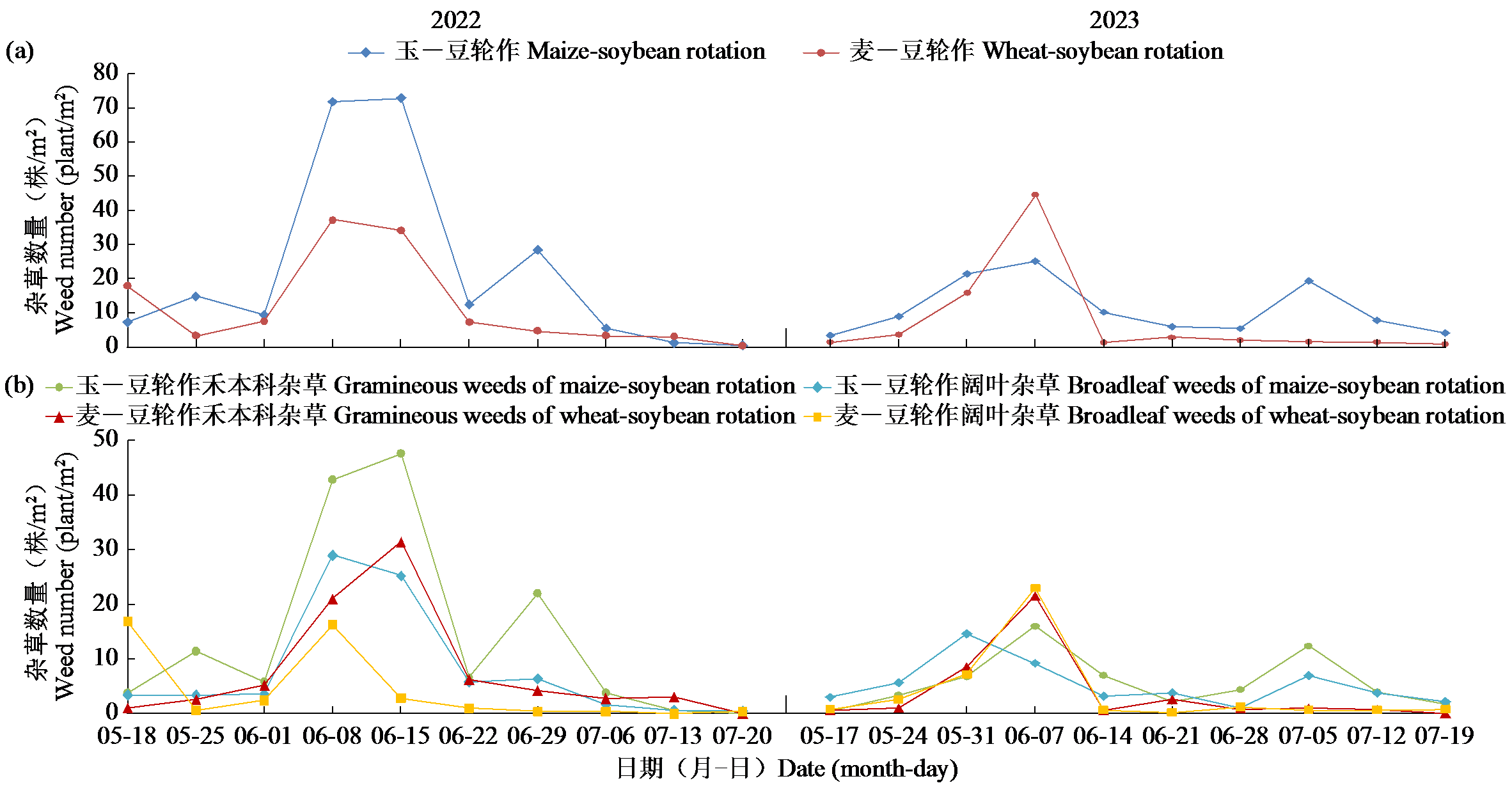
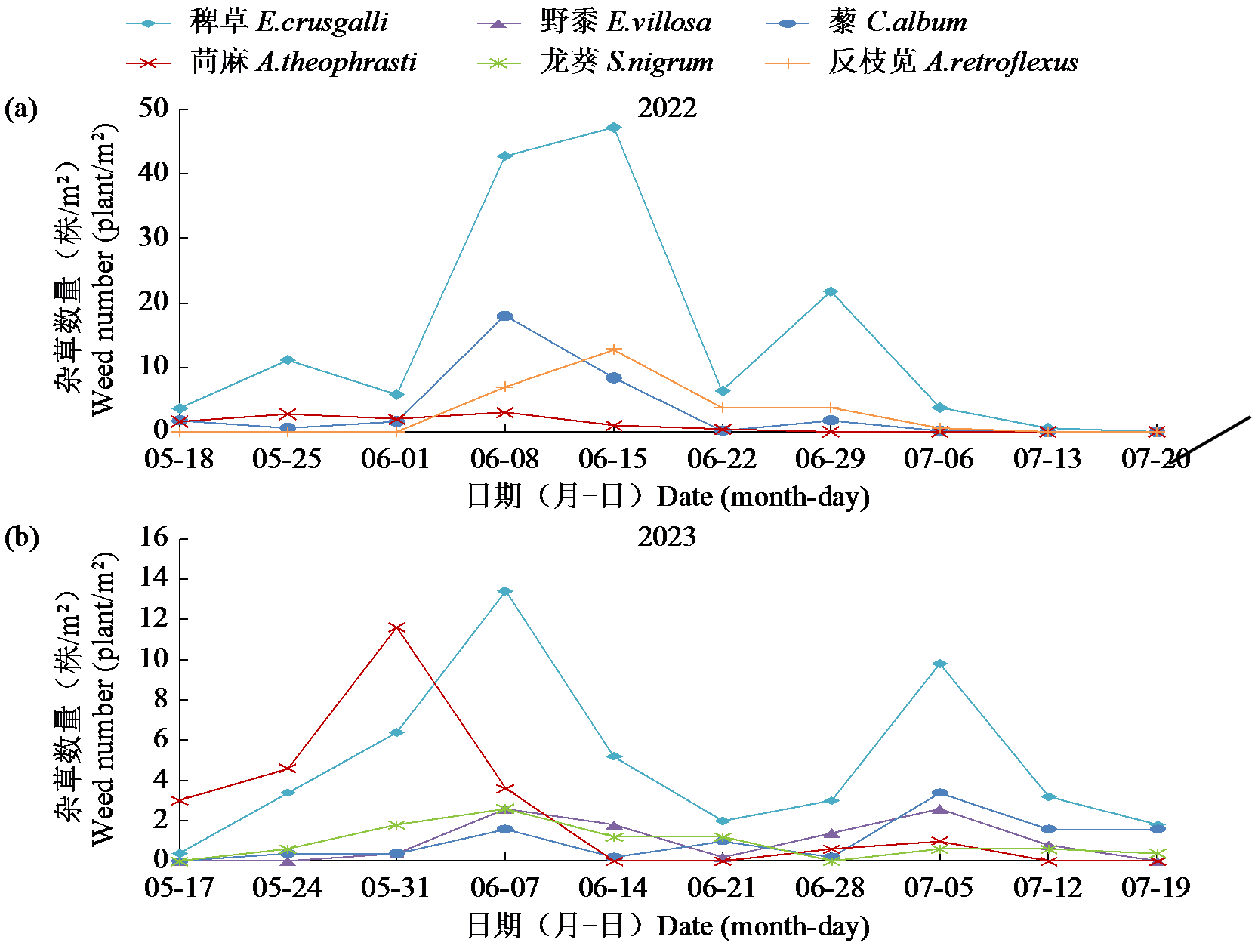
为精准制定玉米―大豆(玉―豆)和小麦―大豆(麦―豆)轮作种植模式下大豆田杂草的防控措施,调查了2种轮作模式下大豆田杂草发生种类和数量。结果表明,在2年试验中,玉―豆轮作模式下的杂草发生量分别是麦―豆轮作模式的1.89倍和1.49倍。玉―豆轮作模式下共11种杂草在2年均有发生,包括2种禾本科杂草和9种阔叶杂草,优势种杂草为禾本科杂草稗草和阔叶杂草藜、苘麻,亚优势种杂草为禾本科杂草野黍和阔叶杂草反枝苋、龙葵。麦―豆轮作模式下2年有8种杂草共同发生,包括禾本科杂草2种和阔叶杂草6种,优势种杂草为禾本科杂草稗草和阔叶杂草藜、苘麻,亚优势种杂草为阔叶杂草龙葵。玉―豆轮作模式下杂草发生量有2个高峰期,分别是在5月末到6月中旬和6月末到7月上旬,第1个高峰期的发生量大于第2个高峰期;而麦―豆轮作模式下则只有1个杂草发生高峰期,主要集中在6月上中旬。

| [1] | 王金生, 闫晓艳, 吴俊江, 等. 大豆营养高效利用型品种筛选. 大豆科学, 2020, 39(5):696-702. |
| [2] | 王婉, 刘鑫磊, 孙君明, 等. 大豆新品种黑农84品质性状的环境稳定性分析. 大豆科学, 2024, 43(1):1-12. |
| [3] | 刘忠堂. 再谈我国大豆发展问题. 大豆科技, 2012(6):4-6. |
| [4] | Zhang W W, Feng Z Z, Wang X K, et al. Quantification of ozone exposure- and stomatal uptake-yield response relationships for soybean in Northeast China. Science of the Total Environment, 2017(599/600):710-720. |
| [5] | 国家统计局.中国统计年鉴2022. 北京: 中国统计出版社, 2022. |
| [6] |
She S Y, Niu J J, Zhang C, et al. Significant relationship between soil bacterial community structure and incidence of bacterial wilt disease under continuous cropping system. Archives of Microbiology, 2017, 199(2):267-275.
doi: 10.1007/s00203-016-1301-x pmid: 27699437 |
| [7] | 陈雪丽, 王玉峰, 李伟群, 等. 黑土区连作大豆根际微生物群落结构的动态变化. 大豆科学, 2018, 37(5):748-755. |
| [8] |
Wang Y Z, Xu X M, Liu T M, et al. Analysis of bacterial and fungal communities in continuous-cropping ramie (Boehmeria nivea L. Gaud) fields in different areas in China. Scientific Reports, 2020, 10(1):3264.
doi: 10.1038/s41598-020-58608-0 |
| [9] | 刘兴龙, 王克勤, 王晓曦, 等. 不同秸秆还田模式对亚洲玉米螟发生及玉米产量的影响. 黑龙江农业科学, 2023(4):31-35. |
| [10] | 程传鹏, 潘俊峰, 万开元, 等. 轮作对农田杂草的影响研究进展. 中国农学通报, 2013, 29(30):1-9. |
| [11] | 王康君, 陈凤, 樊继伟, 等. 小麦化感作用的研究进展与展望. 农业科技通讯, 2018(2):7-11. |
| [12] | 邢海峰, 高翠萍, 王雪寅, 等. 三周龄小麦地上部浸提液对农田杂草的化感作用研究. 沈阳农业大学学报, 2022, 53(3):294-301. |
| [13] | 王洪武. 黑龙江省三江平原玉米-大豆轮作模式下田间杂草分布与防除. 园艺与种苗, 2023, 43(7):88-90. |
| [14] | 魏守辉, 强胜, 马波, 等. 不同作物轮作制度对土壤杂草种子库特征的影响. 生态学杂志, 2005(4):385-389. |
| [15] | 黄春艳, 王宇, 黄元炬, 等. 不同耕作模式对玉米田杂草发生规律的影响. 玉米科学, 2010, 18(4):103-107,111. |
| [16] | 殷红, 刘芳, 李建东, 等. 不同种植方式春玉米田杂草的生态经济阈值研究. 作物杂志, 2009(6):49-52. |
| [17] | 王宇, 郭玉莲, 罗婵, 等. 不同秸秆还田模式对玉米田杂草发生规律的影响. 黑龙江农业科学, 2022(3):38-42. |
| [18] | 于乐, 李林, 黄红娟, 等. 湖北省玉米田杂草种类组成及群落特征. 作物杂志, 2023(5):272-279. |
| [19] |
于博, 王钰艳, 任琴, 等. 秸秆还田对土壤结构和春玉米生长的影响. 浙江农业学报, 2023, 35(10):2446-2455.
doi: 10.3969/j.issn.1004-1524.20221624 |
| [20] | 李瑞平, 罗洋, 郑洪兵, 等. 吉林省中部玉米秸秆还田方式对出苗及苗期生长发育的影响. 农业与技术, 2020, 40(18):6-8. |
| [21] | 高盼, 刘玉涛, 徐莹莹, 等. 秸秆覆盖与翻埋两种还田模式对农田土壤物理性质及玉米产量的影响. 黑龙江农业科学, 2021(11):13-17. |
| [22] | 丁奠元, 冯浩, 赵英, 等. 氨化秸秆还田对土壤孔隙结构的影响. 植物营养与肥料学报, 2016, 22(3):650-658. |
| [1] | 朱建国, 崔正果, 张波, 王学端, 张月明, 吕小飞, 王洪预, 李秋祝, 崔金虎. 玉米―花生―谷子轮作对吉林省风沙盐碱地区土壤微生态、产量和效益的影响[J]. 作物杂志, 2025, (5): 19–28 |
| [2] | 王籽懿, 韩伟, 金鸿飚, 黄修梅, 张凤兰, 杨忠仁. 不同轮作模式对高寒黑土区马铃薯根际土壤真菌群落结构与功能的影响[J]. 作物杂志, 2025, (5): 221–232 |
| [3] | 吕伟生, 王馨悦, 陈明, 邓雪云, 张晨, 李子婧, 罗军元, 刘小三, 肖国滨. 红壤旱地油菜―芝麻轮作下油菜控释氮肥施用效果及其后效[J]. 作物杂志, 2024, (6): 113–119 |
| [4] | 张玉林, 杜艺, 柴旭田, 李向义, 鲁艳, 张志浩, 曾凡江. 不同生育时期油莎豆饲草离子特性和根系养分对不同种植模式的响应[J]. 作物杂志, 2024, (1): 104–110 |
| [5] | 熊又升, 熊汉锋, 郭衍龙, 王海生, 刘威, 严与向, 谢媛园, 周剑雄, 杨立军. 减量施肥模式对稻麦轮作体系中小麦产量和养分利用效率的影响[J]. 作物杂志, 2022, (6): 118–123 |
| [6] | 龙瑞平, 张朝钟, 戈芹英, 万卫东, 王勤, 李贵勇, 夏琼梅, 朱海平, 杨从党. 水旱轮作下穗肥氮用量对机插粳稻生长特性及经济效益分析[J]. 作物杂志, 2022, (1): 124–129 |
| [7] | 刘亚军, 王文静, 王红刚, 王祁, 胡启国, 储凤丽. 作物轮作对甘薯田土壤微生物群落的影响[J]. 作物杂志, 2021, (6): 122–128 |
| [8] | 胡启国, 刘亚军, 王文静, 王祁, 王红刚, 储凤丽. 甘薯轮作与间作对根际土壤微生物群落的影响[J]. 作物杂志, 2021, (5): 153–159 |
| [9] | 范业赓, 陈荣发, 闫海锋, 周慧文, 翁梦苓, 黄杏, 罗霆, 周忠凤, 丘立杭, 吴建明. 甘蔗轮作青饲玉米和花生对甘蔗生长和土壤性状的影响[J]. 作物杂志, 2021, (1): 104–111 |
| [10] | 刘佳敏, 汪洋, 褚旭, 齐欣, 王慢慢, 赵亚南, 叶优良, 黄玉芳. 种植密度和施氮量对小麦-玉米轮作体系下周年产量及氮肥利用率的影响[J]. 作物杂志, 2021, (1): 143–149 |
| [11] | 宋秋来, 王麒, 冯延江, 孙羽, 曾宪楠, 来永才. 寒地水旱轮作及秸秆还田对土壤相关酶活性的影响[J]. 作物杂志, 2020, (3): 149–153 |
| [12] | 张海斌,蒙美莲,刘坤雨,章凌翔,陈有君. 不同轮作模式对马铃薯干物质积累、病害发生及产量的影响[J]. 作物杂志, 2019, (4): 170–175 |
| [13] | 白雨,韩雪莹,董海洋,乌云苏都,李冰圳,陈贵林. 轮作及农艺措施对减轻向日葵列当危害的影响[J]. 作物杂志, 2019, (2): 192–196 |
| [14] | 崔勇. 稻田水旱轮作的研究进展[J]. 作物杂志, 2018, (3): 8–14 |
| [15] | 石晓华,杨海鹰,康文钦,秦永林,樊明寿,贾立国. 不同施氮量对马铃薯-小麦轮作体系产量及土壤氮素平衡的影响[J]. 作物杂志, 2018, (2): 108–116 |
|
||