



黄体酮是普遍存在于高等植物中的一种激素,在不同植物各器官中的含量差异较大[1-2],功效也不尽相同。近年来研究表明,黄体酮在多种逆境胁迫中发挥重要作用,适宜浓度的黄体酮可增强植物体内抗氧化酶活性,降低脂质过氧化水平和过氧化氢含量,缓解盐胁迫对小麦幼苗生长的抑制作用[3],改变低温胁迫下小麦的细胞膜脂结构[4],还可减轻高温和高光强引发的氧化伤害[5-6]。在拟南芥中,黄体酮预处理可缓解假单胞菌侵染导致的坏死现象[7]。过表达CYP11A1的烟草转基因植株(黄体酮水平比野生型植株高3~4倍)能有效抵御真菌病原体侵染[8]。此外,外施黄体酮可减轻鹰嘴豆、玉米及香蕉果实在冷胁迫下诱导的氧化伤害[9-
黄体酮虽能调节植物生长发育,但其具体调控机制相关的研究尚显不足。目前,黄体酮相关研究多集中于洋地黄、苦参、桂竹香和小球藻等植物[18],在粮食作物中的研究相对较少,针对植物根系的研究则更为匮乏。小麦(Triticum aestivum L.)是全球主要粮食作物之一,研究黄体酮对其生长发育的影响,对小麦抗逆性研究及生产实践具有重要意义。根系在小麦生长中起到固定植株、提供养分和水分等重要作用,直接影响其产量形成及植株抗逆能力。本试验以小麦为研究对象,重点探究黄体酮对小麦根系伸长生长的影响,并解析其调控机制及主要途径,旨在为揭示黄体酮调控作物根系生长的路径以及指导小麦抗逆稳产栽培提供理论依据。
1 材料与方法
1.1 试验设计
以黄淮地区主推小麦品种“百农207”为试验材料。选取籽粒饱满且大小均匀的种子,用5%过氧化氢消毒5 min,蒸馏水冲洗3~4次。用蒸馏水浸泡4~6 h后,把种子放在湿润的滤纸上催芽72 h,待种子芽长约2 cm、主根长约3 cm时,将长势一致的幼苗移到不同浓度外源黄体酮和葡萄糖的Hoagland培养液中进行培养,环境条件为:温度25 oC/22 oC(白天/晚上),光周期14 h/10 h(光照/黑暗),光照强度300 μmol/(m2·s),相对湿度保持在70%。
设5种浓度的黄体酮处理,分别为0.000(P0)、0.001(P1)、0.010(P2)、0.100(P3)和1.000 μmol/L(P4);7种浓度的葡萄糖Hoagland培养液处理,分别为0.0(G0)、0.1(G1)、1.0(G2)、10.0(G3)、100.0(G4)、1000.0(G5)和10 000.0 μmol/L(G6)。黄体酮和葡萄糖交互处理试验共设置5个处理组合,分别为正常培养(PG0,CK)、10 μmol/L葡萄糖(PG1)、10 μmol/L葡萄糖+0.1 μmol/L黄体酮(PG2)、10 000 μmol/L葡萄糖(PG3)和10 000 μmol/L葡萄糖+0.001 μmol/L黄体酮(PG4)。每个处理不少于3次重复,每3 d更换1次营养液,6 d后测定根长,并取样保存于-80 oC超低温冰箱备测,各处理样品测试3次重复。
1.2 测定项目与方法
1.2.1 根长
在根系旁放置标尺并拍照,随后将图片置入Photoshop 7.0,使用标尺工具测定根长,每种处理测量5~10株,结果取平均值。
1.2.2 葡萄糖含量
将0.1 g样品于预冷研钵中迅速研磨,转移至1.5 mL的离心管中,加入1 mL蒸馏水,置沸水浴中煮沸10 min。室温冷却后,8000 g室温离心10 min,取上清液,采用BC2500试剂盒(北京索莱宝科技有限公司)测定葡萄糖含量。
1.2.3 磷酸果糖激酶(PFK)活性
将0.1 g样品于预冷研钵中迅速研磨,转移至1.5 mL的离心管中,加入1 mL提取液,采用冷冻离心机在4 ℃下8 000 g离心10 min,取上清液,采用BC0530试剂盒(北京索莱宝科技有限公司)测定PFK活性。
1.3 数据处理
采用SPSS软件进行数据统计与分析,采用Duncan新复极差法进行差异显著性检验。
2 结果与分析
2.1 外源黄体酮对小麦根系生长的影响
如图1所示,在P1和P2处理下,小麦平均根长较P0处理显著增长,分别增加了15.3%和9.0%,但P1和P2处理间差异不显著;P3和P4处理的平均根长较P0处理分别显著减少了10.9%和34.6%,2个处理间差异也达显著水平,表明低浓度外源黄体酮促进小麦根系伸长,高浓度抑制其伸长。
图1
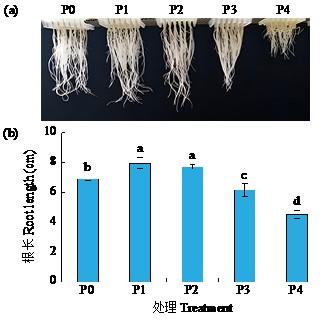
图1
外源黄体酮对小麦根系生长的影响
不同小写字母表示处理间在P < 0.05水平差异显著,下同。
Fig.1
Effects of exogenous progesterone on root elongation of wheat
Different lowercase letters indicate significant difference among treatments at P < 0.05 level, the same below.
2.2 外源黄体酮对小麦根系中葡萄糖含量及PFK活性的影响
如图2所示,与P0处理相比,P1和P2处理均降低了小麦根系中的葡萄糖含量,P1处理根系中葡萄糖含量降为P0处理的65%,与P0处理差异显著;P2处理略有降低,与P0处理差异不显著;且P1与P2处理间差异显著。P3和P4处理的根系中葡萄糖含量显著升高,分别为P0处理的1.35和2.23倍,且2个处理间的差异也达到显著水平。综上,低浓度黄体酮处理下,小麦根系中葡萄糖含量降低;高浓度黄体酮处理下,根系中葡萄糖含量显著增加。
图2
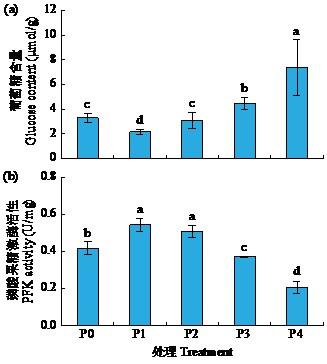
图2
外源黄体酮对小麦根系中葡萄糖含量和PFK活性的影响
Fig.2
Effects of exogenous progesterone on glucose content and PFK activity in wheat roots
PFK是糖酵解代谢途径中的关键限速酶,如图2b所示,P1和P2处理的PFK活性显著增加,较P0处理分别提高了30.4%和21.6%,2个处理间差异不显著;P3和P4处理的小麦根系中PFK活性显著下降,分别为P0处理的89.5%和49.7%,差异达显著水平,且P3和P4处理间差异显著。综上,低浓度的黄体酮诱导PFK活性增加,而高浓度黄体酮抑制PFK活性。
外源黄体酮显著影响小麦幼苗根系中的葡萄糖含量和PFK的活性。随着外源黄体酮浓度升高,小麦根系中的葡萄糖含量先降低后升高,而PFK活性则呈先升高后下降的趋势。
2.3 外源葡萄糖对小麦根系生长的影响
除G6处理外,其余处理的根长较G0处理均有不同程度增长(图3)。其中,G1、G2和G3处理与G0处理的差异达显著水平,G3处理增长最多,增幅为62.9%;G4和G5处理增长不显著;G6处理根长仅为G0处理的68.5%,差异显著。综上,外源葡萄糖可显著影响小麦根长,低浓度促进小麦根系伸长,高浓度则抑制;与黄体酮对小麦根系伸长生长的影响趋势相似。
图3
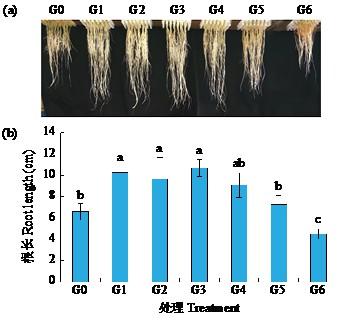
图3
外源葡萄糖对小麦根系生长的影响
Fig.3
Effects of exogenous glucose on wheat root elongation
2.4 外源黄体酮和葡萄糖交互作用对小麦根长的影响
黄体酮对小麦根长的调控与葡萄糖代谢有关(图4)。与PG0处理相比,10 μmol/L葡萄糖(PG1和PG2)处理促进小麦幼苗根系伸长,10 000 μmol/L葡萄糖(PG3和PG4)处理抑制根系伸长。PG2处理在10 μmol/L葡萄糖(促进根系伸长)处理的同时,加入0.1 μmol/L黄体酮(抑制根系伸长)可显著抑制外源葡萄糖对根系伸长的促进作用,PG2较PG1处理的根长降低了14.5%。相反,PG4处理在10 000 μmol/L葡萄糖(抑制根系伸长)处理同时,加入0.001 μmol/L黄体酮(促进根系伸长)可缓解外源葡萄糖对根系伸长的抑制作用,PG4处理的根长较PG3处理增加了40.7%。结合黄体酮可以显著影响根系中葡萄糖含量及PFK活性的试验结果(图2)分析得出,黄体酮对小麦根系伸长的调控与葡萄糖代谢途径密切相关。
图4
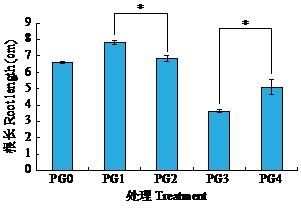
图4
外源黄体酮和葡萄糖互作处理对小麦根系生长的影响
“*”表示处理间在P < 0.05水平差异显著,下同。
Fig.4
Effects of exogenous progesterone and glucose on root elongation of wheat
“*”indicates significant difference among treatments at P < 0.05 level, the same below.
2.5 外源黄体酮和葡萄糖交互作用对小麦根系中葡萄糖含量及PFK活性的影响
图5
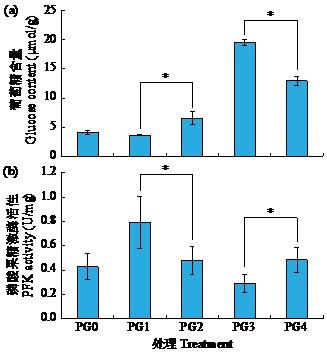
图5
外源黄体酮和葡萄糖互作处理对小麦根系中葡萄糖含量和PFK活性的影响
Fig.5
Effects of exogenous progesterone and glucose on glucose content and PFK activity in wheat roots
PG2处理下,加入0.1 μmol/L黄体酮可显著促进10 μmol/L葡萄糖处理下小麦根系中葡萄糖的积累,约较PG0处理提高了78.4%;PG1和PG2处理间葡萄糖含量差异显著。PG4处理中,0.001 μmol/L黄体酮的加入显著抑制了10 000 μmol/L葡萄糖处理下根系葡萄糖的积累,降幅为50.6%。另外,PG2处理中0.1 μmol/L黄体酮的加入显著抑制了10 μmol/L葡萄糖处理下小麦根系PFK活性的增加,降至PG1处理下的60.5%。而在PG4处理下,0.001 μmol/L黄体酮的加入有效解除了外源葡萄糖对PFK活性的抑制,PFK活性显著提高到PG3处理下的1.66倍。
3 讨论
植物根系的生长发育受多种植物激素调控,如生长素、细胞分裂素、赤霉素、脱落酸、乙烯和油菜素甾醇等[23],这些激素相互作用,共同调控根系生长[24]。黄体酮被认为是植物体内的一种候选激素,探讨其对植物根系的调控作用具有重要意义。本研究表明,外源黄体酮对小麦根系伸长生长的影响表现为低浓度促进、高浓度抑制,这与前人在拟南芥[17]和向日葵[1]中的研究结果相似。前人[25-
为明确黄体酮通过调控根系葡萄糖含量影响小麦根系伸长生长的潜在机制,本试验开展了进一步研究。葡萄糖的氧化代谢始于糖酵解途径,PFK是该途径的关键限速酶,其活性直接决定糖酵解速率。本研究检测了黄体酮处理下小麦根系中PFK的活性变化,结果表明低浓度黄体酮处理可显著提升小麦根系中PFK的活性,而高浓度黄体酮则显著抑制其活性。黄体酮与葡萄糖的交互试验表明,葡萄糖处理下根系PFK活性的变化趋势与黄体酮处理一致,低浓度葡萄糖显著增强PFK活性,高浓度则显著抑制。同时,高浓度黄体酮可抑制低浓度葡萄糖对PFK的诱导作用,而低浓度黄体酮可缓解高浓度葡萄糖对PFK的抑制效应。基于上述结果,推测低浓度黄体酮通过增加PFK活性和加速糖酵解进程,从而降低根系葡萄糖含量;而高浓度黄体酮则抑制PFK活性并减缓糖酵解进程,导致根系葡萄糖积累、含量升高。本研究明确了外源黄体酮对小麦根系伸长生长的影响,并初步分析了其调控机制,为进一步探明黄体酮调控小麦根系伸长的调控路径提供了理论参考。
4 结论
外源黄体酮可显著影响小麦根系的伸长生长,表现为低浓度促进、高浓度抑制。0.001 μmol/L和0.01 μmol/L黄体酮处理下,小麦根长较对照分别增加了15.3%和9.0%。大田生产中应用低浓度黄体酮进行浸种或根施可有效促进小麦根系伸长,提高抗逆性。黄体酮可能通过调控PFK活性影响糖酵解进程,进而影响小麦根系中的葡萄糖含量,实现对根系伸长生长的调控。低浓度黄体酮通过提升PFK活性加速糖酵解进程,促进葡萄糖代谢,降低根系葡萄糖含量,最终促进根系伸长;高浓度黄体酮抑制PFK活性,减缓糖酵解进程,导致根系葡萄糖积累,抑制根系伸长。
参考文献
Progesterone: Its occurrence in plants and involvement in plant growth
DOI:10.1016/j.phytochem.2007.04.002
PMID:17512025
[本文引用: 3]

Progesterone is a mammalian gonadal hormone. In the current study, we identified and quantified progesterone in a range of higher plants by using GC-MS and examined its effects on the vegetative growth of plants. The growth of Arabidopsis (Arabidopsis thaliana) seedlings was promoted by progesterone at low concentrations but suppressed at higher concentrations under both light and dark growth conditions. The growth of the gibberellin-deficient mutant lh of pea (Pisum sativum) was also promoted by progesterone. An earlier study demonstrated that progesterone binds to MEMBRANE STEROID BINDING PROTEIN 1 (MSBP1) of Arabidopsis. In this work, we cloned the homologous genes of Arabidopsis, MSBP2 and STEROID BINDING PROTEIN (SBP), as well as of rice (Oryza sativa), OsMSBP1, OsMSBP2 and OsSBP and examined their expression in plant tissues. All of these genes, except OsMSBP1, were expressed abundantly in plant tissues. The roles of progesterone in plant growth were also discussed.
Immunoreactive detection of four mammalian steroids in plants
DOI:10.1139/b89-042 URL [本文引用: 1]
Alleviation of salt stress in wheat seedlings by mammalian sex hormones
DOI:10.1002/jsfa.4716
PMID:22102166
[本文引用: 1]
Salinity is one of the most serious constraints facing agriculture today. Some mechanical, chemical and biological approaches are being pursued to cope with soil salinity. Although exogenously treated mammalian sex hormones (MSHs), progesterone, β-estradiol and androsterone, activate significant effects in various biological aspects in plants growing under normal conditions, there is no report investigating their effects on plants growing under salt stress. The present study aimed to investigate whether MSHs could alleviate the destructive effect of salt stress on wheat seedlings and thereby increase their salt tolerance. Wheat leaves were sprayed with 10(-6), 10(-8) and 10(-10) mol L(-1) concentrations of MSH on the ninth day after sowing. MSH-treated seedlings (10-day-old seedlings) were subjected to salt stress for 5 days (between days 10 and 15).At all the concentrations tested, MSH treatment provided a significant protection against to detrimental effects of salt stress in wheat seedlings. It improved dry weight, sugar, proline, protein, chlorophyll and glutathione contents in comparison to salinity alone. Similarly, superoxide dismutase, peroxidase, catalase, ascorbate peroxidase and nitrate reductase activities also were augmented by MSH treatment. On the other hand, increases in lipid peroxidation level, superoxide production and hydrogen peroxide content arising from salt treatment were reduced by MSH treatment. The highest salt tolerance was obtained at the concentrations of 10(-6) mol L(-1) for progesterone and 10(-8) mol L(-1) for β-estradiol and for androsterone.MSHs could be used effectively to protect wheat seedlings from the destructive effects of salt stress by stimulating both enzymatic and non-enzymatic antioxidant mechanism and by promoting levels of osmotic protectants such as proline and sugars resulting in osmotic adjustment, carbon storage and radical scavenging in plants.Copyright © 2011 Society of Chemical Industry.
Regulation of the membrane structure by brassinosteroids and progesterone in winter wheat seedlings exposed to low temperature
DOI:S0039-128X(17)30182-4
PMID:29030144
[本文引用: 1]
Steroids constitute one of the most important groups of compounds of regulatory properties both in the animal and plant kingdom. In plants, steroids such as brassinosteroids or progesterone, by binding to protein receptors in cell membranes, regulate growth and initiate processes leading to increased tolerance to stress conditions. Due to their structural similarities to sterols, these steroids may also directly interact with cellular membranes. Our aim was to determine the changes of the structural parameters of lipid membranes under the influence of hydrophobic steroid compounds, i.e., 24-epibrassinolide (EBR) and its precursor-24-epicastasterone (ECS) and progesterone (PRO). Lipids were isolated from wheat seedlings with different tolerances to frost, grown at low temperatures (5 °C) for 1.5 and 3 weeks (acclimation process). Control plants were cultured continuously at 20 °C. From galactolipids and phospholipids, the main polar lipid fractions, the monolayers were formed, using a technique of Langmuir trough. EBR and ECS were introduced into monolayers, together with lipids, whereas the PRO was dissolved in the aqueous sub-phase upon which the monolayers were spread. Measurements performed at 25 °C and 10 °C showed a significant action of the tested compounds on the physicochemical properties of the monolayers. EBR and PRO increased the area per lipid molecule in monolayers, resulting in formation of more flexible surface structures while the presence of the ECS induced the opposite effect. The influence of the polarity of lipids and steroids on the interactions in the monolayer was discussed. Lipids extracted from the membranes of wheat with the most tolerance to frost were characterized by the highest fatty acid unsaturation and steroids had a relatively weak effect on the parameters of the structure of their monolayers.Copyright © 2017 Elsevier Inc. All rights reserved.
Progesterone increases photochemical efficiency of photosystem II in wheat under heat stress by facilitating D1 protein phosphorylation
DOI:10.1007/s11099-016-0681-0 URL [本文引用: 1]
Exogenous progesterone alleviates heat and high light stress-induced inactivation of photosystem II in wheat by enhancing antioxidant defense and D1 protein stability
DOI:10.1007/s10725-014-9920-1 URL [本文引用: 1]
Progesterone moderates damage in Arabidopsis thaliana caused by infection with Pseudomonas syringae or P. fluorescens
DOI:10.1007/s10535-012-0142-y URL [本文引用: 1]
A key enzyme of animal steroidogenesis can function in plants enhancing their immunity and accelerating the processes of growth and development
DOI:10.1186/s12870-017-1123-2 URL [本文引用: 1]
Exogenous progesterone treatment alleviates chilling injury in postharvest banana fruit associated with induction of alternative oxidase and antioxidant defense
DOI:10.1016/j.foodchem.2019.02.027 URL [本文引用: 1]
The property of progesterone to mitigate cold stress in maize is linked to a modulation of the mitochondrial respiratory pathway
DOI:10.1007/s40626-016-0076-4 URL
Exogenous progesterone application protects chickpea seedlings against chilling-induced oxidative stress
DOI:10.1007/s11738-012-1070-3 URL [本文引用: 1]
Steroid hormone effects on growth and apical dominance of sunflower
DOI:10.1016/0031-9422(81)83014-2 URL [本文引用: 1]
Steroid hormones stimulate germination and tube growth of in vitro matured tobacco pollen
A study of the effects of different steroids on germination and tube growth of tobacco pollen (Nicotiana tabacum L. cv Petit Havana SR1) matured in vitro is presented. Application of the mammalian steroid sex hormones (testosterone, progesterone, and estradiol) resulted in a stimulation of pollen germination and tube elongation. The presence of both steroids and flavonols in the germination medium strongly enhanced the growth of tobacco male gametophytes.
The environmental endocrine disruptor, bisphenol A, affects germination, elicits stress response and alters steroid hormone production in kiwifruit pollen
DOI:10.1111/j.1438-8677.2010.00330.x
PMID:21143743
[本文引用: 1]
In vitro toxicity of the endocrine disruptor bisphenol A (BPA) to pollen, the male haploid generation of higher plants, was studied. BPA caused significant inhibition of both tube emergence and elongation of kiwifruit pollen in a dose-dependent manner, beginning at 10 mg · l(-1); morphological changes to tubes were also detected. Despite strong inhibition of pollen tube production and growth, a large percentage of treated cells remained viable. Immunoblotting experiments indicated that levels of BiP and 14-3-3, which are proteins involved in stress response, substantially increased in BPA-treated pollen compared to controls. The increases were dose-dependent in the range 10-50 mg · l(-1) BPA, i.e. even when germination ability was completely blocked. Steroid hormones (17 β-estradiol, progesterone and testosterone) were detected in kiwifruit pollen, and their levels increased during germination in basal medium. In a BPA treatment of 30 mg · l(-1), larger increases in both estrogen and testosterone concentrations were detected, in particular, a six-fold increase of 17 β-estradiol over control concentration (30 min). The increased hormone levels were maintained for at least the 90 min incubation. Increasing concentrations of exogenous testosterone and 17 β-estradiol increasingly inhibited pollen tube emergence and elongation. Current data for BPA-exposed kiwifruit pollen suggest a toxicity mechanism that is at least in part based on a dramatic imbalance of steroid hormone production during tube organisation, emergence and elongation. It may be concluded that BPA, a widespread environmental contaminant, can cause serious adverse effects to essential pollen functions. On a broader scale, this chemical poses a potential risk to the reproductive success of higher plants.© 2010 German Botanical Society and The Royal Botanical Society of the Netherlands.
Disturbances in production of progesterone and their implications in plant studies
DOI:10.1016/j.steroids.2015.01.025
PMID:25676788
[本文引用: 1]
Progesterone is a mammalian hormone that has also been discovered in plants but its physiological function in plants is not explained. Experiments using inhibitors of progesterone synthesis and binding would be useful in studies on the significance of this compound in plants. Until now, trilostane and mifepristone have been used in medical sciences as progesterone biosynthesis and binding inhibitors, respectively. We tested these synthetic steroids for the first time in plants and found that they reduced the content of progesterone in wheat. The aim of further experiments was to answer whether the potential disturbances in the production/binding of progesterone, influence resistance to environmental stress (drought) and the development of wheat. Inhibitors and progesterone were applied to plants via roots in a concentration of 0.25-0.5mg/l water. Both inhibitors lowered the activity of CO2 binding enzyme (Rubisco) in wheat exposed to drought stress and trilostane additionally lowered the chlorophyll content. However, trilostane-treated plants were rescued by treatment with exogenous progesterone. The inhibitors also modulated the development of winter wheat, which indicated the significance of steroid regulators and their receptors in this process. In this study, in addition to progesterone and its inhibitors, brassinosteroid (24-epibrassinolide) and an inhibitor of biosynthesis of brassinosteroids were also applied. Mifepristone inhibited the generative development of wheat (like 24-epibrassinolide), while trilostane (like progesterone and an inhibitor of biosynthesis of brassinosteroids) stimulated the development. We propose a model of steroid-induced regulation of the development of winter wheat, where brassinosteroids act as inhibitors of generative development, while progesterone or other pregnane derivatives act as stimulators. Copyright © 2015 Elsevier Inc. All rights reserved.
Stimulation of generative development in partly vernalized winter wheat by animal sex hormone
DOI:10.1007/s11738-002-0054-0 URL [本文引用: 1]
The influence of animal sex hormones on the induction of flowering in Arabidopsis thaliana: comparison with the effect of 24- epibrassinolide
DOI:10.1023/A:1022291718398 [本文引用: 2]
The presence and activity of progesterone in the plant kingdom
DOI:10.1016/j.steroids.2011.10.012
PMID:22100776
[本文引用: 1]
Steroids are present in living organisms as one of the most essential groups of compounds. Continuous research has led to new discoveries and the revision of existing information concerning the occurrence and the role of steroids, both in animals and plants. This article will focus on reviewing the literature studying progesterone in the plant kingdom, including its discovery, its occurrence in different plant species as well as its biological activity and molecular basis of action. This review will present and discuss the current data in addition to introducing potential directions for further research on the subject of progesterone in plants.Copyright © 2011 Elsevier Inc. All rights reserved.
Hormone symphony during root growth and development
DOI:10.1002/dvdy.23878
PMID:23027524
[本文引用: 1]
Hormones regulate plant growth and development in response to external environmental stimuli via complex signal transduction pathways, which in turn form complex networks of interaction. Several classes of hormones have been reported, and their activity depends on their biosynthesis, transport, conjugation, accumulation in the vacuole, and degradation. However, the activity of a given hormone is also dependent on its interaction with other hormones. Indeed, there is a complex crosstalk between hormones that regulates their biosynthesis, transport, and/or signaling functionality, although some hormones have overlapping or opposite functions. The plant root is a particularly useful system in which to study the complex role of plant hormones in the plastic control of plant development. Physiological, cellular, and molecular genetic approaches have been used to study the role of plant hormones in root meristem homeostasis. In this review, we discuss recent findings on the synthesis, signaling, transport of hormones and role during root development and examine the role of hormone crosstalk in maintaining homeostasis in the apical root meristem.Copyright © 2012 Wiley Periodicals, Inc.
Plant hormone cross-talk: The pivot of root growth
DOI:10.1093/jxb/eru534
PMID:25628331
[本文引用: 1]
Root indeterminate growth and its outstanding ability to produce new tissues continuously make this organ a highly dynamic structure able to respond promptly to external environmental stimuli. Developmental processes therefore need to be finely tuned, and hormonal cross-talk plays a pivotal role in the regulation of root growth. In contrast to what happens in animals, plant development is a post-embryonic process. A pool of stem cells, placed in a niche at the apex of the meristem, is a source of self-renewing cells that provides cells for tissue formation. During the first days post-germination, the meristem reaches its final size as a result of a balance between cell division and cell differentiation. A complex network of interactions between hormonal pathways co-ordinates such developmental inputs. In recent years, by means of molecular and computational approaches, many efforts have been made aiming to define the molecular components of these networks. In this review, we focus our attention on the molecular mechanisms at the basis of hormone cross-talk during root meristem size determination. © The Author 2015. Published by Oxford University Press on behalf of the Society for Experimental Biology. All rights reserved. For permissions, please email: journals.permissions@oup.com.
The versatile role of glucose signalling in regulating growth, development and stress responses in plants
DOI:10.1007/s13562-020-00550-3
Interaction of glucose and phytohormone signaling in plants
Glucose and auxin signaling interaction in controlling Arabidopsis thaliana seedlings root growth and development
DOI:10.1371/journal.pone.0004502 URL [本文引用: 1]
Glucose inhibits root meristem growth via ABA INSENSITIVE 5, which represses PIN1 accumulation and auxin activity in Arabidopsis
DOI:10.1111/pce.2014.37.issue-6 URL [本文引用: 1]
Exogenous Glucose mediates the regulation of root morphology and carbon-nitrogen metabolism by Indole-3-Acetic Acid (IAA) in Malus baccata (L.) Borkh. in soil with low organic carbon content
DOI:10.1007/s00344-019-10005-2 [本文引用: 1]


