



玉米是我国最重要的粮食兼饲料作物,也是全球应用转基因技术最成功的作物之一。当前,未成熟胚是玉米遗传转化的首选外植体类型,且幼胚质量是决定转化效率的关键因素。然而,受地域气候或温室条件的限制,很多实验室面临难以常年持续提供优质玉米幼胚作为遗传转化外植体的难题。
玉米幼胚转化早期研究主要依赖基因枪转化法,但该方法存在多拷贝整合、基因沉默率高和随机插入等问题[1]。Frame等[2]首先建立了农杆菌介导的玉米未成熟胚遗传转化体系,显著提高了转化效率,为玉米基因功能研究和分子育种奠定了基础。Ishida等[3]进一步优化了该方法,使其适用于更多基因型,并指出幼胚质量是获得高效率转化的关键。未成熟胚因其较高的再生和转化效率,成为目前玉米遗传转化的常用外植体类型。用于供胚的玉米对于生长条件的要求极高,期间需要投入大量的人力和物力进行精心管理。即便如此,大田供胚仍受自然天气等一系列不可控因素的影响。随着转基因和基因编辑技术的发展,玉米遗传转化早已不再局限于几个模式品种,人工气候室供胚虽然一定程度上规避了天气的影响,但也无法同时兼顾多个品种的生长条件。很多单位受地域或经费的限制,仍然难以实现持续大量供胚。
1 材料与方法
1.1 试验材料
试验所用载体是以中国农业大学提供的pG4GB411-BMW载体为骨架进行改造后形成的新载体p411BMWG(图1)。转化所用根癌农杆菌菌种EHA105由山东舜丰生物科技有限公司保存。玉米受体自交系M013、M018、DH351、F003、Qi319及PH4CV由山东舜丰生物科技有限公司收集与保存。
图1

图1
p411BMWG载体T-DNA结构示意图
Fig.1
Schematic diagram of the T-DNA region of the p411BMWG vector
1.2 培养基配方
表1 试验所用培养基
Table 1
| 培养基Medium | 培养基组分Medium composition |
|---|---|
| 种子萌发培养基 Seed germination medium (G) | MS+20 g/L蔗糖+5 g/L琼脂+10 mg/L噻苯唑,pH 5.6 |
| 侵染液培养基 Infection medium (I) | 1.204 g/L MgSO4+5 g/L麦芽糖+20 mg/L乙酰丁香酮+0.5 mg/L羟敌草腈+0.01% (v/v) BREAK-THRU S233,pH 5.6 |
| 共培培养基 Co-cultivation medium (C) | MS+20 g/L麦芽糖+10 g/L葡萄糖+0.8 mg/L CuSO4+0.7 g/L脯氨酸+0.5 g/L 2-吗啉乙磺酸+2 mg/L 2,4-二氯苯氧乙酸+10 mg/L维生素C+20 mg/L乙酰丁香酮+3.4 mg/L硝酸银+300 mg/L半胱氨酸+8 g/L琼脂,pH 5.6 |
| 恢复培养基 Resting medium (Rs) | M5605 (Phytotech)+20 g/L蔗糖+0.6 g/L葡萄糖+0.3 g/L酸水解酪蛋白+0.8 mg/L酸水解酪蛋白+1.2 mg/L麦草畏+3.4 mg/L硝酸银+200 mg/L特美汀+0.025 mg/L植物磺肽素+6 g/L 琼脂,pH 5.6 |
| 愈伤组织诱导培养1 Calli inducing medium 1 (CIM1) | N492 (Phytotech)+20 g/L蔗糖+2.88 g/L脯氨酸+650 mg/L MgCl2+300 mg/L谷氨酰胺+0.1 g/L酸水解酪蛋白+ 2.2 mg/L 2,4-二氯苯氧乙酸+10 mg/L硝酸银+200 mg/L特美汀+0.025 mg/L植物磺肽素+8 g/L琼脂,pH 5.8 |
| 愈伤组织诱导培养2 Calli inducing medium 2 (CIM2) | N492+20 g/L蔗糖+2.88 g/L脯氨酸+650 mg/L MgCl2+0.1 g/L酸水解酪蛋白+2.2 mg/L 2,4-二氯苯氧乙酸+ 10 mg/L硝酸银+200 mg/L特美汀+0.025 mg/L植物磺肽素+8 g/L琼脂,pH 5.8 |
| 分化培养基 Maturation medium (M) | MS+30 g/L蔗糖+0.5 g/L 2-吗啉乙磺酸+1.3 mg/L CuSO4+0.1 mg/L噻苯隆+0.5 mg/L玉米素+1 mg/L吲哚乙酸+ 0.1 μmol/L脱落酸+200 mg/L特美汀+3.5 g/L植物凝胶,pH 5.8 |
| 生根培养基Rooting medium (R) | MS+30 g/L蔗糖+0.5 g/L 2-吗啉乙磺酸+1.3 mg/L CuSO4+200 mg/L特美汀+3.5 g/L植物凝胶,pH 5.8 |
1.3 试验方法
1.3.1 种子消毒及萌发
挑选成熟种子,剔除破损的种子,将合格种子放入50 mL离心管,用75%酒精溶液晃动处理6 min,后用含0.1% Tween-20和1.5%次氯酸钠溶液柔和振荡处理25 min,无菌水冲洗3次后,将种子以胚面朝上的方式接种至G培养基上,置于26 ℃组培室培养约12 d,光照/黑暗周期为16 h/8 h。其中G培养基中的噻苯唑(thiabendazole)是用二甲基亚砜(DMSO)溶解成20 mg/mL的母液,过滤灭菌,待培养基降温至约55 ℃后,将其加入。
1.3.2 农杆菌制备
将在-80 ℃冰箱保存的农杆菌菌液取出,室温下融化后用移液枪吸取60 μL,在添加了相应抗生素的YEP培养基上进行划板,在28 ℃培养箱暗培养过夜,侵染前用侵染液I重悬,将菌体打散至无明显菌块,调整OD600值至0.5。
1.3.3 叶片采集及农杆菌侵染
将萌发12 d的幼苗基部约3 cm剪下(图2),放至加入少量侵染液I的培养皿中,用手术刀将叶片切成1 mm×2 mm大小的碎片,并使其足够分散。将切碎的叶片装入离心管,放至43 ℃水浴锅热激处理6 min,热激结束后立即将重悬好的菌液倒入,以未经热激处理的材料作为对照,轻微振荡侵染20 min。
图2
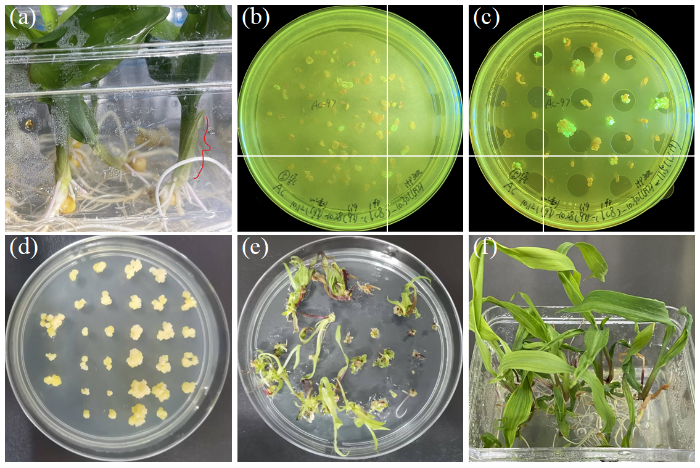
图2
玉米叶片转化流程
(a) 种子萌发;(b) 恢复培养;(c) 愈伤诱导;(d) 愈伤继代;(e) 分化出苗;(f) 再生植株。
Fig.2
Transformation process of maize leaves
(a) seed germination; (b) recovery culture; (c) callus induction; (d) callus subculture; (e) differentiation and emergence; (f) regenerated plant.
1.3.4 共培养
侵染完成后倒掉多余的菌液,将叶片材料放置于2张滤纸上,吸干多余的菌液,将叶片外植体均匀铺在放有1张滤纸的C培养基上,在22 ℃条件下暗培养2 d。
1.3.5 恢复培养
培养2 d后,将叶片和滤纸一并转至Rs培养基上,29 ℃暗培养7 d,于侵染后3~9 d,在荧光灯照射下观察转化叶片瞬时荧光情况。
1.3.6 愈伤诱导与继代
将叶片转至CIM1上,29 ℃暗培养21 d,进行愈伤诱导,将质地疏松且颜色淡黄的愈伤组织转至CIM2上进行继代培养,每14 d继代1次。
1.3.7 分化植株
将继代后的愈伤组织转至M培养基上,26 ℃光照培养,每14 d将有绿点的愈伤组织进行继代培养直至分化出再生苗。
1.3.8 转基因苗伸长与生根
将分化出的小苗转至装有R培养基的大组培盒中,26 ℃光照培养进行生根,生长至约10 cm时转移至人工气候室定植。
1.3.9 转化植株的分子检测
再生苗正常生根后,取1.0 cm×0.5 cm大小的叶片组织,用TPS法提取样品DNA后,利用PCR检测转入基因GFP。GFP基因特异引物EGFP-jc-F2(GTCCATGCCGAGA GTGATCC)和EGFP-jc-R2(CTCGTGACCACCC TGACCTA),目的片段大小为525 bp,所用标记为FY2000。
1.3.10 转化效率
计算不同玉米自交系的转化效率,转化效率(%)=(阳性苗数/碎叶片数)×100。
2 结果与分析
2.1 噻苯唑对抑制真菌污染的影响
图3
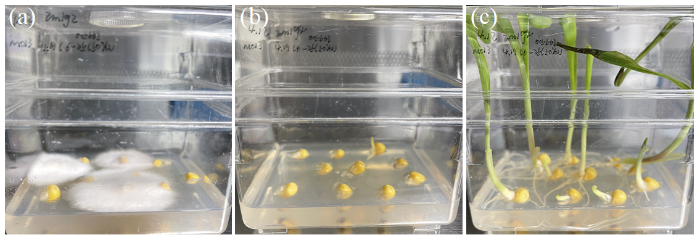
图3
噻苯唑对种子萌发污染的影响
(a) 种子在未添加噻苯唑培养基生长7 d的生长情况;(b) 种子在添加10 mg/L噻苯唑培养基上7 d的生长情况;(c) 种子在添加10 mg/L噻苯唑培养基上14 d的生长情况。
Fig.3
Effects of thiabendazole on seed germination contamination
(a) seeds on medium without thiabendazole for 7 d; (b) seeds on medium with 10 mg/L thiabendazole for 7 d; (c) seeds on medium with 10 mg/L thiabendazole for 14 d.
图4
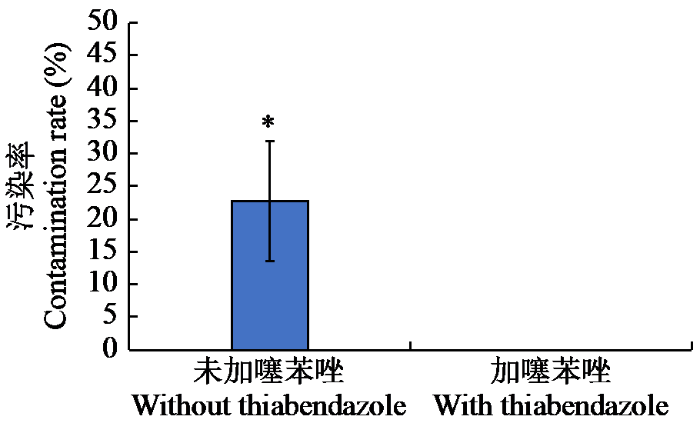
图4
噻苯唑对抑制真菌污染的影响
“*”表示差异显著(P < 0.05)。下同。
Fig.4
Effect of thiabendazole on inhibiting fungal contamination
“*”indicates significant difference (P < 0.05). The same below.
2.2 水浴热处理对转化效果的影响
图5
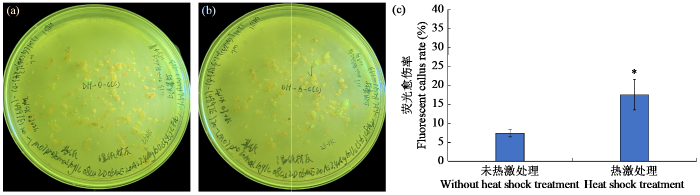
图5
热激处理对转化效果的影响
(a) 未热激处理;(b) 热激处理。
Fig.5
Effects of heat shock treatment on transformation efficiency
(a) without heat shock treatment; (b) heat shock treatment.
2.3 叶片转化在不同玉米自交系中的应用
叶片侵染3 d后即可观察到明显荧光,20 d左右可长出小米粒大小的淡黄色愈伤组织,将愈伤组织继代扩增后进行分化,分化7 d左右的愈伤组织上可见微小芽体,21 d时再生出完整植株,转移至R培养基中7 d左右可生成1~2条根。再生苗通过根部GFP绿色荧光进行初步确认后,提取叶片DNA,利用PCR方法检测GFP基因片段,结果(图6)表明,所有根部显示GFP绿色荧光的植株均为PCR阳性植株。
图6

图6
1 :阳性对照;2:阴性对照;3~23:转基因植株。
Fig.6
1 : positive control; 2: negative control; 3-23: transgenic plants.
通过荧光筛选和PCR的双重鉴定,发现参加测试的6个自交系均获得转基因阳性植株,证明该方法具有普遍适用性,各品种转化效率见表2。同时也发现不同品种间转化效率存在较大差异,其中M013转化效率最高,达11.0%,PH4CV最低,为1.1%,说明叶片转化也存在一定的基因型依赖性。
表2 不同玉米自交系的转化效率
Table 2
| 编号 Number | 自交系 Inbred line | 杂种优势群 Heterotic group | 起始种子数 Number of starting seeds | 碎叶片数 Number of chopped leaves | 阳性苗数 Number of positive seedlings | 转化效率 Transformation rate (%) |
|---|---|---|---|---|---|---|
| 1 | M013 | Lancaster | 11 | 1925 | 212 | 11.0 |
| 2 | M018 | Lancaster | 10 | 1900 | 86 | 4.5 |
| 3 | DH351 | Reid | 6 | 1092 | 36 | 3.3 |
| 4 | F003 | Reid | 2 | 372 | 12 | 3.2 |
| 5 | Qi319 | PB | 16 | 2752 | 52 | 1.9 |
| 6 | PH4CV | Lancaster | 3 | 540 | 6 | 1.1 |
3 讨论
玉米成熟种子消毒较为困难,容易发生真菌污染,影响试验进展。早期试验尝试通过精细挑选种子、调整酒精和次氯酸钠消毒时间、采用氯气消毒法等,均未能有效地解决真菌污染问题,后期尝试将噻苯唑加入G培养基,以保证外植体不受真菌污染。噻苯唑是一种高效、广谱的杀菌剂,常用于植物真菌病害防治,以及预防果蔬贮存期的真菌污染。在组织培养中,抑制细菌污染的常用药品有很多,而能明显抑制真菌污染且对植物伤害较小的药品较少。本试验发现,通过剔除破损的种子、调整合适的消毒强度及在G培养基中加入10 mg/L噻苯唑能够有效解决大部分批次玉米种子的真菌污染问题,表明噻苯唑是一种有效的抑制组培真菌污染的药品。
本试验前期参考Wang等[6]的方法,将幼苗放在45 ℃培养箱处理3 h后,再将叶片切碎进行转化,但未见明显的转化效率提升,可能是由于切碎叶片需要一定的时间,导致此时叶片细胞已由“热激状态”转为普通状态,不利于转化。因此,后期试验在叶片切碎后对其进行水浴热激处理,处理后直接将菌液倒入侵染,明显提高了侵染效率。在继代阶段,对Ahmadabadi等[7]的愈伤继代方法进行改良,通过多次继代,增加愈伤组织数量,并最终确认适当增加继代次数能够获得更多阳性幼苗。Wang等[6]在叶片形成愈伤组织后,直接将其转移至分化培养基中以分化出苗,出苗数量有限。而本试验在愈伤组织生成后,将愈伤组织继续多次继代并仍可以分化出苗,提高了叶片转化效率。
本研究共测试6个玉米自交系,每个自交系使用种子不超过16粒,最终获得6~212株阳性苗,展现出了叶片转化所需材料少和阳性苗得苗率高的优点。以M018自交系为例,在同样获得10株阳性苗的前提下,使用常规未成熟胚转化体系,需要生长状态良好的玉米完整果穗2~3个;而叶片转化法只需要2~3粒成熟种子,且不受光温条件限制,优势明显。本研究结果也显示,虽然不同杂交优势群在转化效率的比较中处于相近的趋势,但同一杂交优势群不同品种间的转化效率也存在一定差异。与幼胚相比,叶片的细胞全能性更差,需要更复杂的外源激素配伍,也需要与外植体内源激素的代谢较好地相互配合才能完成再生过程。不同品种的激素代谢水平不尽相同,同一杂交优势群可能在激素代谢水平上有更多的相似性,这可能是叶片转化方法受基因型影响较大的原因之一。
目前该体系的转化效率仍有较大提升空间,在后续测试中,可通过进一步提升Cre/loxP系统的环出效率提高其转化效率和普适性,也可通过优化农杆菌侵染条件和培养基成分等方式进一步提高转化效率。玉米叶片遗传转化方法的开发为玉米功能基因组研究与分子育种提供了理论依据。
4 结论
本研究成功建立了一种以玉米叶片为外植体的转化方法。通过在G培养基中添加杀真菌剂,可显著抑制种子真菌污染;对切碎的叶片进行水浴热激处理,可显著提升荧光愈伤诱导率;利用该体系对6个玉米自交系进行转化,均可获得转基因阳性植株。与传统的幼胚转化相比,该体系具有材料获取简便和不受季节限制等优势。
参考文献
Efficient transformation of scutellar tissue of immature maize embryos
DOI:10.1007/s001220050473 URL [本文引用: 1]
Agrobacterium tumefaciens -mediated transformation of maize embryos using a standard binary vector system
DOI:10.1104/pp.000653
PMID:12011333
[本文引用: 1]

We have achieved routine transformation of maize (Zea mays) using an Agrobacterium tumefaciens standard binary (non-super binary) vector system. Immature zygotic embryos of the hybrid line Hi II were infected with A. tumefaciens strain EHA101 harboring a standard binary vector and cocultivated in the presence of 400 mg L-1 L-cysteine. Inclusion of L-cysteine in cocultivation medium lead to an improvement in transient beta-glucuronidase expression observed in targeted cells and a significant increase in stable transformation efficiency, but was associated with a decrease in embryo response after cocultivation. The average stable transformation efficiency (no. of bialaphos-resistant events recovered per 100 embryos infected) of the present protocol was 5.5%. Southern-blot and progeny analyses confirmed the integration, expression, and inheritance of the bar and gus transgenes in R0, R1, and R2 generations of transgenic events. To our knowledge, this represents the first report in which fertile, stable transgenic maize has been routinely produced using an A. tumefaciens standard binary vector system.
Agrobacterium-mediated transformation of maize
DOI:10.1038/nprot.2007.241
PMID:17585302
[本文引用: 1]
Maize may be transformed very efficiently using Agrobacterium tumefaciens-mediated methods. The most critical factor in the transformation protocol is the co-cultivation of healthy immature embryos of the correct developmental stage with A. tumefaciens; the embryos should be collected only from vigorous plants grown in well-conditioned glasshouses. With the protocol described here, approximately 50% of immature embryos from the inbred line A188 and 15% from inbred lines A634, H99 and W117 will produce transformants. About half of the transformed plants are expected to carry one or two copies of the transgenes, which are inherited by the progeny in a mendelian fashion. More than 90% of transformants are expected to be normal in morphology. The protocol takes about 3 months from the start of co-cultivation to the planting of transformants into pots.
Commercial scale genetic transformation of mature seed embryo explants in maize
DOI:10.3389/fpls.2022.1056190
URL
[本文引用: 1]
A novel, efficient maize genetic transformation system was developed using Agrobacterium-mediated transformation of embryo explants from mature seeds. Seeds from field grown plants were sterilized and crushed to isolate embryo explants consisting of the coleoptile, leaf primordia, and shoot apical meristem which were then purified from the ground seed bulk preparation. The infection of relevant tissues of seed embryo explants (SEEs) by Agrobacterium was improved by the centrifugation of the explants. Transgenic plants were obtained by multiple bud induction on high cytokinin media, followed by plant regeneration on hormone-free medium. Three different selectable markers (cp4 epsps, aadA, and nptII) were successfully used for producing transgenic plants. Stable integration of transgenes in the maize genome was demonstrated by molecular analyses and germline transmission of the inserted transgenes to the next generation was confirmed by pollen segregation and progeny analysis. Phenotypic evidence for chimeric transgenic tissue was frequently observed in initial experiments but was significantly reduced by including a second bud induction step with optimized cytokinin concentration. Additional improvements, including culturing explants at an elevated temperature during bud induction led to the development of a revolutionary system for efficient transgenic plant production and genome editing. To our knowledge, this is the first report of successful transgenic plant regeneration through Agrobacterium-mediated transformation of maize mature SEEs. This system starts with mature seed that can be produced in large volumes and the SEEs explants are storable. It has significant advantages in terms of scalability and flexibility over methods that rely on immature explants.
Morphogenic regulators Baby boom and Wuschel improve monocot transformation
DOI:10.1105/tpc.16.00124 URL [本文引用: 1]
Leaf transformation for efficient random integration and targeted genome modification in maize and sorghum
DOI:10.1038/s41477-022-01338-0
PMID:36759580
[本文引用: 4]
Transformation in grass species has traditionally relied on immature embryos and has therefore been limited to a few major Poaceae crops. Other transformation explants, including leaf tissue, have been explored but with low success rates, which is one of the major factors hindering the broad application of genome editing for crop improvement. Recently, leaf transformation using morphogenic genes Wuschel2 (Wus2) and Babyboom (Bbm) has been successfully used for Cas9-mediated mutagenesis, but complex genome editing applications, requiring large numbers of regenerated plants to be screened, remain elusive. Here we demonstrate that enhanced Wus2/Bbm expression substantially improves leaf transformation in maize and sorghum, allowing the recovery of plants with Cas9-mediated gene dropouts and targeted gene insertion. Moreover, using a maize-optimized Wus2/Bbm construct, embryogenic callus and regenerated plantlets were successfully produced in eight species spanning four grass subfamilies, suggesting that this may lead to a universal family-wide method for transformation and genome editing across the Poaceae.© 2023. The Author(s).
A leaf-based regeneration and transformation system for maize (Zea mays L.)
DOI:10.1007/s11248-006-9046-y
PMID:17103238
[本文引用: 4]
Efficient methods for in vitro propagation, regeneration, and transformation of plants are of pivotal importance to both basic and applied research. While being the world's major food crops, cereals are among the most difficult-to-handle plants in tissue culture which severely limits genetic engineering approaches. In maize, immature zygotic embryos provide the predominantly used material for establishing regeneration-competent cell or callus cultures for genetic transformation experiments. The procedures involved are demanding, laborious and time consuming and depend on greenhouse facilities. We have developed a novel tissue culture and plant regeneration system that uses maize leaf tissue and thus is independent of zygotic embryos and greenhouse facilities. We report here: (i) a protocol for the efficient induction of regeneration-competent callus from maize leaves in the dark, (ii) a protocol for inducing highly regenerable callus in the light, and (iii) the use of leaf-derived callus for the generation of stably transformed maize plants.
Seedling-derived leaf and root tip as alternative explants for callus induction and plant regeneration in maize
DOI:10.1111/ppl.v172.3 URL [本文引用: 1]
Agrobacterium-mediated transformation of seedling-derived maize callus
DOI:10.1007/s00299-005-0058-5
PMID:16252091
[本文引用: 1]
Efficient production of seedling-derived Type I callus was demonstrated for several corn genotypes including commercial inbred lines. Seeds were germinated on MS-based medium containing 10 mg l(-1) picloram and 3 mg l(-1) 6-benzylaminopurine, which induced the development of axillary buds in the area of coleoptilar node. Nodal sections of 7-10-day old seedlings were isolated, split longitudinally, and placed on callus induction medium supplemented with 2.2 mg l(-1) picloram and 0.5 mg l(-1) 2,4-dichlorophenoxyacetic acid. For lines L4 and L9 the frequency of embryogenic callus induction was 38-42% based on calli per split nodal section. Frequency of callus induction from split nodal sections of seeds germinated on media without growth regulators was 0-3%. Seedling-derived callus of five genotypes was used for Agrobacterium-mediated transformation. Two constructs containing the green fluorescence protein gene and genes for either neomycin phosphotransferase II or glyphosate selection were used in transformation experiments. Transformation frequency varied from 2 to 11% and about 60% of the T(0) plants had 1-2 copies of transgenes.
Improved frequency of transformation in rice and maize by treatment of immature embryos with centrifugation and heat prior to infection with Agrobacterium tumefaciens
DOI:10.1007/s11240-006-9157-4 URL [本文引用: 1]
An improved ternary vector system for Agrobacterium-mediated rapid maize transformation
DOI:10.1007/s11103-018-0732-y [本文引用: 1]
A novel ternary vector system united with morphogenic genes enhances CRISPR/Cas delivery in maize
DOI:10.1104/pp.19.00767
PMID:31558579
The lack of efficient delivery methods is a major barrier to clustered regularly interspaced short palindromic repeats/CRISPR-associated protein (CRISPR/Cas)-mediated genome editing in many plant species. Combinations of morphogenic regulator (MR) genes and ternary vector systems are promising solutions to this problem. In this study, we first demonstrated that MR vectors greatly enhance maize () transformation. We then tested a CRISPR/Cas9 MR vector in maize and found that the MR and CRISPR/Cas9 modules have no negative influence on each other. Finally, we developed a novel ternary vector system to integrate the MR and CRISPR/Cas modules. Our ternary vector system is composed of new pGreen-like binary vectors, here named pGreen3, and a pVS1-based virulence helper plasmid, which also functions as a replication helper for the pGreen3 vectors in The pGreen3 vectors were derived from the plasmid pRK2 and display advantages over pGreen2 vectors regarding both compatibility and stability. We demonstrated that the union of our ternary vector system with MR gene modules has additive effects in enhancing maize transformation and that this enhancement is especially evident in the transformation of recalcitrant maize inbred lines. Collectively, our ternary vector system-based tools provide a user-friendly solution to the low efficiency of CRISPR/Cas delivery in maize and represent a basic platform for developing efficient delivery tools to use in other plant species recalcitrant to transformation.© 2019 American Society of Plant Biologists. All Rights Reserved.
An improved Agrobacterium- mediated transformation and genome-editing method for maize inbred B104 using a ternary vector system and immature embryos
DOI:10.3389/fpls.2022.860971
URL
[本文引用: 1]
For maize genome-editing and bioengineering, genetic transformation of inbred genotypes is most desired due to the uniformity of genetic background in their progenies. However, most maize inbred lines are recalcitrant to tissue culture and transformation. A public, transformable maize inbred B104 has been widely used for genome editing in recent years. This is primarily due to its high degree of genetic similarity shared with B73, an inbred of the reference genome and parent of many breeding populations. Conventional B104 maize transformation protocol requires 16–22 weeks to produce rooted transgenic plants with an average of 4% transformation frequency (number of T0 plants per 100 infected embryos). In this Method paper, we describe an advanced B104 transformation protocol that requires only 7–10 weeks to generate transgenic plants with an average of 6.4% transformation frequency. Over 66% of transgenic plants carried CRISPR/Cas9-induced indel mutations on the target gene, demonstrating that this protocol can be used for genome editing applications. Following the detailed and stepwise procedure described here, this quick and simplified method using the Agrobacterium ternary vector system consisting of a T-DNA binary vector and a compatible helper plasmid can be readily transferable to interested researchers.
Enhancing Agrobacterium-mediated plant transformation efficiency through improved ternary vector systems and auxotrophic strains
DOI:10.3389/fpls.2024.1429353
URL
Agrobacterium-mediated transformation is an essential tool for functional genomics studies and crop improvements. Recently developed ternary vector systems, which consist of a T-DNA vector and a compatible virulence (vir) gene helper plasmid (ternary helper), demonstrated that including an additional vir gene helper plasmid into disarmed Agrobacterium strains significantly improves T-DNA delivery efficiency, enhancing plant transformation. Here, we report the development of a new ternary helper and thymidine auxotrophic Agrobacterium strains to boost Agrobacterium-mediated plant transformation efficiency. Auxotrophic Agrobacterium strains are useful in reducing Agrobacterium overgrowth after the co-cultivation period because they can be easily removed from the explants due to their dependence on essential nutrient supplementation. We generated thymidine auxotrophic strains from public Agrobacterium strains EHA101, EHA105, EHA105D, and LBA4404. These strains exhibited thymidine-dependent growth in the bacterial medium, and transient GUS expression assay using Arabidopsis seedlings showed that they retain similar T-DNA transfer capability as their original strains. Auxotrophic strains EHA105Thy- and LBA4404T1 were tested for maize B104 immature embryo transformation using our rapid transformation method, and both strains demonstrated comparable transformation frequencies to the control strain LBA4404Thy-. In addition, our new ternary helper pKL2299A, which carries the virA gene from pTiBo542 in addition to other vir gene operons (virG, virB, virC, virD, virE, and virJ), demonstrated consistently improved maize B104 immature embryo transformation frequencies compared to the original version of pKL2299 (33.3% vs 25.6%, respectively). Therefore, our improved Agrobacterium system, including auxotrophic disarmed Agrobacterium strains and a new ternary helper plasmid, can be useful for enhancing plant transformation and genome editing applications.
An Agrobacterium strain auxotrophic for methionine is useful for switchgrass transformation
DOI:10.1007/s11248-022-00328-4
PMID:36239844
[本文引用: 1]
Auxotrophic strains of Agrobacterium tumefaciens can contribute to the development of more efficient transformation systems, especially for crops historically considered recalcitrant. Homologous recombination was used to derive methionine auxotrophs of two common A. tumefaciens strains, LBA4404 and EHA105. The EHA105 strains were more efficient for switchgrass transformation, while both the EHA105 and LBA4404 strains worked equally well for the rice control. Event quality, as measured by transgene copy number, was not affected by auxotrophy, but was higher for the LBA4404 strains than the EHA105 strains. Ultimately, the use of auxotrophs reduced bacterial overgrowth during co-cultivation and decreased the need for antibiotics.© 2022. The Author(s).
Efficient regeneration system from wheat leaf base segments
DOI:10.1007/s10535-006-0045-x URL [本文引用: 1]
Efficient regeneration system from rye leaf base segments
Rye is second only to wheat among grains most widely used in the making of bread and is also a very important gene resource for breeding and improvement of wheat and other cereal crops owing to tolerance to abiotic stress factors such as low temperatures, drought and poor soil conditions. However, application of biotechnologies has been limited in rye breeding since it is one of the most recalcitrant species in tissue culture. A simple and fast regeneration system from leaf-base segment explant of rye was developed in this study. Basal media, carbohydrate source, combination of plant growth regulators and the leaf segment locations were evaluated for callus and shoot formation. The highest callus formation (10.39%) and shoot formation (4.53%) were achieved from first basal segments 3-4 days old seedlings. MS (Murashige and Skoog, in Physiol Plant 15:473-497, 1962) medium supplemented with 30 g/L sucrose and 2 mg/L 2,4-D (2-4 dichlorophenoxyacetic acid) + 1 mg/L TDZ (Thidiazuran) was the best medium for shoot formation (18.75%) in first leaf base segment culture. Regenerated plants were phenotypically normal and set seed after they were successfully transferred to soil. The results indicate that this regeneration method can be used for genetic transformation in rye.
Efficient in vitro plant regeneration via leaf base segments of indica rice (Oryza sativa L.)
A reliable and reproducible protocol has been developed for high frequency plant regeneration from 4-5 mm long leaf base segments of 4 days old in vitro germinated seedlings of indica rice (Oryza sativa) cultivar Rasi. The effect of age of seedlings, position of leaf base segments and optimum concentration of 2,4-D on callus induction frequency was investigated with a future aim to use leaf bases for biolistic and Agrobacterium-mediated transformation experiments. Friable, nodular and white to pale yellow embryogenic callus cultures (206 mg fresh weight /explant) were obtained from the first basal segments of rice seedlings on Linsmaier and Skoog (LS) medium supplemented with 2,4-D (11.3 microM) and 3.0 microM thiamine-HCL. Plant regeneration was achieved after the transfer of 54 days old embryogenic callus cultures to Murashige and Skoog (MS) medium supplemented with BAP (2.2 microM) and NAA (0.27 microM). In vitro regenerated plants with multiple shoots and roots transferred to sterile soil in growth chamber and maintained in greenhouse exhibited normal growth and were phenotypically similar to plants germinated from seeds.
In vitro regeneration from leaf-base segments in three genotypes of Urochloa spp
DOI:10.1071/CP17395
URL
[本文引用: 1]
The key agricultural species of Urochloa P.Beauv. (signal grass), important as tropical forage grasses, are characterised by asexual seed formation (apomixis), and this presents a challenge for breeding programs. Biotechnological approaches could be an option to develop improved cultivars. We evaluated the regenerative potential from three commercial genotypes, U. brizantha cv. Marandu, U. decumbens cv. Basilisk and U. ruziziensis cv. Ruziziensis, by using leaf-base segments as explants. We tested two auxins (2,4-D and picloram) and one cytokinin (TDZ) at four concentrations (1, 2, 3 and 4 mg L–1). Seeds were scarified, peeled and disinfected before inoculation on half-strength MS media in the dark for 14 days. Leaf-base explants were sectioned in thin slices and inoculated into the media. We analysed the number of primary calluses, number of calluses with shoots clusters and the average of regenerated plants. The lowest concentration of auxins tested (1 mg L–1) yielded the highest number of regenerated plants for Marandú and Basilisk, whereas the optimum for Ruziziensis was 2 mg L–1. Medium with higher concentrations of TDZ (4 mg L–1) was required to produce high frequency of plants for all genotypes. Explants cultured on media with TDZ produced very few calluses. These results indicate that the auxins and cytokinin tested can induce plant regeneration from Urochloa leaf-base segments, and may be used to produce transgenic plants in genetic transformation studies.


