



苦荞(Fagopyrum tataricum L. Gaertn)属蓼科(Polygonaceae)荞麦属(Fagopyrum),为药食同源植物[1],其籽粒中含有较高的蛋白质、矿物质、维生素、膳食纤维以及其他粮食作物不具备或稀缺的特殊营养素和药用成分,如黄酮类化合物芦丁,其具有抗过敏、降血脂、降血压和降血糖等功效[2-
农作物的适时播种不仅能够使其稳产、高产,而且还能更加丰富其营养物质的积累,使其品质更优,从而充分发挥其品种潜力[12-13]。葛维德等[14]发现,沈阳地区苦荞的适宜播期在7月中下旬,而且株高、分枝数、株粒重和千粒重等性状均随播种期变化而变化,播种期越早则生育期越长。李春花等[15]发现,随着播期的延迟,3个苦荞品种的生育期均明显缩短,而株高、主茎节数和一级分枝数等株型性状没有规律性地减少或增加,株粒数、千粒重、株粒重及产量及其相关性状则随着播期的推后呈降低趋势,并且云南省的最佳夏播时期是6月下旬。王炎等[16]发现播期对苦荞的生长发育、产量和品质均有一定的影响,并且在贵州毕节地区秋播的适宜时间为8月28日左右。刘伟春等[17]发现第一播期的产量、黄酮含量和干物质积累量最高,但出苗率低;第二播期出苗率最高,产量最低,黄酮含量和干物质积累量居中;第三播期的产量和出苗率居中,黄酮含量和干物质积累量最低,并且通辽地区荞麦的适宜播期为5月27日。在吉林省,关于玉米[18]、花生[19]、小麦[20]、甜荞[21]、大豆[22]和水稻[23]等农作物的播期对产量影响的研究均有报道,但播期对苦荞农艺性状及产量的影响未见报道。本研究以9个苦荞品种为材料,在吉林省西部地区研究不同播期对苦荞农艺性状及产量的影响,为确定合理的播期、提高结实率与产量,并为开展品种选育和高产栽培技术研究提供理论依据。
1 材料与方法
1.1 试验材料
供试的9个苦荞品种名称及来源见表1。
表1 供试苦荞品种名称及来源
Table 1
| 编号Number | 品种Variety | 来源Origin |
|---|---|---|
| 1 | 贵米苦18 | 贵州 |
| 2 | 凉山苦荞 | 四川 |
| 3 | 黔苦6号 | 贵州 |
| 4 | 通苦荞1号 | 内蒙古 |
| 5 | 西荞1号 | 四川 |
| 6 | 云荞2号 | 云南 |
| 7 | 昭苦5号 | 云南 |
| 8 | 六农1号 | 贵州 |
| 9 | 晋荞麦6号 | 山西 |
1.2 试验设计
试验于2023年在吉林省白城市农业科学院试验基地(45°37′ N,122°47′ E)进行,该地区海拔155.4 m。根据生产实际,设3个播期,播种日期间隔21 d,分别为5月25日(B1)、6月15日(B2)和7月6日(B3)。试验采用完全随机区组设计,3次重复,小区长4.0 m,行距0.6 m,每小区4行,小区面积9.6 m2。播种方式为机械开沟人工条播,播种量为20.0 kg/hm2,田间正常管理。
1.3 测定项目与方法
待籽粒70%~80%成熟时收获,每小区随机选取5个单株,参照《荞麦种质资源描述规范和数据标准》[24]测定株高、主茎节数、分枝数和茎粗等株型相关性状,之后单株脱粒,经2周风干后利用万深SC-G自动考种分析系统及千粒重仪测定株粒数、千粒重、株粒重、籽粒面积、籽粒周长、长宽比、籽粒长、籽粒宽、籽粒直径和籽粒圆度等产量与籽粒相关性状。
1.4 数据处理
采用Microsoft Excel 2007和JMP 9.0.2软件进行方差分析与多重比较。
2 结果与分析
2.1 播期对苦荞生育期及株型性状的影响
由表2可知,苦荞品种的生育期与株型性状均会因播期不同而受到不同程度的影响。随着播期延迟,苦荞生育期、株高和主茎节数缩短,分枝数和茎粗增加。9个苦荞品种在B1播期的平均生育期(119.28 d)大于B2播期(109.60 d)和B3播期(96.95 d),而且B3播期均显著小于其他播期,除编号1和4外,其余7个品种的生育期均随着播期的推迟而缩短。9个苦荞品种B1播期的株高和主茎节数均与其他播期存在显著性差异。9个苦荞品种的分枝数和茎粗随着播期的推迟所受影响程度不同。从变异系数来看,生育期、主茎节数和分枝数随着播期的推迟而增大,株高和茎粗则随着播期推迟而减小。生育期及株型性状中,生育期和株高的变异系数较小,均小于10.00%,分枝数的变异系数最大,3个播期的平均值为32.05%,主茎节数和茎粗的变异系数均在10.00%~20.00%之间。
表2 播期对苦荞生育期及株型性状的影响
Table 2
| 编号 Number | 生育期Growth period (d) | 株高Plant height (cm) | 主茎节数Node number of main stem | ||||||||
|---|---|---|---|---|---|---|---|---|---|---|---|
| B1 | B2 | B3 | B1 | B2 | B3 | B1 | B2 | B3 | |||
| 1 | 116cB | 121bA | 100bC | 134.60eA | 113.00fC | 120.88dB | 24.60cA | 23.75bA | 18.25dB | ||
| 2 | 116cA | 107dB | 100bC | 151.10dA | 142.25cB | 126.11cC | 28.75aA | 28.40aA | 20.67abcB | ||
| 3 | 116cA | 107dB | 88cC | 156.90cdA | 130.71dB | 123.67cdC | 25.10cA | 20.43eB | 19.33cdB | ||
| 4 | 116cB | 125aA | 100bC | 182.27aA | 144.50cB | 154.00aB | 26.18bcA | 23.17bB | 22.75aB | ||
| 5 | 116cA | 107dB | 100bC | 167.90bA | 123.00eB | 123.57cdB | 26.10bcA | 21.00deB | 19.57cdC | ||
| 6 | 124bA | 103eB | 88cC | 159.13cA | 149.43bB | 133.83bC | 25.63bcA | 23.00bB | 22.17abB | ||
| 7 | 114cA | 107dB | 88cC | 138.40eA | 126.50eB | 133.75bA | 25.40bcA | 22.50bcdB | 19.25cdC | ||
| 8 | 128aA | 113cB | 100bC | 176.56aA | 131.88dB | 126.00cB | 26.89abA | 21.25cdeB | 21.40abcB | ||
| 9 | 124bA | 104eB | 103aC | 168.69bA | 153.00aB | 112.50eC | 25.54bcA | 22.44bcB | 19.67bcdC | ||
| 平均值Mean | 119.28 | 109.60 | 96.95 | 162.77 | 136.33 | 126.69 | 26.09 | 22.51 | 20.20 | ||
| 变异系数CV (%) | 3.97 | 6.10 | 6.55 | 9.71 | 9.34 | 8.02 | 10.31 | 10.57 | 11.98 | ||
| 编号 Number | 分枝数Number of branches | 茎粗Stem diameter (mm) | |||||||||
| B1 | B2 | B3 | B1 | B2 | B3 | ||||||
| 1 | 4.80dC | 11.25aA | 9.00cB | 6.34gC | 9.69bcA | 7.46eB | |||||
| 2 | 7.30bB | 6.75cdB | 10.67bA | 8.15eB | 9.98bA | 9.52cA | |||||
| 3 | 6.30cA | 4.43fB | 4.67fB | 10.01cA | 7.84eC | 9.48cB | |||||
| 4 | 5.00dC | 8.17bA | 6.25eB | 8.17eC | 12.71aA | 9.48cB | |||||
| 5 | 5.20dB | 6.38dB | 8.00dA | 12.03aA | 7.75eC | 10.34bB | |||||
| 6 | 5.38cdA | 5.57deA | 4.67fB | 8.04eC | 9.36cB | 11.56aA | |||||
| 7 | 5.20cdB | 5.50defB | 8.00dA | 7.21fC | 8.80dB | 9.69cA | |||||
| 8 | 9.00aAB | 7.75bcC | 13.40aA | 8.57dA | 8.68dB | 8.72dA | |||||
| 9 | 5.38dA | 5.00efAB | 4.33fB | 10.34bA | 9.77bB | 9.60cB | |||||
| 平均值Mean | 6.10 | 6.51 | 7.82 | 9.08 | 9.30 | 9.49 | |||||
| 变异系数CV (%) | 26.96 | 31.34 | 37.85 | 17.06 | 16.00 | 12.12 | |||||
同列不同小写字母表示品种间差异显著(P < 0.05);同一性状中,同行不同大写字母表示播期间差异显著(P < 0.05)。下同。
Different lowercase letters in the same column indicate significant differences among varieties (P < 0.05); in the same trait, different capital letters in the same line indicate significant differences during sowing dates (P < 0.05). The same below.
2.2 播期对苦荞粒形性状的影响
由表3可知,苦荞品种的粒形性状均不同程度地受播期影响。随着播期的延迟,苦荞6个粒形相关性状的平均值均增大。除编号2的籽粒周长、籽粒长、籽粒直径和编号7的籽粒长在3个播期间存在显著性差异以外,大部分品种的粒形性状在不同播期间不存在显著性差异。变异系数则随着播期的延迟先减后增,籽粒周长、籽粒宽和籽粒直径的变异系数较小,均小于10.00%,长宽比、籽粒长和籽粒圆度在10.00%~20.00%之间。
表3 播期对苦荞粒形性状的影响
Table 3
| 编号 Number | 籽粒周长Grain perimeter (mm) | 长宽比Length-to-width ratio | 籽粒长Grain length (mm) | ||||||||
|---|---|---|---|---|---|---|---|---|---|---|---|
| B1 | B2 | B3 | B1 | B2 | B3 | B1 | B2 | B3 | |||
| 1 | 11.03dA | 11.48eA | 11.13eA | 1.41dA | 1.37cA | 1.33cA | 3.97dA | 4.11dA | 3.92eA | ||
| 2 | 11.69cC | 12.40dB | 12.91dA | 1.22eB | 1.26dAB | 1.33cA | 3.91dC | 4.21dB | 4.51dA | ||
| 3 | 13.61aA | 13.13bcA | 13.51bcA | 1.66abA | 1.60bA | 1.69abA | 5.06aA | 4.85bcA | 5.07bA | ||
| 4 | 11.66cA | 11.50eA | 11.44eA | 1.16eA | 1.17eA | 1.15dA | 3.77dA | 3.75eA | 3.70eA | ||
| 5 | 12.80bA | 12.96cA | 13.23cdA | 1.61abcA | 1.67aA | 1.65bA | 4.79bcA | 4.86bcA | 4.96bcA | ||
| 6 | 12.63bA | 13.26bcA | 12.88dA | 1.57cA | 1.66bA | 1.63bA | 4.69cA | 4.97bcA | 4.81cA | ||
| 7 | 12.59bB | 12.87cB | 13.41bcA | 1.60abcB | 1.64abAB | 1.68abA | 4.69cC | 4.83cB | 5.06bA | ||
| 8 | 13.44aA | 13.76aA | 13.85abA | 1.60bcB | 1.61bB | 1.65bA | 4.95abB | 5.09aAB | 5.16bA | ||
| 9 | 13.71aAB | 13.47abB | 14.14aA | 1.67aB | 1.66abB | 1.78aA | 5.14aB | 5.02abB | 5.40aA | ||
| 平均值Mean | 12.59 | 12.75 | 12.95 | 1.49 | 1.51 | 1.54 | 4.55 | 4.63 | 4.73 | ||
| 变异系数CV (%) | 7.63 | 6.51 | 8.03 | 12.75 | 12.58 | 14.29 | 11.65 | 10.15 | 12.26 | ||
| 编号 Number | 籽粒宽Grain widtd (mm) | 籽粒直径Grain diameter (mm) | 籽粒圆度Grain circularity | ||||||||
| B1 | B2 | B3 | B1 | B2 | B3 | B1 | B2 | B3 | |||
| 1 | 2.83eB | 3.00cdA | 2.97dA | 3.21dB | 3.37eA | 3.29dAB | 0.75cA | 0.76cA | 0.78bA | ||
| 2 | 3.21abB | 3.36aA | 3.42aA | 3.39cC | 3.60dB | 3.71bcA | 0.85bA | 0.82bAB | 0.78bB | ||
| 3 | 3.07cdA | 3.03cdA | 3.04cdA | 3.75aA | 3.70bcdA | 3.77abA | 0.61efA | 0.63dA | 0.60cdA | ||
| 4 | 3.24aA | 3.20bA | 3.22bA | 3.34cA | 3.35eA | 3.34dA | 0.90aA | 0.88aA | 0.89aA | ||
| 5 | 2.98dA | 2.92dA | 3.03cdA | 3.62bB | 3.64bcdAB | 3.73bcA | 0.64deA | 0.61dA | 0.62cA | ||
| 6 | 2.99dA | 3.00cdA | 2.98dA | 3.58bA | 3.73bcA | 3.65cA | 0.65dA | 0.61dA | 0.63cA | ||
| 7 | 2.95deA | 2.96cdA | 3.02cdA | 3.55bB | 3.62cdB | 3.74bcA | 0.63defA | 0.61dA | 0.60cdA | ||
| 8 | 3.12bcA | 3.18bA | 3.14bcA | 3.78aA | 3.87aA | 3.87aA | 0.63deA | 0.63dA | 0.61cB | ||
| 9 | 3.08cdA | 3.04cA | 3.05cdA | 3.80aA | 3.74bA | 3.87aA | 0.60fA | 0.60dA | 0.56dB | ||
| 平均值Mean | 3.06 | 3.08 | 3.10 | 3.56 | 3.62 | 3.66 | 0.68 | 0.70 | 0.71 | ||
| 变异系数CV (%) | 4.90 | 4.87 | 5.16 | 5.90 | 4.97 | 6.01 | 15.71 | 14.71 | 16.18 | ||
2.3 播期对苦荞产量相关性状的影响
由表4可知,苦荞品种的产量相关性状均不同程度地受播期影响。随着播期的延迟,苦荞3个产量相关性状的平均值均增大。从株粒数和株粒重来看,除编号9在B1和B2播期间不存在显著差异外,其他品种均在不同播期间存在显著差异,而且编号1、2和3在B2播期中,4、5、6、7和9在B3播期中,8在B1播期中均表现出最高值。对于千粒重而言,除编号1、3、4、6、7和9在3个播期间存在显著差异以外,其他4个品种在其中2个播期间存在显著差异,而且编号1、2、3、4和8在B2播期中,5、6、7和9在B3播期中均表现出最高值。变异系数则随着播期的延迟先减后增,千粒重的变异系数小于株粒数和株粒重。
表4 播期对苦荞产量相关性状的影响
Table 4
| 编号 Number | 株粒数Grain number per plant | 千粒重1000-grain weight (g) | 株粒重Grain weight per plant (g) | ||||||||
|---|---|---|---|---|---|---|---|---|---|---|---|
| B1 | B2 | B3 | B1 | B2 | B3 | B1 | B2 | B3 | |||
| 1 | 254.40fB | 737.00cA | 114.60hC | 14.49gB | 15.66gA | 13.32iC | 2.76iB | 8.18eA | 1.27iC | ||
| 2 | 607.00cB | 722.60dA | 563.60cC | 18.82dB | 20.99dA | 20.85gA | 8.90dC | 12.25cA | 11.71dB | ||
| 3 | 647.00cC | 804.20bA | 698.60bB | 21.12aC | 22.32bA | 21.84eB | 12.24cC | 15.04aA | 14.00cB | ||
| 4 | 331.20eC | 346.00hB | 545.20dA | 17.76fC | 19.30fA | 18.74hB | 4.90gC | 5.92hB | 9.39gA | ||
| 5 | 751.60bB | 214.60iC | 875.20aA | 19.25cB | 19.25fB | 20.96fA | 14.12bB | 3.83iC | 14.33bA | ||
| 6 | 327.00eC | 406.40fB | 532.75eA | 18.44deC | 21.48cB | 22.00cA | 5.74fC | 7.70fB | 11.38eA | ||
| 7 | 265.00fC | 845.60aB | 878.50aA | 18.28eC | 19.84eB | 21.94dA | 4.83hC | 13.80bB | 16.29aA | ||
| 8 | 932.80aA | 666.50eB | 472.75gC | 20.76bB | 22.85aA | 22.36bA | 17.06aA | 12.07dB | 8.95hC | ||
| 9 | 390.40dB | 373.80gB | 520.80fA | 21.18aC | 22.13bB | 22.94aA | 8.62eB | 6.66gC | 11.31fA | ||
| 平均值Mean | 506.07 | 566.30 | 570.33 | 18.92 | 20.37 | 20.44 | 8.91 | 9.44 | 10.75 | ||
| 变异系数CV (%) | 46.30 | 39.54 | 50.28 | 10.73 | 10.46 | 14.19 | 51.96 | 39.62 | 49.77 | ||
2.4 不同播期苦荞农艺性状的相关性分析
由表5可知,在3个播期中籽粒周长与长宽比、籽粒长、籽粒直径、千粒重,长宽比与籽粒长,籽粒长与籽粒直径,籽粒直径与千粒重,株粒数与株粒重均达到极显著正相关;籽粒圆度与籽粒周长、长宽比、籽粒长均达到极显著负相关;籽粒直径与长宽比达到显著正相关,与籽粒圆度达到显著负相关。其中籽粒周长与籽粒直径、长宽比与籽粒长和籽粒圆度、籽粒长与籽粒圆度的相关系数的绝对值在3个播期中均大于0.95。生育期与株高、主茎节数、茎粗、籽粒宽、千粒重、株粒数、株粒重,株高与主茎节数和籽粒宽以外的11个性状,主茎节数与株高和籽粒宽以外的11个性状,分枝数与茎粗、长宽比、籽粒长、籽粒宽、籽粒直径、籽粒圆度,茎粗与籽粒周长、籽粒宽、籽粒直径、株粒数,籽粒周长与籽粒宽,长宽比与株粒数、株粒重,籽粒长与籽粒宽、株粒数和株粒重,籽粒宽与籽粒直径、籽粒圆度、株粒数、千粒重、株粒重,籽粒圆度与株粒重在3个播期中均无显著性差异。其他性状随着播期不同呈现不同的相关程度。
表5 不同播期苦荞农艺性状的相关系数
Table 5
| 性状 Traits | 播期 Sowing date | 生育 期 Growth period | 株高 Plant height | 主茎节数 Node number of main stem | 分枝数 Number of branches | 茎粗 Stem diameter | 籽粒 周长 Grain perimeter | 长宽比 Length- to-width ratio | 籽粒长 Grain length | 籽粒宽 Grain width | 籽粒 直径 Grain diameter | 籽粒 圆度 Grain circularity | 株粒数 Grain number per plant | 千粒重 1000- grain weight |
|---|---|---|---|---|---|---|---|---|---|---|---|---|---|---|
| 株高 Plant height | B1 | 0.488 | ||||||||||||
| B2 | -0.325 | |||||||||||||
| B3 | -0.213 | |||||||||||||
| 主茎节数 Node number of main stem | B1 | 0.096 | 0.271 | |||||||||||
| B2 | 0.058 | 0.237 | ||||||||||||
| B3 | 0.016 | 0.698* | ||||||||||||
| 分枝数 Number of branches | B1 | 0.523 | 0.286 | 0.624 | ||||||||||
| B2 | 0.812** | -0.507 | 0.261 | |||||||||||
| B3 | 0.374 | -0.056 | 0.001 | |||||||||||
| 茎粗 Stem diameter | B1 | 0.109 | 0.532 | 0.065 | 0.031 | |||||||||
| B2 | 0.641 | 0.441 | 0.453 | 0.391 | ||||||||||
| B3 | -0.454 | 0.230 | 0.476 | -0.490 | ||||||||||
| 籽粒周长 Grain perimeter | B1 | 0.525 | 0.400 | -0.122 | 0.344 | 0.638 | ||||||||
| B2 | -0.772* | 0.296 | -0.438 | -0.696* | -0.643 | |||||||||
| B3 | -0.154 | -0.502 | -0.090 | -0.018 | 0.368 | |||||||||
| 长宽比 Length-to- width ratio | B1 | 0.380 | -0.061 | -0.489 | 0.054 | 0.449 | 0.809** | |||||||
| B2 | -0.726* | -0.040 | -0.654 | -0.580 | -0.787* | 0.836** | ||||||||
| B3 | -0.342 | -0.599 | -0.324 | -0.220 | 0.351 | 0.868** | ||||||||
| 籽粒长 Grain length | B1 | 0.486 | 0.170 | -0.310 | 0.216 | 0.569 | 0.948*** | 0.954*** | ||||||
| B2 | -0.777* | 0.101 | -0.551 | -0.632 | -0.765* | 0.955*** | 0.957*** | |||||||
| B3 | -0.236 | -0.594 | -0.229 | -0.079 | 0.354 | 0.972*** | 0.956*** | |||||||
| 籽粒宽 Grain width | B1 | 0.143 | 0.678* | 0.702* | 0.456 | 0.194 | 0.121 | -0.484 | -0.198 | |||||
| B2 | 0.251 | 0.394 | 0.690* | 0.170 | 0.518 | -0.198 | -0.696* | -0.461 | ||||||
| B3 | 0.391 | 0.265 | 0.418 | 0.425 | -0.065 | -0.053 | -0.533 | -0.265 | ||||||
| 籽粒直径 Grain diameter | B1 | 0.576 | 0.419 | -0.048 | 0.407 | 0.639 | 0.995*** | 0.797* | 0.941*** | 0.139 | ||||
| B2 | -0.744* | 0.287 | -0.341 | -0.631 | -0.633 | 0.986*** | 0.761* | 0.915*** | -0.071 | |||||
| B3 | -0.134 | -0.504 | -0.067 | 0.071 | 0.361 | 0.992*** | 0.827** | 0.953*** | 0.029 | |||||
| 籽粒圆度 Grain circularity | B1 | -0.401 | 0.081 | 0.460 | -0.087 | -0.413 | -0.805** | -0.998*** | -0.952*** | 0.482 | -0.798* | |||
| B2 | 0.732* | 0.045 | 0.642 | 0.585 | 0.796* | -0.840** | -0.998*** | -0.961*** | 0.683 | -0.769* | ||||
| B3 | 0.346 | 0.613 | 0.339 | 0.173 | -0.329 | -0.867** | -0.998*** | -0.958*** | 0.526 | -0.831** | ||||
| 株粒数 Grain number per plant | B1 | 0.348 | 0.461 | 0.483 | 0.788* | 0.553 | 0.482 | 0.242 | 0.384 | 0.339 | 0.535 | -0.244 | ||
| B2 | 0.012 | -0.405 | 0.189 | 0.080 | -0.248 | -0.043 | -0.082 | -0.019 | 0.172 | 0.031 | 0.031 | |||
| B3 | -0.401 | 0.149 | 0.018 | -0.187 | 0.603 | 0.540 | 0.444 | 0.499 | 0.014 | 0.530 | -0.430 | |||
| 千粒重 1000 grain- weight | B1 | 0.454 | 0.543 | 0.242 | 0.504 | 0.680* | 0.913*** | 0.524 | 0.752* | 0.483 | 0.920*** | -0.523 | 0.607 | |
| B2 | -0.597 | 0.627 | -0.196 | -0.757* | -0.251 | 0.821** | 0.425 | 0.633 | 0.262 | 0.840** | -0.435 | -0.007 | ||
| B3 | -0.282 | -0.101 | 0.300 | -0.157 | 0.658 | 0.891** | 0.683* | 0.810** | 0.111 | 0.885** | -0.671* | 0.677* | ||
| 株粒重 Grain weight per plant | B1 | 0.421 | 0.513 | 0.350 | 0.715* | 0.672* | 0.666 | 0.429 | 0.578 | 0.291 | 0.710* | -0.427 | 0.971*** | 0.737* |
| B2 | -0.215 | -0.151 | 0.073 | -0.269 | -0.332 | 0.247 | 0.070 | 0.195 | 0.244 | 0.316 | -0.118 | 0.910*** | 0.376 | |
| B3 | -0.476 | 0.075 | 0.070 | -0.270 | 0.681* | 0.665 | 0.530 | 0.611 | 0.064 | 0.654 | -0.515 | 0.960*** | 0.813** |
“*”、“**”和“***”分别表示在P < 0.05、P < 0.01和P < 0.001水平显著相关。
“*”,“**”and“***”indicate significant correlations at P < 0.05, P < 0.01 and P < 0.001 levels, respectively.
2.5 不同播期对苦荞产量的影响
由表6可知,播期、品种以及两者间互作效应对苦荞产量均产生显著影响,其中播期的影响最大,其次为两者间互作效应,品种效应较小。再利用Studentʼs t-test比较法进行产量在各播期不同品种间的显著性差异分析。在B1播期中编号4和6的产量分别为1857.99和1944.79 kg/hm2,显著高于其他品种,而编号1和7的产量分别为825.35和880.21 kg/hm2,显著低于其他品种;在B2播期中编号8的产量为2634.38 kg/hm2,显著高于其他品种,而编号6的产量为1147.22 kg/hm2,显著低于其他品种;在B3播期中编号6和7的产量分别为1758.33和1705.21 kg/hm2,显著高于其他品种,而编号2和9的产量分别为948.96和995.49 kg/hm2,显著低于其他品种。另外,3个播期9个苦荞品种产量的平均值为B2>B1>B3,变异系数为B3>B1>B2(表7)。
表6 9个苦荞品种产量的方差分析
Table 6
| 变异来源Source of variation | 自由度df | 平方和SS | 均方MS | F值F-value | |
|---|---|---|---|---|---|
| 品种Variety | 8 | 3 010 703.00 | 376 337.90 | 47.83 | ** |
| 播期Sowing date | 2 | 2 527 207.00 | 1 263 603.00 | 160.59 | ** |
| 播期×品种Sowing date×Variety | 16 | 7 797 472.00 | 487 342.00 | 61.94 | ** |
| 误差Error | 54 | 424 893.30 | 7868.40 | ||
“**”表示在P < 0.01水平影响显著。
“**”indicates significant influence at P < 0.01 level.
表7 产量在不同播期和苦荞品种间的差异
Table 7
| 编号Number | B1 | B2 | B3 |
|---|---|---|---|
| 1 | 825.35dB | 1604.51bcA | 744.10fB |
| 2 | 1317.36cB | 1761.11bcA | 948.96eC |
| 3 | 1215.63cC | 1717.19bcA | 1630.21bB |
| 4 | 1857.99aA | 1496.53cdB | 1126.39dC |
| 5 | 1633.68bB | 1733.85bcA | 770.31fC |
| 6 | 1944.79aA | 1147.22eB | 1758.33aA |
| 7 | 880.21dC | 1353.13deB | 1705.21abA |
| 8 | 1594.10bB | 2634.38aA | 1224.65cC |
| 9 | 1615.28bA | 1512.85cdA | 995.49eB |
| 平均值Mean | 1431.59 | 1657.25 | 1228.49 |
| 变异系数CV (%) | 27.42 | 25.73 | 30.91 |
2.6 不同播期苦荞品种的主成分分析
对9个苦荞品种在3个播期的14个农艺性状进行主成分分析,结果(表8)表明,前4个因子对总方差的贡献最大,累计贡献率为83.745%。PC1特征值为6.150,贡献率为43.929%;PC2特征值为2.554,贡献率为18.242%;PC3特征值为2.008,贡献率为14.340%;PC4特征值为1.013,贡献率为7.234%。
表8 9个苦荞品种在3个播期下的农艺性状主成分分析
Table 8
| 主成分 Principal component | 特征值 Eigenvalue | 贡献率 Contribution rate (%) | 累计贡献率 Cumulative contribution rate (%) |
|---|---|---|---|
| PC1 | 6.150 | 43.929 | 43.929 |
| PC2 | 2.554 | 18.242 | 62.171 |
| PC3 | 2.008 | 14.340 | 76.511 |
| PC4 | 1.013 | 7.234 | 83.745 |
由载荷矩阵(表9)可知,籽粒周长、长宽比、籽粒长、籽粒宽、籽粒直径和籽粒圆度是PC1的主要指标,其特征向量所表达的生物学信息主要与籽粒形状相关;株粒数、千粒重和株粒重是PC2的主要指标,其特征向量所表达的生物学信息主要与产量相关性状有关;株高、主茎节数、分枝数和茎粗是PC3的主要指标,其特征向量所表达的生物学信息主要与株型性状相关;生育期是PC4的主要指标,其特征向量所表达的生物学信息主要与生育期相关。
表9 旋转后的因子载荷矩阵
Table 9
| 性状 Trait | 主成分Principal component | |||
|---|---|---|---|---|
| PC1 | PC2 | PC3 | PC4 | |
| 生育期Growth period | -0.401 | 0.268 | 0.347 | 0.633 |
| 株高Plant height | -0.227 | 0.515 | 0.692 | -0.036 |
| 主茎节数Node number of main stem | -0.415 | 0.507 | 0.638 | 0.072 |
| 分枝数Number of branches | -0.086 | 0.196 | 0.671 | -0.563 |
| 茎粗Stem diameter | 0.243 | -0.137 | 0.523 | -0.333 |
| 籽粒周长Grain perimeter | 0.951 | 0.090 | 0.140 | 0.202 |
| 长宽比Length-to-width ratio | 0.887 | -0.350 | 0.266 | 0.026 |
| 籽粒长Grain length | 0.961 | -0.126 | 0.187 | 0.145 |
| 籽粒宽Grain width | 0.769 | -0.164 | -0.342 | 0.267 |
| 籽粒直径Grain diameter | 0.944 | 0.147 | 0.056 | 0.244 |
| 籽粒圆度Grain circularity | -0.884 | 0.344 | -0.266 | -0.055 |
| 株粒数Grain number per plant | 0.493 | 0.565 | -0.207 | -0.250 |
| 千粒重1000-grain weight | 0.372 | 0.831 | -0.026 | 0.006 |
| 株粒重Grain weight per plant | 0.558 | 0.671 | -0.161 | -0.256 |
2.7 不同播期苦荞品种的聚类分析
对9个苦荞品种在3个播期下的14个农艺性状进行聚类分析(图1),在欧式距离为15处,可将其分为3大类群。类群Ⅰ中包含10个处理,其生育期、株高和主茎节数的平均值较大,分枝数、茎粗、籽粒周长、长宽比、籽粒长、籽粒宽、籽粒直径、株粒数、千粒重和株粒重的平均值较小。综合各性状,该类群为生育期较长,植株较高,产量相关性状较小的小粒型群体。类群Ⅱ包含5个处理,其生育期、分枝数和茎粗的平均值中等,株高、株粒数、千粒重、株粒重、籽粒周长、长宽比、籽粒长和籽粒直径的平均值较大。综合各性状,该类群为植株较高、产量相关性状较大的长粒型群体。类群Ⅲ包含12个处理,其生育期和株高的平均值较小,分枝数、茎粗和籽粒宽的平均值较大,主茎节数、株粒数、千粒重、株粒重、籽粒周长、长宽比、籽粒长和籽粒直径的平均值中等。综合各性状,该类群为生育期较短、植株较矮且产量相关性状平均值中等的短粒型群体(表10)。
图1
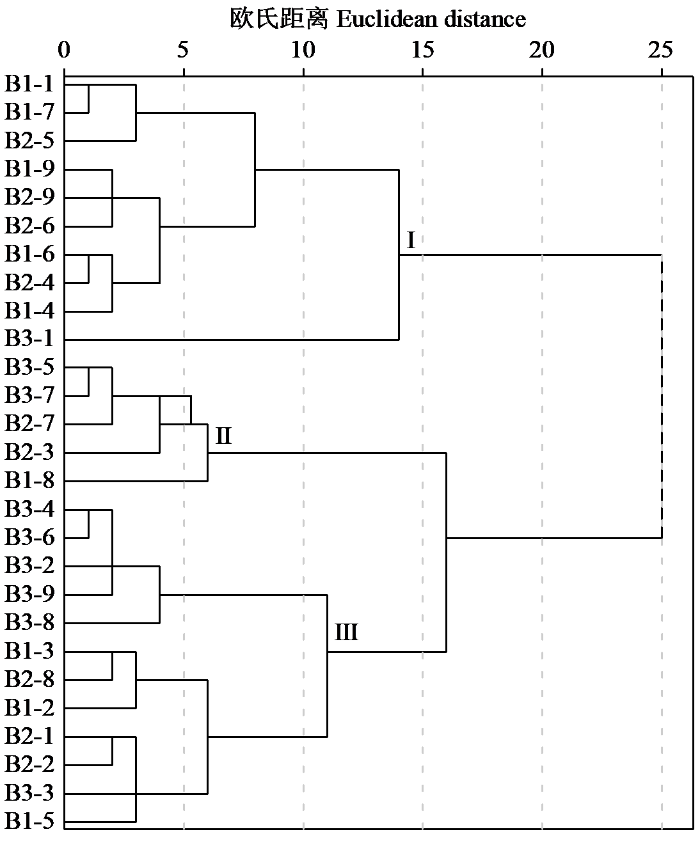
图1
不同播期下9个苦荞品种聚类分析
Fig.1
Cluster analysis of nine tartary buckwheat varieties under different sowing dates
表10 不同类群苦荞农艺性状的统计参数
Table 10
| 类群 Group | 统计参数 Statistical parameter | 生育 期 Growth period (d) | 株高 Plant height (cm) | 主茎节数 Node number of main stem | 分枝数 Number of branches | 茎粗 Stem diameter (mm) | 籽粒 周长 Grain perimeter (mm) | 长宽比 Length- to-width ratio | 籽粒长 Grain length (mm) | 籽粒宽 Grain width (mm) | 籽粒 直径 Grain diameter (mm) | 籽粒 圆度 Grain circularity | 株粒数 Grain number per plant | 千粒重 1000- grain weight (g) | 株粒重 Grain weight per plant (g) |
|---|---|---|---|---|---|---|---|---|---|---|---|---|---|---|---|
| Ⅰ | 平均值 | 113.30 | 147.39 | 23.52 | 5.99 | 8.72 | 12.39 | 1.49 | 4.48 | 3.02 | 3.52 | 0.70 | 302.34 | 18.56 | 5.22 |
| 变异系数CV (%) | 8.27 | 13.18 | 10.59 | 24.21 | 21.33 | 7.99 | 14.09 | 12.50 | 3.97 | 5.97 | 17.14 | 29.93 | 15.46 | 42.53 | |
| Ⅱ | 平均值 | 106.00 | 138.22 | 21.73 | 6.99 | 9.05 | 13.22 | 1.63 | 4.93 | 3.03 | 3.71 | 0.62 | 867.26 | 21.16 | 15.30 |
| 变异系数CV (%) | 13.72 | 15.76 | 14.50 | 27.61 | 10.83 | 1.74 | 1.84 | 1.83 | 1.98 | 1.62 | 1.61 | 5.45 | 4.68 | 8.82 | |
| Ⅲ | 平均值 | 105.67 | 136.60 | 23.28 | 7.38 | 9.74 | 12.87 | 1.50 | 4.65 | 3.14 | 3.65 | 0.70 | 622.12 | 20.62 | 11.21 |
| 变异系数CV (%) | 10.44 | 13.05 | 13.70 | 39.57 | 11.40 | 7.38 | 14.00 | 11.83 | 4.78 | 5.48 | 15.71 | 15.22 | 10.38 | 17.48 |
3 讨论
前人[16]研究表明,由于不同播期的温度、光照和降水等环境因素的差异,苦荞的农艺性状和产量等受到一定的影响。在苦荞生产中,播期对苦荞的生育期有极显著影响,在一定范围内随着播期的推迟,生育期也随之缩短[15,25]。本研究结果表明,9个苦荞品种的生育期平均值从B1到B2和B3播期分别缩短9.68和22.33 d,与上述研究结果基本一致,而且生育期的变异系数随着播期的延迟逐渐增大,表明选择生育期差异较大的苦荞品种,可使晚播得到更为理想的效果。另外,4个株型性状、6个粒形性状和3个产量相关性状中,随着播期的推迟,除株高和主茎节数呈减小趋势外,其他性状均呈逐渐增高的趋势。这与苦荞株高、主茎节数和一级分枝数随着播期的延迟没有发生规律性减少或增加,株粒数、千粒重和株粒重随着播期的推后均有降低的趋势[15],以及农艺性状和产量构成因子随播期的推迟呈先增后降[16]的结论不一致。这可能与进行试验的南北方生态环境差异有关。
本研究发现,在3个播期中,籽粒周长与长宽比、籽粒长、籽粒直径、千粒重,长宽比与籽粒长,籽粒长与籽粒直径,籽粒直径与千粒重,株粒数与株粒重均达到极显著正相关,长宽比与籽粒圆度均达到极显著负相关,这与李春花等[21]发现甜荞株粒数与株粒重均达到极显著正相关,长宽比与籽粒圆度均达到极显著负相关的结果一致,表明不管是甜荞还是苦荞,其性状间依然存在密切的相关性,改良其中一个性状时应考虑另外一个性状的变化。
本研究结果表明,播期对苦荞品种的产量有显著影响,而且3个播期的苦荞产量随着播期的推迟呈先增后减的趋势。这与张艳军等[26]和王炎等[16]的结果一致,表明播期是影响苦荞产量的重要因素之一[27]。不同苦荞品种的适应性是各性状的综合体现,每个品种均具有其适宜的播期,因而需要将播期和品种成分进行综合分析。聚类分析是研究样本与指标分类问题的一种统计方法,可以将样本分类,使得同类个体具有较高的同质性,类间个体具有较大的差异性[28]。本研究通过分析9个品种在3个播期下的27个处理,将供试品种分为3大类,类群Ⅰ为生育期较长、植株较高且产量相关性状较小的小粒型群体,类群Ⅱ为植株较高且产量相关性状较大的长粒型群体,类群Ⅲ为生育期较短、植株较矮和产量相关性状平均值中等的短粒型群体。
4 结论
在吉林西部地区,若以高产为目的,通苦荞1号、云荞2号和晋荞麦6号适合于5月25日种植(早播),贵米苦18号、凉山苦荞、黔苦6号、西荞1号、六农1号和晋荞麦6号适合于6月15日种植(中期播种),云荞2号和昭苦5号适合于7月6日种植(晚播)。
参考文献
Antioxidative activity of the buckwheat polyphenol rutin in combination with ovalbumin
DOI:10.3892/mmr_00000228
PMID:21472210
[本文引用: 1]

Buckwheat flour is well known for its highly antioxidative ingredient, rutin. We have undertaken to examine alterations in the characteristics of rutin treated with various proteins. In this study, the radical scavenging activities of a rutin-ovalbumin complex were examined. Dissolved rutin hydrate and ovalbumin were combined and boiled in water for 10 min. In the resulting rutin-ovalbumin complex, a new high molecular weight peak was detected using gel permeation chromatography analysis, and an existing high molecular weight area of ovalbumin was observed to be increased by the addition of rutin. This suggested that ovalbumin molecules produce a complex through their interaction with rutin. Alkaline luminol chemiluminescence and electron spin resonance analysis revealed the formation of a rutin-ovalbumin complex that markedly enhanced the peroxyl, but not the hydroxyl, radical scavenging activity of rutin. Rutin also demonstrated antioxidative activity against hydroxyl radicals in a DNA protection assay. We therefore conclude that, compared with ovalbumin or rutin alone, the rutin-ovalbumin complex has improved antioxidative activities in the form of enhanced peroxyl radical scavenging activity and DNA protection from apurinic/apyrimidinic site formation caused by hydroxyl radicals.
Changes in phenols contents from buckwheat sprouts during growth stage
DOI:10.1007/s13197-011-0316-1
PMID:24425891
Germinated buckwheat is buckwheat seeds soaked in water just until it begins to bud. Buckwheat sprouts are seedling plants of buckwheat grown up to 10-15 cm. The purpose of this study was to determine the optimal growth period for accumulating the most abundant functional phenol(s) in germinated buckwheat that had been soaked in darkness and buckwheat sprouts cultivated by hydroponic culture. The rutin contained in germinated buckwheat was analyzed by CE (capillary electrophoresis). Phenols, including isoorientin, orientin, isovitexin, vitexin, and rutin were separated from buckwheat sprouts by HPLC and identified by LC-MS. The highest rutin content in germinated buckwheat was found to be 15.8 mg/100 g DW at 20 h after germination. Buckwheat sprouts contained five kinds of major phenols. The highest amounts of isoorientin, orientin, isovitexin, and vitexin were measured at day 3, with the exception of rutin, and then a gradual decrease was observed as the sprouts grew. The quantities of isoorientin, orientin, isovitexin, and vitexin at day 3 were 5.8, 11.7, 26.2, and 28.9 mg/100 g FW, respectively. The rutin content rapidly increased to 109.0 mg/100 g FW until day 6. The highest total phenols in buckwheat sprouts were 162.9 mg/100 g FW at day 6. Germinated buckwheat soaked for 20 h and buckwheat sprouts cultivated for 6 days were rich in dietary phenol(s), which makes these plants a valuable functional food for human consumption.
Extraction of rutin from buckwheat (Fagopyrum esculentum Moench) seeds and determination by capillary electrophoresis
DOI:10.1021/jf990186p
PMID:10552865
[本文引用: 1]
The content of the flavonoid rutin was determined in different milling fractions of buckwheat seeds and in buckwheat stems, leaves, and flowers. The extraction was performed by using a solvent containing 60% of ethanol and 5% of ammonia in water. The extracts were analyzed by capillary electrophoresis (running buffer of 50 mM borate (pH 9.3), 100 mM sodium dodecyl sulfate; determination at 380 nm). In bran fractions the concentration of rutin was 131-476 ppm, and in flour fractions 19-168 ppm. On average, about 300, 1000, and 46000 ppm of rutin were found in leaves, stems, and flowers, respectively. The results indicate that buckwheat could be an important nutritional source of flavonoids, especially in countries with a low mean daily flavonoid intake.
Origin, geographical distribution and phylogenic relationship of common buckwheat (Fagopyrum esculentum Moench)
Development of gluten-free fresh egg pasta analogues containing buckwheat
DOI:10.1007/s00217-006-0405-y URL
Eating buckwheat cookies is associated with the education in serum levels of myeloperoxidase and cholesterol: a double blind crossover study in day-care centre staffs
Buckwheat food is a good source of antioxidants, e.g. rutin, and other beneficial substances. Here we investigated the effects of the intake of common buckwheat (low rutin content) and tartary buckwheat cookies (high rutin content) on selected clinical markers. A double blind crossover study was performed among female day-care centre staffs (N = 62) from five day-care centres. Participants were randomly divided into two groups. The first group initially consumed four common buckwheat cookies per day (16.5 mg rutin equivalents/day) for two weeks, while the second group consumed four tartary buckwheat cookies per day (359.7 mg rutin equivalents/day). Then the groups switched their type of cookies and consumed them for another two weeks. We monitored selected clinical markers related to cardiovascular disease and lower airway inflammation, lung function, and subjective breathing difficulties in the staffs. Intake of tartary buckwheat cookies reduced the serum level of myeloperoxidase (MPO) by a factor 0.84 (p = 0.02). When grouping the two types of buckwheat cookies together, there was a reduction of total serum cholesterol (p < 0.001) and HDL-cholesterol (p < 0.001) during the study period, with improved lung vital capacity (p < 0.001). The degree of reduction in total and HDL cholesterol levels was similar in staffs with low and high body mass index (cut off 25). In conclusion, intake of tartary buckwheat cookies with high level of the antioxidant rutin may reduce levels of MPO, an indicator of inflammation. Moreover, intake of both types of buckwheat cookies may lower cholesterol levels.
不同播期对玉米生长发育及产量的影响
播期对苦荞品种主要农艺性状及产量的影响
DOI:10.11924/j.issn.1000-6850.casb14120191
[本文引用: 3]
为了探讨苦荞品种在云南昆明周围夏播的优质高产栽培的最佳播期,以3个品种(‘云荞1号’、‘迪苦一号’、‘晋苦6号’)为供试材料,研究了4个播期(6月25日、7月5日、7月15日、7月25日)对其生育期、农艺性状及产量性状的影响。结果表明,随着播期的迟延,3个苦荞品种的生育期均明显缩短,而株高、主茎节数、一级分枝数随着播期的迟延,没有规律性的减少或增加,而株粒数、千粒重、株粒重及产量都随着播期的推后均有降低的趋势。并且3个品种在产量上分别与早播(6月25日)比,7月5日减产69.4%~74.8%,7月15日减产61.4%~93.3%,7月25日减产88.3%~94.7%。在本试验条件下,云南夏播苦荞的优质与高产相结合的最佳播期是6月25日,使产量达到最高水平。
播期和密度对春小麦吉春13号产量及其构成因素的影响
DOI:10.16178/j.issn.0528-9017.20200558
[本文引用: 1]
在吉林省农业科学院作物资源研究所育种试验地(公主岭)对春小麦品种吉春13号进行不同播期和密度试验。播期为3月29日、4月10日和21日,种植密度为350万、400万、450万、500万和550万株·hm<sup>-2</sup>,研究不同处理组合对穗数、穗粒数、千粒重和产量的影响。结果表明,不同播期对穗数、千粒重和产量均有显著影响,不同密度对产量也有显著影响。春小麦吉春13号在4月10日播种、密度500万株·hm<sup>-2</sup>下,籽粒产量最高,达5.953 t·hm<sup>-2</sup>。
播期对不同类型机插稻产量及光合物质生产特性的影响
DOI:10.11869/j.issn.100-8551.2015.03.0528
[本文引用: 1]
为阐明播期对不同类型机插稻产量及光合物质生产特性的影响,以三系籼粳交甬优2640(大穗型)及超级稻武运粳24(多穗型)为试验材料,依据江苏省里下河稻区稻麦周年生产实践,设置6个播期,采用毯苗机插方式,研究不同播期条件下机插稻产量及光合物质生产特性的影响。结果表明,各水稻产量随播期推迟显著下降,但变化幅度有差异;播期推迟,水稻生育时期相对延迟,生育期缩短,主要生育阶段积温及其利用率明显降低;产量构成因素中穗数和千粒重受播期的影响较小,每穗颖花数和结实率变化较大;随播期推迟,水稻主要生育阶段光合势下降,群体生长率和净同化率于生育前期上升,生育中、后期明显下降,叶面积指数、干物质积累在拔节期略有升高,在抽穗期和成熟期相对降低,抽穗后叶面积衰减率呈上升趋势,收获指数下降。试验设置播期范围内,抢时早播有利于调节机插稻主要生育阶段干物质积累,形成"前小、中高、后强"的高质量水稻群体,易攻取高产。从生育安全性考虑,机插稻最迟应在6月15日播种。迟播条件下,应尽量避免选用大穗型品种,规避种植风险,降低生产成本投入,因此大穗型品种最晚播期宜提前至6月5日。本研究可为机插稻高产、高效生产提供参考。


