



氮素是植物体内蛋白质、核酸、磷脂、酶和生长激素的重要组分,因此施用氮肥是农业生产中提高作物产量的关键措施[1]。水稻是我国第一大口粮作物,确保并提高其产量一直以来都是关注的焦点。合理施用氮肥可以促进水稻生长,提高叶片光合能力,进而促进籽粒建成,提高产量[2]。氮素供应不足,水稻植株的正常生长受抑制。在水稻苗期,低氮素胁迫会导致氨基酸合成受阻,使植株生物量不足,产量低[3];在分蘖期缺氮影响有效分蘖的形成[4];在抽穗期缺氮则影响籽粒灌浆,单位面积穗数、穗粒数及结实率随之降低[5]。同时,氮肥过量除使水稻无效分蘖增多,结实率降低,茎和叶徒长外,还会破坏土壤养分平衡,造成产量和品质双受损[6]。因此,探索提升水稻产量、品质、生产效率并改善农田生态环境的关键氮肥管理技术及原理具有重要的理论和现实意义[7]。
在生长发育过程中,植物根系向生长介质中分泌或渗出的物质被称为根系分泌物,约占植物净光合产物的21%[8]。作为根与生长介质间进行物质循环、能量传递和信息交流的重要媒介,根系分泌物参与调控植物的生长和发育。国内外学者依靠分析技术从根系分泌物的成分识别及其功能研究、生态系统群落的结构与功能调控、缓解重金属污染等多个领域进行深入探讨[9]。研究[10]表明,施用氮肥可能通过影响根系分泌物,直接或间接对根际土壤固氮微生物群落结构产生影响,进而改变微生物的生存环境与生命活动。此外,Coskun等[11]认为,植物根系分泌物可驱动土壤氮循环,有利于减少氮素流失和温室气体排放。当前,氮肥管理面临“用量高、效率低、污染重”的问题,而根系分泌物的调控潜力尚未充分挖掘。本文就根系分泌物在水稻氮素吸收利用中的作用机制及氮肥调控进行概述,以期为解析氮高效利用机理和构建“分泌物”导向的氮肥高效管理策略提供理论依据。
1 水稻根系分泌物
1.1 根系分泌物的种类和组成
表1 根系分泌物的分类
Table 1
| 根系分泌物种类Types of root exudates | 有机物类别Organic compound class | 有机物的组成Composition of organic compound |
|---|---|---|
| 低分子量有机物 Low-molecular-weight organic compound | 糖类 | 葡萄糖、果糖、半乳糖、核糖、蔗糖等 |
| 有机酸 | 酒石酸、草酸、乙酸、乙醇酸、延胡索酸、水杨酸等 | |
| 氨基酸 | 甲硫氨酸、络氨酸、脯氨酸、组氨酸等 | |
| 酚酸类 | 咖啡酸、肉桂酸、杏仁酸、水杨酸等 | |
| 其他 | 1,9-癸二醇、对羟基苯丙酸甲酯、独角金内酯类似物等 | |
| 高分子量有机物 High-molecular-weight organic compound | 酶类 | 蛋白酶、RNA酶、转化酶、磷酸酶、DNA酶、硝酸酶等 |
| 黏胶类 | 多聚糖、酚类化合物、多聚半乳糖醛酸等 | |
| 黄酮类 | 黄酮类、黄酮醇类、异黄酮类等 | |
| 生长素类 | 生物素、植物生长素、维生素、胆固醇等 | |
| 衰老细胞分解物及其内含物 Senescent cell debris and its contents | − | − |
“−”表示该指标没有具体的分类。
“−”indicates that there is no specific classification for this indicator.
1.2 根系分泌物的功能
1.2.1 调节土壤环境
1.2.2 影响养分吸收
1.2.3 与微生物的相互作用
1.3 根系分泌物的产生途径
植物根系最显著的代谢特征之一是将大量化合物分泌至根际,5%~21%固定碳以根系分泌物的形式转移到根际[24]。根系分泌物的产生主要有代谢途径和非代谢途径。根据运输方式,代谢途径分为主动运输和被动运输2种运输类型。被动运输是一种不依赖于能量的跨膜移动,主要包括简单扩散、离子通道运输和囊泡运输。简单扩散是被动运输最基本的形式,由细胞间的浓度差和极性驱动,主要释放糖、氨基酸和有机酸等低分子量物质。当扩散受影响时,位于细胞膜上的离子通道可以发挥通路功能,负责渗出碳水化合物和羧酸盐。其中,离子通道包含慢阴离子通道(S型)和快阴离子通道(R型),激活前者需耗用几秒钟,而激活后者仅需几毫秒。黏液、多糖和蛋白质等高分子量物质由囊泡负责运输,该过程也称为胞吐作用[25]。主动运输由根质膜蛋白介导,是依赖能量渗出初级代谢物和次级代谢物的过程。初级代谢物是指根系受到外界胁迫时,为维持植物正常生命活动而主动释放的化学物质,与之相对,次生代谢物为响应逆境、抵御外界压力而释放,并不直接参与植物生长繁殖。非代谢途径产生的分泌物主要是指不受代谢调控的、根表皮衰老细胞分解及其细胞内含物释放的产物[26]。
2 根系分泌物在氮素吸收利用中的作用机制
2.1 根系分泌物与土壤氮素形态的转化
2.1.1 根系分泌物对氮素固定和矿化的影响
根系分泌物对土壤氮素固定的促进作用,主要源于其含有可供微生物利用的碳源,这使根际微生物的数量得以增加,能够进行一定的氮固定过程[27]。在关键代谢物对土壤固氮菌的影响试验中,Chen等[28]观察到,在低氮条件下,柠檬酸促进固氮细菌的增殖,在水稻根际易形成高效固氮环境。而不同水稻品种的优势固氮微生物属也不同,化感水稻PI312777根际好气性固氮菌的数量高于非化感水稻Lemont[29],这可能是水稻分泌物选择性富集的结果。Yan等[30]通过基因编辑生成富含芹菜素的水稻植株,证明芹菜素等黄酮化合物可增加生物膜量,进而富集重氮营养细菌,增强根际生物固氮,并在有限的氮土壤条件下提高了水稻产量。根系分泌物还能为微生物活动提供能量,活化与氮矿化相关的微生物及其酶,利用激发效应加速土壤氮矿化[31]。Liu等[21]通过添加碳水化合物和有机酸,发现无论总氮矿化率还是氮固定化率,有机酸处理的土壤均高于另一处理。可见,植物利用根系分泌物调节微生物群落,能有效加速氮素向无机态转化,氮素矿化速率显著提高。而根系分泌物对氮矿化的抑制作用,主要在于有机酸的释放会降低根际土壤pH,使土壤微生物活动受阻,从而抑制了氮矿化[32]。
2.1.2 根系分泌物对硝化作用的影响
目前普遍认为水稻是喜铵作物,但以硝态氮作氮源也能生长良好。硝态氮主要包括NO2−和NO3−,是硝化微生物利用O2将还原性强的铵态氮氧化形成的,即硝化作用[33]。此过程伴随硝酸盐浸出并产生气态N2O,使植物的氮损失高达50%。因此,抑制硝化过程是农业中减少氮损失的关键[34]。首先,根系分泌物抑制硝化作用的机制主要有2种:一是抑制氨氧化过程中氨单加氧酶的活性;二是根系分泌物中的某些物质能够干扰羟胺还原酶、泛酸和辅酶Q之间的电子传递。其次,植物根系可以释放硝化抑制化合物,即生物硝化抑制剂(biological nitrification inhibitor,BNI)[35],它们可以选择性地抑制土壤中硝化细菌的活性。Tanaka等[36]对36种不同水稻基因型的根系分泌物中的BNI活性进行评估,证实了BNI能够有效降低土壤中的硝化速率。具较强硝化能力的1,9-癸二醇是从水稻根系分泌物中分离鉴定的[37]。值得一提的是,BNI因其可降低氮损失并提升氮肥利用率而展现出绿色优势。氨基酸和糖类可为硝化细菌代谢提供能量和营养物质,与硝化速率呈显著正相关[38]。乳酸等低分子有机酸因提高土壤pH和土壤脱氢酶活性能增加细菌数量,可有效加速硝化进程[39]。由于强大的通气组织,水稻根系在水淹环境中还可通过泌氧维持低氧气浓度下的硝化作用[40]。由此可见,根系分泌物促进硝化作用主要是通过影响硝化微生物的活性来实现的。
2.1.3 根系分泌物对反硝化作用的影响
反硝化作用是微生物在缺氧或者厌氧情况下将NO3−或者NO2−还原为NO、N2O和N2的过程,也是稻田氮损失的主要途径之一。根系分泌物通过提供碳源、改变土壤环境和影响微生物群落结构等多种机制影响反硝化作用。反硝化作用是厌氧过程,因此根系泌氧会抑制反硝化作用,但同时也能促进硝化作用,增加反硝化底物NO3−含量。当NO3−迁移到厌氧区时,反硝化作用又会增强,N2O排放增加[41]。Langarica-Fuentes等[42]为研究不同根系分泌物对土壤反硝化速率的影响,模拟添加多种糖类、氨基酸和有机酸,结果表明,根系分泌物中的碳输入显著提升了土壤的反硝化速率。在高氮条件下,根系分泌物中的油酸酰胺和芥酸酰等脂肪酸酰物质,对反硝化作用的促进效果尤为显著[43]。水稻在分蘖期和抽穗期根系分泌旺盛,乙酸和柠檬酸浓度分别达到50 μmol/L和30 μmol/L左右,这些低分子有机酸使氧化还原电位维持在-150~-100 mV,厌氧环境稳定。而在成熟期,水稻根系分泌能力下降,根际氧化还原电位升高,厌氧环境遭破坏[44]。这些因素都可能影响根际反硝化作用。葡萄糖和蔗糖等含碳分泌物则作为反硝化过程中的碳源,为反硝化微生物提供能量,推动反硝化作用进程[45]。总体而言,在生产上应缓解硝化作用与反硝化作用伴随的氮损失,提高氮素利用率。
2.2 根系分泌物与氮素吸收相关的信号传导
氮及其代谢产物在根际还充当信号分子,调节植物的生育过程,氮素信号传导在根系生长和氮素吸收中起着关键作用。植物将硝态氮转运到各种细胞和组织中进行吸收以促进生长。研究[46-47]显示,在响应硝酸盐信号的过程中,NRT1.1和NRT2.1是2种主要的硝酸盐转运蛋白,它们不仅负责硝酸盐的吸收和运输,还作为感应元件感知硝酸盐浓度的变化。其中,NRT1.1是一种双重亲和力的NO3−转运蛋白,它对外界硝酸盐浓度的感知由CHL1T101位点的磷酸化直接决定。当根际环境中的硝酸盐浓度较低时,CHL1T101位点会被磷酸化,导致NRT1.1的亲和性较高,从而引发低水平的初级硝酸盐反应;而当硝酸盐浓度较高时,CHL1T101位点则被去磷酸化,NRT1.1的亲和性降低,进而引发较高水平的初级硝酸盐反应[48]。在外部NO3−浓度低时,NRT2.1功能活跃,反之其表达则受抑制,这表明NRT2.1在低NO3−浓度时起着重要作用[49]。
此外,当根系分泌物浓度较高,如在高蔗糖下筛选到侧根数目增加的突变体atnrt2.1,说明NRT2.1抑制该条件下的侧根形成。根系还可通过调节激素信号来增强对氮素的吸收能力[50]。糖信号和还原态氮信号是根吸收硝酸盐的关键信号分子。糖信号作为正向反馈,促进根系对氮素的吸收,而还原态氮信号则作为负向反馈,共同维持植物体内的氮素平衡[51]。分泌物也可以作为激素信号分子对氮信号转运起协同作用。生长素(indole-3-acetic acid,IAA)通过扩展根系表面积促进根系的生长发育和调节NRT1.1的表达和功能,影响根系对硝酸盐的吸收和运输。细胞分裂素(cytokinin,CTK)和赤霉素(gibberellin,GA)等则通过延缓根系衰老维持氮代谢活性。
2.3 根系分泌物与土壤微生物互作下的氮素利用
根系分泌物与土壤微生物的互作对土壤中氮素的转化和利用有着重要影响。土壤微生物,尤其是固氮菌、硝化菌和反硝化菌,是土壤氮循环的关键参与者,根际环境中氮素的形态转化主要由微生物驱动。因此,影响与氮形态转化相关微生物的活性及生命代谢的因素,都会直接或间接地改变根系的正常代谢,引起根际氮素的低效转化。同时,根际微生物通过调控特定分泌物的产生,对作物的生理代谢可产生间接效应。芽孢杆菌和假单胞菌生命活动产生的GA等激素,能诱导根系分泌酰基糖和糖基化壬二酸,导致植物代谢组和转录组变化[52]。面临病原菌的入侵,根系会分泌长链脂肪酸和氨基酸等物质,并富集诱导植物抗性的假单胞菌到根际,从而提高植物抗性,维持氮素等养分的吸收利用[53]。当植物面临氮胁迫时,水稻黄酮类化合物的分泌量增加40%~ 60%,显著增强了根际固氮菌丰度[54]。这些固氮细菌通过提供固定氮与水稻进行碳的交换,从而缓解水稻氮胁迫。总之,根系分泌物通过“化学调控―信号感知―微生物网络”三重机制,实现对氮素循环的精准干预,为氮肥高效利用提供多靶点调控路径。综上,根系分泌物在氮素吸收利用中的作用机制大致可用图1来表示。
图1
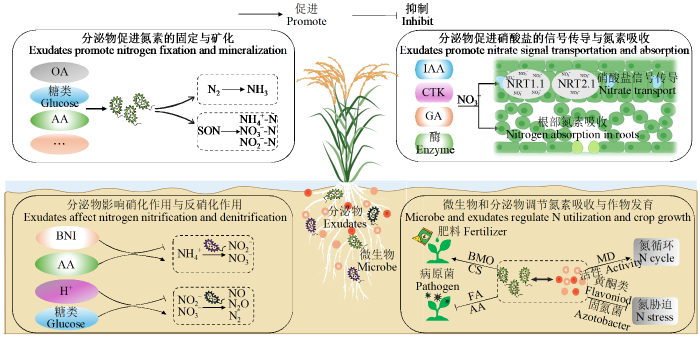
图1
根系分泌物在氮素吸收利用中的作用机制
OA:有机酸;AA:氨基酸;SON:土壤有机氮;NRT:硝酸盐转运蛋白;BMO:有益微生物;CS:碳源;FA:脂肪酸;MD:微生物驱动。
Fig.1
The mechanism of root exudates in nitrogen absorption and utilization
OA: organic acid; AA: amino acid; SON: soil organic nitrogen; NRT: nitrate transporter; BMO: beneficial microbe; CS: carbon source; FA: fatty acid; MD: microbial-driven.
3 氮肥调控对根系分泌物的影响
3.1 氮肥种类对根系分泌物的影响
在大田生产中,速效氮肥因其养分释放速度较快,可被植物迅速吸收利用而最为常用,主要分为铵态氮肥和硝态氮肥。铵态氮肥指含NH4+的氮肥。常见的主要有碳酸氢铵(NH4HCO3)、硫酸铵[(NH4)2SO4]和氯化铵(NH4Cl)。研究[55]表明,随着铵态氮肥释放肥效,NH4+被根系吸收后同化,此过程产生的H+通过质子泵排出,会增大细胞膜内外质子浓度梯度及质子泵活性。尽管水稻可能面临酸胁迫,但仍能进一步加强根系对NH4+的吸收利用。由于水稻根系对NH4+浓度变化的敏感响应,根际NH4+浓度处于低到中等水平(≤1.0 mmol/L)时,能显著增强1,9-癸二醇从水稻根系的释放[56]。这有利于降低硝化作用导致的氮损失,提高氮肥利用率。在硝态氮处理下,根系分泌物中的有机酸总量、氨基酸含量及根系活性均明显上升,且与氮素累积量呈显著正相关[57]。然而,硝态氮肥易在土壤中残留累积,加剧反硝化作用并降低氮素利用率,加之水稻根系偏好,故在生产中不单独施用。在局部根系水分胁迫下,两侧根系均单一供应硝态氮的水稻氮素吸收和累积量最少,而两侧根系同时供应NH4+-N和NO3−-N的水稻氮素吸收和累积量最多,表明铵态氮与硝态氮配施可有效提高水稻氮素利用率[58]。因此,如何精准调控硝态氮供应量,实现铵态氮与硝态氮的最佳配比,以达到水稻产量和氮素利用效率的最优平衡,仍需深入研究。
3.2 氮肥用量与根系分泌物的关系
一般来说,氮肥用量差异会影响植物根系的生长与生理代谢,进而影响根系分泌物的组成和数量。氮肥过量会导致根际环境中NH4+浓度过高,水稻根部谷氨酰胺合成酶和谷氨酸脱氢酶活性升高,直至谷氨酰胺等含氮化合物积累到一定程度,会通过负反馈调节抑制根系细胞膜上NH4⁺转运蛋白的活性,直接减少根系对NH4⁺的主动吸收,氮素的吸收和利用受抑制[59-60]。低氮胁迫会改变水稻根系中硝酸还原酶和亚硝酸还原酶的活性,干扰NO3−还原成NH4+的过程,影响植株对硝酸根离子的还原和利用效率。因此,确定适宜的氮肥施用量是优化氮肥管理、维持植物根系正常生理代谢的关键。在水稻的生育进程中,在需氮量大的分蘖期和孕穗期分2次施肥,可使根系在分蘖期分泌更多有机酸,在孕穗期分泌更多氨基酸,分别提升根系对土壤有机氮的矿化能力和硝态氮的快速吸收。这种分时调控不仅使水稻氮素利用率较一次性施肥提高12%~15%,还使土壤无机氮残留量降低了21%。
4 存在问题与研究展望
在农业生产中,根系分泌物的调控为提高氮素利用率和减少氮肥使用量提供了新的思路。首先,优化氮肥种类和施用方式是关键。研究[61]表明,铵态氮与硝态氮的合理配施能够显著提高水稻氮素吸收效率,建议在水稻分蘖期和孕穗期分别施用适量的铵态氮和硝态氮,以满足不同生育阶段的氮素需求。其次,精准施肥技术的应用也至关重要,如根据土壤肥力和水稻生长状况进行分时施肥,能够在关键时期精准调控根系分泌物的种类和数量,从而提高氮素吸收效率。此外,利用BNI和生物固氮菌等微生物资源,可以有效减少氮素损失并提高氮肥利用率。例如,通过筛选和应用富含黄酮类化合物的水稻品种,增加根际固氮菌的丰度,从而减少对化学氮肥的依赖。最后,推广生态农业模式,如稻田养鱼或稻鸭共作,能够改善根际环境,促进根系分泌物的有益调控,进一步提高氮素利用效率。
尽管目前对根系分泌物在氮素吸收利用中的作用机制已有一定研究,但仍存在不足。首先,根系分泌物的种类繁多且动态变化复杂,目前对其在不同土壤类型和环境条件下的具体调控机制尚不完全清楚。其次,现有研究多集中于实验室条件下,缺乏在大田生产中的长期监测和验证,难以直接应用于实际农业生产。此外,对于根系分泌物与土壤微生物互作的复杂网络,尤其是微生物群落结构的长期演变及其对氮素循环的长期影响,研究还不够深入。这些不足限制了根系分泌物在氮肥管理中的广泛应用。未来的研究应聚焦于以下几个方向。一是进一步深入解析根系分泌物在不同土壤类型、气候条件和氮肥管理措施下的动态变化规律,特别是其在长期田间试验中的表现,以完善理论体系并为实际应用提供更精准的指导;二是应加强根系分泌物与土壤微生物互作机制的研究,利用高通量测序和代谢组学等技术,深入解析微生物群落结构的变化及其对氮素循环的调控作用,探索微生物介导的氮素高效利用途径;三是结合基因编辑技术,筛选和培育能够优化根系分泌物组成的水稻新品种,以提高其氮素吸收利用效率;最后,开发基于根系分泌物调控的新型氮肥产品和施肥技术,如缓释肥料和生物肥料,以实现氮肥的高效利用和农业的可持续发展。
参考文献
不同地力条件下施氮量对杂交籼稻干物质积累、氮肥利用率和产量的影响
DOI:10.3969/j.issn.1006-8082.2023.02.007
[本文引用: 1]

在大田试验条件下,以宜香优2115为试验材料,设地力(高、较高、中、低)和施氮量(0、75、150 和225 kg/hm<sup>2</sup>)两因素处理,探明不同地力条件下施氮量对杂交籼稻干物质积累、转运和产量及氮肥利用率的影响。结果表明,随着施氮量增加,穗前和成熟期干物质积累量有增加趋势;抽穗期至成熟期,随着施氮量的增加,茎叶干物质转运量和茎叶干物质转运对穗部贡献率均呈先增加后降低的趋势;随着施氮量的增加,氮肥吸收利用率、农学利用率和偏生产力,以及千粒重和结实率逐渐降低,每穗粒数和产量先增加后降低,而有效穗数逐渐升高。随着地力条件的降低,穗前、成熟期和穗后干物质积累量、茎叶干物质转运量和茎叶干物质对穗部的贡献率及穗部干物质增加量均呈逐渐下降趋势,氮肥吸收利用率和生理利用率亦有降低趋势,而偏生产力呈先增后降的趋势。水稻有效穗数和产量均随土壤地力的提高而增加,而每穗粒数表现为下降。回归分析表明,在高、较高、中、低地力条件下,水稻可获得的最高产量分别为10 829.94、10 107.20、9 757.30和9 112.37 kg/hm<sup>2</sup>,其对应的适宜施氮量分别为141.96、165.47、154.86和152.98 kg/hm<sup>2</sup>。综上所述,中等施氮量能够使杂交籼稻在不同地力条件下获得较高的干物质积累量和转运能力,及较高的氮肥利用率,实现高产稳产。
Precise delivery of nitrogen at tillering stage enhances grain yield and nitrogen use efficiency in double rice cropping systems of South China
Deep placement of nitrogen fertilizer increases rice yield and nitrogen use efficiency with fewer greenhouse gas emissions in a mechanical direct-seeded cropping system
DOI:10.1016/j.cj.2020.12.011 URL [本文引用: 1]
Recent advances on nitrogen use efficiency in rice
DOI:10.3390/agronomy11040753
URL
[本文引用: 1]
Rice (Oryza sativa L.) is a daily staple food crop for more than half of the global population and improving productivity is an important task to meet future demands of the expanding world population. The application of nitrogen (N) fertilization improved rice growth and productivity in the world, but excess use causes environmental and economic issues. One of the main goals of rice breeding is reducing N fertilization while maintaining productivity. Therefore, enhancing rice nitrogen use efficiency (NUE) is essential for the development of sustainable agriculture and has become urgently needed. Many studies have been conducted on the main steps in the use of N including uptake and transport, reduction and assimilation, and translocation and remobilization, and on transcription factors regulating N metabolism. Understanding of these complex processes provides a base for the development of novel strategies to improve NUE for rice productivity under varying N conditions.
Root exudates impact plant performance under abiotic stress
DOI:10.1016/j.tplants.2021.08.003 URL [本文引用: 1]
植物根系分泌物在污染及沙化土壤修复中的应用现状与前景
DOI:10.13287/j.1001-9332.202107.039
[本文引用: 1]
近年来重金属污染等生态环境问题日益受到重视,而物理、化学修复方法存在的诸如成本高、二次污染等问题,使得利用植物、微生物等进行联合治理成为环境修复的重要手段。植物根系分泌物作为植物与土壤进行营养和信息交流的重要媒介,不但对植物的生长具有重要作用,其在污染及沙化土壤修复中作用的研究也得以广泛开展。本文对根系分泌物的组成、分泌机制进行了阐述,并对其在植物吸收重金属、化感作用、植物根系与根际微生物互作、改变土壤理化性质等过程中的作用及机理进行了总结。此外,本文还对利用根系分泌物和根际微生物在生态环境治理中的应用现状、面临的难题及未来的发展等进行了讨论。希望本文可为基于植物与微生物进行的环境修复技术的实际应用提供理论支撑。
Linkages of microbial community structure and root exudates: evidence from microbial nitrogen limitation in soils of crop families
How plant root exudates shape the nitrogen cycle
DOI:S1360-1385(17)30093-6
PMID:28601419
[本文引用: 1]
Although the global nitrogen (N) cycle is largely driven by soil microbes, plant root exudates can profoundly modify soil microbial communities and influence their N transformations. A detailed understanding is now beginning to emerge regarding the control that root exudates exert over two major soil N processes - nitrification and N fixation. We discuss recent breakthroughs in this area, including the identification of root exudates as nitrification inhibitors and as signaling compounds facilitating N-acquisition symbioses. We indicate gaps in current knowledge, including questions of how root exudates affect newly discovered microbial players and N-cycle components. A better understanding of these processes is urgent given the widespread inefficiencies in agricultural N use and their links to N pollution and climate change.Copyright © 2017 Elsevier Ltd. All rights reserved.
Sugar transporters in plants and their interactions with fungi
DOI:10.1016/j.tplants.2012.03.009
PMID:22513109
[本文引用: 1]
Sucrose and monosaccharide transporters mediate long distance transport of sugar from source to sink organs and constitute key components for carbon partitioning at the whole plant level and in interactions with fungi. Even if numerous families of plant sugar transporters are defined; efflux capacities, subcellular localization and association to membrane rafts have only been recently reported. On the fungal side, the investigation of sugar transport mechanisms in mutualistic and pathogenic interactions is now emerging. Here, we review the essential role of sugar transporters for distribution of carbohydrates inside plant cells, as well as for plant-fungal interaction functioning. Altogether these data highlight the need for a better comprehension of the mechanisms underlying sugar exchanges between fungi and their host plants.Copyright © 2012 Elsevier Ltd. All rights reserved.
A tonoplast Glu/Asp/GABA exchanger that affects tomato fruit amino acid composition
DOI:10.1111/tpj.12766
PMID:25602029
Vacuolar accumulation of acidic metabolites is an important aspect of tomato fruit flavour and nutritional quality. The amino acids Asp and Glu accumulate to high concentrations during ripening, while γ-aminobutyrate (GABA) shows an approximately stoichiometric decline. Given that GABA can be catabolised to form Glu and subsequently Asp, and the requirement for the fruit to maintain osmotic homeostasis during ripening, we hypothesised the existence of a tonoplast transporter that exports GABA from the vacuole in exchange for import of either Asp or Glu. We show here that the tomato vacuolar membrane possesses such a transport property: transport of Glu across isolated tonoplast vesicle membranes was trans-stimulated in counterexchange mode by GABA, Glu and Asp. We identified SlCAT9 as a candidate protein for this exchanger using quantitative proteomics of a tonoplast-enriched membrane fraction. Transient expression of a SlCAT9-YFP fusion in tobacco confirmed a tonoplast localisation. The function of the protein was examined by overexpression of SlCAT9 in transgenic tomato plants. Tonoplast vesicles isolated from transgenic plants showed higher rates of Glu and GABA transport than wild-type (WT) only when assayed in counterexchange mode with Glu, Asp, or GABA. Moreover, there were substantial increases in the content of all three cognate amino acids in ripe fruit from the transgenic plants. We conclude that SlCAT9 is a tonoplast Glu/Asp/GABA exchanger that strongly influences the accumulation of these amino acids during fruit development. © 2015 The Authors The Plant Journal published by Society for Experimental Biology and John Wiley & Sons Ltd.
The ALMT family of organic acid transporters in plants and their involvement in detoxification and nutrient security
Root exudates ameliorate cadmium tolerance in plants: a review
DOI:10.1007/s10311-020-01012-x [本文引用: 1]
Distinct metabolite classes in root exudates are indicative for field-or hydroponically-grown cover crops
Root exudates mediate the processes of soil organic carbon input and efflux
DOI:10.3390/plants12030630
URL
[本文引用: 1]
Root exudates, as an important form of material input from plants to the soil, regulate the carbon input and efflux of plant rhizosphere soil and play an important role in maintaining the carbon and nutrient balance of the whole ecosystem. Root exudates are notoriously difficult to collect due to their underlying characteristics (e.g., low concentration and fast turnover rate) and the associated methodological challenges of accurately measuring root exudates in native soils. As a result, up until now, it has been difficult to accurately quantify the soil organic carbon input from root exudates to the soil in most studies. In recent years, the contribution and ecological effects of root exudates to soil organic carbon input and efflux have been paid more and more attention. However, the ecological mechanism of soil organic carbon input and efflux mediated by root exudates are rarely analyzed comprehensively. In this review, the main processes and influencing factors of soil organic carbon input and efflux mediated by root exudates are demonstrated. Soil minerals and soil microbes play key roles in the processes. The carbon allocation from plants to soil is influenced by the relationship between root exudates and root functional traits. Compared with the quantity of root exudates, the response of root exudate quality to environmental changes affects soil carbon function more. In the future, the contribution of root exudates in different plants to soil carbon turnover and their relationship with soil nutrient availability will be accurately quantified, which will be helpful to understand the mechanism of soil organic carbon sequestration.
Crop acquisition of phosphorus, iron and zinc from soil in cereal/legume intercropping systems: a critical review
DOI:10.1093/aob/mcv182
PMID:26749590
[本文引用: 1]
Phosphorus (P), iron (Fe) and zinc (Zn) are essential elements for plant growth and development, but their availability in soil is often limited. Intercropping contributes to increased P, Fe and Zn uptake and thereby increases yield and improves grain nutritional quality and ultimately human health. A better understanding of how intercropping leads to increased plant P, Fe and Zn availability will help to improve P-fertilizer-use efficiency and agronomic Fe and Zn biofortification.This review synthesizes the literature on how intercropping of legumes with cereals increases acquisition of P, Fe and Zn from soil and recapitulates what is known about root-to-shoot nutrient translocation, plant-internal nutrient remobilization and allocation to grains.Direct interspecific facilitation in intercropping involves below-ground processes in which cereals increase Fe and Zn bioavailability while companion legumes benefit. This has been demonstrated and verified using isotopic nutrient tracing and molecular analysis. The same methodological approaches and field studies should be used to explore direct interspecific P facilitation. Both niche complementarity and interspecific facilitation contribute to increased P acquisition in intercropping. Niche complementarity may also contribute to increased Fe and Zn acquisition, an aspect poorly understood. Interspecific mobilization and uptake facilitation of sparingly soluble P, Fe and Zn from soil, however, are not the only determinants of the concentrations of P, Fe and Zn in grains. Grain yield and nutrient translocation from roots to shoots further influence the concentrations of these nutrients in grains.© The Author 2016. Published by Oxford University Press on behalf of the Annals of Botany Company. All rights reserved. For Permissions, please email: journals.permissions@oup.com.
What controls the availability of organic and inorganic P sources in top- and subsoils? A 33P isotopic labeling study with root exudate addition
Mineralization of native soil organic matter is not regulated by the size,activity or composition of the soil microbial biomass—a new perspective
DOI:10.1016/j.soilbio.2007.06.021 URL [本文引用: 1]
Root exudates shift how N mineralization and N fixation contribute to the plant-available N supply in low fertility soils
An extended root phenotype: the rhizosphere, its formation and impacts on plant fitness
DOI:10.1111/tpj.14781
PMID:32324287
[本文引用: 1]
Plants forage soil for water and nutrients, whose distribution is patchy and often dynamic. To improve their foraging activities, plants have evolved mechanisms to modify the physicochemical properties and microbial communities of the rhizosphere, i.e. the soil compartment under the influence of the roots. This dynamic interplay in root-soil-microbiome interactions creates emerging properties that impact plant nutrition and health. As a consequence, the rhizosphere can be considered an extended root phenotype, a manifestation of the effects of plant genes on their environment inside and/or outside of the organism. Here, we review current understanding of how plants shape the rhizosphere and the benefits it confers to plant fitness. We discuss future research challenges and how applying their solutions in crops will enable us to harvest the benefits of the extended root phenotype.© 2020 Society for Experimental Biology and John Wiley & Sons Ltd.
Maize genotype-specific exudation strategies: an adaptive mechanism to increase microbial activity in the rhizosphere
Soil carbon sequestration by root exudates
DOI:10.1016/j.tplants.2022.04.009 URL [本文引用: 1]
Root exudates: from plant to rhizosphere and beyond
DOI:10.1007/s00299-019-02447-5
PMID:31346716
[本文引用: 1]
This article describes the composition of root exudates, how these metabolites are released to the rhizosphere and their importance in the recruitment of beneficial microbiota that alleviate plant stress. Metabolites secreted to the rhizosphere by roots are involved in several processes. By modulating the composition of the root exudates, plants can modify soil properties to adapt and ensure their survival under adverse conditions. They use several strategies such as (1) changing soil pH to solubilize nutrients into assimilable forms, (2) chelating toxic compounds, (3) attracting beneficial microbiota, or (4) releasing toxic substances for pathogens, etc. In this work, the composition of root exudates as well as the different mechanisms of root exudation have been reviewed. Existing methodologies to collect root exudates, indicating their advantages and disadvantages, are also described. Factors affecting root exudation have been exposed, including physical, chemical, and biological agents which can produce qualitative and quantitative changes in exudate composition. Finally, since root exudates play an important role in the recruitment of mycorrhizal fungi and plant growth-promoting rhizobacteria (PGPR), the mechanisms of interaction between plants and the beneficial microbiota have been highlighted.
Root exudates contribute to belowground ecosystem hotspots: a review
Feed your friends: do plant exudates shape the root microbiome
DOI:10.1016/j.tplants.2017.09.003 URL [本文引用: 1]
OsCIPK2 mediated rice root microorganisms and metabolites to improve plant nitrogen uptake
Genetic modification of flavone biosynthesis in rice enhances biofilm formation of soil diazotrophic bacteria and biological nitrogen fixation
DOI:10.1111/pbi.v20.11 URL [本文引用: 1]
Assessing the influence of rice roots and root exudates on nitrogen mineralization in soil using a novel protocol. Proceedings of the 2016 International Nitrogen Initiative Conference, “Solutions to improve nitrogen use efficiency for the world”
The controlling factors and the role of soil heterotrophic nitrification from a global review
Nitrification in agricultural soils: impact, actors and mitigation
A bioluminescence assay to detect nitrification inhibitors released from plant roots: a case study with Brachiaria humidicola
Nitrification inhibition activity, a novel trait in root exudates of rice
Effects of selected root exudate components on soil bacterial communities
DOI:10.1111/j.1574-6941.2011.01150.x
PMID:21658090
[本文引用: 1]
Low-molecular-weight organic compounds in root exudates play a key role in plant-microorganism interactions by influencing the structure and function of soil microbial communities. Model exudate solutions, based on organic acids (OAs) (quinic, lactic, maleic acids) and sugars (glucose, sucrose, fructose), previously identified in the rhizosphere of Pinus radiata, were applied to soil microcosms. Root exudate compound solutions stimulated soil dehydrogenase activity and the addition of OAs increased soil pH. The structure of active bacterial communities, based on reverse-transcribed 16S rRNA gene PCR, was assessed by denaturing gradient gel electrophoresis and PhyloChip microarrays. Bacterial taxon richness was greater in all treatments than that in control soil, with a wide range of taxa (88-1043) responding positively to exudate solutions and fewer (<24) responding negatively. OAs caused significantly greater increases than sugars in the detectable richness of the soil bacterial community and larger shifts of dominant taxa. The greater response of bacteria to OAs may be due to the higher amounts of added carbon, solubilization of soil organic matter or shifts in soil pH. Our results indicate that OAs play a significant role in shaping soil bacterial communities and this may therefore have a significant impact on plant growth.© 2011 Federation of European Microbiological Societies. Published by Blackwell Publishing Ltd. All rights reserved.
Rhizosphere aeration improves nitrogen transformation in soil, and nitrogen absorption and accumulation in rice plants
DOI:10.1016/j.rsci.2020.01.007
[本文引用: 1]
Two rice cultivars (Xiushui 09 and Chunyou 84) were used to evaluate the effects of various soil oxygen (O2) conditions on soil nitrogen (N) transformation, absorption and accumulation in rice plants. The treatments were continuous flooding (CF), continuous flooding and aeration (CFA), and alternate wetting and drying (AWD). The results showed that the AWD and CFA treatments improved soil N transformation, rice growth, and N absorption and accumulation. Soil NO3- content, nitrification activity and ammonia-oxidising bacteria abundance, leaf area, nitrate reductase activity, and N absorption and accumulation in rice all increased in both cultivars. However, soil microbial biomass carbon and pH did not significantly change during the whole period of rice growth. Correlation analysis revealed a significant positive correlation between the nitrification activity and ammonia-oxidising bacteria abundance, and both of them significantly increased as the total N accumulation in rice increased. Our results indicated that improved soil O2 conditions led to changing soil N cycling and contributed to increases in N absorption and accumulation by rice in paddy fields.
Microbial utilization of rice root exudates: 13C labeling and PLFA composition
Effect of model root exudate on denitrifier community dynamics and activity at different water-filled pore space levels in a fertilised soil
Root-induced changes in nutrient cycling in forests depend on exudation rates
DOI:10.1016/j.soilbio.2014.07.022 URL [本文引用: 1]
The phenological stage of rice growth determines anaerobic ammonium oxidation activity in rhizosphere soil
Interactive regulation of root exudation and rhizosphere denitrification by plant metabolite content and soil properties
Cloning and functional characterization of a constitutively expressed nitrate transporter gene, OsNRT1, from rice
Plant nitrate transporters: from gene function to application
DOI:10.1093/jxb/erx011
PMID:28158856
[本文引用: 1]
We summarize nitrate transporters and discuss their potential in breeding for improved nitrogen use efficiency and yield.© The Author 2017. Published by Oxford University Press on behalf of the Society for Experimental Biology. All rights reserved. For permissions, please email: journals.permissions@oup.com.
Characterization of the signaling pathways involved in the repression of root nitrate uptake by nitrate in Arabidopsis thaliana
DOI:10.1093/jxb/erad149
URL
[本文引用: 1]
In Arabidopsis thaliana, root high-affinity nitrate (NO3–) uptake depends mainly on NRT2.1, 2.4, and 2.5, which are repressed by high NO3– supply at the transcript level. For NRT2.1, this regulation is due to the action of (i) feedback down-regulation by N metabolites and (ii) repression by NO3– itself mediated by the transceptor NRT1.1(NPF6.3). However, for NRT2.4 and NRT2.5, the signalling pathway(s) remain unknown as do the molecular elements involved. Here we show that unlike NRT2.1, NRT2.4 and NRT2.5 are not induced in an NO3– reductase mutant but are up-regulated following replacement of NO3– by ammonium (NH4+) as the N source. Moreover, increasing the NO3– concentration in a mixed nutrient solution with constant NH4+ concentration results in a gradual repression of NRT2.4 and NRT2.5, which is suppressed in an nrt1.1 mutant. This indicates that NRT2.4 and NRT2.5 are subjected to repression by NRT1.1-mediated NO3– sensing, and not to feedback repression by reduced N metabolites. We further show that key regulators of NRT2 transporters, such as HHO1, HRS1, PP2C, LBD39, BT1, and BT2, are also regulated by NRT1.1-mediated NO3– sensing, and that several of them are involved in NO3– repression of NRT2.1, NRT2.4, and NRT2.5. Finally, we provide evidence that it is the phosphorylated form of NRT1.1 at the T101 residue, which is most active in triggering the NRT1.1-mediated NO3– regulation of all these genes. Altogether, these data led us to propose a regulatory model for high-affinity NO3– uptake in Arabidopsis, highlighting several NO3– transduction cascades downstream of the phosphorylated form of the NRT1.1 transceptor.
Integrating N signals and root growth: the role of nitrate transceptor NRT1.1 in auxin-mediated lateral root development
DOI:10.1093/jxb/eraa243 PMID:32710785 [本文引用: 1]
Root exudate signals in plant-plant interactions
DOI:10.1111/pce.v44.4 URL [本文引用: 1]
Rhizosphere microbiome mediates systemic root metabolite exudation by root-to-root signaling
Root exudates mediate plant defense against foliar pathogens by recruiting beneficial microbes
DOI:10.1007/s42832-020-0057-z
[本文引用: 1]
<p><List> <ListItem><ItemContent><p>• Long-chain fatty acids and amino acids application could form foliar disease resistant-soil microbial community </p></ItemContent></ListItem> <ListItem><ItemContent><p>• Population of <i>Pseudomonas</i> was enriched by long-chain fatty acids and amino acids application</p></ItemContent></ListItem> <ListItem><ItemContent><p>• The enriched <i>Pseudomonas</i> could help plant resistant foliar pathogens.</p></ItemContent></ListItem></List></p> <p><fig><graphic-alternatives><graphic xmlns:xlink="http://www.w3.org/1999/xlink" xlink:href="2662-2289-3-1-42/sel-00057-jy-tu1.jpg"/><graphic xmlns:xlink="http://www.w3.org/1999/xlink" xlink:href="2662-2289-3-1-42/SEL-00057-JY-tu1.tif"/></graphic-alternatives></fig></p> <p>Plants are capable of releasing specific root exudates to recruit beneficial rhizosphere microbes upon foliar pathogen invasion attack, including long-chain fatty acids, amino acids, short-chain organic acids and sugars. Although long-chain fatty acids and amino acids application have been linked to soil legacy effects that improve future plant performance in the presence of the pathogen, the precise mechanisms involved are to a large extent still unknown. Here, we conditioned soils with long-chain fatty acids and amino acids application (L+ A) or short-chain organic acids and sugars (S+ S) to examine the direct role of such exudates on soil microbiome structure and function. The L+ A treatment recruited higher abundances of Proteobacteria which were further identified as members of the genera <i>Sphingomonas</i>, <i>Pseudomonas</i>, <i>Roseiflexus,</i> and <i>Flavitalea</i>. We then isolated the enriched bacterial strains from these groups, identifying ten <i>Pseudomonas</i> strains that were able to help host plant to resist foliar pathogen infection. Further investigation showed that the L+ A treatment resulted in growth promotion of these <i>Pseudomonas</i> strains. Collectively, our data suggest that long-chain fatty acids and amino acids stimulated by foliar pathogen infection can recruit specific <i>Pseudomonas</i> populations that can help protect the host plant or future plant generations.</p>
Flavonoids in agriculture: Chemistry and roles in, biotic and abiotic stress responses, and microbial associations
DOI:10.3390/agronomy10081209
URL
[本文引用: 1]
The current world of climate change, global warming and a constantly changing environment have made life very stressful for living entities, which has driven the evolution of biochemical processes to cope with stressed environmental and ecological conditions. As climate change conditions continue to develop, we anticipate more frequent occurrences of abiotic stresses such as drought, high temperature and salinity. Living plants, which are sessile beings, are more exposed to environmental extremes. However, plants are equipped with biosynthetic machinery operating to supply thousands of bio-compounds required for maintaining internal homeostasis. In addition to chemical coordination within a plant, these compounds have the potential to assist plants in tolerating, resisting and escaping biotic and abiotic stresses generated by the external environment. Among certain biosynthates, flavonoids are an important example of these stress mitigators. Flavonoids are secondary metabolites and biostimulants; they play a key role in plant growth by inducing resistance against certain biotic and abiotic stresses. In addition, the function of flavonoids as signal compounds to communicate with rhizosphere microbes is indispensable. In this review, the significance of flavonoids as biostimulants, stress mitigators, mediators of allelopathy and signaling compounds is discussed. The chemical nature and biosynthetic pathway of flavonoid production are also highlighted.
Factors influencing the release of the biological nitrification inhibitor 1,9-decanediol from rice (Oryza sativa L.) roots
Reproducible growth of Brachypodium in EcoFAB 2.0 reveals that nitrogen form and starvation modulate root exudation
局部根系水分胁迫下氮素形态对水稻幼苗生理特性和根系生长的影响
DOI:10.7668/hbnxb.201751056
[本文引用: 1]
为了探讨局部根系水分胁迫下不同形态氮素对水稻幼苗氮素吸收、生理特性和根系生长的影响,以水稻品种金优402为材料,设置非胁迫、局部根系胁迫、全根胁迫3种水分条件和全硝、铵硝比为50/50、全铵3个氮素形态,采用PEG模拟水分胁迫的室内分根营养液培养方法,研究其氮素吸收和累积、光合速率、蒸腾速率、气孔导度及根长、根表面积、根体积的变化规律。结果表明,在局部根系水分胁迫下,两侧根系同时供应NH<sub>4</sub><sup>+</sup>-N和NO<sub>3</sub><sup>-</sup>-N最有利于水稻氮素的吸收和累积,两侧根系均单一供应NO<sub>3</sub><sup>-</sup>-N的水稻氮素吸收和累积量最少;与未受胁迫处理的水稻相比,局部根系胁迫下两侧根系同时供应NH<sub>4</sub><sup>+</sup>-N和NO<sub>3</sub><sup>-</sup>-N的水稻光合速率受影响较小,而气孔导度和蒸腾速率则明显下降。不同氮形态处理间,两侧根系同时供应NH<sub>4</sub><sup>+</sup>-N和NO<sub>3</sub><sup>-</sup>-N的水稻光合速率和气孔导度均为最大,单一供应NO<sub>3</sub><sup>-</sup>-N的最小。在所有处理中,局部根系水分胁迫下两侧根系同时供应NH<sub>4</sub><sup>+</sup>-N和NO<sub>3</sub><sup>-</sup>-N的水稻WUE最高。在局部根系水分胁迫下,两侧同时供应NH<sub>4</sub><sup>+</sup>-N和NO<sub>3</sub><sup>-</sup>-N的水稻根长、根表面积、根体积绝大多数大于其他2种氮素形态,且受胁迫一侧和不受胁迫一侧根系相差较小。除左右根室均单一供应NO<sub>3</sub><sup>-</sup>-N的水稻外,局部根系胁迫处理的根长、根表面积、根体积均大于非胁迫处理。研究结果表明,局部根系水分胁迫和氮素形态耦合可以提高水稻幼苗的水、氮素吸收。
Three polarly localized ammonium transporter 1 members are cooperatively responsible for ammonium uptake in rice under low ammonium condition
DOI:10.1111/nph.17679
PMID:34392543
[本文引用: 1]
Ammonium is a preferential nitrogen form for rice (Oryza sativa) grown in paddy field, but the molecular mechanisms for ammonium uptake have not been well understood. We functionally characterized three members belonging to ammonium transporter 1 (AMT1) and investigated their contributions to ammonium uptake. Spatial expression analysis showed that the up-regulated expression of OsAMT1;1 and OsAMT1;2 and down-regulated expression of OsAMT1;3 by ammonium were higher in the root mature region than in the root tips. All OsAMT1 members were polarly localized at the distal side of exodermis in the mature region of crown roots and lateral roots. Upon exposure to ammonium, localization of OsAMT1;1 and OsAMT1;2 was also observed in the endoplasmic reticulum, but their abundance in the plasma membrane was not changed. Single knockout of either gene did not affect ammonium uptake, but knockout of all three genes resulted in 95% reduction of ammonium uptake. However, the nitrogen uptake did not differ between the wild-type rice and triple mutants at high ammonium and nitrate supply. Our results indicate that three OsAMT1 members are cooperatively required for uptake of low ammonium in rice roots and that they undergo a distinct regulatory mechanism in response to ammonium.This article is protected by copyright. All rights reserved.


