



土壤水分含量会影响植株的形态结构,如株高、叶面积和地上部干重等性状对水分亏缺非常敏感,不同土壤水分含量对形态结构的影响不同,重度干旱胁迫会严重影响植株的正常生长[8-
与传统栽培措施相比,喷施植物生长调节剂是一项操作简单、效果显著且经济高效的作物抗旱技术[19-
因此,本研究以黑龙江省主栽红小豆品种珍珠红为供试品种,采用盆栽方式模拟干旱胁迫并喷施褪黑素处理,对比分析褪黑素对红小豆生长相关形态和生理指标的影响,并着重探究红小豆根系形态和生理指标与地上部生长关键指标的关系,以期从根系与地上部协同的角度解析褪黑素提高红小豆抗旱能力的生理机制。
1 材料与方法
1.1 试验材料
试验于2023年在黑龙江省大庆市国家杂粮工程技术研究中心盆栽场进行。选用珍珠红为主栽品种,外源施用褪黑素。采用盆栽方式结合控水模拟干旱胁迫,盆栽所用培养钵高15.0 cm,直径10.0 cm,底部有6个圆孔(直径0.5 cm)。培养基质取自玉米田表层20 cm厚度黑土,装入培养钵前先通过筛网筛除植物残体和石块。在培养钵底部垫2层窗纱(防止基质外漏,同时限制根系长出钵外),而后装入1 kg黑土。在装土的同时,选取一部分黑土用于土壤含水量的测定,并采用环刀法测定田间持水量。播种前,用自来水将每个培养钵中黑土浇透,而后于湿土表面均匀摆放6粒种子(播种前0.5 h用“亮盾”种衣剂包衣),再覆盖2 cm厚黑土即完成播种。待幼苗生长至V1期(单叶充分生长,第一复叶小叶片的叶缘分离)间苗,每个培养钵保留长势一致的3株。培养钵放置在可移动防雨棚中,防止雨水干扰。
1.2 试验设计
自播种至V2期(单叶以上第一片复叶充分生长),采用称重法和差额补水法控制培养钵土壤含水量,使其维持在田间持水量的75%~80%(每天8:00和16:00称量1次土壤含水量,根据称量结果补充自来水)。V2期当天记为第0天,将长势均匀一致的红小豆幼苗分成3组,其中第1组土壤含水量维持为田间持水量的75%~80%,同时在第0、1和2天的20:30喷施蒸馏水至叶片表面布满水珠但不成股流下,即为对照(CK);第2组于第0天开始控水,至第20天结束,土壤含水量于第3天达到干旱胁迫对应的目标含水量(田间持水量的45%~50%),并同CK相同时间喷施等量蒸馏水,即为干旱胁迫处理(D);第3组控水过程同D处理,在第0天、第1天和第2天的20:30喷施浓度为100 μmol/L的褪黑素溶液,喷液量同CK,即为D+M处理。
在第0、10和20天取样,选取代表性植株用于光合气体交换参数的测定,而后将红小豆幼苗分解为根、茎和叶3部分,在完成形态指标测量后装入信封中,先在105 ℃下杀青30 min,后再80 ℃下烘干至恒重。分别在第3、6和9天选取部分成熟叶片测定光合色素含量,另外选取成熟叶片和根系用液氮冷冻后迅速转移至-80 ℃冰箱保存,用于测定生理指标。每个处理每次取样6盆用于形态指标测量,取样3盆用于生理指标测定。
1.3 测定项目与方法
1.3.1 形态指标
采用直尺测量株高和根长;采用游标卡尺测量第1节中部直径(子叶痕记为第0节)即为茎粗;采用Yaxin-1241叶面积仪(北京雅欣理仪科技有限公司)测量叶面积。
1.3.2 干物质积累量
用于形态学测量的植物样本被分成叶、茎和根,放在信封中,先放入105 ℃的烘箱中杀青30 min,而后将样品置于80 ℃下烘干至恒重,称量并记录干重。根据称量结果计算第0~10天和第0~20天生长速率,计算公式如下:生长速率[g/(株·d)]=[干物质积累量终值(g/株)-干物质积累量初值(g/株)]/生长天数。
1.3.3 光合色素含量及光合气体交换参数
称取0.1 g红小豆倒3叶功能叶片浸泡于10 mL无水乙醇中,常温暗处理24 h,参照Lichtenthaler[33]的方法,采用乙醇比色法,按照以下公式计算:叶绿素a(Chla)=13.95OD665-6.88OD649;叶绿素b(Chlb)=24.96OD649-7.32OD665;总叶绿素含量(Chl)=Chla+Chlb;类胡萝卜素(Car)=(1000OD470-2.05Ch1a-111.48Chlb)/245;光合色素含量(mg/g FW)=(ΔOD提取液总量×稀释倍数)/样品重。
利用LI-6400便携式光合仪(Li-C公司,美国)测定叶片的净光合速率(Pn)、蒸腾速率(Tr)、气孔导度(Gs)和胞间CO2浓度(Ci)。选择人工红蓝光源,测定时光照强度设为1000 μmo1/(m2·s),空气流速为500 μmol/s,采用缓冲瓶来控制测定时CO2浓度(400 μmol/mo1),每个处理5次重复。
1.3.4 生理指标
1.4 数据处理
使用Microsoft Excel 2020进行数据整理,采用R语言进行数据分析和绘图。采用Duncan法进行方差分析。在Mantel分析中,皮尔逊相关系数r用来表征2个变量之间的线性相关性,其值接近0表示无相关性;0.1~0.3或-0.1~-0.3表示相关性较弱;0.3~0.5或-0.3~-0.5表示相关性中等;>0.5或<-0.5则表示相关性强。Mantel相关系数r用来表示2个距离矩阵之间的相似性或差异性,其阈值范围与皮尔逊相关系数r类似。
2 结果与分析
2.1 外源褪黑素对干旱胁迫下红小豆幼苗生长的影响
由图1可知,干旱胁迫显著抑制了红小豆生长相关指标,与CK处理相比,第10天时D处理的生长速率、根长、根体积、株高、茎粗、叶面积、根干重、茎干重和叶干重分别显著降低了92.10%、65.75%、46.67%、77.08%、32.50%、80.68%、109.20%、77.30%和112.30%。D+M处理分别显著降低了43.68%、42.35%、36.36%、28.79%、26.37%、54.06%、31.40%、53.78%和44.69%;与D处理相比,D+M处理生长速率、根长、根体积、株高、茎粗、叶面积、根干重、茎干重和叶干重分别提高了78.12%、16.44%、40.00%、37.50%、12.40%、15.11%、63.86%、19.81%和29.14%。
图1
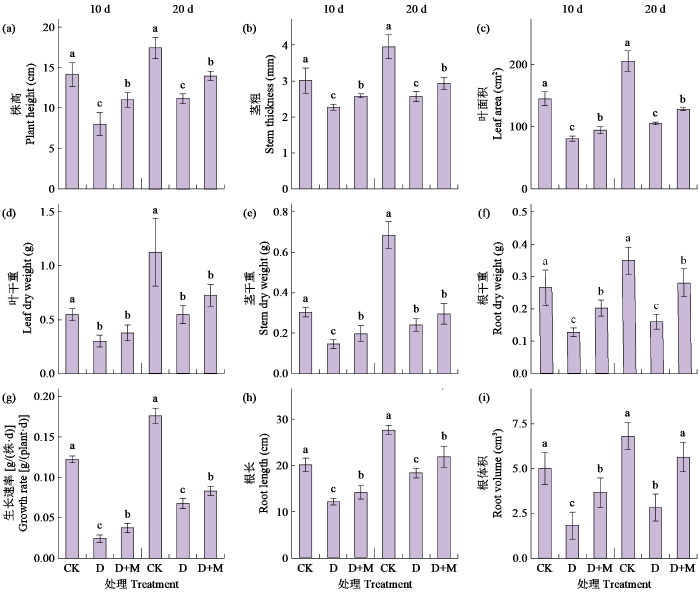
图1
外源褪黑素对干旱胁迫下红小豆幼苗生长的影响
不同小写字母在P < 0.05的水平上表示显著差异,下同。
Fig.1
The effect of exogenous melatonin on the growth of adzuki bean seedlings under drought stress
Different lowercase letters indicate significant differences at P < 0.05 level. The same below.
与CK处理相比,第20天时D处理生长速率、根长、根体积、株高、茎粗、叶面积、根干重、茎干重和叶干重分别降低了56.77%、57.53%、46.67%、77.08%、36.90%、87.31%、25.00%、131.69%和55.30%;D+M处理分别降低了43.68%、42.35%、36.36%、28.79%、26.37%、54.06%、31.40%、53.78%和44.69%;与D处理相比,D+M处理生长速率、根长、根体积、株高、茎粗、叶面积、根干重、茎干重和叶干重分别提高了78.12%、57.53%、46.67%、37.50%、12.40%、15.11%、87.95%、19.81%和29.14%。结果表明,褪黑素在一定程度上能够缓解干旱胁迫对红小豆生长的抑制。
2.2 外源褪黑素对干旱胁迫下红小豆根系活力、根系关键抗氧化酶活性和渗透调节物质含量的影响
由图2可知,干旱胁迫抑制了红小豆根系活力和蔗糖含量,促进抗氧化酶活性和渗透调节物质(除蔗糖)的活性。与CK处理相比,第3天时D处理根系活力显著降低了43.50%,但SOD、POD、CAT及APX活性均显著提高了32.40%、2.55%、31.62%和66.02%;果糖、可溶性糖和可溶性蛋白含量分别显著提高了36.50%、31.19%和11.69%;蔗糖含量显著降低了38.45%。与D处理相比,D+M处理根系活力、SOD、POD、CAT和APX活性分别提高了35.00%、17.00%、4.30%、44.82%和2.83%;果糖、可溶性糖和可溶性蛋白和蔗糖含量分别提高了20.17%、20.85%、16.45%和37.53%。
图2
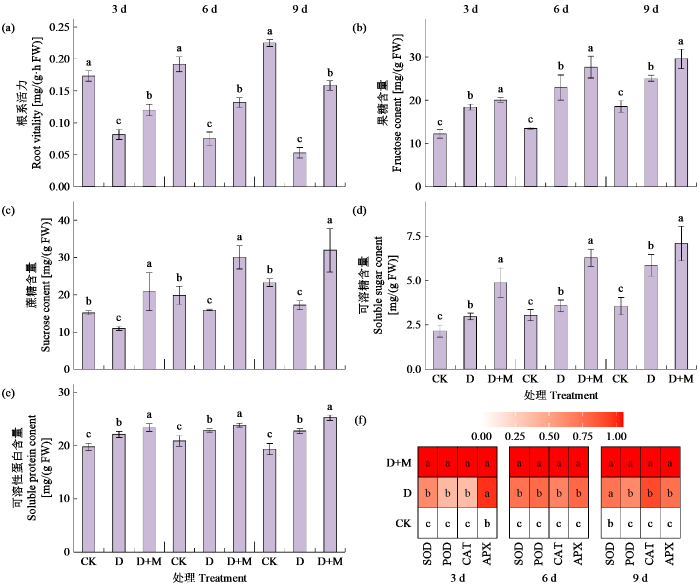
图2
外源褪黑素对干旱胁迫下红小豆根系活力、关键抗氧化酶活性和渗透调节物质含量的影响
Fig.2
The effect of exogenous melatonin on root vitality, key antioxidant enzyme activities, and osmotic regulating substance content of adzuki bean roots under drought stress
与CK处理相比,第6天时D处理根系活力显著降低了71.96%,但SOD、POD、CAT和APX活性均显著提高,分别提高了54.73%、2.39%和72.70%、20.57%;根系果糖、可溶性糖和可溶性蛋白含量分别显著提高了70.59%、89.74%和9.50%;蔗糖含量显著降低了70.21%。与D处理相比,D+M处理根系活力提高了138.41%,SOD、POD、CAT和APX活性分别提高了12.81%、1.00%、24.64%和5.64%;果糖、可溶性糖、可溶性蛋白和蔗糖含量分别提高了11.02%、67.89%、8.65%和11.02%。
与CK处理相比,第9天时D处理根系活力显著降低了80.86%,但SOD、POD、CAT和APX活性均显著提高,分别提高了98.36%、3.69%、181.92%和36.94%;果糖、可溶性糖和可溶性蛋白含量分别显著提高了62.27%、31.19%和17.47%;蔗糖含量显著降低了62.27%。与D处理相比,D+M处理根系活力提高了171.68%,SOD、POD、CAT和APX活性分别提高了21.94%、2.39%、10.58%、10.87%;果糖、可溶性糖、可溶性蛋白和蔗糖含量分别提高了14.20%、20.85%、23.49%和14.20%。由此可知,外源褪黑素可显著提高干旱胁迫下红小豆根系活力、根系关键抗氧化酶活性和渗透调节物质含量,缓解干旱胁迫对根系的氧化损伤,提高红小豆的抗旱能力。
2.3 外源褪黑素对干旱胁迫下红小豆光合色素含量和光合气体交换参数的影响
由图3可知,干旱胁迫抑制了红小豆光合色素含量和光合气体交换参数相关指标。与CK处理相比,第3天时D处理Chla、Chlb、Chl、Car含量分别降低了41.75%、7.51%、48.69%、36.13%,Pn、Tr、Gs和Ci分别降低了79.66%、43.60%、15.15%和14.40%。与D处理相比,D+M处理Chla、Chlb、Chl、Car含量分别提高了48.20%、28.14%、12.11%、41.94%,Pn、Tr、Gs和Ci分别提高了17.56%、41.88%、5.10%和9.65%。
图3
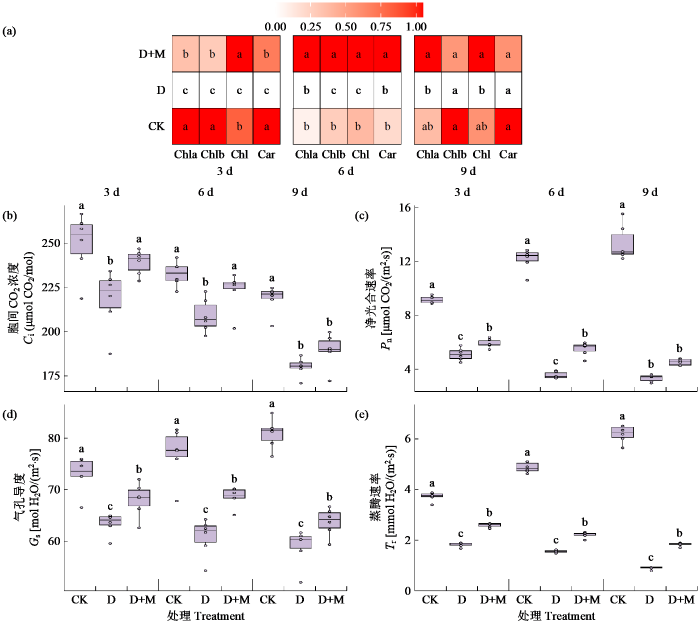
图3
外源褪黑素对干旱胁迫下红小豆叶绿素含量和光合气体交换参数的影响
Fig.3
The effect of exogenous melatonin on chlorophyll content and photosynthetic gas exchange parameters in adzuki bean under drought stress
与CK处理相比,第6天时D处理Chla、Chlb、Chl、Car含量分别降低了13.25%、15.45%、13.64%、13.86%,Pn、Tr、Gs和Ci分别降低了54.30%、42.69%、26.61%和11.32%。与D处理相比,D+M处理Chla、Chlb、Chl、Car含量分别提高了7.69%、11.16%、8.72%、8.66%,Pn、Tr、Gs和Ci分别提高了54.30%、42.69%、5.10%和6.79%。
与CK处理相比,第9天时D处理Chla、Chlb、Chl、Car含量分别降低了11.27%、15.16%、10.13%、12.44%,Pn、Tr、Gs和Ci分别降低了42.49%、104.66%、37.41%和21.35%。与D处理相比,D+M处理Chla、Chlb、Chl、Car含量分别提高了7.48%、9.72%、4.52%、8.15%,Pn、Tr、Gs和Ci分别提高了42.49%、104.66%、28.91%和5.19%。由此可知,外源褪黑素处理能有效提高红小豆在干旱胁迫下叶片光合能力,促进叶片中物质积累。
2.4 外源褪黑素对干旱胁迫下红小豆根系蔗糖代谢关键酶的影响
由图4可知,干旱胁迫显著改变了红小豆幼苗根系蔗糖合成酶(SS)、蔗糖磷酸合成酶(SPS)、酸性转化酶(AI)和中性转化酶(NI)活性,外源褪黑素可通过调控关键酶活性,改善干旱胁迫下的蔗糖代谢过程。与CK相比,D处理显著降低了第3天的AI和NI活性,同时提高了SS和SPS的活性;D+M处理则显著降低了AI和NI活性,但SS活性低于D处理,仅SPS活性在褪黑素处理下进一步升高。与CK处理相比,第3天D处理SS、SPS活性分别提高了96.96%和86.59%,而AI、NI活性分别降低了20.21%和10.90%;与D处理相比,D+M处理SPS、AI和NI活性分别提升了13.40%、50.80%和11.01%,而SS活性降低了30.61%,说明褪黑素主要通过提高蔗糖分解相关酶活性恢复代谢,而非进一步促进蔗糖合成。
图4
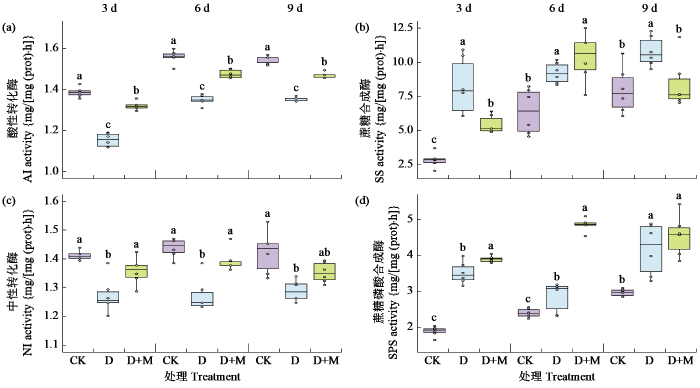
图4
外源褪黑素对干旱胁迫下红小豆根系碳代谢关键酶的影响
Fig.4
The effect of exogenous melatonin on key carbon metabolic enzymes in roots of adzuki bean under drought stress
与CK处理相比,第6天D处理SS和SPS活性分别显著提高了56.80%和18.89%,AI和NI活性分别显著降低了15.52%和3.62%;与D处理相比,D+M处理SPS、AI和NI活性分别显著提升了68.13%、5.49%和69.94%,褪黑素对蔗糖合成酶活性的抑制趋势更加明显,对蔗糖分解酶活性的恢复作用则持续增强。
与CK处理相比,第9天D处理SPS活性显著提高了40.75%,AI和NI活性分别降低了14.29%和9.64%;与D处理相比,D+M处理SPS、AI和NI活性分别提升了4.91%、28.10%和9.04%,而SS活性显著降低了5.81%,褪黑素对SS活性的抑制效应减弱,但仍未恢复至D处理水平,而对蔗糖分解酶活性的提升效果依然显著。
由此可知,干旱胁迫下红小豆通过提高SS和SPS活性促进蔗糖合成,降低AI和NI活性减少蔗糖分解;褪黑素主要通过显著提高AI、NI活性恢复蔗糖分解代谢,同时抑制过高的SS活性,避免蔗糖过度合成与积累,从而维持干旱胁迫下根系的碳代谢平衡,提高红小豆的抗旱能力。
2.5 根系形态、生理指标与地上部关键生长指标联合分析
对根系形态与其各生理指标间,以及地上部关键生长指标与红小豆植株形态、干物质积累量、光合特征的相关关系进行了分析。由图5a可知,根系形态指标根长、根重和根体积之间呈极显著正相关关系,三者与大部分生理指标呈负相关或弱相关,仅与AI呈正相关;而根系活力也与绝大多数根系其他生理指标呈负相关,仅与可溶性蛋白含量呈正相关;抗氧化酶SOD、POD、CAT、APX活性之间存在极显著正相关,与AI和NI呈极显著负相关,与SSC、SPC和SPS活性呈极显著正相关;渗透调节物质Suc、Fru、SSC和SPC与蔗糖代谢关键酶AI、NI、SS和SPS活性之间的相关性无显著规律性。
图5
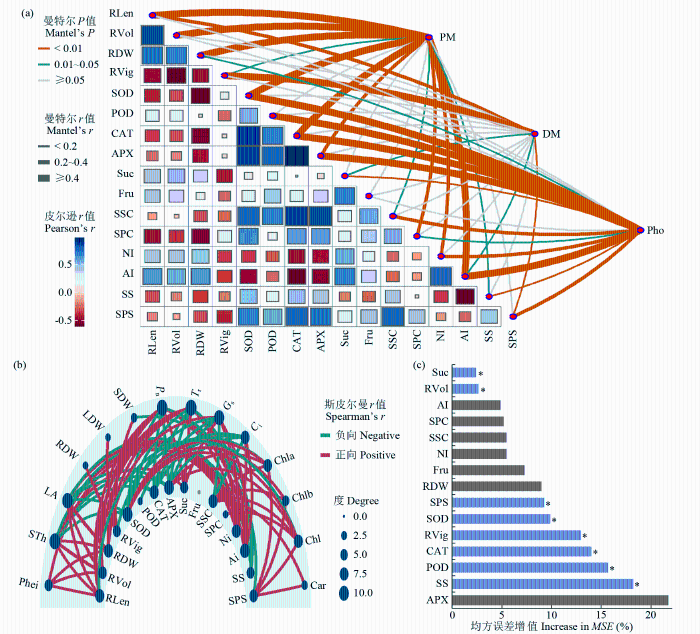
图5
根系形态和生理指标与地上部关键生长指标联合分析
“*”表示在P < 0.05水平上的相关性显著。RLen:根长,RDW:根干重,RVol:根体积,Suc:蔗糖,Fru:果糖,SSC:可溶性糖,SPC:可溶性蛋白,RVig:根系活力,Phei:株高,STh:茎粗,LA:叶面积,LDW:叶干重,SDW:茎干重,PM:形态,DM:干物质,Pho:光合。
Fig.5
Joint analysis of root morphological and physiological indicators with key aboveground growth indicators
“*”indicate significant correlation at P < 0.05 level. Rlen: root length, RDW: root dry weight, RVol: root volume, Suc: sucrose, Fru: fructose, SSC: soluble sugar, SPC: soluble protein, RVig: root vitality, Phei: plant height, STh: stem diameter, LA: leaf area, LDW: leaf dry weight, SDW: stem dry weight, PM: morphology, DM: dry matter, Pho: photosynthesis.
Mantel分析表明,根系形态指标与地上部形态特征表现为极显著正相关,而与干物质积累量和光合生理无相关关系;抗氧化酶活性表现为与地上部形态特征和光合特征呈极显著正相关,与干物质积累无相关关系;渗透调节物质中仅可溶性糖含量与光合特征、可溶性蛋白含量与形态特征呈极显著正相关;蔗糖代谢关键酶中AI与形态和光合特征呈极显著正相关关系;NI与形态和光合特征呈正相关关系。
二分图(图5b、c)分析显示,根系形态和生理指标中除SS、Fru、CAT和POD与地上部生长和光合特征表现为负相关或无相关外,大多指标表现为正相关;而与根系形态和生理指标表现出较密切关系的地上部生长和光合关键指标包括茎粗、叶面积、Pn和Tr。进一步的随机森林分析筛选出对红小豆生长速率重要性排名大于10%的指标依次为APX、SS、POD、CAT和根系活力。
3 讨论
干旱是全球范围内限制作物产量最主要的非生物胁迫之一[43]。营养生长阶段发生干旱胁迫必然造成红小豆植株矮小,叶面积和主茎节数受到抑制[44],无法为生殖生长提供良好的形态和充足的物质基础;而生殖生长期发生干旱胁迫必然直接影响花、荚果和籽粒的发育,造成荚果数量和百粒重下降[45]。为应对干旱胁迫,植物进化出一系列机制从基因表达、生理和形态层面进行调整以缓解干旱胁迫对红小豆生长和产量的抑制作用[46]。根系作为感知干旱胁迫最早的器官[47],必然会在形态上做出调整如增加根长和侧根数量、减小根粗以增加根系与土壤接触面积,从而增加吸收水分的能力[48];在生理方面,抗氧化酶系统和渗透调节物质会协同响应,以缓解干旱胁迫引起的ROS过度积累[49]。本研究显示,D处理红小豆根系形态相关指标显著低于CK处理,这可能是因为本研究所设置的干旱胁迫程度较重,处理时间较长所致。而喷施褪黑素后,干旱胁迫对红小豆根系的限制作用在一定程度上有所缓解,这与干旱胁迫下褪黑素对番茄[50]、小麦[51]和薄荷[52]的研究结果相一致。同时,本研究也表明干旱胁迫提高了红小豆根系抗氧化酶活性和可溶性糖、可溶性蛋白含量,褪黑素的施用进一步提高了上述指标,增强了ROS清除和耐受能力,这也与前人[45]研究结果一致。Huang等[53]研究指出,根系活力的高低与作物抗旱能力存在正相关关系,而本研究中干旱胁迫导致红小豆根系活力下降,褪黑素的施用则可缓解干旱对根系活力的抑制作用,这在一定程度上证实了褪黑素提高了红小豆抗旱能力。根系活力的提高必然有利于水分和矿质营养的吸收,进而改善红小豆整体生长状态。研究[54]证实,褪黑素能够缓解干旱胁迫对作物生长的抑制作用,其改善的基本途径是通过调控光合作用实现的。本研究显示,褪黑素不仅提高了干旱胁迫下红小豆光合色素含量和光合气体参数,还提高了蔗糖代谢关键酶活性,据此推测褪黑素在改善光合作用关键指标的同时也可能促进了光合产物代谢强度,有利于维持高光合效率。
相关性分析显示,根系形态指标与大部分根系生理指标呈负相关或弱相关关系,这可能是因为干旱胁迫下红小豆根系能够支配的物质和能量有限,根系形态和生理调节存在一定“竞争关系”[55]。同样根系活力与大多数其他根系生理指标也呈负相关关系,这可能是因为根系活力的提高在一定程度上意味着旺盛的生长状态,但干旱胁迫下植物的生长与抗氧化和渗透调节等抵抗逆境胁迫的生理活动也存在一定矛盾[56]。抗氧化酶活性与渗透调节物质含量呈正相关关系,这可能是因为二者在应对活性氧时存在协同作用[57]。而蔗糖代谢关键酶活性与渗透调节物质含量的相关性未呈现出明显规律性。大部分上述根系形态和生理指标分别或同时与地上部形态、干物质积累和光合作用呈显著正相关关系,这意味着根系形态和生理的改善也有利于上述3个方面的改善。二分图和随机森林分析结果进一步显示,根系活力、根系中抗氧化酶活性和蔗糖合成酶在红小豆应对干旱胁迫、维持生长过程中起重要作用。以上结果与前人[49,51,58]研究结论相一致,即褪黑素通过调控根系生长促进干旱胁迫下作物生长。
4 结论
叶面喷施褪黑素显著改善了红小豆的根系形态指标,包括根长和根体积。此外,褪黑素处理还提高了根系的活力,增强了根系中抗氧化酶的活性,增加了渗透调节物质的含量,并促进了与蔗糖代谢相关的关键酶的活性。这些变化进一步改善了光合作用的关键参数,促进了地上部干物质的积累,最终在干旱胁迫条件下显著促进了红小豆幼苗的生长。
参考文献
Adzuki bean (Vigna angularis (Willd.) Ohwi & Ohashi) breeding
In vitro anti- inflammatory activity of phenolic rich extracts from white and red common beans
DOI:10.1016/j.foodchem.2014.04.004 URL [本文引用: 1]
Non-nutritive bioactive compounds in pulses and their impact on human health: an overview
DOI:10.4236/fns.2012.312218 URL [本文引用: 1]
Minor components of pulses and their potential impact on human health
DOI:10.1016/j.foodres.2009.09.004 URL
Nutraceutical properties of legume seeds: phytochemical compounds
Diversified diazotrophs associated with the rhizosphere of Western Indian Himalayan native red kidney beans (Phaseolus vulgaris L.)
DOI:10.1007/s13205-014-0238-5 URL [本文引用: 1]
干旱胁迫与复水对棉花叶片光谱、光合和荧光参数的影响
DOI:10.3864/j.issn.0578-1752.2013.11.024
[本文引用: 1]

【目的】明确持续干旱胁迫对棉花叶片光谱、光合和荧光特征的影响,为筛选水分敏感指标提供理论依据。【方法】以转基因抗虫棉银瑞361为试材,采用盆栽控水方式,测定持续干旱与复水条件下棉花叶片光谱、光合和荧光参数。【结果】两年试验结果表明,随着干旱胁迫时间的延长叶片相对含水量(RWC)、净光合速率(Pn)、气孔导度(Gs)、蒸腾速率(Tr)、PSⅡ原初光能转化效率(Fv/Fm)、PSⅡ实际光化学量子产量(ΦPSⅡ)、光化学淬灭系数(qP)、光化学反射指数(PRI)呈下降趋势,气孔限制值(Ls)先上升后下降,非光化学淬灭系数(NPQ)则呈上升趋势,复水后除RWC外,其它指标都未恢复到初始状态。与初始状态相比,Pn、Gs、Tr、Fv/Fm、ΦPSⅡ、qP、PRI在干旱胁迫第4天时,两年平均下降了53.1%、79.9%、66.0%、3.8%、11.0%、5.7%、18.4%;Ls、NPQ在第4天时,两年平均上升了98.1%、28.6%。综合两年数据,只有Pn、Gs、Tr、Ls、Fv/Fm、PRI在第4天时与初始状态差异极显著,与RWC的R2分别为0.7640、0.7058、0.5625、0.3665、0.7319、0.4378。【结论】Pn、Gs、Tr、Ls、Fv/Fm、PRI均能在干旱胁迫初期灵敏地反映棉花叶片水分状况;在持续干旱胁迫中,Pn、Gs、Fv/Fm能更灵敏、准确地反映棉花叶片水分状况。
水分胁迫对谷子幼苗生长和光合特性的影响
Impacts of droughts on the growth resilience of Northern Hemisphere forests
DOI:10.1111/geb.2017.26.issue-2 URL
Implications of abscisic acid in the drought stress tolerance of plants
DOI:10.3390/agronomy10091323 URL [本文引用: 1]
Improving the drought tolerance in rice (Oryza sativa L.) by exogenous application of salicylic acid
DOI:10.1111/jac.2009.195.issue-4 URL [本文引用: 1]
Effect of exogenously applied jasmonic acid and kinetin on drought tolerance of wheat cultivars based on morpho-physiological evaluation
DOI:10.1007/s42729-020-00348-1
Engineering of enhanced glycine betaine synthesis improves drought tolerance in maize
Glycine betaine plays an important role in some plants, including maize, in conditions of abiotic stress, but different maize varieties vary in their capacity to accumulate glycine betaine. An elite maize inbred line DH4866 was transformed with the betA gene from Escherichia coli encoding choline dehydrogenase (EC 1.1.99.1), a key enzyme in the biosynthesis of glycine betaine from choline. The transgenic maize plants accumulated higher levels of glycine betaine and were more tolerant to drought stress than wild-type plants (non-transgenic) at germination and the young seedling stage. Most importantly, the grain yield of transgenic plants was significantly higher than that of wild-type plants after drought treatment. The enhanced glycine betaine accumulation in transgenic maize provides greater protection of the integrity of the cell membrane and greater activity of enzymes compared with wild-type plants in conditions of drought stress.
Improvement of uniconazole-induced protection in wheat seedlings
Chitosan nanoparticles enhance drought tolerance in tomatoes (Solanum lycopersicum L.) via gene expression modulation
Functions and prospects of melatonin in plant growth, yield, and quality
DOI:10.1093/jxb/erac233 URL [本文引用: 1]
Melatonin enhances drought tolerance in cotton (Gossypium hirsutum L.) by modulating root architecture, antioxidant system, and yield formation
Control of plant water use by ABA induction of senescence and dormancy: an overlooked lesson from evolution
DOI:10.1093/pcp/pcx086
PMID:28961993
[本文引用: 1]
Drought stress is a condition that in specific climate contexts results in insufficient water availability and often limits plant productivity through perturbing development and reducing plant growth and survival. Plants use senescence of old leaves and dormancy of buds and seeds to survive extreme environmental conditions. The plant hormone ABA accumulates after drought stress, and increases plant survival by inducing quick responses such as stomatal closure, and long-term responses such as extended growth inhibition, osmotic regulation, accumulation of cuticular wax, senescence, abscission and dormancy. Here we focus on how the long-term ABA responses contribute to plant survival during severe drought stress. Leaf senescence and abscission of older leaves reduce total plant transpirational water loss and increase the transfer of nutrients to meristems and to some storage tissues. Osmotic regulation favors water consumption in sink tissues, and accumulation of cuticular wax helps to seal the plant surface and limits non-stomatal water loss.© The Author 2017. Published by Oxford University Press on behalf of Japanese Society of Plant Physiologists. All rights reserved. For permissions, please email: journals.permissions@oup.com.
Massive increases in C 31 alkane on Zygophyllum xanthoxylum leaves contribute to its excellent abiotic stress tolerance
DOI:10.1093/aob/mcad038
URL
[本文引用: 1]
Desert plants possess excellent water-conservation capacities to survive in extreme environments. Cuticular wax plays a pivotal role in reducing water loss through plant aerial surfaces. However, the role of cuticular wax in water retention by desert plants is poorly understood.
Physiological response of soybean plants to water deficit
Antioxidant enzymes regulate reactive oxygen species during pod elongation in Pisum sativum and Brassica chinensis
DOI:10.1371/journal.pone.0087588 URL [本文引用: 1]
Reactive oxygen species (ROS) and response of antioxidants as ROS-scavengers during environmental stress in plants
Reactive oxygen species, oxidative damage, and antioxidative defense mechanism in plants under stressful conditions
Recent developments in enzymatic antioxidant defence mechanism in plants with special reference to abiotic stress
DOI:10.3390/biology10040267 URL [本文引用: 1]
Chlorophylls and carotenoids: pigments of photosynthetic biomembranes
Changes in carbohydrate levels and their metabolic enzymes in leaves, phloem sap and mesocarp during cucumber (Cucumis sativus L.) fruit development
DOI:10.1016/j.scienta.2009.01.023 URL [本文引用: 1]
A rapid and sensitive method for the quantitation of microgram quantities of protein utilizing the principle of protein-dye binding
DOI:10.1016/0003-2697(76)90527-3 URL [本文引用: 1]
Melatonin confers drought stress tolerance in soybean (Glycine max L.) by modulating photosynthesis, osmolytes, and reactive oxygen metabolism
DOI:10.32615/ps.2019.045 URL [本文引用: 1]
Superoxide dismutases: occurrence in higher plants
DOI:10.1104/pp.59.2.309
PMID:16659839
[本文引用: 1]
Shoots, roots, and seeds of corn (Zea mays L., cv. Michigan 500), oats (Avena sativa L., cv. Au Sable), and peas (Pisum sativum L., cv. Wando) were analyzed for their superoxide dismutase content using a photochemical assay system consisting of methionine, riboflavin, and p-nitro blue tetrazolium. The enzyme is present in the shoots, roots, and seeds of the three species. On a dry weight basis, shoots contain more enzyme than roots. In seeds, the enzyme is present in both the embryo and the storage tissue. Electrophoresis indicated a total of 10 distinct forms of the enzyme. Corn contained seven of these forms and oats three. Peas contained one of the corn and two of the oat enzymes. Nine of the enzyme activities were eliminated with cyanide treatment suggesting that they may be cupro-zinc enzymes, whereas one was cyanide-resistant and may be a manganese enzyme. Some of the leaf superoxide dismutases were found primarily in mitochondria or chloroplasts. Peroxidases at high concentrations interfere with the assay. In test tube assays of crude extracts from seedlings, the interference was negligible. On gels, however, peroxidases may account for two of the 10 superoxide dismutase forms.
Reactive oxygen species and antioxidant defense system in plants under abiotic stress
Assay of catalases and peroxidases
Involvement of antioxidants and lipid peroxidation in the adaptation of two cool-season grasses to localized drought stress
DOI:10.1016/s0098-8472(00)00084-8
PMID:11275219
[本文引用: 1]
In natural environments, drought often occurs in surface soil while water is available for plant uptake deeper in the soil profile. The objective of the study was to examine the involvement of antioxidant metabolism and lipid peroxidation in the responses of two cool-season grasses to surface soil drying. Kentucky bluegrass (Poa pratensis L) and tall fescue (Festuca arundinacea Schreb.) were grown in split tubes, consisting of two sections (each 10 cm in diameter and 20 cm long). Grasses were subjected to three soil moisture regimes: (a) well-watered control: whole soil profile was watered; (b) surface drying: surface 20 cm of soil was dried by withholding irrigation and the lower 20 cm of soil was watered; (c) full drying: whole soil profile was dried. Surface drying had no effects on relative water content (RWC) and chlorophyll content (Chl) for both grasses and only slightly reduced shoot growth for tall fescue. Superoxide dismutase (SOD) activity increased, while catalase (CAT) and peroxidase (POD) activities remained unchanged during most periods of surface drying. Malondialdehyde (MDA) content was unaffected by surface drying for tall fescue, but increased initially and then decreased to the control level for Kentucky bluegrass. Under full drying, RWC, Chl content, and shoot dry weight decreased, but MDA content increased in both grasses; SOD and POD activities initially increased transiently and then decreased; CAT remained unchanged for 25 days and then decreased. These results suggested that both Kentucky bluegrass and tall fescue were capable of surviving surface soil drying. This capability could be related to increases in antioxidant activities, particularly SOD and CAT. However, full drying suppressed antioxidant activities and induced lipid peroxidation.
Magnesium deficiency and high light intensity enhance activities of superoxide dismutase, ascorbate peroxidase, and glutathione reductase in bean leaves
DOI:10.1104/pp.98.4.1222
PMID:16668779
[本文引用: 1]
The influence of varied Mg supply (10-1000 micromolar) and light intensity (100-580 microeinsteins per square meter per second) on the concentrations of ascorbate (AsA) and nonprotein SH-compounds and the activities of superoxide dismutase (SOD; EC 1.15.11) and the H(2)O(2) scavenging enzymes, AsA peroxidase (EC 1.11.1.7), dehydroascorbate reductase (EC 1.8.5.1), and glutathione reductase (EC 1.6.4.2) were studied in bean (Phaseolus vulgaris L.) leaves over a 13-day period. The concentrations of AsA and SH-compounds and the activities of SOD and H(2)O(2) scavenging enzymes increased with light intensity, in particular in Mg-deficient leaves. Over the 12-day period of growth for a given light intensity, the concentrations of AsA and SH-compounds and the activities of these enzymes remained more or less constant in Mg-sufficient leaves. In contrast, in Mg-deficient leaves, a progressive increase was recorded, particularly in concentrations of AsA and activities of AsA peroxidase and glutathione reductase, whereas the activities of guaiacol peroxidase and catalase were only slightly enhanced. Partial shading of Mg-deficient leaf blades for 4 days prevented chlorosis, and the activities of the O(2) (.-) and H(2)O(2) scavenging enzymes remained at a low level. The results demonstrate the role of both light intensity and Mg nutritional status on the regulation of O(2) (.-) and H(2)O(2) scavenging enzymes in chloroplasts.
Enzymes of sucrose and hexose metabolism in developing kernels of two inbreds of maize
DOI:10.1104/pp.86.4.1013
PMID:16666024
[本文引用: 1]
Tissue distribution and activity of enzymes involved in sucrose and hexose metabolism were examined in kernels of two inbreds of maize (Zea mays L.) at progressive stages of development. Levels of sugars and starch were also quantitated throughout development. Enzyme activities studied were: ATP-linked fructokinase, UTP-linked fructokinase, ATP-linked glucokinase, sucrose synthase, UDP-Glc pyrophosphorylase, UDP-Glc dehydrogenase, PPi-linked phosphofructokinase, ATP-linked phosphofructokinase, NAD-dependent sorbitol dehydrogenase, NADP-dependent 6-P-gluconate dehydrogenase, NADP-dependent Glc-6-P dehydrogenase, aldolase, phosphoglucoisomerase, and phosphoglucomutase. Distribution of invertase activity was examined histochemically. Hexokinase and ATP-linked phosphofructokinase activities were the lowest among these enzymes and it is likely that these enzymes may regulate the utilization of sucrose in developing maize kernels. Most of the hexokinase activity was found in the endosperm, but the embryo had high activity on a dry weight basis. The endosperm, which stores primarily starch, contained high PPi-linked phosphofructokinase and low ATP-linked phosphofructokinase activities, whereas the embryo, which stores primarily lipids, had much higher ATP-linked phosphofructokinase activity than did the endosperm. It is suggested that PPi required by UDP-Glc pyrophosphorylase and PPi-linked phosphofructokinase in the endosperm may be supplied by starch synthesis. Sorbitol dehydrogenase activity was largely restricted to the endosperm, whereas 6-P-gluconate and Glc-6-P dehydrogenase activities were highest in the base and pericarp. A possible metabolic pathway by which sucrose is converted into starch is proposed.
24- Epibrassinolide promotes activation of physiological compensation mechanisms in response to drought stress and rehydration and improves yield in soybean
DOI:10.1111/jac.v209.3 URL [本文引用: 1]
Effect of drought at different reproductive stages on yield and yield components of some cowpea (Vigna unguiculata L. Walp) varieties in Lapai, Niger State, Nigeria
DOI:10.4314/swj.v18i4.21
URL
[本文引用: 1]
Drought is one of the most unfavorable abiotic factors that can affect the growth and yield of cowpea. Drought at different reproductive stages can interfere with the morphological processes of plants. Therefore this research aim to determine the effect of drought at different reproductive stages on yield and yield components of some cowpea varieties. A screen house experiment was conducted at the Botanical Garden of Biological Science Department, Ibrahim Badamasi Babangida, University during the 2022 cropping season The three cowpea varieties used were; FUAMPEA 1, FUAMPEA 2 and ITK89KD-288 which were planted and subjected to water stress at three different reproductive stages which included; early flowering stage, early pod set stage, early seed filling stage and a well-watered treatment to serve as control. The treatments were arranged in a Complete Randomized Design (CRD) in three replications. Cowpea yield attributes evaluated were; number of pods per plant, pod length, pod weight per pot, number of seeds per pod, 100 seed weight, total grain yield per pot and estimated grain yield per hectare. Results revealed that variety was highly significant (p≤0.01) for pod length, total grain yield per pot and estimated grain yield per hectare. On the other hand, drought was significant (p≤0.05) for pod weight per pot. Variety however was not significant for number of pods per plant, number of seeds per pod and 100 seed weight. Drought showed a highly significant effect (p≤0.01) on number of pods per plant, pod length, pod weight per pot, number of seeds per pod, 100 seed weight, total grain yield per pot and estimated grain yield per hectare. Water stress at early seed filling stage significantly reduced total grain yield per plot and total grain yield per hectare. Drought at different reproductive stages affects the morphological and physiological processes of cowpea as a crop. This is an indication that water is very crucial during the growth and yield of cowpea.
Physiology of medicinal and aromatic plants under drought stress
DOI:10.1016/j.cj.2023.12.003 URL [本文引用: 2]
PtrABR1 increases tolerance to drought stress by enhancing lateral root formation in Populus trichocarpa
DOI:10.3390/ijms241813748
URL
[本文引用: 1]
Roots are the main organ for water uptake and the earliest part of a plant’s response to drought, making them of great importance to our understanding of the root system’s response to drought. However, little is known about the underlying molecular mechanisms that control root responses to drought stress. Here, we identified and functionally characterized the AP2/ERF family transcription factor (TF) PtrABR1 and the upstream target gene zinc-finger protein TF PtrYY1, which respond to drought stress by promoting the growth and development of lateral roots in Populus trichocarpa. A root-specific induction of PtrABR1 under drought stress was explored. The overexpression of PtrABR1 (PtrABR1-OE) promoted root growth and development, thereby increasing tolerance to drought stress. In addition, PtrYY1 is directly bound to the promoter of PtrABR1 under drought stress, and the overexpression of PtrYY1 (PtrYY1-OE) promoted lateral root growth and development and increased tolerance to drought stress. An RNA-seq analysis of PtrABR1-OE with wild-type (WT) poplar identified PtrGH3.6 and PtrPP2C44, which share the same pattern of expression changes as PtrABR1. A qRT-PCR and cis-element analysis further suggested that PtrGH3.6 and PtrPP2C44 may act as potential downstream targets of PtrABR1 genes in the root response pathway to drought stress. In conclusion, these results reveal a novel drought regulatory pathway in which PtrABR1 regulates the network through the upstream target gene PtrYY1 and the potential downstream target genes PtrGH3.6 and PtrPP2C44, thereby promoting root growth and development and improving tolerance to drought stress.
Adaptation of rhizosphere bacterial communities of drought-resistant sugarcane varieties under different degrees of drought stress
Exogenous uniconazole application positively regulates carbon metabolism under drought stress in wheat seedlings
DOI:10.3390/agronomy14010022 URL [本文引用: 1]
The effect of exogenous melatonin on root growth and lifespan and seed cotton yield under drought stress
Melatonin improves drought stress tolerance of tomato by modulating plant growth, root architecture, photosynthesis, and antioxidant defense system
DOI:10.3390/antiox11020309
URL
[本文引用: 1]
Tomato is an important vegetable that is highly sensitive to drought (DR) stress which impairs the development of tomato seedlings. Recently, melatonin (ME) has emerged as a nontoxic, regulatory biomolecule that regulates plant growth and enhances the DR tolerance mechanism in plants. The present study was conducted to examine the defensive role of ME in photosynthesis, root architecture, and the antioxidant enzymes’ activities of tomato seedlings subjected to DR stress. Our results indicated that DR stress strongly suppressed growth and biomass production, inhibited photosynthesis, negatively affected root morphology, and reduced photosynthetic pigments in tomato seedlings. Per contra, soluble sugars, proline, and ROS (reactive oxygen species) were suggested to be improved in seedlings under DR stress. Conversely, ME (100 µM) pretreatment improved the detrimental-effect of DR by restoring chlorophyll content, root architecture, gas exchange parameters and plant growth attributes compared with DR-group only. Moreover, ME supplementation also mitigated the antioxidant enzymes [APX (ascorbate peroxidase), CAT (catalase), DHAR (dehydroascorbate reductase), GST (glutathione S-transferase), GR (glutathione reductase), MDHAR (monodehydroascorbate reductase), POD (peroxidase), and SOD (superoxide dismutase)], non-enzymatic antioxidant [AsA (ascorbate), DHA (dehydroascorbic acid), GSH (glutathione), and GSSG, (oxidized glutathione)] activities, reduced oxidative damage [EL (electrolyte leakage), H2O2 (hydrogen peroxide), MDA (malondialdehyde), and O2•− (superoxide ion)] and osmoregulation (soluble sugars and proline) of tomato seedlings, by regulating gene expression for SOD, CAT, APX, GR, POD, GST, DHAR, and MDHAR. These findings determine that ME pretreatment could efficiently improve the seedlings growth, root characteristics, leaf photosynthesis and antioxidant machinery under DR stress and thereby increasing the seedlings’ adaptability to DR stress.
Melatonin increases drought resistance through regulating the fine root and root hair morphology of wheat revealed with rhizopot
Overexpression of a WRKY transcription factor McWRKY57-like from Mentha canadensis L. enhances drought tolerance in transgenic Arabidopsis
DOI:10.1186/s12870-023-04213-y
[本文引用: 1]
Drought has become a major environmental problem affecting crop production. Members of the WRKY family play important roles in plant development and stress responses. However, their roles in mint have been barely explored.
Dynamic responses of root vigor, lipid peroxidation and antioxidant enzymes in Artemisia selengensis to long-term drought and re-watering
DOI:10.1007/s10452-023-10012-2 [本文引用: 1]
Melatonin regulates the functional components of photosynthesis, antioxidant system, gene expression, and metabolic pathways to induce drought resistance in grafted Carya cathayensis plants
Linking root respiration to chemistry and morphology across species
DOI:10.1111/gcb.15391
PMID:33058350
[本文引用: 1]
Root respiration is a critical physiological trait involved in root resource acquisition strategies, yet it is less represented in root trait syndrome. Here we compiled a large dataset of root respiration associated with root chemical and morphological traits from 245 plant species. Our results demonstrated that root respiration correlated positively with root nitrogen concentration (RNC) and negatively with root tissue density (RTD) across and within woody and non-woody species. However, the relationships between root respiration and specific root length (SRL) and root diameter (RD) were weak or even insignificant. Such root respiration-traits relationships were not completely in line with predictions by the root economics spectrum (RES). Furthermore, the principal component analysis showed that root trait syndrome was multidimensional. Root respiration was associated more strongly with the RNC-RTD axis (the classical RES) than with the orthogonal SRL-RD axis for woody species, but not for non-woody species. Collectively, the linkages of root physiological, chemical, and morphological traits provide a better understanding of root trait covariation and root resource acquisition strategies.© 2020 John Wiley & Sons Ltd.
Multiple heavy metals affect root response, iron plaque formation, and metal bioaccumulation of Kandelia obovata
DOI:10.1038/s41598-022-14867-7
[本文引用: 1]
Multiple heavy metal pollution in mangrove wetlands is serious. Kandelia obovata seedlings were cultured in pots in which lead (Pb), zinc (Zn) and copper (Cu) were added separately and in combinations. The results showed that heavy metal stress improved the rate of root oxygen leakage, enhanced root activity, and reduced root porosity. The root under single heavy metal stress was impacted by the addition of other heavy metals, demonstrating antagonistic or synergistic effects. Iron plaque (IP) formation was improved under single Zn or Cu stress, and inhibited in binary stress of Pb + Cu. The adsorptions of IP on heavy metals in combined stress (Pb, 62–116 μg g−1; Zn, 194–207 μg g−1; Cu, 35–52 μg g−1) were higher than that in single stress (Pb, 18 μg g−1; Zn, 163 μg g−1; Cu, 22 μg g−1). K. obovata accumulated higher levels of heavy metals in root (Pb, 7–200 μg g−1; Cu, 4–78 μg g−1), compared with IP (Pb, 18–116 μg g−1; Cu, 22–52 μg g−1), stem (Pb, 3–7 μg g−1; Cu, 9–17 μg g−1), and leaf (Pb, 2–4 μg g−1; Cu, 4–7 μg g−1). Correlation analysis showed that single and binary stresses affected K. obovata, with more significant effect of trinary stress. Regression path analysis showed that multiple heavy metal stress firstly affected root, then indirectly contributed to IP formation, as well as heavy metal in IP and root; at last, heavy metal in IP directly contributed to heavy metal bioaccumulations in root.
Oxalic acid secretion alleviates saline-alkali stress in alfalfa by improving photosynthetic characteristics and antioxidant activity
Melatonin enhances drought resistance by regulating leaf stomatal behaviour, root growth and catalase activity in two contrasting rapeseed (Brassica napus L.) genotypes


