



稻米品质鉴定与改良是水稻研究的重要内容,品质评价是其关键环节。稻米品质主要包括碾米品质、外观品质、蒸煮品质、食味品质及营养品质5个方面,其中碾米品质包括糙米率、精米率和整精米率;外观品质涉及粒型、垩白度、透明度和色泽等;蒸煮品质包含直链淀粉含量(amylose content,AC)、胶稠度(gel consistency,GC)及糊化温度等;食味品质为糯性、风味和适口性等;营养品质指稻米中所含有的对人体有益的成分,如蛋白质、功能淀粉、脂肪、维生素、膳食纤维以及人体必需的矿物营养元素等[1]。上述品质指标为稻米的理化和感官评价体系,稻米品质改良的核心是淀粉品质和蛋白质含量的协同优化。直链淀粉约占胚乳干重的90%,其含量对蒸煮品质起决定性作用;储藏蛋白约占胚乳的8%,其含量过高或过低均对稻米的烹饪口感产生负面影响[2-3]。稻米品质的形成受遗传背景、环境条件与栽培技术三者互作的复杂调控。然而,随着全球气候变暖,极端天气频发,优质水稻育种面临前所未有的挑战,传统育种往往陷入抗逆性提升与品质优化的权衡困境:水稻环境适应性增强的同时,常伴随垩白增加和食味劣变等品质下降问题。这一矛盾形成的原因在于对水稻如何感知环境胁迫信号,并协同调控下游品质形成网络的分子机制的系统性认识薄弱。温度、水分与光照是制约水稻籽粒灌浆的关键环境因子,对籽粒灌浆、碳氮代谢和淀粉合成有重要调控作用,进而影响水稻产量与品质。
目前,国内外已在水稻中鉴定出大量抗逆及品质相关基因,如耐旱基因HD-Zip transcription factor(OsTF1L)、Waxy/OsGBSSI等位变异等,但这些基因多聚焦于单一性状,且如何响应非生物胁迫及对下游品质的协同调控机理尚不清楚。值得注意的是,一类兼具胁迫响应与品质调控双重功能的基因,为突破抗逆与优质之间的拮抗瓶颈提供了关键分子切入点,该基因不仅参与非生物胁迫的信号转导及适应性调控,还直接或间接介导籽粒灌浆、淀粉合成和蛋白积累等品质形成过程。为此,本文从生理生化及分子层面厘清“环境―基因―品质”的网络关系,探讨关键栽培技术对水稻品质形成的补偿效应,为突破作物育种中抗逆与优质难以协同的瓶颈提供理论参考。
1 环境胁迫的分子级联响应及对品质的影响
水稻遭受高温、干旱和弱光等非生物胁迫时,会启动激素―酶防御分子级联响应,如脱落酸(ABA)激增触发抗氧化系统,协同促进渗透调节物积累,重塑细胞稳态,进而影响稻米品质;高温干旱等非生物胁迫通过抑制淀粉粒结合型淀粉合成酶/淀粉分支酶(granule-bound starch synthase/starch branching enzyme IIb,OsGBSSI/OsBEIIb)活性,阻遏bZIP-NAC转录因子(bZIP transcription factor-NAC transcription factor,OsbZIP-OsNAC)所介导的逆境信号传递,进而影响稻米品质,表现为垩白度增加、食味变劣。同时,氮肥施用与水分管理等栽培技术通过DNA甲基转移酶(methyltransferase 1,OsMET1)介导的DNA甲基化等表观遗传修饰,以及谷氨酸脱羧酶(glutamate decarboxylase 4,OsGAD4)代谢重编程,调控ABA积累,从而影响籽粒蛋白含量。这些环境胁迫级联响应网络能够协调渗透平衡、膜完整性及物质分配与运输,为抗逆与品质协同改良提供新机遇。
1.1 温度胁迫对品质的影响
灌浆前期和中期是稻米品质形成的关键时期,特别是齐穗后10~20 d的温度对品质有重要决定作用[6]。该阶段高温胁迫可抑制多个合成途径中关键酶的活性,造成早花、花粉活性减弱、小穗育性和结实率下降等问题,同时还影响淀粉积累和垩白度[7]。但高温效应因处理时段而异:抽穗后1~10 d高温处理下,水稻淀粉含量和葡萄糖焦磷酸化酶(ADP-glucose pyrophosphorylase,AGPase)活性增强;而抽穗后11~20 d处理则呈相反趋势,这可能与水稻品种的耐热性差异或高温促进生殖生长有关[8]。灌浆期高温会加速籽粒灌浆速率,缩短灌浆进程,造成灌浆不充分,进而降低糙米率、精米率和整精米率[9]。李进波等[10]发现当灌浆期日均温超过26 ℃时,垩白度显著上升。黄金杰等[11]比较了222份栽培稻的食味品质,发现高温胁迫下AC和米饭硬度下降,但米饭外观、口感、黏性和综合评分均明显增强。也有研究[12]表明灌浆期高温胁迫引起稻米凝胶稠度、峰值黏度和崩解值下降,糊化温度升高,上述不同结果可能是研究材料的遗传背景不同造成的,但需进一步验证。此外,高温胁迫还会影响矿物成分积累,如增加稻米中大量元素(Mg、K、P和S)及微量元素(Cu、Zn和Mo)的含量[8]。因此,高温胁迫对碾米品质、外观品质、蒸煮品质及营养品质均有影响。
高温胁迫加快代谢速率,增强线粒体电子传递链活性,使叶绿体、线粒体和质膜中的活性氧(reactive oxygen species,ROS)大量积累,进而造成膜氧化损伤与蛋白质变性;同时加速叶绿素降解,抑制光合关键酶核酮糖-1,5-二磷酸羧化酶(ribulose-1,5-bisphosphate carboxylase/oxygenase,Rubisco)活性,降低羧化效率,并抑制筛管H+-ATP酶活性,削弱蔗糖运输,最终使光合速率下降、营养物质积累减少[7,13]。开花期高温抑制中心碳代谢与碳水化合物分配,导致粒重下降[14]。灌浆期高温改变直链与支链淀粉比例,降低淀粉结晶度,使得垩白度增加,食味品质下降;同时增强氮代谢,使得氨基酸及蛋白含量上升,但由于碳氮竞争与生物稀释效应导致粒重下降[15-16]。综上,高温胁迫抑制碳代谢、诱导淀粉结构异常及增强氮代谢等通路,造成水稻减产与品质劣变。
高温胁迫下,发育籽粒中ABA和茉莉酸激素信号通路、热休克蛋白、抗氧化剂和其他非生物胁迫蛋白相关基因差异表达,说明这些蛋白和途径在发育籽粒热胁迫响应中发挥重要调控作用[17]。将高温下这些基因的调控类型大致分为4种。第1种类型是蛋白与氧化稳态调控,通过分子伴侣系统直接修复高温下变性的淀粉合成酶,维持淀粉合成酶活性,防止胚乳垩白。如在高温胁迫下,Hsp101/FLO24与淀粉生物合成种的关键酶(AGPL1、AGPL3和PHO1)发生物理互作,且热休克蛋白OsHsp70cp-2/FLO11与胚乳发育调节因子OsHsp101/FLO24互作,二者共同修复因高温失活的淀粉合成酶,维持其活性,进而调控水稻淀粉合成及胚乳发育[18-19]。同时,水稻分子伴侣OsHsp70- 2/FLO11还与OsHsp40-1相互作用,协同调控OsGBSSI和OsPPDKB等淀粉合成酶的稳定性,缓解高温对淀粉合成的抑制作用,降低垩白度,并维持AC,进而改善稻米品质[18]。SMG9正调控籽粒大小,它也能够降低胚乳内的ROS积累并延缓细胞程序性死亡,进而负调控稻米品质和耐热性[20]。FLR3和FLR14通过缓解胚乳中热诱导的氧化应激来降低籽粒垩白[21]。LOC_Os11g39670突变体中OsAGPS2b、OsAGPL1、OsAGPL4、OsSSIIa和OsBEIIb基因的表达水平在整个灌浆期显著下调。CHALK-H是LOC_Os11g39670基因的等位突变体(第6外显子A→T,Glu→Val),高温下其光合相关基因表达下调,导致胚乳淀粉粒松散形成垩白,过表达可恢复正常表型。另一等位突变体TSCD11(第8外显子G→A)同样编码叶绿体丝氨酸tRNA合成酶,但主要抑制植株生长(株高、穗长、结实率和千粒重显著降低)。二者表明该基因通过维持高温下叶绿体功能,协同调控耐热性、稻米品质与产量[22-23]。第2种类型是叶绿体蛋白降解,如定位于质膜的热损伤感受器TT3.2,能够感知高温信号,而定位于细胞质囊泡的E3泛素连接酶TT3.1则能够降解受损的TT3.2,解除其对叶绿体耐热途径的抑制,从而增强水稻的耐热性。高温下,过表达TT3.1或敲除TT3.2均可显著增产;常温下,TT3.1维持基础粒型(TT3.1突变体粒长和粒宽下降),但过表达并不额外改善粒型,其增产效应仅在高温下激活[24]。第3种类型是第二信使信号转导,如GS3/TT2是控制籽粒大小的主效QTL,但其通过介导高温诱导的Ca2+信号,激活CaM-SCT1调控模块,抑制OsWR2表达,减少蜡质积累,从而负向调控水稻耐热性[25]。第4种类型是转录与代谢稳态调控,QT12启动子与NF-Ys复合体协同作用,形成“双生锁”基因开关系统,控制高温信号从感知到下游代谢调控的传导过程,在QT12耐高温变异中,高温信号转导受抑制,从而维持蛋白和淀粉酶的稳定性,改善稻米品质[5]。TTL1是在水稻驯化中被选择的负调控耐热性基因,ttl1突变体在热胁迫下耐热负调控因子(WRKY10、TT2、SCT1)下调、正调控因子(NTL3、CNGC14、ZIP74)上调,从而增强苗期耐热性,同时籽粒长宽、千粒重和产量增加,且TTL1对其他耐热及粒型基因具有叠加效应[26]。
与高温胁迫类似,低温胁迫同样对水稻产量与品质有显著负向效应。温度胁迫可能引起细胞膜流动性降低,激活Ca2+通道和受体样激酶等膜相关蛋白,进而改变细胞内的Ca2+浓度和蛋白磷酸化,启动下游信号转导。温度胁迫下,细胞内Ca2+浓度升高,进而激活下游的钙依赖性蛋白激酶(calcium- dependent protein kinases,CPKs)和丝裂原活化蛋白激酶(mitogen-activated protein kinase,MAPK)级联[27]。低温与高温胁迫具有相似的早期信号转导机制,但二者在下游转录调控网络上存在显著差异,高温通过HSFs诱导热激蛋白等表达,而低温主要激活ICE-CBF冷响应通路。张锦文等[28]发现粳稻中MYB和WRKY转录因子、蛋白磷酸酶在低温胁迫下差异表达;同时低温胁迫响应与激素信号通路、MAPK信号通路、甘油磷脂代谢通路密切相关。研究[29]表明MAPK信号广泛参与生长发育调控以响应环境胁迫,穗粒数负调控因子激活OsMKKK10-OsMKK4-OsMAPK6级联反应,从而调控细胞分裂代谢,参与水稻穗部形态建成。低温胁迫促进OsMAPK6磷酸化,增强低温信号级联反应的核心转录因子OsICE1(inducer of CBF expression 1)和理想株型蛋白OsIPA1/OsSPL14(ideal plant architectutre1/squamosa promoter binding protein-like 14)的稳定性,进而激活OsTPP1和OsCBFs等冷响应基因表达,形成OsMAPK6- OsIPA1/OsICE1低温信号级联响应,提高水稻耐冷性,其中,OsMAPK6在调控水稻籽粒大小中发挥重要作用;OsSPL14敲除会导致籽粒变大,但总淀粉和直链淀粉含量下降、蛋白质含量上升、淀粉颗粒形态异常、垩白加剧,过表达OsSPL14呈完全相反的表型[30-31]。OsMAPK3与OsLEA9也能够协同增强粳稻的耐冷性,低温胁迫下,OsMAPK3磷酸化OsICE1,进而激活OsTPP1表达,增加海藻糖含量,从而调控OsAMY1a下调表达、抑制α-淀粉酶活性和淀粉降解,阻遏种子发芽,增强水稻耐冷性[32-33]。此外,低温诱导OsMYB30表达也有类似的效果[34]。OsHox12与孕穗期耐冷基因CTB5(cold tolerance at the booting stage 5)协同调控ABA受体基因PYL9表达,进而增强幼苗中ABA信号转导,减少ROS积累,提高水稻耐冷性,但其对产量、粒长和粒宽有负调控作用[35]。水稻植株感受到低温信号后miR396表达水平显著上调,miR396的表达会下调OsGRF4/LGS1的转录本水平,而LGS1的2个碱基突变(LGS1 mRNA第487至488位由“TC”变为“AA”)阻碍了miR396对LGS1转录本的下调,LGS1促进灌浆速率,形成大胚乳,最终增加粒长、粒宽及粒重[36]。鉴于上述部分低温胁迫响应基因对水稻生育期、产量与品质均有负面效应,因此在应对环境胁迫的研究中,抗逆与优质的协同面临更大挑战,需要通过精细调控或筛选有利等位基因来突破。
1.2 干旱胁迫对品质的调控
不同水分胁迫程度对稻米品质的影响存在显著差异,与水稻内源激素尤其是CTK、1-氨基环丙烷-1-羧酸(1-aminocyclopropane-1-carboxylic acid,ACC)、乙烯等含量水平以及淀粉合成酶的活性密切相关。干旱胁迫初期水稻Rubisco活性瞬时增强,随后其活性显著降低,叶片净光合速率随之下降。干旱胁迫对水稻叶片中糖代谢酶活性呈差异调控,一方面,干旱胁迫显著增强果糖-1,6-二磷酸醛缩酶(fructose-1,6-bisphosphate aldolase,FBA)活性,且胁迫越强,FBA活性越高;另一方面,干旱胁迫导致蔗糖磷酸合成酶(sucrose phosphate synthase,SPS)和蔗糖合成酶(sucrose synthase,SuSase)活性降低,因此既保障能量供给又减少蔗糖合成[39]。研究[40]表明干旱胁迫引起水稻ROS和脯氨酸含量增加,超氧化物歧化酶(superoxide dismutase,SOD)、过氧化物酶(peroxidase,POD)和抗坏血酸过氧化物酶(ascorbate peroxidase,APX)活性增强,而干旱敏感品种由于抗氧化酶活性提升有限、ROS大量积累、膜脂过氧化导致损伤加重,进而影响籽粒灌浆,使结实率和千粒重显著下降,垩白度大幅增加,整精米率降低,外观和加工品质劣变。上述研究表明水分胁迫对水稻籽粒淀粉合成途径有重要调控作用,同时还影响糖代谢过程及脯氨酸、POD、SOD等抗氧化物的含量与活性,因此水分胁迫是品质与抗逆协同调控的关键环境因子。
干旱胁迫调控激素含量水平,进而影响水稻生殖和发育。干旱胁迫下,ABA含量大幅上升,如根系中增加58~101倍,叶片中增长4~9倍,在形态上关闭气孔,降低蒸腾,以调节细胞反应。ABA处理能够诱导叶片衰老,从而促进养分向生殖器官转移,提高灌浆速率和粒重,抑制减产,但过量ABA处理对水稻产量和品质有负面效应[41-
干旱胁迫被细胞膜上的受体识别后激活胞内信号网络。其中,MAPK级联通路为高度保守的信号传递网络,能够将胞外环境刺激信号转化为胞内信号并向下游传递。MAPK级联家族包含MAPK激酶的激酶(MAP kinase kinase kinase,MKKK)、MAPK激酶(mitogen-activated protein kinase kinase,MAPKK)和MAPK 3种激酶[49]。OsMAPKK3/4/5为上游MAPKK激酶,在级联信号中激活耐旱正调控因子OsMAPK5,随后OsMAPK3/4/5-OsMAPK5介导MAKP信号通路调控OsWRKY72靶向,并激活启动子中的W-box基序,促进IAA应答因子OsARF6表达,从而调控生长素转运载体OsAUX3表达,诱导IAA响应,粒长和粒重增加。可见,OsMAPK5-OsWRKY72- OsARF6模块可以通过调节IAA含量控制水稻粒型和粒重[50]。OsERF101过表达植株中ABA响应基因RD22、LEA3和PODs均上调表达,结实率高于野生型,说明干旱胁迫通过ABA通路影响花粉发育和授精,进而影响粒型[51]。此外,干旱胁迫调控基因还有OsLEA3、OsAPX2、OsNAC1、OsDREB2A、OsDREB1C、OsZIP23、OsP5CS、OsAHL1和OsCATA等[52]。总体而言,水分胁迫下相关调控基因和转录因子形成ABA和IAA级联信号分子网络,进而影响水稻产量和品质。
干旱胁迫下水稻感知信号分子激活胞内信号网络,进一步激活耐旱转录因子表达,缓解环境胁迫伤害(图1)。玉米泛素启动子诱导水稻胞质ABA受体吡喃菌素抗性基因家族OsPYL/RCAR5组成型表达,正调控非生物胁迫响应基因表达。在未胁迫条件下,也能够诱导胁迫响应基因表达,提高水稻干旱胁迫的耐受性[53-54]。干旱胁迫下,水稻ABA含量显著增加,其受体蛋白结合形成PYR/PYLs/RCARs(pyrabactin resistance/pyr1-like/ regulatory components of ABA receptor)复合体,抑制蛋白磷酸酶(protein phosphatase 2C,PP2C)的活性,并激活蔗糖非依赖型蛋白激酶(sucrose non- fermenting-1-related protein kinase 2,SnRK2),进而磷酸化钾离子通道蛋白(potassium channel gene 1,KAT1)及慢型阴离子通道蛋白(slow anion channel- associated 1,SLAC1和slow anion channel-associated homolog 3,SLAH3)调控关闭气孔,减少蒸腾;此外,过表达组成型胁迫响应基因表达,显著提高了干旱耐受性但生长变迟缓[55]。耐旱基因PYL10过表达植株中,转录因子DREB1F和MYB3R2、渗透调节酶(tripeptidyl peptidase 1,TPP1)等显著高于野生型,ABA积累增加,水分利用效率增强,有效减少叶片水分流失[56]。WRKY也是干旱胁迫响应的重要基因家族,与MAPK家族互作调节幼穗IAA含量,同时受ABA诱导表达响应干旱胁迫。水稻中OsWRKY11异位表达使干旱耐受性显著增强,同时诱导干旱响应基因组成型表达;OsWRKY97受各种非生物胁迫和ABA诱导,呈组成型表达[57-58]。就bZIP转录因子而言,miR2105靶向切割OsbZIP86 mRNA,进而调控OsbZIP86的转录水平,OsbZIP86的表达量在正常条件下对水稻生长发育和产量无显著影响,但与干旱胁迫耐受性呈正相关关系。干旱胁迫下SnRK2蛋白激酶通过磷酸化作用调控OsbZIP86表达,从而增强其对ABA限速酶OsNCED3的转录激活,促进干旱胁迫响应[59]。SnRK2蛋白激酶的磷酸化状态SAPK2是ABA通路的正调控因子,OsbZIP23被SAPK2磷酸化激活,而抑制蛋白磷酸酶2C型49(OsPP2C49)又抑制OsbZIP23转录,表明bZIP转录因子与这2种酶互作调控水稻ABA信号通路和抗旱性[60]。干旱胁迫下,定位于质膜的富含半胱氨酸受体激酶OsCRK14,磷酸化胞质激酶OsRLCK57,启动MAPK级联(OsMKKK10-OsMKK4-OsMPK6),OsMPK6进一步磷酸化ABA响应转录因子OsbZIP66,增强其稳定性并激活抗旱基因表达[61]。OsbZIP46与ABRE元件结合,共同调控ABA和IAA信号通路响应干旱胁迫[62],OsHDA716与OsPUB75协同促进去乙酰化的OsbZIP46泛素化与降解,负调控耐旱性[63]。这些研究表明耐旱转录因子通过调控ABA和IAA信号通路响应胁迫,其中ABA受体是水稻响应干旱并缓解环境胁迫的关键因子,为利用栽培技术调控水稻品质的重要靶标。
图1
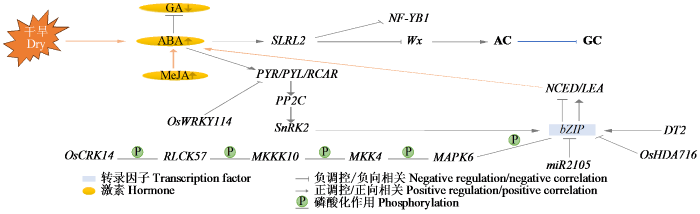
图1
水稻响应干旱胁迫的关键基因调控网络
斜体代表基因,加粗代表性状。
Fig.1
The key gene regulatory network of rice in response to drought stress
Genes are italicized, and traits are bolded.
此外,还有对高温和干旱进行协同调节的基因,如OsLEA1b作为水稻灌浆期的热应激反应基因,其敲除突变体在高温下表现出严重的稻米品质劣化,胚乳半透明且垩白率达95%,复粒淀粉形态异常,胶稠度下降,总淀粉、直链淀粉、蛋白质和脂质含量均显著降低,同时短链淀粉(聚合度6-13)比例减少,而中长链淀粉(聚合度14-48)比例增加;高温会进一步加剧这些品质缺陷。在干旱胁迫下,oslea1b突变体存活率显著下降,ROS水平升高,且PEG和NaCl处理使其根与地上部生长受抑更为明显,表明OsLEA1b通过维持胚乳淀粉正常合成与积累,在高温和干旱双重逆境下正向调控稻米的外观、蒸煮食味及营养品质[64]。GSA1通过重塑水稻类黄酮代谢谱,间接调节IAA的极性运输及其相关基因的表达水平,从而改变细胞的增殖与扩展能力,实现对籽粒粒型的正向调控。同时,过表达GSA1不仅能显著增大籽粒、提高粒重,还可协同增强水稻对高温、干旱等多种逆境胁迫的耐受性[65]。OsPP2C49是调控水稻对干旱和高温适应性的负调控因子,过表达OsPP2C49导致ABA敏感性降低,株高和穗长增加,粒长、粒宽、粒重和单株产量增加,敲除突变体ospp2c49中观察到相反表型,OsPP2C49在抗逆和品质方面表现出拮抗作用[66-67]。这些发现揭示了作物在资源分配上的复杂权衡,也为未来培育“逆境稳产、优质协同”的水稻品种提供了多元化的分子靶点。
1.3 光照强度对品质的影响
光照强度对水稻品质影响的研究主要集中于生理生化特性,对分子机制研究相对较少。弱光胁迫下突变体osmgd2光合作用减弱,穗粒数减少43.8%,千粒重增加6.3%,产量显著降低,糊化特性下降,亚油酸含量降低26.6%,而野生型OsMGD有较强的弱光胁迫耐受性[72-73]。过表达OsMGD1植株在弱光和高光照条件下均表现出更强的光合能力,生物产量、籽粒产量及膜脂不饱和脂肪酸的比例均显著升高;但在弱光胁迫下过表达OsMGD1,植株叶绿素含量增加,光捕获能力增强,从而提高光合效率,而在高光照条件下,过表达植株中叶黄素循环中脱环氧化状态更高,从而提供充足光保护作用,减少光氧化损伤,提高电子传递速率[74]。此外,RGA1/D1在弱光应答和碳代谢中发挥正调控作用,其功能缺失使稻米外观品质显著改善,垩白度下降,食用和烹饪品质无显著差异,但可能引起ABA积累进而抑制种子萌发与早期发育[75-76]。HPY1通过上调Rubisco小亚基基因(RbcS2/3/4)提升叶片碳固定能力,同时激活颖壳发育关键基因CCP1和FLO2,促进籽粒灌浆、增大籽粒[77],有望在强光条件下减少垩白发生率,从而正向调控稻米外观品质。
目前,在水稻中鉴定出与温度、干旱及光逆境响应相关的基因如表1所示,涵盖编码产物、调控方式与逆境类别、调控功能及对品质性状的影响。这些基因在同一逆境中存在正、负调控因子的协同与拮抗,如QT12和DG1基因在调控抗逆性的同时,对粒型、垩白度、淀粉含量及营养组分等品质性状均有显著效应,说明抗逆与品质之间存在复杂的调控网络,这些协同与拮抗基因为深入解析“环境―基因―品质”互作调控网络及分子育种提供了重要靶点。
表1 水稻逆境调控基因及其对品质性状的影响
Table 1
| 基因 Gene | 编码产物 Coding product | 调控类型 Regulation type | 调控功能 Function | 品质性状 Quality trait |
|---|---|---|---|---|
| Hsp101/FLO24[18-19] | ATP酶 | 正调控耐热性 | 维持淀粉合成酶活性 | 垩白度,AC |
| OsHsp70-2/FLO11,OsHsp40-1[5] | 热激蛋白 | 正调控耐热性 | 调控淀粉合成 | 垩白度 |
| SMG9[20] | 春化不敏感蛋白 | 负调控耐热性 | 降低ROS积累和细胞程序死亡 | 粒型 |
| FLR3,FLR14[21] | 受体样激酶 | 正调控耐热性 | 缓解氧化应激 | 垩白度 |
| CHALK-H[22] | 丝氨酸tRNA合成酶 | 正调控耐热性 | 垩白度 | |
| TT3.1[24] | RING锌指蛋白 | 正调控耐热性 | 减少细胞损伤 | 粒型 |
| GS3/TT2[25] | 异三聚体G蛋白γ亚基 | 负调控耐热性 | 调控籽粒灌浆与粒型 | 粒型 |
| QT12[5] | Sec61转运蛋白β亚基 | 负调控耐热性 | 垩白形成 | 垩白度,营养成分 |
| TTL1[26] | 转录激活因子 | 负调控耐热性 | 调控热响应基因表达 | 粒型 |
| OsMAPK6[30],OsMAPK3[32] | 丝裂原活化蛋白激酶 | 正调控耐冷性 | 激活冷响应基因表达 | 粒型,垩白度 |
| OsIPA1/OsSPL14[31] | Squamosa启动子结合蛋白 | 正调控耐冷性 | 激活冷响应基因表达 | AC,蛋白质含量,垩白 |
| OsLEA9[32] | 胚胎发生晚期蛋白 | 正调控耐冷性 | 维持细胞膜结构和蛋白稳定性 | / |
| OsTPP1[33] | 海藻糖-6-磷酸磷酸酶 | 正调控耐冷性 | 维持细胞渗透平衡 | 淀粉含量 |
| CTB5[35] | 亮氨酸拉链蛋白 | 正调控耐冷性 | 促进生殖发育 | 粒型 |
| SLRL2[47] | GRAS家族转录因子 | 正调控耐旱性 | 调控籽粒灌浆 | AC |
| NCED2[48] | 9-顺式环氧类胡萝卜素双加氧酶 | 正调控耐旱性 | 提高内源ABA水平 | AC,GC |
| DG1[48] | ABA转运蛋白 | 正调控耐旱性 | 调控ABA信号分布 | AC,GC,粒型 |
| OsARF6[50] | IAA响应因子 | 正调控耐旱性 | 激活干旱响应基因表达, 调控叶夹角与粒型 | 粒型 |
| OsERF101[51] | 乙烯应答元件结合蛋白 | 正调控耐旱性 | 激活干旱胁迫响应基因表达 | 粒型 |
| OsbZIP66[61] | TRAB1 | 正调控耐旱性 | 激活ABA响应基因表达 | / |
| OsHDA716[63] | 组蛋白去乙酰化酶716 | 负调控耐旱性 | 抑制干旱响应基因表达 | / |
| OsMGD2[72] | 单半乳糖二酰甘油合酶2 | 调控耐弱光 | 维持类囊体膜稳定性 | 糊化特性 |
| OsMGD1[74] | 单半乳糖二酰甘油合酶1 | 调控耐弱光 | 提高光合效率 | 粒型 |
| RGA1/D1[75] | 抗病蛋白RGA1 | 正调控耐弱光 | 增强弱光耐受性 | 垩白度 |
2 栽培技术调控水稻品质形成的生理基础
水稻生育期主要分为发芽期、幼苗期、分蘖期、拔节期、孕穗期、抽穗期、开花期和灌浆成熟期8个阶段,其中前4个时期为营养生长阶段,后4个时期主要为生殖生长阶段。在水稻栽培中,精准控水为施肥、晒田创造基础条件,科学施肥需结合水分管理提高养分吸收效率,因此在营养生长阶段和生殖生长时期,精准控水和科学施肥对水稻产量和品质有决定作用。
2.1 水分管理对水稻品质的调控研究
水分是水稻生长之基,且不同生育期对水分的需求存在显著差异,因此精准控水需根据其生长阶段的生理特点动态调整,以创造适宜环境,协调营养供给,确保水稻优质与高产协同发展。
2.1.1 营养生长阶段浅水促蘖和适时晒田对品质的影响
分蘖数直接影响有效穗数,因此对水稻产量的形成具有重要影响。水稻分蘖由腋分生组织(axillary meristem,AM)起始和发育及分蘖芽生长等分子网络协同调控[78]。此外,环境因子和内源激素水平对水稻分蘖也有重要调节作用。
研究[81]表明激素对水稻分蘖有重要调控作用,其中CTK和IAA的调控作用最显著。CTK在分蘖芽的萌发和生长中均起关键作用,而IAA则调控分蘖芽的顶端优势进而影响分蘖数。IAA下调CTK合成基因OsIPT表达,从而减少CTK合成,因此IAA和CTK协同调控水稻分蘖[81]。独脚金内酯(strigolactones,SLs)是调控分蘖的激素,对株型有重要决定作用。多蘖矮秆基因DWARF53为SL信号的抑制因子,在SL信号诱导下,DWARF53蛋白能够与SL信号感知因子DWARF14和DWARF3[SCF(SKP1-CUL1-F-box protein-Ubiquitin ligase)E3泛素连接酶复合体的F-box元件]结合形成复合体,泛素化DWARF53蛋白,后被26S蛋白酶体识别并降解,解除DWARF53蛋白对SL下游响应因子的抑制作用,抑制分蘖芽的伸长生长,从而调控水稻株型[82-83]。因此,环境、基因型和发育过程均影响水稻分蘖,国内外对水稻分蘖的分子调控机理开展了大量研究,但目前关于浅水环境或水层变化如何响应激素及分子信号的机理尚不清楚,推测分蘖形成的部位可能存在感知或接收氧气信号,进而诱导分蘖芽形成的响应机制。
晒田能够促进ABA的产生,减少高节位的无效分蘖,进而提高水稻产量[88]。在中度和重度干旱下,水稻幼穗中的ABA含量均显著增加,且重度干旱下的增幅大于中度干旱;中度干旱下,水稻幼穗中的油菜素内酯(brassinosteroids,BR)含量也显著上升。中度干旱一方面可以通过调控水稻幼穗中ABA和BR积累,影响减数分裂过程,协同抑制小穗变性;另一方面有利于水稻籽粒灌浆,增加粒重,如调控籽粒淀粉合成酶SuSase、AGPase、可溶性淀粉合成酶(soluble starch synthase,SSS)、颗粒结合型淀粉合成酶(granule-bound starch synthase,GBSS)和淀粉分支酶(starch branching enzyme,SBE)的活性,并促进SuS2、SuS3、SuS4、AGPS2b、AGPL1、AGPL2、SSSIIb、SSSIIc、GBSSI、GBSSII、SBEI和SBEIIb的上调表达,从而在转录水平调控籽粒灌浆[89-90]。上述研究表明,适度晒田不仅创造了适宜的干旱环境,还能够诱导激素及淀粉合成相关基因表达,进而影响水稻的外观品质、蒸煮品质和食味品质。
2.1.2 生殖生长时期精准控水与品质的关系
水稻全生育期进行干湿交替灌溉,其地上部分的生物量、干物质量、叶绿素含量、光合速率和灌浆速率均较常规灌溉高[93]。干湿交替灌溉能够显著降低水稻中砷(As)和镉(Cd)积累,减少CH4排放,因此环境效益显著,同时干湿交替灌溉还有利于促进养分向籽粒的转移,从而增加粒重,提高品质[94-95]。轻度干湿交替灌溉后,水稻根系分泌物中有机酸含量明显增加,而重度干湿交替灌溉下显著降低,有机酸含量变化能够调控根系活性,进而影响水稻产量与品质[96]。在施氮量一致的条件下,与传统水层灌溉相比,干湿交替灌溉的优势主要体现在叶片生理方面,叶绿素含量与净光合速率显著提升,SOD、过氧化氢酶(catalase,CAT)、硝酸还原酶(nitrate reductase,NR)、谷氨酰胺合成酶(glutamine synthetase,GS)和谷氨酸合成酶(glutamate synthase,GOGAT)活性显著增强,POD及内肽酶活性显著降低,丙二醛(malondialdehyde,MDA)含量显著下降;在根系中,氮代谢关键酶活性显著提高;在产量与氮效率方面,水稻产量、氮素转运量与转运率及氮肥吸收利用率均显著增加[97]。此外,干湿交替灌溉还影响稻米香味,在分蘖期、孕穗期和灌浆期,干湿交替灌溉能够显著提高籽粒香气物质2-乙酰-1-吡咯啉(2-AP)的含量[98]。
拔节期和孕穗期是水稻产量和品质形成的关键阶段,这2个时期需水量大,水分亏缺直接导致产量因子穗粒数及粒重降低[99]。开花期干旱胁迫影响水稻多个生理性状和产量[100]。减数分裂期,干旱胁迫不可逆地影响水稻花药中的转化酶活性,导致花粉无法将蔗糖转化为己糖,进而造成淀粉积累受阻。同时,干旱胁迫还影响花药的性质和结构,如减数分裂细胞变性、小孢子定向障碍、中间层扩张和空泡化绒毡形成,从而导致不育[46]。然而,在开花期轻度干旱胁迫,可提高水稻千粒重并增加产量;在灌浆期轻度干旱胁迫,则能显著提升穗粒数、结实率和千粒重,进而实现产量增长,这表明开花期与灌浆期的适度水分亏缺具有节水增产效应[38]。综上所述,分蘖期干湿适宜可促进有效分蘖,灌浆期轻度干旱胁迫能够提高千粒重与结实率;而拔节、孕穗、开花期干旱胁迫可能损伤花药导致不育,但轻度胁迫有助于增产,因此水稻栽培中需精准调控水分时序,以提高水稻产量和品质。
2.2 科学施肥对水稻品质的调控作用
水稻科学施肥的关键在于依据生育期需肥规律、土壤供肥能力及目标产量进行科学配比与调控,其中测土配方是关键,原则上“前促中控后保”,避免前期旺长、后期早衰。
水稻施肥按生育期分为基肥、蘖肥、穗肥(促花肥和保花肥)和抽穗肥(粒肥)。氮肥运筹处理中,基蘖肥对水稻吸收总氮量的贡献较小,穗肥的贡献最大;基蘖肥与穗肥比例为6:4或7:3时,水稻产量及品质效益最佳[101-102]。由于氮是氨基酸、叶绿素和核酸的合成原料,磷是ATP、NADPH和磷脂的组成成分,基肥和蘖肥施用氮和磷能够加速根系ATP合成,增加CTK含量及调控Rubisco合成,进而促进水稻分蘖及能量代谢。钾肥能够激活NR并调节叶片气孔开闭,提高光合效率,且钾肥对氮肥有一定的补偿效应。适当增施钾量能够补偿施氮不足引起的水稻植株矮小,但钾素营养对叶片颜色的调控存在滞后性,因此前期缺氮可能影响叶片颜色进而氧化损伤叶绿体[103]。水稻氮素亏缺可以根据顶3和顶4叶的叶色差进行判断,当顶3叶叶色的SPAD值等于顶4叶时,叶片含氮率约为2.7%(粳稻)和2.5%(籼稻),此时碳氮代谢平衡,有利于大穗形成,无需追施穗肥;若顶3叶叶色>顶4叶,养分不足,分蘖停止;当顶4叶叶色>顶3叶,代表植株氮素水平过高。该判断标准不受品种和生育时期的影响,不依赖SPAD仪也能够简单地通过叶色深浅确定氮素盈亏,因而广泛用于水稻施肥管理中[104]。
氮肥施用对品质的影响十分复杂,包括碾米品质、外观品质、蒸煮品质、食味品质、营养品质及蛋白组分等。随着施氮水平的提高,糙米率、垩白度和蛋白质含量增加,整精米率下降,精米率、AC和凝胶稠度无显著变化[105]。但也有研究[106]显示,随着施氮量增加,水稻产量和品质难以协调,呈此消彼长的关系。基于SPAD测定阈值的动态施氮策略能够在一定程度上改善水稻产量与品质之间的矛盾,实现二者的协同发展。此外,氮肥施用对蛋白质组分有重要决定作用,单欣兰等[107]发现高氮处理下,水稻籽粒醇溶蛋白与谷蛋白合成基因上调表达,而清蛋白与球蛋白合成基因的表达无明显变化。石吕等[108]研究表明生育后期氮肥施用显著增加了稻米蛋白质组分的含量,且醇溶蛋白和谷蛋白对氮肥更敏感。蛋白质含量上升不利于稻米品质改良,主要原因是高蛋白质含量促进淀粉与蛋白质形成致密凝胶网络,垩白度增加,抑制淀粉糊化过程中的水分吸收和膨化,最终导致米饭变硬且黏性下降,而钾肥的施用能够有效降低AC和蛋白质含量,改善蒸煮品质[109-110]。
微量元素在水稻品质形成中也发挥重要作用。施用镁肥可明显提高稻米蛋白质含量,且随镁施用量增加呈上升趋势,而AC与垩白度则逐渐降低[111]。硒肥施用也能够增加籽粒蛋白质含量,由对照组的6.65%增至叶面喷施75 g/hm2处理组的7.17%,增幅达7.8%,同时还提高了籽粒中的硒含量,有助于稻米中锰和铁元素吸收,间接改善了稻米营养品质[112]。在120~200 kg/hm2施用水平内,硅肥可显著提高生育后期功能叶片的叶绿素含量、根系活力及茎秆粗纤维素含量,同时其AC下降、消减值增加、垩白度减少;此外,富硅微肥施用能够有效促进水稻对氮和磷的吸收,增强肥料利用率与硅含量,进而提高产量[113-114]。总而言之,水稻科学施肥需按生育期精准调控,注重氮、磷、钾协同增效及微量元素的补充作用,同时还要兼顾平衡蛋白―淀粉互作关系,通过科学施肥调控水稻品质。
3 栽培技术对环境胁迫的补偿效应
在环境胁迫与栽培技术对水稻产量与品质的影响研究中,部分栽培技术在应对环境胁迫或水稻内环境稳态失衡时具有补偿作用。低温胁迫后施锌能够促进水稻分蘖恢复;抽穗期高温胁迫下稻米的垩白度显著上升,但施用氮肥与高温胁迫对垩白度存在互作效应,因此抽穗期施用氮肥能够缓解高温造成的垩白度增加,防止稻米品质变劣[115-
此外,激素施用在缓解环境胁迫对水稻的损伤方面也具有显著补偿效应。低温胁迫下,胺鲜酯(DA-6)处理可以使水稻幼苗根系活力提高28.9%[123]。外源CTK通过调控AGPase和SBE活性,促进淀粉积累,从而实现低温胁迫下产量补偿[124]。分蘖期重度干湿交替灌溉条件下喷施6-苄氨基腺嘌呤(6-benzylaminoadenine,6-BA),并且在剑叶展叶期喷施已酸二乙氨基乙醇酯(diethyl aminoethyl hexanoate,DA)可实现轻度干湿交替灌溉处理下的增产效果[125],说明6-BA+DA对干旱胁迫也有一定的补充作用。目前,栽培技术对环境胁迫的补偿效应研究多聚焦于激素对水稻抗逆生理的调控作用,而对稻米品质影响的研究较少。
4 讨论
综合应用环境胁迫响应分子机制、逆境适应性栽培技术及抗逆与优质基因协同育种是在环境胁迫条件下提升水稻品质,实现抗逆与品质协同的最有效途径。研究环境胁迫下水稻激素变化及其作用机制,探究高效外源激素辅助抵御环境胁迫是一种响应环境胁迫调控淀粉合成,进而提高水稻品质的重要方法。就水稻栽培技术而言,一方面采取物理调节,如高温胁迫可以在温度敏感期灌溉深井水以达到降温效果;另一方面采用生理调节,精准利用水稻自身的胁迫应对措施“逃、避、耐”。高温胁迫下可以通过喷施水杨酸和BR增强花粉育性、减少空秕率;分蘖期适度晒田以诱导根系深扎,提高耐旱性。在抗逆与优质协同育种方面,利用优质抗逆水稻如耐盐水稻种质Pokkali[126]和耐旱耐热种质Nagina22[127]等,由于Pokkali的长链非编码RNA参与冷、热和干旱等多种胁迫响应及分子途径,可作为优质基因供体使用[126];Nagina22的EMS诱导突变体NH219hwde热应激耐受性更强,产量与品质稳定性好,是抗逆与优质兼具的重要育种材料[127]。
此外,不同品种对水分胁迫的响应存在显著差异。节水抗旱稻“旱优113”的抗旱能力强于杂交稻“扬两优6号”,适度干旱可以改善节水抗旱稻的垩白度[128],说明适度胁迫能够改善稻米品质,但不同水稻品种对此存在遗传背景特异性。稻米品质在不同栽培条件下的表型与品质性状的遗传基础密切相关,播种期间接影响灌浆期的有效积温,同时不同Wx等位基因对播种期的响应存在显著差异,Wxmp、Wxb和Wxlv等基因型,推迟播种期有利于提高峰值黏度、崩解值及食味值;而wx和Wxla基因型,提前播种则更有利于食味品质的提升[129]。耐冷基因LTIA1与LTIA2在分布与进化上呈现明显分化,LTIA1缺失稀少且仅限于粳稻,LTIA2缺失广泛且集中于低纬度籼稻;LTIA2起源于LTIA1的复制并在部分野生稻中发生再缺失,该变异可作为缓解早稻倒春寒低温损害的潜在基因资源[130]。在今后的研究中应进一步挖掘耐逆优质基因资源,明确不同遗传背景下胁迫响应的差异机制,解析这些基因感知环境信号和调控稻米品质的作用模式。
在水稻响应环境胁迫的通路中共享多个交叉调控转录因子和中间途径。如LEA编码基因OsWsi18在耐冷基因OsICE1过表达植株中上调表达,从而增强干旱下的膜稳定性[131]。MAPK信号作为多种环境胁迫的中间信号,调控下游基因影响稻米品质。目前已在水稻中鉴定出多个完整的MAPK级联通路,包括调控激素信号和环境胁迫响应的OsMAPKKK10-OsMAPKK4-OsMAPK6、OsMAPKKK63-OsMAPKK1-OsMAPK4和OsMAPKKK62-OsMAPKK3-OsMAPK7/14级联通路[132],以及控制晶粒大小和叶夹角的信号级联OsBSK3-OsMKKK10-OsMKK4-OsMAPK6-OsWRKY53[133]。说明MAPK参与多种环境胁迫响应调控,随着分子模块与分子调控网络研究的不断深入,未来有望挖掘出可协同调控环境胁迫响应、产量及品质的MAPK中间信号。此外,WRKY、bZIP、NAC等转录因子也需要重点关注。
参考文献
我国稻米品质标准及检测技术创新概述
DOI:10.3969/j.issn.1006-8082.2022.01.001
[本文引用: 1]

稻米品质是决定其市场价值和商品价值的重要属性。本文简述了我国稻米品质标准的现状;探讨了稻米品质评价包括的五个方面:加工品质、外观品质、蒸煮品质、食味品质及营养品质;介绍了稻米品质检测技术的创新进展。
水稻产量与淀粉品质协同调控的分子遗传研究进展
DOI:10.16819/j.1001-7216.2026.240901
[本文引用: 1]
高产和优质是水稻育种的两大主要目标,产量与品质协同改良是水稻育种和功能基因组研究面临的重大挑战。本文从水稻淀粉合成的遗传调控、产量形成的分子生物学基础、产量与淀粉品质协同调控的分子机理及相关基因的克隆与功能研究等方面,总结水稻产量与淀粉品质协同调控的分子遗传研究进展,分析现有研究存在的问题,初步提出未来解决水稻产量与品质难以兼得关键问题的遗传改良策略,为利用分子育种技术协调产量与品质均衡,培育既高产又优质的水稻新品种提供信息参考。
Genetic control of grain appearance quality in rice
DOI:10.1016/j.biotechadv.2022.108014 URL [本文引用: 1]
A natural gene on-off system confers field thermotolerance for grain quality and yield in rice
DOI:10.1016/j.cell.2025.04.011
PMID:40311617
[本文引用: 4]
Rising global temperatures threaten crop grain quality and yield; however, how temperature regulates grain quality and how to achieve synergistic thermotolerance for both quality and yield remain unknown. Here, we identified a rice major locus, QT12, which negatively controls grain-quality field thermotolerance by disrupting endosperm storage substance homeostasis through over-activating unfolded protein response (UPR). Natural variations in QT12 and an NF-Y complex form a natural gene on-off system to modulate QT12 expression and thermotolerance. High temperatures weaken NF-YB9/NF-YC10 interactions with NF-YA8, releasing QT12 suppression and triggering quality deterioration. Low QT12 expression confers superior quality and increases elite rice yield up to 1.31-1.93 times under large-scale high-temperature trials. Two trait regulatory haplotypes (TRHs) from co-selected variations of the four genetically unlinked genes in NF-Ys-QT12 were identified for subspecies thermotolerance differentiation. Our work provides mechanistic insights into rice field thermotolerance and offers a proof-of-concept breeding strategy to break stress-growth and yield-quality trade-offs.Copyright © 2025 Elsevier Inc. All rights reserved.
灌浆期不同时段高温对稻米淀粉理化特性的影响
DOI:10.16819/j.1001-7216.2022.210413
[本文引用: 1]
【目的】研究灌浆期不同时段高温对稻米淀粉组成、结构和理化特性的影响,揭示高温对稻米淀粉理化特性影响的时段效应,阐明高温、结构和功能之间的关系。【方法】以耐热水稻品种黄华占和热敏感的9311近等位基因系为实验材料,利用人工气候箱设置高温[38℃(昼)/30℃(夜)]和对照[28℃(昼)/22℃(夜)],研究灌浆前期(齐穗期后1-15 d)和后期(齐穗期后16 d至成熟)高温对稻米的加工品质、外观品质、淀粉组成、支链淀粉链长分布、粒度分布、胶稠度、黏度特性、糊化特性、结晶特性和颗粒形态的影响。【结果】灌浆期高温使糙米率、精米率、整精米率显著下降,使垩白粒率和垩白度显著升高,导致加工品质和外观品质变差。灌浆期高温使总淀粉含量、直链淀粉含量、短支链淀粉含量、大淀粉粒占比、直/支链淀粉比显著下降,而中等支链淀粉含量、小中淀粉粒占比、糊化温度和糊化焓显著上升,黏度特性显著改变,结晶类型不变但结晶度显著改变,淀粉颗粒表面出现小孔,表面变得凹凸不平,导致淀粉颗粒更加碎片化和蒸煮食味品质变劣。灌浆期不同时段高温对稻米品质的影响不同,灌浆前期高温对稻米淀粉的影响大于灌浆后期,耐热品种受影响小于热敏感品种。灌浆前期高温处理下供试材料具有较高的消减值和较低的崩解值,黏度特性变差;灌浆后期高温处理下供试材料具有较低的消减值和较高的崩解值,黏度特性变好。【结论】灌浆前期高温对淀粉理化特性的影响最大,进而导致稻米的加工品质、外观品质和蒸煮食味品质变劣,灌浆后期高温提升了黏度特性。
Effects of high temperature on grain quality and enzyme activity in heat-sensitive versus heat-tolerant rice cultivars
DOI:10.1002/jsfa.v104.15 URL [本文引用: 2]
The hot science in rice research: how rice plants cope with heat stress
DOI:10.1111/pce.14509
URL
[本文引用: 2]
Global climate change has great impacts on plant growth and development, reducing crop productivity worldwide. Rice ( Oryza sativa L.), one of the world's most important food crops, is susceptible to high‐temperature stress from seedling stage to reproductive stage. In this review, we summarize recent advances in understanding the molecular mechanisms underlying heat stress responses in rice, including heat sensing and signalling, transcriptional regulation, transcript processing, protein translation, and post‐translational regulation. We also highlight the irreversible effects of high temperature on reproduction and grain quality in rice. Finally, we discuss challenges and opportunities for future research on heat stress responses in rice.\n
灌浆期高温胁迫对早籼稻品质性状的影响
DOI:10.16819/j.1001-7216.2024.221114
[本文引用: 1]
【目的】研究灌浆期高温胁迫对早籼稻碾磨、外观和蒸煮食味品质的影响,揭示早籼稻品质性状对灌浆期高温胁迫的响应规律。【方法】以R996、湘早籼45号和6个新育成的早籼稻品系为试验材料,以分期播种方式利用自然高温进行胁迫处理,分析了供试品系的碾磨、外观和蒸煮食味品质,筛选出对高温钝感和敏感的水稻品系,探究稻米品质性状对灌浆期高温胁迫的响应规律。【结果】稻米品质性状对灌浆期不同时段温度的敏感性不同,始穗后10 d内温度对稻米碾磨品质和蒸煮食味品质影响最显著,始穗后30 d内温度对稻米外观品质影响最显著。稻米品质对灌浆期高温胁迫的响应因性状而异,灌浆期高温胁迫显著降低糙米率、精米率、整精米率和粒长,显著提高垩白粒率、垩白度,劣化了稻米碾磨品质和外观品质;显著降低直链淀粉含量,提高米饭外观、米饭口感和米饭黏度,提升了米饭适口性。水稻品系对高温胁迫的响应因稻米品质性状而异,Q3、Q8、Q11、Q13属于碾磨品质高温钝感品系,Q3、Q4、Q5和Q11属于外观品质高温钝感品系且高温下蒸煮食味品质优。【结论】灌浆期高温胁迫会降低稻米的碾磨品质和外观品质,提高米饭适口性。水稻品系Q3和Q11碾磨品质、外观品质好且高温钝感,蒸煮食味品质优良,可望为早籼稻优质育种提供新的种质资源。
Effect of high temperature on starch biosynthetic enzymes and starch structure in japonica rice cultivar ‘Akitakomachi’ (Oryza sativa L.) endosperm and palatability of cooked rice
DOI:10.1016/j.jcs.2019.04.001 URL [本文引用: 1]
Heat stress-reduced kernel weight in rice at anthesis is associated with impaired source-sink relationship and sugars allocation
DOI:10.1016/j.envexpbot.2018.08.021 URL [本文引用: 1]
Combined drought and heat stress affect starch synthesis and grain quality-related traits during the grain-filling stage of rice (Oryza sativa L.)
DOI:10.1002/jsfa.v105.15 URL [本文引用: 1]
Transcriptome analysis of Oryza sativa (rice) seed germination at high temperature shows dynamics of genome expression associated with hormones signalling and abiotic stress pathways
DOI:10.1007/s12042-016-9170-7 URL [本文引用: 1]
A molecular module improves rice grain quality and yield at high temperatures
DOI:10.1093/nsr/nwae416 URL [本文引用: 3]
Floury Endosperm 24, a heat shock protein 101 (HSP101), is required for starch biosynthesis and endosperm development in rice
DOI:10.1111/nph.v242.6 URL [本文引用: 3]
SMG9 stabilizes grain yield and quality in rice under heat stress
DOI:10.1016/j.cj.2025.12.015 URL [本文引用: 2]
Rice feronia-like receptor 3 and 14 affect grain quality by regulating redox homeostasis during endosperm development
DOI:10.1093/jxb/erad077
URL
[本文引用: 2]
Chalky endosperm negatively affects the appearance, milling, and eating qualities of rice (Oryza sativa L.) grains. Here, we report the role of two receptor-like kinases, FERONIA-LIKE RECEPTOR 3 (FLR3) and FERONIA-LIKE RECEPTOR 14 (FLR14), in grain chalkiness and quality. Knockouts of FLR3 and/or FLR14 increased the number of white-core grains caused by aberrant accumulation of storage substances, resulting in poor grain quality. Conversely, the overexpression of FLR3 or FLR14 reduced grain chalkiness and improved grain quality. Transcriptome and metabolome analyses showed that genes and metabolites involved in the oxidative stress response were significantly up-regulated in flr3 and flr14 grains. The content of reactive oxygen species was significantly increased in flr3 and flr14 mutant endosperm but decreased in overexpression lines. This strong oxidative stress response induced the expression of programmed cell death (PCD)-related genes and caspase activity in endosperm, which further accelerated PCD, resulting in grain chalkiness. We also demonstrated that FLR3 and FLR14 reduced grain chalkiness by alleviating heat-induced oxidative stress in rice endosperm. Therefore, we report two positive regulators of grain quality that maintain redox homeostasis in the endosperm, with potential applications in breeding rice for optimal grain quality.
Identification and characterization of the chalkiness endosperm gene CHALK-H in rice (Oryza sativa L.)
DOI:10.1016/j.jia.2023.04.020 URL [本文引用: 2]
Isolation of TSCD11 gene for early chloroplast development under high temperature in rice
DOI:10.1186/s12284-020-00411-6
[本文引用: 1]
Chloroplasts are essential for photosynthesis and play key roles in plant development. High temperature affects structure of chloroplasts and metabolism in plants. The seryl-tRNA synthetase plays an important role in translation of proteins. Although seryl-tRNA synthetase has been widely studied in microbes and animals, few studies have reported about its role in chloroplast development under high temperature in rice.
A genetic module at one locus in rice protects chloroplasts to enhance thermotolerance
DOI:10.1126/science.abo5721
PMID:35709289
[本文引用: 2]
How the plasma membrane senses external heat-stress signals to communicate with chloroplasts to orchestrate thermotolerance remains elusive. We identified a quantitative trait locus, (), consisting of two genes, and, that interact together to enhance rice thermotolerance and reduce grain-yield losses caused by heat stress. Upon heat stress, plasma membrane-localized E3 ligase TT3.1 translocates to the endosomes, on which TT3.1 ubiquitinates chloroplast precursor protein TT3.2 for vacuolar degradation, implying that TT3.1 might serve as a potential thermosensor. Lesser accumulated, mature TT3.2 proteins in chloroplasts are essential for protecting thylakoids from heat stress. Our findings not only reveal a genetic module at one locus that transduces heat signals from plasma membrane to chloroplasts but also provide the strategy for breeding highly thermotolerant crops.
TT2 controls rice thermotolerance through SCT1-dependent alteration of wax biosynthesis
DOI:10.1038/s41477-021-01039-0 [本文引用: 2]
Identification of natural allelic variation in TTL1 controlling thermotolerance and grain size by a rice super pan-genome
DOI:10.1111/jipb.v65.12 URL [本文引用: 2]
Direct phosphorylation and activation of a mitogen-activated protein kinase by a calcium- dependent protein kinase in rice
DOI:10.1105/tpc.114.126441 URL [本文引用: 1]
Control of grain size and weight by the OsMKKK10-OsMKK4-OsMAPK6 signaling pathway in rice
DOI:S1674-2052(18)30133-3
PMID:29702261
[本文引用: 1]
Grain size is one of the key agronomic traits that determine grain yield in crops. However, the mechanisms underlying grain size control in crops remain elusive. Here we demonstrate that the OsMKKK10-OsMKK4-OsMAPK6 signaling pathway positively regulates grain size and weight in rice. In rice, loss of OsMKKK10 function results in small and light grains, short panicles, and semi-dwarf plants, while overexpression of constitutively active OsMKKK10 (CA-OsMKKK10) results in large and heavy grains, long panicles, and tall plants. OsMKKK10 interacts with and phosphorylates OsMKK4. We identified an OsMKK4 gain-of-function mutant (large11-1D) that produces large and heavy grains. OsMKK4 encoded by the large11-1D allele has stronger kinase activity than OsMKK4. Plants overexpressing a constitutively active form of OsMKK4 (OsMKK4-DD) also produce large grains. Further biochemical and genetic analyses revealed that OsMKKK10, OsMKK4, and OsMAPK6 function in a common pathway to control grain size. Taken together, our study establishes an important genetic and molecular framework for OsMKKK10-OsMKK4-OsMAPK6 cascade-mediated control of grain size and weight in rice.Copyright © 2018 The Author. Published by Elsevier Inc. All rights reserved.
OsMAPK6 positively regulates rice cold tolerance at seedling stage via phosphorylating and stabilizing OsICE1 and OsIPA1
DOI:10.1007/s00122-023-04506-8
PMID:38103049
[本文引用: 2]
Rice is a chilling-sensitive plant, and extremely low temperatures seriously decrease rice production. Several genes involved in chilling stress have been reported in rice; however, the chilling signaling in rice remains largely unknown. Here, we investigated the chilling tolerance phenotype of overexpression of constitutive active OsMAPK6 (CAMAPK6-OE) and OsMAPK6 mutant dsg1, and demonstrated that OsMAPK6 positively regulated rice chilling tolerance. It was shown that, under cold stress, the survival rate of dsg1 was significantly lower than that of WT, whereas CAMAPK6-OE display higher survival rate than WT. Physiological assays indicate that ion leakage and dead cell in dsg1 was much more severe than those in WT and CAMAPK6-OE. Consistently, expression of chilling responsive genes in dsg1, including OsCBFs and OsTPP1, was significantly lower than that of in WT and CAMAPK6-OE. Biochemical analyses revealed that chilling stress promotes phosphorylation of OsMAPK6. Besides, we found that OsMAPK6 interacts with and phosphorylates two key regulators in rice cold signaling, OsIPA1 and OsICE1, and then enhance their protein stability. Overall, our results revealed a cold-induced OsMAPK6-OsICE1/OsIPA1 signaling cascade by which OsMAPK6 was involved in rice chilling tolerance, which provides novel insights to understand rice cold response at seedling stage.© 2023. The Author(s), under exclusive licence to Springer-Verlag GmbH Germany, part of Springer Nature.
Strigolactones regulate sugar allocation to control rice tillering and root development via the OsSPL14-OsSHR1-OsSWEET16 pathway
DOI:10.1111/pbi.v24.2 URL [本文引用: 2]
Cold-adaptive evolution at the reproductive stage in geng/japonica subspecies reveals the role of OsMAPK3 and OsLEA9
DOI:10.1111/tpj.v111.4 URL [本文引用: 3]
OsMAPK3 phosphorylates OsbHLH002/OsICE1 and inhibits its ubiquitination to activate OsTPP1 and enhances rice chilling tolerance
DOI:S1534-5807(17)30951-6
PMID:29257952
[本文引用: 2]
Improvement of chilling tolerance is a major target in rice breeding. The signaling pathways regulating chilling consist of complex networks, including key transcription factors and their targets. However, it remains largely unknown how transcription factors are activated by chilling stress. Here, we report that the transcription factor OsbHLH002/OsICE1 is phosphorylated by OsMAPK3 under chilling stress. The osbhlh002-1 knockout mutant and antisense transgenic plants showed chilling hypersensitivity, whereas OsbHLH002-overexpressing plants exhibited enhanced chilling tolerance. OsbHLH002 can directly target OsTPP1, which encodes a key enzyme for trehalose biosynthesis. OsMAPK3 interacts with OsbHLH002 to prevent its ubiquitination by the E3 ligase OsHOS1. Under chilling stress, active OsMAPK3 phosphorylates OsbHLH002, leading to accumulation of phospho-OsbHLH002, which promotes OsTPP1 expression and increases trehalose content and resistance to chilling damage. Taken together, these results indicate that OsbHLH002 is phosphorylated by OsMAPK3, which enhances OsbHLH002 activation to its target OsTPP1 during chilling stress.Copyright © 2017 Elsevier Inc. All rights reserved.
Transcription factor OsMYB30 increases trehalose content to inhibit α-amylase and seed germination at low temperature
DOI:10.1093/plphys/kiad650
URL
[本文引用: 1]
Low-temperature germination (LTG) is an important agronomic trait for direct-seeding cultivation of rice (Oryza sativa). Both OsMYB30 and OsTPP1 regulate the cold stress response in rice, but the function of OsMYB30 and OsTPP1 in regulating LTG and the underlying molecular mechanism remains unknown. Employing transcriptomics and functional studies revealed a sugar signaling pathway that regulates seed germination in response to low temperature (LT). Expression of OsMYB30 and OsTPP1 was induced by LT during seed germination, and overexpressing either OsMYB30 or OsTPP1 delayed seed germination and increased sensitivity to LT during seed germination. Transcriptomics and qPCR revealed that expression of OsTPP1 was upregulated in OsMYB30-overexpressing lines but downregulated in OsMYB30-knockout lines. In vitro and in vivo experiments revealed that OsMYB30 bound to the promoter of OsTPP1 and regulated the abundance of OsTPP1 transcripts. Overaccumulation of trehalose (Tre) was found in both OsMYB30- and OsTPP1-overexpressing lines, resulting in inhibition of α-amylase 1a (OsAMY1a) gene during seed germination. Both LT and exogenous Tre treatments suppressed the expression of OsAMY1a, and the osamy1a mutant was not sensitive to exogenous Tre during seed germination. Overall, we concluded that OsMYB30 expression was induced by LT to activate the expression of OsTPP1 and increase Tre content, which thus inhibited α-amylase activity and seed germination. This study identified a phytohormone-independent pathway that integrates environmental cues with internal factors to control seed germination.
Natural variation of CTB5 confers cold adaptation in plateau japonica rice
DOI:10.1038/s41467-025-56174-5 [本文引用: 2]
A missense mutation in Large Grain Size 1 increases grain size and enhances cold tolerance in rice
DOI:10.1093/jxb/erz192 URL [本文引用: 1]
Photosynthetic carbon fixation and sucrose metabolism supplemented by weighted gene co-expression network analysis in response to water stress in rice with overlapping growth stages
DOI:10.3389/fpls.2022.864605
URL
[本文引用: 1]
Drought stress at jointing and booting phases of plant development directly affects plant growth and productivity in rice. Limited by natural factors, the jointing and booting stages in rice varieties are known to overlap in high-latitude areas that are more sensitive to water deficit. However, the regulation of photosynthetic carbon fixation and sucrose metabolism in rice leaves under different degrees of drought stress remains unclear. In this study, rice plants were subjected to three degrees of drought stress (−10, −25, −and 40 kPa) for 15 days during the jointing-booting stage, we investigated photosynthetic carbon sequestration and sucrose metabolism pathways in rice leaves and analyzed key genes and regulatory networks using transcriptome sequencing in 2016. And we investigated the effects of drought stress on the growth periods of rice with overlapping growth periods in 2016 and 2017. The results showed that short-term drought stress promoted photosynthetic carbon fixation. However, ribulose-1,5-bisphosphate carboxylase/oxygenase (RuBisCO) activity significantly decreased, resulting in a significant decrease in photosynthetic rate. Drought stress increased the maximum activity of fructose-1,6-bisphosphate aldolase (FBA). FBA maintains the necessary photosynthetic rate during drought stress and provides a material base after the resumption of irrigation in the form of controlling the content of its reaction product triose phosphate. Drought stress significantly affected the activities of sucrose synthase (SuSase) and sucrose phosphate synthase (SPS). Vacuoles invertase (VIN) activity increased significantly, and the more severe the drought, the higher the VIN activity. Severe drought stress at the jointing-booting stage severely restricted the growth process of rice with overlapping growth stages and significantly delayed heading and anthesis stages. Transcriptome analysis showed that the number of differentially expressed genes was highest at 6–9 days after drought stress. Two invertase and four β-amylase genes with time-specific expression were involved in sucrose-starch metabolism in rice under drought stress. Combined with weighted gene co-expression network analysis, VIN and β-amylase genes up-regulated throughout drought stress were regulated by OsbZIP04 and OsWRKY62 transcription factors under drought stress. This study showed that any water deficit at the jointing-booting stage would have a serious effect on sucrose metabolism in leaves of rice with overlapping growth stages.\n
水稻对干旱胁迫的生理生化响应及分子调控研究进展
DOI:10.16819/j.1001-7216.2024.230410
[本文引用: 1]
水稻是全球最重要的粮食作物之一,其生长过程需要大量水分。随着全球气候变暖,干旱成为其产量的重要限制因素。因此,本文结合近些年的研究成果从形态(根系和地上部)、生理(气孔、蒸腾作用、光合作用和水分利用率)、生化(植物激素、脯氨酸等渗透调节剂和抗氧化剂)及分子水平(抗旱基因的表达水平)综述了水稻在干旱胁迫下的自我保护机制,可为全面了解水稻抗旱机制和选育抗旱品种提供参考。
自然干旱胁迫下配方肥增效剂对水稻内源激素的影响
为揭示土壤自然干旱条件下配方肥增效剂对水稻植株内源激素的影响,以中稻培两优93为材料,采用盆栽法研究了配方肥增效剂对水稻内源脱落酸(ABA)、生长素(IAA)、赤霉酸(GA3)、玉米素核苷(ZR)的影响。干旱处理后,ABA在前期大量积累,后期呈下降趋势。根系和叶片中ABA含量大幅度升高,其中根系中ABA增幅达58~101倍,根源ABA积累幅度远高于叶源ABA积累幅度,而增效剂处理促进了ABA的积累。干旱胁迫前,增效剂处理水稻植株根系IAA、ZR和叶片GA3均显著高于对照;而干旱胁迫后,增效剂处理植株上述激素水平均大幅下降,而对照下降幅度较小。叶中IAA、ZR和GA3的变化则与根系相反。
Methyl jasmonate reduces grain yield by mediating stress signals to alter spikelet development in rice
DOI:10.1104/pp.108.134684
PMID:19211695
[本文引用: 1]
Jasmonic acid (JA) is involved in plant development and the defense response. Transgenic overexpression of the Arabidopsis (Arabidopsis thaliana) jasmonic acid carboxyl methyltransferase gene (AtJMT) linked to the Ubi1 promoter increased levels of methyl jasmonate (MeJA) by 6-fold in young panicles. Grain yield was greatly reduced in Ubi1:AtJMT plants due to a lower numbers of spikelets and lower filling rates than were observed for nontransgenic (NT) controls. Ubi1:AtJMT plants had altered numbers of spikelet organs, including the lemma/palea, lodicule, anther, and pistil. The loss of grain yield and alteration in spikelet organ numbers were reproduced by treating NT plants with exogenous MeJA, indicating that increased levels of MeJA in Ubi1:AtJMT panicles inhibited spikelet development. Interestingly, MeJA levels were increased by 19-fold in young NT panicles upon exposure to drought conditions, resulting in a loss of grain yield that was similar to that observed in Ubi1:AtJMT plants. Levels of abscisic acid (ABA) were increased by 1.9- and 1.4-fold in Ubi1:AtJMT and drought-treated NT panicles, respectively. The ABA increase in Ubi1:AtJMT panicles grown in nondrought conditions suggests that MeJA, rather than drought stress, induces ABA biosynthesis under drought conditions. Using microarray and quantitative polymerase chain reaction analyses, we identified seven genes that were regulated in both Ubi1:AtJMT and drought-treated NT panicles. Two genes, OsJMT1 and OsSDR (for short-chain alcohol dehydrogenase), are involved in MeJA and ABA biosynthesis, respectively, in rice (Oryza sativa). Overall, our results suggest that plants produce MeJA during drought stress, which in turn stimulates the production of ABA, together leading to a loss of grain yield.
Stress-induced cytokinin synthesis increases drought tolerance through the coordinated regulation of carbon and nitrogen assimilation in rice
DOI:10.1104/pp.113.227702
PMID:24101772
[本文引用: 1]
The effects of water deficit on carbon and nitrogen metabolism were investigated in flag leaves of wild-type and transgenic rice (Oryza sativa japonica 'Kitaake') plants expressing ISOPENTENYLTRANSFERASE (IPT; encoding the enzyme that mediates the rate-limiting step in cytokinin synthesis) under the control of P(SARK), a maturation- and stress-induced promoter. While the wild-type plants displayed inhibition of photosynthesis and nitrogen assimilation during water stress, neither carbon nor nitrogen assimilation was affected by stress in the transgenic P(SARK)::IPT plants. In the transgenic plants, photosynthesis was maintained at control levels during stress and the flag leaf showed increased sucrose (Suc) phosphate synthase activity and reduced Suc synthase and invertase activities, leading to increased Suc contents. The sustained carbon assimilation in the transgenic P(SARK)::IPT plants was well correlated with enhanced nitrate content, higher nitrate reductase activity, and sustained ammonium contents, indicating that the stress-induced cytokinin synthesis in the transgenic plants played a role in maintaining nitrate acquisition. Protein contents decreased and free amino acids increased in wild-type plants during stress, while protein content was preserved in the transgenic plants. Our results indicate that the stress-induced cytokinin synthesis in the transgenic plants promoted sink strengthening through a cytokinin-dependent coordinated regulation of carbon and nitrogen metabolism that facilitates an enhanced tolerance of the transgenic plants to water deficit.
Crop pollen development under drought: from the phenotype to the mechanism
DOI:10.3390/ijms20071550
URL
[本文引用: 2]
Drought stress induced pollen sterility is a harmful factor that reduces crop yield worldwide. During the reproductive process, the meiotic stage and the mitotic stage in anthers are both highly vulnerable to water deficiency. Drought at these stages causes pollen sterility by affecting the nature and structure of the anthers, including the degeneration of some meiocytes, disorientated microspores, an expanded middle layer and abnormal vacuolizated tapeta. The homeostasis of the internal environment is imbalanced in drought-treated anthers, involving the decreases of gibberellic acid (GA) and auxin, and the increases of abscisic acid (ABA), jasmonic acid (JA) and reactive oxygen species (ROS). Changes in carbohydrate availability, metabolism and distribution may be involved in the effects of drought stress at the reproductive stages. Here, we summarize the molecular regulatory mechanism of crop pollen development under drought stresses. The meiosis-related genes, sugar transporter genes, GA and ABA pathway genes and ROS-related genes may be altered in their expression in anthers to repair the drought-induced injures. It could also be that some drought-responsive genes, mainly expressed in the anther, regulate the expression of anther-related genes to improve both drought tolerance and anther development. A deepened understanding of the molecular regulatory mechanism of pollen development under stress will be beneficial for breeding drought-tolerant crops with high and stable yield under drought conditions.
ABA-mediated regulation of rice grain quality and seed dormancy via the NF-YB1- SLRL2-bHLH144 module
DOI:10.1038/s41467-024-48760-w
[本文引用: 2]
Abscisic acid (ABA) plays a crucial role in promoting plant stress resistance and seed dormancy. However, how ABA regulates rice quality remains unclear. This study identifies a key transcription factor SLR1-like2 (SLRL2), which mediates the ABA-regulated amylose content (AC) of rice. Mechanistically, SLRL2 interacts with NF-YB1 to co-regulate Wx, a determinant of AC and rice quality. In contrast to SLR1, SLRL2 is ABA inducible but insensitive to GA. In addition, SLRL2 exhibits DNA-binding activity and directly regulates the expression of Wx, bHLH144 and MFT2. SLRL2 competes with NF-YC12 for interaction with NF-YB1. NF-YB1 also directly represses SLRL2 transcription. Genetic validation supports that SLRL2 functions downstream of NF-YB1 and bHLH144 in regulating rice AC. Thus, an NF-YB1-SLRL2-bHLH144 regulatory module is successfully revealed. Furthermore, SLRL2 regulates rice dormancy by modulating the expression of MFT2. In conclusion, this study revealed an ABA-responsive regulatory cascade that functions in both rice quality and seed dormancy.
MATE transporter GFD1 cooperates with sugar transporters,mediates carbohydrate partitioning,and controls grain filling duration,grain size and number in rice
DOI:10.1111/pbi.v21.3 URL [本文引用: 3]
The OsMAPK5-OsWRKY72 module negatively regulates grain length and grain weight in rice
DOI:10.1111/jipb.v66.12 URL [本文引用: 2]
OsERF101, an ERF family transcription factor, regulates drought stress response in reproductive tissues
DOI:10.1007/s11103-018-0762-5
PMID:30143992
[本文引用: 2]
An ERF transcription factor OsERF101 is predominantly expressed in rice reproductive tissues and plays an important role in improving rice seed setting rate under drought stress. Drought reduces grain yield due to the cumulative damage effects to plant vegetative and reproductive developmental processes. However, the genes involved in these processes are still not completely understood. In this study, we identified a gene named OsERF101 as an important positive regulator in the adaptive responses to dehydration stress during the reproductive and vegetative stages. This gene encodes a member of APETALA2/Ethylene-Responsive Element Binding Protein (AP2/EREBP) family. OsERF101 was predominantly expressed in flowers, particularly in the tapetum and microspores under normal growth conditions. It was induced by drought, PEG6000 and abscisic acid (ABA) in leaves. During the vegetative stage, OsERF101-overexpression plants were more resistant to osmotic stress caused by PEG6000 compared to the control plants. They also had higher survival and seed setting rates than wild type when subjected to reproductive-stage drought stress. Further physiological analysis revealed that the pollen fertility was improved in the overexpression lines, while the knockout mutant and RNAi lines showed reduced pollen fertility and compromised drought tolerance during the reproductive stage. The increased proline content and peroxidase activity in OsERF101-overexpression plants might contribute to the improved drought-tolerance of plants. In addition, OsERF101-overexpression plants displayed ABA susceptible phenotype, in which the expression levels of ABA-responsive genes RD22, LEA3, and PODs were up-regulated. Taken together, our results indicate that OsERF101 is a gene that regulates dehydration responses during the vegetative and reproductive stages.
Integrated analysis of yield response and early stage biochemical,molecular,and gene expression profiles of pre-breeding rice lines under water deficit stress
Overexpression of PYL5 in rice enhances drought tolerance,inhibits growth,and modulates gene expression
DOI:10.1093/jxb/ert397 URL [本文引用: 1]
A rice orthologue of the ABA receptor, OsPYL/RCAR5, is a positive regulator of the ABA signal transduction pathway in seed germination and early seedling growth
DOI:10.1093/jxb/err338
PMID:22071266
[本文引用: 1]
Abscisic acid (ABA) is a phytohormone that positively regulates seed dormancy and stress tolerance. PYL/RCARs were identified an intracellular ABA receptors regulating ABA-dependent gene expression in Arabidopsis thaliana. However, their function in monocot species has not been characterized yet. Herein, it is demonstrated that PYL/RCAR orthologues in Oryza sativa function as a positive regulator of the ABA signal transduction pathway. Transgenic rice plants expressing OsPYL/RCAR5, a PYL/RCAR orthologue of rice, were found to be hypersensitive to ABA during seed germination and early seedling growth. A rice ABA signalling unit composed of OsPYL/RCAR5, OsPP2C30, SAPK2, and OREB1 for ABA-dependent gene regulation was further identified, via interaction assays and a transient gene expression assay. Thus, a core signalling unit for ABA-responsive gene expression modulating seed germination and early seedling growth in rice has been unravelled. This study provides substantial contributions toward understanding the ABA signal transduction pathway in rice.
Initiation and amplification of SnRK2 activation in abscisic acid signaling
DOI:10.1038/s41467-021-22812-x
PMID:33911084
[本文引用: 1]
The phytohormone abscisic acid (ABA) is crucial for plant responses to environmental challenges. The SNF1-regulated protein kinase 2s (SnRK2s) are key components in ABA-receptor coupled core signaling, and are rapidly phosphorylated and activated by ABA. Recent studies have suggested that Raf-like protein kinases (RAFs) participate in ABA-triggered SnRK2 activation. In vitro kinase assays also suggest the existence of autophosphorylation of SnRK2s. Thus, how SnRK2 kinases are quickly activated during ABA signaling still needs to be clarified. Here, we show that both B2 and B3 RAFs directly phosphorylate SnRK2.6 in the kinase activation loop. This transphosphorylation by RAFs is essential for SnRK2 activation. The activated SnRK2s then intermolecularly trans-phosphorylate other SnRK2s that are not yet activated to amplify the response. High-order Arabidopsis mutants lacking multiple B2 and B3 RAFs show ABA hyposensitivity. Our findings reveal a unique initiation and amplification mechanism of SnRK2 activation in ABA signaling in higher plants.
Overexpression of ABA receptor PYL10 gene confers drought and cold tolerance to Indica rice
DOI:10.3389/fpls.2019.01488 URL [本文引用: 1]
Rice WRKY11 plays a role in pathogen defense and drought tolerance
DOI:10.1186/s12284-018-0199-0 [本文引用: 1]
OsWRKY97, an abiotic stress-induced gene of rice, plays a key role in drought tolerance
DOI:10.3390/plants12183338
URL
[本文引用: 1]
Drought stress is one of the major causes of crop losses. The WRKY families play important roles in the regulation of many plant processes, including drought stress response. However, the function of individual WRKY genes in plants is still under investigation. Here, we identified a new member of the WRKY families, OsWRKY97, and analyzed its role in stress resistance by using a series of transgenic plant lines. OsWRKY97 positively regulates drought tolerance in rice. OsWRKY97 was expressed in all examined tissues and could be induced by various abiotic stresses and abscisic acid (ABA). OsWRKY97-GFP was localized to the nucleus. Various abiotic stress-related cis-acting elements were observed in the promoters of OsWRKY97. The results of OsWRKY97-overexpressing plant analyses revealed that OsWRKY97 plays a positive role in drought stress tolerance. In addition, physiological analyses revealed that OsWRKY97 improves drought stress tolerance by improving the osmotic adjustment ability, oxidative stress tolerance, and water retention capacity of the plant. Furthermore, OsWRKY97-overexpressing plants also showed higher sensitivity to exogenous ABA compared with that of wild-type rice (WT). Overexpression of OsWRKY97 also affected the transcript levels of ABA-responsive genes and the accumulation of ABA. These results indicate that OsWRKY97 plays a crucial role in the response to drought stress and may possess high potential value in improving drought tolerance in rice.
miR2105 and the kinase OsSAPK10 co-regulate OsbZIP86 to mediate drought-induced ABA biosynthesis in rice
DOI:10.1093/plphys/kiac071
PMID:35188194
[本文引用: 1]
Mediating induced abscisic acid (ABA) biosynthesis is important for enhancing plant stress tolerance. Here, we found that rice (Oryza sativa L.) osa-miR2105 (miR2105) and the Stress/ABA-activated protein kinase (OsSAPK10) coordinately regulate the rice bZIP transcription factor (OsbZIP86) at the post-transcriptional and post-translational levels to control drought-induced ABA biosynthesis via modulation of rice 9-cis-epoxycarotenoid dioxygenase (OsNCED3) expression. OsbZIP86 expression is regulated by miR2105-directed cleavage of the OsbZIP86 mRNA. OsbZIP86 encodes a nuclear transcription factor that binds to the promoter of the ABA biosynthetic gene OsNCED3. OsSAPK10 can phosphorylate and activate OsbZIP86 to enhance the expression of OsNCED3. Under normal growth conditions, altered expression of miR2105 and OsbZIP86 displayed no substantial effect on rice growth. However, under drought conditions, miR2105 knockdown or OsbZIP86 overexpression transgenic rice plants showed higher ABA content, enhanced tolerance to drought, lower rates of water loss, and more stomatal closure of seedlings, compared with wild-type rice Zhonghua 11 (ZH11); by contrast, miR2105 overexpression, OsbZIP86 downregulation, and OsbZIP86 knockout plants displayed opposite phenotypes. Collectively, our results show that the 'miR2105-(OsSAPK10)-OsbZIP86-OsNCED3' module regulates the drought-induced ABA biosynthesis without penalty on rice growth under normal conditions, suggesting candidates for improving drought tolerance in rice.© American Society of Plant Biologists 2022. All rights reserved. For permissions, please email: journals.permissions@oup.com.
Feedback regulation of ABA signaling and biosynthesis by a bZIP transcription factor targets drought-resistance-related genes
DOI:10.1104/pp.16.00469
PMID:27325665
[本文引用: 1]
The OsbZIP23 transcription factor has been characterized for its essential role in drought resistance in rice (Oryza sativa), but the mechanism is unknown. In this study, we first investigated the transcriptional activation of OsbZIP23. A homolog of SnRK2 protein kinase (SAPK2) was found to interact with and phosphorylate OsbZIP23 for its transcriptional activation. SAPK2 also interacted with OsPP2C49, an ABI1 homolog, which deactivated the SAPK2 to inhibit the transcriptional activation activity of OsbZIP23. Next, we performed genome-wide identification of OsbZIP23 targets by immunoprecipitation sequencing and RNA sequencing analyses in the OsbZIP23-overexpression, osbzip23 mutant, and wild-type rice under normal and drought stress conditions. OsbZIP23 directly regulates a large number of reported genes that function in stress response, hormone signaling, and developmental processes. Among these targets, we found that OsbZIP23 could positively regulate OsPP2C49, and overexpression of OsPP2C49 in rice resulted in significantly decreased sensitivity of the abscisic acid (ABA) response and rapid dehydration. Moreover, OsNCED4 (9-cis-epoxycarotenoid dioxygenase4), a key gene in ABA biosynthesis, was also positively regulated by OsbZIP23. Together, our results suggest that OsbZIP23 acts as a central regulator in ABA signaling and biosynthesis, and drought resistance in rice.© 2016 American Society of Plant Biologists. All Rights Reserved.
A novel OsCRK14- OsRLCK57-MAPK signaling module activates OsbZIP66 to confer drought resistance in rice
DOI:10.1016/j.molp.2025.07.011 URL [本文引用: 2]
Rice ABI5-Like1 regulates abscisic acid and auxin responses by affecting the expression of ABRE-containing genes
DOI:10.1104/pp.111.173427
PMID:21546455
[本文引用: 1]
Abscisic acid (ABA) regulates plant development and is crucial for plant responses to biotic and abiotic stresses. Studies have identified the key components of ABA signaling in Arabidopsis (Arabidopsis thaliana), some of which regulate ABA responses by the transcriptional regulation of downstream genes. Here, we report the functional identification of rice (Oryza sativa) ABI5-Like1 (ABL1), which is a basic region/leucine zipper motif transcription factor. ABL1 is expressed in various tissues and is induced by the hormones ABA and indole-3-acetic acid and stress conditions including salinity, drought, and osmotic pressure. The ABL1 deficiency mutant, abl1, shows suppressed ABA responses, and ABL1 expression in the Arabidopsis abi5 mutant rescued the ABA sensitivity. The ABL1 protein is localized to the nucleus and can directly bind ABA-responsive elements (ABREs; G-box) in vitro. A gene expression analysis by DNA chip hybridization confirms that a large proportion of down-regulated genes of abl1 are involved in stress responses, consistent with the transcriptional activating effects of ABL1. Further studies indicate that ABL1 regulates the plant stress responses by regulating a series of ABRE-containing WRKY family genes. In addition, the abl1 mutant is hypersensitive to exogenous indole-3-acetic acid, and some ABRE-containing genes related to auxin metabolism or signaling are altered under ABL1 deficiency, suggesting that ABL1 modulates ABA and auxin responses by directly regulating the ABRE-containing genes.
OsPUB75-OsHDA716 mediates deactivation and degradation of OsbZIP46 to negatively regulate drought tolerance in rice
DOI:10.1093/plphys/kiae545
URL
[本文引用: 2]
Histone deacetylases (HDACs) play crucial roles in plant stress responses via modification of histone as well as nonhistone proteins; however, how HDAC-mediated deacetylation of nonhistone substrates affects protein functions remains elusive. Here, we report that the reduced potassium dependency3/histone deacetylase1–type histone deacetylase OsHDA716 and plant U-box E3 ubiquitin ligase OsPUB75 form a complex to regulate rice drought response via deactivation and degradation of basic leucine zipper (bZIP) transcription factor OsbZIP46 in rice (Oryza sativa). OsHDA716 decreases abscisic acid (ABA)-induced drought tolerance, and mechanistic investigations showed that OsHDA716 interacts with and deacetylates OsbZIP46, a key regulator in ABA signaling and drought response, thus inhibiting its transcriptional activity. Furthermore, OsHDA716 recruits OsPUB75 to facilitate ubiquitination and degradation of deacetylated OsbZIP46. Therefore, the OsPUB75–OsHDA716 complex exerts double restrictions on the transcriptional activity and protein stability of OsbZIP46, leading to repression of downstream drought-responsive gene expression and consequently resulting in reduced drought tolerance. Conversely, OsbZIP46 acts as an upstream repressor to repress OsHDA716 expression, and therefore OsHDA716 and OsbZIP46 form an antagonistic pair to reciprocally inhibit each other. Genetic evidence showed that OsHDA716 works with OsbZIP46 in a common pathway to antagonistically regulate rice drought response, revealing that plants can fine-tune stress responses by the complex interplay between chromatin regulators and transcription factors. Our findings unveil an acetylation-dependent regulatory mechanism governing protein functions and shed light on the precise coordination of activity and stability of key transcription factors through a combination of different posttranslational modifications.
OsLEA1b modulates starch biosynthesis at high temperatures in rice
DOI:10.3390/plants12234070
URL
[本文引用: 1]
High temperatures accelerate the accumulation of storage material in seeds, often leading to defects in grain filling. However, the mechanisms regulating grain filling at high temperatures remain unknown. Here, we want to explore the quality factors influenced by the environment and have identified a LATE EMBROYGENESIS ABUNDANT gene, OsLEA1b, a heat-stress-responsive gene in rice grain filling. OsLEA1b is highly expressed in the endosperm, and its coding protein localizes to the nucleus and cytoplasm. Knock-out mutants of OsLEA1b had abnormal compound starch granules in endosperm cells and chalky endosperm with significantly decreased grain weight and grain number per panicle. The oslea1b mutants exhibited a lower proportion of short starch chains with degrees of polymerization values from 6 to 13 and a higher proportion of chains with degrees from 14 to 48, as well as significantly lower contents of starch, protein, and lipid compared to the wild type. The difference was exacerbated under high temperature conditions. Moreover, OsLEA1b was induced by drought stress. The survival rate of oslea1b mutants decreased significantly under drought stress treatment, with significant increase in ROS levels. These results indicate that OsLEA1b regulates starch biosynthesis and influences rice grain quality, especially under high temperatures. This provides a valuable resource for genetic improvement in rice grain quality.
UDP-glucosyltransferase regulates grain size and abiotic stress tolerance associated with metabolic flux redirection in rice
DOI:10.1038/s41467-020-16403-5
[本文引用: 1]
Grain size is an important component trait of grain yield, which is frequently threatened by abiotic stress. However, little is known about how grain yield and abiotic stress tolerance are regulated. Here, we characterize GSA1, a quantitative trait locus (QTL) regulating grain size and abiotic stress tolerance associated with metabolic flux redirection. GSA1 encodes a UDP-glucosyltransferase, which exhibits glucosyltransferase activity toward flavonoids and monolignols. GSA1 regulates grain size by modulating cell proliferation and expansion, which are regulated by flavonoid-mediated auxin levels and related gene expression. GSA1 is required for the redirection of metabolic flux from lignin biosynthesis to flavonoid biosynthesis under abiotic stress and the accumulation of flavonoid glycosides, which protect rice against abiotic stress. GSA1 overexpression results in larger grains and enhanced abiotic stress tolerance. Our findings provide insights into the regulation of grain size and abiotic stress tolerance associated with metabolic flux redirection and a potential means to improve crops.
2C类蛋白磷酸酶基因OsPP2C49调控水稻干旱和高温胁迫响应的机制研究
OsPP2C49, a negative regulatory factor in the abscisic acid signaling pathway, positively regulates grain yield in rice
DOI:10.1186/s12284-024-00746-4
PMID:39438299
[本文引用: 1]
Clade A type 2C protein phosphatases (PP2Cs) are crucial components of the abscisic acid (ABA) signaling pathway. Research on clade A PP2Cs has focused more on their roles related to ABA signaling and stress responses than on the molecular mechanisms mediating their effects on plant growth and grain yield. Rice (Oryza sativa L.) is an important food crop worldwide. We previously determined that OsPP2C49, which encodes a rice clade A PP2C family member, negatively controls rice responses to drought, salt, and high-temperature stresses. In this study, we investigated the regulatory effects of OsPP2C49 on ABA responses and rice grain yield. By analyzing potential interactions with core ABA components, including pyrabactin resistance 1 (PYR1)/PYR1-like (PYL)/regulatory component of the ABA receptor (RCAR) and stress-activated protein kinases (SAPKs), we confirmed that OsPP2C49 is involved in the ABA signaling pathway. OsPP2C49 overexpression led to decreased ABA sensitivity and increased rice grain yield; the opposite phenotypes were observed in the ospp2c49 knockout mutants. Therefore, OsPP2C49 negatively regulates ABA responses, but positively modulates rice grain yield. Furthermore, we found that OsPP2C49 can interact with and dephosphorylate five OsSAPKs in vitro. Unlike OsPP2C49, these OsSAPKs positively modulate ABA responsiveness, but negatively affect rice yield. These findings indicate that OsPP2C49 may partially regulate ABA responses and rice grain production by dephosphorylating OsSAPKs. This study preliminarily explored the molecular basis of the regulatory effects of OsPP2C49 on rice plant growth and grain yield.© 2024. The Author(s).
Shading at the booting stage improved the grain quality of hybrid rice due to reduced spikelet production
DOI:10.3390/agriculture14030371
URL
[本文引用: 1]
As a growing abiotic stress, light deficient conditions seriously affect the yield and quality of rice. However, few studies focus on the effects of shading on grain quality at the booting stage and the responses of different hybrid rice cultivars to shading. Field experiments involving four representative rice (Oryza sativa L.) cultivars across no shading (CK) and 40% shading at the booting (S) and grain filling stages (SS) were conducted in 2021 and 2022. Compared with CK, S reduced grain yield by 53.0% but increased the head rice rate by 11.4% averaged across varieties and years. The chalkiness degree (CD) and chalky grain percentage (CR) were reduced by 73.0% and 61.6% in S due to its 45.3% lower total spikelets m–2, 44.0% lower grain–leaf ratio and 23.5% lower dry weight spikelet production efficiency, compared with CK. The CD and CR in SS were 49.5% and 41.0% higher and HR was 7.1% lower than that in CK. Shading significantly reduced amylose content, peak viscosity and breakdown value, but increased protein content and setback value, and the effects of SS were greater than S. Y-liangyou900 and Liangyoupeijiu showed better milling quality, while Y-liangyou900 and Chuanyou6203 obtained a better appearance and eating quality than the other varieties under both S and SS. In conclusion, shading at the booting stage significantly improved the milling, appearance and nutritional quality, and did not reduce the cooking and eating quality, but led to a significant decline in the grain yield of hybrid rice. Moreover, Y-liangyou900 exhibited better rice quality but lower yield under shading treatments. Therefore, more attention needs to be focused on screening shade-tolerant varieties using both yield and quality to cope with climate change in the future.
Characterization and mutational analysis of a monogalactosyldiacylglycerol synthase gene OsMGD2 in rice
DOI:10.3389/fpls.2019.00992 URL [本文引用: 2]
Cloning of a putative monogalactosyldiacylglycerol synthase gene from rice (Oryza sativa L.) plants and its expression in response to submergence and other stresses
Rice MGD1-Mediated improvement of photosynthesis and crop yield by flexible adaptation to different light conditions
DOI:10.1111/pbi.v24.2 URL [本文引用: 2]
RGA1 alleviates low- light-repressed pollen tube elongation by improving the metabolism and allocation of sugars and energy
DOI:10.1111/pce.14547
URL
[本文引用: 2]
Low‐light stress compromises photosynthetic and energy efficiency and leads to spikelet sterility; however, the effect of low‐light stress on pollen tube elongation in the pistil remains poorly understood. The gene RGA1, which encodes a Gα‐subunit of the heterotrimeric G‐protein, enhanced low‐light tolerance at anthesis by preventing the cessation of pollen tube elongation in the pistil of rice plants. In this process, marked increases in the activities of acid invertase (INV), sucrose synthase (SUS) and mitochondrial respiratory electron transport chain complexes, as well as the relative expression levels of SUTs (sucrose transporter), SWEETs (sugars will eventually be exported transporters), SUSs, INVs, CINs (cell‐wall INV 1), SnRK1A (sucrose‐nonfermenting 1‐related kinase 1) and SnRK1B, were observed in OE‐1 plants. Accordingly, notable increases in contents of ATP and ATPase were presented in OE‐1 plants under low‐light conditions, while they were decreased in d1 plants. Importantly, INV and ATPase activators (sucrose and Na2SO3, respectively) increased spikelet fertility by improving the energy status in the pistil under low‐light conditions, and the ATPase inhibitor Na2VO4 induced spikelet sterility and decreased ATPase activity. These results suggest that RGA1 could alleviate the low‐light stress‐induced impairment of pollen tube elongation to increase spikelet fertility by promoting sucrose unloading in the pistil and improving the metabolism and allocation of energy.
RGA1 regulates grain size, rice quality and seed germination in the small and round grain mutant srg5
DOI:10.1186/s12870-024-04864-5
PMID:38438916
[本文引用: 1]
Generating elite rice varieties with high yield and superior quality is the main goal of rice breeding programs. Key agronomic traits, including grain size and seed germination characteristics, affect the final yield and quality of rice. The RGA1 gene, which encodes the α-subunit of rice G-protein, plays an important role in regulating rice architecture, seed size and abiotic stress responses. However, whether RGA1 is involved in the regulation of rice quality and seed germination traits is still unclear.In this study, a rice mutant small and round grain 5 (srg5), was identified in an EMS-induced rice mutant library. Systematic analysis of its major agronomic traits revealed that the srg5 mutant exhibited a semi-dwarf plant height with small and round grain and reduced panicle length. Analysis of the physicochemical properties of rice showed that the difference in rice eating and cooking quality (ECQ) between the srg5 mutant and its wild-type control was small, but the appearance quality was significantly improved. Interestingly, a significant suppression of rice seed germination and shoot growth was observed in the srg5 mutant, which was mainly related to the regulation of ABA metabolism. RGA1 was identified as the candidate gene for the srg5 mutant by BSA analysis. A SNP at the splice site of the first intron disrupted the normal splicing of the RGA1 transcript precursor, resulting in a premature stop codon. Additional linkage analysis confirmed that the target gene causing the srg5 mutant phenotype was RGA1. Finally, the introduction of the RGA1 mutant allele into two indica rice varieties also resulted in small and round rice grains with less chalkiness.These results indicate that RGA1 is not only involved in the control of rice architecture and grain size, but also in the regulation of rice quality and seed germination. This study sheds new light on the biological functions of RGA1, thereby providing valuable information for future systematic analysis of the G-protein pathway and its potential application in rice breeding programs.© 2024. The Author(s).
Gain-of-function allele of HPY1 coordinates source and sink to increase grain yield in rice
DOI:10.1016/j.scib.2023.08.033 URL [本文引用: 1]
Regulation of tillering and panicle branching in rice and wheat
DOI:10.1016/j.jgg.2024.12.005 URL [本文引用: 1]
旱作水稻在水分胁迫下的光合生理响应与优化灌溉策略
Strigolactones and cytokinin interaction in buds in the control of rice tillering
DOI:10.3389/fpls.2022.837136
URL
[本文引用: 2]
Shoot branching is among the most crucial morphological traits in rice (Oryza sativa L.) and is physiologically modulated by auxins, cytokinins (CKs), and strigolactones (SLs) cumulatively in rice. A number of studies focused on the interplay of these three hormones in regulating rice tiller extension. The present study primarily aimed at determining the impact of different treatments, which were used to regulate rice tiller and axillary bud development on node 2 at the tillering stage and full heading stage, respectively. Transcription levels of several genes were quantified through qRT-PCR analysis, and an endogenous auxin and four types of CKs were determined through LC-MS/MS. Both nutrient deficiency and exogenous SL supply were found to inhibit rice tiller outgrowth by reducing the CK content in the tiller buds. Furthermore, supplying the inhibitor of both exogenous SLs and endogenous SL synthesis could also affect the expression level of OsCKX genes but not the OsIPT genes. Comparison of OsCKX gene expression pattern under exogenous SL and CK supply suggested that the induction of OsCKX expression was most likely via a CK-induced independent pathway. These results combined with the expression of CK type-A RR genes in bud support a role for SLs in regulating bud outgrowth through the regulation of local CK levels. SL functioned antagonistically with CK in regulating the outgrowth of buds on node 2, by promoting the OsCKX gene expression in buds.
DWARF53 acts as a repressor of strigolactone signalling in rice
DOI:10.1038/nature12870 [本文引用: 1]
Canonical strigolactones are not the major determinant of tillering but important rhizospheric signals in rice
DOI:10.1126/sciadv.add1278
URL
[本文引用: 1]
Strigolactones (SLs) are a plant hormone inhibiting shoot branching/tillering and a rhizospheric, chemical signal that triggers seed germination of the noxious root parasitic plant Striga and mediates symbiosis with beneficial arbuscular mycorrhizal fungi. Identifying specific roles of canonical and noncanonical SLs, the two SL subfamilies, is important for developing Striga -resistant cereals and for engineering plant architecture. Here, we report that rice mutants lacking canonical SLs do not show the shoot phenotypes known for SL-deficient plants, exhibiting only a delay in establishing arbuscular mycorrhizal symbiosis, but release exudates with a significantly decreased Striga seed–germinating activity. Blocking the biosynthesis of canonical SLs by TIS108, a specific enzyme inhibitor, significantly lowered Striga infestation without affecting rice growth. These results indicate that canonical SLs are not the determinant of shoot architecture and pave the way for increasing crop resistance by gene editing or chemical treatment.\n
多年生稻产量品质抗逆响应形成的生理生态机制及其调控途径研究进展
DOI:10.16819/j.1001-7216.2025.241012
[本文引用: 1]
多年生稻,以其“一种两熟”或“一种多熟”的特性,成为可持续农业的关键组成部分。目前,关于多年生稻生理生态机制及其调控途径的研究已经取得了显著的进展。本文旨在对多年生稻的现状、产量与品质形成特性、生理生态特征及分子机制进行系统综述,并深入探讨其在逆境胁迫下的响应机制。最后,本文总结了多年生稻的栽培模式与调控策略,以期为多年生稻的种植区域拓展及稻作资源的多样性提供理论基础与实践指导。
不同氮肥施用比例对辽北地区精确定量栽培水稻生长的影响
DOI:10.3969/j.issn.1006-8082.2014.05.015
[本文引用: 1]
以常规施肥方式为对照,通过对比3种氮肥施用比例应用效果,探索了适合辽北地区水稻精确定量栽培的施肥模式。结果表明,氮肥中基蘖肥和穗粒肥比例以6∶4较为合理,结合晒田能够有效控制水稻无效分蘖,提高穗粒数、结实率及千粒重,进而增加产量,与常规施肥方式相比产量增加18.6%。
根际氧含量影响植物生长的生理生态机制研究进展
DOI:10.17521/cjpe.2017.0042
[本文引用: 1]
氧是植物生命活动所必需的营养因子, 充足的氧供应才能满足植物正常生长发育的需求, 但频发的洪涝灾害使根系淹水缺氧成为植物生长过程中经常遭受的非生物胁迫。因此, 了解植物对根际氧含量变化的响应与适应机制对作物的生产及抗性品种的选育有重要意义。该文对根际氧环境对植物多方面的影响进行了综述, 包括植物的需氧量、氧含量对根际环境的影响和氧含量对植物的影响等, 并阐明植物在低氧下的伤害与适应机理和植物对低氧信号的感应与信号传导机制, 最后总结了避免缺氧伤害的措施, 同时还提出根际氧含量方面有待进一步探索的问题与研究方向, 为后续的研究提供新思路。
ζ-carotene isomerase suppresses tillering in rice through the coordinated biosynthesis of strigolactone and abscisic acid
DOI:10.1016/j.molp.2020.10.001
PMID:33038484
[本文引用: 1]
Rice tillering is an important agronomic trait affecting grain yield. Here, we identified a high-tillering mutant tillering20 (t20), which could be restored to the wild type by treatment with the strigolactone (SL) analog rac-GR24. T20 encodes a chloroplast ζ-carotene isomerase (Z-ISO), which is involved in the biosynthesis of carotenoids and their metabolites, SL and abscisic acid (ABA). The t20 mutant has reduced SL and ABA, raising the question of how SL and ABA biosynthesis is coordinated, and whether they have overlapping functions in tillering. We discovered that rac-GR24 stimulated T20 expression and enhanced all-trans-β-carotene biosynthesis. Importantly, rac-GR24 also stimulated expression of Oryza sativa 9-CIS-EPOXYCAROTENOID DIOXYGENASE 1 (OsNCED1) through induction of Oryza sativa HOMEOBOX12 (OsHOX12), promoting ABA biosynthesis in shoot base. On the other hand, ABA treatment significantly repressed SL biosynthesis and the ABA biosynthetic mutants displayed elevated SL biosynthesis. ABA treatment reduced the number of basal tillers in both t20 and wild-type plants. Furthermore, while ABA-deficient mutants aba1 and aba2 had the same number of basal tillers as wild type, they had more unproductive upper tillers at maturity. This work demonstrates complex interactions in the biosynthesis of carotenoid, SLs and ABA, and reveals a role for ABA in the regulation of rice tillering.Copyright © 2020 The Authors. Published by Elsevier Inc. All rights reserved.
Involvement of brassinosteroids and abscisic acid in spikelet degeneration in rice under soil drying during meiosis
DOI:10.1093/jxb/erad461
URL
[本文引用: 1]
Spikelet degeneration in rice (Oryza sativa L.) is a serious physiological defect, and can be regulated by soil moisture status and phytohormones. This study investigated the possibility that brassinosteroids (BRs) in collaboration with abscisic acid (ABA) are involved in mediating the effect of soil drying during meiosis on spikelet degeneration in rice. Three rice cultivars were field grown and three irrigation regimes including well watered (WW), moderate soil drying (MD), and severe soil drying (SD) were imposed during meiosis. MD significantly decreased spikelet degeneration in comparison with WW, due mainly to the alleviation in oxidative damage via enhancing ascorbate–glutathione (AsA–GSH) cycle activity in young panicles, and SD exhibited the opposite effects. Enhanced AsA–GSH cycle strength, decreased oxidative stress, and spikelet degeneration rate were closely associated with the synergistically elevated BR and ABA levels in young panicles in MD. In contrast, low BR and excessive ABA levels led to an increase in spikelet degeneration in SD. The three cultivars exhibited the same tendencies. The intrinsic link among AsA-GSH cycle, oxidative stress, spikelet degeneration rate, and BR and ABA levels was further verified by using transgenic rice lines and chemical regulators. BRs or ABA play a unique role in regulating spikelet degeneration. Synergistically increased BR and ABA levels in MD could work together to strengthen AsA–GSH cycle activity, leading to a reduction in oxidative damage and spikelet degeneration. On the other hand, a severe imbalance between low BR and excessive ABA levels may have contributed to the opposite effects in SD.
Abscisic acid and the key enzymes and genes in sucrose-to-starch conversion in rice spikelets in response to soil drying during grain filling
DOI:10.1007/s00425-015-2245-0
PMID:25589060
[本文引用: 1]
Abscisic acid mediates the effect of post-anthesis soil drying on grain filling through regulating the activities of key enzymes and expressions of genes involved in sucrose-to-starch conversion in rice spikelets. This study investigated if abscisic acid (ABA) would mediate the effect of post-anthesis soil drying on grain filling through regulating the key enzymes in sucrose-to-starch conversion in rice (Oryza sativa L.) spikelets. Two rice cultivars were field-grown. Three treatments, well-watered (WW), moderate soil drying (MD), and severe soil drying (SD), were imposed from 6 days after full heading until maturity. When compared with those under the WW, grain filling rate, grain weight, and sink activity, in terms of the activities and gene expression levels of sucrose synthase, ADP glucose pyrophosphorylase, starch synthase, and starch branching enzyme, in inferior spikelets were substantially increased under the MD, whereas they were markedly decreased in both superior and inferior spikelets under the SD. The two cultivars showed the same tendencies. Both MD and SD increased ABA content and expression levels of its biosynthesis genes in spikelets, with more increase under the SD than the MD. ABA content was significantly correlated with grain filling rate and sink activities under both WW and MD, while the correlations were not significant under the SD. Application of a low concentration ABA to WW plants imitated the results under the MD, and applying with a high concentration ABA showed the effect of the SD. The results suggest that ABA plays a vital role in grain filling through regulating sink activity and functions in a dose-dependent manner. An elevated ABA level under the MD enhances, whereas a too high level of ABA under the SD decreases, sink activity.
Dry cultivation and cultivar affect starch synthesis and traits to define rice grain quality in various panicle parts
DOI:10.1016/j.carbpol.2021.118336 URL [本文引用: 1]
不同水分管理方式对旱直播水稻产量和稻米品质的影响
DOI:10.16819/j.1001-7216.2023.220810
[本文引用: 1]
【目的】研究旱直播模式下不同水分管理方式对水稻产量、光合生理特性和稻米品质的影响,以期为干旱气候条件下的节水栽培提供理论依据。【方法】采用大田小区试验,以杂交稻旱优73和常规稻黄华占为试验材料,通过设置全生育期内旱管和水管两种水分管理模式,综合考查旱直播模式下不同水分管理方式对水稻叶片光合特性、地上部干物质积累及分配、产量和稻米品质的影响。【结果】水稻旱直播模式下进行旱作栽培显著提高了水分利用效率和水稻产量,降低了稻米的外观品质和食味品质。与淹水灌溉相比,旱作处理显著提高了叶片SPAD值和齐穗期净光合速率,促进了地上部干物质的积累;增加了茎秆和叶片干物质转运量和对籽粒贡献率,进而提高了水稻有效穗和千粒重。其中,黄华占和旱优73 产量分别增加14.0%和11.9%。旱作处理对加工品质没有显著影响,但显著降低了直链淀粉含量,增加了蛋白质含量;同时降低籽粒中重金属砷的含量,增加了重金属镉的含量。【结论】水稻旱直播模式为干旱气候条件下的水稻适应性栽培提供了可能,但稻米品质与产量协同提升因品种而异。因此,旱直播模式下高效优质栽培技术还需进一步研究。
灌溉模式与施氮方式对北方粳稻产量及干物质累积的影响
DOI:10.3969/j.issn.1006-8082.2023.05.013
[本文引用: 1]
为探讨灌溉模式与施氮方式对水稻产量及干物质积累的影响,以辽宁省主栽水稻品种沈稻47为试材开展田间试验。试验设淹水灌溉(W1)和干湿交替灌溉(W2)2种灌溉模式,施氮量为200 kg/hm2,根据不同时期施氮比例分为3种施氮方式:基肥∶分蘖肥∶穗肥=5∶3∶2(F1)、基肥∶分蘖肥∶穗肥=4∶5∶1(F2)、基肥∶分蘖肥∶穗肥=4∶3∶3(F3)。结果表明,W2模式比W1模式增产3.90%;2种灌溉模式下均以F3处理产量表现最佳,W2F3处理要比W1F3处理增产7.48%。增产的主要原因是增加了单位面积有效穗数、穗粒数和结实率。与W1模式相比,W2模式下的茎蘖成穗率、剑叶SPAD、LAI整体表现较高,尤其是在水稻生长后期。与W1F1(常规栽培管理)相比,W2F1和W2F3处理抽穗前干物质显著增加了14.24%和14.71%,各器官干物质量的积累也显著增加。相对于W1F1处理,W1F2和W2F1处理显著提高了叶片干物质输出率和转化率,W2F2和W2F3处理显著提高了茎鞘干物质输出率和转化率。研究结果为东北地区水稻高产合理灌溉和氮肥运筹提供了理论依据。
Water management of alternate wetting and drying combined with phosphate application reduced lead and arsenic accumulation in rice
DOI:10.1016/j.chemosphere.2021.131043 URL [本文引用: 1]
Effects of alternate wetting and drying on oxyanion-forming and cationic trace elements in rice paddy soils: impacts on arsenic, cadmium, and micronutrients in rice
DOI:10.1007/s10653-023-01702-9
PMID:37548848
[本文引用: 1]
Rice is a global dietary staple and its traditional cultivation under flooded soil conditions leads to accumulation of arsenic (As) in rice grains. Alternate wetting and drying (AWD) is a widely advocated water management practice to achieve lower As concentrations in rice, water savings, and decreased methane emissions. It is not yet clear whether AWD leads to tradeoffs between concentrations of As and micronutrient elements (e.g., zinc, manganese, molybdenum) in rice grain. We analyzed pore water chemistry and rice grain composition data from a field experiment conducted in Arkansas, USA, in 2017 and 2018 to test the hypothesis that AWD will have diverging effects on oxyanion-forming (arsenic, molybdenum) vs. cationic (cadmium, zinc, manganese, copper) trace elements. This was hypothesized to occur via decreases in soil pH and/or precipitation of iron oxide minerals during oxidizing conditions under AWD. Solubility of all trace elements, except zinc, increased in more reducing conditions. Consistent with our hypothesis, AWD tended to increase grain concentrations of cationic elements while decreasing grain concentrations of oxyanionic elements. Decreases in total As in rice grains under AWD were mainly driven by changes in dimethylarsinic concentrations, with negligible changes in inorganic As. Linear mixed-effects modeling showed that effects of AWD on grain composition were more significant in 2017 compared to 2018. These differences may be related to the timing of dry-downs in the developmental stage of rice plants, with dry-downs during the heading stage of rice development leading to larger impacts on grain composition of certain elements. We also observed significant interannual variability in grain elemental composition from continuously-flooded fields and postulate the warmer temperatures in 2018 may have played a role in these differences.© 2023. The Author(s), under exclusive licence to Springer Nature B.V.
干湿交替灌溉和施氮量对粳稻光合特性和氮素吸收利用的影响
DOI:10.3724/SP.J.1006.2024.32056
[本文引用: 1]
水分和氮素对水稻叶片光合特性和氮素吸收利用有重要影响, 但在干湿交替灌溉条件下, 水、氮是如何影响水稻叶片和根系氮代谢酶活性、产量和氮素吸收利用的仍不清楚。探明这一问题对于协同提高产量和氮肥利用效率有重要意义。本研究以超级稻品种南粳9108为材料, 大田种植, 设置全生育期常规灌溉(conventional irrigation, CI)和干湿交替灌溉(alternate wetting and drying irrigation, AWD) 2种灌溉方式及5个施氮水平, 不施氮(N0)、施氮90 kg hm-2 (N1)、施氮180 kg hm-2 (N2)、施氮270 kg hm-2 (N3)和施氮360 kg hm-2 (N4)。结果表明, 与CI相比, AWD增加了水稻主要生育时期叶片的叶绿素a、叶绿素b、总叶绿素和类胡萝卜素含量, 提高了叶片净光合速率, 并显著增加了叶片中超氧化物歧化酶、过氧化氢酶、硝酸还原酶、谷氨酰胺合成酶和谷氨酸合成酶活性, 显著降低了过氧化物酶、内肽酶活性和丙二醛含量, 显著提高了根系中氮代谢酶硝酸还原酶、谷氨酰胺合成酶、谷氨酸合成酶和谷氨酸脱氢酶活性; AWD的产量较CI平均增加了10.4%。AWD显著提高了氮素转运量、氮素转运率、氮肥吸收利用率和氮肥偏生产力, 产量和氮肥利用率均以AWD+N3处理组合的最高。因此, 轻度干湿交替灌溉配合一定的施氮量, 可以充分发挥水、肥效应, 促进根系和叶片的氮代谢水平, 提高叶片光合特性, 协调地下地上部生长, 有利于水稻产量和氮肥利用率的协同提高。
水稻香味物质的研究进展
DOI:10.16819/j.1001-7216.2025.240301
[本文引用: 1]
水稻独特的香味被认为是一个优良性状。因此,香稻在市场中有很高的经济价值,且深受消费者喜爱。香味的产生与BADH2基因的突变有关,该基因突变后会产生一个隐性的等位基因,导致甜菜碱醛脱氢酶失活,进而引起2-乙酰基-1-吡咯啉(2-AP)的前体物质增加,最终促使2-AP不断积累并产生香味。然而,水稻香味产生的遗传背景以及香味物质形成的生理和生化机制尚未完全阐明。本文总结了目前已知的香味基因的遗传背景、基因功能以及香味物质的合成途径,同时对近年来香稻育种的研究现状以及香稻在不同环境条件和栽培技术下的响应进行了全面梳理和总结,旨在为香稻新品种的创制提供科学参考。
稻田水氮氧环境因子对水稻生长发育、光合作用和氮利用的调控研究进展
DOI:10.13287/j.1001-9332.202104.020
[本文引用: 1]
水分和氮素是影响水稻生长发育的两个重要环境因子。适宜的水氮耦合模式可通过“以水调氮、以水控氧”调控稻田根际氮形态和溶氧量等环境因子,促进良好根系形态构建,提高叶片光合速率和光合产物“源-库”分配平衡,提高水稻群体质量和产量形成。同时,稻田水氮氧环境因子驱动的微生物调控机制在水稻-土壤系统氮高效利用方面也发挥重要作用。本文重点阐述了水氮耦合下水分、氮形态和溶氧量对水稻生长发育、光合作用、碳氮代谢、稻田氮转化过程及其微生物调控机制等方面的研究进展,展望并提出了未来亟待加强的研究方向:1)开展水氮耦合下水稻根际溶氧量时空动态分布特征及氧环境调控关键因子研究;2)明确不同基因型水稻根源信号增氧响应特征及其对水稻生长发育的影响调控机制;3)阐明根际氧环境驱动的关键微生物过程对稻田氮转化和氮素利用的影响。
The different influences of drought stress at the flowering stage on rice physiological traits, grain yield, and quality
DOI:10.1038/s41598-019-40161-0
PMID:30842474
[本文引用: 1]
Seasonal drought is a major threat to rice production. However, the sensitivity of rice to drought stress (DS) at different growth periods remains unclear. The objective of this study was to reveal the different impacts of DS at the flowering stage on rice physiological traits, grain yield, and quality. Field experiments were conducted with two rice cultivars, Yangliangyou 6 (YLY6) and Hanyou 113 (HY113) under two water treatments (traditional flooding (CK) and DS at flowering stage) in 2013 and 2014. Compared with CK, grain yield (GY) under DS was significantly reduced by 23.2% for YLY6 and 24.0% for HY113 while instantaneous water use efficiency (IWUE) was significantly increased by 39% for YLY6 and 37% for HY113, respectively. All physiological traits were significantly decreased under DS and physiological activities did not revert to normal levels at grain filling stage. There was no significant effect on the appearance and nutritional quality except for the significant increase in chalky kernel and chalkiness under DS. Our data suggest that drought stress at flowering stage has a strong influence on rice physiological traits and yield. Stronger recovery capability contributes to maintaining relatively high grain production, which could be a great target for the breeder in developing drought-tolerant rice cultivars.
关于用水稻“顶3顶4叶叶色差”作为高产群体叶色诊断统一指标的再论证
DOI:10.3864/j.issn.0578-1752.2017.24.004
[本文引用: 1]
【目的】进一步论证用水稻“顶3顶4叶叶色差”作为高产群体叶色诊断的统一指标。【方法】以2001—2002年的试验结果进行再论证。选择叶色(SPAD)差异较大的金南风、9915、越光、9325等4个粳稻材料,白稻、H97-322等2个籼稻材料;通过不同施氮量试验,用SPAD-502型叶绿素计于有效分蘖临界叶龄期(N-n)、倒2叶期和齐穗期测定全株各叶的SPAD值,比较单叶SPAD值、顶3顶4叶色差跟植株含氮率、产量形成的关系差异。【结果】单叶SPAD值品种间或生育期差异很大,难以用某一叶的SPAD值诊断氮素营养状态,而在生育各期会出现顶4<顶3、顶4=顶3和顶4>顶3三种叶色差,是氮素不足、正常和过剩的生理反映;单叶的SPAD值与分蘖率、成穗率、每穗颖花数和结实率之间没有规律性的关系,不能作为共同诊断指标,而顶3顶4叶叶色差和产量三因素的形成存在规律性的变化关系;单叶SPAD值不能作为产量诊断的指标值,而在N-n叶龄期、倒2叶龄期和齐穗期3个叶龄期顶3顶4叶色差值相等的群体,均可以获得最高的产量。【结论】顶3叶顶4叶叶色差是稻体氮素营养水平的表观指标;单叶SPAD测定和顶3顶4叶色差诊断配合,可以准确诊断水稻植株氮素的丰亏。
基于氮肥运筹下水稻产量与品质协同的农艺生理指标解析
DOI:10.3724/SP.J.1006.2025.42024
[本文引用: 1]
提升水稻产量与品质的协同效应是当前水稻生产面临的重大挑战。深入剖析并清晰界定影响产量与品质协同提升的关键水稻群体特征, 对于指导水稻品种的改良和栽培技术的优化具有至关重要的意义。本研究以秀水134 (XS134)和黄华占(HHZ)为材料, 分别设置常规固定施氮模式(N0、N1、N2、N3)和基于SPAD阈值的动态施氮模式(RTNM、S34、S37、S40)。通过在水稻关键生育期采集静态与动态农艺生理指标, 以及产量和稻米品质数据, 采用不同多目标回归预测模型, 以深入解析水稻关键农艺生理指标对产量和稻米品质的响应。结果表明: (1) 总体上水稻产量与稻米综合指标(GQI)呈互斥关系。随着施氮量的增加, 产量逐渐提高, 而GQI则呈降低趋势, 尤其在固定施氮模式下, 这种负相关性更为明显。然而, 与固定施氮模式(N2)相比, 动态施氮(RTNM)在施氮量减少了32.01%~58.02%的同时, 能够稳定水稻产量并提升了GQI 3.10%~38.34% (除2022年XS134外), 这凸显了动态施氮模式在缓解水稻产量与品质互斥性, 并推动两者协同提升方面的潜力。(2) 相关性分析表明, 50个静态农艺指标中, 有28个指标与水稻产量和GQI均呈显著相关性, 占比56.00%。3种“量质”回归模型对水稻产量(R2: 0.74~0.83; RMSE: 0.40~0.49)和GQI (R2: 0.81~0.90; RMSE: 0.63~0.88)的预测能力表现出不同程度的准确性。特征重要性解析表明分蘖期的群体生物量是对产量和品质的预测均为正效应(0.09~6.37), 而株高、叶面积指数和叶重等在预测产量和品质时出现互斥, 这表明在构建水稻产量与品质协同提升的分蘖期群体时, 需要在确保群体生物量的基础上, 对“量质互斥指标”开展适宜度评估与优化。同时, 穗发育期的群体净同化率(NAR)对水稻产量和GQI均呈现出不同程度的正效应值(0.06~1.00), 暗示了穗发育阶段水稻的单位叶片光合效率可能是实现二者协同提升的重要群体特征。综上, 相较于常规固定施氮模式, 基于SPAD阈值的动态施氮策略可在一定程度上实现水稻产量与品质的协同提升; 分蘖期干物重和穗发育期NAR可以作为实现这一协同效应的重要参考指标。
不同类型水稻品种稻米蛋白质含量与蒸煮食味品质的关系及后期氮肥的效应
DOI:10.16819/j.1001-7216.2019.9022
[本文引用: 1]
目的 为揭示不同类型水稻品种稻米蛋白质含量与其蒸煮食味品质间的关系及其对不同后期施氮水平的响应。方法 以3个常规籼稻品种和3个常规粳稻品种为供试材料,在抽穗期实施不同氮肥水平的处理,分析稻米蛋白质及其组分含量与蒸煮食味品质的关系。结果 不论籼粳亚种,后期氮素肥料均显著增加了稻米蛋白质含量,品种对氮素的反应存在明显不同,但肥料处理效应大于品种间差异。随着后期氮肥水平的提高,稻米中四种蛋白组分含量也显著增加,以醇溶蛋白和谷蛋白对氮肥的施用反应较大;直链淀粉含量有所下降,胶稠度显著变短;淀粉糊化特征值中最高黏度、热浆黏度、崩解值和最终黏度下降,而回复值、消减值呈上升趋势;食味值显著下降。相关分析显示,籼﹑粳稻总蛋白质含量与胶稠度呈极显著负相关;籼稻蛋白质含量与食味值(r=-0.975**)﹑最高黏度呈极显著负相关,与崩解值呈负相关,与回复值﹑消减值呈正相关或显著正相关;粳稻蛋白质含量与食味值(r=-0.923**)和崩解值呈极显著负相关,与最高黏度呈显著负相关,与回复值﹑消减值的关系和籼稻基本相同。籼、粳稻食味值均与球蛋白、醇溶蛋白和谷蛋白显著负相关,与清蛋白(即比例最小的组分)的关系,籼稻呈极显著负相关,而粳稻相关性未达显著。结论 后期氮肥水平的增加显著提高稻米蛋白质及其组分含量。稻米蛋白质含量的增加,显著劣化稻米蒸煮品质和适口性。四种蛋白组分的增加均会不同程度地劣化稻米食味,其中,尤以球蛋白和醇溶蛋白的负效应较为显著,谷蛋白对食味的负效应也不可忽视,在籼稻品种中表现更明显。
Exploring protein-mediated quality control mechanisms in Rice cooking behavior: from static protein content to dynamic architecture
DOI:10.1016/j.foodchem.2025.146133 URL [本文引用: 1]
Effect of different nitrogen doses on the storage proteins and palatability of rice grains of primary and secondary rachis branches
DOI:10.1626/pps.15.253 URL [本文引用: 1]
氮肥减量配施硅肥对水稻产量及病虫害防控的影响
DOI:10.3969/j.issn.1006-8082.2020.03.019
[本文引用: 1]
为探究减氮条件下配施硅肥对水稻产量及病虫害的影响,本研究比较了氮肥常规用量和氮肥用量减少20%~40%条件下,配施一定量的硅肥对水稻产量及病虫害发生的影响。结果表明,与常规用量施氮(300 kg/hm2)相比,氮肥减少20%~40%条件下,配施硅肥提高了水稻的产量及经济效益,显著降低了卷叶螟的数量且提升了害虫天敌数量,并显著降低稻曲病发生率和病情指数,最终减轻水稻病虫害。
Short-term complete submergence of rice at the tillering stage increases yield
Controlled soil drying mitigates the effects of high-temperature stress on rice quality by enhancing starch accumulation and stabilizing starch structure and functional properties
DOI:10.1016/j.carbpol.2025.123688 URL [本文引用: 1]
Application of nitrogen fertilizer at heading stage improves rice quality under elevated temperature during grain-filling stage
DOI:10.2135/cropsci2016.05.0350
URL
[本文引用: 1]
Global warming would deteriorate rice (Oryza sativa L.) quality, especially chalk characteristic. To better cope with the challenges from global warming, the effects of nitrogen (N) fertilizer at heading stage on rice quality under elevated temperature during grain‐filling stage were investigated. Four different growth regimes, including no warming without N fertilizer at heading stage (CK), elevated temperature without N fertilizer at heading stage (ET), elevated temperature with N fertilizer at heading stage (ET+N), no warming with N fertilizer at heading stage (CK+N), were conducted. Elevated temperature during grain filling was achieved by a free‐air temperature enhancement facility with the increase of 4°C in ET and 3.7°C in ET+N. Results showed that elevated temperature decreased rice appearance quality and cooking quality and increased rice nutritional quality and eating quality. Grain‐filling rate and amyloplast development for both superior and inferior spikelets were obviously accelerated during early grain‐filling stage by elevated temperature. The application of N fertilizer at heading stage could inhibit the deterioration of rice quality, particularly for chalk performance, and may be associated with the alleviation of grain‐filling rate and amyloplast development. The above evidence indicated that the application of N fertilizer at heading stage is efficient to mitigate rice quality deterioration under higher temperatures in the Yangtze River Valley.
The inferior grain filling initiation promotes the source strength of rice leaves
DOI:10.1186/s12284-023-00656-x
PMID:37715876
[本文引用: 1]
Poor grain-filling initiation in inferior spikelets severely impedes rice yield improvement, while photo-assimilates from source leaves can greatly stimulate the initiation of inferior grain-filling (sink). To investigate the underlying mechanism of source-sink interaction, a two-year field experiment was conducted in 2019 and 2020 using two large-panicle rice cultivars (CJ03 and W1844). The treatments included intact panicles and partial spikelet removal. These two cultivars showed no significant difference in the number of spikelets per panicle. However, after removing spikelet, W1844 showed higher promotion on 1000-grain weight and seed-setting rate than CJ03, particularly for inferior spikelets. The reason was that the better sink activity of W1844 led to a more effective initiation of inferior grain-filling compared to CJ03. The inferior grain weight of CJ03 and W1844 did not show a significant increase until 8 days poster anthesis (DPA), which follows a similar pattern to the accumulation of photo-assimilates in leaves. After removing spikelets, the source leaves of W1844 exhibited lower photosynthetic inhibition compared to CJ03, as well as stronger metabolism and transport of photo-assimilates. Although T6P levels remained constant in both cultivars under same conditions, the source leaves of W1844 showed notable downregulation of SnRK1 activity and upregulation of phytohormones (such as abscisic acid, cytokinins, and auxin) after removing spikelets. Hence, the high sink strength of inferior spikelets plays a role in triggering the enhancement of source strength in rice leaves, thereby fulfilling grain-filling initiation demands.© 2023. Springer Science+Business Media, LLC, part of Springer Nature.
建立均衡高质量健康群体是实现水稻高产优质协同的关键
DOI:10.3969/j.issn.1006-8082.2025.04.004
[本文引用: 1]
水稻是我国第一大口粮作物,实现水稻高产优质协同对于保障国家粮食安全意义重大。鉴于耕地和水资源等条件的限制,提高单产成为我国提升粮食产能的主要途径。现代高产优质水稻品种普遍具有穗大粒多的特征,但若栽培管理措施不当,易引发群体发育不均衡、弱势粒灌浆不充分等问题,严重制约水稻品种高产优质潜力的发挥。作者团队在20多年理论研究与技术探索基础上,创新性提出了“水稻均衡高质量健康群体理论”,并构建了以“匀起点、调碳氮、强弱粒”为核心的水稻均衡群体栽培技术体系。该体系以缓混肥一次施肥技术为核心,同时配套精播壮苗微喷旱育技术、增氧促根匀插早发技术以及强弱势粒差异化调控技术等。通过提高水稻单穴穗数均匀度、穗粒数均匀度以及强弱势籽粒灌浆均匀度,有效提升了水稻单产和品质水平,为我国粮食安全保障提供了重要的理论指导与技术支撑。
Nitrogen fertilizer application does not always improve available carbohydrate per spikelet but decreases chalkiness under high temperature in rice (Oryza sativa L.) grains
DOI:10.1016/j.fcr.2022.108741 URL [本文引用: 1]
Effects of water stress on starch synthesis and accumulation of two rice cultivars at different growth stages
DOI:10.3389/fpls.2023.1133524
URL
[本文引用: 1]
Rice is a water intensive crop and soil water conditions affect rice yield and quality. However, there is limited research on the starch synthesis and accumulation of rice under different soil water conditions at different growth stages. Thus, a pot experiment was conducted to explore the effects of IR72 (indica) and Nanjing (NJ) 9108 (japonica) rice cultivars under flood-irrigated treatment (CK, 0 kPa), light water stress treatment (L, -20 ± 5 kPa), moderate water stress treatment (M, -40 ± 5 kPa) and severe water stress treatment (S, -60 ± 5 kPa) on the starch synthesis and accumulation and rice yield at booting stage (T1), flowering stage (T2) and filling stage (T3), respectively. Under LT treatment, the total soluble sugar and sucrose contents of both cultivars decreased while the amylose and total starch contents increased. Starch synthesis-related enzyme activities and their peak activities at mid-late growth stage increased as well. However, applying MT and ST treatments produced the opposite effects. The 1000-grain weight of both cultivars increased under LT treatment while the seed setting rate increased only under LT3 treatment. Compared with CK, water stress at booting stage decreased grain yield. The principal component analysis (PCA) showed that LT3 got the highest comprehensive score while ST1 got lowest for both cultivars. Furthermore, the comprehensive score of both cultivars under the same water stress treatment followed the trend of T3 > T2 > T1, and NJ 9108 had a better drought-resistant ability than IR72. Compared with CK, the grain yield under LT3 increased by 11.59% for IR72 and 16.01% for NJ 9108, respectively. Overall, these results suggested that light water stress at filling stage could be an effective method to enhance starch synthesis-related enzyme activities, promote starch synthesis and accumulation and increase grain yield.
Response of different exogenous phytohormones to rice yield under low-temperature stress at the filling stage
DOI:10.3390/agronomy14102450
URL
[本文引用: 1]
This paper aims to clarify the effects of different exogenous phytohormones on the physiological traits of rice (Oryza sativa L.) at the early stage of irrigation under low-temperature stress. In this study, two types of rice varieties with different temperature sensitivities screened out previously, namely, a cold-tolerant variety (Nan Jing 9108) and a low-temperature-sensitive variety (Hui Liang You 898), were used in pots to simulate the process of low-temperature stress in rice at the early stage of grouting (6–9 days after anthesis) with artificial low-temperature treatments. The experimental treatments were 450 mg L−1 Methyl jasmine acid (MJ), 46 mg L−1 Melatonin (MT), 69 mg L−1 Salicylate (SA), 40 mg L−1 Erythromycin (GA3), 25 mg L−1 Zeatin (Z), 145 mg L−1 Spermidine (SPD), and 5 mg L−1 Abscisic acid (ABA) sprayed on rice before low-temperature stress, while low-temperature treatment without spraying (DK) and conventional planting without spraying (CK) were added as the control. The results showed that compared with the room temperature control (CK, sprayed with deionized water), the low-temperature control (DK, low-temperature treatment, and sprayed with deionized water) all significantly reduced the rice grain yield. Different exogenous hormones sprayed before low-temperature stress could increase rice yield, among which, Z and SPD spraying treatments had a better effect on the yield of Hui Liang You 898, while different exogenous hormone treatments increased the yield of Nan Jing 9108 in an average manner. The Z and SPD treatments increased the yield of Hui Liang You 898 by 24.87% and 26.16% and that of Nan Jing 9108 by 15.87% and 17.80%, respectively. This was mainly attributed to the significant increase in thousand-grain weight and fruiting rate, while there was no significant difference in the number of spikes and number of grains. The different exogenous hormone treatments were able to delay leaf senescence, enhance the photosynthetic production capacity of plants by increasing leaf chlorophyll content, and thus increase the accumulation of photosynthetic assimilation products and population growth rate after flowering. Among them, both Z and SPD treatments resulted in a population growth rate of more than 30% from spike flushing to maturity, which led to a higher dry matter accumulation of the plant at maturity. In addition, in the dry matter distribution of the plant at maturity, the seeds occupied a higher accumulation amount and proportion compared with the respective DK; the SPD treatment resulted in the maximum distribution rate of seeds at maturity of Hui Liang You 898, with an increase of 8.27%, and the Z treatment resulted in the maximum distribution rate of seeds at maturity of Nan Jing 9108, with an increase of 7.34%. At the same time, the Z treatment significantly increased the activities of adenosine diphosphate glucose phosphorylated enzyme (AGP) and starch branching enzyme (SBE) in the grains of both varieties, which resulted in the accumulation of more starch and ultimately increased the rice grain yield. The results verified that different exogenous phytohormones could be used to regulate the insufficiency of grouting caused by low-temperature stress during the grouting and fruiting stages of rice and enriched their agronomic and physiological traits in response at the same time.
干湿交替灌溉与植物生长调节剂对水稻光合特性及内源激素的影响
DOI:10.3724/SP.J.1006.2025.32055
[本文引用: 1]
为探明干湿交替灌溉与植物生长调节剂(plant growth regulators, PGRs)对水稻光合特性、内源激素及产量的影响。采用盆栽与大田相结合方式, 以龙粳31为试验材料, 设置轻干湿交替灌溉(MI)和重干湿交替灌溉(HI) 2种灌溉处理, 于分蘖盛期和剑叶展叶期喷施已酸二乙氨基乙醇酯(diethyl aminoethyl caproate, DA)、6-苄氨基腺嘌呤(6-benzylaminoadenine, BA)和BA (分蘖盛期)+DA (剑叶展叶期) 3种PGRs, 并设置清水对照, 探究干湿交替灌溉、PGRs及互作下干物质积累、光合特性、内源激素及产量差异。结果表明, 与HI相比, MI显著增加了抽穗后叶面积、叶面积指数、SPAD值及净光合速率, 提高了剑叶与籽粒IAA、GA<sub>3</sub>和ZR含量, 降低了ABA含量, 增加了干物质积累及茎鞘物质转运能力, 并在改善节间性状基础上增加了结实率、每穗粒数及粒重, 增产5.30% (盆栽)和5.11% (大田)。与CK相比, 喷施BA+DA显著提高了抽穗后剑叶净光合速率、干物质积累及茎鞘物质转运能力, 提高了剑叶与籽粒IAA、GA<sub>3</sub>和ZR含量, 增加了千粒重、结实率、收获指数、每穗粒数和粒重, 增产6.60% (盆栽)和6.05% (大田), 其次是BA。干湿交替灌溉与PGRs互作对叶面积指数、内源激素含量、每穗粒数及千粒重存在显著影响, 其中MI×(BA+DA)处理更有助于维持抽穗后绿叶功能持续期, 提高叶片SPAD值、叶面积、叶面积指数和净光合速率, 增强干物质积累及茎鞘物质转运能力, 提高叶片与籽粒IAA、GA<sub>3</sub>和ZR含量, 促进同化物向籽粒输出, 并在稳定穗数基础上增加了千粒重、每穗粒数和粒重, 提高了结实率和收获指数, 实现产量较其他处理及CK增幅3.17%~12.57% (盆栽)和3.14%~11.55% (大田), 而HI×(BA+DA)处理可实现MI×CK产量效果。综上所述, 干湿交替灌溉配合喷施BA+DA可作为本区域水稻高产高效生产环节中的一种节水化控栽培组合措施。
Pokkali: a naturally evolved salt-tolerant rice shows a distinguished set of lncRNAs possibly contributing to the tolerant phenotype
DOI:10.3390/ijms241411677
URL
[本文引用: 2]
Pokkali is a strong representation of how stress-tolerant genotypes have evolved due to natural selection pressure. Numerous omics-based investigations have indicated different categories of stress-related genes and proteins, possibly contributing to salinity tolerance in this wild rice. However, a comprehensive study towards understanding the role of long-noncoding RNAs (lncRNAs) in the salinity response of Pokkali has not been done to date. We have identified salt-responsive lncRNAs from contrasting rice genotypes IR64 and Pokkali. A total of 63 and 81 salinity-responsive lncRNAs were differentially expressed in IR64 and Pokkali, respectively. Molecular characterization of lncRNAs and lncRNA-miRNA-mRNA interaction networks helps to explore the role of lncRNAs in the stress response. Functional annotation revealed that identified lncRNAs modulate various cellular processes, including transcriptional regulation, ion homeostasis, and secondary metabolite production. Additionally, lncRNAs were predicted to bind stress-responsive transcription factors, namely ERF, DOF, and WRKY. In addition to salinity, expression profiling was also performed under other abiotic stresses and phytohormone treatments. A positive modulation in TCONS_00035411, TCONS_00059828, and TCONS_00096512 under both abiotic stress and phytohormone treatments could be considered as being of potential interest for the further functional characterization of IncRNA. Thus, extensive analysis of lncRNAs under various treatments helps to delineate stress tolerance mechanisms and possible cross-talk.
Characterization of a Nagina22 rice mutant for heat tolerance and mapping of yield traits
DOI:10.1186/1939-8433-6-36
PMID:24295086
[本文引用: 2]
Heat is one of the major factors that considerably limit rice production. Nagina 22 (N22) is a deep-rooted, drought and heat tolerant aus rice cultivar. This study reports the characterization of a previously isolated dark green leaf mutant N22-H-dgl219 (NH219) which showed reduced accumulation of reactive oxygen species in leaf under 40A degrees C heat conditions.;The mutant was characterized for several traits in field under ambient (38A degrees C) and heat stress (44A degrees C) conditions by raising temperature artificially from flowering stage till maturity by covering plants with polythene sheets during dry season 2011. Yield traits were mapped in 70 F-2 segregants of IR64 x NH219 and 36 F-2 segregants of its reciprocal cross.;Leaf proteome analysis using two-dimensional gel electrophoresis from N22 and NH219 showed distinct constitutive expression of ribulose bisphosphate carboxylase large chain precursor (EC 4.1.1.39) in NH219 under ambient growth condition. Heat stress resulted in reduction of all 11 traits except plant height in both N22 and NH219. The extent of reduction was more in N22 than in NH219. Both pollen viability and spikelet fertility were not reduced significantly in N22 and NH219 but reduced by 20% in IR64.;NH219 is more tolerant to heat stress than wild type N22 as its percent yield reduction is lesser than N22. Single marker analysis showed significant association of RM1089 with number of tillers and yield per plant, RM423 with leaf senescence, RM584 with leaf width and RM229 with yield per plant.
Origin of the presence/absence variation of the LTIA1/LTIA2 mini-ribonuclease III genes required for low-temperature growth in rice
DOI:10.1016/j.cj.2024.09.008 URL [本文引用: 1]
OsICE1 transcription factor improves photosynthetic performance and reduces grain losses in rice plants subjected to drought
DOI:10.1016/j.envexpbot.2018.02.004 URL [本文引用: 1]
Update on the roles of rice MAPK cascades
DOI:10.3390/ijms22010001
URL
[本文引用: 1]
Mitochondria are double membrane-bound organelles which are essential for the viability of eukaryotic cells, because they play a crucial role in bioenergetics, metabolism and signaling [...]
OsBSK3 and OsBSK2 regulate grain size and leaf angle via MAPK signaling pathway in rice
DOI:10.1007/s00122-025-04889-w [本文引用: 1]


