



马铃薯(Solanum tuberosum L.)是世界上仅次于小麦、水稻和玉米的第四大粮食作物,其单产水平较低的主要制约因素包括干旱、高温、盐渍化等非生物逆境和病虫害、杂草等生物逆境,除此之外,种薯质量也是影响产量和品质的重要因素之一。基因型和脱毒质量对马铃薯种薯质量的影响较大。提升马铃薯种薯质量和生产效率是保障商品薯生产的关键环节。国内外马铃薯微型薯生产方式主要有4种,即微繁、水培、无土基质栽培和雾培法[1],相较于其他3种方法,雾培法使马铃薯植株根系在雾化营养液环境中生长[2],根系质量显著提升,可有效缓解根系水气矛盾,促进叶片气孔打开,提升叶片蒸腾速率,增加植物光合产物积累,同时可规避土传病害和连作障碍等问题[3]。雾培法种植一季可采收1~4次微型薯,多数品种的单株结薯数在30粒以上,产量较无土基质培养方式提高5~20倍[4]。但雾培法生产过程中微型薯长期处于雾化营养液的高湿环境,导致微型薯皮孔增大,易感染细菌和病虫害,同时微型薯含水量高,贮藏过程中易皱缩腐烂。前期针对雾培法生产微型薯的品质和效率,在超声波效应[5]、控制喷雾根区温度、pH、N供应、营养液电导率[6]、营养中断[7]、种植密度和收获间隔[8]等方面做了研究,但这些研究在不同控制条件、管理措施和品种间增产效果存在较大差异[9]。
雾培条件中植物激素应用及其生理调控机制对微型薯产量与品质形成具有重要作用,但施用时期、浓度和方法仍不明确。植物激素是连接环境信号与微型薯发育的核心调控因子,通过外源施加不同植物激素可调控微型薯产量及品质,赤霉素(gibberellin A3,GA3)可延长马铃薯结薯期,不利于缩短生产周期[10];脱落酸(abscisic acid,ABA)可促进微型薯数量增加,缩短结薯周期[11];生长素(auxin,IAA)可提高微型薯中酚类物质、游离氨基酸、粗脂和磷脂含量,降低铁含量[12];乙烯(ethylene,ETH)影响微型薯中蔗糖浓度和碳水化合物代谢[11];细胞分裂素(cytokinin,CTK)可激活富含CTK部位,促进微型薯形成,增加产量[13-14];茉莉酸(jasmonic acid,JA)能够增加匍匐茎顶端弯钩处膜厚度,使匍匐茎由轴向生长转变为侧向生长[15],诱导匍匐茎髓部细胞扩张并积累淀粉,在微型薯膨大期增加蔗糖的积累,促进微型薯产量构成和品质形成[16-17]。但JA对微型薯形成和发育的具体作用浓度范围尚未确定。前期研究[18]认为低浓度JA(0.6~20.0 μmol/L)会增加马铃薯分生组织厚度,并且促进植株茎、叶和根的生长,高浓度JA(>200 μmol/L)的促进效果不明显,甚至抑制微型薯生长。外源施加适宜浓度(20~200 μmol/L)JA会促进微型薯细胞膨大和微型薯形成[14]。本研究以费乌瑞它和甘农薯7号脱毒组培苗为试验材料,采用雾培法,通过叶面喷施100 μmol/L的茉莉酸甲酯(methyl jasmonate,MeJA),探究MeJA对微型薯产量及微型薯内蔗糖、淀粉、相关激素含量的影响。
1 材料与方法
1.1 试验材料
选用早熟品种费乌瑞它和中晚熟品种甘农薯7号脱毒组培苗。试验材料由甘肃农业大学省部共建干旱生境作物学国家重点实验室提供。
主要试剂中正丙醇、二氯甲烷、甲醇为国产色谱纯产品,蒽酮、浓硫酸(浓度为98%)、乙醇为国产分析纯产品以及MeJA原液(98%)。MeJA购自Sigma-Aldrich(St. Louis,MO,美国)。首先将MeJA溶解于少量无水乙醇中配制母液,再用蒸馏水稀释至终浓度为100 μmol/L,最终乙醇体积分数控制在0.1%(v/v)以下。以含等体积分数乙醇的蒸馏水作为对照处理。
1.2 试验设计
试验于2024年在甘肃省平凉市庄浪县水洛镇庄浪县马铃薯脱毒种薯繁育中心(海拔1618.9 m,年降水量547.8 mm,年日照时数2179 h,年均气温7.9 ℃,无霜期142 d)6号温室[光照时间12 h/d、光照强度600 μmol/(m2·s)、温度20~30 ℃、湿度70%~80%)]进行。脱毒马铃薯试管苗扩繁、炼苗后定植于雾培栽培槽中,每个品种4个水培槽,种植密度40~50株/m2。定植20 d(90%匍匐茎顶端弯钩开始膨大)后,采用手持式喷雾器于上午9:00进行叶面喷施,使叶片正反面均匀润湿但不产生明显滴落。每7 d喷施1次MeJA和蒸馏水(CK)[19]至收获前结束,共喷施6次。处理期间,每次喷施的时间、喷施量和喷施手法相同,雾培系统的营养液配方、喷雾频率、光照及温湿度条件均保持一致,以减少环境因素对试验结果的影响。喷施前随机取样并保存于-80 ℃冰箱,测定并记录株高、茎粗、茎节间数、茎节间长度、地下茎节数和同一茎节匍匐茎分枝数,并整株拍照,收获期统计大、小薯数及重量。正式试验前,以费乌瑞它和甘农薯7号脱毒组培苗开展不同浓度MeJA处理的预试验,以筛选合适的处理浓度。预试验设置0、50、100、150和200 μmol/L MeJA处理,处理方式及培养条件与正式试验保持一致。处理后综合评估微型薯产量和部分品质性状变化情况。结果显示,100 μmol/L MeJA处理下目标指标表现较为稳定且有显著的调控效应。因此,本试验选用100 μmol/L MeJA作为最适处理浓度。
1.3 测定指标与方法
1.3.1 形态指标
株高:茎基部到顶端生长点的距离;茎粗:从茎基部开始到顶端生长点,每一节茎粗的平均值;茎节间长度:从茎基部开始到顶端生长点,相邻侧芽间的距离;茎节间数:从茎基部开始到顶端生长点,统计主茎节间数;地下茎节数:从主茎基部开始向茎尖方向,统计主茎上匍匐茎的茎节数,及同一部位匍匐茎分枝数。
1.3.2 产量指标
试验材料完全成熟后,收获微型薯并测定单株大薯数(≥5 g的微型薯数)、单株大薯重(≥5 g的微型薯重)、单株小薯数(<5 g的微型薯数)和单株小薯重(<5 g的微型薯重)。
1.3.3 蔗糖含量
采用改进的蒽酮比色法测定蔗糖含量[20]。称取100 mg微型薯冻干研磨粉,加入2 mL蒸馏水,25 ℃下10 350转/min离心10 min。取上清液,离心管内补1 mL蒸馏水,间隔2~3 min再次离心,收集上清液共3 mL。取200 μL上清液,加入100 μL KOH,100 ℃水浴15 min,冷却至室温。取100 μL待测液,加入1 mL蒽酮,40 ℃水浴30 min,620 nm处测定吸光值。以空白为对照,记录其吸光值,每个样本重复3次。
1.3.4 淀粉含量
采用改进的酶解法测定淀粉含量[21]。称取15 mg微型薯冻干研磨样于离心管中,加入1 mL 85%乙醇,80 ℃水浴1 h,5000转/min离心20 min,弃上清,加入1 mL蒸馏水,沸水浴糊化1 h,糊化液冷却后加入1 mL α-淀粉酶溶液,60 ℃水浴酶解1 h,15 000转/min离心10 min,取上清液稀释合适倍数,620 nm处测定吸光值。
1.3.5 内源激素含量
参照Pan等[22]的改进方法提取内源激素。称取500 mg微型薯冻干研磨粉于离心管中,加5 mL正丙醇/水/HCl(2:1:0.002,v/v/v)混合溶液,4 ℃ 100转/min振荡30 min,加入10 mL二氯甲烷,4 ℃下100转/min振荡30 min,13 000转/min冷冻离心5 min,取下层有机相3 mL,用冷冻台式真空离心浓缩仪浓缩,加入900 μL甲醇复溶,过0.22 μm有机滤膜。使用液相色谱―质谱联用仪(LC-MS)测定滤液。所用色谱柱参数:ZORBAX Eclipse Plus C18(Rapid Resolution HD 2.1 mm×150.0 mm,1.8 μm);检测波长:290 nm;柱温:35 ℃;流速:0.3 mL/min;流动相:A(0.1%甲酸水),B(甲醇),采用梯度洗脱:0.0~1.0 min(0%~60% A);1.0~2.5 min(60%~55% A);2.5~5.0 min(55%~20% A);5.0~5.1 min(20%~90% A);5.1~7.1 min(90%~90% A);进样量:2 μL。质谱参数:ESI负离子扫描,多反应监测模式,离子源温度350℃,干燥器流速11 L/min,雾化器压力35 psi,毛细管电压4 kV。
1.4 数据处理
运用数据分析软件SPSS 19.0和Origin 9.0统计分析数据,使用Photoshop 2021软件处理图片。蔗糖和淀粉的变化率计算公式为:变化率(%)=(处理-对照)/对照×100。
2 结果与分析
2.1 马铃薯植株地上和地下形态变化分析
图1
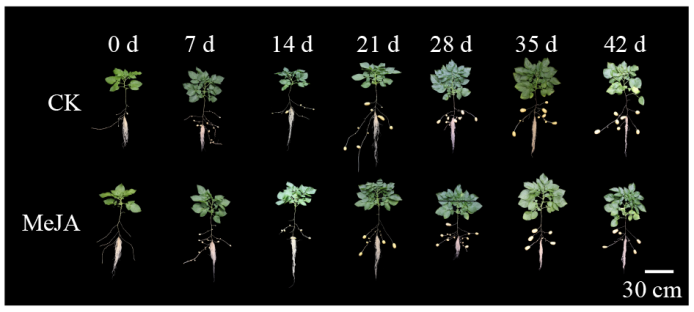
图1
费乌瑞它MeJA处理与对照在不同时期的植株形态
Fig.1
Plant morphological of Favorita at different stages under MeJA and CK treatments
图2
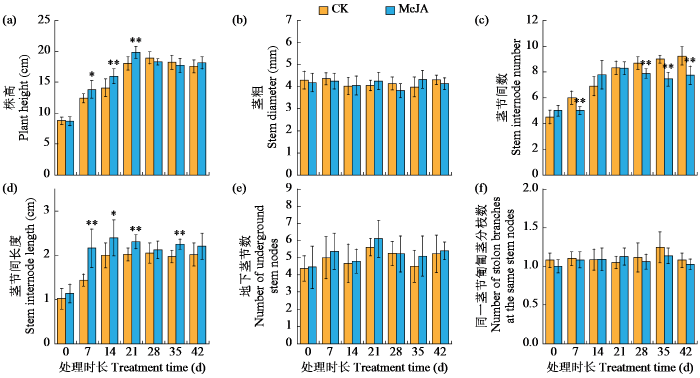
图2
费乌瑞它MeJA处理与对照不同时期田间性状统计
“*”和“**”分别表示在P < 0.05和P < 0.01水平上差异显著。下同。
Fig.2
Field character statistics of Favorita at different stages under MeJA and CK treatments
“*”and“**”represent significance difference at the P < 0.05 and P < 0.01 levels. The same below.
图3
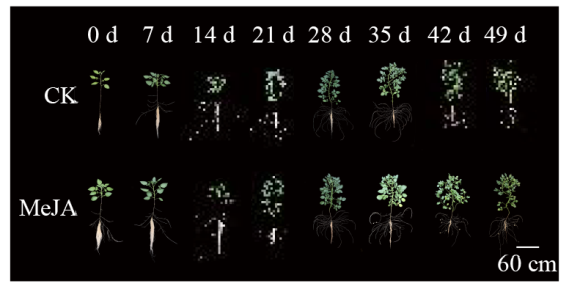
图3
甘农薯7号MeJA处理与对照在不同时期的植株形态
Fig.3
Plant morphological of Gannongshu 7 at different stages under MeJA and CK treatments
图4
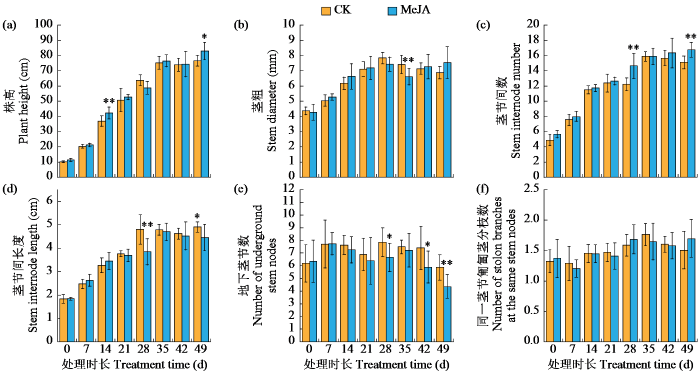
图4
甘农薯7号MeJA处理与对照不同时期田间性状
Fig.4
Field characteristics of Gannongshu 7 at different stages under MeJA and CK treatments
通过分析叶面喷施100 μmol/L MeJA与CK处理对雾培微型薯结薯数和重量的影响,发现费乌瑞它在MeJA处理后单株小薯数和重量分别增加52.70%和28.20%,单株结薯总数增加15.70%,单株小薯数、单株小薯重和单株结薯总数均与CK间存在极显著差异,总重无显著差异(图5)。说明MeJA处理后可增加单株小薯数,从而增加单株结薯总数。甘农薯7号在MeJA处理后单株小薯数和单株小薯重分别增加60.80%和76.90%,单株结薯总数和总重分别增加11.10%和8.10%,单株小薯数、单株小薯重和单株结薯总数均与CK存在极显著差异(图6)。说明MeJA处理可增加单株小薯数和单株小薯重从而增加单株结薯总数和总重。
图5
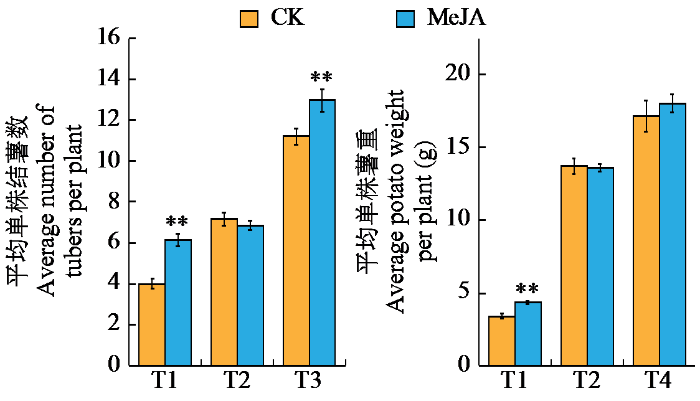
图5
费乌瑞它MeJA处理与对照平均单株结薯数和平均单株薯重
T1:<5 g的微型薯;T2:≥5 g的微型薯;T3:总的微型薯数;T4:总的微型薯重。下同。
Fig.5
Average number of tubers per plant and average potato weight per plant of Favorita under MeJA and CK treatments
T1: Minituber (< 5 g); T2: Minituber (≥ 5 g); T3: Total weight of minitubers; T4: Total number of minitubers. The same below.
图6
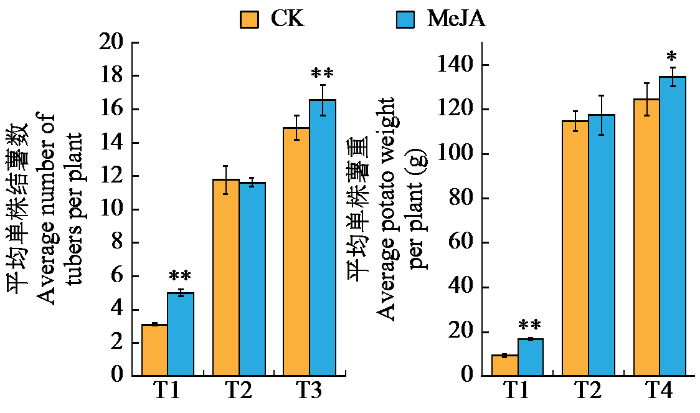
图6
甘农薯7号MeJA处理与对照平均单株结薯数和平均单株薯重
Fig.6
Average number of tubers per plant and average potato weight per plant of Gannongshu 7 under MeJA and CK treatments
2.2 微型薯生理指标变化分析
表1显示,与CK相比,MeJA处理后费乌瑞它微型薯内蔗糖含量极显著降低21.68%,淀粉含量增加2.92%,但无显著差异;甘农薯7号蔗糖含量极显著增加19.33%,淀粉含量增加0.02%,但无显著差异。说明叶面喷施MeJA会降低费乌瑞它微型薯蔗糖含量,增加甘农薯7号微型薯中蔗糖含量,但对2个品种微型薯淀粉含量影响均不显著。
表1 不同品种MeJA处理与对照间微型薯内蔗糖和淀粉含量
Table 1
| 品种 Variety | 处理 Treatment | 蔗糖含量 Sucrose content (mg/g DW) | 淀粉含量 Starch content (% DW) |
|---|---|---|---|
| 费乌瑞它 Favorita | CK | 78.13** | 57.31 |
| MeJA | 61.19** | 58.98 | |
| 甘农薯7号 Gannongshu 7 | CK | 24.55** | 53.11 |
| MeJA | 29.30** | 53.12 |
“**”表示在P < 0.01水平上差异显著。下同。
“**”represents significant difference at the P < 0.01 level. The same below.
2.3 微型薯内源激素含量变化分析
表2显示,与CK相比,MeJA处理后费乌瑞它微型薯内源IAA含量显著增加63.90%,GA3和ABA含量分别增加6.93%和15.85%;甘农薯7号内源IAA含量极显著增加148.00%,GA3含量显著降低19.29%,ABA含量极显著增加56.88%。说明叶面喷施MeJA会增加微型薯内源IAA和ABA含量。
表2 不同品种MeJA处理与对照间内源IAA、GA3、ABA含量
Table 2
| 品种 Variety | 处理 Treatment | 生长素 IAA | 赤霉素 GA3 | 脱落酸 ABA |
|---|---|---|---|---|
| 费乌瑞它 Favorita | CK | 18.38* | 72.92 | 182.53 |
| MeJA | 30.13* | 77.98 | 211.46 | |
| 甘农薯7号 Gannongshu 7 | CK | 31.72** | 82.91* | 104.28** |
| MeJA | 78.66** | 66.92* | 163.59** |
“*”表示在P < 0.05水平上差异显著。
“*”indicates significant difference at the P < 0.05 level.
2.4 MeJA处理下植株性状、微型薯组分与产量性状的相关性分析
图7
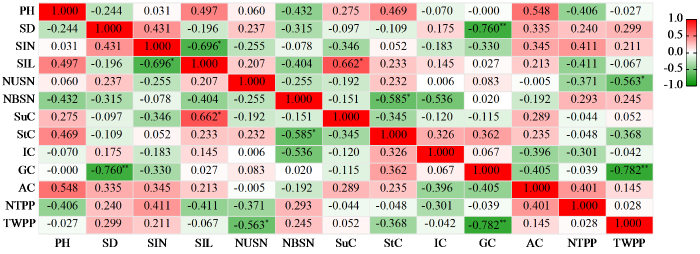
图7
MeJA处理下费乌瑞它植株性状、微型薯品质与产量性状相关性分析
PH:株高,SD:茎粗,SIN:茎节间数,SIL:茎节间长度,NUSN:地下茎节数,NBSN:同一茎节分枝数,SuC:蔗糖含量,StC:淀粉含量,IC:IAA含量,GC:GA3含量,AC:ABA含量,NTPP:单株薯数,TWPP:单株薯重。“*”和“**”分别表示在P < 0.05和P < 0.01水平上相关性显著。下同。
Fig.7
Correlation analysis among plant traits, minituber quality and yield traits of Favorita under MeJA treatment
PH: plant height, SD: stem diameter, SIN: stem internode number, SIL: stem internode length, NUSN: number of underground stem nodes, NBSN: number of branches per stem node, SuC: sucrose content, StC: starch content, IC: IAA content, GC: GA3 content, AC: ABA content, NTPP: number of tubers per plant, TWPP: tuber weight per plant.“*”and“**”indicate significant correlation at P < 0.05 and P < 0.01 levels, respectively. The
same below.
图8
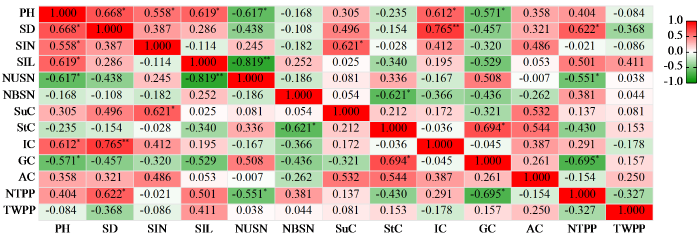
图8
MeJA处理下甘农薯7号植株性状、微型薯品质与产量性状相关性分析
Fig.8
Correlation analysis among plant traits, minituber quality and yield traits of Gannongshu 7 under MeJA treatment
3 讨论
JA类物质可抑制根生长、诱导地下贮藏器官形成和促进植物果实成熟[23]。微型薯生物量、直径及匍匐茎结薯率均随JA浓度升高而显著增加,降低JA浓度会导致微型薯生物量及匍匐茎结薯率均显著降低,说明适宜浓度的JA会促进微型薯产量增加[24]。离体条件下MeJA与微型薯内淀粉积累有关,适宜浓度的MeJA能提高试管薯结薯率,降低微型薯可溶性糖含量,增加淀粉含量[25]。生产实践表明,喷施150 μmol/L MeJA可显著提高微型薯的总薯数[26],叶面喷施100 μmol/L MeJA,马铃薯微型薯的产量增加且不影响生长[19],为保证微型薯结薯数,MeJA浓度应随种植密度的提高而逐渐降低[26]。此外,100 μmol/L MeJA处理可显著改善植株的生长表现(株高、冠幅、鲜重等指标),并增强多种生理代谢反应,且多项生理功能(包括营养供应和抗氧化代谢通路)表现最优,说明该浓度有积极的生长促进效应[27]。根据前期预试验结果,本研究选取100 μmol/L MeJA处理以探究其对微型薯结薯及相关生长、生理响应的影响,该浓度考虑了激素效应的显著性和高浓度可能对植株产生的抑制作用,有助于清晰解析本试验条件下的激素响应机制。
不同马铃薯品种的熟性差异与生长周期、同化物分配模式、微型薯形成节律以及激素调控响应特性密切相关[28],早熟品种与中晚熟品种在微型薯诱导时间、物质积累速度及生理代谢特征方面存在显著差异[29]。本研究选用早熟品种费乌瑞它和中晚熟品种甘农薯7号,旨在探究不同熟性背景下植株对外源MeJA处理的响应差异,评估MeJA调控效应的品种特异性。MeJA处理后株高和茎节间数显著增加,单株小薯数及重量均有显著增加,说明叶面喷施MeJA处理可以通过增加单株小薯数及重量来促进单株产量增加。尽管费乌瑞它在MeJA处理后总产量未表现出显著差异,但其在部分生长和生理指标上的响应仍明显,表明该品种对MeJA的敏感性可能主要体现在生理调节层面,而非最终产量的积累,MeJA的调控效应可能具有品种依赖性,并非对所有品种均表现为产量的提升。MeJA处理极显著降低了费乌瑞它微型薯蔗糖含量,极显著增加了甘农薯7号微型薯蔗糖含量,同时增加了2个品种微型薯淀粉含量,与前人[30]部分研究结果相似。证明叶面喷施MeJA能够促进微型薯形成和发育。
GA3可延长马铃薯结薯期,在诱导微型薯形成时要降低其浓度,进而促进匍匐茎膨大结薯。GA3作用于匍匐茎顶端,调控匍匐茎伸长到微型薯形成过程中碳水化合物的代谢,诱导微型薯形成[31]。将GAs应用于植物叶片时,收获的微型薯比未经处理的微型薯更易打破休眠[32-33]。GA3影响休眠的终止和幼苗生长,可显著降低微型薯休眠时间,促进微型薯发芽[32-
综上所述,叶面喷施100 μmol/L MeJA能在雾培条件下调控微型薯形成及相关生长与生理响应。然而,本研究仅在单一生长季条件下开展,尚未系统评估环境因子的互作效应。未来研究有必要结合多环境及分子水平分析,进一步阐明MeJA介导马铃薯微型薯形成与产量调控的作用机制。
4 结论
叶面喷施MeJA使2个品种株高、单株产量均增加,2个品种微型薯内淀粉含量及内源IAA和ABA含量增加。MeJA处理可促进脱毒组培苗的生长并增加单株结薯数,在中晚熟品种甘农薯7号中增产效果更显著。
参考文献
Potato minituber production using aeroponics: effect of plant density and harvesting intervals
DOI:10.1007/BF02869609 URL [本文引用: 1]
Potential of aeroponics system in the production of quality potato (Solanum tuberosum L.) seed in developing countries
Comparison of aeroponics and conventional potato mini tuber production systems at different plant densities
DOI:10.1007/s11540-020-09463-z [本文引用: 1]
Modern plant cultivation technologies in agriculture under controlled environment: a review on aeroponics
DOI:10.1080/17429145.2018.1472308 URL [本文引用: 1]
Growth and tuberization of hydroponically grown potatoes
DOI:10.1007/s11540-012-9208-7 URL [本文引用: 1]
Physiological growth responses by nutrient interruption in aeroponically grown potatoes
DOI:10.1007/s12230-008-9024-4 URL [本文引用: 1]
Possible involvement of jasmonates in various morphogenic events
DOI:10.1111/ppl.1997.100.issue-3 URL [本文引用: 1]
Methods of pre-basic seed potato production with special reference to aeroponics-a review
DOI:10.1016/j.scienta.2016.03.041 URL [本文引用: 1]
Multiple signaling pathways control tuber induction in potato
DOI:10.1016/j.plaphy.2017.08.009 URL [本文引用: 2]
Effect of magnesium fertilization on the quality of potatoes. Yield, discoloration, phenols, and lipids
DOI:10.1021/jf00104a040 URL [本文引用: 1]
Rentschler and JH Doods. Induction of in vitro potato tubers
Cytokinins antagonize the jasmonates action on the regulation of potato (Solanum tuberosum) tuber formation in vitro
DOI:10.1007/s11240-006-9166-3 URL [本文引用: 2]
Transcriptomic and proteomic analyses of pericycle cells of the maize primary root
Jasmonate effect on in vitro tuberization of potato (Solanum tuberosum L.) cultivars under light and dark conditions
DOI:10.1007/BF02358592 URL [本文引用: 1]
The effects of IAA and tetcyclacis on tuberization in potato (Solanum tuberosum L.) shoot cultures in vitro
DOI:10.1007/s10725-007-9243-6 URL [本文引用: 1]
Exogenous methyl jasmonate diminishes the formation of lipid‐derived compounds in boiled potato (Solanum tuberosum L.)
DOI:10.1002/jsfa.v90:13 URL [本文引用: 1]
Relationship of harvest sucrose content to processing maturity and storage life of potatoes
DOI:10.1007/BF02852074 URL [本文引用: 1]
A starch hydrolysis procedure to estimate glycemic index
DOI:10.1016/S0271-5317(97)00010-9 URL [本文引用: 1]
Quantitative analysis of major plant hormones in crude plant extracts by high-performance liquid chromatography-mass spectrometry
DOI:10.1038/nprot.2010.37
PMID:20448544
[本文引用: 1]

The ability to measure plant hormones quantitatively is important as plant hormones regulate plant growth, development and response to biotic and abiotic cues. In this protocol, we describe the quantitative analysis of major plant hormones from crude plant extracts. Plant hormones are determined using reverse-phase liquid chromatography-tandem mass spectrometry with multiple reaction monitoring. The method provides quantification of most major plant hormones in a single run from 50 mg of fresh plant tissue. Extraction and quantitative analysis of 40 samples takes 2-3 d.
Preharvest treatment of methyl jasmonate and salicylic acid increase the yield, antioxidant activity and GABA content of tomato
DOI:10.3390/agronomy11112293
URL
[本文引用: 1]
This study investigated the effect of preharvest treatment of 0.25 mM methyl jasmonate (MeJA) and 0.5 mM salicylic acid (SA) on quality parameters, most important secondary metabolites (lycopene, β-carotene, ascorbic acid, total phenolics, and flavonoids), antioxidant activities, and amino acid contents of ‘Kumato’ tomato. Treatments with MeJA and SA led to an increase of total yield per plant and were effective in maintaining the fruit quality attributes such as firmness, total soluble solids, titratable acidity, and Brix acid ratio at two maturity stages (S1 and S2). In addition, lycopene, β-carotene, ascorbic acid, total phenolics, and flavonoids were significantly higher in the treated fruit than in the control. Moreover, γ-aminobutyric acid (GABA), essential amino acids, and antioxidant activity increased due to MeJA and SA treatments at both stages, especially with MeJA treatment at S2. Overall results also showed the effectiveness of MeJA treatment than SA on improving the yield and nutritional quality of ‘Kumato’ tomato.
Effects of exogenous methyl jasmonate on metabolism and soil activity in Chrysanthemum morifolium
DOI:10.3390/plants14193026
URL
[本文引用: 1]
Challenges significantly hinder the sustainable cultivation of tea chrysanthemum, leading to imbalances in soil nutrients, the accumulation of allelopathic phenolic acids, reduced enzymatic activity, and disruptions in rhizosphere microbial communities. To explore potential mitigation strategies, this study systematically evaluated the integrative effects of exogenous methyl jasmonate (MeJA, 0–400 (μmol L−1)) on both soil environmental parameters and plant growth performance under continuous cropping conditions. The results revealed that treatment with 100 (μmol L−1) MeJA significantly enhanced plant height, canopy width, flower number, and fresh flower weight. Concurrently, it improved soil organic matter content, the available nitrogen levels, and redox stability while increasing the activity of key enzymes, including polyphenol oxidase, urease, and catalase. Notably, this treatment markedly reduced the accumulation of allelopathic phenolic acids, such as p-hydroxybenzoic acid and vanillic acid. High-throughput sequencing further demonstrated that 100 (μmol L−1) MeJA optimized the composition of soil microbial communities, increasing the abundance of beneficial taxa, such as nitrogen-fixing and phosphate-solubilizing bacteria, while suppressing pathogenic fungi. Metabolomic analysis showed that this concentration of MeJA activated stress-resistance metabolic pathways involving flavonoids and terpenoids while downregulating degradation-related processes, thereby supporting enhanced plant resilience at the metabolic level. Collectively, these findings demonstrate that an appropriate concentration of exogenous MeJA can effectively alleviate continuous cropping obstacles in Chrysanthemum morifolium, providing both theoretical insights and practical guidance for its eco-friendly and efficient cultivation.
Changes in GA 20‐oxidase gene expression strongly affect stem length, tuber induction and tuber yield of potato plants
DOI:10.1046/j.1365-313x.2000.00736.x
URL
[本文引用: 1]
Gene StGA20ox1 encoding potato GA 20‐oxidase is expressed to relatively high levels in leaves and regulated by daylength. To investigate whether this gene is involved in photoperiodic regulation of tuber formation, we have obtained transgenic potato plants expressing sense and antisense copies of the StGA20ox1 cDNA. Over‐expression of this cDNA resulted in taller plants that required a longer duration of a short day photoperiod (SD) to tuberize. Tubers from these plants had a decreased time of dormancy and developed sprouts with elongated internodes. Plants expressing antisense copies of the StGA20ox1 cDNA had shorter stems, a decreased length of the internodes and tuberized earlier than control plants, showing increased tuber yields. Antisense inhibition of this gene had no visible effect on the time of dormancy of the tubers, although at the end of dormancy these formed sprouts with shortened internodes. Decreased levels of endogenous GA 20 and GA 1 were detected in the apex and first leaves of the antisense lines. These results demonstrate the involvement of the GA 20‐oxidase activity encoded by StGA20ox1 in the control of stem elongation and in tuber induction but not in tuber dormancy, indicating that the latter may be regulated by another member of the gene family.\n
Variation in the duration of tuber dormancy within a seed potato lot
DOI:10.1007/BF02357706 URL [本文引用: 2]
Effect of plant growth regulators on the tuberisation and physiological age of potato (Solanum tuberosum L.) tubers grown from true potato seed
DOI:10.4141/P05-227
URL
[本文引用: 1]
The effects of plant growth regulators [6-benzyl amino purine (BA), indole-3-acetic acid (IAA), 2,4-dichlorophenoxyacetic acid (2,4-D), gibberellic acid (GA3), chlormequat chloride (CCC), daminozide] and their time of application on tuberisation and physiological age of cv. Chacasina F1 grown from true potato seed (TPS) were studied in four experiments conducted in spring or autumn in Greece. BA, IAA and 2,4-D did not affect plant development, tuberisation or the physiological age of the tubers produced. Daminozide and CCC reduced plant height when applied 30 but not 60 d after transplanting (DAT) in both spring and autumn. Neither substance affected tuberisation or the physiological age of the tubers formed. Application of GA3 30 DAT significantly increased plant height and the number, but not the weight, of tubers formed per plant. Tubers from GA3-treated plants tended to be elongated with a low dry matter content. When GA3 was applied at 60 DAT, plant height was increased, but tuber number, weight and dry matter content were not affected. Late application of GA3 induced a high percentage of sprouted tubers prior to harvest and significantly increased the physiological age of the tubers, as reflected by an increased rate of respiration, sprouting and weight loss after harvest. Although early application of GA3 also increased tuber sprouting prior to harvest, it had no effect on sprouting, respiration and weight loss after harvest. Application of GA3 early in the vegetative cycle may be useful for the production of mini-tubers for propagation, whereas application at a later stage may aid in early planting by accelerating the breaking of tuber dormancy. Key words: Gibberellin, chlormequat chloride, daminozide, dormancy, tuberisation
Role of endogenous abscisic acid in potato microtuber dormancy
DOI:10.1104/pp.105.3.891
PMID:12232251
[本文引用: 1]
Potato (Solanum tuberosum L. cv Russet Burbank) microtubers generated in vitro from single-node explants contained substantial amounts (approximately 250 pmol/g fresh weight) of free abscisic acid (ABA) and were completely dormant for a minimum of 12 weeks. Microtubers that developed in the presence of 10 [mu]M fluridone (FLD) contained considerably reduced amounts (approximately 5-25 pmol/g fresh weight) of free ABA and exhibited a precocious loss of dormancy. Inclusion of exogenous racemic ABA in the FLD-containing medium suppressed the premature sprouting of these microtubers in a dose-dependent manner. At a concentration of 50 [mu]M, exogenous ABA restored internal ABA levels to control values and completely inhibited FLD-induced precocious sprouting. Exogenous jasmonic acid was ineffective in suppressing FLD-induced sprouting. Application of FLD to preformed, fully dormant microtubers also resulted in a reduction in internal ABA content and precocious sprouting. These results indicate that endogenous ABA is essential for the induction and maintenance of potato microtuber dormancy.
Postharvest changes in endogenous ABA levels and ABA metabolism in relation to dormancy in potato tubers
DOI:10.1111/ppl.1995.95.issue-2 URL [本文引用: 1]
Regulation of potato tuber dormancy and sprouting
DOI:10.1134/S1021443713030023 URL [本文引用: 1]
Hormonal regulation in higher plants: growth and development are regulated by interactions between promotive and inhibitory hormones
Phytohormones: plant switchers in developmental and growth stages in potato
DOI:10.1186/s43141-021-00192-5 URL [本文引用: 1]
马铃薯块茎形成的生理生化基础和分子机制
DOI:10.13560/j.cnki.biotech.bull.1985.2021-0065
[本文引用: 1]
马铃薯(Solanum tuberosum L.)块茎诱导和形成是其生长发育和产量决定最重要的事件,涉及多重环境因素与植物激素及信号分子的互作以及这种互作对大量关键基因及多条信号转导与代谢途径的调控。概述了马铃薯块茎形成的生理生化基础,包括块茎形成的过程及影响块茎形成的内源因素和环境条件;讨论了块茎诱导形成过程中信号转导途径及相关基因、蛋白、miRNAs、激素和第二信使分子等对块茎形成的调节;构建了块茎诱导形成过程中可能的分子互作网络;展望了未来研究的方向和可能的突破点,旨在为将来通过精准分子育种手段来培育高产优质的马铃薯品种提供借鉴和新思路。


