



随着全球气候变暖趋势的加剧,高温热害已逐渐成为作物生长发育的主要限制因子之一[1]。水稻是全世界重要的粮食作物,长江中下游地区是我国重要的水稻主产区,但水稻生长季中绝大多数时间都处于炎热的夏季,逐渐升高的平均气温和时有发生的极端高温天气给水稻的生长发育和产量形成带来了严重的高温胁迫[2]。据统计,全球气温每升高1 ℃,水稻的产量将下降3.2%[3]。近60年来,江西省年平均气温显著上升,累计升温约0.94 ℃,极端高温天气发生频次也显著增加,且持续时间较长[4]。高温天气的开始时间、持续时间、极端最高温度和最大升温幅度是长江中下游地区水稻高温热害的主要影响因子[5]。因此,提高水稻耐热性保证水稻稳产对于维护国家粮食安全意义重大。
目前,减轻水稻高温热害的主要措施有选用耐热性强的水稻品种、调整播期以避开高温天气、调整水肥管理方式以及喷施外源物质等[14]。耐热水稻种质资源的选育是解决作物应对高温热害环境的主要技术途径之一。近年来,国内外学者从生长发育和生理代谢等多方面鉴定并筛选了许多耐热水稻种质资源,例如黄华占、国稻6号、996、扬稻6号、D优527、Ⅱ优7号、赣香糯和渝优1号等[15-16]。其中,黄华占在抽穗期能够忍受日均温度大于35 ℃的高温条件,能够保持较高的花粉育性、结实率和千粒重,减产率明显低于热敏感品种双桂1号[17]。国稻6号在开花及灌浆初期对高温胁迫具有较高的抗性,在40~42 ℃的高温条件下,国稻6号能够提高叶片光合效率,促进茎鞘部位物质积累,并通过调节弱势粒的充实过程提高千粒重,降低减产率[18]。此外,扬稻6号、D优527、Ⅱ优7号和渝优1号等品种在抽穗开花期能够忍受日平均气温大于35 ℃的高温环境,保持较高的结实率[19⇓-21]。抽穗开花期是水稻籽粒形成的关键时期,在抽穗开花期研究不同水稻种质资源生长发育、生理代谢和籽粒形成等过程对高温胁迫的响应机制和差异性,是鉴定水稻耐热性的重要时期和方法,也是耐热水稻品种选育的重要方向。据此,本研究通过在人工气候室中精确控制温度,研究抽穗期高温胁迫对不同水稻品种产量构成、淀粉含量和稻米品质的影响,并利用抗逆系数评价抽穗期高温胁迫对水稻多个生长发育和生理代谢指标的影响程度,为耐热水稻种质资源的筛选和鉴定提供理论基础。
1 材料与方法
1.1 供试材料
供试水稻材料为江西省普遍推广种植的8个水稻品种,分别为黄华占(C1)、虾稻1号(C2)、绣占15(C3)、粤王丝苗(C4)、Y两优1577(C5)、湘两优900(C6)、泰优390(C7)和湘两优2号(C8)。其中C1~C4为常规籼稻品种;C5~C8为杂交籼稻品种,均由江西省高等学校硒农业工程技术研究中心提供。各品种生育期见表1。
表1 不同水稻品种的生育期
Table 1
| 品种 Variety | 生育期 Growth period | 品种 Variety | 生育期 Growth period | |
|---|---|---|---|---|
| C1 | 136 | C5 | 136 | |
| C2 | 122 | C6 | 139 | |
| C3 | 122 | C7 | 121 | |
| C4 | 121 | C8 | 139 |
1.2 试验设计
试验于2021年5-9月在宜春学院现代农业研究所和江西省高等学校硒农业工程技术研究中心实验室进行,水稻前期的培养在宜春学院现代农业研究所采用盆栽方式进行,高温处理在江西省高等学校硒农业工程技术研究中心的人工气候室进行。5月1日播种,供试水稻品种的种子用0.1%(V/V)的HgCl2充分消毒10 min,然后用蒸馏水冲洗5次,于30 ℃恒温箱中浸种48 h,去掉多余水分,保持湿润状态于培养皿中催芽24 h。选取出芽一致的种子播种于装有草炭土(有机质30.91 g/kg、全氮2.3 g/kg、速效磷20.56 mg/kg、速效钾142.39 mg/kg)的黑色育苗杯中进行育秧,育秧25 d后移栽。选择均匀一致的壮苗移栽至桶中,桶高28 cm、内径25 cm,塑料桶内装有稻田土,采自宜春学院现代农业研究所水稻田(有机质26.32 g/kg、全氮1.93 g/kg、速效磷15.25 mg/kg、速效钾106.85 mg/kg),土壤经粉碎、过筛、风干并混匀装入桶中,每桶装土10 kg,秧苗移栽前施底肥3.5 g,底肥为复合肥(含N、P、K各15%)。秧苗移栽时每桶2穴,每穴3苗。移栽后于自然条件下培养,全生育期保持浅水层,严格防控病虫害。
各供试水稻品种培养至孕穗期,调查水稻的抽穗情况,以穗顶露出剑叶叶枕1 cm为标准记为抽穗,记录各品种的始穗期(群体抽穗达10%)和齐穗期(群体抽穗达80%)。参照前期[8]试验方法,每个品种在始穗期将水稻分别移入高温环境(HS)和对照环境(CK),在人工气候室中进行高温处理。人工气候室采用远红外热风机(额定功率2000 W)和自动控温系统调节温室,白色LED灯管提供光照。根据前人[22-23]对江西省水稻高温热害的研究,在每天9:00-16:00设置38 ℃的高温胁迫,其他时间设置为32 ℃。对照组环境设置为白天(7:00-19:00)32 ℃,夜晚(19:00-7:00)26 ℃,温度上下波动约0.5 ℃。相对湿度设置为80%,光照时间均为12 h光/12 h暗,光照强度为450 µmol/(m2‧s),每天早上9:00和下午16:00开门通风10 min。处理8 d后移出,置于自然环境中培养至成熟,每个处理3次重复,每个重复种植2盆。成熟后采集水稻植株进行考种,收集籽粒用于品质指标的测定。
1.3 测定项目与方法
1.3.1 产量结构
收获期将水稻植株于根部剪断,自然风干后测定每穴的有效穗数,将所有穗剪下后随机选取10个穗测定穗长、穗重。将穗脱粒、去杂质(不去空秕粒),分为实粒和瘪粒,测定每穴的实粒数、秕粒数、实粒重和秕粒重,计算总粒数、总粒重、每穗总颖花数、结实率、千粒重、收获指数和产量。收获指数(%)=总粒重/(总粒重+茎秆干重)×100,每穴产量(g/穴)=(穗数×穗粒数×结实率×千粒重)/100 000。
1.3.2 籽粒生理指标
1.3.3 籽粒品质
稻谷置于室温风干后,按照GB/T 17891-2017[25]测定稻米的出糙率、精米率、整精米率、垩白粒率和垩白度。
1.4 数据处理
计算各水稻品种不同指标在高温胁迫下的抗逆系数,抗逆系数=胁迫处理测定值/对照测定值。采用Excel 2016软件进行数据的统计和分析,采用Origin 2016软件进行绘图,利用SPSS 21.0软件进行数据的显著性差异分析和相关性分析,显著性差异水平为P<0.05。
2 结果与分析
2.1 高温胁迫对不同水稻品种抽穗时间的影响
由表2可知,水稻在抽穗期遭遇高温胁迫会导致抽穗时间缩短,不同水稻品种的抽穗期缩短1~3 d。高温胁迫下,供试水稻品种中C1、C3和C7的抽穗期缩短1 d,C2、C4和C5的缩短2 d,C8的缩短3 d,C6的没有缩短。
表2 不同水稻品种的抽穗期
Table 2
| 品种 Variety | 始穗期 Initial heading stage | 齐穗期Full heading stage | |
|---|---|---|---|
| 对照CK | 高温HS | ||
| C1 | 07-23 | 08-01 | 07-31 |
| C2 | 07-14 | 07-22 | 07-20 |
| C3 | 07-15 | 07-24 | 07-23 |
| C4 | 07-13 | 07-22 | 07-20 |
| C5 | 07-25 | 08-04 | 08-02 |
| C6 | 07-26 | 08-04 | 08-04 |
| C7 | 07-13 | 07-21 | 07-20 |
| C8 | 07-25 | 08-04 | 08-01 |
2.2 抽穗期高温胁迫对不同水稻品种穗部发育和产量构成的影响
由图1可知,抽穗期高温胁迫对水稻穗部发育指标影响明显。高温胁迫下,供试水稻品种中除C1外,其他品种的穗长较对照均显著或极显著下降(图1a);所有供试水稻品种的穗重较对照均显著或极显著下降,抽穗期高温胁迫导致水稻的穗重分别下降了18.85%~31.12%(图1b)。其中,穗重下降幅度较大的是C4和C8,较小的是C1和C6。抽穗期高温胁迫对水稻穗数影响较小,供试水稻品种中仅C8达显著差异水平(图1c)。高温胁迫下,水稻的穗粒数在品种间存在差异性,供试水稻品种中C2、C3、C4和C8的穗粒数较对照显著下降,其他品种较对照差异不显著(图1d)。抽穗期高温胁迫对水稻结实率和千粒重影响明显,所有供试水稻品种的结实率和千粒重较对照均显著或极显著下降(图1e和1f)。抽穗期高温胁迫导致水稻的结实率和千粒重分别下降了4.55%~11.49%和4.60%~20.49%。
图1
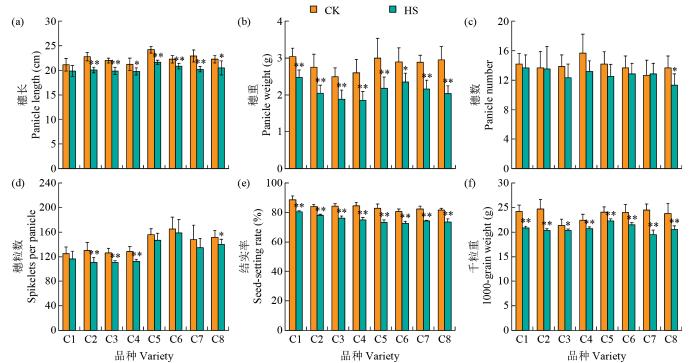
图1
抽穗期高温胁迫下不同水稻品种穗部生长指标和产量构成的差异
“*”和“**”分别表示同一品种的不同处理在0.05和0.01水平上差异显著,下同。
Fig.1
Differences of panicle growth and yield components of different rice varieties under heat stress during heading stage
“*”and“**”indicate significant differences at P < 0.05 and P < 0.01 levels between different treatments in the same rice variety, respectively, the same below.
2.3 抽穗期高温胁迫对不同水稻品种产量和收获指数的影响
图2
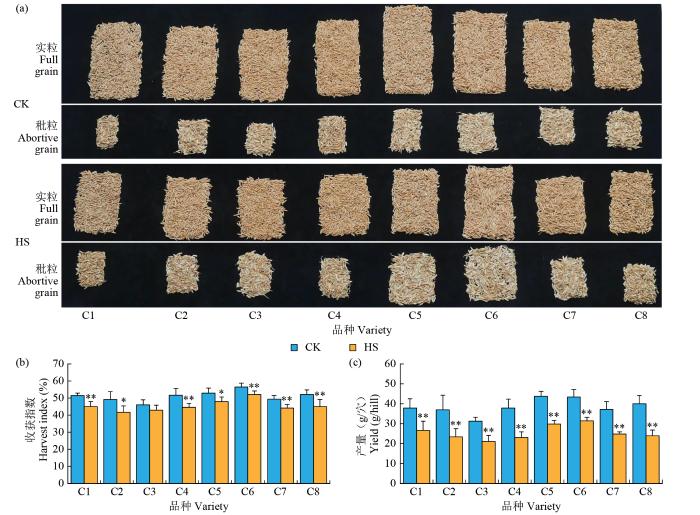
图2
抽穗期高温胁迫对不同水稻品种产量的影响
Fig.2
Effects of heat stress on yields in different rice varieties during heading stage
2.4 抽穗期高温胁迫对水稻籽粒淀粉和糖类物质含量的影响
图3
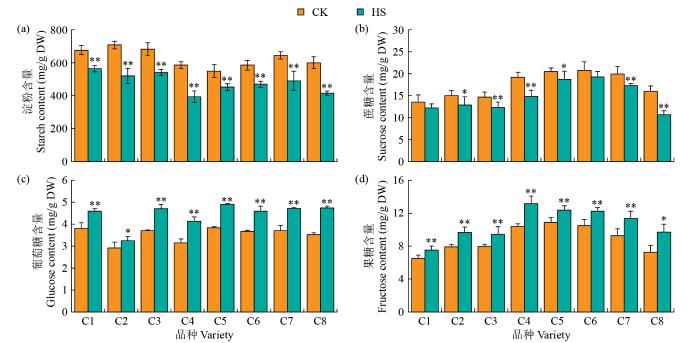
图3
抽穗期高温胁迫对不同水稻品种籽粒淀粉和糖类物质含量的影响
Fig.3
Effects of heat stress on starch and sucrose contents in different rice varieties during heading stage
2.5 抽穗期高温胁迫对不同水稻品种稻米外观和加工品质的影响
由表3可知,抽穗期高温胁迫导致水稻糙米率、精米率和整精米率下降,垩白粒率和垩白度上升。水稻籽粒的糙米率下降了7.84%~13.90%,精米率下降了6.56%~11.81%,整精米率下降了7.56%~ 11.88%,垩白粒率增加了18.81%~38.05%,垩白度增加了14.97%~34.43%。高温胁迫下,供试水稻品种的糙米率和整精米率较对照均显著下降(P<0.05),垩白粒率和垩白度较对照均显著增加(P<0.05)。高温胁迫下,仅C7的整精米率较对照差异不显著(P>0.05),其他水稻品种的整精米率较对照均显著下降(P<0.05)。高温胁迫下,常规品种的糙米率、精米率和整精米率较对照的平均下降幅度以及垩白粒数和垩白度较对照的平均增加幅度高于杂交品种,品种C1的糙米率、精米率和整精米率较对照的下降幅度较小。
表3 抽穗期高温胁迫对不同水稻品种稻米外观和加工品质的影响
Table 3
| 品种 Variety | 糙米率 Brown rice rate | 精米率 Milled rice rate | 整精米率 Head rice rate | 垩白粒率 Chalky kernel rate | 垩白度 Chalkiness | |||||||||
|---|---|---|---|---|---|---|---|---|---|---|---|---|---|---|
| 对照CK | 高温HS | 对照CK | 高温HS | 对照CK | 高温HS | 对照CK | 高温HS | 对照CK | 高温HS | |||||
| C1 | 77.88±3.66 | 71.47±3.49* | 72.37±2.31 | 67.62±2.35** | 68.13±5.55 | 62.63±2.18* | 8.48±1.25 | 10.37±0.63** | 3.78±0.56 | 4.80±0.51** | ||||
| C2 | 74.35±3.34 | 64.02±2.63** | 64.33±3.07 | 57.50±3.08** | 57.82±3.02 | 51.90±1.19** | 14.87±1.79 | 18.20±1.32** | 5.10±0.63 | 6.47±0.22** | ||||
| C3 | 78.98±3.28 | 70.98±2.69** | 71.20±2.95 | 63.07±1.75** | 63.95±1.98 | 56.35±2.16** | 12.38±2.00 | 15.87±0.48** | 4.03±0.61 | 5.32±0.23** | ||||
| C4 | 72.08±1.16 | 62.35±1.79** | 66.47±3.36 | 58.62±2.04** | 58.80±1.96 | 52.05±1.71** | 15.90±1.60 | 20.78±1.24** | 5.82±0.52 | 7.80±0.33** | ||||
| C5 | 70.78±3.99 | 65.23±2.92* | 70.68±3.10 | 64.20±1.48** | 64.63±2.99 | 59.75±3.39* | 13.18±2.04 | 16.28±0.99** | 5.15±1.10 | 6.20±0.44* | ||||
| C6 | 71.12±3.88 | 64.80±4.00* | 69.65±4.94 | 63.12±1.48* | 65.30±2.89 | 58.85±1.80** | 10.47±1.07 | 13.03±0.54** | 4.17±0.77 | 5.03±0.22* | ||||
| C7 | 76.10±4.18 | 69.95±3.08* | 68.33±5.50 | 62.70±2.70* | 59.28±5.83 | 54.30±1.51 | 17.72±1.86 | 21.05±1.26** | 8.02±0.79 | 9.22±0.46** | ||||
| C8 | 78.57±3.37 | 71.27±1.90** | 69.78±5.07 | 63.78±1.99* | 62.57±1.94 | 56.50±1.76** | 17.92±1.68 | 24.73±1.43** | 8.08±0.39 | 10.87±0.56** | ||||
“*”和“**”分别表示同一品种的不同处理间在0.05和0.01水平上差异显著。
“*”and“**”indicate the significant differences at 0.05 and 0.01 levels between different treatments in the same rice variety, respectively.
2.6 抽穗期高温胁迫下不同水稻品种各指标的抗逆系数
由图4可知,抽穗期高温胁迫对水稻产量构成指标的影响程度具有差异性,对产量、穗重和千粒重的影响较大,对穗数和穗长影响较小。其中,千粒重的抗逆系数在不同品种间差异显著(P<0.05),其他指标在不同品种间差异不显著。抽穗期高温胁迫下,不同水稻品种淀粉、蔗糖、葡萄糖和果糖含量的抗逆系数差异显著(P<0.05);不同水稻品种的籽粒糙米率、精米率、整精米率、垩白粒率和垩白度的抗逆系数在不同水稻品种间差异不显著(P>0.05)。从各品种抗逆系数的平均值来看,高温胁迫下呈下降趋势的指标的抗逆系数表现为C1>C6>C5>C7>C3>C2>C4>C8,与产量的结果一致,且C8和C4的葡萄糖、果糖、垩白粒率和垩白度的抗逆系数也较高。
图4
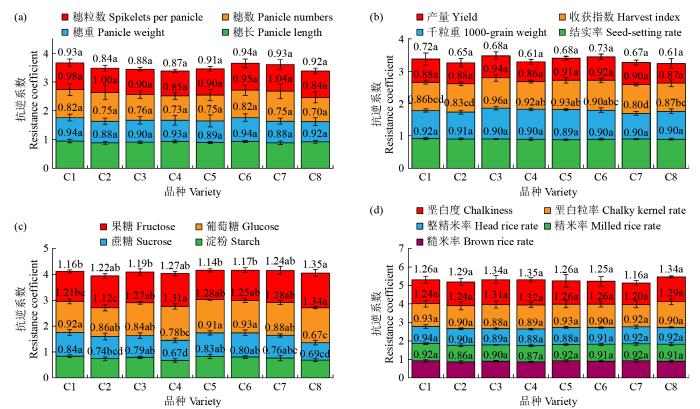
图4
抽穗期高温胁迫下不同水稻品种各指标的抗逆系数
不同小写字母表示不同品种间在0.05水平上差异显著。
Fig.4
The resistance coefficient of each index in different rice varieties under heat stress during heading stage
Different small letters indicate significant differences between different rice varieties at 0.05 level.
3 讨论
生殖生长阶段是水稻对高温胁迫最敏感的时期,此时的高温胁迫会影响水稻拔节孕穗,抑制水稻幼穗发育,降低结实率,并通过影响淀粉合成降低千粒重,最终导致产量和品质下降[8,10]。抽穗开花期高温胁迫是造成水稻减产的关键,此时高温胁迫会影响水稻花粉活性、降低花粉粒数、影响减数分裂进程,并影响籽粒灌浆,导致结实率严重下降[9,26⇓-28]。本研究结果表明,抽穗期高温胁迫影响水稻抽穗进程,导致抽穗时间缩短,穗长和穗重均显著下降,这可能是因为高温胁迫降低叶绿素含量,影响光合作用,抑制光合产物从叶片向穗部运输,导致穗部器官发育因能量和有机物质供给不足而发育缓慢,与前人[29-30]研究结果基本一致。同时,抽穗期高温胁迫导致所有供试水稻品种的结实率、千粒重和产量均显著下降,长时间的高温胁迫可导致水稻产量下降,最高达40%,进一步验证了前人[8,31]的研究结果。不同水稻品种的穗数和穗粒数在高温胁迫下的下降幅度不一致,这与不同品种对高温胁迫响应机制的差异性有关[32-33]。此外,抽穗期高温胁迫影响了稻米品质,淀粉含量下降,蔗糖、葡萄糖和果糖含量增加,稻米外观和加工品质下降,这与前人[34-35]研究结果基本一致。以上研究结果表明,抽穗期高温胁迫通过影响水稻抽穗开花的多个生理代谢过程降低其结实率,通过影响籽粒灌浆进程降低千粒重,影响产量和稻米品质。探索高温对水稻抽穗开花期的伤害机制以进一步挖掘抽穗开花期耐热强且稳定的水稻品种资源是缓解热害的有效措施。
高温胁迫对水稻的伤害因不同品种而异,不同类型水稻品种在不同生育期对高温胁迫的生长和生理响应不一致[2]。粳稻品种Nipponbare的幼苗在45 ℃条件下72 h即表现为叶片全部枯萎,而耐热籼稻品种HT54在48 ℃条件下能够存活79 h[36]。抽穗开花期高温胁迫导致耐热水稻品种N22柱头上的花粉粒下降了55%,粳稻品种Moroberekan下降了85%,对籼稻品种IR64花粉粒的影响较小;抽穗开花期高温胁迫下水稻品种Moroberekan、IR64和N22的结实率分别为18%、48%和72%[37]。抽穗结实期高温胁迫下,耐热水稻品种能够保持良好的灌浆速率,降低高温对粒重的影响来保持产量稳定[38-39]。本试验中,高温胁迫下,不同水稻品种的产量均显著下降,但品种间存在差异性,产量损失较小的品种有湘两优900和黄华占,较大的品种有粤王丝苗和湘两优2号,进一步说明选择耐热性强的水稻品种在高温环境下水稻高产栽培技术中的重要优势。从生长发育状况来看,产量损失最小的品种湘两优900在抽穗期高温胁迫下的抽穗时间没有缩短,而产量损失最大的品种湘两优2号抽穗时间缩短了3d,说明高温胁迫对抽穗进程的影响与后期的产量形成密切相关,保证高温胁迫下水稻完整的抽穗进程是水稻高产稳产的关键环节。因此,调整播期以使水稻在抽穗期避开高温胁迫在田间生产中根据地域情况予以广泛推广[7]。从穗发育状况来看,产量损失较大的品种湘两优2号,其穗部生长发育指标受高温胁迫影响较大,而产量损失较小的品种湘两优900的穗重下降幅度较小,说明高温胁迫通过一系列途径抑制抽穗期水稻的穗部生长发育,高温胁迫下不同水稻品种穗部生长发育指标的差异性可能与高温胁迫影响稻穗碳氮代谢、酶活性、激素水平和基因表达有关[40],其影响机制有待于进一步探究。水稻的最终产量与穗数、穗粒数、结实率和千粒重等产量构成息息相关[41],本试验中,产量损失较大的品种粤王丝苗和湘两优2号的产量构成指标下降幅度较大,产量、穗重和千粒重等指标的抗逆系数较小,说明其受高温胁迫的影响较大。所有品种的结实率和千粒重均显著下降,抗逆系数在品种间无显著差异,说明结实率和千粒重下降是抽穗期高温胁迫导致水稻减产的共同因素。
高温胁迫通过影响光合作用、酶活性和基因表达水平等多种途径影响淀粉合成和氮代谢过程,进而影响直链和支链淀粉含量以及籽粒中碳水化合物含量,最终影响稻米食味品质[12,42]。水稻在抽穗结实期遭遇高温胁迫将明显影响稻米品质,直链淀粉含量升高[34]或下降[43],糙米率和精米率下降,垩白度增加[44]。本研究结果表明,抽穗期高温胁迫导致籽粒总淀粉和蔗糖含量下降,葡萄糖和果糖含量增加,说明抽穗期高温胁迫影响了水稻籽粒中的蔗糖转运和分解过程,蔗糖含量下降的结果可能是由于高温胁迫影响此时期的光合作用,抑制光合产物向籽粒的转运效率[31]。水稻籽粒中的葡萄糖和果糖含量在高温胁迫下显著升高,这主要与高温胁迫影响淀粉合成酶活性,抑制葡萄糖向淀粉转化有关[45]。供试品种中,产量损失较大的品种粤王丝苗和湘两优2号淀粉和蔗糖含量的抗逆系数较小,这与前面穗重和千粒重的结果一致,说明热敏感品种籽粒淀粉形成过程受高温胁迫影响更大,更加剧了产量损失。同时,抽穗期高温胁迫导致所有供试水稻品种的糙米率、精米率和整精米率明显下降,常规籼稻品种的下降幅度高于杂交籼稻品种。黄华占属耐热水稻品种,其在高温胁迫下能够保持较高的结实率,本试验中,黄华占在高温胁迫下的产量损失较小,糙米率、精米率、整精米率、垩白粒率和垩白度下降幅度也较小。然而,产量损失较大的2个品种粤王丝苗和湘两优2号,其籽粒垩白粒率和垩白度受高温胁迫影响较大。以上结果表明,抽穗期高温胁迫对水稻籽粒外观和碾磨品质的影响与产量构成具有一定的协同性,这可能与高温胁迫影响了齐穗期至灌浆初期水稻籽粒内淀粉形成初期的酶活性和编码基因的表达有关[14]。未来研究中可利用不同稻米品质特性的水稻资源为材料深入探究灌浆期高温胁迫下水稻籽粒内蔗糖的转运和分解、淀粉合成和降解等代谢过程的生理及分子机制。本试验中,粤王丝苗和湘两优2号的综合抗逆系数与产量损失具有高度一致性,说明高温胁迫对水稻生长发育、产量和稻米品质的影响具有高度协同性,耐高温水稻品种的选育应综合考虑产量、食味品质和外观品质等多个指标,培育产量损失较小且品质优良的水稻品种。
4 结论
抽穗期高温胁迫缩短水稻抽穗期,降低穗长、穗重和结实率,影响葡萄糖向淀粉转化,降低千粒重,导致水稻减产。抽穗期高温胁迫对水稻产量构成和稻米品质的影响具有一致性,黄华占和湘两优900能够保持较高的产量和品质,是抽穗期耐热性强的水稻品种,粤王丝苗和湘两优2号在抽穗期对高温胁迫较敏感。
参考文献
Temperature increase reduces global yields of major crops in four independent estimates
The impact of high-temperature stress on rice: challenges and solutions
DOI:10.1016/j.cj.2021.02.011 URL [本文引用: 3]
Molecular and genetic bases of heat stress responses in crop plants and breeding for increased resilience and productivity
DOI:10.1093/jxb/eraa034
PMID:31970395
[本文引用: 1]

To ensure the food security of future generations and to address the challenge of the 'no hunger zone' proposed by the FAO (Food and Agriculture Organization), crop production must be doubled by 2050, but environmental stresses are counteracting this goal. Heat stress in particular is affecting agricultural crops more frequently and more severely. Since the discovery of the physiological, molecular, and genetic bases of heat stress responses, cultivated plants have become the subject of intense research on how they may avoid or tolerate heat stress by either using natural genetic variation or creating new variation with DNA technologies, mutational breeding, or genome editing. This review reports current understanding of the genetic and molecular bases of heat stress in crops together with recent approaches to creating heat-tolerant varieties. Research is close to a breakthrough of global relevance, breeding plants fitter to face the biggest challenge of our time.© The Author(s) 2020. Published by Oxford University Press on behalf of the Society for Experimental Biology.
江西早稻高温热害等级动态判识及时空变化特征
DOI:10.13287/j.1001-9332.202001.017
[本文引用: 1]
构建考虑高温天气过程(包括发生时间、持续日数)的水稻高温热害指标,可以实现对水稻高温热害等级的动态判识,对精准监测、预警与评估水稻高温热害意义重大。以江西早稻为对象,利用气象资料、早稻高温热害灾情史料和生育期资料,反演历史早稻高温热害,采用K-S分布拟合检验和置信区间方法,构建基于高温天气过程的早稻高温热害动态指标,并采用预留的独立的早稻高温热害样本进行检验验证。在此基础上,计算江西各站点早稻高温热害指数(M),并分析水稻热害。结果表明: 高温天气过程起始时间、持续日数是影响早稻高温热害发生程度的关键因子,其中,起始时间的影响大于持续日数。3~5 d早稻轻、中、重度高温热害的起始时间阈值分别为抽穗后第10~12、5~9、2~4天;6~8 d早稻轻、中、重度高温热害的起始时间阈值为抽穗后第11~18、8~10和1~7天;>8 d早稻轻、中、重度高温热害的起始时间阈值为抽穗后第12~18、8~11和0~7天。指标验证完全一致的吻合率为73.7%,完全一致及相差1级的吻合率为89.5%。1981—2015年,M的线性倾向率为0.04·a<sup>-1</sup>,1999年左右发生由低到高突变;M高值区域主要位于江西中部和东北部,M>0.18;江西中部、东北部和南部地区M值呈显著增加趋势,线性倾向率均大于0.04·a<sup>-1</sup>。总体来说,本文构建的指标实现了基于高温天气过程的早稻高温热害动态判识,江西中部和东北部是早稻高温热害的高风险区域。
水稻产量对生殖生长阶段不同时期高温的响应差异
DOI:10.16819/j.1001-7216.2021.0203
[本文引用: 2]
【目的】研究水稻产量对不同时期不同类型高温的响应差异,为耐热水稻品种的筛选与培育提供依据。【方法】在桶栽条件下,于人工气候室内,以耐热水稻品种Nagina 22、汕优63和热敏感品种两优培九为材料,设置三个处理时期,即穗分化期、开花期和灌浆期;四种处理温度,即白天高温、夜间高温、全天高温和适宜温度,研究水稻产量和产量构成因子对不同时期高温的响应。【结果】汕优63在三个时期均表现出较强的耐热性;Nagina 22在花期和灌浆期对高温耐性较强,但易受穗分化期高温影响;两优培九对不同时期高温均较敏感。汕优63在不同时期高温下均表现出稳定的伤流强度,而高温敏感品种两优培九的伤流强度受高温影响均显著下降。【结论】水稻对不同时期的高温耐性并不具有相关性,筛选或培育耐热品种时应考虑其对不同时期高温的综合耐受性。
脱落酸对水稻抽穗开花期耐高温胁迫的诱抗效应
DOI:10.11983/CBB22022
[本文引用: 4]
为探究脱落酸(ABA)对水稻(Oryza sativa)抽穗开花期高温胁迫的诱抗效应, 以江西省主推水稻品种黄华占为材料, 于孕穗期用蒸馏水、ABA溶液(10、50和100 µmol∙L<sup>-1</sup>)、氟啶酮(FLU)和原花青素(PC) 6种溶液进行叶面喷施, 然后移入对照(CK)和高温胁迫(HS)环境处理8天, 考查籽粒活性氧(ROS)积累、抗氧化防御能力、产量构成及相关基因的表达。结果表明, 高温胁迫下, 水稻的穗长、穗重、结实率、千粒重和产量与超氧阴离子和过氧化氢含量呈显著负相关。高温胁迫下, 喷施ABA显著上调了ABA应答和抗氧化防御基因的表达, 籽粒中活性氧含量下降了8.24%-31.35%; 喷施ABA显著增加了水稻的穗长、穗重、结实率和千粒重, 显著上调了产量形成基因的表达, 增产12.73%-20.77%。高温胁迫下, 喷施FLU可抑制ABA的生物合成, 导致ROS过量积累和水稻减产; 喷施抗氧化剂PC则抑制ROS过量积累, 使产量增加。以上结果表明, 高温胁迫下, 孕穗期喷施ABA不仅能够激发ABA信号通路, 而且上调抗氧化防御能力和产量形成基因的表达, 进而提高水稻在抽穗开花期的耐热性, 达到增产目的。
Research progress on heat stress of rice at flowering stage
DOI:10.1016/j.rsci.2018.06.009
[本文引用: 2]
Global warming has caused frequent occurrence of heat stress at the flowering stage of single-season rice in the Yangtze River region of China, which results in declines of spikelet fertility and yield in rice. Rice flowering stage is the most sensitive period to high temperatures, and therefore, the key for heat stress happening is the flowering stage coinciding with high temperature, which causes spikelet fertility decreasing in heat-sensitive varieties, and is the major factor for heat injury differences among various rice planting regions. With the development of rice breeding, temperature indexes for heat stress has been converted from daily maximum temperature of 35 ºC to 38 ºC with the stress duration of more than 3 d. During the flowering stage, anther dehiscence inhibition and low pollen shedding onto the stigma are two main reasons for spikelet fertility reduction under high temperatures. At panicle initiation stage, high temperatures aggravate spikelet degeneration, and destroy floral organ development. Various types of rice varieties coexist in production, and indica-japonica hybrid rice demonstrates the highest heat resistance in general, followed by indica and japonica rice varieties. In production, avoiding high temperature is the main strategy of preventing heat stress, and planting suitable cultivars and adjustment of sowing date are the most effective measures. Irrigation is an effective real-time cultivation measure to decline the canopy temperature during the rice flowering stage. We suggested that further study should be focused on exploring heat injury differences among different rice variety types, and innovating rice-planting methods according to planting system changes in rice planting regions with extreme heat stress. Meanwhile, high temperature monitor and warning systems should be improved to achieve optimal heat stress management efficiencies.
Heat stress-reduced kernel weight in rice at anthesis is associated with impaired source-sink relationship and sugars allocation
DOI:10.1016/j.envexpbot.2018.08.021 URL [本文引用: 1]
齐穗至乳熟期不同温度对水稻南粳9108籽粒激素含量、淀粉积累及其合成关键酶活性的影响
DOI:10.16819/j.1001-7216.2019.8077
[本文引用: 3]
【目的】为了明确灌浆结实前中期不同温度对晚粳稻籽粒灌浆、总淀粉及其组分含量的影响特征及其机理,【方法】以优质食味粳稻南粳9108为材料,利用植物培养箱控温,于水稻灌浆结实期设置高温(HT,日均温度31℃)、中温(MT,日均温度26℃)和低温(LT,日均温度21℃)三个处理,以自然温度为对照(CK),研究灌浆结实前中期持续高低温对晚粳稻籽粒灌浆、内源激素含量、淀粉及其及合成关键酶活性的影响。【结果】随温度上升(21℃~31℃),晚粳稻结实率和千粒重降低;灌浆前中期籽粒总淀粉积累速率加快,但持续时间短,总含量降低,而直链淀粉含量及其所占比例在整个灌浆期均呈降低趋势;灌浆前中期脱落酸(ABA)含量显著增加,赤霉素(GA<sub>3</sub>)含量降低,玉米素核苷(ZR)含量呈“先增先降”趋势;MT处理有利于提高灌浆结实期籽粒生长素(IAA)含量,HT和LT处理均降低籽粒IAA含量,LT处理下,IAA含量先降后升,而HT处理籽粒IAA含量一直处于较低水平;籽粒可溶性淀粉合成酶(SSS)活性与ZR变化规律相似,也呈“先增先降”趋势,但二者在灌浆结实期并不同步;淀粉分支酶(SBE)活性增加而淀粉脱分支酶(DBE)活性降低。【结论】不同温度显著影响晚粳稻籽粒内源激素含量和淀粉合成关键酶活性的变化,进而影响晚粳稻籽粒灌浆、总淀粉及其组分的积累。
Neglecting rice milling yield and quality underestimates economic losses from high-temperature stress
DOI:10.1371/journal.pone.0072157 URL [本文引用: 1]
高温和干旱对水稻的影响及其机制的研究进展
DOI:10.16819/j.1001-7216.2019.8106
[本文引用: 2]
高温和干旱是影响水稻生长、发育、产量和品质的两个最重要的环境因子,全面理解高温和干旱胁迫对评价气候变化对水稻生产的影响至关重要。概述了高温、干旱及其复合胁迫对水稻生长发育、产量形成和稻米品质的影响;从光合作用、抗氧化系统、内源激素、蔗糖-淀粉代谢途径关键酶活性、分子机制等方面阐述其生理机制;提出减轻水稻高温干旱胁迫的调控措施;对未来深入开展水稻高温干旱逆境的研究提出建议。
水稻高温热害的研究现状与进展
DOI:10.13287/j.1001-9332.202008.027
[本文引用: 1]
全球气候变暖环境下,水稻高温热害频发,孕穗-开花期和灌浆期高温已成为制约水稻产量和品质的主要因素之一。本文综述了水稻高温热害的发生特点(鉴定与分级、区域和时间)和高温对水稻生长发育(生理、产量和品质)的影响,总结了水稻高温热害的数量性状座位定位、转录组和蛋白质组分析等分子生物学研究及监测预警与风险评估,重点阐述了高温热害的防御措施,包括选用耐热品种、改善田间管理和喷施外源物质,并对今后水稻高温热害研究进行了展望,以期为水稻高温热害防御和农业减灾增效提供科学支持。
开花和灌浆初期高温胁迫对国稻6号结实的生理影响
DOI:10.3724/SP.J.1006.2009.00110
[本文引用: 1]
为研究杂交稻对开花结实期高温胁迫的生理生态适应性,选用具代表性的主栽杂交稻组合国稻6号、协优46,人工设计极值高温40~42℃,自始穗期至此后15 d每天6 h行热害处理,以自然气候条件为对照,比较研究高温胁迫对国稻6号与协优46结实的生理影响。结果表明,国稻6号具较高的受孕小穗成粒效应,即不仅不孕小穗率低,而且秕谷率也低。国稻6号对开花结实期高温较协优46钝感,两者在小穗育性和热害指数上的差异达到显著水平(P<0.05)。究其生理原因, (1)成熟期间稻株剑叶光能转化效率及光合效率较高,茎鞘储藏物质较丰;(2)成熟期间稻株仍具较强根系吸水能力与叶片蒸腾水平,维持蒸腾流利于光合物质运输;(3)成熟灌浆期稻株自动调节粒间顶端优势,增进迟开花的弱势粒充实成实粒。
Relationship of ROS accumulation and superoxide dismutase isozymes in developing anther with floret fertility of rice under heat stress
DOI:S0981-9428(17)30372-8
PMID:29202329
[本文引用: 1]
High temperature (HT) at meiosis stage is one of most important environment constraint affecting spikelet fertility and rice yield. In this paper, the effects of HT exposure at meiosis stage on the ROS (reactive oxygen species) accumulation, various superoxide dismutase (SOD, EC1.15.1.11) isozymes in developing anther, and its relationship with HT-induced decline in pollen viability and floret fertility were investigated by using four rice cultivars differing in heat tolerance under well-controlled climatic condition. Results showed that HT exposure significantly increased ROS level and malondialdehyde (MDA) content in rice anther, and this occurrence was strongly responsible for the HT-induced decline in pollen viability and harmful effect of HT adversity on floret fertility. However, the increased extent of ROS concentration in rice anther under HT exposure was greatly variable, depending on both the intensity and duration of HT exposure and different rice cultivars used. The SOD and CAT activities of HT-sensitive cultivars decreased more profoundly than those of HT-tolerant cultivars under the same HT regimes. Among various types of SOD enzymes, Cu/Zn-SODa expressed highly in rice anther and responded sensitively to HT exposure, while Cu/Zn-SODb expressed weakly in rice anther and preferentially in rice leaves. HT exposure suppressed the expression of Cu/Zn-SODa in developing anther, which was closely associated with the down-regulated transcripts of cCu/Zn-SOD1 gene. Hence, Cu/Zn-SODa may play a central role in the regulation of total SOD activity and ROS detoxification in rice anther as affected by HT exposure at meiosis stage.Copyright © 2017. Published by Elsevier Masson SAS.
Post-heading heat stress in rice of South China during 1981-2010
DOI:10.1371/journal.pone.0130642 URL [本文引用: 1]
Recent changes of rice heat stress in Jiangxi province, southeast China
DOI:10.1007/s00484-016-1239-3
PMID:27577031
[本文引用: 1]
Around the intensity, frequency, duration, accumulated temperature, and even extremes of high-temperature events, nine selected temperature-related indices were used to explore the space and time changes of rice heat stress in Jiangxi province, southeast China. Several statistical methods including Mann-Kendall trend test (M-K test) and principal component analysis (PCA) were used in this study, and main results were listed as follows: (1) The changes in the intensity indices for high-temperature events were more significant, it was mainly embodied in that more than 80 % of stations had positive trends. (2) R-mode PCA was applied to the multiannual average values of nine selected indices of whole stations, and the results showed that the higher hazard for rice heat stress could be mainly detected in the middle and northeast area of Jiangxi. (3) S-mode PCA was applied to the integrated heat stress index series, and the results demonstrated that Jiangxi could be divided into four sub-regions with different variability in rice heat stress. However, all the sub-regions are dominated by increasing tendencies in rice heat stress since 1990. (4) Further analysis indicated that the western north Pacific sub-tropical high (WPSH) had the significant dominant influence on the rice heat stress in Jiangxi province.
Effect of high temperature on grain filling period, yield, amylose content and activity of starch biosynthesis enzymes in endosperm of basmati rice
DOI:10.1002/jsfa.2015.95.issue-11 URL [本文引用: 1]
Pollen germination and in vivo fertilization in response to high-temperature during flowering in hybrid and inbred rice
DOI:10.1111/pce.v41.6 URL [本文引用: 1]
Heat stress induces spikelet sterility in rice at anthesis through inhibition of pollen tube elongation interfering with auxin homeostasis in pollinated pistils
DOI:10.1186/s12284-018-0206-5
PMID:29532187
[本文引用: 1]
Background: Pollen tube elongation in the pistil is a key step for pollination success in plants, and auxins play an important role in this process. However, the function of auxins in pollen tube elongation in the pistil of rice under heat stress has seldom been previously reported.Results: Two rice genotypes differing in heat tolerance were subjected to heat stress of 40 degrees C for 2 h after flowering. A sharp decrease in spikelet fertility was found in the Nipponbare (NPB) and its mutant High temperature susceptible (HTS) under heat stress, but the stress-induced spikelet sterility was reversed by 1-naphthaleneacetic acid (NAA), especially the HTS. Under heat stress, the pollen tubes of NPB were visible in ovule, while those of HTS were invisible. However, we found the pollen tubes in ovule when sprayed with NAA. During this process, a significant increase in indole-3-acetic acid (IAA) and reactive oxygen species (ROS) levels was found in the pistil of heat-stressed NPB, while in heat-stressed HTS they were obviously decreased. Additionally, the peroxidase (POD) activity in pistil of NPB was significantly decreased by heat stress, whereas there was no difference between the heat-stressed and non-heat-stressed pistils of HTS.Conclusion: It was concluded that the enhancement of heat tolerance in plants by NAA was achieved through the increase of the levels of auxins, which prevented the inhibition of pollen tube elongation in pistil, and the crosstalk between auxins and ROS, which might be involved in this process. In addition, POD might be a negative mediator in pollen tube elongation under heat stress due to its ability to scavenge ROS and degrade auxin.
减数分裂期高温对水稻穗粒数影响的定量分析
DOI:10.16819/j.1001-7216.2017.7032
[本文引用: 1]
【目的】 穗粒数是水稻产量构成因子之一。为明确减数分裂期高温对水稻穗粒数的可能影响,构建其定量估算模型,【方法】于2014–2015年以两优培九和南粳45为供试材料,于减数分裂期设置不同强度和持续时间的高温处理,以自然无高温环境为对照,分析了减数分裂期不同高温强度和高温持续时间对穗粒数的影响,建立了减数分裂期高温与穗粒数的定量关系,最后根据温度日变化特征,构建了自然环境下的减数分裂期高温对穗粒数的定量影响算法。【结果】 减数分裂期高温对穗粒数的影响程度与高温强度、持续时间有关。同样高温条件下,穗粒数随高温持续天数增加呈指数减少;日相对穗粒数随温度增加而减少,可用二次曲线进行描述。穗粒数对高温敏感的终止时间大约为抽穗前5 d。利用2015年试验资料对上述模型进行了检验,两优培九和南粳45穗粒数模拟值的相对均方根差为0.094和0.085,说明模型可很好地模拟减数期高温对穗粒数的影响。【结论】 对完善高温对水稻生长过程的定量影响具有重要作用。
不同水稻品种在高温逼熟下的表现及其与气象因子的关系
DOI:10.16819/j.1001-7216.2021.210509
[本文引用: 1]
【目的】随着全球气候变暖的加剧,灌浆期高温逼熟对水稻产量和品质的威胁日趋严重,明确水稻不同耐热性品种对灌浆期高温逼熟的反应及其与气象因子间的关系,对提高优质稻栽培和育种水平意义重大。【方法】对48个不同类型的水稻品种分4期进行大田播种,使各品种在灌浆期经历不同气象条件,探讨其主要产量、品质性状表现及其与气象因子的关系。【结果】多数品种粒重和品质指标在播期间差异显著;根据各指标变异系数和指标间相关性,确定千粒重、整精米率和垩白度等作为水稻品种灌浆期响应气象条件的主要农艺学指标;而气象因子中,日平均温度、相对湿度和日照时数为主要影响指标。采用隶属函数值对品种进行分类,感性品种千粒重、整精米率和垩白度的平均差异分别比耐性品种大1.98 g、30.02%和19.81%。进一步分析隶属函数值随日平均气温、相对湿度和日照时数的分布发现,齐穗后1–15 d日平均气温≥28℃、相对湿度≤84%、日照时数6~10 h时品种间耐性差异最大。【结论】垩白度、整精米率和千粒重可作为品种对高温逼熟响应的代表性农艺学指标;田间形成高温逼熟危害的气象条件是以温湿度为主导的综合气象条件,齐穗后1–15 d日平均气温≥28℃、平均相对湿度≤84%和日照时数≥6.5 h时,品种间耐性差异最大,是田间高温逼熟耐性筛选和鉴定的适宜气象条件。
抽穗结实期不同时段高温对稻米品质的影响
DOI:10.3864/j.issn.0578-1752.2013.14.003
[本文引用: 2]
【目的】研究抽穗结实期不同时段高温处理对稻米品质的影响,阐明高温对稻米品质的影响机理及其时段效应。【方法】选用耐热性不同的两个水稻品系,利用人工气候室进行抽穗结实期不同时段温度试验,研究抽穗结实期高温对稻米外观品质、加工品质、直链淀粉含量、胶稠度、蛋白质含量、RVA特征谱、Mg/ K及籽粒的淀粉粒结构的影响。【结果】抽穗结实期高温使两品系稻米长宽比变小,垩白粒率和垩白度增加,糙米率、精米率、整精米率降低,直链淀粉含量和蛋白质含量增加,胶稠度降低;淀粉RVA谱特征值崩解值降低,冷胶粘度、消减值和糊化温度升高,峰值时间延长,Mg、K含量增加,Mg/K比值降低;淀粉粒扫描电镜显示,高温条件下,淀粉粒间结合较为疏松,籽粒内大多以单个淀粉粒的形式存在,折光率下降,胚乳透明度降低,导致垩白形成。相同处理条件下,耐热品系996稻米品质受高温影响低于热敏感品系4628。抽穗结实期不同时段高温对稻米品质影响存在显著差异,以始穗后8—14 d对稻米品质影响最大,其次为始穗后15—21 d、1—7 d、始穗后22—28 d影响较小。【结论】始穗后8—21 d是温度对稻米品质影响的关键时期,对稻米品质形成具有决定作用,而结实后期(始穗22 d后)环境温度对稻米品质影响较弱。
The RING finger ubiquitin E3 ligase OsHTAS enhances heat tolerance by promoting H2O2- induced stomatal closure in rice
DOI:10.1104/pp.15.00879
URL
[本文引用: 1]
Heat stress often results in the generation of reactive oxygen species, such as hydrogen peroxide, which plays a vital role as a secondary messenger in the process of abscisic acid (ABA)-mediated stomatal closure. Here, we characterized the rice (Oryza sativa) HEAT TOLERANCE AT SEEDLING STAGE (OsHTAS) gene, which plays a positive role in heat tolerance at the seedling stage. OsHTAS encodes a ubiquitin ligase localized to the nucleus and cytoplasm. OsHTAS expression was detected in all tissues surveyed and peaked in leaf blade, in which the expression was concentrated in mesophyll cells. OsHTAS was responsive to multiple stresses and was strongly induced by exogenous ABA. In yeast two-hybrid assays, OsHTAS interacted with components of the ubiquitin/26S proteasome system and an isoform of rice ascorbate peroxidase. OsHTAS modulated hydrogen peroxide accumulation in shoots, altered the stomatal aperture status of rice leaves, and promoted ABA biosynthesis. The results suggested that the RING finger ubiquitin E3 ligase OsHTAS functions in leaf blade to enhance heat tolerance through modulation of hydrogen peroxide-induced stomatal closure and is involved in both ABA-dependent and DROUGHT AND SALT TOLERANCE-mediated pathways.
Physiological and proteomic approaches to address heat tolerance during anthesis in rice (Oryza sativa L.)
DOI:10.1093/jxb/erp289
PMID:19858118
[本文引用: 1]
Episodes of high temperature at anthesis, which in rice is the most sensitive stage to temperature, are expected to occur more frequently in future climates. The morphology of the reproductive organs and pollen number, and changes in anther protein expression, were studied in response to high temperature at anthesis in three rice (Oryza sativa L.) genotypes. Plants were exposed to 6 h of high (38 degrees C) and control (29 degrees C) temperature at anthesis and spikelets collected for morphological and proteomic analysis. Moroberekan was the most heat-sensitive genotype (18% spikelet fertility at 38 degrees C), while IR64 (48%) and N22 (71%) were moderately and highly heat tolerant, respectively. There were significant differences among the genotypes in anther length and width, apical and basal pore lengths, apical pore area, and stigma and pistil length. Temperature also affected some of these traits, increasing anther pore size and reducing stigma length. Nonetheless, variation in the number of pollen on the stigma could not be related to measured morphological traits. Variation in spikelet fertility was highly correlated (r=0.97, n=6) with the proportion of spikelets with > or = 20 germinated pollen grains on the stigma. A 2D-gel electrophoresis showed 46 protein spots changing in abundance, of which 13 differentially expressed protein spots were analysed by MS/MALDI-TOF. A cold and a heat shock protein were found significantly up-regulated in N22, and this may have contributed to the greater heat tolerance of N22. The role of differentially expressed proteins and morphology during anther dehiscence and pollination in shaping heat tolerance and susceptibility is discussed.
Identification on heat tolerance of backcross recombinant lines and screening of backcross introgression lines with heat tolerance at milky stage in rice
DOI:10.1016/S1672-6308(12)60006-7 URL [本文引用: 1]
High day- and night-time temperatures affect grain growth dynamics in contrasting rice genotypes
DOI:10.1093/jxb/erx344
PMID:29106621
[本文引用: 1]
Rice grain yield and quality are predicted to be highly vulnerable to global warming. Five genotypes including heat-tolerant and susceptible checks, a heat-tolerant near-isogenic line and two hybrids were exposed to control (31 °C/23 °C, day/night), high night-time temperature (HNT; 31 °C/30 °C), high day-time temperature (HDT; 38 °C/23 °C) and high day- and night-time temperature (HNDT; 38 °C/30 °C) treatments for 20 consecutive days during the grain-filling stage. Grain-filling dynamics, starch metabolism enzymes, temporal starch accumulation patterns and the process of chalk formation were quantified. Compensation between the rate and duration of grain filling minimized the impact of HNT, but irreversible impacts on seed-set, grain filling and ultimately grain weight were recorded with HDT and HNDT. Scanning electron microscopy demonstrated irregular and smaller starch granule formation affecting amyloplast build-up with HDT and HNDT, while a quicker but normal amylopast build-up was recorded with HNT. Our findings revealed temporal variation in the starch metabolism enzymes in all three stress treatments. Changes in the enzymatic activity did not derail starch accumulation under HNT when assimilates were sufficiently available, while both sucrose supply and the conversion of sucrose into starch were affected by HDT and HNDT. The findings indicate differential mechanisms leading to high day and high night temperature stress-induced loss in yield and quality. Additional genetic improvement is needed to sustain rice productivity and quality under future climates.© Society for Experimental Biology 2017.
RNAi-mediated suppression of the abscisic acid catabolism gene OsABA8ox1 increases abscisic acid content and tolerance to saline-alkaline stress in rice (Oryza sativa L.)
DOI:10.1016/j.cj.2021.06.011 URL [本文引用: 1]
Effect of high temperature on starch biosynthetic enzymes and starch structure in japonica rice cultivar “Akitakomachi” (Oryza sativa L.) endosperm and palatability of cooked rice
DOI:10.1016/j.jcs.2019.04.001 URL [本文引用: 1]
Responses of indica rice yield and quality to extreme high and low temperatures during the reproductive period
DOI:10.1016/j.eja.2019.03.004 URL [本文引用: 1]


