



在植物体内,磷能调节多种生理生化和代谢过程,同时参与多个关键的生物合成途径[6-7]。植物缺磷会导致茎生长受阻、叶片过早衰老、生殖器官发育和开花延迟,从而降低植物的产量[8]。世界上可耕地中约43%的土壤含磷量较低,如高度风化的土壤,这对于大多数需要高磷土壤的农作物而言并不适宜其生长[9]。一些植物已经适应了低磷土壤环境,但对于新引进的作物仍需要外部提供水溶性磷肥,以实现作物产量的最大化[10]。然而,磷肥在中、高磷吸附农业土壤中的使用率往往较低,因为磷肥的效率还取决于土壤的磷吸附能力和植物品种的磷利用效率[8]。目前,一般采用优化土壤肥力、开发施肥新技术、增强土壤生物菌和筛选磷高效品种等技术以解决农业中磷利用率的问题[11]。植物自身能够进化出多种形态和生理机制来对抗缺磷,如通过改变根系形态和根系结构(增加根系生长、特定根长、根表面积、根毛密度和长度)、增加根际体积以提高磷的吸收率[12-13]。许多作物在缺磷时会影响光合作用和叶片叶绿素。除形态适应外,植物还可通过改变根系生理机能来应对缺磷问题。植物根系向根际释放一系列有机酸、磷酸酶和植酸酶,以促进无机磷和有机磷的增溶作用[14-
对多种国外引进的工业大麻品种进行种子萌发和早期幼苗生长试验,发现了2个具有鲜明对比的工业大麻品种Mountain Mango和Victory Haze,而品种Rewined S1在种子萌发率、茎长、茎生长速率、幼苗活力指数和平均粗根长度方面的表现介于Mountain Mango和Victory Haze之间。基于此,本试验主要研究不同供磷水平对工业大麻生长、根系形态、根际羧酸渗出和养分吸收的影响,并分析低磷土壤中3个工业大麻品种的磷利用率。
1 材料与方法
1.1 试验地概况
表层土壤(0~10 cm)采自黑龙江省农业科学院试验地(无施肥史)。将固有低磷(6.5 mg/kg)的土壤[pH (CaCl2) 6.4、pH (H2O) 7.3、氮4.8 mg/kg、磷6.5 mg/kg、钾117 mg/kg、有机质7.0 g/kg]风干并筛分以进行基础研究。棕色河砂[pH (CaCl2)6.1、pH (H2O) 6.6、氮2.0 mg/kg、磷10 mg/kg、钾40 mg/kg、有机质2.5 g/kg]由黑龙江省农业科学院绥化分院提供。将土壤与棕色河砂混合,两者比例为3:1,以增加土壤混合物的孔隙和透水性。
1.2 试验材料
供试的3个工业大麻品种(Mountain Mango、Victory Haze和Rewined S1)的种子由黑龙江省农业科学院绥化分院提供。种子在实验室可控环境生长室中繁育,并用可再封铝箔袋贮存(15 °C)备用。
1.3 试验方法
采用随机完全区组设计,4次重复。4个不同供磷水平(0、40、80和120 mg/kg培养基质,分别记为P0、P40、P80和P120)模拟了从缺磷到磷过量的土壤环境条件。3个品种,共48个盆栽桶。在模拟缺磷土壤环境中,工业大麻最佳生长对磷肥的最低要求为40 kg/hm2。采用过磷酸钙(single superphosphate,SSP)作为磷源,其含P 9.0%、Ca 20.1%和S 11.4%(w/w)。从SSP中添加的Ca和S元素用石膏和农业硫进行平衡。此外,每个处理还添加了基础剂量的氮(100 mg/kg)、钾(80 mg/kg)和其他必需的微量元素。包括基质养分在内的所有预处理都在土壤砂混合物中充分混匀。试验花盆(2.8 L,180 mm×170 mm)为黑色塑料材质,内置一个聚乙烯袋,装入3 kg的土壤混合物。播撒种子5粒,深度约为2 cm,出苗10 d后每盆稀播2株。工业大麻在绥化分院创新基地的受控环境生长室中生长,14 h/10 h(光照/黑暗),平均温度、相对湿度和辐照强度分别为24.7/21.4 °C、71.9%/70.3%和5.8/0.0 W/m2。每天花盆称重后,用去离子水人工浇灌,浇水量为田间水量的70%,每周在区块范围内重新随机分配花盆位置,以尽量减少生长室环境的影响。为了获得更高的生物量,在播种后35 d,即在开花和种子形成期开始前的生长阶段(第3对至第N对叶片)收获大麻植株[17]。
1.4 测定指标与方法
1.4.1 植株生长指标与生物量
收获后,测量工业大麻单株生长和生物量(茎长、茎干重、根干重,其中茎长指大麻植株的地上部分,与植株的根对应)、生理指标[叶片叶绿素相对含量(SPAD)、净光合速率(Pn)、气孔导度(Gs)、细胞间CO2浓度(Ci)]、根形态(根长、根表面积、细根长和粗根长)、根际羧酸盐渗出量(柠檬酸盐、苹果酸盐、富马酸盐、草酸盐和丙酮酸盐渗出量、根际pH)、养分吸收(氮磷钾的浓度和含量、氮磷比)和磷使用率(农艺磷使用率、磷吸收率、磷利用率)等相关参数。
1.4.2 根际羧酸盐渗出分析
从土壤表面切下植物的茎部,将聚乙烯袋从花盆中取出并剪开后,轻轻取出根部并摇晃以去除多余的土壤。羧酸盐的提取过程,基于不同的根系表面积将松散附着在根际土壤中的根部转移到装有0.2 mmol/L CaCl2溶液的烧杯中。在溶液中轻轻摇动根部约1 min,尽可能分离根际土壤。然后取出根系,测定溶液pH。使用0.45 μm注射过滤器过滤1 mL溶液,随后倒入装有25 μL浓正磷酸的1 mL液相上机小瓶,基于高效液相色谱法进行测定。其中,采用草酸盐测定通用方法[18]测定草酸盐含量。
1.4.3 茎部氮磷钾(NPK)
将待测的茎部样本置于70 °C烘箱中进行干燥72 h后测定茎组织中NPK的浓度。采用德国Elementar元素分析仪测定茎中N含量。采用美国赛默飞电感耦合等离子体发射光谱仪测定P和K的含量。根据Simmons等[19]的方法,在浓硝酸和高氯酸中消解待测植株原料。氮、磷、钾含量等于氮、磷、钾浓度与相应植株茎干重的乘积。
1.4.4 叶片叶绿素和气孔导度
采用日本美能达叶绿素测定仪(SPAD-502 Plus)测定工业大麻叶片SPAD值。此外,基于美国LI-COR的LI-6400XT便携式光合作用测量系统记录大麻植株Pn、Gs和Ci。
1.4.5 根系形态分析
通过根系扫描仪(Epson Perfection V800 Photo)对工业大麻植株的平均根长、根表面积、细根长(≤0.2 mm)和粗根长进行扫描并生成图像。
1.4.6 磷利用率
基于邱化蛟等[20]提出的公式,在植株收获时计算磷利用率。农艺磷使用率(agronomic P-use efficiency,APUE)以每单位磷肥添加量所增加的茎干重来表示;磷吸收率(P-uptake efficiency,PUpE)是指每单位磷肥添加量所增加的茎磷含量;磷利用率(P-utilisation efficiency,PUtE)以每增加单位的茎磷含量所增加的茎干重来表示(PUtE=APUE/PUpE)。
1.5 数据处理
通过方差分析(ANOVA)确定了3个工业大麻品种、4个不同供磷水平及其交互作用对检测参数的影响。在没有显著性交互作用的情况下,通过不同品种和供磷水平的数据进行主效应分析(P<0.05)。采用Tukey检验进行多重比较,并评估平均值之间的显著性差异(P<0.05)。
2 结果与分析
2.1 品种和供磷水平对工业大麻生长和生物量的影响
表1 以品种和供磷水平为主要因素的检测参数方差分析
Table 1
| 项目 Item | 参数 Parameter | 品种 Variety | 供磷水平 P supply level | 品种×供磷水平 Variety×P supply level |
|---|---|---|---|---|
| 生长和生物量Growth and biomass | 茎干重 (g) | 0.015* | <0.001*** | 0.111ns |
| 根干重 (g) | 0.070ns | <0.001*** | 0.528ns | |
| 茎长 (cm) | <0.001*** | <0.001*** | <0.001*** | |
| 根系形态Root morphology | 根长 (cm) | 0.017* | <0.001*** | 0.234ns |
| 细根长 (cm) | 0.017* | <0.001*** | 0.234ns | |
| 粗根长 (cm) | 0.043* | <0.001*** | 0.047* | |
| 根表面积 (cm2) | 0.004** | <0.001*** | 0.155ns | |
| 生理指标Physiological indicator | SPAD | 0.012* | 0.038* | 0.274ns |
| Pn [μmol CO2/(m2·s)] | 0.278ns | 0.020* | 0.942ns | |
| Gs [mol H2O/(m2·s)] | 0.340ns | 0.042* | 0.913ns | |
| Ci (μmol CO2/mol) | 0.028** | 0.376ns | 0.873ns | |
| 根际羧酸盐渗出量 Rhizosphere carboxylate exudation | 柠檬酸盐渗出量 (μmol/g) | 0.045* | <0.001*** | 0.206ns |
| 苹果酸盐渗出量 (μmol/g) | 0.461ns | 0.047* | 0.773ns | |
| 福马酸盐渗出量 (μmol/g) | 0.234ns | 0.580ns | 0.762ns | |
| 草酸盐渗出量 (μmol/g) | 0.890ns | 0.252ns | 0.691ns | |
| 丙酮酸盐渗出量 (μmol/g) | 0.439ns | 0.350ns | 0.628ns | |
| 养分吸收Nutrient uptake | 茎氮浓度 (mg/g) | 0.135ns | <0.001*** | 0.125ns |
| 茎磷浓度 (mg/g) | 0.018* | <0.001*** | 0.229ns | |
| 茎钾浓度 (mg/g) | 0.256ns | <0.001*** | 0.123ns | |
| 茎氮含量 (mg) | 0.989ns | <0.001*** | 0.631ns | |
| 茎磷含量 (mg) | 0.112ns | <0.001*** | 0.071ns | |
| 茎钾含量 (mg) | 0.213ns | <0.001*** | 0.290ns | |
| 茎氮磷比 | 0.030* | <0.001*** | 0.204ns | |
| 磷利用率Phosphorus utilization efficiency | 农艺磷使用率 (g DM/g Pf) | 0.016* | <0.001*** | 0.816ns |
| 磷吸收率 (g Pc/g Pf) | 0.033* | <0.001*** | 0.026* | |
| 磷利用率 (g DM/g Pc) | 0.005** | <0.001*** | 0.090ns |
“*”P < 0.05,“**”P < 0.01,“***”P < 0.001;ns:无显著性;DM:茎干重;Pf:磷肥添加量;Pc:茎磷含量的增加量。
“*”P < 0.05,“**”P < 0.01,“***”P < 0.001; ns: no significant; DM: stem dry weight; Pf: phosphorus fertiliser addition; Pc: increase in stem phosphorus content.
表2 品种和供磷水平对工业大麻茎和根干重的影响
Table 2
| 指标 Index | 品种Variety | 供磷水平P supply level (mg/kg) | ||||||
|---|---|---|---|---|---|---|---|---|
| Mountain Mango | Victory Haze | Rewined S1 | P0 | P40 | P80 | P120 | ||
| 茎干重Stem dry weight (g) | 3.4ab | 2.9b | 3.7a | 0.3c | 3.7b | 4.8a | 5.3a | |
| 根干重Root dry weight (g) | 0.6a | 0.5a | 0.6a | 0.2b | 0.7a | 0.9a | 0.9a | |
不同小写字母表示差异显著(P < 0.05)。下同。
Different lowercase letters indicate significant differences at P < 0.05 level. The same below.
工业大麻品种×供磷水平的交互作用对茎长有显著影响。由图1可知,在所有试验条件下,Rewined S1在P120时的茎长最长;在相同供磷水平下,Rewined S1的茎长均高于Mountain Mango和Victory Haze,但在P0中Victory Haze的茎长最长。在P40和P80的试验组中,Mountain Mango和Victory Haze的茎长相似但均小于Rewined S1。可见,Rewined S1的茎生长模式与Mountain Mango和Victory Haze的并不相同。
图1
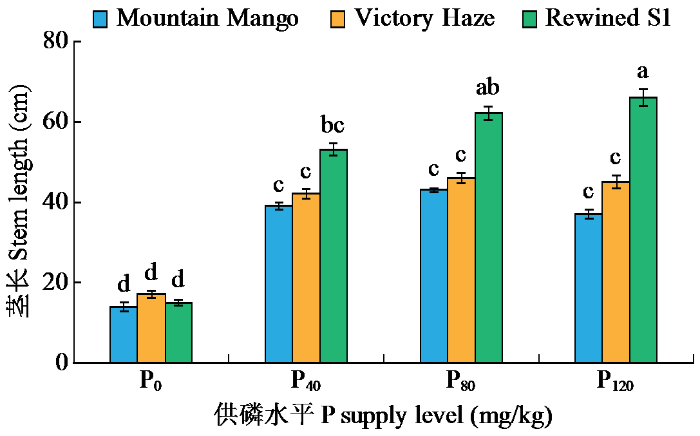
图1
品种和供磷水平的交互作用对茎长的影响
不同小写字母表示差异显著(P < 0.05)。下同。
Fig.1
Effects of the interaction between varieties and P supply levels on stem length
Different lowercase letters indicate significant differences at P < 0.05 level. The same below.
2.2 品种和供磷水平对工业大麻根系形态的影响
表3 品种和供磷水平对工业大麻根系形态的影响
Table 3
| 指标 Index | 品种Variety | 供磷水平P supply level (mg/kg) | ||||||
|---|---|---|---|---|---|---|---|---|
| Mountain Mango | Victory Haze | Rewined S1 | P0 | P40 | P80 | P120 | ||
| 根长Root length (cm) | 5312.0a | 3372.0b | 5056.0ab | 701.0b | 5672.0a | 6017.0a | 5838.0a | |
| 细根长Fine root length (cm) | 5285.0a | 3347.0b | 5029.0ab | 699.0b | 5665.0a | 6009.0a | 5826.0a | |
| 根表面积Root surface area (cm2) | 488.6a | 281.0b | 447.4a | 63.1b | 480.1a | 536.4a | 515.5a | |
由图2可知,Mountain Mango在P120生长条件下的粗根长明显高于Victory Haze和Rewined S1。Mountain Mango的粗根长会随着供磷水平的提高而递增,可见其粗根的生长模式与Victory Haze和Rewined S1并不相同。在P80供磷水平下,3个工业大麻品种的粗根长无显著性差异。
图2
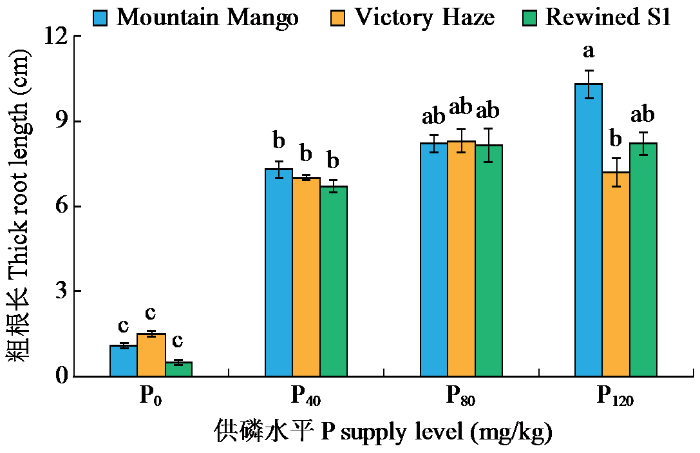
图2
品种和供磷水平的交互作用对粗根长的影响
Fig.2
Effects of the interaction between varieties and P supply levels on coarse root length
2.3 品种和供磷水平对工业大麻生理指标的影响
由表4可知,工业大麻品种和供磷水平对叶片SPAD值有显著性影响。Mountain Mango的叶片SPAD值高于Victory Haze和Rewined S1。在P80生长的大麻植株只有叶片SPAD值高于P0。供磷水平对Pn有显著影响,P0的Pn最大。品种对大麻植株Ci有显著影响,Rewined S1比Mountain Mango的含量高且具有显著性。
表4 品种和供磷水平对工业大麻生理指标的影响
Table 4
| 指标 Index | 品种Variety | 供磷水平P supply level (mg/kg) | ||||||
|---|---|---|---|---|---|---|---|---|
| Mountain Mango | Victory Haze | Rewined S1 | P0 | P40 | P80 | P120 | ||
| SPAD | 50.2a | 41.9b | 42.7b | 40.1b | 44.0ab | 48.9a | 44.5ab | |
| Pn [μmol CO2/(m2·s)] | 7.2 | 7.6 | 5.6 | 9.2a | 8.1ab | 4.5b | 7.2ab | |
| Gs [mol H2O/(m2·s)] | 0.1 | 0.2 | 0.1 | 0.2ab | 0.1ab | 0.1b | 0.2a | |
| Ci (μmol CO2/mol) | 272b | 288ab | 301a | 275 | 261 | 264 | 281 | |
2.4 品种和供磷水平对工业大麻根际羧酸盐渗出的影响
表5 品种和供磷水平对工业大麻羧酸盐渗出量的影响
Table 5
| 指标 Index | 品种Variety | 供磷水平P supply level (mg/kg) | ||||||
|---|---|---|---|---|---|---|---|---|
| Mountain Mango | Victory Haze | Rewined S1 | P0 | P40 | P80 | P120 | ||
| 柠檬酸盐Citrate (μmol/g) | 18.3b | 35.1a | 24.6ab | 78.3a | 16.4b | 6.2b | 6.7b | |
| 苹果酸盐Malate (μmol/g) | 105 | 179 | 132 | 12.1b | 199a | 178ab | 142ab | |
| 福马酸盐Fumarate (μmol/g) | 0.8 | 1.2 | 0.8 | 0.8 | 1.2 | 0.9 | 0.7 | |
| 草酸盐Oxalate (μmol/g) | 30.5 | 36.4 | 33.9 | 19.4 | 29.7 | 40.1 | 45.8 | |
| 丙酮酸盐Pyruvate (μmol/g)) | 0.3 | 0.4 | 0.3 | 0.3 | 0.4 | 0.4 | 0.3 | |
由图3可知,P0水平时的Rewined S1根际土壤pH明显高于P40、P80和P120水平的Rewined S1,也明显高于P80和P120水平的Mountain Mango以及P0和P80水平的Victory Haze。然而,Rewined S1在P0水平时的pH与Mountain Mango在P0和P40水平时、Victory Haze在P40和P120水平时的pH在统计学上无显著性差异。Rewined S1根际土壤的pH随供磷水平的增加而降低的特性与Mountain Mango和Victory Haze并不相同。
图3
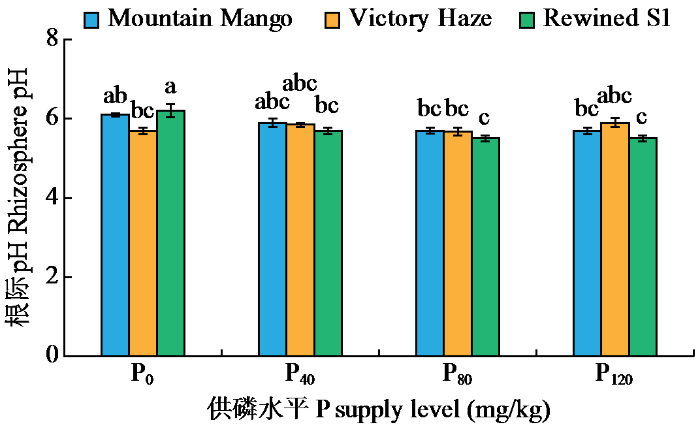
图3
品种和供磷水平的交互作用对根际pH的影响
Fig.3
Effects of the interaction between varieties and P supply level on rhizosphere pH
2.5 品种和供磷水平对工业大麻养分吸收的影响
工业大麻的品种对茎磷浓度和氮磷比有显著性影响(P<0.05),而供磷水平对于茎部氮磷钾和氮磷比均有显著性影响(表1)。由表6可知,Victory Haze比Mountain Mango的P浓度高且具有显著性差异。所有工业大麻品种的N和K的浓度随着供磷水平的增加而降低,然而,P浓度则随着供磷水平的增加而升高。P120产生P浓度显著高于P0和P40,但与P80产生的P浓度在统计学上无明显差异。P0时的氮磷比高于其他3个供磷水平(P40、P80和P120)。P120和P80的N含量无显著性差异但显著高于P0和P40。随着供磷水平的增加茎P含量显著递增。尽管P80的K含量最高且显著高于P0和P40,但与P80的K含量无显著性差异。
表6 品种和供磷水平对工业大麻养分吸收的影响
Table 6
| 指标 Index | 品种Variety | 供磷水平P supply level (mg/kg) | ||||||
|---|---|---|---|---|---|---|---|---|
| Mountain Mango | Victory Haze | Rewined S1 | P0 | P40 | P80 | P120 | ||
| 茎氮浓度Stem N concentration (mg/g) | 27.0 | 29.5 | 26.1 | 40.5a | 24.5b | 23.6b | 22.2b | |
| 茎磷浓度Stem P concentration (mg/g) | 2.2b | 2.8a | 2.4ab | 1.6c | 2.2bc | 2.4ab | 2.7a | |
| 茎钾浓度Stem K concentration (mg/g) | 25.1 | 26.7 | 24.4 | 30.0a | 26.9ab | 22.6bc | 21.3c | |
| 茎氮含量Stem N content (mg) | 75.2 | 75.1 | 74.8 | 8.5d | 87.1c | 101a | 98a | |
| 茎磷含量Stem P content (mg) | 7.9 | 8.2 | 8.7 | 0.4d | 7.3c | 11.9b | 13.5a | |
| 茎钾含量Stem K content (mg) | 79.7 | 73.9 | 76.8 | 6.1c | 93.7b | 103a | 100ab | |
| 茎氮磷比Stem N:P ratio | 15.1a | 13.3ab | 12.8b | 25.2a | 12.5b | 9.1c | 7.7c | |
2.6 品种和供磷水平对工业大麻磷利用率的影响
表7 品种和供磷水平对工业大麻磷利用率的影响
Table 7
| 指标 Index | 品种Variety | 供磷水平P supply level (mg/kg) | |||||
|---|---|---|---|---|---|---|---|
| Mountain Mango | Victory Haze | Rewined S1 | P40 | P80 | P120 | ||
| 农艺磷使用率APUE (g DM/g Pf) | 62.5ab | 52.4b | 66.6a | 84.1a | 57.3b | 42.7c | |
| 磷利用率PUtE (g DM/g Pc) | 472.0a | 361.0b | 448.0a | 505.0a | 404.0b | 375.0b | |
图4
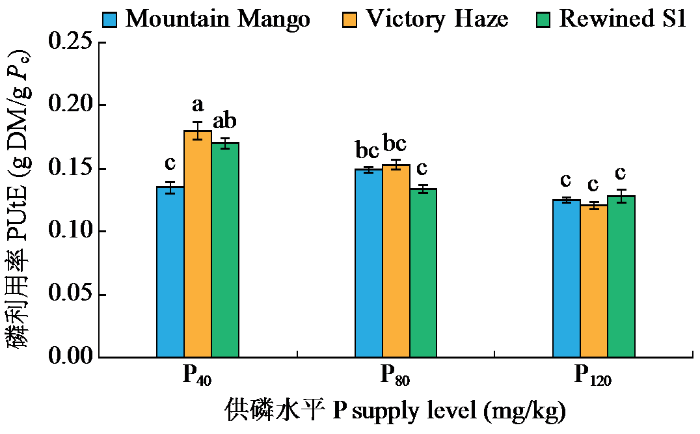
图4
品种和供磷水平的交互作用对磷利用率的影响
Fig.4
Effects of the interaction between Varieties and P supply levels on PUtE
3 讨论
本研究基于3种国外引进的工业大麻品种(Mountain Mango 、Victory Haze和Rewined S1)在低磷土壤环境中通过不同的供磷水平(P40、P80和P120)对受试植株的生长发育、根系形态、生理指标、根际羧酸盐渗出量、养分吸收和磷利用率的影响进行了全面分析。P40、P80和P120供磷水平下产生的茎(大麻植株的地上部分)和根(大麻植株的地下部分)的干重显著高于P0(即不添加磷)。相关研究[2,21]表明,在土壤磷浓度充足的情况下额外添加的磷含量不会对大麻产生影响。然而,在初始土壤肥力较低的情况下,工业大麻的产量会受到供磷水平的影响。此外,土壤添加磷,特别是再添加氮后,可以增加工业大麻的茎长[22]。可见,工业大麻对磷肥的反应可能依赖于土壤环境[23]。由图1可知,Rewined S1在P120时的茎长高于Mountain Mango和Victory Haze在所有供磷水平上的茎长。在P40和P80时,Rewined S1的茎长均高于同等供磷水平下的Mountain Mango和Victory Haze。同时,Rewined S1的茎干重也显著高于Victory Haze,但与Mountain Mango无显著性差异(表2)。
工业大麻植株对不同供磷水平的反应以及磷使用率取决于根系形态(包括根长、根直径和根表面积)[13]。这些根部性状的表达具有基因特异性并受环境条件的影响[15]。由图2可知,Mountain Mango在P120时的粗根长最长,显著高于Victory Haze,且Mountain Mango的粗根生长模式也与Victory Haze和Rewined S1的不同。由表3可知,Mountain Mango的根长和细根长显著高于Victory Haze,而Mountain Mango和Rewined S1的根表面积显著高于Victory Haze。植株对于缺磷的根系反应一般体现在根长增加和根直径减小[15,22]。但在本研究中,不同品种和供磷水平的根直径没有显著性差异。这表明该性状与大麻根系受低磷水平的影响无关。工业大麻植株可能会通过增加根长和根表面积来适应其根系形态的变化。
在低磷土壤环境下,植物的生理参数会受到缺磷的影响(表4)。大麻植株的叶片SPAD值会随供磷水平的增加而升高,在P80时的SPAD值达到最大值。不同大麻品种之间,Mountain Mango的SPAD值显著高于Victory Haze和Rewined S1。有研究[24-25]表明,在缺磷条件下医用大麻因叶片中氮的减少间接影响了叶绿素的生成,从而使叶绿素的浓度降低。高磷组P80与P0相比,对工业大麻的Pn和Gs产生了不利影响。此结果与Shiponi等[26]在施用高磷肥时,医用大麻也出现了净光合速率下降的类似情况,其原因在于磷的毒性;但对生物量没有影响,表明固碳不是限制因素。在本研究中,Ci的高低因工业大麻的品种而异,Rewined S1对CO2的同化作用显著高于Mountain Mango。Ci较高可提高羧化作用和水分利用率,降低Gs和光呼吸作用,促进光合作用和植物生长[27]。
工业大麻的根际pH也会受到供磷水平的影响。根际pH会影响根系的生理、微生物、有害元素和养分的生物利用率[29]。由图3可知,大麻品种和供磷水平的交互作用对根际pH的影响显著。本研究使用的低磷土壤的初始pH(H2O)约为7.3。在P0时,所有大麻品种的根际pH均下降(平均pH值约为6.0),Victory Haze显著低于Rewined S1。这可能是由于在缺磷情况下,根细胞吸收的阳离子多于阴离子,从而诱导根系释放羧酸以维持细胞平衡(即阳离子―阴离子平衡)[30]。羧酸盐的渗出也伴随着H+的释放,以平衡电荷,最终降低根际的pH[31]。由图3可知,随着供磷水平的增加,根际pH下降且低于P0,Rewined S1在P40、P80和P120时显著低于P0。这可能与大麻根系随着磷供应量的增加释放出更多的苹果酸盐有关,同时伴随着H+的渗出,促使根际部位进一步酸化。
氮磷比可用于评估氮磷可用性对植物生长的限制作用。在本研究中,品种和供磷水平影响了工业大麻的茎氮磷比。氮磷比<14表示氮限制;而氮磷比>16则表示磷限制[32]。由表6可知,Victory Haze和Rewined S1的氮磷比<14,表明氮限制;而Mountain Mango的氮磷比为15.1,表明氮不是限制因素,Mountain Mango的叶片SPAD值高于Victory Haze和Rewined S1。在P0时的氮磷比>16,但在P40、P80和P120时,氮磷比<14,表明磷供给抑制了氮吸收,这可能归因于养分的吸收与利用。Mountain Mango和Rewined S1由于维持最佳光合作用和生长适应性不同,Mountain Mango的叶片SPAD值和粗根长会增加,而RewinedS1的Ci和茎长会增加。
4 结论
Mountain Mango和Rewined S1提高了根干重、茎干重、根长和根表面积,高供磷水平具有较高的农艺磷使用率和磷利用率;而Victory Haze的根干重、茎干重和根系生长适中,柠檬酸盐渗出量和磷利用率较高。在缺磷条件下,工业大麻的根际主要释放柠檬酸盐,随着供磷水平的增加,大麻根际逐渐转向释放苹果酸盐。氮磷比、叶片SPAD值、Gs和根茎长的结果表明,Mountain Mango和Rewined S1在维持光合作用、生长形态和生理适应方面存在差异。P80是提高工业大麻茎生物量和生长的最适供磷水平,而P40则是农艺学上最佳的磷利用率,可提高低磷土壤中工业大麻的根干重和生长发育。
参考文献
Industrial hemp (Cannabis sativa L.)agronomy and utilization: a review
DOI:10.3390/agronomy13030931
URL
[本文引用: 1]

Currently, there are increased interests in growing grain and fiber hemp (Cannabis sativa L.) as well as in large-scale hemp products. Cannabis has been grown/utilized for thousands of years as a fiber, grain, and drug/medicinal plant. However, the strict control of cannabis cultivation to combat illegal use, the spread of new yarns and oilseeds, and the advent of cheap synthetic fibers caused a decreased/eliminated hemp production. Hemp has been banned in most of the world for more than seven decades; it missed out on the Green Revolution and the adoption of new technologies and varieties, creating a knowledge gap. After the 2014 and 2018 Farm Bill in the USA, hemp became legal and the land grand universities launched research programs. The ability to utilize the entire plant for multiple purposes creates opportunity for the market to value hemp products. Hemp production technology varies depending on the type of hemp cultivated (grain, fiber, or cannabinoids), soil characteristics, and environmental factors. Hemp has the potential to be a very sustainable and ecologically benign crop. Hemp roots have a significant potential for absorbing and storing heavy metals such as lead, nickel, cadmium, and other harmful substances. In addition, hemp has been proven to be an excellent carbon trap and biofuel crop. Hemp has the ability to successfully suppress weeds, and it is generally regarded a pesticide-free crop. The purpose of this paper is to examine historic and recent industrial hemp (grain and fiber) literature, with a focus on hemp agronomy and utilization.
Phosphorus stress strongly reduced plant physiological activity, but only temporarily, in a mesocosm experiment with Zea mays colonized by arbuscular mycorrhizal fungi
DOI:10.5194/bg-19-2353-2022
URL
[本文引用: 2]
. Phosphorus (P) is an essential macronutrient for plant growth and\none of the least available nutrients in soil. P limitation is often a major\nconstraint for plant growth globally. Although P addition experiments have\nbeen carried out to study the long-term effects on yield, data on P addition\neffects on seasonal variation in leaf-level photosynthesis are scarce.\nArbuscular mycorrhizal fungi (AMF) can be of major importance for plant\nnutrient uptake, and AMF growth may be important for explaining temporal\npatterns in leaf physiology. In a nitrogen (N) and P fertilization\nexperiment with Zea mays, we investigated the effect of P limitation on leaf\npigments and leaf enzymes, how these relate to leaf-level photosynthesis,\nand how these relationships change during the growing season. A previous\nstudy on this experiment indicated that N availability was generally high,\nand as a consequence, N addition did not affect plant growth, and also the\nleaf measurements in the current study were unaffected by N addition.\nContrary to N addition, P addition strongly influenced plant growth and\nleaf-level measurements. At low soil P availability, leaf-level\nphotosynthetic and respiratory activity strongly decreased, and this was\nassociated with reduced chlorophyll and photosynthetic enzymes. Contrary to\nthe expected increase in P stress over time following gradual soil P\ndepletion, plant P limitation decreased over time. For most leaf-level\nprocesses, pigments and enzymes under study, the fertilization effect had\neven disappeared 2 months after planting. Our results point towards a key\nrole for the AMF symbiosis and consequent increase in P uptake in explaining\nthe vanishing P stress.
The sustainability of industrial hemp: a literature review of its economic, environmental, and social sustainability
DOI:10.3390/su15086457
URL
[本文引用: 1]
Industrial hemp is a versatile, sustainable plant with several applications of its various forms, including fiber obtained from hemp stalks, food obtained from hemp seeds, and oil obtained from hemp flowers and seeds. Industrial hemp has the potential to offer a solution to the crisis of climate change, since it is a viable energy source that satisfies the three pillars of sustainability, namely economy, environment, and society. Although industrial hemp has been growing as an agricultural commodity in different parts of the world for decades, its production was banned until recently in the U.S. because of its association with marijuana. We conducted a literature review to explore some of the reasons why the U.S. production of industrial hemp has increased significantly since the ban was lifted. Our findings revealed that hemp’s rapidly increasing popularity in the U.S. since 2018 can be attributed, in part, to its sustainability potential (defined as the potential to positively impact the sustainability of products, using hemp as a renewable raw material). This study fills a gap in the knowledge regarding hemp’s potential as a sustainable crop.
Prospects of blockchain technology in China’s industrial hemp industry
DOI:10.1080/15440478.2022.2160406 URL [本文引用: 1]
Phosphate-dependent regulation of growth and stresses management in plants
DOI:10.3389/fpls.2021.679916 URL [本文引用: 1]
Physiological and morphological responses of hydroponically grown pear rootstock under phosphorus treatment
DOI:10.3389/fpls.2021.696045
URL
[本文引用: 1]
Phosphorus (P) is an essential macronutrient for the growth and development of fruit trees, playing an important role in photosynthesis, nucleic acid synthesis, and enzyme activity regulation. The plasticity of plant phenotypic has been investigated in diverse species under conditions of P-deficiency or P-excess. Based on these researches, P level fluctuations in different species result in different characteristics of the response. Nevertheless, little is known about the response of pear seedling rootstock (Pyrus betulifolia Bunge) to the changing of P levels. To explore the effects of different levels of P on the growth of pear seedling rootstock, we performed the hydroponic assays to determine and analyze the biological indexes including growth parameters, photosynthetic rate, root and shoot morphological traits, and concentrations of macro- and micronutrients. The results show that either deficiency or excess of P inhibited the growth and development of pear seedling rootstock. Root growth (down 44.8%), photosynthetic rate (down 59.8%), and acid phosphatase (ACP) activity (down 44.4%) were inhibited under the P-deficiency conditions (0mM), compared with normal P conditions (1mM). On the other hand, dark green leaves, suppression of root elongation (down 18.8%), and photosynthetic rate (down 25%) were observed under regimes of excessive P, compared with normal P conditions (1mM). Furthermore, the root concentration of not only P, but also those of other mineral nutrients were affected by either P treatment. In brief, these results indicated that a careful choice of P fertilizer supply is crucial to ensuring normal growth and development of pear seedling rootstock.
Strategies and agronomic interventions to improve the phosphorus-use efficiency of farming systems
DOI:10.1007/s11104-011-0880-1 URL [本文引用: 2]
The seed of industrial hemp (Cannabis sativa L.): nutritional quality and potential functionality for human health and nutrition
DOI:10.3390/nu12071935
URL
[本文引用: 1]
Hempseeds, the edible fruits of the Cannabis sativa L. plant, were initially considered a by-product of the hemp technical fibre industry. Nowadays, following the restorationing of the cultivation of C. sativa L. plants containing an amount of delta-9-tetrahydrocannabinol (THC) <0.3% or 0.2% (industrial hemp) there is a growing interest for the hempseeds production due to their high nutritional value and functional features. The goal of this review is to examine the scientific literature concerning the nutritional and functional properties of hempseeds. Furthermore, we revised the scientific literature regarding the potential use of hempseeds and their derivatives as a dietary supplement for the prevention and treatment of inflammatory and chronic-degenerative diseases on animal models and humans too. In the first part of the work, we provide information regarding the genetic, biochemical, and legislative aspects of this plant that are, in our opinion essential to understand the difference between “industrial” and “drug-type” hemp. In the final part of the review, the employment of hempseeds by the food industry as livestock feed supplement and as ingredient to enrich or fortify daily foods has also revised. Overall, this review intends to encourage further and comprehensive investigations about the adoption of hempseeds in the functional foods field.
Phosphorus fertiliser value of sewage sludge ash applied to soils differing in phosphate buffering and phosphate sorption capacity
DOI:10.1007/s10705-022-10206-4 [本文引用: 1]
Growth, rhizosphere carboxylate exudation, and arbuscular mycorrhizal colonisation in temperate perennial pasture grasses varied with phosphorus application
DOI:10.3390/agronomy10122017
URL
[本文引用: 3]
Phosphorus (P) fertiliser is applied regularly to the nutrient-poor sandy soils in southwestern Australia to elevate and/or maintain pasture production. This study aimed to characterise differential growth, root carboxylate exudation, and mycorrhizal responses in three temperate perennial pasture grasses at variable P supply. Tall fescue (Festuca arundinacea L. cv. Prosper), veldt grass (Ehrharta calycina Sm. cv. Mission), and tall wheatgrass (Thinopyrum ponticum L. cv. Dundas) with five P rates varying from 0 to 100 mg P kg−1 soil were evaluated in a controlled environment. Rhizosphere carboxylate exudation and mycorrhizal colonisation were assessed. Veldt grass produced the maximum shoot dry weight, highest agronomic phosphorus-use efficiency at low P supply, as well as the highest specific root length and shoot P content at all P rates. Across species, the maximum shoot weight was obtained at 20 and 50 mg P kg−1 soil, which differed significantly from the two lowest P rates (0 and 5 mg P kg−1 soil). Phosphorus application influenced carboxylate exudation, with plants exuding acetate only in the zero P treatment, and citrate and malonate in the P-supplemented treatments. In all three species, acetate and malonate were the major carboxylates exuded (37–51% of the total). Only tall wheatgrass released trans-aconitate. Citrate and malonate concentrations in the rhizosphere increased with P supply, suggesting their important role in P acquisition. Phosphorus applications reduced arbuscular mycorrhizal colonisation and increased root diameter as the P rate increased. Root carboxylate exudation in low-P soil played a role in mobilisation of P via P solubilisation, but the role of exuded carboxylate in soils well supplied with P might be diminished.
Improving phosphorus use efficiency: a complex trait with emerging opportunities
DOI:10.1111/tpj.13423
PMID:27859875
[本文引用: 1]
Phosphorus (P) is one of the essential nutrients for plants, and is indispensable for plant growth and development. P deficiency severely limits crop yield, and regular fertilizer applications are required to obtain high yields and to prevent soil degradation. To access P from the soil, plants have evolved high- and low-affinity Pi transporters and the ability to induce root architectural changes to forage P. Also, adjustments of numerous cellular processes are triggered by the P starvation response, a tightly regulated process in plants. With the increasing demand for food as a result of a growing population, the demand for P fertilizer is steadily increasing. Given the high costs of fertilizers and in light of the fact that phosphate rock, the source of P fertilizer, is a finite natural resource, there is a need to enhance P fertilizer use efficiency in agricultural systems and to develop plants with enhanced Pi uptake and internal P-use efficiency (PUE). In this review we will provide an overview of continuing relevant research and highlight different approaches towards developing crops with enhanced PUE. In this context, we will summarize our current understanding of root responses to low phosphorus conditions and will emphasize the importance of combining PUE with tolerance of other stresses, such as aluminum toxicity. Of the many genes associated with Pi deficiency, this review will focus on those that hold promise or are already at an advanced stage of testing (OsPSTOL1, AVP1, PHO1 and OsPHT1;6). Finally, an update is provided on the progress made exploring alternative technologies, such as phosphite fertilizer.© 2016 The Authors The Plant Journal © 2016 John Wiley & Sons Ltd.
Root developmental responses to phosphorus nutrition
DOI:10.1111/jipb.13090
[本文引用: 2]
Phosphorus is an essential macronutrient for plant growth and development. Root system architecture (RSA) affects a plant's ability to obtain phosphate, the major form of phosphorus that plants uptake. In this review, I first consider the relationship between RSA and plant phosphorus-acquisition efficiency, describe how external phosphorus conditions both induce and impose changes in the RSA of major crops and of the model plant <i>Arabidopsis</i>, and discuss whether shoot phosphorus status affects RSA and whether there is a universal root developmental response across all plant species. I then summarize the current understanding of the molecular mechanisms governing root developmental responses to phosphorus deficiency. I also explore the possible reasons for the inconsistent results reported by different research groups and comment on the relevance of some studies performed under laboratory conditions to what occurs in natural environments.
Rhizosphere carboxylates and morphological root traits in pasture legumes and grasses
DOI:10.1007/s11104-015-2770-4 URL [本文引用: 2]
Microbial consortium inoculant increases pasture grasses yield in low- phosphorus soil by influencing root morphology, rhizosphere carboxylate exudation and mycorrhizal colonisation
DOI:10.1002/jsfa.v102.2 URL [本文引用: 2]
Effects of microbial consortia, applied as fertilizer coating, on soil and rhizosphere microbial communities and potato yield
DOI:10.3389/fagro.2021.714700
URL
[本文引用: 1]
The use of biological inputs in crop production systems, as complements to synthetic inputs, is gaining popularity in the agricultural industry due to increasing consumer demand for more environmentally friendly agriculture. An approach to meeting this demand is the inoculation of field crops with beneficial microbes to promote plant growth and resistance to biotic and abiotic stresses. However, the scientific literature reports inconsistent results following applications of bio-inoculant to fields. The effects of inoculation with beneficial microbes on bulk soil and rhizospheric microbial communities is often overlooked as precise monitoring of soil microbial communities is difficult. The aim of this research was to use Illumina high throughput sequencing (HTS) to shed light on bulk soil and rhizospheric microbial community responses to two commercial microbial inoculants coated onto fertilizer granules, applied to potato fields. Bulk soil samples were collected 4 days before seeding (May 27th), 7 days after seeding (June 7th), at potato shoot emergence (June 21st) and at mid-flowering (July 26th). Rhizospheric soil was collected at the mid-flowering stage. The Illumina MiSeq HTS results indicated that the bulk soil microbial community composition, especially prokaryotes, changed significantly across potato growth stages. Microbial inoculation did not affect bulk soil or rhizospheric microbial communities sampled at the mid-flowering stage. However, a detailed analysis of the HTS results showed that bulk soil and rhizospheric microbial community richness and composition were different for the first treatment block compared to the other three blocks. The spatial heterogeneity of the soil microbial community between blocks of plots was associated with potato tuber yield changes, indicating links between crop productivity and soil microbial community composition. Understanding these links could help in production of high-quality microbial inoculants to promote potato productivity.
Influence of the growth stage of industrial hemp on the yield formation in relation to certain fibre quality traits
DOI:10.1016/S0926-6690(00)00052-2 URL [本文引用: 1]
Background absorption error in determination of copper in plants by flame atomic absorption spectrometry
DOI:10.1021/ac50029a014 URL [本文引用: 1]
Industrial hemp response to nitrogen, phosphorus, and potassium fertilization
The effect of N and P fertilization on growth, seed yield and quality of industrial hemp in the Parkland region of Saskatchewan
DOI:10.4141/P04-022
URL
[本文引用: 2]
Industrial hemp (Cannabis sativa L.) has sparked renewed interest in western Canada in recent years, and there is very little research information available on its fertilizer requirements. The objective of this study was to determine the effect of surface-broadcast ammonium nitrate and seedrow placed monoammonium phosphate fertilizers on the production and seed quality attributes of industrial hemp (cv. Fasamo and Finola). Field experiments were conducted on a Black Chernozem silty loam soil at Melfort, Saskatchewan, Canada, in 2000, 2001 and 2002. Increasing N rates significantly increased plant height, biomass, seed yield and seed protein content of hemp in all years. Seed-applied P fertilizer increased plant height in all years, and biomass in 2000, but reduced plant density, biomass and seed yield in 2001 and 2002. Finola consistently had lower plant height, earlier maturity, heavier seeds, and higher seed yield, seed protein content and seed oil content than Fasamo. The average amount of nitrate-N in the 0–60 cm soil was 40 kg N ha-1. Seed yield kg-1 of N was 9.4, 5.9, 4.5 and 3.7 kg ha-1 for Fasamo, and 10.6, 7.7, 6.0 and 4.5 kg ha-1 for Finola, respectively, at 40, 80, 120 and 160 kg ha-1 of soil plus fertilizer N. Key words: Fertilizer, hemp, nitrogen, phosphorus, rainfall, soil extractable P, soil nitrate-N, cultivars
Impact of different growing substrates on growth, yield and cannabinoid content of two Cannabis sativa L. genotypes in a pot culture
DOI:10.3390/horticulturae6040062
URL
[本文引用: 1]
The impacts of different growing substrate compositions, consisting of peat (PM), peat substituted with 30% green fibre (G30) and coco coir fibre (CC) growth media, were investigated in regard to the plant height, biomass and floral yield, biomass nitrogen (N) content, root growth, and cannabidiol content (CBD/A) of two phytocannabinoid-rich cannabis genotypes in an indoor pot cultivation system. Genotypes and substrate treatment combinations were randomly allocated to 36 plants according to a Latin square design. The results showed a higher total plant height for PM (39.96 cm), followed by G30 (35.28 cm), and the lowest in CC (31.54 cm). The N content of leaves indicated the highest values for plants grown in G30 (52.24 g kg DW−1), followed by PM (46.75 g kg DW−1) and a significantly lower content for CC (37.00 g kg DW−1). Root length density (RLD) increased by 40% (PM) and 50% (G30), compared to CC treatments, with no significant differences in root dry weight. Both genotypes, Kanada (KAN) and 0.2x, reacted in a genotype-specific manner. KAN indicated a reduced floral yield of plants grown in G30 (4.94 g plant−1) and CC (3.84 g plant−1) compared to PM (8.56 g plant−1). 0.2x indicated stable high floral yields of 9.19 g plant−1 (G30) to 7.90 g plant−1 (CC). Leaf DW increased in PM (5.78 g plant−1) and G30 (5.66 g plant−1) compared to CC (3.30 g plant−1), while CBD/A content remained constant. Due to a higher biomass yield, the CBD/A yield of flowers (549.66 mg plant−1) and leaves (224.16 mg plant−1) revealed 0.2x as an interesting genotype for indoor pot cultivation in a peat-based substrate substituted with 30% green fibres. Overall, the demand for organic green fibres to partly replace fractionated peat showed a genotype-specific option for a homogeneous plant development, with comparable high biomass yields and stable cannabinoid contents compared to a peat containing standard substrate.
Plant growth- promoting rhizobacteria (PGPR) in Cannabis sativa ‘Finola’ cultivation: An alternative fertilization strategy to improve plant growth and quality characteristics
DOI:10.1016/j.indcrop.2018.06.033 URL [本文引用: 1]
Response of medical cannabis (Cannabis sativa L.) genotypes to P supply under long photoperiod: Functional phenotyping and the ionome
DOI:10.1016/j.indcrop.2020.113154 URL [本文引用: 2]
Increased CO2 concentrations increasing water use efficiency and improvement PSII function of mulberry seedling leaves under drought stress
DOI:10.1080/17429145.2019.1603405 URL [本文引用: 1]
Plant and microbial strategies to improve the phosphorus efficiency of agriculture
DOI:10.1007/s11104-011-0950-4 URL [本文引用: 1]
Carboxylate composition of root exudates does not relate consistently to a crop species’ ability to use phosphorus from aluminium, iron or calcium phosphate sources
DOI:10.1111/nph.2007.173.issue-1 URL [本文引用: 1]
Origins of root-mediated pH changes in the rhizosphere and their responses to environmental constraints: a review
DOI:10.1023/A:1022371130939 [本文引用: 1]
Genotypic and species variability in carboxylate exudation of wheat (Triticum aestivum L.) and maize (Zea mays L.) in phosphorus deficiency
Leaf nitrogen to phosphorus ratios of tropical trees: experimental assessment of physiological and environmental controls
DOI:10.1111/j.1469-8137.2009.03106.x
PMID:19968799
[本文引用: 1]
We investigated the variation in leaf nitrogen to phosphorus ratios of tropical tree and liana seedlings as a function of the relative growth rate, whole-plant water-use efficiency, soil water content and fertilizer addition. First, seedlings of 13 tree and liana species were grown individually in 38-l pots prepared with a homogeneous soil mixture. Second, seedlings of three tree species were grown in 19-l pots at high or low soil water content, and with or without added fertilizer containing nitrogen, phosphorus and potassium. For plants grown under common soil conditions, leaf nitrogen to phosphorus ratios showed a unimodal, or hump-shaped, relationship with the relative growth rate. The leaf nitrogen to phosphorus ratio increased in response to low soil water content in three species, and increased in response to fertilizer addition in two of the three species. Across all species and treatments, the leaf nitrogen to phosphorus ratio was positively correlated with the water-use efficiency. The results suggest that the within-site variation among tropical tree species in the leaf nitrogen to phosphorus ratio may be caused by associations between this ratio and the relative growth rate. Modification of the soil environment changed the leaf nitrogen to phosphorus ratio, but underlying associations between this ratio and the relative growth rate were generally maintained. The observed correlation between the leaf nitrogen to phosphorus ratio and water-use efficiency has implications for linking nutrient stoichiometry with plant transpiration.


