



长秧龄导致水稻秧苗的存活率降低,伤根程度和伤苗率增加[8],其秧苗素质、群体茎蘖数、叶面积指数、叶片叶绿素相对含量(SPAD值)、根系活力、群体干物质量、阶段干物质积累量、根系生长及氮素利用特性均比短秧龄差[9-
1 材料与方法
1.1 试验材料
供试水稻品种为桂香99(桂审稻2020186号)、桂香18(桂审稻2020183号)、金针香(桂审稻2022161号)和桂玉美香(桂审稻2022163号),均为优质常规水稻品种。
1.2 试验地概况
试验于2023年在广西靖西市新靖镇(23°6′ N,106°21′ E)进行,试验田块土壤为砂质黏土,长期作为烟稻复种田,移栽前试验地土壤基本理化性质为pH 6.8、水解性氮187.7 mg/kg、有效磷10.3 mg/kg、速效钾35.4 mg/kg、有机质38.9 g/kg。
1.3 试验设计
开展品种和秧龄的双因素区组试验。供试品种分批浸种催芽后分期播种于育秧盘中,分期播种时期为6月15日、6月20日、6月25日、6月30日、7月5日和7月10日,所有处理统一移栽时间为7月30日,即设置了6个不同天数的秧龄处理:45、40、35、30、25和20 d,共计24个处理。育秧盘规格为30 cm×60 cm×3 cm,每个品种每个秧龄处理播种6个育秧盘,每个育秧盘播种50 g。人工双苗移栽,株行距20.0 cm×13.0 cm,每个品种每个秧龄处理均设3次重复,共计72个田间小区,小区面积8.0 m×4.0 m。试验小区尿素(N=46.2%)用量为324.7 kg/hm2,按30%基肥、45%分蘖肥和25%穗肥施用,过磷酸钙(有效磷=16.0%)用量为450.0 kg/hm2,均作基肥施用,氯化钾(K2O=62.0%)用量为265.2 kg/hm2,按60%分蘖肥、40%穗肥施用。试验小区水分管理按水稻种植常规方法进行。
1.4 测定项目与方法
1.4.1 秧苗素质
移栽前从各处理的育秧盘中选代表性的1盘,在秧盘中央选取代表性秧苗30株,数叶龄和根数,用直尺测定苗高和根长,用游标卡尺测茎基宽。将根和地上部分开洗净,在105 ℃烘箱内杀青30 min后,保持80 ℃恒温烘干至恒重后称重,测地上部干重和根干重。
1.4.2 生育期
记录各处理返青期、分蘖期、始穗期、齐穗期和成熟期。以80%的叶片吐露为返青完成标准,以50%的植株出现分蘖为分蘖期,以10%的稻穗穗顶露出为始穗期,以90%的稻穗穗顶露出为齐穗期,以90%稻谷粒颖壳变黄为成熟期。
1.4.3 茎蘖动态
各处理小区选择第3行同一方向连续标记10蔸,从移栽后7 d起至分蘖出现下降,每7 d调查1次分蘖情况,高峰期每5 d调查1次,记录最高苗数及分蘖情况。
1.4.4 干物质积累量
分别于分蘖期、齐穗期和成熟期,每小区根据平均分蘖数取代表性3蔸,将叶、茎、穗分开洗净,在105 ℃烘箱内杀青30 min后,保持80 ℃恒温烘干至恒重后称重,并折算成每公顷(3.0×10⁵蔸/hm2)干物质量。
1.4.5 产量及其构成因素
成熟后按五点取样法从各小区取5蔸,调查穗粒数、结实率和千粒重,有效穗数按10蔸的平均数计。产量按小区实收,晒干后称重并按单位面积折算。
1.4.6 稻米品质
各小区收获脱粒后,取稻谷测定稻米品质,用TP-JLG-2018砻谷机(浙江托普云农科技股份有限公司)测定糙米率,用5599降温型智能精米机(欧米亚)测定整精米率,采用SC-E型大米外观品质检测分析仪系统(杭州万深检测科技有限公司)测定粒长、长宽比、垩白度和垩白粒率,用SATAKE RLTA10B-KC食味仪(日本佐竹)测定直链淀粉含量。
1.5 数据处理
用DPS v9.01软件按双因素区组试验进行统计分析和相关分析,采用LSD法检测差异显著性,用WPS进行数据整理、作表和作图。
2 结果与分析
2.1 秧龄对烟后优质稻品种秧苗素质的影响
秧龄对供试品种的秧苗素质指标影响均达极显著(表1)。供试品种的叶龄、苗高和地上部干重随秧龄延长而显著增加,茎基宽随秧龄的延长而增加,但在20和25 d秧龄之间差异不显著。根数、根长和根干重在秧龄20、25、30和35 d时随秧龄的延长而显著增加,但在秧龄40和45 d时增加不显著。延长秧龄虽能增加秧苗素质指标,但秧龄超过35 d后,根数、根长和根干重不再随秧龄延长而显著增加。
表1 不同秧龄下各烟后优质稻品种的秧苗素质
Table 1
| 品种 Variety | 秧龄 Seedling age (d) | 叶龄 Leaf age | 苗高 Plant height (cm) | 茎基宽 Stem diameter (mm) | 根数 Root number | 根长 Root length (cm) | 地上部干重(mg/株) Aboveground dry weight (mg/plant) | 根干重(mg/株) Root dry weight (mg/plant) |
|---|---|---|---|---|---|---|---|---|
| 桂香99 Guixiang 99 | 45 | 5.38±0.22a | 33.27±0.34a | 4.49±0.07a | 18.2±1.0a | 8.78±0.10a | 98.71±1.00a | 28.21±0.31a |
| 40 | 5.05±0.15b | 32.90±0.30b | 4.32±0.06b | 17.7±1.5ab | 8.79±0.10a | 97.61±0.88b | 28.26±0.31a | |
| 35 | 4.62±0.22c | 28.89±0.32c | 3.87±0.05c | 17.4±1.2b | 8.47±0.09b | 85.72±0.94c | 27.21±0.30b | |
| 30 | 4.13±0.22d | 24.90±0.29d | 3.46±0.05d | 14.6±1.1c | 7.60±0.08c | 73.89±0.87d | 24.41±0.27c | |
| 25 | 3.53±0.18e | 20.99±0.30e | 2.86±0.05e | 14.0±0.9c | 6.01±0.06d | 62.27±0.89e | 19.31±0.21d | |
| 20 | 3.05±0.15f | 17.62±0.29f | 2.83±0.05e | 10.6±1.1d | 4.69±0.05e | 52.29±0.86f | 15.07±0.17e | |
| 桂香18 Guixiang 18 | 45 | 5.50±0.00a | 39.74±0.40a | 4.29±0.07a | 18.0±1.1a | 9.68±0.11a | 117.91±1.19a | 31.10±0.34ab |
| 40 | 5.05±0.15b | 39.30±0.36b | 4.12±0.06b | 18.0±1.5a | 9.69±0.11a | 116.59±1.05b | 31.16±0.34a | |
| 35 | 4.62±0.22c | 34.51±0.38c | 3.69±0.05c | 17.8±1.1a | 9.33±0.10b | 102.39±1.12c | 30.96±0.67b | |
| 30 | 4.13±0.22d | 29.75±0.35d | 3.30±0.06d | 14.7±1.1b | 8.37±0.09c | 88.26±1.04d | 26.91±0.29c | |
| 25 | 3.62±0.43e | 25.07±0.36e | 2.74±0.04e | 13.7±0.9c | 6.62±0.07d | 74.39±1.07e | 21.29±0.23d | |
| 20 | 3.03±0.13f | 21.05±0.35f | 2.72±0.21e | 10.4±1.1d | 5.17±0.06e | 62.46±1.03f | 16.61±0.18e | |
| 金针香 Jinzhenxiang | 45 | 5.55±0.15a | 38.46±0.39a | 4.79±0.07a | 18.6±0.7a | 9.57±0.10a | 114.11±1.15a | 30.75±0.34a |
| 40 | 5.05±0.15b | 38.03±0.34b | 4.60±0.07b | 18.3±1.4a | 9.58±0.11a | 112.84±1.02b | 30.80±0.35a | |
| 35 | 4.62±0.22c | 33.40±0.36c | 4.11±0.06c | 18.2±0.9a | 9.23±0.10b | 99.10±1.08c | 30.73±0.49a | |
| 30 | 4.12±0.22d | 28.79±0.34d | 3.67±0.04d | 14.4±1.1b | 8.28±0.09c | 85.42±1.01d | 26.61±0.29b | |
| 25 | 3.62±0.43e | 24.26±0.35e | 3.03±0.05e | 14.2±0.8b | 6.55±0.08d | 71.99±1.03e | 21.05±0.23c | |
| 20 | 2.98±0.21f | 19.74±0.33f | 3.02±0.05e | 10.7±1.2c | 5.11±0.06e | 58.57±0.97f | 16.43±0.18d | |
| 桂玉美香 Guiyumeixiang | 45 | 5.57±0.17a | 39.25±0.40a | 4.39±0.07a | 19.0±0.9a | 9.57±0.10a | 116.46±1.18a | 30.69±0.33ab |
| 40 | 5.05±0.15b | 38.81±0.35b | 4.22±0.06b | 18.7±1.3a | 9.55±0.11a | 115.16±1.04b | 30.75±0.34a | |
| 35 | 4.62±0.22c | 34.09±0.37c | 3.77±0.04c | 17.6±1.1b | 9.21±0.10b | 101.13±1.10c | 30.54±0.54b | |
| 30 | 4.12±0.22d | 29.38±0.35d | 3.37±0.04d | 14.6±1.1c | 8.26±0.09c | 87.17±1.03d | 26.56±0.29c | |
| 25 | 3.62±0.43e | 24.76±0.36e | 2.78±0.04e | 13.9±0.9d | 6.54±0.07d | 73.47±1.06e | 21.01±0.23d | |
| 20 | 5.38±0.21f | 20.79±0.34f | 2.77±0.05e | 10.1±1.1e | 5.10±0.06e | 61.68±1.02f | 16.40±0.18e | |
| 45 d | 5.50±0.17a | 37.68±2.63a | 4.49±0.20a | 18.4±1.0a | 9.39±0.37a | 111.80±7.79a | 30.19±1.20a | |
| 40 d | 5.05±0.15b | 37.26±2.59b | 4.32±0.19b | 18.1±1.5b | 9.41±0.38a | 110.55±7.69b | 30.24±1.21a | |
| 35 d | 4.62±0.21c | 32.72±2.28c | 3.86±0.17c | 17.8±1.1c | 9.06±0.36b | 97.08±6.78c | 29.86±1.62b | |
| 30 d | 4.13±0.22d | 28.20±1.97d | 3.45±0.15d | 14.6±1.1d | 8.13±0.32c | 83.68±5.85d | 26.12±1.04c | |
| 25 d | 3.60±0.38e | 23.77±1.67e | 2.85±0.13e | 13.9±0.9e | 6.43±0.26d | 70.53±4.97e | 20.66±0.82d | |
| 20 d | 3.01±0.18f | 19.80±1.39f | 2.84±0.16e | 10.4±1.1f | 5.02±0.20e | 58.75±4.13f | 16.13±0.64e | |
| 秧龄Seedling age | ** | ** | ** | ** | ** | ** | ** | |
不同小写字母表示差异显著(P < 0.05),“**”表示差异极显著(P < 0.01),下同。
Different lowercase letters indicate significant differences (P < 0.05),“**”indicates extremely significant differences (P < 0.01), the same below.
2.2 秧龄对烟后优质稻品种生育期的影响
秧龄对供试品种移栽到不同生育时期天数的影响均极显著(表2)。随着秧龄的延长,返青出现不同程度的推迟,秧龄越长,移栽后返青需要的天数越长。从移栽到分蘖、始穗、齐穗和成熟所需的天数均随着秧龄的延长而出现不同程度的缩短,这表明延长秧龄能使供试品种的分蘖、抽穗和成熟提早。移栽―齐穗的天数在35、40和45 d秧龄间差异不显著。与20 d秧龄时相比,30 d秧龄时桂香99、桂香18、金针香和桂玉美香的本田期分别显著缩短2.3、2.6、3.3和3.0 d,桂香99、桂香18和桂玉美香在30 d秧龄时的本田期与35、40和45 d秧龄时无显著差异,金针香30 d秧龄时的本田期与35、40 d秧龄时无显著差异,这表明持续延长秧龄对提早齐穗、提早成熟的促进作用有限。供试品种的全生育期均随秧龄的延长而显著增加。
表2 不同秧龄下各烟后优质稻品种的生育期
Table 2
| 品种 Variety | 秧龄 Seedling age (d) | 移栽―返青 Transplanting- Green recovery | 移栽―分蘖 Transplanting- Tillering | 移栽―始穗 Transplanting- Panicle initiation | 移栽―齐穗 Transplanting- Full heading | 移栽―成熟/本田期 Transplanting-Maturity/ Paddy field stage | 播种―成熟/全生育期 Sowing-Maturity/ Whole growth stage |
|---|---|---|---|---|---|---|---|
| 桂香99 Guixiang 99 | 45 | 5.0±0.0a | 8.3±0.6c | 58.3±0.6bc | 61.3±0.6bc | 86.7±1.5c | 131.3±1.2a |
| 40 | 5.0±0.0a | 8.3±0.6c | 58.0±0.0c | 60.3±0.6c | 86.3±0.6c | 126.3±0.6b | |
| 35 | 4.3±0.6ab | 9.0±0.0b | 59.0±1.0ab | 61.7±1.2bc | 87.0±1.0c | 122.0±1.0c | |
| 30 | 4.0±0.0b | 9.3±0.6b | 59.3±1.2a | 62.3±0.6ab | 87.7±1.5bc | 117.7±1.5d | |
| 25 | 4.0±0.0b | 10.0±0.0a | 59.3±1.2a | 63.3±0.6a | 89.0±1.0ab | 114.0±1.0e | |
| 20 | 4.0±0.0b | 10.0±0.0a | 59.7±0.6a | 63.7±0.6a | 90.0±2.6a | 110.3±0.6f | |
| 桂香18 Guixiang 18 | 45 | 5.0±0.0a | 8.7±0.6b | 58.3±0.6cd | 60.7±1.2cd | 86.3±1.5b | 131.3±1.5a |
| 40 | 5.0±0.0a | 8.7±0.6b | 58.0±0.0d | 60.3±0.6d | 86.7±1.2b | 126.7±1.2b | |
| 35 | 4.7±0.6ab | 9.0±0.0b | 58.3±0.6cd | 61.3±0.6cd | 87.3±0.6b | 122.3±0.6c | |
| 30 | 4.7±0.6ab | 9.0±0.0b | 59.0±0.0bc | 62.0±0.0bc | 87.7±1.5b | 117.7±1.5d | |
| 25 | 4.0±0.0b | 10.0±0.0a | 59.7±0.6ab | 63.0±0.0ab | 89.7±0.6a | 114.7±0.6e | |
| 20 | 4.0±0.0b | 10.3±0.6a | 60.3±0.6a | 63.7±0.6a | 90.3±1.2a | 110.3±0.2f | |
| 金针香 Jinzhenxiang | 45 | 4.7±0.6a | 8.7±0.6b | 57.7±1.2c | 61.0±1.7d | 88.0±1.7d | 133.0±1.7a |
| 40 | 4.7±0.6a | 8.7±0.6b | 58.0±0.0c | 62.0±1.7cd | 89.0±1.7cd | 129.0±1.7b | |
| 35 | 4.3±0.6ab | 9.0±0.0b | 58.3±0.6bc | 62.3±1.5cd | 89.3±1.5cd | 124.3±1.5c | |
| 30 | 4.0±0.0abc | 9.0±0.0b | 59.0±0.0b | 63.0±1.7bc | 90.0±1.7c | 120.0±1.7d | |
| 25 | 3.7±0.6bc | 10.0±0.0a | 60.0±0.0a | 64.0±1.7ab | 91.3±2.1b | 116.7±2.1e | |
| 20 | 3.3±0.6c | 9.7±0.6a | 60.7±0.6a | 64.7±2.1a | 93.3±0.6a | 113.3±0.6f | |
| 桂玉美香 Guiyumeixiang | 45 | 5.0±0.0a | 8.3±0.6c | 58.0±1.0c | 60.3±0.6c | 96.3±0.6c | 141.3±0.6a |
| 40 | 4.7±0.0a | 8.0±0.0c | 58.0±1.0c | 61.0±0.0c | 97.0±0.0c | 137.0±0.0b | |
| 35 | 4.3±0.6ab | 9.0±0.0b | 58.3±2.5c | 61.0±0.0c | 97.0±0.0c | 132.0±0.0c | |
| 30 | 3.7±0.6b | 9.0±0.0b | 59.0±0.0bc | 61.7±0.6bc | 97.7±0.6bc | 127.7±0.6d | |
| 25 | 3.7±0.6b | 10.0±0.0a | 60.3±0.6ab | 63.0±0.0ab | 99.0±0.0b | 124.0±0.0e | |
| 20 | 3.7±0.6b | 9.3±0.6b | 61.0±1.0a | 63.7±0.6a | 100.7±0.6a | 120.7±0.6f | |
| 45 d | 4.9±0.3a | 8.5±0.5c | 58.1±0.8c | 60.8±1.0c | 89.3±4.4e | 134.3±4.5a | |
| 40 d | 4.8±0.4a | 8.4±0.5c | 58.0±0.4c | 60.9±1.1c | 89.8±4.6de | 129.8±4.6b | |
| 35 d | 4.4±0.5b | 9.0±0.0b | 58.5±1.2bc | 61.6±1.0bc | 90.2±4.3cd | 125.2±4.3c | |
| 30 d | 4.1±0.5bc | 9.1±0.3b | 59.1±0.5b | 62.3±1.0b | 90.8±4.5c | 120.8±4.5d | |
| 25 d | 3.8±0.4c | 10.0±0.0a | 59.8±0.7a | 63.3±0.9a | 92.3±4.0b | 117.3±4.3e | |
| 20 d | 3.8±0.5c | 9.8±0.6a | 60.4±0.8a | 63.9±1.1a | 93.6±4.1a | 113.7±4.5f | |
| 秧龄Seedling age | ** | ** | ** | ** | ** | ** | |
2.3 秧龄对烟后优质稻品种茎蘖动态的影响
不同秧龄下供试品种的分蘖进程一致,均逐渐达到最高分蘖数后再降低,不同秧龄下的最高分蘖数基本相同(图1)。20、25和30 d秧龄时,桂香99的最高分蘖数出现在移栽后33 d,35、40和45 d秧龄时,桂香99的最高分蘖数出现在移栽后28 d。桂香18、金针香和桂玉美香在各秧龄时的最高分蘖数均出现在移栽后33 d,但35、40和45 d秧龄时,桂香18、金针香和桂玉美香在移栽后28 d的分蘖数已接近最高分蘖数。以上结果表明延长秧龄能加速分蘖进程,较快达到最高分蘖,但不影响最高分蘖数量和茎蘖变化趋势。
图1
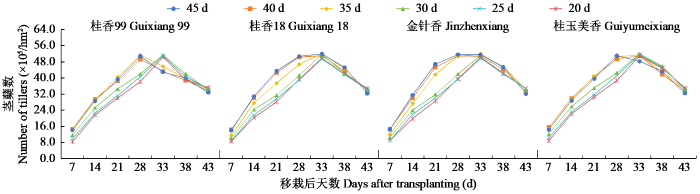
图1
不同秧龄下各烟后优质稻品种的茎蘖变化
Fig.1
The changes in tillers of high-quality rice varieties following tobacco under different seedling ages
2.4 秧龄对烟后优质稻品种干物质积累的影响
秧龄对供试品种各时期干物质量的影响均达极显著(表3)。整体上看,随秧龄的延长,分蘖期干物质量逐渐增加,而齐穗期和成熟期的干物质量逐渐降低,分蘖期―齐穗期、分蘖期―成熟期、齐穗期―成熟期干物质积累量随秧龄的延长而降低。35、40和45 d秧龄时分蘖前干物质量较高,但是分蘖后干物质积累量低,20、25和30 d秧龄时,成熟期干物质量及分蘖期―成熟期干物质积累量较高。
表3 不同秧龄下各烟后优质稻品种的干物质积累
Table 3
| 品种 Variety | 秧龄 Seedling age (d) | 分蘖期 Tillering stage | 齐穗期 Full heading stage | 成熟期 Maturity stage | 分蘖期―齐穗期 Tillering- Full heading | 分蘖期―成熟期 Tillering- Maturity | 齐穗期―成熟期 Full heading- Maturity |
|---|---|---|---|---|---|---|---|
| 桂香99 Guixiang 99 | 45 | 1.01±0.02a | 9.92±0.12b | 13.09±0.18c | 8.91±0.10c | 12.08±0.17c | 3.17±0.16c |
| 40 | 1.01±0.01a | 9.88±0.12b | 13.12±0.06c | 8.87±0.11c | 12.11±0.06c | 3.25±0.17c | |
| 35 | 0.92±0.04b | 10.20±0.35b | 13.83±0.33b | 9.27±0.31bc | 12.90±0.30b | 3.63±0.11abc | |
| 30 | 0.73±0.01c | 10.25±0.11b | 14.26±0.14a | 9.52±0.10b | 13.53±0.13a | 4.01±0.03a | |
| 25 | 0.73±0.03c | 10.81±0.30a | 14.62±0.20a | 10.08±0.29a | 13.89±0.17a | 3.81±0.22ab | |
| 20 | 0.72±0.03c | 10.99±0.26a | 14.31±0.19a | 10.27±0.27a | 13.58±0.16a | 3.32±0.40bc | |
| 桂香18 Guixiang 18 | 45 | 1.11±0.02a | 10.15±0.29c | 12.92±0.18b | 9.04±0.31c | 11.81±0.16c | 2.77±0.45a |
| 40 | 1.11±0.01a | 10.18±0.43c | 13.05±0.36b | 9.07±0.43c | 11.94±0.35c | 2.88±0.12a | |
| 35 | 1.02±0.04b | 10.56±0.11bc | 13.61±0.48a | 9.55±0.08b | 12.60±0.45b | 3.05±0.42a | |
| 30 | 0.79±0.03c | 11.06±0.34a | 13.63±0.23a | 10.27±0.31a | 12.84±0.20ab | 2.57±0.22a | |
| 25 | 0.79±0.06cd | 10.98±0.24ab | 13.61±0.48a | 10.18±0.29a | 12.82±0.51ab | 2.63±0.27a | |
| 20 | 0.75±0.03d | 11.00±0.11a | 13.90±0.27a | 10.26±0.12a | 13.16±0.30a | 2.90±0.28a | |
| 金针香 Jinzhenxiang | 45 | 0.90±0.01a | 9.98±0.15ab | 12.76±0.17d | 9.09±0.16c | 11.86±0.18e | 2.77±0.18b |
| 40 | 0.88±0.01a | 9.94±0.12b | 13.44±0.47c | 9.07±0.12c | 12.56±0.47d | 3.50±0.36a | |
| 35 | 0.81±0.03b | 10.11±0.31ab | 13.46±0.23c | 9.30±0.28bc | 12.65±0.20cd | 3.35±0.20a | |
| 30 | 0.63±0.01c | 10.32±0.24ab | 13.58±0.33bc | 9.69±0.25ab | 12.95±0.34bc | 3.26±0.56ab | |
| 25 | 0.62±0.01c | 10.39±0.48a | 13.90±0.13ab | 9.76±0.48a | 13.28±0.14ab | 3.51±0.61a | |
| 20 | 0.62±0.01c | 10.34±0.19ab | 13.99±0.36a | 9.72±0.18ab | 13.36±0.36a | 3.65±0.50a | |
| 桂玉美香 Guiyumeixiang | 45 | 1.22±0.03a | 11.20±0.36c | 14.23±0.20d | 9.99±0.38b | 13.01±0.18d | 3.03±0.53bc |
| 40 | 1.22±0.01a | 11.35±0.39c | 14.26±0.06d | 10.13±0.39b | 13.05±0.07d | 2.92±0.45c | |
| 35 | 1.12±0.04b | 11.49±0.13bc | 15.01±0.25c | 10.38±0.08b | 13.89±0.22c | 3.52±0.20ab | |
| 30 | 0.88±0.01c | 11.83±0.14ab | 14.99±0.53c | 10.95±0.14a | 14.11±0.52c | 3.16±0.41bc | |
| 25 | 0.88±0.01c | 12.09±0.07a | 15.50±0.15b | 11.21±0.06a | 14.63±0.16b | 3.42±0.19abc | |
| 20 | 0.85±0.05c | 12.06±0.37a | 15.97±0.52a | 11.21±0.41a | 15.12±0.55a | 3.92±0.17a | |
| 45 d | 1.06±0.13a | 10.31±0.58d | 13.25±0.62d | 9.26±0.50d | 12.19±0.53e | 2.94±0.36c | |
| 40 d | 1.05±0.13a | 10.34±0.67d | 13.47±0.56c | 9.28±0.58d | 12.42±0.51d | 3.14±0.37bc | |
| 35 d | 0.97±0.13b | 10.59±0.61c | 13.98±0.70b | 9.62±0.50c | 13.01±0.60c | 3.39±0.32ab | |
| 30 d | 0.76±0.09c | 10.87±0.70b | 14.12±0.67b | 10.11±0.62b | 13.36±0.60b | 3.25±0.62ab | |
| 25 d | 0.76±0.10c | 11.07±0.71ab | 14.41±0.80a | 10.31±0.63ab | 13.65±0.75a | 3.34±0.55ab | |
| 20 d | 0.74±0.09c | 11.10±0.68a | 14.54±0.93a | 10.36±0.60a | 13.81±0.87a | 3.45±0.50a | |
| 秧龄Seedling age | ** | ** | ** | ** | ** | ** | |
2.5 秧龄对烟后优质稻品种产量及其构成因素的影响
秧龄对供试品种有效穗数、结实率和产量的影响均达极显著(表4)。产量在20、25和30 d秧龄间差异不显著,但显著高于其他秧龄时的产量,超过30 d秧龄后,产量随秧龄延长而下降。有效穗数在20、25和30 d秧龄间差异不显著,其中桂香99、桂玉美香在20和25 d秧龄时的有效穗数显著高于40和45 d秧龄,但与30和35 d秧龄时差异不显著,桂香18、金针香在20 d秧龄时有效穗数显著高于35、40和45 d秧龄,但与25和30 d秧龄时差异不显著。从整体上看,35、40和45 d秧龄时的结实率低于20、25和30 d秧龄。以上结果表明,20、25和30 d秧龄时,供试品种能够获得较高的有效穗数和结实率,从而获得较高的产量。
表4 不同秧龄下各烟后优质稻品种的产量及其构成因素
Table 4
| 品种 Variety | 秧龄 Seedling age (d) | 有效穗数 Effective panicle number (×104/hm2) | 穗粒数 Grains per panicle | 结实率 Seed-setting rate (%) | 千粒重 1000-grain weight (g) | 产量 Yield (t/hm2) |
|---|---|---|---|---|---|---|
| 桂香99 Guixiang 99 | 45 | 264.0±6.0c | 191.6±0.8a | 75.5±0.4b | 21.3±0.2a | 7.20±0.03d |
| 40 | 269.0±4.6bc | 191.4±2.3a | 75.8±0.4b | 21.5±0.4a | 7.33±0.10c | |
| 35 | 276.0±10.8ab | 192.1±1.8a | 78.9±1.0a | 21.6±0.2a | 7.43±0.01b | |
| 30 | 277.0±4.6ab | 191.5±1.6a | 79.9±1.8a | 21.5±0.2a | 7.53±0.03a | |
| 25 | 280.0±6.9a | 191.8±1.9a | 80.0±0.5a | 21.3±0.2a | 7.59±0.05a | |
| 20 | 282.0±0.0a | 191.6±2.1a | 79.4±0.8a | 21.7±0.1a | 7.54±0.03a | |
| 桂香18 Guixiang 18 | 45 | 262.0±1.7c | 187.5±1.4a | 78.7±1.9a | 22.0±0.4a | 6.55±0.03c |
| 40 | 271.0±3.5b | 187.5±2.2a | 79.0±2.0a | 22.0±0.4a | 6.67±0.09b | |
| 35 | 272.0±9.2b | 188.2±1.7a | 79.4±1.0a | 21.9±0.4a | 6.72±0.15b | |
| 30 | 278.0±6.2ab | 187.7±1.5a | 80.5±1.8a | 22.1±0.3a | 6.85±0.03a | |
| 25 | 279.0±5.2ab | 188.0±1.8a | 80.5±0.5a | 21.9±0.5a | 6.85±0.07a | |
| 20 | 282.0±0.0a | 187.8±2.1a | 79.9±0.8a | 22.0±0.5a | 6.86±0.03a | |
| 金针香 Jinzhenxiang | 45 | 260.0±1.7c | 191.3±1.5a | 75.7±1.3c | 20.9±0.3a | 6.93±0.06c |
| 40 | 268.0±3.7bc | 191.3±2.3a | 76.9±0.4c | 21.0±0.1a | 6.98±0.08c | |
| 35 | 270.0±9.0b | 192.0±1.8a | 80.0±1.0b | 21.0±0.3a | 7.10±0.07b | |
| 30 | 275.0±6.2ab | 191.4±1.6a | 81.1±1.8ab | 21.4±0.2a | 7.27±0.05a | |
| 25 | 276.0±5.3ab | 191.7±1.9a | 82.1±0.6a | 20.9±0.3a | 7.26±0.03a | |
| 20 | 281.0±3.4a | 191.5±1.2a | 80.5±0.8ab | 21.0±0.3a | 7.26±0.02a | |
| 桂玉美香 Guiyumeixiang | 45 | 263.0±3.5c | 187.6±1.2a | 75.5±1.4c | 20.9±0.3a | 6.67±0.06c |
| 40 | 267.0±6.0bc | 187.5±2.2a | 76.7±0.4c | 21.0±0.2a | 6.64±0.02c | |
| 35 | 275.0±7.6ab | 188.2±1.7a | 79.5±0.5b | 20.7±0.2a | 6.85±0.03b | |
| 30 | 275.0±4.6ab | 187.6±1.5a | 80.9±0.8ab | 20.6±0.2a | 6.98±0.05a | |
| 25 | 277.0±6.9a | 187.9±1.8a | 81.6±0.7a | 20.9±0.2a | 6.96±0.04a | |
| 20 | 281.0±1.7a | 187.4±1.5a | 81.9±0.5a | 20.8±0.3a | 6.97±0.02a | |
| 45 d | 262.3±3.5e | 189.5±2.3a | 76.4±1.9c | 21.3±0.5a | 6.84±0.27d | |
| 40 d | 268.8±4.1d | 189.4±2.8a | 77.1±1.5c | 21.4±0.5a | 6.91±0.30c | |
| 35 d | 273.3±8.2c | 190.1±2.5a | 79.5±0.8b | 21.3±0.6a | 7.03±0.29b | |
| 30 d | 276.3±4.9bc | 189.6±2.4a | 80.61.4±a | 21.4±0.6a | 7.16±0.28a | |
| 25 d | 278.0±5.5ab | 189.8±2.6a | 81.1±1.0a | 21.2±0.5a | 7.17±0.30a | |
| 20 d | 281.5±1.7a | 189.6±2.6a | 80.4±1.2a | 21.4±0.6a | 7.16±0.28a | |
| 秧龄Seedling age | ** | ns | ** | ns | ** | |
“ns”表示差异不显著,下同。
“ns”indicates no significant differences, the same below.
相关分析(表5)发现,齐穗期、成熟期、分蘖期―齐穗期、分蘖期―成熟期、齐穗期―成熟期的干物质积累与有效穗数、结实率及产量均呈显著正相关,表明分蘖后干物质的积累是决定产量形成的关键因素。
表5 产量及其构成因素与干物质积累量间的相关性
Table 5
| 项目Item | 产量 Yield | 有效穗数 Effective panicle number | 穗粒数 Grains per panicle | 结实率 Seed-setting rate | 千粒重 1000-grain weight |
|---|---|---|---|---|---|
| 分蘖期干物质量Dry matter weight at tillering stage | -0.97** | -0.91** | -0.18 | -0.93** | 0.02 |
| 齐穗期干物质量Dry matter weight at full heading stage | 0.96** | 0.94** | 0.28 | 0.94** | -0.13 |
| 成熟期干物质量Dry matter weight at maturity stage | 0.96** | 0.98** | 0.42 | 0.95** | -0.10 |
| 分蘖期―齐穗期干物质积累量 Dry matter accumulation from tillering to full heading | 0.97** | 0.93** | 0.26 | 0.94** | -0.10 |
| 分蘖期―成熟期干物质积累量 Dry matter accumulation from tillering to maturity | 0.97** | 0.98** | 0.37 | 0.96** | -0.08 |
| 齐穗期―成熟期干物质积累量 Dry matter accumulation from full heading to maturity | 0.81* | 0.92** | 0.60 | 0.84* | 0.00 |
“**”表示相关性极显著(P < 0.01),“*”表示相关性显著(P < 0.05)。
“**”indicates extremely significant correlation (P < 0.01),“*”indicates significant correlation (P < 0.05).
2.6 秧龄对烟后优质稻品种稻米品质的影响
秧龄对供试品种糙米率、整精米率、垩白度和垩白粒率的的影响均达极显著(表6)。糙米率和整精米率随秧龄的延长呈降低趋势,糙米率在20、25和30 d秧龄时较高且处理间差异不显著,桂香99和桂玉美香的整精米率在20、25和30 d秧龄时较高且处理间差异不显著,桂香18和金针香的整精米率在30和25 d秧龄间差异不显著,在25和20 d秧龄间差异亦不显著。垩白粒率随秧龄的延长而降低,桂香99的垩白度随秧龄的延长也呈降低趋势,但桂香18和桂玉美香的垩白度在不同秧龄处理间无显著差异。同一品种不同秧龄处理间的粒长、长宽比、透明度和直链淀粉含量均无显著差异。以上结果表明,与35、40和45 d秧龄相比,20、25和30 d秧龄有利于供试品种的糙米率、整精米率,但不利于垩白粒率。
表6 不同秧龄下各烟后优质稻品种的稻米品质
Table 6
| 品种 Variety | 秧龄 Seedling age (d) | 糙米率 Brown rice rate (%) | 整精米率 Head rice rate (%) | 粒长 Grain length (mm) | 长宽比 Length-width ratio | 垩白度 Chalkiness degree (%) | 垩白粒率 Chalkiness rate (%) | 透明度 Transparency | 直链淀粉含量 Amylose content (%) |
|---|---|---|---|---|---|---|---|---|---|
| 桂香99 Guixiang 99 | 45 | 76.20±0.54b | 55.92±0.55c | 6.940±0.211a | 3.43±0.10a | 0.60±0.05d | 2.42±0.12c | 1.0±0.0a | 15.74±1.48a |
| 40 | 77.21±0.97b | 57.68±0.92b | 6.826±0.239a | 3.50±0.12a | 0.71±0.05c | 2.33±0.19c | 1.3±0.6a | 15.40±0.60a | |
| 35 | 79.57±2.07a | 59.05±1.70ab | 6.739±0.212a | 3.41±0.06a | 0.73±0.06bc | 3.15±0.14ab | 1.3±0.6a | 15.41±1.96a | |
| 30 | 80.43±1.57a | 59.37±0.93ab | 6.871±0.189a | 3.36±0.05a | 0.80±0.05bc | 2.93±0.21b | 1.3±0.6a | 16.02±0.28a | |
| 25 | 80.79±0.77a | 60.62±1.12a | 6.900±0.247a | 3.42±0.02a | 0.83±0.04b | 3.55±0.18a | 1.3±0.6a | 15.46±1.20a | |
| 20 | 79.25±0.99a | 59.17±0.84ab | 6.982±0.099a | 3.44±0.11a | 0.99±0.06a | 3.41±0.27a | 1.3±0.6a | 16.89±1.08a | |
| 桂香18 Guixiang 18 | 45 | 75.38±0.38c | 50.62±1.81d | 7.652±0.118a | 4.47±0.07a | 0.03±0.06a | 0.13±0.12d | 1.0±0.0a | 14.66±0.73a |
| 40 | 76.43±0.82bc | 52.15±0.80cd | 7.745±0.046a | 4.44±0.06a | 0.03±0.06a | 0.55±0.34cd | 1.0±0.0a | 14.50±1.62a | |
| 35 | 77.29±0.18b | 54.14±1.28ab | 7.757±0.106a | 4.43±0.06a | 0.08±0.02a | 0.53±0.03cd | 1.3±0.6a | 15.90±1.30a | |
| 30 | 79.34±1.35a | 54.66±0.65a | 7.771±0.039a | 4.47±0.10a | 0.07±0.06a | 0.79±0.27bc | 1.0±0.0a | 16.25±0.81a | |
| 25 | 79.27±2.20a | 53.67±1.02abc | 7.753±0.115a | 4.45±0.05a | 0.04±0.04a | 1.31±0.15a | 1.0±0.0a | 14.74±1.27a | |
| 20 | 79.72±1.95a | 52.55±0.43bc | 7.822±0.041a | 4.50±0.08a | 0.08±0.01a | 1.23±0.28ab | 1.0±0.0a | 16.14±0.49a | |
| 金针香 Jinzhenxiang | 45 | 76.62±0.07d | 54.75±0.87c | 7.669±0.285a | 4.37±0.10a | 0.14±0.12b | 0.40±0.29c | 1.3±0.6a | 17.83±0.82a |
| 40 | 77.54±0.23cd | 54.90±0.43c | 7.686±0.129a | 4.43±0.12a | 0.26±0.05a | 0.65±0.07c | 1.7±0.6a | 17.16±1.81a | |
| 35 | 79.00±0.39bc | 57.62±0.46a | 7.754±0.115a | 4.49±0.08a | 0.31±0.04a | 1.30±0.34b | 1.3±0.6a | 16.91±0.61a | |
| 30 | 80.54±1.33ab | 57.30±1.91a | 7.587±0.182a | 4.43±0.02a | 0.26±0.02a | 1.46±0.43b | 1.3±0.6a | 17.14±1.13a | |
| 25 | 79.94±0.93ab | 57.12±1.16ab | 7.655±0.272a | 4.46±0.19a | 0.28±0.06a | 2.07±0.34a | 1.7±0.6a | 18.10±2.52a | |
| 20 | 80.69±0.36a | 55.49±1.01bc | 7.548±0.220a | 4.45±0.02a | 0.07±0.12b | 2.47±0.18a | 1.3±0.6a | 18.01±1.91a | |
| 桂玉美香 Guiyumeixiang | 45 | 76.44±0.50c | 49.82±0.25b | 7.866±0.157a | 4.49±0.10a | 0.15±0.03a | 0.02±0.04e | 1.0±0.0a | 15.49±1.41a |
| 40 | 77.59±0.26bc | 50.49±1.19b | 7.745±0.204a | 4.54±0.11a | 0.13±0.01a | 0.49±0.43d | 1.0±0.0a | 15.17±0.47a | |
| 35 | 78.79±0.25ab | 53.52±1.48a | 7.725±0.106a | 4.51±0.10a | 0.11±0.10a | 1.28±0.29c | 1.3±0.6a | 16.19±2.59a | |
| 30 | 79.56±0.19a | 53.36±0.59a | 7.636±0.098a | 4.58±0.05a | 0.13±0.04a | 1.55±0.26c | 1.0±0.0a | 16.17±1.93a | |
| 25 | 80.18±0.33a | 53.05±1.11a | 7.710±0.163a | 4.63±0.06a | 0.12±0.02a | 2.67±0.63b | 1.0±0.0a | 14.55±0.65a | |
| 20 | 79.66±0.59a | 52.98±0.79a | 7.714±0.076a | 4.54±0.06a | 0.15±0.01a | 3.16±0.34a | 1.0±0.0a | 14.67±1.41a | |
| 45 d | 76.16±0.61d | 52.78±2.87d | 7.532±0.406a | 4.19±0.47a | 0.23±0.24b | 0.74±1.03d | 1.1±0.3a | 15.93±1.57a | |
| 40 d | 77.19±0.74c | 53.81±2.95c | 7.501±0.433a | 4.23±0.45a | 0.29±0.27a | 1.01±0.84c | 1.3±0.5a | 15.56±1.49a | |
| 35 d | 78.66±1.26b | 56.08±2.70b | 7.494±0.471a | 4.21±0.49a | 0.31±0.28a | 1.57±1.03b | 1.3±0.5a | 16.10±1.62a | |
| 30 d | 79.97±1.19a | 56.18±2.57a | 7.466±0.385a | 4.21±0.52a | 0.31±0.30a | 1.69±0.85b | 1.2±0.4a | 16.40±1.12a | |
| 25 d | 80.04±1.22a | 56.11±3.29a | 7.504±0.408a | 4.24±0.51a | 0.32±0.32a | 2.40±0.91a | 1.3±0.5a | 15.71±2.00a | |
| 20 d | 79.83±1.12a | 55.05±2.81a | 7.517±0.355a | 4.23±0.48a | 0.32±0.41a | 2.57±0.91a | 1.2±0.4a | 16.43±1.70a | |
| 秧龄Seedling age | ** | ** | ns | ns | ** | ** | ns | ns | |
3 讨论
3.1 不同秧龄对秧苗素质、生育期和干物质积累的影响
干物质积累量取决于作物光合作用能力,对产量形成至关重要[24],长秧龄造成全生育期的叶面积指数和结实期的光合速率下降,导致干物质积累量减少[25],曹静[20]研究表明,20 d秧龄时分蘖期的干物质积累低于40 d秧龄时,但齐穗期和成熟期干物质积累高于40 d秧龄时。本研究结果表明,35~45 d秧龄有利于分蘖前干物质的积累,但20~30 d秧龄有利于分蘖后干物质的积累,分析其原因发现,35~45 d秧龄比20~30 d秧龄能更快开始分蘖,也能更快达到最高分蘖数。同时本研究还发现,分蘖后干物质的积累对产量起决定作用,20~30 d秧龄时供试品种的成熟期干物质量及分蘖期―成熟期干物质积累量较高,这是该秧龄下品种高产形成的内在基础。
3.2 不同秧龄对产量及其构成因素和稻米品质的影响
合理的秧龄对移栽后群体质量乃至产量形成至关重要,过长的秧龄造成群体的有效穗数、穗粒数和结实率降低,从而导致产量降低[14]。彭福燕等[13]研究指出,在12~30 d秧龄范围内,产量随秧龄的延长先增加后降低,短秧龄时因有较高的有效穗数而获得较高产量。胡谷琅等[26]研究认为,20~40 d秧龄范围内,20 d秧龄时因有效穗数和穗粒数的增加而获得高产。不同类型品种的最适秧龄有区别,如籼型杂交稻泰两优217高产与优质的最适秧龄比籼粳杂交稻甬优1540短5~7 d[14],本研究表明,供试的籼型优质常规稻品种在20~30 d秧龄时的产量显著高于35~45 d秧龄时,具体表现在该秧龄下有效穗数和结实率高。本研究还发现,不同秧龄处理下供试品种的分蘖进程和最高分蘖数基本相同,然而超过35 d秧龄时的最终有效穗数低于20~30 d秧龄时,这说明长秧龄会导致更多的分蘖转变为无效分蘖。
秧龄通过影响水稻各生育阶段的光温资源分配,尤其是抽穗―成熟期所处的气候环境状态,从而间接地影响稻米品质的形成[27-28]。本研究结果表明,供试品种的糙米率和整精米率在20~30 d秧龄时较高,超过35 d秧龄明显下降,这与马义虎等[14]的研究结论不一致,可能是不同类型的品种对光温条件的响应不同造成的。本研究中,供试品种的垩白粒率随秧龄的延长逐渐降低,这与前人[13-14]研究结果一致,垩白度随秧龄的延长而降低的变化趋势不明显,特别是桂香18和桂玉美香的垩白度在不同秧龄间差异不显著,分析其原因发现,本研究中所用的供试品种均是低垩白的优质稻品种,延长秧龄能够进一步降低垩白度的空间很小。本研究中供试品种在各秧龄处理下的垩白度均<1%,符合《食用稻品种品质》[29]优质一等对垩白度的要求。各秧龄处理下,供试品种的透明度均是1级或2级,直链淀粉含量均在13.0%~20.0%,均符合《食用稻品种品质》[29]优质二等以上对透明度和直链淀粉含量的要求,这说明20~30 d秧龄时供试品种有较高的加工品质,其他稻米品质指标也能达优质等级。
烟叶种植中往往为提高上部烟叶成熟度而延长终采期,从而带来烟后水稻播种、插秧时劳动力不足和田块茬口紧张等问题。广西优质晚稻生产中,秧龄一般是20 d左右[30],但本研究表明,供试品种的产量、品质在25、30 d秧龄与20 d秧龄时没有显著区别,因此采用20~30 d秧龄,即可保证烟后水稻产量和品质,又能有足够的时间跨度协调烟叶终采期与水稻插秧期间的茬口矛盾。
4 结论
20~30 d秧龄是优质常规稻桂香99、桂香18、金针香和桂玉美香作烟后稻种植时实现高产优质相协调的最适秧龄。
参考文献
长期烟稻轮作对烟田土壤微生物多样性和群落结构的影响
Impact of tillage practices on soil bacterial diversity and composition under the tobacco-rice rotation in China
DOI:10.1007/s12275-017-6242-9
PMID:28251545
[本文引用: 1]

Tobacco-rice rotation is a common farming system in south China, and many tillage practices such as straw mulching, dolomite dust, and quicklime application have been adopted to improve crop production. These agricultural management practices alter soil physical and chemical properties and affect microbial life environment and community composition. In this research, six tillage practices including no tobacco and rice straw mulching (CK), tobacco and rice straw mulching (TrSr), rice straw returning fire (TrSc), tobacco and rice straw mulching with dolomite dust (TSD), rice straw returning fire and quicklime (TSQ), and rice straw returning fire, quicklime and reduced fertilizer (TSQf) were conducted to detect changes in soil bacterial diversity and composition using Illumina sequencing. The results showed that the total number of operational taxonomic units (OTUs) from the six treatments was 2030, and the number of mutual OTUs among all samples was 550. The TrSc treatment had the highest diversity and richness, while TSQf had the lowest. Soil physio-chemical properties and microbial diversity can influence each other. Proteobacteria and Actinobacteria had the greatest proportion in all treatments. The abundance of Nitrospirae was the highest in the TrSc treatment. The TSQf treatment had the highest abundance of Firmicutes. The abundance of Nitrospira in the TrSc treatment was 2.29-fold over CK. Streptomyces affiliated with Firmicutes improved by 37.33% in TSQf compared to TSQ. TSQf treatment was considered to be the most important factor in determining the relative abundance at the genus level.
Effects of seedbed management and delayed transplanting of rice seedlings on crop performance, grain yield, and water productivity
DOI:10.1016/j.fcr.2015.08.014 URL [本文引用: 1]
连作杂交晚稻精准条播长秧龄机插的生长及产量特性分析
DOI:10.3724/SP.J.1006.2022.02091
[本文引用: 1]
为明确精准条播(precision drill sowing, PS)在连作晚稻长秧龄机插中的有益效果。本试验以甬优1540为供试品种, 设置标准9寸秧盘横向16条(PS-16, 45.7 g 盘<sup>-1</sup>)和18条(PS-18, 60.5 g 盘<sup>-1</sup>)精准条播, 并以传统撒播(broadcast sowing, BS, 60.5 g 盘<sup>-1</sup>)作为对照, 同期播种, 设置20、25、30和35 d 4个机插秧龄, 比较分析各播种方式水稻秧苗素质、机插特性、群体生长及产量形成的变化。结果表明: (1) 精准条播提高秧苗群体透光性, 与撒播相比, 精准条播提高了长秧龄秧苗的素质, 增加了带分蘖秧苗的比例, 其中PS-16秧苗素质最好, 带分蘖秧苗的比例最高。(2) 与撒播相比, 精准条播显著降低机插漏秧率, 提高机插取秧2~3株苗比例, PS-16和PS-18间差异不明显。秧龄延长增加机插秧苗伤根程度和伤苗率, 降低秧苗存活率, 其中PS-16的伤根程度和伤苗率增加幅度最小, 机插秧苗存活率最高。(3) 机插秧龄延长增加了秧苗缓苗返青天数进而推迟水稻生育期, 各机插秧龄下, PS-16的缓苗返青期最短, 生育期因秧龄延长而推迟的天数最少。(4) 精准条播有效促进分蘖, 其中PS-16效果最好, PS-16机插10 d分蘖数平均比PS-18和BS高16.4%和20.8%。机插秧龄延长降低群体分蘖高峰苗数, 各秧龄下高峰苗数PS-16>PS-18>BS。成穗率在不同播种方式处理间差异不大。(5) 秧龄延长降低抽穗期叶面积指数和干物质积累, PS-16下降幅度最小。(6) 不同机插秧龄下, 精准条播通过增加有效穗数进而提高水稻产量, 有效降低了机插秧龄延长导致的产量损失, 各机插秧龄下产量PS-16>PS-18>BS。试验说明, 与传统撒播相比, 精准条播增强了秧苗素质, 提高了机插质量, 缩短了长秧龄下的返青时间, 促进了分蘖早发, 增加了叶面积指数和干物质积累, 进而有效减少了连作杂交晚稻因机插秧龄延长而引起的产量损失, 其中精准16条条播效果好于18条条播。
不同秧龄下机插方式与密度对杂交稻光合生产及产量的影响
DOI:10.16819/j.1001-7216.2017.6091 265
[本文引用: 2]
【目的】探究不同秧龄下机插方式与密度对杂交稻光合生产及产量的影响,为水稻机插秧配套技术的应用提供理论和实践依据,【方法】以超级杂交稻F优498为材料,采用两因素裂区试验设计,在25 d和40 d秧龄下,设置“钵苗机插+高密度(M<sub>1</sub>D<sub>1</sub>)”、“钵苗机插+中密度(M<sub>1</sub>D<sub>2</sub>)”、“钵苗机插+低密度(M<sub>1</sub>D<sub>3</sub>)”、“毯苗机插+高密度(M<sub>2</sub>D<sub>4</sub>)”、“毯苗机插+中密度(M<sub>2</sub>D<sub>5</sub>)”、“毯苗机插+低密度(M<sub>2</sub>D<sub>6</sub>)”6种机插方式与密度的处理开展试验。【结果】秧龄与插秧方式和密度对水稻主要生育期光合生产及最终产量均存在显著的调控作用,且互作效应显著。同一机插方式及密度处理下,机插25 d秧龄水稻的秧苗素质、群体茎蘖数、叶面积指数(LAI)、单茎叶片和茎鞘表观转运量及转运率、单茎和群体干物质量、阶段干物质积累量、群体生长率、光合势、抽穗后净同化率以及产量均明显优于40 d秧龄处理。同一秧龄和机插方式下,水稻群体茎蘖数、各时期LAI和衰减率、群体干物质量、光合势以及抽穗前干物质积累量、群体生长率、净同化率均表现出随密度的增加而增加的趋势;而抽穗后物质积累量、群体生长率、净同化率在25 d秧龄下钵苗机插均表现为随着密度的增加呈现先增加后降低的趋势,以M<sub>1</sub>D<sub>2</sub>处理最优,而毯苗机插则表现为随着密度的降低而降低的趋势,且钵苗机插各指标较毯苗优势明显。25 d秧龄下,钵苗机插行距33 cm、配套株距14.5~15.5 cm,因群体总颖花数、结实率的优势,产量显著高于其余处理,其中又以行距33 cm、株距15.5 cm最能充分发挥其杂交籼稻株型的优势,提高光合物质生产,产量最高可达到12.74 t/hm<sup>2</sup>,是本研究最佳组合;而毯苗机插随秧龄增大以及栽插密度的降低,群体质量指标恶化,有效穗数不同程度降低,产量并不高。
不同秧龄下机插方式与密度对杂交稻根系生长及氮素利用特征的影响
DOI:10.16819/j.1001-7216.2017.7019
【目的】 机插秧是当前我国水稻种植发展的主要方向,探索不同秧龄下机插方式与密度对杂交稻根系生长及氮素利用特征的影响,对提高水稻产量和氮肥利用率,加快水稻机械化高产高效栽培技术的集成具有重要意义。【方法】 以超级杂交稻F优498为材料,采用两因素裂区试验设计,在25 d和40 d秧龄下,通过“钵苗机插+高密度”、“钵苗机插+中密度”、“钵苗机插+低密度”、“毯苗机插+高密度”、“毯苗机插+中密度”、“毯苗机插+低密度”6种机插方式与密度配合的处理,研究其对氮素利用特征、根系生长特性的影响,并探讨根系生长与氮素利用及产量的关系。【结果】 各生育时期氮素吸收与各阶段氮素积累量,齐穗至成熟期氮素吸收速率、茎和叶的氮素转运量、穗部氮素增加量、氮素偏生产力、拔节后根系干质量以及产量,25 d秧龄均较40 d秧龄优势明显。在相同秧龄下,与毯苗机插相比,钵苗机插可促进杂交稻各生育时期根系生长,提高氮素积累及吸收速率,增加结实期各器官氮素的转运量,从而提高稻谷产量;尤其在秧龄25 d、钵苗机插株距为15.5 cm时,较其他处理优势明显,为本研究最优处理。毯苗机插在25 d秧龄与株距为12 cm时,也能够获得较高产量;密度降低,提高了根冠比及茎叶转运率,但降低了各时期的氮素积累量、吸收速率以及结实期茎叶的转运量,产量较低。相关性分析表明,不同秧龄机插方式与密度配合下,主要生育时期根干质量与产量及氮素吸收利用均存在极显著正相关( r = 0.47**~ 0.83**),齐穗和成熟期根冠比与产量及氮素吸收利用均极显著负相关( r = -0.52**和-0.79**)。【结论】 机插杂交稻25 d秧龄根系生长及氮素利用特性均优于40 d秧龄,且钵苗较毯苗机插能优化水稻个体与群体关系,但其机插密度不宜过高或过低,行距与株距以33 cm×15.5 cm为宜,可促进氮素吸收利用及产量同步提高;且拔节与成熟期根系的生长对产量影响显著。研究结果可为水稻钵苗机插秧高产高效栽培技术集成及应用提供技术和实践依据。
Effects of seedling age on the growth stage and yield formation of hydroponically grown long- mat rice seedlings
DOI:10.1016/S2095-3119(19)62756-5 URL [本文引用: 1]
播种量和秧龄对机插籼粳杂交稻秧苗素质、产量和加工品质的影响
DOI:10.3969/j.issn.1006-8082.2024.03.016
[本文引用: 1]
适宜的播种量与秧龄搭配是保障水稻丰产优质的前提。以籼粳杂交稻甬优6711为供试品种,采用两因素(播种量、秧龄)裂区设计,以探明不同秧龄和播种量处理(T1,秧龄20 d、播种量50 g/盘;T2,秧龄20 d、播种量70 g/盘;T3,秧龄30 d、播种量50 g/盘;T4,秧龄30 d、播种量70 g/盘)对机插稻秧苗素质、产量和加工品质的影响。结果表明,T2和T3处理的产量较高,较T1处理分别增产24.7%和25.2%,较T4处理分别增产17.4%和17.8%。与20 d秧龄处理相比,30 d秧龄处理显著增加苗高、茎基宽、百苗地上及地下部干物质量;70 g/盘播种量处理较50 g/盘播种量处理显著降低苗高、茎基宽和发根力。整体而言,T3处理的秧苗素质最好。从稻米加工品质来看,与20 d秧龄处理相比,30 d秧龄处理的精米率和整精米率均显著下降,但糙米率差异不显著;与50 g/盘播种量处理相比,70 g/盘播种量处理能显著提高糙米率和精米率,但对整精米率影响小。综合来看,T2处理的稻米加工品质最优,而T3处理降低了稻米加工品质。因此,在苏北杂交中粳稻种植区,选择短秧龄、高播量搭配(T2)能同时获得丰产优质,长秧龄、低播量搭配(T3)能获得丰产,但稻米加工品质显著下降。
印度梨形孢与复合肥组合施用对水稻机插秧秧苗素质的影响
DOI:10.16819/j.1001-7216.2025.240706
[本文引用: 1]
【目的】探索印度梨形孢(Piriformospora indica)在水稻生产中的使用方式及应用效果。【方法】以泰优203和ZY246籼稻品种为研究材料,以1 g/L的印度梨形孢菌液为基准施用量,运用灰色关联度分析方法,综合评估了印度梨形孢、复合肥及其组合施用三种处理方式对水稻机插秧秧苗素质的影响。【结果】复合肥不会影响印度梨形孢在水稻根部的正常定殖,可以将印度梨形孢与复合肥组合施用;两者的组合施用不仅能显著促进秧苗生长,提高秧苗生物量、叶绿素含量、根系活力和硝酸还原酶活性,还能促进生长相关基因的表达。【结论】本研究不仅深化了对印度梨形孢促进水稻生长机制的理解,而且为印度梨形孢在水稻生产中的实际应用,尤其是机插秧育秧环节,提供了理论依据和实践指导。
Crop performance and water productivity of transplanted rice as affected by seedling age and seedling density under alternate wetting and drying conditions in Lao PDR
DOI:10.3390/w11091816
URL
[本文引用: 1]
Drought is common under rainfed lowlands in Lao People’s Democratic Republic, and with the uncertain onset of rains during the wet season, delay in transplanting results in yield reduction. This study aims to explore ways to ameliorate the negative influence of delayed transplanting on rice crop. A field experiment was conducted for two wet seasons to investigate the effect of seedling age and seedling density on crop performance in terms of grain yield and water productivity. The experiment was laid out in a split–split plot design in four replicates, with seedling age as the main plot, seedling density as the subplot, and varieties as the sub-sub plot. In both years, there were significant seedling age and variety interactions on grain yield. Higher grain yields were observed with older seedlings having stronger tillering propensity. Seedling density did not affect grain yields in both years, but on grain yield components. Shorter duration variety received less supplemental irrigation than longer duration varieties. Late transplanting improved total water productivity but decreased irrigation water productivity due to harvesting delay. The total crop growth duration (from sowing to maturity) was prolonged with transplanting delay. However, the total stay of plants in the main field (from transplanting to maturity) was reduced by 3–5 d for every 10 d delay in transplanting. The results indicated that a good selection of varieties and increasing seedling density improve crop performance and water productivity with delayed transplanting.
长江中下游双季晚粳稻产量、生育时期及温光资源配置的生态性差异
DOI:10.16819/j.1001-7216.2021.201109
[本文引用: 1]
【目的】明确不同类型双季晚粳稻在长江中下游不同生态区产量表现、生育期及温光资源配置差异,为早籼-晚粳模式在长江中下游稻区应用提供理论依据。【方法】试验于2018–2019年在浙江富阳(30.13°N,海拔41.7 m)和温州(28.52°N,海拔83 m)开展。选择生产上大面积应用品种,以高产籼稻(IR)为对照,设置常规粳稻(IJR)和籼粳杂交稻(IJHR)2个处理。比较不同生态区晚季温光条件下籼稻、常规粳稻和籼粳杂交稻在产量、生育特性以及温光资源配置上的差异。【结果】1)低纬度下粳型水稻品种干物质量、有效穗数及库容较高纬度均有所下降,导致产量降低2.4%~19.1%;但结实率和千粒重稳定或略有提高。同时,籼粳杂交稻产量在两地均最高,分别为8.8~10.3 t/hm<sup>2</sup>(富阳)和8.0~10.2 t/hm<sup>2</sup>(温州);2)供试品种生育时期因纬度不同而存在差异。与高纬度相比,低纬度的水稻营养生长期无显著差异,穗发育期有所缩短(4.2%~27.3%),而灌浆期显著缩短,其中籼稻、常规粳稻以及籼粳杂交稻分别缩短7.3%~11.9%、20.8%~41.9%以及23.1%~35%。3)不同生育阶段温光配置差异主要体现在灌浆期,平均温度低纬度要高于高纬度(籼稻提高0.4~2.4 ℃;常规粳稻2.3~3.5 ℃;籼粳杂交稻2.5~2.8 ℃);有效积温纬度间的差异随品种类型而异,其中籼稻无显著变化,常规粳稻和籼粳杂交稻分别降低24.7~126.4 ℃和25.7~107 ℃。4)主成分分析表明,纬度变化造成的温光资源积累差异(PC1和PC2)是主因(贡献度49%),也是产量差异的主要原因;其次为品种的温光敏感性(PC5,贡献度18%)以及品种的穗粒结构(PC3,贡献度14%)。【结论】与高纬相比,低纬粳型水稻产量降低主要源于生育期缩短(灌浆期为主),有效积温减少,库容降低。籼粳杂交稻在低纬度仍具有较高的产量优势,可能源于其较强的穗粒优势。有鉴于此,重(大)穗型粳稻在长江中下游较低纬度双季晚稻种植可能更具有应用潜力。
施氮量对优质常规稻‘桂育11号’干物质生产及氮肥利用率的影响
Application of nitrogen fertilizer at heading stage improves rice quality under elevated temperature during grain-filling stage
DOI:10.2135/cropsci2016.05.0350
URL
[本文引用: 1]
Global warming would deteriorate rice (Oryza sativa L.) quality, especially chalk characteristic. To better cope with the challenges from global warming, the effects of nitrogen (N) fertilizer at heading stage on rice quality under elevated temperature during grain‐filling stage were investigated. Four different growth regimes, including no warming without N fertilizer at heading stage (CK), elevated temperature without N fertilizer at heading stage (ET), elevated temperature with N fertilizer at heading stage (ET+N), no warming with N fertilizer at heading stage (CK+N), were conducted. Elevated temperature during grain filling was achieved by a free‐air temperature enhancement facility with the increase of 4°C in ET and 3.7°C in ET+N. Results showed that elevated temperature decreased rice appearance quality and cooking quality and increased rice nutritional quality and eating quality. Grain‐filling rate and amyloplast development for both superior and inferior spikelets were obviously accelerated during early grain‐filling stage by elevated temperature. The application of N fertilizer at heading stage could inhibit the deterioration of rice quality, particularly for chalk performance, and may be associated with the alleviation of grain‐filling rate and amyloplast development. The above evidence indicated that the application of N fertilizer at heading stage is efficient to mitigate rice quality deterioration under higher temperatures in the Yangtze River Valley.


