



Trihelix基因家族是植物特有的转录因子家族,于20世纪80年代首次从豌豆中分离出来[3]。该家族成员均含有3个连续的α螺旋结构域,该结构域能特异性地与光响应元件(GT元件)的核心序列5’-GTGTGGTTAATATG-3’结合,因而该家族也被称为GT因子家族[4]。已有研究[5-6]表明,trihelix家族基因在植物生长发育和逆境响应等过程中具有复杂且多样的调控功能。在拟南芥中,trihelix转录因子PETAL LOSS(PTL)的突变会导致萼片扭曲、边缘融合,并影响花瓣的大小、形状和数量[5]。玉米trihelix基因ZmGT-3b敲除后,增强了玉米抗稻瘟病的能力,同时抗旱性显著提高,但抑制了幼苗的生长,光合活性也显著降低[6]。
本研究以向日葵全基因组数据为基础,系统开展了trihelix基因家族的进化关系分析、染色体定位、基因复制、共线性以及组织表达模式分析,并系统解析了trihelix基因在列当接种胁迫下的表达模式。研究结果为向日葵trihelix基因的功能解析及抗逆遗传育种奠定理论基础,同时也对其他作物寄生杂草的防控研究具有重要的参考价值。
1 材料与方法
1.1 试验材料与试验设计
以本课题组选育的高感列当F-小种的向日葵自交系09108A为试验材料,向日葵种子用75%乙醇消毒3 min,用无菌水冲洗5次。消毒完成后的种子放置在无菌滤纸上。将包裹种子的滤纸竖起来,放入装有无菌水(深约2 cm)的塑料杯中。将塑料杯置于光照培养箱中进行培养,温度为24 ℃。先进行1 d暗培养,随后转为光照培养,光周期为14 h/10 h(光照/黑暗),光照强度为8000 lx,温度不变。培养过程中,定期向塑料杯中添加无菌水,保持2 cm深度。待主根长度超过10 cm时,在根部附近均匀撒布0.01 g列当种子,并在接种后的不同时间点(0、4、16、24、48和72 h)采集根系样品,迅速放入液氮中速冻。试验设置3次重复。此外,还对向日葵自交系09108A开展了组织特异性表达模式分析:2024年5月30日,将09108A种植于白城市农业科学院院内的试验基地;分别采集其六叶期的根、茎、叶、芽以及开花期的管状花等样品,保存于-80 ℃冰箱中,用于后续qRT-PCR试验。
1.2 向日葵trihelix家族成员的鉴定和理化性质分析
从NCBI数据库(
采用2种方法鉴定向日葵trihelix家族成员:(1)从Pfam数据库(
通过ExPASy网站(
1.3 向日葵trihelix基因家族系统进化树的构建、基因结构和保守基序分析
利用MEGA v7.0软件对蛋白序列进行ClustalW多序列比对。采用邻接法构建系统进化树,并将进化树文件保存为Newick格式。通过iTOL网站(
1.4 向日葵trihelix基因家族染色体定位和共线性分析
将向日葵trihelix蛋白序列进行BlastP比对,筛选复制基因,并用Circos软件绘制共线关系图。使用TBtools v2.142软件[10]对向日葵与拟南芥、向日葵与水稻trihelix家族基因进行共线性分析。
1.5 组织特异性和列当胁迫下表达模式分析
1.6 荧光定量PCR检测
利用超纯RNA提取试剂盒(CW6581S,江苏康为世纪生物科技股份有限公司)进行总RNA的提取。使用UEIris II RT-PCR System for First-Strand cDNA Synthesis试剂盒(R2028,苏州探研生命科技有限公司)合成cDNA。吸取2 μL cDNA溶液作为模板,进行荧光定量PCR试验。PCR反应体系:2×SYBR Green qPCR Master Mix 5 μL,上、下游引物(10 μmol/L)各0.5 μL,cDNA 2 μL,去RNA酶的超纯水2.0 μL。反应程序:预变性95 ℃,10 min;变性95 ℃、15 s,退火60 ℃、34 s,40个循环;熔解阶段95 ℃、15 s,60 ℃、1 min,95 ℃、15 s。引物序列见表1。采用2-∆∆Ct方法计算荧光定量结果。
表1 qRT-PCR所需引物
Table 1
| 基因名称Gene name | 正向引物(5’-3’)Forward primer (5’-3’) | 反向引物(5’-3’)Reverse primer (5’-3’) |
|---|---|---|
| HaTrihelix6 | GCCGTGGCAGAGGATGAA | GCCGTATCGGAAACTTGAT |
| HaTrihelix12 | ACGTCGTCTCAGCTCCATC | TCACCGTCATCAGTAAATCCA |
| HaTrihelix15 | TTGAAGCGATTGTGAAAGAG | TGCCGAGACAGACGATAA |
| HaTrihelix16 | ATGACTGAACCTCCACCG | CAAATCCCTCGTCTCCTG |
| HaTrihelix19 | ACAATGCGGGAAGTAGAG | GCGAAGAGCTTAGCGATC |
| HaTrihelix20 | CCACCACAACCGACACCA | CGGATACCGATACAGATACAGGA |
| HaTrihelix26 | ACCCGAACCCTGATGTGA | CCCTCGCCAACTCCTTAT |
| HaTrihelix27 | TGAATGAAACCGCTCTGC | ACCGTTGTCATCATCCCT |
| HaTrihelix28 | GCCCGCAATGCAGTTATT | GTCGGTTGTGCTGGTGGT |
| HaTrihelix31 | CCACCAAGTCAGCCTCATG | CAGCACTCAGACTCGCAGTT |
| 18S rRNA | CTACCACATCCAAGGAAGGCAG | CGACAGAAGGGACGAGTAAACC |
2 结果与分析
2.1 向日葵trihelix家族成员的鉴定及其编码蛋白的理化性质分析
通过2种鉴定方法及保守结构域的验证分析,最终在向日葵基因组中共鉴定出46个trihelix家族成员。根据染色体定位顺序,将其命名为HaTrihelix1~HaTrihelix46(表2)。理化性质分析表明,向日葵trihelix蛋白氨基酸数目为53~916。分子量范围在6.11~102.44 kDa。等电点分布范围在4.47~10.28。38个成员的不稳定系数>40.00,为稳定蛋白。所有蛋白的亲水性系数均为负值,表明其普遍具有亲水特性。亚细胞定位预测发现,41个成员主要定位于细胞核。
表2 向日葵trihelix家族蛋白的理化性质
Table 2
| 基因名称 Gene name | 基因登录号 Gene ID | 氨基酸数目 Amino acid number | 分子量 Molecular weight (kDa) | 等电点 Isoelectric point | 不稳定系数 Instability index | 亲水系数 Hydrophilicity coefficient | 亚细胞定位预测 Subcellular location prediction |
|---|---|---|---|---|---|---|---|
| HaTrihelix1 | HanXRQr2_Chr01g0009681 | 251 | 30.12 | 7.44 | 57.26 | -1.127 | 细胞核 |
| HaTrihelix2 | HanXRQr2_Chr01g0010711 | 306 | 33.75 | 8.19 | 46.31 | -0.802 | 细胞核 |
| HaTrihelix3 | HanXRQr2_Chr01g0028301 | 290 | 33.40 | 8.60 | 54.58 | -0.883 | 叶绿体、细胞核 |
| HaTrihelix4 | HanXRQr2_Chr01g0028311 | 347 | 38.41 | 8.88 | 48.68 | -0.801 | 细胞核 |
| HaTrihelix5 | HanXRQr2_Chr01g0031811 | 371 | 42.72 | 5.57 | 47.30 | -1.065 | 细胞核 |
| HaTrihelix6 | HanXRQr2_Chr01g0041281 | 546 | 62.21 | 8.28 | 49.09 | -0.622 | 叶绿体、细胞核 |
| HaTrihelix7 | HanXRQr2_Chr01g0041321 | 188 | 20.81 | 9.24 | 34.10 | -0.713 | 细胞核 |
| HaTrihelix8 | HanXRQr2_Chr01g0041331 | 517 | 56.29 | 7.52 | 32.24 | -0.449 | 叶绿体 |
| HaTrihelix9 | HanXRQr2_Chr01g0041541 | 426 | 49.22 | 7.46 | 60.04 | -0.763 | 叶绿体、细胞核 |
| HaTrihelix10 | HanXRQr2_Chr02g0047701 | 390 | 44.23 | 4.63 | 42.36 | -1.203 | 细胞核 |
| HaTrihelix11 | HanXRQr2_Chr02g0064991 | 53 | 6.11 | 7.26 | 36.06 | -0.743 | 细胞核 |
| HaTrihelix12 | HanXRQr2_Chr02g0065041 | 593 | 65.41 | 6.04 | 61.03 | -0.859 | 细胞核 |
| HaTrihelix13 | HanXRQr2_Chr03g0088951 | 379 | 44.61 | 4.55 | 41.14 | -1.195 | 细胞核 |
| HaTrihelix14 | HanXRQr2_Chr03g0095111 | 916 | 102.44 | 8.26 | 47.23 | -0.391 | 叶绿体 |
| HaTrihelix15 | HanXRQr2_Chr03g0123561 | 248 | 27.74 | 4.54 | 57.25 | -0.617 | 细胞核 |
| HaTrihelix16 | HanXRQr2_Chr03g0124371 | 315 | 36.67 | 8.66 | 61.91 | -1.210 | 细胞核 |
| HaTrihelix17 | HanXRQr2_Chr03g0132841 | 380 | 42.89 | 10.08 | 42.61 | -0.979 | 细胞核 |
| HaTrihelix18 | HanXRQr2_Chr04g0169001 | 596 | 66.77 | 6.10 | 87.15 | -1.220 | 细胞核 |
| HaTrihelix19 | HanXRQr2_Chr04g0172241 | 369 | 41.03 | 9.89 | 59.84 | -0.763 | 细胞核 |
| HaTrihelix20 | HanXRQr2_Chr05g0216931 | 494 | 52.72 | 8.45 | 37.93 | -0.142 | 叶绿体 |
| HaTrihelix21 | HanXRQr2_Chr05g0227381 | 339 | 38.80 | 4.99 | 50.22 | -1.011 | 细胞核 |
| HaTrihelix22 | HanXRQr2_Chr05g0236141 | 650 | 72.51 | 7.50 | 72.61 | -0.979 | 细胞核 |
| HaTrihelix23 | HanXRQr2_Chr06g0242381 | 375 | 42.34 | 6.80 | 42.90 | -0.893 | 叶绿体、细胞核 |
| HaTrihelix24 | HanXRQr2_Chr06g0253741 | 373 | 42.14 | 6.28 | 37.49 | -0.643 | 叶绿体、细胞核 |
| HaTrihelix25 | HanXRQr2_Chr07g0299811 | 412 | 46.36 | 10.00 | 73.35 | -1.217 | 细胞核 |
| HaTrihelix26 | HanXRQr2_Chr09g0382641 | 249 | 28.48 | 10.28 | 26.94 | -1.052 | 叶绿体、细胞核 |
| HaTrihelix27 | HanXRQr2_Chr09g0415361 | 352 | 40.65 | 4.55 | 42.12 | -1.334 | 细胞核 |
| HaTrihelix28 | HanXRQr2_Chr10g0420111 | 632 | 70.22 | 6.29 | 75.62 | -0.956 | 细胞核 |
| HaTrihelix29 | HanXRQr2_Chr10g0430831 | 239 | 28.97 | 8.65 | 71.37 | -1.215 | 细胞核 |
| HaTrihelix30 | HanXRQr2_Chr11g0466401 | 290 | 33.40 | 8.60 | 54.58 | -0.883 | 叶绿体、细胞核 |
| HaTrihelix31 | HanXRQr2_Chr11g0505381 | 309 | 34.94 | 9.43 | 41.31 | -0.877 | 叶绿体、细胞核 |
| HaTrihelix32 | HanXRQr2_Chr11g0515851 | 411 | 46.36 | 6.02 | 53.48 | -1.042 | 细胞核 |
| HaTrihelix33 | HanXRQr2_Chr11g0516471 | 424 | 48.17 | 7.83 | 45.52 | -0.859 | 细胞质、过氧化物酶体 |
| HaTrihelix34 | HanXRQr2_Chr12g0555331 | 296 | 33.83 | 9.04 | 65.97 | -1.024 | 细胞核 |
| HaTrihelix35 | HanXRQr2_Chr12g0564671 | 304 | 34.18 | 5.03 | 61.58 | -0.782 | 细胞核 |
| HaTrihelix36 | HanXRQr2_Chr13g0619331 | 510 | 59.83 | 6.59 | 59.59 | -1.035 | 细胞核 |
| HaTrihelix37 | HanXRQr2_Chr15g0709391 | 393 | 44.78 | 8.24 | 47.19 | -0.932 | 细胞核 |
| HaTrihelix38 | HanXRQr2_Chr15g0715481 | 430 | 49.47 | 6.33 | 55.32 | -0.881 | 细胞核 |
| HaTrihelix39 | HanXRQr2_Chr16g0726631 | 362 | 41.50 | 4.47 | 33.58 | -1.129 | 细胞核 |
| HaTrihelix40 | HanXRQr2_Chr16g0741871 | 273 | 32.45 | 5.78 | 56.67 | -1.149 | 细胞核 |
| HaTrihelix41 | HanXRQr2_Chr16g0753561 | 422 | 48.34 | 6.33 | 63.42 | -0.872 | 细胞核 |
| HaTrihelix42 | HanXRQr2_Chr16g0774461 | 273 | 30.76 | 5.13 | 49.31 | -0.806 | 细胞核 |
| HaTrihelix43 | HanXRQr2_Chr17g0779611 | 345 | 39.11 | 9.44 | 31.35 | -0.766 | 叶绿体 |
| HaTrihelix44 | HanXRQr2_Chr17g0786401 | 254 | 28.67 | 5.60 | 44.26 | -0.729 | 细胞核 |
| HaTrihelix45 | HanXRQr2_Chr17g0786421 | 252 | 28.38 | 5.59 | 43.24 | -0.728 | 细胞核 |
| HaTrihelix46 | HanXRQr2_Chr17g0814401 | 368 | 40.99 | 10.06 | 60.70 | -0.867 | 细胞核 |
2.2 向日葵trihelix家族成员的染色体定位和共线性分析
46个trihelix家族成员不均匀地分布于15条染色体上,染色体8和染色体14上无分布。染色体1上含有trihelix基因的数量最多(9个);染色体3上含有5个trihelix基因,染色体11、染色体16和染色体17上各有4个trihelix基因;其他染色体上分布的较少,多为1~3个trihelix基因(图1)。利用MCScanX软件对向日葵trihelix家族成员进行复制事件分析,结果发现,trihelix基因家族中存在3对串联复制基因,9个家族成员之间形成了6对片段复制基因。
图1
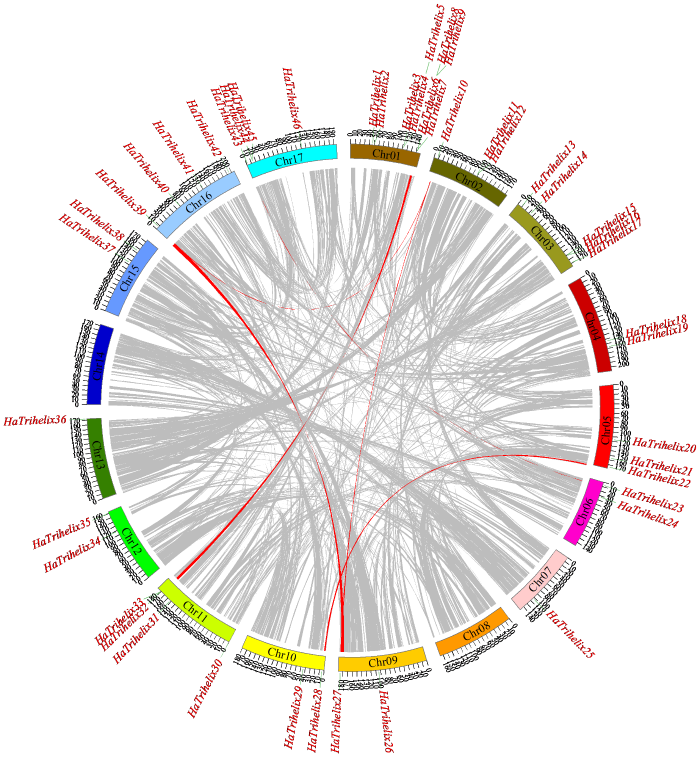
图1
向日葵trihelix基因家族的共线性分析
红色字体的基因为串联复制基因对,长红线表示片段复制基因对。
Fig.1
Collinearity analysis of trihelix gene family in sunflower
Genes shown in red are tandem duplication genes pairs, and the long red line indicates gene pairs involved in segmental duplication.
为解析向日葵与其他物种trihelix基因的进化关系及功能保守性,对向日葵、拟南芥和水稻的种间共线性关系进行分析。结果显示,向日葵trihelix基因与拟南芥、水稻分别存在8对和6对共线基因(图2)。与水稻相比,向日葵与拟南芥之间的亲缘关系更加密切。
图2
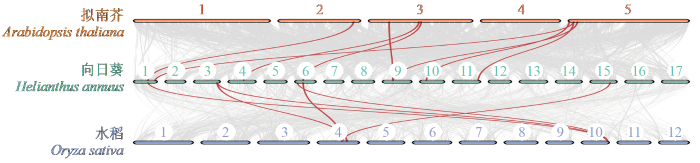
图2
3个物种间trihelix家族基因共线性分析
Fig.2
Collinearity analysis of trihelix family genes among three species
2.3 向日葵trihelix基因家族系统进化分析
基于邻接法构建系统发育树,向日葵trihelix家族被划分为GT-1、GT-2、SH4、GTγ和SIP1共5个亚家族,且在不同亚家族中的分布不均匀(图3)。其中,SIP1亚家族成员数量最多,其次为GT-2,SH4亚家族含有7个成员,GT-1亚家族含有6个成员,而GTγ亚家族仅含有4个成员。
图3
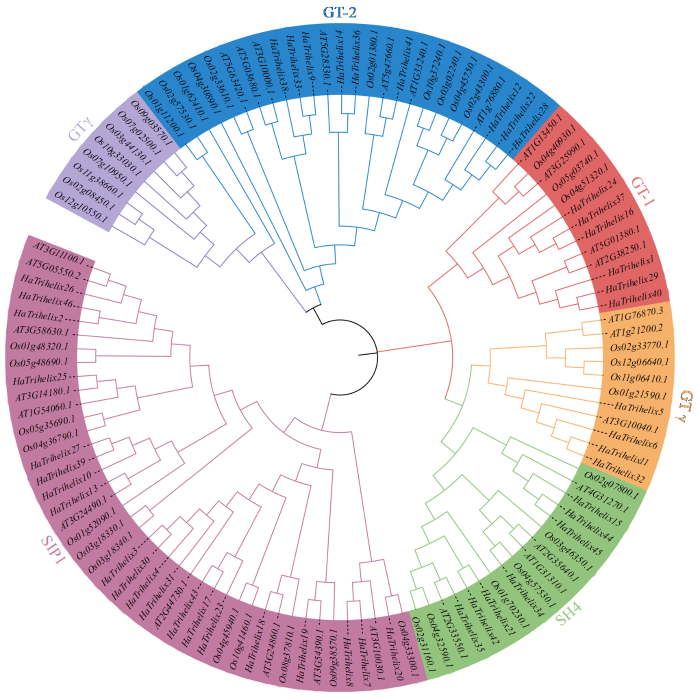
图3
向日葵、拟南芥和水稻trihelix基因家族的系统进化树分析
Fig.3
Phylogenetic tree analysis of trihelix genes among Helianthus annuus, Arabidopsis thaliana and Oryza sativa
2.4 向日葵trihelix基因结构与保守基序分析
如图4a所示,除HaTrihelix8、HaTrihelix13、HaTrihelix14、HaTrihelix20、HaTrihelix21、HaTrihelix34、HaTrihelix36和HaTrihelix37基因长度大于4 kb外,其他36个向日葵trihelix基因长度均在4 kb以内。约89.13%的成员外显子数量在1~3个,仅有5个成员(HaTrihelix8、HaTrihelix14、HaTrihelix20、HaTrihelix24和HaTrihelix37)的外显子数量在3个以上。保守基序分析发现,Motif 1存在于所有家族成员中(图4b和4c)。不同亚家族的成员也含有各自独有的基序。大部分SIP1亚家族
成员(除HaTrihelix7、HaTrihelix8和HaTrihelix20外)特异性含有Motif 4。除HaTrihelix11外,3个GTγ亚家族成员均包含Motif 10(图4b)。
图4
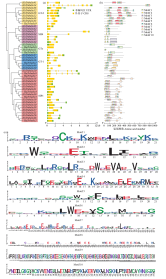
图4
向日葵trihelix家族成员基因结构和保守基序分析
Fig.4
Gene structure and motif analysis of sunflower trihelix family members
基于DNAman多序列比对分析(图5)发现,向日葵trihelix家族的所有蛋白均包含典型的三螺旋结构特征。在3个串联螺旋结构中,有5个氨基酸位点几乎没有发生变异:螺旋1(Helix 1)中的色氨酸(tryptophan,W)和亮氨酸(leucine,L)、螺旋2(Helix 2)的色氨酸以及螺旋3(Helix 3)的半胱氨酸(cystine,C)和亮氨酸(图5)。4个保守基序(Motif1/2/3/6)与三螺旋结构相对应:Motif 2为Helix 1,Motif 6为Helix 2,Motif 3覆盖Helix 1和Helix 2,而Motif 1构成Helix 3(图4b、图4c和图5)。
图5
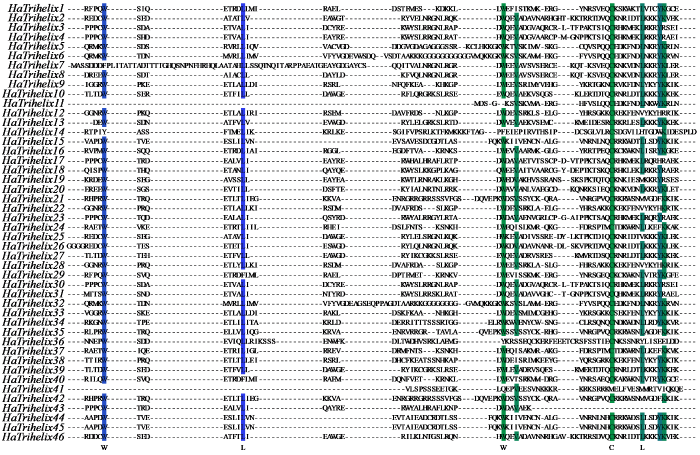
图5
向日葵trihelix转录因子三螺旋结构域氨基酸序列比对
Fig.5
Multiple sequence alignment of triple helix domains of sunflower trihelix transcription factors
2.5 向日葵trihelix基因的组织表达模式
基于NCBI公共转录组数据库,本研究系统解析了向日葵trihelix基因家族在根、茎、叶、花和芽中的表达情况。结果表明,36个trihelix基因在向日葵不同器官中检测到表达活性,但其表达水平在不同组织中呈现显著差异(图6a)。根据表达模式聚类可划分为5类,只有类群Ⅰ基因在根、茎和芽中具有相对较高的表达。类群Ⅱ基因在2种组织(根和芽)中表达水平较高。此外,还有部分基因只在特定的组织中相对高表达,类群Ⅲ基因只在花中具有较高的表达量,类群Ⅳ基因只在芽中呈现显著的表达优势,而类群Ⅴ基因只在茎中高表达。上述组织特异性表达模式结果表明,类群Ⅲ、Ⅳ和Ⅴ基因分别在花、芽和茎的生长和发育过程中发挥特定的作用。
图6
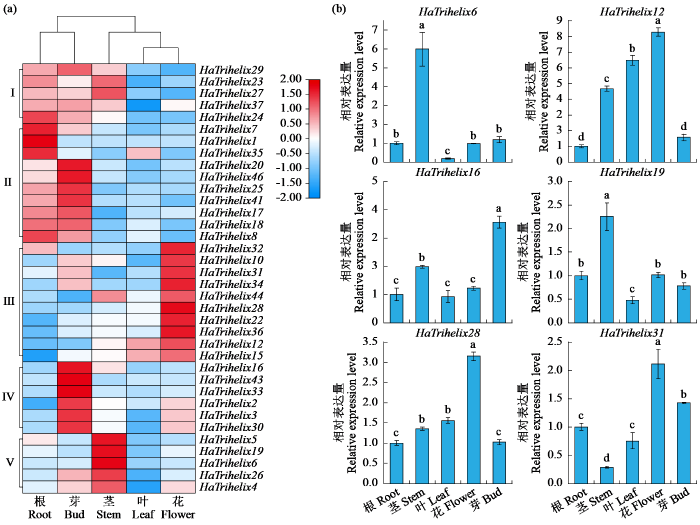
图6
向日葵trihelix家族基因组织表达模式分析
不同小写字母表示在P < 0.05水平差异显著。
Fig.6
Analysis of tissue expression patterns of trihelix family genes in sunflower
Different lowercase letters indicate significant differences at P < 0.05 level.
qRT-PCR试验结果显示,6个trihelix家族成员在向日葵根、茎、叶、花和芽中的表达趋势与图6b中组织表达分析结果相一致。
2.6 向日葵列当接种后trihelix基因表达模式
46个向日葵trihelix基因中,有9个基因未检测到表达量。其余37个差异表达的trihelix基因中,29个基因在接种不同时间点的表达量发生了显著变化(图7a)。与0 hpi(CK)相比,14个向日葵trihelix基因(HaTrihelix1、HaTrihelix3、HaTrihelix8、HaTrihelix10、HaTrihelix18、HaTrihelix16、HaTrihelix19、HaTrihelix22、HaTrihelix25、HaTrihelix27、HaTrihelix28、HaTrihelix37、HaTrihelix40和HaTrihelix46)在向日葵敏感和抗列当材料中均随着接种时间的延长显著上调,但抗列当材料的表达增幅较感病材料高2倍以上。此外,有15个trihelix基因的表达模式在2类材料中呈现显著差异:10个基因(HaTrihelix2、HaTrihelix4、HaTrihelix5、HaTrihelix6、HaTrihelix12、HaTrihelix14、HaTrihelix20、HaTrihelix21、HaTrihelix26和HaTrihelix29)在敏感材料中的表达持续下调,而在抗列当材料中的表达量在48 hpi降至最低,72 hpi显著回升至峰值水平;2个基因(HaTrihelix7和HaTrihelix36)在2类材料中的表达均呈先升后降趋势,但抗列当材料在72 hpi胁迫时出现第2次表达峰值;3个trihelix基因(HaTrihelix15、HaTrihelix24和HaTrihelix31)的表达量在感病材料中随着接种时间的延长呈现增长模式,而在抗列当材料中表现出“升―降―升”的表达模式。
图7
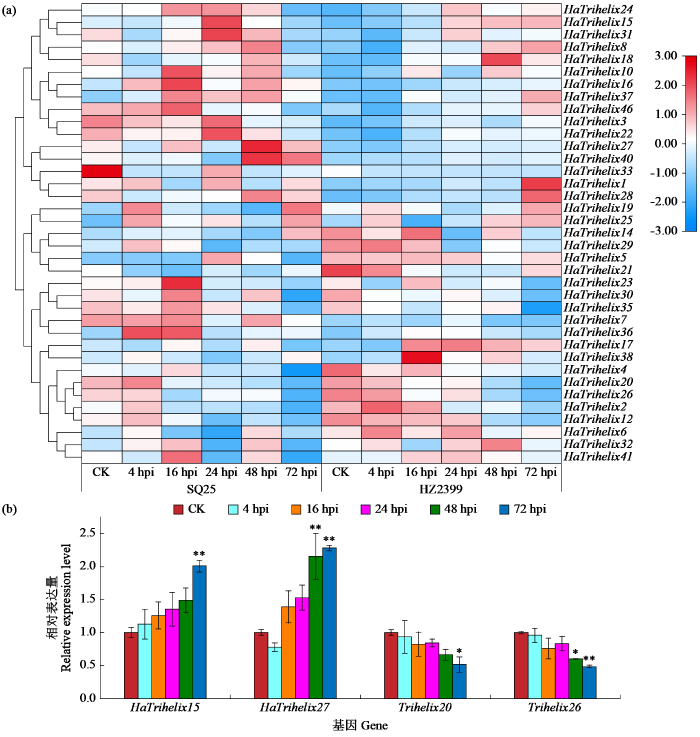
图7
向日葵trihelix家族基因在列当胁迫下的表达分析
hpi为接种后小时数;“*”:P < 0.05,“**”:P < 0.01。
Fig.7
Expression analysis of sunflower trihelix family genes under O. cumana stress
hpi indicates hour post inoculation.
2.7 qRT-PCR验证向日葵trihelix基因在列当胁迫下表达水平
为了验证转录组测序结果的可靠性,本研究从敏感自交系中筛选出4个显著差异表达的trihelix基因进行荧光定量PCR试验。结果显示,2个trihelix基因(HaTrihelix15和HaTrihelix27)的表达水平随着列当接种时间的延长呈上调趋势,而2个trihelix基因(HaTrihelix20和HaTrihelix26)的表达量呈现持续下调,这4个基因的表达模式与转录组表达趋势基本一致(图7b)。以上结果表明,向日葵trihelix基因在向日葵响应列当接种胁迫的分子调控网络中具有重要作用。
3 讨论
Trihelix基因家族是近年来倍受关注的一个基因家族[13]。在本研究中,通过生物信息学分析,从向日葵全基因组中共鉴定出46个trihelix基因。这一数量超过了拟南芥、水稻、荞麦、番茄和菊花等植物中的trihelix基因数量,表明在不同物种的进化过程中,该基因家族成员可能经历了基因的分化与扩增以适应环境的变化[14-
目前,trihelix家族基因的生物学功能在向日葵列当接种胁迫中的作用鲜见报道。本研究分析了2个列当抗性差异明显的向日葵自交系在与列当互作胁迫响应过程中trihelix家族基因表达情况。结果表明,29个trihelix基因在不同接种时间的表达量存在显著差异。qRT-PCR验证结果表明,向日葵敏感材料09108A中4个trihelix基因在列当互作胁迫下的表达量发生了明显变化。这些结果为进一步解析向日葵trihelix基因在列当互作胁迫响应中发挥的具体功能和调控机制提供了理论依据和基因资源,对提升向日葵的抗列当能力和培育抗列当能力更强的向日葵新品种提供理论基础。
4 结论
本研究共鉴定了向日葵trihelix基因家族的46个成员,这些基因不均匀地分布在15条染色体上。根据系统进化树将该家族分为5个亚家族。向日葵trihelix家族基因在根、茎、叶、芽和花等器官中的表达具有组织特异性。通过多组学整合分析及荧光定量PCR试验,发现在列当接种胁迫下,29个基因表现出显著的差异表达,推测该家族基因在向日葵生长发育和列当接种胁迫的逆境响应过程中发挥重要的作用。
参考文献
Genome-wide identification and expression profiling analysis of trihelix gene family in tomato
DOI:10.1016/j.bbrc.2015.11.010 URL [本文引用: 1]
Functional domains of the PETAL LOSS protein,a trihelix transcription factor that represses regional growth in Arabidopsis thaliana
DOI:10.1111/tpj.2014.79.issue-3 URL [本文引用: 2]
GT factor ZmGT-3b is associated with regulation of photosynthesis and defense response to Fusarium graminearum infection in maize seedling
CDD/SPARCLE:the conserved domain database in 2020
Plant-mPLoc: a top-down strategy to augment the power for predicting plant protein subcellular localization
DOI:10.1371/journal.pone.0011335 URL [本文引用: 1]
Interactive tree of life (iTOL): an online tool for phylogenetic tree display and annotation
DOI:10.1093/bioinformatics/btl529
PMID:17050570
[本文引用: 1]

Interactive Tree Of Life (iTOL) is a web-based tool for the display, manipulation and annotation of phylogenetic trees. Trees can be interactively pruned and re-rooted. Various types of data such as genome sizes or protein domain repertoires can be mapped onto the tree. Export to several bitmap and vector graphics formats is supported.iTOL is available at http://itol.embl.de
TBtools-II: a “one for all, all for one” bioinformatics platform for biological big-data mining
DOI:10.1016/j.molp.2023.09.010 URL [本文引用: 2]
Moderated estimation of fold change and dispersion for RNA-seq data with DESeq2
DOI:10.1186/s13059-014-0550-8
URL
[本文引用: 1]
\n In comparative high-throughput sequencing assays, a fundamental task is the analysis of count data, such as read counts per gene in RNA-seq, for evidence of systematic changes across experimental conditions. Small replicate numbers, discreteness, large dynamic range and the presence of outliers require a suitable statistical approach. We present\n DESeq2\n, a method for differential analysis of count data, using shrinkage estimation for dispersions and fold changes to improve stability and interpretability of estimates. This enables a more quantitative analysis focused on the strength rather than the mere presence of differential expression. The\n DESeq2\n package is available at\n http://www.bioconductor.org/packages/release/bioc/html/DESeq2.html\n.\n
Genome-wide analysis of the trihelix gene family reveals that MaGT21 modulates fruit ripening by regulating the expression of MaACO1 in Musa acuminata
Transcriptome-wide identification and expression profiling analysis of chrysanthemum Trihelix transcription factors
Genome-wide identification and expression profiling of trihelix gene family under abiotic stresses in wheat
DOI:10.1186/s12864-019-5632-2
PMID:30975075
[本文引用: 2]
The trihelix gene family is a plant-specific transcription factor family that plays important roles in plant growth, development, and responses to abiotic stresses. However, to date, no systemic characterization of the trihelix genes has yet been conducted in wheat and its close relatives.We identified a total of 94 trihelix genes in wheat, as well as 22 trihelix genes in Triticum urartu, 29 in Aegilops tauschii, and 31 in Brachypodium distachyon. We analyzed the chromosomal locations and orthology relations of the identified trihelix genes, and no trihelix gene was found to be located on chromosome 7A, 7B, or 7D of wheat, thereby reflecting the uneven distributions of wheat trihelix genes. Phylogenetic analysis indicated that the 186 identified trihelix proteins in wheat, rice, B. distachyon, and Arabidopsis were clustered into five major clades. The trihelix genes belonging to the same clades usually shared similar motif compositions and exon/intron structural patterns. Five pairs of tandem duplication genes and three pairs of segmental duplication genes were identified in the wheat trihelix gene family, thereby validating the supposition that more intrachromosomal gene duplication events occur in the genome of wheat than in that of other grass species. The tissue-specific expression and differential expression profiling of the identified genes under cold and drought stresses were analyzed by using RNA-seq data. qRT-PCR was also used to confirm the expression profiles of ten selected wheat trihelix genes under multiple abiotic stresses, and we found that these genes mainly responded to salt and cold stresses.In this study, we identified trihelix genes in wheat and its close relatives and found that gene duplication events are the main driving force for trihelix gene evolution in wheat. Our expression profiling analysis demonstrated that wheat trihelix genes responded to multiple abiotic stresses, especially salt and cold stresses. The results of our study built a basis for further investigation of the functions of wheat trihelix genes and provided candidate genes for stress-resistant wheat breeding programs.
Genome-wide characterization and expression analysis of soybean trihelix gene family
Genome-wide characterization and identification of trihelix transcription factor and expression profiling in response to abiotic stresses in rice (Oryza sativa L.)
DOI:10.3390/ijms20020251
URL
[本文引用: 1]
Trihelix transcription factors play a role in plant growth, development and various stress responses. Here, we identified 41 trihelix family genes in the rice genome. These OsMSLs (Myb/SANT-LIKE) were located on twelve chromosomes. Synteny analysis indicated only six duplicated gene pairs in the rice trihelix family. Phylogenetic analysis of these OsMSLs and the trihelix genes from other species divided them into five clusters. OsMSLs from different groups significantly diverged in terms of gene structure and conserved functional domains. However, all OsMSLs contained the same five cis-elements. Some of these were responsive to light and dehydration stress. All OsMSLs expressed in four tissues and six developmental stages of rice but with different expression patterns. Quantitative real-time PCR analysis revealed that the OsMSLs responded to abiotic stresses including drought and high salt stress and stress signal molecule including ABA (abscisic acid), hydrogen peroxide. OsMSL39 were simultaneously expressed under all treatments, while OsMSL28 showed high expression under hydrogen peroxide, drought, and high salt treatments. Moreover, OsMSL16/27/33 displayed significant expression under ABA and drought treatments. Nevertheless, their responses were regulated by light. The expression levels of the 12 chosen OsMSLs differed between light and dark conditions. In conclusion, our results helped elucidate the biological functions of rice trihelix genes and provided a theoretical basis for further characterizing their biological roles in responding to abiotic stresses.
Genome-wide identification and expression analysis of the trihelix transcription factor family in tartary buckwheat (Fagopyrum tataricum)
DOI:10.1186/s12870-019-1957-x
PMID:31390980
[本文引用: 1]
In the study, the trihelix family, also referred to as GT factors, is one of the transcription factor families. Trihelix genes play roles in the light response, seed maturation, leaf development, abiotic and biological stress and other biological activities. However, the trihelix family in tartary buckwheat (Fagopyrum tataricum), an important usable medicinal crop, has not yet been thoroughly studied. The genome of tartary buckwheat has recently been reported and provides a theoretical basis for our research on the characteristics and expression of trihelix genes in tartary buckwheat based at the whole level.In the present study, a total of 31 FtTH genes were identified based on the buckwheat genome. They were named from FtTH1 to FtTH31 and grouped into 5 groups (GT-1, GT-2, SH4, GTγ and SIP1). FtTH genes are not evenly distributed on the chromosomes, and we found segmental duplication events of FtTH genes on tartary buckwheat chromosomes. According to the results of gene and motif composition, FtTH located in the same group contained analogous intron/exon organizations and motif organizations. qRT-PCR showed that FtTH family members have multiple expression patterns in stems, roots, leaves, fruits, and flowers and during fruit development.Through our study, we identified 31 FtTH genes in tartary buckwheat and synthetically further analyzed the evolution and expression pattern of FtTH proteins. The structure and motif organizations of most genes are conserved in each subfamily, suggesting that they may be functionally conserved. The FtTH characteristics of the gene expression patterns indicate functional diversity in the time and space in the tartary buckwheat life process. Based on the discussion and analysis of FtTH gene function, we screened some genes closely related to the growth and development of tartary buckwheat. This will help us to further study the function of FtTH genes through experimental exploration in tartary buckwheat growth and improve the fruit of tartary buckwheat.
Genome-wide identification of trihelix genes in Moso bamboo (Phyllostachys edulis) and their expression in response to abiotic stress
DOI:10.1007/s00344-019-09918-9 [本文引用: 1]


