



ABC转运蛋白被称为ATP结合盒(ATP- binding cassettes,ABC)转运蛋白,是一个规模巨大且多功能保守的蛋白超家族,有保守的跨膜结构与核苷酸结合结构域,普遍存在于原核与真核生物中。多数ABC转运蛋白利用ATP水解产生的能量介导物质跨膜运输[1-
镉作为一种毒性极强的重金属,对作物的生长造成不可逆的伤害,对人类健康更是构成重大威胁。苎麻(Boehmeria nivea L.)为荨麻科苎麻属多年生宿根性草本植物,是我国重要的经济作物,有着悠久的种植历史,被誉为“中国草”[12]。苎麻根系发达,生长迅速,具有较强的镉耐性与富集镉的能力,且不进入食物链,是土壤镉污染修复的理想作物[13-14]。挖掘苎麻镉耐性相关基因,提高苎麻对镉污染耕地的修复效率,对降低土壤镉污染危害具有重要意义。近年来,随着高通量测序技术和空间多组学技术的发展,通过异源表达证明了苎麻中一些基因在镉、干旱和盐等非生物胁迫中发挥重要作用[15
1 材料与方法
1.1 苎麻ABC转运蛋白基因家族成员全基因组鉴定
从TAIR数据库(
1.2 苎麻ABC转运蛋白基因染色体定位、共线性分析与Ka/Ks分析
通过苎麻基因组结构注释文件信息,采用TBtools II软件中Gene Density Profile插件获取苎麻全基因组基因密度数据,然后利用show gene on chromosome插件对苎麻14条染色体进行可视化整理,并根据这143个基因在染色体上的位置将其重新命名为BnABC1~BnABC143。通过MCScanX[24]对苎麻、拟南芥(Arabidopsis thaliana)、工业大麻(Cannabis sativa)、玉米(Zea mays)、水稻(Oryza sativa)以及苎麻物种内进行染色体共线性分析,然后利用TBtools II中的File Merge For MCScanX插件对物种间共线性分析的gff文件、gene link文件和染色体分布文件进行合并,并用Multiple Synteny Plot插件将3个物种间的比较可视化,同时再利用Advanced Circos插件进行苎麻物种内的可视化,采用Ka/Ks Calculator计算苎麻基因对两两间的Ka/Ks值。
1.3 苎麻ABC转运蛋白基因家族系统发育分析
1.4 苎麻ABC转运蛋白基因保守结构域、保守基序及基因结构分析
1.5 苎麻ABC转运蛋白基因家族顺式作用元件分析
根据苎麻的基因组和结构注释文件,利用TBtools II提取BnABCs成员的上游2000 bp,通过PlantCare[29]网站对其启动子上游顺式作用元件进行分析,将预测的启动子元件按照功能进行分类,并且统计数目,利用TBtools II中的Basic BioSequence Viewe和HeatMap对分类的启动子元件及数量进行可视化分析。
1.6 苎麻ABC转运蛋白基因家族表达模式、表达特异性分析以及候选基因结构预测
1.7 植物材料生长和镉胁迫处理
以“中苎一号”苎麻品种为试验材料,选用饱满一致的种子在中国农业科学院麻类研究所培养室(温度25 ℃,湿度60%,光周期为14 h光照/10 h黑暗)进行培育,待幼苗长至8片真叶时选择长势一致的植株进行镉胁迫处理。利用分析纯无水CdCl2配制浓度为40 mg/L的镉溶液[32],均匀浇灌至盆栽土壤中,在处理后0、3、6、12、24和48 h分别取同一植株的根、茎和叶,所有样品均取3个生物学重复,保存至-80 ℃冰箱,用于后续镉胁迫下的基因表达模式分析。
1.8 实时荧光定量PCR验证
采用SteadyPure植物RNA提取试剂盒(湖南艾科瑞生物科技有限公司)提取苎麻根、茎和叶的总RNA,使用逆转录试剂盒SynScript®Ⅲ RT SuperMix for qPCR(+gDNA Remover)(北京擎科生物科技股份有限公司)逆转录成cDNA,并用无酶水稀释60倍,采用ArtiCanATM SYBR qPCR Mix(北京擎科生物科技股份有限公司)进行实时荧光定量PCR分析,每个处理3个重复。以18S rRNA作为内参基因,采用NCBI Primer-BLAST网站(
表1 实时荧光定量PCR引物
Table 1
| 基因名称Gene name | 正向引物序列(5′-3′)Forward primer sequence (5′-3′) | 反向引物序列(5′-3′)Reverse primer sequence (5′-3′) |
|---|---|---|
| BnABC3 | TCTGTGCCAACAGAGACGAG | TGCTCCCTGTGGTTGATGAC |
| BnABC5 | AGCTGTCGTTGGGACGATTT | AGACAGCGAGCATCAGTACG |
| BnABC11 | GCGTGATGGACCTCAGCAAGTG | CCGACGAGCAGCGAGAAGTAGA |
| BnABC12 | AGGCGTTGAAGTCGTCCATT | CATCGATCGCTTGGACAGGA |
| BnABC13 | GCGTCATGGACCTCAGCAAGTG | CCGACGAGCAGCGAGAAGTAGA |
| BnABC38 | CAAGTACGCAGCGAGAGCTA | GAACCAACGTCACCAGTTGC |
| BnABC54 | GGAGACGTAAGGGATGGAGC | TCATAGCAAGCTCGGCCATT |
| BnABC62 | TCAGCGAAAAGGTCCCAGAC | CTTGCCACACCAACGTGAAG |
| BnABC65 | TAGCATTAGGTGCCGGGTTG | AATCGATCTTCGGGACTCGC |
| BnABC75 | CAAACAGCGTCTACGCATCG | CGGGCGTCCCAAGTTAGAAT |
| BnABC92 | ATTGAGATCGGGTCGCACAA | GGCCGAGCTGAATTGTCTCT |
| BnABC98 | AGGTCGACTCCAAAGTGAGC | ATTTTGCCGAGCGACATCCT |
| BnABC101 | TCCTCAATGCCCATTTGGCT | ATGGCTTATTCCACCTCGGC |
| BnABC118 | GGCTCGATAGACACGCGAAT | AGAAGTTTCGGCCTCGTCAA |
| BnABC128 | ACTTCTCTTAGGCCCACCCA | GCCCGTTGTAGGTGACTCTC |
| BnABC137 | GAAGCAACACCTCGTGGAGA | GTTCTCTCCCTAATCCGGCG |
| 18S | TGACGGAGAATTAGGGTTC | CCGTGTCAGGATTGGGTAATTT |
1.9 数据处理
利用Origin 2021软件进行方差分析,采用Fisher LSD法进行均值多重比较(P<0.05),并绘图分析。
2 结果与分析
2.1 苎麻ABC转运蛋白基因家族成员的全基因组鉴定及蛋白理化性质分析
以拟南芥ABC转运蛋白基因为参考,鉴定获得143个苎麻ABC转运蛋白家族成员,由表2可知,其氨基酸数目在96~2192,分子量在10 344.68~243 148.60 Da。蛋白理化性质分析表明,143个BnABCs的理化性质差异较大,其中理论等电点在4.77~9.94;不稳定指数在21.57~62.96,82个ABC蛋白的不稳定指数小于40.00,稳定性较好,61个大于40.00,相对来说为不稳定蛋白。脂肪族指数在64.87~120.62,总平均亲水性范围在-0.607~ 0.419,其中43个家族成员总平均亲水性小于0.000,表现为亲水性,99个成员表现为疏水性,1个亲水性为0.000。亚细胞定位预测显示,115个BnABCs蛋白位于细胞膜上,13个位于细胞质中,11个位于叶绿体中,4个位于液泡与高尔基体中。
表2 苎麻ABC转运蛋白家族成员理化性质及亚细胞定位预测
Table 2
| 基因名称 Gene name | 氨基酸数目 Number of amino acids | 分子量 Molecular weight (Da) | 理论等电点 Theoretical pI | 不稳定指数 Instability index | 脂肪族指数 Aliphatic index | 总平均亲水范围 Grand average of hydropathicity | 亚细胞定位 Subcellular localization |
|---|---|---|---|---|---|---|---|
| BnABC1 | 329 | 35 786.23 | 5.85 | 57.57 | 102.55 | -0.005 | 叶绿体 |
| BnABC10 | 1067 | 119 303.23 | 9.05 | 43.89 | 87.47 | -0.183 | 细胞膜 |
| BnABC100 | 829 | 93 102.28 | 9.23 | 38.57 | 88.77 | -0.115 | 细胞膜 |
| BnABC101 | 1471 | 165 685.83 | 7.53 | 39.45 | 95.03 | 0.068 | 细胞膜 |
| BnABC102 | 1443 | 163 270.31 | 7.88 | 40.00 | 96.80 | 0.052 | 细胞膜 |
| BnABC103 | 2121 | 237 315.39 | 8.52 | 36.70 | 89.50 | -0.025 | 细胞膜 |
| BnABC104 | 954 | 105 228.38 | 8.05 | 37.90 | 92.65 | 0.077 | 细胞膜 |
| BnABC105 | 698 | 78 573.22 | 9.29 | 36.90 | 92.11 | -0.027 | 叶绿体 |
| BnABC106 | 966 | 108 062.89 | 8.49 | 36.90 | 95.51 | 0.088 | 细胞膜 |
| BnABC107 | 630 | 68 252.87 | 7.71 | 31.98 | 109.97 | 0.142 | 细胞膜 |
| BnABC108 | 1279 | 138 484.91 | 8.31 | 33.28 | 101.16 | 0.153 | 细胞膜 |
| BnABC109 | 229 | 25 909.59 | 9.62 | 42.20 | 108.17 | -0.089 | 叶绿体 |
| BnABC11 | 761 | 83 637.71 | 9.57 | 47.15 | 97.56 | 0.148 | 细胞膜 |
| BnABC110 | 266 | 29 190.96 | 6.61 | 28.42 | 114.29 | -0.006 | 细胞质 |
| BnABC111 | 1262 | 137 845.95 | 9.08 | 39.08 | 96.33 | 0.056 | 细胞膜 |
| BnABC112 | 723 | 79 490.08 | 9.48 | 36.79 | 107.21 | 0.296 | 细胞膜 |
| BnABC113 | 717 | 81 714.16 | 8.87 | 45.76 | 92.83 | 0.011 | 细胞膜 |
| BnABC114 | 166 | 17 960.95 | 9.94 | 21.57 | 89.88 | -0.040 | 叶绿体 |
| BnABC115 | 299 | 33 831.50 | 9.58 | 33.39 | 96.82 | 0.419 | 细胞膜 |
| BnABC116 | 718 | 79 999.54 | 5.72 | 36.10 | 82.47 | -0.607 | 细胞质 |
| BnABC117 | 677 | 75 129.64 | 8.52 | 42.43 | 89.07 | 0.020 | 细胞膜 |
| BnABC118 | 748 | 82 933.77 | 8.81 | 41.33 | 91.32 | 0.054 | 细胞膜 |
| BnABC119 | 118 | 12 434.19 | 9.24 | 35.33 | 72.54 | -0.464 | 细胞膜 |
| BnABC12 | 707 | 76 741.94 | 6.11 | 34.37 | 100.01 | 0.176 | 细胞膜 |
| BnABC120 | 507 | 57 192.68 | 8.86 | 42.30 | 92.64 | 0.180 | 细胞膜 |
| BnABC121 | 150 | 15 627.12 | 4.77 | 46.07 | 64.87 | -0.413 | 细胞质 |
| BnABC122 | 724 | 80 566.04 | 8.64 | 42.66 | 90.43 | 0.044 | 细胞膜 |
| BnABC123 | 605 | 68 253.71 | 8.03 | 32.14 | 95.65 | -0.224 | 细胞质 |
| BnABC124 | 456 | 50 255.76 | 9.76 | 51.31 | 85.13 | 0.071 | 细胞膜 |
| BnABC125 | 173 | 18 659.63 | 9.65 | 24.18 | 90.75 | 0.025 | 叶绿体 |
| BnABC126 | 1427 | 160 469.18 | 8.02 | 40.79 | 100.37 | 0.124 | 细胞膜 |
| BnABC127 | 1399 | 157 363.60 | 6.89 | 40.44 | 99.35 | 0.136 | 细胞膜 |
| BnABC128 | 1437 | 162 922.61 | 7.80 | 40.48 | 91.60 | 0.036 | 细胞膜 |
| BnABC129 | 700 | 76 959.98 | 9.41 | 40.54 | 92.23 | 0.041 | 细胞膜 |
| BnABC13 | 764 | 83 866.95 | 9.57 | 47.00 | 97.43 | 0.151 | 细胞膜 |
| BnABC130 | 700 | 78 410.17 | 9.16 | 45.41 | 92.87 | 0.057 | 细胞膜 |
| BnABC131 | 1838 | 205 293.03 | 7.08 | 36.32 | 93.85 | 0.040 | 细胞膜 |
| BnABC132 | 96 | 10 344.68 | 9.21 | 62.96 | 76.15 | -0.417 | 细胞质 |
| BnABC133 | 633 | 71 347.54 | 9.08 | 44.09 | 99.30 | 0.221 | 细胞膜 |
| BnABC134 | 1931 | 215 756.59 | 6.80 | 34.86 | 95.94 | 0.090 | 细胞膜 |
| BnABC135 | 2192 | 243 148.60 | 5.98 | 42.72 | 83.95 | -0.238 | 细胞质 |
| BnABC136 | 639 | 70 662.25 | 9.25 | 37.76 | 110.23 | 0.164 | 细胞膜 |
| BnABC137 | 1359 | 153 858.44 | 6.01 | 36.70 | 96.40 | 0.120 | 细胞膜 |
| BnABC138 | 1361 | 153 484.27 | 8.47 | 38.00 | 93.09 | 0.084 | 细胞膜 |
| BnABC139 | 790 | 89 381.72 | 6.74 | 35.00 | 96.03 | 0.196 | 细胞膜 |
| BnABC14 | 1107 | 123 621.15 | 9.08 | 43.53 | 88.63 | -0.182 | 细胞膜 |
| BnABC140 | 1325 | 144 689.71 | 8.17 | 35.93 | 94.44 | 0.034 | 细胞膜 |
| BnABC141 | 1063 | 118 402.84 | 9.71 | 56.10 | 80.15 | -0.283 | 细胞膜 |
| BnABC142 | 693 | 75 861.19 | 8.29 | 41.79 | 97.37 | 0.047 | 细胞膜 |
| BnABC143 | 956 | 107 912.18 | 8.17 | 43.32 | 104.93 | 0.076 | 细胞膜 |
| BnABC15 | 1985 | 216 409.71 | 9.22 | 46.55 | 85.36 | -0.291 | 细胞膜 |
| BnABC16 | 654 | 73 534.47 | 8.47 | 39.94 | 105.63 | 0.140 | 细胞膜 |
| BnABC17 | 1499 | 169 483.22 | 8.69 | 39.44 | 88.01 | 0.000 | 细胞膜 |
| BnABC18 | 1456 | 161 252.28 | 7.68 | 40.35 | 109.08 | 0.235 | 细胞膜 |
| BnABC19 | 1374 | 149 492.74 | 9.02 | 42.61 | 92.08 | -0.031 | 细胞膜 |
| BnABC2 | 329 | 35 802.29 | 5.85 | 56.98 | 102.55 | 0.005 | 叶绿体 |
| BnABC20 | 1410 | 157 000.54 | 6.22 | 43.16 | 105.17 | 0.221 | 细胞膜 |
| BnABC21 | 1427 | 161 808.11 | 8.82 | 42.61 | 91.87 | 0.006 | 细胞膜 |
| BnABC22 | 1414 | 159 175.66 | 6.68 | 35.91 | 92.18 | 0.043 | 细胞膜 |
| BnABC23 | 661 | 71 375.06 | 8.86 | 38.29 | 99.03 | 0.096 | 细胞膜 |
| BnABC24 | 1647 | 184 320.56 | 6.16 | 36.09 | 102.40 | 0.070 | 液泡 |
| BnABC25 | 1623 | 182 766.32 | 7.78 | 41.35 | 104.74 | 0.043 | 液泡 |
| BnABC26 | 1504 | 168 461.41 | 8.94 | 39.25 | 106.43 | 0.113 | 液泡 |
| BnABC27 | 585 | 65 618.21 | 6.50 | 31.46 | 77.68 | -0.394 | 叶绿体 |
| BnABC28 | 1249 | 134 406.97 | 8.84 | 40.52 | 108.29 | 0.245 | 细胞膜 |
| BnABC29 | 346 | 37 862.32 | 6.47 | 42.50 | 90.38 | -0.158 | 叶绿体 |
| BnABC3 | 691 | 77 745.35 | 5.87 | 42.27 | 97.50 | -0.122 | 细胞膜 |
| BnABC30 | 598 | 67 041.82 | 6.11 | 35.72 | 90.90 | -0.332 | 叶绿体 |
| BnABC31 | 687 | 76 115.42 | 9.03 | 45.07 | 100.17 | 0.207 | 细胞膜 |
| BnABC32 | 1113 | 122 855.57 | 9.03 | 37.63 | 87.01 | -0.105 | 细胞膜 |
| BnABC33 | 597 | 66 855.55 | 6.03 | 35.26 | 91.39 | -0.326 | 细胞质 |
| BnABC34 | 695 | 76 990.44 | 8.94 | 44.15 | 100.00 | 0.204 | 细胞膜 |
| BnABC35 | 1171 | 129 630.69 | 9.06 | 36.60 | 88.11 | -0.091 | 细胞膜 |
| BnABC36 | 1325 | 149 128.21 | 9.31 | 47.67 | 98.91 | -0.075 | 细胞膜 |
| BnABC37 | 702 | 78 293.93 | 9.11 | 40.28 | 88.63 | 0.055 | 细胞膜 |
| BnABC38 | 678 | 75 331.68 | 9.15 | 44.01 | 97.05 | 0.168 | 细胞膜 |
| BnABC39 | 1521 | 171 581.56 | 8.99 | 39.39 | 93.57 | 0.024 | 细胞膜 |
| BnABC4 | 704 | 78 327.37 | 8.98 | 39.53 | 95.28 | 0.110 | 细胞膜 |
| BnABC40 | 750 | 82 406.44 | 9.47 | 33.27 | 95.08 | -0.015 | 细胞膜 |
| BnABC41 | 1365 | 153 898.34 | 7.35 | 42.98 | 96.29 | -0.038 | 细胞膜 |
| BnABC42 | 1454 | 164 236.73 | 7.17 | 43.02 | 98.25 | 0.016 | 细胞膜 |
| BnABC43 | 331 | 36 795.42 | 8.29 | 46.73 | 93.99 | -0.220 | 细胞质 |
| BnABC44 | 680 | 75 770.76 | 7.96 | 35.20 | 95.32 | 0.167 | 细胞膜 |
| BnABC45 | 707 | 78 368.68 | 8.53 | 33.30 | 94.47 | 0.130 | 细胞膜 |
| BnABC46 | 663 | 74 173.97 | 8.97 | 39.05 | 98.07 | 0.108 | 细胞膜 |
| BnABC47 | 715 | 77 839.38 | 6.23 | 34.38 | 100.66 | 0.189 | 细胞膜 |
| BnABC48 | 1411 | 155 935.63 | 6.14 | 48.48 | 101.51 | 0.065 | 细胞膜 |
| BnABC49 | 663 | 74 157.97 | 8.97 | 39.70 | 98.07 | 0.106 | 细胞膜 |
| BnABC5 | 715 | 77 465.97 | 9.42 | 35.64 | 102.81 | 0.154 | 细胞膜 |
| BnABC50 | 1409 | 158 669.39 | 8.86 | 37.04 | 94.46 | 0.095 | 细胞膜 |
| BnABC51 | 1440 | 162 701.85 | 7.06 | 33.05 | 90.81 | 0.034 | 细胞膜 |
| BnABC52 | 1399 | 157 653.09 | 8.78 | 35.94 | 94.44 | 0.099 | 细胞膜 |
| BnABC53 | 1440 | 162 826.11 | 7.06 | 32.81 | 90.40 | 0.033 | 细胞膜 |
| BnABC54 | 1443 | 163 131.34 | 7.27 | 33.61 | 90.46 | 0.018 | 细胞膜 |
| BnABC55 | 1526 | 169 520.35 | 7.30 | 36.66 | 103.86 | 0.122 | 细胞膜 |
| BnABC56 | 1451 | 160 926.16 | 7.26 | 34.36 | 102.72 | 0.100 | 细胞膜 |
| BnABC57 | 611 | 68 341.51 | 9.09 | 50.23 | 104.84 | 0.195 | 细胞膜 |
| BnABC58 | 604 | 64 942.14 | 8.18 | 31.59 | 109.35 | 0.241 | 细胞膜 |
| BnABC59 | 1253 | 136 569.98 | 8.43 | 36.26 | 99.73 | 0.122 | 细胞膜 |
| BnABC6 | 618 | 68 677.07 | 9.00 | 47.24 | 116.13 | 0.378 | 细胞膜 |
| BnABC60 | 1416 | 161 136.58 | 8.77 | 39.93 | 93.06 | -0.027 | 细胞膜 |
| BnABC61 | 1214 | 138 282.66 | 8.14 | 39.33 | 96.43 | 0.037 | 细胞膜 |
| BnABC62 | 275 | 29 914.70 | 8.97 | 36.90 | 96.80 | 0.304 | 细胞膜 |
| BnABC63 | 401 | 44 158.42 | 9.41 | 32.76 | 106.48 | 0.143 | 细胞膜 |
| BnABC64 | 138 | 15 331.65 | 8.84 | 32.18 | 89.06 | -0.234 | 细胞膜 |
| BnABC65 | 1240 | 133 857.61 | 7.05 | 41.09 | 97.89 | 0.089 | 细胞膜 |
| BnABC66 | 1294 | 141 492.68 | 8.52 | 45.09 | 94.91 | 0.006 | 细胞膜 |
| BnABC67 | 472 | 51 962.45 | 6.44 | 41.60 | 95.21 | -0.062 | 细胞膜 |
| BnABC68 | 658 | 73 509.27 | 9.44 | 43.50 | 109.53 | 0.086 | 细胞膜 |
| BnABC69 | 160 | 18 189.44 | 5.41 | 43.29 | 120.62 | 0.080 | 细胞膜 |
| BnABC7 | 399 | 44 315.80 | 5.56 | 43.81 | 96.04 | -0.049 | 细胞膜 |
| BnABC70 | 265 | 29 216.26 | 9.04 | 52.27 | 98.72 | 0.325 | 细胞膜 |
| BnABC71 | 1318 | 143 829.35 | 8.67 | 43.37 | 93.56 | -0.005 | 细胞膜 |
| BnABC72 | 1498 | 167 470.87 | 6.63 | 32.82 | 108.15 | 0.256 | 细胞膜 |
| BnABC73 | 1140 | 128 564.11 | 7.57 | 39.56 | 105.86 | 0.117 | 细胞膜 |
| BnABC74 | 1485 | 166 786.94 | 7.69 | 40.34 | 106.67 | 0.201 | 细胞膜 |
| BnABC75 | 1228 | 134 490.45 | 8.61 | 35.05 | 103.88 | 0.114 | 细胞膜 |
| BnABC76 | 478 | 51 808.60 | 6.03 | 50.00 | 85.46 | -0.260 | 叶绿体 |
| BnABC77 | 709 | 79 001.04 | 5.70 | 37.13 | 89.79 | -0.263 | 叶绿体 |
| BnABC78 | 1518 | 168 062.72 | 8.07 | 37.84 | 105.61 | 0.204 | 细胞膜 |
| BnABC79 | 108 | 12 443.61 | 5.00 | 41.89 | 112.04 | -0.203 | 细胞质 |
| BnABC8 | 1473 | 164 206.31 | 8.23 | 36.14 | 103.61 | 0.136 | 细胞膜 |
| BnABC80 | 284 | 31 495.17 | 6.08 | 47.56 | 91.62 | -0.132 | 细胞质 |
| BnABC81 | 1505 | 168 501.65 | 8.39 | 37.23 | 103.36 | 0.163 | 细胞膜 |
| BnABC82 | 675 | 74 654.83 | 7.98 | 37.69 | 92.92 | 0.036 | 细胞膜 |
| BnABC83 | 150 | 16 509.76 | 4.87 | 42.84 | 94.93 | -0.099 | 细胞质 |
| BnABC84 | 731 | 79 316.15 | 8.76 | 39.43 | 92.38 | -0.029 | 细胞膜 |
| BnABC85 | 264 | 29 407.77 | 5.34 | 37.81 | 93.11 | -0.035 | 细胞膜 |
| BnABC86 | 605 | 68 280.74 | 7.80 | 36.37 | 95.34 | -0.230 | 细胞质 |
| BnABC87 | 304 | 34 736.06 | 9.20 | 37.45 | 107.11 | 0.373 | 高尔基体 |
| BnABC88 | 716 | 78 153.08 | 9.07 | 36.99 | 93.80 | 0.087 | 细胞膜 |
| BnABC89 | 461 | 51 398.71 | 8.97 | 39.00 | 105.75 | 0.258 | 细胞膜 |
| BnABC9 | 1263 | 139 196.94 | 8.78 | 43.68 | 101.41 | 0.045 | 细胞膜 |
| BnABC90 | 1252 | 137 490.25 | 9.36 | 37.03 | 97.84 | 0.042 | 细胞膜 |
| BnABC91 | 1426 | 159 285.37 | 8.40 | 35.73 | 104.87 | 0.102 | 细胞膜 |
| BnABC92 | 1208 | 131 757.85 | 9.15 | 38.42 | 96.67 | 0.061 | 细胞膜 |
| BnABC93 | 1422 | 161 910.16 | 8.18 | 39.01 | 93.65 | 0.067 | 细胞膜 |
| BnABC94 | 602 | 67 293.34 | 8.97 | 42.36 | 103.90 | 0.228 | 细胞膜 |
| BnABC95 | 1422 | 161 910.20 | 8.30 | 38.77 | 93.52 | 0.065 | 细胞膜 |
| BnABC96 | 1281 | 137 921.08 | 8.71 | 34.63 | 99.32 | 0.135 | 细胞膜 |
| BnABC97 | 1281 | 138 054.31 | 8.65 | 35.15 | 100.01 | 0.146 | 细胞膜 |
| BnABC98 | 723 | 80 728.35 | 6.40 | 39.43 | 86.13 | -0.451 | 细胞质 |
| BnABC99 | 1248 | 135 387.58 | 8.60 | 33.95 | 107.35 | 0.208 | 细胞膜 |
2.2 苎麻ABC转运蛋白基因染色体定位、共线性分析与Ka/Ks分析
143个BnABCs基因的染色体定位分析(图1)发现有142个BnABCs定位到染色体上,1个基因位于未组装到染色体上的contig上。142个BnABCs基因在苎麻的14条染色体上呈不均匀分布,其中第3条染色体上分布最多,有27个基因。根据在染色体上分布的位置将其命名为BnABC1~ BnABC142,未定位在染色体上的基因命名为BnABC143。
图1
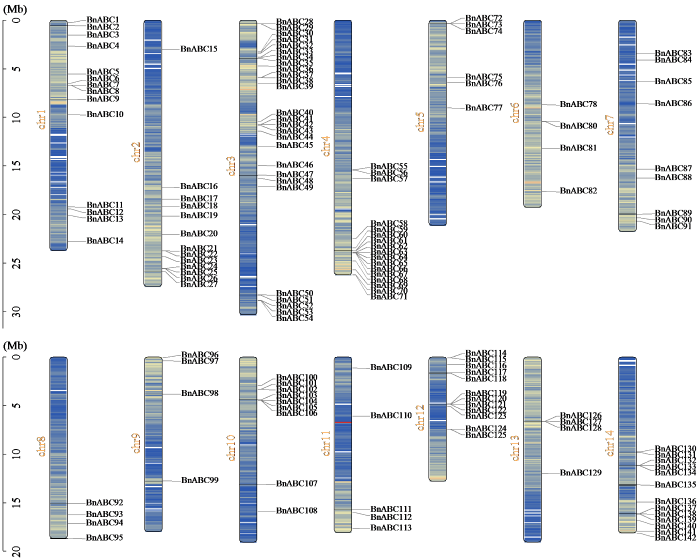
图1
苎麻ABC基因家族成员染色体定位
染色体上的颜色代表基因密度。
Fig.1
Chromosome distribution of ABC gene family members of B. nivea
The colours on the chromosomes represent gene density.
图2
图2
物种间共线性分析
(a) 苎麻与双子叶植物拟南芥和工业大麻间的共线性分析;(b) 苎麻与单子叶植物水稻和玉米间的共线性分析。
Fig.2
The collinearity analysis between B. nivea and other species
(a) the collinearity analysis between B. nivea and the dicotyledonous plants A. thaliana and C. sativa; (b) the collinearity analysis between B. nivea and the monocotyledonous plants O. sativa and Z. mays.
图3
图3
苎麻物种内的共线性分析
染色体上的颜色代表基因密度,黑色线条代表GC含量。
Fig.3
Intraspecies collinearity analysis of B. nivea
Colours on chromosomes represent gene density and black lines represent GC content.
表3 苎麻物种内同源基因对的Ka/Ks计算
Table 3
| 序号 Number | 基因名称1 Gene name 1 | 基因名称2 Gene name 2 | 基因复制类型 Types of gene replication | Ka | Ks | Ka/Ks | 选择类型 Selective type |
|---|---|---|---|---|---|---|---|
| 1 | BnABC10 | BnABC14 | 全基因组或基因片段复制 | 0.0029 | 0.0311 | 0.0920 | 纯化选择 |
| 2 | BnABC13 | BnABC141 | 全基因组或基因片段复制 | 0.1916 | 1.0169 | 0.1885 | 纯化选择 |
| 3 | BnABC10 | BnABC35 | 全基因组或基因片段复制 | 0.2404 | 2.0903 | 0.1150 | 纯化选择 |
| 4 | BnABC12 | BnABC47 | 全基因组或基因片段复制 | 0.0101 | 0.0303 | 0.3348 | 纯化选择 |
| 5 | BnABC7 | BnABC72 | 全基因组或基因片段复制 | 0.1770 | 3.4031 | 0.0520 | 纯化选择 |
| 6 | BnABC107 | BnABC58 | 全基因组或基因片段复制 | 0.1285 | 1.8864 | 0.0681 | 纯化选择 |
| 7 | BnABC114 | BnABC125 | 全基因组或基因片段复制 | 0.0160 | 0.0432 | 0.3707 | 纯化选择 |
| 8 | BnABC115 | BnABC124 | 全基因组或基因片段复制 | 0.0000 | 0.0135 | 0.0000 | 纯化选择 |
| 9 | BnABC117 | BnABC119 | 全基因组或基因片段复制 | 0.2610 | 0.4263 | 0.6123 | 纯化选择 |
| 10 | BnABC126 | BnABC21 | 全基因组或基因片段复制 | 0.2313 | 2.3434 | 0.0987 | 纯化选择 |
| 11 | BnABC130 | BnABC132 | 全基因组或基因片段复制 | 0.0423 | 0.0287 | 1.4705 | 正向选择 |
| 12 | BnABC131 | BnABC134 | 全基因组或基因片段复制 | 0.0014 | 0.0095 | 0.1495 | 纯化选择 |
| 13 | BnABC137 | BnABC52 | 全基因组或基因片段复制 | 0.2119 | 2.0754 | 0.1021 | 纯化选择 |
| 14 | BnABC137 | BnABC50 | 全基因组或基因片段复制 | 0.2114 | 2.1753 | 0.0972 | 纯化选择 |
| 15 | BnABC30 | BnABC33 | 全基因组或基因片段复制 | 0.0051 | 0.0222 | 0.2298 | 纯化选择 |
| 16 | BnABC31 | BnABC34 | 全基因组或基因片段复制 | 0.0026 | 0.0265 | 0.0971 | 纯化选择 |
| 17 | BnABC32 | BnABC35 | 全基因组或基因片段复制 | 0.0008 | 0.0132 | 0.0601 | 纯化选择 |
| 18 | BnABC50 | BnABC52 | 全基因组或基因片段复制 | 0.0028 | 0.0369 | 0.0770 | 纯化选择 |
| 19 | BnABC44 | BnABC45 | 全基因组或基因片段复制 | 0.0272 | 0.0660 | 0.4118 | 纯化选择 |
| 20 | BnABC46 | BnABC49 | 全基因组或基因片段复制 | 0.0027 | 0.0320 | 0.0828 | 纯化选择 |
| 21 | BnABC63 | BnABC70 | 全基因组或基因片段复制 | 0.2962 | 1.9769 | 0.1498 | 纯化选择 |
| 22 | BnABC57 | BnABC94 | 全基因组或基因片段复制 | 0.2845 | 2.7581 | 0.1032 | 纯化选择 |
| 23 | BnABC87 | BnABC88 | 全基因组或基因片段复制 | 0.0043 | 0.0325 | 0.1340 | 纯化选择 |
| 24 | BnABC84 | BnABC85 | 全基因组或基因片段复制 | 0.0039 | 0.0138 | 0.2830 | 纯化选择 |
| 25 | BnABC93 | BnABC95 | 全基因组或基因片段复制 | 0.0009 | 0.0119 | 0.0777 | 纯化选择 |
| 26 | BnABC96 | BnABC97 | 全基因组或基因片段复制 | 0.0031 | 0.0185 | 0.1673 | 纯化选择 |
2.3 苎麻ABC转运蛋白系统进化分析
图4
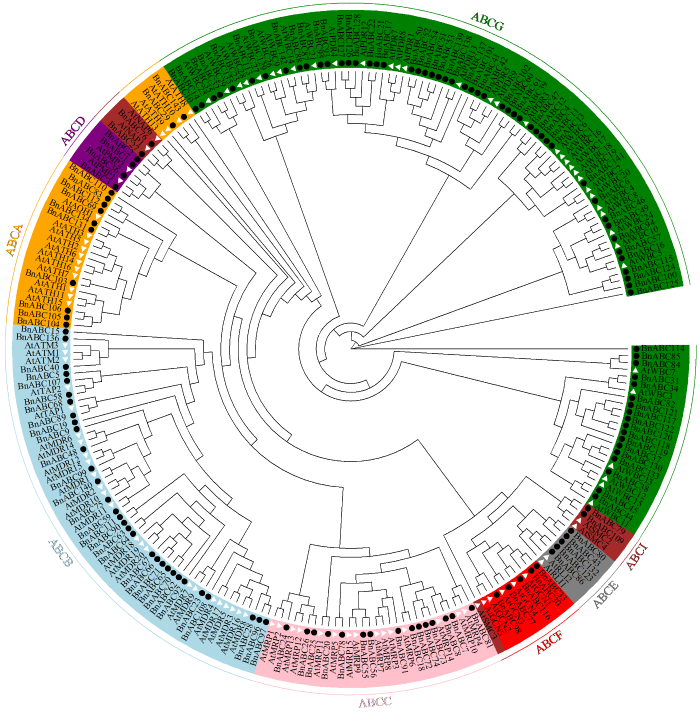
图4
苎麻与拟南芥ABC基因家族成员系统进化树分析
黑色圆代表苎麻ABC转运蛋白,白色三角代表拟南芥ABC转运蛋白。
Fig.4
Phylogenetic tree analysis of ABC gene family members in B. nivea and A. thaliana
Black circles represent ABC transporter proteins in B. nivea and white triangles represent ABC transporter proteins in A. thaliana.
2.4 苎麻ABC转运蛋白保守基序及基因结构分析
图5
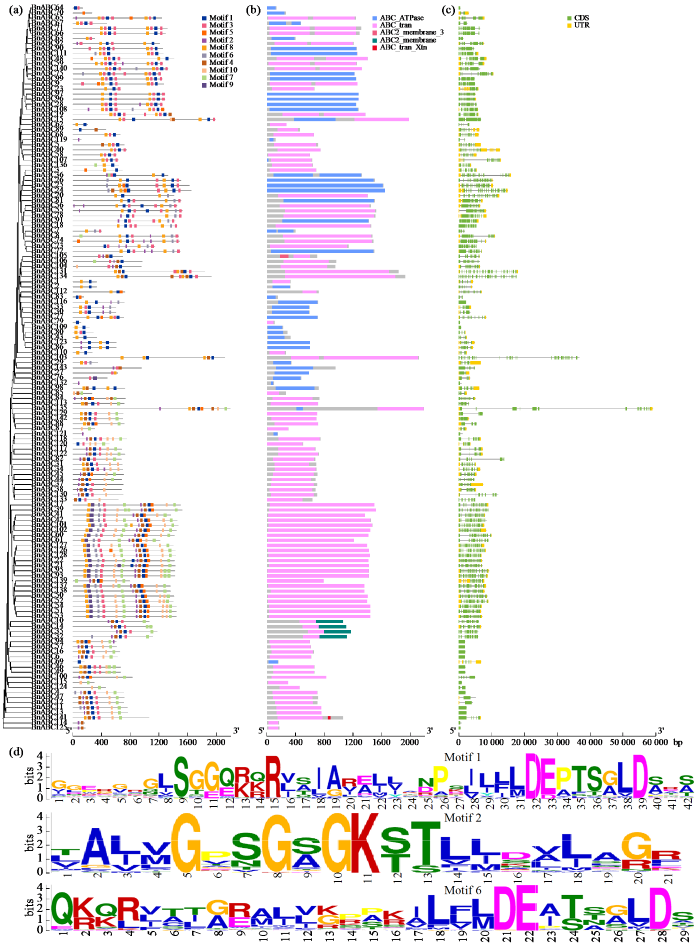
图5
苎麻ABC基因家族成员蛋白保守基序及标志图、保守结构域、基因结构分析
(a)和(d)分别为蛋白质保守基序结构图与标志图,(b)为保守结构域结构图,(c)为基因结构图。
Fig.5
Analysis of conserved motif and logo diagram, conserved domain, gene structure analyses of ABC gene family members in B. nivea
(a) and (d) are the protein conserved motif structure and logo diagrams, respectively, (b) is the conserved structural domain structure, and (c) is the gene structure diagram.
保守结构域与基因结构分析(图5b)发现,苎麻ABC基因家族成员大多数都含有ABC_tran或ABC_ATPase保守结构域,它们的存在为跨膜转运提供了能量来源。143个BnABCs中均至少含有1条CDS,43个没有非编码区域(UTR)(图5c)。具有类似保守基序与保守结构域的基因,其外显子区域的分布位置和长度相似,推测它们在功能上也类似。位于第10条染色体上的BnABC103和位于第14条染色体上的BnABC131、BnABC134、BnABC135基因的长度远超其他成员,含有较多的外显子与内含子数目,其中BnABC103、BnABC131和BnABC134有39个外显子,38个内含子;BnABC135有20个外显子,19个内含子。
2.5 启动子顺式作用元件预测分析
对基因上游2000 bp的顺式作用元件分析(图6)表明,BnABCs家族成员含光响应元件最多,共检测到1726个,每个基因的启动子区域含有2~28个,说明它们富含光响应元件。其次为植物激素调控元件(1209个),主要有脱落酸(abscisic acid)、茉莉酸甲酯(MeJA)、赤霉素(gibberellin)等。关于生长发育相关的元件(247个)大多参与分生组织形成。同时胁迫响应元件(566个)在BnABCs中也广泛存在,几乎所有的ABCG与ABCB亚家族成员都拥有胁迫元件,特别是BnABC61和BnABC9胁迫元件数目超过10个,大多都属于非生物胁迫响应元件。响应干旱胁迫的元件均与MYB结合位点相关,94个BnABCs上游存在MYB结合位点,其中属于ABCG与ABCB亚家族的有68个。
图6
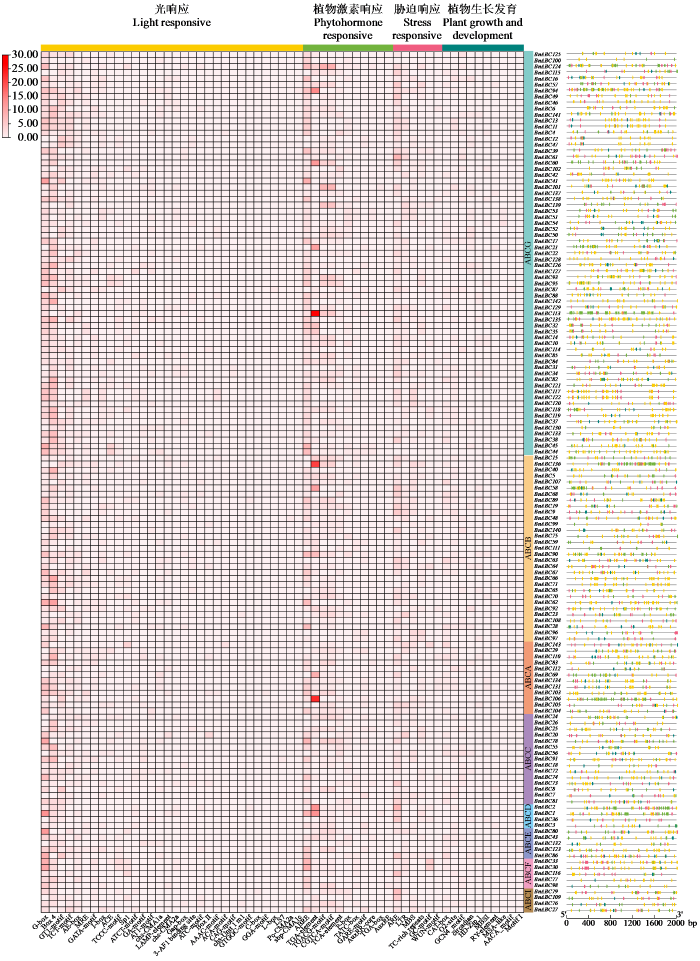
图6
苎麻ABC基因家族成员启动子顺式作用元件预测
红色方框中为不同组织特异性表达基因。
Fig.6
Prediction of promoter cis-acting elements of ABC gene family members in B. nivea
Different tissue-specific expressed genes are shown in the red box.
2.6 苎麻ABC转运蛋白基因家族成员的组织表达特异性分析
为探究BnABCs在根、茎、叶中的表达特异性,基于全基因组测序品种中苎一号不同组织转录组的数据计算其Tau值,剔除掉Tau为0(在根、茎、叶都没有表达量)或为1(只在1个部位有表达量)的基因,得到133个苎麻ABC基因家族成员的表达量情况。其中Tau值大于0.85的有30个基因(图7),它们的表达具有较强的组织特异性,其中14个在根中特异性表达,5个在茎中特异性表达,11个在叶中特异性表达。将在根、茎、叶中表达量超过1且启动子区域含有1个以上胁迫元件的16个基因作为候选基因,用于后续验证。
图7
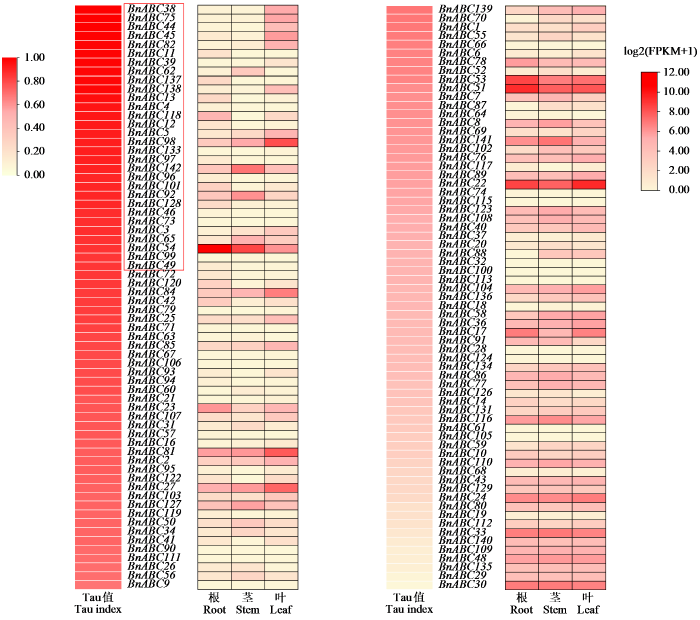
图7
苎麻ABC基因家族成员不同苎麻部位中表达量
Fig.7
Expression levels of ABC gene family members in different parts of B. nivea
获得的16个BnABCs均含有MYB结合位点,二级结构中α-螺旋的占比最高,在41.66%~66.91%,其次是无规卷曲(平均占比33.60%)、延伸链(平均占比11.67%)和β-转角(平均占比3.85%)(表4)。10个候选基因蛋白二级结构的α-螺旋占比超过了50%,其中5个属于ABCB亚家族,4个属于ABCG亚家族,1个属于ABCD亚家族;并且它们的跨膜结构域数目均不低于3,说明这些蛋白二级结构具有较好的稳定性,且更容易形成跨膜结构。
表4 候选基因蛋白二级结构与跨膜结构域数目
Table 4
| 基因名称 Gene name | α-螺旋比例 Alpha helix ratio (%) | β-转角比例 Beta turn ratio (%) | 无规卷曲比例 Random coil ratio (%) | 延伸链比例 Extended strand ratio (%) | 跨膜结构域数目 Number of transmembrane domains | 亚家族名称 Subfamily name |
|---|---|---|---|---|---|---|
| BnABC3 | 52.10 | 3.04 | 34.15 | 10.71 | 5 | ABCD |
| BnABC5 | 53.01 | 4.20 | 31.05 | 11.75 | 3 | ABCB |
| BnABC11 | 41.66 | 3.81 | 43.76 | 10.78 | 6 | ABCG |
| BnABC12 | 44.84 | 4.81 | 38.90 | 11.46 | 5 | ABCG |
| BnABC13 | 43.85 | 3.53 | 42.80 | 9.82 | 6 | ABCG |
| BnABC38 | 48.53 | 4.28 | 35.25 | 11.95 | 7 | ABCG |
| BnABC54 | 51.77 | 2.91 | 35.76 | 9.56 | 13 | ABCG |
| BnABC62 | 66.91 | 4.36 | 17.09 | 11.64 | 3 | ABCB |
| BnABC65 | 56.85 | 4.52 | 25.16 | 13.47 | 8 | ABCB |
| BnABC75 | 56.03 | 4.89 | 25.00 | 14.09 | 10 | ABCB |
| BnABC92 | 55.88 | 3.64 | 27.32 | 13.16 | 9 | ABCB |
| BnABC98 | 45.92 | 5.12 | 35.55 | 13.42 | 0 | ABCF |
| BnABC101 | 51.19 | 2.79 | 35.69 | 10.33 | 13 | ABCG |
| BnABC118 | 43.45 | 3.48 | 39.44 | 13.64 | 6 | ABCG |
| BnABC128 | 50.73 | 3.34 | 35.56 | 10.37 | 13 | ABCG |
| BnABC137 | 51.36 | 2.87 | 35.17 | 10.60 | 13 | ABCG |
2.7 镉胁迫下苎麻ABC转运蛋白候选基因表达量分析
为进一步验证筛选出的候选基因是否参与苎麻镉胁迫应答响应,以镉处理下不同部位的苎麻材料为模版进行实时荧光定量PCR分析。结果如图8所示,16个基因在镉胁迫下根、茎、叶中的表达量变化规律存在差异。在根中,大部分基因的表达量在镉处理3~24 h变化不明显,48 h显著升高;而BnABC54与BnABC12的表达量随着时间变化减少;BnABC128则表现为先升高后降低。在茎中,大部分基因在前24 h表现为先降低,处理48 h后显著升高,而BnABC11与大部分基因在根中的表达情况类似,前期无明显变化,48 h后的表达量陡增。在叶中,呈先升高后下降的变化趋势,并且除BnABC118出现了10以上的表达量外,其他基因的表达量均相对较低。综合来看,根、茎、叶3个部位中,BnABC92、BnABC118和BnABC128这3个基因不仅在镉胁迫下表达被显著激活,并且跨膜结构的数量均不低于6,预示其可能具有转运镉的能力,初步将其确定为开展后续功能验证的候选基因。
图8
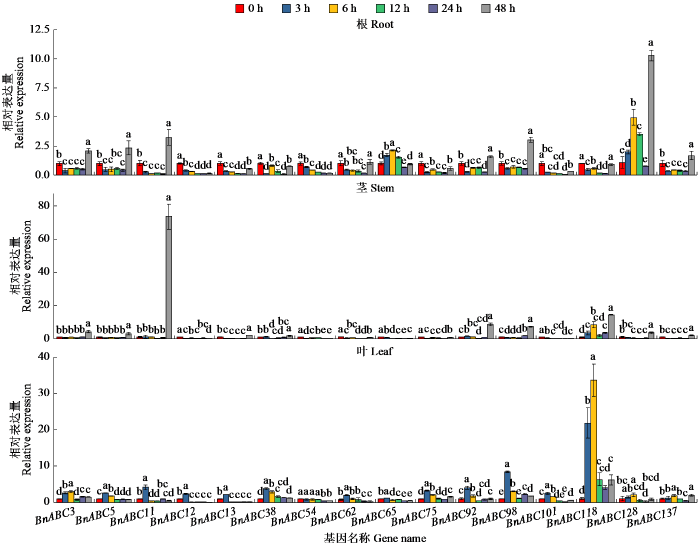
图8
镉胁迫下苎麻ABC转运蛋白候选基因的组织表达模式
不同小写字母表示在P < 0.05水平差异显著。
Fig.8
Tissue expression pattern of candidate ABC transporter genes in B. nivea under cadmium stress
Different lowercase letters indicate significant difference at P < 0.05 level.
3 讨论
3.1 苎麻ABC转运蛋白的鉴定与特性分析
ABC转运蛋白是一类最基本的转运体,大多位于细胞膜上,也有少数定位在叶绿体和液泡等细胞器上,负责多糖、毒素和脂质等多种物质的转运[37]。因ABC蛋白结构域不同,植物中ABC转运蛋白家族可分为ABCA~ABCG及ABCI 8个亚家族[5,38],其中ABCG与ABCB为2个主要亚家族。在大豆(Glycine max)中鉴定到255个GmABCs,ABCG和ABCB亚家族成员占比64%[39];在扁桃(Prunus dulcis)中鉴定到117个PdABCs,68%属于ABCG和ABCB亚家族[40]。尽管ABC转运蛋白的鉴定与分类在不同作物中被广泛研究,但苎麻ABC转运蛋白家族的鉴定和基因功能探索仍然缺乏。本研究鉴定到143个BnABCs,其中80%预测亚细胞定位于细胞膜上,与其他作物[41-42]中的鉴定结果类似。苎麻BnABCs同样被划分为8个亚家族,69%为ABCG与ABCB亚家族成员,几乎每个成员都含ATP结合结构域元件(Walker A、Walker B与ABC标签序列),在结构上有一定的保守性。研究[43
3.2 苎麻ABC转运蛋白候选基因响应镉胁迫表达量分析
已有研究[52]显示,ABC转运蛋白在镉外排的过程中具有重要作用。在外界镉胁迫环境下对ABC转运蛋白的表达量变化的研究有助于镉响应相关基因的挖掘。本研究对利用表达模式及MYB结合位点分析筛选的BnABC3和BnABC5等16个基因进行镉胁迫下的实时荧光定量PCR验证,发现大多数基因胁迫前24 h根和茎中的表达量均无明显变化,48 h显著升高。BnABC11在镉胁迫24 h内茎中的表达量极低,而48 h表达量升高了70~80倍。BnABC12和BnABC54在镉胁迫下根中的表达量出现明显下调;镉胁迫下所测基因在叶中的表达量普遍表现为先升高后下降趋势,BnABC98和BnABC118在镉胁迫3和6 h后表现出高水平的表达,小麦TaPDR6和TaPDR11等5个ABCG基因在镉胁迫下的表达量变化也呈类似规律[53]。这些都进一步表明苎麻ABC转运蛋白家族基因在镉胁迫中具有复杂多样的调控作用。此外,水稻基因OsABCG36[33]、OsPDR20[34]及毛白杨基因PtoABCG36[36],在酵母中表达都具有镉外排的功能,亚细胞位于细胞膜上,并且在镉处理后的短时间内根中的表达量都呈先上升后下降的趋势。本研究中BnABC128与水稻OsPDR20基因的同源性最高,推测其也具有镉外排的功能,并且镉处理下根中的表达在0、3和6 h逐渐升高,12 h后开始下降,其变化规律与OsABCG36、OsPDR20和PtoABCG36相似,可能也通过根系外排减少镉的积累,进而提高镉耐性。
4 结论
在苎麻中共鉴定到143个BnABCs,大部分属于ABCG与ABCB亚家族,主要定位在细胞膜上。几乎每个BnABCs均具有典型的ATP结合结构域。实时荧光定量PCR分析发现,苎麻ABC转运蛋白家族基因在镉胁迫下不同部位的表达量呈明显差异,表明BnABCs在镉胁迫响应中发挥重要作用,并且BnABCs成员可能具有通过根系外排来减少镉在苎麻体内的积累,进而提高镉耐性的重要功能。
参考文献
Plant ABC transporters
Multifunctionality of plant ABC transporters-more than just detoxifiers
PMID:11855639

The ABC-transporter superfamily is one of the largest protein families, and members can be found in bacteria, fungi, plants and animals. The first reports on plant ABC transporters showed that they are implicated in detoxification processes. The recent completion of the genomic sequencing of Arabidopsis thaliana (L.) Heynh. [Arabidopsis Genome Initiative (2000) Nature 408:796-815] showed that Arabidopsis contains more than 100 ABC-type proteins; 53 genes code for so-called full-size transporters, which are large proteins of about 150 kDa consisting of two hydrophobic and two hydrophilic domains. The large number of genes in the MDR/MRP and PDR5-like sub-clusters and the strong sequence homology found in many cases suggest functional redundancy. One reason for the high number of genes can be attributed to the duplication of large segments of Arabidopsis chromosomes. Recent results indicate that the function of this protein family is not restricted to detoxification processes. Plant ABC transporters have been demonstrated to participate in chlorophyll biosynthesis, formation of Fe/S clusters, stomatal movement, and probably ion fluxes; hence they may play a central role in plant growth and developmental processes.
Plant ABC proteins - a unified nomenclature and updated inventory
DOI:10.1016/j.tplants.2008.02.001
PMID:18299247
[本文引用: 1]
The ABC superfamily comprises both membrane-bound transporters and soluble proteins involved in a broad range of processes, many of which are of considerable agricultural, biotechnological and medical potential. Completion of the Arabidopsis and rice genome sequences has revealed a particularly large and diverse complement of plant ABC proteins in comparison with other organisms. Forward and reverse genetics, together with heterologous expression, have uncovered many novel roles for plant ABC proteins, but this progress has been accompanied by a confusing proliferation of names for plant ABC genes and their products. A consolidated nomenclature will provide much-needed clarity and a framework for future research.
ABC transporters 45 years on
DOI:10.3390/ijms242316789
URL
[本文引用: 1]
ABC transporters constitute one of the largest gene families among all species [...]
ABC transporter research:going strong 40 years on
DOI:10.1042/BST20150139
PMID:26517919
[本文引用: 2]
In most organisms, ABC transporters constitute one of the largest families of membrane proteins. In humans, their functions are diverse and underpin numerous key physiological processes, as well as being causative factors in a number of clinically relevant pathologies. Advances in our understanding of these diseases have come about through combinations of genetic and protein biochemical investigations of these transporters and the power of in vitro and in vivo investigations is helping to develop genotype-phenotype understanding. However, the importance of ABC transporter research goes far beyond human biology; microbial ABC transporters are of great interest in terms of understanding virulence and drug resistance and industrial biotechnology researchers are exploring the potential of prokaryotic ABC exporters to increase the capacity of synthetic biology systems. Plant ABC transporters play important roles in transport of hormones, xenobiotics, metals and secondary metabolites, pathogen responses and numerous aspects of development, all of which are important in the global food security area. For 3 days in Chester, this Biochemical Society Focused Meeting brought together researchers with diverse experimental approaches and with different fundamental questions, all of which are linked by the commonality of ABC transporters. © 2015 Authors.
Functions of ABC transporters in plant growth and development
DOI:S1369-5266(17)30151-6
PMID:28854397
[本文引用: 1]
ABC transporters are essential for plant development, playing roles in processes such as gametogenesis, seed development, seed germination, organ formation, and secondary growth. ABC transporters are directly energized by ATP and can transport complex organic materials against concentration gradients; thus, they are uniquely suited to provide the complex building blocks required for the development of specialized plant cells. We review recent progress in our understanding of the contribution ABC transporters make to the growth and development of plants, including their roles in protective layer formation and in transporting phytohormones.Copyright © 2017 Elsevier Ltd. All rights reserved.
ABC transporters involved in the transport of plant secondary metabolites
The maize ATP-binding cassette (ABC) transporter ZmMRPA6 confers cold and salt stress tolerance in plants
DOI:10.1007/s00299-023-03094-7
PMID:38135780
[本文引用: 1]
ZmMRPA6 was cloned and characterized as the first ATP-binding cassette (ABC) transporter in maize to be proven to participate in cold and salt tolerance. Homologous genes AtABCC4 and AtABCC14 of ZmMRPA6 also responded to salt stress. ATP-binding cassette (ABC) proteins are major transmembrane transporters that play significant roles in plant development against various abiotic stresses. However, available information regarding stress-related ABC genes in maize is minimal. In this study, a maize ABC transporter gene, ZmMRPA6, was identified through genome-wide association analysis (GWAS) for cold tolerance in maize seeds germination and functionally characterized. During germination and seedling stages, the zmmrpa6 mutant exhibited enhanced resistance to cold or salt stress. Mutated of ZmMRPA6 did not affect the expression of downstream response genes related cold or salt response at the transcriptional level. Mass spectrometry analysis revealed that most of the differential proteins between zmmrpa6 and wild-type plants were involved in response to stress process including oxidative reduction, hydrolase activity, small molecule metabolism, and photosynthesis process. Meanwhile, the plants which lack the ZmMRPA6 homologous genes AtABCC4 or AtABCC14 were sensitive to salt stress in Arabidopsis. These results indicated that ZmMRPA6 and its homologous genes play a conserved role in cold and salt stress, and functional differentiation occurs in monocotyledonous and dicotyledonous plants. In summary, these findings dramatically improved our understanding of the function of ABC transporters resistance to abiotic stresses in plants.© 2023. The Author(s), under exclusive licence to Springer-Verlag GmbH Germany, part of Springer Nature.
Structural basis for heavy metal detoxification by an Atm1-Type ABC Exporter
DOI:10.1126/science.1246489
PMID:24604198
[本文引用: 1]
Although substantial progress has been achieved in the structural analysis of exporters from the superfamily of adenosine triphosphate (ATP)-binding cassette (ABC) transporters, much less is known about how they selectively recognize substrates and how substrate binding is coupled to ATP hydrolysis. We have addressed these questions through crystallographic analysis of the Atm1/ABCB7/HMT1/ABCB6 ortholog from Novosphingobium aromaticivorans DSM 12444, NaAtm1, at 2.4 angstrom resolution. Consistent with a physiological role in cellular detoxification processes, functional studies showed that glutathione derivatives can serve as substrates for NaAtm1 and that its overexpression in Escherichia coli confers protection against silver and mercury toxicity. The glutathione binding site highlights the articulated design of ABC exporters, with ligands and nucleotides spanning structurally conserved elements to create adaptable interfaces accommodating conformational rearrangements during the transport cycle.
Comprehensive mechanisms of heavy metal toxicity in plants,detoxification,and remediation
DOI:10.1016/j.jhazmat.2023.131039 URL [本文引用: 1]
Integrative analysis of the ABC gene family in sorghum revealed SbABCB11 participating in translocation of cadmium from roots to shoots
DOI:10.1007/s00425-025-04637-w
[本文引用: 2]
Aptamer technology has significantly advanced the field of plant research, emerging as a tool for enhancing agricultural productivity, plant growth, and environmental monitoring.
Identification of ramie genes in response to Pratylenchus coffeae infection challenge by digital gene expression analysis
DOI:10.3390/ijms160921989
URL
[本文引用: 1]
Root lesion disease, caused by Pratylenchus coffeae, seriously impairs the growth and yield of ramie, an important natural fiber crop. The ramie defense mechanism against P. coffeae infection is poorly understood, which hinders efforts to improve resistance via breeding programs. In this study, the transcriptome of the resistant ramie cultivar Qingdaye was characterized using Illumina sequence technology. About 46.3 million clean pair end (PE) reads were generated and assembled into 40,826 unigenes with a mean length of 830 bp. Digital gene expression (DGE) analysis was performed on both the control roots (CK) and P. coffeae-challenged roots (CH), and the differentially expressed genes (DEGs) were identified. Approximately 10.16 and 8.07 million cDNA reads in the CK and CH cDNA libraries were sequenced, respectively. A total of 137 genes exhibited different transcript abundances between the two libraries. Among them, the expressions of 117 and 20 DEGs were up- and down-regulated in P. coffeae-challenged ramie, respectively. The expression patterns of 15 candidate genes determined by qRT-PCR confirmed the results of DGE analysis. Time-course expression profiles of eight defense-related genes in susceptible and resistant ramie cultivars were different after P. coffeae inoculation. The differential expression of protease inhibitors, pathogenesis-related proteins (PRs), and transcription factors in resistant and susceptible ramie during P. coffeae infection indicated that cystatin likely plays an important role in nematode resistance.
Systematic evaluation of ramie (Boehmeria nivea L.) for phytoremediation of cadmium contaminated soil and the mechanism of microbial regulation
DOI:10.1016/j.chemosphere.2023.139298 URL [本文引用: 1]
Study on remediation of cadmium contaminated paddy field by ramie (Boehmeria nivea L.) floating island and its supporting technology
DOI:10.1016/j.envres.2023.117798 URL [本文引用: 1]
A ramie bZIP transcription factor BnbZIP2 is involved in drought,salt,and heavy metal stress response
DOI:10.1089/dna.2016.3251 URL [本文引用: 1]
Identification of the Xyloglucan Endotransglycosylase/Hydrolase (XTH) gene family members expressed in Boehmeria nivea in response to cadmium stress
Xyloglucan endotransglycosylase/hydrolase (XTH) genes play an important role in plant resistance to abiotic stress. However, systematic studies of the response of Boehmeria nivea (ramie) XTH genes (BnXTHs) to cadmium (Cd) stress are lacking. We sought to identify the BnXTH-family genes in ramie through bioinformatics analyses and to investigate their responses to Cd stress. We identified 19 members of the BnXTH gene family from the ramie genome, referred to as BnXTH1-19, among which BnXTH18 and BnXTH19 were located on no chromosomes and the remaining genes were unevenly distributed across 11 chromosomes. The 19 members were divided into four groups, Groups I/II/IIIA/IIIB, according to their phylogenetic relationships, and these groups were supported by analyses of intron–exon structure and conserved motif composition. A highly conserved catalytic site (HDEIDFEFLG) was observed in all BnXTH proteins. Additionally, three gene pairs (BnXTH6–BnXTH16, BnXTH8–BnXTH9, and BnXTH17–BnXTH18) were obtained with a fragment and tandem-repeat event analysis of the ramie genome. An analysis of cisregulatory elements revealed that BnXTH expression might be regulated by multiple hormones and abiotic and biotic stress responses. In particular, 17 cisregulatory elements related to abiotic and biotic stress responses and 11 cisregulatory elements related to hormone responses were identified. We also found that most BnXTH genes responded to Cd stress, and BnXTH1, BnXTH3, BnXTH6, and BnXTH15 were most likely to contribute to the Cd tolerance of ramie, as evidenced by the substantial increases in expression under Cd treatment. Heterologous expression of BnXTH1, BnXTH6, and BnXTH15 significantly enhanced the Cd tolerance of transgenic yeast cells. These results suggest that the BnXTH gene family is involved in Cd stress responses, laying a theoretical foundation for functional studies of BnXTH genes and the innovative breeding of Cd-tolerant ramie.
Improving drought stress tolerance in ramie (Boehmeria nivea L.) using molecular techniques
DOI:10.3389/fpls.2022.911610
URL
Ramie is one of the most significant fiber crops and contributes to good quality fiber. Drought stress (DS) is one of the most devastating abiotic factors which is accountable for a substantial loss in crop growth and production and disturbing sustainable crop production. DS impairs growth, plant water relation, and nutrient uptake. Ramie has evolved a series of defense responses to cope with DS. There are numerous genes regulating the drought tolerance (DT) mechanism in ramie. The morphological and physiological mechanism of DT is well-studied; however, modified methods would be more effective. The use of novel genome editing tools like clustered regularly interspaced short palindromic repeats (CRISPR) is being used to edit the recessive genes in crops to modify their function. The transgenic approaches are used to develop several drought-tolerant varieties in ramie, and further identification of tolerant genes is needed for an effective breeding plan. Quantitative trait loci (QTLs) mapping, transcription factors (TFs) and speed breeding are highly studied techniques, and these would lead to the development of drought-resilient ramie cultivars. The use of hormones in enhancing crop growth and development under water scarcity circumstances is critical; however, using different concentrations and testing genotypes in changing environments would be helpful to sort the tolerant genotypes. Since plants use various ways to counter DS, investigating mechanisms of DT in plants will lead to improved DT in ramie. This critical review summarized the recent advancements on DT in ramie using novel molecular techniques. This information would help ramie breeders to conduct research studies and develop drought tolerant ramie cultivars.
BnXTH1 regulates cadmium tolerance by modulating vacuolar compartmentalization and the cadmium binding capacity of cell walls in ramie (Boehmeria nivea)
DOI:10.1016/j.jhazmat.2024.134172 URL [本文引用: 1]
The chromosome-level assembly of ramie (Boehmeria nivea L.) genome provides insights into molecular regulation of fiber fineness
DOI:10.1080/15440478.2023.2168819 URL [本文引用: 1]
TBtools-II: A “one for all, all for one” bioinformatics platform for biological big-data mining
DOI:10.1016/j.molp.2023.09.010 URL [本文引用: 1]
NCBI's conserved domain database and tools for protein domain analysis
ExPASy: SIB bioinformatics resource portal
DOI:10.1093/nar/gks400
PMID:22661580
[本文引用: 1]
ExPASy (http://www.expasy.org) has worldwide reputation as one of the main bioinformatics resources for proteomics. It has now evolved, becoming an extensible and integrative portal accessing many scientific resources, databases and software tools in different areas of life sciences. Scientists can henceforth access seamlessly a wide range of resources in many different domains, such as proteomics, genomics, phylogeny/evolution, systems biology, population genetics, transcriptomics, etc. The individual resources (databases, web-based and downloadable software tools) are hosted in a 'decentralized' way by different groups of the SIB Swiss Institute of Bioinformatics and partner institutions. Specifically, a single web portal provides a common entry point to a wide range of resources developed and operated by different SIB groups and external institutions. The portal features a search function across 'selected' resources. Additionally, the availability and usage of resources are monitored. The portal is aimed for both expert users and people who are not familiar with a specific domain in life sciences. The new web interface provides, in particular, visual guidance for newcomers to ExPASy.
Cell-PLoc: a package of Web servers for predicting subcellular localization of proteins in various organisms
DOI:10.1038/nprot.2007.494 [本文引用: 1]
MCScanX: a toolkit for detection and evolutionary analysis of gene synteny and collinearity
DOI:10.1093/nar/gkr1293 URL [本文引用: 1]
MEGA11: molecular evolutionary genetics analysis version 11
DOI:10.1093/molbev/msab120
PMID:33892491
[本文引用: 1]
The Molecular Evolutionary Genetics Analysis (MEGA) software has matured to contain a large collection of methods and tools of computational molecular evolution. Here, we describe new additions that make MEGA a more comprehensive tool for building timetrees of species, pathogens, and gene families using rapid relaxed-clock methods. Methods for estimating divergence times and confidence intervals are implemented to use probability densities for calibration constraints for node-dating and sequence sampling dates for tip-dating analyses, which will be supported by new options for tagging sequences with spatiotemporal sampling information, an expanded interactive Node Calibrations Editor, and an extended Tree Explorer to display timetrees. We have now added a Bayesian method for estimating neutral evolutionary probabilities of alleles in a species using multispecies sequence alignments and a machine learning method to test for the autocorrelation of evolutionary rates in phylogenies. The computer memory requirements for the maximum likelihood analysis are reduced significantly through reprogramming, and the graphical user interface (GUI) has been made more responsive and interactive for very big datasets. These enhancements will improve the user experience, quality of results, and the pace of biological discovery. Natively compiled GUI and command-line versions of MEGA11 are available for Microsoft Windows, Linux, and macOS from www.megasoftware.net.© The Author(s) 2021. Published by Oxford University Press on behalf of the Society for Molecular Biology and Evolution.
IQ-TREE: A fast and effective stochastic algorithm for estimating maximum- likelihood phylogenies
DOI:10.1093/molbev/msu300 URL [本文引用: 1]
EvolView, an online tool for visualizing, annotating and managing phylogenetic trees
MEME SUITE: tools for motif discovery and searching
PlantCARE, a database of plant cis-acting regulatory elements and a portal to tools for in silico analysis of promoter sequences
SOPMA: significant improvements in protein secondary structure prediction by consensus prediction from multiple alignments
DOI:10.1093/bioinformatics/11.6.681 URL [本文引用: 1]
苎麻谷胱甘肽-S-转移酶基因BnGSTU1的克隆和表达分析
DOI:10.13430/j.cnki.jpgr.20180228002
[本文引用: 1]
谷胱甘肽-S-转移酶(Glutathione S-transferases, GSTs)是一类存在于动植物中的多功能蛋白,对植物抵御逆境胁迫和解除细胞毒素具有重要作用。为探讨GST基因在苎麻耐镉机制中的作用,本研究在苎麻镉胁迫转录组的基础上,采用RACE方法从苎麻(Boehmeria nivea L.)品种中苎一号中克隆到BnGSTU1基因(GenBank登录号为MG941011)的全长cDNA序列,该基因开放读码框为636 bp,编码211个氨基酸,蛋白质分子量为24.07 kD,等电点为5.29。保守结构域分析表明,BnGSTU1蛋白具有GSTs所特有的N端和C端结构域,并含有典型的G位点和H位点,属于Tau类GST亚家族。系统进化树分析表明,BnGSTU1蛋白与拟南芥、橡胶树等物种Tau类GST蛋白的亲缘关系最近。组织表达特异性分析表明,BnGSTU1在苎麻的叶片中表达量最高,其次为茎,根中表达量最低,存在明显的组织特异性。胁迫诱导表达分析表明,BnGSTU1的表达显著受镉的诱导,且表达量随着镉浓度的升高表现出不断增加的趋势。以上结果表明BnMYB1是一个镉应答基因,可能在植物对镉胁迫的适应中发挥重要作用。
The ABC transporter ABCG36 is required for cadmium tolerance in rice
DOI:10.1093/jxb/erz335
PMID:31328224
[本文引用: 2]
Cadmium (Cd) is a highly toxic heavy metal in nature, which causes severe damage to plant growth. The molecular mechanisms for Cd detoxification are poorly understood. Here, we report that a G-type ATP-binding cassette transporter, OsABCG36, is involved in Cd tolerance in rice. OsABCG36 was expressed in both roots and shoots at a low level, but expression in the roots rather than the shoots was greatly up-regulated by a short exposure to Cd. A spatial expression analysis showed that Cd-induced expression of OsABCG36 was found in both the root tip and the mature root region. Transient expression of OsABCG36 in rice protoplast cells showed that it was localized to the plasma membrane. Immunostaining showed that OsABCG36 was localized in all root cells except the epidermal cells. Knockout of OsABCG36 resulted in increased Cd accumulation in root cell sap and enhanced Cd sensitivity, but did not affect tolerance to other metals including Al, Zn, Cu, and Pb. The concentration of Cd in the shoots was similar between the knockout lines and wild-type rice. Heterologous expression of OsABCG36 in yeast showed an efflux activity for Cd, but not for Zn. Taken together, our results indicate that OsABCG36 is not involved in Cd accumulation in the shoots, but is required for Cd tolerance by exporting Cd or Cd conjugates from the root cells in rice.© The Author(s) 2019. Published by Oxford University Press on behalf of the Society for Experimental Biology.
OsPDR20 is an ABCG metal transporter regulating cadmium accumulation in rice
DOI:10.1016/j.jes.2022.09.021
PMID:37923431
[本文引用: 1]
Cadmium (Cd) is a non-essential toxic heavy metal, seriously posing high environmental risks to human health. Digging genetic resources relevant to functional genes is important for understanding the metal absorption and accumulation in crops and bioremediation of Cd-polluted environments. This study investigated a functionally uncharacterized ATP binding cassette transporter G family (ABCG) gene encoding a Pleiotropic Drug Resistance 20 (PDR20) type metal transporter which is localized to the plasma membrane of rice. OsPDR20 was transcriptionally expressed in almost all tissues and organs in lifespan and was strongly induced in roots and shoots of young rice under Cd stress. Ectopic expression of OsPDR20 in a yeast mutant ycf1 sensitive to Cd conferred cellular tolerance with less Cd accumulation. Knockdown of OsPDR20 by RNA interference (RNAi) moderately attenuated root/shoot elongation and biomass, with reduced chlorophylls in rice grown under hydroponic medium with 2 and 10 µmol/L Cd, but led to more Cd accumulation. A field trial of rice grown in a realistic Cd-contaminated soil (0.40 mg/kg) showed that RNAi plants growth and development were also compromised compared to wild-type (WT), with smaller panicles and lower spikelet fertility but little effect on yield of grains. However, OsPDR20 suppression resulted in unexpectedly higher levels of Cd accumulation in rice straw including lower leaves and culm and grain. These results suggest that OsPDR20 is actively involved in Cd accumulation and homeostasis in rice crops. The increased Cd accumulation in the RNAi plants has the potential application in phytoremediation of Cd-polluted wetland soils.Copyright © 2022. Published by Elsevier B.V.
RsPDR8,a member of ABCG subfamily,plays a positive role in regulating cadmium efflux and tolerance in radish (Raphanus sativus L.)
DOI:10.1016/j.plaphy.2023.108149 URL
Ectopic expression of poplar ABC transporter PtoABCG36 confers Cd tolerance in Arabidopsis thaliana
DOI:10.3390/ijms20133293
URL
[本文引用: 2]
Cadmium (Cd) is one of the most toxic heavy metals for plant growth in soil. ATP-binding cassette (ABC) transporters play important roles in biotic and abiotic stresses. However, few ABC transporters have been characterized in poplar. In this study, we isolated an ABC transporter gene PtoABCG36 from Populus tomentosa. The PtoABCG36 transcript can be detected in leaves, stems and roots, and the expression in the root was 3.8 and 2 times that in stems and leaves, respectively. The PtoABCG36 expression was induced and peaked at 12 h after exposure to Cd stress. Transient expression of PtoABCG36 in tobacco showed that PtoABCG36 is localized at the plasma membrane. When overexpressed in yeast and Arabidopsis, PtoABCG36 could decrease Cd accumulation and confer higher Cd tolerance in transgenic lines than in wild-type (WT) lines. Net Cd2+ efflux measurements showed a decreasing Cd uptake in transgenic Arabidopsis roots than WT. These results demonstrated that PtoABCG36 functions as a cadmium extrusion pump participating in enhancing tolerance to Cd through decreasing Cd content in plants, which provides a promising way for making heavy metal tolerant poplar by manipulating ABC transporters in cadmium polluted areas.
Plant ABC transporters
DOI:10.1199/tab.0153 URL [本文引用: 1]
Genome-wide identification of soybean ABC transporters relate to aluminum toxicity
DOI:10.3390/ijms22126556
URL
[本文引用: 1]
ATP-binding cassette (ABC) transporter proteins are a gene super-family in plants and play vital roles in growth, development, and response to abiotic and biotic stresses. The ABC transporters have been identified in crop plants such as rice and buckwheat, but little is known about them in soybean. Soybean is an important oil crop and is one of the five major crops in the world. In this study, 255 ABC genes that putatively encode ABC transporters were identified from soybean through bioinformatics and then categorized into eight subfamilies, including 7 ABCAs, 52 ABCBs, 48 ABCCs, 5 ABCDs, 1 ABCEs, 10 ABCFs, 111 ABCGs, and 21 ABCIs. Their phylogenetic relationships, gene structure, and gene expression profiles were characterized. Segmental duplication was the main reason for the expansion of the GmABC genes. Ka/Ks analysis suggested that intense purifying selection was accompanied by the evolution of GmABC genes. The genome-wide collinearity of soybean with other species showed that GmABCs were relatively conserved and that collinear ABCs between species may have originated from the same ancestor. Gene expression analysis of GmABCs revealed the distinct expression pattern in different tissues and diverse developmental stages. The candidate genes GmABCB23, GmABCB25, GmABCB48, GmABCB52, GmABCI1, GmABCI5, and GmABCI13 were responsive to Al toxicity. This work on the GmABC gene family provides useful information for future studies on ABC transporters in soybean and potential targets for the cultivation of new germplasm resources of aluminum-tolerant soybean.
Genome-wide analysis of the ABC gene family in almond and functional predictions during flower development,freezing stress,and salt stress
DOI:10.1186/s12870-023-04698-7
[本文引用: 1]
ABC (ATP-binding cassette) transporter proteins are one of the most extensive protein families known to date and are ubiquitously found in animals, plants, and microorganisms. ABCs have a variety of functions, such as plant tissue development regulation, hormone transport, and biotic and abiotic stress resistance. However, the gene characterization and function of the ABC gene family in almond ( Prunus dulcis ) have not been thoroughly studied. In this study, we identified 117 PdABC genes using the whole genome of ‘Wanfeng’ almond obtained by sequencing and explored their protein characterization. The PdABC family members were classified into eight subfamilies. The members of the same subfamily had conserved motifs but poorly conserved numbers of exons and introns and were unevenly distributed among the eight subfamilies and on the eight chromosomes. Expression patterns showed that PdABC family members were significantly differentially expressed during almond development, dormant freezing stress, and salt stress. We found that PdABC59 and PdABC77 had extremely high expression levels in pollen. PdABC63 and PdABC64 had high expression levels during almond petal development and multiple stages of flower development. PdABC98 was highly expressed in annual dormant branches after six temperature-freezing stress treatments. PdABC29, PdABC69, and PdABC98 were highly expressed under different concentrations of salt stress. This study preliminarily investigated the expression characteristics of ABC genes in different tissues of almond during flower development, freezing stress and salt stress, and the results will provide a reference for further in-depth research and breeding of almond in the future.\n
杜仲ABC转运蛋白基因家族成员鉴定与分析
DOI:10.3969/j.issn.1004-1524.2021.09.02
[本文引用: 1]
ABC转运蛋白(ATP—binding cassette transpoter)是一类庞大而古老的跨膜运输蛋白家族,在生物体内参与多种物质的转运积累、有害物质解毒、气孔调节、植物防御等生理活动。杜仲(Eucommia ulmoides Oliv)作为重要的中药材,其药用成分主要为次生代谢产物,次生代谢物转运与积累过程需要ABC转运蛋白的参与。利用生物信息学手段对杜仲ABC转运蛋白基因家族进行鉴定,并分析该家族蛋白质性质和结构、跨膜结构、亚细胞定位、系统进化关系。研究表明,EuABC家族生物信息学预测有76个成员,含有1~7个保守基序;编码蛋白多为稳定蛋白,主要分布于细胞质膜上,二级结构以α-螺旋和无规卷曲为主要构成元件;进化树分析表明,杜仲ABC转运蛋白家族可分为8个亚家族(A~G;I),每组成员数量分别为3、19、14、1、1、1、29、8。研究结果可为进一步研究杜仲次生代谢物质转运与积累奠定基础,也为其他植物ABC转运蛋白家族的研究提供了参考依据。
A rice ABC transporter, OsABCC1, reduces arsenic accumulation in the grain
Plant ABC transporters: time for biochemistry?
DOI:10.1042/BST20150108
PMID:26517906
ATP-binding cassette (ABC) proteins form a large and ubiquitous family, most members of which are membrane-associated primary transporters. Plant genomes code for a particularly large number of these ABC proteins, with more than 120 genes present in both Arabidopsis thaliana and Oryza sativa (rice). Although plant ABC transporters were initially identified as detoxifiers, sequestering xenobitotics into the vacuole, they were later found to be involved in a wide range of essential physiological processes. Currently, the exact substrates transported by most of these transporters are still unknown and we therefore cannot exclude that a single substrate (e.g. a hormone) is responsible for the diversity of physiological roles. This gap in our knowledge is mainly due to the fact that only a few studies have used direct methods to identify the substrates of these membrane transporters. To address this issue, transport assays involving isolated cells, vesicular membranes or reconstituted liposomes are essential. In this review, we will highlight the importance of the direct biochemical characterization of plant ABC transporters and give some insights into the current status of the homologous and heterologous expression of such proteins. © 2015 Authors; published by Portland Press Limited.
Possible involvement of plant ABC transporters in cadmium detoxification: a cDNA sub- microarray approach
DOI:10.1016/j.envint.2004.10.011 URL
Role of ATP‐binding cassette transporters in maintaining plant homeostasis under abiotic and biotic stresses
DOI:10.1111/ppl.v171.4 URL [本文引用: 2]
ABCG transporter proteins with beneficial activity on plants
DOI:10.1016/j.phytochem.2021.112663
PMID:33550197
[本文引用: 1]
Among the several subfamilies of ABC transporters the ABC-G subfamily is very significant. In the model plant Arabidopsis thaliana itself, ABCG subfamily houses highest number of transporters with mostly half-size transporters (called WBC) and fewer full-size transporters (called PDR). During drought stress the stress hormone abscisic acid (ABA) is exported from the root xylem and imported by the leaf stomatal cells by ABCG transporter proteins to reduce the transpiration of water from leaves. Moreover, the ABCG transporters play a chief role in export of prime biotic stress induced hormones like jasmonic acid and salicylic acid among other secondary metabolites. In this way they protect the plant as the first line of defense against pathogenic damages. The ABCG transporters help the plant in becoming kanamycin resistant which help in plant growth. ABCG transporters of Nicotiana plumbaginifolia provide resistance to pathogens like Pseudomonas syringae. Furthermore several ABCG transporters of A. thaliana are efficient in transporting cuticular lipids like cutin to help development of cuticle. Pollen exine wall formation is also aided by one ABCG transporter itself. Some important ABCG transporters like ABCG36 and ABCG40 have been suggested to contribute hugely towards heavy metal resistance and cellular detoxification in Arabidopsis thaliana.Copyright © 2021 Elsevier Ltd. All rights reserved.
The R2R3-MYB transcription factor ThRAX2 recognized a new element MYB-T (CTTCCA) to enhance cadmium tolerance in Tamarix hispida
DOI:10.1016/j.plantsci.2022.111574 URL [本文引用: 1]
The R2R3-MYB transcription factor MYB49 regulates cadmium accumulation
DOI:10.1104/pp.18.01380
PMID:30782964
Abscisic acid (ABA) reduces accumulation of potentially toxic cadmium (Cd) in plants. How the ABA signal is transmitted to modulate Cd uptake remains largely unclear. Here, we report that the basic region/Leu zipper transcription factor ABSCISIC ACID-INSENSITIVE5 (ABI5), a central ABA signaling molecule, is involved in ABA-repressed Cd accumulation in plants by physically interacting with a previously uncharacterized R2R3-type MYB transcription factor, MYB49. Overexpression of the Cd-induced gene in Arabidopsis () resulted in a significant increase in Cd accumulation, whereas knockout plants and plants expressing chimeric repressors of :ERF-associated amphiphilic repression motif repression domain () exhibited reduced accumulation of Cd. Further investigations revealed that MYB49 positively regulates the expression of the basic helix-loop-helix transcription factors and by directly binding to their promoters, leading to activation of, which encodes a metal transporter involved in Cd uptake. MYB49 also binds to the promoter regions of the heavy metal-associated isoprenylated plant proteins () and, resulting in up-regulation of their expression and subsequent Cd accumulation. On the other hand, as a feedback mechanism to control Cd uptake and accumulation in plant cells, Cd-induced ABA up-regulates the expression of, whose protein product interacts with MYB49 and prevents its binding to the promoters of downstream genes, thereby reducing Cd accumulation. Our results provide new insights into the molecular feedback mechanisms underlying ABA signaling-controlled Cd uptake and accumulation in plants.© 2019 American Society of Plant Biologists. All Rights Reserved.
A MYB transcription factor, BnMYB2, cloned from ramie (Boehmeria nivea) is involved in cadmium tolerance and accumulation
DOI:10.1371/journal.pone.0233375 URL [本文引用: 1]
A R2R3-MYB, BpMYB1, from paper mulberry interacts with DELLA protein BpGAI1 in soil cadmium phytoremediation
DOI:10.1016/j.jhazmat.2023.132871 URL [本文引用: 1]
The ABC transporter AtPDR8 is a cadmium extrusion pump conferring heavy metal resistance
DOI:10.1111/tpj.2007.50.issue-2 URL [本文引用: 1]


