

作物杂志,2026, 第5期: 213–221 doi: 10.16035/j.issn.1001-7283.2026.05.025
灌溉量、种植密度和品种对新疆膜下滴灌玉米产量和水分生产效率的影响
李浩晔1,2( ), 翟娟1,2, 张园梦2, 薛军2,3, 明博2, 王克如2, 谢瑞芝2, 张国强2(), 李少昆1,2()
- 1
石河子大学农学院/新疆生产建设兵团绿洲生态农业重点实验室, 832003, 新疆石河子
2中国农业科学院作物科学研究所/农业农村部作物生理生态重点实验室, 100081, 北京
3中国农业科学院西部农业研究中心, 831100, 新疆昌吉
Effects of Irrigation Amount, Planting Density, and Cultivar on Yield and Water Use Efficiency of Maize under Drip Irrigation with Plastic Mulching in Xinjiang
Li Haoye1,2(), Zhai Juan1,2, Zhang Yuanmeng2, Xue Jun2,3, Ming Bo2, Wang Keru2, Xie Ruizhi2, Zhang Guoqiang2(), Li Shaokun1,2()
- 1
College of Agriculture ,Shihezi University / Key Laboratory of Oasis Eco-Agriculture of Xinjiang Production and Construction Corps Shihezi 832003, Xinjiang, China
2Institute of Crop Sciences ,Chinese Academy of Agricultural Sciences / Key Laboratory of Crop Physiology and Ecology, Ministry of Agriculture and Rural Affairs Beijing 100081, China
3Western Agricultural Research Center ,Chinese Academy of Agricultural Sciences Changji 831100, Xinjiang, China
摘要:
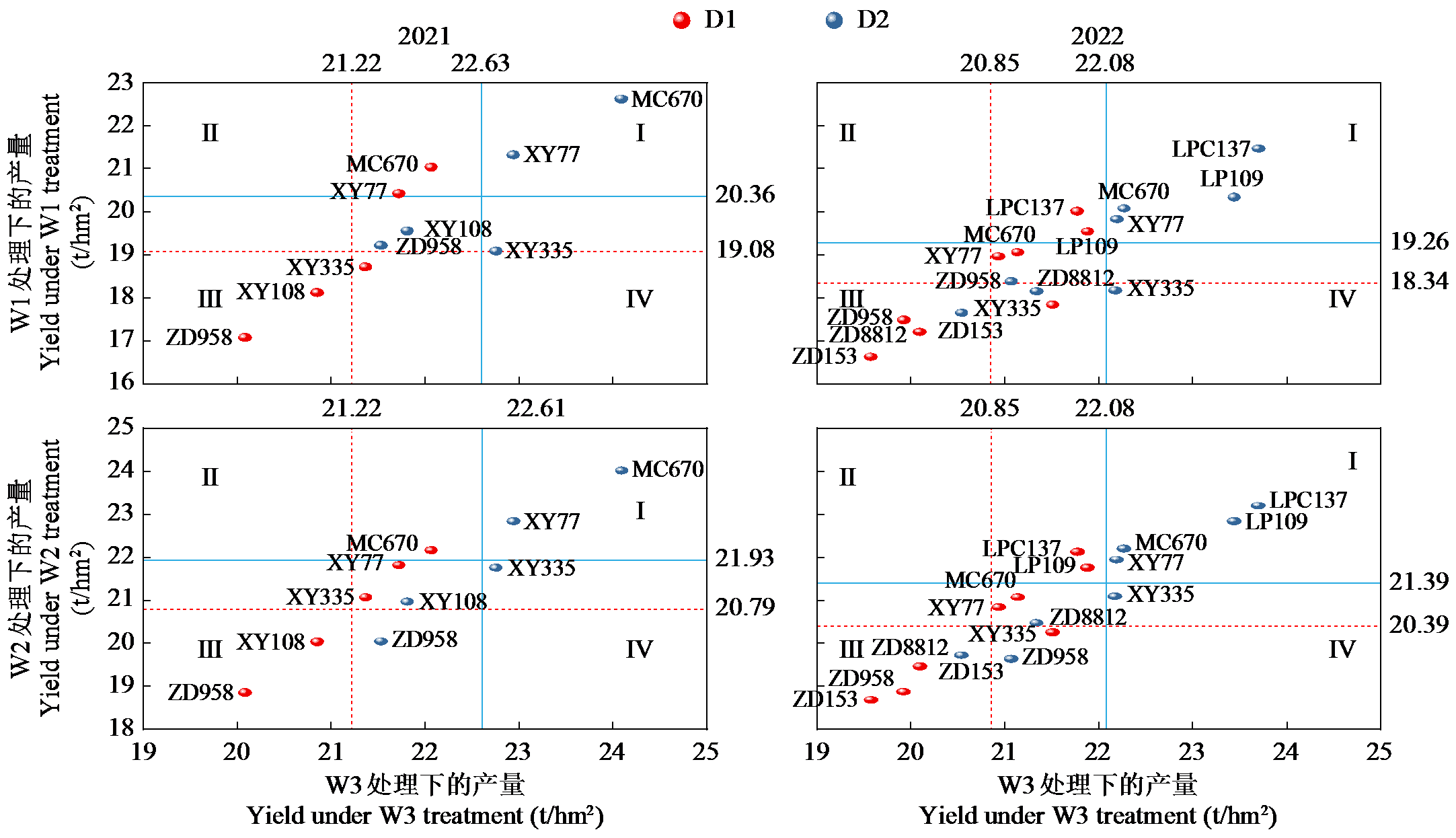
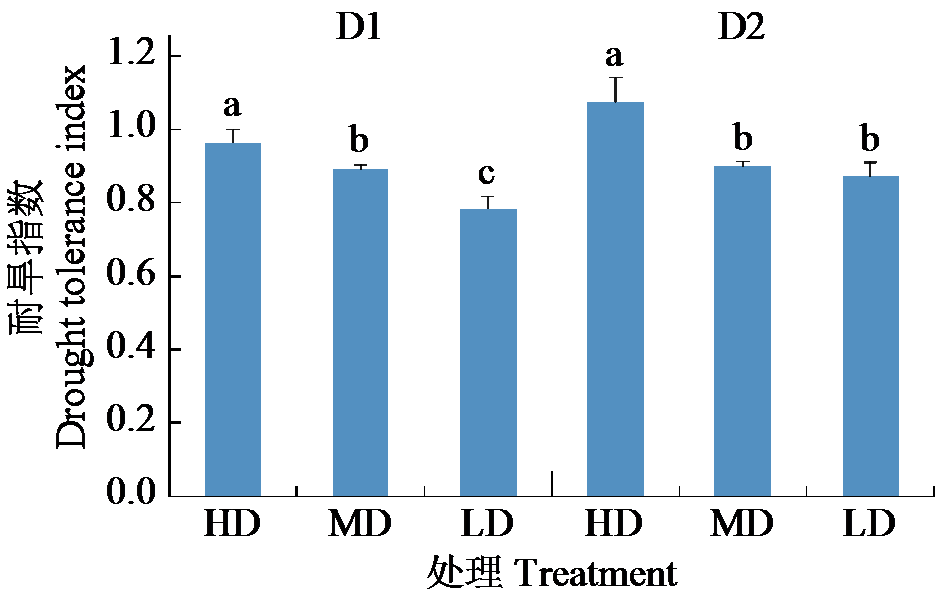
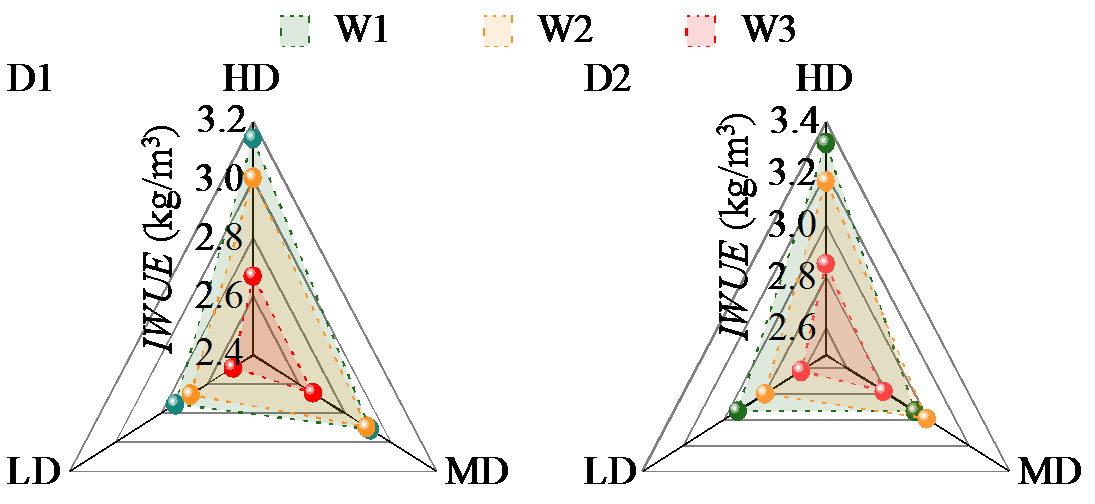
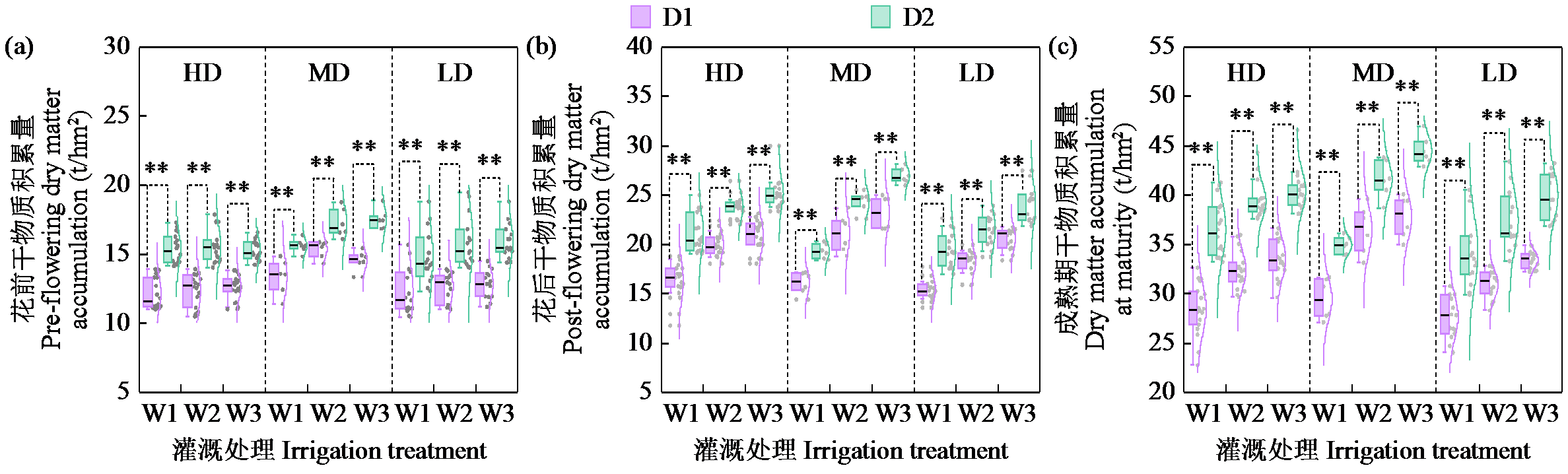
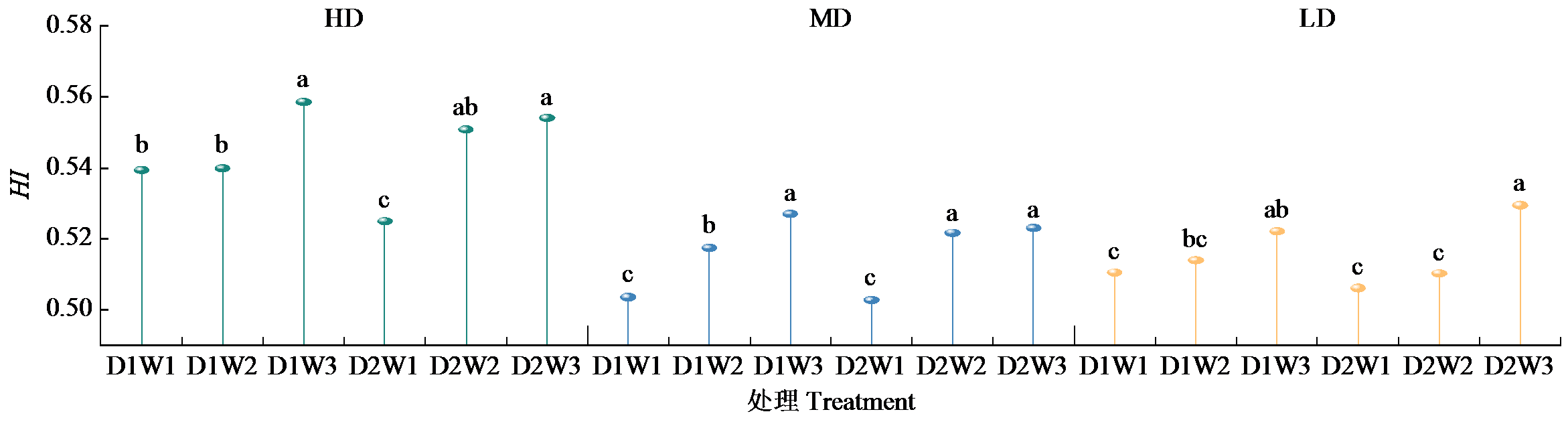
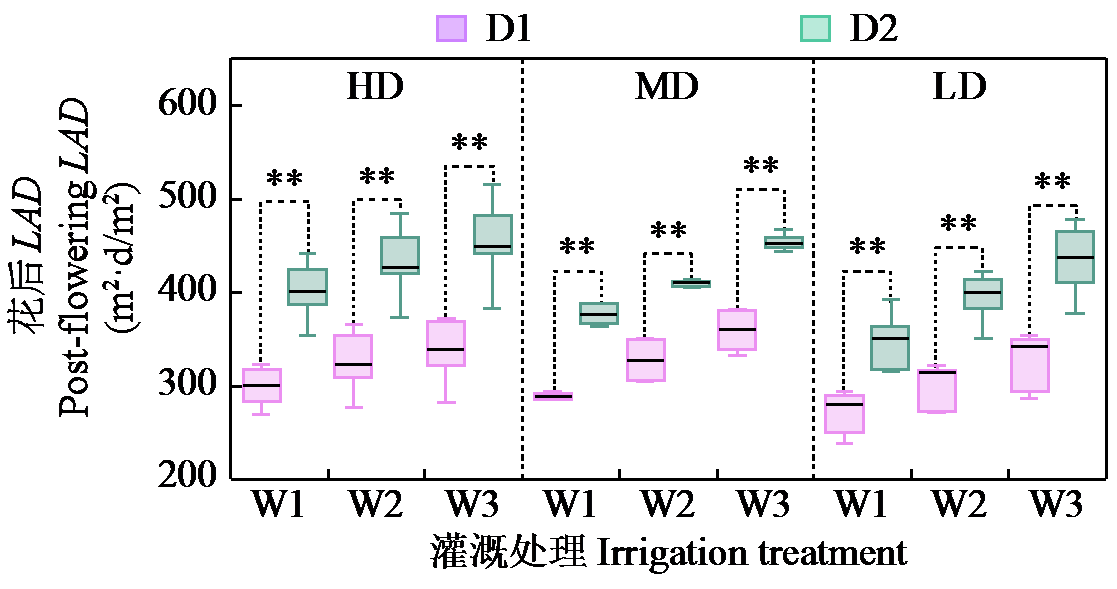
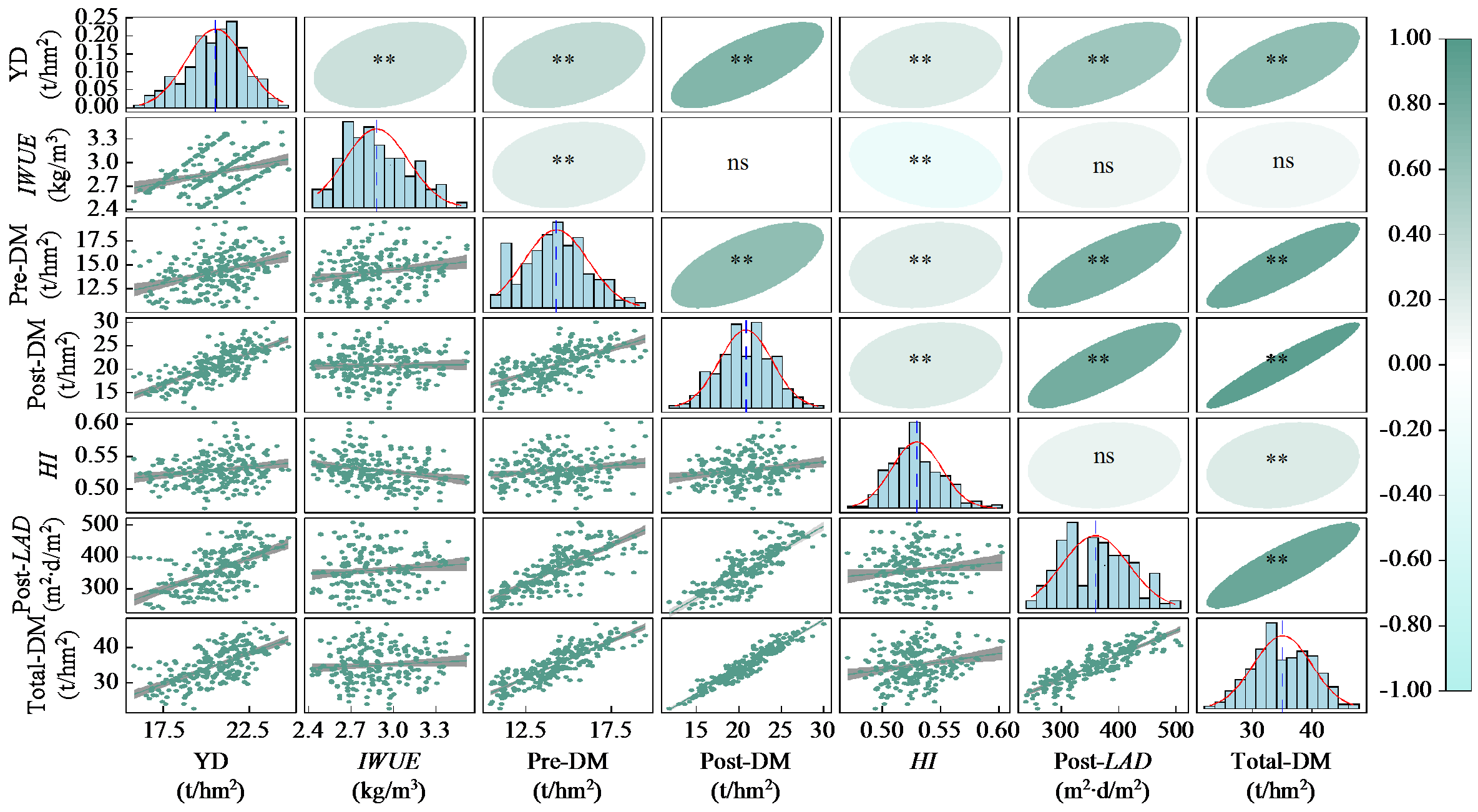
节水增粮是兼顾粮食安全与生态安全的重要路径。试验于2021-2022年在新疆奇台农场开展,设置5400(常规灌量,W3)、4800(W2)和4200 m3/hm2(W1)3个灌溉量,9.0×104(农户种植密度,D1)和12.0×104株/hm2(高产密度,D2)2个种植密度以及9个基因型玉米品种。研究灌溉量、种植密度和不同基因型品种对玉米物质生产、耐旱性、产量和灌溉水利用效率(IWUE)的影响。结果表明,W3处理的产量分别比W2和W1处理高0.68%~8.26%和8.29%~13.69%;D2处理的产量较D1提高了6.64%~11.18%;以不同灌溉量处理的基因型品种产量为分类依据,根据象限法分析了基因型品种的产量分布,将品种分为高产耐旱型(HD)、中产敏感型(LD)和高产敏感型(MD)。其中,HD产量较LD和MD分别高11.82%和6.47%,耐旱指数分别高11.53%和23.73%。HD的花后光合势、花后干物质积累、成熟期干物质积累、收获指数(HI)和IWUE均显著高于MD和LD。综上所述,在干旱区域限量灌溉的条件下,通过采用耐旱型高产玉米品种、合理增密、优化灌溉量并水肥一体化分次灌溉施肥,能够有效增加群体花后光合势和花后干物质积累量,提高HI,进而提高玉米的产量和水分生产效率。

| [1] |
赵鸿, 蔡迪花, 王鹤龄, 等. 干旱灾害对粮食安全的影响及其应对技术研究进展与展望. 干旱气象, 2023, 41(2):187-206.
doi: 10.11755/j.issn.1006-7639(2023)-02-0187 |
| [2] | Liang C. Genetically modified crops with drought tolerance: achievements, challenges, and perspectives. Drought Stress Tolerance in Plants, 2016(2):531-547. |
| [3] |
李少昆, 赵久然, 董树亭, 等. 中国玉米栽培研究进展与展望. 中国农业科学, 2017, 50(11):1941-1959.
doi: 10.3864/j.issn.0578-1752.2017.11.001 |
| [4] |
Kang S Z, Hao X M, Du T S, et al. Improving agricultural water productivity to ensure food security in China under changing environment: from research to practice. Agricultural Water Management, 2017, 179:5-17.
doi: 10.1016/j.agwat.2016.05.007 |
| [5] |
杨哲, 于胜男, 高聚林, 等. 主要栽培措施对北方春玉米产量贡献的定量评估. 中国农业科学, 2020, 53(15):3024-3035.
doi: 10.3864/j.issn.0578-1752.2020.15.004 |
| [6] |
Payero J O, Tarkalson D D, Irmak S, et al. Effect of irrigation amounts applied with subsurface drip irrigation on corn evapotranspiration, yield, water use efficiency, and dry matter production in a semiarid climate. Agricultural Water Management, 2008, 95(8):895-908.
doi: 10.1016/j.agwat.2008.02.015 |
| [7] | 崔蓉, 王天野, 王呈玉, 等. 干旱胁迫对不同玉米品种生长性状及产量的影响. 华北农学报, 2021, 36(增1):94-100. |
| [8] |
Hao B Z, Ma J L, Si S H, et al. Response of grain yield and water productivity to plant density in drought-tolerant maize cultivar underirrigated and rainfed conditions. Agricultural Water Management, 2024, 298:108880.
doi: 10.1016/j.agwat.2024.108880 |
| [9] |
Cooper M, Gho C, Leafgren R, et al. Breeding drought-tolerant maize hybrids for the US corn-belt: discovery to product. Journal of Experimental Botany, 2014, 65(21):6191-6204.
doi: 10.1093/jxb/eru064 pmid: 24596174 |
| [10] | 刘丽平, 张克寒, 佟玲, 等. Meta分析滴灌灌溉量及品种对玉米产量和水分利用效率的影响. 中国农业大学学报, 2025, 30 (1):1-13. |
| [11] |
王楷, 王克如, 王永宏, 等. 密度对玉米产量(>15000 kg∙hm-2)及其产量构成因子的影响. 中国农业科学, 2012, 45(16):3437-3445.
doi: 10.3864/j.issn.0578-1752.2012.16.025 |
| [12] |
Zhang G Q, Shen D P, Ming B, et al. Optimizing planting density to increase maize yield and water use efficiency and economic return in the arid region of northwest China. Agriculture, 2022, 12(9):1322.
doi: 10.3390/agriculture12091322 |
| [13] |
王绍新, 李楠, 王传娟, 等. 国内玉米高效节水灌溉水肥一体化技术研究现状与展望. 节水灌溉, 2023(8):121-128.
doi: 10.12396/jsgg.2022347 |
| [14] | 杨恒山, 薛新伟, 张瑞富, 等. 灌溉方式对西辽河平原玉米产量及水分利用效率的影响. 农业工程学报, 2019, 35(21):69-77. |
| [15] | Fernandez G C J. Effective selection criteria for assessing plant stress tolerance. Taiwan: International Symposium on Adaptation of Food Crops to Temperature and Water Stress, 1992. |
| [16] |
Guo Q, Huang G M, Guo Y L, et al. Optimizing irrigation and planting density of spring maize under mulch drip irrigation system in the arid region of Northwest China. Field Crops Research, 2021, 266:108141.
doi: 10.1016/j.fcr.2021.108141 |
| [17] |
Zhang M, Tao C, Latifmanesh H, et al. How plant density affects maize spike differentiation, kernel set, and grain yield formation in Northeast China?. Journal of Integrative Agriculture, 2018, 17(8):1745-1757.
doi: 10.1016/S2095-3119(17)61877-X |
| [18] | 杨德光, 张鑫辉, 郭校男, 等. 不同密度对黑龙江嫩江地区甜玉米产量和品质的影响. 玉米科学, 2024, 32(9):87-95. |
| [19] |
Liu G Z, Yang Y S, Guo X X, et al. A global analysis of dry matter accumulation and allocation for maize yield breakthrough from 1.0 to 25.0 Mg ha-1. Resources,Conservation and Recycling, 2023, 188:106656.
doi: 10.1016/j.resconrec.2022.106656 |
| [20] | Donald C M, Hamblin J. The biological yield and harvest index of cereals as agronomic and plant breeding criteria. Advances in Agronomy, 1976, 28:361-405. |
| [21] |
Liu W M, Hou P, Liu G Z, et al. Contribution of total dry matter and harvest index to maize grain yield - A multisource data analysis. Food and Energy Security, 2020, 9(4):e256.
doi: 10.1002/fes3.v9.4 |
| [22] |
赵紫平, 邓西平, 王征宏, 等. 灌浆期水分亏缺条件下二、四、六倍体小麦收获指数和水分利用效率的演化. 植物生态学报, 2010, 34(4):444-451.
doi: 10.3773/j.iSDn.1005-264x.2010.04.010 |
| [23] |
刘月娥, 徐田军, 蔡万涛, 等. 我国玉米超高产研究现状与展望. 生物技术通报, 2023, 39(8):52-61.
doi: 10.13560/j.cnki.biotech.bull.1985.2023-0555 |
| [24] |
赵花荣, 任三学, 齐月. 高湿和干旱对夏玉米灌浆期叶片光合特性的影响. 中国农学通报, 2017, 33(31):15-21.
doi: 10.11924/j.issn.1000-6850.casb17030084 |
| [25] |
Li Y B, Tao H B, Zhang B C, et al. Timing of water deficit limits maize kernel setting in association with changes in the source-flow-sink relationship. Frontiers in Plant Science, 2018, 9:1326.
doi: 10.3389/fpls.2018.01326 pmid: 30405644 |
| [26] |
Tollenaar M, Wu J. Yield improvement in temperate maize is attributable to greater stress tolerance. Crop Science, 1999, 39 (6):1597-1604.
doi: 10.2135/cropsci1999.3961597x |
| [27] |
张俊杰, 陈金平, 汤钰镂, 等. 花期前后干旱胁迫对复水后夏玉米光合特性与产量的影响. 作物学报, 2023, 49(5):1397-1409.
doi: 10.3724/SP.J.1006.2023.23003 |
| [28] |
Zhang Y H, Xu Z G, Li J, et al. Optimum planting density improves resource use efficiency and yield stability of rainfed maize in semiarid climate. Frontiers in Plant Science, 2021, 12:752606.
doi: 10.3389/fpls.2021.752606 |
| [29] |
Jia Q M, Sun L F, Mou H Y, et al. Effects of planting patterns and sowing densities on grain-filling, radiation use efficiency and yield of maize (Zea mays L.) in semi-arid regions. Agricultural Water Management, 2018, 201:287-298.
doi: 10.1016/j.agwat.2017.11.025 |
| [30] |
Assefa Y, Carter P, Hinds M, et al. Analysis of long-term study indicates both agronomic optimal plant density and increase maize yield per plant contributed to yield gain. Scientific Reports, 2018, 8:4937.
doi: 10.1038/s41598-018-23362-x pmid: 29563534 |
| [31] | 汤秋香, 林涛, 董文杰, 等. 干旱胁迫对滴灌冬小麦产量形成及水分利用效率的影响. 新疆农业科学, 2015, 52(3):429-435. |
| [32] | Saseendran S A, Ahuja L R, Nielsen D C, et al. Use of crop simulation models to evaluate limited irrigation management options for corn in a semiarid environment. Water Resources Research, 2008, 44(7):W00E02. |
| [33] | 沈东萍, 张国强, 王克如, 等. 滴灌量对高产春玉米冠层结构特征及产量的影响. 西北农业学报, 2018, 27(8):1137-1145. |
| [34] |
张秀, 朱文美, 董述鑫, 等. 灌水量与密度互作对冬小麦籽粒产量和水分利用效率的影响. 应用生态学报, 2021, 32(1):163-174.
doi: 10.13287/j.1001-9332.202101.025 |
| [35] |
朱金娟, 王慧萍, 杨国栋, 等. 水分管理和品种类型对再生稻产量和稻米品质的影响. 作物学报, 2026, 52(1):295-315.
doi: 10.3724/SP.J.1006.2026.52021 |
| [36] |
Su Z E, Zhao J, Marek T H, et al. Drought tolerant maize hybrids have higher yields and lower water use under drought conditions at a regional scale. Agricultural Water Management, 2022, 274:107978.
doi: 10.1016/j.agwat.2022.107978 |
| [37] |
Ma Y N, Ren J W, Yang S J, et al. Enhancing maize yield and water productivity through coordinated root-shoot growth under mild water stress in dense planting. Field Crops Research, 2025, 323:109786.
doi: 10.1016/j.fcr.2025.109786 |
| [38] | 李刚, 马骏, 王金艳, 等. 不同玉米品种经济产量水分利用效率的差异比较. 杂粮作物, 2007, 27(3):199-201. |
| [39] | 程雅婷, 李荣发, 王克如, 等. 中国春玉米高产纪录的创造与思考. 玉米科学, 2021, 29(2):56-59. |
| [1] | 虞思佳, 腾峰, 童少华, 王明成, 叶文举, 刘丹, 贺正华, 张士龙, 孙霄鹏, 李曼菲, 杜何为, 贾海涛. 玉米黄化突变基因ZmET10的精细定位[J]. 作物杂志, 2026, (5): 107–114 |
| [2] | 常江育, 吴海彬, 张慧芋, 马小飞, 司中泽, 原鹏莉. 旱地优质小麦新品种临旱26[J]. 作物杂志, 2026, (5): 148–153 |
| [3] | 江峥嵘, 陈秋丽, 曾娜娜, 刘松, 林最昌, 杨扬, 丁艳锋, 李刚华. 缓控释肥对水稻产量及灌浆期叶片碳氮代谢的影响[J]. 作物杂志, 2026, (5): 171–180 |
| [4] | 游昊, 宋文杰, 付斌, 张大弘, 江勋, 卢碧林. 基蘖同步侧深施下氮肥运筹对水稻生长、氮素利用和产量的影响[J]. 作物杂志, 2026, (5): 181–188 |
| [5] | 韦巧, 王思冕, 林娇, 潘翠华, 吴吉平, 李洪菊, 罗艳萍, 罗冬玉, 侯玲, 刘永昌, 周家华, 张小贝. 去除基部枝叶对机采棉花叶片光合特征及产量、品质的影响[J]. 作物杂志, 2026, (5): 222–231 |
| [6] | 杨志雪, 加央多拉, 吴晗, 马飞跃, 田娟, 王开伟, 王霞, 马越, 李春花, 王乐. 播期和播量对白城地区荞麦新品种生长发育和产量的影响[J]. 作物杂志, 2026, (5): 246–254 |
| [7] | 薛乃雯, 刘建霞, 杨珍平, 张东旭. 谷豆间作对谷子生长发育、产量及籽粒品质的影响[J]. 作物杂志, 2026, (5): 255–261 |
| [8] | 王婧, 石文鑫, 孙瑞卿, 秦曙. 喷施不同植物生长调节剂及其浓度对燕麦倒伏性及产量的影响[J]. 作物杂志, 2026, (5): 75–81 |
| [9] | 赵雅萱, 崔雪梅, 王千军, 郑成忠, 王凤梧, 梅雪, 赵宝平. 基于Richards模型分析干物质积累及内源激素对裸燕麦产量形成的影响[J]. 作物杂志, 2026, (5): 82–89 |
| [10] | 陈娟娟, 张玉梅, 周小成, 周爱爱, 付蓉, 张峰. 叶面喷施茉莉酸甲酯对雾培马铃薯产量和品质性状的影响[J]. 作物杂志, 2026, (5): 90–97 |
| [11] | 占东霞, 马利军, 常锦乐, 臧力瑶, 依力亚尔·阿布力米提, 许人颖. 不同种植模式下脱叶剂喷施对海岛棉雾滴沉积及脱叶效果的影响[J]. 作物杂志, 2026, (5): 98–106 |
| [12] | 赵永满, 李瑞奇, 王红光. 拔节前补灌追氮对小麦叶片干物质积累量和产量的影响[J]. 作物杂志, 2026, (4): 101–109 |
| [13] | 许芸菲, 贾浩杨, 李叶彤, 曹瑞, 高梓淇, 赵喆, 陈立强, 梁潇. 氮肥用量及运筹对优良食味粳稻越光产量形成及根系形态的影响[J]. 作物杂志, 2026, (4): 117–128 |
| [14] | 吴子帅, 黄秋要, 陈传华, 罗芳媚, 张世冠, 刘广林, 路一平, 罗群昌, 李虎. 施氮量和栽插密度对桂香99产量和稻米品质的影响[J]. 作物杂志, 2026, (4): 140–145 |
| [15] | 阮新民, 从夕汉, 杜弘杨, 岳伟, 施伏芝, 罗彦长, 王元垒, 罗志祥. 江淮稻作区氮肥用量对高产优质中籼稻产量、品质及氮肥利用效率的影响[J]. 作物杂志, 2026, (4): 146–154 |
|
||