



番茄(Solanum lycopersicum L.)作为全球重要的经济作物之一,其外观、风味、营养成分和产量直接关系农业经济效益和消费者健康需求[1]。近年来,随着设施栽培的普及与集约化生产的发展,番茄果实品质不稳定和转色不均等问题日益凸显,成为制约产业升级的关键因素。植物营养调控作为改善作物生理代谢的重要途径之一,磷、钾与硼元素的协同作用备受关注。磷酸二氢钾(KH2PO4)作为优质的磷钾复合水溶肥,在促进植物生长发育[2]、改善品质[3]以及增强抗逆性[4-5]等方面均表现出显著效果,特别是在花果期的施用,能显著促进果实着色,并有效提升作物的整体品质[6];而硼元素则参与细胞壁形成、花粉管伸长及糖代谢等过程,对果实发育与着色具有潜在调控作用[7]。然而,现有研究多聚焦于单一元素的作用效应,关于磷钾与硼配施对番茄植株整体生长、果实品质形成及转色过程的协同增效效应尚未完全明确,特别是其在番茄不同生育时期(幼果期、绿熟期、转色期、红熟期)的作用缺乏系统性的研究。考虑到番茄各生长阶段对硼的需求存在差异,本文旨在通过研究KH2PO4与硼酸配施对番茄各生长阶段的影响,探究其在促进植株生长、果实发育、营养积累、色素合成及转色过程中的作用。运用方差分析和主成分分析,对不同硼酸添加量处理下番茄幼果期、绿熟期、转色期和红熟期的果实品质进行综合评价,以期筛选出适合番茄不同生长阶段的硼酸添加量,揭示营养协同调控的生理机制,为番茄优质高效栽培及精准施肥技术提供理论参考。
1 材料与方法
1.1 试验材料
供试番茄品种为“红矮生番茄”;供试土壤为云南红壤;试验所用肥料均由云南云天化以化磷业研究技术有限公司提供。
1.2 试验设计
试验于2024年7-12月在云南省昆明市云天化绿色农业科创中心的温室内进行。采用单因素随机区组试验设计,设4个处理:对照组为磷酸二氢钾(CK),处理组包括磷酸二氢钾+0.5%硼酸(T1)、磷酸二氢钾+1.0%硼酸(T2)、磷酸二氢钾+1.5%硼酸(T3),每个处理6次重复。
采用盆栽法移栽种植,挑选颗粒饱满、大小一致的番茄种子播于50穴苗盘中,常规栽培管理。4叶1心期选取长势、生长状态一致的幼苗,用流动水清洗根系,定植到花盆中,红壤:椰糠=1:1。当番茄幼苗成活且稳定生长后,进行施肥处理,所有处理幼苗期至开花坐果期均统一根部浇施19-19-19大量元素水溶平衡肥,幼果期至成熟期根部浇施尿素+各组处理肥料,种植密度37 500株/hm2,番茄施肥量为平衡肥37.5 kg/hm2、尿素19.5 kg/hm2、磷酸二氢钾88.2 kg/hm2,7 d施肥1次,2 d浇水1次,每株番茄浇灌500 mL,直到采收为止。
1.3 测定项目与方法
1.3.1 植株指标
用钢卷尺测量从植株基部至顶端叶尖的距离,即株高;用游标卡尺测量地上部分第1节的直径,即茎粗;采用SPAD-502Plus叶绿素含量测定仪(便携式)测定相对叶绿素含量(SPAD值)。
1.3.2 果实指标
1.4 数据处理
用Excel整理试验数据,用IBM SPSS Statistics 26进行数据统计、单因素方差分析和主成分分析,用Origin 2024作图。
2 结果与分析
2.1 不同处理对番茄植株农艺性状的影响
分析不同处理下各时期番茄株高、茎粗和叶片SPAD值的变化(表1),发现幼果期、绿熟期、转色期和红熟期不同施肥处理间的叶片SPAD值差异均不显著。幼果期,茎粗和株高各处理间差异不显著,但随着果实成熟,番茄植株的茎粗和株高逐渐增大,T2处理显著增加了茎粗,与CK相比,幼果期、绿熟期、转色期和红熟期T2处理下的茎粗分别增加了8.37%、13.36%、13.71%和9.88%。T3处理显著增加了株高,绿熟期和红熟期T3处理显著高于CK,高于T1和T2处理但不显著,转色期,T3处理显著高于CK和T1处理,高于T2但不显著。
表1 不同处理下各时期番茄株高、茎粗和叶片SPAD值的变化
Table 1
| 时期 Stage | 处理 Treatment | SPAD值 SPAD value | 茎粗 Stem diameter (mm) | 株高 Plant height (cm) |
|---|---|---|---|---|
| 幼果期 Young fruit | CK | 50.37±1.04a | 7.17±0.25a | 21.00±0.87a |
| T1 | 49.18±0.03a | 7.97±0.45a | 20.17±1.53a | |
| T2 | 50.37±1.64a | 7.77±0.64a | 21.83±1.76a | |
| T3 | 50.07±0.96a | 7.08±0.71a | 22.33±0.76a | |
| 绿熟期 Mature green | CK | 47.43±1.87a | 7.71±0.39b | 24.17±0.29b |
| T1 | 48.07±1.41a | 8.05±0.40ab | 25.17±1.04ab | |
| T2 | 48.57±0.15a | 8.74±0.59a | 24.67±1.53ab | |
| T3 | 48.48±2.34a | 7.83±0.56ab | 27.33±2.25a | |
| 转色期 Color-changing | CK | 49.02±3.02a | 7.95±0.05b | 24.67±0.76b |
| T1 | 49.40±1.74a | 8.48±0.53ab | 25.33±0.76b | |
| T2 | 48.83±0.51a | 9.04±0.43a | 26.33±1.44ab | |
| T3 | 47.50±0.53a | 8.60±0.22ab | 28.50±2.60a | |
| 红熟期 Red ripe | CK | 48.67±1.83a | 8.40±0.41b | 25.50±1.32b |
| T1 | 48.50±1.13a | 8.62±0.09ab | 26.83±1.76ab | |
| T2 | 48.62±2.58a | 9.23±0.55a | 27.83±1.89ab | |
| T3 | 46.83±2.64a | 9.02±0.17ab | 30.17±2.57a |
各时期同列数值后不同小写字母表示不同处理间差异显著(P < 0.05)。
Different lowercase letters after the values within the same columns at each stage indicate significant differences among different treatments at the P < 0.05 level.
2.2 不同处理对番茄果实品质的影响
随着果实成熟,番茄的可溶性糖含量不断积累,呈上升趋势(图1a)。幼果期,各处理与CK的可溶性糖含量均无显著性差异。绿熟期和转色期,各处理与CK间差异显著,但各处理间差异不显著。红熟期,T1和T3处理显著高于CK,T2与CK、T1和T3处理均没有显著差异,但高于CK,对比CK,T1、T2和T3处理的可溶性糖含量分别增加了30.57%、13.24%和20.10%。
图1
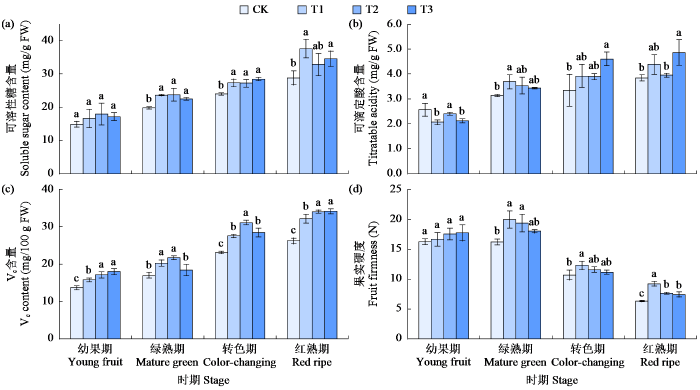
图1
不同处理对番茄各时期果实可溶性糖、可滴定酸、Vc含量及果实硬度的影响
不同小写字母表示差异显著(P < 0.05)。下同。
Fig.1
Effects of different treatments on soluble sugar, titratable acid, Vc content and fruit firmness of tomato at various stages
Different lowercase letters indicate significant differences (P < 0.05). The same below.
各处理可滴定酸含量随着番茄果实的成熟均逐渐增加(图1b)。CK处理的可滴定酸含量在幼果期显著高于T1和T3处理,高于T2处理但不显著,与CK相比,在不同硼酸添加量处理下,绿熟期、转色期和红熟期番茄可滴定酸含量均有不同程度的提高。绿熟期,T1处理可滴定酸含量最高,为3.69 mg/g FW,与CK差异显著,T3处理显著提高了番茄果实转色期和红熟期的可滴定酸含量。
各处理Vc含量随着番茄果实的成熟均逐渐增加(图1c)。与CK相比,除绿熟期的T3处理外,其他不同硼酸添加量处理均显著增加了番茄各时期的Vc含量,幼果期,T3处理下的Vc含量最高,较CK提高了21.20%,其次是T2。绿熟期,T1和T2处理显著高于CK和T3处理。转色期,T2处理显著高于CK、T1和T3,且CK与T1和T3处理差异显著,红熟期,各处理对Vc的影响为T3>T2>T1>CK。
果实成熟过程中,果实硬度呈先上升后下降趋势(图1d)。幼果期,各处理与CK的果实硬度均没有显著性差异,但对比CK,T1、T2和T3处理的果实硬度分别增加了2.21%、7.86%和8.79%。绿熟期、转色期和红熟期各处理对果实硬度的影响相同,均表现为T1>T2>T3>CK。
2.3 不同处理对番茄果实转色指标的影响
2.3.1 类胡萝卜素和番茄红素
各处理的番茄果实中类胡萝卜素含量随着番茄果实的成熟均逐渐增加(图2a)。绿熟期,果实类胡萝卜素含量在6.40~8.69 μg/g FW,T1处理的类胡萝卜素含量显著高于CK处理,T2和T3高于CK但差异不显著。转色期,类胡萝卜素含量与绿熟期相比有明显的提高,在18.98~30.16 μg/g FW,T1和T2处理显著高于CK。红熟期,所有处理的番茄红素含量均达到最大值,在32.93~66.24 μg/g FW,T1显著高于其他处理,T2显著高于T3和CK,CK和T3之间差异不显著,但T3处理的类胡萝卜素含量高于CK。
图2
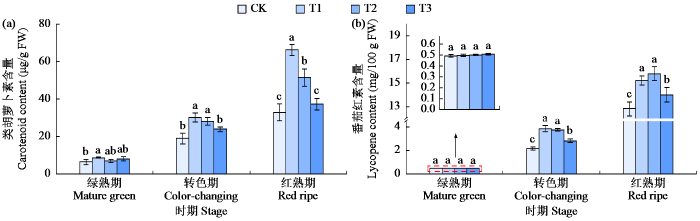
图2
不同处理对番茄各时期果实类胡萝卜素和番茄红素的影响
Fig.2
Effects of different treatments on carotenoids and lycopene in tomato fruit at various stages
随着番茄果实成熟,番茄红素含量不断积累,呈上升趋势(图2b)。不同硼酸添加量处理和CK处理在绿熟期的番茄红素含量均没有显著性差异,而且绿熟期番茄果实中番茄红素含量很低,在0.00~ 0.50 mg/100g FW。转色期和红熟期,T1和T2处理显著高于T3和CK,T3处理显著高于CK,T1和T2处理之间差异不显著,但转色期T1>T2,而红熟期T2>T1。转色期,与CK相比,T1、T2和T3处理的番茄红素含量分别增加了78.60%、72.09%和30.23%。红熟期,所有处理的番茄红素含量达到最高值,T2处理最高,为15.76 mg/100 g FW。
2.3.2 果实叶绿素
如图3所示,随着果实的成熟,果实叶绿素呈下降趋势。幼果期是番茄果实叶绿素含量最高的时期。
图3
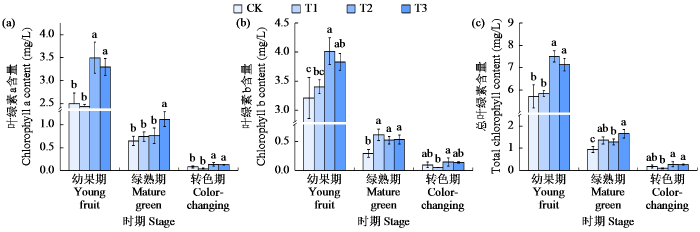
图3
不同处理对番茄各时期果实叶绿素a、叶绿素b和总叶绿素含量的影响
Fig.3
Effects of different treatments on chlorophyll a, chlorophyll b and total chlorophyll contents of tomato fruits at various stages
幼果期,T2、T3处理的叶绿素a和总叶绿素均显著高于CK处理。T2、T3处理的叶绿素a分别高于CK处理40.00%和32.00%,T2、T3处理的总叶绿素分别高于CK处理31.52%和24.87%。T2处理的叶绿素b显著高于T1和CK处理,T3处理显著高于CK处理,T1处理高于CK处理但不显著。
绿熟期,叶绿素含量与幼果期相比有明显下降,T3处理的叶绿素a显著高于其他处理,其他处理间差异不显著。所有处理的叶绿素b均显著高于CK处理,各处理对叶绿素b的影响为T1>T3>T2>CK。T3处理的总叶绿素显著高于T2和CK处理,T1处理与T2和T3处理差异不显著,T1、T2和T3处理显著高于CK处理30.15%、35.79%和74.74%。
转色期,所有处理的叶绿素含量都很低,叶绿素a含量在0.046~0.140 mg/L,叶绿素b含量在0.06~ 0.15 mg/L,总叶绿素含量在0.10~0.29 mg/L,处理对果实叶绿素a、叶绿素b和总叶绿素的影响为T2>T3>CK>T1。
2.4 各个时期番茄生长、品质与转色指标的协同影响分析
2.4.1 幼果期
为了准确评估不同硼酸添加量对番茄幼果期质量的影响,并避免单一指标评价带来的偏差,采用SPSS对10个幼果期质量评价指标进行主成分分析(表2),得到特征值大于1的3个主成分,累积方差贡献率79.18%,可以反映指标的大部分信息。第1主成分主要综合了Vc、果实叶绿素a、果实叶绿素b和总叶绿素等,反映了番茄幼果期的营养积累和光合作用能力;第2主成分主要是可滴定酸,反映了番茄幼果期风味的酸味特征;第3主成分主要综合了茎粗和可溶性糖,反映了番茄幼果期的生长活力与风味甜味特征。
表2 幼果期3个主成分的成分载荷矩阵、特征值、方差贡献率及累积方差贡献率
Table 2
| 项目 Item | 载荷系数 Load coefficient | ||
|---|---|---|---|
| 主成分1 PC1 | 主成分2 PC2 | 主成分3 PC3 | |
| X1 | 0.199 | -0.743 | 0.356 |
| X2 | -0.083 | 0.533 | 0.648 |
| X3 | 0.485 | -0.719 | 0.100 |
| X4 | 0.594 | 0.117 | 0.673 |
| X5 | 0.198 | 0.929 | -0.074 |
| X6 | 0.892 | 0.135 | 0.100 |
| X7 | 0.556 | 0.096 | -0.382 |
| X8 | 0.902 | 0.003 | -0.339 |
| X9 | 0.905 | 0.081 | 0.131 |
| X10 | 0.958 | 0.039 | -0.147 |
| 初始特征值Initial eigenvalue | 4.327 | 2.266 | 1.325 |
| 方差贡献率 Variance contribution rate (%) | 43.27 | 22.66 | 13.25 |
| 累积方差贡献率 Cumulative variance contribution rate (%) | 43.27 | 65.93 | 79.18 |
X1:SPAD值,X2:茎粗,X3:株高,X4:可溶性糖,X5:可滴定酸,X6:维生素C,X7:硬度,X8:叶绿素a,X9:叶绿素b,X10:总叶绿素。下同。
X1: SPAD value, X2: stem thickness, X3: plant height, X4: soluble sugar, X5: titratable acid, X6: vitamin C, X7: hardness, X8: chlorophyll a, X9: chlorophyll b, X10: total chlorophyll. The same below.
将主成分荷载矩阵中各项数据除以对应主成分特征值的平方根(表2),得到3个主成分各指标对应的特征向量,以特征向量为权重和各指标原始数据标准化以后的数值相乘后相加,得到3个主成分的得分公式:
Y1=0.096X1-0.040X2+0.233X3+0.285X4+0.095X5+0.429X6+0.267X7+0.433X8+0.435X9+0.461X10;
Y2=-0.494X1+0.354X2-0.477X3+0.078X4+0.617X5+0.090X6+0.064X7+0.002X8+0.054X9+0.026X10;
Y3=0.309X1+0.563X2+0.087X3+0.584X4-0.064X5+0.087X6-0.332X7-0.294X8+0.114X9-0.128X10。
以3个主成分所对应的相对贡献率为权重,构建综合评价模型:
Y=0.546Y1+0.286Y2+0.167Y3。
根据得分公式和评价模型得到幼果期不同施肥处理综合得分排序(表3),通过计算综合得分,4个处理得分排名依次是T2>T3>T1>CK。
表3 幼果期不同施肥处理综合得分排序
Table 3
| 处理 Treatment | 主成分1 PC1 | 主成分2 PC2 | |||
|---|---|---|---|---|---|
| 得分Score | 排序Ranking | 得分Score | 排序Ranking | ||
| CK | -2.36 | 4 | -1.23 | 4 | |
| T1 | -1.43 | 3 | 1.49 | 1 | |
| T2 | 2.07 | 1 | 0.21 | 2 | |
| T3 | 1.72 | 2 | -0.47 | 3 | |
| 处理 Treatment | 主成分3 PC3 | 综合Comprehensive | |||
| 得分Score | 排序Ranking | 得分Score | 排序Ranking | ||
| CK | -0.24 | 3 | -1.68 | 4 | |
| T1 | 0.49 | 1 | -0.27 | 3 | |
| T2 | 0.25 | 2 | 1.23 | 1 | |
| T3 | -0.50 | 4 | 0.72 | 2 | |
2.4.2 绿熟期
为了准确评估不同硼酸添加量对番茄绿熟期质量的影响,并避免单一指标评价带来的偏差,对12个绿熟期质量评价指标进行主成分分析(表4),得到特征值大于1的4个主成分,累积方差贡献率84.60%,可以反映全部指标中足够的信息。第1主成分主要综合了果实硬度、可溶性糖、可滴定酸、Vc、果实叶绿素b和果实总叶绿素,反映了番茄绿熟期的果实发育情况和营养品质;第2主成分主要综合了株高和果实叶绿素a,反映了番茄绿熟期的植株生长状况和光合作用能力;第3主成分主要是茎粗;第4主成分主要综合了Vc和果实叶绿素b,反映了番茄绿熟期的抗氧化能力。
表4 绿熟期3个主成分的成分载荷矩阵、特征值、方差贡献率及累积方差贡献率
Table 4
| 项目 Item | 载荷系数Load coefficient | ||||
|---|---|---|---|---|---|
| 主成分1 PC1 | 主成分2 PC2 | 主成分3 PC3 | 主成分4 PC4 | ||
| X1 | 0.504 | 0.356 | 0.160 | -0.244 | |
| X2 | 0.245 | -0.661 | 0.628 | 0.177 | |
| X3 | 0.504 | 0.769 | 0.328 | -0.136 | |
| X4 | 0.802 | -0.424 | 0.240 | -0.033 | |
| X5 | 0.719 | -0.238 | -0.581 | 0.076 | |
| X6 | 0.744 | -0.285 | 0.011 | 0.392 | |
| X7 | 0.731 | -0.419 | -0.080 | 0.157 | |
| X8 | 0.376 | 0.849 | 0.138 | 0.323 | |
| X9 | 0.924 | -0.120 | 0.149 | -0.118 | |
| X10 | 0.765 | 0.496 | 0.115 | 0.076 | |
| X11 | 0.586 | -0.160 | -0.127 | -0.774 | |
| X12 | 0.559 | 0.235 | -0.586 | 0.172 | |
| 初始特征值 Initial eigenvalue | 5.052 | 2.711 | 1.342 | 1.047 | |
| 方差贡献率 Variance contribution rate (%) | 42.10 | 22.59 | 11.18 | 8.73 | |
| 累积方差贡献率 Cumulative variance contribution rate (%) | 42.10 | 64.69 | 75.87 | 84.60 | |
X11:类胡萝卜素,X12:番茄红素。下同。
X11: carotenoids, X12: lycopene. The same below.
将主成分荷载矩阵中各项数据除以对应主成分特征值的平方根(表4),得到4个主成分各指标对应的特征向量,以特征向量为权重和各指标原始数据标准化以后的数值相乘后相加,得到4个主成分的得分公式:
Y1=0.224X1+0.109X2+0.224X3+0.331X4+0.357X5+0.32X6+0.325X7+0.167X8+0.411X9+0.340X10+0.261X11+0.249X12;
Y2=0.216X1-0.402X2+0.467X3-0.173X4-0.258X5-0.145X6-0.255X7+0.516X8-0.073X9+0.301X10-0.097X11+0.143X12;
Y3=0.138X1+0.542X2+0.283X3-0.009X4+0.207X5-0.501X6+0.069X7+0.119X8+0.129X9+0.099X10-0.109X11-0.506X12;
Y4=-0.238X1+0.173X2-0.133X3+0.383X4-0.033X5+0.075X6+0.154X7+0.315X8-0.115X9+0.074X10-0.757X11+0.168X12。
以4个主成分所对应的相对贡献率为权重,构建综合评价模型:
Y=0.498Y1+0.267Y2+0.132Y3+0.103Y4。
根据得分公式和评价模型得到绿熟期不同施肥处理综合得分排序(表5),依次为T3>T2>T1>CK。
表5 绿熟期不同施肥处理综合得分排序
Table 5
| 处理 Treatment | 主成分1 PC1 | 主成分2 PC2 | 主成分3 PC3 | ||||||||||
|---|---|---|---|---|---|---|---|---|---|---|---|---|---|
| 得分 Score | 排序 Ranking | 得分 Score | 排序 Ranking | 得分 Score | 排序 Ranking | ||||||||
| CK | -3.49 | 4 | 0.35 | 2 | -0.03 | 3 | |||||||
| T1 | 1.50 | 1 | -0.95 | 3 | -0.44 | 4 | |||||||
| T2 | 1.04 | 2 | -1.11 | 4 | 0.41 | 2 | |||||||
| T3 | 0.95 | 3 | 1.71 | 1 | 0.07 | 1 | |||||||
| 处理 Treatment | 主成分4 PC4 | 综合Comprehensive | |||||||||||
| 得分Score | 排序Ranking | 得分Score | 排序Ranking | ||||||||||
| CK | -0.12 | 2 | -1.66 | 4 | |||||||||
| T1 | -0.55 | 4 | 0.38 | 3 | |||||||||
| T2 | 1.05 | 1 | 0.39 | 2 | |||||||||
| T3 | -0.38 | 3 | 0.90 | 1 | |||||||||
2.4.3 转色期
为了准确评估不同硼酸添加量对番茄转色期质量的影响,并避免单一指标评价带来的偏差,对12个转色期质量评价指标进行主成分分析(表6),得到特征值大于1的3个主成分,累积方差贡献率80.02%,可以反映指标的大部分信息。第1主成分主要综合了茎粗、可溶性糖和Vc,反映了番茄转色期的生长状态、营养积累和品质提升变化;第2主成分主要综合了果实硬度和番茄红素,反映了番茄转色期的的成熟进程、质地变化和色素积累情况;第3主成分主要是果实叶绿素a、叶绿素b和总叶绿素,主要反映了番茄转色期果实的绿色转化过程。
表6 转色期3个主成分的成分载荷矩阵、特征值、方差贡献率及累积方差贡献率
Table 6
| 项目 Item | 载荷系数Load coefficient | ||
|---|---|---|---|
| 主成分1 PC1 | 主成分2 PC2 | 主成分3 PC3 | |
| X1 | -0.296 | 0.366 | 0.098 |
| X2 | 0.739 | 0.225 | 0.004 |
| X3 | 0.490 | -0.306 | -0.718 |
| X4 | 0.844 | 0.176 | -0.167 |
| X5 | 0.585 | -0.205 | -0.593 |
| X6 | 0.927 | 0.182 | 0.056 |
| X7 | 0.344 | 0.812 | 0.095 |
| X8 | 0.629 | -0.691 | 0.286 |
| X9 | 0.554 | -0.726 | 0.337 |
| X10 | 0.600 | -0.725 | 0.320 |
| X11 | 0.648 | 0.675 | 0.221 |
| X12 | 0.634 | 0.707 | 0.126 |
| 初始特征值Initial eigenvalue | 4.793 | 3.53 | 1.28 |
| 方差贡献率 Variance contribution rate (%) | 39.94 | 29.41 | 10.66 |
| 累积方差贡献率 Cumulative variance contribution rate (%) | 39.94 | 69.36 | 80.02 |
将主成分荷载矩阵中各项数据除以对应主成分特征值的平方根(表6),得到3个主成分各指标对应的特征向量,以特征向量为权重和各指标原始数据标准化以后的数值相乘后相加,得到3个主成分的得分公式:
Y1=-0.135X1+0.338X2+0.224X3+0.386X4+0.267X5+0.424X6+0.157X7+0.288X8+0.253X9+0.274X10+0.296X11+0.290X12;
Y2=0.195X1+0.120X2-0.163X3+0.094X4-0.109X5+0.097X6+0.432X7-0.368X8-0.386X9-0.386X10+0.359X11+0.377X12;
Y3=0.087X1+0.003X2-0.635X3-0.148X4-0.524X5+0.049X6+0.084X7+0.253X8+0.298X9+0.283X10+0.196X11+0.112X12。
以3个主成分所对应的相对贡献率为权重,构建综合评价模型:
Y=0.499Y1+0.368Y2+0.133Y3。
根据得分公式和评价模型得到转色期不同施肥处理综合得分排序(表7),依次为T2>T1>T3>CK。
表7 转色期不同施肥处理综合得分排序
Table 7
| 处理 Treatment | 主成分1 PC1 | 主成分2 PC2 | 主成分3 PC3 | 综合 Comprehensive | |||||||
|---|---|---|---|---|---|---|---|---|---|---|---|
| 得分 Score | 排序 Ranking | 得分 Score | 排序 Ranking | 得分 Score | 排序 Ranking | 得分 Score | 排序 Ranking | ||||
| CK | -3.16 | 4 | -1.21 | 3 | 0.48 | 2 | -1.96 | 4 | |||
| T1 | -0.25 | 3 | 2.64 | 1 | -0.27 | 3 | 0.81 | 2 | |||
| T2 | 1.97 | 1 | 0.03 | 2 | 0.88 | 1 | 1.11 | 1 | |||
| T3 | 1.44 | 2 | -1.46 | 4 | -1.08 | 4 | 0.04 | 3 | |||
2.4.4 红熟期
为了准确评估不同硼酸添加量对番茄红熟期质量的影响,并避免单一指标评价带来的偏差,对9个红熟期质量评价指标进行主成分分析(表8),得到特征值大于1的3个主成分,累积方差贡献率80.30%,可以反映指标的大部分信息。第1主成分主要综合了Vc、果实硬度、类胡萝卜素和番茄红素,反映了番茄红熟期的成熟状态;第2主成分主要综合了茎粗和株高,反映了番茄红熟期的生长发育状况;第3主成分主要是可滴定酸,反映了番茄红熟期风味的酸度特征。
表8 红熟期3个主成分的成分载荷矩阵、特征值、方差贡献率及累积方差贡献率
Table 8
| 项目 Item | 载荷系数Load coefficient | ||
|---|---|---|---|
| 主成分1 PC1 | 主成分2 PC2 | 主成分3 PC3 | |
| X1 | -0.092 | -0.529 | 0.440 |
| X2 | 0.422 | 0.684 | -0.416 |
| X3 | 0.456 | 0.657 | 0.416 |
| X4 | 0.840 | -0.440 | 0.042 |
| X5 | 0.810 | -0.209 | 0.136 |
| X6 | 0.478 | 0.367 | 0.713 |
| X7 | 0.828 | 0.316 | -0.108 |
| X11 | 0.768 | -0.599 | -0.046 |
| X12 | 0.841 | -0.090 | -0.398 |
| 初始特征值Initial eigenvalue | 3.967 | 2.019 | 1.240 |
| 方差贡献率Variance contribution rate (%) | 44.08 | 22.44 | 13.78 |
| 累积方差贡献率 Cumulative variance contribution rate (%) | 44.08 | 66.52 | 80.30 |
将主成分荷载矩阵中各项数据除以对应主成分特征值的平方根(表8),得到3个主成分各指标对应的特征向量,以特征向量为权重和各指标原始数据标准化以后的数值相乘后相加,得到3个主成分的得分公式:
Y1=-0.046X1+0.212X2+0.229X3+0.422X4+0.406X5+0.240X6+0.416X7+0.386X11+0.422X12;
Y2=-0.373X1+0.482X2+0.463X3-0.309X4-0.147X5+0.259X6+0.222X7-0.422X11-0.063X12;
Y3=0.395X1-0.373X2+0.374X3+0.038X4+0.122X5+0.640X6-0.097X7-0.041X11-0.358X12。
以3个主成分所对应的相对贡献率为权重,构建综合评价模型:
Y=0.549Y1+0.279Y2+0.172Y3。
根据得分公式和评价模型得到红熟期不同施肥处理综合得分排序(表9),为T3>T1>T2>CK。
表9 红熟期不同施肥处理综合得分排序
Table 9
| 处理 Treatment | 主成分1 PC1 | 主成分2 PC2 | 主成分3 PC3 | 综合 Comprehensive | |||||||
|---|---|---|---|---|---|---|---|---|---|---|---|
| 得分 Score | 排序 Ranking | 得分 Score | 排序 Ranking | 得分 Score | 排序 Ranking | 得分 Score | 排序 Ranking | ||||
| CK | -9.46 | 4 | -1.36 | 3 | 0.20 | 3 | -5.54 | 4 | |||
| T1 | 5.23 | 1 | -4.59 | 4 | 0.48 | 2 | 1.67 | 2 | |||
| T2 | 2.51 | 2 | 0.66 | 2 | -3.18 | 4 | 1.02 | 3 | |||
| T3 | 1.72 | 3 | 5.29 | 1 | 2.51 | 1 | 2.85 | 1 | |||
3 讨论
3.1 磷酸二氢钾与硼酸配施对番茄生长、品质和转色进程的影响
硼是植物生长中必不可少的微量元素,参与细胞分裂、伸长及植物形态发育[10-11]。本研究发现,磷酸二氢钾与硼酸配施对番茄的生长、果实品质及转色产生了显著且多方面的积极影响,体现了二者的协同增效效应。促进植株生长方面,T2和T3处理在番茄的各个生长阶段均显著增加了茎粗和株高。硼作为关键微量元素,尤其在细胞分裂和伸长旺盛的幼嫩组织中需求量大,其充足供应是基础。磷、钾元素的配合施用可能通过增强植株对生长调节物质的响应能力、优化能量代谢和物质运输,进一步放大了硼在促进细胞分裂与扩展方面的效应,从而共同加速了茎部增粗和株高生长。这与徐炜南[12]研究发现的施硼可以提高番茄植株的茎粗、株高和生物积累量,效果随浓度水平提高而提高的结果一致。然而,不同处理对各生长阶段番茄叶片SPAD值均未产生显著影响,这可能表明硼的施用在光合作用中的作用有限,或者施用的硼浓度未达到显著影响植物光合作用的阈值。因此,SPAD值无显著变化是合理的,并符合万宇婷等[13]在灯盏花上增施硼酸对SPAD值影响较小的结论。
提升果实品质方面,磷钾硼配施显著优化了果实的糖酸代谢与相关特性,绿熟期至红熟期,T1处理可溶性糖含量最高,而从转色期开始,T3处理可滴定酸含量最高,这与马路婷等[14]的研究一致。这一效果的产生可能与硼的生化作用有关,它通过优化植物内部的养分平衡,改善了果实的糖酸代谢。Vc在果实中作为抗氧化剂,对果实的成熟过程有重要影响。低水平的Vc含量会延缓番茄果实的成熟。本研究中发现,Vc含量较低的T1处理组果实硬度显著偏高,这一现象可能与H2O2信号缺失导致的细胞壁修饰延迟有关,这与Steelheart等[15]的研究结果相似。与此同时,Zhang等[16]的研究也证明了施硼可以通过改变草莓果实中硼的形式和分布来增加果实的硬度,延长其保鲜期。
3.2 各个时期番茄生长、品质与转色指标的协同调控效应
为了更加科学地评价番茄各生长阶段对磷酸二氢钾与硼酸的需求,本研究对幼果期、绿熟期、转色期和红熟期多个指标进行主成分分析和综合评价,结果表明,幼果期和转色期T2处理表现最佳,而绿熟期和红熟期则是T3处理效果最优,这一现象与硼在植物不同生理阶段的功能作用密切相关。硼是植物生长过程中不可缺少的微量元素,参与细胞壁合成、糖运输和植物生殖发育等过程。在幼果期,磷钾与硼配施有助于细胞分裂和果实膨大,因此适量的硼酸与磷钾配施可能更有利于促进果实的生长。在转色期,果实的糖分积累和色素合成变得尤为重要,此时适量的硼酸与磷钾配施可促进上述过程,但过量的硼酸与磷钾配施可能会抑制其他重要的代谢路径。因此,T2处理可能在幼果期和转色期最为合适。而在绿熟期和红熟期,细胞壁的结构稳定性和抗氧化物质的合成变得更加关键,充足的硼酸与磷钾配施有助于该过程的顺利进行,因此T3处理可能更为适宜。综上所述,硼酸浓度的变化与番茄在不同生长阶段的生理需求密切相关,研究结果为动态施肥策略的制定提供了理论依据,合理调节硼酸浓度与磷钾配施可优化番茄的生长和发育,提高产量和品质。
4 结论
磷酸二氢钾与硼酸配施通过协同增效显著促进番茄生长及果实品质,且硼浓度需求因生育阶段而异。幼果期和转色期,T2处理表现最佳,促进茎粗增大及Vc、叶绿素及可溶性糖积累;绿熟期和红熟期,T3处理更为适宜,提升果实硬度及可滴定酸、类胡萝卜素和番茄红素含量。磷酸二氢钾促进硼的吸收与运输,二者协同优化了番茄生长。
参考文献
Effects of spraying KH2PO4 on flag leaf physiological characteristics and grain yield and quality under heat stress during the filling period in winter wheat
DOI:10.3390/plants12091801
URL
[本文引用: 1]

As one of the most important wheat-producing areas in China, wheat is prone to heat stress during the grain filling period in the Huang-Huai-Hai Plain (3HP), which lowers yields and degrades the grain quality of wheat. To assess the effects of spraying potassium dihydrogen phosphate (KH2PO4) on the physiological traits in flag leaves and grain yield (GY) and quality under heat stress during the filling period, we conducted a two-year field experiment in the winter wheat growing seasons of 2020–2022. In this study, spraying water combined with heat stress (HT), 0.3% KH2PO4 (KDP), and 0.3% KH2PO4 combined with heat stress (PHT) were designed, and spraying water alone was used as a control (CK). The dates for the spraying were the third and eleventh day after anthesis, and a plastic film shed was used to impose heat stress on the wheat plants during the grain filling period. The results showed that spraying KH2PO4 significantly improved the chlorophyll content and net photosynthesis rate (Pn) in flag leaves compared with the non-sprayed treatments. Compared with CK, the Pn in HT decreased by 8.97% after heat stress, while Pn in PHT decreased by 7.44% compared to that of KDP. The activities of superoxide dismutase, catalase, and peroxidase in flag leaves were significantly reduced when the wheat was subjected to heat stress, while malonaldehyde content increased, and the enzyme activities were significantly enhanced when KH2PO4 was sprayed. Heat stress significantly decreased the contribution rate of dry matter accumulation (DM) after anthesis of wheat to grain (CRAA), whereas spraying KH2PO4 significantly increased the CRAA and harvest index. At maturity, the DM in CK was significantly higher than that in HT, KDP was significantly higher than PHT, and KDP had the highest DM. Compared with CK, the GY in KDP significantly increased by 9.85% over the two years, while the GY in HT decreased by 11.44% compared with that of CK, and the GY in PHT decreased by 6.31% compared to that of KDP. Spraying KH2PO4 after anthesis primarily helped GY by maintaining a high thousand grain weight to lessen the negative effects of heat stress on wheat. Moreover, heat stress significantly reduced protein concentration, wet gluten content, dough development time, and hardness index in grains of mature, while spraying KH2PO4 maintained a sufficient grain quality under the conditions of achieving higher yields. Overall, spraying KH2PO4 after anthesis could enhance the heat stress resistance of wheat and maintain the photosynthetic capacity of flag leaves, ensuring the dry matter production and reducing the negative effects on grain yield and quality in the 3HP.
Exogenous application of potassium dihydrogen phosphate can alleviate the adverse effects of salt stress on sunflower
DOI:10.1080/01904167.2011.555585 URL [本文引用: 1]
Co-application of humic acid, potassium dihydrogen phosphate, and melatonin to ameliorate the effects of drought stress on barley (Hordeum vulgare L.)
DOI:10.1007/s42729-023-01570-3 [本文引用: 1]
Effects of foliar-sprayed potassium dihydrogen phosphate on accumulation of flavonoids in cabernet sauvignon (Vitis vinifera L.)
DOI:10.1002/jsfa.v103.10 URL [本文引用: 1]
An improved colorimetric method to quantify sugar content of plant tissue
DOI:10.1093/jxb/44.10.1627 URL [本文引用: 1]
Boron: functions and approaches to enhance its availability in plants for sustainable agriculture
DOI:10.3390/ijms19071856
URL
[本文引用: 1]
Boron (B) is an essential trace element required for the physiological functioning of higher plants. B deficiency is considered as a nutritional disorder that adversely affects the metabolism and growth of plants. B is involved in the structural and functional integrity of the cell wall and membranes, ion fluxes (H+, K+, PO43−, Rb+, Ca2+) across the membranes, cell division and elongation, nitrogen and carbohydrate metabolism, sugar transport, cytoskeletal proteins, and plasmalemma-bound enzymes, nucleic acid, indoleacetic acid, polyamines, ascorbic acid, and phenol metabolism and transport. This review critically examines the functions of B in plants, deficiency symptoms, and the mechanism of B uptake and transport under limited B conditions. B deficiency can be mitigated by inorganic fertilizer supplementation, but the deleterious impact of frequent fertilizer application disrupts soil fertility and creates environmental pollution. Considering this, we have summarized the available information regarding alternative approaches, such as root structural modification, grafting, application of biostimulators (mycorrhizal fungi (MF) and rhizobacteria), and nanotechnology, that can be effectively utilized for B acquisition, leading to resource conservation. Additionally, we have discussed several new aspects, such as the combination of grafting or MF with nanotechnology, combined inoculation of arbuscular MF and rhizobacteria, melatonin application, and the use of natural and synthetic chelators, that possibly play a role in B uptake and translocation under B stress conditions.
Functions of boron in plant roots: current insights
DOI:10.1016/j.sajb.2024.07.041 URL [本文引用: 1]
The effect of low ascorbic acid content on tomato fruit ripening
DOI:10.1007/s00425-020-03440-z
PMID:32767124
[本文引用: 1]
The oxidant/antioxidant balance affects the ripening time of tomato fruit. Ripening of tomato fruit is associated with several modifications such as loss of cell wall firmness and transformation of chloroplasts to chromoplasts. Besides a peak in HO, reactive oxygen species (ROS) are observed at the transition stage. However, the role of different components of oxidative stress metabolism in fruit ripening has been scarcely addressed. Two GDP-L-galactose phosphorylase (GGP) Solanum lycopersicum L. cv Micro-Tom mutants which have fruit with low ascorbic acid content (30% of wild type) were used in this work to unravel the participation of ascorbic acid and HO in fruit maturation. Both GGP mutants show delayed fruit maturation with no peak of HO; treatment with ascorbic acid increases its own concentration and accelerates ripening only in mutants to become like wild type plants. Unexpectedly, the treatment with ascorbic acid increases HO synthesis in both mutants resembling what is observed in wild type fruit. Exogenous supplementation with HO decreases its own synthesis delaying fruit maturation in plants with low ascorbic acid content. The site of ROS production is localized in the chloroplasts of fruit of all genotypes as determined by confocal microscopy analysis. The results presented here demonstrate that both ascorbic acid and HO actively participate in tomato fruit ripening.
Foliar spraying of boron prolongs preservation period of strawberry fruits by altering boron form and boron distribution in cell
DOI:10.3389/fpls.2024.1457694
URL
[本文引用: 1]
Boron (B), an essential micronutrient for fruit development, also plays a crucial role in maintaining the shelf life of strawberries (Fragaria ananassa Duch.) by affecting cell wall structure and components. We investigated the distribution pattern of B within cells and cell walls in strawberry fruits under different B levels and revealed the relationship between the B distribution in cell walls and fruit firmness after harvesting. Foliar spraying of 0.1% H3BO3 promoted the growth of strawberry seedlings and improved fruit yield and flesh firmness by 45.7% and 25.6%. During the fruit softening and decay process, the content of bound B and cell wall-B decreased while more B was allocated to the protoplast and apoplast. The changes in B distribution in cells were attributed to cell damage during fruit decay, and B extended the freshness period of the fruits by alleviating the decrease of B distribution in cell walls. After leaving the fruits at room temperature for 10 h, the B content in different cell wall components significantly decreased, while foliar spraying of B alleviated the reduction of B content in covalently bound pectin (CBP), cellulose, and hemicellulose. Meanwhile, B spraying on fruit decreased the activity of cell wall degradation enzymes, including polygalacturonase (PG) and pectin lyase (PL), by 20.2% and 38.1%, while enhancing the demethylation of pectin by increasing pectin methylesterase (PME) activity from 21.6 U/g to 25.7 U/g. Thus, foliar spraying of 0.1% H3BO3 enhances the cross-linking of B with cell wall components and maintains cell wall structure, thereby prolonging the shelf life of strawberry fruits.


