作物杂志,2026, 第5期: 124–140 doi: 10.16035/j.issn.1001-7283.2026.05.015

• • 上一篇    下一篇

苎麻ABC转运蛋白基因家族鉴定及其镉胁迫表达模式分析

顾一舟1(), 颜世伟1, 朱爱国1, 陈坤梅1, 陈佳1, 陈继康1, 高钢1, 王晓飞1, 吴独清1, 杨桢1, 陈平1,2()   

  1. 1 中国农业科学院麻类研究所, 410221, 湖南长沙
    2 岳麓山实验室, 410082, 湖南长沙
  • 收稿日期:2025-05-09 修回日期:2025-07-18 出版日期:2026-10-15 发布日期:2026-10-22
  • 通讯作者: 陈平,主要从事麻类作物遗传育种研究,E-mail:chenping02@caas.cn
  • 作者简介:顾一舟,主要从事苎麻遗传改良及分子育种研究,E-mail:13812981609@163.com
  • 基金资助:
    国家棉麻产业技术体系(CARS-15);中国农业科学院科技创新工程(CAAS-ASTIP-IBFC04);长沙市杰出创新青年培养计划(kq2306017);中国农业科学院南繁专项(YBXM2420)

Identification of the ABC Transporter Protein Gene Family and Expression Pattern Analysis under Cadmium Stress in Ramie (Boehmeria nivea)

Gu Yizhou1(), Yan Shiwei1, Zhu Aiguo1, Chen Kunmei1, Chen Jia1, Chen Jikang1, Gao Gang1, Wang Xiaofei1, Wu Duqing1, Yang Zhen1, Chen Ping1,2()   

  1. 1 Institute of Bast Fiber Crops, Chinese Academy of Agricultural Sciences, Changsha 410221, Hunan, China
    2 Yuelushan Laboratory, Changsha 410082, Hunan, China
  • Received:2025-05-09 Revised:2025-07-18 Online:2026-10-15 Published:2026-10-22

摘要:

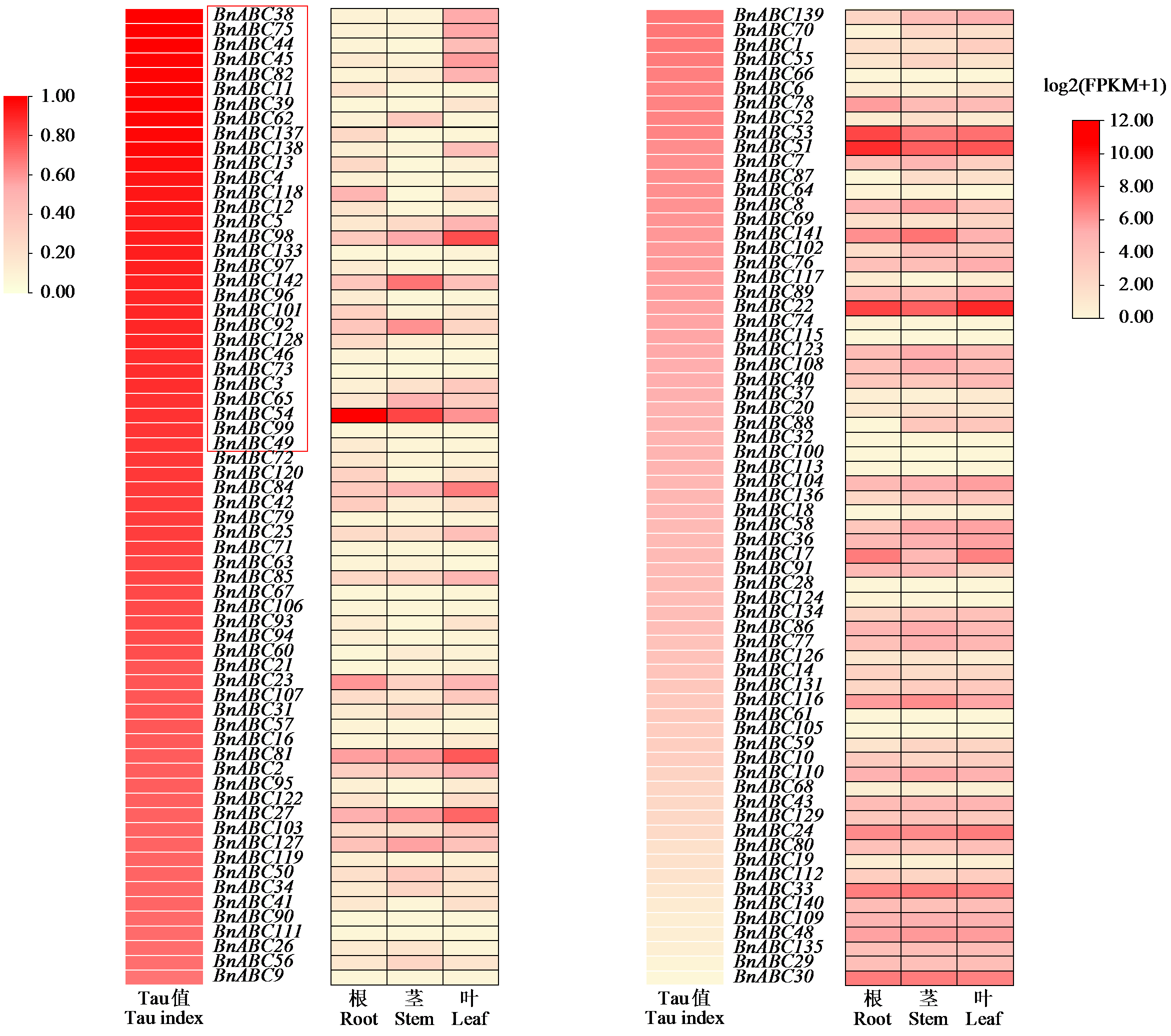
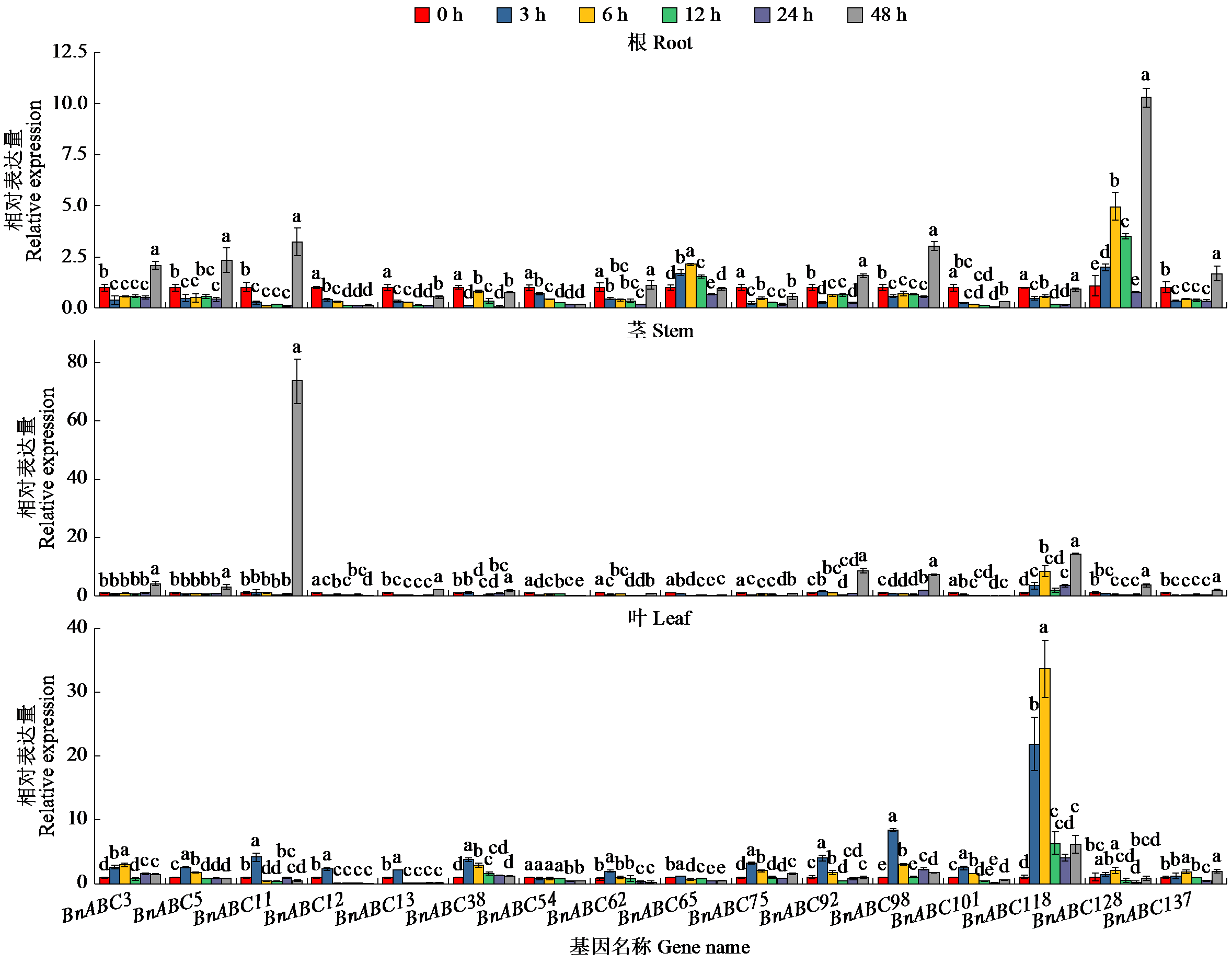
挖掘和鉴定重金属修复作物苎麻的ATP结合盒(ATP-binding cassettes,ABC)转运蛋白对重金属污染修复品种的选育与利用具有重要意义。为筛选在镉胁迫中发挥作用的BnABCs,通过生物信息学共鉴定到143个苎麻ABC转运蛋白基因家族成员,其中69%的成员均属于ABCG与ABCB亚家族,大部分位于细胞膜上。与双子叶植物拟南芥和工业大麻分别有57和86对共线性基因,与单子叶植物水稻和玉米分别有31和15对共线性基因。苎麻内发现26对旁系同源基因,其中只有1对Ka/Ks值大于1,表明受到正向选择,其余25对均小于1,表明受到纯化选择。对基因保守结构进行分析,发现BnABCs含有典型的ATP结合结构域组成元件Walker A motifs、Walker B motifs与ABC标签序列(Walker C motifs)。顺式作用元件分析发现,启动子区域有大量光反应、植物激素反应和胁迫反应元件;通过转录组数据筛选出组织特异性表达,且启动子区域含有胁迫元件和MYB结合位点的BnABCs基因,作为响应镉胁迫的候选基因,大部分属于ABCG与ABCB亚家族,且跨膜结构域数目几乎均高于3。实时荧光定量PCR表明其在镉胁迫下的根、茎和叶中呈不同表达模式,其中BnABC128与水稻中镉耐性的基因同源性最高,可能具有外排镉的能力。

关键词: 苎麻, ABC转运蛋白, 基因家族, 镉胁迫, 基因表达模式

Abstract:

The mining and identification of ATP-binding cassette (ABC) transporter proteins in the heavy metal remediation crop ramie are of great significance for the selection and utilization of heavy metal pollution remediation varieties. In order to screen BnABCs that play a role in cadmium (Cd) stress, a total of 143 members of the ABC transporter protein gene family in ramie were identified by bioinformatics, of which 69% belonged to the ABCG and ABCB subfamilies, and most of them were located on cell membrane. 57 and 86 pairs of collinear genes were identified in common with dicotyledonous plants Arabidopsis thaliana and industrial hemp (Cannabis sativa), respectively, as well as 31 and 15 pairs with monocotyledonous plants rice and maize, respectively. 26 pairs of paralogous genes were found in ramie, only one pair of which had Ka/Ks values greater than 1, indicating positive selection, and the remaining 25 pairs had values less than 1, indicating purifying selection. Based on the analysis of gene conserved structures, it was found that BnABCs have typical ATP- binding structural domains consisting of elements Walker A motifs, Walker B motifs and ABC tag sequences (Walker C motifs). Cis-element prediction analysis showed that there were a large number of light-responsive, phytohormone-responsive, and stress-responsive elements in their promoter regions. BnABCs with tissue-specific expression and containing stress-responsive cis-elements and MYB-binding sites in the promoter region were screened from transcriptome data. Most of BnABCs belonged to the subfamilies of ABCG and ABCB, and had transmembrane domains greater than three. The qRT-PCR analysis showed that there were different expression patterns of BnABCs in roots, stems and leaves under cadmium stress, among which, BnABC128 has the highest homology with the gene of cadmium tolerance in rice, indicating the ability of cadmium efflux.

Key words: Ramie, ABC transporter protein, Gene family, Cadmium stress, Gene expression pattern

表1

实时荧光定量PCR引物

基因名称Gene name 正向引物序列(5′-3′)Forward primer sequence (5′-3′) 反向引物序列(5′-3′)Reverse primer sequence (5′-3′)
BnABC3 TCTGTGCCAACAGAGACGAG TGCTCCCTGTGGTTGATGAC
BnABC5 AGCTGTCGTTGGGACGATTT AGACAGCGAGCATCAGTACG
BnABC11 GCGTGATGGACCTCAGCAAGTG CCGACGAGCAGCGAGAAGTAGA
BnABC12 AGGCGTTGAAGTCGTCCATT CATCGATCGCTTGGACAGGA
BnABC13 GCGTCATGGACCTCAGCAAGTG CCGACGAGCAGCGAGAAGTAGA
BnABC38 CAAGTACGCAGCGAGAGCTA GAACCAACGTCACCAGTTGC
BnABC54 GGAGACGTAAGGGATGGAGC TCATAGCAAGCTCGGCCATT
BnABC62 TCAGCGAAAAGGTCCCAGAC CTTGCCACACCAACGTGAAG
BnABC65 TAGCATTAGGTGCCGGGTTG AATCGATCTTCGGGACTCGC
BnABC75 CAAACAGCGTCTACGCATCG CGGGCGTCCCAAGTTAGAAT
BnABC92 ATTGAGATCGGGTCGCACAA GGCCGAGCTGAATTGTCTCT
BnABC98 AGGTCGACTCCAAAGTGAGC ATTTTGCCGAGCGACATCCT
BnABC101 TCCTCAATGCCCATTTGGCT ATGGCTTATTCCACCTCGGC
BnABC118 GGCTCGATAGACACGCGAAT AGAAGTTTCGGCCTCGTCAA
BnABC128 ACTTCTCTTAGGCCCACCCA GCCCGTTGTAGGTGACTCTC
BnABC137 GAAGCAACACCTCGTGGAGA GTTCTCTCCCTAATCCGGCG
18S TGACGGAGAATTAGGGTTC CCGTGTCAGGATTGGGTAATTT

表2

苎麻ABC转运蛋白家族成员理化性质及亚细胞定位预测

基因名称
Gene name
氨基酸数目
Number of
amino acids
分子量
Molecular
weight (Da)
理论等电点
Theoretical pI
不稳定指数
Instability
index
脂肪族指数
Aliphatic
index
总平均亲水范围
Grand average
of hydropathicity
亚细胞定位
Subcellular
localization
BnABC1 329 35 786.23 5.85 57.57 102.55 -0.005 叶绿体
BnABC10 1067 119 303.23 9.05 43.89 87.47 -0.183 细胞膜
BnABC100 829 93 102.28 9.23 38.57 88.77 -0.115 细胞膜
BnABC101 1471 165 685.83 7.53 39.45 95.03 0.068 细胞膜
BnABC102 1443 163 270.31 7.88 40.00 96.80 0.052 细胞膜
BnABC103 2121 237 315.39 8.52 36.70 89.50 -0.025 细胞膜
BnABC104 954 105 228.38 8.05 37.90 92.65 0.077 细胞膜
BnABC105 698 78 573.22 9.29 36.90 92.11 -0.027 叶绿体
BnABC106 966 108 062.89 8.49 36.90 95.51 0.088 细胞膜
BnABC107 630 68 252.87 7.71 31.98 109.97 0.142 细胞膜
BnABC108 1279 138 484.91 8.31 33.28 101.16 0.153 细胞膜
BnABC109 229 25 909.59 9.62 42.20 108.17 -0.089 叶绿体
BnABC11 761 83 637.71 9.57 47.15 97.56 0.148 细胞膜
BnABC110 266 29 190.96 6.61 28.42 114.29 -0.006 细胞质
BnABC111 1262 137 845.95 9.08 39.08 96.33 0.056 细胞膜
BnABC112 723 79 490.08 9.48 36.79 107.21 0.296 细胞膜
BnABC113 717 81 714.16 8.87 45.76 92.83 0.011 细胞膜
BnABC114 166 17 960.95 9.94 21.57 89.88 -0.040 叶绿体
BnABC115 299 33 831.50 9.58 33.39 96.82 0.419 细胞膜
BnABC116 718 79 999.54 5.72 36.10 82.47 -0.607 细胞质
BnABC117 677 75 129.64 8.52 42.43 89.07 0.020 细胞膜
BnABC118 748 82 933.77 8.81 41.33 91.32 0.054 细胞膜
BnABC119 118 12 434.19 9.24 35.33 72.54 -0.464 细胞膜
BnABC12 707 76 741.94 6.11 34.37 100.01 0.176 细胞膜
BnABC120 507 57 192.68 8.86 42.30 92.64 0.180 细胞膜
BnABC121 150 15 627.12 4.77 46.07 64.87 -0.413 细胞质
BnABC122 724 80 566.04 8.64 42.66 90.43 0.044 细胞膜
BnABC123 605 68 253.71 8.03 32.14 95.65 -0.224 细胞质
BnABC124 456 50 255.76 9.76 51.31 85.13 0.071 细胞膜
BnABC125 173 18 659.63 9.65 24.18 90.75 0.025 叶绿体
BnABC126 1427 160 469.18 8.02 40.79 100.37 0.124 细胞膜
BnABC127 1399 157 363.60 6.89 40.44 99.35 0.136 细胞膜
BnABC128 1437 162 922.61 7.80 40.48 91.60 0.036 细胞膜
BnABC129 700 76 959.98 9.41 40.54 92.23 0.041 细胞膜
BnABC13 764 83 866.95 9.57 47.00 97.43 0.151 细胞膜
BnABC130 700 78 410.17 9.16 45.41 92.87 0.057 细胞膜
BnABC131 1838 205 293.03 7.08 36.32 93.85 0.040 细胞膜
BnABC132 96 10 344.68 9.21 62.96 76.15 -0.417 细胞质
BnABC133 633 71 347.54 9.08 44.09 99.30 0.221 细胞膜
BnABC134 1931 215 756.59 6.80 34.86 95.94 0.090 细胞膜
BnABC135 2192 243 148.60 5.98 42.72 83.95 -0.238 细胞质
BnABC136 639 70 662.25 9.25 37.76 110.23 0.164 细胞膜
BnABC137 1359 153 858.44 6.01 36.70 96.40 0.120 细胞膜
BnABC138 1361 153 484.27 8.47 38.00 93.09 0.084 细胞膜
BnABC139 790 89 381.72 6.74 35.00 96.03 0.196 细胞膜
BnABC14 1107 123 621.15 9.08 43.53 88.63 -0.182 细胞膜
BnABC140 1325 144 689.71 8.17 35.93 94.44 0.034 细胞膜
BnABC141 1063 118 402.84 9.71 56.10 80.15 -0.283 细胞膜
BnABC142 693 75 861.19 8.29 41.79 97.37 0.047 细胞膜
BnABC143 956 107 912.18 8.17 43.32 104.93 0.076 细胞膜
BnABC15 1985 216 409.71 9.22 46.55 85.36 -0.291 细胞膜
BnABC16 654 73 534.47 8.47 39.94 105.63 0.140 细胞膜
BnABC17 1499 169 483.22 8.69 39.44 88.01 0.000 细胞膜
BnABC18 1456 161 252.28 7.68 40.35 109.08 0.235 细胞膜
BnABC19 1374 149 492.74 9.02 42.61 92.08 -0.031 细胞膜
BnABC2 329 35 802.29 5.85 56.98 102.55 0.005 叶绿体
BnABC20 1410 157 000.54 6.22 43.16 105.17 0.221 细胞膜
BnABC21 1427 161 808.11 8.82 42.61 91.87 0.006 细胞膜
BnABC22 1414 159 175.66 6.68 35.91 92.18 0.043 细胞膜
BnABC23 661 71 375.06 8.86 38.29 99.03 0.096 细胞膜
BnABC24 1647 184 320.56 6.16 36.09 102.40 0.070 液泡
BnABC25 1623 182 766.32 7.78 41.35 104.74 0.043 液泡
BnABC26 1504 168 461.41 8.94 39.25 106.43 0.113 液泡
BnABC27 585 65 618.21 6.50 31.46 77.68 -0.394 叶绿体
BnABC28 1249 134 406.97 8.84 40.52 108.29 0.245 细胞膜
BnABC29 346 37 862.32 6.47 42.50 90.38 -0.158 叶绿体
BnABC3 691 77 745.35 5.87 42.27 97.50 -0.122 细胞膜
BnABC30 598 67 041.82 6.11 35.72 90.90 -0.332 叶绿体
BnABC31 687 76 115.42 9.03 45.07 100.17 0.207 细胞膜
BnABC32 1113 122 855.57 9.03 37.63 87.01 -0.105 细胞膜
BnABC33 597 66 855.55 6.03 35.26 91.39 -0.326 细胞质
BnABC34 695 76 990.44 8.94 44.15 100.00 0.204 细胞膜
BnABC35 1171 129 630.69 9.06 36.60 88.11 -0.091 细胞膜
BnABC36 1325 149 128.21 9.31 47.67 98.91 -0.075 细胞膜
BnABC37 702 78 293.93 9.11 40.28 88.63 0.055 细胞膜
BnABC38 678 75 331.68 9.15 44.01 97.05 0.168 细胞膜
BnABC39 1521 171 581.56 8.99 39.39 93.57 0.024 细胞膜
BnABC4 704 78 327.37 8.98 39.53 95.28 0.110 细胞膜
BnABC40 750 82 406.44 9.47 33.27 95.08 -0.015 细胞膜
BnABC41 1365 153 898.34 7.35 42.98 96.29 -0.038 细胞膜
BnABC42 1454 164 236.73 7.17 43.02 98.25 0.016 细胞膜
BnABC43 331 36 795.42 8.29 46.73 93.99 -0.220 细胞质
BnABC44 680 75 770.76 7.96 35.20 95.32 0.167 细胞膜
BnABC45 707 78 368.68 8.53 33.30 94.47 0.130 细胞膜
BnABC46 663 74 173.97 8.97 39.05 98.07 0.108 细胞膜
BnABC47 715 77 839.38 6.23 34.38 100.66 0.189 细胞膜
BnABC48 1411 155 935.63 6.14 48.48 101.51 0.065 细胞膜
BnABC49 663 74 157.97 8.97 39.70 98.07 0.106 细胞膜
BnABC5 715 77 465.97 9.42 35.64 102.81 0.154 细胞膜
BnABC50 1409 158 669.39 8.86 37.04 94.46 0.095 细胞膜
BnABC51 1440 162 701.85 7.06 33.05 90.81 0.034 细胞膜
BnABC52 1399 157 653.09 8.78 35.94 94.44 0.099 细胞膜
BnABC53 1440 162 826.11 7.06 32.81 90.40 0.033 细胞膜
BnABC54 1443 163 131.34 7.27 33.61 90.46 0.018 细胞膜
BnABC55 1526 169 520.35 7.30 36.66 103.86 0.122 细胞膜
BnABC56 1451 160 926.16 7.26 34.36 102.72 0.100 细胞膜
BnABC57 611 68 341.51 9.09 50.23 104.84 0.195 细胞膜
BnABC58 604 64 942.14 8.18 31.59 109.35 0.241 细胞膜
BnABC59 1253 136 569.98 8.43 36.26 99.73 0.122 细胞膜
BnABC6 618 68 677.07 9.00 47.24 116.13 0.378 细胞膜
BnABC60 1416 161 136.58 8.77 39.93 93.06 -0.027 细胞膜
BnABC61 1214 138 282.66 8.14 39.33 96.43 0.037 细胞膜
BnABC62 275 29 914.70 8.97 36.90 96.80 0.304 细胞膜
BnABC63 401 44 158.42 9.41 32.76 106.48 0.143 细胞膜
BnABC64 138 15 331.65 8.84 32.18 89.06 -0.234 细胞膜
BnABC65 1240 133 857.61 7.05 41.09 97.89 0.089 细胞膜
BnABC66 1294 141 492.68 8.52 45.09 94.91 0.006 细胞膜
BnABC67 472 51 962.45 6.44 41.60 95.21 -0.062 细胞膜
BnABC68 658 73 509.27 9.44 43.50 109.53 0.086 细胞膜
BnABC69 160 18 189.44 5.41 43.29 120.62 0.080 细胞膜
BnABC7 399 44 315.80 5.56 43.81 96.04 -0.049 细胞膜
BnABC70 265 29 216.26 9.04 52.27 98.72 0.325 细胞膜
BnABC71 1318 143 829.35 8.67 43.37 93.56 -0.005 细胞膜
BnABC72 1498 167 470.87 6.63 32.82 108.15 0.256 细胞膜
BnABC73 1140 128 564.11 7.57 39.56 105.86 0.117 细胞膜
BnABC74 1485 166 786.94 7.69 40.34 106.67 0.201 细胞膜
BnABC75 1228 134 490.45 8.61 35.05 103.88 0.114 细胞膜
BnABC76 478 51 808.60 6.03 50.00 85.46 -0.260 叶绿体
BnABC77 709 79 001.04 5.70 37.13 89.79 -0.263 叶绿体
BnABC78 1518 168 062.72 8.07 37.84 105.61 0.204 细胞膜
BnABC79 108 12 443.61 5.00 41.89 112.04 -0.203 细胞质
BnABC8 1473 164 206.31 8.23 36.14 103.61 0.136 细胞膜
BnABC80 284 31 495.17 6.08 47.56 91.62 -0.132 细胞质
BnABC81 1505 168 501.65 8.39 37.23 103.36 0.163 细胞膜
BnABC82 675 74 654.83 7.98 37.69 92.92 0.036 细胞膜
BnABC83 150 16 509.76 4.87 42.84 94.93 -0.099 细胞质
BnABC84 731 79 316.15 8.76 39.43 92.38 -0.029 细胞膜
BnABC85 264 29 407.77 5.34 37.81 93.11 -0.035 细胞膜
BnABC86 605 68 280.74 7.80 36.37 95.34 -0.230 细胞质
BnABC87 304 34 736.06 9.20 37.45 107.11 0.373 高尔基体
BnABC88 716 78 153.08 9.07 36.99 93.80 0.087 细胞膜
BnABC89 461 51 398.71 8.97 39.00 105.75 0.258 细胞膜
BnABC9 1263 139 196.94 8.78 43.68 101.41 0.045 细胞膜
BnABC90 1252 137 490.25 9.36 37.03 97.84 0.042 细胞膜
BnABC91 1426 159 285.37 8.40 35.73 104.87 0.102 细胞膜
BnABC92 1208 131 757.85 9.15 38.42 96.67 0.061 细胞膜
BnABC93 1422 161 910.16 8.18 39.01 93.65 0.067 细胞膜
BnABC94 602 67 293.34 8.97 42.36 103.90 0.228 细胞膜
BnABC95 1422 161 910.20 8.30 38.77 93.52 0.065 细胞膜
BnABC96 1281 137 921.08 8.71 34.63 99.32 0.135 细胞膜
BnABC97 1281 138 054.31 8.65 35.15 100.01 0.146 细胞膜
BnABC98 723 80 728.35 6.40 39.43 86.13 -0.451 细胞质
BnABC99 1248 135 387.58 8.60 33.95 107.35 0.208 细胞膜

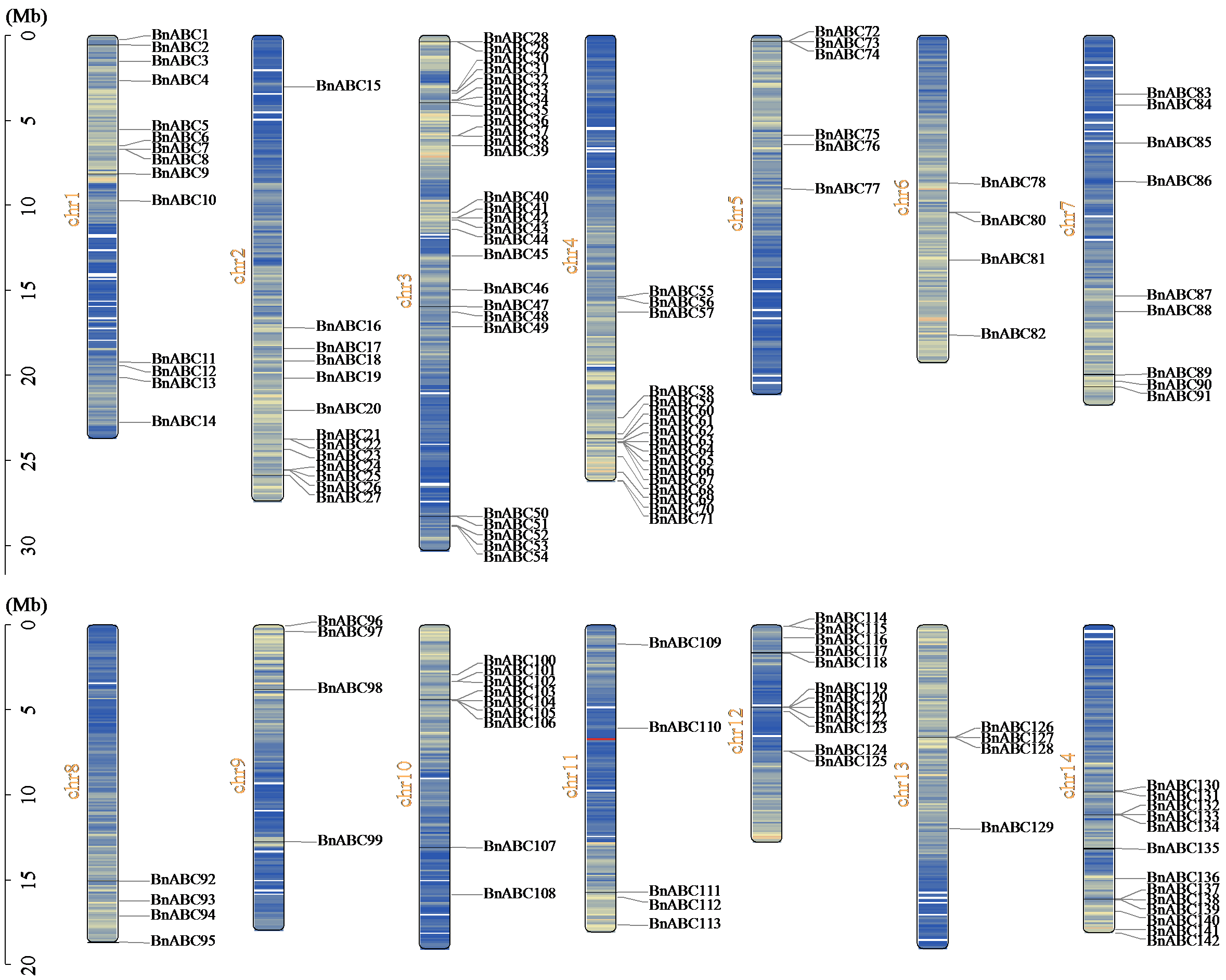
图1

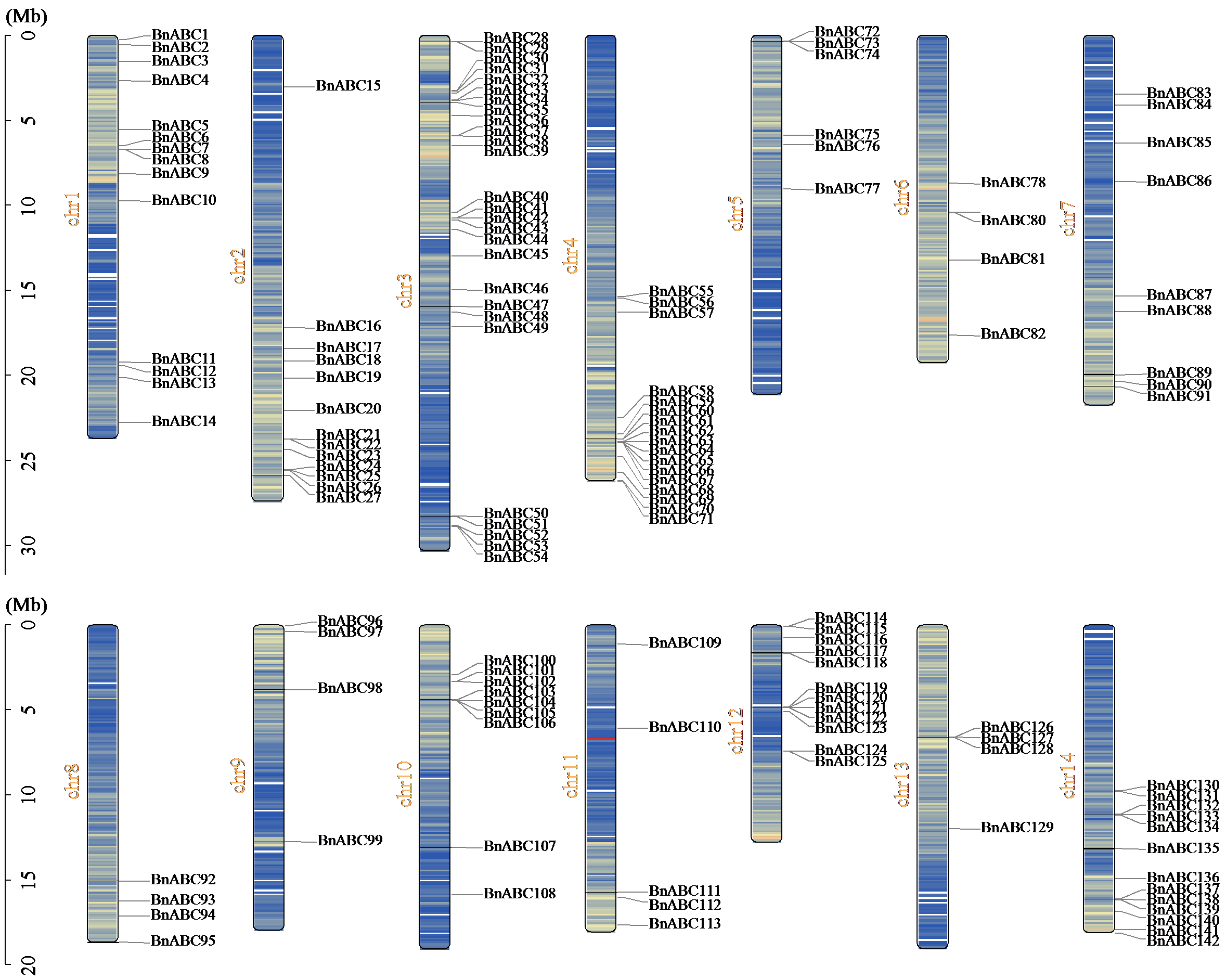
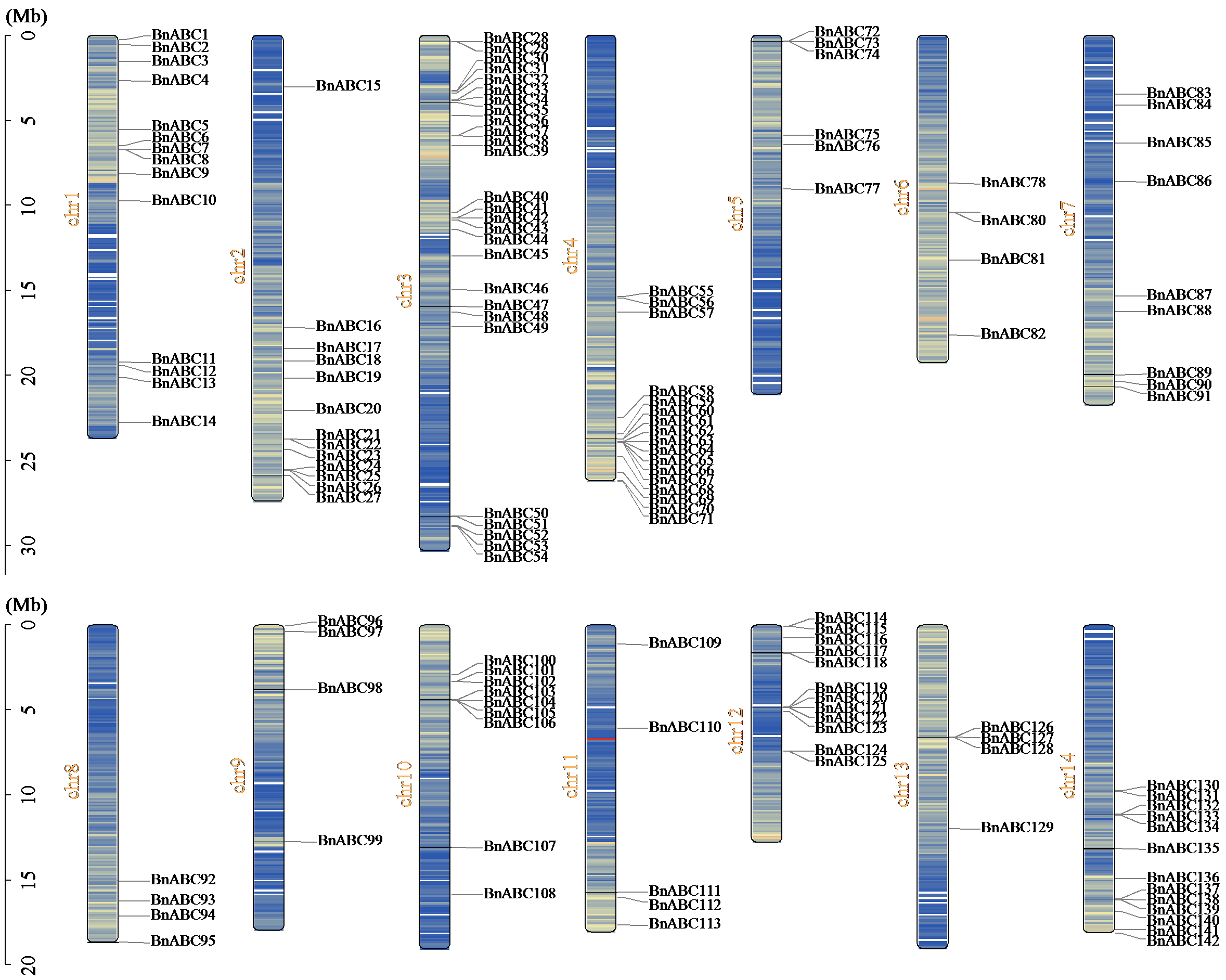
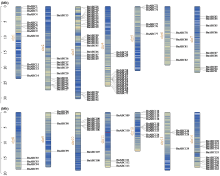
苎麻ABC基因家族成员染色体定位 染色体上的颜色代表基因密度。

图2

物种间共线性分析 (a) 苎麻与双子叶植物拟南芥和工业大麻间的共线性分析;(b) 苎麻与单子叶植物水稻和玉米间的共线性分析。

图3

苎麻物种内的共线性分析 染色体上的颜色代表基因密度,黑色线条代表GC含量。

表3

苎麻物种内同源基因对的Ka/Ks计算

序号
Number
基因名称1
Gene name 1
基因名称2
Gene name 2
基因复制类型
Types of gene replication
Ka Ks Ka/Ks 选择类型
Selective type
1 BnABC10 BnABC14 全基因组或基因片段复制 0.0029 0.0311 0.0920 纯化选择
2 BnABC13 BnABC141 全基因组或基因片段复制 0.1916 1.0169 0.1885 纯化选择
3 BnABC10 BnABC35 全基因组或基因片段复制 0.2404 2.0903 0.1150 纯化选择
4 BnABC12 BnABC47 全基因组或基因片段复制 0.0101 0.0303 0.3348 纯化选择
5 BnABC7 BnABC72 全基因组或基因片段复制 0.1770 3.4031 0.0520 纯化选择
6 BnABC107 BnABC58 全基因组或基因片段复制 0.1285 1.8864 0.0681 纯化选择
7 BnABC114 BnABC125 全基因组或基因片段复制 0.0160 0.0432 0.3707 纯化选择
8 BnABC115 BnABC124 全基因组或基因片段复制 0.0000 0.0135 0.0000 纯化选择
9 BnABC117 BnABC119 全基因组或基因片段复制 0.2610 0.4263 0.6123 纯化选择
10 BnABC126 BnABC21 全基因组或基因片段复制 0.2313 2.3434 0.0987 纯化选择
11 BnABC130 BnABC132 全基因组或基因片段复制 0.0423 0.0287 1.4705 正向选择
12 BnABC131 BnABC134 全基因组或基因片段复制 0.0014 0.0095 0.1495 纯化选择
13 BnABC137 BnABC52 全基因组或基因片段复制 0.2119 2.0754 0.1021 纯化选择
14 BnABC137 BnABC50 全基因组或基因片段复制 0.2114 2.1753 0.0972 纯化选择
15 BnABC30 BnABC33 全基因组或基因片段复制 0.0051 0.0222 0.2298 纯化选择
16 BnABC31 BnABC34 全基因组或基因片段复制 0.0026 0.0265 0.0971 纯化选择
17 BnABC32 BnABC35 全基因组或基因片段复制 0.0008 0.0132 0.0601 纯化选择
18 BnABC50 BnABC52 全基因组或基因片段复制 0.0028 0.0369 0.0770 纯化选择
19 BnABC44 BnABC45 全基因组或基因片段复制 0.0272 0.0660 0.4118 纯化选择
20 BnABC46 BnABC49 全基因组或基因片段复制 0.0027 0.0320 0.0828 纯化选择
21 BnABC63 BnABC70 全基因组或基因片段复制 0.2962 1.9769 0.1498 纯化选择
22 BnABC57 BnABC94 全基因组或基因片段复制 0.2845 2.7581 0.1032 纯化选择
23 BnABC87 BnABC88 全基因组或基因片段复制 0.0043 0.0325 0.1340 纯化选择
24 BnABC84 BnABC85 全基因组或基因片段复制 0.0039 0.0138 0.2830 纯化选择
25 BnABC93 BnABC95 全基因组或基因片段复制 0.0009 0.0119 0.0777 纯化选择
26 BnABC96 BnABC97 全基因组或基因片段复制 0.0031 0.0185 0.1673 纯化选择

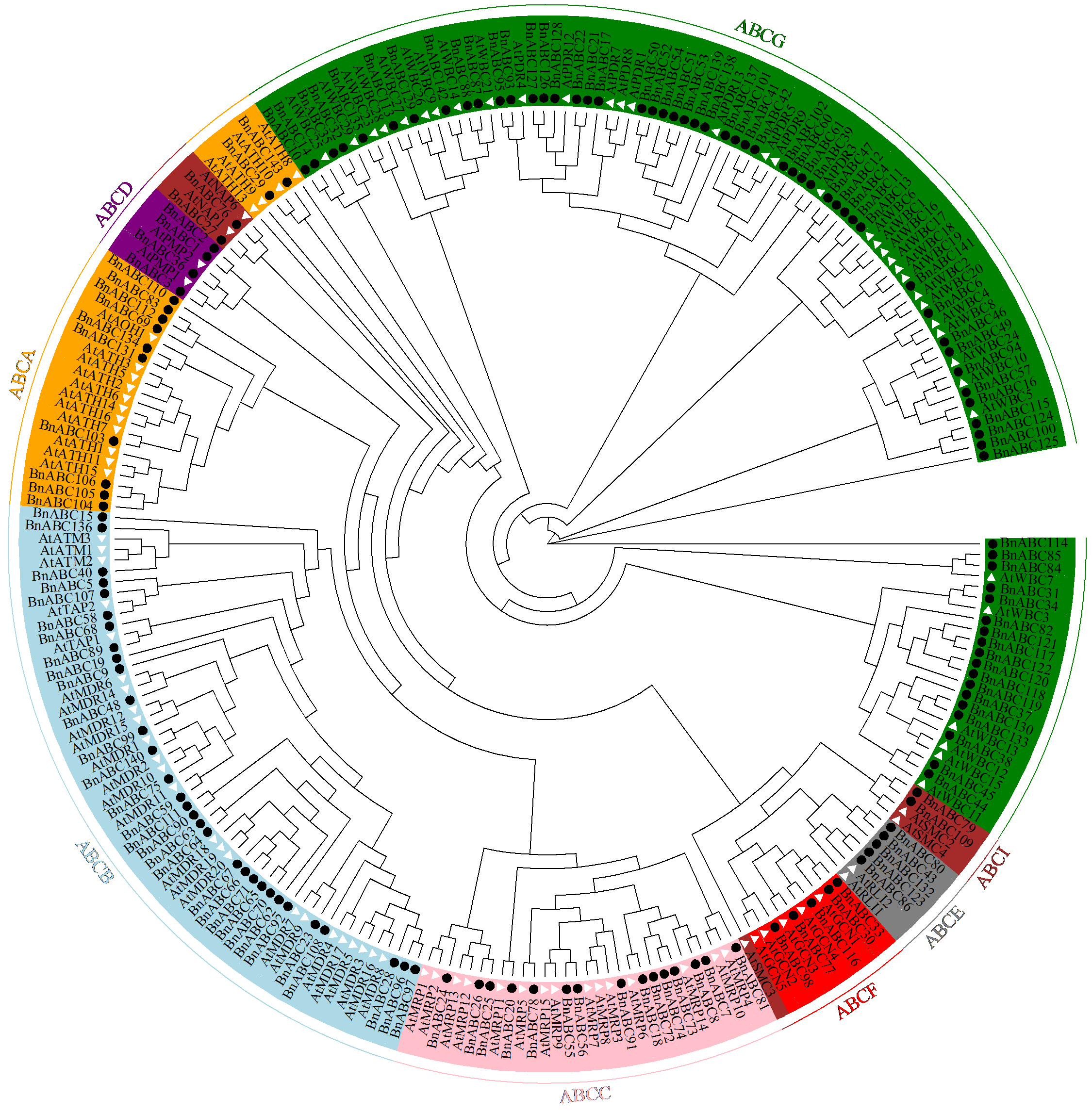
图4

苎麻与拟南芥ABC基因家族成员系统进化树分析 黑色圆代表苎麻ABC转运蛋白,白色三角代表拟南芥ABC转运蛋白。

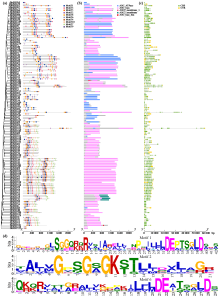
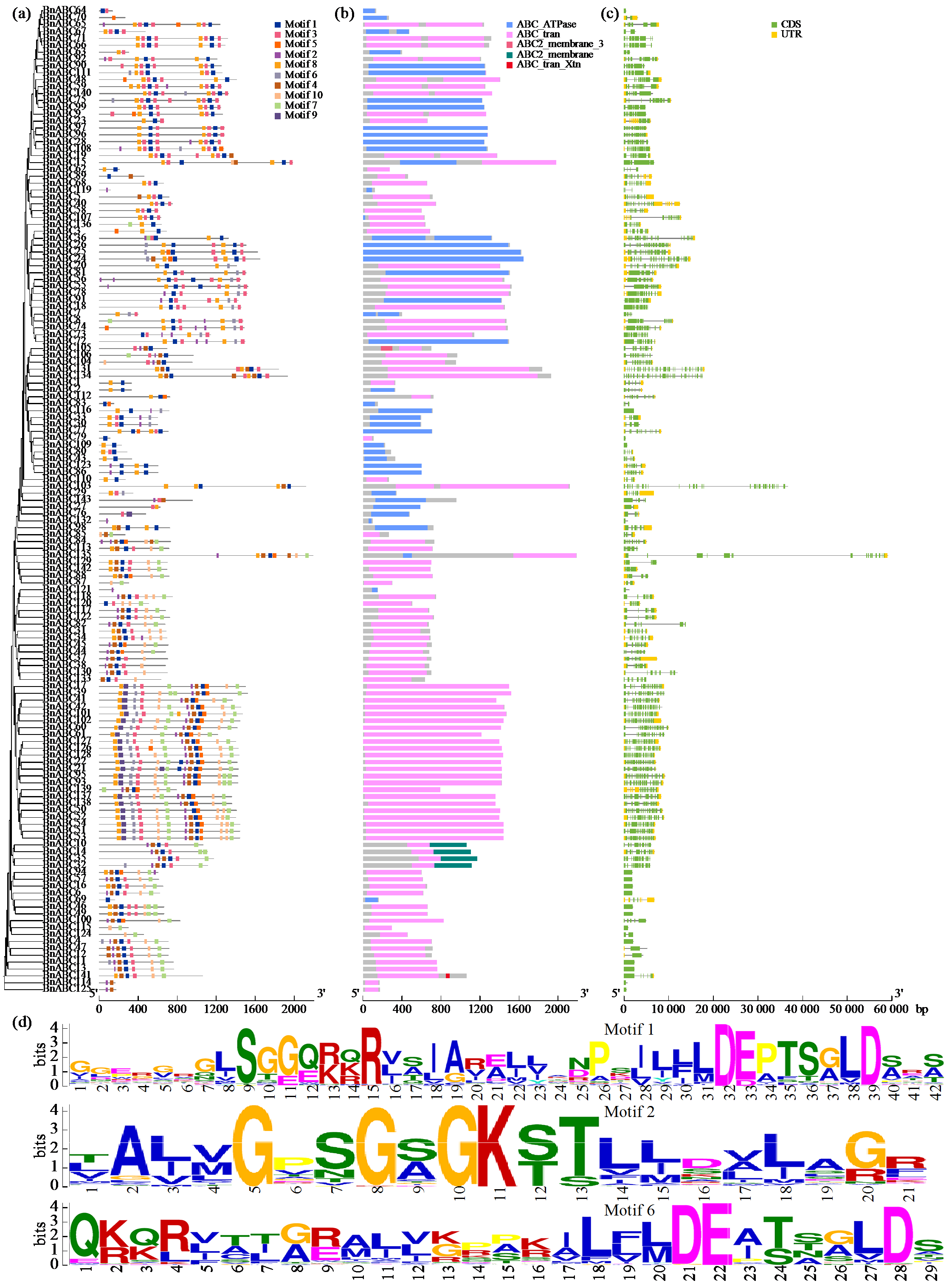
图5

苎麻ABC基因家族成员蛋白保守基序及标志图、保守结构域、基因结构分析 (a)和(d)分别为蛋白质保守基序结构图与标志图,(b)为保守结构域结构图,(c)为基因结构图。

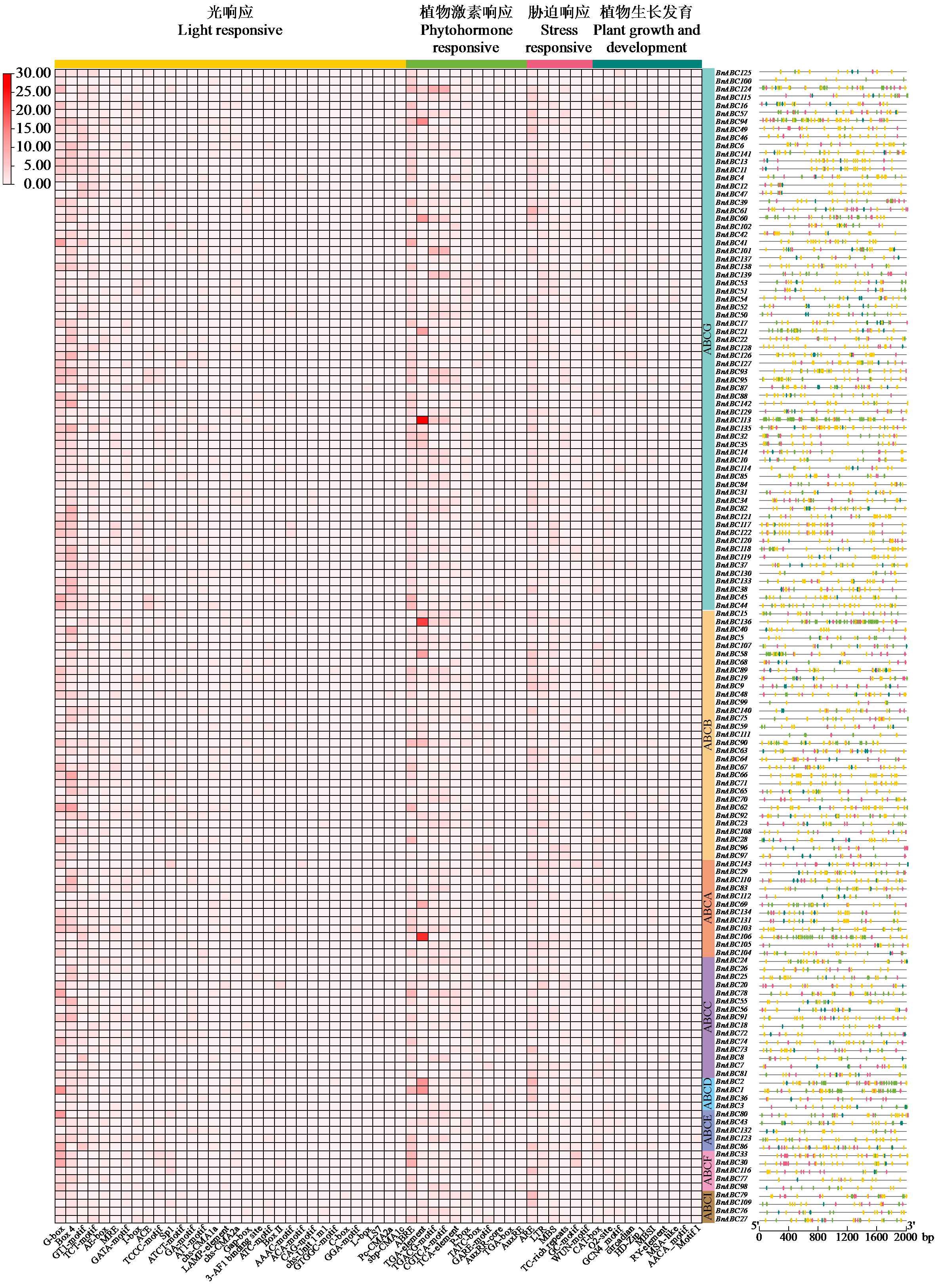
图6

苎麻ABC基因家族成员启动子顺式作用元件预测 红色方框中为不同组织特异性表达基因。

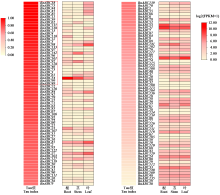
图7

苎麻ABC基因家族成员不同苎麻部位中表达量

表4

候选基因蛋白二级结构与跨膜结构域数目

基因名称
Gene name
α-螺旋比例
Alpha helix
ratio (%)
β-转角比例
Beta turn
ratio (%)
无规卷曲比例
Random coil
ratio (%)
延伸链比例
Extended strand
ratio (%)
跨膜结构域数目
Number of
transmembrane domains
亚家族名称
Subfamily
name
BnABC3 52.10 3.04 34.15 10.71 5 ABCD
BnABC5 53.01 4.20 31.05 11.75 3 ABCB
BnABC11 41.66 3.81 43.76 10.78 6 ABCG
BnABC12 44.84 4.81 38.90 11.46 5 ABCG
BnABC13 43.85 3.53 42.80 9.82 6 ABCG
BnABC38 48.53 4.28 35.25 11.95 7 ABCG
BnABC54 51.77 2.91 35.76 9.56 13 ABCG
BnABC62 66.91 4.36 17.09 11.64 3 ABCB
BnABC65 56.85 4.52 25.16 13.47 8 ABCB
BnABC75 56.03 4.89 25.00 14.09 10 ABCB
BnABC92 55.88 3.64 27.32 13.16 9 ABCB
BnABC98 45.92 5.12 35.55 13.42 0 ABCF
BnABC101 51.19 2.79 35.69 10.33 13 ABCG
BnABC118 43.45 3.48 39.44 13.64 6 ABCG
BnABC128 50.73 3.34 35.56 10.37 13 ABCG
BnABC137 51.36 2.87 35.17 10.60 13 ABCG

图8

镉胁迫下苎麻ABC转运蛋白候选基因的组织表达模式 不同小写字母表示在P < 0.05水平差异显著。

[1] Theodoulou F L. Plant ABC transporters. Biochimica et Biophysica Acta, 2000, 1465(1/2):79-103.
[2] Martinoia E, Klein M, Geisler M, et al. Multifunctionality of plant ABC transporters-more than just detoxifiers. Planta, 2002, 214 (3):345-355.
pmid: 11855639
[3] Verrier P J, Bird D, Burla B, et al. Plant ABC proteins - a unified nomenclature and updated inventory. Trends in Plant Science, 2008, 13:151-159.
doi: 10.1016/j.tplants.2008.02.001 pmid: 18299247
[4] George A M. ABC transporters 45 years on. International Journal of Molecular Sciences, 2023, 24(23):16789.
doi: 10.3390/ijms242316789
[5] Theodoulou F, Kerr I. ABC transporter research:going strong 40 years on. Biochemical Society Transactions, 2015, 43(5):1033-1040.
doi: 10.1042/BST20150139 pmid: 26517919
[6] Do T H T, Martinoia E, Lee Y. Functions of ABC transporters in plant growth and development. Current Opinion in Plant Biology, 2018, 41:32-38.
doi: S1369-5266(17)30151-6 pmid: 28854397
[7] Yazaki K. ABC transporters involved in the transport of plant secondary metabolites. FEBS Letters, 2006, 4:1183-1191.
[8] Yang W, Liu X, Yu S W, et al. The maize ATP-binding cassette (ABC) transporter ZmMRPA6 confers cold and salt stress tolerance in plants. Plant Cell Reports, 2023, 43:13.
doi: 10.1007/s00299-023-03094-7 pmid: 38135780
[9] Lee J Y, Yang J G, Zhitnitsky D, et al. Structural basis for heavy metal detoxification by an Atm1-Type ABC Exporter. Science, 2014, 343:1133-1136.
doi: 10.1126/science.1246489 pmid: 24604198
[10] Ghuge S A, Nikalje G C, Kadam U S, et al. Comprehensive mechanisms of heavy metal toxicity in plants,detoxification,and remediation. Journal of Hazardous Materials, 2023, 450:131039.
doi: 10.1016/j.jhazmat.2023.131039
[11] Zhang B, Jia W T, Lin K Q, et al. Integrative analysis of the ABC gene family in sorghum revealed SbABCB11 participating in translocation of cadmium from roots to shoots. Planta, 2025, 261 (3):63.
doi: 10.1007/s00425-025-04637-w
[12] Yu Y T, Zeng L B, Yan Z, et al. Identification of ramie genes in response to Pratylenchus coffeae infection challenge by digital gene expression analysis. International Journal of Molecular Sciences, 2015, 16(9):21989-22007.
doi: 10.3390/ijms160921989
[13] Chen K M, Li Y L, Yu C M, et al. Systematic evaluation of ramie (Boehmeria nivea L.) for phytoremediation of cadmium contaminated soil and the mechanism of microbial regulation. Chemosphere, 2023, 337:139298.
doi: 10.1016/j.chemosphere.2023.139298
[14] Zhao Y J, Yu C M, Chen P, et al. Study on remediation of cadmium contaminated paddy field by ramie (Boehmeria nivea L.) floating island and its supporting technology. Environmental Research, 2024, 242:117798.
doi: 10.1016/j.envres.2023.117798
[15] Huang C, Zhou J, Jie Y C, et al. A ramie bZIP transcription factor BnbZIP2 is involved in drought,salt,and heavy metal stress response. DNA and Cell Biology, 2016, 35(12):776-786.
doi: 10.1089/dna.2016.3251
[16] Ma Y H, Jie H M, Zhao L, et al. Identification of the Xyloglucan Endotransglycosylase/Hydrolase (XTH) gene family members expressed in Boehmeria nivea in response to cadmium stress. International Journal of Molecular Sciences, 2022, 23(24):16104.
doi: 10.3390/ijms232416104
[17] Rasheed A, Jie Y, Nawaz M, et al. Improving drought stress tolerance in ramie (Boehmeria nivea L.) using molecular techniques. Frontiers in Plant Science, 2022, 13:911610.
doi: 10.3389/fpls.2022.911610
[18] Ma Y H, Jie H M, Zhao L, et al. BnXTH1 regulates cadmium tolerance by modulating vacuolar compartmentalization and the cadmium binding capacity of cell walls in ramie (Boehmeria nivea). Journal of Hazardous Materials, 2024, 470:134172.
doi: 10.1016/j.jhazmat.2024.134172
[19] Chen K M, Ming Y L, Luan M B, et al. The chromosome-level assembly of ramie (Boehmeria nivea L.) genome provides insights into molecular regulation of fiber fineness. Journal of Natural Fibers, 2023, 20:2168819.
doi: 10.1080/15440478.2023.2168819
[20] Chen C J, Wu Y, Li J W, et al. TBtools-II: A “one for all, all for one” bioinformatics platform for biological big-data mining. Molecular Plant, 2023, 16(11):1733-1742.
doi: 10.1016/j.molp.2023.09.010
[21] Yang M Y, Derbyshire M K, Yamashita R A, et al. NCBI's conserved domain database and tools for protein domain analysis. Current Protocols in Bioinformatics, 2020, 69(1):e90.
[22] Artimo P, Jonnalagedda M, Arnold K, et al. ExPASy: SIB bioinformatics resource portal. Nucleic Acids Research, 2012, 40:597-603.
doi: 10.1093/nar/gks400 pmid: 22661580
[23] Chou K C, Shen H B. Cell-PLoc: a package of Web servers for predicting subcellular localization of proteins in various organisms. Nature Protocols, 2008, 3(2):153-162.
doi: 10.1038/nprot.2007.494
[24] Wang Y P, Tang H B, Debarry J D, et al. MCScanX: a toolkit for detection and evolutionary analysis of gene synteny and collinearity. Nucleic Acids Research, 2012, 40(7):e49.
doi: 10.1093/nar/gkr1293
[25] Tamura K, Stecher G, Kumar S. MEGA11: molecular evolutionary genetics analysis version 11. Molecular Biology and Evolution, 2021, 38(7):3022-3027.
doi: 10.1093/molbev/msab120 pmid: 33892491
[26] Nguyen L T, Schmidt H A, Von haeseler A, et al. IQ-TREE: A fast and effective stochastic algorithm for estimating maximum- likelihood phylogenies. Molecular Biology and Evolution, 2015, 32(1):268-274.
doi: 10.1093/molbev/msu300
[27] Zhang H, Gao S H, Lercher M J, et al. EvolView, an online tool for visualizing, annotating and managing phylogenetic trees. Nucleic Acids Research, 2012, 40(1):569-572.
[28] Bailey T L, Boden M, Buske F A, et al. MEME SUITE: tools for motif discovery and searching. Nucleic Acids Research, 2009, 37(2):202-208.
[29] Lescot M, Déhais P, Thijs G, et al. PlantCARE, a database of plant cis-acting regulatory elements and a portal to tools for in silico analysis of promoter sequences. Nucleic Acids Research, 2002, 30(1):325-327.
[30] Geourjon C, Deléage G. SOPMA: significant improvements in protein secondary structure prediction by consensus prediction from multiple alignments. Bioinformatics, 1995, 11(6):681-684.
doi: 10.1093/bioinformatics/11.6.681
[31] Sonnhammer E L, Heijne G V, Krogh A. A hidden Markov model for predicting transmembrane helices in protein sequences. Proceedings of the 6th International Conference on Intelligent Systems for Molecular Biology. Menlo: AAAI Press, 1998:175-182.
[32] 朱守晶, 史文娟. 苎麻谷胱甘肽-S-转移酶基因BnGSTU1的克隆和表达分析. 植物遗传资源学报, 2018, 19(6):1197-1204.
doi: 10.13430/j.cnki.jpgr.20180228002
[33] Fu S, Lu Y F, Zhang X Z, et al. The ABC transporter ABCG36 is required for cadmium tolerance in rice. Journal of Experimental Botany, 2019, 70:5909-5918.
doi: 10.1093/jxb/erz335 pmid: 31328224
[34] Li H, Li C X, Sun D, et al. OsPDR20 is an ABCG metal transporter regulating cadmium accumulation in rice. Journal of Environmental Sciences, 2024, 136:21-34.
doi: 10.1016/j.jes.2022.09.021 pmid: 37923431
[35] Zhang X, Ma Y, Lai D W, et al. RsPDR8,a member of ABCG subfamily,plays a positive role in regulating cadmium efflux and tolerance in radish (Raphanus sativus L.). Plant Physiology and Biochemistry, 2023, 205:108149.
doi: 10.1016/j.plaphy.2023.108149
[36] Wang H Z, Liu Y, Peng Z H, et al. Ectopic expression of poplar ABC transporter PtoABCG36 confers Cd tolerance in Arabidopsis thaliana. International Journal of Molecular Sciences, 2019, 20:3293.
doi: 10.3390/ijms20133293
[37] 唐桃霞, 孔维萍, 任凯丽, 等. 植物ABC转运蛋白功能研究进展. 西北农业学报, 2023, 32(1):1-10.
[38] Kang J, Park J, Choi H, et al. Plant ABC transporters. The Arabidopsis Book, 2011, 9:e0153.
doi: 10.1199/tab.0153
[39] Huang J J, Li X Y, Chen X, et al. Genome-wide identification of soybean ABC transporters relate to aluminum toxicity. International Journal of Molecular Sciences, 2021, 22(12):6556.
doi: 10.3390/ijms22126556
[40] Zhang D D, Yu Z, Zeng B, et al. Genome-wide analysis of the ABC gene family in almond and functional predictions during flower development,freezing stress,and salt stress. BMC Plant Biology, 2024, 24(1):12.
doi: 10.1186/s12870-023-04698-7
[41] 蔡方阳, 赵懿琛, 李义, 等. 杜仲ABC转运蛋白基因家族成员鉴定与分析. 浙江农业学报, 2021, 33(9):1581-1591.
doi: 10.3969/j.issn.1004-1524.2021.09.02
[42] 朱康, 王柯蔼, 王秋艳, 等. 甘蓝型油菜PDR基因家族鉴定及系统进化分析. 植物生理学报, 2022, 58(12):2351-2363.
[43] Song W Y, Yamaki T, Yamaji N, et al. A rice ABC transporter, OsABCC1, reduces arsenic accumulation in the grain. Proceedings of the National Academy of Sciences of the United States of America, 2014, 111(44):15699-15704.
[44] Lefèvre F, Baijot A, Boutry M. Plant ABC transporters: time for biochemistry?. Biochemical Society Transactions, 2015, 43(5):931-936.
doi: 10.1042/BST20150108 pmid: 26517906
[45] Bovet L, Feller U, Martinoia E. Possible involvement of plant ABC transporters in cadmium detoxification: a cDNA sub- microarray approach. Environment International, 2005, 31(2):263-267.
doi: 10.1016/j.envint.2004.10.011
[46] Dahuja A, Kumar R R, Sakhare A, et al. Role of ATP‐binding cassette transporters in maintaining plant homeostasis under abiotic and biotic stresses. Physiologia Plantarum, 2021, 171(4):785-801.
doi: 10.1111/ppl.v171.4
[47] Dhara A, Raichaudhuri A. ABCG transporter proteins with beneficial activity on plants. Phytochemistry, 2021, 184:112663.
doi: 10.1016/j.phytochem.2021.112663 pmid: 33550197
[48] Wang Y C, Wu J C, Li J B, et al. The R2R3-MYB transcription factor ThRAX2 recognized a new element MYB-T (CTTCCA) to enhance cadmium tolerance in Tamarix hispida. Plant Science, 2023, 329:111574.
doi: 10.1016/j.plantsci.2022.111574
[49] Zhang P P, Wang R K, Ju Q, et al. The R2R3-MYB transcription factor MYB49 regulates cadmium accumulation. Plant Physiology, 2019, 180(1):529-542.
doi: 10.1104/pp.18.01380 pmid: 30782964
[50] Zhu S J, Shi W J, Jie Y C, et al. A MYB transcription factor, BnMYB2, cloned from ramie (Boehmeria nivea) is involved in cadmium tolerance and accumulation. PLoS One, 2020, 15(5):e0233375.
doi: 10.1371/journal.pone.0233375
[51] Xu Z, Wang T, Hou S, et al. A R2R3-MYB, BpMYB1, from paper mulberry interacts with DELLA protein BpGAI1 in soil cadmium phytoremediation. Journal of Hazardous Materials, 2023, 463:132871.
doi: 10.1016/j.jhazmat.2023.132871
[52] Kim D Y, Bovet L, Maeshima M, et al. The ABC transporter AtPDR8 is a cadmium extrusion pump conferring heavy metal resistance. The Plant Journal, 2007, 50(2):207-218.
doi: 10.1111/tpj.2007.50.issue-2
[53] 何浩, 王志明, 张立强, 等. 小麦PDR基因家族的鉴定与表达分析. 农业生物技术学报, 2023, 31(3):445-459.
[1] 黄新元, 张英, 陶迎梅, 江青山, 魏丕伟. 水稻OsDOG1-like基因家族突变体种子的萌发势及其GA敏感性的研究[J]. 作物杂志, 2026, (4): 36–45
[2] 张曼, 董海潇, 田娟, 冯博, 于学鹏, 王祉诺, 张雷, 巴桑平措, 李雪英, 李慧英. 向日葵Trihelix转录因子家族鉴定及表达分析[J]. 作物杂志, 2026, (4): 46–56
[3] 唐立郦, 杨洌, 张文洁, 宋喜霞, 程莉莉, 刘丹丹, 姚丹丹, 姜卫东, 康庆华, 樊超, 袁红梅. 亚麻bHLH转录因子基因家族鉴定与表达分析[J]. 作物杂志, 2026, (3): 171–184
[4] 李洁, 刘聪聪, 张莹莹, 董晓月, 杨宜红, 马金娜, 谷献锋. 花生FKBP基因家族成员的鉴定及表达分析[J]. 作物杂志, 2026, (3): 185–196
[5] 张业猛, 卢柯欣, 毛文钰, 张晓燕, 李文静, 杨修. 藜麦LEA基因家族鉴定及盐胁迫下的表达分析[J]. 作物杂志, 2025, (6): 100–111
[6] 杜含梅, 谭露, 李声春, 王清海, 徐洲, 吴丹丹, 王安虎. 苦荞萌芽期镉耐受性及对幼苗生理特性的影响[J]. 作物杂志, 2025, (5): 209–220
[7] 瞿宏悦, 朱林欣, 何也君, 邵明宇, 韩昕冉, 揭雨成, 邢虎成. 苎麻浸提液对油菜种子发芽及角果期渍涝胁迫的影响[J]. 作物杂志, 2025, (4): 142–149
[8] 陈虎, 高原, 孙家猛, 俞鹏, 肖洪武, 张海涛. 大麦典型硫氧还蛋白(TRX)基因家族鉴定与生物信息学分析[J]. 作物杂志, 2025, (2): 66–73
[9] 黄承建, 李祥, 刘小康, 潘庭杰, 雷宁, 罗芳, 赵思毅. 不同农作物种植对土壤和作物重金属的影响[J]. 作物杂志, 2025, (2): 180–188
[10] 李坤杰, 刘念, 丁磊, 朱燕, 蒙大庆, 范其新, 李迎春, 陈军. 甘蓝型油菜LPAT家族基因鉴定与表达模式分析[J]. 作物杂志, 2025, (2): 29–39
[11] 付森杰, 宋迎辉, 朱灿灿, 叶珍言, 秦娜, 代书桃, 刘海霞, 王春义, 李君霞. 高粱Dof基因家族鉴定及表达分析[J]. 作物杂志, 2025, (1): 54–65
[12] 姚琦, 王皓, 徐翎清, 兴旺, 刘大丽, 鲁振强. 甜菜C2H2型锌指蛋白转录因子家族全基因组鉴定及镉胁迫下的表达分析[J]. 作物杂志, 2024, (4): 33–42
[13] 杜含梅, 谭露, 陈勃, 于秋竹, 吴丹丹, 王安虎. 苦荞苗期镉耐受性综合评价[J]. 作物杂志, 2024, (2): 40–53
[14] 孟亚轩, 姚旭航, 孙颖琦, 赵心月, 王凤霞, 瓮巧云, 刘颖慧. 主要禾谷类作物DGAT基因家族比较分析[J]. 作物杂志, 2023, (1): 20–29
[15] 杜甫, 夏茂林, 刘新源, 于兆锦, 张展, 刘云飞, 姬小明. 丙烯酰胺/羧甲基纤维素/生物炭复合水凝胶对烟苗镉胁迫的缓解效应研究[J]. 作物杂志, 2022, (4): 138–145
Viewed
Full text


Abstract

Cited

  Shared   
  Discussed   
No Suggested Reading articles found!