作物杂志,2026, 第4期: 228–237 doi: 10.16035/j.issn.1001-7283.2026.04.027

• 生理生化·植物营养·栽培耕作 • 上一篇    下一篇

播种方式及肥料运筹对苦荞产量、品质及肥料利用率的影响

李君保1(), 吴银环2,3, 冉文秀1, 李华明4, 冉元龙4, 丁梦琦2, 张颖韬5()   

  1. 1 酉阳土家族苗族自治县农业技术推广站, 409899, 重庆
    2 西南大学农学与生命技术学院, 400715, 重庆
    3 广西农业科学院蔬菜研究所, 530007, 广西南宁
    4 忠县农业科技推广中心, 404300, 重庆
    5 重庆市农业技术推广总站, 401121, 重庆
  • 收稿日期:2025-05-08 修回日期:2025-06-13 出版日期:2026-08-15 发布日期:2026-08-11
  • 通讯作者: 张颖韬
  • 作者简介:李君保,主要从事粮油作物生产和植保研究,E-mail:156166466@qq.com
  • 基金资助:
    酉阳县2023年荞麦基地建设项目(Yyx20230167);酉阳县2024年荞麦基地建设项目(Yyx20240058)

Effects of Sowing Methods and Fertilizer Management on Yield, Quality, and Fertilizer Utilization Efficiency of Tartary Buckwheat

Li Junbao1(), Wu Yinhuan2,3, Ran Wenxiu1, Li Huaming4, Ran Yuanlong4, Ding Mengqi2, Zhang Yingtao5()   

  1. 1 Youyang Agricultural Technology Extension Station, Chongqing 409899, China
    2 College of Agronomy and Biotechnology, Southwest University, Chongqing 400715, China
    3 Vegetable Research Institute, Guangxi Academy of Agricultural Sciences, Nanning 530007, Guangxi, China
    4 Zhongxian Agricultural Science and Technology Extension Center, Chongqing 404300, China
    5 Chongqing Municipal Agricultural Technology Extension Station, Chongqing 401121, China
  • Received:2025-05-08 Revised:2025-06-13 Online:2026-08-15 Published:2026-08-11
  • Contact: Zhang Yingtao

摘要:

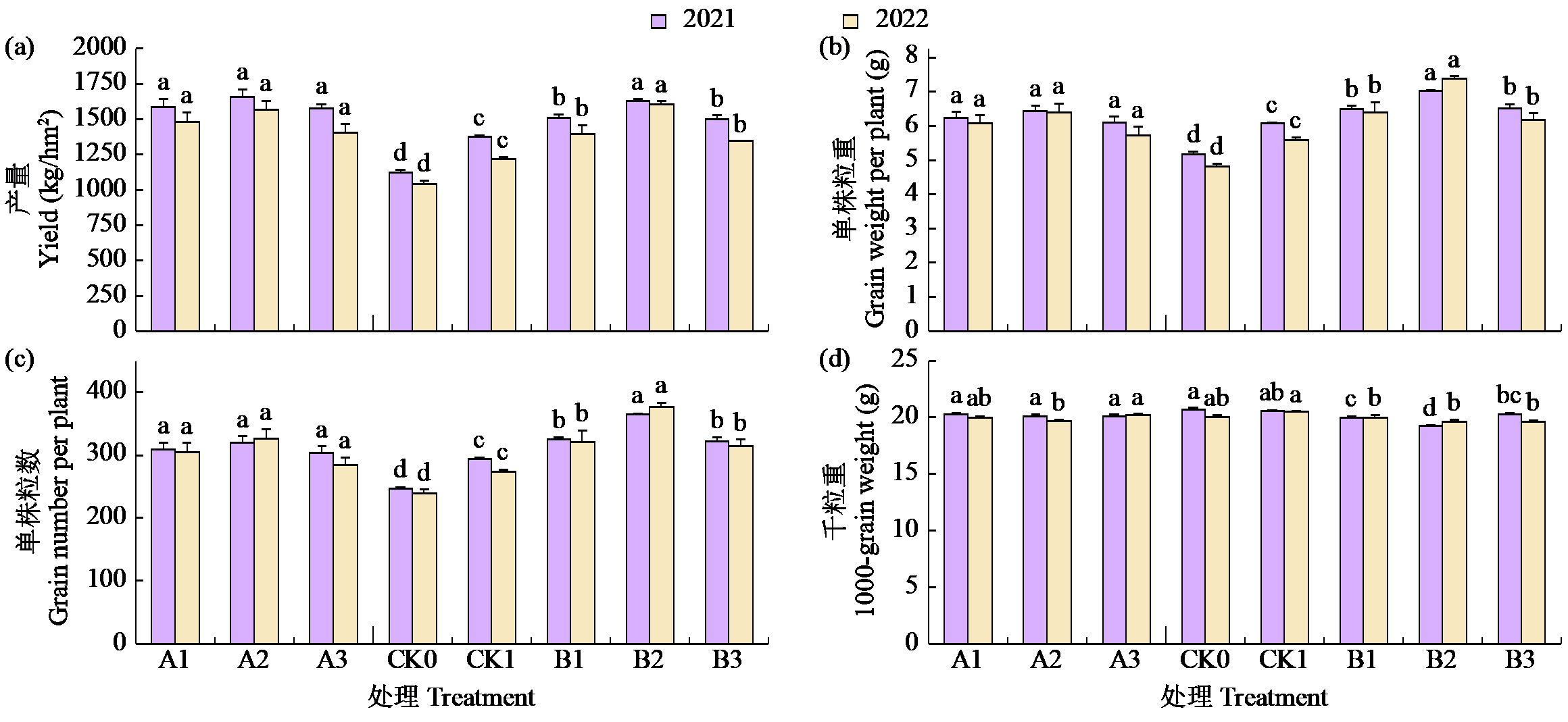
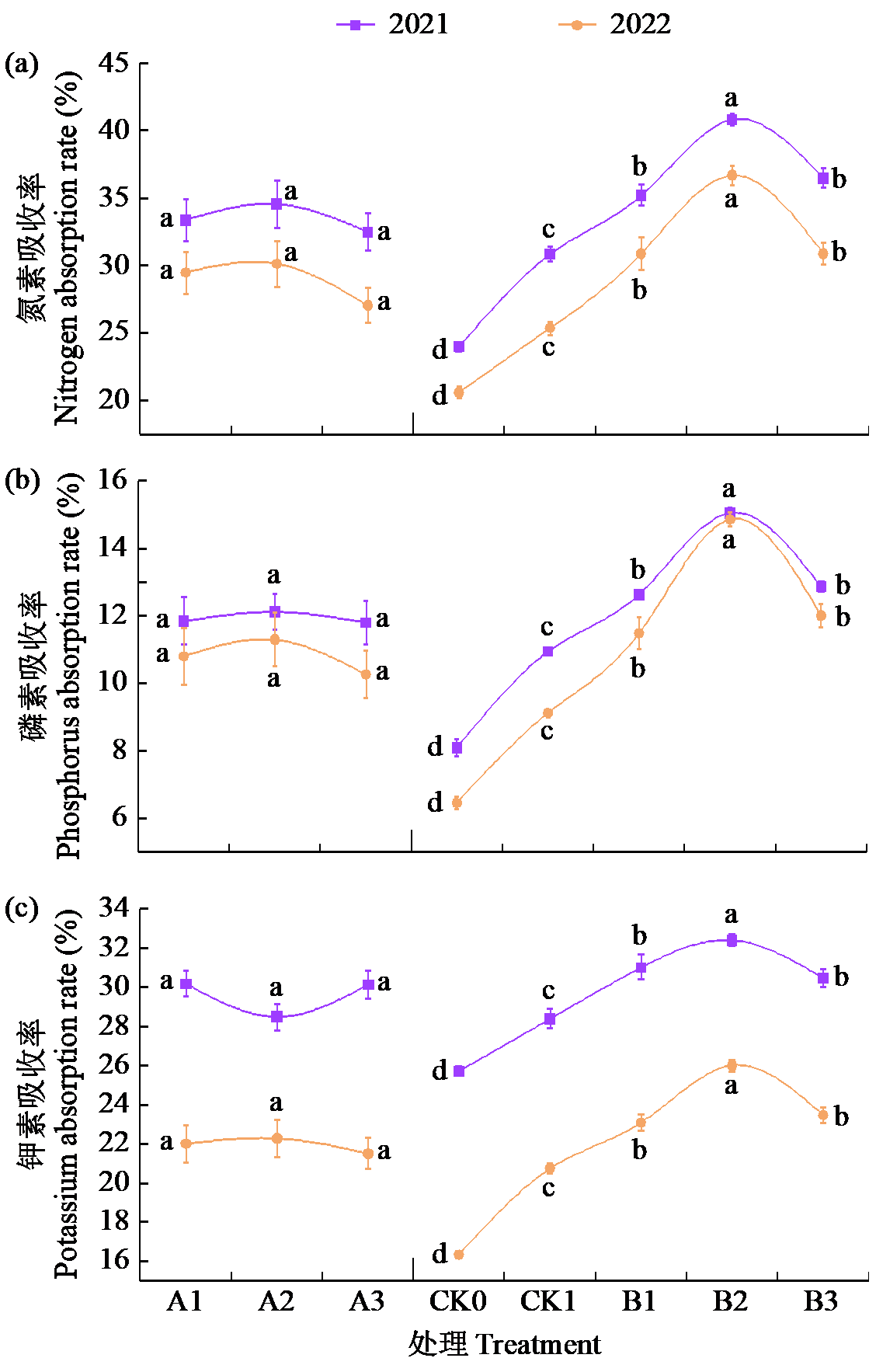
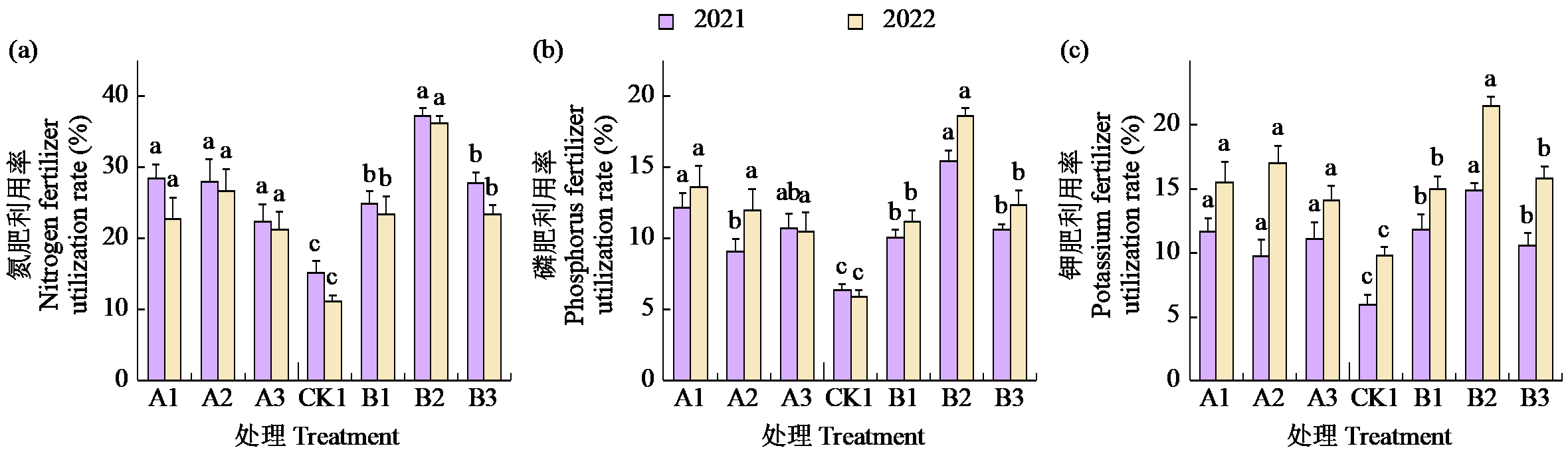
为探明苦荞适宜的播种方式和施肥配比,利用酉荞5号苦荞品种为材料,在2021-2022年春季进行随机区组试验,设置条播(A1)、穴播(A2)和撒播(A3)3种播种方式,以及基追比1:1(B1)、2:1(B2)、3:1(B3)、只施基肥(CK1)和不施肥(CK0)5种施肥模式,研究播种方式及肥料运筹对苦荞产量、品质及肥料利用率的影响。结果表明,苦荞产量、单株粒数和单株粒重在不同播种方式下均表现为A2>A1>A3,差异不显著;施肥处理组均显著高于CK0处理,B2处理最优,显著高于B1和B3处理,极显著高于CK1和CK0处理;不同播种方式及肥料运筹互作下的产量及其构成因素存在极显著差异,A2×B2处理的产量、单株粒数及单株粒重最大。播种方式及肥料运筹对籽粒芦丁含量无显著影响,以A2×B2处理最高;不同播种方式下籽粒的其他品质均无显著差异;不同肥料运筹下的籽粒品质均呈极显著差异,施肥处理组显著高于CK0处理。田间肥料利用率表现为A2>A1>A3,无显著差异。不同肥料运筹处理的氮、磷和钾等元素吸收率及肥料利用率存在极显著差异,B2处理最大。综上,苦荞在A2×B2处理下产量、品质和肥料利用率最优。

关键词: 苦荞, 播种方式, 肥料运筹, 肥料利用率, 产量, 品质

Abstract:

To explore the optimal sowing methods and fertilization ratios for tartary buckwheat, a randomized block experiment was conducted in the spring of 2021 and 2022 using the variety Youqiao 5. Three sowing methods including strip sowing (A1), hole sowing (A2), and broadcast sowing (A3), and five fertilization modes including basal-to-topdressing ratios of 1:1 (B1), 2:1 (B2), 3:1 (B3), basal fertilizer only (CK1), and no fertilizer (CK0) were set up to study the effects of sowing methods and fertilizer management on the yield, quality, and fertilizer utilization efficiency of tartary buckwheat. The results showed that under different sowing methods, yield, grain number per plant, and grain weight per plant followed the order of A2 > A1 > A3, with no significant differences. All fertilizer treatments significantly outperformed the CK0 treatment, with the B2 treatment being the optimal, showing significantly higher values than B1 and B3, and highly significantly higher than CK1 and CK0. Highly significant differences were observed in yield and its components under the interaction of sowing methods and fertilizer management, with the A2×B2 treatment achieving the highest yield, grain number per plant, and grain weight per plant. Sowing methods and fertilizer management had no significant effects on grain rutin content, with the A2×B2 treatment being the highest. There were no significant differences in other grain qualities across different sowing methods. However, grain quality showed extremely significant differences under different fertilizer management modes, with fertilizer treatments significantly higher than the CK0 treatment. Field fertilizer utilization efficiency followed the order A2 > A1 > A3, with no significant differences. Highly significant differences were found in the uptake rates of elements such as nitrogen, phosphorus, and potassium, as well as fertilizer utilization efficiency among different fertilizer management treatments, with the B2 treatment showing the highest values. In conclusion, tartary buckwheat achieved optimal yield, quality, and fertilizer utilization efficiency under the A2×B2 treatment.

Key words: Tartary buckwheat, Sowing method, Fertilizer management, Fertilizer utilization efficiency, Yield, Quality

表1

试验地土壤基础肥力

年份
Year
pH 全氮
Total nitrogen
(mg/kg)
全磷
Total phosphorus
(mg/kg)
全钾
Total potassium
(g/kg)
速效钾
Available potassium
(mg/kg)
速效磷
Available phosphorus
(mg/kg)
碱解氮
Alkaline hydrolyzable
nitrogen (mg/kg)
2021 7.63 632.98 485.43 1.75 165.47 53.87 60.93
2022 7.85 657.22 479.55 1.86 167.35 56.45 61.76

表2

播种方式及肥料运筹互作对苦荞产量及其构成因素的影响

年份
Year
处理
Treatment
产量
Yield (kg/hm2)
单株粒数
Grain number per plant
单株粒重
Grain weight per plant (g)
千粒重
1000-grain weight (g)
2021 A1×CK0 1224.13±3.16h 243.00±1.15g 5.08±0.04g 20.90±0.07a
A1×CK1 1546.39±4.29ef 294.33±2.03f 6.07±0.06e 20.61±0.24abc
A1×B1 1673.99±3.76bc 323.75±5.55cd 6.38±0.09cd 19.71±0.52defg
A1×B2 1836.19±1.91a 363.00±2.89a 7.00±0.11a 19.27±0.28fg
A1×B3 1652.10±5.63cd 320.11±5.60cd 6.59±0.20bc 20.60±0.05abc
A2×CK0 1333.50±3.95g 256.00±2.89g 5.44±0.02f 20.75±0.29ab
A2×CK1 1580.15±4.08cde 297.10±1.76f 6.17±0.05de 20.77±0.08ab
A2×B1 1754.88±3.48ab 334.50±4.33bc 6.69±0.36b 19.98±0.61cde
A2×B2 1841.05±4.67a 367.33±2.33a 7.00±0.08a 19.05±0.03g
A2×B3 1783.69±3.62a 340.83±4.70b 6.80±0.24ab 19.94±0.21cdef
A3×CK0 1230.18±3.58h 241.33±1.54g 4.96±0.02g 20.54±0.31abc
A3×CK1 1523.08±4.38f 292.33±2.33f 5.92±0.07e 20.25±0.25abcd
A3×B1 1675.49±1.89bc 317.50±4.14de 6.38±0.13cd 20.12±0.85bcd
A3×B2 1837.50±2.12a 361.30±2.10a 7.01±0.17a 19.42±0.31efg
A3×B3 1612.50±5.18def 304.17±1.30ef 6.14±0.23de 20.21±0.42abcd
2022 A1×CK0 1153.79±3.76fg 232.78±3.48f 4.71±0.17fg 20.24±0.44abcd
A1×CK1 1365.81±4.75cd 274.45±4.24de 5.57±0.06cd 20.32±0.34abcd
A1×B1 1433.82±2.21c 290.00±3.51d 5.85±0.16c 20.18±0.31abcd
A1×B2 1787.30±1.91ab 376.72±4.01ab 7.30±0.16ab 19.37±0.30efg
A1×B3 1679.27±5.33b 349.67±1.09c 6.85±0.36b 19.63±0.63defg
A2×CK0 1246.52±5.76ef 257.17±3.02e 5.09±0.25ef 19.78±0.05bcdefg
A2×CK1 1434.11±5.49c 286.11±3.95d 5.85±0.11c 20.46±0.26abc
A2×B1 1839.62±0.45a 392.00±4.95a 7.51±0.36a 19.15±0.19g
A2×B2 1855.49±5.35a 392.39±2.34a 7.57±0.32a 19.31±0.25fg
A2×B3 1438.23±3.44c 300.33±2.08d 5.87±0.02c 19.55±0.16defg
A3×CK0 1116.06±2.13g 227.11±5.32f 4.56±0.18g 20.08±0.74abcdef
A3×CK1 1306.18±3.02de 258.78±1.47e 5.33±0.02de 20.61±0.19a
A3×B1 1415.47±6.27cd 281.33±3.01de 5.78±0.48cd 20.52±0.62ab
A3×B2 1773.43±6.95ab 360.17±2.16bc 7.24±0.05ab 20.12±0.71abcde
A3×B3 1404.40±6.66cd 290.78±2.78d 5.73±0.47cd 19.71±0.12cdefg

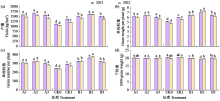
图1

播种方式和肥料运筹对苦荞产量及其构成因素的影响 不同小写字母表示在P < 0.05水平差异显著,下同。

表3

不同处理对苦荞籽粒品质的影响

处理
Treatment
芦丁含量
Rutin content (mg/g)
蛋白质含量
Protein content (%)
总淀粉含量
Total starch content (%)
直链淀粉含量
Amylose content (%)
支链淀粉含量
Amylopectin content (%)
2021 2022 2021 2022 2021 2022 2021 2022 2021 2022
A1 0.99a 1.02a 9.17a 9.68a 64.10b 63.64a 14.33a 13.87ab 49.31a 49.77a
A2 1.01a 1.02a 9.23a 9.45a 63.49b 62.94a 14.23a 14.40a 48.71a 48.53a
A3 0.99a 1.02a 9.00a 9.25a 68.61a 64.87a 14.29a 13.69b 50.58a 51.18a
CK0 0.98a 0.98b 8.23d 8.54c 57.15b 52.40b 14.00bc 13.24c 38.63b 39.16b
CK1 0.99a 1.00ab 9.01c 9.01b 67.73a 67.98a 13.84c 13.84bc 53.91a 54.14a
B1 1.00a 1.05a 9.41b 9.88a 69.46a 67.49a 14.41ab 14.12ab 53.08a 53.37a
B2 1.01a 1.02ab 9.73a 10.08a 66.20a 66.17a 14.76a 14.73a 51.41a 51.44a
B3 0.98a 1.01ab 9.28b 9.80a 66.46a 65.03a 14.40ab 13.99b 50.62a 51.03a
A ns ns ns ns ns ns ns * ns ns
B ns * ** ** ** ** ** ** ** **
A×B ns ns ** ** ** ** ** ** ** **

表4

播种方式与肥料运筹互作对苦荞籽粒品质的影响

年份
Year
处理
Treatment
芦丁含量
Rutin content (mg/g)
蛋白质含量
Protein content (%)
总淀粉含量
Total starch content (%)
直链淀粉含量
Amylose content (%)
支链淀粉含量
Amylopectin content (%)
2021 A1×CK0 0.97±0.01ab 8.22±0.12f 50.60±2.28d 13.93±0.71b 35.72±1.35g
A1×CK1 0.99±0.01ab 9.13±0.35cde 66.28±1.30abc 14.14±0.49ab 51.92±2.58bcd
A1×B1 0.99±0.04ab 9.43±0.39bcd 71.61±0.25a 14.23±0.13ab 55.41±0.73ab
A1×B2 1.01±0.04ab 9.71±0.06ab 63.58±0.84bc 14.94±0.17a 48.26±3.85d
A1×B3 0.99±0.01ab 9.36±0.04bcd 68.45±2.74abc 14.40±0.19ab 55.23±1.83ab
A2×CK0 1.00±0.02ab 8.35±0.30f 55.25±0.50d 13.69±0.55b 40.47±0.68ef
A2×CK1 1.01±0.06ab 9.00±0.04de 65.18±1.25abc 14.05±0.56ab 51.41±0.83bcd
A2×B1 1.02±0.05ab 9.54±0.05bc 69.80±1.63ab 14.43±0.34ab 54.36±2.33ab
A2×B2 1.05±0.06a 9.95±0.28a 64.93±1.97bc 14.41±0.56ab 53.15±4.03bc
A2×B3 0.94±0.11b 9.32±0.41bcde 62.28±1.94c 14.56±0.78ab 44.15±0.48e
A3×CK0 0.99±0.06ab 8.13±0.14f 65.61±2.45abc 13.68±0.56b 39.71±0.35fg
A3×CK1 0.97±0.01ab 8.89±0.16e 71.72±0.29a 14.02±0.6ab 58.41±2.78a
A3×B1 0.99±0.03ab 9.26±0.06cde 66.96±0.86abc 14.57±0.42ab 49.46±2.13cd
A3×B2 0.98±0.02ab 9.53±0.12bc 70.08±3.62ab 14.93±0.39a 52.81±2.64bcd
A3×B3 1.01±0.03ab 9.16±0.36cde 68.66±3.04abc 14.26±0.34ab 52.49±4.36bcd
2022 A1×CK0 0.98±0.01bcd 8.92±0.81efg 49.65±0.40g 13.06±0.42d 36.60±1.11f
A1×CK1 1.05±0.07abc 9.26±0.40cde 66.07±0.38bcd 13.81±0.75bcd 52.25±3.02bcd
A1×B1 1.05±0.02ab 9.74±0.04bcd 69.64±2.27ab 13.97±0.93abcd 55.67±0.83ab
A1×B2 0.99±0.03abcd 10.45±0.04a 63.20±1.11d 14.81±0.42ab 48.39±3.74d
A1×B3 1.02±0.04abcd 10.05±0.58ab 69.63±1.49ab 13.71±0.22bcd 55.92±1.71ab
A2×CK0 1.00±0.04abcd 8.26±0.13g 54.15±0.09f 13.36±1.19cd 40.80±1.34ef
A2×CK1 0.99±0.04abcd 9.06±0.14def 65.46±1.15bcd 13.97±0.13abcd 51.49±1.02bcd
A2×B1 1.06±0.03a 10.10±0.07ab 68.80±2.00ab 15.02±0.80a 53.78±2.05bc
A2×B2 1.03±0.06abcd 10.15±0.40ab 67.56±0.32bcd 14.96±0.24a 52.60±3.35bcd
A2×B3 1.00±0.04abcd 9.69±0.32bcd 58.71±0.55e 14.71±0.22ab 44.00±0.77e
A3×CK0 0.97±0.02cd 8.45±0.32fg 53.38±0.12fg 13.31±0.01d 40.08±0.21ef
A3×CK1 0.97±0.02d 8.72±0.58efg 72.42±1.35a 13.75±0.23bcd 58.67±2.39a
A3×B1 1.02±0.05abcd 9.79±0.13abc 64.03±1.30cd 13.38±0.07cd 50.66±2.4cd
A3×B2 1.04±0.05abc 9.63±0.27bcd 67.75±2.71bc 14.43±0.31abc 53.31±2.56bc
A3×B3 1.02±0.03abcd 9.68±0.26bcd 66.75±1.44bcd 13.56±0.85cd 53.19±5.09bc

图2

播种方式和肥料运筹对苦荞氮、磷、钾吸收率的影响

表5

播种方式和肥料运筹互作对苦荞氮、磷、钾素吸收率的影响

处理
Treatment
氮素吸收率Nitrogen absorption rate 磷素吸收率Phosphorus absorption rate 钾素吸收率Potassium absorption rate
2021 2022 2021 2022 2021 2022
A1×CK0 23.11±0.15h 21.32±0.98g 7.47±0.37e 5.91±0.13h 25.99±0.47f 16.41±0.32h
A1×CK1 32.78±0.33f 25.88±0.79e 11.03±0.19c 9.26±0.43f 29.61±0.49de 20.14±0.78g
A1×B1 34.74±1.08de 28.95±0.61c 12.60±0.46b 10.71±0.59e 30.87±1.60bcd 23.32±0.72cd
A1×B2 40.54±0.27ab 37.64±0.45a 15.35±0.15a 14.97±0.33ab 33.08±1.21a 26.19±0.48a
A1×B3 35.64±0.67d 33.63±0.91b 12.74±0.36b 13.15±0.78c 31.35±0.99abcd 23.94±1.93bc
A2×CK0 24.46±0.66h 20.54±0.52g 8.84±0.66d 6.98±0.46g 24.97±0.42f 16.16±0.76h
A2×CK1 29.75±0.56g 26.42±0.20de 11.12±0.35c 9.27±0.33f 26.67±0.99f 21.38±0.48efg
A2×B1 37.64±0.84c 35.43±1.03b 12.71±0.54b 13.19±0.78c 29.52±0.32de 23.84±1.67bc
A2×B2 42.10±0.40a 38.25±0.97a 14.62±0.74a 15.34±0.74a 31.58±0.34abc 26.51±1.26a
A2×B3 38.75±1.19bc 29.94±0.55c 13.26±0.41b 11.66±0.08d 29.64±1.35de 23.48±0.84cd
A3×CK0 24.42±0.35h 19.94±0.64g 7.95±0.57e 6.50±0.18gh 26.15±0.36f 16.43±0.67h
A3×CK1 29.98±0.11g 23.84±0.70f 10.67±0.17c 8.82±0.24f 28.88±0.26e 20.69±0.65fg
A3×B1 33.17±0.29ef 28.29±0.48cd 12.59±0.29b 10.53±0.51e 32.65±2.14ab 22.10±0.46def
A3×B2 39.70±0.76b 34.07±0.14b 15.16±0.23a 14.23±0.14ab 32.54±0.35ab 25.30±0.20ab
A3×B3 35.07±0.53de 29.08±0.60c 12.60±0.44b 11.22±0.76de 30.42±1.57cde 22.98±0.58cde

表6

播种方式和肥料运筹互作对苦荞肥料利用率的影响

处理
Treatment
氮肥利用率
Nitrogen fertilizer utilization rate
磷肥利用率
Phosphorus fertilizer utilization rate
钾肥利用率
Potassium fertilizer utilization rate
2021 2022 2021 2022 2021 2022
A1×CK1 21.48±0.73fg 10.12±1.75g 7.91±0.42f 7.45±0.95f 6.69±0.91def 8.29±1.74g
A1×B1 25.84±2.39def 16.94±1.36ef 11.40±1.02bcd 10.68±1.30e 9.03±2.97bcde 15.35±1.60cde
A1×B2 38.72±0.60a 36.25±0.99ab 17.51±0.32a 20.14±0.74a 13.13±2.24a 21.74±1.07a
A1×B3 27.83±1.48cde 27.35±2.01c 11.72±0.80bc 16.09±1.72c 9.91±1.84abcd 16.74±4.29bc
A2×CK1 11.76±1.24h 13.06±0.44fg 5.06±0.77g 5.09±0.73g 3.15±1.83f 11.60±1.08efg
A2×B1 29.30±1.85cd 33.09±2.28b 8.60±1.19ef 13.80±1.73d 8.42±0.59bcde 17.07±3.72bc
A2×B2 39.21±0.89a 39.34±2.15a 12.83±1.64b 18.58±1.64ab 12.25±0.64ab 22.99±2.80a
A2×B3 31.76±2.65bc 20.88±1.22de 9.81±0.91de 10.40±0.18e 8.65±2.50bcde 16.26±1.88bcd
A3×CK1 12.36±0.25h 10.16±1.56g 6.06±0.38g 5.17±0.54g 5.05±0.49ef 9.46±1.45fg
A3×B1 19.46±0.66g 20.05±1.06de 10.32±0.65cd 8.96±1.13ef 12.03±3.97ab 12.59±1.03def
A3×B2 33.96±1.67b 32.91±0.30b 16.04±0.51a 17.19±0.32bc 11.83±0.65abc 19.71±0.44ab
A3×B3 23.66±1.18efg 21.81±1.34d 10.34±0.97cd 10.48±1.70e 7.90±2.90cde 14.55±1.29cde

图3

播种方式和肥料运筹对苦荞肥料利用率的影响

[1] Zhou M L, Ivan K, Galina S, et al. Buckwheat germplasm in the world. London: Academic Press, 2018.
[2] 唐宇, 邵继荣, 周美亮. 中国荞麦属植物分类学的修订. 植物遗传资源学报, 2019, 20(3):646-653.
doi: 10.13430/j.cnki.jpgr.20181210001
[3] Sharma S K, Ramesh A, Sharma M P, et al. Microbial community structure and diversity as indicators for evaluating soil quality. Biodiversity Biofuels Agroforestry and Conservation Agriculture,Sustainable Agriculture Reviews, 2011,5:317-358.
[4] Guo X N, Yao H Y. Fractionation and characterization of tartary buckwheat flour proteins. Food Chemistry, 2006, 98(1):90-94.
doi: 10.1016/j.foodchem.2005.05.055
[5] Ding M Q, Wu Y M, Wei L, et al. Progress of research on buckwheat forage and its application in the livestock and poultry industries. Pratacultural Science, 2018, 35(1):176-185.
[6] 向达兵, 彭镰心, 赵钢, 等. 荞麦栽培研究进展. 作物杂志, 2013(3):1-6.
[7] Zhao G, Zhao J L, Peng L X, et al. Effects of yeast polysaccharide on growth and flavonoid accumulation in Fagopyrum tataricum sprout cultures. Molecules, 2012, 17(10):11335-11345.
doi: 10.3390/molecules171011335
[8] Zuo G M, Tan B, Wang J H, et al. Evaluation and utilization of nutrient function components in tartary buckwheat rice and tartary buckwheat powder processing. Food Science, 2009, 30(14):183-187.
[9] 谢耀丽, 张德奇, 李向东, 等. 豫南雨养区近15年小麦生产能力提升原因分析与技术对策——以西平县为例. 中国农学通报, 2013, 29(18):32-37.
[10] 祁皓天, 董永利, 李川, 等. 播种方式和播量对冬小麦‘西农20’产量及品质的影响. 西北农业学报, 2021, 30(1):32-40.
[11] 丁锦峰, 游蕊, 丁永刚, 等. 基于不同栽培模式的小麦强、弱势粒灌浆特性研究. 麦类作物学报, 2020, 40(10):1206-1214.
[12] 毛妍婷, 雷宝坤, 陈安强, 等. 不同免耕覆盖栽培模式下耕层土壤水热变化对小麦产量的影响. 西南农业学报, 2015, 28 (4):1553-1558.
[13] 张广峰, 陈喜明, 韩云丽, 等. 增施氮肥对晋荞麦2号产量和品质的影响. 黑龙江农业科学, 2022(10):33-37.
[14] 李桂强, 何平, 张春平, 等. 药用金荞麦“3414”施肥效应研究. 中药材, 2011, 32(2):171-175.
[15] 向达兵, 杨玲玲, 李静, 等. 施肥对苦荞麦产量、经济效益及肥效的影响. 河南农业科学, 2015, 44(4):83-87.
[16] 胡启山. 荞麦需肥少施肥贵在巧. 科学种养, 2011(1):15.
[17] 吕丹. 苦荞种质资源产量性状和籽粒黄酮含量与SSR标记的关联分析. 贵阳:贵州师范大学, 2020.
[18] 汪连爱. 双光束双波长分光光度计测定稻米中直链淀粉的方法. 粮食与饲料工业, 1999(3):47-48.
[19] 吴康红. 硅磷配施对甜荞倒伏性能及产量的影响. 重庆:西南大学, 2020.
[20] 吴邦谟. 不同播种方式和氮肥追施对冬小麦生育特性及产量品质的影响. 杨凌:西北农林科技大学, 2019.
[21] 杨军学, 罗世武, 程炳文, 等. 播种方式与密度互作对糜子群体冠层及产量的影响. 江苏农业科学, 2022, 50(24):65-73.
[22] 周传猛, 梁琳, 李科冰, 等. 播种方式对米粉加工专用型杂交稻品种农艺性状及产量的影响. 中国种业, 2022(4):82-85.
[23] 段玉婷, 祝海竣, 刘乾峰, 等. 肥料运筹对双季杂交稻干物质积累及产量形成的影响. 分子植物育种. (2022-10-31)[2025-05-08]. https://link.cnki.net/urlid/46.1068.S.20221030.2005.008.
[24] 刘博, 卫玲, 肖俊红, 等. 肥料运筹对大豆产量及生长的影响. 华北农学报, 2018, 33(增1):195-200.
[25] 王玉娇, 常旭虹, 王德梅, 等. 播种方式对不同品种小麦产量和品质的影响. 作物杂志, 2023(1):122-128.
[26] 董飞, 闫秋艳, 张敏敏, 等. 追氮量对不同粒色小麦籽粒产量、品质及硒吸收的影响. 中国农业大学学报, 2022, 27(8):13-23.
[27] 朱新开, 郭凯泉, 郭文善, 等. 播种方式对强筋小麦籽粒品质和产量的影响. 扬州大学学报(农业与生命科学版), 2009, 30(2):59-63.
[28] Pomeranz Y, Peterson C J, Marttern P J. Hardness of winter wheat grown under widely different climatic conditions. Cereal Chemistry, 1985, 62(6):463-467.
[29] Peterson C J, Graybosch R A, Baenziger P S, et al. Genotype and environment effects on quality characteristics of hard red winter wheat. Crop Science, 1992,32:98-103.
[30] Wieser H. Chemistry of gluten proteins. Food Microbiology, 2007, 24(2):115-119.
doi: 10.1016/j.fm.2006.07.004 pmid: 17008153
[31] 朱元刚, 初金鹏, 张秀, 等. 不同播期冬小麦氮素出籽效率与氮素利用及转运的相关性. 应用生态学报, 2019, 30(4):1151-1160.
doi: 10.13287/j.1001-9332.201904.005
[32] Dai X L, Wang Y C, Dong X C, et al. Delayed sowing can increase lodging resistance while maintaining grain yield and nitrogen use efficiency in winter wheat. The Crop Journal, 2017, 5(6):541-552.
doi: 10.1016/j.cj.2017.05.003
[33] Davarpanah R, Ahmadi S H. Modeling the effects of irrigation management scenarios on winter wheat yield and water use indicators in response to climate variations and water delivery systems. Journal of Hydrology, 2021,598:126269.
[34] 刘运景, 郑飞娜, 张秀, 等. 宽幅播种对强筋小麦籽粒产量、品质和氮素吸收利用的影响. 作物学报, 2022, 48(3):716-725.
doi: 10.3724/SP.J.1006.2022.11012
[35] 初金鹏, 朱文美, 尹立俊, 等. 宽幅播种对冬小麦‘泰农18’产量和氮素利用率的影响. 应用生态学报, 2018, 29(8):2517-2524.
doi: 10.13287/j.1001-9332.201808.027
[36] 刘曼玉. 播种方式与施氮量互作对冬小麦产量和氮素吸收利用的调控. 泰安:山东农业大学, 2022.
[37] Nguyen H, Schoenau J J, Nguyen D, et al. Effects of long-term nitrogen, phosphorus, and potassium fertilization on cassava yield and plant nutrient composition in north Vietnam. Journal of Plant Nutrition, 2002, 25(3):425-442.
doi: 10.1081/PLN-120003374
[38] 林忠成, 李土明, 吴福观, 等. 基蘖肥与穗肥氮比例对双季稻产量和碳氮比的影响. 植物营养与肥料学报, 2011, 17(2):269-275.
[39] Peng S B, Buresha R J, Huang J L. Strategies for overcoming low agronomic nitrogen use efficiency in irrigated rice systems in China. Field Crops Research, 2006, 96(1):37-47.
doi: 10.1016/j.fcr.2005.05.004
[40] 林义月, 李阳, 汪本福, 等. 氮肥运筹对机直播水稻产量、品质及氮素利用率的影响. 华中农业大学学报, 2023, 42(2):93‐98.
[1] 赵永满, 李瑞奇, 王红光. 拔节前补灌追氮对小麦叶片干物质积累量和产量的影响[J]. 作物杂志, 2026, (4): 101–109
[2] 许芸菲, 贾浩杨, 李叶彤, 曹瑞, 高梓淇, 赵喆, 陈立强, 梁潇. 氮肥用量及运筹对优良食味粳稻越光产量形成及根系形态的影响[J]. 作物杂志, 2026, (4): 117–128
[3] 吴子帅, 黄秋要, 陈传华, 罗芳媚, 张世冠, 刘广林, 路一平, 罗群昌, 李虎. 施氮量和栽插密度对桂香99产量和稻米品质的影响[J]. 作物杂志, 2026, (4): 140–145
[4] 阮新民, 从夕汉, 杜弘杨, 岳伟, 施伏芝, 罗彦长, 王元垒, 罗志祥. 江淮稻作区氮肥用量对高产优质中籼稻产量、品质及氮肥利用效率的影响[J]. 作物杂志, 2026, (4): 146–154
[5] 李行, 陈广周, 王运韬, 连世昊, 李家豪, 田文强, 张金汕, 石书兵. 宽幅匀播对新疆春小麦光合特性及产量的影响[J]. 作物杂志, 2026, (4): 164–170
[6] 陈京都, 洪叶, 唐建鹏, 邓沁宇, 刘绍贵, 张彦, 冯烨. 土壤修复剂与不同肥料运筹模式对稻茬小麦产量及品质的影响[J]. 作物杂志, 2026, (4): 180–187
[7] 侯晓敏, 闫锋, 董扬, 赵富阳, 李清泉, 卢环, 张金东, 张巩亮. 调环酸钙对糜子茎秆特征及抗倒伏能力的影响[J]. 作物杂志, 2026, (4): 207–213
[8] 张卓, 聂江力, 邱晓坤, 宿珈嘉, 任俊涵, 刘广慧, 刘艳军, 裴毅. 蚯蚓粪肥部分替代化肥对兰州百合光合特性、品质和产量的影响[J]. 作物杂志, 2026, (4): 221–227
[9] 樊海潮, 张志恒, 赵中亭, 张桂花. 种植密度与整枝方式对蒜后直播棉产量和品质的影响[J]. 作物杂志, 2026, (4): 238–245
[10] 吴淼淼, 王素华, 田静, 袁星星, 陈新, 王丽侠. 2022-2024年国家食用豆产业技术体系普通豇豆新品种(系)联合鉴定分析[J]. 作物杂志, 2026, (3): 102–109
[11] 谢福平, 毛涛. 化肥减量配施生物有机肥对设施番茄产量、品质及土壤肥力的影响[J]. 作物杂志, 2026, (3): 197–203
[12] 史婵, 韩丽, 李秋卓, 张芳魁, 曾秀丽, 李玉蓉, 张兴端. 不同氮、磷、钾配比对紫甘薯花青素积累及产量的影响[J]. 作物杂志, 2026, (3): 204–209
[13] 郭威, 孙冬, 闫治霖, 丁蓓, 杜跃辰, 吴慧扬, 徐强, 窦志, 高辉. 灌浆结实期半深水灌溉对水稻产量、干物质转运及籽粒灌浆的影响[J]. 作物杂志, 2026, (3): 21–29
[14] 谢章书, 荣志凌, 覃业玲, 李侃, 周仲华, 屠小菊, 汪启明, 刘爱玉. 夏播短季栽培模式下棉花产量及纤维品质对脱叶催熟剂喷施时间的响应[J]. 作物杂志, 2026, (3): 225–232
[15] 卢燕回, 宋战锋, 李虎, 刘广林, 陈传华, 罗群昌, 吴子帅. 秧龄对烟后水稻秧苗素质、产量及稻米品质的影响[J]. 作物杂志, 2026, (3): 233–241
Viewed
Full text


Abstract

Cited

  Shared   
  Discussed   
No Suggested Reading articles found!