

作物杂志,2026, 第3期: 56–63 doi: 10.16035/j.issn.1001-7283.2026.03.008
• 第二十八届中国科协年会学术论文专栏(主要粮食作物产能品质提升与高质量发展路径) • 上一篇 下一篇
同化物积累与分配对冬小麦小花发育成粒的影响及密度调控效应
柳东亮1( ), 王雅群1, 黄琴2, 王鹏月1, 张鸿雁1, 房琴1(), 李瑞奇1()
- 1
河北农业大学农学院/省部共建华北作物改良与调控国家重点实验室/河北省作物生长调控实验室 071001, 河北保定
2保定市农业科学院 071000, 河北保定
Effects of Accumulation and Distribution of Assimilates on Floret Development and Grain Set of Winter Wheat and the Regulatory Effect of Density
Liu Dongliang1(), Wang Yaqun1, Huang Qin2, Wang Pengyue1, Zhang Hongyan1, Fang Qin1(), Li Ruiqi1()
- 1
College of Agronomy ,Hebei Agricultural University / State Key Laboratory of Crop Improvement and Regulation in North China / Hebei Provincial Laboratory of Crop Growth Regulation, Baoding 071001 Hebei, China
2Baoding Academy of Agricultural Sciences ,Baoding 071000 Hebei, China
摘要:
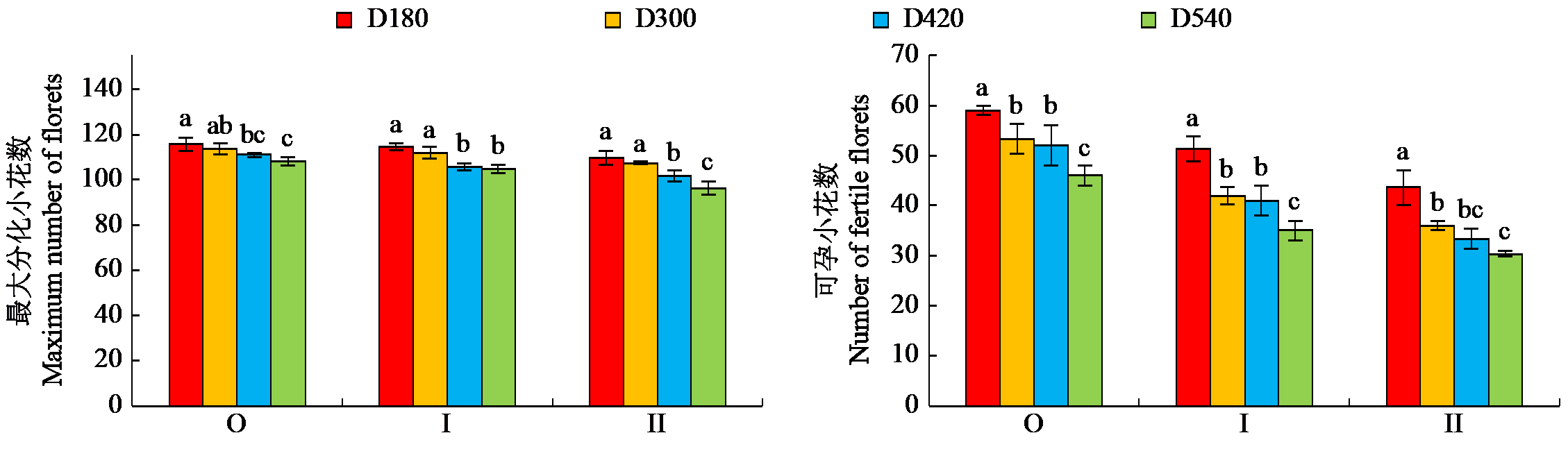
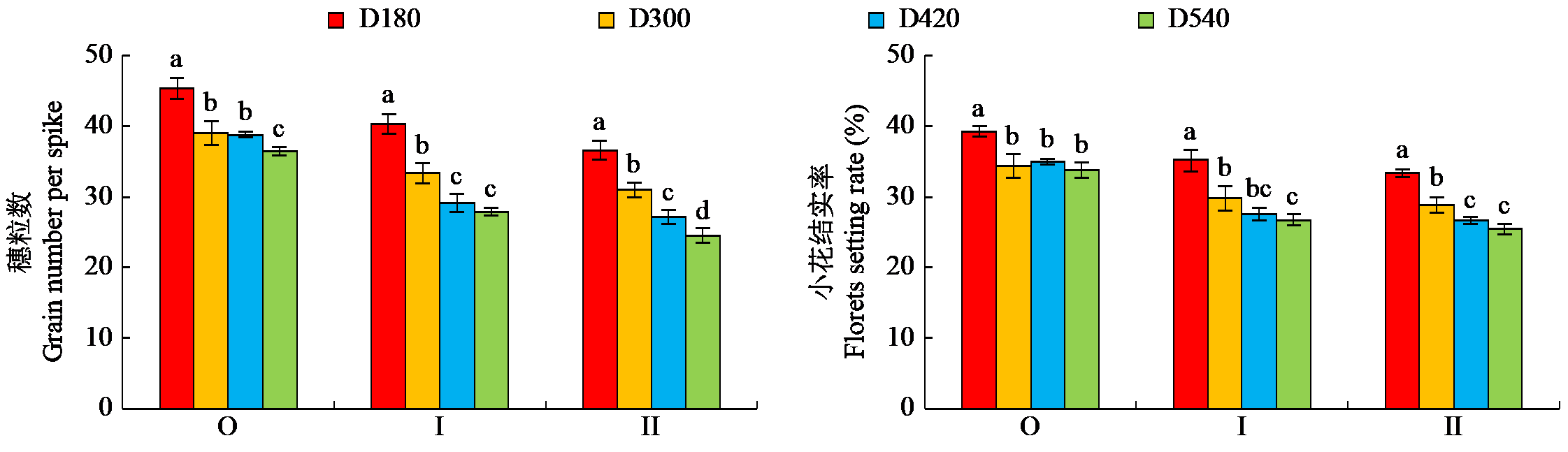
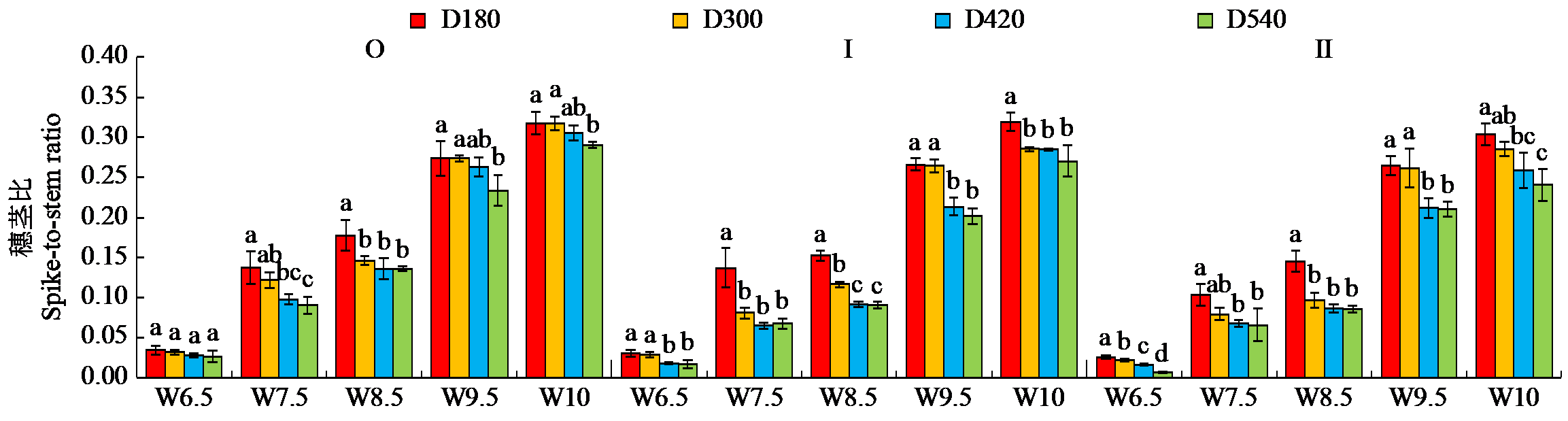
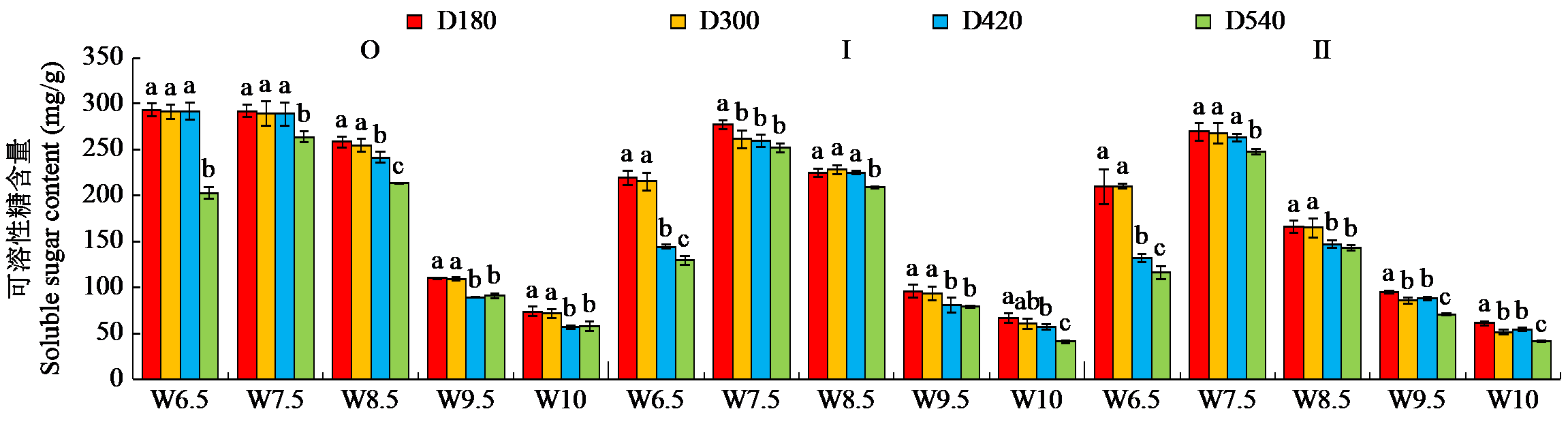
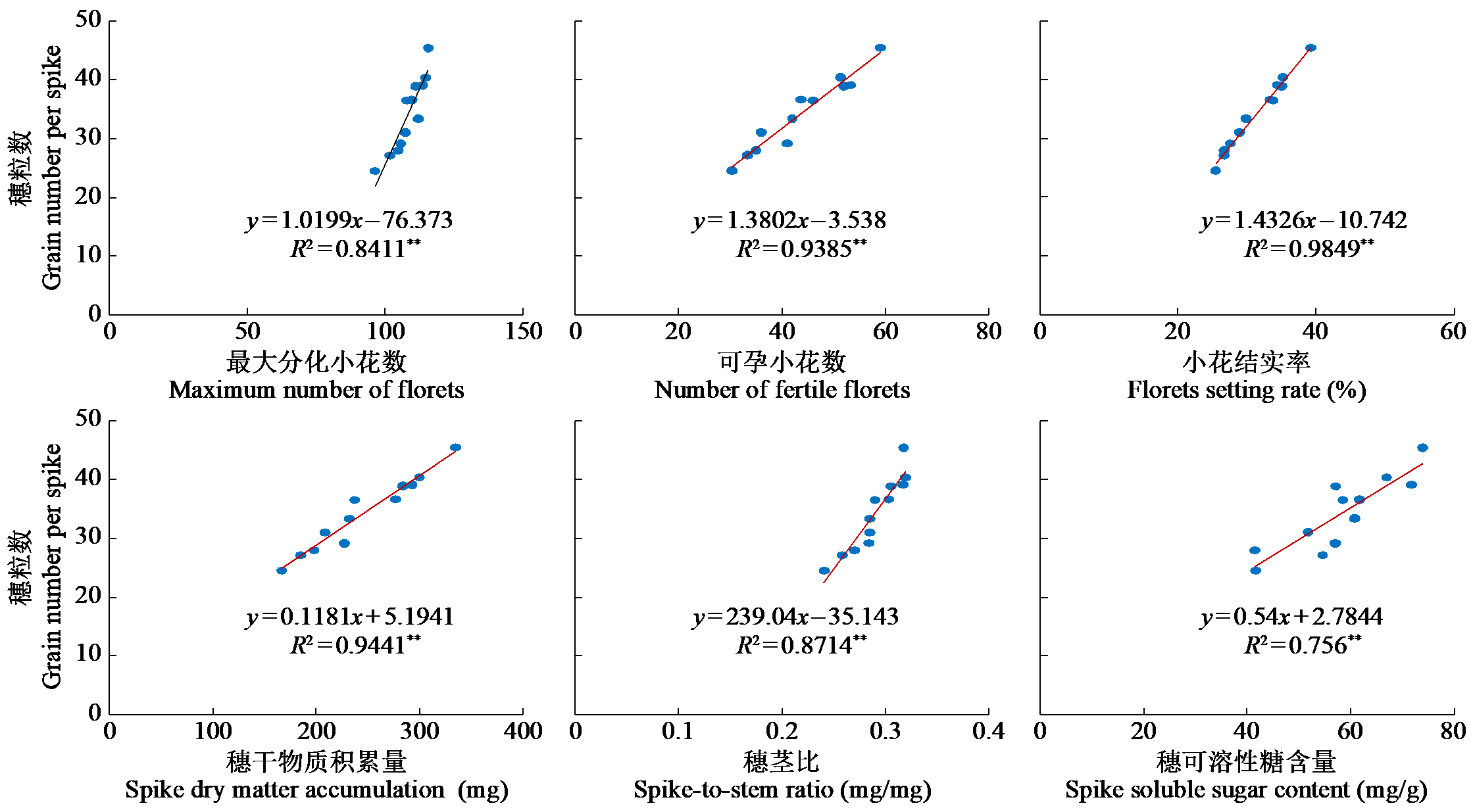
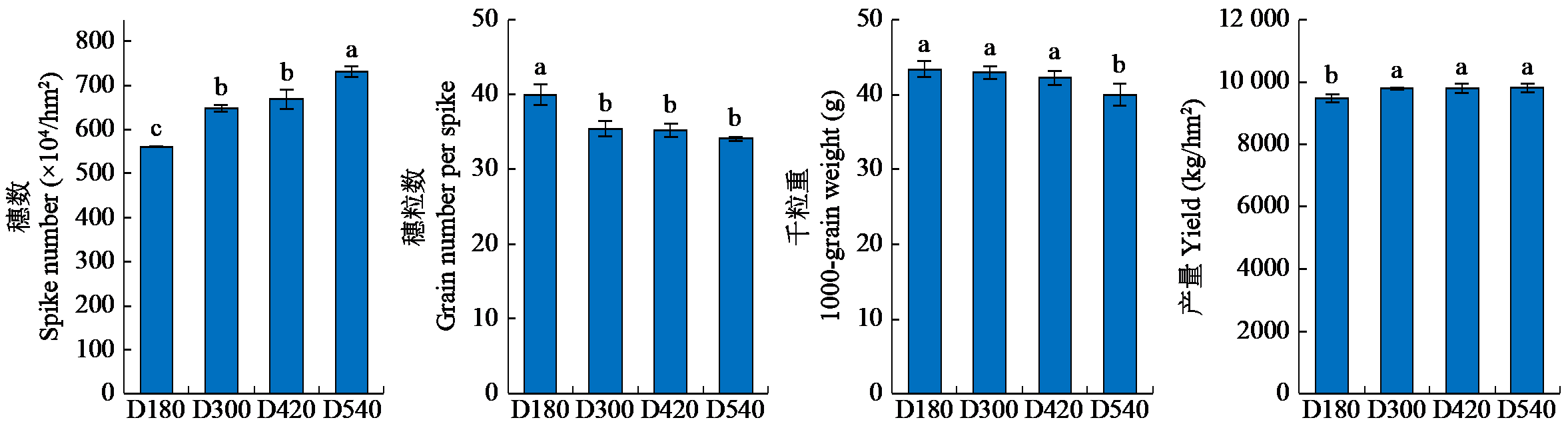
为明确同化物积累与分配对冬小麦小花发育成粒的影响及密度调控效应,于2023-2024年以冬小麦品种衡观35为试验材料,设置4个密度水平,分别为基本苗180万(D180)、300万(D300)、420万(D420)和540万株/hm2(D540),比较主茎、I分蘖和II分蘖的最大分化小花数、可孕小花数、小花结实率和结实粒数的差异,结合穗和茎的干物质积累量与穗的可溶性糖含量,分析同化物积累与分配对小花发育成粒的影响。结果表明,同一密度下主茎的分化小花数和结实粒数均高于分蘖。随着密度增加,最大分化小花数、可孕小花数和小花结实率均呈下降趋势,D180与D420、D540处理间的差异均达显著水平。穗、茎的干物质积累量和穗茎比均表现为低密度高于高密度处理,D180与D540处理差异达显著水平。相关分析表明,最大分化小花数、可孕小花数、穗干物质积累量、穗茎比、穗可溶性糖含量与穗粒数均呈极显著正相关。本试验条件下,主茎、I分蘖和II分蘖的穗粒数均表现为D180>D300>D420>D540,同化物在穗部积累量以及分配比例的增加为促进小花发育成粒和提高穗粒数奠定了良好的物质基础。综上,D300处理的产量构成要素更加协调,是本试验的最优密度处理。






| [1] | 国家统计局农村社会经济调查司. 中国农村统计年鉴—2024. 北京: 中国统计出版社, 2024. |
| [2] | 朱慧杰, 郑春风, 张国钊, 等. 栽培管理模式对冬小麦小花发育与结实特性的影响. 麦类作物学报, 2014, 34(10):1383-1389. |
| [3] | 郑春风, 任伟, 徐福新, 等. 孕穗前期叶面喷赛苗旺对冬小麦穗粒数和粒质量的影响. 河南农业科学, 2018, 47(11):8-12. |
| [4] |
Zhu Y G, Chu G P, Dai X L, et al. Delayed sowing increases grain number by enhancing spike competition capacity for assimilates in winter wheat. European Journal of Agronomy, 2019, 104:49-62.
doi: 10.1016/j.eja.2019.01.006 |
| [5] | 王志敏, 王树安, 苏宝林. 小麦穗粒数的调节II开花前遮光对穗碳水化合物代谢和内源激素水平的影响. 华北农学报, 1997, 12(4):43-48. |
| [6] | 朱元刚, 肖岩岩, 初金鹏, 等. 不同播期冬小麦小花发育特性与同化物代谢的相关性. 植物营养与肥料学报, 2019, 25(3):370-381. |
| [7] | 谢琰. 氮肥和密度对不同穗型小麦穗粒数形成的影响. 南京: 南京农业大学, 2012. |
| [8] | 于振文. 不同密度条件对冬小麦小花发育的影响. 作物学报, 1984, 10(3):185-194. |
| [9] | 文祥朋, 任伟, 孙克刚, 等. 不同穗型小麦小花发育过程中幼穗内同化物分配与穗粒数的关系. 江西农业学报, 2017, 29(8):11-14. |
| [10] | 马金荣, 张雁鸿, 王雅群, 等. 种植密度对不同穗型冬小麦品种结实特性和产量的影响. 麦类作物学报, 2023, 43(12):1607-1615. |
| [11] |
Waddington S R, Cartwright P M, Wall P C. A quantitative scale of spike initial and pistil development in barley and wheat. Annals of Botany, 1983, 51(1):119-130.
doi: 10.1093/oxfordjournals.aob.a086434 |
| [12] |
Shang Y Q, Wang S, Lin X, et al. Supplemental irrigation at jointing improves spike formation of wheat tillers by regulating sugar distribution in ear and stem. Agricultural Water Management, 2023, 279:108160.
doi: 10.1016/j.agwat.2023.108160 |
| [13] | 李怡香. 氮肥和密度对小麦穗粒数形成的影响及生理基础. 南京: 南京农业大学, 2014. |
| [14] |
Wen L Y, Liu Y Q, Zhou B J, et al. Differences between two wheat genotypes in the development of floret primordia and contents of pigments and hormones. The Crop Journal, 2024, 12:1196-1207.
doi: 10.1016/j.cj.2024.04.007 |
| [15] |
Zheng C F, Zhu Y J, Zhu H J, et al. Floret development and grain setting characteristics in winter wheat in response to pre-anthesis applications of 6-benzylaminopurine and boron. Field Crops Research, 2014, 169:70-76.
doi: 10.1016/j.fcr.2014.09.005 |
| [16] |
张荣, 刘淋茹, 付凯霞, 等. 干旱胁迫下外源褪黑素对冬小麦小花发育及碳营养代谢的调控. 中国农业科学, 2024, 57(23):4644-4657.
doi: 10.3864/j.issn.0578-1752.2024.23.006 |
| [17] | 刘北城, 张艳艳, 戎亚思, 等. 干旱胁迫下喷施14-羟基芸苔素甾醇对冬小麦穗花发育及碳氮代谢的调控. 植物营养与肥料学报, 2021, 27(6):1004-1015. |
| [18] | 郑春风, 朱慧杰, 朱云集, 等. 冬小麦小花发育及结实特性对叶面喷硼的响应. 植物营养与肥料学报, 2016, 22(2):550-556. |
| [19] |
Zhang Z, Li J, Hu N Y, et al. Spike growth affects spike fertility through the number of florets with green anthers before floret abortion in wheat. Field Crops Research, 2021, 260:108007.
doi: 10.1016/j.fcr.2020.108007 |
| [20] |
Miralles D J, Katz S D, Colloca A, et al. Floret development in near isogenic wheat lines differing in plant height. Field Crops Research, 1998, 59:21-30.
doi: 10.1016/S0378-4290(98)00103-8 |
| [21] | 王志敏, 王树安. 小麦穗茎生长与穗粒数的关系. 北京农业科学, 1996, 14(3):4-7. |
| [22] |
Slafer G A, Calderini D F, Miralles D J, et al. Preanthesis shading effects on the number of grains of three bread wheat cultivars of different potential number of grains. Field Crops Research, 1994, 36:31-39.
doi: 10.1016/0378-4290(94)90050-7 |
| [23] | 王嘉佳, 唐中华. 可溶性糖对植物生长发育调控作用的研究进展. 植物学研究, 2014, 3(3):71-76. |
| [24] |
Li J, Li G G, Li Z Y, et al. Spermidine alleviates drought-induced wheat floret degeneration by mitigating oxidative damage and maintaining energy homeostasis. The Crop Journal, 2024, 12:1765-1779.
doi: 10.1016/j.cj.2024.07.017 |
| [25] |
Dreccer M F, Wockner K B, Palta J A, et al. More fertile florets and grains per spike can be achieved at higher temperature in wheat lines with high spike biomass and sugar content at booting. Functional Plant Biology, 2014, 41:482-495.
doi: 10.1071/FP13232 pmid: 32481007 |
| [26] |
Xu H C, Cai T, Wang Z L, et al. Physiological basis for the differences of productive capacity among tillers in winter wheat. Journal of Integrative Agriculture, 2015, 14(10):1958-1970.
doi: 10.1016/S2095-3119(15)61094-2 |
| [27] | 张晶, 王姣爱, 党建友, 等. 冬小麦主茎及分蘖籽粒产量和品质的差异. 麦类作物学报, 2010, 30(3):526-528. |
| [28] |
李萍, 尚云秋, 林祥, 等. 拔节期阶段性干旱对小麦茎蘖成穗与结实的影响. 中国农业科学, 2020, 53(20):4137-4151.
doi: 10.3864/j.issn.0578-1752.2020.20.004 |
| [29] | 佟汉文, 彭敏, 朱展望, 等. 湖北稻茬小麦主茎、分蘖1、分蘖2和分蘖3的成穗率、产量贡献率及主要农艺性状分析. 麦类作物学报, 2020, 40(2):177-184. |
| [1] | 樊海潮, 张志恒, 赵中亭, 张桂花. 种植密度与整枝方式对蒜后直播棉产量和品质的影响[J]. 作物杂志, 2026, (4): 238–245 |
| [2] | 白燕, 及嘉兴, 闫晓斌, 白娟, 乔星星, 赵钰, 王超, 冯美臣, 肖璐洁, 宋晓彦, 张美俊, 杨武德, 李广信. 基于多角度高光谱与小波变换的冬小麦LAI监测[J]. 作物杂志, 2026, (4): 270–277 |
| [3] | 王晓婷, 王立明, 杜世坤, 杨如萍, 张晓艳, 汤春晖, 陈光荣. 种植密度对西北不同生态区大豆产量及品质的影响[J]. 作物杂志, 2026, (3): 48–55 |
| [4] | 罗亚伟, 农永前, 苏治友, 阳太亿, 杨翠芳, 刘丽敏, 陆衫羽, 苏树权, 周珊, 高轶静. 不同蔗区施肥量和种植密度对壮糖6号产量及经济效益的影响[J]. 作物杂志, 2026, (2): 194–201 |
| [5] | 李青欣, 金秀良, 宋晓, 张珂珂, 郭腾飞, 黄绍敏, 岳克, 丁世杰, 黄明, 李友军. 有机肥部分替代氮肥对豫东冬小麦生长及土壤特性的影响[J]. 作物杂志, 2025, (6): 121–131 |
| [6] | 陈志豪, 王婷, 常旭虹, 王艳杰, 刘希伟, 杨玉双, 王玉娇, 王德梅, 赵广才. 黄淮冬麦区北片冬小麦产量和品质性状的综合分析[J]. 作物杂志, 2025, (6): 148–155 |
| [7] | 李小敏, 龚红瑜, 田冰欣, 刘东华, 李春喜, 姜丽娜, 马建辉. 黄淮海平原不同行距配置和密度组合对小麦冠层结构和氮素利用的影响[J]. 作物杂志, 2025, (5): 171–176 |
| [8] | 李加汇, 陈如雪, 白红波, 王永华. 不同株型冬小麦光合―灌浆协同特性及其对产量构成的影响[J]. 作物杂志, 2025, (5): 195–203 |
| [9] | 李杰, 张永强, 雷钧杰, 吕晓庆, 陈传信, 徐其江, 聂石辉, 徐文修, 常旭虹. 不同尿素类型及施用方式对滴灌冬小麦植株性状及产量构成的影响[J]. 作物杂志, 2025, (5): 266–271 |
| [10] | 张承洁, 王丽, 胡浩然, 宁丽云, 吴一帆, 张巨松. 施氮量与种植密度对海岛棉铃叶系统抗氧化特性的影响[J]. 作物杂志, 2025, (4): 164–172 |
| [11] | 王丽, 张承洁, 胡浩然, 宁丽云, 吴一帆, 郭仁松, 张巨松. 施氮量和种植密度对海岛棉冠层结构和光合特性的影响[J]. 作物杂志, 2025, (3): 116–124 |
| [12] | 李家豪, 贾永红, 连世昊, 刘跃, 于姗, 田文强, 王子骞, 张金汕, 石书兵. 调环酸钙和施磷量对冬小麦生长、干物质积累及产量的影响[J]. 作物杂志, 2025, (3): 165–171 |
| [13] | 李虎, 黄秋要, 吴子帅, 刘广林, 陈传华, 罗群昌, 朱其南. 种植密度和施氮量对优质常规稻桂育12产量和米质的影响[J]. 作物杂志, 2025, (3): 195–201 |
| [14] | 张圣昌, 魏玉明, 马丽娜, 杨钊, 刘文瑜, 黄杰, 刘欢, 杨发荣. 种植密度和施肥对饲用型藜麦生长特性的影响[J]. 作物杂志, 2025, (2): 128–134 |
| [15] | 储昭康, 王世济, 毕健健, 张林, 彭晨, 陈翔, 武文明. 江淮中部播期对夏玉米产量与灌浆特性的影响[J]. 作物杂志, 2025, (1): 117–122 |
|
||