



水稻是全球半数以上人口的日常主食,是人类不可或缺的粮食基石[1]。在水稻的众多农艺性状中,粒型占据着极为关键的地位,它不仅直接决定了水稻的产量,还会对稻米品质产生影响。禾谷类作物的产量很大程度上取决于其粒型及大小。迄今为止,已报道[2]的与水稻粒型相关的基因和数量性状位点(QTL)达400多个。在这些基因和位点中,GS3[3]、GL3.1[4]、GL4[5]和TGW6[6]等是水稻粒长性状的主效QTL,GW2[7]、TGW2[8-9]、GW5[10]和GW8[11]等是水稻粒宽性状的主效QTL。GS3是第1个成功克隆的粒型基因,是控制籽粒大小的关键QTL,其cDNA全长956 bp,包含5个外显子,编码1个由232个氨基酸组成的跨膜蛋白,它在调节籽粒和器官大小中起负调控作用[3]。GS9编码的蛋白质具有未知的保守功能域,同时具备转录因子活性,它主要通过改变细胞分裂来调节粒型,具体表现为负调控粒长[12]。GW2是第2个与水稻籽粒大小相关的粒宽基因,位于细胞质中,编码一种具有E3泛素连接酶活性的RING型蛋白,通过将其底物锚定到泛素―蛋白酶体中进行降解,从而负调节细胞的分裂,其功能的丧失增加了籽粒细胞数量,导致小穗壳更大(更宽),加快了籽粒灌浆速度,从而增加了籽粒宽度、重量和产量[7]。
CRISPR/Cas9基因编辑技术能对特定基因进行修饰,该技术通过一种具有颈环结构sgRNA来识别PAM序列,并引导Cas9核酸酶切割目标基因,造成DNA双链断裂[13
1 材料与方法
1.1 试验材料
遗传转化受体材料锡贡6号由贵州省水稻研究所提供。采用双季栽培模式种植转基因材料,2023年冬季在海南三亚南繁育种试验田种植,2024年夏季在江西省农业科学院水稻研究所试验基地种植。栽培管理严格遵循常规水稻生产规范,水肥耦合管理及病虫害综合防治均根据标准田间栽培方法进行。
试验所用载体pCAMBIA1300和pEGCas9Pubi-H均来源于华南农业大学刘耀光院士团队。
1.2 敲除靶点的设计及载体构建
通过NCBI(
表1 引物信息
Table 1
| 引物名称Primer name | 引物序列(5′-3′)Primer sequence (5′-3′) |
|---|---|
| Cas-9-gRT1 | ACGCGCTCCACCGCGAGATgttttagagctagaaat |
| Cas-9-OsU6aT1-R | ATCTCGCGGTGGAGCGCGTCggcagccaagccagca |
| Cas-9-gRT2 | CGATTGCTTCCTGCTCGGTTgttttagagctagaaat |
| Cas-9-OsU6bT2-R | AACCGAGCAGGAAGCAATCGCaacacaagcggcagc |
| Cas-9-gRT3 | AAGCTCGCGCCGTGCTACATgttttagagctagaaat |
| Cas-9-OsU3T3-R | ATGTAGCACGGCGCGAGCTTCtgagcctcagcgcag |
| U-F | CTCCGTTTTACCTGTGGAATCG |
| gRNA-R | CGGAGGAAAATTCCATCCAC |
| Pps-R | TTCAGAggtctcT accg ACTAGTATGGAATCGGCAGCAAAGG |
| Pgs-L | AGCGTGggtctcG ctcg ACGCGTATCCATCCACTCCAAGCTC |
| SP-L | GCGGTGTCATCTATGTTACTAG |
| RB-R | AAGTTGGGTAACGCCAGGGT |
| Cas9-F | GAGACTATCACCCCTTGGAA |
| Cas9-R | GATGAGCGTAAGTCTTGAGC |
| GS3-F | CGGAGTGACATGGCAATGG |
| GS3-R | TTCGACAGATAGCAAGCCGT |
| GS9-F | AGCTGCAGGGAGTGTCCT |
| GS9-R | AGCAGGGCACGTACAGAGT |
| GW2-F | GAGTGGTGAGGGTTTCATCTG |
| GW2-R | TACCAGGAAGCAGATGGGG |
引物序列中小写字母代表接头序列。
Lowercase letters in the primer sequences represent adapter sequences.
1.3 阳性克隆筛选
将所连接好的产物通过热激法转入大肠杆菌DH5α感受态细胞中,通过培养基培养后挑选单菌落,并以潮霉素检测特异性引物SP-L/RB-R(表1)进行PCR扩增检测,筛选阳性菌落提取质粒,用Bsa I内切酶对质粒进行酶切检测,将正确检测的质粒转入EHA105感受态农杆菌。
1.4 T0代转基因植株的获得
1.5 T1代转基因阳性植株筛选
利用Cas9-F/Cas9-R引物在阳性植株中筛选无转基因成分的植株,并进行种植。利用GS3-F/GS3- R、GS9-F/GS9-R和GW2-F/GW2-R(表1)对不含外源转化成分的植株进行测序,分析T1代突变情况。不含转基因成分的T1代突变体植株用于表型分析。
1.6 突变体农艺性状考察
将锡贡6号野生型和T1代无转基因成分突变体同时进行种植,在成熟期对其农艺性状粒长、粒宽、长宽比、单株产量、千粒重、单株粒重、结实率、出糙率、精米率、整精米率、垩白粒率和垩白度进行考察。
1.7 数据处理
利用Excel 2019进行数据统计,利用SPSS 22.0进行统计分析。
2 结果与分析
2.1 GS3、GS9和GW2基因靶点的设计
利用CRISPR-P网站对GS3、GS9和GW2基因编码区进行PAM序列筛选和分析,分别在GS3、GS9和GW2第1外显子各设计了1个敲除靶点(图1)。
图1
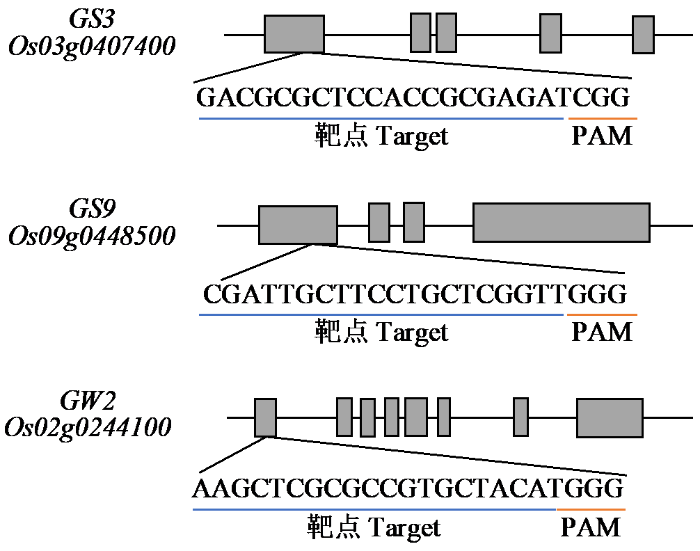
图1
GS3、GS9和GW2基因敲除靶点位置
Fig.1
Knockout target locations of GS3, GS9, and GW2 genes
2.2 CRISPR/Cas9表达载体的构建
图2

图2
载体图谱
插入片段区域包含35S启动子激活的潮霉素磷酸转移酶基因,泛素启动子激活的Cas9基因,U6a、U6b和U3启动子激活的具有敲除靶点的GS3/GS9/GW2-sgRNA表达盒;LB:T-DNA左边界;RB:T-DNA右边界。
Fig.2
Vector diagram
The insert region contains the hygromycin phosphotransferase gene activated by the 35S promoter, the Cas9 gene activated by the ubiquitin promoter, and the GS3/GS9/GW2-sgRNA expression cassette with knockout targets activated by the U6a, U6b, and U3 promoters; LB: left border of T-DNA; RB: T-DNA right border.
2.3 T0代转基因植株的获得
CRISPR/Cas9编辑载体经测序及酶切验证无误后,转入农杆菌EHA105菌株。侵染大粒香愈伤组织,将愈伤组织转移到潮霉素筛选培养基上进行筛选,选择培养2次,一次2周,将经筛选得到的抗性愈伤转到带抗性的预分化培养基中,再转移到三角瓶里的分化培养基中进行培养,待苗长到3~4 cm,转入生根培养基中培养,最后获得T0代植株。
2.4 T0代植株靶点编辑鉴定
图3
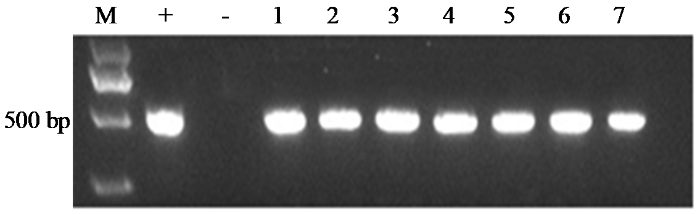
图3
筛选T0代阳性转化植株
M:2000 bp marker;“+”:阳性对照;“-”:阴性对照,下同。1~7依次为1188-2、1188-4、1188-11、1188-18、1188-31、1188-33和1188-42。
Fig.3
Screening of T0 generation positive transformed plants
“+”: positive control;“-”: negative control, the same below. 1-7are respectively 1188-2, 1188-4, 1188-11, 1188-18, 1188-31, 1188-33, and 1188-42.
图4
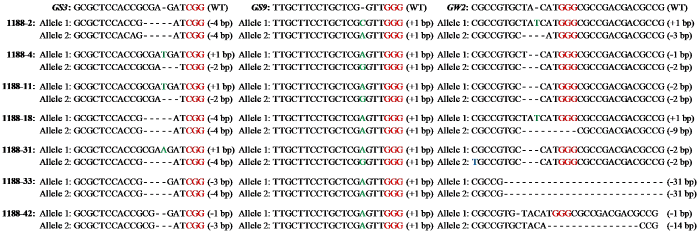
图4
T0代3个靶点的Sanger测序分析
“-”代表缺失;绿色代表插入位点;蓝色代表碱基替换位点;红色代表PAM序列。下同。
Fig.4
Sanger sequencing analysis of three targets in T0 generation
“-” represents missing; Green represents the insertion site; Blue represents base substitution sites; Red represents PAM sequence. The same below.
2.5 无外源转基因成分突变株筛选
将T0代突变株自交繁殖成T1代突变群体,提取所有T1代单株的DNA并经质量检测合格后,利用Cas9外源成分特异PCR引物Cas9-F/Cas9-R筛选无外源成分突变株。通过筛选后,获得20个不含外源成分突变植株(图5)。经过对T1代不含外源成分突变植株的外形观察,选取其中5个与野生型长势一致、株叶型态相似的突变体,利用引物GS3-F/GS3-R、GS9-F/GS9-R和GW2-F/GW2-R分别对GS3、GS9和GW2基因进行测序,经DSD解码法分析后发现,T1代的GS3、GS9和GW2基因的碱基插入和缺失类型与T0代一致(图6)。GS3/ GS9/GW2的三基因突变体中,1188-4-12的3个基因均为双等位基因杂合型;1188-4-13的GS3基因为双等位基因杂合型,GS9和GW2基因为双等位基因纯合型;1188-18-8和1188-42-2的GS3和GW2基因为双等位基因纯合型,GS9为双等位基因杂合型;1188-42-1的GS3和GW2基因为双等位基因杂合型,GS9为双等位基因纯合型(图6)。
图5
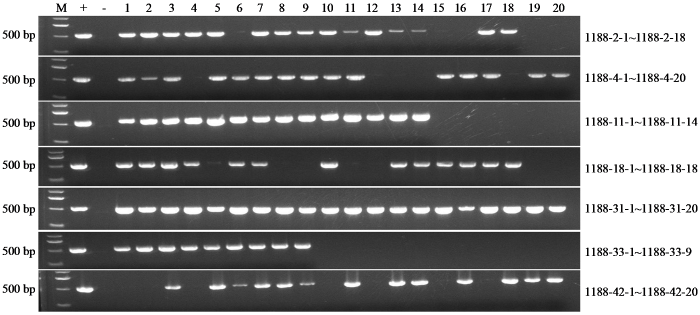
图5
PCR筛选无外源转基因成分的突变植株
Fig.5
PCR screening of mutant plants without exogenous transgenic components
图6

图6
T1代突变类型
1188-4-12、1188-4-13、1188-18-8、1188-42-1和1188-42-2为T1代突变体。下同。
Fig.6
T1 generation mutation types
1188-4-12, 1188-4-13, 1188-18-8, 1188-42-1, and 1188-42-2 being T1 generation mutants. The same below.
2.6 T1代植株农艺性状考察
图7

图7
T1代粒型农艺性状差异
WT为野生型。不同小写字母表示差异显著(P < 0.05),下同。
Fig.7
Differences in agronomic traits of T1 generation grain types
WT represents the wild type. Different lowercase letters indicate significant difference (P < 0.05), the same below.
图8
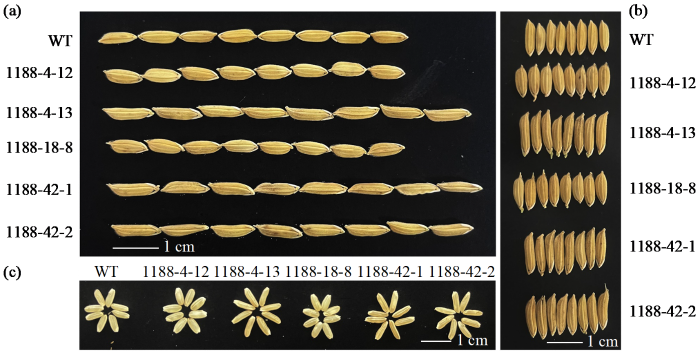
图8
T1代粒长、粒宽和糙米外观形态观察
(a) 粒长;(b) 粒宽;(c) 糙米外观形态。
Fig.8
Observation of grain length, grain width, and appearance and morphology of brown rice in T1 generation
(a) grain length; (b) grain width; (c) appearance and morphology of brown rice.
为检验通过粒型基因编辑对单株产量性状的影响,对突变体单株产量性状考察发现,与WT相比,在千粒重方面,突变体1188-4-12、1188-4-13、1188-18-8、1188-42-1和1188-42-2分别显著增加了27.15%、26.65%、24.01%、33.23%和38.38%(图9a)。在单株粒重上,突变体1188-4-12、1188-4-13、1188-18-8、1188-42-1和1188-42-2分别显著增加了160.72%、246.73%、79.06%、165.40%和290.05%(图9b)。突变体1188-4-12、1188-4-13、1188-18-8、1188-42-1和1188-42-2的单株产量分别显著增加了160.68%、246.78%、79.06%、165.40%和290.05%(图9c)。突变体1188-4-12、1188-4-13、1188-18-8、1188-42-1和1188-42-2的结实率分别显著降低了7.22%、10.31%、13.40%、4.12%和9.28%(图9d)。
图9
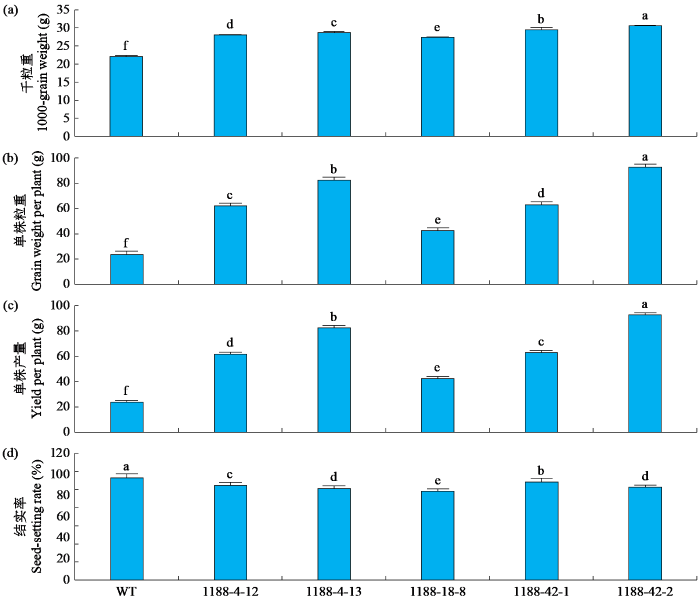
图9
T1代单株产量农艺性状差异
Fig.9
Differences in agronomic traits of yield per plant in T1 generation
为考察粒型基因的编辑对稻米品质的影响,对突变体稻米的外观品质测评发现,与WT相比,突变体1188-4-12、1188-4-13、1188-18-8、1188-42-1和1188-42-2的出糙率分别显著增加了12.50%、6.25%、6.25%、15.63%和9.38%(图10a),精米率分别显著增加了10.00%、5.00%、5.00%、15.00%和8.33%(图10b),整精米率分别显著增加了19.44%、20.83%、11.11%、12.50%和12.28%(图10c)。与WT相比,在垩白粒率方面,突变体1188-18-8和1188-42-1分别显著增加了175.00%和48.51%,突变体1188-4-13和1188-42-2分别显著降低了25.74%和50.50%(图10d);突变体1188-4-12、1188-4-13、1188-18-8、1188-42-1和1188-42-2的垩白度分别显著增加了42.14%、27.84%、99.36%、78.99%和23.71%(图10e)。
图10
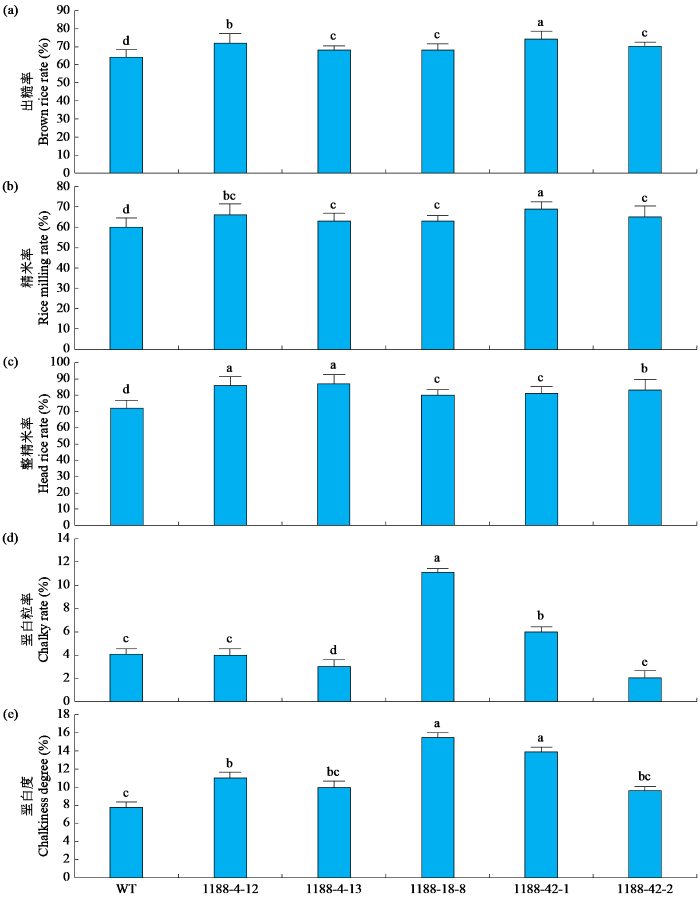
图10
T1代稻米外观品质农艺性状差异
Fig.10
Differences in agronomic traits of the appearance quality of T1 generation rice
3 讨论
早期的研究[18,38-
随着技术的不断发展和研究的持续深入,对多个基因同时进行同步编辑和协同优化以改良水稻粒型已经成为一个新的研究方向。黎华等[18]研究表明,当同时对GS3和GS9进行编辑时,GS9对粒长的增加效应可以与GS3叠加,协同改良粒长。韩政宏等[37]通过基因编辑技术发现,GS3单基因突变体的粒长可以增加8%~17%,而千粒重也可以增加8%~15%;GS9单基因突变体的粒长增加5%~15%;而对于GS3/GS9的双基因突变体,粒长增加15%~ 21%,千粒重增加10%~13%。徐善斌等[41]通过对GS3和GS9基因的编辑获得GS3/GS9双基因突变体,其粒长增加26.43%~27.01%,千粒重增加18.34%~41.36%。以上研究均表明,通过多基因编辑均可获得比单基因编辑更好的粒型改良效果,这主要归因于调控粒型基因的功能缺失具有协同增效的特性。本研究通过基因编辑实现粒型综合改良,获得GS3/GS9/GW2的三基因突变体,均表现出了更加优异的综合表型:千粒重增加24.01%~ 38.38%,粒长增幅19.68%~21.62%,粒宽和长宽比分别提升10.15%~13.16%和19.16%~26.65%;另外,产量性状均得到显著提升,稻米外观品质也显著改善。因此,在后续研究中,将会对T1代植株进行加代种植,筛选3个基因突变位点均为纯合的突变体,以期获得能稳定遗传的纯合突变体。以上结果均表明,相对于野生型,通过同时对3个基因进行基因编辑,能够获取相较于单基因编辑更为优良的改良效果,使水稻粒型得到更显著的优化。
4 结论
本研究运用CRISPR/Cas9技术对水稻GS3、GS9、GW2基因进行编辑。在T0代获得多个阳性转化且发生突变的植株,通过自交繁殖至T1代并筛选出无外源成分突变株。对T1代的代表性突变体农艺性状考察发现,粒长、粒宽、长宽比、千粒重、单株产量和稻米外观品质等关键农艺性状较野生型均有显著提升。与单基因编辑相比,多基因编辑(GS3/GS9/GW2 3个基因突变体)表现出更为优良的改良效果,能更大程度对水稻粒型进行改良。
参考文献
Rome: Food and Agriculture Organization of the United Nations
(
GS3, a major QTL for grain length and weight and minor QTL for grain width and thickness in rice,encodes a putative transmembrane protein
DOI:10.1007/s00122-006-0218-1 URL [本文引用: 2]
The novel quantitative trait locus GL3.1 controls rice grain size and yield by regulating Cyclin-T1; 3
A single-nucleotide polymorphism causes smaller grain size and loss of seed shattering during African rice domestication
DOI:10.1038/nplants.2017.64 URL [本文引用: 1]
Loss of function of the IAA-glucose hydrolase gene TGW6 enhances rice grain weight and increases yield
DOI:10.1038/ng.2612
PMID:23583977
[本文引用: 1]

Increases in the yield of rice, a staple crop for more than half of the global population, are imperative to support rapid population growth. Grain weight is a major determining factor of yield. Here, we report the cloning and functional analysis of THOUSAND-GRAIN WEIGHT 6 (TGW6), a gene from the Indian landrace rice Kasalath. TGW6 encodes a novel protein with indole-3-acetic acid (IAA)-glucose hydrolase activity. In sink organs, the Nipponbare tgw6 allele affects the timing of the transition from the syncytial to the cellular phase by controlling IAA supply and limiting cell number and grain length. Most notably, loss of function of the Kasalath allele enhances grain weight through pleiotropic effects on source organs and leads to significant yield increases. Our findings suggest that TGW6 may be useful for further improvements in yield characteristics in most cultivars.
A QTL for rice grain width and weight encodes a previously unknown RING-type E3 ubiquitin ligase
Natural variation in the promoter of TGW2 determines grain width and weight in rice
Targeted mutagenesis of the rice FW 2.2-like gene family using the CRISPR/Cas 9 system reveals OsFWL4 as a regulator of tiller number and plant yield in rice
DOI:10.3390/ijms21030809
URL
[本文引用: 1]
The FW2.2-like (FWL) genes encode cysteine-rich proteins with a placenta-specific 8 domain. They play roles in cell division and organ size control, response to rhizobium infection, and metal ion homeostasis in plants. Here, we target eight rice FWL genes using the CRISPR/Cas9 system delivered by Agrobacterium-mediated transformation. We successfully generate transgenic T0 lines for 15 of the 16 targets. The targeted mutations are detected in the T0 lines of all 15 targets and the average mutation rate is found to be 81.6%. Transfer DNA (T-DNA) truncation is a major reason for the failure of mutagenesis in T0 plants. T-DNA segregation analysis reveals that the T-DNA inserts in transgenic plants can be easily eliminated in the T1 generation. Of the 30 putative off-target sites examined, unintended mutations are detected in 13 sites. Phenotypic analysis reveals that tiller number and plant yield of OsFWL4 gene mutants are significantly greater than those of the wild type. Flag leaves of OsFWL4 gene mutants are wider than those of the wild type. The increase in leaf width of the mutants is caused by an increase in cell number. Additionally, grain length of OsFWL1 gene mutants is higher than that of the wild type. Our results suggest that transgene-free rice plants with targeted mutations can be produced in the T1 generation using the Agrobacterium-mediated CRISPR/Cas9 system and that the OsFWL4 gene is a negative regulator of tiller number and plant yield.
GW5 acts in the brassinosteroid signalling pathway to regulate grain width and weight in rice
DOI:10.1038/nplants.2017.43 URL [本文引用: 1]
The OsSPL16-GW7 regulatory module determines grain shape and simultaneously improves rice yield and grain quality
GS9 acts as a transcriptional activator to regulate rice grain shape and appearance quality
DOI:10.1038/s41467-018-03616-y
[本文引用: 2]
Identification of grain shape determining genes can facilitate breeding of rice cultivars with optimal grain shape and appearance quality. Here, we identify GS9 (Grain Shape Gene on Chromosome 9) gene by map-based cloning. The gs9 null mutant has slender grains, while overexpression GS9 results in round grains. GS9 encodes a protein without known conserved functional domain. It regulates grain shape by altering cell division. The interaction of GS9 and ovate family proteins OsOFP14 and OsOFP8 is modulated by OsGSK2 kinase, a key regulator of the brassinosteroids signaling pathway. Genetic interaction analysis reveals that GS9 functions independently from other previously identified grain size genes. Introducing the gs9 allele into elite rice cultivars significantly improves grain shape and appearance quality. It suggests potential application of gs9, alone or in combination with other grain size determining genes, in breeding of rice varieties with optimized grain shape.
A programmable dual-RNA-guided DNA endonuclease in adaptive bacterial immunity
Cas9-crRNA ribonucleoprotein complex mediates specific DNA cleavage for adaptive immunity in bacteria
CRISPR provides acquired resistance against viruses in prokaryotes
DOI:10.1126/science.1138140
PMID:17379808
Clustered regularly interspaced short palindromic repeats (CRISPR) are a distinctive feature of the genomes of most Bacteria and Archaea and are thought to be involved in resistance to bacteriophages. We found that, after viral challenge, bacteria integrated new spacers derived from phage genomic sequences. Removal or addition of particular spacers modified the phage-resistance phenotype of the cell. Thus, CRISPR, together with associated cas genes, provided resistance against phages, and resistance specificity is determined by spacer-phage sequence similarity.
基因编辑及全基因组选择技术在水稻育种中的应用展望
在籼稻中突变GS9同时影响粒型和株型
Perspectives on the application of genome-editing technologies in crop breeding
DOI:S1674-2052(19)30230-8
PMID:31260812
[本文引用: 1]
Most conventional and modern crop-improvement methods exploit natural or artificially induced genetic variations and require laborious characterization of the progenies of multiple generations derived from time-consuming genetic crosses. Genome-editing systems, in contrast, provide the means to rapidly modify genomes in a precise and predictable way, making it possible to introduce improvements directly into elite varieties. Here, we describe the range of applications available to agricultural researchers using existing genome-editing tools. In addition to providing examples of genome-editing applications in crop breeding, we discuss the technical and social challenges faced by breeders using genome-editing tools for crop improvement.Copyright © 2019 The Author. Published by Elsevier Inc. All rights reserved.
Wide Grain 7 increases grain width by enhancing H3K4me3 enrichment in the OsMADS1 promoter in rice (Oryza sativa L.)
Rapid production of novel beneficial alleles for improving rice appearance quality by targeting a regulatory element of SLG7
DOI:10.1111/pbi.v21.7 URL [本文引用: 3]
Targeted manipulation of grain shape genes effectively improves outcrossing rate and hybrid seed production in rice
DOI:10.1111/pbi.v21.2 URL [本文引用: 1]
Loss of Gn1a/OsCKX2 confers heavy-panicle rice with excellent lodging resistance
DOI:10.1111/jipb.v64.1 URL [本文引用: 1]
Cytokinin oxidase/ dehydrogenase family genes exhibit functional divergence and overlap in rice growth and development, especially in control of tillering
A cytokinin-activation enzyme-like gene improves grain yield under various field conditions in rice
DOI:10.1007/s11103-019-00952-5 [本文引用: 1]
The genetic editing of GS3 via CRISPR/Cas 9 accelerates the breeding of three-line hybrid rice with superior yield and grain quality
DOI:10.1007/s11032-022-01290-z
[本文引用: 2]
Grain size is one of the major traits that determine rice grain yield and quality. The GS3 gene is the first major quantitative trait locus (QTL) that was identified in regulating rice grain length and weight. It was reported that the gs3 allele with a mutation in the organ size regulation (OSR) domain of the GS3 protein produced longer grains. In this study, we used the CRISPR/Cas9 gene editing technology to introduce an edited gs3 allele into our indica maintainer line, Mei1B, to enhance its grain yield and quality. Through molecular analysis and sequencing, a homologous edited-gs3 mutant line without any transgene was obtained in the T1 generation and was named Mei2B. A superior male sterile line Mei2A was generated by backcrossing the cytoplasmic male sterile (CMS) line Mei1A with Mei2B. Mei2B had a higher grain quality and yield compared to its wild-type Mei1B. Its grain length increased by 7.9%, its length/width ratio increased from 3.89 to 4.19, TGW increased by 6.7%, and grain yield per plant increased by 14.9%. In addition, genetic improvement of other quality traits including brown rice length (6.83 mm), brown rice grain length/width ratio (3.61), matched the appearance standards set for traditional Simiao (silk seedling) type cultivars. Two restorer lines were outcrossed to both Mei1A and Mei2A to produce hybrid rice. Compared to two hybrids of Mei1A, the hybrids of Mei2A had longer grains, higher length/width ratio, TGW, and yield per plant. In addition, the hybrids of Mei2A showed a better grain appearance including better translucency, a lower chalky rice rate, and degree of chalkiness than the hybrids of Mei1A. These results demonstrated that the introduction of an elite gs3 allele into Mei1A via CRISPR/Cas9 gene editing technology led to significant genetic improvement of the rice grain. The resultant CMS line Mei2A(gs3) displayed much higher grain quality and yield than the original Mei1A. Therefore, our study demonstrated that the targeted genetic improvement via gene editing technology can enhance rice breeding, especially the breeding of three-line hybrid rice.
利用CRISPR/Cas9系统定向改良水稻粒长和穗粒数性状
DOI:10.16819/j.1001-7216.2017.7029 223
[本文引用: 1]
【目的】基因组定点编辑技术已成为分子育种的重要手段。本研究拟对GS3和Gn1a功能缺失突变对目标性状的改良效应进行分析,以期为培育高产水稻提供理论基础。【方法】利用CRISPR/Cas9系统,以控制粒型基因GS3和控制每穗粒数基因Gn1a为编辑对象,构建了共敲除载体pC1300-2×35S::Cas9-g<sup>GS3</sup>-g<sup>Gn1a</sup>,用农杆菌介导法转化4个优质水稻品种,分析了基因突变的特征和相应农艺性状。【结果】构建的敲除载体成功地实现了对GS3和Gn1a基因的定点编辑。在4个转化受体的T<sub>0</sub>代均分别获得了gs3和gs3gn1a的移码突变体。对T<sub>1</sub>代中无选择标记突变体的农艺性状分析表明,突变体 gs3和gs3gn1a与野生型相比粒长变长,千粒重增加;突变体gs3gn1a与突变体 gs3相比,每穗粒数显著增加。【结论】利用CRISPR/Cas9系统进行水稻基因编辑可以快速改良品种的目标性状,在水稻品种的定向改良方面具有巨大的潜力。
A robust CRISPR/Cas 9 system for convenient, high-efficiency multiplex genome editing in monocot and dicot plants
DOI:10.1016/j.molp.2015.04.007 URL [本文引用: 2]
Dsdecode:A web-based tool for decoding of sequencing chromatograms for genotyping of targeted mutations
DOI:10.1016/j.molp.2015.05.009 URL [本文引用: 1]
Quantitative regulation of waxy expression by CRISPR/Cas9-based promoter and 5’UTR- intron editing improves grain quality in rice
DOI:10.1111/pbi.v18.12 URL [本文引用: 1]
The GW2-WG1-OsbZIP47 pathway controls grain size and weight in rice
DOI:10.1016/j.molp.2021.04.011 URL [本文引用: 1]
Linking differential domain functions of the GS3 protein to natural variation of grain size in rice
利用CRISPR/Cas9技术敲除GS3和GS9基因改良水稻粒型性状
DOI:10.7668/hbnxb.20192762
[本文引用: 2]
为促进长粒型粳稻品种的选育,以粳稻品种东富139、龙粳31和东农427为试验材料,利用CRISPR/Cas9基因编辑技术构建了pYLCRISPR/Cas9-GS3-RNA和pYLCRISPR/Cas9-GS3-GS9-RNA 2个敲除载体,通过农杆菌转化法侵染受体材料的愈伤组织,对GS3和GS9基因进行定点编辑。最终,3个品种在T<sub>2</sub>都获得了GS3单基因突变、GS9单基因突变和GS3、GS9双基因突变,且无T-DNA元件的纯合植株。在成熟期对T<sub>2</sub>突变体及其野生型的农艺性状进行考察分析,结果表明,与野生型相比,3个品种的gs3突变植株的粒长、千粒质量均显著增加,粒宽、结实率和穗粒数无显著变化;gs9突变体粒长显著增加,粒宽显著减少,千粒质量、结实率和穗粒数无显著变化;gs3gs9突变体粒长增加,且增幅大于gs3和gs9,同时粒宽显著减少,千粒质量显著增加,而结实率和穗粒数无显著变化。综上,利用CRISPR/Cas9技术对东富139、龙粳31和东农427等3个粳稻品种的粒型进行改良,加快了长粒型粳稻新品种的选育进程。
利用CRISPR/Cas9技术高效创制长粒香型水稻
DOI:10.16819/j.1001-7216.2020.0104
[本文引用: 1]
【目的】CRISPR/Cas9基因编辑技术已成为水稻分子育种的重要手段。为了促进水稻育种的发展,本研究以非香型粳稻品种龙粳11为试验材料,对GS3、GS9和Badh2基因进行编辑,以期获得能稳定遗传的长粒香水稻材料。【方法】利用CRISPR/Cas9技术,以GS3、GS9和Badh2为靶基因,构建敲除载体pYLCRISPR/Cas9-GS3/ GS9/Badh2-gRNA,通过农杆菌介导法,在龙粳11的GS3、GS9和Badh2基因中引入了特定的突变。【结果】T<sub>2</sub>代无转基因的gs3/gs9/badh2纯合突变体与野生型龙粳11相比,粒长增加26.43%~27.01%,单株产量增加10.82%~12.11%,千粒重增加18.34%~41.36%,稻米变香,高效地将圆粒水稻变成长粒香型水稻。【结论】利用CRISPR/Cas9技术获得能够稳定遗传并具有长粒香品质的纯合突变株系,为组合多个品质性状提供了一种方便有效的方法,从育种角度加快了新品系创制过程。


