

作物杂志,2023, 第4期: 174–181 doi: 10.16035/j.issn.1001-7283.2023.04.025
所属专题: 玉米专题
京津唐夏玉米区生产现状调研分析
李雨新1,2( ), 卢敏1, 赵久然2, 王荣焕2(), 徐田军2, 吕天放2, 蔡万涛2, 张勇2, 薛洪贺2, 刘月娥2()
- 1北京农学院,100096,北京
2北京市农林科学院玉米研究中心/玉米DNA指纹及分子育种北京市重点实验室,100097,北京
The Production Status Investigation and Analysis of Summer Maize in Beijing-Tianjin-Tangshan Region
Li Yuxin1,2(), Lu Min1, Zhao Jiuran2, Wang Ronghuan2(), Xu Tianjun2, Lü Tianfang2, Cai Wantao2, Zhang Yong2, Xue Honghe2, Liu Yueʼe2()
- 1Beijing University of Agriculture, Beijing 100096, China
2Maize Research Center, Beijing Academy of Agriculture & Forestry Sciences/Beijing Key Laboratory of Maize DNA Fingerprinting and Molecular Breeding, Beijing 100097, China
摘要:
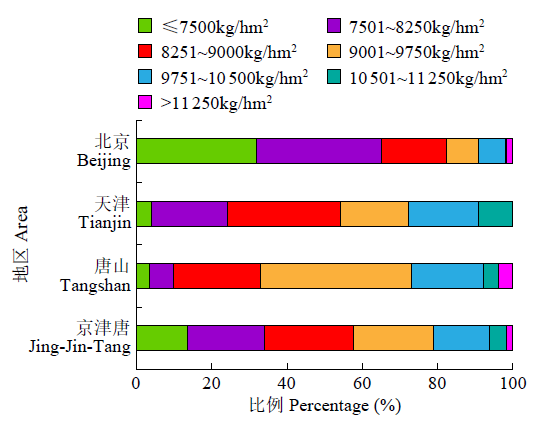
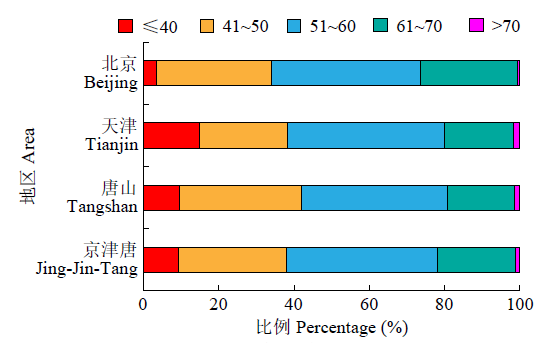
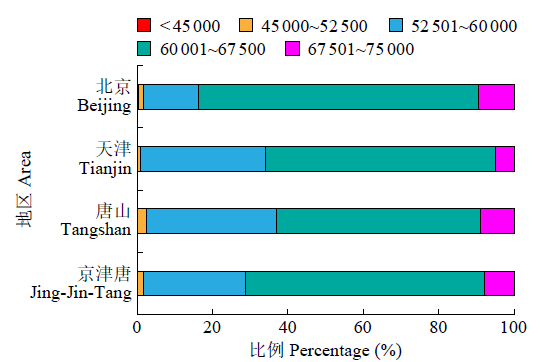
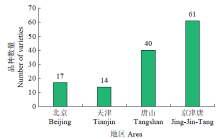
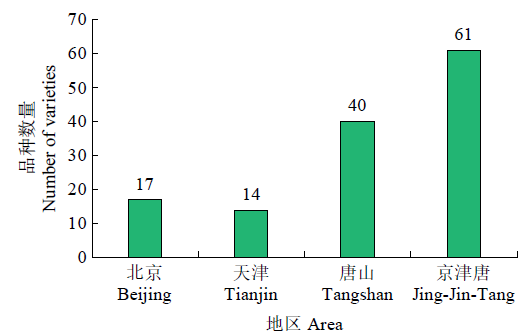
京津唐夏玉米区位于我国冬小麦―夏玉米轮作区的最北部,玉米生长期间光热资源比较紧张,分析该区玉米生产中存在的主要问题及对策,尤其是品种选用的问题,对稳定该区域玉米产量意义重大。本研究通过对北京、天津和唐山具有典型土壤和气候特征的区、镇、村的农户发放调查问卷的形式,对农户生产情况进行调研,2016-2017年共发放720份,收回有效调查问卷445份,分析发现,京津唐夏玉米产量范围为4500~12 750kg/hm2,平均产量9003kg/hm2(变异系数12.82%),产量≤8250kg/hm2的农户占比最大为34.17%。京津唐玉米平均种植密度为63 945株/hm2,28.87%的农户玉米种植密度低于60 000株/hm2。被调研农户选用玉米品种多达61个,但被农户利用较高的品种过于单一,高达55个品种的农户使用率不足3.00%。同时,农户选用的玉米品种生育期较长,环境积温保障率过高,超过82.35%的玉米品种环境积温保障率>90.00%,不利于当地玉米稳产和高产。

| [1] | 陈印军, 王琦琪, 向雁. 我国玉米生产地位、优势与自给率分析. 中国农业资源与区划, 2019, 40(1):7-16. |
| [2] | 赵久然, 王荣焕, 刘新香. 我国玉米产业现状及生物育种发展趋势. 生物产业技术, 2016(3):45-52. |
| [3] | 李少昆, 王崇桃. 玉米高产潜力·途径. 北京: 科学出版社, 2010. |
| [4] |
Ma D L, Xie R Z, Niu X K, et al. Changes in the morphological traits of maize genotypes in China between the 1950s and 2000s. European Journal of Agronomy, 2014, 58:1-10.
doi: 10.1016/j.eja.2014.04.001 |
| [5] |
Ma D L, Li S K, Zhai L C, et al. Response of maize barrenness to density and nitrogen increases in Chinese cultivars released from the 1950s to 2010s. Field Crops Research, 2020, 250:107766.
doi: 10.1016/j.fcr.2020.107766 |
| [6] | Duvick D N. The contribution of breeding to yield advances in maize (Zea mays L.). Advances in Agronomy, 2005, 86:83-145. |
| [7] | 张涛. 对“多、 乱、杂”概念的辩析. 种子科技, 1995(1):17. |
| [8] |
Liu Y E, Li Y X, Lv T F, et al. The priority of management factors for reducing the yield gap of summer maize in the north of Huang- Huai-Hai region, China. Journal of Integrative Agriculture, 2021, 20(2):450-459.
doi: 10.1016/S2095-3119(20)63294-4 |
| [9] | 李少昆, 王克如, 谢瑞芝, 等. 实施密植高产机械化生产实现玉米高产高效协同. 作物杂志, 2016(4):1-6. |
| [10] |
Liu G Z, Hou P, Xie R Z, et al. Canopy characteristics of high-yield maize with yield potential of 22.5 Mg ha-1. Field Crops Research, 2017, 213:221-230.
doi: 10.1016/j.fcr.2017.08.011 |
| [11] |
Lobell D B, Cassman K G, Field C B. Crop yield gaps: Their importance, magnitudes, and causes. Annual Review of Environment and Resources, 2009, 34:179-204.
doi: 10.1146/energy.2009.34.issue-1 |
| [12] | Duvick D N.What is yield? Developing drought- and low N- tolerant maize. Proceedings of a symposium, March 25-29,1996. Mexico:CIMMYT,1997. |
| [13] |
Hammer G L, Dong Z S, Mclean G, et al. Can changes in canopy and/or root system architecture explain historical maize yield trends in the U.S. Corn Belt?. Crop Science, 2009, 49:299-312.
doi: 10.2135/cropsci2008.03.0152 |
| [14] | 赵文媛. 郑单958与先玉335对玉米育种思路的启示. 辽宁农业科学, 2012(5):47-49. |
| [15] |
Olivier F C, Annandale J G. Thermal time requirements for the development of green pea (Pisum sativum L.). Field Crops Research, 1998, 56:301-307.
doi: 10.1016/S0378-4290(97)00097-X |
| [16] |
Dong J W, Liu J Y, Tao F L, et al. Spatio-temporal changes in annual accumulated temperature in China and the effects on cropping systems, 1980s to 2000. Climate Research, 2009, 40:37-48.
doi: 10.3354/cr00823 |
| [17] |
Liu Y E, Hou P, Xie R Z, et al. Spatial variation in the utilization efficiency of accumulated temperature for maize and measures to efficiently use it in China. Crop Science, 2015, 55(4):1806-1817.
doi: 10.2135/cropsci2014.10.0735 |
| [18] |
Dwyer L M, Stewart D W, Carrigan L, et al. Guidelines for comparisons among different maize maturity rating systems. Agronomy Journal, 1999, 91:946-949.
doi: 10.2134/agronj1999.916946x |
| [19] |
Liu Y E, Hou P, Xie R Z, et al. Spatial adaptabilities of spring maize to variation of climatic conditions. Crop Science, 2013, 53:1693-1703.
doi: 10.2135/cropsci2012.12.0688 |
| [1] | 周文丽, 郝淼艺, 张仁和. 高密度种植下氮肥对玉米根系生长及氮代谢的影响[J]. 作物杂志, 2026, (1): 125–132 |
| [2] | 马小明, 齐翔鲲, 谭雪, 史孟豫, 王玉凤, 付健, 杨克军. 免耕秸秆覆盖对半干旱区土壤团聚体稳定性和玉米产量的影响[J]. 作物杂志, 2026, (1): 152–159 |
| [3] | 谢富欣, 江晓林, 李成焕, 张文菁, 王飞雪, 胡卫丽, 梅鸿献, 何革命, 刘焱. 芝麻叶菜采摘时期对主要经济产量性状的影响及综合效益分析[J]. 作物杂志, 2026, (1): 160–166 |
| [4] | 施锘, 朱宏强, 杨梦璇, 周艳宾, 代惠娟, 吕鹏辉, 刘波, 王圣丰, 穆文坡, 杜宇. 不同微生物菌肥对烤烟生长发育、产量及品质的影响[J]. 作物杂志, 2026, (1): 189–196 |
| [5] | 张乐, 韩云飞, 杜二小, 李保成, 伞薪潼, 刘新雨, 王艳莉, 赵沛义, 任永峰. 有机培肥措施对马铃薯光合特性、养分含量及产量的影响[J]. 作物杂志, 2026, (1): 197–207 |
| [6] | 徐浩, 魏全全, 谭洪伟, 芶久兰, 冉雪松, 张萌, 宋南伶, 柳玲玲, 顾小凤, 吕锡斌. 酒糟有机无机复混肥对酒用高粱产量、品质、养分吸收及利用的影响[J]. 作物杂志, 2026, (1): 208–216 |
| [7] | 叶晓娟, 刘强. 不同降水年型下春小麦产量对降水、施氮及秸秆覆盖的响应模拟[J]. 作物杂志, 2026, (1): 217–224 |
| [8] | 桑瑞娟, 董春阳, 张红妹, 何云, 孙浩, 刘伯帅, 朱晓艳, 马森, 李德锋. 不同生育期刈割对豫北小黑麦草产量、品质和青贮发酵质量的影响[J]. 作物杂志, 2026, (1): 225–230 |
| [9] | 杨文高, 袁文珏, 李兆光, 和桂青, 和琼姬, 王蕊, 李燕, 叶磊, 侯志江. 播期对滇西北冬播藜麦农艺性状和产量的影响[J]. 作物杂志, 2026, (1): 257–265 |
| [10] | 李青欣, 金秀良, 宋晓, 张珂珂, 郭腾飞, 黄绍敏, 岳克, 丁世杰, 黄明, 李友军. 有机肥部分替代氮肥对豫东冬小麦生长及土壤特性的影响[J]. 作物杂志, 2025, (6): 121–131 |
| [11] | 高文瑞, 孙艳军, 韩冰, 张晓青, 王显生, 郑子松. 外源有机硒对设施樱桃番茄产量及果实品质的影响[J]. 作物杂志, 2025, (6): 140–147 |
| [12] | 兰秀, 梁振华, 杨海霞, 李恒锐, 阮丽霞, 韦婉羚, 陈会鲜, 何洪良, 黄若兰, 赵春慧, 汤丹峰. 甘蔗―凉粉草间作对土壤理化性质及作物产量的影响[J]. 作物杂志, 2025, (6): 156–163 |
| [13] | 秦娜娜, 黄淋华, 陈莹, 王胜谋, 谢勇, 缪凯, 李万明, 戚兰. 叶面喷施丙酰芸苔素内酯对夏大豆光合作用、农艺性状和产量的影响[J]. 作物杂志, 2025, (6): 164–171 |
| [14] | 王舒琦, 李建波, 刘志萍, 马宇, 渠佳慧, 巴图, 徐寿军. 不同栽培模式下大麦产量与蛋白质形成的生理机制研究[J]. 作物杂志, 2025, (6): 172–180 |
| [15] | 颜小文, 梁俊超, 曾攀, 周红英, 王郅琪, 乐美旺, 孙建. 迟播对秋芝麻主要农艺性状及产量的影响[J]. 作物杂志, 2025, (6): 189–194 |
|
||