作物杂志,2026, 第1期: 208–216 doi: 10.16035/j.issn.1001-7283.2026.01.026

• 生理生化·植物营养·栽培耕作 • 上一篇    下一篇

酒糟有机无机复混肥对酒用高粱产量、品质、养分吸收及利用的影响

徐浩1(), 魏全全2, 谭洪伟1, 芶久兰2, 冉雪松1, 张萌2, 宋南伶1, 柳玲玲2, 顾小凤2, 吕锡斌1()   

  1. 1贵州茅台酒厂(集团)循环经济产业投资开发有限公司,563100,贵州遵义
    2贵州省农业科学院土壤肥料研究所,550006,贵州贵阳
  • 收稿日期:2024-09-14 修回日期:2024-12-05 出版日期:2026-02-15 发布日期:2026-02-10
  • 通讯作者: 吕锡斌,主要从事酿酒废弃物的资源化利用研究,E-mail:gzmtxhct@163.com
  • 作者简介:徐浩,主要从事酿酒废弃物的资源化利用研究,E-mail:2594775535@qq.com
  • 基金资助:
    贵州省土壤肥料研究所成果转化技术服务项目(XHFW2022085);贵州省土壤肥料研究所成果转化技术服务项目(XHFW2022060)

Effect of Organic-Inorganic Compound Fertilizer from Distillerʼs Grains on Yield, Quality, Nutrient Uptake and Utilization of Sorghum

Xu Hao1(), Wei Quanquan2, Tan Hongwei1, Gou Jiulan2, Ran Xuesong1, Zhang Meng2, Song Nanling1, Liu Lingling2, Gu Xiaofeng2, Lü Xibin1()   

  1. 1Kweichow Moutai Distillery (Group) Circular Economy Industrial Investment and Development Co., Ltd., Zunyi 563100, Guizhou, China
    2Institute of Soil and Fertilizer, Guizhou Academy of Agricultural Sciences, Guiyang 550006, Guizhou, China
  • Received:2024-09-14 Revised:2024-12-05 Online:2026-02-15 Published:2026-02-10

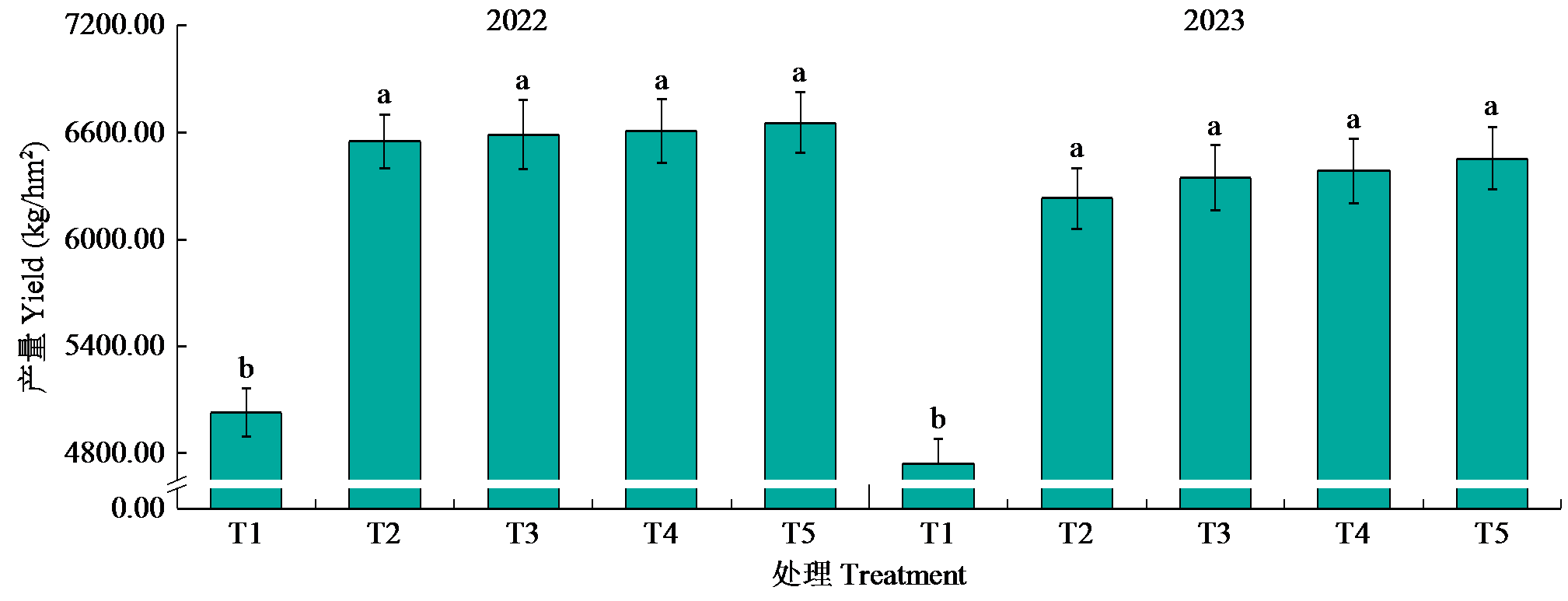
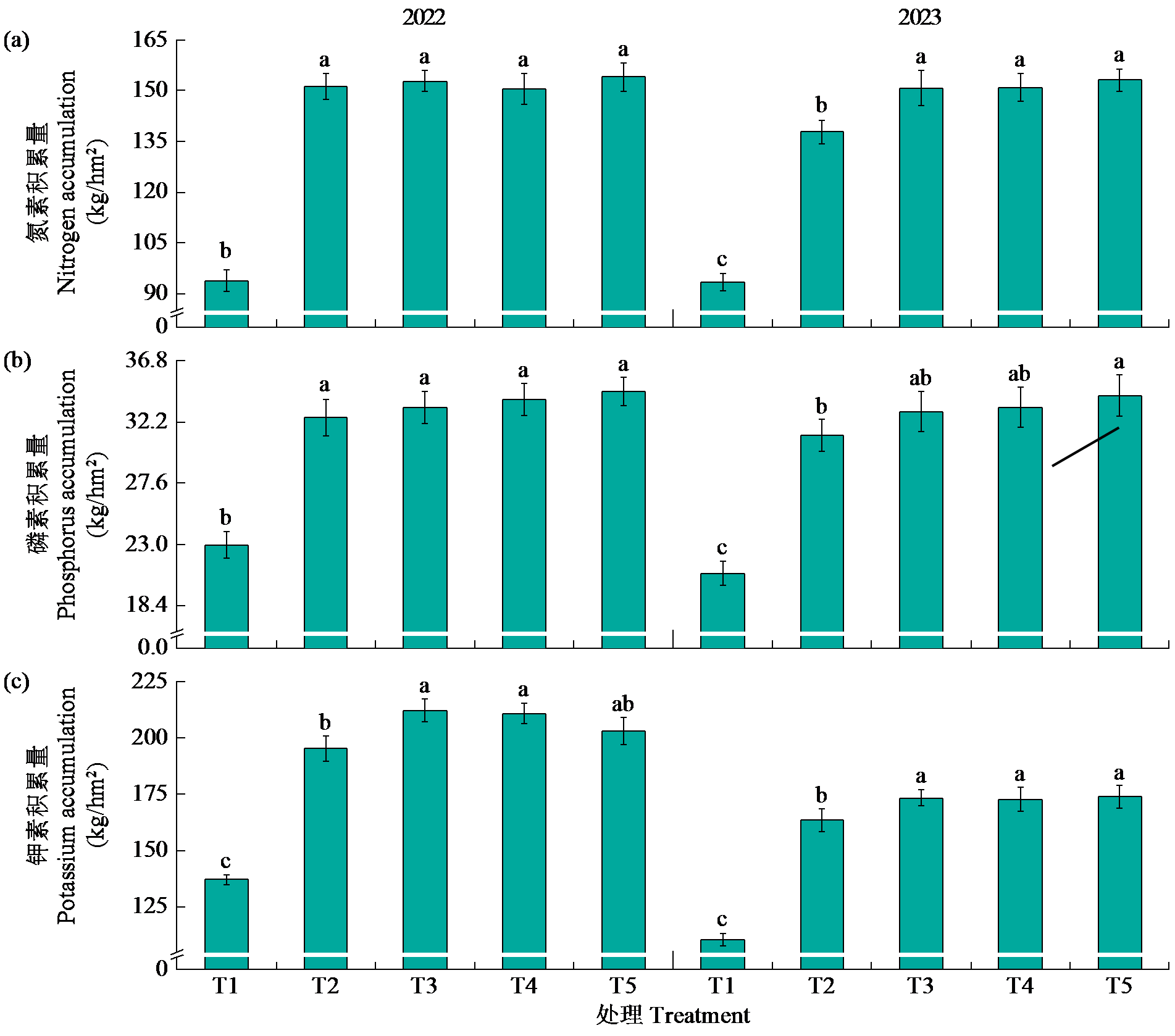
摘要: 于2022-2023年连续2年在贵州省遵义市开展大田定位试验,设不施肥(T1),农民习惯施肥、基施普通复合肥900 kg/hm2、穗期追施纯氮45 kg/hm2(T2),基施Ⅰ型肥料1800 kg/hm2、不追肥(T3),基施Ⅱ型肥料3000 kg/hm2、不追肥(T4)和基施Ⅲ型肥料1500 kg/hm2、穗期追施纯氮90 kg/hm2(T5)5个处理,研究不同酒糟有机无机复混肥对高粱产量、品质、养分吸收及利用的影响。结果表明,与T2处理相比,T3、T4和T5处理高粱产量平均分别提高76.57、107.57和164.66 kg/hm2,总生物量平均分别提高328.40、358.98和463.54 kg/hm2。T3~T5处理高粱支链淀粉含量较T2处理平均增加1.13%~7.02%,单宁含量增加1.63%~4.35%。与T2处理相比,T3、T4和T5处理氮素累积量平均分别提高7.27、6.22和9.07 kg/hm2,磷素累积量平均分别提高1.27、1.72和2.47 kg/hm2,钾素累积量平均分别提高13.35、12.38和9.15 kg/hm2。高粱收获后,T3、T4和T5处理均能维持或提高土壤养分含量。经济效益方面,T5处理的2年平均净收益为45 189.7元/hm2,产投比为2.679,高于T2、T3和T4处理。综上,采用一次性基施Ⅰ型、Ⅱ型和基施Ⅲ型+穗期追氮肥施肥方式的高粱产量、养分吸收利用均优于农民习惯施肥,建议当劳动力不足时,优先选择前者,当劳动力充足时,可选择后者。


关键词: 酒糟有机无机复混肥, 高粱, 产量, 品质, 养分吸收及利用

Abstract:

A two-year field experiment was conducted from 2022 to 2023 in Zunyi, Guizhou Province. Five fertilization treatments, no fertilization (T1), farmer?s habit fertilization, basal application ordinary compound fertilizer 900 kg/ha and topdressing of pure N 45.0 kg/ha during panicle stage (T2), basal application type I fertilizer 1800 kg/ha, no topdressing (T3), basal application type II fertilizer 3000 kg/ha, no topdressing (T4), basal application type III fertilizer 1500 kg/ha and topdressing of pure N 90.0 kg/ha during panicle stage (T5) were set up to study the effects of different organic-inorganic compound fertilizers from distiller?s grains on sorghum yield, quality, nutrient uptake and utilization. The result showed that compared with T2 treatment, the sorghum yield of T3, T4, and T5 treatment increased by 76.57, 107.57, 164.66 kg/ha and total biomass increased 328.40, 358.98, and 463.54 kg/ha. Compared with T2 treatment, the amylopectin content in sorghum from T3 to T5 treatment increased by 1.13%-7.02% and and tannin content increased by 1.63%-4.35%. Compared with T2 treatment, the nitrogen accumulation of T3, T4 and T5 treatments were increased by 7.27, 6.22, 9.07 kg/ha, the phosphorus accumulation were increased by 1.27, 1.72, 2.47 kg/ha, the potassium accumulation were increased by 13.35, 12.38, 9.15 kg/ha. After harvesting of sorghum, T3, T4 and T5 treatments could all maintain or increase soil nutrient content. The two-year average net benefit of T5 treatment were 45 189.7 yuan/ha, and output/input ratio were 2.679, higher than T2, T3, and T4 treatments. In summary, both the one-time basal application of Type I and Type II and basal application of Type III + topdressing of nitrogen at panicle stage methods could improve the yield, nutrient absorption and utilization, and maintain soil fertility levels. We suggested that when labor is in sufficient, the former is preferred; when labor is sufficient, the latter is an alternative.

Key words: Organic-inorganic compound fertilizer from distiller?s grains, Sorghum, Yield, Quality, Nutrient uptake and utilization

表1

不同施肥处理的肥料施用量

处理
Treatment
肥料
Fertilizer
总养分投入量Total nutrient input
N P2O5 K2O
T1 不施肥 0 0 0
T2 农民习惯施肥,基施普通复合肥900 kg/hm2,穗期追纯氮45 kg/hm2 180 135 135
T3 基施Ⅰ型肥料1800 kg/hm2,不追肥 180 144 144
T4 基施Ⅱ型肥料3000 kg/hm2,不追肥 180 150 150
T5 基施Ⅲ型肥料1500 kg/hm2,穗期追纯氮90 kg/hm2 180 150 150

图1

不同处理高粱产量 不同的小写字母表示达到P < 0.05的差异显著水平。下同。

表2

不同施肥处理的高粱生物量

处理
Treatment
籽粒生物量Grain biomass 茎叶生物量Stem and leaf biomass 总生物量Total biomass
2022 2023 均值
Mean
2022 2023 均值
Mean
2022 2023 均值
Mean
T1 5029.50±134.40b 4741.72±139.80b 4885.61 6319.50±281.40b 6081.94±163.95b 6200.72 11 349.00 10 823.67 11 086.33
T2 6549.00±149.70a 6230.75±169.95a 6389.88 8128.50±266.55a 7768.18±298.20a 7948.34 14 677.50 13 998.93 14 338.22
T3 6588.00±191.85a 6344.89±185.10a 6466.45 8269.50±228.30a 8130.85±270.30a 8200.17 14 857.50 14 475.74 14 666.62
T4 6609.00±175.55a 6385.90±179.70a 6497.45 8356.50±292.80a 8043.00±255.00a 8199.75 14 965.50 14 428.90 14 697.20
T5 6654.00±169.95a 6455.08±173.85a 6554.54 8407.50±280.65a 8086.95±299.85a 8247.22 15 061.50 14 542.03 14 801.76

表3

不同施肥处理的高粱农艺性状

处理
Treatment
株高Plant height (m) 茎粗Stem diameter (mm) 穗长Panicle length (cm) 千粒重1000-grain weight (g)
2022 2023 均值
Mean
2022 2023 均值
Mean
2022 2023 均值
Mean
2022 2023 均值
Mean
T1 2.55±0.13b 2.37±0.11b 2.46 14.17±0.53b 12.43±0.23b 13.30 33.00±1.42b 32.02±1.43b 32.51 19.90±0.44b 17.01±0.43b 18.46
T2 2.65±0.15a 2.44±0.13a 2.55 15.60±0.45a 14.53±0.34a 15.07 34.44±1.62a 33.92±1.34a 34.18 23.20±0.54a 18.73±0.34a 20.97
T3 2.67±0.17a 2.51±0.12a 2.59 15.60±0.56a 15.03±0.29a 15.32 34.89±1.43a 34.81±1.28a 34.85 24.50±0.51a 19.05±0.37a 21.77
T4 2.72±0.15a 2.48±0.13a 2.60 16.97±0.62a 15.17±0.27a 16.07 34.78±1.42a 34.67±1.42a 34.72 24.30±0.37a 18.77±0.33a 21.53
T5 2.69±0.19a 2.54±0.12a 2.61 16.88±0.51a 15.39±0.23a 16.13 35.11±1.28a 35.01±1.33a 35.06 24.80±0.67a 19.21±0.26a 22.01

表4

不同施肥处理的高粱品质

处理
Treatment
支链淀粉含量Amylopectin content 单宁含量Tannin content
2022 2023 均值Mean 2022 2023 均值Mean
T1 51.91±1.27b 51.14±1.25b 51.53 1.79±0.05b 1.73±0.06a 1.77
T2 53.52±1.36ab 52.75±1.37ab 53.14 1.86±0.06ab 1.81±0.07a 1.84
T3 54.14±1.54ab 53.33±1.49ab 53.74 1.90±0.08ab 1.83±0.09a 1.87
T4 56.05±1.51a 55.76±1.39a 55.91 1.93±0.06a 1.89±0.10a 1.91
T5 57.07±1.40a 56.67±1.34a 56.87 1.95±0.07a 1.88±0.10a 1.92

图2

不同施肥处理对高粱氮、磷、钾养分积累量的影响

表5

不同施肥处理的高粱肥料利用率

处理
Treatment
表观利用率Appearance utilization rate (%)
氮Nitrogen 磷Phosphorus 钾Potassium
2022 2023 均值Mean 2022 2023 均值Mean 2022 2023 均值Mean
T1
T2 30.76±1.58b 23.89±1.76b 27.33 7.09±0.49b 7.60±0.29c 7.34 43.11±1.56b 39.32±1.90b 41.21
T3 32.83±1.33a 31.90±2.14a 32.37 7.14±0.42ab 8.39±0.44b 7.76 43.81±1.74b 43.81±1.85a 47.95
T4 31.58±1.71ab 32.00±1.88a 31.79 7.26±0.35ab 8.32±0.27b 7.79 49.20±2.11a 41.55±1.95a 45.38
T5 33.50±1.34a 33.26±1.30a 33.38 7.61±0.31a 8.90±0.34a 8.25 44.00±2.03b 42.43±1.95a 43.21
处理
Treatment
农学效率Agricultural efficiency (kg/kg)
氮Nitrogen 磷Phosphorus 钾Potassium
2022 2023 均值Mean 2022 2023 均值Mean 2022 2023 均值Mean
T1
T2 8.14±0.22c 7.97±0.19c 8.05 11.26±0.34a 11.03±0.25a 11.14 11.26±0.34a 11.03±0.25a 11.14
T3 8.66±0.15b 8.91±0.15b 8.78 10.82±0.29a 11.13±0.30a 10.98 10.82±0.29a 11.13±0.30a 10.98
T4 8.78±0.29b 9.13±0.37ab 8.95 10.53±0.40a 10.96±0.33a 10.75 10.53±0.40a 10.96±0.33a 10.75
T5 9.03±0.38a 9.52±0.39a 9.28 10.83±0.36a 11.42±0.32a 11.13 10.83±0.36a 11.42±0.32a 11.13

表6

不同施肥处理的土壤肥力状况

处理
Treatment
pH 有机质Organic matter (g/kg) 全氮Total nitrogen (g/kg)
2022 2023 均值Mean 2022 2023 均值Mean 2022 2023 均值Mean
T1 5.03±0.10a 5.04±0.13a 5.04 45.50±1.33b 43.80±1.11b 44.65 1.95±0.05b 1.90±0.05b 1.93
T2 5.17±0.13a 5.36±0.10a 5.27 46.90±1.08ab 45.17±1.15a 46.04 2.04±0.07ab 1.97±0.08ab 2.01
T3 5.09±0.11a 5.29±0.20a 5.19 47.30±1.19ab 46.61±1.27a 46.96 2.10±0.04a 2.10±0.10a 2.10
T4 5.15±0.12a 5.18±0.18a 5.17 49.00±1.32a 46.66±1.29a 47.83 2.14±0.05a 2.10±0.09a 2.12
T5 5.15±0.20a 5.19±0.13a 5.17 48.30±1.35a 46.54±1.51a 47.42 2.16±0.04a 2.11±0.04a 2.14
处理
Treatment
有效磷Available phosphorus (mg/kg) 速效钾Available potassium (mg/kg)
2022 2023 均值Mean 2022 2023 均值Mean
T1 54.90±2.51d 49.33±2.57c 52.12 181.30±4.55c 141.26±3.43c 161.28
T2 70.00±2.16c 82.23±3.11a 76.12 335.40±5.70b 286.48±5.78b 310.94
T3 94.20±3.24a 82.93±2.89a 88.57 339.70±5.08b 289.78±6.52b 314.74
T4 85.30±3.33b 79.77±3.01b 82.54 374.80±5.99a 304.51±6.47a 339.66
T5 95.80±3.59a 83.18±3.10a 89.49 381.60±6.15a 285.48±6.67b 333.54

表7

不同施肥处理的高粱经济效益

处理
Treatment
产量
Yield
(kg/hm2)
产值
Output
value
成本Cost 净收益
Net
benefit
产投比
Output/
input ratio
种子
Seed
肥料
Fertilizer
农药
Pesticide
其他
Others
合计
Total
T1 4855.6 53 411.6 450.0 0.0 600.0 21 750.0 22 800.0 30 611.6 2.343
T2 6389.9 70 288.9 450.0 4284.8 600.0 23 250.0 285 84.8 41 704.1 2.459
T3 6466.4 71 130.4 450.0 4143.6 600.0 21 750.0 26 943.6 44 186.8 2.640
T4 6497.5 71 472.5 450.0 5370.0 600.0 21 750.0 28 170.0 43 302.5 2.537
T5 6554.5 72 099.5 450.0 2609.8 600.0 23 250.0 26 909.8 45 189.7 2.679
[1] 叶雨, 闫松显. 贵州省高粱种植产业发展现状及展望. 河南农业, 2023(29):10-12.
[2] 郭旭, 刘鹤, 赵晓峰, 等. 产业集群视角下贵州酿酒高粱产业发展对策研究. 贵州商学院学报, 2023, 36(3):68-78.
[3] 曹忠耀, 陶雪, 闫松显, 等. 贵州省酒糟利用方式分析及能源潜力评估. 化工设计通讯, 2023, 49(9):118-120,123.
[4] 蔡凤娇, 蔡林洋, 孔博, 等. 白酒糟的多元化利用研究进展. 酿酒, 2020, 47(2):11-15.
[5] 中华人民共和国农业农村部.农业部关于印发《到2020年化肥使用量零增长行动方案》的通知. (2015-05-25)[2024-12-05].http://www.moa.gov.cn/govpublic/ZZYGLS/201505/t20150525_4614695.htm.
[6] 中国人民共和国农业农村部.农业农村部关于印发《到2025年化肥减量化行动方案》和《到2025年化学农药减量化行动方案》的通知. (2022-11-18)[2024-12-05].http://www.moa.gov.cn/govpublic/ZZYGLS/202212/t20221201_6416398.htm.
[7] 张萌, 刘彦伶, 魏全全, 等. 酒糟生物炭短期施用对贵州黄壤氮素有效性及细菌群落结构多样性的影响. 环境科学, 2020, 41(10):4690-4700.
[8] 许华杰, 陈芹卉, 吴永琴, 等. 酒糟炭基肥对红缨子高粱生长、产量及土壤养分的影响研究. 中国酿造, 2021, 40(12):199-203.
doi: 10.11882/j.issn.0254-5071.2021.12.036
[9] 赵福培, 顾小凤, 张萌, 等. 酿酒废弃物不同配比基质对有机高粱幼苗生长发育的影响. 贵州农业科学, 2023, 51(8):18-27.
[10] 胡伟, 魏全全, 芶久兰, 等. 酒糟发酵有机肥对酒用高粱生长及养分吸收的影响. 贵州农业科学, 2021, 49(12):33-40.
[11] 胡伟, 张萌, 芶久兰, 等. 酒糟有机肥连续施用对湄潭翠芽茶叶生物效应的影响. 华北农学报, 2022, 37(增1):268-274.
[12] 胡京钰. 酒糟生物炭和有机肥施用的土壤及作物效应研究. 重庆:西南大学, 2023.
[13] 鲍士旦. 土壤农化分析. 北京: 中国农业出版社, 2000.
[14] 郜睿, 张崇玉. 高粱单宁测定方法比较分析. 贵州农业科学, 2008, 36(6):38-39.
[15] 霍权恭, 范璐, 周展明. 高粱单宁含量的测定:GB/T 15686— 2008. 北京: 中国标准出版社, 2008.
[16] 孟广琴, 李霞辉, 何照范. 水稻、玉米、谷子籽粒直链淀粉测定法:GB 7648—1987. 北京: 中国标准出版社,1987.
[17] 彭少兵, 黄见良, 钟旭华, 等. 提高中国稻田氮肥利用率的研究策略. 中国农业科学, 2002, 35(9):1095-1103.
[18] Fageria N K, Baligar V C. Methodology for evaluation of lowland rice genotypes for nitrogen use efficiency. Plant Nutrition, 2003,26:1315-1333.
[19] Takahashi S, Anwar M K. Wheat grain yield,phosphorus uptake and soil phosphorus fraction after 23 years of annual fertilizer application to an Andosol. Field Crops Research, 2007,101:160-171.
[20] 樊吴静, 杨鑫, 韦玉恒, 等. 有机无机复混肥对旱藕生长发育及土壤理化性状的影响. 热带作物学报, 2021, 42(7):1981-1987.
doi: 10.3969/j.issn.1000-2561.2021.07.022
[21] 杨旭, 刘海林, 黄艳艳, 等. 有机无机复混肥施用量对热带水稻土微生物群落和酶活性的影响. 植物营养与肥料学报, 2021, 27(4):619-629.
[22] 杨旭, 林清火, 史东梅, 等. 有机无机复混肥在热带地区双季稻上化肥减施的应用效果. 热带作物学报, 2021, 42(1):85-91.
doi: 10.3969/j.issn.1000-2561.2021.01.013
[23] 余小芬, 杨树明, 邹炳礼, 等. 菜籽油枯有机无机复混肥对烤烟产质量及养分利用率的影响. 土壤学报, 2020, 57(6):1564-1574.
[24] 鲁帅, 罗晓刚, 刘全伟, 等. 有机无机复混肥对小麦生长、土壤养分和重金属含量的影响. 浙江农业学报, 2023, 35(4):922-930.
doi: 10.3969/j.issn.1004-1524.2023.04.19
[25] 戴黎, 胡诚, 万建华, 等. 有机-无机复混肥料对水稻产量及养分吸收利用的影响. 中国土壤与肥料, 2024(2):111-119.
[26] 王艳阳, 叶爱萍, 王平平, 等. 蚯蚓粪有机无机复混肥对陕南烟田有机碳及烤烟品质的影响. 江苏农业科学, 2024, 52(2):78-83.
[27] 张福锁, 王激清, 张卫峰, 等. 中国主要粮食作物肥料利用率现状与提高途径. 土壤学报, 2008, 45(5):915-924.
[28] Congreves K A, Otchere O, Ferland D, et al. Nitrogen use efficiency definitions of today and tomorrow. Frontiers in Plant Science, 2021,12:637108.
[1] 周文丽, 郝淼艺, 张仁和. 高密度种植下氮肥对玉米根系生长及氮代谢的影响[J]. 作物杂志, 2026, (1): 125–132
[2] 马小明, 齐翔鲲, 谭雪, 史孟豫, 王玉凤, 付健, 杨克军. 免耕秸秆覆盖对半干旱区土壤团聚体稳定性和玉米产量的影响[J]. 作物杂志, 2026, (1): 152–159
[3] 谢富欣, 江晓林, 李成焕, 张文菁, 王飞雪, 胡卫丽, 梅鸿献, 何革命, 刘焱. 芝麻叶菜采摘时期对主要经济产量性状的影响及综合效益分析[J]. 作物杂志, 2026, (1): 160–166
[4] 施锘, 朱宏强, 杨梦璇, 周艳宾, 代惠娟, 吕鹏辉, 刘波, 王圣丰, 穆文坡, 杜宇. 不同微生物菌肥对烤烟生长发育、产量及品质的影响[J]. 作物杂志, 2026, (1): 189–196
[5] 张乐, 韩云飞, 杜二小, 李保成, 伞薪潼, 刘新雨, 王艳莉, 赵沛义, 任永峰. 有机培肥措施对马铃薯光合特性、养分含量及产量的影响[J]. 作物杂志, 2026, (1): 197–207
[6] 叶晓娟, 刘强. 不同降水年型下春小麦产量对降水、施氮及秸秆覆盖的响应模拟[J]. 作物杂志, 2026, (1): 217–224
[7] 桑瑞娟, 董春阳, 张红妹, 何云, 孙浩, 刘伯帅, 朱晓艳, 马森, 李德锋. 不同生育期刈割对豫北小黑麦草产量、品质和青贮发酵质量的影响[J]. 作物杂志, 2026, (1): 225–230
[8] 杨文高, 袁文珏, 李兆光, 和桂青, 和琼姬, 王蕊, 李燕, 叶磊, 侯志江. 播期对滇西北冬播藜麦农艺性状和产量的影响[J]. 作物杂志, 2026, (1): 257–265
[9] 刘晓涵, 唐玉劼, 刘新宇, 乔钲岩, 石贵山, 于淼, 李扬, 王鼐, 祁宏英, 陈冰嬬. 春播早熟区高粱骨干亲本主要性状配合力及杂种优势分析[J]. 作物杂志, 2026, (1): 47–53
[10] 高凤云, 伊六喜, 周宇, 斯钦巴特尔, 何瑞超, 贾霄云. 亚麻种质资源遗传多样性分析[J]. 作物杂志, 2026, (1): 60–71
[11] 李青欣, 金秀良, 宋晓, 张珂珂, 郭腾飞, 黄绍敏, 岳克, 丁世杰, 黄明, 李友军. 有机肥部分替代氮肥对豫东冬小麦生长及土壤特性的影响[J]. 作物杂志, 2025, (6): 121–131
[12] 陈雷, 唐茂艳, 张战营, 钟晓媛, 高国庆, 张晓丽, 梁天锋, 潘英华. 花期高温胁迫下水稻种质资源的外观品质分析与评价[J]. 作物杂志, 2025, (6): 132–139
[13] 高文瑞, 孙艳军, 韩冰, 张晓青, 王显生, 郑子松. 外源有机硒对设施樱桃番茄产量及果实品质的影响[J]. 作物杂志, 2025, (6): 140–147
[14] 陈志豪, 王婷, 常旭虹, 王艳杰, 刘希伟, 杨玉双, 王玉娇, 王德梅, 赵广才. 黄淮冬麦区北片冬小麦产量和品质性状的综合分析[J]. 作物杂志, 2025, (6): 148–155
[15] 兰秀, 梁振华, 杨海霞, 李恒锐, 阮丽霞, 韦婉羚, 陈会鲜, 何洪良, 黄若兰, 赵春慧, 汤丹峰. 甘蔗―凉粉草间作对土壤理化性质及作物产量的影响[J]. 作物杂志, 2025, (6): 156–163
Viewed
Full text


Abstract

Cited

  Shared   
  Discussed   
No Suggested Reading articles found!