

作物杂志,2026, 第3期: 30–37 doi: 10.16035/j.issn.1001-7283.2026.03.005
• 第二十八届中国科协年会学术论文专栏(主要粮食作物产能品质提升与高质量发展路径) • 上一篇 下一篇
不同施磷方式下磷肥减施对伊犁黑土区春小麦产量及磷肥利用率的影响
方一涵1( ), 陈楠楠1, 王畅2, 王博媛1, 张立存1,3,4(), 梁飞1,3,4()
- 1
伊犁师范大学资源与环境学院, 835000, 新疆伊宁
2新疆百诺农业科技有限公司, 833200, 新疆奎屯
3伊犁师范大学资源与生态研究所, 835000, 新疆伊宁
4伊犁师范大学伊犁河谷农业资源与环境实验室, 835000, 新疆伊宁
Effects of Phosphorus Fertilizer Reduction under Different Phosphorus Application Methods on Spring Wheat Yield and Phosphorus Use Efficiency in the Ili Black Soil Region
Fang Yihan1(), Chen Nannan1, Wang Chang2, Wang Boyuan1, Zhang Licun1,3,4(), Liang Fei1,3,4()
- 1
College of Resources and Environment ,Ili Normal University Yining 835000, Xinjiang, China
2Xinjiang Bainuo Agricultural Technology Co. ,Ltd Kuitun 833200, Xinjiang, China
3Institute of Resources and Ecology ,Ili Normal University Yining 835000, Xinjiang, China
4Ili Valley Agricultural Resources and Environment Laboratory ,Ili Normal University Yining 835000, Xinjiang, China
摘要:
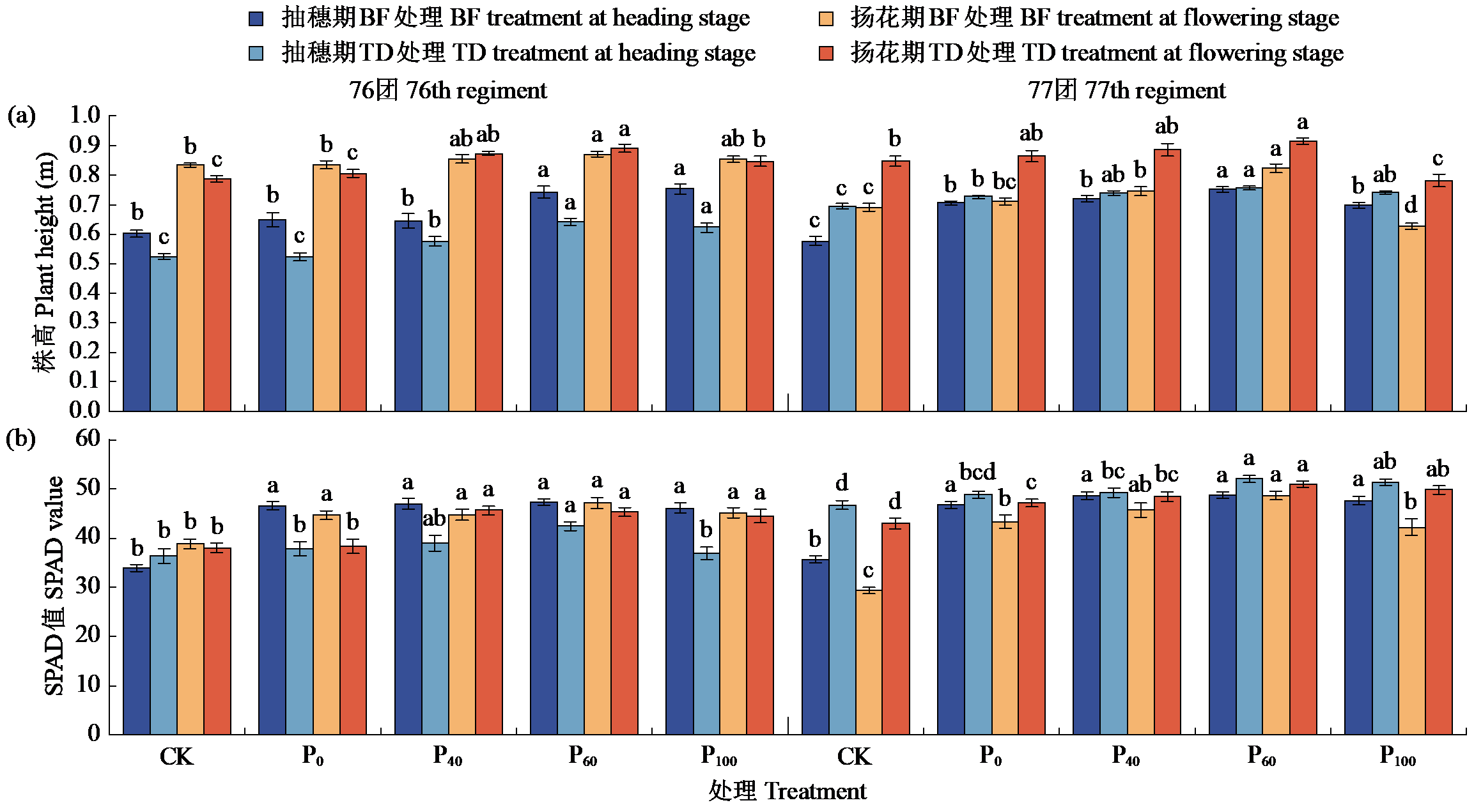
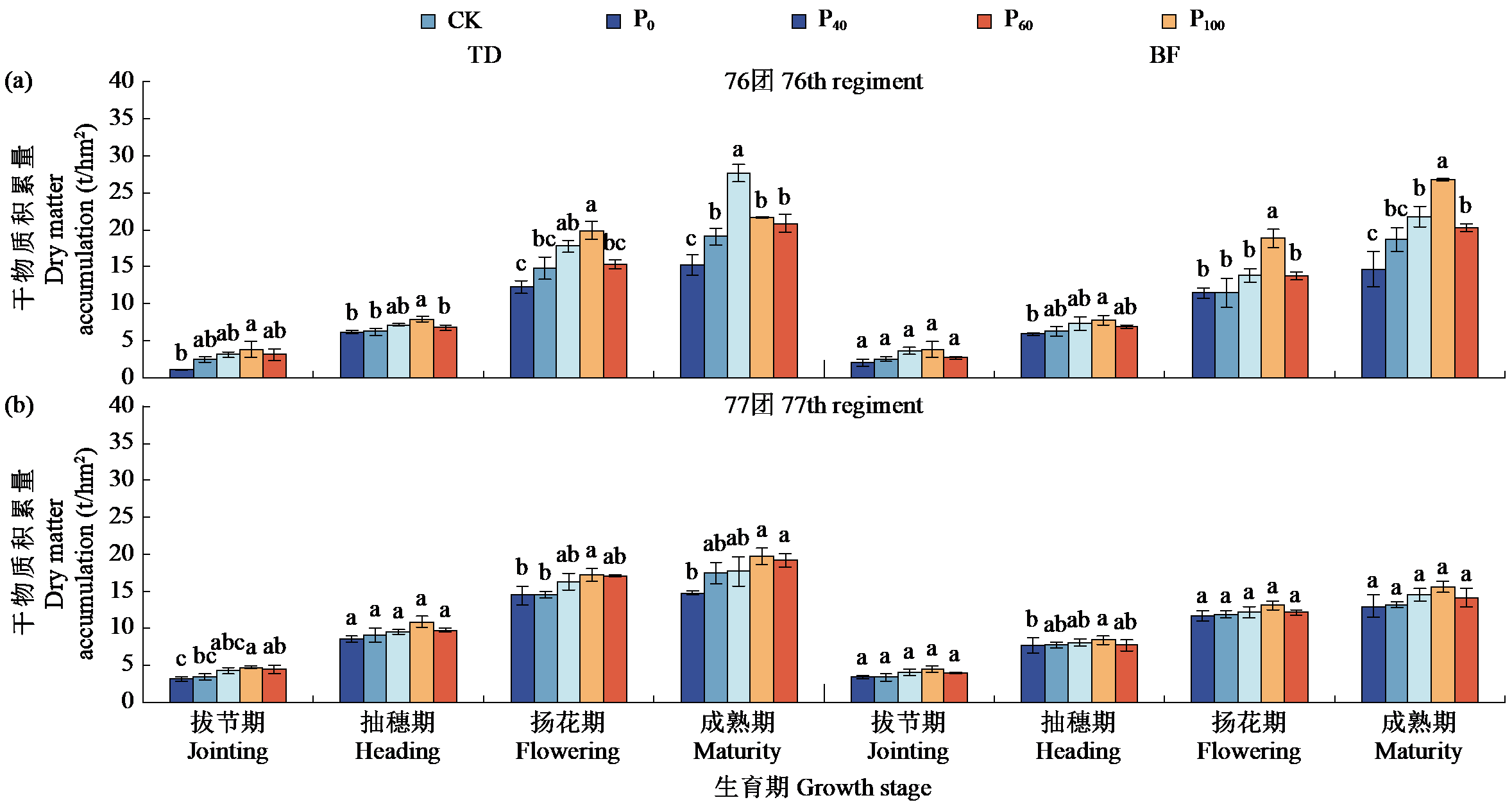
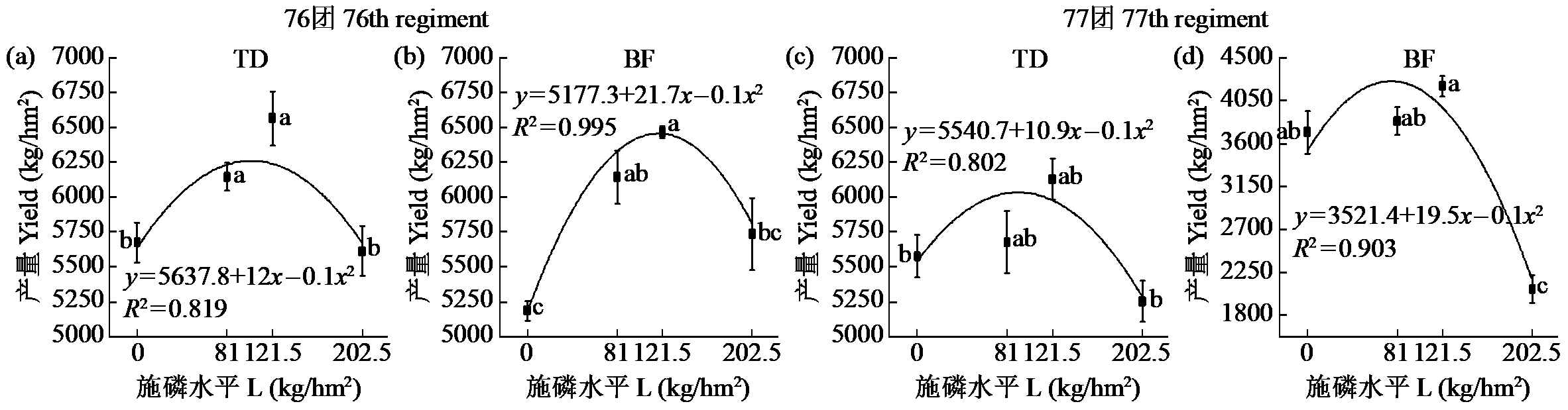
为探究不同施磷方式下磷肥减施对新疆伊犁黑土区春小麦产量形成及磷肥利用率的影响,以新疆生产建设兵团第四师的76团与77团为双试验区,采用双因素裂区设计,设置一次性施基肥(BF)和滴灌分次施肥(基肥70%、抽穗期后15%和扬花期后15%,TD)2种施磷方式,常规用量(202.5 kg/hm2,P100)、常规用量60%(121.5 kg/hm2,P60)、常规用量40%(81.0 kg/hm2,P40)、不施磷肥(P0)和不施肥(CK)5个磷肥水平。结果表明,P60处理可显著提高磷肥利用率及春小麦的株高、SPAD值、干物质积累量和产量;P60较P100处理的株高提高8.9%~30.4%,SPAD值提高0.7%~19.1%。TD处理显著提升黑土区磷素有效性,2个试验区TD-P60较传统基肥处理(BF-P60)分别增产4.9%(76团)和31.2%(77团),磷肥偏生产力(PFP)和农学效率(AE)最高分别达75.9 kg/kg和11.8 kg/kg。TD处理在底砾黑土区(77团)的增产增效响应更明显。综上,本研究条件下全程BF处理磷肥推荐用量为97.5~108.5 kg/hm2,TD处理推荐用量为54.5~60.0 kg/hm2;优先采用TD-P60处理以协同提升春小麦产量与磷肥利用率,实现伊犁黑土区农业可持续发展。


| [1] |
Li H J, Zhou Y, Xin W L, et al. Wheat breeding in Northern China: achievements and technical advances. The Crop Journal, 2019, 7(6):718-729.
doi: 10.1016/j.cj.2019.09.003 |
| [2] |
Khan F, Siddique A B, Shabala S, et al. Phosphorus plays key roles in regulating plants’ physiological responses to abiotic stresses. Plants, 2023, 12(15):28-61.
doi: 10.3390/plants12010028 |
| [3] |
王西娜, 于金铭, 谭军利, 等. 宁夏引黄灌区春小麦氮磷钾需求及化肥减施潜力. 中国农业科学, 2020, 53(23):4891-4903.
doi: 10.3864/j.issn.0578-1752.2020.23.014 |
| [4] | 刘冲, 贾永红, 张金汕, 等. 施磷量对不同播种方式下冬小麦干物质转运及养分吸收利用的影响. 植物营养与肥料学报, 2020, 26(5):975-986. |
| [5] |
贾兵丽, 李艳行, 杨文杰, 等. 不同降水年型磷肥对旱地冬小麦产量及磷素吸收利用的影响. 中国农业科学, 2024, 57(16):3192-3206.
doi: 10.3864/j.issn.0578-1752.2024.16.008 |
| [6] | 娄梦玉, 薛华龙, 郭彬彬, 等. 施磷水平与冬小麦产量和土壤有效磷含量的关系. 植物营养与肥料学报, 2022, 28(9):1582-1593. |
| [7] | 万晓菊, 张国强, 王克如, 等. 北疆春玉米覆膜、滴灌技术效应研究. 作物杂志, 2019(4):107-112. |
| [8] | 梁辉, 章建新, 薛丽华, 等. 水氮后移条件下滴灌量对新农豆2号根系生长及产量的影响. 作物杂志, 2025(3):233-240. |
| [9] | 石雄高, 裴雪霞, 党建友, 等. 小麦微喷(滴)灌水肥一体化高产优质高效生态栽培研究进展. 作物杂志, 2022(1):1-10. |
| [10] |
汤明尧, 沈重阳, 陈署晃, 等. 新疆小麦、玉米的产量和氮磷钾肥利用效率. 中国农业科学, 2022, 55(14):2762-2774.
doi: 10.3864/j.issn.0578-1752.2022.14.007 |
| [11] | 温蕊, 陈茜午, 赵雅杰, 等. 西北黄土高原旱作区不同地膜覆盖种植模式谷田水温效应及水分利用效率研究. 作物杂志, 2022(6):111-117. |
| [12] |
马清霞, 王朝辉, 惠晓丽, 等. 基于产量和养分含量的旱地小麦施磷量和土壤有效磷优化. 中国农业科学, 2019, 52(1):73-85.
doi: 10.3864/j.issn.0578-1752.2019.01.008 |
| [13] | 李刚, 张祥池, 李诚, 等. 不同供磷水平对小麦苗期干旱胁迫适应性的影响. 麦类作物学报, 2023, 43(1):91-101. |
| [14] | 杨玉海, 陈亚宁, 陈亚鹏, 等. 伊犁河流域土壤分布规律及其对土地开发的意义. 新疆农业科学, 2008, 45(3):25-28. |
| [15] | 牛帅帅, 郭大勇, 杜鹃, 等. 磷肥种类及施磷水平对冬小麦生长发育和土壤磷库的影响. 麦类作物学报, 2024, 44(8):1048-1055. |
| [16] | 闫蓉, 朱利, 冉瑾怡, 等. 渭北旱地磷肥减施措施对冬小麦产量及磷吸收利用的影响. 植物营养与肥料学报, 2023, 29(7):1265-1279. |
| [17] | 李海强, 祁帅, 李改民, 等. 关中土区冬小麦-夏玉米体系磷肥减施增效技术研究. 植物营养与肥料学报, 2023, 29(2):300-307. |
| [18] | 徐孟泽, 王磊, 卢艳丽, 等. 砂质潮土长期施磷的农学效应及有效性演变. 植物营养与肥料学报, 2022, 28(2):205-215. |
| [19] | Arai Y, Sparks D L. Phosphate reaction dynamics in soils and soil components: a multiscale approach. Advances in Agronomy, 2007, 94:135-179. |
| [20] | 李巧丽, 刘朋召, 师祖姣, 等. 关中平原冬小麦临界磷浓度稀释曲线的构建与磷营养诊断. 植物营养与肥料学报, 2022, 28(11):2011-2019. |
| [21] |
Nadeemf F, Abbas S, Waseem F, et al. Phosphorus (P) and zinc (Zn) nutrition constraints: a perspective of linking soil application with plant regulations. Environmental and Experimental Botany, 2024, 226:105875.
doi: 10.1016/j.envexpbot.2024.105875 |
| [22] |
Li Y L, Xu Z, Zhang L, et al. Dynamics between soil fixation of fertilizer phosphorus and biological phosphorus mobilization determine the phosphorus budgets in agroecosystems. Agriculture,Ecosystems & Environment, 2024, 375:109174.
doi: 10.1016/j.agee.2024.109174 |
| [23] | 尹飞虎, 曾胜和, 刘瑜, 等. 滴灌春麦水肥一体化肥效试验研究. 新疆农业科学, 2011, 48(12):2299-2303. |
| [24] | 梁飞, 曾胜和, 张磊, 等. 北疆滴灌小麦平衡施用氮磷效应研究. 作物杂志, 2012(2):109-111. |
| [25] |
Meier S, Campos P, Morales A, et al. Genotypic responses to phosphorus and water management in winter wheat: strategies to increase resource use efficiency and productivity. Agricultural Water Management, 2024, 295:108762.
doi: 10.1016/j.agwat.2024.108762 |
| [26] |
Vance C P, Uhde-Stone C, Allan D L, et al. Phosphorus acquisition and use: critical adaptations by plants for securing a nonrenewable resource. New Phytologist, 2003, 157(3):423-447.
doi: 10.1046/j.1469-8137.2003.00695.x pmid: 33873400 |
| [27] |
Lv X K, Han J, Liao Y C, et al. Effect of phosphorus and potassium foliage application post-anthesis on grain filling and hormonal changes of wheat. Field Crops Research, 2017, 214:83-93.
doi: 10.1016/j.fcr.2017.09.001 |
| [28] |
王月梅, 田海梅, 王西娜, 等. 引黄灌区连续减施化肥对春小麦产量稳定性的影响. 中国农业科学, 2024, 57(3):539-554.
doi: 10.3864/j.issn.0578-1752.2024.03.009 |
| [29] |
Liu Y X, Heuvelink G B M, Bai Z G, et al. Analysis of spatio-temporal variation of crop yield in China using stepwise multiple linear regression. Field Crops Research, 2021, 264:108098.
doi: 10.1016/j.fcr.2021.108098 |
| [30] | 都江雪, 韩天富, 曲潇林, 等. 中国主要粮食作物磷肥偏生产力时空演变特征及驱动因素. 植物营养与肥料学报, 2022, 28(2):191-204. |
| [1] | 李行, 陈广周, 王运韬, 连世昊, 李家豪, 田文强, 张金汕, 石书兵. 宽幅匀播对新疆春小麦光合特性及产量的影响[J]. 作物杂志, 2026, (4): 164–170 |
| [2] | 叶晓娟, 刘强. 不同降水年型下春小麦产量对降水、施氮及秸秆覆盖的响应模拟[J]. 作物杂志, 2026, (1): 217–224 |
| [3] | 吴立国, 李晓慧, 赵清, 陈小龙, 潘静, 刘旺清, 白海波, 李前荣. 宁夏春小麦品种(系)农艺性状遗传多样性分析[J]. 作物杂志, 2025, (5): 147–154 |
| [4] | 雒兴刚, 万海元, 安丽蓉, 李永海, 雒兴玉, 张学凯, 梁维云, 朱建强. 垄作条播下春小麦不同品种与施氮量对边行效应、产量与水分利用效率的影响[J]. 作物杂志, 2025, (4): 251–258 |
| [5] | 王志刚, 刘强, 王谨, 巩敬锦, 姚群英. 未来气象条件下旱地春小麦产量及生物量对施氮量和播期变化的响应模拟[J]. 作物杂志, 2025, (4): 276–282 |
| [6] | 王佳童, 马映辰, 冯燕飞, 路佳慧, 郭振清, 李学利, 李云, 韩玉翠, 林小虎. 减量追氮对冀东地区春小麦磷、钾肥利用及品质的影响[J]. 作物杂志, 2025, (3): 141–148 |
| [7] | 樊明, 李红霞, 王轲, 唐华丽, 杨乐, 李前荣, 叶兴国, 张双喜. 抗白粉病小麦新品种宁春66号选育及栽培技术[J]. 作物杂志, 2025, (3): 249–254 |
| [8] | 樊明, 张双喜, 陈嘉, 张娇, 李红霞. 宁夏春小麦品种抗倒伏相关性状分析及综合评价体系构建[J]. 作物杂志, 2024, (6): 39–46 |
| [9] | 路佳慧, 王爽, 李云, 郭振清, 王健, 韩玉翠, 林小虎. 减量施氮对春小麦不同器官氮肥利用及籽粒品质的影响[J]. 作物杂志, 2024, (5): 220–227 |
| [10] | 惠超, 杨卫君, 邓天池, 陈雨欣, 宋世龙, 张金汕, 石书兵. 生物炭用量对灌区春小麦干物质和氮素积累、转运及产量的影响[J]. 作物杂志, 2022, (6): 201–207 |
| [11] | 常海刚, 李广, 袁建钰, 谢明君, 祁小平. 不同施肥方式对甘肃陇中黄土丘陵区土壤养分及春小麦产量的影响[J]. 作物杂志, 2022, (5): 160–166 |
| [12] | 高甜甜, 王德梅, 王艳杰, 杨玉双, 常旭虹, 赵广才. 不同春小麦品种对氮肥处理的响应[J]. 作物杂志, 2021, (6): 67–71 |
| [13] | 马一峰,梁茜,葛均筑,辛德财. 冬小麦济麦22和春小麦津强8号的产量形成差异分析[J]. 作物杂志, 2019, (5): 192–195 |
| [14] | 杨飞,马文礼,陈永伟,张战胜,王昊. 匀播、滴灌对春小麦幼穗分化进程及产量的影响[J]. 作物杂志, 2018, (4): 84–88 |
| [15] | 朱英杰,常旭虹,王德梅,杨玉双,王雨,吕冰,马瑞琦,刘莹,王玉娇,赵广才,陶志强. 黑土与潮土对不同春小麦营养品质的影响[J]. 作物杂志, 2017, (6): 84–90 |
|
||