

作物杂志,2026, 第4期: 57–66 doi: 10.16035/j.issn.1001-7283.2026.04.007
利用CRISPR/Cas9技术编辑Badh2基因改良水稻优质恢复系QR79的香味
吴钱蓉1,2( ), 吴娴2, 姜雪2, 王倩2,3, 宫彦龙2, 王忠妮2, 朱速松4(), 宋莉1()
- 1
贵州大学生命科学学院/贵州大学农业生物工程研究院/山地植物资源保护与种质创新教育部重点实验室, 550000, 贵州贵阳
2贵州省水稻研究所, 550000, 贵州贵阳
3农业农村部喀斯特山区作物基因资源与种质创新重点实验室, 550000, 贵州贵阳
4贵州省农作物品种资源研究所, 550000, 贵州贵阳
CRISPR/Cas9-Mediated Editing of the Badh2 Gene Improves Aroma in Elite Restorer Line QR79
Wu Qianrong1,2(), Wu Xian2, Jiang Xue2, Wang Qian2,3, Gong Yanlong2, Wang Zhongni2, Zhu Susong4(), Song Li1()
- 1
College of Life Sciences ,Guizhou University / Institute of Agro-Bioengineering, Guizhou University / Key Laboratory of Mountainous Plant Resources Protection and Germplasm Innovation, Ministry of Education Guiyang 550000, Guizhou, China
2Guizhou Rice Research Institute Guiyang 550000, Guizhou, China
3Key Laboratory of Crop Gene Resources and Germplasm Innovation in Karst Mountainous Area ,Ministry of Agriculture and Rural Affairs Guiyang 550000, Guizhou, China
4Guizhou Crop Germplasm Resources Institute Guiyang 550000, Guizhou, China
摘要:
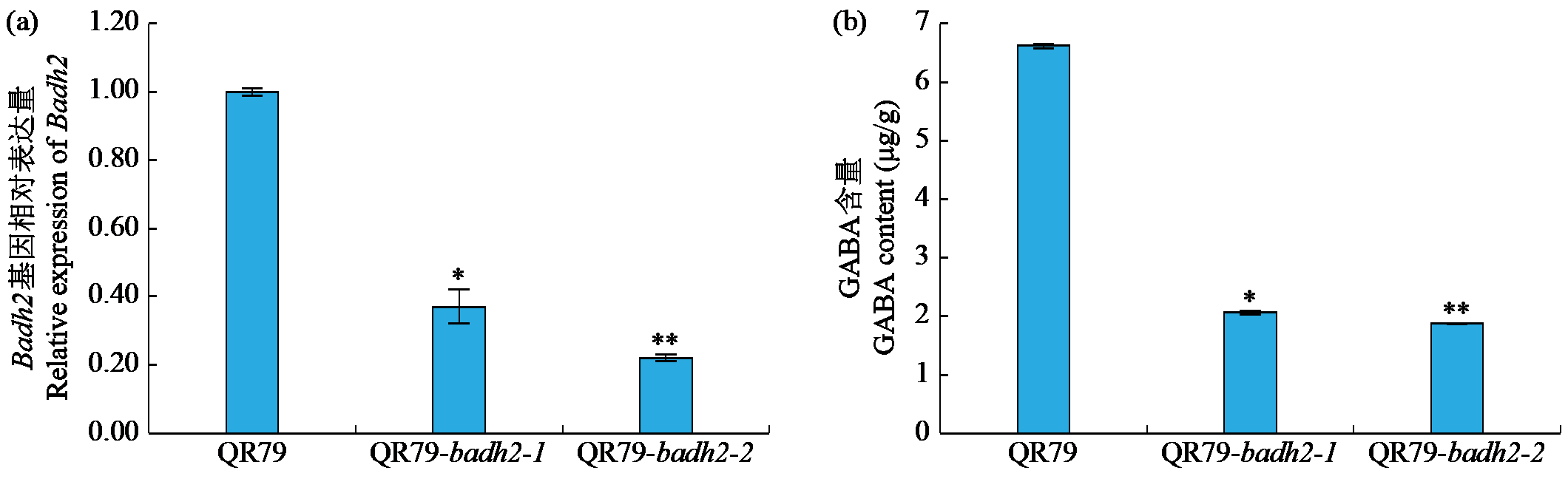
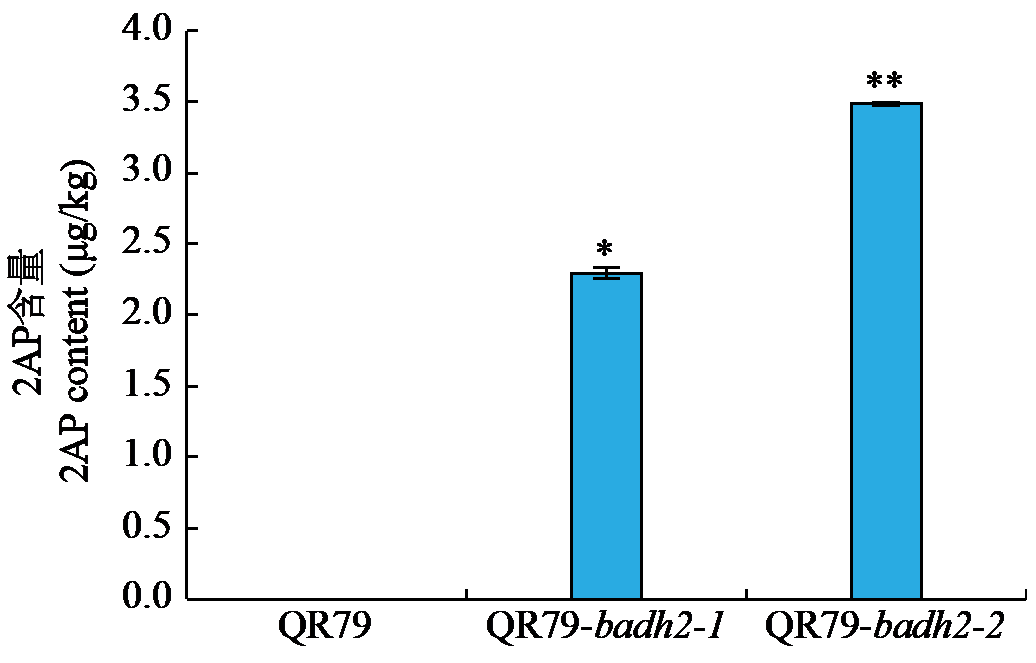
以优质恢复系QR79为受体材料,采用CRISPR/Cas9基因编辑技术,针对其Badh2基因的第1外显子和第2外显子区域,设计2个靶向位点,旨在获得具有香味、无转基因成分且主要农艺性状保持稳定的纯合突变体。对野生型和突变体的Badh2基因表达量、2-乙酰-1-吡咯啉(2AP)含量、γ-氨基丁酸(GABA)含量及主要农艺性状进行了系统测定与分析。结果表明,与野生型相比,纯合突变体植株QR79-badh2-1和QR79-badh2-2中Badh2基因表达量显著降低,2AP含量显著增加,而GABA含量显著减少;同时,粒长、千粒重、整精米率和结实率等主要农艺性状保持稳定,但产量构成因子受到一定程度影响。综上所述,通过CRISPR/Cas9基因编辑技术成功实现了对优质水稻恢复系QR79的香气特性遗传改良,显著提升了香味成分2AP的含量,为加速香型籼稻新品种的研发提供了理论依据和遗传资源。




| [1] |
Sakthivel K, Sundaram R M, Rani N S, et al. Genetic and molecular basis of fragrance in rice. Biotechnology Advances, 2009, 27(4):468-473.
doi: 10.1016/j.biotechadv.2009.04.001 pmid: 19371779 |
| [2] | Okpala N E, Mo Z, Duan M, et al. The genetics and biosynthesis of 2-acetyl-1-pyrroline in fragrant rice. Plant Physiology and Biochemistry, 2019,135:272-276. |
| [3] |
Shan Q W, Zhang Y, Chen K L, et al. Creation of fragrant rice by targeted knockout of the OsBADH2 gene using TALEN technology. Plant Biotechnology Journal, 2015, 13(6):791-800.
doi: 10.1111/pbi.2015.13.issue-6 |
| [4] | Cruz N D, Khush G. Rice grain quality evaluation procedures. Aromatic Rices, 2000,3:15-28. |
| [5] | Verma D K, Srivastav P P. Science and technology of aroma, flavor and fragrance in rice. USA:Apple Academic Press, 2019. |
| [6] | Hu X Q, Lu L, Guo Z L, et al. Volatile compounds,affecting factors and evaluation methods for rice aroma: a review. Trends in Food Science & Technology, 2020,97:136-146. |
| [7] | Buttery R G, Ling L C, Bo J O. 2-Acetyl-1-pyrroline: an important aroma component of cooked rice. Chemistry & Industry, 1982,22:958-959. |
| [8] |
Bergman C J, Delgado J T, Bryant R, et al. Rapid gas chromatographic technique for quantifying 2‐acetyl‐1‐pyrroline and hexanal in rice (Oryza sativa L.). Cereal Chemistry, 2000, 77 (4):454-458.
doi: 10.1094/CCHEM.2000.77.4.454 |
| [9] |
Fitzgerald M A, McCouch S R, Hall R D. Not just a grain of rice: the quest for quality. Trends in Plant Science, 2009, 14(3):133-139.
doi: 10.1016/j.tplants.2008.12.004 pmid: 19230745 |
| [10] |
Hashemi F S G, Rafii M Y, Ismail M R, et al. The genetic and molecular origin of natural variation for the fragrance trait in an elite Malaysian aromatic rice through quantitative trait loci mapping using SSR and gene-based markers. Gene, 2015, 555 (2):101-107.
doi: 10.1016/j.gene.2014.10.048 pmid: 25445269 |
| [11] | Griglione A, Liberto E, Cordero C, et al. High-quality Italian rice cultivars: chemical indices of ageing and aroma quality. Food Chemistry, 2015,172:305-313. |
| [12] |
Hinge V R, Patil H, Nadaf A. Aroma volatile analyses and 2AP characterization at various develop-mental stages in Basmati and Non-Basmati scented rice (Oryza sativa L.) cultivars. Rice, 2016, 9(1):1-22.
doi: 10.1186/s12284-015-0073-2 |
| [13] | Huang N, McCouch S, Mew T, et al. Development of an RFLP map from a doubled haploid population in rice. Theoretical and Applied Genetics, 1994, 89(5):609-617. |
| [14] | Sood B C, Siddiq E A. A rapid technique for scent determination in rice. Indian Journal of Genetics and Plant Breeding, 1978,38:268-271. |
| [15] | Ahn S N, Bollich C N, Tanksley S D. RFLP tagging of a gene for aroma in rice. Theoretical and Applied Genetics, 1992,84:825-828. |
| [16] |
Chen S H, Yang Y, Shi W W, et al. Badh2,encoding betaine aldehyde dehydrogenase, inhibits the biosynthesis of 2-acetyl- 1-pyrroline,a major component in rice fragrance. The Plant Cell, 2008, 20 (7):1850-1861.
doi: 10.1105/tpc.108.058917 |
| [17] | 陈明亮. 人工miRNA干扰共转化法获得无筛选标记转基因香稻. 北京: 中国农业科学院, 2012. |
| [18] | Bradbury L M T, Gillies S A, Brushett D J, et al. Inactivation of an aminoaldehyde dehydrogenase is responsible for fragrance in rice. Plant Molecular Biology, 2008,68:439-449. |
| [19] | 于梅梅, 陶权丹, 华杰, 等. 香软米水稻的研究进展. 江苏农业科学, 2019, 47(10):11-15. |
| [20] |
Hui S, Li H, Mawia A M, et al. Production of aromatic three‐line hybrid rice using novel alleles of BADH2. Plant Biotechnology Journal, 2022, 20(1):59-74.
doi: 10.1111/pbi.v20.1 |
| [21] |
韦新宇, 曾跃辉, 杨旺兴, 等. 利用CRISPR-Cas9技术编辑Badh2基因创制优质香型籼稻三系不育系. 作物学报, 2023, 49(8):2144-2159.
doi: 10.3724/SP.J.1006.2023.22043 |
| [22] | 张文婷, 李阳, 裘实, 等. 基于CRISPR/Cas9基因编辑技术研究Badh2基因对稻米品质的影响. 中国农业科技导报, 2025, 27(5):39-48. |
| [23] |
Gao Y B, Zhao Y D. Self‐processing of ribozyme‐flanked RNAs into guide RNAs in vitro and in vivo for CRISPR‐mediated genome editing. Journal of Integrative Plant Biology, 2014, 56(4):343-349.
doi: 10.1111/jipb.v56.4 |
| [24] |
孙慧宇, 宋佳, 王敬国, 等. 利用CRISPR/Cas9技术编辑Badh2基因改良粳稻香味. 华北农学报, 2019, 34(4):1-8.
doi: 10.7668/hbnxb.201751503 |
| [25] | 应兴华, 徐霞, 陈铭学, 等. 气相色谱-质谱技术分析香稻特征化合物2-乙酰基吡咯啉. 色谱, 2010, 28(8):782-785. |
| [26] | 张现伟, 王静, 唐永群, 等. 香稻香味遗传育种及其保香栽培. 基因组学与应用生物学, 2010, 29(3):550-555. |
| [27] | 王加峰, 郑才敏, 刘维, 等. 基于CRISPR/Cas9技术的水稻千粒重基因tgw6突变体的创建. 作物学报, 2016, 42(8):1160-1167. |
| [28] |
周冠彤, 雷建峰, 代培红, 等. 棉花CRISPR/Cas9基因编辑有效sgRNA高效筛选体系的研究. 作物学报, 2021, 47(3):427-437.
doi: 10.3724/SP.J.1006.2021.04178 |
| [29] | 胡黎明, 彭彦, 郑文杰, 等. 利用CRISPR/Cas9技术创制镉低积累香型水稻. 杂交水稻, 2021, 36(6):77-83. |
| [30] |
李景芳, 温舒越, 赵利君, 等. 基于CRISPR/Cas9技术创制耐盐香稻. 中国水稻科学, 2023, 37(5):478-485.
doi: 10.16819/j.1001-7216.2023.220907 |
| [31] | 黄艳辉.利用CRISPR/Cas9技术编辑SD1及LARGE2基因创制老香禾新种质. 贵阳: 贵州大学, 2023. |
| [32] | 卫正. 利用CRISPR介导的基因编辑技术创制水稻优质抗病新种质. 北京: 中国农业科学院, 2022. |
| [33] | 唐湘如, 吴密. 施用锌、铁、镧肥对香稻米质和产量的影响. 杂交水稻, 2007, 22(2):69-72. |
| [34] |
Pattanayak V, Lin S, Guilinger J P, et al. High-throughput profiling of off-target DNA cleavage reveals RNA-programmed Cas 9 nuclease specificity. Nature Biotechnology, 2013, 31(9):839-843.
doi: 10.1038/nbt.2673 pmid: 23934178 |
| [35] |
Endo M, Mikami M, Toki S. Multigene knockout utilizing off-target mutations of the CRISPR/Cas9 system in rice. Plant and Cell Physiology, 2015, 56(1):41-47.
doi: 10.1093/pcp/pcu154 pmid: 25392068 |
| [1] | 阙涛, 吴娴, 王忠妮, 吴钱蓉, 龙武华, 王倩, 朱速松. 利用CRISPR/Cas9技术编辑GS3、GS9和GW2基因改良水稻粒型[J]. 作物杂志, 2026, (4): 17–26 |
| [2] | 王鑫琦, 车欣洋, 张海洋, 王旭, 李玉涵, 赵硕, 刘思贝, 王雪贺缘, 贺琳, 徐晶宇. 玉米二酰甘油激酶基因耐低温分析[J]. 作物杂志, 2026, (4): 27–35 |
| [3] | 杨铁鑫, 董立强, 马亮, 冯莹莹, 李志强. 辽宁中部平原稻区香型粳稻品种产量及品质评价[J]. 作物杂志, 2024, (6): 71–77 |
| [4] | 杨善伟, 梁仁敏, 赵海红, 韦贵剑, 贺登美, 黄徐谋, 胡忠银, 韦春项, 许畅, 韦敏超, 魏爽, 罗继腾, 徐莹莹, 张秀花, 韩亦, 王士强. 孕穗期低温胁迫对优质香稻产量及其构成因素的影响[J]. 作物杂志, 2023, (6): 143–149 |
| [5] | 邢丕鹏, 黄彦峰, 易思媛, 兰儒剑, 潘圣刚, 莫钊文, 田华, 段美洋, 唐湘如. 抽穗期叶面喷施鸟氨酸对香稻产量、品质以及2-乙酰基-1-吡咯啉生物合成的影响[J]. 作物杂志, 2023, (3): 134–138 |
| [6] | 成大宇, 刘昆, 高捷, 张杏雨, 顾希, 刘立军. 养分和水分管理对稻米香味影响的研究进展[J]. 作物杂志, 2022, (2): 22–27 |
| [7] | 佟天一, 蔡健旋, 张集胜, 李林, 马林, 何柔静, 唐湘如. 香稻专用肥料类型对香稻产量、品质和香气的影响[J]. 作物杂志, 2021, (4): 152–158 |
| [8] | 赖日芳, 郑阿香, 罗昊文, 吴窕艳, 赵旭泽, 何隆鑫, 王连祥, 唐湘如. 不同育秧方式对机插香稻秧苗素质及生理特性的影响[J]. 作物杂志, 2020, (3): 137–141 |
| [9] | 王付华,薛华政,王亚,王生轩,王越涛,付景,杨文博,白涛,李俊周,尹海庆. 利用CRISPR/CAS9基因编辑技术创制香型郑稻19新种质[J]. 作物杂志, 2018, (6): 36–42 |
| [10] | 李燕敏,祁显涛,刘昌林,刘方,谢传晓. 除草剂抗性农作物育种研究进展[J]. 作物杂志, 2017, (2): 1–6 |
| [11] | 邵金良,杨东顺,樊建麟,刘兴勇,杜丽娟,王丽,汪禄祥,刘宏程. DABS-Cl柱前衍生-HPLC测定稻米中γ-氨基丁酸方法优化[J]. 作物杂志, 2016, (1): 129–134 |
| [12] | 刘化龙, 张宇, 邹德堂, 等. 香稻种质资源筛选及香味基因遗传研究[J]. 作物杂志, 2014, (6): 21–26 |
| [13] | 贾琰, 赵宏伟, 王敬国, 等. 逆境胁迫下作物中γ-氨基丁酸代谢及作用的研究进展[J]. 作物杂志, 2014, (5): 9–15 |
| [14] | 徐振江, 肖立中, 刘洪, 等. 灌浆结实期适度高温对香稻产量的影响及其机理[J]. 作物杂志, 2012, (2): 55–58 |
| [15] | 阎勇, 莫海玲, 于松保, 等. 优质红香稻桂红一号的选育与应用[J]. 作物杂志, 2012, (2): 149–150+4 |
|
||