

作物杂志,2026, 第5期: 171–180 doi: 10.16035/j.issn.1001-7283.2026.05.020
缓控释肥对水稻产量及灌浆期叶片碳氮代谢的影响
江峥嵘1( ), 陈秋丽2(), 曾娜娜1, 刘松1, 林最昌1, 杨扬1, 丁艳锋1, 李刚华1()
- 1
南京农业大学农学院/农业农村部作物生理生态与生产管理重点实验室, 210095, 江苏南京
2江苏徐淮地区徐州农业科学研究所, 221131, 江苏徐州
Effects of Slow- and Controlled-Release Fertilizers on Grain Yield and Leaf Carbon and Nitrogen Metabolism during the Grain-Filling Stage in Rice
Jiang Zhengrong1(), Chen Qiuli2(), Zeng Nana1, Liu Song1, Lin Zuichang1, Yang Yang1, Ding Yanfeng1, Li Ganghua1()
- 1
College of Agriculture ,Nanjing Agricultural University / Key Laboratory of Crop Physiology Ecology and Production Management, Ministry of Agriculture and Rural Affairs Nanjing 210095, Jiangsu, China
2Xuzhou Institute of Agricultural Sciences in Jiangsu Xuhuai District Xuzhou 221131, Jiangsu, China
摘要:
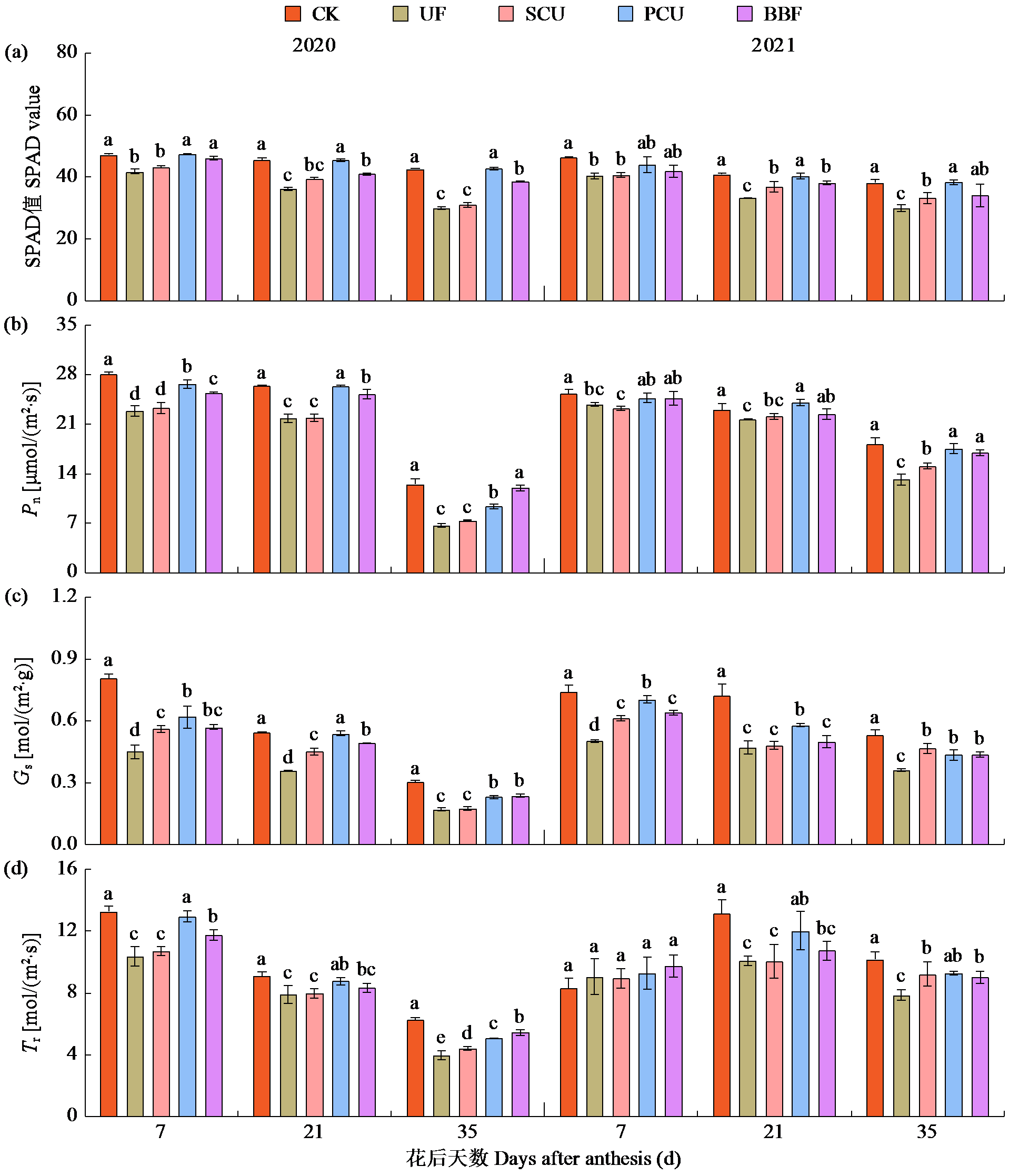
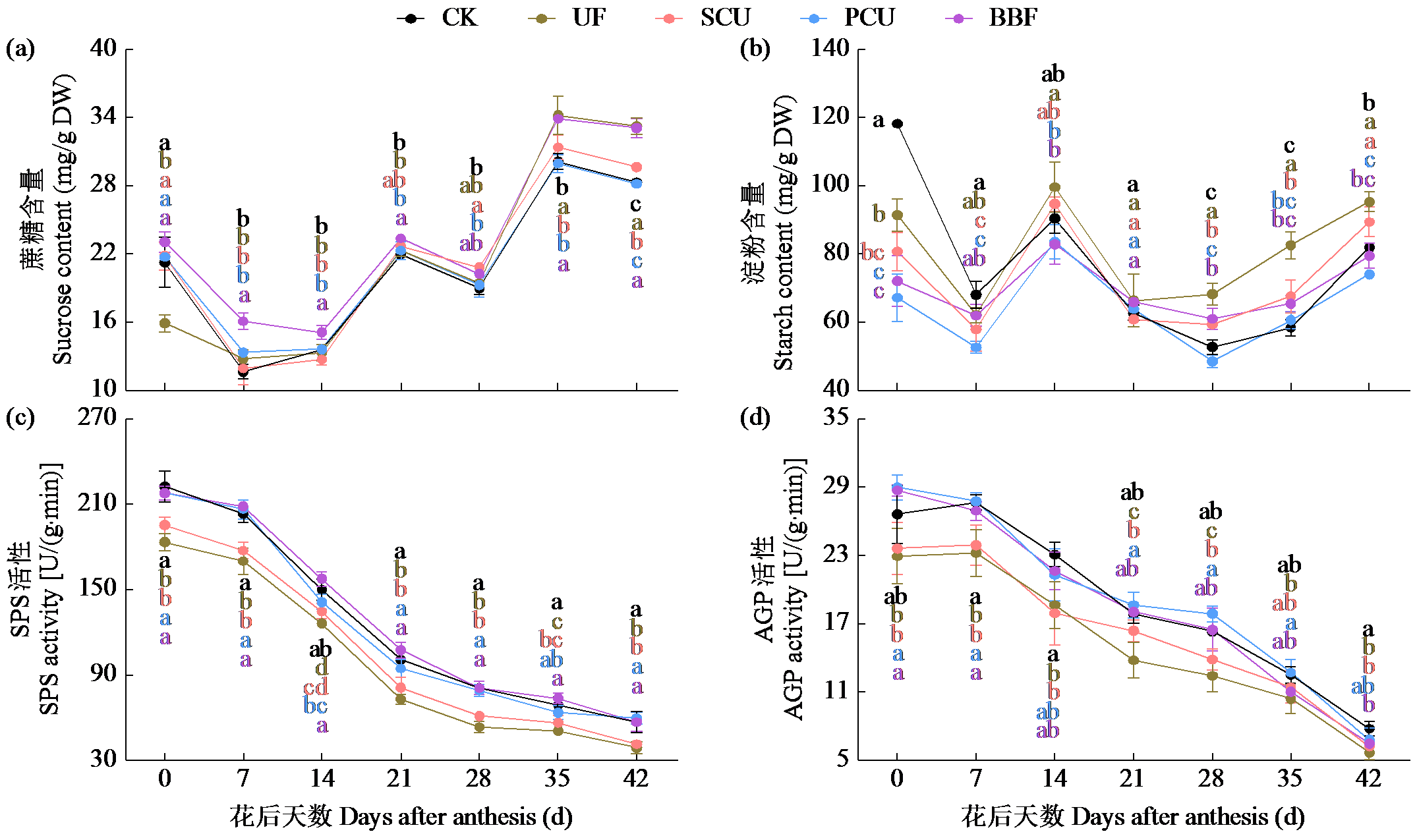
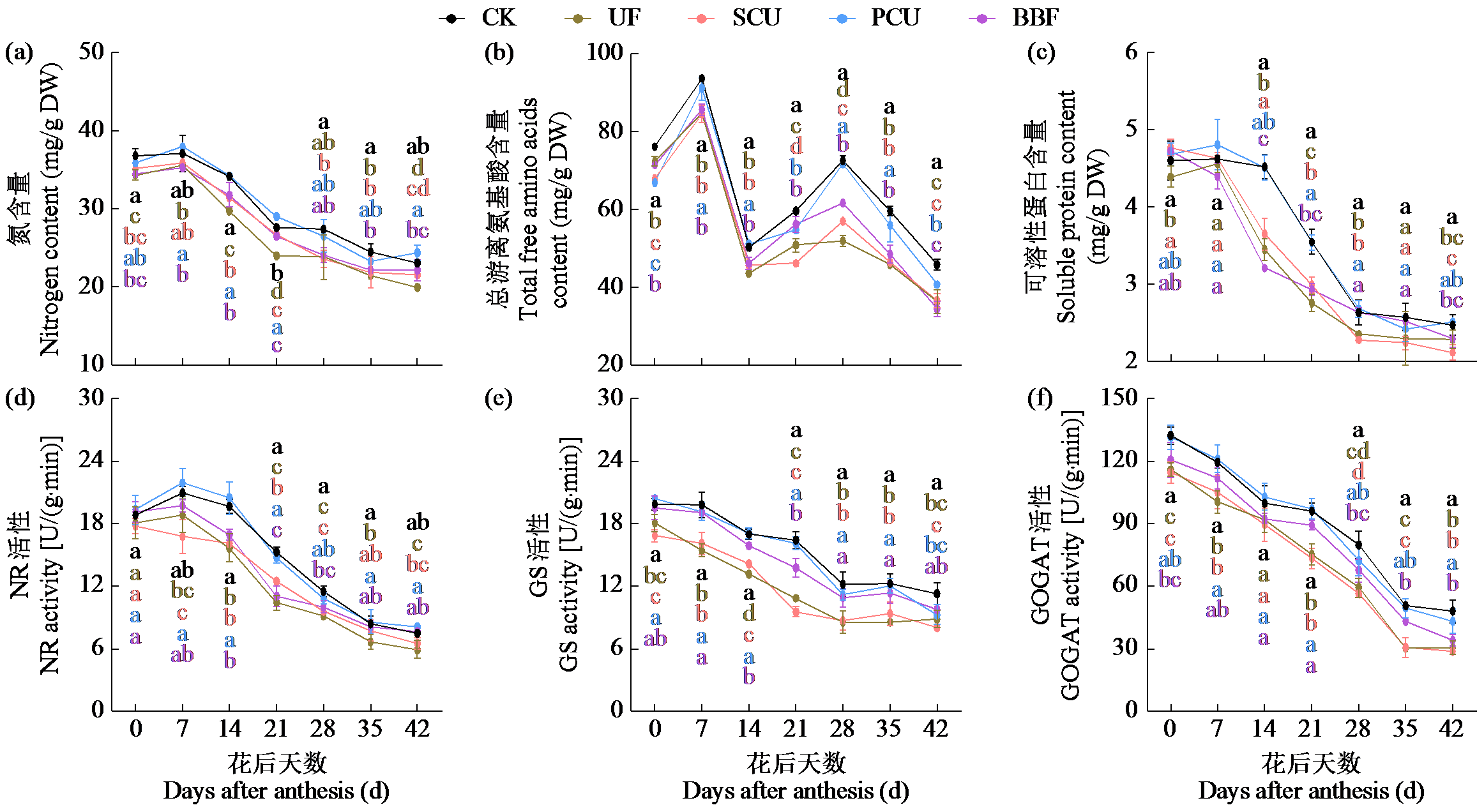
水稻灌浆期叶片碳氮代谢是调控产量形成的关键生理过程。为探究不同类型缓控释肥能否通过调控灌浆期叶片碳氮代谢进而影响水稻产量,于2020-2021年水稻生长季,以宁粳8号为供试材料,设置传统分次施肥(CK)及4种缓控释肥处理(速效缓释型肥料UF和SCU,控释型肥料PCU和BBF),开展田间试验。结果表明,UF和SCU处理的产量显著低于CK,2020年分别降低17.65%和5.88%,2021年分别降低13.40%和23.21%;而PCU和BBF处理的产量与CK相当,主要归因于其总颖花量和粒重均维持在CK水平。UF和SCU处理因水稻生育后期氮素供应不足,叶片光合能力下降,蔗糖与淀粉利用效率降低,碳氮代谢关键酶活性较低;PCU处理养分在生育后期大量释放,灌浆期氮素供应充足,促进了叶片碳代谢物的吸收利用,并增强了氮代谢物含量及相关酶活性;双峰释放模式的BBF处理在生育后期维持了适度的氮素供应,叶片光合能力较高,碳氮代谢水平趋于适中,从而使产量达到CK水平。综上,合理选择在水稻生育后期能够适量供应氮素的缓控释肥,有助于维持水稻高产。

| [1] |
Sun Z, Li X. Technical efficiency of chemical fertilizer use and its influencing factors in China’s rice production. Sustainability, 2021, 13(3):1155.
doi: 10.3390/su13031155 |
| [2] |
Peng S B, Tang Q Y, Zou Y B. Current status and challenges of rice production in China. Plant Production Science, 2009, 12(1):3-8.
doi: 10.1626/pps.12.3 |
| [3] |
Li X H, Li Z H. Global trends and current advances in slow/controlled-release fertilizers: a bibliometric analysis from 1990 to 2023. Agriculture, 2024, 14(9):1502-1525.
doi: 10.3390/agriculture14091502 |
| [4] |
Sanchez-Bragado R, Molero G, Reynolds M P, et al. Photosynthetic contribution of the ear to grain filling in wheat: a comparison of different methodologies for evaluation. Journal of Experimental Botany, 2016, 67(9):2787-2798.
doi: 10.1093/jxb/erw116 pmid: 27012283 |
| [5] |
Haefele S M, Jabbar S M A, Siopongco J D L C, et al. Nitrogen use efficiency in selected rice (Oryza sativa L.) genotypes under different water regimes and nitrogen levels. Field Crops Research, 2008, 107(2):137-146.
doi: 10.1016/j.fcr.2008.01.007 |
| [6] | 丁怡梦, 陈慕琪, 丁文锐, 等. 谷类作物碳氮代谢互作机制的研究进展. 植物生理学报, 2024, 60(5):753-761. |
| [7] | Deng J F, Ye J, Liu K, et al. Optimizing agronomy improves super hybrid rice yield and nitrogen use efficiency through enhanced post-heading carbon and nitrogen metabolism. Agronomy-Basel, 2023, 13(1):1-17. |
| [8] |
Kusano M, Fukushima A, Redestig H, et al. Metabolomic approaches toward understanding nitrogen metabolism in plants. Journal of Experimental Botany, 2011, 62(4):1439-1453.
doi: 10.1093/jxb/erq417 pmid: 21220784 |
| [9] |
Xin W J, Zhang L, Zhang W, et al. An integrated analysis of the rice transcriptome and metabolome reveals differential regulation of carbon and nitrogen metabolism in response to nitrogen availability. International Journal of Molecular Sciences, 2019, 20(9):1-17.
doi: 10.3390/ijms20010001 |
| [10] | 彭玉, 孙永健, 蒋明金, 等. 不同水分条件下缓/控释氮肥对水稻干物质量和氮素吸收、运转及分配的影响. 作物学报, 2014, 40(5):859-870. |
| [11] |
Zhao Y L, Xi M, Zhang X, et al. Nitrogen effect on amino acid composition in leaf and grain of japonica rice during grain filling stage. Journal of Cereal Science, 2015, 64:29-33.
doi: 10.1016/j.jcs.2015.03.011 |
| [12] |
Matsue Y, Odahara K, Hiramatsu M. Differences in amylose content, amylographic characteristics and storage proteins of grains on primary and secondary rachis branches in rice. Japanese Journal of Crop Science, 1995, 64(3):601-606.
doi: 10.1626/jcs.64.601 |
| [13] | 李国辉, 崔克辉. 氮对水稻叶蔗糖磷酸合成酶的影响及其与同化物积累和产量的关系. 植物生理学报, 2018, 54(7):1195-1204. |
| [14] |
Ke J, He R Z, Hou P F, et al. Combined controlled-released nitrogen fertilizers and deep placement effects of N leaching, rice yield and N recovery in machine-transplanted rice. Agriculture Ecosystems & Environment, 2018, 265:402-412.
doi: 10.1016/j.agee.2018.06.023 |
| [15] | Tang X N, Lu B, Jiang X Y, et al. Optimizing nitrogen release patterns for direct-seeded rice: a life cycle assessment. European Journal of Agronomy, 2026, 117:128094. |
| [16] |
Yang Y C, Zhang M, Li Y C, et al. Controlled release urea improved nitrogen use efficiency, activities of leaf enzymes, and rice yield. Soil Science Society of America Journal, 2012, 76(6):2307-2317.
doi: 10.2136/sssaj2012.0173 |
| [17] |
Wu Q, Wang Y, Ding Y F, et al. Effects of different types of slow- and controlled-release fertilizers on rice yield. Journal of Integrative Agriculture, 2021, 20(6):1503-1514.
doi: 10.1016/S2095-3119(20)63406-2 |
| [18] |
Hendrix D L. Rapid extraction and analysis of nonstructural carbohydrates in plant-tissues. Crop Science, 1993, 33(6):1306-1311.
doi: 10.2135/cropsci1993.0011183X003300060037x |
| [19] | 翁霞, 辛广, 李云霞. 蒽酮比色法测定马铃薯淀粉总糖的条件研究. 食品研究与开发, 2013, 34(17):86-88. |
| [20] |
Tsukaguchi T, Taniguchi Y, Ito R. The effects of nitrogen uptake before and after heading on grain protein content and the occurrence of basal- and back-white grains in rice (Oryza sativa L.). Plant Production Science, 2016, 19(4):508-517.
doi: 10.1080/1343943X.2016.1223527 |
| [21] | 熊庆娥. 植物生理学实验教程. 成都: 四川科学技术出版社, 2003:85-86. |
| [22] |
Okamura M, Aoki N, Hirose T, et al. Tissue specificity and diurnal change in gene expression of the sucrose phosphate synthase gene family in rice. Plant Science, 2011, 181(2):159-166.
doi: 10.1016/j.plantsci.2011.04.019 pmid: 21683881 |
| [23] |
Nakamura Y, Yuki K, Park S, et al. Carbohydrate-metabolism in the developing endosperm of rice grains. Plant and Cell Physiology, 1989, 30(6):833-839.
doi: 10.1093/oxfordjournals.pcp.a077813 |
| [24] | 李合生. 植物生理生化实验原理和技术. 北京: 高等教育出版社, 2000:125-127. |
| [25] |
Umemoto T, Nakamura Y, Ishikura N. Effect of grain location on the panicle on activities involved in starch synthesis in rice endosperm. Phytochemistry, 1994, 36(4):843-847.
doi: 10.1016/S0031-9422(00)90448-5 |
| [26] |
Govil S, Van Duc Long N, Escribà-Gelonch M, et al. Controlled- release fertiliser: recent developments and perspectives. Industrial Crops and Products, 2024, 219:119160.
doi: 10.1016/j.indcrop.2024.119160 |
| [27] |
Liu C X, Sun Y J, Wu G, et al. Amendment with controlled release urea increases leaf morpho-physiological traits, grain yield and NUE in a double-cropping rice system in southern China. Journal of the Science of Food and Agriculture, 2023, 103(4):1692-1703.
doi: 10.1002/jsfa.v103.4 |
| [28] | Aminpanah H, Firouzi S. Fertilizer management using plant growth-promoting rhizobacteria in rice fields. International Journal of Agricultural Management and Development, 2019, 9 (1):67-76. |
| [29] |
Xu K, Chai Q, Hu F L, et al. N-fertilizer postponing application improves dry matter translocation and increases system productivity of wheat/maize intercropping. Scientific Reports, 2021, 11(1):22825.
doi: 10.1038/s41598-021-02345-5 pmid: 34819592 |
| [30] |
Jiang Z W, Yang H Y, Zhu M C, et al. The inferior grain filling initiation promotes the source strength of rice leaves. Rice, 2023, 16(1):41-56.
doi: 10.1186/s12284-023-00656-x |
| [31] |
Li G H, Zhou C Y, Yang Z J, et al. Low nitrogen enhances apoplastic phloem loading and improves the translocation of photoassimilates in rice leaves and stems. Plant and Cell Physiology, 2022, 63(7):991-1007.
doi: 10.1093/pcp/pcac066 pmid: 35579477 |
| [32] |
Song Y S, Dong M H, Hu Y J, et al. Effects of nitrogen fertilization on nitrogen metabolism and grain protein in premium-tasty japonica rice. Cereal Research Communications, 2024, 52(4):1831-1842.
doi: 10.1007/s42976-023-00480-5 |
| [33] |
Liao G X, Yang Y H, Xiao W M, et al. Nitrogen modulates grain yield,nitrogen metabolism, and antioxidant response in different rice genotypes. Journal of Plant Growth Regulation, 2023, 42 (4):2103-2114.
doi: 10.1007/s00344-022-10684-4 |
| [34] |
Zhang Y F, Wang N, He C G, et al. Comparative transcriptome analysis reveals major genes, transcription factors and biosynthetic pathways associated with leaf senescence in rice under different nitrogen application. BMC Plant Biology, 2024, 24(1):419.
doi: 10.1186/s12870-024-05129-x pmid: 38760728 |
| [35] |
Wang W S, Wang W P, Pan Y L, et al. A new gain-of-function OsGS2/GRF4 allele generated by CRISPR/Cas 9 genome editing increases rice grain size and yield. The Crop Journal, 2022, 10 (4):1207-1212.
doi: 10.1016/j.cj.2022.01.004 |
| [36] |
Huang X L, Zhang Y Y, Wang L L, et al. OsDOF11 affects nitrogen metabolism by sucrose transport signaling in rice (Oryza sativa L.). Frontiers in Plant Science, 2021, 12:703034.
doi: 10.3389/fpls.2021.703034 |
| [1] | 李兴沂, 肖素勤, 邵建韬, 陈玲, 殷富有, 李金璐, 张建红, 邢佳鑫, 付惠仙, 程在全, 刘丽. 环境胁迫与栽培技术对水稻品质形成的多维影响及分子调控研究进展[J]. 作物杂志, 2026, (5): 1–14 |
| [2] | 常江育, 吴海彬, 张慧芋, 马小飞, 司中泽, 原鹏莉. 旱地优质小麦新品种临旱26[J]. 作物杂志, 2026, (5): 148–153 |
| [3] | 游昊, 宋文杰, 付斌, 张大弘, 江勋, 卢碧林. 基蘖同步侧深施下氮肥运筹对水稻生长、氮素利用和产量的影响[J]. 作物杂志, 2026, (5): 181–188 |
| [4] | 李浩晔, 翟娟, 张园梦, 薛军, 明博, 王克如, 谢瑞芝, 张国强, 李少昆. 灌溉量、种植密度和品种对新疆膜下滴灌玉米产量和水分生产效率的影响[J]. 作物杂志, 2026, (5): 213–221 |
| [5] | 韦巧, 王思冕, 林娇, 潘翠华, 吴吉平, 李洪菊, 罗艳萍, 罗冬玉, 侯玲, 刘永昌, 周家华, 张小贝. 去除基部枝叶对机采棉花叶片光合特征及产量、品质的影响[J]. 作物杂志, 2026, (5): 222–231 |
| [6] | 杨志雪, 加央多拉, 吴晗, 马飞跃, 田娟, 王开伟, 王霞, 马越, 李春花, 王乐. 播期和播量对白城地区荞麦新品种生长发育和产量的影响[J]. 作物杂志, 2026, (5): 246–254 |
| [7] | 薛乃雯, 刘建霞, 杨珍平, 张东旭. 谷豆间作对谷子生长发育、产量及籽粒品质的影响[J]. 作物杂志, 2026, (5): 255–261 |
| [8] | 李嘉永, 张城蓓, 雷云康, 杨炯, 谭舒, 丁松爽, 张凯, 时向东, 刘冰洋. 氮密互作对雪茄烟叶碳氮代谢及品质形成的影响[J]. 作物杂志, 2026, (5): 262–271 |
| [9] | 张苏新, 李广雨, 王春, 王芊, 黄元炬. 嗪吡嘧磺隆对不同水稻品种的安全性研究[J]. 作物杂志, 2026, (5): 289–296 |
| [10] | 纪子贤, 李乐晨, 蔡欣, 陈才敏, 丁佳淳, 黄志濠, 李克克. 水稻赤霉素受体GID1L2的表达分析[J]. 作物杂志, 2026, (5): 42–50 |
| [11] | 王婧, 石文鑫, 孙瑞卿, 秦曙. 喷施不同植物生长调节剂及其浓度对燕麦倒伏性及产量的影响[J]. 作物杂志, 2026, (5): 75–81 |
| [12] | 陈娟娟, 张玉梅, 周小成, 周爱爱, 付蓉, 张峰. 叶面喷施茉莉酸甲酯对雾培马铃薯产量和品质性状的影响[J]. 作物杂志, 2026, (5): 90–97 |
| [13] | 占东霞, 马利军, 常锦乐, 臧力瑶, 依力亚尔·阿布力米提, 许人颖. 不同种植模式下脱叶剂喷施对海岛棉雾滴沉积及脱叶效果的影响[J]. 作物杂志, 2026, (5): 98–106 |
| [14] | 殷佳, 张男, 孙茹梦, 汝艳, 景文疆, 张耗. 根系分泌物在水稻氮素吸收利用中的作用机制及氮肥调控研究进展[J]. 作物杂志, 2026, (4): 1–7 |
| [15] | 赵永满, 李瑞奇, 王红光. 拔节前补灌追氮对小麦叶片干物质积累量和产量的影响[J]. 作物杂志, 2026, (4): 101–109 |
|
||