



藜麦(Chenopodium quinoa Willd.)属苋科藜属,为一年生双子叶植物,是一种假谷物。其原产于安第斯山脉地区,拥有7000多年的种植历史,曾是古印加民族的主要粮食作物之一。2008年,我国开始规模化种植藜麦,目前主要分布于内蒙古、河北、甘肃、山西、青海、云南、新疆和四川等省区[1-2]。藜麦营养价值丰富,富含蛋白质、淀粉、脂肪、矿物质及维生素等[3]。当前,国内外对藜麦的加工利用研究不仅聚焦于籽粒,还涉及籽粒麸皮[4-5]、发酵籽粒[6-7]以及所含淀粉[8]、酚酸[9]、多糖[10
藜麦芽苗富含多种营养物质及生物活性成分,是蛋白质、氨基酸、矿物质和omega-3脂肪酸的优质摄入来源,具备抗菌、抗癌、抗糖尿病、抗氧化和抗肥胖等多种特性[19]。相较于未发芽的藜麦,藜麦芽展现出更强的抗氧化性能[20]。研究[21]表明,以藜麦芽为原料制成的酸奶,其抗氧化能力高于未发芽藜麦籽粒制成的酸奶,这归因于发芽过程提升了藜麦中多酚和类黄酮含量,进而提高了藜麦酸奶的整体品质。Lim等[18]研究发现,藜麦籽粒与茎叶在总酚、黄酮含量及抗氧化活性方面存在差异,茎的总酚及黄酮含量略低于种子,而叶的总酚及黄酮含量则显著高于种子,且茎叶的自由基清除活性显著强于种子。藜麦芽苗菜中的主要酚酸成分包括阿魏酸、异阿魏酸和异槲皮苷[22]。此外,藜麦品种、生长环境及提取方法等因素均会影响总多酚含量和酚酸种类[23]。张琴萍[24]对云南红藜、云南白藜和蒙藜1号3个不同品种藜麦苗在17~33 d内的营养及功能活性成分变化趋势进行了研究,结果显示总酚含量与DPPH(1,1-二苯基-2-三硝基苯肼)和ABTS(2,2′-联氮-双-3-乙基苯并噻唑啉-6-磺酸)自由基清除活性呈正相关,总黄酮含量与ABTS清除活性呈显著正相关,且多酚及黄酮含量因品种和采收时期的不同而存在较大差异。
海南省四面环海,属热带季风气候,长夏无冬,地理环境与我国其他地区存在显著差异。当前,全球气候变暖导致极端天气频发,降水模式不稳定,可能引发作物减产。而藜麦对干旱和盐度等非生物胁迫具有高度耐受性,能在不利土壤和气候条件下生长。发展藜麦芽苗菜这一新型蔬菜产业,既有助于缓解海南省冬季瓜菜产业的市场竞争压力,也能积极应对未来潜在的环境变化。目前,针对我国海南地区藜麦芽苗菜功能活性成分的研究较少。因此,本研究选取来自河北和新疆的19份藜麦品种,对其不同生长时期的芽苗菜中总黄酮和总多酚含量进行测定分析,并评估其抗氧化活性,旨在为藜麦芽苗菜在海南的推广种植及规模化生产提供理论依据。
1 材料与方法
1.1 试验材料
19份试验材料名称及来源如表1所示。Y1~ Y10来源于河北,Y11~Y19来源于新疆。2023年1月9日播种于海南省乐东县尖峰镇老罗村张家口市农业科学院南繁实验基地(18°45′5.38″ N,109°10′10.22″ E,海拔134 m)。基地土壤为热带雨林地区典型土壤泥燥土(典型燥红土),表土层多为浅黄色或灰黄色,以砂质壤土为主。
表1 试验材料名称及来源
Table 1
| 编号 Number | 品种名称 Variety name | 材料来源 Material source |
|---|---|---|
| Y1 | SX4 特76 | 张家口市农业科学院 |
| Y2 | SX12 石家庄(18) | 张家口市农业科学院 |
| Y3 | QS 石家庄(19) | 张家口市农业科学院 |
| Y4 | 石家庄(11) | 张家口市农业科学院 |
| Y5 | 石家庄(3) | 张家口市农业科学院 |
| Y6 | xsg70-100-3 | 张家口市农业科学院 |
| Y7 | LMSX4 | 张家口市农业科学院 |
| Y8 | 2022南繁种 | 张家口市农业科学院 |
| Y9 | YY-11-192-3 | 张家口市农业科学院 |
| Y10 | XJ-SY-3 | 张家口市农业科学院 |
| Y11 | XJ-SY-5 | 伊犁哈萨克自治州农业科学研究所 |
| Y12 | XJ-SY-6 | 伊犁哈萨克自治州农业科学研究所 |
| Y13 | XJ-SY-10 | 伊犁哈萨克自治州农业科学研究所 |
| Y14 | XJ-SY-13 | 伊犁哈萨克自治州农业科学研究所 |
| Y15 | XJ-SY-22 | 伊犁哈萨克自治州农业科学研究所 |
| Y16 | XJ-SY-26 | 伊犁哈萨克自治州农业科学研究所 |
| Y17 | XJ-SY-29 | 伊犁哈萨克自治州农业科学研究所 |
| Y18 | XJ-SY-35 | 伊犁哈萨克自治州农业科学研究所 |
| Y19 | XJ-SY-41 | 伊犁哈萨克自治州农业科学研究所 |
1.2 试验方法
试验采用田间种植,小区面积为30 m2。翻地、整地后播种,铺设滴灌带,播种株行距20 cm×25 cm,人工穴播,于12片真叶时施三元复合肥15 g/m2(氮:磷:钾=15:5:15),无底肥。
1.3 测定项目与方法
1.3.1 农艺性状
随机取藜麦苗3株,测量株高(地面上的茎秆高度)和单株鲜重,取均值,每次取样间隔6 d,即播种后21~49 d,从株高达到13 cm且具有10片真叶开始,按折合干重20 g取样。鼓风干燥至恒重,研磨成粉过60目筛,置于-18 ℃冰箱备用。
1.3.2 水分含量
参考《食品安全国家标准 食品中水分的测定》(GB 5009.3-2016)[25]中的直接干燥法测定水分含量。
1.3.3 功能成分
1.3.4 抗氧化活性
1.4 数据处理
试验设3次重复。采用Excel 2016、SPSS 26.0和Origin 2024软件进行统计分析和绘图。
2 结果与分析
2.1 藜麦芽苗菜株高和鲜重
如表2所示,不同时期、不同品种之间藜麦芽苗菜的株高和鲜重有一定差异。随着采收期的变化,株高和鲜重均呈显著上升趋势。株高从21 d的15.57 cm增长至49 d的60.60 cm,鲜重从21 d的9.27 g/株增至49 d的47.74 g/株。且在35~42 d生长最快(株高增加60.05%,鲜重增加86.69%),此时,茎秆呈现出木质化,不宜再作为菜用。
表2 藜麦芽苗菜生长过程中株高和鲜重变化
Table 2
| 编号 Number | 21 d | 28 d | 35 d | 42 d | 49 d | |||||||||
|---|---|---|---|---|---|---|---|---|---|---|---|---|---|---|
| 株高 Plant height (cm) | 鲜重(g/株) Fresh weight (g/plant) | 株高 Plant height (cm) | 鲜重(g/株) Fresh weight (g/plant) | 株高 Plant height (cm) | 鲜重(g/株) Fresh weight (g/plant) | 株高 Plant height (cm) | 鲜重(g/株) Fresh weight (g/plant) | 株高 Plant height (cm) | 鲜重(g/株) Fresh weight (g/plant) | |||||
| Y1 | 16.40±0.07d | 9.97±0.32d | 20.86±0.49d | 12.03±0.56d | 31.65±3.25c | 18.89±2.25c | 49.17±4.32b | 60.00±6.36b | 57.07±1.12a | 66.39±0.96a | ||||
| Y2 | 15.98±0.64e | 9.31±0.94c | 20.94±0.58d | 11.52±0.16c | 31.00±0.87c | 19.39±2.52c | 48.40±3.75b | 37.28±10.72b | 51.87±1.53a | 49.11±4.39a | ||||
| Y3 | 15.85±0.44e | 9.82±0.78d | 21.56±1.05d | 13.12±0.42d | 28.60±1.82c | 29.17±1.54c | 45.80±2.52b | 58.97±9.24b | 55.25±3.12a | 67.08±0.27a | ||||
| Y4 | 15.82±0.31d | 10.01±0.71c | 19.33±0.63d | 13.69±0.14c | 31.15±4.72c | 24.65±5.10b | 46.00±0.10b | 58.87±10.18a | 60.90±4.97a | 57.50±5.96a | ||||
| Y5 | 14.98±0.58e | 9.84±0.24d | 21.05±0.31d | 11.89±0.38d | 30.23±1.15c | 23.11±1.61c | 48.70±3.12b | 38.93±3.43b | 63.42±0.61a | 46.89±4.42a | ||||
| Y6 | 14.50±0.76d | 8.87±0.71d | 20.91±0.54c | 10.71±0.49cd | 27.97±3.06b | 19.39±2.77bc | 38.37±3.66a | 27.55±1.65b | 41.77±0.58a | 54.11±10.74a | ||||
| Y7 | 15.92±0.35e | 9.31±0.45d | 20.96±0.81d | 10.17±0.57d | 29.77±2.07c | 26.10±0.55c | 56.87±4.44b | 39.33±3.14b | 63.48±2.97a | 49.31±3.52a | ||||
| Y8 | 15.98±0.60e | 9.01±0.25c | 22.03±1.53d | 11.97±0.31c | 33.93±2.21c | 26.48±1.14b | 63.07±1.79b | 61.29±6.27a | 66.93±0.84a | 65.92±6.09a | ||||
| Y9 | 15.91±0.37d | 9.34±0.53c | 21.28±1.97d | 11.23±0.60c | 33.33±2.93c | 25.01±1.98b | 46.77±7.46b | 46.97±10.55a | 57.33±1.91a | 49.55±4.76a | ||||
| Y10 | 14.79±0.40e | 9.16±0.45c | 20.96±1.31d | 7.84±1.65c | 31.30±0.82c | 8.81±1.10c | 56.97±2.87b | 44.29±10.19b | 66.92±1.99a | 54.88±2.72a | ||||
| Y11 | 15.73±0.10e | 9.47±0.40c | 23.96±3.08d | 11.55±0.33c | 32.50±3.46c | 9.44±0.74c | 60.03±3.56b | 24.48±8.31b | 72.12±1.60a | 37.94±1.58a | ||||
| Y12 | 16.31±0.16e | 9.25±0.82d | 22.18±1.02d | 12.40±0.83cd | 35.83±1.15c | 13.33±2.32c | 56.90±2.21b | 21.90±2.51b | 70.25±1.05a | 37.46±1.53a | ||||
| Y13 | 15.09±0.12e | 9.40±0.86c | 21.41±1.23d | 12.76±0.37c | 29.13±3.00c | 25.19±9.61b | 56.50±1.57b | 22.81±1.63b | 76.25±0.82a | 37.95±0.91a | ||||
| Y14 | 15.43±0.16e | 9.50±0.15d | 20.92±0.71d | 11.80±0.49cd | 27.50±2.65c | 15.08±5.42c | 42.43±3.00b | 21.69±2.28b | 63.45±2.52a | 39.19±1.01a | ||||
| Y15 | 15.78±0.73e | 9.05±0.24b | 20.76±0.63d | 10.22±0.95b | 23.43±0.75c | 7.81±2.68b | 37.73±0.78b | 8.62±0.37b | 52.60±1.74a | 37.06±1.97a | ||||
| Y16 | 15.40±0.23e | 9.41±0.49c | 22.15±2.52d | 12.84±0.13c | 32.67±1.53c | 15.72±0.68bc | 40.07±6.82b | 24.79±12.24b | 57.05±2.34a | 40.24±4.19a | ||||
| Y17 | 15.05±0.26d | 8.76±0.46c | 20.75±3.21d | 10.64±1.00c | 30.02±4.46c | 19.30±2.85c | 41.67±6.31b | 13.42±5.79b | 49.63±0.73a | 37.77±1.50a | ||||
| Y18 | 14.98±0.60e | 8.09±0.73d | 19.74±0.83d | 10.60±0.26cd | 30.60±1.87c | 14.23±2.42c | 40.37±0.96b | 19.30±0.99b | 57.12±0.42a | 41.08±3.99a | ||||
| Y19 | 15.96±0.43e | 8.62±0.73c | 19.99±1.48d | 10.97±0.27bc | 33.87±1.76c | 14.42±1.60b | 59.50±1.40b | 33.20±5.27a | 67.95±1.98a | 37.64±1.59a | ||||
| 平均值 Mean | 15.57±0.54e | 9.27±0.48d | 21.15±1.01d | 11.47±1.33d | 30.76±2.80c | 18.71±6.47c | 49.23±8.13b | 34.93±16.51b | 60.60±8.57a | 47.74±10.63a | ||||
不同小写字母表示存在显著差异(P < 0.05),下同。
Different lowercase letters indicate significant difference (P < 0.05), the same below.
2.2 藜麦芽苗菜总多酚和总黄酮含量
如图1所示,21 d时藜麦芽苗菜总多酚含量最高,平均为12.88 mg GAE/g DW,随采收期变化整体呈下降趋势,在21~35 d生长期内显著下降,35 d后趋于稳定。如表3所示,不同采收期藜麦芽苗菜总多酚含量范围在9.03~15.00 mg GAE/g DW,除Y5和Y16外,所有品种的总多酚含量在21 d时均较大。其中,Y5在35 d总多酚含量最高(12.19 mg GAE/g DW),Y16在28 d总多酚含量最高(12.80 mg GAE/g DW)。藜麦芽苗菜总黄酮含量从21 d的30.89 mg RE/g DW下降至28 d的23.70 mg RE/g DW,降幅为23.28%,但随后在28~49 d趋于稳定,这与总多酚含量的变化趋势较为一致。如表4所示,不同采收期藜麦芽苗菜总黄酮含量范围在17.23~36.03 mg RE/g DW。除Y2、Y9、Y10和Y17外,所有的藜麦芽苗菜品种总黄酮含量均在21 d时较大。其中,Y2(30.22 mg RE/g DW)和Y10(35.40 mg RE/g DW)在49 d时总黄酮含量最高,Y9在42 d时最高(27.21 mg RE/g DW),Y17在35 d时最高(28.22 mg RE/g DW)。
图1
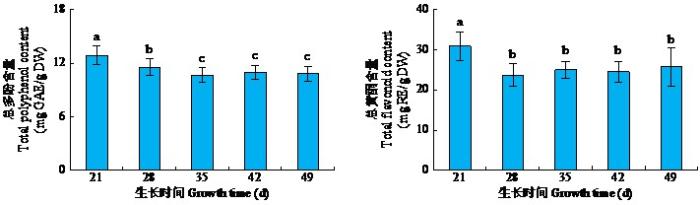
图1
藜麦芽苗菜生长过程中总多酚和总黄酮含量变化
不同小写字母表示存在显著差异(P < 0.05),下同。
Fig.1
Changes of total polyphenol and total flavonoid contents of quinoa sprouts during the growth
Different lowercase letters indicate significant difference (P < 0.05), the same below.
表3 不同采收期藜麦芽苗菜的总多酚含量
Table 3
| 编号Number | 21 d | 28 d | 35 d | 42 d | 49 d |
|---|---|---|---|---|---|
| Y1 | 12.99±0.37a | 12.01±0.18b | 11.08±0.39c | 10.75±0.13c | 11.61±0.23b |
| Y2 | 15.00±0.16a | 11.36±0.25b | 10.80±0.13c | 11.63±0.27b | 10.53±0.24c |
| Y3 | 12.71±0.04a | 10.29±0.17d | 11.19±0.34c | 11.84±0.06b | 11.57±0.08b |
| Y4 | 10.59±0.35ab | 10.91±0.09a | 10.38±0.02b | 9.81±0.20c | 9.28±0.12d |
| Y5 | 11.75±0.24b | 11.83±0.10b | 12.19±0.06a | 10.92±0.19c | 10.93±0.02c |
| Y6 | 13.05±0.08a | 10.99±0.38c | 12.71±0.10ab | 12.59±0.15b | 10.50±0.02d |
| Y7 | 12.68±0.27a | 12.18±0.37b | 10.49±0.03c | 10.74±0.12c | 10.72±0.37c |
| Y8 | 13.98±0.02a | 13.26±0.19b | 11.19±0.23c | 10.66±0.12d | 9.87±0.22e |
| Y9 | 13.35±0.12a | 9.98±0.19d | 11.23±0.26c | 11.04±0.25c | 11.98±0.15b |
| Y10 | 14.58±0.05a | 12.75±0.14b | 10.53±0.10e | 11.85±0.27d | 12.33±0.04c |
| Y11 | 11.53±0.21ab | 11.73±0.17a | 10.39±0.22c | 10.47±0.21c | 11.29±0.23b |
| Y12 | 12.48±0.18a | 10.66±0.14c | 9.54±0.15d | 11.26±0.26b | 10.66±0.26c |
| Y13 | 13.88±0.11a | 10.55±0.11c | 9.35±0.08d | 10.99±0.38b | 10.48±0.15c |
| Y14 | 12.68±0.17a | 11.72±0.15b | 9.56±0.16e | 11.26±0.32c | 10.08±0.08d |
| Y15 | 12.56±0.28a | 12.52±0.18a | 10.47±0.28b | 12.09±0.29a | 10.53±0.25b |
| Y16 | 12.29±0.15b | 12.80±0.12a | 9.53±0.14d | 9.64±0.12d | 10.89±0.11c |
| Y17 | 12.70±0.46a | 11.31±0.10b | 10.27±0.21c | 10.89±0.18b | 11.47±0.46b |
| Y18 | 12.54±0.12a | 11.56±0.30b | 11.03±0.08c | 9.83±0.21d | 11.42±0.06b |
| Y19 | 13.35±0.41a | 11.25±0.43b | 10.94±0.01b | 9.99±0.17c | 9.03±0.15d |
表4 不同采收期藜麦芽苗菜的总黄酮含量
Table 4
| 编号Number | 21 d | 28 d | 35 d | 42 d | 49 d |
|---|---|---|---|---|---|
| Y1 | 29.76±0.04a | 24.37±0.44c | 22.07±0.44e | 23.40±0.61d | 26.38±0.62b |
| Y2 | 29.18±0.45b | 28.20±0.50b | 25.31±0.59c | 23.43±0.34d | 30.22±0.67a |
| Y3 | 36.03±1.15a | 26.55±0.50c | 24.48±0.63d | 25.85±0.65cd | 33.01±0.74b |
| Y4 | 31.65±0.51a | 28.10±1.00b | 22.91±0.48d | 22.28±0.61d | 26.57±0.43c |
| Y5 | 35.60±0.09a | 23.11±0.51e | 24.23±0.13d | 25.78±0.25c | 29.15±1.13b |
| Y6 | 32.59±0.88a | 23.64±0.21c | 26.28±0.34b | 25.44±0.39b | 25.82±0.96b |
| Y7 | 29.34±1.49a | 22.49±0.33c | 26.20±0.82b | 19.99±0.39d | 27.87±0.87a |
| Y8 | 33.71±0.59a | 23.97±1.00b | 22.55±0.33c | 22.36±0.60c | 24.53±0.37b |
| Y9 | 25.72±0.14b | 22.29±0.22d | 23.42±0.12c | 27.21±0.13a | 26.87±0.78a |
| Y10 | 32.48±0.20b | 25.49±0.10c | 21.92±0.48d | 25.61±0.66c | 35.40±0.71a |
| Y11 | 35.87±0.95a | 24.46±0.89c | 24.14±0.90c | 21.72±0.13d | 28.19±0.31b |
| Y12 | 30.69±1.20a | 21.58±0.06d | 28.32±0.52b | 26.72±0.87c | 18.67±0.70e |
| Y13 | 28.33±0.31a | 27.88±0.31a | 28.26±0.70a | 23.89±0.23b | 17.23±0.55c |
| Y14 | 31.65±0.45a | 19.95±0.61d | 24.29±0.53c | 28.27±0.18b | 20.10±0.40d |
| Y15 | 29.83±0.82a | 20.13±0.25c | 29.11±0.90a | 28.85±0.75a | 23.37±0.46b |
| Y16 | 34.94±0.24a | 25.33±0.19b | 23.88±0.40c | 20.62±0.19e | 22.64±0.29d |
| Y17 | 24.84±0.94c | 23.20±0.25d | 28.22±0.48a | 25.51±0.69bc | 26.60±0.46b |
| Y18 | 30.33±0.45a | 20.29±0.41e | 24.74±0.49d | 26.83±0.43b | 25.94±0.48c |
| Y19 | 24.29±0.08a | 19.36±0.29d | 23.99±0.62a | 22.16±0.34b | 20.37±0.26c |
2.3 藜麦芽苗菜抗氧化活性
图2
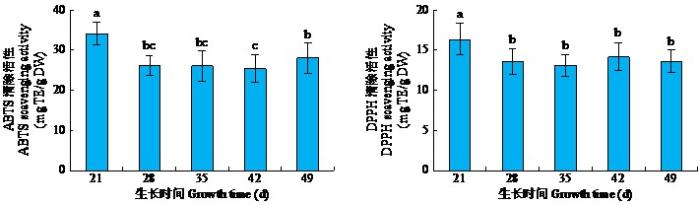
图2
藜麦芽苗菜生长过程中DPPH和ABTS清除活性变化
Fig.2
Changes of DPPH and ABTS scavenging activity of quinoa sprouts during the growth
表5 不同采收期藜麦芽苗菜的DPPH清除活性
Table 5
| 编号Number | 21 d | 28 d | 35 d | 42 d | 49 d |
|---|---|---|---|---|---|
| Y1 | 16.46±0.26a | 13.61±0.11c | 12.91±0.17d | 14.86±0.16b | 13.31±0.62cd |
| Y2 | 18.90±0.26a | 13.56±0.17c | 12.46±0.30d | 14.88±0.22b | 12.65±0.25d |
| Y3 | 15.34±0.27b | 11.09±0.14d | 14.21±0.51c | 15.90±0.28a | 14.24±0.19c |
| Y4 | 14.16±0.02a | 13.15±0.17c | 12.77±0.16d | 12.79±0.15d | 13.71±0.19b |
| Y5 | 14.67±0.07b | 13.39±0.31c | 15.64±0.55a | 16.16±0.29a | 12.94±0.09c |
| Y6 | 15.66±0.09b | 14.15±0.27c | 14.62±0.55c | 17.55±0.18a | 11.39±0.38d |
| Y7 | 14.83±0.08a | 14.59±0.20a | 11.65±0.28c | 13.55±0.50b | 14.74±0.36a |
| Y8 | 19.55±0.11a | 17.16±0.09b | 13.28±0.22d | 14.99±0.49c | 13.03±0.03d |
| Y9 | 16.58±0.04a | 12.02±0.27d | 13.79±0.17c | 14.77±0.31b | 14.68±0.17b |
| Y10 | 21.21±0.31a | 16.52±0.28b | 12.10±0.30d | 13.42±0.24c | 10.61±0.12e |
| Y11 | 15.44±0.35a | 14.72±0.21b | 11.17±0.05c | 11.39±0.25c | 14.92±0.37b |
| Y12 | 14.32±0.14a | 12.02±0.26d | 12.72±0.29c | 14.83±0.62a | 13.50±0.15b |
| Y13 | 17.92±0.10a | 11.68±0.26e | 12.33±0.32d | 13.37±0.34c | 14.09±0.03b |
| Y14 | 15.64±0.14a | 13.20±0.04c | 11.34±0.15d | 14.83±0.45b | 12.92±0.10c |
| Y15 | 14.75±0.21b | 12.58±0.20d | 15.29±0.21b | 16.53±0.59a | 13.66±0.24c |
| Y16 | 14.27±0.09a | 14.14±0.24ab | 11.79±0.31c | 11.48±0.34c | 13.75±0.02b |
| Y17 | 16.46±0.18b | 14.24±0.42c | 12.21±0.61d | 12.50±0.05d | 17.35±0.24a |
| Y18 | 16.22±0.32a | 14.28±0.25b | 12.91±0.48c | 12.74±0.27c | 13.12±0.10c |
| Y19 | 18.05±0.38a | 12.00±0.26e | 15.04±0.68b | 12.71±0.11d | 13.90±0.21c |
采收期内,藜麦芽苗菜的ABTS清除活性呈下降趋势,由21 d的34.13 mg TE/g DW降至42 d的25.41 mg TE/g DW,降幅为25.55%。在49 d时,ABTS清除活性显著升高至28.11 mg TE/g DW。不同采收期藜麦芽苗菜的ABTS清除活性如表6所示,范围在20.11~39.96 mg TE/g DW。除Y15在42 d时最高(31.86 mg TE/g DW)外,其余品种均在21 d时有较好的活性。
表6 不同采收期藜麦芽苗菜的ABTS清除活性
Table 6
| 编号Number | 21 d | 28 d | 35 d | 42 d | 49 d |
|---|---|---|---|---|---|
| Y1 | 39.66±0.96a | 25.69±1.55c | 33.52±0.20b | 24.78±1.01c | 33.62±1.72b |
| Y2 | 39.96±0.79a | 25.57±0.29cd | 24.56±1.25d | 30.14±0.22b | 26.71±0.19c |
| Y3 | 34.48±0.32a | 22.13±0.68e | 26.01±0.94d | 28.14±1.17c | 30.00±0.24b |
| Y4 | 31.78±0.95a | 28.57±0.74b | 28.65±0.19b | 21.07±0.32d | 22.99±0.49c |
| Y5 | 32.11±1.04a | 25.51±2.36b | 25.30±0.58b | 25.38±0.55b | 28.23±2.17b |
| Y6 | 31.90±2.24ab | 28.43±0.35c | 33.98±0.45a | 31.48±1.45b | 28.56±0.39c |
| Y7 | 33.21±1.17a | 26.97±1.05c | 29.83±0.38b | 23.17±0.70d | 29.20±0.76b |
| Y8 | 33.07±1.15a | 27.78±0.70c | 30.34±0.48b | 28.58±0.77c | 23.40±0.68d |
| Y9 | 33.19±2.62a | 22.29±0.50c | 28.02±0.51b | 27.63±0.67b | 29.12±0.56b |
| Y10 | 35.07±0.49a | 32.23±0.54b | 25.20±0.68c | 24.00±0.50d | 34.09±0.58a |
| Y11 | 30.89±1.16a | 26.71±1.45b | 22.01±1.06c | 20.51±0.27c | 30.84±0.58a |
| Y12 | 31.50±0.94a | 21.75±0.69d | 23.09±0.12c | 28.11±0.58b | 28.80±0.53b |
| Y13 | 36.65±0.94a | 25.72±0.83c | 23.20±1.23d | 21.80±0.20d | 27.54±0.75b |
| Y14 | 36.29±1.20a | 25.88±0.90b | 23.17±0.78c | 24.26±0.37bc | 24.78±1.13bc |
| Y15 | 29.30±0.07b | 25.43±0.40c | 23.87±1.38d | 31.86±0.10a | 30.20±0.91b |
| Y16 | 33.09±1.29a | 28.34±0.69b | 20.25±1.52d | 22.05±0.93cd | 23.61±1.00c |
| Y17 | 34.56±1.85a | 26.03±0.43c | 23.73±0.30d | 23.69±0.64d | 30.92±0.31b |
| Y18 | 35.83±1.36a | 25.21±1.34c | 24.05±0.08cd | 22.76±0.48d | 31.36±1.19b |
| Y19 | 35.97±1.60a | 26.09±1.48b | 26.55±0.67b | 23.44±0.63c | 20.11±1.66d |
2.4 藜麦芽苗菜总黄酮、总多酚含量和体外抗氧化活性的相关性分析
对不同采收期藜麦芽苗菜的总多酚、总黄酮和体外抗氧化活性进行相关性分析(表7),藜麦芽苗菜总多酚含量与总黄酮含量、DPPH和ABTS清除活性间呈极显著正相关,其相关指数分别为0.393、0.738和0.750;总黄酮含量与DPPH和ABTS清除活性间呈极显著正相关,相关指数分别为0.330和0.509;DPPH与ABTS清除活性间呈极显著正相关,相关指数为0.622。
表7 不同采收期藜麦芽苗菜总多酚、总黄酮和体外抗氧化活性的相关性分析
Table 7
| 指标 Index | 总多酚 Total polyphenol | 总黄酮 Total flavonoid | DPPH清除活性 DPPH scavenging activity | ABTS清除活性 ABTS scavenging activity |
|---|---|---|---|---|
| 总多酚Total polyphenol | 1.000 | |||
| 总黄酮Total flavonoid | 0.393** | 1.000 | ||
| DPPH清除活性DPPH scavenging activity | 0.738** | 0.330** | 1.000 | |
| ABTS清除活性ABTS scavenging activity | 0.750** | 0.509** | 0.622** | 1.000 |
“**”表示在P < 0.01水平相关性极显著。
“**”indicates extremely significant correlation at P < 0.01 level.
2.5 不同来源藜麦材料的聚类分析
表8 不同来源藜麦芽苗菜材料聚类分析
Table 8
| 来源 Source | 总份数 Total number | 类群Ⅰ Group Ⅰ | 类群Ⅱ Group Ⅱ | 类群Ⅲ Group Ⅲ | |||||
|---|---|---|---|---|---|---|---|---|---|
| 份数 Number | 占比 Proportion (%) | 份数 Number | 占比 Proportion (%) | 份数 Number | 占比 Proportion (%) | ||||
| 张家口Zhangjiakou | 50 | 10 | 20.00 | 40 | 80.00 | 0 | 0.00 | ||
| 伊犁Yili | 45 | 9 | 20.00 | 0 | 0.00 | 36 | 80.00 | ||
表9 不同类群藜麦的总多酚含量、总黄酮含量、抗氧化活性、株高和鲜重
Table 9
| 组合 Group | 总多酚 Total polyphenol (mg GAE/g DW) | 总黄酮 Total flavonoid (mg RE/g DW) | DPPH清除活性 DPPH scavenging activity (mg TE/g DW) | ABTS清除活性 ABTS scavenging activity (mg TE/g DW) | 株高 Plant height (cm) | 鲜重(g/株) Fresh weight (g/plant) | |||||||||||
|---|---|---|---|---|---|---|---|---|---|---|---|---|---|---|---|---|---|
| 平均值 Mean | 标准偏差 SD | 平均值 Mean | 标准偏差 SD | 平均值 Mean | 标准偏差 SD | 平均值 Mean | 标准偏差 SD | 平均值 Mean | 标准偏差 SD | 平均值 Mean | 标准偏差 SD | ||||||
| 类群Ⅰ Group Ⅰ | 12.88 | 1.03 | 30.89 | 3.54 | 16.34 | 1.97 | 34.13 | 2.81 | 15.57 | 0.54 | 9.27 | 0.48 | |||||
| 类群Ⅱ Group Ⅱ | 11.21 | 0.89 | 25.37 | 3.03 | 13.82 | 1.58 | 27.52 | 3.38 | 40.10 | 15.92 | 34.24 | 19.81 | |||||
| 类群Ⅲ Group Ⅲ | 10.76 | 0.88 | 24.02 | 3.31 | 13.37 | 1.46 | 25.21 | 3.22 | 40.81 | 17.58 | 21.52 | 11.34 | |||||
| 平均值 Mean | 11.38 | 1.20 | 25.96 | 4.10 | 14.15 | 1.95 | 27.97 | 4.56 | 35.46 | 17.90 | 24.43 | 17.36 | |||||
3 讨论
藜麦适宜生长于阳光充沛、昼夜温差显著且降水较少的高海拔冷凉气候区。海南属热带季风海洋性气候,四季界限不清晰,夏无极端高温,冬无严寒,年均气温较高,干湿季分明,光、热和水资源充沛。这些气候特征能够为藜麦幼苗生长营造适宜环境,因此在海南发展藜麦芽苗菜产业具备可行性。
本研究结果表明,藜麦芽苗菜在生长初期较为缓慢,35 d后生长加速,于49 d达到峰值。研究[17]指出,播种时节与环境温度显著影响藜麦苗的生长速率,且粗纤维含量过高会降低苗菜的适口性。随着生长周期的延长,藜麦苗体内糖分积累增加,为粗纤维合成提供了条件。至孕穗期,茎秆出现一定程度的木质化。因此,研究[29-30]建议为保持良好口感,藜麦苗宜在株高约30 cm时采收,这与本研究中35 d时藜麦芽苗菜的生物产量(株高30.76 cm,鲜重18.71 g/株)相吻合。功能活性成分研究是评估藜麦芽苗菜品质的重要指标。多酚是一类具有抗氧化、抗炎和抗癌等多种生物活性的化合物,广泛存在于植物性食品中,包括类黄酮、酚酸和木脂素等[31]。本研究测得藜麦芽苗菜多酚含量范围在9.03~15.00 mg GAE/g DW,与Gómez等[32]测得的20 d时藜麦苗多酚含量(969.00~1195.00 mg GAE/100 g DW)相近,略高于陆敏佳等[33]所测藜麦叶多酚含量(4.48~6.75 mg GAE/g DW),但低于Wan等[34]所测结果(55.58~65.29 mg GAE/g DW)。这种差异可能由于材料及提取方法的不同,研究[35]表明不同提取方式对亚麻籽等多酚提取率影响显著,超声波辅助提取组的提取率可达同等条件下未超声组的2倍。本研究还发现,藜麦芽苗菜不同采收期的总酚含量存在显著差异,与罗秀秀等[36]在藜麦苗营养品质研究中的结果一致。特别是21 d采收的幼苗总酚含量较高,这可能与酚类物质帮助幼苗适应环境变化和提高抗逆性有关[37]。此外,萌发过程中的生物合成与转化以及结合酚的释放可能增加了幼苗的多酚含量,而后期含量的降低可能归因于不溶性或不可提取的蛋白质―多酚复合物的形成及低分子量多酚的聚合[38],这与萝卜芽苗菜多酚及抗氧化活性的变化趋势相似[39]。Yeasmen等[40]研究了3-8月生长周期下糖枫树叶酚类物质及相关抗氧化活性的变化,发现幼叶总多酚含量较高可能与光保护假说有关,即幼叶具有不成熟的叶绿体结构,光合装置中吸收光子的能力较弱,比成熟叶需要更多的光保护,且推测糖枫树叶中大多酚类化合物的生物合成主要发生在叶片扩展阶段和生育阶段。黄酮类化合物作为重要的植物次级代谢产物,属于多酚类物质,具有抗菌、抗病毒、抗炎和抗氧化等多种特性。本研究中,不同采收期藜麦芽苗菜的总黄酮含量在17.23~36.03 mg RE/g DW,略高于张琴萍[24]所测结果(18.48~30.38 mg RE/g DW),这可能与海南地区紫外线辐射较强,植物为保护自身而合成更多黄酮类化合物有关[41]。研究[42]采用分光光度法和高效液相色谱法对藜麦叶黄酮类化合物进行了定量分析,结果显示所测材料中黄酮类化合物含量为131.80 mg GAE/100 g DW,对没食子酸、儿茶素、山奈酚和桑黄素等物质进行定量发现,儿茶素含量最高。
本研究中,藜麦芽苗菜的DPPH与ABTS清除活性整体呈下降趋势,但不同品种间存在一定差异。Gómez等[32]测得20 d生长期藜麦苗甲醇提取物的DPPH清除活性为7.64~8.44 g TE/kg DW,略低于Villacrés等[43]所测藜麦绿叶在80 d时的抗氧化值(11.05 g TE/kg DW)。这可能是采收时间影响藜麦苗抗氧化活性,或是藜麦品种类型和农业环境条件不同所致[32]。相关性分析显示,藜麦芽苗菜的总多酚含量、总黄酮含量与抗氧化活性之间存在显著相关性。这与Zhang等[41]对菠菜、苋菜和红薯的研究结果类似,这3种叶菜中,叶绿素、类胡萝卜素、总黄酮和抗氧化能力间显著相关,相关系数大于0.70。赵齐燕等[44]在紫云英芽苗菜的研究中也得出了相同结论,并认为山奈酚、槲皮素和阿魏酸等酚类物质是苗菜抗氧化活性的主要贡献者。然而,豌豆苗[45]在0~4 d和苦荞芽[46]在0~7 d的生长期内,总多酚和总黄酮含量逐渐增加,自由基清除活性也逐渐增强,且彼此间存在显著相关性。二阶聚类可同时对连续变量和离散变量进行聚类分析,可适应大样本数据量的计算[47]。聚类结果表明,21 d采收的苗菜功能活性成分含量最高,由张家口市农业科学院提供的藜麦籽粒收获的苗菜功能活性成分表现最佳。结合生物产量和适口性来看,35 d采收的Y1~Y10号藜麦苗功能活性成分和生物产量较高,适口性较好,适合用于苗菜推广。
总体而言,随着采收期的变化,藜麦芽苗菜的株高和鲜重显著增加,总多酚、总黄酮含量以及自由基清除活性整体呈下降趋势。其中,藜麦芽苗菜生长至35 d后,总多酚含量趋于稳定;生长至28 d后,总黄酮含量和抗氧化活性逐渐趋于稳定。但在42~49 d生长期内,ABTS清除活性显著升高至28.11 mg TE/g DW。本研究中的相关性分析、聚类分析与总多酚、总黄酮含量及抗氧化活性变化结果高度一致。
4 结论
藜麦芽苗菜在21~49 d时总多酚和总黄酮含量降低,总多酚含量在生长至35 d后趋于稳定,总黄酮含量在生长至28 d后趋于稳定,抗氧化活性也随之降低,在28 d后趋于稳定。在35 d时,来自于河北省张家口市农业科学院的Y1~Y10号品种藜麦芽苗菜生物产量较高,品质较为鲜嫩,总黄酮和总多酚含量较高,且具备一定的DPPH和ABTS清除活性,可为海南省新型苗菜产品的开发提供参考。
参考文献
Evaluation of nutritional value, bioactivity and mineral content of quinoa bran in China and its potential use in the food industry
DOI:10.1016/j.crfs.2023.100562 URL [本文引用: 1]
Physico-chemical and techno- functional characterization of quinoa bran protein concentrate
DOI:10.1016/j.jcs.2023.103835 URL [本文引用: 1]
Development of an instant- mix probiotic beverage based on fermented quinoa with reduced phytate content
DOI:10.1016/j.jff.2021.104831 URL [本文引用: 1]
Potential food applications and biological activities of fermented quinoa: A review
Pickering emulsifiers based on enzymatically modified quinoa starches: Preparation, microstructures, hydrophilic property and emulsifying property
DOI:10.1016/j.ijbiomac.2021.08.212
PMID:34481848
[本文引用: 1]

Quinoa starch was developed as a new kind of Pickering emulsifier by enzymatic modification. The morphological structure, crystalline structure, lamellar structure, fractal structure, particle size distribution, contact angle, emulsion index (EI), and emulsion micromorphology were studied to explore the relationship between structure characteristics, hydrophilic property, and emulsifying properties of enzymatically modified (EM) quinoa starches. With the increasing enzymatic hydrolysis time in the test range of 0-9 h, particle size of EM quinoa starch decreased, and the broken starch and contact angle of EM quinoa starch increased; the EI value of emulsions with EM quinoa starch increased, and the oil droplet size of emulsions with EM quinoa starch decreased. It suggested that both the smallest particle size and the closest extent of the contact angle to 90° derived the best emulsifying property of EM-9. The EM quinoa starch had higher emulsifying capacity at higher oil volume fraction (Φ) (50%) than at lower Φ (20%), proving that the EM starch has potential to be used as Pickering emulsifiers in higher oil products, such as salad dressing.Copyright © 2018. Published by Elsevier B.V.
Characterization of bioactive phenolic compounds in seeds of chilean quinoa (Chenopodium quinoa Willd.) germplasm
DOI:10.3390/agronomy13082170 URL [本文引用: 1]
Anti-aging effects of polysaccharides from quinoa (Chenopodium quinoa Willd.) in improving memory and cognitive function
DOI:10.1016/j.jff.2022.105097 URL [本文引用: 1]
In vitro study of the effect of quinoa and quinoa polysaccharides on human gut microbiota
Physicochemical properties and biological activities of quinoa polysaccharides
DOI:10.3390/molecules29071576 URL
Physicochemical properties, structural characterization and biological activities of polysaccharides from quinoa (Chenopodium quinoa Willd.) seeds
DOI:10.1016/j.ijbiomac.2021.10.226 URL
Structural characterization and antioxidant activity of alkali-extracted polysaccharides from quinoa
DOI:10.1016/j.foodhyd.2020.106392 URL [本文引用: 1]
Effect of germination treatment on the structural and physicochemical properties of quinoa starch
DOI:10.1016/j.foodhyd.2021.106604 URL [本文引用: 1]
The gluten structure, starch digestibility and quality properties of pasta supplemented with native or germinated quinoa flour
DOI:10.1016/j.foodchem.2022.133976 URL
Analysis of saponin composition and comparison of the antioxidant activity of various parts of the quinoa plant (Chenopodium quinoa Willd.)
DOI:10.1002/fsn3.v8.1 URL [本文引用: 2]
Nutritional composition and bioactive components in quinoa (Chenopodium quinoa Willd.) greens: a review
DOI:10.3390/nu14030558 URL [本文引用: 1]
Impact of germination pre-treatments on buckwheat and quinoa: Mitigation of anti-nutrient content and enhancement of antioxidant properties
DOI:10.1016/j.fochx.2024.101182 URL [本文引用: 1]
Antioxidant capacity of germinated quinoa-based yoghurt and concomitant effect of sprouting on its functional properties
Changes in bio-accessibility,polyphenol profile and antioxidants of quinoa and djulis sprouts during in vitro simulated gastrointestinal digestion
DOI:10.1002/fsn3.v8.8 URL [本文引用: 2]
藜麦活性成分研究进展
DOI:10.3724/SP.J.1006.2018.01579
[本文引用: 1]
藜麦是苋科藜属一年生双子叶植物, 作为一种营养价值突出的功能性健康食品, 不仅富含多酚、黄酮、皂苷、多糖、多肽、蜕皮激素等活性成分, 还含有丰富的维生素、必需氨基酸、矿物质(K、P、Mg、Ca、Zn、Fe)等营养物质, 具有均衡补充营养、增强机体功能、抗氧化、降血糖、降血脂、抗炎、提高免疫、防治心血管疾病以及抗菌抗溃疡等生理活性, 尤其适于高血糖、高血压、高血脂、心脏病等慢性病人群及婴幼儿、孕产妇、儿童、学生、老年人等人群食用。藜麦因其全面的营养价值和食用功能特性, 且优于大多数谷物, 成为适宜人类食用的全营养食品。本文综述藜麦的活性成分及其生理功能作用, 并展望其在食品工业中的发展前景, 旨在对藜麦产业、食品保健和医药研发等领域提供重要的参考价值。
Changes in phytochemical compositions, antioxidant and α-glucosidase inhibitory activities during the processing of tartary buckwheat tea
DOI:10.1016/j.foodres.2011.03.028 URL [本文引用: 1]
Response of nutrients, minerals, antioxidant leaf pigments, vitamins, polyphenol, flavonoid and antioxidant activity in selected vegetable amaranth under four soil water content
DOI:S0308-8146(18)30106-7
PMID:29478565
[本文引用: 1]
Four selected vegetable amaranths were grown under four soil water content to evaluate their response in nutrients, minerals, antioxidant leaf pigments, vitamins, polyphenol, flavonoid and total antioxidant activity (TAC). Vegetable amaranth was significantly affected by variety, soil water content and variety × soil water content interactions for all the traits studied. Increase in water stress, resulted in significant changes in proximate compositions, minerals (macro and micro), leaf pigments, vitamin, total polyphenol content (TPC), and total flavonoid content (TFC) of vegetable amaranth. Accessions VA14 and VA16 performed better for all the traits studied. Correlation study revealed a strong antioxidant scavenging activity of leaf pigments, ascorbic acid, TPC and TFC. Vegetable amaranth can tolerate soil water stress without compromising the high quality of the final product in terms of nutrients and antioxidant profiles. Therefore, it could be a promising alternative crop in semi-arid and dry areas and also during dry seasons.Copyright © 2018. Published by Elsevier Ltd.
Antioxidant and antidiabetic activities of black mung bean (Vigna radiata L.)
DOI:10.1021/jf401812z
PMID:23947804
[本文引用: 1]
Interest in mung bean as a functional food is growing. The objective of this study was to characterize the phenolic compounds, antioxidant activities, and antidiabetic activities of black mung beans. Five black mung beans were selected, and one green mung bean was included for comparison. The free phenolic acid and bound phenolic acid contents ranged from 16.68 to 255.51 μg/g and from 2284.53 to 5363.75 μg/g, respectively, whereas the total anthocyanin contents ranged from 0 to 810.55 μg/g with cyanidin-3-glucoside as the most dominant form, respectively. Among the mung beans tested, black mug bean Xiaoqu 7110 had the highest content of bound phenolic acids and exhibited the strongest antioxidant capacities (1,1-diphenyl-2-picrylhydrazyl, 2,2'-azinobis(3-ethylbenzothiazoline-6-sulfonic acid) diammonium salt and oxygen radical absorbance capacity) as compared to the other tested mung beans. Jiheilv 27-3 exhibited higher antidiabetic activities (inhibition of α-glucosidase and advanced glycation end products).
The effect of sowing date and harvest time on leafy greens of quinoa (Chenopodium quinoa Willd.) yield and selected nutritional parameters
DOI:10.3390/agriculture11050405 URL [本文引用: 1]
Current understanding of polyphenols to enhance bioavailability for better therapies
DOI:10.3390/biomedicines11072078 URL [本文引用: 1]
Nutritional composition of quinoa leafy greens: An underutilized plant-based food with the potential of contributing to current dietary trends
DOI:10.1016/j.foodres.2023.113862 URL [本文引用: 3]
Evaluation of morphology, nutrients, phytochemistry and pigments suggests the optimum harvest date for high-quality quinoa leafy vegetable
DOI:10.1016/j.scienta.2022.111240 URL [本文引用: 1]
Effect of ultrasonic treatment on the polyphenol content and antioxidant capacity of extract from defatted hemp, flax and canola seed cakes
DOI:10.1016/j.ultsonch.2013.08.002 URL [本文引用: 1]
Metabolomic analysis of energy regulated germination and sprouting of organic mung bean (Vigna radiata) using NMR spectroscopy
DOI:S0308-8146(19)30274-2
PMID:30827671
[本文引用: 1]
Germination and sprouting are regulated by the energy status. In the present study, mung bean seeds were treated with adenosine triphosphate and 2,4-dinitrophenol (DNP). The metabolomic changes during development of mung beans under different energy statuses were investigated. In total, 42 metabolites were identified. Principal component analysis revealed that the featured compounds produced in seeds were oleic, linoleic, and succinic acids. Sugars, including maltose, sucrose, and glucose were related to sprouting. Mung bean seeds utilised diverse energy resources and produced higher succinic acid content. Sugars and secondary metabolites accumulated in sprouts. Nitrogen, sugar, and amino acid metabolism pathways contributed to this physiological process. DNP caused an energy deficit, which resulted in the consumption and translation of glucose. Higher contents of other saccharides and amino acids were observed. The transcriptional results further confirmed our metabolic hypothesis. In conclusion, sufficient energy supply is crucial for sprout development and nutritive metabolite synthesis.Copyright © 2019 Elsevier Ltd. All rights reserved.
光质对萝卜芽苗菜总酚类物质含量及抗氧化能力的影响
采用发光二极管(LED)精确调制光质和光量,以黑暗为对照,研究光质对‘杨花萝卜’和‘青头萝卜’芽苗菜生长、总酚类物质含量、抗氧化能力及苯丙氨酸解氨酶(PAL)活性的影响。结果表明,芽苗菜的生长、总酚类物质含量、抗氧化能力和PAL 活性因光质和处理时间不同而异。总体来看,下胚轴长和地上部鲜质量在培养3 ~ 7 d 增加迅速,其后增加缓慢,且总酚类物质含量也是在培养初期高于培养后期。与黑暗处理相比,紫外光(UV-B)处理显著增加了芽苗菜中酚类物质的含量。相应地,芽苗菜的抗氧化能力和PAL 活性都在UV-B 处理下最高。另外,蓝光处理也显著增加了‘杨花萝卜’芽苗菜中酚类物质的含量及PAL 活性。因此认为UV-B 和蓝光,能增加芽苗菜中的总酚类物质含量,提高萝卜芽苗菜的营养品质。
Phenolic mapping and associated antioxidant activities through the annual growth cycle of sugar maple leaves
DOI:10.1016/j.foodchem.2023.136882 URL [本文引用: 1]
Variation in the main health-promoting compounds and antioxidant capacity of three leafy vegetables in Southwest China
DOI:10.3390/molecules28124780 URL [本文引用: 2]
Quinoa leaf as a nutritional alternative
Nutritional value and bioactive compounds of leaves and grains from quinoa (Chenopodium quinoa Willd.)
DOI:10.3390/plants11020213 URL [本文引用: 1]


