



水稻作为全球粮食供应的重要基石,其品质的提升已成为育种领域的研究热点。在众多品质特性中,香味是衡量水稻品质的关键指标之一[1]。香稻凭借其独特的香气深受消费者喜爱,市场价格也相对较高[2-
传统水稻育种主要采用杂交育种和系统选育等方法,这些方法存在育种周期漫长、受环境影响大、性状易因环境改变而鉴定难、劳动强度高、基因资源利用局限、育种效率低等缺点。相比之下,CRISPR/Cas基因编辑技术作为一种前沿的生物技术,具有高效性和高度精确性。该技术能够通过特定的引导RNA与目标DNA序列的精准互补配对,在较短的时间周期内培育出具有特定优良性状的新水稻种质资源。Hui等[20]以粳稻宁粳1号(NJ1)和籼稻黄华占(HHZ)为受体材料,利用CRISPR/Cas9基因编辑技术创建Badh2的新等位基因,将获得的新等位基因材料与不育系桃农1A杂交,成功获得了具有香味的三系杂交品种B-桃优香占。韦新宇等[21]利用CRISPR/Cas9基因编辑技术对无香水稻明太B的香味基因Badh2进行编辑,在T2代通过测交和回交转育的方法,成功培育出高产且具有香味的三系不育系。张文婷等[22]利用CRISPR/ Cas9基因编辑技术以无香水稻日本晴为背景构建了Badh2基因的敲除株系,成功获得了2株具有香味的突变体植株。
本研究以非香型恢复系QR79为受体材料,利用CRISPR/Cas9基因编辑技术针对其Badh2基因的第1和第2外显子进行精准编辑,旨在获得具有香味、不含转基因成分且主要农艺性状保持不变的纯合突变体,为加速香型优质籼稻新品种的培育提供理论依据和材料支持。
1 材料与方法
1.1 试验材料
水稻遗传转化受体材料为优质恢复系QR79,该材料是贵州省水稻研究所选育的国家审定通过、符合市场需求的优质稻新品种泰丰优79的亲本材料,具有恢复力强、配合力高、穗大、花粉量足及制种产量高等特点,属于典型的非香稻材料。香味表型鉴定香稻对照材料为大粒香,该材料是贵州省水稻研究所采用粳籼杂交于2002年选育而成的优质、大粒、香型常规水稻品种,属于典型的香稻材料。转基因材料于2023年冬季种植在海南三亚南繁育种试验田,2024年夏季种植在江西省农业科学院水稻研究所试验基地,按正常水稻生长季节在田间栽培,根据标准田间栽培方法施用水和肥料。
CRISPR/Cas9敲除载体pEGCas9Pubi-H和模板由华南农业大学刘耀光院士惠赠。
1.2 Badh2靶点设计及CRISPR/Cas9敲除载体构建
根据NCBI(National Center for Biotechnology Information)提供的Badh2基因序列信息,下载水稻香味基因Badh2(登陆号:LOC_Os08g32870)DNA序列。结合CRISPR-GE(
图1
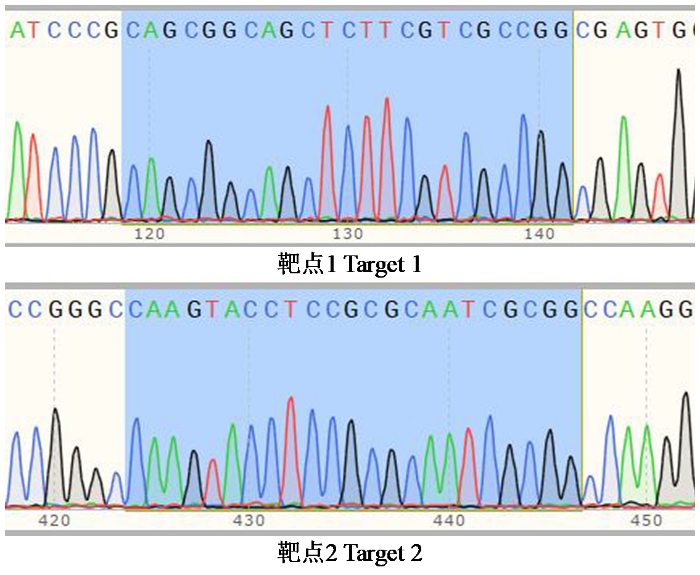
表1 试验所用引物序列
Table 1
| 引物名称Primer name | 引物序列(5′-3′)Primer sequence | 引物用途Purpose |
|---|---|---|
| gR-F-T1 | CAGCGGCAGCTCTTCGTCGCgttttagagctagaaat | 载体构建 |
| OsU6a-R-T1 | GCGACGAAGAGCTGCCGCTGCggcagccaagccagca | 载体构建 |
| gR-F-T2 | CAAGTACCTCCGCGCAATCGgttttagagctagaaat | 载体构建 |
| OsU6b-R-T2 | CGATTGCGCGGAGGTACTTGCaacacaagcggcagc | 载体构建 |
| U-F | CTCCGTTTTACCTGTGGAATCG | 载体构建 |
| gRNA-R | CGGAGGAAAATTCCATCCAC | 载体构建 |
| Pps-R | TTCAGAggtctcT accg ACTAGTATGGAATCGGCAGCAAAGG | 载体构建 |
| Pgs-L | AGCGTGggtctcG ctcg ACGCGTATCCATCCACTCCAAGCTC | 载体构建 |
| SP-L | GCGGTGTCATCTATGTTACTAG | 菌落PCR检测 |
| SP-R | TGCAATAACTTCGTATAGGC | 菌落PCR检测 |
| Cas9-F | AGATGATCGCCAAGTCCGAGC | 转基因阳性株检测 |
| Cas9-R | CTTGATGATGAGGTCCTTCTTG | 转基因阳性株检测 |
| Badh2 -F | TCCATCTCCGTATCTCTCAC | Badh2基因扩增、测序 |
| Badh2-R | TATGGGGGGCTTATACCGAA | Badh2基因扩增、测序 |
| Badh2-RP-F | TTATGGTCTGGCTGGTGCTGT | Badh2基因的荧光定量PCR扩增 |
| Badh2-RP-R | TGCTTGACGCTTAGGTAGTTGT | Badh2基因的荧光定量PCR扩增 |
| Actin-RP | GTACAGTGTCTGGATTGGAGGAT | 水稻内参基因扩增 |
| Actin-FP | GGGTCCGAAGAATTAGAAGCA | 水稻内参基因扩增 |
1.3 转基因材料的创建与检测
1.4 突变类型分析
根据水稻香味基因Badh2序列,在其靶点位置上下游设计特异性测序引物Badh2-F/R,利用DNA聚合酶2×Magic Green Taq SuperMix(TOLOBIo)对基因编辑后代Badh2基因靶点相邻序列进行PCR扩增。经过1.5%琼脂糖凝胶电泳验证PCR扩增产物中的目的条带后,将PCR产物提交至重庆擎科生物技术有限公司进行测序。以野生型优质恢复系QR79的Badh2基因序列为对照,利用Snapgene和DNAMAN等软件工具,对测序数据进行比对与解析。
1.5 通过感官评价试验筛选T0和T1代的香气
香味表型鉴定方法参考文献[14],具体步骤如下:首先,将大约4 g水稻叶片剪碎后置入试管,随后向试管中加入15~20 mL浓度为1.7%的KOH溶液。接着用橡胶塞紧密封闭试管口,在室温(约25 ℃)下浸泡20 min。打开橡胶塞,由5位鉴定人员依次嗅闻其气味,判断是否存在香味。根据5次鉴定结果,若大于3次鉴定结果为香,则汇总记为“香”;若大于3次鉴定结果为不香,则汇总记为“不香”。该方法也被应用于鉴定T1代材料,以确定无转基因成分单株的香味表型。
1.6 Badh2基因表达水平及GABA含量测定
采用Trizol试剂从野生型和转基因突变体植株的分蘖期叶片中提取总RNA,使用反转录试剂盒(Takara)获得第1链cDNA,将cDNA模板稀释至适当倍数后,应用于荧光定量qRT-PCR分析香味基因Badh2的相对表达水平,Actin作为内参基因,通过2-ΔΔCT公式计算基因的相对表达量。采用液相色谱―质谱联用技术(HPLC-MS/MS)检测和分析野生型和突变体植株成熟籽粒中GABA的含量。
1.7 香味物质2AP含量测定
采用气相色谱―质谱联用(GC-MS)仪测定香味物质2AP的含量,以2,4,6,-三甲基吡啶(TMP)作为内标。收获野生型和转基因材料成熟种子,脱壳成糙米,称取3 g大米样品添加到20 mL顶空瓶中,加入3 mL饱和氯化钠进行萃取,同时加入内标(TMP,相对密度1.215 g/mL)盖紧盖子,使用三重四级杆气质联用仪(Trace1310/TSQ 9000,Thermo Scientific)进行检测。气相色谱毛细管色谱柱为TG-5MS(长30 m×内径0.25 mm×膜厚0.25 μm),色谱及质谱条件参照文献[25],检测工作由中山大学生命科学学院水产动物疫病防控与健康养殖全国重点实验室完成。
1.8 突变体株系主要农艺性状考察
2024年夏,在水稻成熟期,分别随机选取野生型和T1代纯合突变且不含Cas9基因的植株,对粒长、粒宽、长宽比、有效穗数、每穗总粒数、千粒重、结实率、整精米率主要农艺性状进行考察和分析。
1.9 数据处理
通过Microsoft Excel进行数据统计和分析。
2 结果与分析
2.1 CRISPR/Cas9表达载体的构建
图2
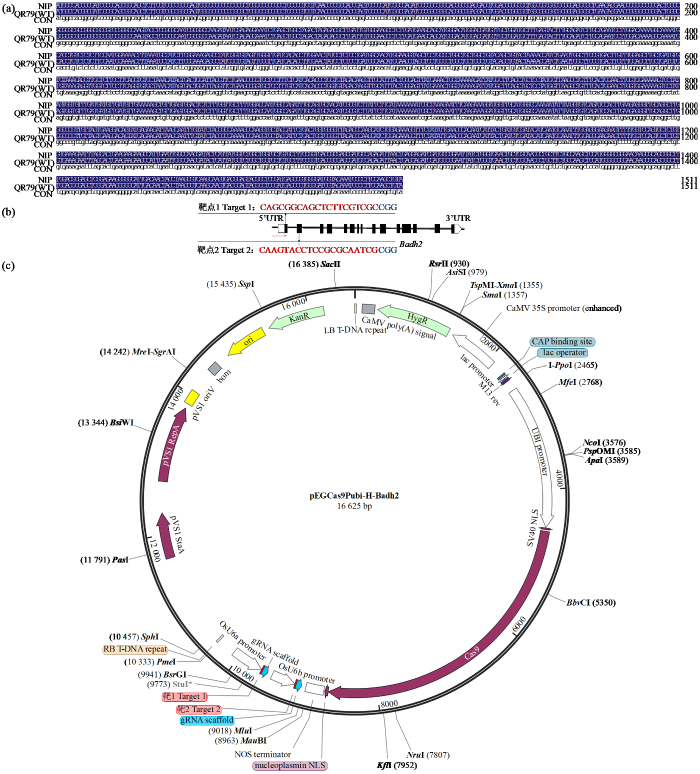
图2
靶位点在Badh2基因上的位置及载体构建图
(a) 优质恢复系QR79香味基因Badh2全长序列对比图,NIP:日本晴,CON:共识序列,下同;(b) 2个靶位点在Badh2基因上的位置,黑色区域为外显子区域,左一为第1外显子,左二为第2外显子,红色序列为靶点序列,蓝色序列为PAM序列;(c) U6a驱动的T1和U6b驱动的T2 2个表达盒在pEGCas9Pubi-H-Badh2载体上的连接顺序。
Fig.2
The position of the target site on the Badh2 gene and the vector construction diagram
(a) full-length sequence alignment of fragrance gene Badh2 in elite restorer line QR79, NIP: Nipponbare, CON: consensus, the same below; (b) positions of two target sites on the Badh2 gene. Black regions represent exons (the leftmost one is Exon 1, the second from the left is Exon 2); red sequences indicate target sequences, and blue sequences denote PAM sequences; (c) assembly order of two expression cassettes (T1 driven by U6a and T2 driven by U6b) on vector pEGCas9Pubi-H-Badh2.
2.2 T0代阳性转基因植株鉴定及靶点突变类型分析
通过农杆菌介导的水稻转化法进行遗传转化,共获得12个独立的T0代转基因植株。分别提取每个转基因植株苗期叶片全基因组DNA,并利用核酸酶Cas9特异性引物Cas9-F/R对DNA进行PCR扩增检测外源基因。根据琼脂糖胶图看出,其中有9个单株为转基因阳性植株,转化率达到75.0%(图3a)。通过设计特异性测序引物Badh2 J-F/R对筛选出的9个阳性转基因植株Badh2基因靶点位置相邻序列进行PCR扩增和测序分析。通过序列对比得出,在9个转基因阳性植株中,有4个单株为杂合突变,分别是J-19(缺失19个碱基)、J-22(插入1个碱基A)、J-23(插入1个碱基T)和J-27(插入1个碱基T);有3个单株为双杂合突变,分别是J-25(插入1个碱基T,缺失8个碱基)、J-26(插入2个碱基T和A)和J-32(插入2个碱基C和A);2个单株为双等位基因纯合突变,分别为J-18(缺失1个碱基)和J-29(靶点上缺失18个碱基,靶点之前缺失3个碱基,共计缺失21个碱基)(图3b~c)。
图3
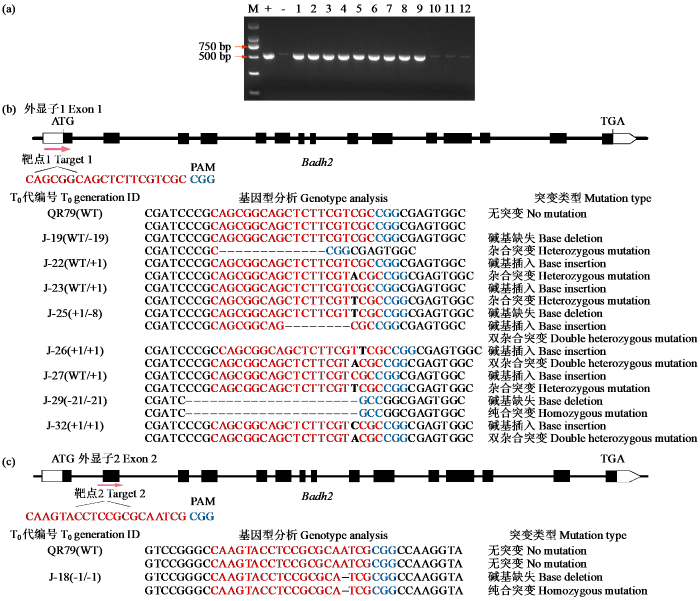
图3
T0代转基因阳性植株鉴定及其突变类型分析
(a) Cas9-F/R引物对T0代阳性转基因植株PCR检测;编号1~12对应材料J-18、J-19、J-22、J-23、J-25、J-26、J-27、J-29、J-32、J-阴-1、J-阴-2、J-阴-3;“+”代表阳性对照,“-”代表阴性对照,M代表2000 bp DNA marker,下同。(b)和(c)分别为基因编辑株系T0代单株靶点1和靶点2突变类型分析;红色字体表示靶点序列,蓝色字体表示PAM序列,“-”表示碱基缺失,黑色加粗表示碱基突变。
Fig.3
Identification of T0 generation transgenic positive plants and analysis of their mutation types
(a) PCR detection of T₀ positive transgenic plants using Cas9-F/R primer pairs; Numbers 1-12 correspond to materials J-18, J-19, J-22, J-23, J-25, J-26, J-27, J-29, J-32, J-Neg-1, J-Neg-2, J-Neg-3;“+”denotes positive control,“-”denotes negative control, and M represents 2000 bp DNA marker, the same below. (b) and (c) Mutation pattern analysis at Target 1 and Target 2 of individual T₀ gene-edited lines, respectively; red fonts indicate target sequences, blue fonts indicate PAM sequences,“-”represents base deletions, and bold black fonts represent base substitutions.
2.3 筛选T1代不含Cas9基因的纯合突变植株
为获得有香味且无转基因载体成分的基因编辑株系,分别单独收取2个T0代纯合突变植株J-18和J-29成熟种子,于2024年夏在转基因试验田种植T1代分离材料,每个株系分别种植16个单株。抽穗期,在2个株系中,分别挑选与野生型长势一致的8个单株提取基因组DNA,利用核酸酶Cas9特异性引物来筛选不含外源转基因载体,在J-18株系挑选的8株中,有1株不含Cas9外源基因;而在J-29株系中挑选的8株中,有2株不含Cas9外源基因(图4a~b)。随后,以野生型作为非香稻对照,大粒香为香稻材料对照,对筛选出来的3株不含外源基因的植株进行香味表型鉴定,结果表明J-18株系中筛选到的1株不含Cas9外源基因植株不具有香味,J-29株系中筛选到的2株不含Cas9外源基因植株具有香味。接着对J-29株系中的2株无Cas9基因有香味的植株对其Badh2基因靶点位置DNA序列进行PCR扩增和测序分析。测序结果(图4c)显示,2株都为纯合突变,与T0代突变一致,在后续的研究中,将其命名为QR79-badh2-1和QR79-badh2-2。在抽穗期,对这2株进行套袋,防止飞花,等到种子成熟后,分别收取进行进一步加代繁殖,并用于后续的功能研究和表型分析。
图4
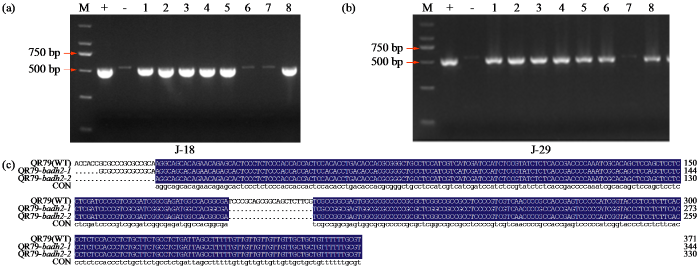
图4
Cas9-F/R引物对T1代基因编辑株系中Cas9基因PCR检测图
(a) 编号1~8对应J-18株系;(b) 编号1~8对应J-29株系;(c) T1代纯合突变植株序列对比图。
Fig.4
The PCR detection diagram of the Cas9 gene in the T1 generation gene-edited lines using the Cas9-F/R primer pair
(a) Number 1-8 correspond to line J-18; (b) Number 1-8 correspond to line J-29; (c) Sequence alignment of homozygous mutant plants in the T₁ generation.
2.4 T1代纯合突变植株Badh2基因表达水平及GABA含量
为了深入探究香味基因Badh2在转基因植株后代的功能特性及其RNA转录层面的表达模式,分别提取野生型QR79和纯合突变体QR79-badh2-1、QR79-badh2-2材料叶片总RNA,并通过荧光定量qRT-PCR技术对Badh2基因进行表达水平分析。根据数据分析(图5a)得出,相较于野生型QR79,突变体中Badh2基因的相对表达量显著降低。表明突变体QR79-badh2材料中Badh2基因的突变是直接导致该基因RNA水平降低的原因。用HPLC-MS/MS对GABA含量检测的结果(图5b)显示,野生型中的GABA含量显著高于突变体中的,表明Badh2基因发生了功能缺失型突变,导致BADH2蛋白失去催化活性,使得AB-ald无法转化为GABA。
图5
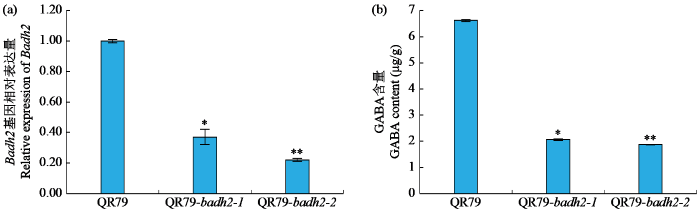
图5
转基因后代中Badh2基因表达水平及GABA含量检测
*:P < 0.05,**:P < 0.01。下同。
Fig.5
Detection of the expression level of the Badh2 gene and the content of GABA in the transgenic offspring
*: P < 0.05, **: P < 0.01. The same below.
2.5 转基因后代香味物质2AP含量
为测定基因编辑品系中香气成分2-AP的浓度,收取纯合突变体植株QR79-badh2-1、QR79- badh2-2与野生型植株的成熟籽粒样本,并利用GC-MS对样本中的2AP含量进行了定量与分析。在此分析过程中,选用了TMP作为内标物,因其分子量及化学属性与GC-MS检测中的2AP相近。检测结果(图6)显示,在野生型QR79的成熟籽粒中,未检测到香气成分2AP的存在;相比之下,编辑品系QR79-badh2-1的成熟籽粒中2AP含量达到了2.2923 μg/kg,显著高于野生型(P<0.05);而在QR79-badh2-2的成熟籽粒中,2AP含量更是高达3.4847 μg/kg,与野生型相比呈现出极显著差异(P<0.01)。上述发现表明,突变体中Badh2基因的突变导致了其表达水平的下调,进而促使香气成分2AP的含量上升,赋予了突变体更为浓郁的香气特征,实现了香味性状的优化。
图6
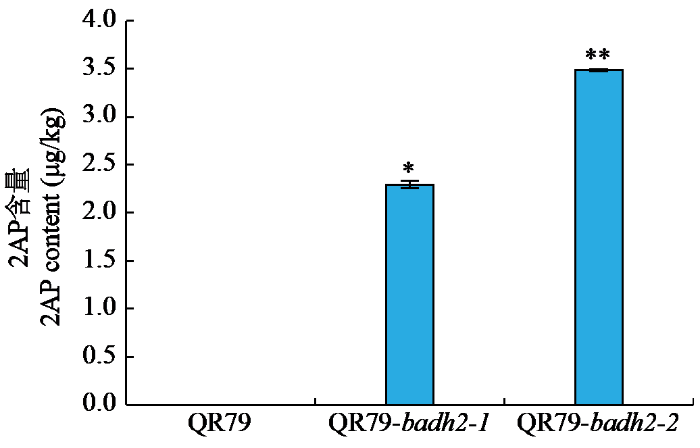
图6
野生型QR79和突变体QR79-badh2成熟籽粒中2AP含量
Fig.6
2AP content in mature grains of wild-type QR79 and the mutant QR79-badh2
2.6 主要农艺性状考察
为研究香味基因Badh2突变后是否对主要农艺性状及产量有影响,针对野生型QR79及其T1代纯合突变体(QR79-badh2-1与QR79-badh2-2),进行了包括粒长、粒宽、长宽比、有效穗数、每穗总粒数、千粒重、结实率以及整精米率等农艺性状的统计分析。由图7可得,相对于野生型,纯合突变体QR79-badh2-1和QR79-badh2-2的千粒重、每穗总粒数、整精米率和结实率无显著差异;粒长显著降低,粒宽显著提高(P<0.05),每穗总粒数有所降低;而突变体QR79-badh2-1长宽比则极显著降低(P<0.01),QR79-badh2-2显著降低(P<0.05)。因此,通过以上数据分析结果可以推断,利用CRISPR/Cas9基因编辑技术对优质恢复系QR79中的香味基因Badh2进行敲除后,可以获得有香味的纯合突变植株,且植株的粒长和结实率等核心农艺性状保持稳定,但产量构成因子受到一定程度影响。在后续育种实践中,可采用回交育种技术与野生型亲本进行多代回交,在田间开展双重筛选:一方面针对目标性状进行定向选择,在保证受体亲本主要农艺性状(株型和产量构成因子等)稳定遗传的前提下,筛选出香味物质含量显著提升的单株;另一方面通过SSR分子标记辅助选择,结合GC-MS技术对2AP等特征香气成分进行定量检测,精准鉴定携带目标香味基因的纯合株系。最终通过系统选育,构建既保持QR79品种原有丰产性和抗逆性等优良特性,又兼具优质香味性状的新种质资源。
图7
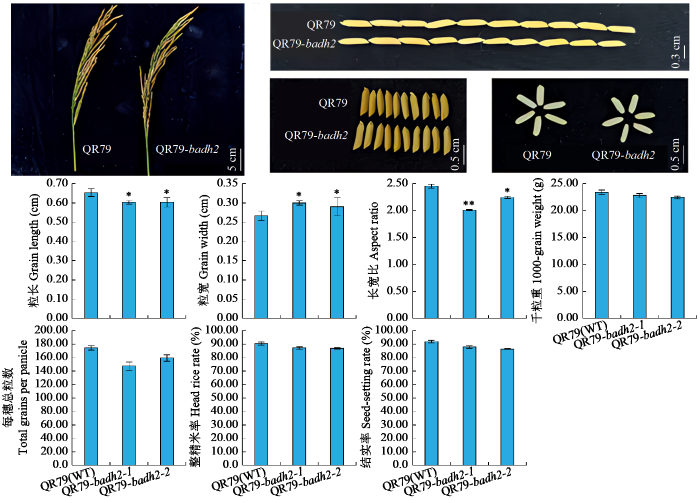
图7
野生型QR79和纯合突变体植株QR79-badh2的表型性状
Fig.7
Phenotypic traits of wild-type QR79 and homozygous mutant plant QR79-badh2
3 讨论
在市场经济环境下,商品的价格由供需关系决定。对于大米而言,香气出众的品种更受消费者喜爱,其市场需求通常较高。然而,由于种植条件、品种特性等因素的限制,优质香气大米的供给量相对有限。这种供不应求的市场态势使得香气优良的大米在价格上具有明显优势[26]。Badh2基因作为调控水稻香气的主要基因,其功能丧失会导致芳香族化合物2AP的积累,从而增强大米的香气,不同类型的Badh2突变会影响2AP的积累水平。CRISPR/ Cas9基因编辑技术凭借其精准高效的基因组编辑能力,在植物育种领域成为传统育种方法的有效替代方案。相较于传统的回交法和诱变育种技术,该技术能够根据实际生产需求及人类改良目标,对任意目标性状进行定向编辑与优化。该技术不仅加速了有利等位基因材料的开发,还促进了新型遗传资源的创造,为新品种的培育提供了高效且创新的策略[27-28]。
CRISPR/Cas9技术已成功应用于改良水稻中的Badh2基因,直接对不同水稻材料中的香味基因Badh2进行敲除或编辑,不仅显著提高了香味物质含量,还获得了适应性广、产量高且品质优良的水稻品种,从而加快育种进程。例如,胡黎明等[29]利用CRISPR/Cas9基因编辑技术对镉吸收转运基因OsNramp5和香味基因OsBadh2同时进行编辑,培育出后代性状稳定的优质低镉水稻品种;李景芳等[30]利用CRISPR/Cas9技术对Badh2和OsRR22基因编辑获得能稳定遗传且无外源基因插入的耐盐香稻材料,加快了水稻多性状聚合的选育进程;黄艳辉[31]以从江老香禾为材料,利用CRISPR/Cas9技术对其SD1和LARGE2基因进行编辑,获得了SD1与LARGE2基因同时突变的从江老香禾新种质;卫正[32]利用CRISPR/Cas9基因编辑技术,分别通过同源重组修复(homology directed repair,HdR)和非同源末端连接(non-homologous end joining,NHEJ)2种途径实现了水稻抗白叶枯病优质种质的创制。
本研究对受体材料质恢复系QR79的Badh2基因进行了全长序列测定,并利用CRISPR/Cas9技术对该基因进行了编辑,成功培育出无外源基因整合且携带香味特征的纯合突变体植株QR79-badh2-1与QR79-badh2-2。2株突变体植株的Badh2基因在第1外显子区域存在18个碱基的缺失,使得突变体中该基因的表达水平相较于野生型显著降低,从而促使突变体籽粒中香味成分2AP的含量大幅增加,赋予了突变体植株籽粒浓郁的香气特征。在T0代中,J-18表现为纯合突变,在T1代中筛选出1株不携带Cas9外源基因的植株,然而通过1.7% KOH的表型鉴定,该植株被判定为非香型。相比之下,同样在T0代表现为纯合突变的J-29,在T1代中筛选出了2株既无Cas9外源基因又保持纯合突变的植株,这2株经1.7% KOH表型鉴定确认为香型。因此,两者的检测结果呈现出明显差异。为进一步验证,采用GC-MS技术对J-29中筛选出的2株无Cas9外源基因植株的香味物质进行了定量分析,结果显示其香味物质2AP含量显著高于野生型(图6),这与先前的1.7% KOH鉴定结果相吻合。至于J-18与J-29后代在表型鉴定上出现的差异,可能源于鉴定过程中人员主观判断的不同,或是由于种植地点的生态条件及种植季节的差异所导致。研究[26,33]表明,香稻的香气特征受生态气候条件、土壤类型、肥料种类、栽培管理实践以及储存方式等因素的影响。
4 结论
通过CRISPR/Cas9基因编辑技术对优质恢复系QR79的Badh2基因进行编辑,利用GC-MS技术测定野生型及突变体材料籽粒中香味物质2AP含量,野生型成熟籽粒2AP的含量为0.0000 μg/kg,纯合突变体植株QR79-badh2-1、QR79-badh2-2成熟籽粒中2AP的含量分别为2.2923和3.4847 μg/kg,实现了香味物质含量的显著提高;成功获得了具有香味、无转基因成分且主要农艺性状未发生显著变化的纯合突变材料,实现了香味成分含量的显著提升,为加速香型籼稻新品种的研发提供了理论依据和遗传资源。
参考文献
Genetic and molecular basis of fragrance in rice
DOI:10.1016/j.biotechadv.2009.04.001
PMID:19371779
[本文引用: 1]

Fragrance or aroma in rice is considered as a special trait with huge economic importance that determines the premium price in global trade. With the availability of molecular maps and genome sequences, a major gene for fragrance (badh2) was identified on chromosome 8. An 8-bp deletion in the exon 7 of this gene was reported to result in truncation of betaine aldehyde dehydrogenase enzyme whose loss-of-function lead to the accumulation of a major aromatic compound, 2-acetyl 1-pyrroline (2AP) in fragrant rice. However, several studies have reported exceptions to this mutation and indicated the involvement of other genetic loci in controlling fragrance trait. These studies emphasize the need to characterize the fragrance and its underlying factors in a wide range of genetic resources available for this trait. This review summarizes the new insights gained on the genetic and molecular understanding of fragrance in rice.
The genetics and biosynthesis of 2-acetyl-1-pyrroline in fragrant rice
Creation of fragrant rice by targeted knockout of the OsBADH2 gene using TALEN technology
DOI:10.1111/pbi.2015.13.issue-6 URL [本文引用: 1]
Science and technology of aroma, flavor and fragrance in rice
Volatile compounds,affecting factors and evaluation methods for rice aroma: a review
2-Acetyl-1-pyrroline: an important aroma component of cooked rice
Rapid gas chromatographic technique for quantifying 2‐acetyl‐1‐pyrroline and hexanal in rice (Oryza sativa L.)
DOI:10.1094/CCHEM.2000.77.4.454
URL
The aroma of rice plays a role in its consumer acceptability. The popcorn‐like smell of aromatic rice stemming primarily from its 2‐ acetyl‐1‐pyrroline (2‐AP) content is considered desirable by many consumers. Conversely, hexanal has been correlated with off odors in rice that develop from lipid oxidation. A rapid method for 2‐AP and hexanal quantification suitable for use in breeding programs, large‐scale research efforts, and quality assurance programs is needed. While developing such a method, sample preparation (degree of milling, particle size), solvent extraction time and temperature, and gas chromatographic parameters were studied. Particle size had no influence on 2‐AP or hexanal recovered. One extraction solubilized ≈80% of the 2‐AP and 56% of the hexanal present in milled rice. The optimum extraction method was assessed to require 0.3 g of ground brown or milled rice in methylene chloride held at 85°C for 2.5 hr. The complete gas chromatographic run requires ≈25 min, and 50 samples can be analyzed per day. The optimized method's linear response (R2 = 0.99) and reproducibility was demonstrated. The stability of 2‐AP and hexanal in frozen milled rice and in refrigerated methylene chloride extracts was excellent for at least six months. Milled and unmilled commercial and breeders' aromatic rice samples contained 10–1,104 ng/g of 2‐AP and 148–2,541 ng/g of hexanal. Genotype had the greatest effect on the 2‐AP and hexanal content of two lines grown over four years and in four states.
Not just a grain of rice: the quest for quality
DOI:10.1016/j.tplants.2008.12.004
PMID:19230745
A better understanding of the factors that contribute to the overall grain quality of rice (Oryza sativa) will lay the foundation for developing new breeding and selection strategies for combining high quality, with high yield. This is necessary to meet the growing global demand for high quality rice while offering producing countries additional opportunities for generating higher export revenues. Several recent developments in genetics, genomics, metabolomics and phenomics are enhancing our understanding of the pathways that determine several quality traits. New research strategies, as well as access to the draft of the rice genome, will not only advance our understanding of the molecular mechanisms that lead to quality rice but will also pave the way for efficient and targeted grain improvement.
The genetic and molecular origin of natural variation for the fragrance trait in an elite Malaysian aromatic rice through quantitative trait loci mapping using SSR and gene-based markers
DOI:10.1016/j.gene.2014.10.048
PMID:25445269
MRQ74, a popular aromatic Malaysian landrace, allows for charging considerably higher prices than non-aromatic landraces. Thus, breeding this profitable trait has become a priority for Malaysian rice breeding. Despite many studies on aroma genetics, ambiguities considering its genetic basis remain. It has been observed that identifying quantitative trait loci (QTLs) based on anchor markers, particularly candidate genes controlling a trait of interest, can increase the power of QTL detection. Hence, this study aimed to locate QTLs that influence natural variations in rice scent using microsatellites and candidate gene-based sequence polymorphisms. For this purpose, an F2 mapping population including 189 individual plants was developed by MRQ74 crosses with 'MR84', a non-scented Malaysian accession. Additionally, qualitative and quantitative approaches were applied to obtain a phenotype data framework. Consequently, we identified two QTLs on chromosomes 4 and 8. These QTLs explained from 3.2% to 39.3% of the total fragrance phenotypic variance. In addition, we could resolve linkage group 8 by adding six gene-based primers in the interval harboring the most robust QTL. Hence, we could locate a putative fgr allele in the QTL found on chromosome 8 in the interval RM223-SCU015RM (1.63cM). The identified QTLs represent an important step toward recognition of the rice flavor genetic control mechanism. In addition, this identification will likely accelerate the progress of the use of molecular markers for gene isolation, gene-based cloning, and marker-assisted selection breeding programs aimed at improving rice cultivars. Copyright © 2014 Elsevier B.V. All rights reserved.
High-quality Italian rice cultivars: chemical indices of ageing and aroma quality
Aroma volatile analyses and 2AP characterization at various develop-mental stages in Basmati and Non-Basmati scented rice (Oryza sativa L.) cultivars
DOI:10.1186/s12284-015-0073-2 URL [本文引用: 1]
Development of an RFLP map from a doubled haploid population in rice
A rapid technique for scent determination in rice
RFLP tagging of a gene for aroma in rice
Badh2,encoding betaine aldehyde dehydrogenase, inhibits the biosynthesis of 2-acetyl- 1-pyrroline,a major component in rice fragrance
DOI:10.1105/tpc.108.058917
URL
[本文引用: 3]
In rice (Oryza sativa), the presence of a dominant Badh2 allele encoding betaine aldehyde dehydrogenase (BADH2) inhibits the synthesis of 2-acetyl-1-pyrroline (2AP), a potent flavor component in rice fragrance. By contrast, its two recessive alleles, badh2-E2 and badh2-E7, induce 2AP formation. Badh2 was found to be transcribed in all tissues tested except for roots, and the transcript was detected at higher abundance in young, healthy leaves than in other tissues. Multiple Badh2 transcript lengths were detected, and the complete, full-length Badh2 transcript was much less abundant than partial Badh2 transcripts. 2AP levels were significantly reduced in cauliflower mosaic virus 35S-driven transgenic lines expressing the complete, but not the partial, Badh2 coding sequences. In accordance, the intact, full-length BADH2 protein (503 residues) appeared exclusively in nonfragrant transgenic lines and rice varieties. These results indicate that the full-length BADH2 protein encoded by Badh2 renders rice nonfragrant by inhibiting 2AP biosynthesis. The BADH2 enzyme was predicted to contain three domains: NAD binding, substrate binding, and oligomerization domains. BADH2 was distributed throughout the cytoplasm, where it is predicted to catalyze the oxidization of betaine aldehyde, 4-aminobutyraldehyde (AB-ald), and 3-aminopropionaldehyde. The presence of null badh2 alleles resulted in AB-ald accumulation and enhanced 2AP biosynthesis. In summary, these data support the hypothesis that BADH2 inhibits 2AP biosynthesis by exhausting AB-ald, a presumed 2AP precursor.
Inactivation of an aminoaldehyde dehydrogenase is responsible for fragrance in rice
Production of aromatic three‐line hybrid rice using novel alleles of BADH2
DOI:10.1111/pbi.v20.1 URL [本文引用: 1]
利用CRISPR-Cas9技术编辑Badh2基因创制优质香型籼稻三系不育系
DOI:10.3724/SP.J.1006.2023.22043
[本文引用: 1]
稻米香味是水稻的重要食味品质之一, 其主要受第8染色体上编码甜菜碱脱氢酶基因Badh2控制, 该基因突变可导致香味物质2-乙酰-1-吡咯啉(2-AP)的含量增加从而促进香味的产生。本研究以三明市农业科学研究院自主选育的优质籼型杂交稻保持系明太B为受体, 利用CRISPR-Cas9技术对其Badh2基因进行编辑和敲除。获得2个T<sub>0</sub>代转基因纯合突变体植株并对其衍生的48个T<sub>1</sub>代单株进行鉴定和分析, 获得1个不含转基因载体骨架且在第2外显子插入单个碱基T的纯合突变体株系明太B-badh2。利用半定量PCR和qRT-PCR技术以及气相色谱质谱联用仪(GC-MS)检测Badh2基因相对表达量和2-AP含量; 同时采用农业行业标准(NY/T 1433-2014)推荐的48对水稻SSR引物进行指纹图谱分析。结果表明, 该株系Badh2基因RNA表达水平显著下调; 籽粒中香味物质2-AP的含量显著增加; 指纹图谱分析发现, 仅1对引物Rm571在野生型和突变体之间鉴定到等位变异, 两组材料遗传差异较小。此外, 本研究还对野生型和突变体T<sub>2</sub>代植株表型性状、稻米蒸煮食味品质和外观品质指标进行了考察和测定分析。结果表明, 所有指标在两组材料间均无显著差异。进一步采用测交和回交转育方法并结合Badh2位点测序分析, 成功选育获得了其对应的纯合香型三系不育系明太A-badh2。通过与恢复系明恢703、明恢3009测配, 其组合产量与国家审定品种明太优703、明太优3009相近且表现出较强的超标优势。此外, 通过与香型恢复系明恢1831测配后发现其组合籽粒中香味物质2-AP含量极显著高于对照组合明太A/明恢1831。因此, 利用CRISPR-Cas9基因编辑技术, 可对水稻香味基因Badh2进行精准定向编辑和敲除, 实现对水稻香味性状的改良, 为创制香型籼稻不育系提供理论指导, 从而加快香型杂交稻育种进程。
Self‐processing of ribozyme‐flanked RNAs into guide RNAs in vitro and in vivo for CRISPR‐mediated genome editing
DOI:10.1111/jipb.v56.4 URL [本文引用: 1]
利用CRISPR/Cas9技术编辑Badh2基因改良粳稻香味
DOI:10.7668/hbnxb.201751503
[本文引用: 1]
CRISPR/Cas9基因编辑技术已经成为水稻育种新型手段,香稻育种一直是水稻育种行业的研究热点,水稻香味主要由8号染色体上的甜菜碱脱氢酶基因Badh2控制。为了改良原有品种的香味性状,促进香稻育种的发展,以非香型粳稻品种东农425为试验材料,构建了2个CRISPR/Cas9敲除载体对Badh2基因进行定点编辑,第1个载体(pYLCRISPR/Cas9-B1-gRNA)的2个靶点分别位于第2和第3外显子上,第2个载体(pYLCRISPR/Cas9-B2-gRNA)的2个靶点均在第2外显子上。采用农杆菌介导法对东农425进行遗传转化,成功获得了T<sub>0</sub>纯合植株,并对其衍生出的T<sub>1</sub>植株进行T-DNA元件检测,共获得8个突变类型不同且不含有转基因成分的纯合突变株系。同时采用咀嚼法和氢氧化钾浸泡法对这8个纯合突变株系的水稻籽粒进行香味检测,结果表明,8个Badh2株系均具有不同程度的香味,总体上载体pYLCRISPR/Cas9-B1-gRNA编辑的3个株系的香味更为浓郁。对这8个纯合突变株系的主要农艺性状进行考察,发现突变株系的穗数、穗粒数、结实率及千粒质量与野生型相比均没有明显差异。综上,本研究对东农425的Badh2基因成功地进行了编辑,并获得了香味显著提高且无转基因成分的纯合突变体材料,为加快香型粳稻品种的培育提供了技术支持。
棉花CRISPR/Cas9基因编辑有效sgRNA高效筛选体系的研究
DOI:10.3724/SP.J.1006.2021.04178
[本文引用: 1]
单向导RNA (sgRNA)是CRISPR/Cas9基因组编辑技术体系的重要元件之一。然而研究显示, 很多sgRNA不能有效工作, 因此需要对多个设计的候选sgRNA进行筛选, 以验证它们的有效性。早期对sgRNA有效性的验证采用的是完整编辑载体瞬时转化原生质体或者叶片的方法。这些方法费时费力, 成功率不高, 尤其是对于原生质体制备效率比较低的棉花。本研究针对GhMAPKKK2和GhAE基因分别设计靶序列, 构建了只转录sgRNA的载体: GhU6-5P::MAPKKK2-sgRNA-1300和GhU6-5P::AE-sgRNA-1300, 并通过农杆菌注射YZ-1 Cas9转基因棉花植株叶片; 与此同时, 构建了对应完整的CRISPR/Cas9 基因组编辑载体: GhU6-5P::MAPKKK2-sgRNA-Cas9和GhU6-5P::AE-sgRNA-Cas9, 并通过农杆菌注射YZ-1野生型棉花植株的叶片。另外, 针对GhPDS、GhCLA1、GhMAPKKK2和GhAE基因分别设计靶序列并构建了GhU6-5P-2::PDS-sgRNA-CLCrVA、GhU6-5P-2::CLA1- sgRNA-CLCrVA、GhU6-5P-2::MAPKKK2-sgRNA-CLCrVA和GhU6-5P-2::AE-sgRNA-CLCrVA病毒投送载体, 通过农杆菌注射YZ-1 Cas9转基因棉花植株叶片。以上试验均以转化对应空载体的植株为对照。对转化后的棉花叶片基因组DNA进行PCR扩增后酶切, 并对未完全消化的PCR产物进行克隆测序, 结果显示, 转化GhU6-5P::AE-sgRNA- 1300、GhU6-5P::MAPKKK2-sgRNA-Cas9、GhU6-5P::AE-sgRNA-Cas9载体的棉花植株均未检测到靶基因突变, 而转化GhU6-5P::MAPKKK2-sgRNA-1300、GhU6-5P-2::PDS-sgRNA-CLCrVA、GhU6-5P-2::CLA1-sgRNA-CLCrVA、GhU6-5P-2::MAPKKK2-sgRNA-CLCrVA和GhU6-5P-2::AE-sgRNA-CLCrVA载体的Cas9转基因阳性植株基因序列发生了改变, 突变类型包括碱基替换、碱基缺失和碱基插入。表明以Cas9转基因阳性植株为转化受体的策略可以高效真实地验证sgRNA的有效性, 排除了因转化效率低而带来的假阴性的结果, 且病毒载体投送sgRNA的策略更高效、更准确。该sgRNA高效验证体系的建立, 为棉花功能基因组学研究提供了重要的技术基础。
基于CRISPR/Cas9技术创制耐盐香稻
DOI:10.16819/j.1001-7216.2023.220907
[本文引用: 1]
【目的】 为了促进耐盐香稻育种,利用CRISPR/Cas9系统对粳稻品种连粳11的Badh2和OsRR22基因进行编辑,以期快速获得一批不含有转基因成分且具有耐盐性和香味的纯合水稻材料。【方法】 根据Badh2和OsRR22基因序列中编辑位点的敲除效率设计靶位点,构建pH-Ubi-Cas9-Badh2-OsRR22敲除载体,利用农杆菌介导法转入受体品种连粳11中。对转基因后代进行潮霉素和Cas9标记PCR检测以及靶基因测序,获得无外源基因插入的badh2-osrr22纯合株系,并对后代种子性状和苗期耐盐性进行分析。【结果】 T<sub>2</sub>代成熟种子中2-AP含量较背景材料连粳11显著增加,千粒重、粒长、粒宽无明显变化;128 mmol/L氯化钠处理14 d后株系21-30较连粳11苗高增加15.2%,苗鲜质量增加45.2%,苗干质量增加13.2%。【结论】 利用CRISPR/Cas9技术对Badh2和OsRR22基因编辑获得能稳定遗传且无外源基因插入的耐盐香稻材料,加快了水稻多性状聚合的选育进程。
High-throughput profiling of off-target DNA cleavage reveals RNA-programmed Cas 9 nuclease specificity
DOI:10.1038/nbt.2673
PMID:23934178
[本文引用: 1]
The RNA-programmable Cas9 endonuclease cleaves double-stranded DNA at sites complementary to a 20-base-pair guide RNA. The Cas9 system has been used to modify genomes in multiple cells and organisms, demonstrating its potential as a facile genome-engineering tool. We used in vitro selection and high-throughput sequencing to determine the propensity of eight guide-RNA:Cas9 complexes to cleave each of 10(12) potential off-target DNA sequences. The selection results predicted five off-target sites in the human genome that were confirmed to undergo genome cleavage in HEK293T cells upon expression of one of two guide-RNA:Cas9 complexes. In contrast to previous models, our results show that guide-RNA:Cas9 specificity extends past a 7- to 12-base-pair seed sequence. Our results also suggest a tradeoff between activity and specificity both in vitro and in cells as a shorter, less-active guide RNA is more specific than a longer, more-active guide RNA. High concentrations of guide-RNA:Cas9 complexes can cleave off-target sites containing mutations near or within the PAM that are not cleaved when enzyme concentrations are limiting.
Multigene knockout utilizing off-target mutations of the CRISPR/Cas9 system in rice
DOI:10.1093/pcp/pcu154
PMID:25392068
[本文引用: 1]
The clustered regularly interspaced short palindromic repeat (CRISPR)-associated endonuclease 9 (CRISPR/Cas9) system has been demonstrated to be a robust genome engineering tool in a variety of organisms including plants. However, it has been shown that the CRISPR/Cas9 system cleaves genomic DNA sequences containing mismatches to the guide RNA strand. We expected that this low specificity could be exploited to induce multihomeologous and multiparalogous gene knockouts. In the case of polyploid plants, simultaneous modification of multiple homeologous genes, i.e. genes with similar but not identical DNA sequences, is often needed to obtain a desired phenotype. Even in diploid plants, disruption of multiparalogous genes, which have functional redundancy, is often needed. To validate the applicability of the CRISPR/Cas9 system to target mutagenesis of paralogous genes in rice, we designed a single-guide RNA (sgRNA) that recognized 20 bp sequences of cyclin-dependent kinase B2 (CDKB2) as an on-target locus. These 20 bp possess similarity to other rice CDK genes (CDKA1, CDKA2 and CDKB1) with different numbers of mismatches. We analyzed mutations in these four CDK genes in plants regenerated from Cas9/sgRNA-transformed calli and revealed that single, double and triple mutants of CDKA2, CDKB1 and CDKB2 can be created by a single sgRNA.© The Author 2014. Published by Oxford University Press on behalf of Japanese Society of Plant Physiologists.


