Crops ›› 2026, Vol. 42 ›› Issue (1): 175-181.doi: 10.16035/j.issn.1001-7283.2026.01.022

Previous Articles     Next Articles

Effects of Maize-Soybean and Wheat-Soybean Rotation Modes on Weed Occurrence Regularity in Soybean Field

Wang Yu1,2(), Wang Jinsheng1,3, Wang Xiaoxi1,2, Ma Li1,3, Wang Keqin1,2, Wang Chun1,2, Liu Xinglong1,2(), Wu Junjiang1,3(), Li Mukai4   

  1. 1Heilongjiang Academy of Agricultural Sciences, Harbin 150086, Heilongjiang, China
    2Scientific Observing and Experimental Station of Crop Pests in Harbin, Ministry of Agriculture and Rural Affairs, Harbin 150086, Heilongjiang, China
    3Key Laboratory of Soybean Cultivation, Ministry of Agriculture and Rural Affairs /Heilongjiang Provincial Key Laboratory of Soybean Cultivation, Harbin 150086, Heilongjiang, China
    4College of Agriculture, Heilongjiang Bayi Agricultural University, Daqing 163319, Heilongjiang, China
  • Received:2024-08-28 Revised:2024-09-09 Online:2026-02-15 Published:2026-02-10

Abstract:

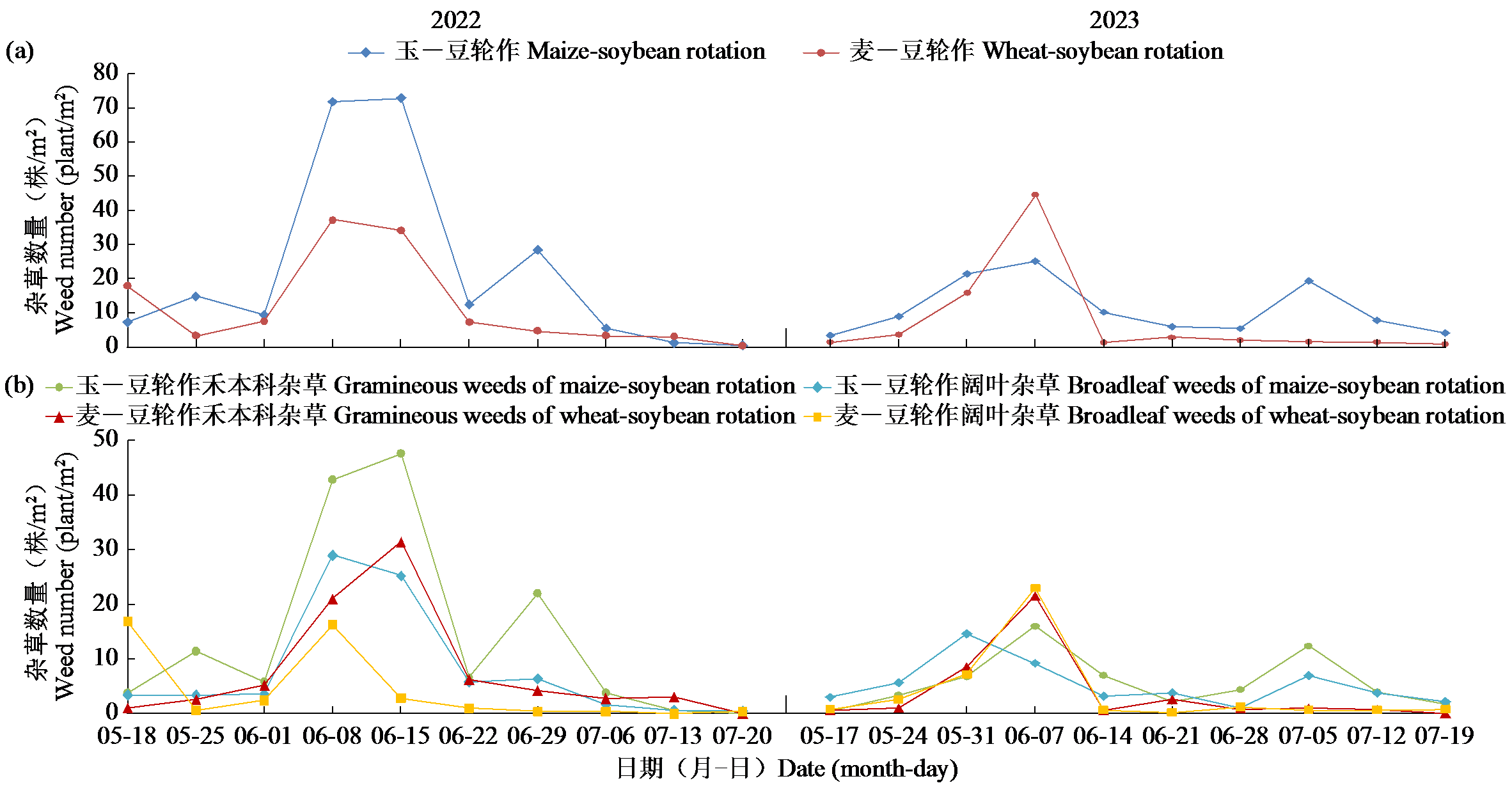
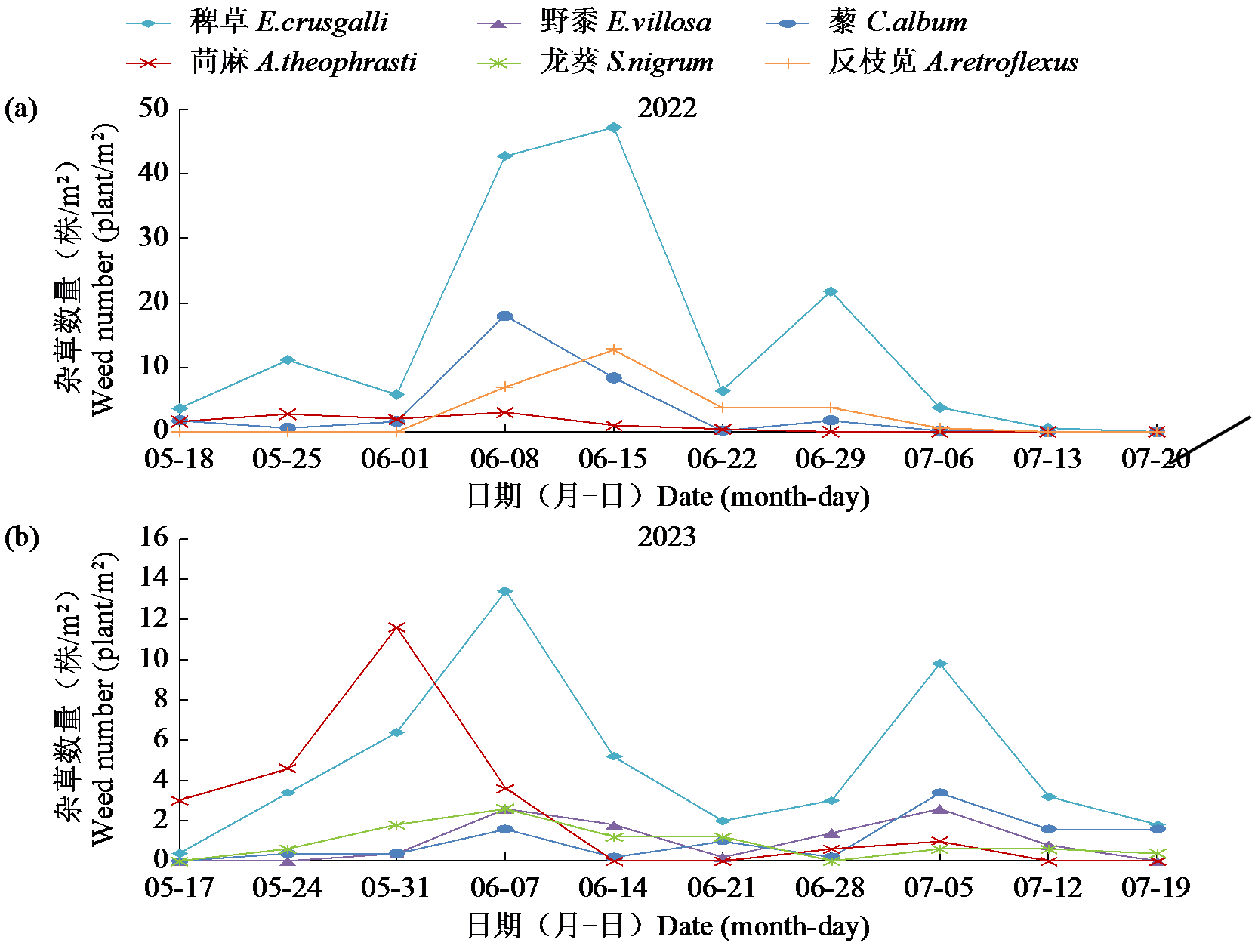
In order to precisely formulate weed control strategies for soybean field under maize-soybean and wheat-soybean rotation modes, the species and quantities of weeds were investigated in these two rotation modes. The results showed that during the two-year experiment, the weed occurrence in the maize-soybean rotation mode was 1.89 and 1.49 times higher than that in the wheat-soybean rotation mode, respectively. In the maize-soybean rotation mode, a total of 11 weed species were consistently observed over the two years, including two gramineous weeds and nine broadleaf weeds. The dominant weed species were the gramineous Echinochloa crusgalli and the broadleaf Chenopodium album and Abutilon theophrasti. The subdominant species were the gramineous Eriochloa villosa and the broadleaf Amaranthus retroflexus and Solanum nigrum. For the wheat-soybean rotation mode, eight weed species were commonly observed over the two years, including two gramineous weeds and six broadleaf weeds. The dominant species included the gramineous E.crusgalli and the broadleaf C.album and A.theophrasti, while the subdominant species was the broadleaf Solanum nigrum. The maize-soybean rotation mode exhibited two weed occurrence peaks: one from late May to mid-June, and another from late June to early July, with the weed occurrence during the first peak period being greater than that during the second. Conversely, the wheat-soybean rotation mode showed only one weed occurrence peak, primarily concentrated in early to mid-June.

Key words: Soybean field, Rotation, Weed species, Dominant weed species, Weed occurrence regularity

Table 1

Species and life forms of weeds in soybean field under different rotation modes"


Family

Genus
杂草
Weed
生活型
Life form
种群密度(株/m2
Population density (plant/m2)
2022 2023
玉―豆
Maize-
soybean
麦―豆
Wheat-
soybean
玉―豆
Maize-
soybean
麦―豆
Wheat-
soybean
禾本科Poaceae 稗属Echinochloa 稗草 [Echinochloa crusgalli (L.) Beauv.] 一年生草本 143.2 76.8 48.6 37.2
野黍属Eriochloa 野黍 [Eriochloa villosa (Thunb.) Kunth] 一年生草本 1.2 0.6 9.8 0.4
藜科Chenopodiaceae 藜属Chenopodium 藜 [Chenopodium album L.] 一年生草本 32.6 32.4 10.4 10.0
锦葵科Malvaceae 苘麻属Abutilon 苘麻 [Abutilon theophrasti Medicus] 一年生草本 10.8 6.6 24.4 4.6
木槿属Hibiscus 野西瓜苗 [Hibiscus trionum L.] 一年生草本 0.6
苋科Amaranthaceae 苋属Amaranthus 反枝苋 [Amaranthus retroflexus L.] 一年生草本 28.0 2.2
茄科Solanaceae 茄属Solanum 龙葵 [Solanum nigrum L.] 一年生草本 1.2 0.6 9.0 17.8
马齿苋科Portulacaceae 马齿苋属Portulaca 马齿苋 [Portulaca oleracea L.] 一年生草本 3.6 1.6 0.2
唇形科Lamiaceae 水棘针属Amethystea 水棘针 [Amethystea caerulea L.] 一年生草本 0.2 0.6 1.0 3.4
蓼科Polygonaceae 蓼属Polygonum 本氏蓼 [Polygonum bungeanum Turcz.] 一年生草本 0.4 0.2 2.4 1.4
萹蓄 [Polygonum aviculare L.] 一年生草本 0.4
菊科Asteraceae 鬼针草属Bidens 狼耙草 [Bidens tripartita L.] 一年生草本 1.2 0.2
苍耳属Xanthium 苍耳 [Xanthium sibiricum Patrin ex Widder] 一年生草本 0.2
蓟属Cirsium 刺儿菜 [Cirsium setosum (Willd.) M.Bieb] 多年生草本 0.6
大戟科Euphorbiaceae 铁苋菜属Acalypha 铁苋菜 [Acalypha australis L.] 一年生草本 0.4 0.2 1.0 0.2
萝藦科Asclepiadaceae 萝藦属Metaplexis 萝藦 [Metaplexis japonica (Thunb.) Makino] 多年生草本 0.6 0.2
合计Total 223.8 118.4 111.8 75.2

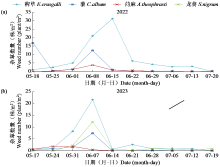
Fig.1

Weed occurrence dynamics of two rotation modes in soybean field"

Table 2

Analysis of dominant weeds in soybean field under two rotation modes"

杂草类型
Weed
type
杂草种类
Weed
species
玉―豆轮作Maize-soybean rotation 麦―豆轮作Wheat-soybean rotation
密度
Density
频度
Frequency
相对优势度
Relative abundance
密度
Density
频度
Frequency
相对优势度
Relative abundance
2022 2023 2022 2023 2022 2023 2022 2023 2022 2023 2022 2023
禾本科杂草
Gramineous weed
稗草 143.2 48.6 76 82 90.9 69.1 76.8 37.2 24 58 87.1 82.4
野黍 1.2 9.8 12 36 4.8 20.0 0.6 0.4 2 4 2.4 2.8
阔叶杂草
Broadleaf weed
32.6 10.4 52 48 33.0 24.3 32.4 10.0 36 26 60.7 28.1
苘麻 10.8 24.4 38 46 18.3 36.2 6.6 4.6 26 28 29.6 22.0
反枝苋 28.0 2.2 42 14 27.4 6.3
马齿苋 3.6 1.6 20 8 8.7 3.9 0.2 2 1.4
龙葵 1.2 9.0 12 42 4.8 21.2 0.6 17.8 6 36 6.1 44.1
水棘针 0.2 1.0 2 10 0.8 4.0 0.6 3.4 6 12 6.1 11.3
本氏蓼 0.4 2.4 4 14 1.6 6.5 0.2 1.4 2 8 2.0 6.4
铁苋菜 0.4 1.0 4 10 1.6 4.0 0.2 0.2 2 2 2.0 1.4
狼耙草 1.2 0.2 12 2 4.8 0.8 0.2 2 2.0
萝藦 0.6 4 1.7
萹蓄 0.4 4 1.6
苍耳 0.2 2 2.0
野西瓜苗 0.6 4 1.8
刺儿菜 0.6 4 1.8

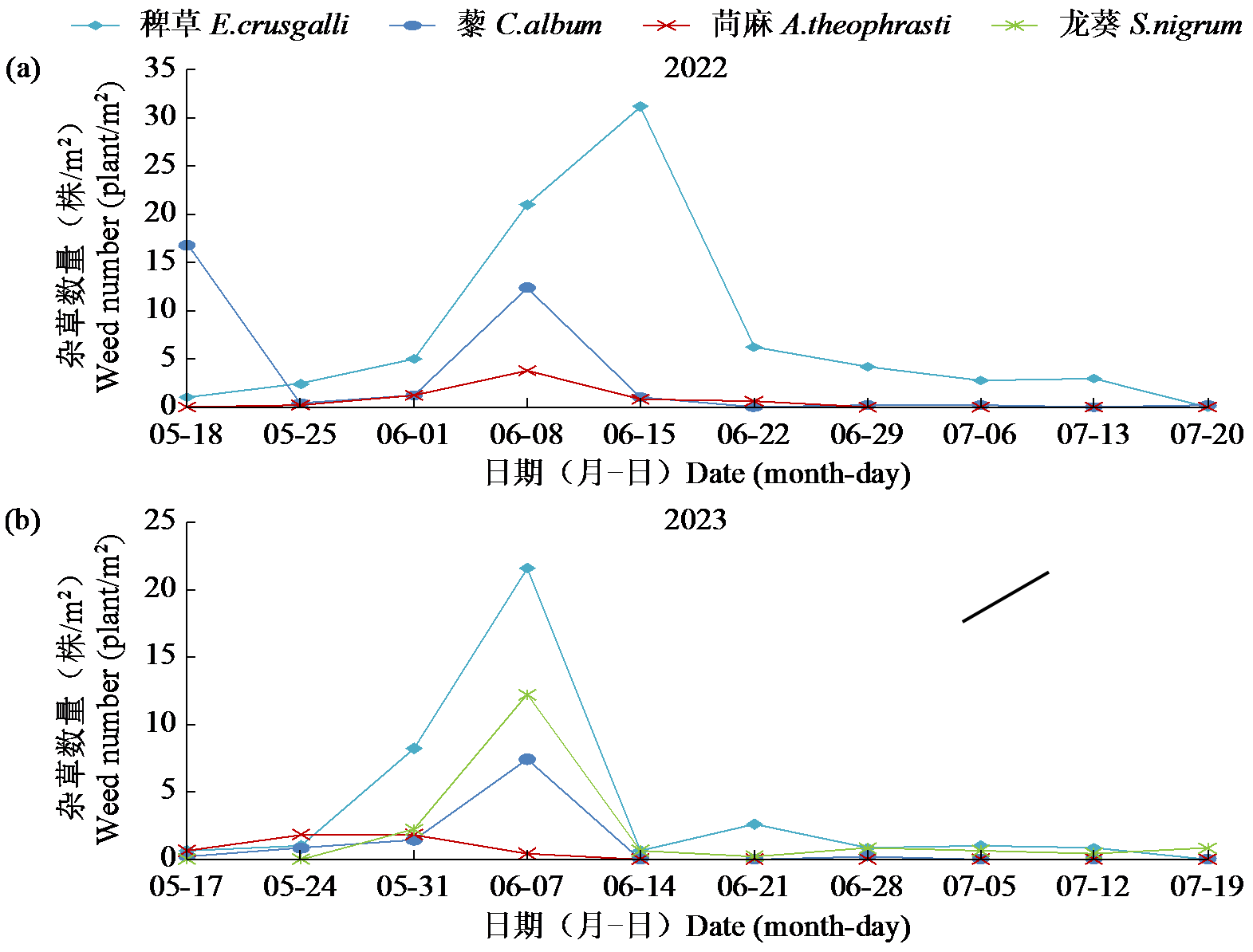
Fig.2

Dominant weeds occurrence dynamics of maize-soybean rotation mode in soybean field"

Fig.3

Dominant weeds occurrence dynamics of wheat-soybean rotation mode in soybean field"

[1] 王金生, 闫晓艳, 吴俊江, 等. 大豆营养高效利用型品种筛选. 大豆科学, 2020, 39(5):696-702.
[2] 王婉, 刘鑫磊, 孙君明, 等. 大豆新品种黑农84品质性状的环境稳定性分析. 大豆科学, 2024, 43(1):1-12.
[3] 刘忠堂. 再谈我国大豆发展问题. 大豆科技, 2012(6):4-6.
[4] Zhang W W, Feng Z Z, Wang X K, et al. Quantification of ozone exposure- and stomatal uptake-yield response relationships for soybean in Northeast China. Science of the Total Environment, 2017(599/600):710-720.
[5] 国家统计局.中国统计年鉴2022. 北京: 中国统计出版社, 2022.
[6] She S Y, Niu J J, Zhang C, et al. Significant relationship between soil bacterial community structure and incidence of bacterial wilt disease under continuous cropping system. Archives of Microbiology, 2017, 199(2):267-275.
doi: 10.1007/s00203-016-1301-x pmid: 27699437
[7] 陈雪丽, 王玉峰, 李伟群, 等. 黑土区连作大豆根际微生物群落结构的动态变化. 大豆科学, 2018, 37(5):748-755.
[8] Wang Y Z, Xu X M, Liu T M, et al. Analysis of bacterial and fungal communities in continuous-cropping ramie (Boehmeria nivea L. Gaud) fields in different areas in China. Scientific Reports, 2020, 10(1):3264.
doi: 10.1038/s41598-020-58608-0
[9] 刘兴龙, 王克勤, 王晓曦, 等. 不同秸秆还田模式对亚洲玉米螟发生及玉米产量的影响. 黑龙江农业科学, 2023(4):31-35.
[10] 程传鹏, 潘俊峰, 万开元, 等. 轮作对农田杂草的影响研究进展. 中国农学通报, 2013, 29(30):1-9.
[11] 王康君, 陈凤, 樊继伟, 等. 小麦化感作用的研究进展与展望. 农业科技通讯, 2018(2):7-11.
[12] 邢海峰, 高翠萍, 王雪寅, 等. 三周龄小麦地上部浸提液对农田杂草的化感作用研究. 沈阳农业大学学报, 2022, 53(3):294-301.
[13] 王洪武. 黑龙江省三江平原玉米-大豆轮作模式下田间杂草分布与防除. 园艺与种苗, 2023, 43(7):88-90.
[14] 魏守辉, 强胜, 马波, 等. 不同作物轮作制度对土壤杂草种子库特征的影响. 生态学杂志, 2005(4):385-389.
[15] 黄春艳, 王宇, 黄元炬, 等. 不同耕作模式对玉米田杂草发生规律的影响. 玉米科学, 2010, 18(4):103-107,111.
[16] 殷红, 刘芳, 李建东, 等. 不同种植方式春玉米田杂草的生态经济阈值研究. 作物杂志, 2009(6):49-52.
[17] 王宇, 郭玉莲, 罗婵, 等. 不同秸秆还田模式对玉米田杂草发生规律的影响. 黑龙江农业科学, 2022(3):38-42.
[18] 于乐, 李林, 黄红娟, 等. 湖北省玉米田杂草种类组成及群落特征. 作物杂志, 2023(5):272-279.
[19] 于博, 王钰艳, 任琴, 等. 秸秆还田对土壤结构和春玉米生长的影响. 浙江农业学报, 2023, 35(10):2446-2455.
doi: 10.3969/j.issn.1004-1524.20221624
[20] 李瑞平, 罗洋, 郑洪兵, 等. 吉林省中部玉米秸秆还田方式对出苗及苗期生长发育的影响. 农业与技术, 2020, 40(18):6-8.
[21] 高盼, 刘玉涛, 徐莹莹, 等. 秸秆覆盖与翻埋两种还田模式对农田土壤物理性质及玉米产量的影响. 黑龙江农业科学, 2021(11):13-17.
[22] 丁奠元, 冯浩, 赵英, 等. 氨化秸秆还田对土壤孔隙结构的影响. 植物营养与肥料学报, 2016, 22(3):650-658.
[1] Zhu Jianguo, Cui Zhengguo, Zhang Bo, Wang Xueduan, Zhang Yueming, Lü Xiaofei, Wang Hongyu, Li Qiuzhu, Cui Jinhu. Effects of Corn-Peanut-Foxtail Millet Rotation on Soil Microecology, Yield, and Benefits in Sandy Saline-Alkali Lands of Jilin Province [J]. Crops, 2025, 41(5): 19-28.
[2] Wang Ziyi, Han Wei, Jin Hongbiao, Huang Xiumei, Zhang Fenglan, Yang Zhongren. The Effects of Different Rotation Patterns on the Structure and Function of Fungal Communities in Potato Rhizosphere Soil in High-Altitude Black Soil Areas [J]. Crops, 2025, 41(5): 221-232.
[3] Lü Weisheng, Wang Xinyue, Chen Ming, Deng Xueyun, Zhang Chen, Li Zijing, Luo Junyuan, Liu Xiaosan, Xiao Guobin. The Effect and the Residual Effect of Special Controlled-Release Nitrogen Fertilizer for Rapeseed (Brassica napus L.) under Rapeseed-Sesame Rotation System in Red-Soil Dryland [J]. Crops, 2024, 40(6): 113-119.
[4] Zhang Yulin, Du Yi, Chai Xutian, Li Xiangyi, Lu Yan, Zhang Zhihao, Zeng Fanjiang. Responses of Forage Grass Ion Characteristics and Root Nutrients of the Cyperus esculentus to Different Planting Patterns at Different Growth Stages [J]. Crops, 2024, 40(1): 104-110.
[5] Zhang Dongxu, Hu Danzhu, Yan Jinlong, Feng Liyun, Wu Zhiyuan, Zhang Junling, Li Yanhua. Effects of Spraying Streptomyces on Yield and Photosynthetic Characteristics of Late-Sown Wheat under Different Crop Rotations [J]. Crops, 2023, 39(5): 255-263.
[6] Guo Shuya, Shang Shang, Tang Qining, Zhang Yan, Lu Guangyuan. Effects of Different Rotation Tillage Methods and Biochar on Soil Enzyme Activity, Soil Nutrients and Yield of Wheat and Maize [J]. Crops, 2022, 38(3): 211-217.
[7] Long Ruiping, Zhang Chaozhong, Ge Qinying, Wan Weidong, Wang Qin, Li Guiyong, Xia Qiongmei, Zhu Haiping, Yang Congdang. Analysis of Growth Characteristics and Economic Benefit of Mechanical Transplanted Japonica Rice with Applying Panicle Nitrogen under Rotation of Paddy-Upland [J]. Crops, 2022, 38(1): 124-129.
[8] Liu Yajun, Wang Wenjing, Wang Honggang, Wang Qi, Hu Qiguo, Chu Fengli. Effects of Crop Rotation on Soil Microbial Community in Sweet Potato Field [J]. Crops, 2021, 37(6): 122-128.
[9] Hu Qiguo, Liu Yajun, Wang Wenjing, Wang Qi, Wang Honggang, Chu Fengli. Effects of Sweet Potato Rotation and Intercropping on the Microbial Community of Rhizosphere Soil [J]. Crops, 2021, 37(5): 153-159.
[10] Fan Yegeng, Chen Rongfa, Yan Haifeng, Zhou Huiwen, Weng Mengling, Huang Xing, Luo Ting, Zhou Zhongfeng, Qiu Lihang, Wu Jianming. Effects of Sugarcane Rotation Green Fodder Corn and Peanut on Sugarcane Growth and Soil Properties [J]. Crops, 2021, 37(1): 104-111.
[11] Liu Jiamin, Wang Yang, Chu Xu, Qi Xin, Wang Manman, Zhao Ya'nan, Ye Youliang, Huang Yufang. Effects of Planting Density and Nitrogen Application Rate on Annual Yield and Nitrogen Use Efficiency of Wheat-Maize Rotation System [J]. Crops, 2021, 37(1): 143-149.
[12] Song Qiulai, Wang Qi, Feng Yanjiang, Sun Yu, Zeng Xiannan, Lai Yongcai. Effects of Paddy-Upland Rotation and Straw Returning on Soil Related Enzyme Activities in Cold Region [J]. Crops, 2020, 36(3): 149-153.
[13] Gu Kejun,Gu Dongxiang,Zhang Simei,Zhang Chuanhui,Zhang Henggan,Wu Jingjing,Fan Pingsheng. Short-Term Effects of Tillage and Organic Fertilizer Application on Soil Characters and Annual Rice-Wheat Yield in Coastal Low- and Medium-Yield Farmland of the Old Yellow River [J]. Crops, 2020, 36(1): 76-80.
[14] Chen Li,Zhang Luxin,Wu Feng,Li Zhen,Long Xingzhou,Yang Yurui,Yin Baozhong. Effects of Wheat-Maize Double Crops Rotational Tillage on Soil Characteristics and Crop Yield in Hebei Plain [J]. Crops, 2019, 35(5): 143-150.
[15] Zhang Haibin,Meng Meilian,Liu Kunyu,Zhang Lingxiang,Chen Youjun. Effects of Different Rotation Patterns on Dry Matter Accumulation, Disease Occurrence and Yield of Potato [J]. Crops, 2019, 35(4): 170-175.
Viewed
Full text


Abstract

Cited

  Shared   
  Discussed   
No Suggested Reading articles found!