

作物杂志,2026, 第1期: 240–248 doi: 10.16035/j.issn.1001-7283.2026.01.030
施氮量对小麦籽粒主要矿质元素含量的影响和有效性分析
王云江1,2( ), 王玉莹1, 刘畅1,2, 敬雪妍1,2, 羊辰1,2, 孙彩霞3(), 王春平1,2()
- 1河南科技大学农学院,471000,河南洛阳
2神农种业实验室,450000,河南郑州
3博爱县农业机械技术中心,454000,河南焦作
Effects of Nitrogen Application Rate on Major Mineral Element Content and Bioavailability in Wheat Grains
Wang Yunjiang1,2(), Wang Yuying1, Liu Chang1,2, Jing Xueyan1,2, Yang Chen1,2, Sun Caixia3(), Wang Chunping1,2()
- 1College of Agriculture, Henan University of Science and Technology, Luoyang 471000, Henan, China
2The Shennong Laboratory, Zhengzhou 450000, Henan, China
3Bo?ai County Agricultural Machinery Technology Center, Jiaozuo 454000, Henan, China
摘要:
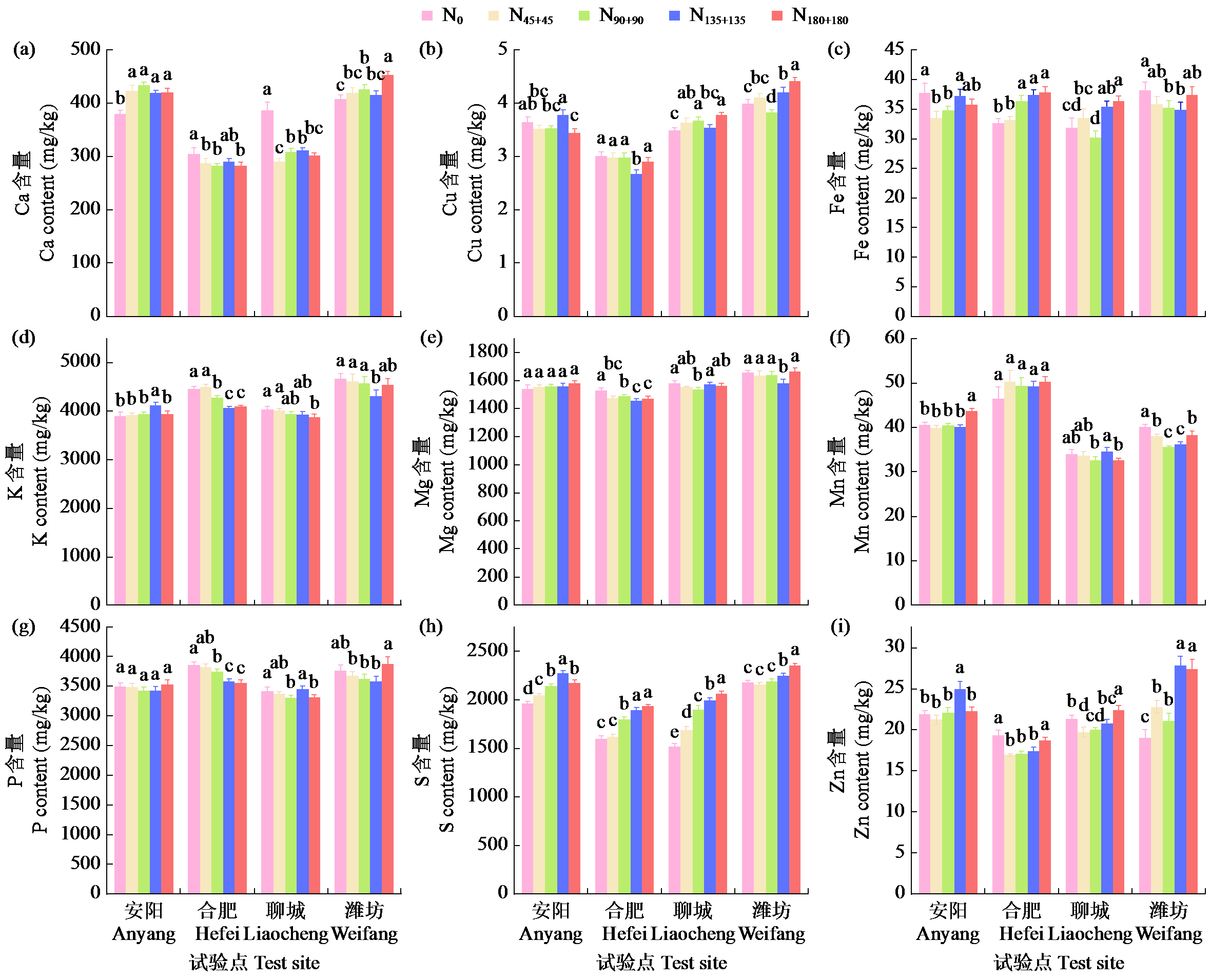
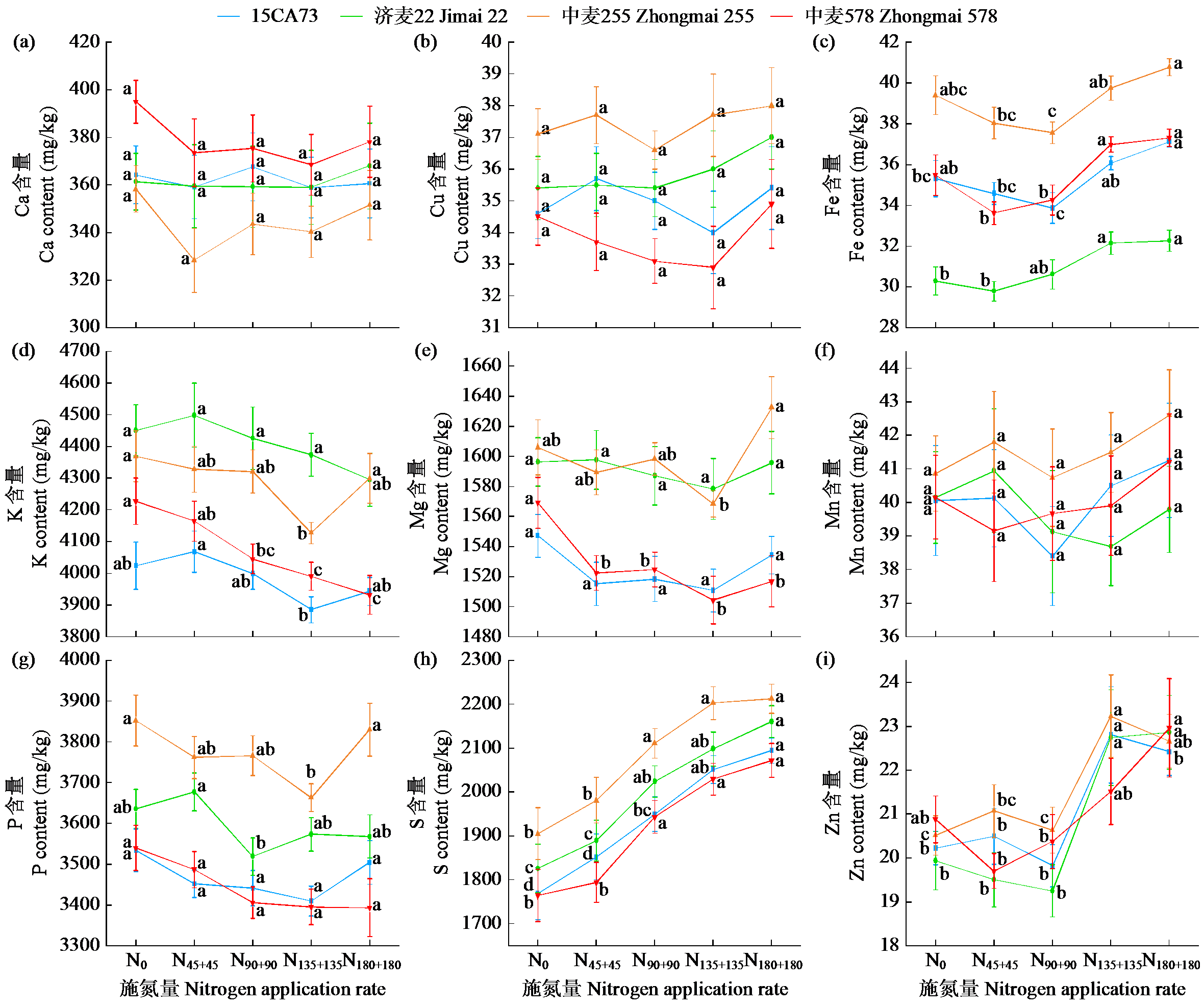
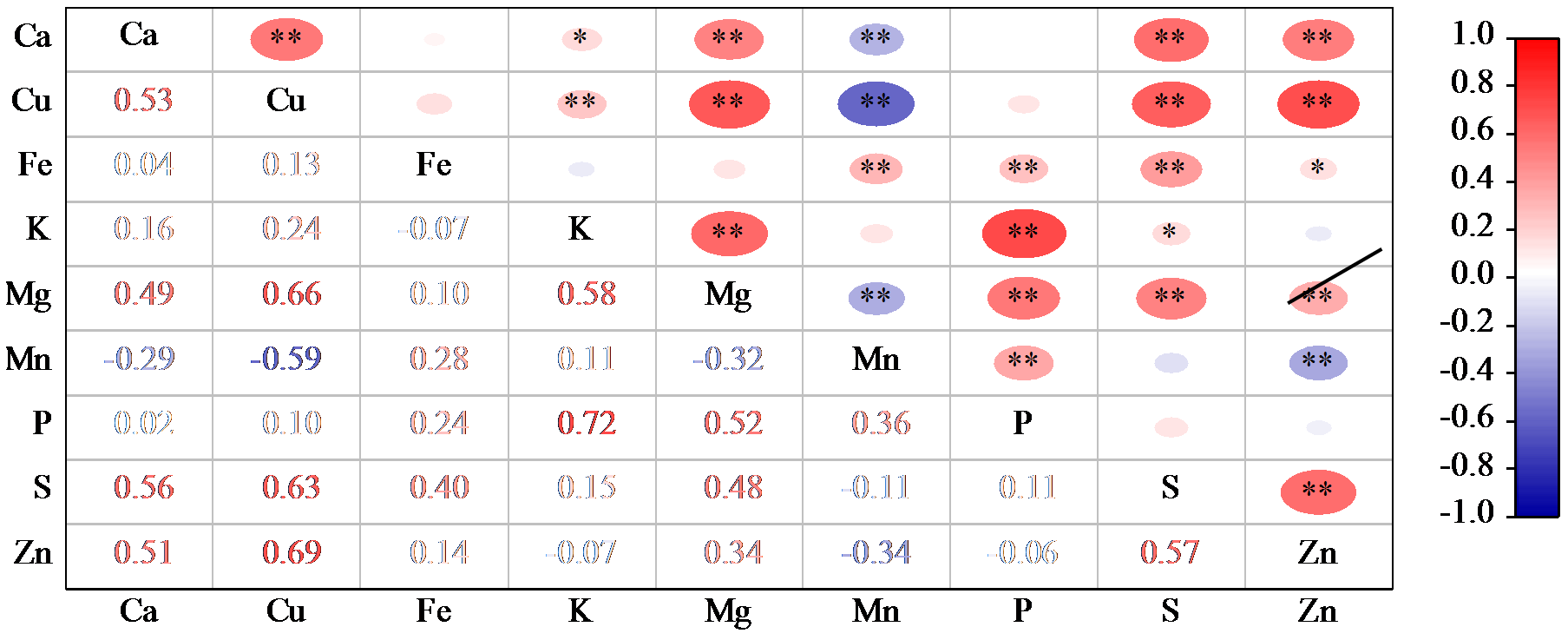
探究不同环境下小麦品种的最佳施氮量,为提升小麦籽粒矿质元素含量提供科学依据。以15CA73、济麦22、中麦255和中麦578为材料,在河南安阳、安徽合肥、山东潍坊和聊城4个环境设置5种氮处理:不施氮(N0)、基施纯氮45 kg/hm2+拔节期追施纯氮45 kg/hm2(N45+45)、基施纯氮90 kg/hm2+拔节期追施纯氮90 kg/hm2(N90+90)、基施纯氮135 kg/hm2+拔节期追施纯氮135 kg/hm2(N135+135)以及基施纯氮180 kg/hm2+拔节期追施纯氮180 kg/hm2(N180+180)。结果表明,籽粒中K和P(r=0.72)、Zn和Cu(r=0.69)等元素含量间相关系数较高,达极显著水平(P<0.01)。与N0处理相比,N180+180处理下潍坊试验点小麦籽粒中Ca、Cu、Mg和S含量在各环境中最高,分别提高了11.06%、10.78%、0.15%和7.83%,N135+135处理下潍坊试验点Zn含量最高,提高了46.01%。与N0处理相比,N180+180处理下中麦255籽粒Cu、Fe、Mg、Mn和S含量在各参试品种中最高,分别提高了2.42%、3.50%、1.65%、4.23%和16.10%;N135+135处理下中麦255籽粒Zn含量最高,提高了13.26%。综上,增施氮肥提高了小麦籽粒Ca、Cu、Fe、Mn、S、Mg和Zn含量,K含量受施氮量影响较小,P含量有下降趋势;同时降低了P/Mg、P/Fe和P/Zn值,使籽粒中Mg、Fe和Zn的生物有效性得到进一步提升。在安阳、合肥、聊城和潍坊试验点种植小麦推荐的最佳氮肥处理分别为N135+135、N0、N180+180和N180+180。15CA73和济麦22的最佳氮肥处理为N0,中麦255和中麦578的最佳氮肥处理为N180+180。

| [1] |
崔振坤, 于振文, 石玉, 等. 水氮运筹对小麦光合物质生产和产量的影响. 应用生态学报, 2024, 35(6):1564-1572.
doi: 10.13287/j.1001-9332.202406.017 |
| [2] | 刘美佳, 韩证仿, 杨世佳, 等. 氮肥用量对苏中冬小麦地上部主要矿质元素含量的影响. 麦类作物学报, 2012, 32(4):728-733. |
| [3] | Bouis H E.Micronutrient fortification of plants through plant breeding: can it improve nutrition in man at low cost?. Proceedings of the Nutrition Society, 2003, 62(2):403-411. |
| [4] |
Muthayya S, Rah J H, Sugimoto J D, et al. The global hidden hunger indices and maps: an advocacy tool for action. PLoS ONE, 2013, 8(6):e67860.
doi: 10.1371/journal.pone.0067860 |
| [5] | 刘水苗, 关小康, 刘长硕, 等. 适宜耕作模式提高黄淮海平原冬小麦产量并改善土壤水肥状况. 农业工程学报, 2023, 39 (18):82-91. |
| [6] | Guo S, Chen Y H, Chen X C, et al. Grain mineral accumulation changes in Chinese maize cultivars released in different decades and the responses to nitrogen fertilizer. Frontiers in Plant Science, 2020,10:1662. |
| [7] | 常旭虹, 赵广才, 王德梅, 等. 生态环境与施氮量协同对小麦籽粒微量元素含量的影响. 植物营养与肥料学报, 2014, 20(4):885-895. |
| [8] | 张盼盼. 氮锌施用对小麦矿质元素积累分配和籽粒品质的调控效应. 郑州:河南农业大学, 2017. |
| [9] |
Svecnjak Z, Jenel M, Bujan M, et al. Trace element concentrations in the grain of wheat cultivars as affected by nitrogen fertilization. Agricultural and Food Science, 2013, 22(4):445-451.
doi: 10.23986/afsci.8230 |
| [10] | Dolijanović Ž, Roljević Nikolić S, Kovačević D, et al. Mineral profile of the winter wheat grain: effects of soil tillage systems and nitrogen fertilization. Applied Ecology and Environmental Research, 2019, 17(5):11757-11771. |
| [11] | 王子健. 华北地区滴灌施肥对小麦-玉米籽粒矿质元素含量和品质的影响. 北京: 中国农业科学院, 2022. |
| [12] |
Ren P X, Zhao D H, Zeng Z K, et al. Pleiotropic effect analysis and marker development for grain zinc and iron concentrations in spring wheat. Molecular Breeding, 2022, 42(9):49.
doi: 10.1007/s11032-022-01317-5 |
| [13] | 刘跃, 贾永红, 于月华, 等. 北疆氮肥运筹对花生生长发育、产量及品质的影响. 作物杂志, 2024(3):119-126. |
| [14] |
Xu K J, Zhang Z X, Tian W F, et al. Comparative analysis of yield and quality traits in two elite Chinese wheat varieties under varied nitrogen fertilizations and environmental conditions. Cereal Chemistry, 2024, 101(5):1139-1149.
doi: 10.1002/cche.v101.5 |
| [15] | 张盼盼, 乔江方, 李川, 等. 氮锌配施对不同锌效率玉米品种植株矿质元素累积、分配的影响. 河南农业科学, 2024, 53(6):1-10. |
| [16] | Velu G, Singh R P, Crespo-Herrera L, et al. Genetic dissection of grain zinc concentration in spring wheat for mainstreaming biofortification in CIMMYT wheat breeding. Scientific Reports, 2018,8:13526. |
| [17] | 罗付香, 林超文, 庞良玉, 等. 氮肥运筹对不同小麦品种籽粒微量元素含量和产量的影响. 麦类作物学报, 2011, 31(4):695-701. |
| [18] | 王维, 郭红, 于慧, 等. 富含有益矿质元素小麦种质资源的筛选及育种利用. 粮油食品科技, 2021, 29(2):15-24. |
| [19] | 黄玉芳, 叶优良, 赵亚南, 等. 施氮量对豫北冬小麦产量及子粒主要矿质元素含量的影响. 作物杂志, 2019(5):104-108. |
| [20] |
Ajiboye B, Cakmak I, Paterson D, et al. X-ray fluorescence microscopy of zinc localization in wheat grains biofortified through foliar zinc applications at different growth stages under field conditions. Plant and Soil, 2015, 392(1/2):357-370.
doi: 10.1007/s11104-015-2467-8 |
| [21] | 张鹏霞. 不同氮钾处理下小麦籽粒矿质元素相关性状的QTL分析. 泰安:山东农业大学, 2021. |
| [22] | 张勇, 王德森, 张艳, 等. 北方冬麦区小麦品种籽粒主要矿物质元素含量分布及其相关性分析. 中国农业科学, 2007, 40(9):1871-1876. |
| [23] | Shi M, Wang X S, Wang H L, et al. High phosphorus fertilization changes the speciation and distribution of manganese in wheat grains grown in a calcareous soil. Science of the Total Environment, 2021,787:147608. |
| [24] | 胡红林, 国政. 不同地区饲料大麦矿物质元素含量的比较分析. 中国饲料, 2023(18):16-19. |
| [25] | 黄玉芳, 叶优良, 陈文莉, 等. 氮肥用量对玉米籽粒主要矿质元素质量分数的影响. 西北农业学报, 2020, 29(6):870-876. |
| [26] | 石吕, 薛亚光, 魏亚凤, 等. 不同氮素粒肥水平下精米蒸煮食味品质变化及其与矿质元素含量相关性分析. 作物杂志, 2019(6):57-65. |
| [27] |
Jiang L N, Ma J L, Wang X J, et al. Grain zinc and iron concentrations of Chinese wheat landraces and cultivars and their responses to foliar micronutrient applications. Journal of Integrative Agriculture, 2022, 21(2):532-541.
doi: 10.1016/S2095-3119(21)63614-6 |
| [28] |
Xia H Y, Wang L, Qiao Y T, et al. Elucidating the source-sink relationships of zinc biofortification in wheat grains: a review. Food and Energy Security, 2020, 9(4):e243.
doi: 10.1002/fes3.v9.4 |
| [29] |
Xue Y F, Zhang W, Liu D Y, et al. Nutritional composition of iron, zinc, calcium, and phosphorus in wheat grain milling fractions as affected by fertilizer nitrogen supply. Cereal Chemistry, 2016, 93(6):543-549.
doi: 10.1094/CCHEM-12-15-0243-R |
| [30] | 姜丽娜, 郑冬云, 蒿宝珍, 等. 氮肥对小麦不同品种籽粒微量元素含量的影响. 西北农业学报, 2009, 18(6):97-102. |
| [31] | 马红艳, 聂兆君, 刘红恩, 等. 施氮量和施硒方式对冬小麦产量和籽粒矿质元素积累的影响. 河南农业科学, 2022, 51(5):10-22. |
| [32] | 薛艳芳. 氮肥管理对高产小麦和玉米锌吸收、转移与累积的影响. 北京: 中国农业大学, 2014. |
| [33] |
Erenoglu E B, Kutman U B, Ceylan Y, et al. Improved nitrogen nutrition enhances root uptake, root-to-shoot translocation and remobilization of zinc (65Zn) in wheat. New Phytologist, 2011, 189(2):438-448.
doi: 10.1111/j.1469-8137.2010.03488.x pmid: 21029104 |
| [34] | 李峰, 田霄鸿, 陈玲, 等. 栽培模式、施氮量和播种密度对小麦子粒中锌、铁、锰、铜含量和携出量的影响. 土壤肥料, 2006(2):42-46. |
| [35] |
Salvagiotti F, Castellarín J M, Miralles D J, et al. Sulfur fertilization improves nitrogen use efficiency in wheat by increasing nitrogen uptake. Field Crops Research, 2009, 113(2):170-177.
doi: 10.1016/j.fcr.2009.05.003 |
| [36] | 袁继超, 刘丛军, 俄胜哲, 等. 施氮量和穗粒肥比例对稻米营养品质及中微量元素含量的影响. 植物营养与肥料学报, 2006, 12(2):183-187,200. |
| [37] |
郭晓红, 姜红芳, 王鹤璎, 等. 氮肥运筹对寒地水稻籽粒植酸、蛋白质和矿质元素的影响. 核农学报, 2020, 34(7):1534-1542.
doi: 10.11869/j.issn.100-8551.2020.07.1534 |
| [38] | 李晓靖. 氮肥和前茬作物对小麦籽粒产量和氮、锌等矿质营养元素累积的影响. 济南:山东师范大学, 2023. |
| [39] | Graham R D, Welch R M, Bouis H E. Addressing micronutrient malnutrition through enhancing the nutritional quality of staple foods: principles, perspectives and knowledge gaps. Advances in Agronomy, 2001, 70(1):77-142. |
| [40] | 孙宪印, 田枫, 米勇, 等. 小麦重组自交系群体籽粒主要矿质元素含量的分析. 麦类作物学报, 2016, 36(7):872-877. |
| [41] | 平文静. 玉米锌铁元素吸收分配的研究及相关性状的QTL定位. 保定:河北农业大学, 2019. |
| [42] | 周让让, 刘韬, 陈红, 等. 青海富硒地区31份小麦新品系硒、铁、锌含量分析. 分子植物育种, 2022, 20(8):2725-2732. |
| [43] |
张盼盼, 乔江方, 李川, 等. 氮锌配施对夏玉米籽粒矿质元素含量和累积量的影响. 华北农学报, 2023, 38(3):87-99.
doi: 10.7668/hbnxb.20193757 |
| [44] |
刘玉秀, 黄淑华, 王景琳, 等. 小麦籽粒钙元素含量的研究进展. 作物学报, 2021, 47(2):187-196.
doi: 10.3724/SP.J.1006.2021.01045 |
| [45] |
Ryan M H, McInerney J K, Record I R, et al. Zinc bioavailability in wheat grain in relation to phosphorus fertiliser, crop sequence and mycorrhizal fungi. Journal of the Science of Food and Agriculture, 2008, 88(7):1208-1216.
doi: 10.1002/jsfa.v88:7 |
| [46] | Xia H Y, Xue Y F, Liu D Y, et al. Rational application of fertilizer nitrogen to soil in combination with foliar Zn spraying improved Zn nutritional quality of wheat grains. Frontiers in Plant Science, 2018,9:677. |
| [47] |
蔺江韵, 尹本酥, 王星舒, 等. 长期施氮条件下小麦铁锰累积及其与土壤养分的关系. 中国农业科学, 2023, 56(17):3372-3382.
doi: 10.3864/j.issn.0578-1752.2023.17.011 |
| [48] | 左毅, 马冬云, 王晨阳, 等. 花后叶面喷施氮肥和锌肥对小麦粒重及营养品质的影响. 麦类作物学报, 2013, 33(1):123-128. |
| [49] | 王吉. 生物炭对稻田土壤微量元素有效性的影响及作用机制. 扬州:扬州大学, 2023. |
| [1] | 刘陈, 王伟妮, 廖世鹏, 任涛, 郭晨, 许源源, 于道海, 刘俊梅, 张豪强, 孙霞, 鲁剑巍. 沿黄灌区不同种植模式下麦后复种油菜适宜施氮量研究[J]. 作物杂志, 2026, (1): 104–110 |
| [2] | 贾永红, 魏海鹏, 曾潮武, 刘俊, 陈艳妮, 李建疆, 梁晓东. 基于KASP技术鉴定新疆春小麦材料抗病基因[J]. 作物杂志, 2026, (1): 15–19 |
| [3] | 叶晓娟, 刘强. 不同降水年型下春小麦产量对降水、施氮及秸秆覆盖的响应模拟[J]. 作物杂志, 2026, (1): 217–224 |
| [4] | 李青欣, 金秀良, 宋晓, 张珂珂, 郭腾飞, 黄绍敏, 岳克, 丁世杰, 黄明, 李友军. 有机肥部分替代氮肥对豫东冬小麦生长及土壤特性的影响[J]. 作物杂志, 2025, (6): 121–131 |
| [5] | 陈雷, 唐茂艳, 张战营, 钟晓媛, 高国庆, 张晓丽, 梁天锋, 潘英华. 花期高温胁迫下水稻种质资源的外观品质分析与评价[J]. 作物杂志, 2025, (6): 132–139 |
| [6] | 陈志豪, 王婷, 常旭虹, 王艳杰, 刘希伟, 杨玉双, 王玉娇, 王德梅, 赵广才. 黄淮冬麦区北片冬小麦产量和品质性状的综合分析[J]. 作物杂志, 2025, (6): 148–155 |
| [7] | 杜晓宇, 邹少奎, 李楠楠, 王丽娜, 张倩, 吕永军, 李顺成, 韩玉林. 高产小麦品种周麦27号及其亲本的遗传分析[J]. 作物杂志, 2025, (6): 67–72 |
| [8] | 马强, 李延坤, 王桂娥, 文婷婷, 张天雨, 田纪春, 王延训. 山东省审定彩色小麦品种农艺性状和品质分析及改良方向研究[J]. 作物杂志, 2025, (5): 113–119 |
| [9] | 李天奇, 曹燕燕, 葛昌斌, 李雷雷, 黄杰, 廖平安. 小麦品种漯麦906及其衍生系的KASP标记检测与分析[J]. 作物杂志, 2025, (5): 128–134 |
| [10] | 吴立国, 李晓慧, 赵清, 陈小龙, 潘静, 刘旺清, 白海波, 李前荣. 宁夏春小麦品种(系)农艺性状遗传多样性分析[J]. 作物杂志, 2025, (5): 147–154 |
| [11] | 李小敏, 龚红瑜, 田冰欣, 刘东华, 李春喜, 姜丽娜, 马建辉. 黄淮海平原不同行距配置和密度组合对小麦冠层结构和氮素利用的影响[J]. 作物杂志, 2025, (5): 171–176 |
| [12] | 李加汇, 陈如雪, 白红波, 王永华. 不同株型冬小麦光合―灌浆协同特性及其对产量构成的影响[J]. 作物杂志, 2025, (5): 195–203 |
| [13] | 李杰, 张永强, 雷钧杰, 吕晓庆, 陈传信, 徐其江, 聂石辉, 徐文修, 常旭虹. 不同尿素类型及施用方式对滴灌冬小麦植株性状及产量构成的影响[J]. 作物杂志, 2025, (5): 266–271 |
| [14] | 孙宪印, 张继波, 吕广德, 亓晓蕾, 孙盈盈, 米勇, 牟秋焕, 尹逊栋, 王瑞霞, 钱兆国, 高明刚. 旱地与补灌条件下不同基因型小麦高产稳产性比较[J]. 作物杂志, 2025, (4): 104–110 |
| [15] | 张承洁, 王丽, 胡浩然, 宁丽云, 吴一帆, 张巨松. 施氮量与种植密度对海岛棉铃叶系统抗氧化特性的影响[J]. 作物杂志, 2025, (4): 164–172 |
|
||